Article

Hydrogel Utilization and Water Management for Annual and Perennial Herbs in an Extensive Green Roof Environment

by
Stuart Alan Walters
* and
Hunter M. Christenson
School of Forestry and Horticulture, Southern Illinois University, Carbondale, IL 62901, USA
*
Author to whom correspondence should be addressed.
Horticulturae 2026, 12(2), 145; https://doi.org/10.3390/horticulturae12020145
Submission received: 7 November 2025 / Revised: 21 January 2026 / Accepted: 23 January 2026 / Published: 28 January 2026

Abstract

Extensive green roofs can be used to provide spaces for local agriculture in urban environments, although extreme moisture and temperature conditions typically found in these systems can often be challenging for crop production. The Southern Illinois University-Carbondale extensive green roof was utilized to determine the effects of a polyacrylamide hydrogel, pine bark mulch, and irrigation frequency on the growth and productivity of ‘Compact’ and ‘Italian Large Leaf’ basil (Ocimum basilicum), and the growth and overwintering ability of two perennial culinary herbs, sage (Salvia officinalis) and thyme (Thymus vulgaris). Results indicated that weekly irrigation increased late-season basil and perennial plant vigor, basil fresh and dry weight, and overwintered perennial plant vigor and height compared to bimonthly watering. Although the use of pine bark mulch improved basil fresh weight and plant vigor compared to no mulch, mulching did not influence (p > 0.05) perennial herb growth or overwintering in an extensive green roof environment. Hydrogel applications improved basil plant height compared to none, although fresh and dry plant biomass were not influenced by hydrogel applications. In comparison, hydrogels as additions to the green roof medium did not influence either early- or late-season perennial plant vigor, although the overwintered plant vigor collected the following spring was greater in the no-hydrogel treatment. For perennial herbs, sage had greater vigor, overwinter survival, and overall suitability for extensive green roof environments compared to thyme. This research indicated the importance of perennial herb selection and consistent water supply for annual and perennial herb growth and the overwintering success of perennial herbs. Thus, supplemental water and other management strategies to provide more constant medium moisture content are important considerations for sustaining culinary herb production on extensive green roofs.

1. Introduction

Urbanization presents numerous challenges, including increased stormwater runoff, elevated urban heat island effects, and reduced biodiversity [1]. As cities grow denser and more populated, innovative solutions are required to mitigate these and other resulting environmental impacts while enhancing urban sustainability. Rooftops are often underutilized spaces in cities that can help mitigate some resulting impacts of urbanization. In densely populated cities, conventional rooftops account for 40 to 50% of impermeable surfaces in urban environments [2]. In these unused spaces, green roofs are being explored as not only a potential partial solution to help mitigate the influences of climate extremes in these environments, but also to provide holistic benefits across ecological, economic, and social spheres for urban residents [3]. Extensive green roofs, with their shallow substrate layers and low-maintenance vegetation, are especially suitable for urban environments due to their adaptability and lower structural requirements by adapting to existing roofing systems [4]. Moreover, decades of research have indicated that these systems have proven to provide environmental, social, and economic benefits, and can have profound effects on humans and our planet. There are numerous environmental benefits provided by green roofs. The reduction in stormwater runoff is a widely known benefit [5,6], but green roofs can also help mitigate urban heat island effects and improve air quality [7]. These spaces are also widely acclaimed for improving the diversity of wildlife, such as birds and especially pollinators [8]. Besides these widely known environmental benefits that green roofs offer, they have demonstrated their ability to improve mental health, foster community engagement, and enhance aesthetic values [9,10]. Thus, there are considerable advantages to reclaiming these underused spaces with vegetated roof systems.
Extensive green roofs are becoming increasingly popular as spaces for urban agriculture. However, the importance of plant selection and varieties chosen for crop production, as well as water management, should be carefully considered since they are critical factors affecting urban agriculture. The planning and design of green roofs should not be constrained by a narrow focus only on environmental metrics but should instead embrace a broader perspective that seeks to balance ecological, social, and economic objectives with urban agriculture. However, the extreme drought and heat conditions typically found on green roofs present significant challenges for urban agricultural activities [11,12]. Extensive green roofs, with their shallow growing mediums and limited water availability, necessitate careful selection of plant species and cultural practices (irrigation, mulch, nutrition, etc.) to ensure long-term survival and productivity [13,14]. Expanded aggregate mediums tend to have minimal weight fluctuations during rain events and will retain much less water weight afterwards, resulting in a more predictable weight upon the supporting structure [15]. Mediterranean herbs adapted to dry, thin soils, such as basil, sage, and thyme, are potentially well-suited for these conditions [12,16]. The selection of appropriate plant species is critical to optimize crop production in this human-made environment, which has increased temperatures and low moisture availability due to irregular rainfall patterns and mediums with low water-holding capacities. These high temperatures and low water availability place additional plant growth stresses on urban agriculture [6,17,18].
Water management strategies are a critical component for optimizing plant growth on green roofs [19,20]. Under the stressful conditions imposed by ongoing climate variability and volatility, water management becomes especially important. Hydrogels, also known as superabsorbent polymers (SAPs), have been used in other traditional horticulture applications to enhance water retention in soils and substrates, mostly in container and retail garden applications, making them an intriguing candidate for use in extensive green roof systems [21]. These materials can absorb and release large amounts of water slowly, and research has demonstrated the prospect of better self-regulation in response to drought events. This reduces the need for increased irrigation frequency and volumes applied [22], but their effectiveness can be variable. Studies have shown that hydrogels can improve water use efficiency in some cases, while in other cases, they fail to impact plant water usage or growth [23,24]. In some instances, high rates of hydrogels have also negatively influenced plant growth by reducing root development and shoot biomass [25,26]. Additionally, mulches are a cultural practice used to conserve soil moisture and regulate substrate temperature on green roofs and are widely used in traditional landscape horticulture [27]. Mulches have the potential to reduce soil water evaporation and suppress weed growth, and their impact on crop production varies depending on the mulch type and plant species involved [14,28]. Some studies have found that mulch treatments, such as pine bark mulch, can reduce substrate moisture content by impeding moisture from rain events reaching the root zone, leading to lower crop productivity [27]. Additionally, organic material from mulch placed on green roofs is also likely responsible for producing some contaminants in the resulting runoff effluent.
Crop plant selection, water management practices, and mulching are a few of the puzzle pieces that can be used to help maintain environmental balance on green roofs, obtain predictable and consistent yields, and provide other positive environmental and sociological impacts. Moreover, plant selection and water management strategies are fundamental prerequisites to successful urban agriculture activities in a green roof cultivation system. However, hydrogels and mulches in these systems have the potential to significantly improve plant resilience and productivity during extreme heat and drought conditions typically found in green roof environments during the summer months. These strategies can lead the way for more sustainable local urban agricultural activities when fine-tuned to the specific needs of the crop related to this environmental context [12].
Although research has indicated that irrigation strategies, plant and variety selection, nutrient management, and substrate amendments can all influence the performance of culinary herbs, such as basil (Ocimum basilicum), sage (Salvia officinalis), and thyme (Thymus vulgaris) in rooftop environments [12,18,29], little information is available on the resulting combination of these factors with hydrogels for their production in extensive green roof environments. Therefore, a study was designed to evaluate polyacrylamide hydrogels, mulch, and irrigation frequency on the growth and yield of basil, and plant growth and overwintering of sage, and thyme on an extensive green roof, with specific objectives: (1) evaluate both compact and large leaf forms of basil for growth and yield using three hydrogel rates, mulch or no mulch, and two irrigation rates, and (2) evaluate two perennial herbs (sage and thyme) for plant growth and overwintering using two hydrogel rates, mulch and no mulch, and two irrigations regimes. The potential use of these cultural practices to improve herb plant resilience and productivity in an extensive green roof environment is critical to allow effective production of these crops in this harsh environment.

2. Materials and Methods

A two-year study was conducted from May 2022 until May 2023 and from May 2023 until May 2024 on the Southern Illinois University-Carbondale (SIUC) campus green roof to evaluate the effects of polyacrylamide hydrogels, mulch, and irrigation frequency on the growth and productivity of basil, sage, and thyme. This extensive green roof system is designed to simulate typical rooftop environments with limited water availability and shallow growing mediums, making it ideal for the experimental evaluation of water retention and management strategies for urban agriculture. The SIUC green roof consists of multiple layers: a waterproof membrane, a protective fabric layer, root permeable layer, a drainage layer, a filter fabric layer, and a growing medium retained by metal edging [30]. The drainage layer is composed of a plastic egg-crate tray system that facilitates rainwater collection and excess water drainage. The growing medium was sourced from Midwest Trading Company (Virgil, IL, USA) and is primarily a mineral-based expanded lightweight clay aggregate, containing 4 to 5% organic material. Green roofs in the Chicago, IL, USA area widely use these growing medium materials for their green roof production structures, and the SIUC green roof was modeled after these systems. The rooftop’s weight constraints limit the growing medium depth to approximately 8 cm, supporting a maximum load of 11 kg/m2. The green roof was prepared before planting by homogenizing the substrate to ensure consistent conditions across all experimental units.
The temperature on the green roof can exceed 40 °C during the summer months, with nighttime lows averaging 20 to 25 °C. Winter temperatures are more variable, with daytime highs sometimes reaching 15 to 20 °C, while lows can drop below −10 °C. Weather conditions for each growing season are shown in Table 1. Maximum temperatures on the green roof over the two growing seasons were between 37 and 39 °C, with minimums occurring in October of each year, ranging between −3 and −6 °C. The average temperatures were similar each year, ranging from 22 to 31 °C, with June, July, August, and September being the warmest months. Average dewpoints followed the same trends as average temperatures, with the highest levels occurring in the summer months, indicating the highest humidities during this time. Each month during the primary growing season receives some rainfall, with June, July, and September typically being the driest months. May 2022 received the most rainfall, while June 2023 received the least. Maximum wind speeds were generally higher in 2022 than in 2023, ranging from 20 to 60 kg/h; but, overall average wind speeds ranged from 6 to 13 kg/h over the two growing seasons. Average sunlight durations per day were 14.3, 14.7, 14.4, 13.5, 12.4, and 11.2 hrs for each month from May to October, respectively.

2.1. Basil Evaluation

2.1.1. Basil Experimental Setup

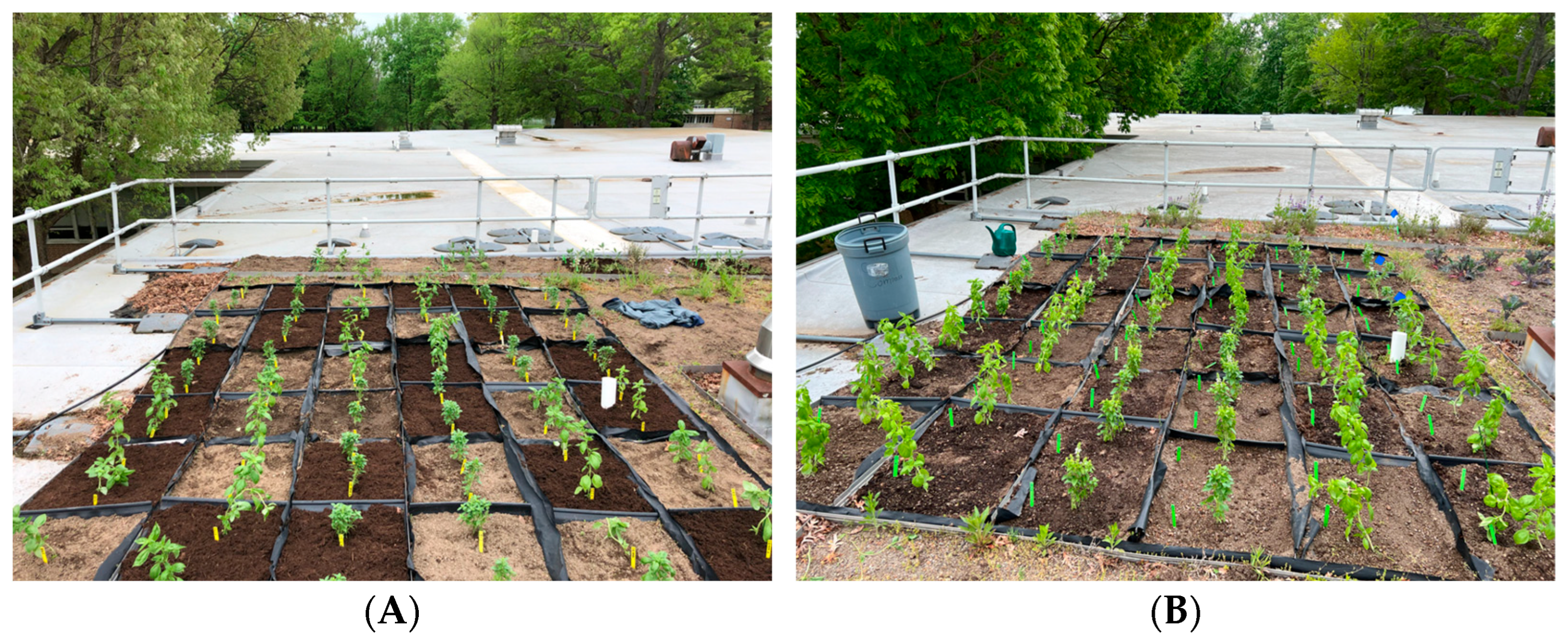
The basil experiment was set up as a split-plot treatment arrangement with 4 factors in a randomized complete block design (RCBD) with main plots being the two mulch treatments (no mulch or 2.5 cm layer of pine bark mulch), subplots were the two basil cultivars (‘Compact’ and ‘Italian Large Leaf’), the three hydrogel rates (0 g, 28 g, and 85 g per 0.3 m2) were the sub–subplots, and sub–sub–subplots were two irrigation frequencies (1 L applied weekly or bimonthly per plant). The 1 L of water applied represented about 13 mm of rainfall, and the application of 1 L of water weekly or bimonthly would provide the equivalent of 13 and 6.5 mm of rainfall per week, respectively. All watering regimes were supplemental to natural precipitation, which was minimal and erratic (~13 and 11 mm per week on average for 2022 and 2023, respectively) during the growing season (Table 1). The section of the green roof used in this experiment was divided into six rows with the 24 experimental units evaluated in two side-by-side rows (one replication); each experimental unit contained one basil plant and was spaced approximately 0.5 m within and between rows (Figure 1). Each treatment combination was replicated three times.

2.1.2. Treatment Materials and Application for Basil Experiment

The hydrogel used in this experiment was a polyacrylamide-based superabsorbent polymer (SoilMoist; 2–4 micron in size; JRM Chemical, Inc., Cleveland, OH, USA) that was incorporated into the green roof growing medium at the designated rate for each treatment. The specific hydrogel rate was thoroughly mixed into the medium to its full depth prior to planting to ensure uniform distribution within each experimental unit. The mulch used in this study was a locally sourced premium pine bark mulch (Burkdell Mulch, Carbondale, IL, USA) uniformly applied as a 2.5 cm layer over the medium. Irrigation was applied weekly to bimonthly by hand using a 1 L measuring beaker during the morning hours, depending on the specific treatment, as described previously. Water was applied directly to the base of each plant within the drip line to minimize water loss due to evaporation. ‘Compact’ and ‘Italian Large Leaf’ basil varieties were sourced from Livingston Seed Co. (Columbus, OH, USA) and started in a greenhouse in a peat-based mix (Berger BM1; Saint-Modeste, QC, Canada) eight weeks prior to transplanting.

2.1.3. Basil Fertilization

Plants were fertilized weekly with a 20-20-20 (N-P-K) liquid fertilizer (Jack’s; J.R. Peters Inc., Allentown, PA, USA) at a rate of 0.8 EC. Transplants were planted into the green roof medium on 5 May for each of 2022 and 2023 (Figure 1). Osmocote® slow-release fertilizer (14N-14P-14K; The Scotts Company, Marysville, OH, USA) was applied at a rate of 5 g per plant at the time of transplanting, with a second application provided to basil plants the last week of July. Additionally, Jack’s 20-20-20 liquid fertilizer was applied at a rate of 1.0 EC three times: at planting, early July, and early September.

2.1.4. Data Collection and Analysis for Basil Experiment

Plant growth vigor data was collected midway through the experiment on 26 July and again on 12 September for both 2022 and 2023. Basil plant vigor was rated on a scale of 1 to 3 = low (small plant stature, low amounts of leaf growth and obvious inhibited plant development), 4 to 6 = moderate (medium plant stature, more leaf growth than low rating, and adequate plant development), and 7 to 9 = high amounts of visible plant vigor (large plant stature, high amount of leaf growth and plant development). Fresh plant weights were collected directly after harvesting, while dry weights were collected after 2 months of drying in individual brown paper bags inside the SIU Horticultural Research Greenhouse. Additionally, plant height data were collected at the termination of each experiment on 5 May 2023 and 2024 after overwintering. All data were analyzed using analysis of variance (ANOVA) appropriate for a split-plot experimental design using the GLM procedure of SAS version 9.4. A mixed-model analysis was utilized with year as a random effect and treatments as fixed effects. A 4-factor split-plot ANOVA has distinct error terms for its factors, and in this experiment, mulch was tested by the whole-plot error, basil variety by the split-plot error, hydrogel by the split–split-plot error, and irrigation by the residual error. Means were compared using Fisher’s protected least significant difference (LSD) test at (p ≤ 0.05).

2.2. Perennial Herb Overwintering Evaluation

2.2.1. Perennial Herb Experimental Setup

This experiment was setup as a split-plot treatment arrangement in a randomized complete block design (RCBD) with main plots being the two mulch treatments (no mulch or 2.5 cm layer of pine bark mulch from identical source as basil experiment), subplots were the two irrigation frequencies (1 L weekly or bimonthly to each experimental unit growing area), sub–subplots were the two perennial herbs (sage and thyme), and the two hydrogel rates (0 and 85 g per 0.175 m2) were the sub–sub–subplots. Each experimental unit contained three plants that were spaced 23 cm apart both in-row and between rows, and replicated 3 times.

2.2.2. Experimental Treatments for Perennial Herb Experiment

Sage and thyme were the perennial herbs chosen due to their popularity in regional markets and their ability to survive hot, dry summers. Sage and thyme seed (Seed ‘N Such, Augusta, GA, USA) were started in a greenhouse in a peat-based mix (Berger BM1; Saint-Modeste, QC, Canada) eight weeks prior to transplanting. Hydrogels were applied at the rates of 0 and 85 g per experimental unit (or about 28 g/per plant for the three-plant growing area) and mixed into the medium uniformly prior to planting. Pine bark mulch was applied to a 2.5 cm depth once herbs were transplanted into the medium for those experimental units receiving this treatment. Water was delivered by hand to each experimental unit, either weekly or bimonthly, using a 1 L glass beaker.

2.2.3. Perennial Herb Fertilization

Plants were fertilized weekly with a 20-20-20 (N-P-K) liquid (as described earlier) at a rate of 0.8 EC. Transplants were planted on the green roof during early May in 2022 and 2023. Osmocote® (The Scotts Company, Marysville, OH, USA) slow-release fertilizer (14N-14P-14K) was applied at a rate of 5 g per plant at the time of transplanting, with a second application in late July each year.

2.2.4. Data Collection and Analysis for Perennial Herb Experiment

Plant growth vigor data were collected three times during the experiment: late July (2.5 months after planting), near the end of the growing season in late October, and then early May the following year to determine the influences of treatment combinations on overwintering. Overwinter survival of each perennial herb plant in each experimental unit (plant dead, did not survive overwinter = 0% survival rate, and plant survived with new growth = 100% survival rate). This ability of a plant to survive over the winter months after one season of growth was collected about a month after the plants had begun to grow and develop new leaves on 5 May 2023 and 2024. This was important to determine the ability of sage and thyme to persist through winter conditions on the rooftop based on specific treatment combinations. Additionally, plant heights were also recorded at experiment termination. All data were analyzed using analysis of variance (ANOVA) appropriate for a split-plot treatment arrangement in a randomized complete block design. A mixed-model analysis was utilized with year as a random effect and treatments as fixed effects. A 4-factor split-plot ANOVA has distinct error terms for its factors, and in this experiment, mulch was tested by the whole-plot error, irrigation by the split-plot error, perennial herb species by the split–split-plot error, and hydrogel by the residual error. Means were compared using Fisher’s protected least significant difference (LSD) test at (p ≤ 0.05).

3. Results

3.1. Basil Results

3.1.1. Analysis of Basil Data

All data were pooled, combining both years, and analyzed to determine if interactions existed among years and treatments, and among various treatments for the dependent variables collected. Year by treatment interactions and interactions among the various fixed factors evaluated (mulch, irrigation frequencies, basil variety, and hydrogel rates) for the dependent variables collected were generally not significant (p > 0.05). Therefore, data for both growing seasons were combined, with only treatment main effects presented (Table 2). This indicates that the various treatments evaluated (mulch, irrigation frequencies, perennial herbs, and hydrogel rates) all responded similarly regardless of the treatment combination or year.

3.1.2. Hydrogel Rates in Basil Experiment

Basil plant vigor and some growth characters were influenced by hydrogel rate (Table 2). Although the no hydrogel treatment did not differ (p > 0.05) from the low hydrogel rate for early season basil vigor, the high rate provided more early season vigor (~17% increase) than no hydrogel. Additionally, no differences (p > 0.05) were detected between the low and high hydrogel rates for early-season basil plant vigor. The high hydrogel rate improved late-season herb plant vigor by 16% and 10%, respectively, compared to the no or low hydrogel rate for late-season herb plant vigor. The no and low hydrogel did not differ (p > 0.05) for herb plant vigor at this timing. Although no differences were detected (p > 0.05) among hydrogel rates for basil fresh and dry weight, plant heights were improved (p ≤ 0.05) by hydrogel use, regardless of rate. Basil plant heights increased 42% and 32%, at the 28 and 85 g hydrogel rate, respectively, compared to no hydrogel.

3.1.3. Basil Experiment Irrigation Frequency

Although irrigation frequency did not influence (p > 0.05) basil plant vigor in the early season, water application did affect (p ≤ 0.05) late-season plant vigor and all growth characters (Table 2). When water was applied weekly compared to bimonthly, basil plant vigor during the late growing season was increased by 16%, while fresh and dry weight, and plant heights were improved 37%, 47%, and 26%, respectively. Thus, these results indicate that water application frequency is critical to maximize basil productivity in an extensive green roof environment. These results suggest that a limited water supply will sustain basil plants in an extensive green roof environment, but to maximize productivity, more than bimonthly water applications are required in this typically stressful, hot, and drought-prone environment.

3.1.4. Basil Variety

Basil varieties did not differ (p > 0.05) for plant vigor during both the early and late season (Table 2), although ‘Italian Large Leaf’ basil provided greater fresh and dry weight and plant heights compared to ‘Compact’ basil. The large leaf variety was substantially greater for all plant growth characteristics, with increases of 83%, 89%, and 167% for fresh weight, dry weight, and height, respectively, compared to the compact form.

3.1.5. Mulch Application in Basil Experiment

The use of an organic bark mulch improved plant vigor and all plant growth characteristics compared to no mulch (Table 2). The bark mulch provided early- and late-season basil plant vigor increases of 32% and 22%, respectively, compared to no mulch. Additionally, a 19%, 16%, and 16% increase for fresh weight, dry weight, and height, respectively, was observed with bark compared to no mulch.

3.2. Perennial Herb Results

3.2.1. Analysis of Perennial Herb Data

Perennial herb data collected for this experiment were combined over both growing seasons and analyzed to determine interaction significance among years and treatments, and among various treatments. The data analysis generally indicated no interactions (p > 0.05) between any treatment and year combination or among specific treatments for all dependent variables analyzed (mulch, irrigation frequencies, perennial herb type, and hydrogel rate). Therefore, data for both growing seasons were combined, with only treatment main effects presented (Table 3). The various treatments evaluated in this experiment (mulch, irrigation frequencies, perennial herbs, and hydrogel rates) all responded similarly regardless of the treatment combination or year.

3.2.2. Hydrogel Rates for Perennial Herb Experiment

Hydrogel application did not affect perennial herb vigor in the early or late season (Table 3). However, overwintered plant vigor assessed the following spring was significantly lower in the high hydrogel (28 g/per plant) treatment compared to the control, showing an approximately 22% reduction. Similarly, final plant height was greater in plots without hydrogel. Despite the negative impact on vigor, hydrogel application did not significantly affect overwinter survival rates, which ranged from 89% to 90% across treatments.

3.2.3. Perennial Herb Irrigation Frequency

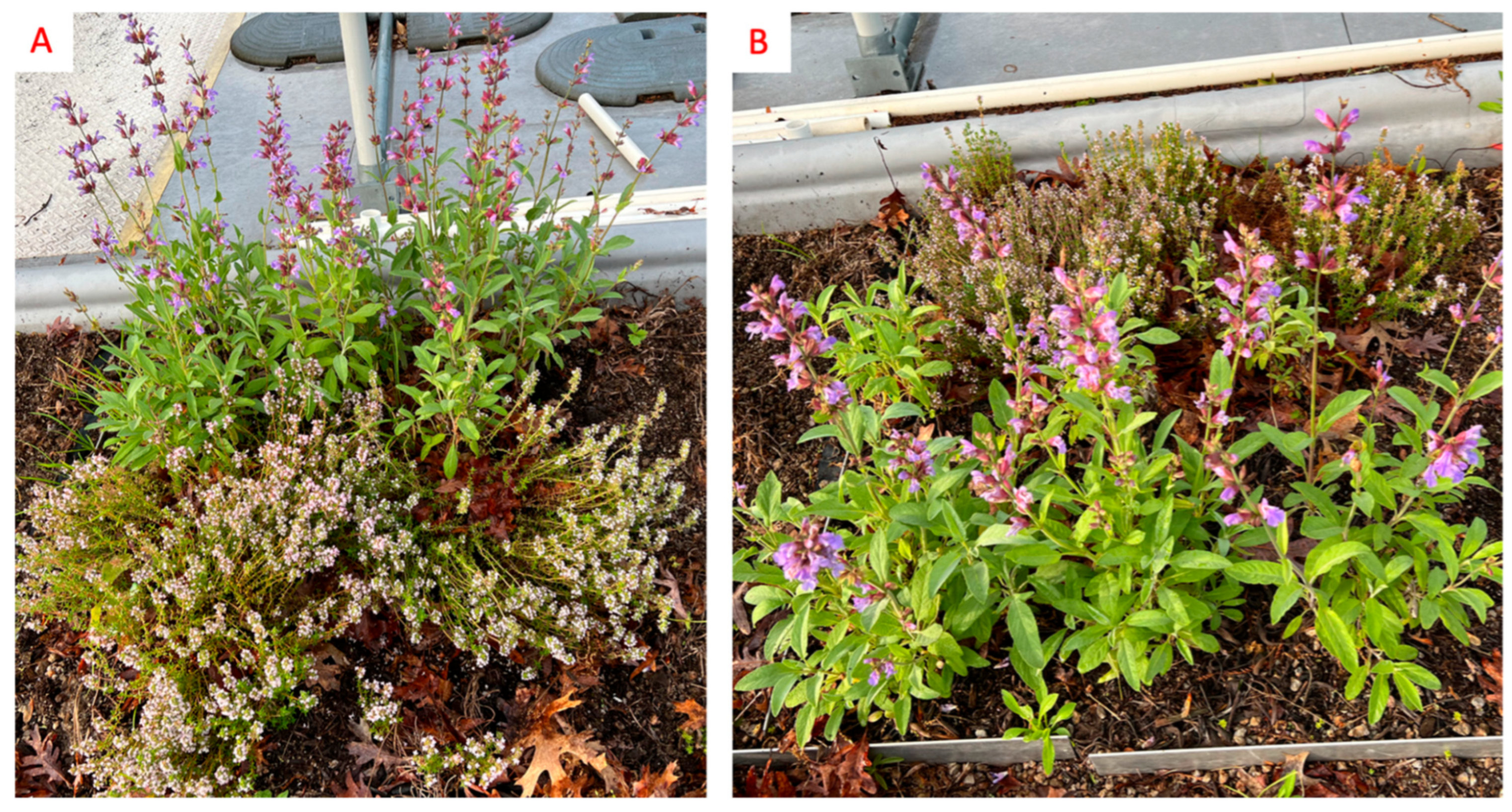
Irrigation frequency is important for perennial herbs produced in an extensive green roof environment (Table 3; Figure 2). Although irrigation frequency did not influence (p > 0.05) perennial herb overwintering survival or early-season plant vigor, water application did have an effect (p ≤ 0.05) on plant vigor observed in late-season, as well as that resulting from the following spring, once growth had begun again after overwintering. This was also confirmed by increases in plant heights by those that received increased water applications. Perennial plant vigor observed in late season and, once new growth had started the following spring, was 19% and 20% greater, respectively, in the weekly more frequent watering application compared to the less frequent bimonthly watering regime.

3.2.4. Perennial Herb Comparisons

Sage provided greater plant vigor at all timings evaluated and greater overwinter survival compared to thyme (Table 3). Although the growth habits are obviously different, with sage being a more robust plant having greater plant height than thyme (Figure 2), the initial growth and establishment of thyme was less, which put it at a marked disadvantage compared to sage. The plant vigor observed for sage compared to thyme was 32%, 23%, and 28% greater, respectively, during the early- and late-season the first year, andin May the following year after overwintering. Additionally, the overwintering rate for sage was 96%, which was 15% greater than that observed for thyme. From this experiment, sage appears to be a great choice for a perennial herb to utilize in an extensive green roof environment due to its high winter survival rate.

3.2.5. Mulch Application in Perennial Herb Experiment

The use of a bark mulch did not influence perennial herb plant vigor at any of the timings evaluated, plant heights at experiment termination, nor the overwintering survival rate (Table 3). Results indicated that the use of a mulch is most likely not warranted for these perennial herbs when grown in an extensive green roof environment. Surprisingly, although the green roof is a harsh environment both in the summer and winter months in our northern subtropical environment, the application of a mulch does not appear to provide any growth or overwintering advantage to sage or thyme.

4. Discussion

Our results describe potential challenges when growing herbs in an extensive green roof environment and underscore the complexity involved in green roof management decisions when producing edible crops. Culinary herb plant selections, irrigation intervals, mulch choices, and amending the medium with hydrogels will all alter the growing conditions that affect the growth and development of these plants produced in this environment. Therefore, understanding the effects of their use in combination with each other will help develop best management practices that will lead to improved outcomes for edible crop green roof installations.

4.1. Hydrogel Use in Extensive Green Roof Mediums

This study indicated a diminishing return for hydrogel application rates in an extensive green roof medium. This trend reflects the findings of existing hydrogel research [29,31,32,33]. The lower application rate evaluated would be best based on our findings, as minimal or no improvements to annual or perennial herb plant vigor were generally observed at the higher rate (Table 2 and Table 3). The only exception was perennial herb overwintered vigor and plant heights that were reduced by 22% and 16%, respectively, the following spring at the high rate compared to no hydrogel (Table 3).
Basil is an annual that is harvested during its vegetative form, prior to or just at flower initiation, coinciding with the early-season timeframe for plant vigor collected in this study. Thus, the higher rate would not be justified for use in basil production, since it had similar plant vigor results to the low rate (Table 2). Additionally, the low hydrogel rate was comparable to the higher rate for all the basil plant growth characteristics. Although there was a reduction in late-season basil plant vigor for the low hydrogel rate, plant weights and height were comparable between the two hydrogel rates (28 and 85 g). These results indicate the 28 g application rate would be better than the high rate for basil based upon our study conditions. Additionally, basil fresh and dry weight from no hydrogel was also comparable to the hydrogel rates used, with only heights being improved with hydrogel use. Therefore, the only benefit to adding hydrogel to an extensive green roof medium would be to increase basil plant height, but this is only beneficial when the additional height contributes to aesthetic value, yield, or harvestability. A shorter and more robust plant stature would be preferred to resist extreme wind and rain events that are common on rooftops [34]. Furthermore, due to the shallow root medium depth in an extensive green roof, a lower shoot-to-root ratio is preferred to avoid uprooting plants. Since substrate depth is generally a limiting factor for plant growth in extensive green roofs, larger plants will have greater water needs than shorter-statured plants, and the water availability within the limited substrate depth can reduce survivability during low moisture or drought periods.
Hydrogel rate influenced overwintered perennial herb plant vigor and plant heights the following spring after planting, but all other parameters, including early- and late-season vigor and percent overwinter survival, remained similar between none or high rate (Table 3). This influence on early spring perennial herb plant vigor and plant heights once growth resumed after overwintering was probably due to the high hydrogel rate absorbing moisture and pushing roots of these plants out of the medium during the winter months, which exposed them to below freezing temperatures during the dormancy period. Hydrogel use caused extensive medium heaving, probably causing root damage from low temperatures and drying during the cold winter season. However, overall survival at a high rate did not differ (p > 0.05) from no hydrogel through two winters (Table 3), but the vigor may not persist in longer-term plantings. The reduction in plant vigor would most likely lead to significant losses in subsequent growing seasons. Most importantly, hydrogel application in the low water treatment did not make up for the water deficit (Figure 2).
Higher hydrogel application rates are more costly than lower rates and carry with them the possibility of negative environmental effects and less plant productivity. Since polymers were first used as soil amendments to grow crops, material cost and degradation were the primary prohibitive disadvantages for their use [35]. Degradation due to negative interactions with fertilizer salts, specifically multivalent ions of calcium, magnesium, and iron, has been shown to interfere with the ability of the hydrogels to attract water molecules and expand [36,37]. This interaction is one possible explanation for the diminishing returns for plant productivity observed with hydrogels in this study and should be an important research focus going forward for using super absorbent polymers in green roofs or other applications.
The degradation of hydrogels from other interactions, such as light, heat, microorganisms, and mechanical forces, represents notable challenges to the long-term adoption of this technology by the green roof industry [36]. Light exposure generates free radicals (hydroxyl radicals) that can break chemical bonds within the hydrogel polymer’s main chain, which can lead to a reduction in water absorption. However, photons resulting from light exposure do not generally penetrate substrate mediums to the depths hydrogels are placed. However, observations made during this study indicate that the possible swelling of the hydrogels can cause them to migrate out of the medium and accumulate on the surface, resulting in exposure to light. Additionally, biodegradation of hydrogel can occur by microorganisms using the amide group of the polymer as a nitrogen source, as well as the carbon backbone, as a source for carbon [26,38]. This interaction is of less concern for extensive green roof mediums, due to the generally low microbial activity and reduced organic material. Mechanical degradation of hydrogels can result from the low shearing force required to fragment the gel. This mechanical degradation is concerning for green roofs, as the expanded clay aggregate that makes up the bulk of most substrates remains rigid and unforgiving to surface abrasions of individual gel fragments from constant swelling and loss of water. Thus, hydrogels can have applications on green roofs for water management, although it depends on the situation and crop(s) being grown. Based on our own and others’ research, it is also important to note that lower hydrogel rates generally provide more consistent results.

4.2. Irrigation and Growing Edibles in Extensive Green Roof Environments

Both annual and perennial herbs can be adequately produced on extensive green roofs in our northern subtropical environment. Although the overall water demand for fast-growing herbaceous annuals, like basil, has a strong correlation between watering frequency and total yield [39,40], twice the amount of water applied did not equate to double the yield (Table 2). While the higher water frequency gave better overall production for basil fresh and dry weight, the lower water frequency produced adequate yield and vigor with a significant reduction in total water usage. Basil requires significant amounts of moisture to effectively grow and develop properly in an extensive green roof environment. Additionally, the perennial culinary herbs followed a similar trend. Although higher amounts of plant vigor were detected (p ≤ 0.05) for the weekly water application during late-season and the following spring, adequate amounts of vigor could be achieved with bimonthly applications (Table 3; Figure 2).
Moisture applications are essential for herbs grown in an extensive green roof environment [12,20]. For overall plant vigor, weekly application generally provided a growth response advantage compared to the bimonthly application (Table 2 and Table 3). Results also indicated that perennial culinary herbs are generally more drought-tolerant once established, but we observed that more consistent watering is required initially to get these plants started in the green roof medium, and applying water weekly once they are transplanted can be detrimental to their establishment on an extensive green roof. Perennial herbs typically are more tolerant of drought stress and often benefit from less water retention in their tissues to have a greater culinary quality [41,42,43]. Culinary annual and perennial herb crops like basil, sage, and thyme can be adequately produced in the harsh, hot, dry summer environments of extensive green roofs with limited water applications. Water is critical to maintain effective crop production in an extensive green roof environment, and any cultural management treatment that can be used to improve soil moisture will most likely increase productivity [44].

4.3. Basil and Perennial Culinary Herbs Grown in Extensive Green Roof Environments

The type of herb and oftentimes the specific variety play a major role in the success of culinary herbs grown in an extensive green roof environment. For example, the large leaf basil variety provided marginally better vigor in this system, and yields were significantly better than the compact variety (Table 2). Large leaf varieties are generally preferred and more marketable for fresh markets. In comparison, the compact basil variety used in our study has a smaller stature and growth habit, and a higher ornamental value due to its more rounded growth habit and overall appearance with smaller leaves. Additionally, the small shrub-type growth habit of ‘Compact’ basil is more conducive to the harsh environments of green roofs. Based on our observations, small leaf varieties tend to flower earlier in the season than those with larger leaves, which can be an important aspect when trying to attract insect pollinators. However, for a crop like basil that is harvested throughout the season for its stems and leaves, foliar biomass is paramount, and a taller plant producing greater marketable yield is generally desirable.
Perennial culinary herbs also differ morphologically and in their growth habit within our northern subtropical environment. Sage was a more upright and woody plant with a larger leaf surface and a more rapid growth rate, compared to thyme, which has very tiny leaves, grows much lower to the medium surface, at a slower rate, and has smaller, fine roots with a delicate structure. Both the vigor and survival rate indicate that thyme did not grow as well in this environment compared to sage (Table 3). The survival rate of thyme was also acceptable at 82%, but compared to sage, this culinary herb was observed to have a less extensive root system in the shallow green roof medium, which most likely made it more susceptible to cold injury during winter and drought conditions in summer.
With performance differences aside, both thyme and sage have flowers that attract beneficial insects and pollinators. Thyme may be considered as a ground cover and could serve this purpose as a companion planting option for green roof applications. Sage established very quickly in an extensive green roof environment and performed well during the first growing season for new growth, productivity, and flowering. White, dainty flowers appeared on thyme plants earlier in the spring, once established, while sage flowered later in the growing season and had prominent dark lavender flowers. Although both provided distinct and outstanding floral characteristics that attracted a wide range of pollinators, sage was more striking in this green roof environment (Figure 2).
The type of herb, growth habit, and variety grown are all important considerations when growing in extensive green roof environments. Some edible culinary herbs are more adaptable to green roof production systems due to their minimal water use requirements compared to others (20). Those culinary herbs (and varieties) most suited to extensive green roof production should be determined in further evaluations to identify those most suitable for this harsh, mostly dry growing environment [12]. However, multiple plant species having some level of drought tolerance should be utilized to improve green roof biodiversity through the development of more diverse plant communities [45].

4.4. Mulch Applications in Extensive Green Roof Environments

Although there were pronounced benefits when using mulch in the basil experiment (Table 2), no differences (p > 0.05) were observed for any collected parameters in the culinary perennial herb experiment (Table 3). Thus, due to the increased overall water demand for herbaceous annuals, such as basil, during stressful conditions, mulch could prove more beneficial in extensive green roof applications. However, it is also important to note that the use of organic mulches can increase the weight load on roofs, and specific engineering specifications for load-bearing weight should be considered prior to their use [44]. Additionally, mulch has been shown to increase green roof runoff pollution, and the far-reaching implications of these and other organic material additions onto green roofs to the surrounding ecosystems should be considered [27]. The potential overall improvements in basil plant vigor and growth from mulch additions in our study may have also resulted from the additive influences of several factors, including potential improvements in nutrient holding and cation exchange capacity, organic matter content, residual nitrogen, as well as other influences of the mulch itself that may not be specifically related to water retention through less moisture evaporation. Additionally, compost additions to extensive or semi-intensive green roofs resulted in less water consumption without restriction of plant growth during the initial plant establishment phase or the first drought period for several aromatic herbs [19]. While we did not observe a detriment from the application of pine bark mulch with any of the herbs evaluated, there was no benefit for use with perennial culinary herbs (Table 3). Compared to basil, a fast-growing herbaceous annual that did benefit from the addition of mulch, the sage and thyme plant vigor or survival rate did not improve with organic mulch additions.

4.5. Cost–Benefit Analysis of Management Practices for Culinary Herbs in Extensive Green Roof Environments

Some green roof management practices provided a greater return on investment for culinary herb productivity than others in this study. Specific cultural practices utilized in green roof agriculture can provide differing cost-to-benefit estimates, with some providing greater economic feasibility for crop growth in this environment. Hydrogels generally provided no or limited plant growth gains with costs exceeding benefits, while the benefits of organic mulches depended on the culinary herb species used. In comparison, herb plant species or variety selection and water applications were worth the costs incurred, since they provided a higher benefit than hydrogels or organic mulches to improve culinary herb crop productivity in an extensive green roof environment.
Hydrogels are used to improve the water-holding capacity of a growth medium and slowly release moisture to plants, which should, in theory, reduce water applications [21,22,24]. However, in this study, hydrogel use did not generally provide a significant, consistent growth benefit for the herbs evaluated in this study. So, their cost exceeded the potential benefits, and it is thus not recommended for this application. In comparison, the economic feasibility of organic mulches depended on the herb species evaluated, with benefits exceeding costs for basil to improve yield and revenue generation, but not for the perennial culinary herbs, sage and thyme. Moisture applications are essential to maximize productivity for culinary herbs grown in an extensive green roof environment, and supplemental water applications increase yield and crop value, directly relating to a high benefit compared to the costs incurred. Hand-watering is probably not the most feasible way to irrigate extensive green roofs, but drip irrigation would significantly boost net returns in this environment. Lastly, the herb species or variety selected played a large role in crop productivity and potential revenues, with ‘Italian Large Leaf’ basil having a greater potential to increase revenues than ‘Compact’. Additionally, sage provided greater yields than thyme in our extensive green roof environment. These examples show the importance of specific cultural practices on potential revenue generation or loss for annual and perennial herbs in an extensive green roof environment.

5. Conclusions

Several management practices to improve the extensive green roof medium soil moisture content were evaluated on the productivity of annual and perennial culinary herbs. Watering frequency was the most critical factor evaluated to maintain soil moisture in an extensive medium for herb growth. Plant species and varieties were a conditional factor, while hydrogels and organic mulches provided limited benefit. The type of culinary herb or variety selected can play a critical role in effectively growing these crops on a green roof. Our study further indicated that hydrogel use as medium amendments, specific irrigation intervals, and mulch choices often alter the growing conditions that affect the growth and development of these edibles produced in this environment. Therefore, understanding the effects of their use in combination with each other will help develop best management practices that will lead to improved outcomes for edible crop green roof installations. Drought is a limiting factor in extensive green roof production systems due to the shallow medium substrate depths having limited moisture-holding capacity, and supplemental irrigation is thus critical for culinary herbs produced in extensive green roof systems to provide the consistent moisture required to maximize productivity. The herbaceous annual and perennial culinary herbs utilized in this study responded in different ways to the cultural management practices utilized, although consistent water use was most important to their survival and growth. Suggestions for future directions to improve the growth of edibles in extensive green roof environments should include evaluation of novel mediums with increased water-holding capacities, matching water applications specifically to plant needs, and selection of edible species that grow best in this environment. To fully realize the potential benefit of green roof agriculture in urban food systems, further research is needed to identify more practical solutions for food production in these environments.

Author Contributions

Conceptualization, S.A.W.; formal analysis, H.M.C. and S.A.W.; investigation, H.M.C.; resources, S.A.W.; data curation, H.M.C.; writing—original draft preparation, H.M.C. and S.A.W.; writing—review and editing, S.A.W.; supervision, S.A.W.; project administration, S.A.W. All authors have read and agreed to the published version of the manuscript.

Funding

This research received no external funding.

Data Availability Statement

The original contributions presented in this study are included in the article. Further inquiries can be directed to the corresponding author.

Acknowledgments

The College of Agriculture, Life and Physical Sciences, School of Forestry and Horticulture, and Southern Illinois University-Carbondale should all be recognized for their continued support of the campus green roof and for providing monetary support for assistantships that directly allowed for the completion of this project.

Conflicts of Interest

The authors declare no conflicts of interest.

References

  1. Merino-Saum, A.; Halla, P.; Superti, V.; Boesch, A.; Binder, C.R. Indicators for urban sustainability: Key lessons from a systematic analysis of 67 measurement initiatives. Ecol. Indic. 2020, 119, 106879. [Google Scholar] [CrossRef] [Scilit]
  2. Lepp, N. Planting Green Roofs and Living Walls. J. Environ. Qual. 2008, 37, 2408. [Google Scholar] [CrossRef] [Scilit]
  3. Manso, M.; Teotónio, I.; Silva, C.M.; Cruz, C.O. Green roof and green wall benefits and costs: A review of the quantitative evidence. Renew. Sustain. Energy Rev. 2021, 135, 110111. [Google Scholar] [CrossRef] [Scilit]
  4. Getter, K.L.; Rowe, D.B. The role of extensive green roofs in sustainable development. HortScience 2006, 41, 1276–1285. [Google Scholar] [CrossRef] [Scilit]
  5. Stovin, V.; Vesuviano, G.; Kasmin, H. The hydrological performance of a green roof test bed under UK climatic conditions. J. Hydrol. 2012, 414–415, 148–161. [Google Scholar] [CrossRef] [Scilit]
  6. Vanuytrecht, E.; Van Mechelen, C.; Van Meerbeek, K.; Willems, P.; Hermy, M.; Raes, D. Runoff and vegetation stress of green roofs under different climate change scenarios. Landsc. Urban Plan. 2014, 122, 68–77. [Google Scholar] [CrossRef] [Scilit]
  7. Susca, T.; Gaffin, S.R.; Dell ‘Osso, G.R. Positive effects of vegetation: Urban heat island and green roofs. Environ. Pollut. 2011, 159, 2119–2126. [Google Scholar] [CrossRef] [Scilit]
  8. Jacobs, J.; Beenaerts, N.; Artois, T. Green roofs and pollinators, useful green spots for some wild bee species (Hymenoptera: Anthophila), but not so much for hoverflies (Diptera: Syrphidae). Sci. Rep. 2023, 13, 1449. [Google Scholar] [CrossRef] [Scilit]
  9. Wood, E.; Harsant, A.; Dallimer, M.; de Chavez, C.A.; McEachan, R.R.C.; Hassall, C. Not all green space is created equal: Biodiversity predicts psychological restorative benefits from urban green space. Front. Psychol. 2018, 9, 2320. [Google Scholar] [CrossRef] [Scilit]
  10. Vanstockem, J.; Vranken, L.; Bleys, B.; Somers, B.; Hermy, M. Do looks matter? A case study on extensive green roofs using discrete choice experiments. Sustainability 2018, 10, 309. [Google Scholar] [CrossRef] [Scilit]
  11. Bovin, M.-A.; Lamy, M.-P.; Gosselin, A.; Dansereau, B. Effect of artificial substrate depth on freezing injury of six herbaceous perennials grown in a green roof system. HortTechnology 2001, 11, 409–412. [Google Scholar] [CrossRef] [Scilit]
  12. Walters, S.A.; Gajewski, C.; Sadeghpour, A.; Groninger, J.W. Mitigation of climate change for urban agriculture: Water management of culinary herbs grown in an extensive green roof environment. Climate 2022, 10, 180. [Google Scholar] [CrossRef] [Scilit]
  13. Nagase, A.; Dunnett, N. Drought tolerance in different vegetation types for extensive green roofs: Effects of watering and diversity. Landsc. Urban Plann. 2010, 97, 318–327. [Google Scholar] [CrossRef] [Scilit]
  14. Sherk, J.T.; Fu, W.; Neal, J.C. Site conditions, maintenance costs, and plant performance of 10 extensive green roofs in the research triangle area of Central North Carolina. HortTechnology 2020, 30, 761–769. [Google Scholar] [CrossRef] [Scilit]
  15. Ampim, P.A.; Sloan, J.J.; Cabrera, R.I.; Harp, D.A.; Jaber, F.H. Green roof growing substrates: Types, ingredients, composition and properties. J. Environ. Hortic. 2010, 28, 244–252. [Google Scholar] [CrossRef] [Scilit]
  16. Arabi, R.; Shahidan, M.F.; Kamal, M.; Ja’afar, M.F.Z.B.; Rakhshandehroo, M. Considerations for plant selection in green roofs. Univ. Putra Malaysia. Alam Cipta 2015, 8, 10–17. Available online: https://files01.core.ac.uk/download/pdf/153821903.pdf (accessed on 22 January 2026).
  17. Simmons, M.T. Climates and microclimates: Challenges for extensive green roof design in hot climates. In Green Roof Ecosystems, Ecological Studies; Sutton, R., Ed.; Springer International Publishing: Cham, Switzerland, 2015; Volume 223, pp. 63–80. Available online: https://link.springer.com/chapter/10.1007/978-3-319-14983-7_3 (accessed on 3 January 2026).
  18. Ahmed, S.; Buckley, S.; Stratton, A.E.; Asefaha, F.; Butler, C.; Reynolds, M.; Orians, C. Sedum groundcover variably enhances performance and phenolic concentrations of perennial culinary herbs in an urban edible green roof. Agroecol. Sustain. Food Syst. 2017, 41, 487–504. [Google Scholar] [CrossRef] [Scilit]
  19. Papafotiou, M.; Pergialioti, N.; Tassoula, L.; Massas, I.; Kargas, G. Growth of native aromatic xerophytes in an extensive Mediterranean green roof as affected by substrate type and depth and irrigation frequency. HortScience 2013, 48, 1327–1333. [Google Scholar] [CrossRef] [Scilit]
  20. Kokkinou, I.; Ntoulas, N.; Nektarios, P.A.; Varela, D. Response of native aromatic and medicinal plant species to water stress on adaptive green roof systems. HortScience 2016, 51, 608–614. [Google Scholar] [CrossRef] [Scilit]
  21. Yang, M.; Wu, P.; Graham, G.; Lin, J.; Huang, M. Hotspots, Frontiers, and Emerging Trends of Superabsorbent Polymer Research: A Comprehensive Review. Front. Chem. 2021, 9, 688127. [Google Scholar] [CrossRef] [Scilit]
  22. Abobatta, W. Impact of hydrogel polymer in agricultural sector. Adv. Agric. Environ. Sci. Open Access 2018, 1, 59–64. [Google Scholar] [CrossRef] [Scilit]
  23. Letey, J.; Clark, P.R.; Amrhein, C. Water-sorbing polymers do not conserve water. Calif. Agric. 1992, 46, 9–10. [Google Scholar] [CrossRef] [Scilit]
  24. Orzolek, M.D. Use of Hydrophylic Polymers in Horticulture. HortTechnology 1993, 3, 41–44. [Google Scholar] [CrossRef] [Scilit]
  25. Keever, G.; Cobb, G.; Stephenson, J.; Foster, W. Effect of hydrophylic polymer amendment on growth of container grown landscape plants. J. Environ. Hort. 1989, 7, 52–56. [Google Scholar] [CrossRef] [Scilit]
  26. Rydlová, J.; Püschel, D. Arbuscular mycorrhiza, but not hydrogel, alleviates drought stress of ornamental plants in peat-based substrate. Appl. Soil Ecol. 2020, 146, 103394. [Google Scholar] [CrossRef] [Scilit]
  27. Whittinghill, L.J.; Rowe, D.B.; Ngouajio, M.; Cregg, B.M. Evaluation of nutrient management and mulching strategies for vegetable production on an extensive green roof. Agroecol. Sustain. Food Syst. 2016, 40, 297–318. [Google Scholar] [CrossRef] [Scilit]
  28. Ju, J.-H.; Yoon, Y.-H. Effect of organic matter ratios in substrate and mulching materials on growth of Liatris spicata under non-irrigated green roofs. J. Korean Inst. Landsc. Archit. 2012, 40, 130–137. [Google Scholar] [CrossRef] [Scilit]
  29. Ju, J.H.; Xu, H.; Yeum, K.J.; Yoon, Y.H. Effects of Hydrophilic Polymer on the Survival, Growth, and Flowering Characteristics of Pineapple Sage (Salvia elegans) in Unirrigated Green Roofs. Appl. Ecol. Environ. Res. 2020, 18, 3887–3896. Available online: https://www.aloki.hu/pdf/1803_38873896.pdf (accessed on 22 January 2026). [CrossRef] [Scilit]
  30. Ouellette, N.A.; Walters, S.A.; Midden, K.S. Fertility management for tomato production on an extensive green roof. J. Living Archit. 2013, 1, 1–14. Available online: https://static1.squarespace.com/static/5feb6d2cab06677bba637eba/t/606c78ccca4a5871abf8b8d8/1617721548204/JLIV2013Volume1_Issue1-Ouellette_etal.pdf (accessed on 22 January 2026). [CrossRef] [Scilit]
  31. El-Dewiny, C. Water and fertilizer use efficiency by squash grown under stress on sandy soil treated with acrylamide hydrogels. J. Appl. Sci. 2011, 7, 1828–1833. Available online: https://www.aensiweb.com/old/jasr/jasr/2011/1828-1833.pdf (accessed on 22 January 2026).
  32. Crous, J.W. Use of hydrogels in the planting of industrial wood plantations. South. For. A J. For. Sci. 2017, 79, 197–213. [Google Scholar] [CrossRef] [Scilit]
  33. Deska, I.; Mrowiec, M.; Ociepa, E.; Lewandowska, A. Influence of the hydrogel amendment on the water retention capacity of extensive green roof models. J. Ecol. Eng. 2020, 21, 195–204. [Google Scholar] [CrossRef] [Scilit]
  34. Schneider, A.; Landis, M.; Bousselot, J. Observations on the survival capacity of 118 plant taxa on a green roof in a semi-arid climate: 12-year update. J. Living Archit. 2021, 8, 19–40. [Google Scholar] [CrossRef] [Scilit]
  35. Hedrick, R.M.; Mowry, D.T. Effect of synthetic polyelectrolytes on aggregation, aeration, and water relationships of soil. Soil Sci. 1952, 73, 427–442. Available online: https://journals.lww.com/soilsci/citation/1952/06000/effect_of_synthetic_polyelectrolytes_on.3.aspx (accessed on 22 January 2026). [CrossRef] [Scilit]
  36. Bowman, D.C.; Evans, R.Y. Calcium inhibition of polyacrylamide gel hydration is partially reversible by potassium. HortScience 1991, 26, 1063–1065. [Google Scholar] [CrossRef] [Scilit]
  37. Bowman, D.C.; Evans, R.Y.; Paul, J.L. Fertilizer salts reduce hydration of polyacrylamide gels and affect physical properties of gel-amended container media. J. Amer. Soc. Hort. Sci. 1990, 115, 382–386. [Google Scholar] [CrossRef] [Scilit]
  38. Xiong, B.; Loss, R.D.; Shields, D.; Pawlik, T.; Hochreiter, R.; Zydney, A.L.; Kumar, M. Polyacrylamide degradation and its implications in environmental systems. npj Clean Water 2018, 1, 17. [Google Scholar] [CrossRef] [Scilit]
  39. Nam, S.; Kang, S.; Kim, J. Maintaining a constant soil moisture level can enhance the growth and phenolic content of sweet basil better than fluctuating irrigation. Agric. Water Manag. 2020, 238, 106203. [Google Scholar] [CrossRef] [Scilit]
  40. Goldani, M.; Bannayan, M.; Yaghoubi, F. Crop water productivity and yield response of two greenhouse basil (Ocimum basilicum L.) cultivars to deficit irrigation. Water Supply 2021, 21, 3735–3751. [Google Scholar] [CrossRef] [Scilit]
  41. Bettaieb, I.; Hamrouni-Sellami, I.; Bourgou, S.; Limam, F.; Marzouk, B. Drought effects on polyphenol composition and antioxidant activities in aerial parts of Salvia officinalis L. Acta Physiol. Plant. 2001, 33, 1103–1111. [Google Scholar] [CrossRef] [Scilit]
  42. Ozturk, A.; Unlukara, A.; Ipek, A.; Gurbez, B. Effects of salt stress and water deficit on plant growth and essential oil content of lemon balm (Melissa officinalis L.). Pak. J. Bot. 2004, 36, 787–792. Available online: https://www.pakbs.org/pjbot/PDFs/36(4)/PJB36(4)787.pdf (accessed on 22 January 2026).
  43. Bettaieb, I.; Zakhama, N.; Aidi Wannes, W.; Kehouk, M.E.; Marzouk, B. Water deficit effects on Salvia officinalis fatty acids and essential oils composition. Sci. Hort. 2009, 120, 271–275. [Google Scholar] [CrossRef] [Scilit]
  44. Walters, S.A.; Midden, K.S. Sustainability of urban agriculture: Vegetable production on green roofs. Agriculture 2018, 8, 168. [Google Scholar] [CrossRef] [Scilit]
  45. Van Mechelen, C.; Dutoit, T.; Hermy, M. Vegetation development on different extensive green roof types in a Mediterranean and temperate maritime climate. Ecol. Eng. 2015, 82, 571–582. [Google Scholar] [CrossRef] [Scilit]
Figure 1. Green roof basil planting 5 May for each 2022 (A) and 2023 (B), with one basil plant grown in each experimental unit.
Horticulturae 12 00145 g001
Figure 2. Representative images of sage and thyme plants on 5 May 2023, following overwintering. (A) Plants that received weekly irrigation during the previous growing season. (B) Plants that received bi-weekly irrigation during the previous growing season.
Horticulturae 12 00145 g002
Table 1. Monthly meteorological data for the Southern Illinois University green roof in Carbondale, IL, USA, from May to October for each 2022 and 2023 growing seasons.
Year and MonthMaximum Temp °C Minimum Temp °CAverage Temp °CAverage Dewpoint Temp °CPrecipitation (mm)Max Wind Speed (kg/h)Average Wind Speed (kg/h)
2022
May37627241196013
June3710312617529
July3717302814429
August3313282666327
September370282518296
October27−62218264811
2023
May3262522662310
June391031263209
July3614272650268
August3712312869217
September329272416206
October31−32320822210
Meteorological data obtained for Carbondale, IL, USA, from Weather Underground (wunderground.com; accessed on 10 December 2025).
Table 2. Influence of hydrogel rate, irrigation frequency, basil variety, and mulch, and hydrogel rate on resulting plant growth vigor and yield parameters over the 2022 and 2023 growing seasons on the Southern Illinois University-Carbondale green roof.
Plant Vigor (Growth)Plant Yield Characters
Main Effect
Treatments
Early SeasonLate SeasonPlant Fresh
wt (g)
Plant Dry
wt (g)
Plant Height (cm)
Hydrogel
None4.7 b3.7 b101.5 a39.3 a44.7 b
Low rate (28 g)5.3 ab3.9 b107.1 a43.7 a63.6 a
High rate (85 g)5.5 a4.3 a110.6 a44.9 a58.9 a
Irrigation
frequency
Weekly5.3 a4.3 a123.4 a50.4 a62.2 a
Bimonthly4.9 a3.7 b90.1 b34.6 b49.4 b
Basil variety
Compact4.9 a3.8 a75.4 b29.4 b30.4 b
Italian large leaf5.3 a4.2 a138.0 a55.5 a81.1 a
Mulch
None4.4 b3.6 b97.7 b39.3 b51.6 b
Bark mulch5.8 a4.4 a115.8 a45.7 a59.6 a
Plant vigor data was collected two times: 26 July 2022 and 2023 and 13 September 2022 and 2023. Plant vigor was rated on a scale of 1 to 3 = low, 4 to 6 = moderate, and 7 to 9 = high amounts of plant vigor (based on plant growth responses). Plant fresh and dry weights, and plant heights were collected at experiment termination each year. The data presented are means of three replicates. Means within a column followed by the same letter do not differ significantly according to Fisher’s protected LSD, p > 0.05.
Table 3. Perennial herb winter survival, growth, and vigor ratings on the Southern Illinois University-Carbondale green roof as influenced by irrigation interval, mulch, and hydrogel rate, combined over all growing seasons.
Plant Vigor (Growth)Survival RatePlant
Growth
Character
Ain Effect TreatmentsEarly SeasonLate SeasonOverwinteredOverwintered (%)Plant Height (cm)
Hydrogel
None5.6 a5.2 a4.9 a89.9 a26.3 a
High Rate (85 g)5.3 a5.4 a4.0 b88.9 a22.9 b
Water
Weekly5.7 a5.7 a4.8 a87.9 a27.6 a
Bimonthly5.3 a4.8 b4.0 b91.2 a21.6 b
Crop Type
Sage6.2 a5.8 a5.0 a96.3 a30.8 a
Thyme4.7 b4.7 b3.9 b81.7 b18.4 b
Mulch
None5.3 a5.3 a4.1 a89.4 a23.9 a
Bark Mulch5.7 a5.3 a4.8 a89.4 a25.3 a
Plant vigor data was collected two times for each 2022 and 2023: 26 July (early season), 13 September (late season), and 5 May 2023 and 2024 (after overwintering). Plant height data were collected at the termination of each experiment on 5 May 2023 and 2024 once plants had overwintered. Plant vigor was rated on a scale of 1 to 3 = low, 4 to 6 = moderate, and 7 to 9 = high amounts of plant vigor. Data presented are the means of three replicates. Means within a column followed by the same letter do not differ significantly according to Fisher’s protected LSD, p > 0.05.
Disclaimer/Publisher’s Note: The statements, opinions and data contained in all publications are solely those of the individual author(s) and contributor(s) and not of MDPI and/or the editor(s). MDPI and/or the editor(s) disclaim responsibility for any injury to people or property resulting from any ideas, methods, instructions or products referred to in the content.