Article

Revealing the Environmental Factors That Influence the Leaf Biochemistry and Total Antioxidant Activity of Prunus laurocerasus L.

1
Faculty of Science, Department of Biology, Kastamonu University, 37150 Kastamonu, Türkiye
2
Faculty of Forestry, Department of Forest Engineering, Kastamonu University, 37150 Kastamonu, Türkiye
3
Institute of Science, Erzincan Binali Yıldırım University, 24100 Erzincan, Türkiye
4
Erzincan Horticultural Research Institute, Republic of Turkey Ministry of Agriculture and Forestry, 24060 Erzincan, Türkiye
*
Author to whom correspondence should be addressed.
Horticulturae 2025, 11(11), 1403; https://doi.org/10.3390/horticulturae11111403
Submission received: 17 October 2025 / Revised: 18 November 2025 / Accepted: 19 November 2025 / Published: 20 November 2025
(This article belongs to the Special Issue Regulation of Flowering and Development in Ornamental Plants)

Abstract

Understanding the seasonal dynamics of phytochemical composition in evergreen species is crucial for improving ecosystem productivity models and selecting appropriate species for urban landscapes under changing climate conditions. However, knowledge about how light environment, temperature, and precipitation interact to regulate leaf biochemical processes across seasons remains limited. We investigated morphological and biochemical responses of cherry laurel (Prunus laurocerasus L.) grown under contrasting light environments (light-exposed versus shaded) across twelve months, analyzing photosynthetic pigments, antioxidants, osmolytes, and secondary metabolites in relation to environmental variables. Light-exposed leaves exhibited enhanced accumulation of photoprotective compounds, including carotenoids (9.38 mg g−1), xanthophylls (3.60 mg g−1), and flavonoids (0.51 mg g−1), along with superior total antioxidant capacity during spring and autumn. Proline showed bimodal seasonal peaks (93.7 µmol g−1 in August under shade, 71.1 µmol g−1 in July under light), indicating stress responses to both summer heat and winter cold. Multivariate analyses revealed that seasonal variation accounted for 94.9% of total phytochemical variability, with distinct metabolic signatures characterizing winter (high glycine betaine, anthocyanin), spring (high chlorophyll, phenolics), summer (high proline, transient carotenoid peaks), and autumn (maximum antioxidant capacity) periods. We conclude that light environment significantly influences cherry laurel’s seasonal metabolic strategies, with shade-grown plants prioritizing light harvesting efficiency and osmotic adjustment, while light-exposed plants emphasize photoprotection and antioxidant defense. The coordinated regulation of functionally related compounds reveals integrated stress response mechanisms that contribute to cherry laurel’s remarkable environmental plasticity. These quantitative seasonal patterns provide valuable parameters for optimizing cultivation practices, predicting biochemical composition for harvesting purposes, and modeling the ecological performance of this species in variable urban and forest environments under climate change scenarios.

1. Introduction

Light and nutrient availability represent critical environmental determinants shaping the global distribution of plant species, regulating their optimal development, and influencing their longevity [1]. Plants adapted to shaded habitats typically produce leaves with reduced leaf mass per area, whereas those in high-light environments tend to develop leaves with greater structural investment per unit area [2,3]. Importantly, shade-acclimated leaves frequently exhibit not only morphological adaptations but also distinct biochemical profiles that may enhance stress tolerance and potentially extend leaf lifespan compared to sun-exposed counterparts [4]. Understanding the interplay between light conditions and leaf biochemistry is therefore crucial for comprehending plant longevity and ecosystem sustainability. As primary producers, leaves play a crucial role not only for the plant itself but also in optimizing ecosystem functioning through several key processes, including the regulation of atmospheric CO2/O2 balance, the creation and maintenance of microclimates, the preservation of biodiversity via food web dynamics, and the enrichment of soil organic matter through litterfall and subsequent decomposition [1,5]. The sustainability of both the leaf’s physiological functions and its ecological roles is closely influenced by environmental factors such as temperature, light, and precipitation [4,5,6]. Leaf biochemical composition, including photosynthetic pigments, free amino acids, secondary metabolites, vitamins, antioxidant enzymes, phytohormones, and mineral elements, has been confirmed to be highly responsive to environmental factors such as light/shade conditions, temperature, soil nutrient availability, and silvicultural interventions, as demonstrated by the findings of Mathur et al. [4], Kong et al. [5], and Kara et al. [7]. Furthermore, Boeckx et al. [8], Atar et al. [9], and Carvalho et al. [10] stated that some of these compounds accumulate in the spring when green plant tissue is at its most tender stage, while others tend to accumulate in the summer and even in the autumn and winter seasons. Therefore, elucidating the relationship between leaf chemistry and environmental variables is essential for accurately modeling ecosystem primary productivity. While light environment (shade vs. exposed) and macroclimate variables (air temperature, precipitation) serve as accessible proximate factors for this field study, previous studies acknowledge that unmeasured microclimatic parameters, including photosynthetically active radiation (PAR), daily light integral (DLI), leaf surface temperature, vapor pressure deficit (VPD), and soil moisture, represent more direct physiological drivers whose absence may limit mechanistic interpretation of observed biochemical responses [5,6,8].
Cherry laurel (Prunus laurocerasus L.) is an evergreen broadleaf shrub or tree primarily distributed across the Black Sea region of Turkey, parts of the Balkans, Northern Ireland, Western Europe, the southern and western Caucasus, Southwest Asia, and Iran [11,12]. As an evergreen species, it performs photosynthesis year-round, thereby contributing to the regulation of atmospheric CO2/O2 balance. Its broad and persistent foliage plays a crucial role not only in capturing airborne particulate pollutants but also in creating microclimates, mitigating urban noise, and acting as a windbreak [13]. Additionally, its extensive root system aids in soil stabilization and erosion control [3,11]. The aforementioned ecological functions position Prunus laurocerasus as a valuable candidate for addressing environmental challenges such as urban afforestation, flood prevention, and combating environmental pollution. Beyond its ecological importance, cherry laurel is recognized as a medicinal and aromatic plant species, particularly due to the bioactive compounds present in its fruits [11,14]. While the fruits are utilized for their therapeutic properties and high content of antioxidative phytochemicals, the leaves serve primarily ecological functions. Studies on this species have predominantly focused on its medicinal properties [12,14]. However, research investigating the seasonal and climatic variations in biochemical compounds in leaves remains limited. For instance, Atar et al. [9] examined the seasonal alteration in chlorophyll accumulation in the leaves, while Abanoz et al. [11], Kolaylı et al. [12], and Erenler et al. [14] conducted studies on the concentration of antioxidant compounds in the fruits and their potential effects on human health. Yet, comprehensive analyses of how photosynthetic pigments, osmoprotectants, and antioxidant compounds fluctuate throughout the year under different light conditions have not been systematically addressed. We hypothesize that shade-grown cherry laurel will maintain higher chlorophyll a and b concentrations during winter (>1.5-fold increase) to maximize light capture efficiency, light-exposed plants will accumulate significantly elevated carotenoid and flavonoid levels during spring–summer periods as photoprotective mechanisms, and osmolyte accumulation (proline, glycine betaine) will show bimodal peaks corresponding to summer heat stress and winter cold stress, with magnitudes exceeding 70 µmol/g and 100 mg/g, respectively [4,7,9].
The objectives of this study were (i) to elucidate the seasonal variations in leaf biochemical composition of cherry laurel (P. laurocerasus) grown under contrasting light conditions (sun and shade); (ii) to test the hypothesis that photosynthetic pigments, ascorbic acid, and proline tend to accumulate during milder periods (spring and early autumn), enhancing photosynthetic efficiency and antioxidative capacity, whereas glycine betaine and carotenoids are more prominent in colder seasons, potentially contributing to cellular osmoprotection and photoprotection; and (iii) to provide novel insights into the physiological resilience mechanisms that sustain the vegetative growth cycle of cherry laurel throughout the year under different light environments, a topic that has been largely overlooked in previous research.

2. Materials and Methods

This study was conducted in central Kastamonu (northern Türkiye), located within the Euro-Siberian phytogeographic region. The area has a typical Black Sea climate with cold springs and warm summers, influenced partially by continental conditions inland. The mean annual temperature is 9.7 °C, and annual precipitation is 480 mm [7]. Elevation ranges between 700 and 800 m above sea level. Cherry laurel, naturally distributed throughout regions bordering the Black Sea, naturally occurs within the study area [11,12]. Two light conditions were examined to evaluate the influence of light exposure on leaf chemical composition: (i) full-light and (ii) full-shade. Light classification was based on midday (11:00–14:00) direct solar exposure, where trees receiving ≥80% direct sunlight were considered full-light, while those receiving ≤20% direct sunlight, due to obstruction from structures or canopy cover, were classified as full-shade. We used a binary classification based on midday direct sunlight exposure (11:00–14:00) as it does not capture continuous photosynthetically active radiation (PAR), daily light integral (DLI), sunfleck dynamics, seasonal changes in solar angle, or diffuse radiation components [2,4]. The ≥80% and ≤20% thresholds were selected to establish contrasting light regimes relevant to urban and forest understory conditions where cherry laurel naturally occurs [11,13]. While time-integrated PAR measurements at the leaf level would provide more mechanistic insight, our approach offered a practical and replicable framework for characterizing light environments in field studies where continuous radiation sensors are logistically constrained [5,7]. To minimize environmental heterogeneity, sampling areas were chosen within similar slope and soil characteristics. Thirty individuals were randomly selected for each light condition. For chemical analyses, the 3rd–5th fully expanded leaves were collected monthly for two years. During each sampling event, 20 healthy leaves per tree were collected, equally representing the four cardinal directions and similar canopy height to avoid positional bias. The 20 leaves from each tree were pooled to create a single composite sample, with the tree serving as the experimental unit (n = 30 trees per light condition per month). This pooling strategy reduced within-tree variation while maintaining independence among biological replicates, as each tree represents an independent response to the light environment. All chemical analyses were performed in triplicate, and standard deviations are presented in all figures. Monthly temperature and precipitation data for 2023–2024 were obtained from the General Directorate of Meteorology. Soil samples were collected at 20 and 40 cm depths from each sampled tree location and analyzed for elemental composition at Kastamonu University’s Central Research Laboratory. Table 1 presents soil elemental concentrations for the sampling sites. Sodium and magnesium concentrations were approximately 1.8-fold higher under shade conditions, while phosphorus, sulfur, and iron were 1.1-1.3-fold higher under full-light conditions. To account for these systematic edaphic differences, soil mineral contents (Na, Mg, P, S, K, Ca, Mn, Fe, Ni, Cu, Zn) were initially included as covariates in preliminary mixed-effects models. However, none of the soil parameters showed significant effects (p > 0.05) on leaf biochemical traits after accounting for light environment, season, and their interactions, and were subsequently excluded from final models to avoid overparameterization [7].

2.1. Biochemical and Mineral Analyses

Fresh leaf samples collected during monthly sampling events were immediately processed for biochemical analyses. All extractions were initiated within 2 h of collection to minimize enzymatic degradation.

2.2. Pigment Analyses

Photosynthetic pigments (chlorophylls, carotenoids, and xanthophylls) were extracted using 95% ethanol following established spectrophotometric protocols [15,16]. Fresh leaf tissue (1000 mg) was precisely weighed, homogenized using a mortar and pestle, and transferred quantitatively to glass test tubes. Ethanol (10 mL) was added, and tubes were incubated in darkness at room temperature for 15 min with periodic shaking, then centrifuged at 3000 rpm for 10 min. Supernatants were collected and absorbance spectra were recorded from 350 to 700 nm at 1.0 nm intervals using a Shimadzu UV-1700 spectrophotometer (Shimadzu Co., Ltd., Kyoto, Japan). Pigment concentrations were calculated using the following equations [15,16]:
Chlorophyll a (mg g−1 FW) = (13.7 × A665) − (5.76 × A649)/(mass in g × 200)
Chlorophyll b (mg g−1 FW) = (25.8 × A649) − (7.6 × A665)/(mass in g × 200)
Total carotenoids (mg g−1 FW) = [4.7 × A440 − 0.263 × (Chl a + Chl b)]/(mass in g × 200)
Xanthophylls (mg g−1 FW) = (11.51 × A480) − (20.61 × A495)/(mass in g × 200)
where Aλ represents absorbance at wavelength λ (nm), Chl a and Chl b are chlorophyll concentrations in mg g−1 FW calculated from the first two equations, and mass is fresh weight in grams.

2.3. Analyses of Antioxidant Compounds

Total phenolic content was quantified spectrophotometrically using the Folin–Ciocalteu method [17]. Ethanolic leaf extracts (1 mL at 1000 mg L−1) were mixed with 5 mL Folin–Ciocalteu reagent and 4 mL sodium carbonate solution (7.5% w/v). After incubation in darkness for 2 h at room temperature, absorbance was measured at 765 nm. Gallic acid (1–10 μg mL−1) served as the calibration standard (R2 = 0.998), and results were expressed as mg gallic acid equivalents (GAE) per gram fresh weight (mg GAE g−1 FW). Recovery of gallic acid standards spiked into leaf extracts averaged 97.3 ± 3.1% (n = 6). Total flavonoid content (TFC) was determined using aluminum chloride complexation [18]. Fresh leaf tissue (500 mg) was extracted in 10 mL acetone (80% v/v), filtered, and diluted to 50 mL. Extract aliquots (1.5 mL) were mixed with 1.5 mL aluminum chloride solution (2% w/v), and absorbance was recorded at 367.5 nm after 15 min. Rutin (0–0.3 mg mL−1) was used as the calibration standard (R2 = 0.996), and results were expressed as mg rutin equivalents (RE) per gram fresh weight (mg RE g−1 FW). Method recovery using rutin standards was 95.8 ± 4.2% (n = 6). Anthocyanin content was quantified following an acidified methanol extraction procedure [19]. Fresh leaf tissue (500 mg) was homogenized in 3 mL methanol containing 1% HCl (v/v) and incubated at 4 °C for 48 h with periodic agitation. Filtered extracts were measured at 530 nm and 657 nm to correct for chlorophyll interference. Anthocyanin concentration (µmol g−1 FW) was calculated as (A530 − 0.25 × A657) × dilution factor/fresh weight, where the 0.25 correction factor accounts for residual chlorophyll absorption at 530 nm [19].
Polyphenol oxidase (PPO) activity was assayed spectrophotometrically by monitoring 4-methylcatechol oxidation at 420 nm [20]. Crude enzyme extract (500 μL) was mixed with 100 mM sodium phosphate buffer (pH 7.0) and 5 mM 4-methylcatechol in a total volume of 3.0 mL. Absorbance increase was recorded for 3 min, and one unit (U) of PPO activity was defined as the amount of enzyme causing an absorbance change of 0.001 per minute. Activity was expressed as U g−1 FW. Protein content was determined using the Bradford method with bovine serum albumin as standard, but PPO activities are reported per fresh weight for consistency with other measurements. Total antioxidant capacity was measured using two complementary assays: ferric reducing antioxidant power (FRAP) and 2,2’-azino-bis(3-ethylbenzothiazoline-6-sulfonic acid) (ABTS) radical scavenging capacity. For FRAP analysis [21], freshly prepared FRAP reagent (300 mM acetate buffer pH 3.6, 10 mM 2,4,6-tripyridyl-s-triazine in 40 mM HCl, and 20 mM FeCl3·6H2O in 10:1:1 ratio) was mixed with sample extract (80 μL) and distilled water (240 μL) to a total volume of 2.4 mL. After incubation at 37 °C for 5 min, absorbance was measured at 593 nm. Ferrous sulfate (FeSO4·7H2O, 0–2 mM) served as the calibration standard (R2 = 0.999), and results were expressed as mmol Fe2+ equivalents per gram fresh weight (mmol Fe2+ g−1 FW). Recovery of FeSO4 standards averaged 98.2 ± 2.8% (n = 6).
For ABTS analysis [22], radical cation solution was prepared by mixing 7 mM ABTS with 2.45 mM potassium persulfate and incubating in darkness for 12–16 h at room temperature. The working solution was diluted with ethanol to achieve an absorbance of 0.70 ± 0.02 at 734 nm. Sample extract (100 μL) was mixed with 1 mL ABTS working solution and ethanol to a total volume of 5 mL, incubated in darkness for 6 min, and absorbance was measured at 734 nm. Antioxidant capacity was calculated as percent inhibition: [(A0 − A_sample)/A0] × 100, where A0 is the absorbance of the blank (reagent without sample). Trolox (6-hydroxy-2,5,7,8-tetramethylchroman-2-carboxylic acid, 0–1 mM) was used as calibration standard (R2 = 0.998), and results were expressed as mmol Trolox equivalents per gram fresh weight (mmol TE g−1 FW). Recovery of Trolox standards was 96.5 ± 3.5% (n = 6). Limits of detection (LOD) and quantification (LOQ) for ABTS assay were 0.015 and 0.050 mmol TE g−1 FW, respectively.
Ascorbic acid content was quantified using the 2,6-dichlorophenolindophenol titration method [23]. Dried methanolic extract (100 mg) was dissolved in 10 mL metaphosphoric acid (1% w/v) and extracted for 45 min at room temperature with periodic shaking. Filtered extract (1 mL) was mixed with 9 mL 2,6-dichlorophenolindophenol solution, and absorbance was measured at 515 nm after 30 min. L-ascorbic acid (0.020–0.12 mg mL−1) served as calibration standard (R2 = 0.997), and results were expressed as mg ascorbic acid per gram fresh weight (mg g−1 FW). Standard recovery averaged 94.7 ± 4.8% (n = 6). Glycine betaine (GB) content was determined following the periodic-iodide complexation method [24]. Fresh leaf tissue (500 mg) was homogenized in 5 mL toluene–water mixture (0.05% v/v toluene), mechanically shaken at 25 °C for 24 h, and filtered. Extract aliquot (0.5 mL) was sequentially mixed with 1 mL HCl (2 N) and 0.1 mL potassium tri-iodide solution, then incubated in ice-water bath for 90 min. After adding 10 mL ice-cold 1,2-dichloroethane (−10 °C) and 2 mL ice-cold water, the mixture was allowed to separate for 2 min, the aqueous layer was discarded, and absorbance of the organic phase was measured at 365 nm. Glycine betaine standards (0–100 μg mL−1) were used for calibration (R2 = 0.995), and results were expressed as mg g−1 FW. LOD and LOQ were 2.1 and 7.0 µg g−1 FW, respectively.
Free proline content was quantified using the acid-ninhydrin colorimetric method [25]. Fresh leaf tissue (200 mg) was homogenized in 5 mL ethanol (95% v/v), centrifuged, and the residue was re-extracted twice with 5 mL ethanol (70% v/v). Pooled extracts were stored at 4 °C until analysis. Extract aliquot (1 mL) was mixed with 1 mL distilled water, 2 mL acid-ninhydrin reagent (1.25 g ninhydrin in 30 mL glacial acetic acid + 20 mL 6 M phosphoric acid), and 2 mL glacial acetic acid. The mixture was incubated at 100 °C for 1 h in a boiling water bath, immediately cooled in ice water, and the chromophore was extracted with 4 mL toluene. Absorbance was measured at 520 nm. L-proline standards (0–100 μg mL−1) were used for calibration (R2 = 0.998), and results were expressed as μmol g−1 FW. Standard recovery was 96.1 ± 3.9% (n = 6), with LOD and LOQ of 1.2 and 4.0 μmol g−1 FW, respectively.

2.4. Statistical Analyses

The effects of light environment (full-light versus full-shade), month (categorical factor representing seasonal variation), mean monthly temperature, mean monthly precipitation, and tree size (crown diameter) on leaf biochemical composition were evaluated using linear mixed-effects models. Individual trees were included as random intercepts to account for repeated measurements across months. For each biochemical response variable (total chlorophyll, carotenoid, xanthophyll, anthocyanin, flavonoid, phenolic, ascorbic acid, proline, glycine betaine, PPO activity, FRAP, and ABTS), we constructed an initial full model including all fixed effects and their two-way interactions. Prior to modeling, continuous predictors (temperature, precipitation, crown diameter) were centered and scaled to reduce multicollinearity; variance inflation factors (VIF) were calculated to diagnose collinearity, and all VIF values were <3, indicating acceptable collinearity levels [26]. We employed a backward stepwise selection procedure, sequentially removing terms with p > 0.05, beginning with highest-order interactions. Model comparisons were validated using Akaike Information Criterion (AIC), and only models with ΔAIC > 2 were considered improved fits. Final models retained only significant predictors (p < 0.05). Model assumptions (normality and homoscedasticity of residuals, linearity of relationships) were verified through visual inspection of residual plots and Q-Q plots. All mixed-effects analyses were conducted using the “lme” function in the nlme package [27] in R version 4.3.1 (R Core Team, 2023). To comprehensively evaluate relationships among phytochemical compounds and antioxidant capacity, several complementary multivariate analyses were performed. Pearson correlation coefficients between all measured variables were calculated and visualized as a correlation matrix heatmap using the corrplot package in R [28]. Principal component analysis (PCA) was conducted on standardized (mean-centered, unit-variance scaled) biochemical data using the prcomp function in R. The resulting PCA biplot displays samples in the space of the first two principal components (PC1 and PC2), with variable loadings shown as vectors to illustrate their contributions to sample separation. Hierarchical clustering was performed using Ward’s linkage method with Euclidean distance metrics on standardized data, and the resulting dendrogram was visualized as an unrooted tree using the ape package [29] to depict dissimilarity relationships among monthly samples grouped by light environment and season. All statistical analyses and visualizations were conducted in R, and significance was declared at p = 0.05.

3. Results

Cherry laurels grown under shade and light conditions exhibited distinct biochemical profiles across the two-year study period (Table 2). Shade-grown plants maintained lower mean total chlorophyll concentrations (0.95 ± 0.42 mg g−1 FW) compared to light-exposed plants (1.11 ± 0.40 mg g−1 FW) when averaged across all months. Light-exposed leaves showed elevated levels of carotenoids (9.38 ± 3.20 mg g−1 FW), xanthophylls (3.60 ± 1.01 mg g−1 FW), total flavonoids (0.51 ± 0.09 mg g−1 FW), and glycine betaine (43.60 ± 14.90 µg g−1 FW) compared to shade-grown leaves (8.63 ± 3.30, 2.97 ± 0.80, 0.45 ± 0.10, and 40.30 ± 14.03 µg g−1 FW, respectively). Total antioxidant capacity measured by FRAP was slightly higher under light conditions (0.171 ± 0.22 mmol Fe2+ g−1 FW) compared to shade (0.169.00 ± 0.028 mmol Fe2+ g−1 FW), while ABTS radical scavenging capacity showed similar values between treatments (light: 0.179 ± 0.24 mmol TE g−1 FW; shade: 0.173 ± 0.33 mmol TE g−1 FW). Free proline concentrations were slightly higher in shade-grown plants (56.40 ± 21.90 μmol g−1 FW) compared to light-exposed plants (53.20 ± 16.80 μmol g−1 FW). Anthocyanin content was comparable between light (0.67 ± 0.14 μmol g−1 FW) and shade conditions (0.65 ± 0.12 μmol g−1 FW). Total phenolic content (TPC) showed similar mean values between treatments (shade: 21.50 ± 4.30 mg GAE g−1 FW; light: 21.10 ± 3.60 mg GAE g−1 FW), as did ascorbic acid levels (shade: 0.40 ± 0.09 mg g−1 FW; light: 0.39 ± 0.15 mg g−1 FW). PPO activity demonstrated slightly higher mean values under light conditions (4.31 ± 0.32 U g−1 FW) relative to shade (3.91 ± 0.26 U g−1 FW).
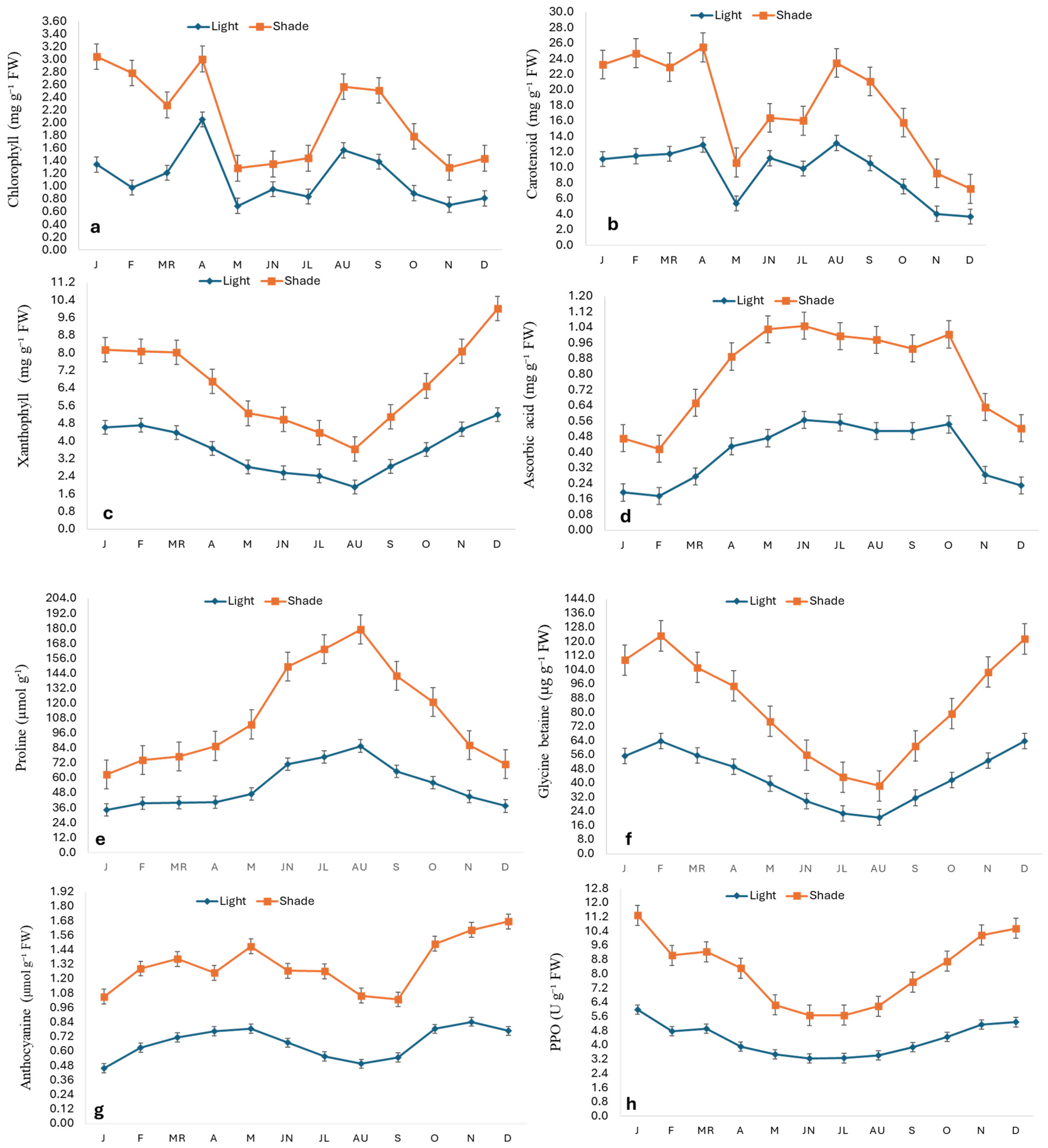
Seasonal variations in photosynthetic pigments showed distinct patterns between light environments. Total chlorophyll content in shade conditions peaked in February (1.81 mg g−1 FW) and remained consistently higher than light conditions throughout most months, except April when light-exposed leaves reached maximum values (2.06 mg g−1 FW). Summer months (June through September) showed reduced chlorophyll levels in both environments, with minimum values observed in May (light: 0.69 mg g−1 FW; shade: 0.59 mg g−1 FW). During autumn and winter, shade leaves maintained 1.5–2.0 times higher chlorophyll concentrations compared to light-exposed leaves (Figure 1a). Carotenoid concentrations exhibited highest values in January for both conditions (light: 11.1 mg g−1 FW; shade: 12.2 mg g−1 FW) and April (light: 12.9 mg g−1 FW; shade: 12.5 mg g−1 FW), with shade leaves maintaining elevated levels through early spring. A pronounced decline occurred from May onwards, reaching minimum in December (light: 3.7 mg g−1 FW; shade: 3.6 mg g−1 FW). August showed a transient peak in both conditions (light: 13.1 mg g−1 FW; shade: 10.3 mg g−1 FW) (Figure 1b). Xanthophylls content displayed a consistent declining trend from winter to summer in both environments, with peak concentrations in January (light: 4.6 mg g−1 FW; shade: 3.5 mg g−1 FW) and February (light: 4.7 mg g−1 FW; shade: 3.4 mg g−1 FW), followed by gradual reduction to minimum values in August (light: 1.9 mg g−1 FW; shade: 1.7 mg g−1 FW). Light-exposed leaves maintained higher xanthophylls levels throughout the year compared to shade leaves. Ascorbic acid levels demonstrated contrasting patterns between light environments. Shade conditions showed pronounced seasonal variation, with a sharp increase from February (0.19 mg g−1 FW) to May (1.04 mg g−1 FW), maintaining high concentrations through summer (0.90–1.01 mg g−1 FW), followed by decline in autumn and winter (0.51–0.64 mg g−1 FW). In contrast, light-exposed leaves maintained relatively stable and lower concentrations throughout the year (0.19–0.57 mg g−1 FW), with maximum in June (0.57 mg g−1 FW) (Figure 1c).
Osmoprotectant accumulation demonstrated marked seasonal dynamics with distinct responses to light conditions. Proline concentrations in shade leaves showed bimodal peaks, with highest values in August (93.7 μmol g−1 FW) and substantial accumulation in January (78.6 μmol g−1 FW). Light-exposed leaves exhibited maximum proline in July (71.1 μmol g−1 FW) and April (68.7 μmol g−1 FW), with generally lower concentrations compared to shade throughout the year. Minimum proline levels occurred in May for light conditions (40.8 μmol g−1 FW) and June for shade conditions (53.8 μmol g−1 FW). Both environments showed elevated proline during summer and winter months, with reduced levels in spring and autumn transitions (Figure 1d). Glycine betaine exhibited pronounced seasonal fluctuations with the highest concentrations in winter months for both conditions. January showed maximum accumulation (light: 106.7 µg g−1 FW; shade: 124.3 µg g−1 FW), with shade leaves maintaining elevated levels through February (122.4 µg g−1 FW). A dramatic decline occurred from spring through summer, reaching minimum in August (light: 18.9 µg g−1 FW; shade: 39.2 µg g−1 FW). Autumn months showed recovery, particularly in shade conditions, with October and December reaching 78.1 and 119.7 µg g−1 FW, respectively. Shade leaves consistently accumulated 1.2–2.5 times higher glycine betaine than light-exposed leaves across most months (Figure 1e). Anthocyanin content remained consistently higher in shade leaves (0.59–1.70 μmol g−1 FW) compared to light leaves (0.46–0.91 μmol g−1 FW) throughout the year. Maximum values occurred in December for both conditions (light: 0.77 μmol g−1 FW; shade: 1.70 μmol g−1 FW), while minimum levels were observed in January for light (0.46 μmol g−1 FW) and June for shade (0.59 μmol g−1 FW). Summer months showed relatively stable anthocyanin concentrations in shade leaves (0.67–0.77 μmol g−1 FW), whereas light-exposed leaves displayed gradual increase from summer to winter (Figure 1f).
Total phenolic content showed distinct seasonal patterns between environments. Shade leaves accumulated significantly higher concentrations, particularly during winter months, with maximum in January (11.2 mg GAE g−1 FW) and February (9.1 mg GAE g−1 FW). Light-exposed leaves maintained lower and more stable levels throughout the year (3.2–5.9 mg GAE g−1 FW), with peak values in January (5.9 mg GAE g−1 FW). Both conditions showed minimum phenolic content during summer, with July recording the lowest values (light: 3.2 mg GAE g−1 FW; shade: 5.5 mg GAE g−1 FW). Autumn months demonstrated recovery in phenolic accumulation, especially in shade conditions (Figure 1g). PPO activity exhibited parallel trends to phenolic content, with shade leaves showing higher enzyme activity across all months. Maximum PPO activity occurred in January for shade (5.3 U g−1 FW) and October for light (5.2 U g−1 FW), while minimum values were observed in June and July for both conditions (light: 2.4–2.6 U g−1 FW; shade: 3.1–3.2 U g−1 FW). Winter months consistently showed elevated PPO activity in shade leaves (4.3–5.3 U g−1 FW) compared to light-exposed leaves (3.4–4.8 U g−1 FW) (Figure 1h).
Multiple regression analyses revealed significant relationships between environmental parameters and biochemical compounds. Total chlorophyll was positively influenced by shade conditions (coefficient: 0.159, p < 0.05) but showed negative interaction between shade and temperature (−0.03, p < 0.001) (AIC: −353.7). Carotenoid content increased with shade (1.46, p < 0.05), temperature (0.07, p < 0.05), and precipitation (0.02, p < 0.01), while shade–temperature interaction showed negative effect (−0.22, p < 0.001) (AIC: 456.9). Xanthophylls were negatively affected by shade (−0.98, p < 0.001) and temperature (−0.14, p < 0.001), but positively influenced by precipitation (0.03, p < 0.001) (AIC: 285.5). Total flavonoids and anthocyanins displayed negative relationships with all environmental factors. Flavonoids decreased with shade (−0.05, p < 0.001), temperature (−0.01, p < 0.001), and precipitation (−0.001, p < 0.001) (AIC: −1071). Anthocyanin content was negatively correlated with temperature (−0.003, p < 0.001) and precipitation (−0.0007, p < 0.001) (AIC: −415.9). TPC showed positive associations with shade (5.24, p < 0.001) and temperature (0.21, p < 0.001), negative correlation with precipitation (−0.02, p < 0.001), and negative shade–temperature interaction (−0.01, p < 0.05). Polyphenol oxidase activity decreased with shade (−0.22, p < 0.05), temperature (−0.11, p < 0.001), and precipitation (−0.03, p < 0.001), including negative shade–temperature interaction (−0.47, p < 0.05) (AIC: 392.3). Ascorbic acid increased with shade (0.089, p < 0.001) and temperature (0.02, p < 0.001), but showed negative shade–temperature interaction (−0.01, p < 0.001) (AIC: −836). Glycine betaine was negatively influenced by both shade (−3.53, p < 0.001) and temperature (−1.92, p < 0.001) (AIC: 2005.1). Free proline demonstrated negative relationship with shade (−5.11, p < 0.01), positive correlation with temperature (2.1, p < 0.001), and positive shade–temperature interaction (0.81, p < 0.001) (AIC: 2251.3) (Table 3).
Flavonoid content exhibited significant seasonal variation (F = 745.03, p < 0.001) with light-exposed leaves maintaining consistently higher concentrations than shade leaves across all months (Table 4). Maximum values occurred in December for both conditions (light: 0.640 mg RE g−1 FW; shade: 0.665 mg RE g−1 FW), while minimum levels were observed in July (light: 0.342 mg RE g−1 FW; shade: 0.287 mg RE g−1 FW). Winter and early spring months showed elevated flavonoid accumulation, with gradual decline through summer followed by recovery in autumn. TPC demonstrated highly significant seasonal and light-dependent variation (F = 2785, p < 0.001). Light-exposed leaves displayed peak concentrations in May (26.14 mg GAE g−1 FW) and November (25.15 mg GAE g−1 FW), while shade leaves reached maximum in November (27.96 mg GAE g−1 FW) and April (27.25 mg GAE g−1 FW). Shade conditions generally promoted higher phenolic accumulation during spring (March–April) and autumn–winter (October–November) periods, whereas light-exposed leaves showed elevated levels in late spring and early summer. FRAP values showed significant variation (F = 1425.06, p < 0.001) with highest antioxidant capacity in November for both environments (light: 0.232 mmol Fe2+ g−1 FW; shade: 0.216 mmol Fe2+ g−1 FW), followed by October and September. Minimum FRAP values occurred in August and July. Light-exposed leaves exhibited slightly higher FRAP capacity during spring and autumn, while shade leaves showed comparable or higher values during winter months. ABTS radical scavenging activity displayed significant seasonal patterns (F = 1205, p < 0.001) with maximum values in November (light: 0.256 mmol TE g−1 FW; shade: 0.237 mmol TE g−1 FW). Light-exposed leaves demonstrated higher ABTS activity during spring (April–May) and autumn (September–November), reaching 0.177–0.256 mmol TE g−1 FW. Shade leaves maintained elevated ABTS values in winter and late summer (August: 0.178 mmol TE g−1 FW), with minimum levels occurring in February for both conditions.

General Evaluation

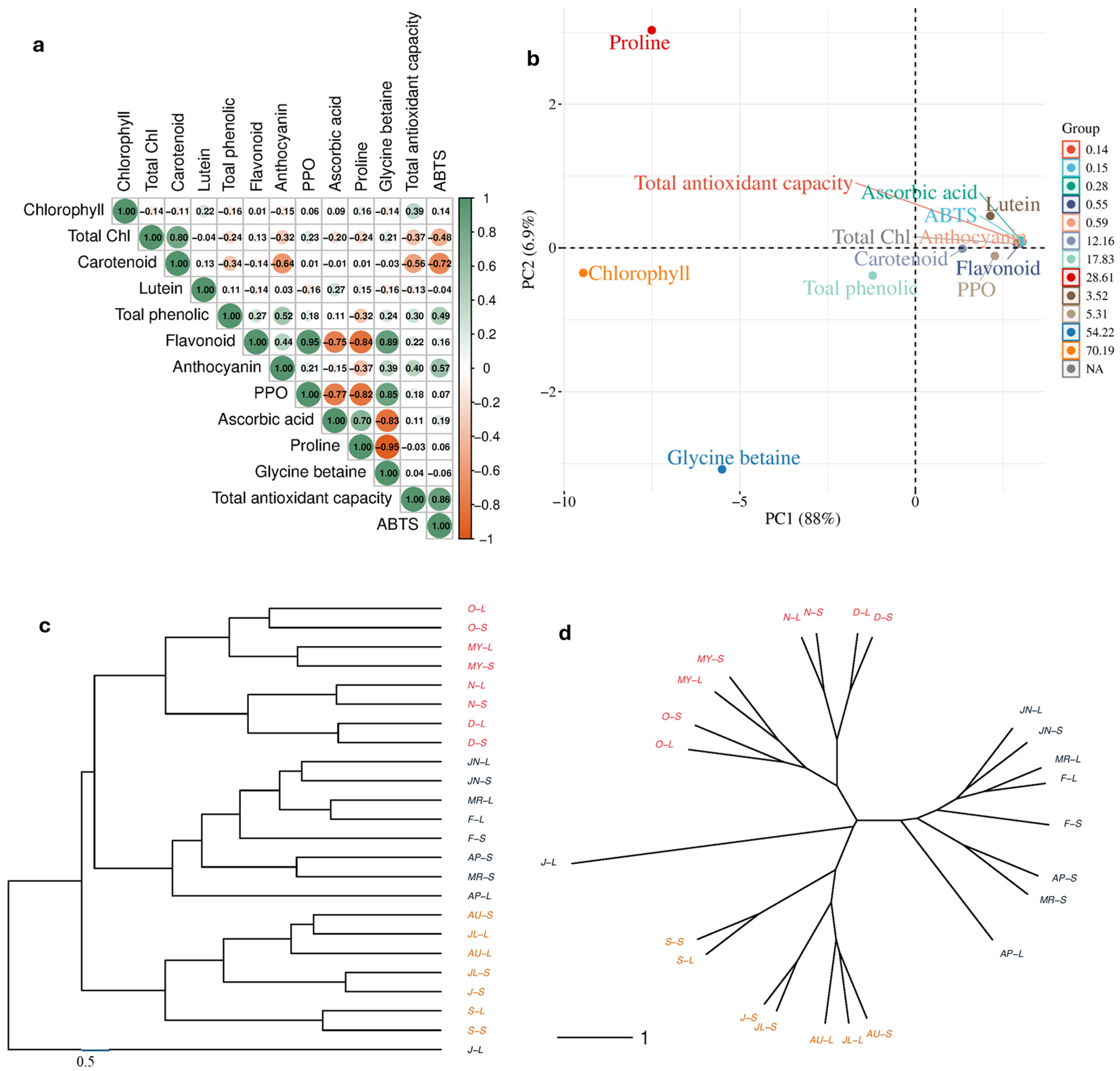
The correlation matrix revealed complex relationships among phytochemical compounds and antioxidant parameters (Figure 2a). The most notable positive correlations include flavonoid–PPO (0.95), indicating these phenolic compounds accumulate together, and glycine betaine–PPO (0.89), suggesting polyphenol oxidase activity is closely linked to flavonoid content. Total antioxidant capacity strongly correlates with ABTS (0.86), confirming measurement consistency. Total chlorophyll and carotenoid show coordinated synthesis (0.80). Strong negative correlations include proline–glycine betaine (−0.95), indicating these osmoprotectants may have antagonistic accumulation patterns, and ascorbic acid–glycine betaine (−0.83), suggesting inverse regulation. Carotenoid showed negative correlation with anthocyanin (−0.64), antioxidant capacity (−0.56), and ABTS (−0.72), indicating potential metabolic trade-offs between different antioxidant pathways. On the other hand, the PCA biplot revealed that PC1 and PC2 explained 88% and 6.9% of the total variance, respectively, accounting for 94.9% of the total variability in the dataset (Figure 2b). The loading vectors showed distinct groupings of variables based on their contributions to the principal components. Chlorophyll exhibited a unique loading pattern positioned distinctly in the negative PC1 region. Glycine betaine, total antioxidant capacity, and ABTS displayed similar loading directions in the positive PC2 region, indicating their strong co-variation. Total chlorophyll, carotenoid, and anthocyanin showed loading vectors in the negative PC1 and slightly positive PC2 direction. Flavonoid, TPC, and PPO exhibited loading patterns in the central region with moderate contributions to both components. Proline and ascorbic acid were positioned in the positive PC2 region but with different PC1 contributions. The sample distribution showed clear separation along PC1, with samples forming distinct clusters based on their phytochemical profiles. The orange-colored sample (Group 70.19, referring to its PCA cluster code) was distinctly separated from the other samples.
The hierarchical cluster dendrogram organized samples into several major clusters with distinct branching patterns (Figure 2c). One primary cluster included O-L, O-S, MY-L, and MY-S samples, indicating similar phytochemical profiles among October and May samples. N-L and N-S (November samples) formed a tight sub-cluster, demonstrating high similarity between leaf and stem tissues in this month. D-L and D-S (December samples) clustered closely together in another branch. JN-L and JN-S (January samples) formed a distinct cluster separate from other winter months. MR-L and MR-S (March samples) grouped together but showed some distance from other spring samples. F-L and F-S (February samples) clustered with AP-S, MR-S, and AP-L, suggesting shared characteristics among late winter and early spring samples. A separate major cluster included AU-S, J-L, and AU-L (August and June samples), indicating similarity among summer samples. JL-S, J-S, S-L, and S-S (July, June, and September samples) formed another distinct cluster, representing mid-to-late summer samples. The dendrogram scale indicated a clustering distance of approximately 0.5 units. The unrooted clustering tree provided an alternative visualization of sample relationships without assuming a root or directionality (Figure 2d). The tree structure revealed several major clades with varying branch lengths. N-L, N-S, D-L, and D-S formed one prominent clade, with relatively short internal branches indicating close relationships among November and December samples. MY-S and MY-L were positioned together on a relatively long branch, suggesting distinctiveness from other samples. O-S and O-L occupied a separate branch with moderate distance from the main cluster. JN-L and JN-S (January samples) formed an isolated clade positioned distinctly from other groups. F-L and F-S showed close relationships in the tree structure. AP-S, MR-S, AP-L, and MR-L formed an interconnected cluster representing spring samples. The summer samples (AU, JL, J, and S) clustered in a complex branching pattern, with AU-S, AU-L, and JL-L forming one sub-clade, while J-L, J-S, JL-S, and S-L, S-S formed another interconnected group. The scale bar indicated a distance of 1 unit.

4. Discussion

4.1. Photosynthetic Pigment Dynamics Under Varying Light Environments

Cherry laurel leaves are rich in photosynthetic pigments, including chlorophylls (chlorophyll a, b), xanthophyll, lycopene, and carotene [3,12,13]. While chlorophylls harvest light energy and arrest it in the chemical bonds of organic compounds, carotenoids contribute to capturing light energy by leaves, protect the photosynthetic apparatus against photo-oxidation, and inhibit UV damage to plants [6,7]. The observed patterns revealed that shade leaves maintained considerably higher chlorophyll concentrations throughout most of the year, particularly during autumn and winter months when they contained 1.5–2.0 times more chlorophyll than light-exposed leaves, although a few months with unusually high chlorophyll peaks in light-exposed leaves shifted the overall annual average to slightly higher values in the light treatment. This enhanced accumulation under shade during winter represents a strategic adaptation to maximize light harvesting efficiency under limited light availability [6,8,26]. The elevated chlorophyll levels in shade-grown plants during winter may be interpreted as a compensatory mechanism to increase light harvesting efficiency despite low light intensity [8,16]. Additionally, the temperature change between day and night is less pronounced in the shade, while water movement up to the leaves is higher in shade conditions, thereby ensuring the continuity of synthesis events [1,5]. These findings align with reports by Mathur et al. [4], Kara et al. [7], and Hasanuzzaman et al. [27], who noted that higher total chlorophyll accumulation in shade during winter may likely be due to species’ shade tolerance or a strategy to prevent chlorophyll degradation. It is important to note that while these patterns are consistent with adaptive hypotheses regarding light harvesting efficiency, our correlative approach under naturally varying conditions precludes definitive mechanistic attribution. The observed relationships between environmental factors and pigment concentrations may reflect direct causal pathways or confounding by unmeasured variables. Controlled experiments with targeted measurements of chlorophyll turnover rates, leaf temperature, and tissue water status would be necessary to establish mechanism-level understanding of these physiological responses. In similar studies, Atar et al. [9] and Carvalho et al. [10] observed that shade-tolerant species usually had more chlorophyll than sensitive ones under light conditions, and they also cited that plants increase their light absorption efficiency to produce sufficient energy and nutrients to grow and thrive under low light intensity.
However, a notable shift occurred in April when light-exposed leaves reached maximum chlorophyll values, surpassing shade conditions. This peak in spring under light conditions indicated the interactions involving temperature, light, and chlorophyll synthesis [5,8,26]. Since cherry laurel is an evergreen plant, chlorophyll biosynthesis occurs in the leaves, especially under light conditions during cool seasons [3,5]. Conversely, summer months showed the lowest values in both environments, reflecting typical patterns where high temperatures and intense radiation impair chlorophyll stability. Carotenoid content exhibited highest values in January and April, followed by pronounced decline from May onwards, reaching minimum in December. Notably, a transient peak appeared in August, suggesting an adaptive response to summer stress. The regression analysis revealed that carotenoid content increased with shade, temperature, and precipitation, though negative shade–temperature interaction indicated complex environmental regulation. While our regression models captured significant effects of shade, temperature, and precipitation, we acknowledge that unmeasured factors such as soil heterogeneity, leaf-level temperature differences, and vapor pressure deficit (VPD) between light environments may mediate these relationships. Future studies incorporating direct measurements of leaf temperature, water potential, and microclimate conditions would strengthen causal inference regarding the observed phytochemical patterns. Light-exposed leaves maintained higher xanthophylls levels throughout the year, with peaks in January–February and gradual reduction to August minimums. The lowest xanthophyll values in summer months have been associated with the protective roles of xanthophyll to the chlorophyll molecule during increased temperatures [4,28]. A matching of a lower xanthophyll in summer with a higher chlorophyll value in August also confirmed this event. Similarly, an increase in chlorophyll and carotenoids in Juniperus grown under light conditions was noted by Kara et al. [7]. The physical–chemical properties of leaves are commonly investigated to predict future plant health, assess tolerance to stress factors, and select appropriate species for greening and reforestation efforts [4,10,13]. In this study, variations in the concentrations of pigments, ascorbic acid, anthocyanin, amino acids, TFC, TPC, the activity of PPO, and total antioxidant capacity (TAC, measured via FRAP and ABTS) in the leaves of cherry laurel were investigated in relation to environmental and climatic factors. These molecules not only play a crucial role in the plant’s adaptation to changing environmental conditions, but also modulate the accumulation of antioxidant compounds in both leaves and fruits [12,14].

4.2. Ascorbic Acid Accumulation Patterns and Their Physiological Significance

Ascorbic acid, a vitamin found at millimolar concentrations in fruits, flowers, roots, and leaves, accumulates most abundantly in the primary production organ, the leaves, as reported by Smirnoff and Wheeler [28]. It has been proposed that, by promoting cell wall synthesis and tissue regeneration to enhance mechanical strength in plants [29], as well as balancing redox status and suppressing ROS production, it plays a crucial role in the induction of stress tolerance [30,31]. The dynamics in our results revealed contrasting patterns between light environments that illuminate multiple roles of this essential compound. Shade conditions positively affected ascorbic acid concentration in leaves, exhibiting pronounced seasonal variation with sharp increase from February to May, maintaining high concentrations through summer, followed by autumn–winter decline. This pattern suggests shade environments promote ascorbic acid biosynthesis during growing season when metabolic demand peaks. In contrast, light-exposed leaves maintained relatively stable and lower concentrations throughout the year, with maximum in June. These findings appear somewhat contradictory to observations by Zhang et al. [30] and Maruta [29], who observed that increasing light intensity stimulated the accumulation of ascorbic acid in leaves, noting that light-induced antioxidant system contributes to ascorbic acid accumulation. Similarly, Mastropasqua et al. [31] observed a decline in ascorbic acid levels of oat leaves in darkness, but it was fully recovered upon irradiance with blue light. However, the increased values in shade-grown plants during winter and spring observed in our study are consistent with results of Massot et al. [32], who recorded that despite light efficiency, higher temperature inhibited ascorbic acid accumulation. This suggests that the interplay between light and temperature may be more complex than previously understood, with temperature potentially playing a dominant role in ascorbic acid metabolism under certain conditions.

4.3. Secondary Metabolite Dynamics and Adaptive Significance

Secondary metabolites, including anthocyanin, TFC, and TPC, play a role in the formation of taste, flavor, and odor, as well as the coloration of plants [8,33]. They play a role in the elimination of free radicals by inactivating enzymes responsible for the synthesis of reactive oxygen species, restraining the breakdown of peroxides into free radicals and switching radicals into less sentient forms [6,34]. Additionally, they contribute vitally to stimulating autoimmunity against pathogen-induced diseases, nitrogen fixation, and reducing UV damage [26,33]. The accumulation patterns revealed sophisticated adaptive mechanisms varying with both light environment and season. Flavonoid content exhibited significant seasonal variation with light-exposed leaves maintaining consistently higher concentrations than shade leaves across all months, reaching maximum in December and minimum in July. The regression analysis revealed that flavonoids decreased with shade, temperature, and precipitation, indicating that light exposure and moderate environmental conditions favor flavonoid biosynthesis. These findings corroborate reports by Dan Ravzani & Rodica [6], Zhou et al. [34], and Starks et al. [35], who noted that accumulation of anthocyanin and flavonoid in leaves during autumn showed an increasing pattern. TPC demonstrated highly significant seasonal and light-dependent variation. Shade leaves displayed a consistent seasonal pattern across the study according to the Folin–Ciocalteu assay, with concentrations peaking in November and April, while light-exposed leaves showed their highest total phenolic levels in May and November. Both conditions showed minimum phenolic content during summer. The regression showed positive associations with shade and temperature, negative correlation with precipitation, and negative shade–temperature interaction. These results overlapped with findings by Stark et al. [35], who noted that chlorophyll declined in plants grown in cool environments while TPC were elevated by shifting protein metabolism to phenol synthesis. Similarly, Zhou et al. [34] and Zhang et al. [36] demonstrated that phenolic compounds accumulated in low light density. PPO activity exhibited parallel trends to phenolic content, with shade leaves showing higher enzyme activity across all months, underscoring enzymatic regulation of phenolic biosynthesis pathways. Anthocyanin content remained consistently higher in shade leaves compared to light leaves throughout the year, with maximum values in December and minimum in January (light) and June (shade). Zhang et al. [26] monitored that flavonoid synthesis increased significantly in summer compared to winter, whereas anthocyanin accumulation was stimulated more in autumn–winter. The regression showed negative correlations with temperature and precipitation, which aligns with the observed seasonal patterns and suggests that cooler, drier conditions favor anthocyanin biosynthesis.

4.4. Enzyme Activity and Antioxidant Capacity Under Environmental Variation

PPO is a metalloenzyme found in both soluble and membrane-bound forms within photosynthetic (chloroplast) and non-photosynthetic plant organelles. Although PPO indirectly participates in the biosynthesis of secondary metabolites through specific phenolic acids, it plays a prominent role in plant defense and disease-resistance metabolic pathways due to its antioxidant function [20,34,36]. PPO activity showed slight differences between conditions but exhibited consistently higher activity in light-exposed plants throughout the year, with enhancement during colder periods. Light conditions may have encouraged PPO activity by increasing ambient temperature [8]. The regression revealed PPO activity decreased with shade, temperature, precipitation, and shade–temperature interaction, suggesting complex regulatory mechanisms involving multiple environmental factors. The activity of total antioxidant capacity (TAC) can sometimes be determined by measuring the inhibition of lipid or lipoprotein oxidation by antioxidants, as well as by measuring the free radical elimination activities of these compounds [37]. The ABTS is used to examine the antioxidant activity of compounds that are electron and/or hydrogen atom donors, while the FRAP method reveals the antioxidant activity of substances that provide an electron [38]. Both assays provide comprehensive insights into the redox dynamics, antioxidant defense pathways, and metabolic robustness of phytochemical constituents, thereby clarifying the plant’s intrinsic ability to attenuate oxidative damage and sustain cellular homeostasis [39]. FRAP values showed highest antioxidant capacity in November for both environments, followed by October and September, with minimum in August and July. Light-exposed leaves exhibited slightly higher FRAP capacity during spring and autumn, while shade leaves showed comparable or higher values during winter. ABTS radical scavenging activity displayed maximum values in November, with light-exposed leaves demonstrating higher activity during spring and autumn, while shade leaves maintained elevated values in winter and late summer. The high TAC level of leaves was attributed to high levels of phenolic compounds, flavonoids, and amino acids [35,36,37,38]. TAC values are in harmony with literature showing that total phenolic compounds, flavonoids, vitamin C, and amino acids contribute to enhancement of antioxidant capacity [40]. Previous studies reported that when organs such as leaves [4], flowers, and fruits [41] are rich in these compounds, their total antioxidant capacity is correspondingly very high. Studies by Carvalho et al. [10], Maruta [29], and Stark et al. [35] provided valuable insights into how climatic factors and growing environment shape antioxidant capacities through synthesis and accumulation of antioxidative molecules. It is well known that shade and rainy conditions can suppress photosynthetic metabolism and subsequent antioxidative molecule synthesis by lowering light intensity due to cloud cover [5,26]. The data confirmed that phenols and flavones significantly increase antioxidant properties of plants [7,8], thereby establishing a mechanistic link between secondary metabolite accumulation and overall plant stress resilience.

4.5. Osmolyte Accumulation and Osmoregulation Mechanisms

Osmotic adjustment through the accumulation of osmolytes, including proline and glycine betaine, is a key adaptive mechanism for maintaining cellular turgor [13,24]. Under stress conditions, they accumulate at higher levels compared to normal conditions, playing a crucial role in maintaining osmotic homeostasis, ROS elimination, and stabilizing cellular membranes, proteins, and other vital macromolecules [7,42]. Proline concentrations exhibited distinct bimodal peaks in shade leaves, with highest values in August and substantial accumulation in January (78.6 μmol g−1), while light-exposed leaves exhibited maximum in July and April with generally lower concentrations. Both environments showed elevated proline during summer and winter, with reduced levels during spring and autumn transitions. The regression revealed negative relationship with shade, positive correlation with temperature, and positive shade–temperature interaction, confirming that hot temperatures stimulate proline accumulation. High proline accumulation in leaf tissues during winter is considered essential to stabilize turgor pressure and ensure cytosolic activity [7,27]. Junior et al. [43] in tomato, and Sorwong and Sakhonwasee [44] in marigold, demonstrated that light significantly promotes proline accumulation, not only by enhancing photosynthetic activity but also by activating stress-responsive signaling pathways. This suggests that the lower proline levels observed in shade-grown leaves may reflect reduced photosynthetic activity and, consequently, diminished capacity for proline biosynthesis.
Glycine betaine exhibited pronounced seasonal fluctuations with highest concentrations in winter, showing maximum accumulation in January, with shade leaves maintaining elevated levels through February. A dramatic decline occurred from spring through summer, reaching minimum in August, while autumn showed recovery particularly in shade conditions. Shade leaves consistently accumulated 1.2–2.5 times higher glycine betaine than light-exposed leaves across most months. The regression indicated glycine betaine was negatively influenced by both shade and temperature, which appears paradoxical given the higher accumulation in shade leaves. This apparent contradiction may be resolved by considering that the regression captures overall trends across all conditions, while the shade effect may be mediated through other environmental factors such as improved water status or reduced evaporative demand. This apparent discrepancy between the negative regression coefficient for shade and the higher observed glycine betaine concentrations in shade leaves warrants clarification. The regression coefficient represents the partial effect of shade while statistically controlling for temperature and precipitation, whereas the raw comparisons reflect the combined influence of all co-varying environmental factors. In shade environments, lower temperatures and reduced evaporative demand likely create conditions favoring glycine betaine accumulation despite the negative partial effect of light limitation per se. Interactive effects between shade and temperature (as indicated by the shade–temperature interaction term) further complicate interpretation, suggesting that the relationship between light environment and osmolyte accumulation is context-dependent and modulated by thermal conditions. Sorwong and Sakhonwasee [44] and Hasanuzzaman et al. [27] stated that betaine accumulates under low-temperature conditions, preventing icing and water scarcity in cells, maintaining cellular membrane integrity, and providing a nitrogen source for developing tissues. Carvalho et al. [10] and Zhang et al. [26] observed that nitrogenous compounds increased in flower tissue during vegetation while decreasing in leaves and suggested this may be an adaptation for distribution of nutrients from leaves to reproductive organs in seasons when metabolism slows down. Similarly to this study, research demonstrated that proline and betaine are the most effective osmoprotectants among compatible solutes [45,46], highlighting their central role in plant stress tolerance mechanisms.

4.6. Integrated Metabolic Responses: Correlation and Multivariate Analyses

The correlation matrix revealed complex relationships among phytochemical compounds and antioxidant parameters (Figure 2a). The strongest positive correlations were observed between flavonoid and anthocyanin (r = 0.95), indicating these phenolic compounds accumulate together through shared biosynthetic pathways, and total antioxidant capacity with ABTS (r = 0.86), confirming measurement consistency between different antioxidant assays. Flavonoid content also showed strong positive correlation with PPO activity (r = 0.89), suggesting polyphenol oxidase plays a central role in phenolic compound biosynthesis. Total chlorophyll and carotenoid displayed coordinated synthesis (r = 0.80), reflecting their functional integration in the photosynthetic apparatus. Notable negative correlations included proline and glycine betaine (r = −0.95), indicating these osmoprotectants may have antagonistic accumulation patterns despite their similar osmoregulatory functions, and ascorbic acid with PPO activity (r = −0.83), suggesting inverse regulation between these antioxidant components. Carotenoid content showed negative correlations with flavonoid (r = −0.64), total antioxidant capacity (r = −0.56), and ABTS (r = −0.72), indicating potential metabolic trade-offs where plants allocate resources between primary photosynthetic pigments and secondary antioxidant metabolites. This pattern suggests that environmental conditions favoring chlorophyll and carotenoid accumulation for photosynthesis may not necessarily promote secondary metabolite synthesis, reflecting the balance between growth-related primary metabolism and stress-induced secondary metabolism. The PCA biplot revealed PC1 and PC2 explained 88% and 6.9% of total variance, respectively, accounting for 94.9% of total variability. This high variance explanation indicates two principal components effectively capture major patterns of phytochemical variation. Loading vectors showed distinct groupings based on contributions to principal components. Glycine betaine, total antioxidant capacity, and ABTS displayed similar loading directions in positive PC2 region, indicating strong co-variation and supporting functional relationship in stress response. Total chlorophyll, carotenoid, and anthocyanin showed loading vectors in negative PC1 and slightly positive PC2 direction, reflecting coordinated roles in photosynthesis and photoprotection. Sample distribution showed clear separation along PC1, with samples forming distinct clusters based on phytochemical profiles, demonstrating that environmental conditions and sampling time create distinct metabolic signatures. The hierarchical cluster dendrogram organized samples into several major clusters with distinct branching patterns, with October and May samples showing similar phytochemical profiles, while November–December samples formed tight sub-clusters, demonstrating high similarity within late autumn and early winter. January–February samples formed distinct clusters reflecting unique winter stress responses, while summer samples clustered together, representing distinctive metabolic state during hot season. The unrooted clustering tree provided alternative visualization, with November–December, May, and October samples forming prominent clades with relatively short internal branches, indicating close relationships, while January samples formed isolated clade, emphasizing unique metabolic profile during peak winter. These multivariate analyses collectively demonstrate that cherry laurel exhibits sophisticated metabolic plasticity in response to environmental variation, with clear seasonal and light-environment-dependent patterns in phytochemical composition. The strong correlations among functionally related compounds and distinct clustering patterns suggest coordinated regulation of metabolic pathways rather than independent responses to environmental factors. This integrated metabolic response likely contributes to cherry laurel’s ability to thrive across diverse light and seasonal conditions, making it a valuable species for urban greening and reforestation efforts where environmental conditions vary considerably [4,10,13]. Furthermore, the temporal clustering of samples indicates that cherry laurel employs distinct metabolic strategies corresponding to seasonal environmental challenges, shifting from cold stress responses in winter to heat and drought stress adaptations in summer, with transitional metabolic states during spring and autumn periods.

5. Conclusions

Our study revealed that light environment and seasonal variation significantly influence phytochemical composition and antioxidant properties in cherry laurel (P. laurocerasus L.) leaves under observed field conditions. Comparing light-exposed and shade-grown plants across twelve months, we found that these environments elicited distinct biochemical strategies, with shade conditions promoting light-harvesting efficiency and osmotic adjustment, while light exposure enhanced photoprotection and antioxidant defense mechanisms. However, several methodological limitations warrant acknowledgment: the binary light classification (light vs. shade) may oversimplify the light gradient continuum; absence of direct measurements of photosynthetically active radiation (PAR), daily light integral (DLI), leaf temperature, and vapor pressure deficit (VPD) limits mechanistic interpretation; potential soil heterogeneity between light environments may confound observed phytochemical patterns. These factors suggest that the reported light effects represent composite influences of co-varying environmental conditions rather than isolated light responses. Overall, cherry laurel exhibited flexible and environment-dependent adjustments in its phytochemical and antioxidant metabolism. Shade conditions promoted chlorophyll retention, osmolyte accumulation, and sustained antioxidant support during the growing season, helping maintain photosynthetic efficiency under reduced light. In contrast, high light stimulated the production of photoprotective pigments and enhanced antioxidant enzyme activity, strengthening the plant’s capacity to cope with oxidative stress. These coordinated and seasonally distinct metabolic patterns indicate that cherry laurel does not rely on a single protective mechanism, but instead employs an integrated strategy that shifts with changing environmental conditions. From an applied perspective, our findings suggest testable hypotheses for urban forestry and landscape management, though recommendations should be considered preliminary pending validation under controlled conditions. Future research should employ paired sun–shade tree comparisons with matched soil properties, continuous monitoring of DLI and VPD, direct leaf temperature measurements, and tissue water status assessments to disentangle light effects from confounding microclimatic factors. Controlled experiments manipulating individual environmental variables would strengthen causal inference regarding the observed phytochemical responses. Shade-grown plants appear well-suited for understory planting and shaded urban landscapes due to their sustained chlorophyll retention and osmotic adjustment capacity, promoting efficient photosynthesis under low-light conditions. In contrast, plants under high light develop stronger photoprotective and antioxidant systems, indicating potential suitability for open, sun-exposed environments where oxidative stress potential is greater. These practical applications warrant empirical validation through reciprocal transplant experiments and performance monitoring across diverse urban microclimates to establish evidence-based guidelines for species deployment in landscape design.

Author Contributions

Conceptualization, N.T. and O.K.; methodology, N.T. and F.K.; validation, F.Y. and K.G.; formal analysis, N.T. and F.K.; investigation, N.T.; resources, F.Y. and K.G.; data curation, O.K.; writing—original draft preparation, O.K.; writing—review and editing, N.T. and O.K.; visualization, O.K.; supervision, N.T. All authors have read and agreed to the published version of the manuscript.

Funding

This research was funded by the Kastamonu University Scientific Research Projects Coordination Unit, project number KÜ-BAP01/2019-49. All authors have verified that the funding information is accurate.

Data Availability Statement

The data presented in this study are available on request from the corresponding author. The data are not publicly available due to institutional policy and ongoing related research.

Acknowledgments

The chemical analyses of this study were conducted with the support of the project KÜ-BAP01/2019-49, funded by the Kastamonu University Scientific Research Projects Coordination Unit. We extend our sincere appreciation to the Coordination Unit for their valuable contribution.

Conflicts of Interest

The authors declare no conflicts of interest. The funders had no role in the design of the study; in the collection, analyses, or interpretation of data; in the writing of the manuscript; or in the decision to publish the results.

References

  1. Alton, P.B.; North, P.R.; Los, S.O. The impact of diffuse sunlight on canopy light-use efficiency, gross photosynthetic product and net ecosystem Exchange in three forest biomes. Glob. Change Biol. 2007, 13, 776–787. [Google Scholar] [CrossRef]
  2. Liu, T.; Barbour, M.M.; Yu, D.; Rao, S.; Song, X. Mesophyll conductance exerts a significant limitation on photosynthesis during light induction. New Phytol. 2022, 233, 360–372. [Google Scholar] [CrossRef]
  3. Jetter, R.; Schaffer, S. Chemical composition of the Prunus laurocerasus leaf surface. Dynamic changes of the epicuticular wax film during leaf development. Plant Physiol. 2001, 126, 1725–1737. [Google Scholar] [CrossRef]
  4. Mathur, S.; Jain, L.; Jajoo, A. Photosynthetic efficiency in sun and shade plants. Photosynthetica 2018, 56, 354–365. [Google Scholar] [CrossRef]
  5. Kong, D.X.; Li, Y.Q.; Wang, M.L.; Bai, M.; Zou, R.; Tang, H.; Wu, H. Effects of light intensity on leaf photosynthetic characteristics, chloroplast structure, and alkaloid content of Mahonia bodinieri (Gagnep.) Laferr. Acta Physiol. Plant 2016, 38, 120. [Google Scholar] [CrossRef]
  6. Dan Ravzani, P.; Rodica, B. Seasonal evolutıon of folıar chlorophylls, carotenoıds and flavonoıds ın Platycladus orıentalıs (L.) Franco. Analele Univ. Craiova Ser. Filos. 2017, 22, 427–432. [Google Scholar]
  7. Kara, F.; Turfan, N.; Alay, M. Understory junipers and light environment effects on biomass, chemical composition, and nutrient contents of black pine seedlings. BioResources 2023, 18, 6025–6043. [Google Scholar] [CrossRef]
  8. Boeckx, T.; Winters, A.L.; Webb, K.J.; Kingston-Smith, A.H. Polyphenol oxidase in leaves: Is there any significance to the chloroplastic localisation? J. Exp. Bot. 2015, 66, 3571–3579. [Google Scholar] [CrossRef]
  9. Atar, F.; Güney, D.; Bayraktar, A.; Yıldırım, N.; Turna, İ. Seasonal change of chlorophyll content (SPAD value) in some tree and shrub species. Turk. J. For. Sci. 2020, 4, 245–256. [Google Scholar] [CrossRef]
  10. Carvalho, S.; Macel, M.; Mulder, P.J.; Skidmore, A.; Van Der Putten, W. Chemical variation in Jacobaea vulgaris is influenced by the interaction of season and vegetation successional stage. Phytochemistry 2014, 99, 86–94. [Google Scholar] [CrossRef]
  11. Abanoz, Y.; Okcu, Z. Biochemical content of cherry laurel (Prunus laurocerasus L.) fruits with edible coatings based on caseinate, semperfresh, and lecithin. Turk. J. For. Sci. 2022, 46, 908–918. [Google Scholar]
  12. Kolaylı, S.; Kucuk, M.; Duran, C.; Candan, F.; Dincer, B. Chemical and antioxidant properties of Prunus laurocerasus Roem. (cherry laurel) fruit grown in the Black Sea Region. J. Agric. Food Chem. 2003, 51, 489–7494. [Google Scholar] [CrossRef]
  13. Turfan, N.; Meşe, Ö. Effects of Air Pollution on Some Chemical Compounds of Cherry Laurel (Prunus laurocerasus L.) in Kastamonu. J. Bartın Fac. For. 2019, 21, 486–494. [Google Scholar]
  14. Erenler, R.; Yılmaz, B.; Tekin, Ş. Antiproliferative effect of cherry laurel. J. Turk. Chem. Soc. A Chem. 2016, 3, 217–228. [Google Scholar]
  15. Kukric, Z.Z.; Topalic-Trivunovic, L.N.; Kukavica, B.M.; Matos, S.B.; Pavicic, S.S.; Boroja, M.M.; Savic, A.V. Characterization of antioxidant and microbial activities of nettle leaves (Urtica dioica L.). Acta Period. Technol. 2012, 43, 257–272. [Google Scholar] [CrossRef]
  16. Chang, S.K.; Nagendra Prasad, K.; Amin, I. Carotenoid retention in leafy vegetables based on cooking methods. Int. Food Res. J. 2013, 20, 457–465. [Google Scholar]
  17. Singleton, V.L.; Rossi, J.A. Colorimetry of total phenolics with phosphomolybdic-phosphotungstic acid reagents. Am. J. Enol. Vitic. 1965, 16, 144–158. [Google Scholar] [CrossRef]
  18. Luximon-Ramma, A.; Bahorum, T.; Soobratee, M.A.; Aruoma, O.I. Antioxidant activities of flavonoid compounds in extracts of Cassia fistula. J. Agric. Food Chem. 2020, 50, 5042–5047. [Google Scholar] [CrossRef]
  19. Mancinelli, A.L. Interaction between light quality and light quantity in the photoregulation of anthocyanin production. Plant Physiol. 1990, 92, 1191–1195. [Google Scholar] [CrossRef]
  20. Kumar, V.B.A.; Mohan, T.C.K.; Murugan, K. Purification and kinetic characterization of polyphenol oxidase from Barbados cherry (Malpighia glabra L.). Food Chem. 2008, 110, 328–333. [Google Scholar] [CrossRef]
  21. Benzie, I.F.F.; Strain, J.J. The ferric reducing ability of plasma (FRAP) as a measure of ‘antioxidant power’: The FRAP assay. Anal. Biochem. 1996, 239, 70–76. [Google Scholar] [CrossRef]
  22. Re, R.; Pellegrini, N.; Proteggente, A.; Pannala, A.; Yang, M.; Rice-Evans, C. Antioxidant activity applying an improved ABTS radical cation decolorization assay. Free Radic. Biol. Med. 1999, 26, 1231–1237. [Google Scholar] [CrossRef]
  23. Klein, B.P.; Perry, A.K. Ascorbic acid and vitamin A activity in selected vegetables from different geographical areas of the United States. J. Food Sci. 1982, 47, 941–945. [Google Scholar] [CrossRef]
  24. Grieve, C.M.; Grattan, S.R. Rapid assay for the determination of water soluble quaternary ammonium compounds. Plant Soil 1983, 70, 303–307. [Google Scholar] [CrossRef]
  25. Bates, L.S.; Waldern, R.P.; Teare, I.D. Rapid determination of free proline for water-stress studies. Plant Soil 1973, 39, 205–207. [Google Scholar] [CrossRef]
  26. Zhang, T.J.; Tian, X.S.; Liu, X.T.; Huang, X.D.; Peng, C.L. Seasonal variations in group leaf characteristics in species with red young leaves. Sci. Rep. 2019, 11, 16529. [Google Scholar] [CrossRef] [PubMed]
  27. Hasanuzzaman, M.; Zhou, M.; Shabala, S. Physiological and morphological mechanisms mediating plant tolerance to osmotic stress: Balancing tolerance and productivity. In Climate Change and Crop Production: Foundations for Agroecosystem Resilience; Benkeblia, N., Ed.; CRC Press: Boca Raton, FL, USA, 2018; pp. 35–58. [Google Scholar]
  28. Smirnoff, N.; Wheeler, G.L. The ascorbate biosynthesis pathway in plants is known, but there is a way to go with understanding control and functions. J. Exp. Bot. 2024, 75, 2604–2630. [Google Scholar] [CrossRef]
  29. Maruta, T. How does light facilitate vitamin C biosynthesis in leaves? Biosci. Biotechnol. Biochem. 2022, 24, 173–1182. [Google Scholar] [CrossRef]
  30. Zhang, L.; Ma, G.; Yamawaki, K.; Ikoma, Y.; Matsumoto, H.; Yoshioka, T.; Ohta, S.; Kato, M. Regulation of ascorbic acid metabolism by blue LED light irradiation in citrus juice sacs. Plant Sci. 2015, 233, 134–142. [Google Scholar] [CrossRef]
  31. Mastropasqua, L.; Borraccino, B.; Bianco, L.; Paciolla, C. Light qualities and dose influence ascorbate pool size in detached oat leaves. Plant Sci. 2012, 183, 57–64. [Google Scholar] [CrossRef]
  32. Massot, C.; Bancel, D.; Lopez Lauri, F.; Truffault, V.; Baldet, P.; Stevens, R.; Gautier, H. High temperature inhibits ascorbate recycling and light stimulation of the ascorbate pool in tomato despite increased expression of biosynthesis genes. PLoS ONE 2013, 8, e84474. [Google Scholar] [CrossRef]
  33. Kitao, M.; Yazaki, K.; Tobita, H.; Agathokleus, E.; Kishimoto, J.; Takabayashi, A.; Tanaka, R. Anthocyanins act as a sugar-buffer and an alternative electron sink in response to starch depletion during leaf senescence: A case study on a typical anthocyanic tree species, Acer japonicum. J. Exp. Bot. 2024, 75, 3521–3544. [Google Scholar] [CrossRef] [PubMed]
  34. Zhou, R.; Su, W.H.; Zhang, G.F.; Zhang, Y.N.; Guo, X.R. Relationship between flavonoids and photoprotection in shade-developed Erigeron breviscapus transferred to sunlight. Photosynthetica 2016, 54, 201–209. [Google Scholar] [CrossRef]
  35. Stark, S.; Vaisanen, M.; Ylanne, H.; Julkunen-Tiitto, R.; Martz, F. Decreased phenolic defence in dwarf birch (Betula nana) after warming in subarctic tundra. Polar Biol. 2015, 38, 993–2005. [Google Scholar] [CrossRef]
  36. Zhang, L.X.; Guo, Q.S.; Chang, Q.S.; Zhu, Z.B.; Liu, L.; Chen, Y.H. Chloroplast ultrastructure, photosynthesis and accumulation of secondary metabolites in Glechoma longituba in response to irradiance. Photosynthetica 2015, 53, 144–153. [Google Scholar] [CrossRef]
  37. Sutuliene, R.; Lauzike, K.; Pukas, T.; Samuoliene, G. Effect of light intensity on the growth and antioxidant activity of sweet basil and lettuce. Plants 2022, 11, 1709. [Google Scholar] [CrossRef]
  38. Rawat, P.; Dasila, K.; Singh, M. Influence of environmental factors on phytochemical compositions and antioxidant activity of Juniperus communis L. Discov. Environ. 2025, 3, 11. [Google Scholar] [CrossRef]
  39. Kumar, S.; Sandhir, R.; Ojha, S. Evaluation of antioxidant activity and total phenol in different varieties of Lantana camara leaves. BMC Res. Notes 2014, 7, 560. [Google Scholar] [CrossRef]
  40. Chua, I.Y.P.; King, P.J.H.; Ong, K.H.; Sarbini, S.R.; Yiu, P.H. Influence of light intensity and temperature on antioxidant activity in Premna serratifolia L. J. Soil Sci. Plant Nutr. 2015, 15, 605–614. [Google Scholar]
  41. El-Zaeddi, H.; Calín-Sánchez, L.; Noguera-Artiaga, L.; Martínez-Tomé, J.; Carbonell-Barrachina, A. Optimization of harvest date according to the volatile composition of Mediterranean aromatic herbs at different vegetative stages. Sci. Hortic. 2020, 267, 109336. [Google Scholar] [CrossRef]
  42. Gupta, N.; Thind, S.K. Improving photosynthetic performance of bread wheat under field drought stress by foliar applied glycine betaine. J. Agric. Sci. Technol. 2018, 17, 75–86. [Google Scholar]
  43. Junior, D.C.; Gaion, L.A.; Júnior, G.S.; Santos, D.M.M.; Carvalho, R.F. Drought-induced proline synthesis depends on root-to-shoot communication mediated by light perception. Acta Physiol. Plant. 2018, 40, 15. [Google Scholar] [CrossRef]
  44. Sorwong, A.; Sakhonwasee, S. Foliar application of glycine betaine mitigates the effect of heat stress in three marigolds (Tagetes erecta) cultivars. J. Horic. 2015, 84, 161–171. [Google Scholar] [CrossRef]
  45. Szepesi, A.; Szollosi, R. Mechanism of proline biosynthesis and role of proline metabolism enzymes under environmental stress in plants. In Plant Metabolites and Regulation Under Environmental Stress; Academic Press: Cambridge, MA, USA, 2018; pp. 337–353. [Google Scholar]
  46. Aman, S.N. Role of exogenous application of proline and glycine betaine in the salinity tolerance of Solanaceae family: A Review. Acta Sci. Agric. 2022, 6, 46–54. [Google Scholar] [CrossRef]
Figure 1. Changes in concentrations of total chlorophyll (a), carotenoid (b), xanthophyll (c), ascorbic acid (d), proline (e), glycine betaine (f), (anthocyanin (g), PPO activity (h) in leaves by months (letters represent months).
Horticulturae 11 01403 g001
Figure 2. Correlation analysis and principal component analysis of phytochemical compounds and antioxidant capacity in samples. (a) Correlation matrix showing Pearson correlation coefficients between measured compounds and antioxidant capacity indicators. (b) PCA biplot displaying the distribution of samples and loading vectors of phytochemical variables. (c) Hierarchical cluster dendrogram of samples based on phytochemical profiles. (d) Unrooted clustering tree showing relationships among samples.
Horticulturae 11 01403 g002
Table 1. Soil mineral contents under light and shade conditions.
Minerals (ppm)LightShade
Sodium11,65521,145
Magnesium30,05544,000
Phosphorus27062408
Sulfur12,1369662
Potassium12,52014,095
Calcium110,375120,070
Manganese1024.41019
Iron59,35053,630
Nickel233.0234.6
Copper55.652.5
Zinc95.5114.4
Table 2. The mean concentrations (two-year averages) of the chosen components of cherry laurels grown in shade and light conditions. Numbers in parentheses show the standard deviations.
ComponentsShade ConditionsLight Conditions
Total chlorophyll (mg g−1 FW)0.95 ± 0.421.11 ± 0.40
Total carotenoids (mg g−1 FW)8.63 ± 3.309.38 ± 3.20
Xanthophylls (mg g−1 FW)2.97 ± 0.803.60 ± 1.01
Ascorbic acid (mg g−1 FW)0.40 ± 0.090.39 ± 0.15
Anthocyanin (μmol g−1 FW)0.65 ± 0.120.67 ± 0.14
Total flavonoids (mg RE g−1 FW)0.45 ± 0.100.51 ± 0.09
Total phenolic (mg GAE g−1 FW)21.50 ± 4.3021.10 ± 3.60
PPO activity (U g−1 FW)3.91 ± 0.264.31 ± 0.32
FRAP (mmol Fe2+ g−1 FW)0.169 ± 0.0280.171 ± 0.22
ABTS (mmol TE g−1 FW)0.173 ± 0.330.179 ± 0.24
Glycine betaine (µg g−1 FW)40.30 ± 14.0343.60 ± 14.90
Free proline (μmol g−1 FW)56.40 ± 21.9053.20 ± 16.80
Table 3. Multiple regression analyses between the environmental parameters (i.e., light conditions, temperature, and precipitation) on the dependent variables (i.e., total chlorophyll, carotenoid, xanthophyll, TPC, TFC, anthocyanin, glycine betaine, proline, and ascorbic acid content, and PPO activity).
ModelsAIC
Total chlorophyll = 1.061 + (0.159 SHADE) * − (0.03 SHADE:TEMP) ***−353.7
Carotenoid = 7.858 + (1.46 SHADE) * + (0.07 TEMP) * + (0.02 PREC) ** − (0.22 SHADE:TEMP) ***456.9
Xanthophylls = 5.01 − (0.98 SHADE) *** − (0.14 TEMP) *** + (0.03 PREC) ***285.5
Total flavonoids = 0.641 − (0.05 SHADE) *** − (0.01 TEMP) *** − (0.001 PREC) ***−1071
Anthocyanin = 0.728 − (0.003 TEMP) *** − (0.0007 PREC) ***−415.9
Total phenolic = 20.28 + (5.24 SHADE) *** + (0.21 TEMP) *** − (0.02 PREC) *** − (0.01 SHADE:TEMP) *
Polyphenol oxidase = 5.5 − (0.22 SHADE) * − (0.11 TEMP) *** − (0.03 PREC) *** − (0.47 SHADE:TEMP) *392.3
Ascorbic acid = 0.211 + (0.089 SHADE) *** + (0.02 TEMP) *** − (0.01 SHADE:TEMP) *** − 836
Glycine betaine = 63.12- (3.53 SHADE) *** − (1.92 TEMP) ***2005.1
Free proline = 32.28 − (5.11 SHADE) ** + (2.1 TEMP) *** + (0.81 SHADE:TEMP) ***2251.3
TEMP: temperature and PREC: precipitation. AIC: Akaike Information Criterion, ns, *, **, *** are not significant, p > 0.05, p < 0.05, p < 0.01, and p < 0.001, respectively. Regression models were selected based on the lowest AIC value. Non-significant main effects were removed during model simplification; however, significant interaction terms (e.g., SHADE:TEMP) were retained even if one of the corresponding main effects was excluded.
Table 4. Variation in total flavonoid and total phenolic compounds contents, and total antioxidant activity capacity of leaves by monthly.
MonthFlavonoid (mg RE g−1 FW)Total Phenolic (mg GAE g−1 FW)FRAP (mmol Fe2+ g−1 FW)ABTS (mmol TE g−1 FW)
LightShadeLightShadeLightShadeLightShade
JN0.620 ± 0.003 b*0.569 ± 0.003 b14.88 ± 0.05 d17.83 ± 0.06 c0.161 ± 0.001 f0.138 ± 0.002 f0.143 ± 0.001 hı0.150 ± 0.001 fg
F0.553 ± 0.003 e0.474 ± 0.00217.68 ± 0.04 c21.25 ± 0.06 b0.136 ± 0.0010.124 ± 0.001 g0.134 ± 0.001 ı0.125 ± 0.001 h
MR0.569 ± 0.005 d0.525 ± 0.002 cd15.92 ± 0.02 cd24.80 ± 0.13 ab0.156 ± 0.001 g0.142 ± 0.001 ef0.149 ± 0.001 h0.143 ± 0.001 g
AP0.495 ± 0.004 g0.437 ± 0.002 de23.54 ± 0.06 ab27.25 ± 0.05 a0.178 ± 0.001 de0.165 ± 0.001 d0.177 ± 0.001 de0.156 ± 0.001 f
MY0.429 ± 0.004 ı0.349 ± 0.002 f26.14 ± 0.03 a21.15 ± 0.05 b0.184 ± 0.001 d0.180 ± 0.001 c0.205 ± 0.001 bc0.186 ± 0.001 c
JU0.389 ± 0.004 i0.333 ± 0.003 fg23.17 ± 0.06 ab17.05 ± 0.06 c0.145 ± 0.001 h0.167 ± 0.001 d0.166 ± 0.001 f0.174 ± 0.001 d
JL0.342 ± 0.003 j0.287 ± 0.005 gh21.61 ± 0.06 b17.12 ± 0.05 c0.135 ± 0.001 h0.150 ± 0.001 e0.154 ± 0.001 g0.165 ± 0.001 e
AU0.382 ± 0.004 i0.292 ± 0.002 g21.15 ± 0.03 b17.51 ± 0.06 c0.134 ± 0.001 h0.148 ± 0.001 e0.157 ± 0.001 g0.178 ± 0.001 d
S0.460 ± 0.006 h0.393 ± 0.00 e18.22 ± 0.07 c17.28 ± 0.05 c0.191 ± 0.001 c0.208 ± 0.001 b0.181 ± 0.001 d0.177 ± 0.001 d
O0.517 ± 0.003 f0.477 ± 0.003 d20.96 ± 0.02 b23.28 ± 0.06 b0.212 ± 0.001 b0.224 ± 0.001 a0.215 ± 0.001 b0.199 ± 0.001 b
N0.605 ± 0.003 c0.556 ± 0.004 c25.15 ± 0.04 a27.96 ± 0.03 a0.232 ± 0.001 a0.216 ± 0.001 ab0.256 ± 0.001 a0.237 ± 0.001 a
D0.640 ± 0.003 a0.665 ± 0.004 a24.85 ± 0.05 a26.19 ± 0.04 a0.181 ± 0.001 d0.173 ± 0.001 c0.198 ± 0.001 c0.188 ± 0.001 c
F745.0327851425.061205
p<0.001<0.001<0.001<0.001
* Data are mean ± standard error; JN: January, F: February, MR: March, AP: April, MY: May, JU: June, JL: July, AU: August, S: September, O: October, N: November, D: December.
Disclaimer/Publisher’s Note: The statements, opinions and data contained in all publications are solely those of the individual author(s) and contributor(s) and not of MDPI and/or the editor(s). MDPI and/or the editor(s) disclaim responsibility for any injury to people or property resulting from any ideas, methods, instructions or products referred to in the content.