Article

Shade and Fabric Mulching Drive Variation in Medicinal Compounds and Rhizosphere Bacterial Communities in Epimedium sagittatum

1
College of Pharmacy and Shaanxi Qinling Application Development and Engineering Center of Chinese Herbal Medicine, Shaanxi University of Chinese Medicine, Xianyang 712046, China
2
College of Pharmacy, Gansu University of Chinese Medicine, Lanzhou 730000, China
3
Co-Construction Collaborative Innovation Center for Chinese Medicine Resources Industrialization by Shaanxi and Education Ministry, Shaanxi University of Chinese Medicine, Xianyang 712083, China
4
Ningqiang County Traditional Chinese Medicine Industry Development Center, Hanzhong 723000, China
*
Authors to whom correspondence should be addressed.
Horticulturae 2025, 11(11), 1408; https://doi.org/10.3390/horticulturae11111408
Submission received: 25 September 2025 / Revised: 9 November 2025 / Accepted: 13 November 2025 / Published: 20 November 2025

Abstract

This study investigated the interactive effects of different light conditions and weed control methods on the medicinal compound composition and rhizosphere bacterial community structure of Epimedium sagittatum. A completely randomized block design was employed, incorporating four treatments: full light with manual weeding (LN), shade with manual weeding (SN), full light with weed-control fabric mulch (LG), and shade with mulch (SG). Active compound levels in two-year-old plants were quantified using HPLC, and rhizobacterial diversity was assessed via high-throughput sequencing. The results indicated that the SG treatment significantly enhanced the photosynthetic efficiency and yielded the highest levels of epimedin C and total active compounds. In contrast, the SN treatment fostered a beneficial rhizosphere environment—characterized by increased pH, ammonium nitrogen (NH4+-N), bacterial diversity, and the abundance of Flavobacterium—which supported the highest production of epimedin B and icariin. Redundancy analysis confirmed that these microbial shifts were primarily driven by soil pH, nitrate nitrogen (NO3-N), and shading. Furthermore, while stochastic processes governed bacterial community assembly, deterministic selection intensified across the treatments from LN to SG. Collectively, our findings demonstrate that light and mulching can be strategically tailored to manipulate the plant–soil-microbe system, thereby enabling precise modulation of the medicinal quality of E. sagittatum.

1. Introduction

Epimedii Folium, a well-known traditional Chinese herbal medicine, is derived from the dried above-ground parts of Epimedium brevicornum Maxim., E. sagittatum (Sieb.et Zucc.) Maxim., E. pubescens Maxim., and E. koreanum Nakai [1]. It is widely used in traditional Chinese medicine for its nutritional and anti-rheumatic properties [2]. Although recent pharmacological research into Epimedii Folium has grown significantly, there remains a relative paucity of studies focused on cultivation techniques and management practices that determine product quality. The quality of Epimedii Folium is influenced by several factors, including species, geographical origin, harvesting time, and processing methods [3,4]. Among these, light intensity emerges as a crucial environmental factor directly influencing the growth and quality of medicinal plants. For instance, E. sagittatum is adapted to shaded habitats: excessive sunlight can inhibit its growth and reduce the quality of harvested material, whereas moderate shading—approximately 50% shade—has been reported to promote robust growth and increase concentrations of medicinally relevant compounds [5].
Light not only modulates primary productivity and secondary metabolites synthesis within the plant, but it can also alter carbon allocation patterns and root exudation. A substantial fraction of photosynthetically fixed carbon (roughly 10–40%) is released from roots as exudates, which in turn shape the rhizosphere microbial community [6]. Changes in root exudate composition under different light regimes have been shown to affect plant–microbe associations in diverse species (for example, Larix decidua and Arabidopsis thaliana), and shifts in the rhizosphere microbiome can help plants adapt to light-limited conditions by modulating nutrient availability and stress responses [7,8]. These findings indicate that light regimes may influence plant performance both directly (via plant metabolism) and indirectly (via microbiome-mediated processes).
Plants and their associated microorganisms co-evolve and engage in tightly integrated interactions that affect growth, health, and secondary metabolite production [9,10,11]. Soil physicochemical properties—such as nutrient status, pH, moisture, and organic matter—also influence metabolite synthesis, and conversely, plant metabolites and root exudates can modify soil properties and select for specific microbial taxa [12]. In agroecosystems, shifts in crop composition or management (for instance, crop rotation or the presence of particular weeds) can change the pool of root-derived compounds and thereby recruit beneficial microbes that suppress pathogens and enhance soil fertility [13].
Weed management is an important, yet sometimes overlooked, component of medicinal plant cultivation [14]. While a diverse weed flora can contribute to agroecosystem biodiversity and aid in pest and disease regulation, uncontrolled weeds compete with crops for light, water, and nutrients [15]. Mulching with weed-control fabric (synthetic weed mats) is a widely used practice that suppresses weeds, conserves soil moisture, moderates soil temperature, and can influence the timing of crop development [16]. This technology has demonstrated benefits for weed control, moisture and nutrient retention, and improvement of crop quality and yield in various agricultural systems [17,18]. However, mulching can also alter the soil microclimate—increasing temperature and humidity under the mulch—and thereby affect microbial activity, community composition, and nutrient cycling. The net effect of these changes on the rhizosphere microbiome and on the growth and secondary metabolite accumulation of medicinal plants such as E. sagittatum is not yet well characterized and likely depends on mulch type, local climate, and species-specific responses.
Despite the recognized importance of both light regimes and mulch-based weed control, their combined effects on the plant–soil-microbe system of E. sagittatum and the consequent impact on medicinal quality remain unclear. This study therefore aimed to elucidate the interactive effects of shade and fabric mulching on (i) the accumulation of bioactive compounds, (ii) rhizosphere soil properties, and (iii) the structure and assembly of the bacterial community. Through this investigation, we seek to decipher the underlying mechanisms driving quality formation and to provide a scientific foundation for optimizing cultivation practices to enhance the medicinal quality of E. sagittatum.

2. Materials and Methods

2.1. Site Description

A field experiment was carried out at E. sagittatum cultivation sites in Tangjiagou and Xijiagou, located in Ningqiang County (32° N, 106° E), Hanzhong City, Shaanxi Province, China. This region experiences a warm-temperate, mountainous, humid monsoon climate, characterized by an average annual temperature of 13 °C, annual precipitation of 1178 mm, approximately 1619 h of sunshine per year, and a frost-free period lasting 247 d. Before the experiment, soil properties were determined: the soil type was sandy loam, with a slightly acidic to neutral pH and good drainage conditions, which are suitable for the growth of E. sagittatum. Detailed climate dynamic data during the experimental period (October 2020–May 2022) are shown in Table S1. The experimental site soils are slightly acidic, characterized by relatively high levels of organic matter and total nitrogen, which are common attributes of fertile forest soils; data are provided in Table S2.

2.2. Experimental Design and Plant Cultivation

The study adopted a completely randomized block design, incorporating four treatment groups: full light with manual weeding (LN), shade conditions with manual weeding (SN), full light with weed control fabric mulch (LG), and shade conditions with weed control fabric mulch (SG). The weed control fabric mulch was made of black non-woven polypropylene material (Dongying Yibuer New Materials Co., Ltd., Dongying, China).
The plant material used was the “Gui Tong Jianye No. 1” variety of E. sagittatum, an elite cultivar selected by China National Medicines Tongjitang (Guizhou) Pharmaceutical Co., Ltd., Guiyang, China. One-year-old seedlings of E. sagittatum, which had been pre-cultivated from seeds in a shaded nursery environment at the same base, served as the plant material. In October 2020, uniformly healthy seedlings were transplanted into the experimental plots at a density of 20 cm (plant spacing) by 30 cm (row spacing), with a soil covering depth of approximately 5 cm to promote proper root establishment. The experiment continued until plant sampling in May 2022.
Common agronomic practices were uniformly applied across all plots. A base dressing of well-decomposed farmyard manure was applied at a rate of 1 ton per mu (approximately 15 t ha−1) during field preparation prior to transplanting. Starting from the second year of growth (2021 and 2022), top-dressing was applied twice annually, once before spring budbreak and once after autumn leaf fall, with each application consisting of organic compound fertilizer at a rate of 20 kg per mu (approximately 300 kg ha−1). No significant pest or disease incidents were observed during the experiment, and therefore, no pesticide applications were made. The plants relied exclusively on natural precipitation for moisture, with no artificial irrigation provided at any point during the experimental period.

2.3. Rhizosphere Soil Collection

Ten evenly growing E. sagittatum plants were collected from each treatment group. The rhizosphere soil was collected as follows: first, the soil around the roots was loosened with a small shovel. Then, the plants were gently uprooted. After that, loose soil was shaken off gently, and the soil tightly adhering to the rhizosphere was collected using a disinfected brush. Three subsamples were collected from the same location, transferred into sterile centrifuge tubes, placed within a sealed bag, and transported back to the laboratory in an ice-packed cooler. One subsample was used for the determination of soil physicochemical properties, one for high-throughput sequencing of the microbial community, and one was stored at −80 °C as a backup sample.

2.4. Analytical Methods

2.4.1. Determination of Soil Chemical Properties

Soil pH was measured using a pH meter with a soil-to-water ratio of 1:2.5 [19]. Total nitrogen (TN) content was determined by the Kjeldahl method [20]. Soil nitrate-nitrogen (NO3-N) and ammonium-nitrogen (NH4+-N) were extracted with potassium chloride (KCl) and quantified using a continuous flow analyzer [21]. Total organic carbon (TOC) was measured via the potassium dichromate volumetric method [19]. Total phosphorus (TP) and available phosphorus (AP) contents were analyzed using the molybdenum-antimony anti-colorimetric method [22].

2.4.2. DNA Extraction, PCR Amplification and High-Throughput Sequencing

Microbial DNA was extracted using the HiPure Soil DNA Kit (Guangzhou Meiji Biotechnology Co., Ltd., Guangzhou, China). For the assessment of nucleic acid purity, the absorbance was measured using a NanoDrop microvolume spectrophotometer (NanoDrop 2000; Thermo Fisher Scientific Inc., Wilmington, DE, USA). The A260/A280 ratio was required to be between 1.8 and 2.0. These measurements were performed in accordance with the manufacturer’s instructions as detailed in the “NanoDrop 2000/2000c Spectrophotometer V1.0 User Manual”. The integrity of the total DNA sample was then evaluated through agarose gel electrophoresis. The diluted DNA was used as a template to amplify the target regions of 16S rRNA using specific barcoded primers.
The PCR amplification procedure included an initial denaturation at 95 °C for 5 min, followed by 30 cycles of denaturation at 95 °C for 1 min, annealing at 60 °C for 1 min, and extension at 72 °C for 1 min, concluding with a final extension at 72 °C for 7 min. PCR products were purified using AMPure XP Beads and quantified with Qubit 3.0 fluorometer. Sequencing libraries were constructed using the Illumina DNA Prep Kit (Illumina, San Diego, CA, USA). The quality of the libraries was assessed using the ABI StepOnePlus Real-Time PCR System (Life Technologies, Carlsbad, CA USA), and sequencing was performed on the NovaSeq 6000 platform using the PE250 mode (NovaSeq6000 S2 Reagent Kit v1.5, Illumina, San Diego, CA USA). Sequencing services were provided by Guangzhou Gene Denovo Honour Biotechnology Co., Ltd., Guangzhou China.

2.4.3. Determination of Bioactive Compound Concentration

The purity of all reference standards was ≥98%. Epimedin A, Epimedin B, Epimedin C, and Icariin were purchased from Chengdu Must Bio-Technology Co., Ltd., Chengdu, China. Their batch numbers were MUST-21112118, MUST-21110403, MUST-21100310, and MUST-22012418, respectively. HPLC separations were performed using a Shimadzu Prominence LC-20XR HPLC system (Shimadzu Corporation, Kyoto, Japan) with an Agilent 5 TC-C18 column (5 µm, 250 mm × 4.6 mm; Agilent Technologies, Santa Clara USA). The mobile phase consisted of double-distilled water (eluent A) and acetonitrile (eluent B), with a gradient elution program as follows: 0–5 min (10–25% B); 5–15 min (25–28% B); 15–25 min (28–31% B); 25–30 min (31–45% B). The flow rate was set at 1.0 mL min−1, with an injection volume of 10 µL, a column temperature of 30 °C, and detection at 270 nm [23]. Sample pretreatment followed the guidelines outlined in the Pharmacopoeia of the People’s Republic of China [23].
Preparation of Test Solution: The dried aerial parts of E. sagittatum plants were ground and passed through a No. 4 sieve (250 μm). Approximately 200 mg of the powdered sample was mixed with 20 mL of diluted methanol and sonicated for 1 h at room temperature. The sample was then reweighed, and any weight loss was compensated by adding methanol. The mixture was then thoroughly shaken, filtered, weighed, and the filtrate was collected for further analysis.
Preparation of Reference Standard Solutions: An appropriate amount of Epimedin A, Epimedin B, Epimedin C, and Icariin reference standards was precisely weighed. Each compound was separately dissolved in methanol to prepare individual stock solutions with concentrations of 0.05 mg mL−1, 0.33 mg mL−1, 3.25 mg mL−1, and 1.64 mg mL−1, respectively. Subsequently, 1 mL of each individual stock solution was precisely pipetted and combined to prepare a mixed reference standard stock solution with corresponding mass concentrations. This mixed stock solution was stored at 4 °C for later use to prepare standard working solutions by dilution, to draw calibration curves, and quantitatively determine the four bioactive compounds in E. sagittatum via HPLC.

2.4.4. Determination of Chlorophyll Fluorescence Parameters

The determination of chlorophyll fluorescence parameters was performed following the method described by Ye Yiquan [24]. Chlorophyll fluorescence parameters of leaves were determined using a Plant Efficiency Analyzer (Pocket PEA, Hansatech Instruments, Lufthansa Scientific Instruments Co., Ltd., King’s Lynn, UK). For the determination, leaves different from those used in gas exchange measurements were selected. First, the leaves were dark-adapted for 30 min, and then flattened and fixed on the probe measurement window using the instrument’s built-in clip-on leaf holder, ensuring no air bubbles or wrinkles on the contact surface between the leaves and the sensor. Subsequently, relevant parameters were recorded, including the maximum photosynthetic efficiency of PSII (Fv/Fm), photochemical quenching coefficient (qP), non-photochemical quenching coefficient (NPQ), photosynthetic performance index (PIInst.), non-photochemical quenching yield (Y(NPQ)), actual photochemical efficiency of PSII (Y(II)), electron transport rate of PSII (ETR), as well as JIP-test related parameters: light energy absorbed per reaction center (ABS/RC), light energy dissipated per reaction center (DIo/RC), light energy trapped per reaction center for QA reduction (TRo/RC), light energy used for electron transport per reaction center (ETo/RC), electron transfer efficiency (φEo) and primary light energy conversion efficiency (φPo).

2.5. Data Analysis

After sequencing, data were assembled, quality-controlled, and adapter-trimmed to obtain high-quality sequences. Operational Taxonomic Units (OTUs) were clustered at 97% similarity using the UPARSE algorithm for all downstream analyses. Differences among treatment groups were evaluated by one-way analysis of variance (ANOVA) in SPSS 26.0 (SPSS Inc., Chicago, IL, USA), with Duncan’s multiple range test used for post-hoc comparisons. In R v.4.2.2, microbial analyses included alpha-diversity indices computed with the “vegan” package, functional traits prediction for nitrogen-fixing bacteria via Tax4Fun2, and assessment of correlations between bacterial community structure and soil properties using the Mantel test (“vegan”). Redundancy Analysis (RDA) and Variation Partitioning Analysis (VPA) were conducted using “vegan”. Biomarkers were identified through LEfSe. Co-occurrence networks were constructed with the “microeco” package based on Spearman correlation (|r| > 0.6, p < 0.05). The role of neutral processes in community assembly was evaluated using the Neutral Community Model (NCM) and the Normalized Stochasticity Ratio (NST).

3. Results

3.1. Photosynthetic Characteristics of E. sagittatum and Soil Bacterial Community Composition

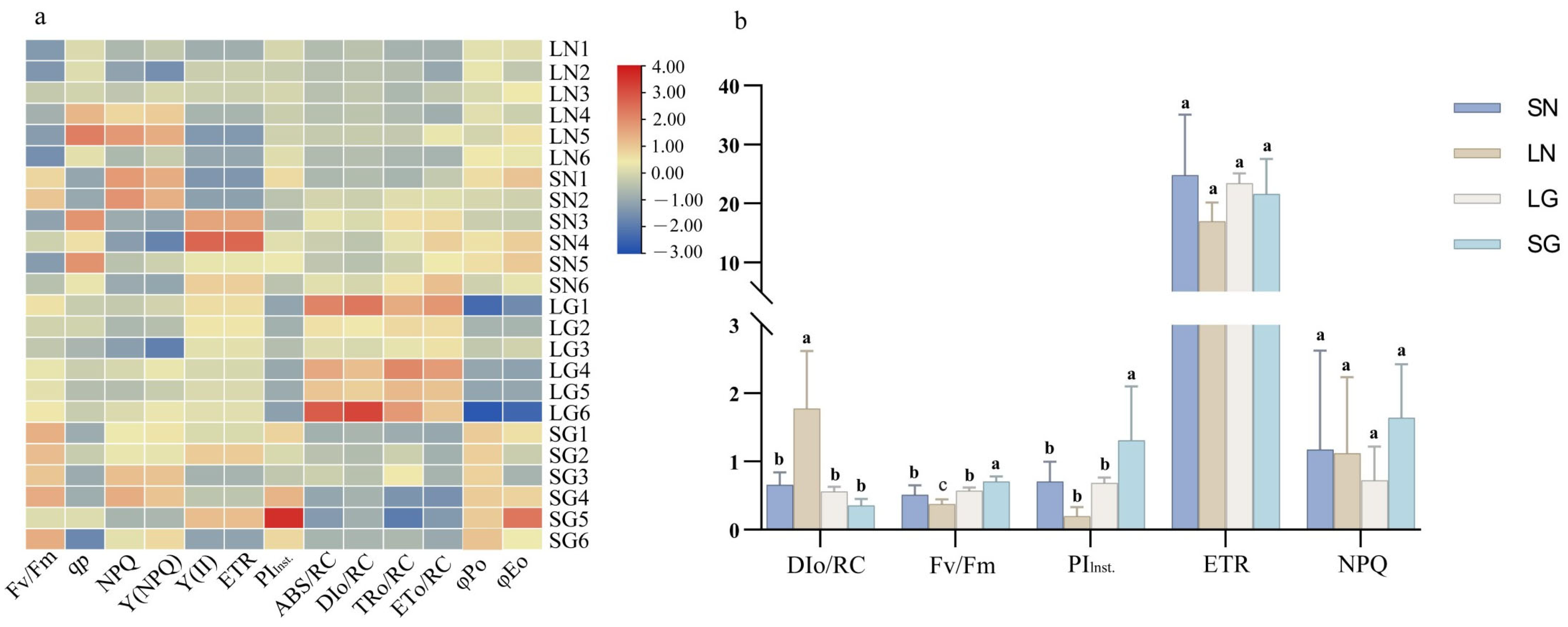
The photosynthetic performance of E. sagittatum varied markedly across the different treatment groups. Analysis of key parameters showed that φPo and PIInst. were elevated in SG, where PIInst. was significantly the highest. Fv/Fm was significantly higher in SG than in SN, LG, and LN. Parameters linked to photodamage and energy overflow also showed distinct variation. TRo/RC and ETo/RC were highest in LN. φEo differed significantly, with the lowest value in LN and no differences among SN, LG, and SG. Some variations were observed between replicates in all groups. As a key photoprotective parameter, NPQ showed no significant differences among treatments (p > 0.05), though its values were numerically higher in the shaded treatments (SN, SG) than in LN and LG (Figure 1a). Figure 1b presents the changes in key chlorophyll fluorescence parameters. An integrated analysis of these parameters identified SG as the optimal treatment, with Fv/Fm close to the normal physiological level, the highest PIInst. and NPQ, and the lowest DIo/RC (Table S3).
The UpSet diagram illustrates the composition of soil bacterial communities in the rhizosphere (Figure S1). At the phylum level, 29 bacterial phyla were common across all four treatments, with no bacterial phylum being exclusive to any single treatment. At the genus level, 171 bacterial genera were shared among the four treatments. The SG treatment contained the highest number of unique bacterial genera at 23, while LN, SN, and LG had 16, 19, and 20 independent bacterial genera, respectively. These results indicate minimal differences in the relative abundance of bacterial phyla and genera across the different treatments, suggesting a degree of similarity in bacterial species composition.
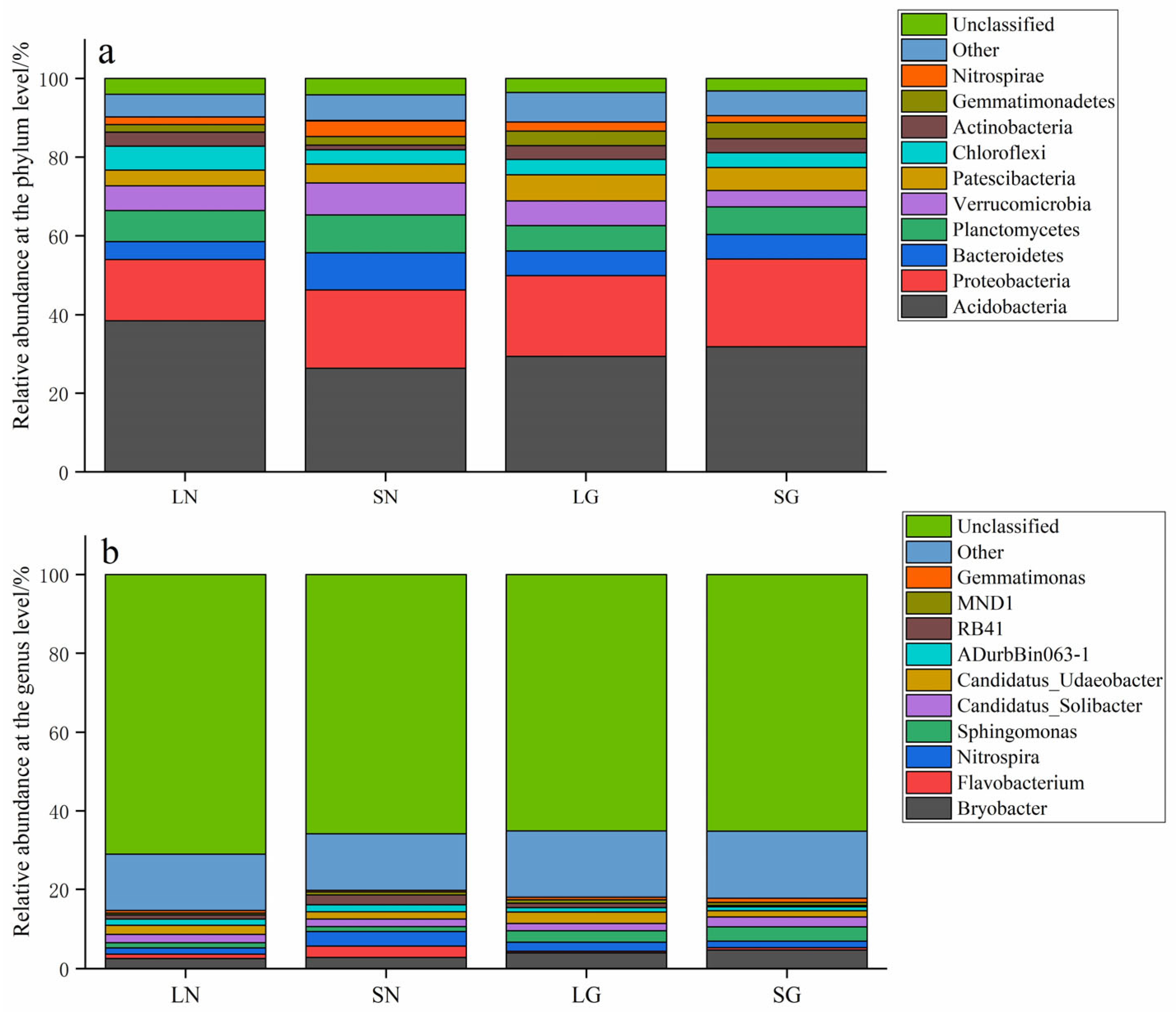
At the bacterial phylum level, dominant phyla with higher relative abundance included Acidobacteria, Proteobacteria, Bacteroidetes, Planctomycetes, Verrucomicrobia, Patescibacteria, Chloroflexi, Actinobacteria, Gemmatimonadetes, and Nitrospirae (Figure 2a). Under the LN treatment, Acidobacteria and Chloroflexi showed a greater relative abundance compared to the other three treatments, whereas Proteobacteria and Bacteroidetes were comparatively lower. In the SN treatment, Bacteroidetes and Nitrospirae exhibited the highest abundance, while Actinobacteria showed the lowest. For the LG treatment, the relative abundances of Acidobacteria and Chloroflexi were lower than those in LN but higher than in SN and SG, and the abundance of Cyanobacteria was the highest among the four treatments. As for the SG treatment, the abundances of Bacteroidetes and Nitrospirae were lower than those in SN but higher than in LN and LG, and the abundance of Acidobacteriales and Alphaproteobacteria were significantly higher than in other treatments.
At the genus level, the relative abundance was higher for taxa such as Bryobacter, Flavobacterium, Nitrospira, Sphingomonas, Candidatus Solibacter, Candidatus Udaeobacter, ADurbBin063-1, RB41, MND1, and Gemmatimonas (Figure 2b). Notably, Flavobacterium abundance was significantly higher under the SN treatment, whereas RB41 abundance was significantly reduced in the SG treatment.

3.2. LEfSe Analysis of Bacterial Communities in the Rhizosphere Soil of E. sagittatum Under Different Treatments

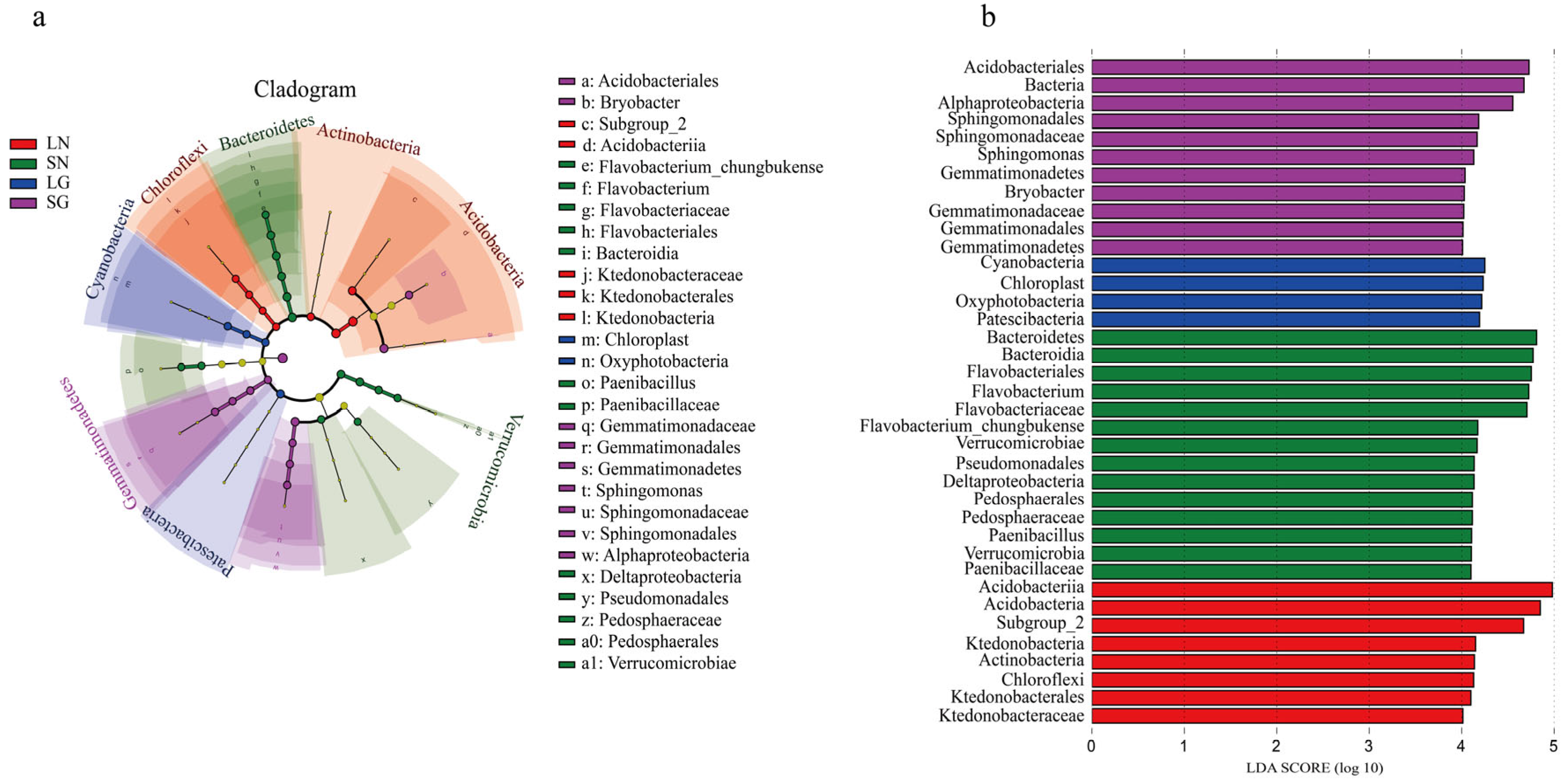
LEfSe analysis (LDA score > 4.0, p < 0.05) revealed significant differences in bacterial taxa present in the rhizosphere soil of E. sagittatum across different treatments (Figure 3). Specifically, 8, 14, 4, and 11 bacterial taxa were significantly enriched under LN, SN, LG, and SG treatments, respectively; shading treatments exhibited broader taxonomic differentiation than full-light conditions. The dominant bacterial groups under LN treatment included Acidobacteria, and Acidobacteria Subgroup 2. In the SN treatment, the predominant bacteria were Bacteroidetes, Bacteroidia, Flavobacteriales, Flavobacterium, and Flavobacteriaceae. The LG treatment was significantly enriched with Cyanobacteria, Oxyphotobacteria and Patescibacteria, whereas the SG treatment was characterized by a higher relative abundance of Acidobacteriales and Alphaproteobacteria.

3.3. Soil Bacterial Community Diversity and Function

The Alpha diversity of bacteria in the rhizosphere soil of E. sagittatum was comprehensively assessed using the Sobs, Shannon, Simpson, Chao1, and ACE indices. As indicated in Table 1, these indices were all higher in the SN treatment group compared to the other groups. Specifically, the Sobs, ACE, and Chao1 indices followed the order: SN > LN > LG > SG, while the Shannon index was ranked as SN > LG > LN > SG. The Simpson index also reached its highest value under SN treatment. These results indicate that the SN treatment resulted in the highest bacterial community abundance in the soil, whereas the SG treatment had the lowest bacterial community abundance.
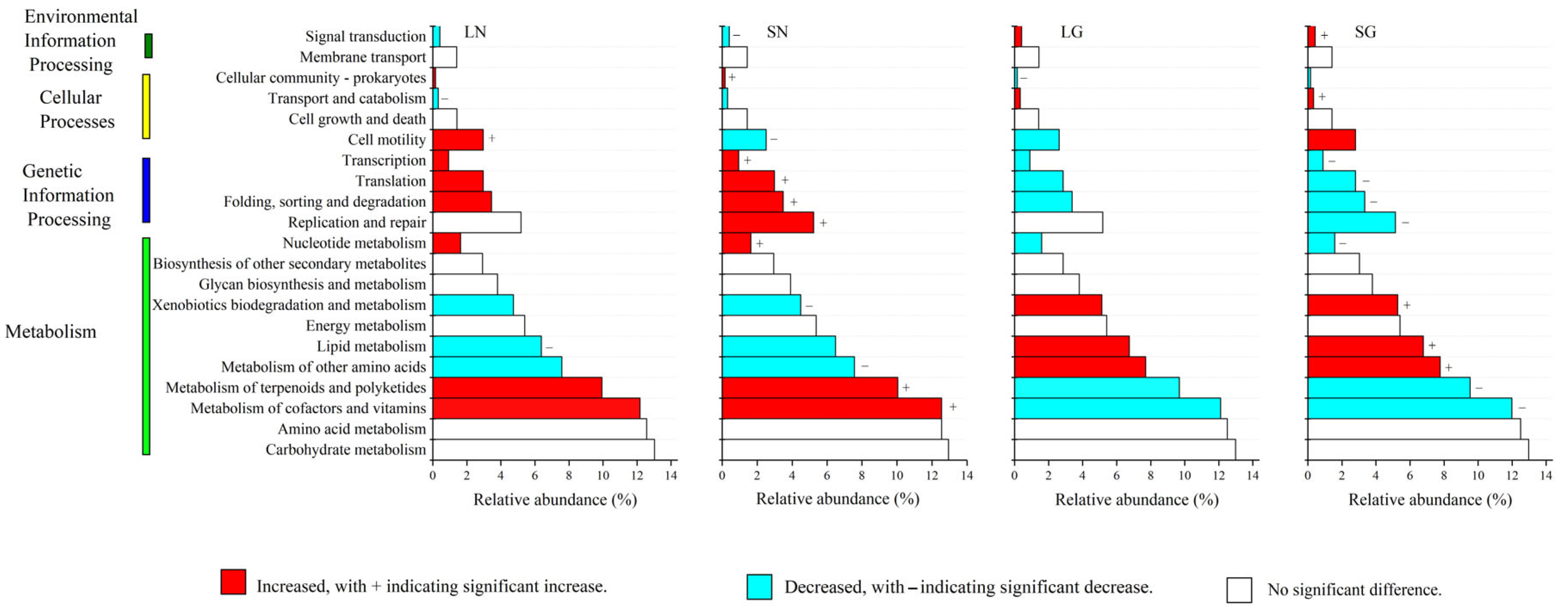
Tax4Fun2 was used to functionally annotate four Level 1 functional categories and twenty-two Level 2 functional subcategories, as illustrated in Figure 4. ANOVA of secondary metabolic pathways revealed that the LN and SN treatments had significantly higher abundances in several pathways, including translation, transcription, folding, sorting and degradation, metabolism of terpenoids and polyketides, metabolism of cofactors and vitamins, nucleotide metabolism, and cellular community-prokaryotes. Conversely, the LG and SG treatments were more enriched in pathways related to signal transduction, transport and catabolism, xenobiotic biodegradation and metabolism, lipid metabolism, and metabolism of other amino acids. Moreover, the replication and repair pathway was significantly enriched in the SN treatment (p < 0.05), while the cell motility pathway showed a significant increase in the LN treatment (p < 0.05).

3.4. Key Environmental Factors Influencing the Spatial Variation of Soil Bacterial Communities

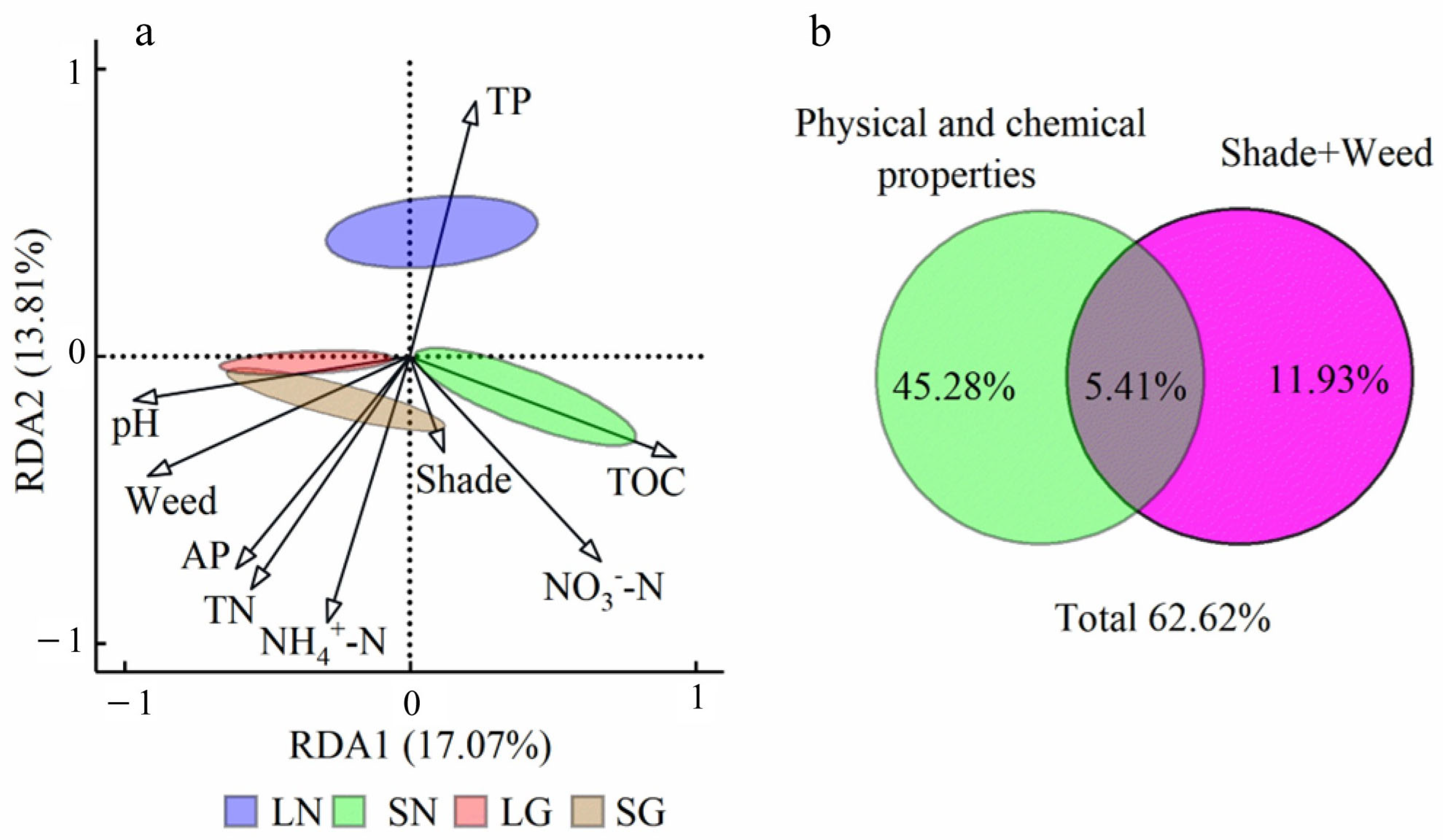
RDA plots were employed to identify the key environmental drivers by illustrating the relative impacts of different environmental variables on biocenosis. The analysis of RDA results across different treatments and soil physicochemical properties revealed that the LN treatments were clustered away from the other treatments along the second axis (Figure 5a). On the first axis, the remaining three treatments were grouped into separate clusters. Additionally, soil pH, soil NO3-N content, and shading conditions significantly influenced the bacterial community structure, accounting for 75.70% of the variation in the first two principal component axes, which were the primary environmental factors shaping the soil bacterial community composition. VPA explained the contribution of environmental factors to changes in microbial communities (Figure 5b). Of the changes, 45.28% were attributed to soil physicochemical properties, 11.93% to shade and weeds, and 5.41% to the combined effect of both.

3.5. Correlations Among Bacterial Communities, Nitrogen Cycling, and Soil Properties

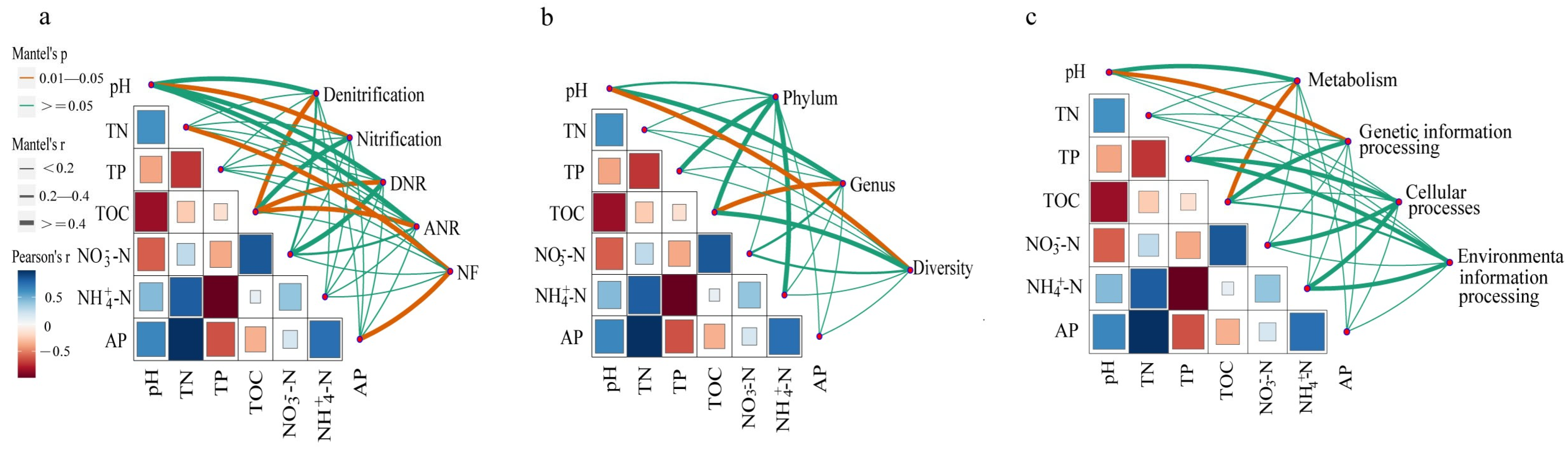
The Mantel test was employed to assess correlations among bacterial community composition, functional traits, nitrogen cycling processes, and various environmental indices (Figure 6). The results revealed that soil nitrogen cycling functions—specifically denitrification, dissimilatory nitrate reduction, and assimilatory nitrate reduction—were significantly correlated with TOC. Nitrification showed a significant correlation with soil pH, while nitrogen fixation was significantly correlated to TN and AP. However, NO3-N, AP, and TP did not show any significant correlations with nitrogen cycle-related genes. Bacterial metabolic diversity and genus-level diversity were significantly correlated to TOC. Additionally, the genetic information processing pathways of soil bacterial community functions were significantly correlated to pH levels. There were no significant correlations between cellular processes and environmental information processing pathways and the soil physicochemical properties. Furthermore, bacterial community diversity was significantly correlated with soil pH, while bacterial phylum-level diversity did not show a significant correlation with any measured soil properties.

3.6. Determination of Functional Genes in Soil Nitrogen Cycling

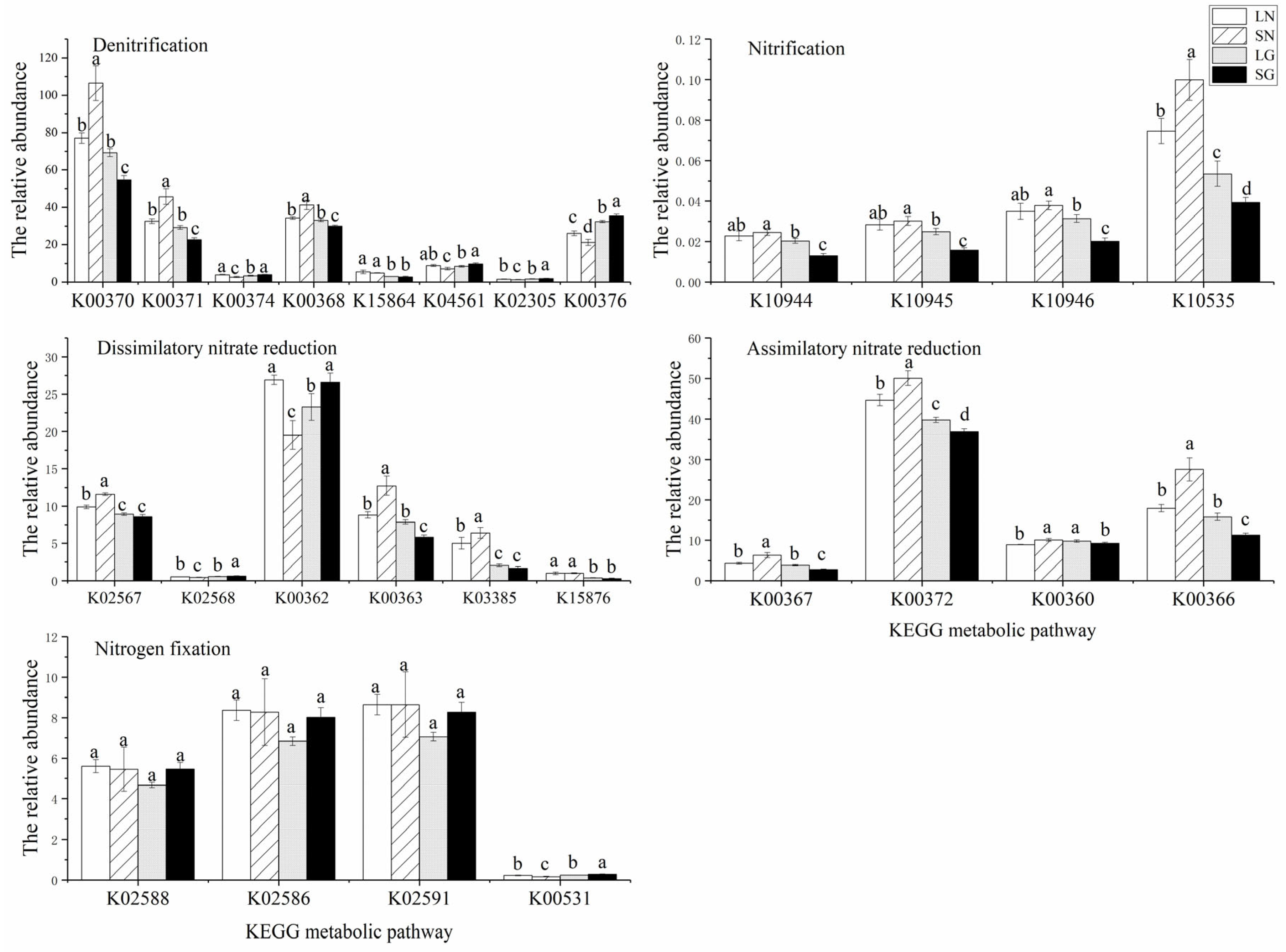
The expression of functional genes involved in nitrogen cycling pathways was distinctly modulated by the different treatments (Figure 7). Under the SN treatment, the expression levels of denitrification-related genes K00370 (narG/narZ/nxrA), K00371 (narH/nary/nxrB), and K00368 (nirK) typically increased in soil. However, the expression of other denitrification genes—K00374 (narI, narV), K04561 (norB), K02305 (norC), and K00376 (nosZ)—was lower compared to the other three treatments. Under the SG treatment, the expression levels of K00370, K00371, and K00368 functional genes related to denitrification decreased, while the expression level of the K00376 functional gene increased.

3.7. Co-Occurrence Network Analysis of the Relative Abundance of Bacterial Communities in Rhizosphere Soil

This study examined the symbiotic relationships and community complexity of bacterial communities under different treatment conditions, focusing on OTU levels and network topology properties to explore the interaction mechanisms among microbial taxa in complex microbial communities. As outlined in Table 2, the rhizosphere bacterial communities subjected to weed-proof treatments (LG and SG) exhibited a higher number of vertices compared to those under non-weed-proof treatments (LN and SN). Additionally, the shading treatments (SN and SG) showed higher values for edges, average degree, density, and positive links than the full-light treatments (LN and LG). These findings suggest that shading treatment, as opposed to full light treatment, enhanced the complexity of the rhizosphere microbial network in E. sagittatum, promoting closer and more cooperative interactions among bacterial taxa.

3.8. Assembly of Bacterial Communities in the Rhizosphere Soil of E. sagittatum Under Different Treatments

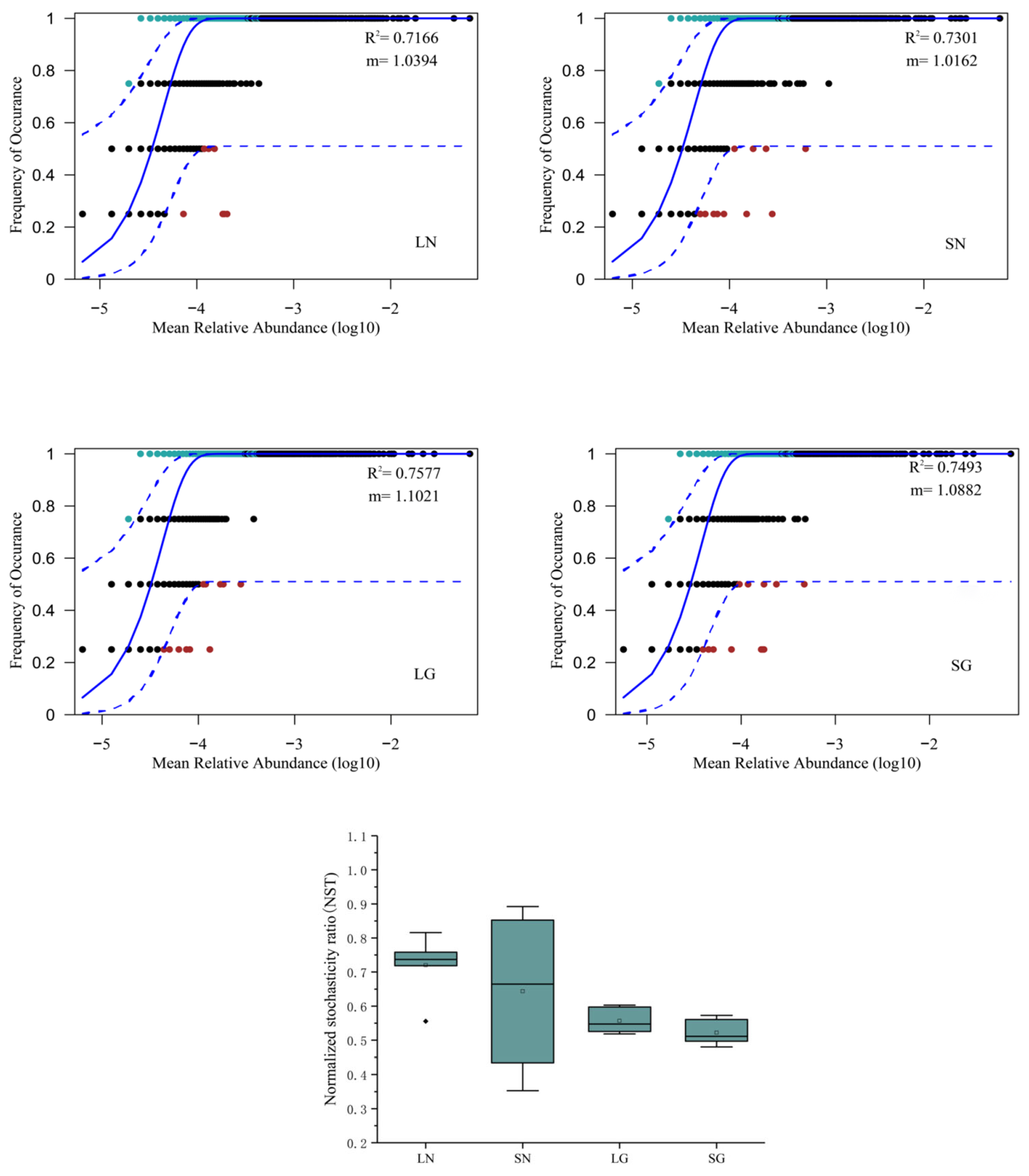
In order to evaluate the influence of deterministic and random processes on the assembly of bacterial communities in the rhizosphere soil of E. sagittatum, an NCM fitting analysis of the soil bacterial community assembly process was carried out (Figure 8). The results showed that the treatment with weed control fabric mulch accounted for more variation in the bacterial community compared to the uncovered treatment. NST analysis revealed that the stochastic process played a predominant role in shaping the bacterial community in the rhizosphere of E. sagittatum. Among the different treatments, the influence of the stochastic process followed the order LN > SN > LG > SG, while the contribution of the deterministic process gradually increased, indicating shifted microbial community assembly mechanisms.

3.9. Changes in the Active Compounds and Soil Physicochemical Properties of E. sagittatum

The content of active compounds in E. sagittatum is listed in Table 3. Epimedin A levels were highest under full light treatments (LG and LN), while epimedin B and icariin reached their peak concentrations in the SN treatment. The LG treatment resulted in the lowest levels of epimedin C and total active components, whereas the SG treatment produced the highest levels of both epimedin C and total active components.
The physicochemical properties of the rhizosphere soil of E. sagittatum across treatments exhibited notable differences (Table 4). The SG treatment significantly increased soil pH and NH4+-N, but decreased TP and NO3-N. In contrast, the SN treatment significantly increased TOC and NO3-N. The LG treatment significantly enhanced TN and AP contents, while the LN treatment significantly raised TP but decreased the content of TN, NH4+-N, and AP.
Table 5. Two-way ANOVA on the effects of light and weed barrier fabric on the bioactive constituents in E. sagittatum.
Dependent VariableF
Epimedin AEpimedin BEpimedin CIcariinTotal Content
Light14.01 **90.14 **1022.31 **112.95 **236.69 **
Cover6.07 *1.33151.12 **2.2510.74 *
Light × Cover3.48237.14 **1524.67 **8.22 *13.28 **
* and ** indicate significant correlations at 0.05 and 0.01 levels, respectively.
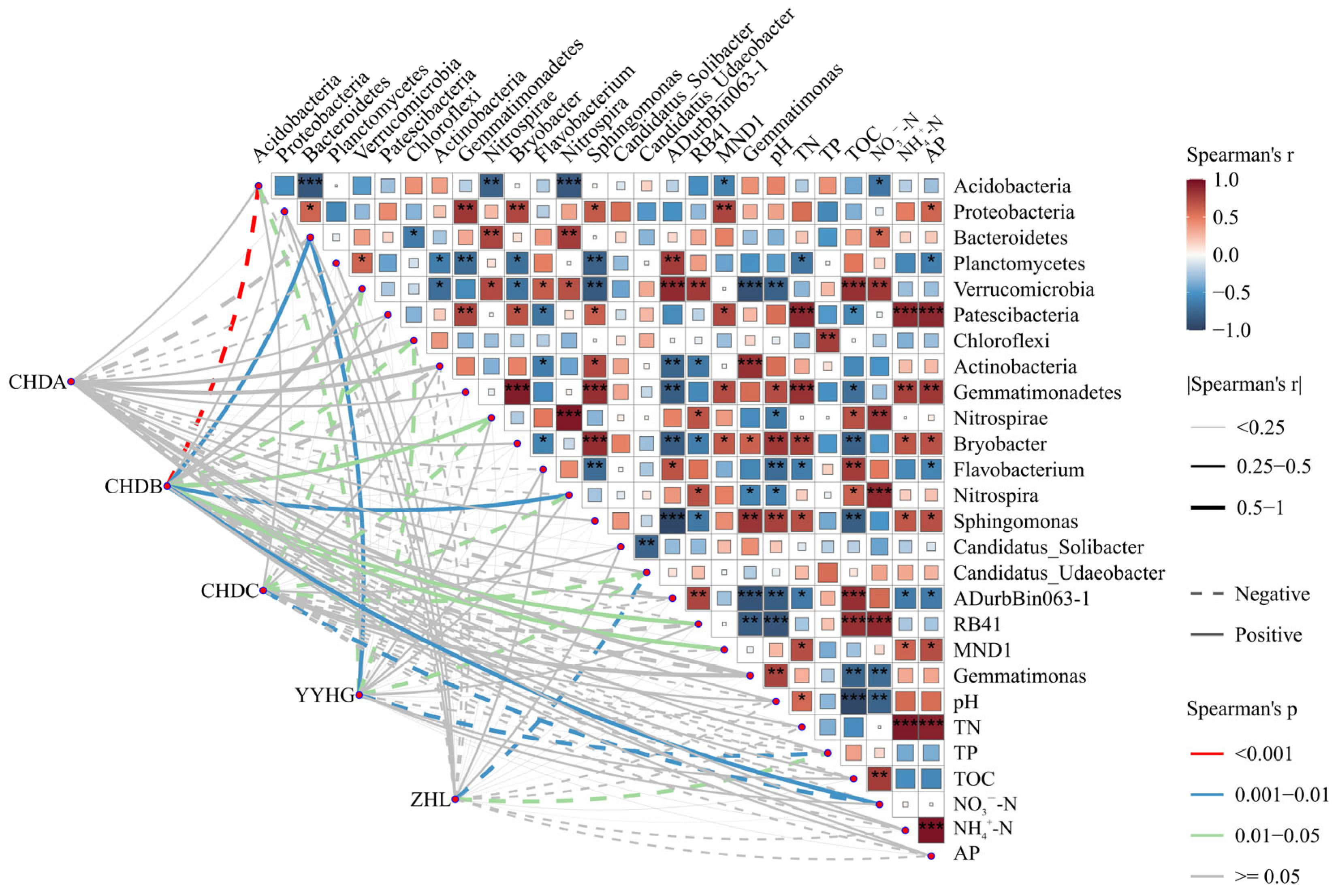
To further explore the relationship between soil environmental factors and the active compound concentration in E. sagittatum, as well as the correlations among soil environmental factors, Spearman correlation analysis was applied. This analysis helped construct a model linking the active compounds in E. sagittatum with key soil ecological factors, including the top ten bacterial taxa (at the phylum and genus levels) based on their physicochemical characteristics and relative abundance. As depicted in Figure 9, epimedin B content exhibited significant negative correlations with Acidobacteria and Chloroflexi, and significant positive correlations with Bacteroidetes, Nitrospirae, Nitrospira, RB41, MND1, and NO3-N. Epimedin C content was significantly negatively correlated with Verrucomicrobia, Nitrospirae, Nitrospira, Candidatus Udaeobacter, and NO3-N. Meanwhile, icariin content showed a significant positive correlation with Bacteroidetes, and negative correlations with Chloroflexi, Candidatus Udaeobacter, and TP. The total concentration of active compounds showed a significant negative correlation with both Candidatus Udaeobacter and TP. Soil pH was negatively correlated with Verrucomicrobia, Nitrospirae, Flavobacterium, Nitrospira, ADurbBin063-1, and RB41, but positively correlated with Gemmatimonadetes, Bryobacter, Gennatimonas, and Sphingomonas. TN was negatively correlated with Planctomycetes, Flavobacterium, and ADurbBin063-1, while showing positive correlations with Patescibacteria, Gemmatimonadetes, Bryobacter, pH, and MND1. TOC was significantly positively correlated with Verrucomicrobia, Nitrospirae, Flavobacterium, Nitrospira, ADurbBin063-1, and RB41, but negatively correlated with Patescibacteria, Gemmatimonadetes, Bryobacter, Sphingomonas, pH, and Gemmatimonas. NO3-N showed positive correlations with Bacteroidetes, Verrucomicrobia, Nitrospirae, Nitrospira, TOC, and RB41. NH4+-N and AP were positively correlated with Patescibacteria, Gemmatimonadetes, Bryobacter, Sphingomonas, and MND1.

4. Discussion

4.1. SG Treatment Enhances Photosynthetic Performance in E. sagittatum

Chlorophyll fluorescence parameters, such as Fv/Fm and Y(II), are effective indicators of PSII photochemical efficiency and photoprotection, providing rapid assessment of plant photosynthetic performance and stress responses [25,26]. While NPQ is recognized for its key role in dissipating excess energy as heat under high-light stress, our findings revealed a more nuanced picture. Shading treatments (SN, SG) did not universally improve photosynthetic parameters. Only SG stood out with higher Fv/Fm, PIInst., and φPo. φPo further exhibited a clear gradient: SG > SN and LG > LN, confirming LNs severely suppressed maximum PSII quantum yield. Meanwhile, Y(II), ETR, and φEo showed no consistent differences between shading and full sunlight treatments, which partially aligns with prior observations on shade-adapted medicinal plants [27].
The optimal performance of SG, characterized by higher values of Fv/Fm, PIInst., and φPo alongside lower energy dissipation, points to a highly efficient energy-use strategy. This is supported by the ABS/RC and DIo/RC data: LN showed significantly higher values for both parameters than the other three treatments, while SG, SN, and LG maintained lower and statistically similar levels. This pattern indicates that LN suffered from excess energy input and inefficient dissipation, whereas SG minimized energy loss by reducing absorption and dissipation per reaction center. We propose that the shade cloth directly alleviated photoinhibition pressure, a common stressor for understory plants under high light [26]. The fabric mulch likely contributed to this optimization indirectly by conserving soil moisture and stabilizing the root zone environment [28]. Consequently, the synergy in SG emerges from the combined effects of direct physiological relief provided by shading and the indirect, soil-mediated stability afforded by mulching.

4.2. Soil Microbial Community Composition and Influences of Environmental Conditions

Soil microorganisms, primarily bacteria, fungi, and microfauna such as protozoa and nematodes [29], form complex communities critical for soil health. Bacterial diversity, in particular, reflects soil resilience, nutrient cycling, and overall fertility. Management practices, along with environmental factors like light exposure and weed control methods, substantially influence microbial community structure and function [30]. Our study revealed that shaded environments with manual weed removal (SN) foster significantly higher microbial diversity and richness indices. Higher microbial diversity is often linked to greater functional redundancy and ecosystem stability [31], indicating a more resilient soil ecosystem. Conversely, full sunlight coupled with weed-control fabric mulch (LN) led to reduced diversity and richness, likely due to alterations in soil physicochemical properties—such as pH, nutrient levels, and moisture—that limit microbial heterogeneity [32].
In LN-treated soils, the relative abundances of Acidobacteria and Chloroflexi were significantly elevated. Certain Chloroflexi are capable of degrading refractory organic compounds, contributing to complex carbon decomposition [33]. Acidobacteria are often considered oligotrophs [34], thriving in nutrient-poor conditions, which aligns with the lower TN and AP we observed in LN soils. The enrichment of Chloroflexi, some members of which are involved in degrading complex organic matter [32], might indicate a carbon cycle geared towards decomposition rather than nutrient mobilization. Although genes associated with nitrate assimilation were upregulated, the actual soil nitrogen pools (TN, NH4+-N, NO3-N) remained low. This discrepancy indicates inefficiencies in nitrogen transformation and a tight immobilization of available nitrogen. Collectively, these findings depict an LN-driven ecosystem where carbon and nitrogen cycling are decoupled, which limits plant-available nitrogen and could increase the risk of nutrient leaching under high-light, mulch-covered conditions.

4.3. SN Treatment Enhances Microbial Diversity and Activity

The SN treatment consistently demonstrated higher microbial diversity metrics—Sobs, Shannon, Simpson, Chao1, and ACE indices—and a more complex, interconnected microbial network. Soil properties like pH, NO3-N, and shading levels were key drivers shaping bacterial community structure. These observations demonstrate that shaded environments with manual weed control foster a soil ecosystem with exceptionally high microbial species diversity and evenness, reflecting a healthy and stable ecosystem endowed with strong resistance and resilience to disturbances. These findings align with previous observations that shading alters soil microbial communities [35]. The underlying mechanism is that shading reduces air circulation, lowers soil temperature, and increases humidity. This modified microclimate, in turn, alters soil physicochemical properties and directly influences the structure and diversity of the soil microbial community [36].
Flavobacterium, along with elevated populations of Bacteroidetes and Nitrospirae, plays a critical role in plant microbial communities. Flavobacterium, a genus known for its ability to decompose complex organic compounds like cellulose and chitin [37], was a key beneficiary in the SN treatment. In our study, the abundance of Flavobacterium showed significant negative correlations with soil pH, TN, and AP but a noteworthy positive correlation with TOC. This specific ecological niche suggests that Flavobacterium thrives in the high-organic-carbon, low-nutrient-status environment shaped by shading and manual weeding, positioning it as an integral node in the microbial network that contributes to plant health and metabolite synthesis [38]. Critically, the enrichment of Flavobacterium and other Bacteroidetes has been linked to enhanced plant growth and stress resistance through the provision of vitamins, phytohormones, and bioavailable nutrients [38], establishing a plausible microbial bridge between management practices and plant performance.
The SN treatment, by creating a shaded environment, enhanced soil moisture and NO3-N levels, favoring nitrifying bacteria like Nitrospirae [39]. Concurrently, the proliferation of Bacteroidetes—key players in decomposing organic matter—facilitates the production of small-molecule organic acids [40]. These compounds can act as carbon skeletons or signaling molecules, potentially directly promoting the synthesis of specific flavonoids such as epimedin B and icariin. This functional shift, supported by the upregulation of nitrogen-cycling genes, drove rapid nitrogen transformation. The resulting increase in bioavailable nitrogen likely supplies both substrates and energy for the synthesis of secondary metabolites in E. sagittatum. Furthermore, manual weeding may improve soil aeration, sustaining the activity of these key bacteria [41]. Co-occurrence network analysis confirmed that SN treatment fostered stronger cooperative interactions and a more stable bacterial community. Ultimately, SN treatment enriches beneficial microbes like Flavobacterium and synergistically creates a rhizosphere microenvironment optimized for enhancing medicinal quality.

4.4. Enhanced Nitrogen Cycle Gene Expression and Microbial Metabolism Under SN Treatment

Building on the observation that SN treatment enhances nitrogen cycling, gene expression analyses confirmed that soil under SN treatment exhibited an upregulation of pathways involved in nitrification, denitrification, and nitrate reduction—both dissimilatory and assimilatory. These processes facilitate the transformation of nitrogen into bioavailable forms, supporting plant nitrogen uptake and secondary metabolite synthesis. Active nitrogen cycling increases soil nitrogen pools (NH4+, NO3), thereby creating a nutrient-rich environment conducive to metabolic activities essential for plant growth and compound biosynthesis, such as icariin.
Furthermore, the abundance of key cellular processes such as translation, transcription, folding, sorting and degradation under the SN treatment reflected active biological activity. The elevated presence of functional categories like terpenoid and polyketides metabolism, cofactors and vitamins metabolism, and nucleotide metabolism highlights the robust ability of the microorganisms to synthesize complex molecules, which are essential for supporting plant growth and maintaining soil health [11]. Weed management practices have a significant impact on soil properties, as well as the composition and diversity of microbial communities. Artificial weeding tends to enhance microbial diversity and increases TOC levels in the soil. In contrast, prolonged usage of weed-proof cloth mulch can reduce soil air permeability and thermal conductivity [42], indirectly influencing bacterial community structure and interspecific interactions through changes in TOC and soil temperature. At the same time, long-term mulching contributes to plastic accumulation in the soil and promotes the growth of specific microbial communities on the plastic residue film, which ultimately reduces the diversity of microbial communities [4].

4.5. Light Intensity Modulates Medicinal Components in E. sagittatum

Light plays a pivotal role in regulating plant secondary metabolite biosynthesis. Multiple studies have demonstrated that optimal secondary metabolite accumulation is often achieved under specific light intensities tailored to species’ requirements [43]. For example, Mahonia breviracema yields higher alkaloids under 30–50% sunlight, while Glechoma longituba produces more ursolic and oleanolic acids at 16–33% light [44,45].
In our study, E. sagittatum grown under full sunlight with manual weed control had the highest levels of epimedin A. This suggests that the biosynthesis of epimedin A might be stimulated by high-light stress, possibly as part of a protective antioxidant response [46]. Conversely, shading combined with weed-control fabric mulch elevated epimedin C and total active compounds, while shaded conditions with manual weeding favored increased levels of epimedin B and icariin. These differential responses highlight that specific flavonoid branches are regulated independently by light and rhizosphere conditions [47]. We hypothesize that the SG treatment, by optimizing photosynthesis, provides abundant carbon skeletons that favor the synthesis of certain flavonoids like epimedin C [48]. In contrast, the SN treatment, through its specialized microbiome and enhanced nitrogen cycling, creates a unique physiological and nutritional state that preferentially shunts resources towards epimedin B and icariin synthesis.

4.6. Ecological Considerations for Sustainable Cultivation

Although our study demonstrates agronomic benefits of weed-control fabric mulch (for example, the SG treatment) for certain medicinal components, its potential ecological drawbacks must be acknowledged for long-term sustainability. Our data provide direct evidence for this trade-off: the use of weed-control fabric mulch (LG and SG) was consistently associated with reduced soil microbial diversity and richness. This observation aligns with broader concerns that prolonged use of polypropylene-based mulches can impair soil aeration and thermal conductivity and promote microplastic accumulation, ultimately reducing soil biodiversity [4,49]. Such effects compromise soil health and resilience over time and therefore constitute a significant sustainability limitation. Future management of E. sagittatum should balance short-term productivity goals with long-term soil ecosystem stability, for example by evaluating biodegradable mulches, rotating or periodically removing plastic mulch, and integrating alternative weed-management practices [50].

5. Conclusions

This study demonstrates that the interaction between light and weed control steers the growth and medicinal quality of E. sagittatum via plant–soil–microbe feedback. We identified two distinct optimization pathways: the SG treatment enhanced photosynthesis and total active compounds (especially epimedin C). In contrast, SN fostered a specialized soil microbiome with elevated diversity and reinforced nitrogen cycling, creating a rhizosphere that preferentially boosted epimedin B and icariin production—a strategy for premium quality. However, the observed decline in microbial diversity under fabric mulch highlights a critical sustainability trade-off. Consequently, tailoring light and weed management offers a precise framework for directing phytochemical profiles in medicinal plants. Our findings highlight the rhizosphere microbiome as a key mediator of agricultural practices on plant metabolism. Future research should decipher the mechanisms by which key taxa like Flavobacterium influence flavonoid synthesis and explore biodegradable mulches to protect soil biodiversity.

Supplementary Materials

The following supporting information can be downloaded at: https://www.mdpi.com/article/10.3390/horticulturae11111408/s1, Figure S1: UpSet diagrams illustrating soil bacterial communities. (a) phylum level. (b) genus level; Table S1: Climatic dynamic data of Ningqiang County from October 2020 to May 2022; Table S2: Physicochemical Properties of Primary Forest Soil; Table S3: Summary of chlorophyll fluorescence parameter values.

Author Contributions

The authors confirm contribution to the paper as follows: draft manuscript preparation: X.L., Y.X., Z.J. and J.G.; data collection and project administration: N.W., B.L. and W.Z.; analysis and interpretation of results: N.W., Y.C. and F.Y.; experiments performed and funding acquisition: N.W., J.G. and J.S.; revised manuscript preparation: G.Z. and J.S. All authors have read and agreed to the published version of the manuscript.

Funding

This research was funded by the National Key Research and Development Program of China (2021YFD1601004), Scientific Research Program Funded by Shaanxi Provincial Education Department (22JC028), Natural Science Basic Research Project of Shaanxi Provincial Department of Science and Technology (2024JC-YBMS-751), and the open foundation of Shaanxi University of Chinese Medicine state key laboratory of R&D of Characteristic Qin Medicine Resources (QY202104).

Data Availability Statement

The data used and analyzed in the current study are available from the corresponding author on reasonable request.

Conflicts of Interest

The authors declare that they have no conflict of interest.

Abbreviations

The following abbreviations are used in this manuscript:
Fv/FmMaximum Photosynthetic Efficiency of PSII
qPPhotochemical Quenching Coefficient
NPQNon-Photochemical Quenching Coefficient
PIInst.Photosynthetic Performance Index
Y(NPQ)Non-Photochemical Quenching Yield
Y(II)Actual Photochemical Efficiency of PSII
ETRElectron Transport Rate of PSII
ABS/RCLight Energy Absorbed per Reaction Center
DIo/RCEnergy Dissipation per Reaction Center
TRo/RCLight Energy Trapped per Reaction Center for QA Reduction
ETo/RCLight Energy Used for Electron Transport per Reaction Center
φEoElectron Transfer Efficiency
φPoPrimary Light Energy Conversion Efficiency

References

  1. Zhong, H.L.; Sai, N.Y.; Bin, D.; You, Q.L.; Shi, F. A systematic review on quality control of Epimedium sagittatum. Pak. J. Agric. Sci. 2022, 59, 729–737. [Google Scholar] [CrossRef]
  2. Agrawal, N.; Goyal, D.; Bansal, D. A comprehensive review on chemistry and contribution of Chinese herb Epimedium brevicornum Maxim in medicine. Curr. Tradit. Med. 2024, 10, 102–114. [Google Scholar] [CrossRef]
  3. Deng, A.P.; Fang, W.T.; Zhou, Q.G.; Yang, H.J.; Wang, L.; Nan, T.G.; Kang, L.P.; Guo, L.P.; Huang, L.Q.; Zhan, Z.L. Research actuality and quality-influencing factor of Epimedii Folium. China J. Chin. Mater. Medica 2018, 43, 1062–1070. [Google Scholar] [CrossRef]
  4. Zhang, K.; Gao, N.; Li, Y.; Dou, S.; Liu, Z.; Chen, Y.; Ma, C.; Zhang, H. Responses of maize (Zea mays L.) seedlings growth and physiological traits triggered by polyvinyl chloride microplastics is dominated by soil available nitrogen. Ecotoxicol. Environ. Saf. 2023, 252, 114618. [Google Scholar] [CrossRef]
  5. Yang, Q.; Pan, J.; Shen, G.; Guo, B. Yellow light promotes the growth and accumulation of bioactive flavonoids in Epimedium pseudowushanense. J. Photochem. Photobiol. B Biol. 2019, 197, 111550. [Google Scholar] [CrossRef]
  6. Martin, B.C.; Gleeson, D.; Statton, J.; Siebers, A.R.; Grierson, P.; Ryan, M.H.; Kendrick, G.A. Low light availability alters root exudation and reduces putative beneficial microorganisms in seagrass roots. Front. Microbiol. 2018, 8, 2667. [Google Scholar] [CrossRef]
  7. Praeg, N.; Illmer, P. Microbial community composition in the rhizosphere of Larix decidua under different light regimes with additional focus on methane cycling microorganisms. Sci. Rep. 2020, 10, 22324. [Google Scholar] [CrossRef]
  8. Hou, S.; Thiergart, T.; Vannier, N.; Mesny, F.; Ziegler, J.; Pickel, B.; Hacquard, S. A microbiota–root–shoot circuit favours Arabidopsis growth over defence under suboptimal light. Nat. Plants 2021, 7, 1078–1092. [Google Scholar] [CrossRef]
  9. Gonin, M.; Salas-González, I.; Gopaulchan, D.; Frene, J.P.; Roden, S.; Van de Poel, B.; Salt, D.E.; Castrillo, G. Plant microbiota controls an alternative root branching regulatory mechanism in plants. Proc. Natl. Acad. Sci. USA 2023, 120, e2301054120. [Google Scholar] [CrossRef]
  10. Huang, W.; Long, C.; Lam, E. Roles of plant-associated microbiota in traditional herbal medicine. Trends Plant Sci. 2018, 23, 559–562. [Google Scholar] [CrossRef]
  11. Köberl, M.; Schmidt, R.; Ramadan, E.M.; Bauer, R.; Berg, G. The microbiome of medicinal plants: Diversity and importance for plant growth, quality and health. Front. Microbiol. 2013, 4, 400. [Google Scholar] [CrossRef]
  12. Bag, S.; Mondal, A.; Majumder, A.; Mondal, S.K.; Banik, A. Flavonoid mediated selective cross-talk between plants and beneficial soil microbiome. Phytochem. Rev. 2022, 21, 1739–1760. [Google Scholar] [CrossRef]
  13. Zhang, J.; Zhou, D.; Yuan, X.; Xu, Y.; Chen, C.; Zhao, L. Soil microbiome and metabolome analysis reveals beneficial effects of ginseng–celandine rotation on the rhizosphere soil of ginseng-used fields. Rhizosphere 2022, 23, 100559. [Google Scholar] [CrossRef]
  14. Corneo, P.E.; Pellegrini, A.; Cappellin, L.; Gessler, C.; Pertot, I. Weeds influence soil bacterial and fungal communities. Plant Soil 2013, 373, 107–123. [Google Scholar] [CrossRef]
  15. Petit, S.; Cordeau, S.; Chauvel, B.; Bohan, D.; Guillemin, J.-P.; Steinberg, C. Biodiversity-based options for arable weed management. A review. Agron. Sustain. Dev. 2018, 38, 48. [Google Scholar] [CrossRef]
  16. Gurmessa, B.; Udawatta, R.P.; Rambadagalla, R.T.; Reinbott, T. Soil bacterial communities benefit from long-term cover crop mixtures. Eur. J. Soil Biol. 2025, 124, 103714. [Google Scholar] [CrossRef]
  17. Nunez-Elisea, R.; Cahn, H.; Caldeira, L.; Seavert, C.F. Polypropylene Row Covers Greatly Enhance Growth and Production of Fourth-leaf Sweet Cherry Trees. HortScience 2005, 40, 1129A–1129. [Google Scholar] [CrossRef]
  18. Yu, S.Y.; Jiang, X.F.; Li, C.; Shi, X.P.; Ye, C.; Jiang, L.H.; Li, H.B.; Huang, S.S. Effects of different mulching materials on soil temperature and weed growth in tea gardens. Acta Agric. Univ. Jiangxiensis 2021, 33, 78–82. [Google Scholar] [CrossRef]
  19. Bao, S.D. Soil Agricultural Chemical Analysis, 3rd ed.; China Agricultural Press: Beijing, China, 2000. [Google Scholar]
  20. Lloret, S.M.; Andrés, J.V.; Legua, C.M.; Falcó, P.C. Determination of ammonia and primary amine compounds and Kjeldahl nitrogen in water samples with a modified Roth’s fluorimetric method. Talanta 2005, 65, 869–875. [Google Scholar] [CrossRef]
  21. Tong, Y.S.; Zhang, C.P.; Dong, Q.M.; Yang, Z.Z.; Zhang, X.F.; Huo, L.A.; Cao, Q.; Zhang, Z.S.; Yu, Y.; Yang, X.X. Effects of different forms of nitrogen addition on soil physical and chemical properties and microbial community structure of perennial alpine cultivated grassland. Huanjing Kexue 2024, 45, 3595–3604. [Google Scholar] [CrossRef]
  22. Stauffer, R.E. Determination of arsenic and phosphous compounds in groundwater with reduced molybdenum blue. Anal. Chem. 1983, 55, 1205–1210. [Google Scholar] [CrossRef]
  23. Chinese Pharmacopoeia Commission. Chinese Pharmacopoeia; China Medical Science and Technology Press: Beijing, China, 2020. [Google Scholar]
  24. Ye, Y.Q.; Hong, K.; Zhang, J.J.; Cao, G.Q.; Yang, Q.; Xu, S.H. Effects of aluminum stress on growth, photosynthetic characteristics and chloroplast ultrastructure in leaves of Cunninghamia lanceolata seedlings. J. Northeast For. Univ. 2020, 48, 7–11+16. [Google Scholar] [CrossRef]
  25. Shu, S.; Guo, S.-R.; Sun, J.; Yuan, L.-Y. Effects of salt stress on the structure and function of the photosynthetic apparatus in Cucumis sativus and its protection by exogenous putrescine. Physiol. Plant. 2012, 146, 285–296. [Google Scholar] [CrossRef]
  26. Baker, N.R. Chlorophyll fluorescence: A probe of photosynthesis in vivo. Annu. Rev. Plant Biol. 2008, 59, 89–113. [Google Scholar] [CrossRef] [PubMed]
  27. Dai, Y.; Shen, Z.; Liu, Y.; Wang, L.; Hannaway, D.; Lu, H. Effects of shade treatments on the photosynthetic capacity, chlorophyll fluorescence, and chlorophyll content of Tetrastigma hemsleyanum Diels et Gilg. Environ. Exp. Bot. 2009, 65, 177–182. [Google Scholar] [CrossRef]
  28. Baxter, L.L.; West, C.P.; Brown, C.P.; Green, P.E. Cover crop management on the Southern High Plains: Impacts on crop productivity and soil water depletion. Animals 2021, 11, 212. [Google Scholar] [CrossRef]
  29. Kibblewhite, M.G.; Ritz, K.; Swift, M.J. Soil health in agricultural systems. Philos. Trans. R. Soc. B Biol. Sci. 2008, 363, 685–701. [Google Scholar] [CrossRef] [PubMed]
  30. Muneer, M.A.; Hou, W.; Li, J.; Huang, X.; Kayani, M.U.R.; Cai, Y.; Yang, W.; Wu, L.; Ji, B.; Zheng, C. Soil pH: A key edaphic factor regulating distribution and functions of bacterial community along vertical soil profiles in red soil of pomelo orchard. BMC Microbiol. 2022, 22, 38. [Google Scholar] [CrossRef]
  31. Delgado-Baquerizo, M.; Maestre, F.T.; Reich, P.B.; Jeffries, T.C.; Gaitan, J.J.; Encinar, D.; Berdugo, M.; Campbell, C.D.; Singh, B.K. Microbial diversity drives multifunctionality in terrestrial ecosystems. Nat. Commun. 2016, 7, 10541. [Google Scholar] [CrossRef]
  32. Dai, L.; Zhang, G.; Yu, Z.; Ding, H.; Xu, Y.; Zhang, Z. Effect of drought stress and developmental stages on microbial community structure and diversity in peanut rhizosphere soil. Int. J. Mol. Sci. 2019, 20, 2265. [Google Scholar] [CrossRef]
  33. Li, J.; Qiu, C.; Liu, N.; Chen, X.; Zhang, Y.; Wang, C.; Qi, L.; Wang, S. Impact of biochar prepared at different pyrolysis temperatures on the methane production and microbial community structure of food waste anaerobic digestion. Int. J. Hydrogen Energy 2024, 96, 860–869. [Google Scholar] [CrossRef]
  34. Kalam, S.; Basu, A.; Ahmad, I.; Sayyed, R.; El-Enshasy, H.A.; Dailin, D.J.; Suriani, N.L. Recent understanding of soil acidobacteria and their ecological significance: A critical review. Front. Microbiol. 2020, 11, 580024. [Google Scholar] [CrossRef]
  35. Xi, N.; Bloor, J.M.; Wang, Y.; Chu, C. Contribution of conspecific soil microorganisms to tree seedling light responses: Insights from two tropical species with contrasting shade tolerance. Environ. Exp. Bot. 2019, 166, 103826. [Google Scholar] [CrossRef]
  36. Fu, J.; Luo, Y.; Sun, P.; Gao, J.; Zhao, D.; Yang, P.; Hu, T. Effects of shade stress on turfgrasses morphophysiology and rhizosphere soil bacterial communities. BMC Plant Biol. 2020, 20, 92. [Google Scholar] [CrossRef] [PubMed]
  37. Kolton, M.; Sela, N.; Elad, Y.; Cytryn, E. Comparative genomic analysis indicates that niche adaptation of terrestrial Flavobacteria is strongly linked to plant glycan metabolism. PLoS ONE 2013, 8, e76704. [Google Scholar] [CrossRef] [PubMed]
  38. Seo, H.; Kim, J.H.; Lee, S.-M.; Lee, S.-W. The plant-associated Flavobacterium: A hidden helper for improving plant health. Plant Pathol. J. 2024, 40, 251. [Google Scholar] [CrossRef]
  39. Hartmann, A.A.; Barnard, R.L.; Marhan, S.; Niklaus, P.A. Effects of drought and N-fertilization on N cycling in two grassland soils. Oecologia 2013, 171, 705–717. [Google Scholar] [CrossRef]
  40. Larsbrink, J.; McKee, L.S. Chapter Two—Bacteroidetes bacteria in the soil: Glycan acquisition, enzyme secretion, and gliding motility. Adv. Appl. Microbiol. 2020, 110, 63–98. [Google Scholar] [CrossRef]
  41. Lupwayi, N.Z.; Arshad, M.A.; Rice, W.A.; Clayton, G.W. Bacterial diversity in water-stable aggregates of soils under conventional and zero tillage management. Appl. Soil Ecol. 2001, 16, 251–261. [Google Scholar] [CrossRef]
  42. Qi, Y.; Beriot, N.; Gort, G.; Lwanga, E.H.; Gooren, H.; Yang, X.; Geissen, V. Impact of plastic mulch film debris on soil physicochemical and hydrological properties. Environ. Pollut. 2020, 266, 115097. [Google Scholar] [CrossRef]
  43. Zhang, S.; Zhang, L.; Zou, H.; Qiu, L.; Zheng, Y.; Yang, D.; Wang, Y. Effects of light on secondary metabolite biosynthesis in medicinal plants. Front. Plant Sci. 2021, 12, 781236. [Google Scholar] [CrossRef]
  44. Li, Y.; Kong, D.; Liang, H.-L.; Wu, H. Alkaloid content and essential oil composition of Mahonia breviracema cultivated under different light environments. J. Appl. Bot. Food Qual. 2018, 91, 171–179. [Google Scholar] [CrossRef]
  45. Zhang, L.; Guo, Q.; Chang, Q.; Zhu, Z.; Liu, L.; Chen, Y. Chloroplast ultrastructure, photosynthesis and accumulation of secondary metabolites in Glechoma longituba in response to irradiance. Photosynthetica 2015, 53, 144–153. [Google Scholar] [CrossRef]
  46. Akula, R.; Ravishankar, G.A. Influence of abiotic stress signals on secondary metabolites in plants. Plant Signal. Behav. 2011, 6, 1720–1731. [Google Scholar] [CrossRef] [PubMed]
  47. Falcone Ferreyra, M.L. Flavonoids: Biosynthesis, biological functions and biotechnological applications. Front. Plant Sci. 2012, 3, 222. [Google Scholar] [CrossRef]
  48. Clapero, V.; Arrivault, S.; Stitt, M. Natural variation in metabolism of the Calvin-Benson cycle. Semin. Cell Dev. Biol. 2024, 155, 23–36. [Google Scholar] [CrossRef] [PubMed]
  49. Kinnebrew, E.; Izzo, V.M.; Neher, D.A.; Ricketts, T.H.; Wallin, K.F.; Galford, G.L. Differing short-term impacts of agricultural tarping on soil-dwelling and surface-active arthropods. Agric. Ecosyst. Environ. 2023, 353, 108542. [Google Scholar] [CrossRef]
  50. Steinmetz, Z.; Wollmann, C.; Schaefer, M.; Buchmann, C.; David, J.; Tröger, J.; Muñoz, K.; Frör, O.; Schaumann, G.E. Plastic mulching in agriculture. Trading short-term agronomic benefits for long-term soil degradation? Sci. Total Environ. 2016, 550, 690–705. [Google Scholar] [CrossRef]
Figure 1. The effect of different treatments on the photosynthetic characteristics of E. sagittatum. (a) Heatmap analysis of chlorophyll fluorescence parameters. Data were subjected to row-wise Z-score normalization. Red indicates values higher than the average across all treatments, while blue indicates values lower than the average. Color depth represents the degree of deviation from the mean. (b) Changes in key chlorophyll fluorescence parameters. Data are presented as mean ± standard deviation (n = 6). Different lowercase letters indicate significant differences among treatments at the p < 0.05 level (one-way analysis of variance (ANOVA) followed by Duncan’s multiple comparison test).
Horticulturae 11 01408 g001
Figure 2. Relative abundance of soil bacterial communities in the rhizosphere of E. sagittatum. (a) At the phylum level; (b) At the genus level.
Horticulturae 11 01408 g002
Figure 3. Differential bacterial taxa in the rhizosphere soil of E. sagittatum under different treatments. (a) Hierarchical tree of bacterial taxa identified through LEfSe analysis. (b) Linear Discriminant Analysis (LDA) discrimination results.
Horticulturae 11 01408 g003
Figure 4. Functional annotation of soil bacterial communities based on Tax4Fun2 prediction. Level 1 functional categories and Level 2 functional subcategories are shown.
Horticulturae 11 01408 g004
Figure 5. Relationships between environmental factors and rhizosphere bacterial OTUs in E. sagittatum. (a) Redundancy Analysis (RDA) ordination plot. (b) Variation Partitioning Analysis (VPA) showing contributions of environmental factors to microbial community variation.
Horticulturae 11 01408 g005
Figure 6. Mantel test results examining relationships among nitrogen cycling genes (a), bacterial community composition and diversity at the phylum and genus levels (b), bacterial community functional profile (c), and soil physicochemical properties. The Pearson’s correlations between soil factors are visualized. Here, blue and red symbolize positive and negative correlations. The square dimensions correspond to the correlation coefficients’ values. TN, total nitrogen; TP, total phosphorus; TOC, total organic carbon; AP, available phosphorus; TP, total phosphorus; DNR, dissimilatory nitrate reduction; ANR, assimilatory nitrate reduction; NF, nitrogen fixation; NH4+-N: ammonium nitrogen; NO3-N: nitrate nitrogen.
Horticulturae 11 01408 g006
Figure 7. Relative abundance of functional genes involved in nitrogen cycling pathways in the rhizosphere soil of E. sagittatum. The complete list of genes analyzed, including their corresponding gene symbols and protein functions, is provided below. Denitrification: K00370 (narG/narZ/nvrA, nitrate reductase); K00371 (narH/narY/nvrB, nitrate reductase); K00374 (narI/narV, nitrate reductase); K00368 (nirK, nitrite reductase); K15864 (nirS, nitrite reductase); K04561 (norB, nitric oxide reductase); K02305 (norC, nitric oxide reductase); K00376 (nosZ, nitrous oxide reductase). Nitrification: K10944 (pmoA, methane monooxygenase); K10945 (pmoB-amoB, ammonia monooxygenase); K10946 (pmoC-amoC, ammonia monooxygenase); K10535 (hao, hydroxylamine dehydrogenase). Dissimilatory nitrate reduction: K02567 (napA, nitrate reductase); K02568 (napB, nitrate reductase); K00362 (nirB, nitrate reductase); K00363 (nirD, nitrite reductase); K03385 (nrfA, nitrite reductase); K15876 (nrfH, cytochrome c nitrite reductase). Assimilatory nitrate reduction: K00367 (narB, ferredoxin-nitrate reductase); K00372 (nasC/nasA, assimilatory nitrate reductase); K00360 (nasB, assimilatory nitrate reductase); K00366 (nirA, ferredoxin-nitrite reductase). Nitrogen fixation: K02588 (nifH, nitrogenase); K02586 (nifD, nitrogenase); K02591 (nifK, nitrogenase); K00531 (anfG, nitrogenase).The expression levels of nitrification-related functional genes were lower under the SG treatment compared to the other three treatments, while the SN treatment generally showed higher expression levels of these genes in the soil. For dissimilatory nitrate reduction, the SN treatment resulted in higher expression of the functional genes K02567 (napA), K00363 (nirD), and K03385 (nrfA), whereas K00362 (nirB) showed lower expression. In terms of assimilatory nitrate reduction, genes K00367 (narB), K00372 (nasC/nasA), and K00366 (nirA) exhibited higher expression levels under SN treatment, but their expression was generally low under SG treatment. The expression of most nitrogen fixation-related functional genes showed minimal variation across the four treatments. Different lowercase letters above the columns indicate significant differences (p < 0.05) in individual pathway genes among groups as determined by LSD test.
Horticulturae 11 01408 g007
Figure 8. Distinct assembly processes drive the rhizosphere bacterial communities of E. sagittatum under different treatments. Community assembly mechanisms were evaluated using the Neutral Community Model (NCM), which fits the occurrence frequency of operational taxonomic units (OTUs) against their mean relative abundance. The solid blue line represents the best model fit, flanked by dashed blue lines indicating the 95% confidence intervals. OTU colors reflect their deviation from the neutral model prediction: black points within the confidence intervals indicate distributions governed by neutral processes; cyan points above the intervals represent generalist taxa occurring more frequently than predicted; and red points below the intervals represent specialist taxa occurring less frequently than predicted. The Normalized Stochasticity Ratio (NST) was additionally applied to quantify the relative importance of stochastic assembly processes across treatments. The R2 value indicates the overall fit of the model, and the parameter m estimates the migration rate.
Horticulturae 11 01408 g008
Figure 9. Correlation analysis between active compounds in E. sagittatum and ecological parameters of its rhizosphere soil. Additionally, Spearman’s correlation coefficients between soil environmental factors and microbes are also shown in the graph. *, **, and *** indicate p < 0.05, p < 0.01, and p < 0.001, respectively. CHDA, epimedin A; CHDB, epimedin B; CHDC, epimedin C; YYHG, icariin; ZHL, total active components.
Horticulturae 11 01408 g009
Table 1. Analysis of α-diversity in the rhizosphere bacterial community of E. sagittatum across different treatments (mean ± SE).
TreatmentSobsShannonSimpsonChao1ACE
LN3695.67 ± 190.47 a9.22 ± 0.26 bc0.99 ± 0.00 b4034.82 ± 202.61 ab4370.69 ± 209.72 ab
SN3881.33 ± 98.81 a9.85 ± 0.04 a1.00 ± 0.00 a4213.04 ± 72.53 a4516.56 ± 69.21 a
LG3666.33 ± 64.61 a9.47 ± 0.10 b0.99 ± 0.00 ab3970.11 ± 45.60 b4264.28 ± 42.14 b
SG3383.67 ± 69.52 b9.15 ± 0.16 c0.99 ± 0.00 b3681.85 ± 73.30 c3970.40 ± 79.18 c
LN—full light with manual weeding; SN—shade conditions with manual weeding, SG—shade conditions with weed control fabric mulch; LG—full light with weed control fabric mulch. The different lowercase letters in the column indicate significant differences (p < 0.05), same as below.
Table 2. Topological characteristics of co-occurrence networks of soil bacterial communities under different treatments.
Topological PropertiesLNSNLGSG
Vertex172173182181
Edge1562220814072197
Average degree18.1625.5315.4624.28
Density0.110.150.090.14
Heterogeneity0.610.560.450.81
Centralization0.100.060.050.16
Modularity0.770.730.860.55
Positive links (%)77.9887.4164.3982.34
LN—full light with manual weeding; SN—shade conditions with manual weeding, SG—shade conditions with weed control fabric mulch; LG—full light with weed control fabric mulch.
Table 3. Concentration of active compounds in E. sagittatum under different treatments (mean ± SE).
TreatmentEpimedin A (%)Epimedin B (%)Epimedin C (%)Icariin (%)Total Active Components (%)
LN0.25 ± 0.02 a0.11 ± 0.00 d4.00 ± 0.01 b1.61 ± 0.09 b5.97 ± 0.08 c
SN0.14 ± 0.01 b0.34 ± 0.00 a3.82 ± 0.03 c3.34 ± 0.02 a7.64 ± 0.02 b
LG0.26 ± 0.02 a0.24 ± 0.01 b2.70 ± 0.02 d1.79 ± 0.02 b4.99 ± 0.15 d
SG0.22 ± 0.02 ab0.19 ± 0.01 c4.50 ± 0.04 a2.78 ± 0.18 a7.69 ± 0.22 a
LN—full light with manual weeding; SN—shade conditions with manual weeding, SG—shade conditions with weed control fabric mulch; LG—full light with weed control fabric mulch. Different lowercase letters in the same column indicate significant differences (p < 0.05).
Table 4. Physicochemical properties of rhizosphere soil under different treatments (mean ± SE).
TreatmentpHTN (mg kg−1)TP (mg kg−1)TOC (%)NO3-N (mg kg−1)NH4+-N (mg kg−1)AP (mg kg−1)
LN7.40 ± 0.01 c8.16 ± 0.01 d351.67 ± 0.88 a6.25 ± 0.00 b14.88 ± 0.02 c5.71 ± 0.01 d11.70 ± 0.06 d
SN7.37 ± 0.00 d11.80 ± 0.06 c241.00 ± 1.16 c7.79 ± 0.01 a18.31 ± 0.01 a8.10 ± 0.01 c14.40 ± 0.12 c
LG7.47 ± 0.01 b17.70 ± 0.06 a251.33 ± 1.45 b6.12 ± 0.00 c16.95 ± 0.01 b8.31 ± 0.00 a21.80 ± 0.15 a
SG7.51 ± 0.02 a13.73 ± 0.07 b236.67 ± 1.86 c5.67 ± 0.00 d14.22 ± 0.01 d8.24 ± 0.01 b17.23 ± 0.09 b
LN—full light with manual weeding; SN—shade conditions with manual weeding; SG—shade conditions with weed control fabric mulch; LG—full light with weed control fabric mulch; TN—Total nitrogen; TP—Total phosphorus; TOC—Total organic carbon; NO3-N—nitrate-nitrogen; NH4+-N—ammonium-nitrogen; AP—available phosphorus. Within each column, values followed by different lowercase letters are significantly different at p < 0.05. Table 5 demonstrates that light exposure exerted highly significant effects (p < 0.01) on the contents of Epimedin A, Epimedin B, Epimedin C, Icariin, and total content, while weed barrier fabric application significantly influenced Epimedin A and total content (p < 0.05) and induced highly significant effects on Epimedin C (p < 0.01). Critically, the interaction effect between light exposure and weed barrier fabric manifested highly significant impacts (p < 0.01) on Epimedin B, Epimedin C, and total content, with significant effects (p < 0.05) observed for Icariin.
Disclaimer/Publisher’s Note: The statements, opinions and data contained in all publications are solely those of the individual author(s) and contributor(s) and not of MDPI and/or the editor(s). MDPI and/or the editor(s) disclaim responsibility for any injury to people or property resulting from any ideas, methods, instructions or products referred to in the content.