Article

Hydroponic Thermal Regulation for Low-Energy Winter Strawberry Production in Mediterranean Coastal Infrastructures


by
Helen Kalorizou
1,*,
Paschalis Giannoulis
2,*,
Athanasios Koulopoulos
1,
Eleni Trigka
1,
Efstathios Xanthopoulos
1,
Eleni Iliopoulou
1,
Athanasios Chatzikamaris
1 and
George Zervoudakis
1
1
Department of Agriculture, School of Agricultural Sciences, University of Patras, New Buildings, 30200 Messolonghi, Greece
2
Department of Agrotechnology, School of Agricultural Sciences, University of Thessaly, Geopolis Campus, 41100 Larisa, Greece
*
Authors to whom correspondence should be addressed.
Horticulturae 2025, 11(11), 1383; https://doi.org/10.3390/horticulturae11111383
Submission received: 15 October 2025 / Revised: 13 November 2025 / Accepted: 14 November 2025 / Published: 16 November 2025

Abstract

The implementation of immersion heaters in hydroponic strawberry systems offers substantial potential for reducing glasshouse operational costs. This 115-day study investigated the effects of nutrient solution temperature on strawberry physiological and biochemical parameters. Temperature significantly influenced anthocyanin accumulation, with a maximum increase (135.49%) at 20 °C. Total chlorophyll content and photosystem II efficiency (Fv/Fm) exhibited temperature-dependent variations, while the 20 °C treatment served as the optimal baseline. Plants maintained at 20 °C demonstrated superior growth performance, achieving 64.79% higher fresh shoot weight and 50.29% greater total dry biomass compared to controls. Fruit quality parameters remained largely temperature-independent, except at 15 °C, which produced fruits with elevated sugar content but reduced acidity and dimensions. Conversely, the 20 °C treatment yielded the maximum fruit weight. Photosynthetic rates peaked during the experimental period, with plants at 20 °C exhibiting optimal recovery capacity. Both transpiration and stomatal conductance displayed treatment-specific patterns, with 20 °C maintaining superior physiological responses despite stress periods. These findings establish that maintaining nutrient solution temperature at 20 °C optimizes strawberry physiology, growth, and fruit quality, validating temperature regulation as an effective practice for hydroponic strawberry production systems.

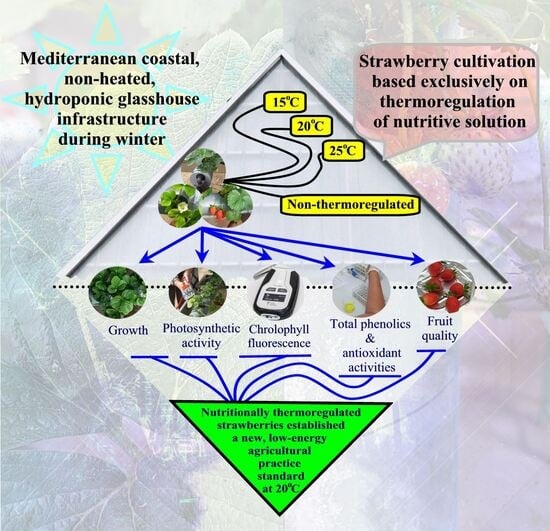
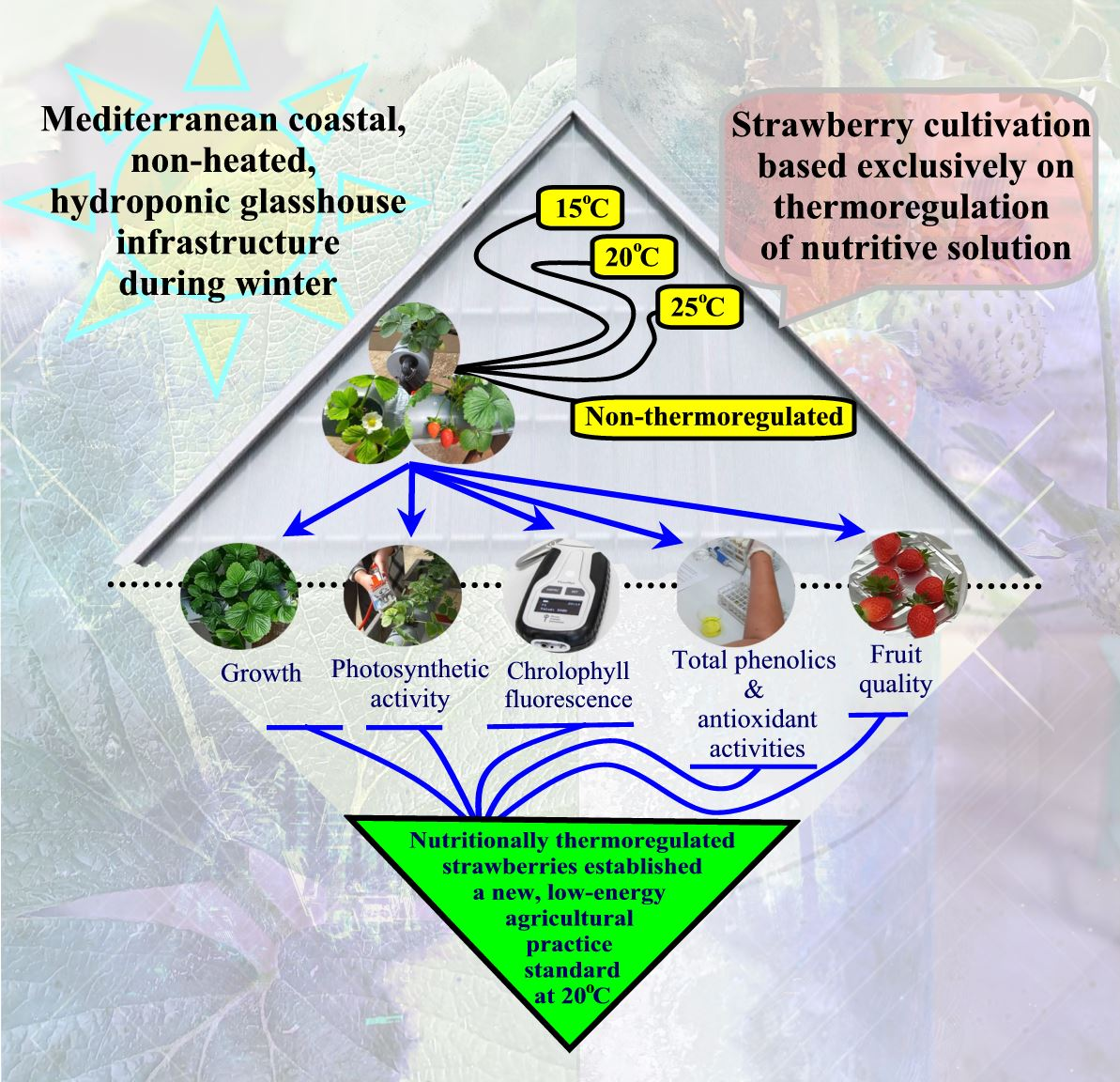
Graphical Abstract

1. Introduction

Global agriculture faces major challenges as the population grows, requiring low-energy strategies to balance food security with sustainable practices [1,2,3]. Urban agriculture and greenhouse strawberry cultivation have emerged as efficient solutions for securing food production while reducing environmental impact [4,5]. Hydroponics represents advanced soilless farming and offers benefits for strawberry production [6]. Plants grow in nutrient-enriched water solutions, eliminating soil disease incidences and enabling precise nutrient control for higher yields [7]. However, the optimization of energy consumption in agriculture, coupled with the increasing prevalence of energy poverty among farmers, poses substantial challenges [8,9]. Operating costs for greenhouses and hydroponic systems can be prohibitive when energy resources are costly or not readily accessible [10]. Initiatives in soilless cultivation with innovative practices are crucial for integrating low-energy management into fruit production [11,12].
Geographic location and climate are pivotal factors influencing the baseline heating requirements in hydroponic strawberry cultivation [13]. Elements such as elevation, proximity to water bodies, and wind patterns significantly affect the heating demands of glasshouses [14]. Although hydroponic systems facilitate year-round production, their economic viability is contingent upon location and climate [15]. Mediterranean regions, characterized by mild winters and warm summers, present advantages for hydroponic strawberry farming due to reduced heating costs [16]. These climatic conditions render facilities more cost-effective compared to colder regions during winter, where climate control constitutes a substantial expense [17]. The abundant sunshine provides natural heating during daylight hours, resulting in heating costs comprising only a minor portion of operational expenses [16].
Nutritional choices for hydroponically grown strawberries are quite diverse, with numerous modifications: from Yamazaki strawberry formulation to Enshi and Hoagland nutritive solution [18,19,20,21,22]. In numerous rural regions worldwide, local producers frequently develop and implement various modifications to the composition of strawberry nutritional solutions, creating multiple concurrent streams of knowledge and agricultural practices [23]. Nutritional adjustments are always taking place according to the growth stage of the plants. Nutritional modifications are consistently implemented in accordance with the developmental stage of the plants. These compositional changes occur during: (a) the establishment phase of the culture, where concentrations of nutritive elements must be reduced for both physiological and economic considerations; (b) the vegetative growth stage, where well-established nutritive solutions are typically employed in their full composition; (c) the flowering stage, which necessitates an increase in phosphorus to support flower development; and (d) the fruiting period, during which the demand for potassium is elevated, as well as during runner production, when plants require an increased nitrogen supply [24,25,26].
The seasonality of nutritional formulas is influenced by the annual cycle, in conjunction with the selection of appropriate crop varieties for cultivation [27]. Strawberry production pattern (continuous vs. seasonal) [28,29], environmental adaptation [30], immunological and toxicological competence to survive in a hydroponic environment [31,32,33], yield and qualitative fruit characteristics [6] for market competitiveness [24,34] strongly affect the applicable formula per time.
Immersion heaters provide direct energy conduction, facilitating immediate and efficient heat transfer to the root zone with minimal energy losses in hydroponic systems [35]. They ensure a uniform temperature distribution throughout the nutrient solution, thereby maintaining stable root zone conditions [36]. Installation is relatively simple within a piping network and occupies minimal space. The nutrient solution acts as a continuous energy reservoir for the plant, promoting growth while being insulated with limited exposure to the surface area. The heating process can occur independently of ventilation requirements, offering stable conditions for the solution with standardized nutrient availability. Temperature sensors are simple and can be integrated with straightforward control logic circuits that require minimal calibration. Heating elements are readily accessible for maintenance or replacement, and potential failures occur locally. Optimizing strawberry growth through root zone temperature management can ensure tailored protocols for plant cultivation and specific growth stages.
In contrast, in ambient glasshouse heating systems, volumes of air are heated prior to reaching plant tissues, resulting in prolonged indirect energy transfer with energy losses via the structural elements of the glasshouse and ventilation operation [37,38]. Temperature gradients emerge as warm air masses, and induced air stratification affects plant growth. The thermal influence within the strawberry microenvironment lacks precision, as heating units are complex, large, and occupy significant space, necessitating extensive maintenance and mechanical expertise [39]. Maintaining the desired temperature is based on a costly, continuous energy supply owing to inevitable heat losses. Ventilation can induce ambient temperature fluctuations, which indirectly impact nutrient availability and increase the risk of inorganic precipitations [40]. System failures, apart from immediate attention, lead to widespread damage, increased complexity, and require greater capital investment. Complex strawberry-specific temperature regimes further complicate this system [41].
Temperature regulation stands as one of the most critical environmental parameters in successful hydroponic strawberry cultivation, directly influencing plant growth, development, flowering, pollen performance, and fruit quality [42,43,44,45]. In alignment with innovative strategies designed to reduce the operational energy costs of hydroponic systems, we evaluated the winter growth, physiological, and biochemical performance of cv. Victory strawberries in a hydroponic facility situated near the Mediterranean seashore, as the experimental site fulfills all necessary conditions. In our investigation, we propose managing the heating within the glasshouse hydroponic facility through the exclusive use of pipe-mounted immersion heaters to facilitate energy transfer to the nutrient solution. This process will be thermally monitored by temperature sensors along the plant line, all controlled with cost-effective IoT technology. This work aims to: (a) investigate whether solely thermo-adjusted nutritional regimes for strawberry hydroponics can sustain production without the need for costly ambient heating of glasshouse facilities during winter, (b) evaluate plant performance through responsive physiological and biochemical indices under various thermo-nutritional regimes, and (c) determine the optimal thermal regime for the hydroponic cultivation of strawberry plants and fruits.

2. Materials and Methods

2.1. Hydroponic System

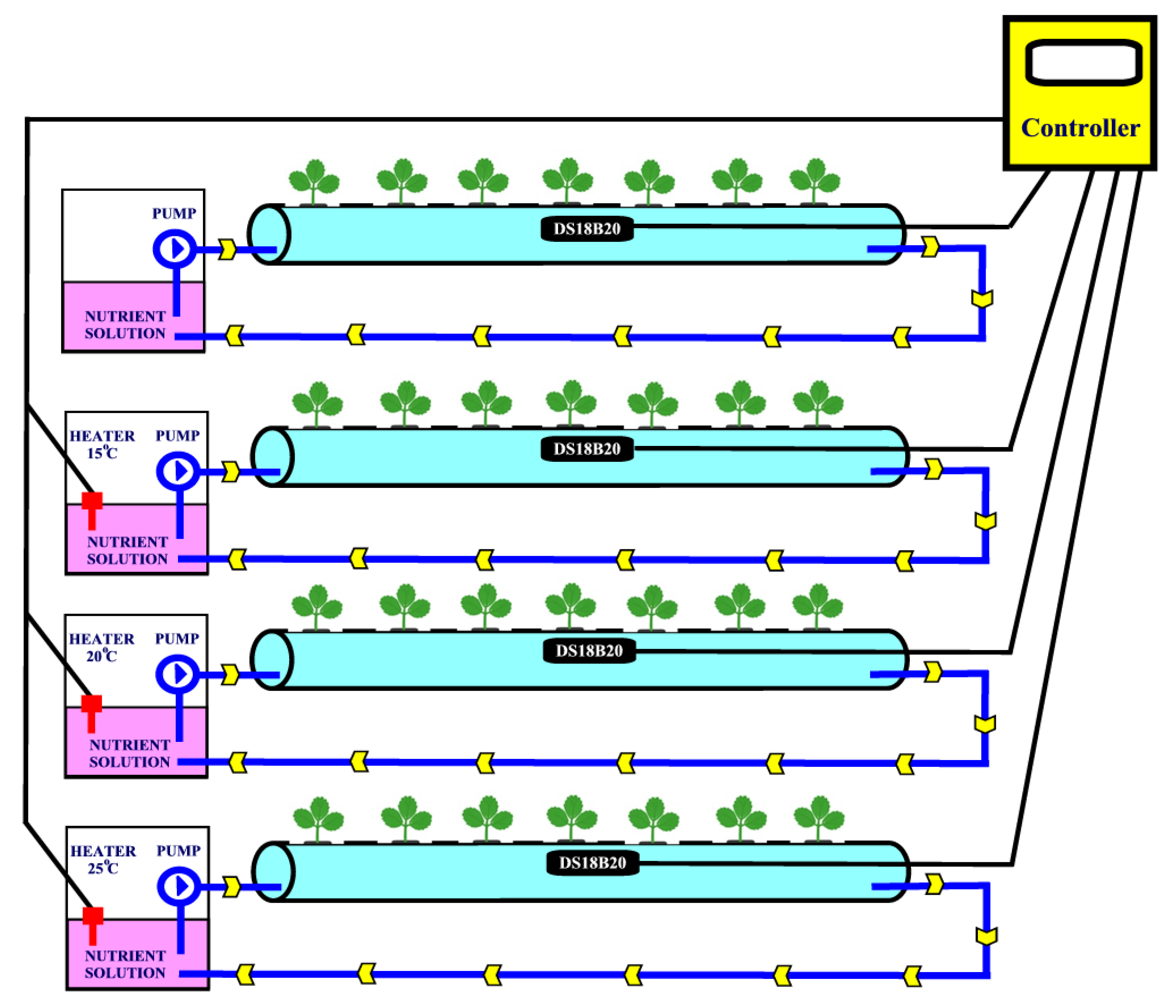
Strawberry plants (Fragaria x ananassa Duch) were established in a deep-water culture (DWC) hydroponic system in a glasshouse at the Department of Agriculture, University of Patras, Greece [38.366717° N, 21.476747° E]. The hydroponic system consisted of rigid PVC pipes (140 cm long and 10 cm in diameter). Each pipe had seven planting holes (5 cm in diameter) spaced at 20 cm intervals. The pipe ends were sealed, incorporating a molded 16 mm inlet and outlet port.
Each hydroponic line was connected to a 35 L nutrient solution tank. The circulation of the nutrient solution was achieved using a 6 W submersible pump, which delivered 60 L per hour at the given manometric head. The system was fitted with 16 mm tubing, which enabled the continuous flow of the nutrient solution from the tank to the PVC pipe inlet and back into the tank.
In each tank, with the exception of non-thermally regulated lines, a 350 W electric immersion heater was installed. In addition, for temperature regulation, a DS18B20 (Maxim Integrated, San Jose, CA, USA) waterproof temperature probe was installed in each tank, which was connected to an Arduino Uno (Arduino S.r.l., Monza, Italy) microcontroller (Figure 1). The programmed control code operated the heaters via relays, maintaining the solution temperature with an accuracy of ±0.2 °C. The temperatures of the nutrient solution circulating within the hydroponic system were maintained at 15, 20, and 25 °C. Non-thermoregulated plant lines were used as a reference, with observed mean daily, daytime, and nighttime temperatures of 16.83 °C, 17.63 °C, and 15.75 °C, respectively, throughout the experimental period.
An independent data logger system was installed for nutrient solution temperature monitoring. A DS18B20 (Maxim Integrated, San Jose, CA, USA) waterproof temperature probe was placed in each hydroponic pipe and connected to an Arduino Uno (Arduino S.r.l., Monza, Italy) microcontroller. The data logger system was programmed to collect and save data to an SD card every 10 min.

2.2. Greenhouse Environmental Conditions

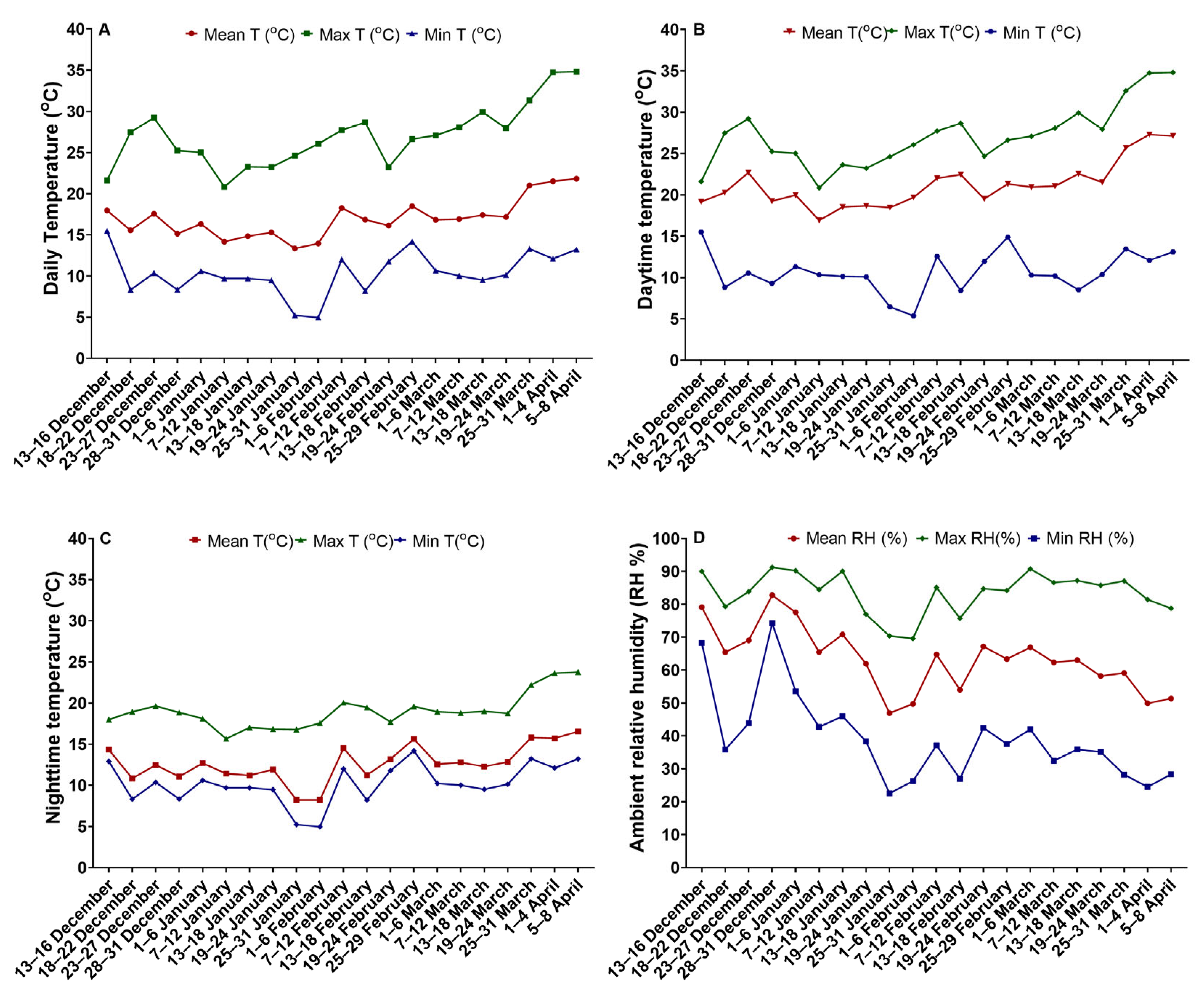
The environmental conditions in the greenhouse were monitored using a third Arduino Uno microcontroller interfaced with a DHT22 (Aosong Electronics Co., Ltd., Guangzhou, China) sensor. The sensor measured the ambient temperature and humidity every 10 min, and the data were saved to an SD card. The mean values of temperature (daily, daytime, nighttime) and ambient relative humidity percentage (maximum, mean, minimum) were recorded during the experimental period from 13 December 2023 to 5 April 2024. The photosynthetically active radiation (PAR, μmol·m−2·s−1) was measured using an SQ-521 sensor (Apogee Instruments, Inc., Logan, UT, USA). Data were automatically recorded every 10 min with a ZL6 data logger (METER Group, Inc., Pullman, WA, USA).
The 24-h temperature data indicate maximum temperatures ranging from 20 °C to 35 °C, demonstrating an upward trend from the testing period. Mean temperatures were recorded between 15 °C and 21 °C, while minimum temperatures ranged from 5 °C to 13 °C, with daily variations of 15–20 °C. Maximum daytime temperatures reached 34 °C in early April, while mean temperatures ranged from 20 °C to 27 °C, and minimum temperatures remained between 8 °C and 13 °C. Maximum nighttime temperatures ranged from 17 °C to 24 °C, with mean values between 10 °C and 16 °C, and minimum temperatures from 5 °C to 12 °C. Ambient relative humidity (RH%) is characterized by maximum values between 80% and 90%, mean values varying from 50% to 80%, and minimum values fluctuating between 25% and 45%. As temperatures rise approaching April, there is a corresponding decrease in minimum humidity, indicative of the typical seasonal variations observed in a non-temperature-regulated hydroponic facility (Figure 2).
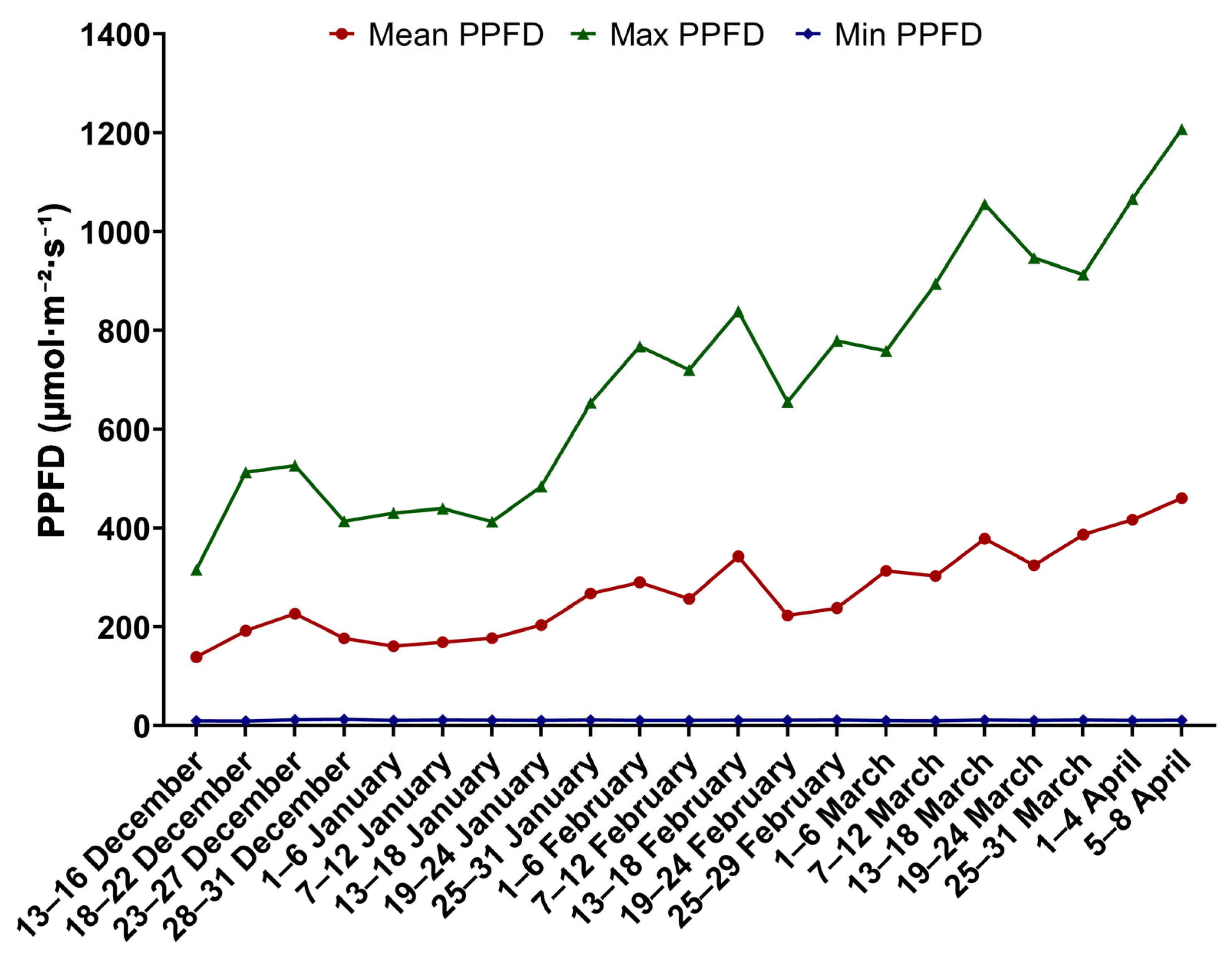
During the same period, both the mean and maximum photosynthetically active photon flux density (PPFD) values increased. The mean PPFD increased from approximately 140 to 460 μmol·m−2·s−1, whereas the maximum PPFD scaled up from 320 to more than 1200 μmol·m−2·s−1, representing an increase of 3.3-fold and 4-fold, respectively. The maximum PPFD demonstrated significant variability, particularly in late December, late January, and mid-February, possibly due to periods of cloud cover. During March and April, the recorded values exceeded 1000 μmol·m−2·s−1, suggesting variations dependent on weather conditions from winter to spring (Figure 3).
The increase in photosynthetically active photon flux density observed over the experimental period indicates seasonal transition, associated with the advancement of spring. Light intensity is also positively correlated with the rise in maximum daily temperatures, increased variability in daily temperatures and a decline in humidity, which are characteristics of a typical winter towards spring experimental period. These data reflect a mid-latitude ambient signature, which is found in zones of 30–45° N [46], where the non-heated glasshouse in Western Greece was used for the current experimentation (38° N). The moderate temperature range with distinct seasonality and moderate humidity levels provides sufficient proof of: (a) avoidance of desert-dry and/or constantly humid tropical conditions and (b) accordance with the defined Koppen’s climate classification for the Mediterranean area (Csa/Csb) [47,48,49,50,51].

2.3. Plant Material

Strawberry plants, cv. ‘Victory’, were selected for cultivation in the DWC hydroponic system. Certified bare root strawberry crowns (10–12 mm in diameter) were purchased from El Pinar Nursery and Fruits Co., Segovia, Spain.
The plants were washed with running tap water to remove soil residues, placed in net pots and subsequently established in the hydroponic system. Hoagland (University of California, Berkeley, CA, USA) nutrient solution was used for plant nutrition. The pH of the solution was adjusted to 5.6 and the electrical conductivity (EC) was set at 1.8 dS/m. Every two weeks, the nutrient solution was replaced with a fresh solution in all hydroponic lines. The experimental design incorporated thirty-five strawberry plants per treatment.

2.4. Plant Growth and Phytomass Production

The rate of plant development was monitored by counting the number of newly formed leaves per plant at six-day intervals. Data collection was initiated 28 days after planting (DAP), at which point 2–3 fully expanded leaves had developed across all treatments. At the same time, the number of flowers and fruits per plant in each treatment was also recorded. To enhance vegetative development, all flowers that emerged between 28 and 45 DAP were manually removed. After this period, flowers were retained on the plants to allow fruit development.
At the end of the experimental period (115 DAP), the strawberry plants were carefully removed from the hydroponic system and washed with distilled water. Prior to measuring the fresh weight of the plants, excess moisture was carefully removed from all plant tissues using laboratory-grade paper. Following fresh weight measurement, the root system of each plant was separated from the aboveground parts, and the fresh weights of the roots and shoots were recorded using a precision balance. To determine dry weight, plant tissues were oven-dried at 70 °C until a constant weight was achieved.

2.5. Physiological Parameters

A portable photosynthesis measuring system (LCproSD, ADC BioScientific Ltd., Hoddesdon, Herts, UK) was used for the direct measurement of leaf photosynthetic rate (Pn, μmol·m−2·s−1), transpiration rate (E, mmol·m−2·s−1), and stomatal conductance (gs, mol·m−2·s−1). The leaf chamber enclosed an exposed leaf area of 6.25 cm2. A constant gas flow rate of 200 mL min−1 was maintained in the chamber. The CO2 concentration was automatically controlled by the LCproSD gas exchange system to 400 ppm, while incident radiation (PAR, mol m−2 s−1) and vapor pressure were those of ambient conditions. The temperature of the chamber was set to 25 °C.
The second and third fully expanded trifoliate leaves from the crown of each plant (14 leaves per treatment in total) were selected for physiological parameters assessment. Data collection involved obtaining three records per leaf from the photosynthetic unit at 30-s intervals. All measurements were conducted during the morning hours (9:00–12:00 a.m.) at 34, 57, 76, 94, and 115 days after planting (DAP).

2.6. Total Chlorophyll, Chlorophyll Fluorescence and Anthocyanin Content

To determine the total chlorophyll and anthocyanin content, readings were taken using the following handheld devices: (a) a total chlorophyll content meter (SPAD-502 Plus, Konica Minolta, Tokyo, Japan) and (b) an anthocyanin content meter (ACM-200 Plus (OPTI-SCIENCES, Hudson, NH, USA).
The second and third fully expanded trifoliate leaves from the crown of each plant were selected for the assessment of total chlorophyll and anthocyanin content. Data collection was set between 9.00 to 12.00 a.m., every 15–20 days from January to April. For total chlorophyll content, data were collected at 34, 57, 76, 94 and 115 DAP, whereas for anthocyanin content, measurements were taken at 34, 50, 69, 84, 98 and 112 DAP. In total, 14 leaves per treatment were assessed with 5 records per leaf.
Leaf chlorophyll fluorescence indices of minimal fluorescence (Fo), maximal fluorescence (Fm) and maximum quantum efficiency of Photosystem II (Fv/Fm) were assessed every 15–20 days. Measurements were taken from the second newly formed leaf from the crown on all the hydroponic plants at 41, 54, 75, 105 and 112 days after planting using a handheld fluorometer FluorPen FP 110 (Photon Systems Instruments Ltd., Drásov, Czech Republic) after leaf adaptation to complete darkness for 15 min.

2.7. Fruit Quality

Fruit harvest began at 82 DAP when the first fruits reached the red ripe stage. Harvesting continued until the end of the experiment, with fruits being collected gradually as they ripened. Immediately after harvest, fruit weight, fruit size, flesh firmness, total soluble solids and titratable acidity were determined. Thirty fruits per treatment were used for fruit analysis.
The weight and size of each individual fruit, along with its three linear dimensions—major axis (length), medium axis (width), and minor axis (thickness)—were recorded using a precision balance (Shimadzu, TX2202L, Kyoto, Japan) and a digital caliper (Mahr GmbH, Goettingen, Germany), respectively.
Fruit firmness was assessed using a digital penetrometer (FR-5120, Lutron Electronic Enterprise Co., Ltd., Taipei, Taiwan). Fully ripened fruits were selected, and the calyxes were removed. Each fruit was positioned stably, and a penetrometer with a tip diameter of 3 mm was inserted into the equatorial region of the fruit flesh. The force necessary to penetrate the flesh was measured in grams (g).

2.8. Total Soluble Solids (TSSs) and Total Titratable Acidity (TA)

Juice was extracted from fresh strawberries using a juicer (Bosch MES3500, BSH Hausgeräte GmbH, Munich, Germany) and subsequently filtered through a fine muslin cloth to obtain a clear juice for the analysis of total soluble solids (TSSs) and titratable acidity (TA).
The total soluble solids (TSSs) content was measured using a digital reflectometer (ORF-2WM KERN & SOHN, GmbH, Balingen-Frommern, Germany) and expressed in degrees Brix.
The acidity of the strawberry juice was quantified through titration using 0.1 N sodium hydroxide (NaOH). A 1 mL aliquot of the juice was diluted with distilled water at a 1:20 ratio. Titratable acidity was measured in the diluted juice by titrating to pH 8.2. The volume of NaOH utilized was recorded, and the juice acidity was calculated and expressed as a percentage (%) of citric acid equivalents according to the following equation [52]:
T A   % =   V 1   ×   N   ×   E q V 2 ×   100
where V1 = volume NaOH (mL) used in titration, N = normality of NaOH, Eq = citric acid equivalent, and V2 = volume of the juice sample titrated (mL).

2.9. Total Phenols and Antioxidant Activity

Leaf extract: Leaf samples (7 leaflets/5 plants/replicate) were collected on the last day of the experimental period (115 DAP). The leaves were washed with distilled water, dried at 40 °C and crushed into 0.2 mm pieces with a grinding mill (KINEMATICA, POLYMIX PX-MFC 90 D Blade Grinding Mill, Malters, LU, Switzerland). Ground leaves (0.5 g) from each sample were added to a screw-capped plastic tube containing 25 mL of methanol solution (80:20 v/v methanol/water), covered with aluminum foil to protect from light exposure and left in a shaker stirrer (170 rpm) for 24 h at room temperature for maceration. The mixture was centrifuged at 5000 rpm for 10 min and the supernatant was collected [53].
Strawberry fruit Juice: Fresh strawberries were processed using a juicer (Bosch MES3500, BSH Hausgeräte GmbH, Munich, Germany), and the resulting juice was filtered through a fine muslin cloth. 5 mL of clear juice was added to a screw-capped plastic tube containing 20 mL of methanol solution (80:20 v/v methanol: water), covered with aluminum foil to protect from light exposure and left in a shaker stirrer (170 rpm) for 24 h at room temperature. The mixture was centrifuged at 5000 rpm for 10 min and the supernatant was collected [53].
Total phenolic content: The total phenolic content of the leaf extracts or juice was determined using the Folin–Ciocalteu method [54] with gallic acid (GAE) as the reference standard. For each sample, 0.2 mL extract, 9.8 mL distilled water and 0.75 mL F-C reagent were added to 16 mL test tubes. After 3 min, 0.25 mL of 20% aqueous sodium carbonate (Na2CO3) solution was added and the reaction mixture was incubated in the dark at room temperature. After 60 min, the absorbance was measured at 750 nm using a UV-VIS spectrophotometer (Shimadzu UV 1900i, Kyoto, Japan). The total phenolic content of the samples was calculated using the linear equation obtained from the gallic acid standard curve (y = 0.0024x + 0.0111, R2 = 0.9996) and the results were expressed as mg of gallic acid (GAE) equivalent per gram of dry weight of leaves (mg GAE/g d.w.) or mg of gallic acid (GAE) equivalent per 100 mL of juice (mg GAE/100 mL juice).
Ferric Reducing Antioxidant Power (FRAP) Assay: The FRAP assay was carried out to determine the total antioxidant capacity of the samples, following the method described by Benzie and Strain [55]. A fresh FRAP reagent was prepared just before use by mixing 300 mM acetate buffer (pH 3.6), 10 mM TPTZ (2,4,6-tripyridyl-s-triazine) in 40 mM HCl and 20 mM FeCl3.6H2O in a ratio of 10:1:1. For the assay, 100 μL of strawberry leaf extract or strawberry juice was mixed with 900 μL of distilled H2O and 3 mL FRAP reagent. The mixture was incubated in a water bath at 37 °C for 4 min and the absorbance was immediately measured at 593 nm using a UV–VIS spectrophotometer (Shimadzu UV 1900i, Kyoto, Japan). For the calibration curve, 5 aqueous solutions of FeSO4·7H2O with concentrations ranging from 100 to 1000 mg/L were used. The equation (y = 0.0005x − 0.0222, R2 = 0.9981) obtained from the linear regression of the standard curve was used to calculate the FRAP value of leaf extracts and the results were expressed as μmol FeSO4 per gram of dry weight of leaves (μmol FeSO4/g d.w.) or μmol FeSO4 per gram of mL of juice (μmol FeSO4/mL juice).

2.10. Statistical Analysis

A completely randomized factorial design with 4 treatments was used in this study. A minimum of 5 replicates was used for each value, unless otherwise stated.
Data were analyzed using the 95% confidence limits overlap protocol of Sokal and Rohlf [56]. The tables and graphical data are presented as mean ± standard error of the mean. An α-level of 0.05 was chosen. Prism 8.0 (GraphPad, Boston, MA, USA) was used for data analysis and graph presentation.

3. Results

3.1. Number of Leaves, Flowers and Fruits

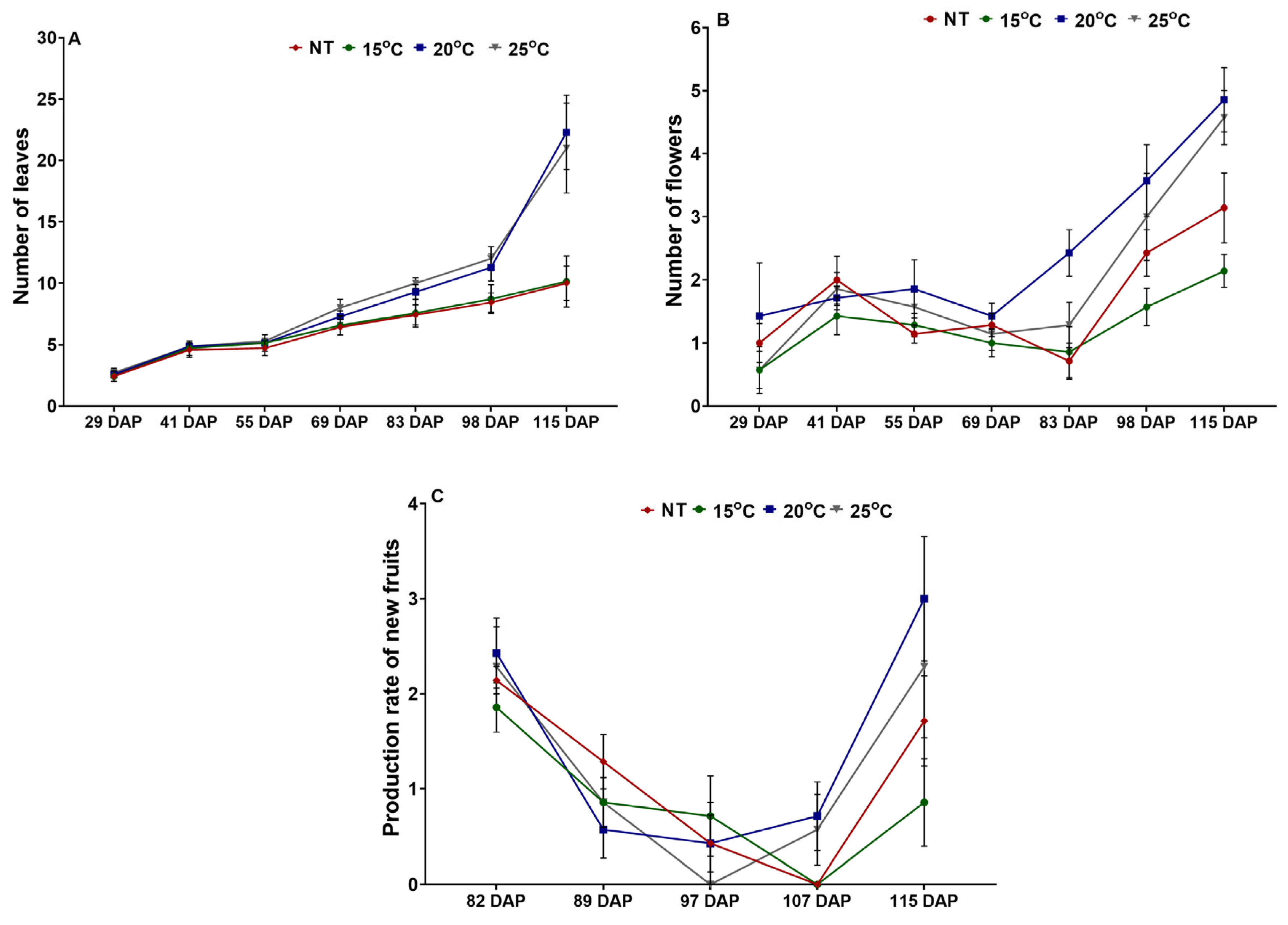
The experimental line of non-thermally regulated nutrition followed a non-significant trend of producing new leaves from 29 to 55 days post-planting. Thereafter, more leaves were produced, which supported photosynthesis and fruit development (Figure 4A). A similar pattern was observed in strawberry plants nutritionally treated at 15 °C. The groups maintained at 20 and 25 °C exhibited an increase in leaf numbers two weeks earlier (after 41 DAP), ultimately doubling their leaf count by the end of the experimental period (115 DAP).
Formation of new flowers was boosted at (98 DAP) for non-thermoregulated and 15 °C strawberry lines. This phenomenon was also expressed at 20 °C and 25 °C at an earlier stage (83 DAP) (Figure 4B). This condition results in the formation of two distinct groups (non-thermoregulated, 15 °C vs. 20 °C, 25 °C), with significant differences observed between them. The latter group emerged as dominant, exhibiting a prevalence of 31.29% to 55.96% by the end of the experimentation period.
Fruit production follows the pattern of flowering activities, with poor production of fruits in non-thermoregulated lines and those exposed at 15 °C during the whole experiment. Major differences in fruit production were apparent 107 days after planting, where 20 °C and 25 °C lines are quite productive, with a rising trend until the end of the experiment (Figure 4C). Lines at 20 °C and 25 °C produced more fruits by 43.00–71.33% and 25.32–62.44% from non-thermoregulated and 15 °C regimes, respectively, demonstrating the dominance of the 20 °C strawberry plant line.

3.2. Shoot, Root and Plant Weights

Strawberry plants subjected to a nutritive solution at 20 °C exhibited significantly higher fresh shoot weight (64.79%) compared to those under untreated conditions (Table 1). The fresh weight of strawberry roots was significantly affected by nutrient solution temperature. The maximum fresh weight was recorded at 20 °C (38.50 g), followed by 25 °C (32.80 g). Plants exhibited an increase in fresh weight when the nutrient solution was thermoregulated at 20 °C (57.30%) and 25 °C (48.59%) in comparison with the untreated ones. The treatment regime at 15 °C did not result in differentiated fresh weights from non-treated experimental lines; a similar pattern was observed in the assessment of dry weight.
The dry shoot weight and overall biomass of plants subjected to a temperature of 20 °C were greater than those in any other treatment, with increases of 59.25% in shoot weight and 50.29% in total plant dry biomass (Table 1) in comparison with the untreated line.

3.3. Total Chlorophyll Content

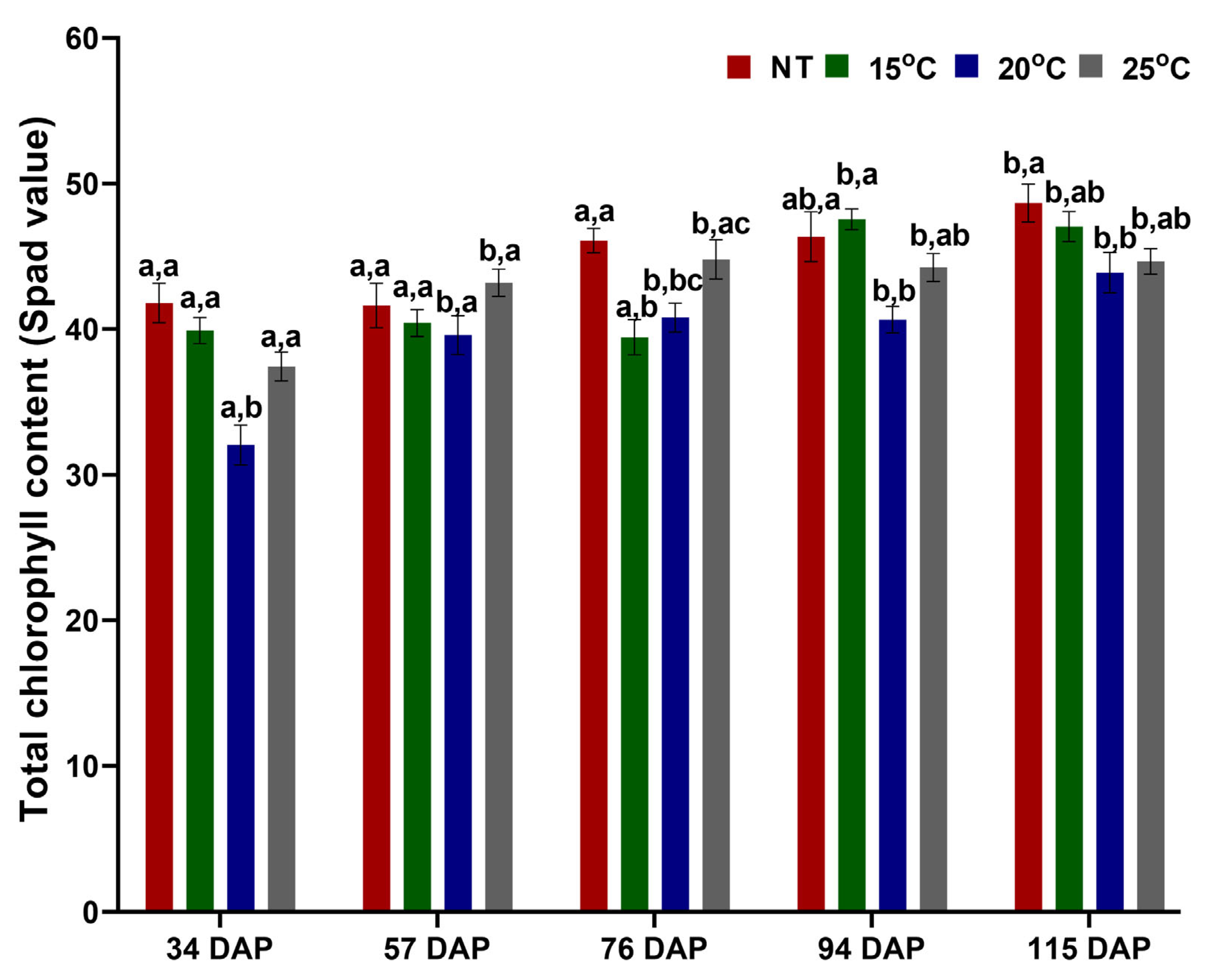
The total chlorophyll content in leaves from plants where temperature was not regulated remained constant between 34 and 94 days after planting, followed by a subsequent increase of 4.76% at the end of the experimental period. Adjustments to the nutritive solution at 15 °C, 20 °C, and 25 °C resulted in an increase in total chlorophyll content over shorter durations (94 DAP for 15 °C and 57 DAP for both 20 °C and 25 °C), with respective upscaling rates of 16.08%, 19.07%, and 13.13% (Figure 5).
Throughout the period of 34 to 57 days post-planting, variations in temperature regimes did not significantly influence the total chlorophyll content in leaves, except for the experimental lines cultivated in a nutritive solution at 20 °C at the beginning of the experimental period, where lower total chlorophyll values were recorded (14.42–23.34%). At 76 days after planting (DAP), a subgroup of strawberries exhibiting low total chlorophyll content was identified when exposed to a nutritive solution at temperatures ranging from 15 to 20 °C. This phenomenon was subsequently observed in plant lines subjected to temperatures of 20–25 °C at a later stage (94 DAP). Temperature treatments did not result in differences in total chlorophyll content by the end of the experimental period. Plants exposed to nutritive solution maintained at 20 °C consistently exhibited the lowest total chlorophyll levels throughout the majority of the study period.

3.4. Chlorophyll Fluorescence

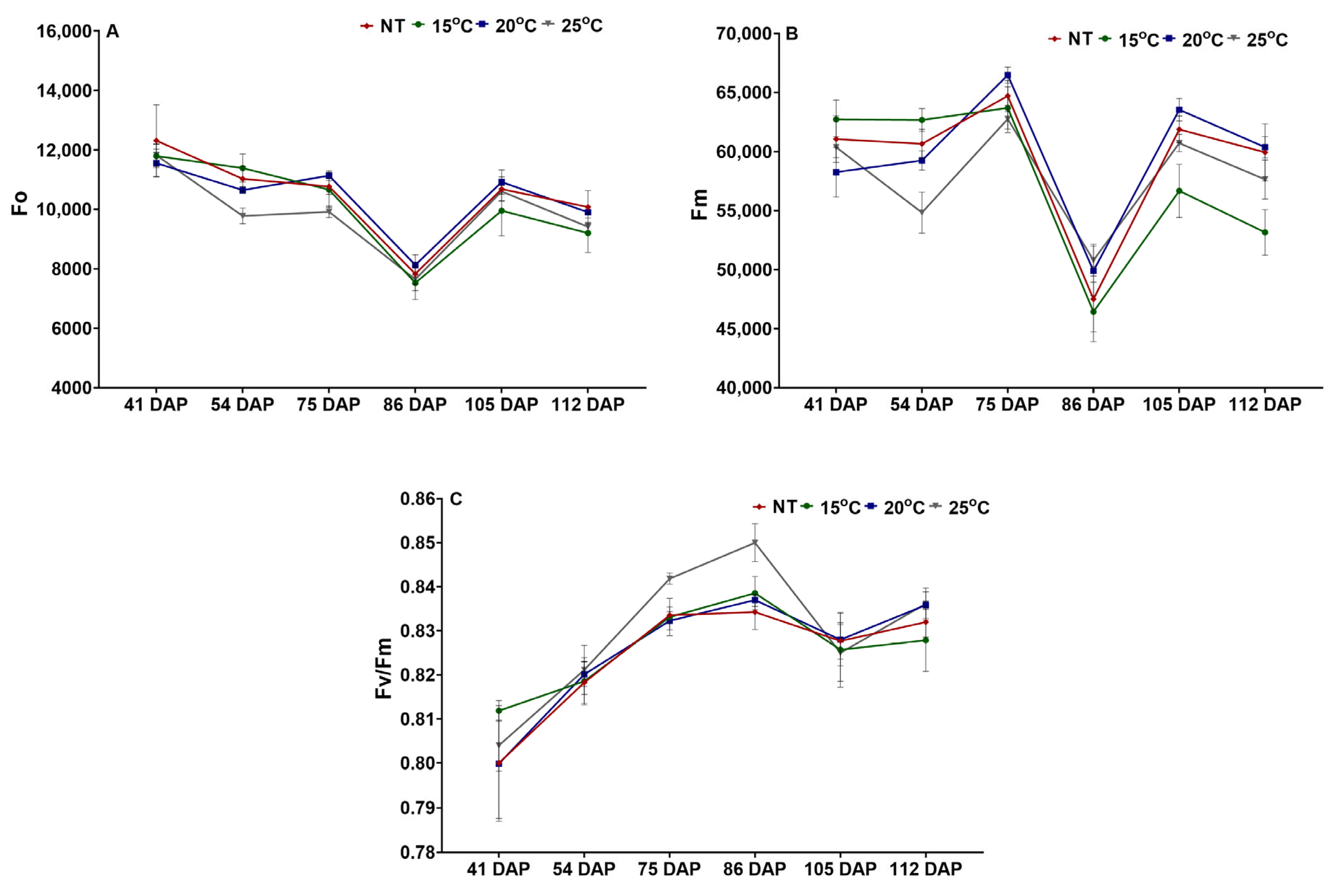
The minimum leaf chlorophyll fluorescence, observed when all PSII reaction centers are open (Fo), remained functional in strawberry plants subjected to a nutritive solution without thermoregulation. In the cases adjusted to 15 and 20 °C, significantly declined values were recorded at approximately 86 and 112 days after planting, respectively. Maintaining the solution temperature at 25 °C resulted in two distinct periods of low values: the first occurred between 54 and 86 days after planting, and the second was observed at the end of the experimental period. Comparing thermal regimes over the same days after planting, no significant differences were observed, except for 25 °C at 54 and 75 DAP, respectively (Figure 6).
At 86 days after planting, the maximum leaf chlorophyll fluorescence (Fm) exhibited the lowest values across all experimental lines. Moreover, notably low values were observed for the 25 °C treatment at 54 DAP and for 15 °C treatment at 105 and 112 DAP. The data trends, characterized by their highs/lows over time, were consistent across all experimental lines. The maximum quantum efficiency of photosystem II (Fv/Fm) showed increasing rates throughout the experimental period, with an upward trend starting at 75 DAP for both non-treated and 25 °C nutritionally treated plants. The comparison of thermal regimes over time did not reveal significant differences, except for the highest value peak observed at 86 DAP when plants were exposed to a 25 °C nutritive solution.

3.5. Anthocyanin Content

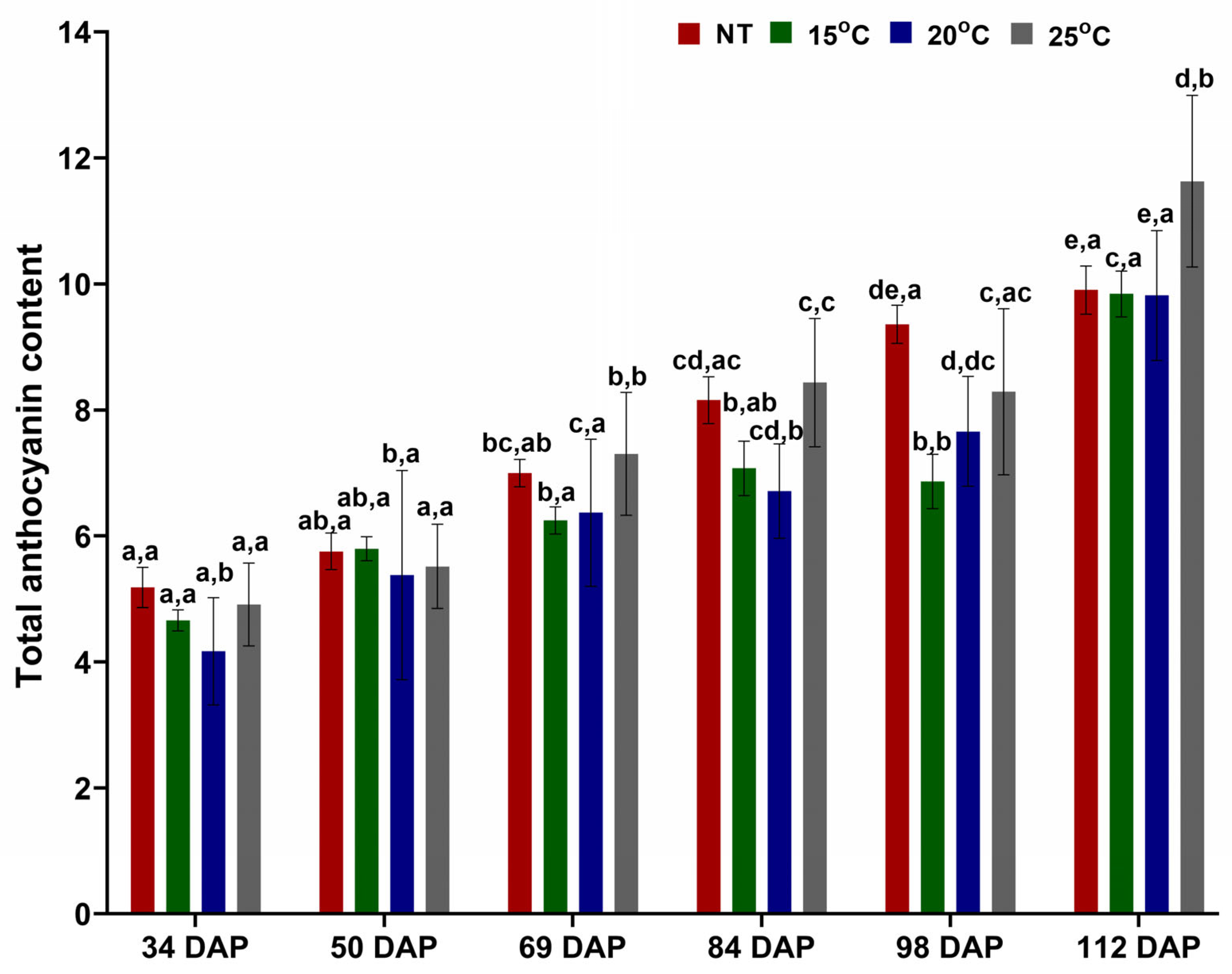
In strawberry lines where temperature adjustments to the nutrient solution were not applied, the anthocyanin content increased by 26.14% and 25.21% during two significant periods of 35 days (34–69 DAP) and 29 days (69–98 DAP), respectively (Figure 7). Over the entire experimental assessment period (34–112 DAP), these plant lines exhibited a 91% increase in anthocyanin content. Plants subjected to a nutrient solution maintained at 15 °C initially exhibited a comparable with untreated lines, initial phase and rate of significant anthocyanin accumulation [35 days (34–69 DAP), 25.44%]. However, the subsequent phase of leaf anthocyanin increase was prolonged and with higher rates of content presence [43 days (69–112 DAP), 36.4%], resulting in an overall rise of 111% over the entire period. Standardizing the temperature of the nutritive solution to 20 °C resulted in an increase in leaf anthocyanin content over shorter time intervals: 34–50 DAP (22.44%), 50–69 DAP (15.54%), 69–98 DAP (16.84%), and 98–112 DAP (21.99%), reaching an overall expansion rate of 135.49%. Three distinct periods of anthocyanin accumulation were identified in strawberry lines when the nutrient solution was maintained at 25 °C, specifically during the intervals of 34–69 DAP, 69–84 DAP, and 84–112 DAP, with respective increases of 32.83%, 13.38%, and 27.42%.
Comparing various temperature regimes applied to the nutritive solution, no significant differences in anthocyanin content were observed among all experimental lines, regardless of their adjustments, during the initial 50 days post-planting, except for lines with nutrient solution treated at 20 °C when assessed 34 days after planting. For the period of 69–84 DAP, non-temperature-regulated nutritive solution induced accumulation of anthocyanins similar to the 25 °C thermal condition of the nutritive solution. At the end of the same period and time, expanded towards 98 days after planting, an intermediate subgroup of leaf anthocyanin production became apparent. This subgroup comprised experimental lines that were subjected to nutritional treatments at 15 °C and 20 °C. At the end of the experimental period (112 DAP), the anthocyanin content was consistent across all experimental lines, except for those in which the nutritive solution was maintained at 25 °C, where the content was observed to be higher by 14.78–15.56%.

3.6. Photosynthetic Rates

Regardless of the treatment applied, the highest leaf photosynthetic rates for all experimental lines were observed at the end of the experimental period, with no discernible differences (Table 2). In a similar pattern, all nutritionally thermo-adjusted lines exhibited reduced photosynthetic rates at 76 days after planting, which were gradually restored over time. Plants treated nutritionally at 20 °C presented the fastest recovery in photosynthetic rates among all the time periods 76–115 DAP. Both the untreated and 25 °C-treated lines demonstrated similar trends: (a) stable leaf photosynthetic rates, although a decline was evident around 76 days after planting (DAP) and (b) delayed effects in restoring their physiological function during the period from 76 to 115 DAP. The experimental lines that exhibited rapid recovery in leaf photosynthetic rates were exclusively the treatment of 20 °C. Initially, these lines maintained stable photosynthetic rates between 34 and 57 days after planting (DAP). This value plateau was followed by a decline at 76 DAP and a rapid recovery between 94 and 115 DAP.

3.7. Transpiration Rates

The nutritionally non-thermoregulated plants initially displayed relatively stable values (76 DAP), experienced a decline in transpiration rates (94 DAP), and then recovered to their highest values (115 DAP). The treatment at 15 °C started with the highest values at 34 DAP but underwent a significant decline (76 DAP), where the minimum value was reached. Although transpiration rates recovered by 115 DAP, they did not return to their initial levels, suggesting an overall inhibitory effect. The nutritionally adjusted 20 °C treatment showed the most variable pattern, with high values at 57 days after planting, followed by a significant drop (76 DAP), and then recovering towards the highest final value. Exposure at 25 °C exhibited the most gradual progression, starting with the lowest values, steadily increasing through 57 DAP, experiencing a moderate dip at 76 DAP, and then finishing by reinstating transpiration rates, revealing sustained responses via consistent enhancement. Certainly, 76 DAP represented the low point for transpiration rates for all experimental lines, except for the nutritionally non-thermoregulated ones. Conditions of 15 °C and 20 °C induced particularly low transpiration rates, suggesting chronologically spotted, suboptimal physiological processes.
Recovery patterns observed between 94 and 115 days after planting (DAP) were specific to each treatment. The investigation of a 5 °C temperature differential indicated that nutritional exposure at 15 °C was limited in its efficacy, whereas exposure at 20 °C exhibited an enhanced capability. Treatment at 20 °C appears optimal for maximizing the final outcome despite intermediate (76 DAP) temporary stress. Feeding strawberry plants at 15 °C was counterproductive, as it exhibited a limited capacity to restore transpiration rates. In contrast, the nutritive solution maintained at 25 °C demonstrated a consistent trend.

3.8. Stomatal Conductance

Stomatal conductance remained unaffected throughout most of the experimental period in the non-nutritionally thermoregulated lines. Temporal differences were evident across all the other treatments. At 15 °C, leaf stomatal conductance decreased during the period of 57–76 days after planting (DAP), but was subsequently restored. Plants nutritionally treated at 20 °C exhibited a decline in value at approximately 76 days after planting (DAP). This decline was rapidly restored and further enhanced, supporting photosynthetic activity. Plants exposed to a nutritional regime at 25 °C demonstrated responses similar to those observed at 20 °C.
At the beginning of the assessment period (34 DAP), no significant differences in stomatal conductance rates were detected. However, twenty-three days later (57 DAP), plants fed at 15 °C exhibited a 47.36% reduction in leaf stomatal functionality compared to all other treated lines. The decline in values became more pronounced over time, reaching 76 days after planting, in plants treated with a 20 °C nutritional regime, subsequently leading to a significant recovery phase. At the end of the experimental period (115 DAP), variations in stomatal conductance were observed among the treatments. Specifically, untreated plants exhibited elevated stomatal conductance, whereas those maintained at 15 °C displayed significantly reduced rates. Plants maintained at 20 and 25 °C exhibited stomatal functionality that was intermediate between the non-treated and 15 °C conditions, as previously described.

3.9. Fruit Quality

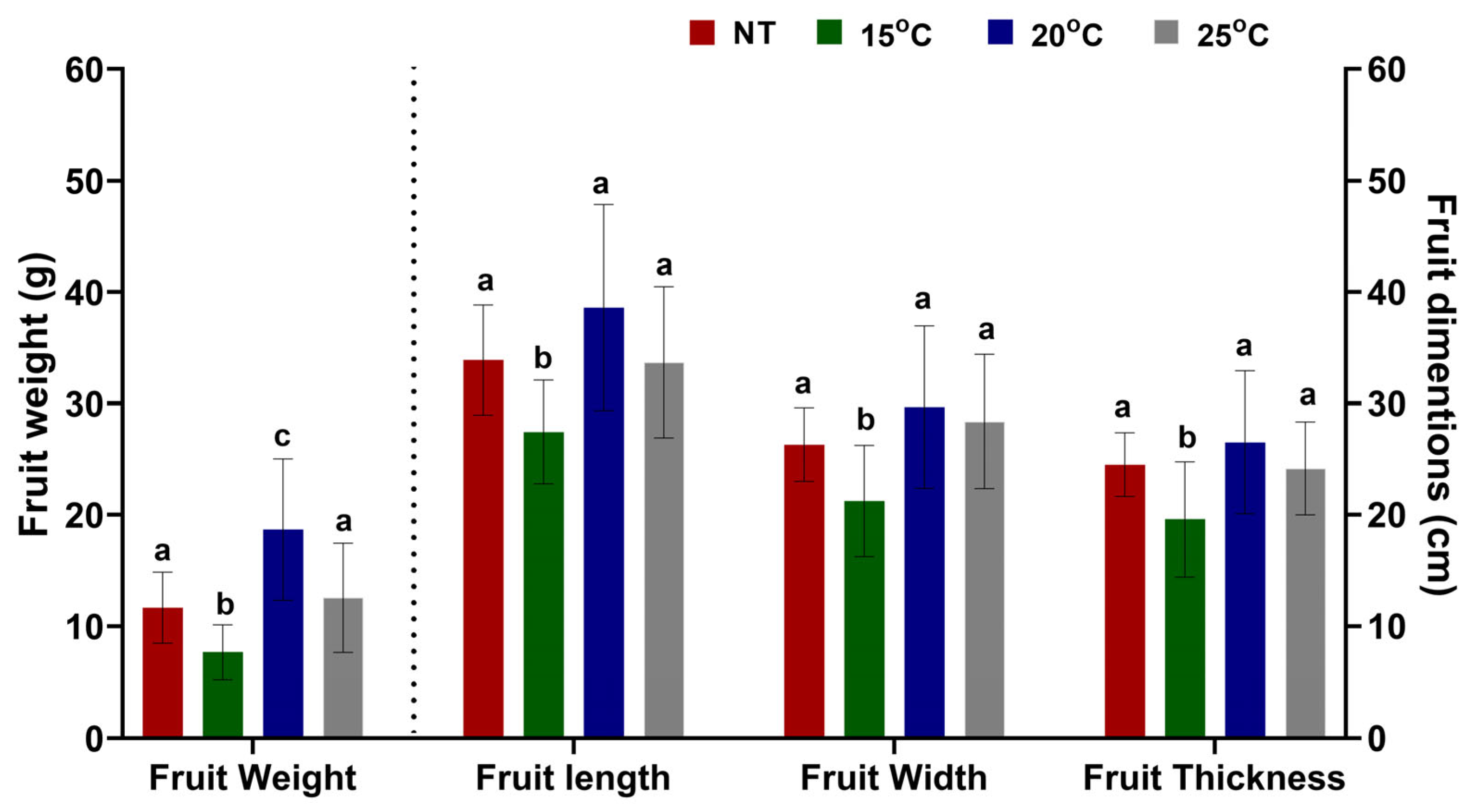
The maximization of fruit weight was observed in plants treated with a nutritive solution at 20 °C, yielding weights between 17.26 and 20.10 g. In contrast, plants subjected to thermo-nutritional conditions at 15 °C yielded fruits that were 34.27% lighter than those that were not treated (Figure 8). The dimensional parameters of the fruit, like length, width, and thickness, remained unaffected by the various temperature regimes, with the exception of the 15 °C condition, where significant losses were observed (19.08%, 19.27% and 20.04%, respectively).
The firmness of the fruit was not affected by the thermal conditions of the nutritive solution. Furthermore, the soluble solid content (SSC), titratable acidity (AC), and their ratio (SSC/AC) in the fruits did not differ from those of the untreated experimental lines (Table 3). However, treatment at 15 °C resulted in significantly higher sugar content, lower acidity and an increased SSC/AC ratio compared to plants nutritionally exposed to 20 °C and 25 °C.

3.10. Total Phenolic Content and Antioxidant Capacity

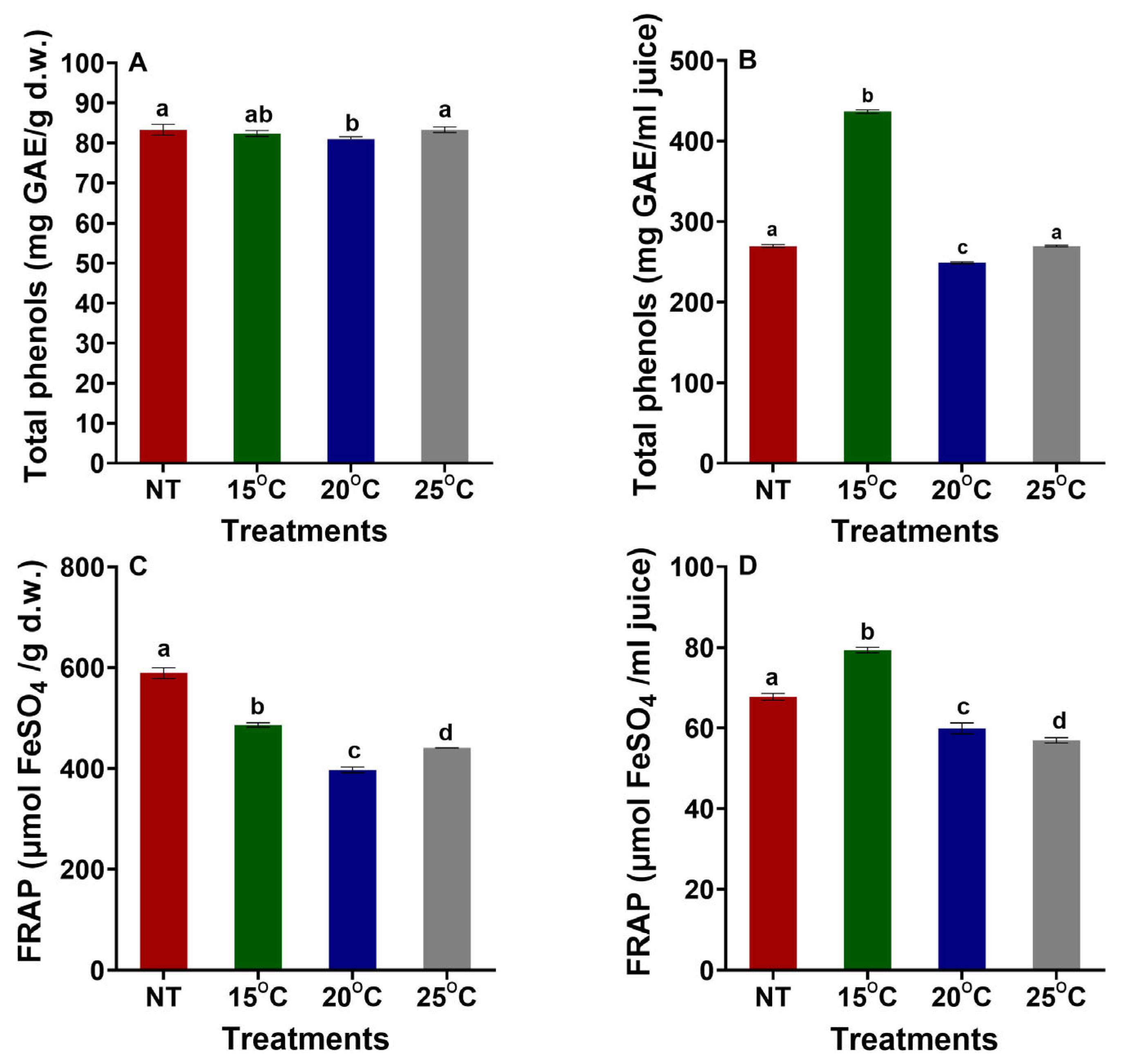
Plants subjected to nutritional exposure at 20 °C exhibited a reduction in phenolic content within their leaves compared to those not exposed to thermoregulation. No other statistically significant differences were observed between the experimental lines (Figure 9). The phenolic content in fruits displayed distinct low (20 °C, −7.70%) and high values (15 °C, 38.19%) compared to non-thermally adjusted and 25 °C treatments. Analysis of total phenolics in both tissues revealed a low content at 20 °C.
The antioxidant capacity in leaves was highest in non-thermoregulated nutritional practices, followed by those regulated at 15 °C (82.47%), 25 °C (74.74%), and 20 °C (67.41%). Fruits cultivated under nutritionally thermoregulated conditions at 15 °C exhibited greater antioxidant activity than those from non-treated lines (Figure 8). The FRAP values reached their maximum at 15 °C, after which a decline was observed as the temperature increased.

4. Discussion

As shown in this work, temperature is a critical environmental factor for hydroponic cultivation of strawberries, where the thermal regulation of the nutrient solution can modify plant growth, flowering, fruit quality and yield.
Leaf number serves as a valuable indicator of fruit yield potential in strawberry greenhouse cultivation [57,58]. The temporal leaf development patterns observed here align with those reported for ‘Rabi 3’, ‘Camarosa’, ‘BARI Strawberry 1’, ‘BADC Strawberry’, and ‘Festival’ cultivars [59]. While temperatures exceeding 30 °C suppress leaf growth [60,61], progressive thermal acclimatization enables sustained leaf production up to 42 °C [62]. Leaf production dynamics are regulated by anatomical and developmental factors, particularly the interaction between crown branching and photoperiod exposure [63,64].
Optimal short-day floral induction in Nordic strawberry cultivation occurs at day/night temperatures of 18/15–18 °C [65]. Reproductive phase initiation is photoperiod-dependent and modifiable through artificial lighting and spectral filtering nets [66,67,68]. Crown size critically determines total flower production [69,70]. Our findings show reduced flower counts at 15 °C nutritional exposure, with maximum flowering occurring at 20–25 °C across varieties—consistent with multiple research groups’ observations [71,72,73,74,75]. The 20–25 °C range accelerated anthesis initiation compared to 15 °C or non-thermoregulated conditions, conferring physiological advantages with positive yield implications when other environmental and nutritional parameters remain optimal.
Optimal strawberry fruit production occurred at 20 °C thermoregulation. In ‘Kent’ and ‘Earliglow’ cultivars, elevated day/night temperatures (30/22 °C) inhibited fruit development and reduced quality [61]. Combined with ‘Festival’ cultivar data—where root-zone cooling to 15 °C enhanced yields compared to ambient (25 °C) or intermediate (20 °C) temperatures [76]—these findings reveal that strawberry plants exhibit complex thermoregulatory mechanisms, including asymmetric temperature responses, bidirectional thermal sensitivity, and multiple adaptive strategies to environmental temperature variations.
Growing media selection significantly influences root architecture and growth dynamics during strawberry propagation [77]. Although shoot-to-root dry weight ratios are primarily genotype-dependent [78], substrate composition modulates this parameter in both soil-based [79,80] and hydroponic systems, as demonstrated by fresh weight variations in ‘San Andreas’ across different media [81]. The cultivar ‘Elsanta’ showed substrate- and container-dependent biomass changes without altered shoot/root ratios, indicating complex interactive effects [82]. Through an alternative thermally directional approach, the use of dry-fog hydroponics (an aeroponic technique) on the ever-bearing ‘Summer Ruby’ variety resulted in a reduction in root temperature by 3–5 °C during the summer period in a solar-heated greenhouse, maintaining the root temperature below 25 °C. This method preserved critical physiological parameters including flower development, fruit weight, and soluble solids content [83].
Implementation of spot heating technology in hydroponic strawberry cultivation, utilizing polyethylene pipes with water circulation at 21–23 °C, yielded significant growth improvements when applied to the bed crown (43%), root zone (39%), and their combination (39%) [84]. Integration of IoT-enabled temperature monitoring systems enhances precision in physiological management of plant development; however, adoption depends on cost-effective, energy-efficient hardware offering scalability and customization capabilities [85]. Unsupervised pump operation can elevate nutrient solution temperatures by 15.5 °C (20.5 °C to 36 °C), causing nutrient imbalance and phytotoxicity [86].
Temperature regulation critically influences chlorophyll dynamics in strawberry plants. Heat acclimation enhances thermotolerance and prevents chlorophyll degradation [62], though temperatures exceeding 30 °C adversely affect chlorophyll presence [87]. Conversely, temperatures below 10 °C reduce chlorophyll content, photosynthetic capacity, cellular membrane integrity, and overall yield [43]. Thermal exposure above 10 °C with high-intensity light supplementation effectively restores chlorophyll fluorescence and photosynthetic parameters damaged by cold stress [88]. Herein, delayed chlorophyll expansion was most pronounced at 15 °C and in non-thermoregulated conditions, though differences were marginal by experiment’s end due to optimal nutritional conditions [89]. The consistently lower total chlorophyll content at 20 °C may result from: (a) temperature-dependent circadian regulation of chlorophyll metabolism [90,91,92], (b) stochastic gene expression variations in sub-epidermal tissues [93] and (c) epigenetic modifications induced by the aqueous nutritive environment, as documented in other species [94].
Chlorophyll fluorescence analysis provides a non-invasive method for assessing the physiological status of strawberry plants before visible stress symptoms emerge [95]. The Fv/Fm ratio, indicating maximum quantum efficiency of photosystem II, typically reaches 0.83 in healthy plants [96]. In the present study, all thermal treatments maintained values consistent with this technical standard during the first 54 days post-plantation, suggesting minimal impairment in photosynthetic energy conversion across all genotypes tested. Exposure of cultivars ‘Sweety Charlie’ and ‘Chandler’ to 40/35 °C day/night temperatures reduced Fv/Fm below 0.75, indicating diminished photosystem II efficiency and photosynthetic capacity. Combined drought and heat stress can further decrease this parameter below 0.67 [97,98]. The low Fo values recorded at the experiment’s conclusion indicate the absence of photoinhibition, with photosystem II reaction centers remaining open and no detectable stress-induced photosynthetic impairment [99,100].
No major differences in photosynthetic rates were observed in this study at the end of the experimental period; however, acceleration and retardance phenomena occurred among treatments during different periods of time for each thermal adjustment of the nutritive solution. Photosynthetic rates of strawberry plants below 10 °C are damaged with low presence of intercellular carbon dioxide concentration, minimizing stomatal functionality; however, more parameters like light exposure can affect plant responses [43,88]. In all cases of ambient temperature adjustments, plants have a mechanism of photosynthetic rate acclimatization to the exposed conditions with regulation of their photosynthetic enzyme activities in response to elevated or reduced temperatures [101]. As shown in plant model organisms and other plant species, leaf age and development (e.g., young/old leaves with low photosynthetic rates) [102,103], carbohydrate accumulation in leaves [104] and photoperiod/natural light adaptation changes [105] can influence the varietal data trend of hydroponically grown strawberry plants in a non-heated glasshouse facility.
Low transpiration rates in nutritionally thermoregulated strawberry plants at 15 °C may be due to stomatal closure and low metabolic rate coupled with adaptive hormonal changes [106]. Strawberry plants exhibit physiologically inducible low metabolic rates, accompanied by reduced transpiration rates and stomatal density, as an adaptive response to salinity stress exposure [107,108]. The pattern of similarities between 20 °C and 25 °C led to the conclusion that multiple environmental factors are at optimal levels for both treatments to express common and non-stressed physiological functionality.
Stomatal conductance remained unaffected throughout the experimental period in the non-nutritionally thermoregulated lines, leading to an under-covered conclusion that affiliated circadian rhythms were absolutely synchronized with ambient temperature fluctuations occurring from the non-heating glasshouse, temperate microenvironment [109,110,111,112,113]. The intermediate values of stomatal conductance recorded at 20 °C and 25 °C corresponded with the optimal physiological range for the plants, as these values were situated between the low temperature condition of 15 °C and the non-thermoregulated exposure.
Elevated temperatures impair strawberry growth and fruit quality by disrupting photosynthesis and hormonal balance. These effects alter carbohydrate metabolism through cellular signaling cascades, reducing fruit size, foliar development, and yield [42]. While thermal acclimation from 30 to 48 °C enhanced thermotolerance in strawberry plants, this adaptation eliminated over 50% of susceptible genotypes as demonstrated in cultivar ‘Taoyuan No. 1’ [62].
A linear relationship between temperature and solar radiation was documented from October to June for short-day cultivated strawberry plants of var. ‘Camarossa’ in Spain; fruit production was initially, at early production stages, linearly correlated to temperature and solar radiation, which was thereafter modified to a quadratic relationship in high tunnel cropping establishments [114]. High tunnel cultivation, which creates a warmer microclimate, enhances plant growth and development compared to field conditions, resulting in earlier fruit production and improved yield and quality under moderate to low temperatures [115]. In general, protected cultivation systems for strawberry production, which include both greenhouses and high tunnels, offer enhanced environmental control through precise temperature management. These systems demonstrate substantially enhanced productivity, with average yields ranging from 33.5 to 47.7 t/ha and yield variations of approximately 50–56%, depending on cultivar selection and management practices. In contrast, open-field production systems remain susceptible to ambient temperature fluctuations and climatic extremes, resulting in markedly lower productivity levels. Open-field systems typically achieve yields of 18.7 t/ha with considerably higher variability, exhibiting deviation rates approaching 98% [116]. Hydroponic yields in closed cultivation systems demonstrated variability across cultivars, with ‘Albion’, ‘Camarosa’, ‘Festival’, and ‘Oso Grande’ producing mean yields ranging from 3.6 to 7.4 kg/m2 [117]. Superior productivity has been documented for the ‘Seolhyang’ cultivar, achieving 9.3–11.5 kg/m2, demonstrating substantial cultivar and microenvironmental influences on system performance [118].
Fruit firmness, a temperature-sensitive trait affecting quality, shelf-life, and consumer acceptance [119], is genetically regulated through genes controlling cell wall integrity and pectin content. Gene editing has achieved 43% increased firmness and reduced water loss, extending shelf life [120,121]. Temperature-sensitive genes involved in cellulose, expansins, and pectin metabolism (FaEXP7, FaPG2, FaCEL) regulate firmness during ripening and post-harvest stages [122,123]. Investigation into the relationship between temperature and fruit firmness within a PVC-covered greenhouse equipped with mechanical ventilation has demonstrated that a 10% variation in relative humidity, within the range of 63–73% at the end of the growing period, does not result in significant qualitative differences in raised bed cultivated fruits of var. ‘Harunoka’ [124]. In this study, fruit firmness was not influenced by the temperature applied to the nutrient solution. This lack of effect may be attributed to the mild-temperate ambient conditions, which (a) did not trigger differential gene expression for cell wall degradation phenomena or (b) did not affect in a diverse way cell wall biosynthetic pathways. Hydroponic enhancement of strawberry fruit firmness can be achieved through nutrient solution salinization without causing systemic physiological adverse effects [125]. Moreover, suboptimal nutritional regimes lacking phosphorus (P) and iron (Fe) have been found to modify the shoot-to-root ratio and reduce the average fruit yield weight. However, these regimes do not negatively affect qualitative and quantitative attributes such as the average number of fruits per plant and fruit firmness [126].
Strawberry plants with thermoregulated nutritive solution at 15 °C resulted in fruits with higher content of solid soluble content when compared to those at 20 and 25 °C. Exposure of var. ‘Harunoka’ variety to similarly low temperatures (12 °C) increased sugar accumulation of the fruits—a close pattern to our data [124]. The ’Honyang‘ variety exhibited a significant peak in sugar accumulation when temperatures of day and night differ by 12 °C (31 °C/19 °C) [127]. Controlled salinity challenge on hydroponically grown strawberries can advance sugar content accumulation in fruits [125]. Seasonal variations in soluble solid fruit content were reported for day-neutral strawberry cultivars (‘Florida Beauty’, ‘No1’, ‘No4’, ‘San Andreas’, ‘Albion’, ‘Portola’, ‘Monterey’), ever-bearing strawberry cultivars (‘Cirafine’, ‘Anabelle’, ‘Charlotte’, ‘Flamenco’, ‘Goha’) and short-day cultivars (‘Festival’, ‘Fortuna’, ‘Brilliance’) [128,129]. Soluble solids content increases progressively during ripening and serves as a critical parameter for assessing flavor quality and marketability. The relative expression of sucrose, glucose, and fructose varies with cultivar-specific genomic characteristics [130]. Successful experimentation of cooling and heating of individual strawberry fruits in greenhouse establishment for achieving precise control over the harvest date demonstrated that localized fruit heating reduced the soluble solids content of the fruit, whereas localized cooling did not adversely affect fruit quality [131].
Exposure to 20 °C yielded the lowest phenolic content in both leaf and fruit tissues across all treatments, indicating minimal stress-responsive biochemical activity. This finding presents two agricultural concerns: (a) increased susceptibility to pathogens and pests with secondary associated viral transmission risks [132,133,134] and (b) reduced fruit nutritional quality and post-harvest longevity [135]. However, this represents a static interpretation requiring further investigation of cv. ‘Victory’ responses to biotic challenges, particularly given the inducible nature of plant defense mechanisms [136,137,138,139]. Strawberry fruits with reduced phenolic content may benefit consumers with digestive sensitivities, as phenolics inhibit α-amylase and pancreatic lipase activities [140,141]. The elevated total phenolic content observed in both tissue types at 15 °C indicates a responsive, suboptimal biochemical condition, characterized by a curve with a nadir at 20 °C, which subsequently rises again at 25 °C. For the two opposed conditions (15 °C and 25 °C), the data trend was in accordance with the phenolic assessment of var. ‘Earliglow’ and ‘Kent’ strawberry fruits, with day and night temperatures of 18/12 °C and 30/22 °C appear to have the lowest and highest phenolic acid contents in fruits, respectively [142]; however, for our tested case of cv. ‘Victory’, no data linearity was apparent among the different thermally tested nutritional administrations, which may be due to the uncontrolled ambient conditions of the non-heated glasshouse.
For non-nutritionally thermoregulated strawberry lines, which had wider fluctuational exposure to ambient conditions, acclimatization occurred at higher levels of antioxidant activity. As the temperature of the nutritive solution increased from 15 °C, there was a decline in FRAP values for leaves and fruits. Temperatures below the tested range are not recommended for the applicability of the proposed technique as glasshouse agricultural practice; further lowering ambient temperature in strawberry plants can induce at least physiological electrolyte leakage and necessitate the implementation of stress alleviation practices with exogenous application of salicylic acid, plant osmolytes or melatonin, leading to increased costs [143,144].
At the end of the experimental period, the thermal condition of 25 °C led to a greater accumulation of anthocyanins compared to that in plant lines exposed to lower temperatures during the nutritional process. As it is shown, anthocyanin synthesis is inhibited at low temperatures due to increased Mitogen-Activated Protein Kinase 3 (FvMAPK3) and Sucrose Nonfermenting1-related Protein Kinase 2.6 (FaSnRK2.6) activities, phosphorylating transcriptional factors and enzymes, leading to limited content presence [89,145]. The level of transcriptional factors’ involvement in the process is dependent on the intensity of cold exposure, the developmental stage of the plant, and the time point of the flowering or fruit ripening process [146,147,148]. Induction of the mechanisms is more visible in stress conditions rather than in the range of optimal hydroponic supplementation of this work [89].

5. Conclusions

The integration of immersion heaters with IoT temperature sensors offers key advantages for hydroponic strawberry cultivation, reducing energy costs and environmental impact. Strawberry plants in 20 °C nutritive solution showed increased shoot weights versus non-thermoregulated conditions, while optimizing root fresh weight at both 20 °C and 25 °C. Plants at 20–25 °C flowered earlier (83 DAP) than non-thermoregulated and 15 °C plants. By 107 DAP, 20 °C proved optimal for yield. The highest leaf photosynthetic rates were recorded at the end of the experiment, with 20 °C facilitating the most rapid recovery (76–115 DAP). Plants at 20 °C and 25 °C had similar stomatal conductance, while 20 °C plants showed lower phenolic content than non-thermoregulated plants, indicating reduced stress. Maintaining a nutritive solution at 20 °C for cv. ‘Victory’ strawberry plants represent an efficient farming practice for similar climatic zones.

Author Contributions

Conceptualization, H.K.; methodology, H.K., G.Z.; software, H.K., P.G.; validation, H.K., P.G.; formal analysis, H.K., P.G.; investigation, H.K., G.Z., E.T., E.X., E.I., A.C.; resources, A.K., A.C.; data curation, H.K., G.Z.; writing—original draft preparation, H.K., P.G.; writing—review and editing, H.K., P.G., G.Z.; visualization, H.K., G.Z., A.K.; supervision, H.K., G.Z.; project administration, H.K., G.Z. All authors have read and agreed to the published version of the manuscript.

Funding

This research received no external funding.

Data Availability Statement

The original contributions presented in this study are included in the article. Further inquiries can be directed to the corresponding author.

Conflicts of Interest

The authors declare no conflicts of interest.

References

  1. Islam, S. Agriculture, Food Security, and Sustainability: A Review. Explor. Foods Foodomics 2025, 3, 101082. [Google Scholar] [CrossRef]
  2. Treftz, C.; Omaye, S.T. Hydroponics: Potential for Augmenting Sustainable Food Production in Non-Arable Regions. Nutr. Food Sci. 2016, 46, 672–684. [Google Scholar] [CrossRef]
  3. Gómez, J.F.M.; Luis Cordova, J.G. Theoretical and Legal Perspectives on Energy-Smart Agri-Food Systems: Sustainability and the Right to Food. Glob. Jurist 2024, 24, 1–24. [Google Scholar] [CrossRef]
  4. Richardson, M.L.; Arlotta, C.G.; Lewers, K.S. Yield and Nutrients of Six Cultivars of Strawberries Grown in Five Urban Cropping Systems. Sci. Hortic. 2022, 294, 110775. [Google Scholar] [CrossRef]
  5. Schnitzler, W.H. Urban Hydroponics for Green and Clean Cities and for Food Security. Acta Hortic. 2013, 1004, 13–26. [Google Scholar] [CrossRef]
  6. Sahoo, S.; Sahoo, D.; Sahoo, K.K. Optimization of an Efficient Hydroponic Cultivation Method for High Yield of Strawberry Plants. S. Afr. J. Bot. 2024, 167, 429–440. [Google Scholar] [CrossRef]
  7. Silva, L.R.D.; Campos, A.A.A.; Moreira, L.C.; Barral, D.M.; Andrade, G.F.P.D.; Guimarães, A.G.; Silva, I.M.D.; Tannure, M.P.; Pinto, N.A.V.D.; Costa, M.R.D.; et al. Agronomic Characteristics and Postharvest Quality of Strawberry in a Semi-Hydroponic Cultivation System. Pesq. Agropec. Bras. 2024, 59, e03384. [Google Scholar] [CrossRef]
  8. Paris, B.; Vandorou, F.; Balafoutis, A.T.; Vaiopoulos, K.; Kyriakarakos, G.; Manolakos, D.; Papadakis, G. Energy Use in Greenhouses in the EU: A Review Recommending Energy Efficiency Measures and Renewable Energy Sources Adoption. Appl. Sci. 2022, 12, 5150. [Google Scholar] [CrossRef]
  9. Huang, Y.; Abbas, Q.; Sharif, M. Addressing Agricultural Energy Poverty to Enhance Farmers’ Profitability and Productivity: Policy Interventions for Global Food Security Challenges. Energy Policy 2025, 206, 114696. [Google Scholar] [CrossRef]
  10. Bradley, P.; Marulanda, C. Simplified Hydroponics to Reduce Global Hunger. Acta Hortic. 2001, 554, 289–296. [Google Scholar] [CrossRef]
  11. Mousavi, M.; Taki, M.; Raeini, M.G.; Soheilifard, F. Evaluation of Energy Consumption and Environmental Impacts of Strawberry Production in Different Greenhouse Structures Using Life Cycle Assessment (LCA) Approach. Energy 2023, 280, 128087. [Google Scholar] [CrossRef]
  12. Zou, J.; Wang, Z.; Huang, H.; Huang, X.; Shi, M. A Low-Energy Lighting Strategy for High-Yield Strawberry Cultivation Under Controlled Environments. Agronomy 2025, 15, 1130. [Google Scholar] [CrossRef]
  13. Hernández-Martínez, N.R.; Blanchard, C.; Wells, D.; Salazar-Gutiérrez, M.R. Current State and Future Perspectives of Commercial Strawberry Production: A Review. Sci. Hortic. 2023, 312, 111893. [Google Scholar] [CrossRef]
  14. Albuja-Illescas, L.M.; Eraso Terán, O.H.; Arias-Muñoz, P.; Basantes-Vizcaíno, T.-F.; Jiménez-Lao, R.; Lao, M.T. Multi-Criteria Analysis of a Potential Expansion of Protected Agriculture in Imbabura, Ecuador. Agronomy 2025, 15, 1518. [Google Scholar] [CrossRef]
  15. Enemaku, L.E.; Ogunlade, C.B. Hydroponic Farming: A Panacea for Climate Change Impacts on Food Security in Nigeria. In Proceedings of the 2nd International Conference, Ilaro, Nigeria, 10–11 November 2020; Volume 2020, pp. 579–584. [Google Scholar]
  16. Kokkini, A. Environmental Impact Assessment of Strawberry Cultivation: The Case of Cyprus. Master’s Thesis, Cyprus University of Technology, Limassol, Cyprus, 2025; 81p. [Google Scholar]
  17. Banaeian, N.; Omid, M.; Ahmadi, H. Energy and Economic Analysis of Greenhouse Strawberry Production in Tehran Province of Iran. Energy Conver. Manag. 2011, 52, 1020–1025. [Google Scholar] [CrossRef]
  18. Mondal, M.F.; Asaduzzaman, M.; Ueno, M.; Kawaguchi, M.; Yano, S.; Ban, T.; Tanaka, H.; Asao, T. Reduction of Potassium (K) Content in Strawberry Fruits through KNO3 Management of Hydroponics. Hortic. J. 2017, 86, 26–36. [Google Scholar] [CrossRef]
  19. Jian, C.; Fang, J.; Rongwei, G.; Dongxian, H. Enhancing Transplant Quality by Optimizing LED Light Spectrum to Advance Post-Transplant Runner Plant Propagation in Strawberry. Int. J. Agric. Biol. Eng. 2025, 18, 74–82. [Google Scholar] [CrossRef]
  20. Kaushalya Madhavi, B.G.; Khan, F.; Bhujel, A.; Jaihuni, M.; Kim, N.E.; Moon, B.E.; Kim, H.T. Influence of Different Growing Media on the Growth and Development of Strawberry Plants. Heliyon 2021, 7, e07170. [Google Scholar] [CrossRef]
  21. Tohidloo, G.; Souri, M.K.; Eskandarpour, S. Growth and Fruit Biochemical Characteristics of Three Strawberry Genotypes under Different Potassium Concentrations of Nutrient Solution. Open Agric. 2018, 3, 356–362. [Google Scholar] [CrossRef]
  22. Le, L.T.; Dinh, H.T.; Takaragawa, H.; Watanabe, K.; Kawamitsu, Y. Whole-Plant and Single-Leaf Photosynthesis of Strawberry under Various Environmental Conditions. Environ. Control Biol. 2021, 59, 173–180. [Google Scholar] [CrossRef]
  23. Schiavon, A.V.; Becker, T.B.; Delazeri, E.E.; Vignolo, G.K.; Mello-Farias, P.; Antunes, L.E.C. Production and Quality of Strawberry Plants Produced from Different Nutrient Solutions in Soilless Cultivation. Rev. Ceres 2022, 69, 348–357. [Google Scholar] [CrossRef]
  24. Yu, W.; Zheng, J.; Wang, Y.; Ji, F.; Zhu, B. Adjusting the Nutrient Solution Formula Based on Growth Stages to Promote the Yield and Quality of Strawberry in Greenhouse. Int. J. Agric. Biol. Eng. 2023, 16, 57–64. [Google Scholar] [CrossRef]
  25. Yafuso, E.J.; Boldt, J.K. Development of a Hydroponic Growing Protocol for Vegetative Strawberry Production. HortScience 2024, 59, 384–393. [Google Scholar] [CrossRef]
  26. Pourhosseini, L. Effect of Different Nutrient Solution EC during Growth Stages on Fruit and Vegetative Characteristics of Strawberry in Hydroponic System. Acta Hortic. 2021, 1315, 533–536. [Google Scholar] [CrossRef]
  27. Caruso, G.; Villari, G.; Melchionna, G.; Conti, S. Effects of Cultural Cycles and Nutrient Solutions on Plant Growth, Yield and Fruit Quality of Alpine Strawberry (Fragaria vesca L.) Grown in Hydroponics. Sci. Hortic. 2011, 129, 479–485. [Google Scholar] [CrossRef]
  28. Lieten, P. Advances in Strawberry Substrate Culture during the Last Twenty Years in the Netherlands and Belgium. Int. J. Fruit Sci. 2013, 13, 84–90. [Google Scholar] [CrossRef]
  29. Takeda, F. Out-of-Season Greenhouse Strawberry Production in Soilless Substrate. Adv. Strawb. Res. 1999, 18, 4–15. [Google Scholar]
  30. Kornatskiy, S.; Kuzmina, M.; Serebryakova, Z.; Kudrina, A. The Effectiveness of Flow-through Substrateless Hydroponics in the Adaptation of Strawberry Microplants. BIO Web Conf. 2024, 121, 01016. [Google Scholar] [CrossRef]
  31. Asaduzzaman, M.; Asao, T. Autotoxicity in Strawberry Under Recycled Hydroponics and Its Mitigation Methods. Hort. J. 2020, 89, 124–137. [Google Scholar] [CrossRef]
  32. Ehret, D.L.; Alsanius, B.; Wohanka, W.; Menzies, J.G.; Utkhede, R. Disinfestation of Recirculating Nutrient Solutions in Greenhouse Horticulture. Agronomie 2001, 21, 323–339. [Google Scholar] [CrossRef]
  33. Amil-Ruiz, F.; Blanco-Portales, R.; Muñoz-Blanco, J.; Caballero, J.L. The Strawberry Plant Defense Mechanism: A Molecular Review. Plant Cell Physiol. 2011, 52, 1873–1903. [Google Scholar] [CrossRef]
  34. Ţălu, Ș. Insights on Hydroponic Systems: Understanding Consumer Attitudes in the Cultivation of Hydroponically Grown Fruits and Vegetables. Hidraulica 2024, 1, 56–67. [Google Scholar]
  35. Resh, H.M. Hydroponic Food Production: A Definitive Guidebook for the Advanced Home Gardener and the Commercial Hydroponic Grower, 8th ed.; CRC Press: New York, NY, USA, 2022; 642p, ISBN 978-1-003-13325-4. [Google Scholar]
  36. Hooks, T.; Sun, L.; Kong, Y.; Masabni, J.; Niu, G. Effect of Nutrient Solution Cooling in Summer and Heating in Winter on the Performance of Baby Leafy Vegetables in Deep-Water Hydroponic Systems. Horticulturae 2022, 8, 749. [Google Scholar] [CrossRef]
  37. Liantas, G.; Chatzigeorgiou, I.; Ravani, M.; Koukounaras, A.; Ntinas, G.K. Energy Use Efficiency and Carbon Footprint of Greenhouse Hydroponic Cultivation Using Public Grid and PVs as Energy Providers. Sustainability 2023, 15, 1024. [Google Scholar] [CrossRef]
  38. Bailey, B.J. Greenhouse Climate Control—New Challenges. Acta Hortic. 1995, 399, 13–24. [Google Scholar] [CrossRef]
  39. Canakci, M.; Yasemin Emekli, N.; Bilgin, S.; Caglayan, N. Heating Requirement and Its Costs in Greenhouse Structures: A Case Study for Mediterranean Region of Turkey. Renew. Sust. Energy Rev. 2013, 24, 483–490. [Google Scholar] [CrossRef]
  40. Ali Al Meselmani, M. Nutrient Solution for Hydroponics. In Recent Research and Advances in Soilless Culture; Turan, M., Argin, S., Yildirim, E., Güneş, A., Eds.; IntechOpen: London, UK, 2023; Volume 581, p. 01043. ISBN 978-1-80355-168-5. [Google Scholar]
  41. Pavlov, M.V.; Vafaeva, K.M.; Karpov, D.F.; Pinjari, M.; Gandhi, A.; Kalele, G.; Ghalwan, M.; Abhilash, P.; Islam, R. Investigation of the Thermal Regime of a Cultivation Structure Following an Emergency Shutdown of the Heating System. E3S Web Conf. 2024, 581, 01043. [Google Scholar] [CrossRef]
  42. Ullah, I.; Toor, M.D.; Yerlikaya, B.A.; Mohamed, H.I.; Yerlikaya, S.; Basit, A.; Rehman, A.U. High-Temperature Stress in Strawberry: Understanding Physiological, Biochemical and Molecular Responses. Planta 2024, 260, 118. [Google Scholar] [CrossRef]
  43. Jiang, N.; Yang, Z.; Zhang, H.; Xu, J.; Li, C. Effect of Low Temperature on Photosynthetic Physiological Activity of Different Photoperiod Types of Strawberry Seedlings and Stress Diagnosis. Agronomy 2023, 13, 1321. [Google Scholar] [CrossRef]
  44. Ledesma, N.; Sugiyama, N. Pollen Quality and Performance in Strawberry Plants Exposed to High-Temperature Stress. J. Am. Soc. Hortic. Sci. 2005, 130, 341–347. [Google Scholar] [CrossRef]
  45. Sønsteby, A.; Heide, O.M. Temperature Responses, Flowering and Fruit Yield of the June-Bearing Strawberry Cultivars Florence, Frida and Korona. Sci. Hortic. 2008, 119, 49–54. [Google Scholar] [CrossRef]
  46. Rego, F.C.; Rocha, M.S. Climatic Patterns in the Mediterranean region. Ecol. Mediterr. 2014, 40, 49–59. [Google Scholar] [CrossRef]
  47. Allam, A.; Moussa, R.; Najem, W.; Bocquillon, C. Specific Climate Classification for Mediterranean Hydrology and Future Evolution under Med-CORDEX Regional Climate Model Scenarios. Hydrol. Earth Syst. Sci. 2020, 24, 4503–4521. [Google Scholar] [CrossRef]
  48. Haines, A.T.; Finlayson, B.L.; McMahon, T.A. A Global Classification of River Regimes. Appl. Geogr. 1988, 8, 255–272. [Google Scholar] [CrossRef]
  49. Turkes, M. Climate and Drought in Turkey. In Water Resources of Turkey; Harmancioglu, N.B., Altinbilek, D., Eds.; World Water Resources; Springer International Publishing: Cham, Switzerland, 2020; Volume 2, pp. 85–125. ISBN 978-3-030-11728-3. [Google Scholar]
  50. Barredo, J.I.; Mauri, A.; Caudullo, G.; Dosio, A. Assessing Shifts of Mediterranean and Arid Climates Under RCP4.5 and RCP8.5 Climate Projections in Europe. Pure Appl. Geophys. 2018, 175, 3955–3971. [Google Scholar] [CrossRef]
  51. Andrade, C.; Fonseca, A.; Santos, J.A. Are Land Use Options in Viticulture and Oliviculture in Agreement with Bioclimatic Shifts in Portugal? Land 2021, 10, 869. [Google Scholar] [CrossRef]
  52. A.O.A.C. (Association of Official Analytical Chemists). Official Methods of Analysis, 16th ed.; Williams, S., Arlington, Eds.; Association of Official Agricultural Chemists: Washington, DC, USA, 1997; p. 1141. [Google Scholar]
  53. Galgano, F.; Tolve, R.; Scarpa, T.; Caruso, M.C.; Lucini, L.; Senizza, B.; Condelli, N. Extraction Kinetics of Total Polyphenols, Flavonoids, and Condensed Tannins of Lentil Seed Coat: Comparison of Solvent and Extraction Methods. Foods 2021, 10, 1810. [Google Scholar] [CrossRef] [PubMed]
  54. Singleton, V.L.; Rossi, J.A. Colorimetry of Total Phenolics with Phosphomolybdic-Phosphotungstic Acid Reagents. Am. J. Enol. Vitic. 1965, 16, 144–158. [Google Scholar] [CrossRef]
  55. Benzie, I.F.F.; Strain, J.J. The Ferric Reducing Ability of Plasma (FRAP) as a Measure of “Antioxidant Power”: The FRAP Assay. Anal. Biochem. 1996, 239, 70–76. [Google Scholar] [CrossRef]
  56. Sokal, R.R.; Rohlf, F.J. Biometry: The Principles and Practice of Statistics in Biological Research, 4th ed.; W.H. Freeman: New York, NY, USA, 2012; 937p, ISBN 978-0-7167-8604-7. [Google Scholar]
  57. He, Y.; Peng, Y.; Wei, C.; Zheng, Y.; Yang, C.; Zou, T. Automatic Disease Detection from Strawberry Leaf Based on Improved YOLOv8. Plants 2024, 13, 2556. [Google Scholar] [CrossRef]
  58. Sim, H.S.; Kim, D.S.; Ahn, M.G.; Ahn, S.R.; Kim, S.K. Prediction of Strawberry Growth and Fruit Yield Based on Environmental and Growth Data in a Greenhouse for Soil Cultivation with Applied Autonomous Facilities. Hortic. Sci. Technol. 2020, 38, 840–849. [Google Scholar] [CrossRef]
  59. Chowhan, S.; Hossain, M.; Hoque, M.; Rasul, G.; Roni, M. Yield Performance of Strawberry Genotypes. Bangladesh J. Agric. Res. 2016, 41, 481–489. [Google Scholar] [CrossRef][Green Version]
  60. Menzel, C.M. Temperatures above 30o C Decrease Leaf Growth in Strawberry under Global Warming. J. Hortic. Sci. Biotech. 2024, 99, 507–530. [Google Scholar] [CrossRef]
  61. Wang, S.Y.; Camp, M.J. Temperatures after Bloom Affect Plant Growth and Fruit Quality of Strawberry. Sci. Hortic. 2000, 85, 183–199. [Google Scholar] [CrossRef]
  62. Seymour, Z.J.; Mercedes, J.F.; Fang, J.-Y. Effect of Heat Acclimation on Thermotolerance of in Vitro Strawberry Plantlets. Folia Hortic. 2024, 36, 135–147. [Google Scholar] [CrossRef]
  63. Hytönen, T.; Palonen, P.; Mouhu, K.; Junttila, O. Crown Branching and Cropping Potential in Strawberry (Fragaria ananassa Duch.) Can Be Enhanced by Daylength Treatments. J. Hortic. Sci. Biotech. 2004, 79, 466–471. [Google Scholar] [CrossRef]
  64. Andrés, J.; Caruana, J.; Liang, J.; Samad, S.; Monfort, A.; Liu, Z.; Hytönen, T.; Koskela, E.A. Woodland Strawberry Axillary Bud Fate Is Dictated by a Crosstalk of Environmental and Endogenous Factors. Plant Physiol. 2021, 187, 1221–1234. [Google Scholar] [CrossRef]
  65. Sønsteby, A.; Heide, O.M. Temperature Limitations for Flowering in Strawberry and Raspberry. Acta Hortic. 2009, 838, 93–98. [Google Scholar] [CrossRef]
  66. Okimura, M.; Igarashi, I. Effects of Photoperiod and Temperature on Flowering in Everbearing Strawberry Seedlings. Acta Hortic. 1997, 439, 605–608. [Google Scholar] [CrossRef]
  67. Park, Y.; Sethi, R.; Temnyk, S. Growth, Flowering, and Fruit Production of Strawberry ‘Albion’ in Response to Photoperiod and Photosynthetic Photon Flux Density of Sole-Source Lighting. Plants 2023, 12, 731. [Google Scholar] [CrossRef]
  68. Takeda, F.; Glenn, D.M.; Callahan, A.; Slovin, J.; Stutte, G.W. Delaying Flowering in Short-Day Strawberry Transplants with Photoselective Nets. Int. J. Fruit Sci. 2010, 10, 134–142. [Google Scholar] [CrossRef]
  69. Fagherazzi, A.F.; Suek Zanin, D.; Soares Dos Santos, M.F.; Martins De Lima, J.; Welter, P.D.; Francis Richter, A.; Regianini Nerbass, F.; Anneliese Kretzschmar, A.; Rufato, L.; Baruzzi, G. Initial Crown Diameter Influences on the Fruit Yield and Quality of Strawberry Pircinque. Agronomy 2021, 11, 184. [Google Scholar] [CrossRef]
  70. Labadie, M.; Guy, K.; Demené, M.-N.; Caraglio, Y.; Heidsieck, G.; Gaston, A.; Rothan, C.; Guédon, Y.; Pradal, C.; Denoyes, B. Spatio-Temporal Analysis of Strawberry Architecture: Insights into the Control of Branching and Inflorescence Complexity. J. Exp. Bot. 2023, 74, 3595–3612. [Google Scholar] [CrossRef]
  71. Darrow, G.M.; Waldo, G.F. Responses of Strawberry Varieties and Species to Duration of the Daily Light Period; United States Department of Agriculture (USDA): Washington, DC, USA, 1934. [CrossRef]
  72. Ito, H.; Saito, T. Studies on the Flower Formation in the Strawberry Plants I. Effects of Temperature and Photoperiod on the Flower Formation. Tohoku J. Agric. Res. 1962, 13, 191–203. [Google Scholar]
  73. Samad, S.; Butare, D.; Marttila, S.; Sønsteby, A.; Khalil, S. Effects of Temperature and Photoperiod on the Flower Potential in Everbearing Strawberry as Evaluated by Meristem Dissection. Horticulturae 2021, 7, 484. [Google Scholar] [CrossRef]
  74. Menzel, C.M. A Review of Fruit Development in Strawberry: High Temperatures Accelerate Flower Development and Decrease the Size of the Flowers and Fruit. J. Hortic. Sci. Biotech. 2023, 98, 409–431. [Google Scholar] [CrossRef]
  75. Kirschbaum, S.D. Temperature and Growth Regulator Effects on Growth and Development of Strawberry (Fragaria x ananassa Duch.). Master’s Thesis, University of Florida, Gainesville, FL, USA, 1998; 144p. [Google Scholar]
  76. Munirah, M.; Abdullah, S.A.; Kassim, R.; Masnira, M.Y.; Sakinah, I.; Ahmad, M.A.; Tajidin, N.E. Effects of Root Zone Temperature and Light Intensity on Plant Growth, Flowering and Fruit Quality of Plant Factory ‘Festival’ Strawberry (Fragaria × ananassa Duch.). Food Res. 2024, 8, 72–78. [Google Scholar] [CrossRef]
  77. Hwang, H.-S.; Jeong, H.-W.; Jo, H.-G.; Kang, J.-H.; Hwang, S.-J. Rooting and Growth Characteristics of ‘Maehyang’ Strawberry Cutting Transplants Affected by Different Growing Media Including Decomposed Granite. Rhizosphere 2022, 22, 100520. [Google Scholar] [CrossRef]
  78. Jamieson, A.R.; Kempler, C. Strawberry Genotypes Differ in Their Ratio of Shoots to Roots, Based on Dry Weight. Acta Hortic. 2009, 842, 589–592. [Google Scholar] [CrossRef]
  79. Wani, R.A.; Akbar, P.I.; Baba, J.A.; Malik, A.R.; Prasad, V.M. Influence of Container Type and Potting Medium on Growth of Strawberry Seedlings. Ann. Hortic. 2010, 3, 114–115. [Google Scholar]
  80. Wahlang, F.C.; Joseph, A.V.; Mishra, S. The Influence of Container Types and Potting Media on the Biometric, Phenological and Yield Parameters of Strawberry cv. Winter Dawn. J. Adv. Biol. Biotechnol. 2024, 27, 310–321. [Google Scholar] [CrossRef]
  81. Tzortzakis, N. Effects of Substrate Medium and Container Type in Hydroponically Grown Strawberries. In Strawberries: Cultivation, Antioxidant Properties and Health Benefits; Malone, N., Ed.; Nova Publishers: Hauppauge, NY, USA, 2014; pp. 343–358. [Google Scholar]
  82. Massetani, F.; Savini, G.; Neri, D. Effect of Substrate and Container Type in the Strawberry Soilless Cultivation. Acta Hortic. 2017, 1156, 295–300. [Google Scholar] [CrossRef]
  83. Kanechi, M.; Hikosaka, Y.; Fukuda, C.; Uno, Y. Ever-Bearing Strawberry Culture Using a New Aeroponic System with Dry-Fog Spray Fertigation during the Summer. Acta Hortic. 2017, 1176, 37–44. [Google Scholar] [CrossRef]
  84. Moon, J.; Kang, G.; Kwon, J.; Lee, T.; Lee, S. Study on Spot Heating Technology of Hydroponics Strawberry by Using Low Density Polyethylene Pipe. In Proceedings of the 2015 ASABE International Meeting, American Society of Agricultural and Biological Engineers, New Orleans, LA, USA, 26–29 July 2015. [Google Scholar] [CrossRef][Green Version]
  85. Mubarakah, N.; Soeharwinto; Tanjung, K.; Simanjuntak, A.J. Monitoring and Control System Design Smart Greenhouse Environmental Conditions in Strawberry Cultivation. In Proceedings of the 2023 7th International Conference on Electrical, Telecommunication and Computer Engineering (ELTICOM), Medan, Indonesia, 13–14 December 2023; IEEE: Piscataway, NJ, USA, 2023; pp. 243–248. [Google Scholar] [CrossRef]
  86. Liu, Y.-W.; Huang, C.-K. Effects of the Circulation Pump Type and Ultraviolet Sterilization on Nutrient Solutions and Plant Growth in Plant Factories. Hortte 2019, 29, 189–198. [Google Scholar] [CrossRef]
  87. Gulen, H.; Eris, A. Some Physiological Changes in Strawberry (Fragaria × ananassa ‘Camarosa’) Plants under Heat Stress. J. Hortic. Sci. Biotech. 2003, 78, 894–898. [Google Scholar] [CrossRef]
  88. Choi, H.G.; Moon, B.Y.; Kang, N.J. Correlation between Strawberry (Fragaria ananassa Duch.) Productivity and Photosynthesis-Related Parameters under Various Growth Conditions. Front. Plant Sci. 2016, 7, 1607. [Google Scholar] [CrossRef]
  89. Mao, W.; Han, Y.; Chen, Y.; Sun, M.; Feng, Q.; Li, L.; Liu, L.; Zhang, K.; Wei, L.; Han, Z.; et al. Low Temperature Inhibits Anthocyanin Accumulation in Strawberry Fruit by Activating FvMAPK3-Induced Phosphorylation of FvMYB10 and Degradation of Chalcone Synthase 1. Plant Cell 2022, 34, 1226–1249. [Google Scholar] [CrossRef]
  90. Kreps, J.A.; Simon, A.E. Environmental and Genetic Effects on Circadian Clock-Regulated Gene Expression in Arabidopsis. Plant Cell 1997, 9, 297–304. [Google Scholar] [CrossRef]
  91. Martino-Catt, S.; Ort, D.R. Low Temperature Interrupts Circadian Regulation of Transcriptional Activity in Chilling-Sensitive Plants. Proc. Natl. Acad. Sci. USA 1992, 89, 3731–3735. [Google Scholar] [CrossRef]
  92. Hu, Z.-H.; Sun, M.-Z.; Yang, K.-X.; Zhang, N.; Chen, C.; Xiong, J.-W.; Yang, N.; Chen, Y.; Liu, H.; Li, X.-H.; et al. High-Throughput Transcriptomic Analysis of Circadian Rhythm of Chlorophyll Metabolism under Different Photoperiods in Tea Plants. Int. J. Mol. Sci. 2024, 25, 9270. [Google Scholar] [CrossRef]
  93. Xu, M.; Du, Q.; Tian, C.; Wang, Y.; Jiao, Y. Stochastic Gene Expression Drives Mesophyll Protoplast Regeneration. Sci. Adv. 2021, 7, eabg8466. [Google Scholar] [CrossRef]
  94. Li, Y.; Xia, M.; Zhao, X.; Hou, H. Water Temperature and Chlorophyll a Density Drive the Genetic and Epigenetic Variation of Vallisneria natans across a Subtropical Freshwater Lake. Ecol. Evol. 2023, 13, e10434. [Google Scholar] [CrossRef]
  95. Poobalasubramanian, M.; Park, E.-S.; Faqeerzada, M.A.; Kim, T.; Kim, M.S.; Baek, I.; Cho, B.-K. Identification of Early Heat and Water Stress in Strawberry Plants Using Chlorophyll-Fluorescence Indices Extracted via Hyperspectral Images. Sensors 2022, 22, 8706. [Google Scholar] [CrossRef]
  96. Bjorkman, O.; Demmig, B. Photon Yield of O2 Evolution and Chlorophyll Fluorescence Characteristics at 77 K among Vascular Plants of Diverse Origins. Planta 1987, 170, 489–504. [Google Scholar] [CrossRef]
  97. Kadir, S.; Sidhu, G.; Al-Khatib, K. Strawberry (Fragaria × ananassa Duch.) Growth and Productivity as Affected by Temperature. HortSci 2006, 41, 1423–1430. [Google Scholar] [CrossRef]
  98. Arief, M.A.A.; Kim, H.; Kurniawan, H.; Nugroho, A.P.; Kim, T.; Cho, B.-K. Chlorophyll Fluorescence Imaging for Early Detection of Drought and Heat Stress in Strawberry Plants. Plants 2023, 12, 1387. [Google Scholar] [CrossRef]
  99. Baker, N.R. Chlorophyll Fluorescence: A Probe of Photosynthesis In Vivo. Annu. Rev. Plant Biol. 2008, 59, 89–113. [Google Scholar] [CrossRef]
  100. Murchie, E.H.; Lawson, T. Chlorophyll Fluorescence Analysis: A Guide to Good Practice and Understanding Some New Applications. J. Exp. Bot. 2013, 64, 3983–3998. [Google Scholar] [CrossRef]
  101. Yamori, W.; Hikosaka, K.; Way, D.A. Temperature Response of Photosynthesis in C3, C4, and CAM Plants: Temperature Acclimation and Temperature Adaptation. Photosynth Res. 2014, 119, 101–117. [Google Scholar] [CrossRef]
  102. Carriquí, M.; Nadal, M.; Flexas, J. Acclimation of Mesophyll Conductance and Anatomy to Light during Leaf Aging in Arabidopsis thaliana. Physiol. Planta. 2021, 172, 1894–1907. [Google Scholar] [CrossRef]
  103. Kitajima, K.; Mulkey, S.S.; Samaniego, M.; Joseph Wright, S. Decline of Photosynthetic Capacity with Leaf Age and Position in Two Tropical Pioneer Tree Species. Am. J. Bot. 2002, 89, 1925–1932. [Google Scholar] [CrossRef]
  104. Strand, Å.; Hurry, V.; Gustafsson, P.; Gardeström, P. Development of Arabidopsis thaliana Leaves at Low Temperatures Releases the Suppression of Photosynthesis and Photosynthetic Gene Expression despite the Accumulation of Soluble Carbohydrates. Plant J. 1997, 12, 605–614. [Google Scholar] [CrossRef]
  105. Guiamba, H.D.S.S.; Zhang, X.; Sierka, E.; Lin, K.; Ali, M.M.; Ali, W.M.; Lamlom, S.F.; Kalaji, H.M.; Telesiński, A.; Yousef, A.F.; et al. Enhancement of Photosynthesis Efficiency and Yield of Strawberry (Fragaria ananassa Duch.) Plants via LED Systems. Front. Plant Sci. 2022, 13, 918038. [Google Scholar] [CrossRef]
  106. Agurla, S.; Gahir, S.; Munemasa, S.; Murata, Y.; Raghavendra, A.S. Mechanism of Stomatal Closure in Plants Exposed to Drought and Cold Stress. In Survival Strategies in Extreme Cold and Desiccation; Iwaya-Inoue, M., Sakurai, M., Uemura, M., Eds.; Advances in Experimental Medicine and Biology; Springer: Singapore, 2018; Volume 1081, pp. 215–232. ISBN 978-981-13-1243-4. [Google Scholar]
  107. Orsini, F.; Alnayef, M.; Bona, S.; Maggio, A.; Gianquinto, G. Low Stomatal Density and Reduced Transpiration Facilitate Strawberry Adaptation to Salinity. Environ. Exp. Bot. 2012, 81, 1–10. [Google Scholar] [CrossRef]
  108. Turhan, E.; Eriş, A. Growth and Stomatal Behaviour of Two Strawberry Cultivars under Long-Term Salinity Stress. Turk. J. Agric. For. 2007, 31, 55–61. [Google Scholar]
  109. Resco De Dios, V.; Gessler, A.; Ferrio, J.P.; Alday, J.G.; Bahn, M.; Del Castillo, J.; Devidal, S.; García-Muñoz, S.; Kayler, Z.; Landais, D.; et al. Circadian Rhythms Have Significant Effects on Leaf-to-Canopy Scale Gas Exchange under Field Conditions. Gigascience 2016, 5, 43. [Google Scholar] [CrossRef]
  110. Webb, A.A.R. The Physiology of Circadian Rhythms in Plants. New Phytol. 2003, 160, 281–303. [Google Scholar] [CrossRef]
  111. Dakhiya, Y.; Hussien, D.; Fridman, E.; Kiflawi, M.; Green, R. Correlations between Circadian Rhythms and Growth in Challenging Environments. Plant Physiol. 2017, 173, 1724–1734. [Google Scholar] [CrossRef]
  112. Hennessey, T.L.; Freeden, A.L.; Field, C.B. Environmental Effects on Circadian Rhythms in Photosynthesis and Stomatal Opening. Planta 1993, 189, 369–376. [Google Scholar] [CrossRef]
  113. Gorton, H.L.; Williams, W.E.; Binns, M.E.; Gemmell, C.N.; Leheny, E.A.; Shepherd, A.C. Circadian Stomatal Rhythms in Epidermal Peels from Vicia faba. Plant Physiol. 1989, 90, 1329–1334. [Google Scholar] [CrossRef]
  114. Palencia, P.; Martínez, F.; Medina, J.J.; López-Medina, J. Strawberry Yield Efficiency and Its Correlation with Temperature and Solar Radiation. Hortic. Bras. 2013, 31, 93–99. [Google Scholar] [CrossRef][Green Version]
  115. Kadir, S.; Carey, E.; Ennahli, S. Influence of High Tunnel and Field Conditions on Strawberry Growth and Development. HortScience 2006, 41, 329–335. [Google Scholar] [CrossRef]
  116. Menzel, C.M. A Review of Strawberry under Protected Cultivation: Yields Are Higher under Tunnels than in the Open Field. J. Hortic. Sci. Biotech. 2025, 100, 286–313. [Google Scholar] [CrossRef]
  117. Miranda, F.R.D.; Silva, V.B.D.; Santos, F.S.R.D.; Rossetti, A.G.; Silva, C.D.F.B.D. Production of Strawberry Cultivars in Closed Hydroponic Systems and Coconut Fibre Substrate. Rev. Ciênc. Agron. 2014, 45, 833–841. [Google Scholar] [CrossRef]
  118. Lim, M.Y.; Kim, S.H.; Roh, M.Y.; Choi, G.L.; Kim, D. Nutrient Dynamics and Resource-Use Efficiency in Greenhouse Strawberries: Effects of Control Variables in Closed-Loop Hydroponics. Horticulturae 2024, 10, 851. [Google Scholar] [CrossRef]
  119. Schwieterman, M.L.; Colquhoun, T.A.; Jaworski, E.A.; Bartoshuk, L.M.; Gilbert, J.L.; Tieman, D.M.; Odabasi, A.Z.; Moskowitz, H.R.; Folta, K.M.; Klee, H.J.; et al. Strawberry Flavor: Diverse Chemical Compositions, a Seasonal Influence, and Effects on Sensory Perception. PLoS ONE 2014, 9, e88446. [Google Scholar] [CrossRef]
  120. López-Casado, G.; Sánchez-Raya, C.; Ric-Varas, P.D.; Paniagua, C.; Blanco-Portales, R.; Muñoz-Blanco, J.; Pose, S.; Matas, A.J.; Mercado, J.A. CRISPR/Cas9 Editing of the Polygalacturonase FaPG1 Gene Improves Strawberry Fruit Firmness. Horticulture Res. 2023, 10, uhad011. [Google Scholar] [CrossRef]
  121. Salentijn, E.M.J.; Aharoni, A.; Schaart, J.G.; Boone, M.J.; Krens, F.A. Differential Gene Expression Analysis of Strawberry Cultivars That Differ in Fruit-firmness. Physiol. Plant. 2003, 118, 571–578. [Google Scholar] [CrossRef]
  122. Ren, Y.; Li, B.; Jia, H.; Yang, X.; Sun, Y.; Shou, J.; Jiang, G.; Shi, Y.; Chen, K. Comparative Analysis of Fruit Firmness and Genes Associated with Cell Wall Metabolisms in Three Cultivated Strawberries During Ripening and Postharvest. Food Qual. Saf. 2023, 7, fyad020. [Google Scholar] [CrossRef]
  123. Zheng, T.; Lv, J.; Sadeghnezhad, E.; Cheng, J.; Jia, H. Transcriptomic and Metabolomic Profiling of Strawberry during Postharvest Cooling and Heat Storage. Front. Plant Sci. 2022, 13, 1009747. [Google Scholar] [CrossRef]
  124. Khammayom, N.; Maruyama, N.; Chaichana, C. The Effect of Climatic Parameters on Strawberry Production in a Small Walk-In Greenhouse. AgriEngineering 2022, 4, 104–121. [Google Scholar] [CrossRef]
  125. Cardeñosa, V.; Medrano, E.; Lorenzo, P.; Sánchez-Guerrero, M.C.; Cuevas, F.; Pradas, I.; Moreno-Rojas, J.M. Effects of Salinity and Nitrogen Supply on the Quality and Health-related Compounds of Strawberry Fruits (Fragaria × ananassa cv. Primoris). J. Sci. Food Agric. 2015, 95, 2924–2930. [Google Scholar] [CrossRef]
  126. Valentinuzzi, F.; Mason, M.; Scampicchio, M.; Andreotti, C.; Cesco, S.; Mimmo, T. Enhancement of the Bioactive Compound Content in Strawberry Fruits Grown under Iron and Phosphorus Deficiency. J. Sci. Food Agric. 2015, 95, 2088–2094. [Google Scholar] [CrossRef]
  127. Wu, X.; Han, W.; Yang, Z.; Zhang, Y.; Zheng, Y. The Difference in Temperature between Day and Night Affects the Strawberry Soluble Sugar Content by Influencing the Photosynthesis, Respiration and Sucrose Phosphatase Synthase. Hortic. Sci. 2021, 48, 174–182. [Google Scholar] [CrossRef]
  128. Ruan, J.; Lee, Y.H.; Hong, S.J.; Yeoung, Y.R. Sugar and Organic Acid Contents of Day-Neutral and Ever-Bearing Strawberry Cultivars in High-Elevation for Summer and Autumn Fruit Production in Korea. Hortic. Environ. Biotechnol. 2013, 54, 214–222. [Google Scholar] [CrossRef]
  129. Menzel, C.M. Effect of Temperature on Soluble Solids Content in Strawberry in Queensland, Australia. Horticulturae 2022, 8, 367. [Google Scholar] [CrossRef]
  130. Kafkas, E.; Koşar, M.; Paydaş, S.; Kafkas, S.; Başer, K.H.C. Quality Characteristics of Strawberry Genotypes at Different Maturation Stages. Food Chem. 2007, 100, 1229–1236. [Google Scholar] [CrossRef]
  131. Kawasaki, Y.; Naito, H.; Lee, U.; Takahashi, M. Effect of Local Temperature Control on Fruit Maturation and Quality in Strawberry ‘Koiminori’. Environ. Control Biol. 2024, 62, 41–47. [Google Scholar] [CrossRef]
  132. Nagpala, E.G.; Guidarelli, M.; Gasperotti, M.; Masuero, D.; Bertolini, P.; Vrhovsek, U.; Baraldi, E. Polyphenols Variation in Fruits of the Susceptible Strawberry Cultivar Alba during Ripening and upon Fungal Pathogen Interaction and Possible Involvement in Unripe Fruit Tolerance. J. Agric. Food Chem. 2016, 64, 1869–1878. [Google Scholar] [CrossRef]
  133. Kim, D.S.; Na, H.; Song, J.H.; Kwack, Y.; Kim, S.K.; Chun, C. Antimicrobial Activity of Thinned Strawberry Fruits at Different Maturation Stages. Korean J. Hortic. Sci. Tech. 2012, 30, 769–775. [Google Scholar] [CrossRef][Green Version]
  134. Yan, B.; Lu, M.; Han, J.; Cao, Y.; Yan, F.; Song, X. Molecular Insights and Diagnostic Advances in Strawberry-Infecting Viruses. Front. Microbiol. 2025, 16, 1655696. [Google Scholar] [CrossRef]
  135. Misran, A.; Padmanabhan, P.; Sullivan, J.A.; Khanizadeh, S.; Paliyath, G. Composition of Phenolics and Volatiles in Strawberry Cultivars and Influence of Preharvest Hexanal Treatment on Their Profiles. Can. J. Plant Sci. 2015, 95, 115–126. [Google Scholar] [CrossRef]
  136. Dodds, P.N.; Chen, J.; Outram, M.A. Pathogen Perception and Signaling in Plant Immunity. Plant Cell 2024, 36, 1465–1481. [Google Scholar] [CrossRef]
  137. Wang, Q.; Cang, X.; Yan, H.; Zhang, Z.; Li, W.; He, J.; Zhang, M.; Lou, L.; Wang, R.; Chang, M. Activating Plant Immunity: The Hidden Dance of Intracellular Ca2+ Stores. New Phytol. 2024, 242, 2430–2439. [Google Scholar] [CrossRef]
  138. Xiao, G.; Zhang, Q.; Zeng, X.; Chen, X.; Liu, S.; Han, Y. Deciphering the Molecular Signatures Associated With Resistance to Botrytis cinerea in Strawberry Flower by Comparative and Dynamic Transcriptome Analysis. Front. Plant Sci. 2022, 13, 888939. [Google Scholar] [CrossRef]
  139. Snoeck, S.; Guayazán-Palacios, N.; Steinbrenner, A.D. Molecular Tug-of-War: Plant Immune Recognition of Herbivory. Plant Cell 2022, 34, 1497–1513. [Google Scholar] [CrossRef]
  140. Boath, A.S.; Grussu, D.; Stewart, D.; McDougall, G.J. Berry Polyphenols Inhibit Digestive Enzymes: A Source of Potential Health Benefits? Food Dig. 2012, 3, 1–7. [Google Scholar] [CrossRef]
  141. McDougall, G.J.; Shpiro, F.; Dobson, P.; Smith, P.; Blake, A.; Stewart, D. Different Polyphenolic Components of Soft Fruits Inhibit α-Amylase and α-Glucosidase. J. Agric. Food Chem. 2005, 53, 2760–2766. [Google Scholar] [CrossRef]
  142. Wang, S.Y.; Zheng, W. Effect of Plant Growth Temperature on Antioxidant Capacity in Strawberry. J. Agric. Food Chem. 2001, 49, 4977–4982. [Google Scholar] [CrossRef]
  143. Roussos, P.A.; Ntanos, E.; Tsafouros, A.; Denaxa, N.-K. Strawberry Physiological and Biochemical Responses to Chilling and Freezing Stress and Application of Alleviating Factors as Countermeasures. J. Berry Res. 2020, 10, 437–457. [Google Scholar] [CrossRef]
  144. Hayat, F.; Sun, Z.; Ni, Z.; Iqbal, S.; Xu, W.; Gao, Z.; Qiao, Y.; Tufail, M.A.; Jahan, M.S.; Khan, U.; et al. Exogenous Melatonin Improves Cold Tolerance of Strawberry (Fragaria × ananassa Duch.) through Modulation of DREB/CBF-COR Pathway and Antioxidant Defense System. Horticulturae 2022, 8, 194. [Google Scholar] [CrossRef]
  145. Han, Y.; Dang, R.; Li, J.; Jiang, J.; Zhang, N.; Jia, M.; Wei, L.; Li, Z.; Li, B.; Jia, W. Sucrose Nonfermenting1-Related Protein Kinase2.6, an Ortholog of Open Stomata1, is a Negative Regulator of Strawberry Fruit Development and Ripening. Plant Physiol. 2015, 167, 915–930. [Google Scholar] [CrossRef] [PubMed]
  146. Sánchez-Gómez, C.; Posé, D.; Martín-Pizarro, C. Insights into Transcription Factors Controlling Strawberry Fruit Development and Ripening. Front. Plant Sci. 2022, 13, 1022369. [Google Scholar] [CrossRef] [PubMed]
  147. Cai, J.; Mo, X.; Wen, C.; Gao, Z.; Chen, X.; Xue, C. FvMYB79 Positively Regulates Strawberry Fruit Softening via Transcriptional Activation of FvPME38. Int. J. Mol. Sci. 2021, 23, 101. [Google Scholar] [CrossRef]
  148. Seymour, G.B.; Ryder, C.D.; Cevik, V.; Hammond, J.P.; Popovich, A.; King, G.J.; Vrebalov, J.; Giovannoni, J.J.; Manning, K. A SEPALLATA Gene Is Involved in the Development and Ripening of Strawberry (Fragaria × ananassa Duch.) Fruit, a Non-Climacteric Tissue. J. Exp. Bot. 2011, 62, 1179–1188. [Google Scholar] [CrossRef]
Figure 1. Diagram of the hydroponic setup.
Horticulturae 11 01383 g001
Figure 2. Mean values of temperature [daily (A), daytime (B), nighttime (C)] and ambient relative humidity (D) during the experimental period (13 December 2023 to 5 April 2024).
Horticulturae 11 01383 g002
Figure 3. Mean, minimum, and maximum photosynthetically active photon flux density (PPFD) during the experimental period (13 December 2023 to 5 April 2024).
Horticulturae 11 01383 g003
Figure 4. Number of leaves (A), Number of flowers (B) and production rate of strawberry fruits (C) at different days after planting, in non-thermoregulated (NT) and regulated nutritional practices (15 °C, 20 °C and 25 °C).
Horticulturae 11 01383 g004
Figure 5. Total chlorophyll content in the leaves of strawberry plants on different days after planting. Different letters indicate a significant (p < 0.05) difference; the first letter demonstrates differences within the same treatment and the second one differences between different treatments [(NT): nutritionally non-thermoregulated line; 15 °C; 20 °C; 25 °C].
Horticulturae 11 01383 g005
Figure 6. Minimum fluorescence (Fo) (A), Maximum fluorescence (Fm) (B) and maximum quantum efficiency of photosystem II (Fv/Fm) (C) of strawberry leaves at different days after planting, in non-thermoregulated (NT) and regulated nutritional practices (15 °C, 20 °C and 25 °C).
Horticulturae 11 01383 g006
Figure 7. Total anthocyanin content in the leaves of strawberry plants on different days after planting. Different letters indicate a significant (p < 0.05) difference; the first letter demonstrates differences within the same treatment and the second one differences between different treatments [(NT): nutritionally non-thermoregulated line; 15 °C; 20 °C; 25 °C].
Horticulturae 11 01383 g007
Figure 8. Weight and dimensional parameters of strawberry fruit in non-thermoregulated (NT) and regulated nutritional practices (15 °C, 20 °C and 25 °C). The different letters indicate a significant (p < 0.05) difference.
Horticulturae 11 01383 g008
Figure 9. Total phenols (A,B) and antioxidant capacity (C,D) of strawberry leaves and fruits in non-thermoregulated (NT) and regulated nutritional practices (15 °C, 20 °C and 25 °C). The different letters indicate a significant (p < 0.05) difference.
Horticulturae 11 01383 g009
Table 1. Fresh and dry weights of hydroponically grown strawberry entire plants, shoots and roots 1.
Non-Thermoregulated
Nutritive Solution
Temperature Regimes
15 °C20 °C25 °C
Fresh Weight (g)
Plant51.28 ± 8.79 ab30.58 ± 10.92 a120.10 ± 19.20 c99.76 ± 18.37 bc
Shoot28.73 ± 6.26 a16.72 ± 7.15 a81.60 ± 14.59 b66.96 ± 12.69 ab
Root22.55 ± 2.95 ab13.86 ± 3.81 a38.50 ± 4.68 b32.80 ± 7.17 ab
Shoot/Root1.25 ± 0.15 a1.03 ± 0.12 a2.03 ± 0.17 a3.13 ± 1.47 a
Dry Weight (g)
Plant9.25 ± 1.88 ab6.21 ± 1.92 a18.61 ± 3.04 b16.02 ± 3.07 ab
Shoot6.01 ± 1.30 a4.22 ± 1.67 a14.75 ± 2.60 b12.35 ± 2.53 ab
Root3.24 ± 0.59 a1.99 ± 0.30 a3.86 ± 0.45 a3.67 ± 0.56 a
Shoot/Root1.81 ± 012 a1.85 ± 0.45 a3.67 ± 0.32 b3.22 ± 0.33 b
1 The different letters indicate a significant (p < 0.05) difference.
Table 2. Leaf photosynthetic rate (Pn), transpiration rate (E) and stomatal conductance (gs), of strawberry plants on different days after planting 1.
Treatments34 DAP57 DAP76 DAP94 DAP115 DAP
PnNT13.51 ± 0.95 ab,a14.74 ± 0.26 ab,a11.97 ± 0.61 a,a11.94 ± 1.11 a,a17.34 ± 1.51 b,a
(μmol.m−2.s−1)15 °C13.21 ± 0.49 bc,a11.61 ± 0.56 b,b8.23 ± 0.67 a,b13.95 ± 0.92 bc,a16.17 ± 1.11 c,a
20 °C14.23 ± 0.27 a,a13.23 ± 0.42 a,ab8.49 ± 0.54 b,b16.91 ± 0.23 c,b17.56 ± 0.35 c,a
25 °C13.45 ± 0.33 a,a13.77 ± 0.83 a,a9.70 ± 0.48 b,b12.27 ± 0.29 a,a18.79 ± 1.39 c,a
ENT3.07 ± 0.21 a,ab2.86 ± 0.11 ab,ab2.98 ± 0.17 a,a2.25 ± 0.18 b,a3.39 ± 0.18 a,ab
(mmol.m−2.s−1)15 °C3.57 ± 0.15 a,a2.23 ± 0.23 bc,a1.89 ± 0.19 c,bc2.38 ± 0.19 b,a2.72 ± 0.24 b,a
20 °C3.57 ± 0.23 ac,a3.78 ± 0.10 a,b1.69 ± 0.14 b,c3.21 ± 0.04 c,b3.90 ± 0.12 a,b
25 °C2.89 ± 0.06 ab,b3.19 ± 0.24 bc,b2.39 ± 0.16 a,ab3.07 ± 0.07 bc,b3.68 ± 0.16 c,b
gsNT0.17 ± 0.01 a,a0.19 ± 0.01 a,a0.14 ± 0.01 a,a0.13 ± 0.02 a,a0.28 ± 0.03 b,a
(mmol.m−2.s−1)15 °C0.22 ± 0.02 a,a0.10 ± 0.01 bc,b0.06 ± 0.01 b,b0.22 ± 0.02 a,b0.16 ± 0.01 ac,c
20 °C0.23 ± 0.02 ac,a0.19 ± 0.01 a,a0.07 ± 0.01 b,b0.27 ± 0.01 c,b0.24 ± 0.01 c,ab
25 °C0.20 ± 0.00 ac,a0.19 ± 0.02 a,a0.12 ± 0.01 b,a0.25 ± 0.01 c,b0.20 ± 0.01 ac,bc
1 Different letters indicate a significant (p < 0.05) difference; the first letter demonstrates differences within the same treatment and the second one differences between different treatments [(NT): nutritionally non-thermoregulated line; 15 °C; 20 °C; 25 °C].
Table 3. Qualitative characteristics of strawberry fruits at the end of the experimentation period 1.
Non-Thermoregulated
Nutritive Solution
Temperature Regimes
15 °C20 °C25 °C
Firmness1.87 ± 0.09 a1.85 ± 0.1 a1.77 ± 0.1 a1.63 ± 0.07 a
Soluble Solid Content (SSC)7.79 ± 0.42 ab8.38 ± 0.2 a6.72 ± 0.21 b6.88 ± 0.24 b
Titrable Acidity (AC)2.25 ± 0.18 ab1.97 ± 0.05 a2.51 ± 0.10 b2.58 ± 0.06 b
Ratio SSC/AC3.80 ± 0.55 ab4.29 ± 0.21 a2.74 ± 0.19 b2.70 ± 0.16 b
1 The different letters indicate a significant (p < 0.05) difference.
Disclaimer/Publisher’s Note: The statements, opinions and data contained in all publications are solely those of the individual author(s) and contributor(s) and not of MDPI and/or the editor(s). MDPI and/or the editor(s) disclaim responsibility for any injury to people or property resulting from any ideas, methods, instructions or products referred to in the content.