Article

Solanum lycopersicoides Introgression Lines Used as Rootstocks Uncover QTLs Affecting Tomato Morphological and Fruit Quality Traits

1
Department of Organic Farming, Manavgat Vocational School, Akdeniz University, Antalya 07070, Türkiye
2
Department of Plant and Animal Production, Vocational School of Food, Agriculture and Livestock, Burdur Mehmet Akif Ersoy University, Burdur 15100, Türkiye
3
Laboratoire de Recherche en Sciences Végétales—Génomique et Biotechnologie des Fruits—UMR 5546, Université de Toulouse, CNRS, UPS, Toulouse INP, 31320 Toulouse, France
4
Institute for Conservation and Improvement of Valencian Agrodiversity, Universitat Politecnica de Valencia, Camino de Vera 14, 46022 Valencia, Spain
5
Department of Agricultural and Livestock Production, Cal Vocational School of Higher Education, Pamukkale University, Denizli 20700, Türkiye
6
Plant Genetics and Agricultural Biotechnology Application and Research Center (PAU BIYOM), Pamukkale University, Denizli 20160, Türkiye
*
Authors to whom correspondence should be addressed.
Horticulturae 2025, 11(11), 1364; https://doi.org/10.3390/horticulturae11111364
Submission received: 3 October 2025 / Revised: 31 October 2025 / Accepted: 10 November 2025 / Published: 13 November 2025
(This article belongs to the Special Issue Genetics, Genomics and Breeding of Vegetable Crops)

Abstract

Tomato (Solanum lycopersicum) is the most important vegetable crop globally; however, its production is often hindered by soil-borne biotic and abiotic stresses. The use of rootstocks provides an effective strategy to mitigate these soil-related challenges. Hence, the development of new rootstock cultivars remains crucial to meet the demands of rapidly changing environmental conditions. Wild tomato species represent valuable genetic resources for rootstock improvement and are increasingly utilized in rootstock breeding programs. Nevertheless, the genetic mechanisms, particularly quantitative trait loci (QTL), underlying rootstock–scion interaction, remain poorly understood. In this study, 38 introgression lines (ILs) derived from S. lycopersicoides were used as rootstock and grafted with the commercial cultivar ‘Torry F1’ to evaluate their effects on morphological and fruit quality traits under greenhouse conditions. The evaluations included assessments of morphological and fruit quality traits for QTL analysis. A total of 19 QTLs were identified, associated with 11 traits such as yield, antioxidant capacity, flavonoid content, and fruit color parameters (L*, a*, b*, C*, h°), with the phenotypic variance explained ranging from 12% to 61%. Of these QTLs, seven favorable alleles originated from S. lycopersicoides, notably including a major yield-associated locus (Fy5.1). In addition, the identification of a QTL for scion stem thickness (Tsc3.1) highlights the genetic contribution of the rootstock to scion development. This study represents the first evaluation of the rootstock potential of S. lycopersicoides ILs and provides novel insights into the genetic basis of rootstock–scion interaction in tomato. The identified QTLs offer valuable information for future breeding efforts aimed at developing improved rootstock cultivars for sustainable tomato production.

1. Introduction

Tomato (Solanum lycopersicum L.) is one of the most extensively cultivated and consumed vegetable crops worldwide, playing a critical role in international agricultural trade. Global tomato production exceeds 192 million tons, with China, India, and Türkiye identified as the leading producers [1]. Despite their considerable adaptability to a variety of climates and soil types, tomato production is still highly susceptible to numerous biotic and abiotic stresses that pose significant threats to plant health and yield [2]. Chemical control methods are commonly utilized to manage pests and diseases; however, their improper application poses risks to human health due to exposure to residues and can also lead to a decline in fruit quality [3]. Grafting tomato plants onto disease-resistant rootstocks has emerged as a practical and effective strategy, particularly for the management of soil-borne pathogens [4]. Beyond resistance to biotic factors, rootstocks enhance tolerance to abiotic stresses due to their vigorous root systems, thereby supporting stable yields and fruit quality under deficit irrigation conditions [5]. Consequently, an ideal rootstock is expected not only to exhibit high graft compatibility and resistance to external factors but also to enhance yield and quality parameters of the scion.
The utilization of rootstocks in tomato production represents an innovative approach to optimizing yield and quality by increasing the resistance of the plant to environmental stress and diseases. The impact of rootstocks on fruit quality has drawn attention due to both its positive and negative effects. On the positive side, using rootstocks has been shown to increase the titratable acidity levels of the fruit, thereby enriching the flavor profile and providing a more balanced taste [6]. Also, rootstock may also enhance the texture and shelf life of the fruit by facilitating efficient nutrient utilization [7]. Although grafting is widely used to increase marketable yield, it can also alter fruit quality. Reported effects include reductions in soluble solids and sugars that diminish sweetness and flavor intensity [8], as well as modifications in key nutritional components such as vitamin C and phenolics, thereby influencing nutritional value [9]. The magnitude and direction of these changes depend strongly on the rootstock–scion combination and the growing environment. Rootstocks can modulate levels of sugars, acids, and volatile compounds, leading to differences in taste and aroma; while some combinations enhance sweetness or specific aroma notes, others may compromise them [6,10].
The use of rootstocks in tomato production offers clear benefits, including enhanced disease resistance, greater tolerance to environmental stresses, and increased yield. Nevertheless, their influence on fruit quality, affecting traits such as flavor, nutritional composition, shelf life, and firmness, can be highly variable and depends on the rootstock–scion combination, environmental conditions, and cultivation practices [6,7,11]. Careful evaluation of rootstocks is therefore essential to achieve the best balance between fruit quality and yield.
Wild tomato species represent valuable genetic resources, particularly for traits conferring resistance or tolerance to abiotic and biotic stresses [12]. Tomato interspecific hybrids are excellent choices for developing rootstocks used for grafting [13]. To date, the majority of studies conducted on the rootstock–scion relationship have focused on resistance to biotic and abiotic stress factors [14,15]. These findings underscore that QTLs originating in rootstock can exert measurable effects on scion characteristics. However, to date, such mapping efforts have been restricted to S. pimpinellifolium, leaving other wild tomato species largely unexplored [16,17]. To address this gap, the present study employed ILs of S. lycopersicoides, a wild tomato species with strong rootstock potential, to identify and map QTLs associated with rootstock-mediated effects on tomato fruit quality and morphological traits in grafted tomato plants.
Solanum lycopersicoides has emerged as a significant genetic resource in tomato breeding due to its rich reservoir of resistance genes [18,19]. An IL library has been developed in the S. lycopersicum genomic background, with each line containing a defined segment of the S. lycopersicoides genome. This population comprises 56 genetically stable lines covering ~96% of the S. lycopersicoides genome, enabling high-resolution QTL mapping [20]. This method, which uses differential analysis between each IL and the recurrent parent, is a widely recognized and valid approach for QTL identification that does not require traditional linkage mapping. It has been successfully applied in numerous studies to map loci from other wild tomato species, including S. pennellii [21], S. habrochaites [22], and S. pimpinellifolium [23]. Previous studies using this IL population have identified QTLs associated with salinity tolerance [24]. In another study using these lines, a locus (Ptr1) that provides resistance to two different disease agents (Race 1 Pseudomonas syringae pv. tomato and to Ralstonia pseudosolanacearum) were mapped on chromosome 4 [18]). These findings underscore the potential of S. lycopersicoides as a genetic reservoir for traits related to stress resistance. Given its genetic diversity and demonstrated utility, the S. lycopersicoides IL population represent an excellent candidate for identifying QTLs governing rootstock–scion compatibility.
In the present study, S. lycopersicoides ILs was employed for the first time to map QTLs associated with rootstock–scion adaptation in terms of morphological and fruit quality traits. QTLs with either positive or negative effects on fruit quality traits including morphological features, antioxidant activity, and nutrient composition were identified. This work contributes to a better understanding of the genetic basis of rootstock–scion compatibility and its influence on both fruit quality and plant developmental traits.

2. Materials and Methods

2.1. Plant Material

Field experiments were carried out during the spring season in a greenhouse located in Antalya, Türkiye. A total of 38 ILs from the S. lycopersicoides IL library, developed by [20] (Table S1), were used as rootstock. Detailed information of ILs is provided in TGRC database (https://tgrc.ucdavis.edu/lycopersicoidesILs (accessed on 30 October 2025)). Each IL was grafted with the commercial tomato cultivar ‘Torry F1’ (Syngenta) as the scion. The tube grafting method was used according to [25]. Following grafting, seedlings were placed in a growth chamber set at 22 ± 2 °C with 85–90% relative humidity to facilitate graft compatibility.
The grafted seedlings were transplanted in the greenhouse following a randomized block design with three biological replicates, each consisting of eight plants. Morphological data at the seedling stage were collected 25 days after grafting. For QTL mapping based on ILs was used ‘VF36’ as the control.

2.2. Morphological Traits

Fruits from grafted ILs were harvested during the 2022 growing season and cultural treatments were applied according to Hanson et al. [26]. A total of 23 morphological traits were evaluated across the grafted ILs and yield was measured separately (Table 1), providing a comprehensive assessment of fruit and plant characteristics for subsequent QTL analysis. The morphological traits of both the scion and rootstock, including scion stem diameter and length, rootstock diameter and length, and leaf number, were assessed when the plants attained the sixth truss stage to identify QTLs associated with the development of these characteristics. Traits associated with fruit were assessed one day following the harvest of fruits at the red-ripe stage.

2.3. Biochemical and Physicochemical Characterization of Fruits

2.3.1. Analysis of Total Antioxidant Capacity

All biochemical analyses (total antioxidant capacity, ascorbic acid content, total phenolic content, total flavonoid content and total soluble solid) were performed using a bulked sample of at least 10 fruits from each replicate. The total antioxidant activity of tomato samples was measured using the ABTS (2,20-azinobis 3-ethylbenzotiazoline-6-sulfonate) assay [27]. Briefly, 10 mL of filtered supernatant was diluted with 15 mL of distilled water. 7 mM of ABTS were incubated in the dark with 2.45 mM potassium persulfate (K2S2O8). The ABTS radical cation (ABTS+), generated as described above, was diluted with phosphate buffer (pH: 7.4) until absorbance at 734 nm reads of ≈0.700 were achieved. Subsequently, 2.5, 5 and 7.5 μL of tomato homogenate were thoroughly mixed with 2 mL of the ABTS solution. All mixtures were incubated in the dark at room temperature for 6 min, and absorbance was read at 734 nm in triplicates. A linear calibration curve was obtained with Trolox® (Calbiochem, San Diego, CA, USA) and the results were expressed as μmol Trolox kg−1.

2.3.2. Ascorbic Acid Content

Ascorbic acid content of tomato samples was determined according to [28]. Two hundred g of tomato fruit was homogenized with 115 mL of extraction buffer containing acetic acid (8% v/v) and metaphosphoric acid (3% w/v), then the mixture was filtered on Whatman filter paper. Finally, 15 mL of this filtered mixture was titrated with a 2,6-dichloroindophenol dye solution. The titrator was calibrated using ascorbic acid standard. Results are reported as mg ascorbic acid kg−1.

2.3.3. Total Phenolic Content

Total phenolic content of the tomato samples was determined using the Folin–Ciocalteu method, as described by Singleton and Rossi [29]. Briefly, 100 g of tomato sample was homogenized with 200 mL of cold ddH2O at 4 °C for 2 min. Subsequently, 2.5 g of tomato homogenate was centrifuged at 11,872× g for 10 min, and 2 mL of the supernatant was incubated in 10 mL of 10% Folin–Ciocalteu solution for 3 min, then 8 mL of 0.7 M sodium carbonate was added to the mixture and incubated for 2 h. The absorbance of the reaction mixture was then measured at 765 nm. Extracts of three biological replicates of each genotype were analyzed, and a standard curve was constructed using gallic acid. Results are reported as gallic acid equivalents (mg kg−1).

2.3.4. Total Flavonoid Content

Total flavonoid content in tomato samples was determined spectrophotometrically following Zhishen et al. [30]. One hundred g of fresh tomato tissue was homogenized with 200 mL of ddH2O at 4 °C for 2 min. A total of 2.5 g of tomato homogenate was diluted with 20 mL of ddH2O and centrifuged at 11,872 rcf for 10 min. 75 μL of 5% NaNO2 (w/v) was added to 1250 μL of the extract and incubated for 5 min. 0.5 mL of 1 M NaOH and 0.6 mL of ddH2O were added, and the mixture was vortexed to ensure full mixing. Absorbance was measured at 510 nm. Extracts of three biological replicates of each genotype were analyzed, and the results were expressed as mg kg−1.

2.3.5. Total Soluble Solids

Total soluble solids (TSS) content of tomato fruit was measured using a digital refractometer. Two drops of freshly extracted tomato juice were placed onto the refractometer prism for each measurement. Prior to utilization, the refractometer was calibrated with ddH2O (0 °Brix TSS). TSS values were recorded in °Brix.

2.3.6. Fruit Color Properties

Fruit color properties were measured using a 3NH NR100 colorimeter (Shenzhen Threenh Technology, Shenzhen, China). The CIE Lab color space standard [31] is the international standard color indicator that was used in fruit color analysis. Accordingly, L*: brightness (0 = black, 100 = white), a*: red-green axis (+a = red, −a = green), b*: yellow-blue axis (+b = yellow, −b = blue), C* (chroma): color saturation, h° (hue): hue angle [32].

2.4. Quantitative Trait Locus (QTL) Analysis

The cultivated tomato cultivar VF36 (S. lycopersicum), the recurrent parent of the IL population, was used as the reference control in all QTL analyses. This study employed an ‘introgression-based QTL mapping’ strategy. In this approach, each IL is known to carry one or more defined genomic introgressions from S. lycopersicoides in the ‘VF36’ background. These introgressions act as large-scale ‘markers’ or ‘bins’. Therefore, by comparing each IL to the ‘VF36’ control, statistically significant phenotypic variation can be mapped to a specific chromosomal region. This methodology is a widely recognized and powerful approach for QTL identification in tomato.
Each trait was analyzed individually using PASW 18 statistical software. For every IL, trait values for quantitative traits were compared with those of VF36 using by ANOVA followed by Dunnett’s test (p < 0.05) with Dunnett correction. The position of the introgressed fragment in the corresponding IL was taken as the putative QTL location. QTL effect size was expressed as the percentage difference relative to VF36, calculated as: 100 × ((IL line mean—‘VF36’)/‘VF36’ mean). For ILs containing multiple introgressed segments, all segments were collectively assigned to the detected QTL, since it was not possible to disentangle the contribution of each individual introgression to the trait variation. A QTL map containing Significant QTLs were drawn using flanking position of markers of ingrogession segments using Mapchart 2,2 software [33]. Positions of markers were obtained from maps Tomato-EXPEN 2000 provided by SOL genomics network database https://solgenomics.net/cview/map.pl?map_id=9&show_offsets=1&show_ruler=1 (accessed on 30 October 2025).

2.5. Statistical Analyses

Statistical analyses and visualizations were conducted using R software 2024.12.0+467 [34]. Pearson correlation coefficients were calculated to assess relationships between traits, visualized as a heatmap with a color gradient. Principal component analysis (PCA) was performed with a scree plot and biplot illustrating variance explained and trait loadings. Hierarchical clustering, using Euclidean distance and Ward’s method, grouped ILs based on trait profiles, depicted in a dendrogram. Significance was evaluated at p < 0.05.

3. Results and Discussion

3.1. Analysis of Morphological Traits

In the present study, the IL population and the recurrent parent ‘VF36’ were cultivated under greenhouse conditions and evaluated for morphological and fruit quality traits. First, plant morphological characteristics were assessed to enhance the understanding of the influence of rootstock on scion development. A total of 14 qualitative plant morphological traits were evaluated (Table S2). These included vegetative and reproductive descriptors such as plant growth type, inflorescence type, leaf and fruit morphology. Among the ILs, significant variation was observed such as plant growth type, inflorescence architecture, fruit shape, and peduncle depression. Grafting facilitates the integration of high-yielding and/or high-quality tomato genotypes with vigorous rootstocks, whose robust root systems, elevated endogenous hormone production, and strengthened vascular connections with the scion play a critical role in the translocation of water and nutrients, ultimately enhancing scion vigor [35,36]. In the present study, most of the ILs (68.42%) exhibited a strong plant vigor, whereas 10 ILs (26.32%) displayed medium vigor and just two ILs (5.26%) showed weak growth. In terms of inflorescence type, 19 ILs (50.00%) had a predominantly multiparous structure, 14 ILs were (36.84%) mainly uniparous, and 5 ILs (13.16%) displayed an equal mix. Regarding fruit shape, the majority of the ILs (60.53%) produced oblate or circular fruit, while others presented more elongated forms (oblong, elliptic, or obovate) (Table S2). The morphological variation found in this study highlights the genetic contribution of S. lycopersicoides chromosomal segments to traits when used as rootstock. Traits such as plant growth type and inflorescence structure are known to be influenced by hormonal and physiological interactions between rootstock and scion [37,38]. The high frequency of strong vigor among ILs might be due to positive effects on vigour from the introgressed segments alleles from the wild tomato, which control root structure and function due to great potential of wild tomato species reported previously [39,40,41].
Table 2 shows descriptive statistics of some morphological traits of ILs. Analysis of quantitative morphological fruit traits demonstrated that the fruit weight of IL lines varied from 105.20 g to 243.40 g, with an average value of 175.15 g. The yield values of IL lines ranged from 1111.20 g to 5372.00 g/plant. Number of locules ranged from 2.00 to 5.53 with a mean value of 3.57 ± 0.56. Pericarp thickness, fruit width, fruit height had mean value of 8.3 ± 0.97 mm, 74.38 ± 5.42 mm and 59.26 ± 4.20 mm, respectively. Firmness and yield had highest variation with CV values of 28.44% and 38.78% (Table 2).

3.2. Analysis of Fruit Physicochemical and Color Traits

ILs and control ‘VF36’ were also evaluated for fruit physicochemical traits, including antioxidant capacity, ascorbic acid content, total phenolic content, total flavonoid content, and TSS content. In addition, color parameters were measured. The total antioxidant activity of the ILs ranged between 1756.25 μmol Trolox kg−1 and 7961.94 μmol Trolox kg−1 with mean value of 4352.08 ± 1316.1 μmol Trolox kg−1. The mean values of ILs for ascorbic acid content, phenolic content, flavonoid content, and TSS were 164.62 ± 37.19 mg kg−1, 420.62 ± 106.54 mg kg−1, 68.11 ± 9.58 mg kg−1, and 3.22 ± 0.82, respectively. CVs of ILs ranged from 22.59% (ascorbic acid) to 35.33% (flavonoid content). Color parameters had lower variation than phytochemical traits. b* had highest variation with a CV value of 11.29% (Table 3).
Physicochemical traits are important because of their positive effects on human health. Consequently, many studies have evaluated tomato genetic resources [42]. However, despite these significant efforts, there are only a limited number of studies evaluated effect of rootstock on physicochemical traits. For instance, Saka et al. [43] reported significant effects of three commercial rootstock (‘Kudret’, ‘Hamarat’, ‘Pençe’) on physicochemical traits at harvest, prior to cold storage. Similar studies conducted using with a limited number of rootstocks have also reported rootstock-specific effects on physicochemical traits [44,45]. These effects may be attributed to differences in rootstock origin and root structure.

3.3. Trait Correlations

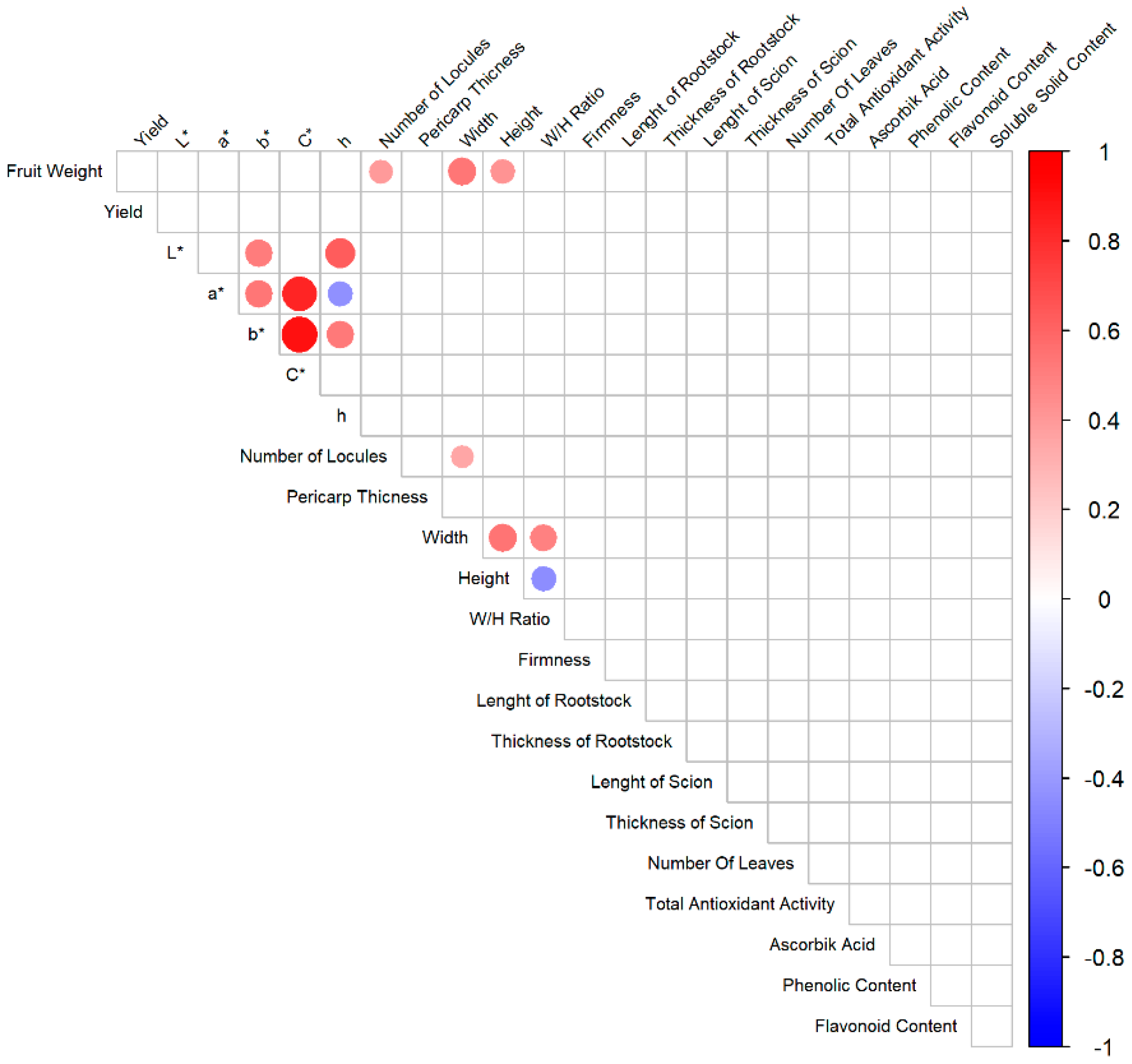
Correlations among all measured quantitative traits were analyzed (p < 0.05). Moderate positive correlations were observed between fruit width and height, width-to-height ratio, fruit weight, and number of locules (r = 0.58, 0.46, 0.56, and 0.36, respectively). Additionally, fruit height showed moderate negative correlations with width-to-height ratio (r = −0.45) and fruit weight had moderate positive correlation (r = 0.44). Fruit weight was also moderately positive correlated with both the number of locules (r = 0.39) and pericarp thickness (r = 0.33). As expected, several moderate correlations were also identified among colorimetric parameters (Figure 1).
Positive correlations between plant height and fruit weight might indicate that taller plants support larger fruit production, a trait potentially enhanced by the rootstock’s genetic background [46]. Grafting with ‘Torry F1’ as the scion could modify these correlations by altering resource allocation or hormonal signaling from the rootstock, making the heatmap a tool to evaluate graft-induced phenotypic variation [47]. Overall, no strong correlations were found among the traits, likely because the ILs used as rootstocks have different effects on the cultivar with high variation.

3.4. Principal Component Analysis

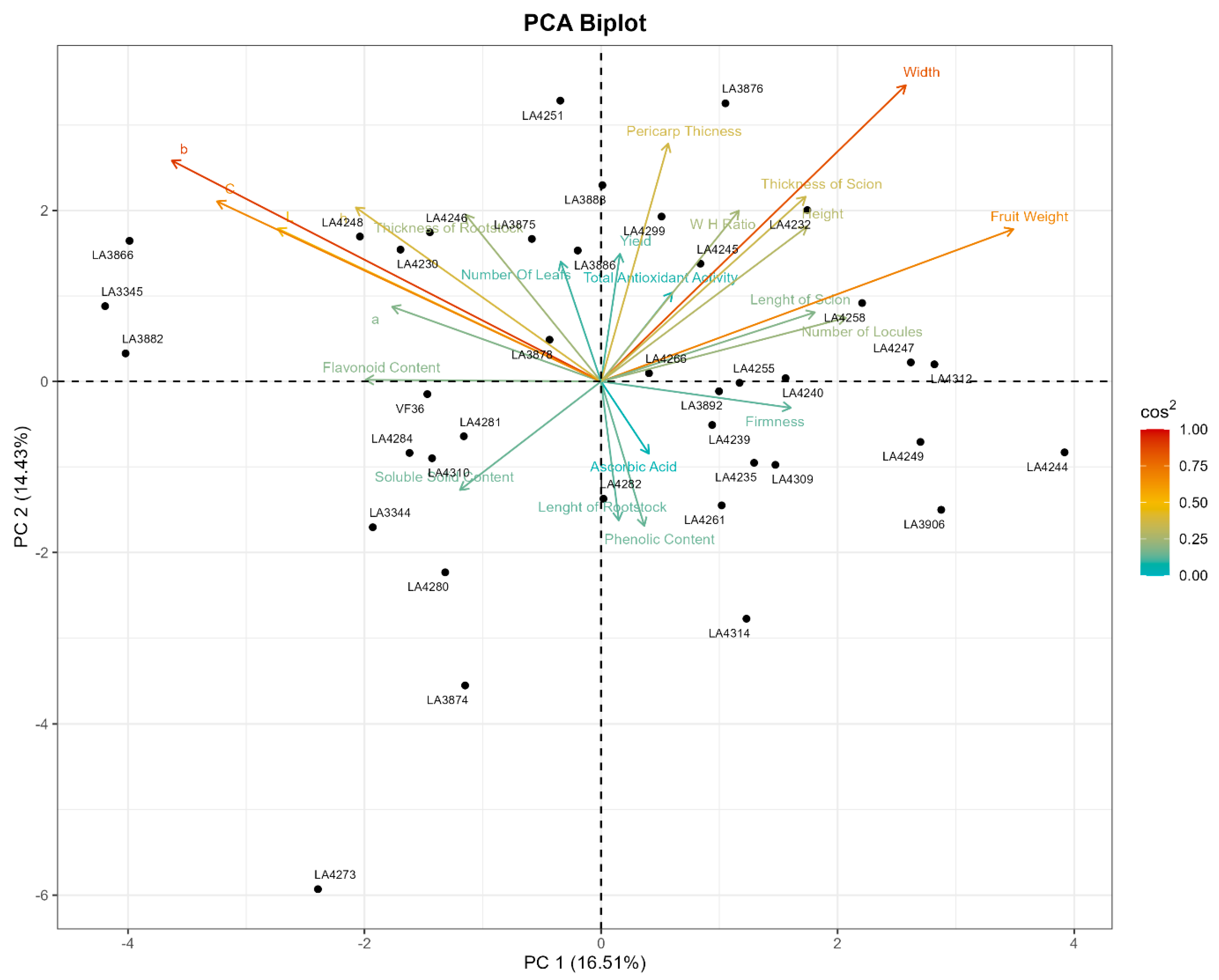
Principal component analysis was performed to evaluate the variation and interrelationships among morphological, agronomic, and biochemical quantitative traits measured across 38 S. lycopersicoides ILs used as rootstocks. The first two principal components (PC1 and PC2) accounted for 16.51% and 14.43% of the total variance, respectively (Figure 2).
The biplot revealed that several fruit morphology traits, specifically width, fruit weight, thickness of scion and pericarp thickness, contributed substantially to PC1, as evidenced by their long vectors and high cos2 values. These traits were projected in similar directions, indicating strong positive correlations, and suggesting a shared physiological or genetic basis, likely related to assimilate partitioning, cell expansion, or cuticle development. Similar trait clustering has been reported in IL populations derived from S. pennellii, where fruit morphology traits are often co-regulated through shared QTLs [23]. Additionally, colorimetric parameters such as L*, a*, b*, h°, and C* values correlated positively with PC1, emphasizing the association of this component with external fruit quality. Conversely, traits such as phenolic content and vitamin C, were oriented in directions orthogonal to fruit size traits, implying weak correlations.
PC2, on the other hand, was more correlated by thickness of scion, number of locules, and total antioxidant activity, separating ILs with higher internal fruit complexity or biochemical enrichment from those emphasizing external fruit traits. The inverse positioning of traits such as vitamin C and fruit weight suggests a metabolic trade-off, consistent with findings from metabolite-based PCA analyses in wild × domesticated tomato crosses [48,49], where investment in biochemical quality often comes at the expense of yield. The biplot also revealed distinct IL clusters based on trait profiles. ILs such as ‘LA3345’, ‘LA3866’ and ‘LA3882’ showed separation from the main cluster, indicating unique introgression effects on overall phenotype. Notably, ‘LA4273’ was positioned in the lower left quadrant, aligning with its reduced fruit weight and width, consistent with its chromosome 10 introgression. This aligns with previous studies where S. pennellii and S. habrochaites alleles on chromosome 10 were associated with smaller fruit size [21]. Overall, the PCA biplot provided an effective visual representation of trait correlations and ILs diversity, facilitating the identification of key traits contributing to phenotypic differentiation. These insights can inform selection criteria in breeding programs aimed at improving both yield components and quality traits in tomato.

3.5. Hierarchical Clustering

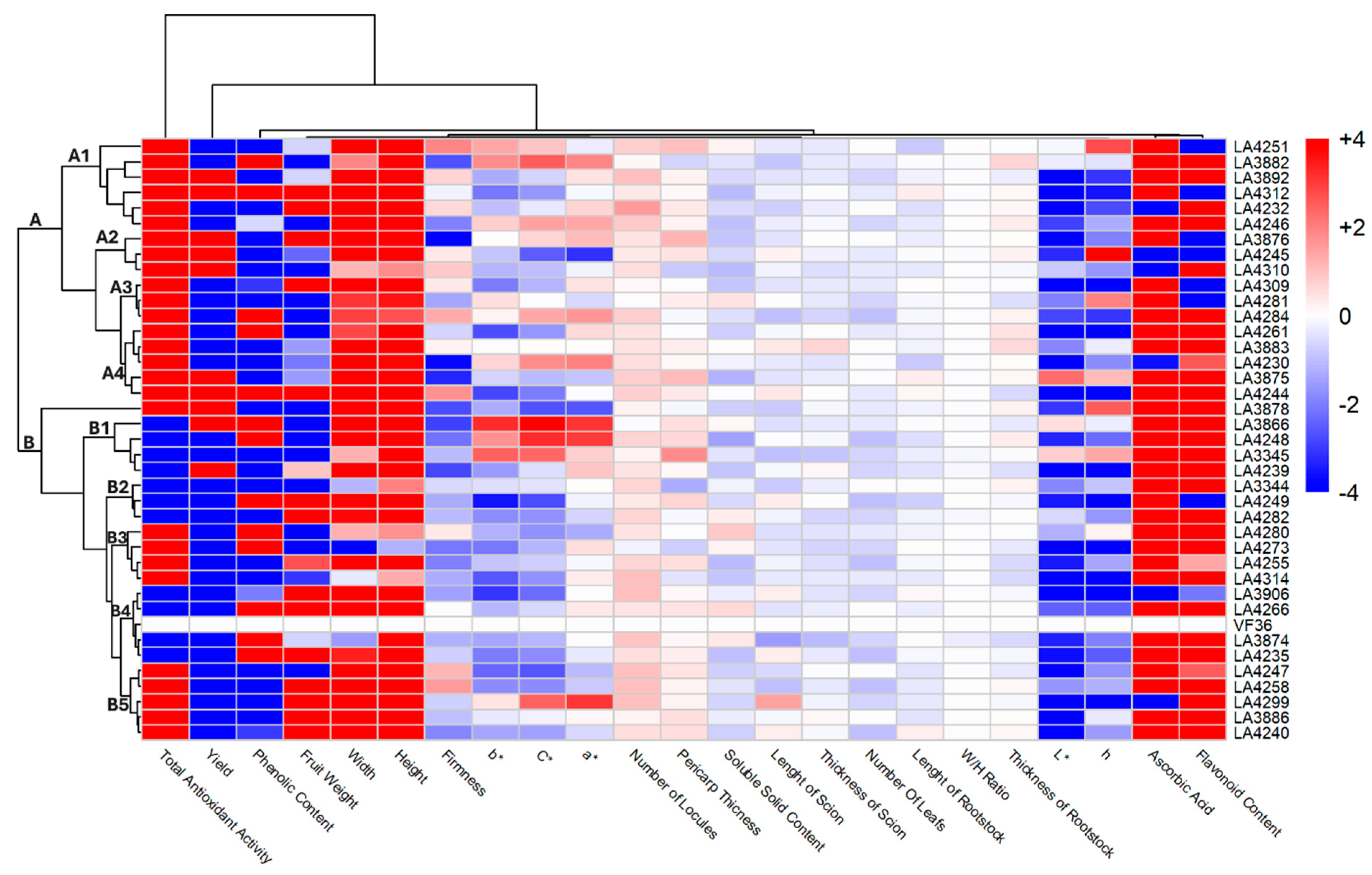
Hierarchical clustering of ILs was performed on quantitative traits and showed as a heatmap. The dendrogram revealed two main clusters (Cluster A and Cluster B). Cluster A comprised four subclusters (A1, A2, A3, and A4), containing 1, 3, 3, and 5 ILs, respectively, for a total of 17 ILs. Cluster B comprised five subclusters (B1, B2, B3, B4, and B5), containing 7, 3, 4, 5, and 5 ILs, respectively, for a total of 24 ILs (Figure 3). Furthermore, IL ‘LA4273’, which clustered distinctly in the heatmap based on fruit size, exhibited lower fruit height and width compared to ‘VF36’ and other genotypes. This line also had reduced L*, which may be attributed to the introgression of wild alleles located on chromosome 10 that negatively affect fruit development.
These findings align with previous research indicating that majority of QTLs derived from wild tomato species such as S. lycopersicoides or S. pennellii exert negative influences on traits associated with fruit size, including fruit weight and pericarp thickness [8,20,21,50]. Despite the prevailing trend of size reduction, certain ILs, such as ‘LA4246’, have been identified as possessing a slightly greater fruit weight compared to the control cultivar ‘VF36’. This observation suggests the potential presence of beneficial alleles that may be strategically utilized in breeding programs [50]. Furthermore, the identification of wild alleles influencing fruit shape, locule number, and pericarp characteristics reinforces the value of S. lycopersicoides introgressions for the dissection of complex traits related to fruit quality [8,50].

3.6. QTL Mapping

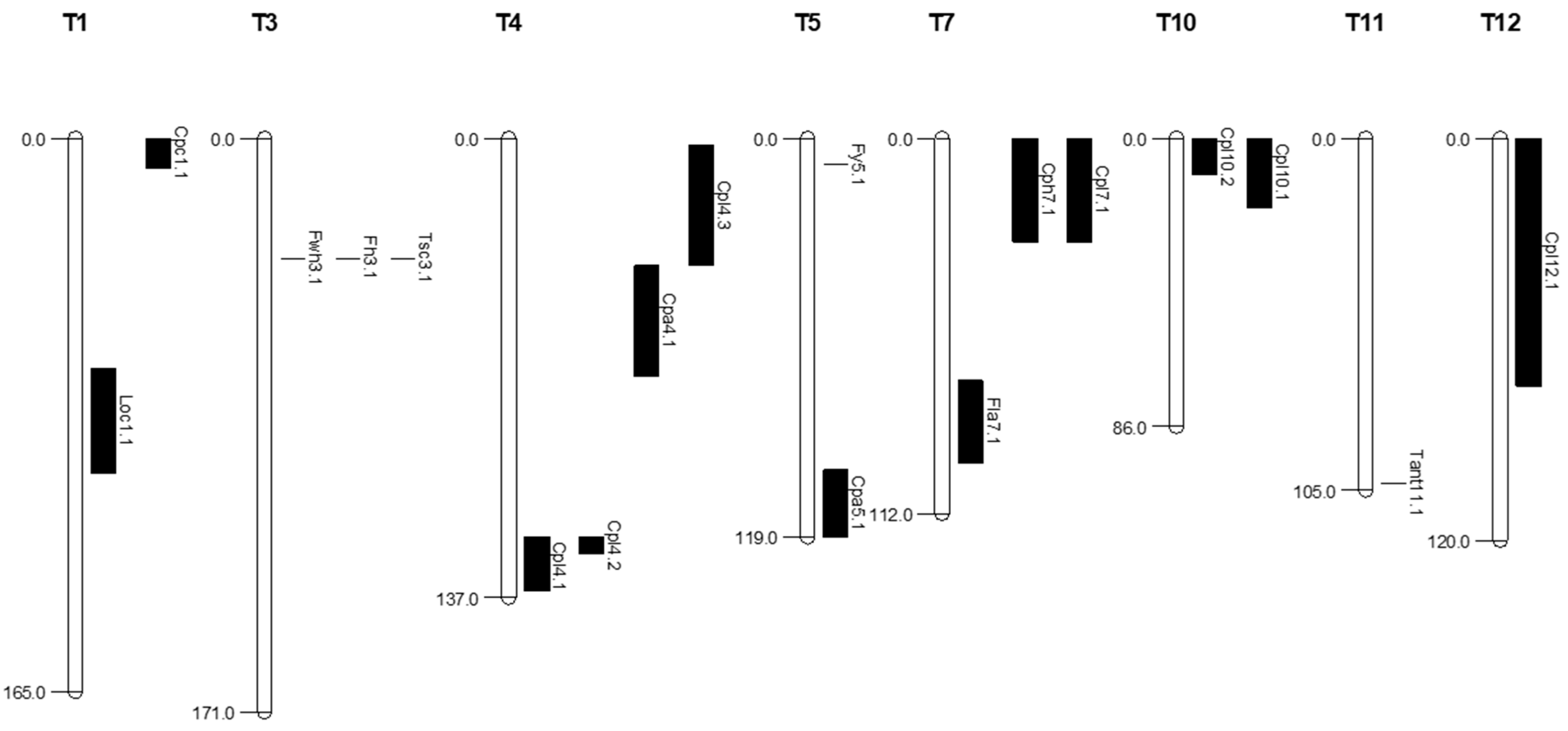
QTL mapping analysis identified a total of 19 QTLs associated with 11 quantitative traits. Phenotypic variation explained (PVEs) of identified QTLs ranged from 12% to 61%. The QTL identified in the present study with the highest PVE, Fy5.1, was located on chromosome T5, associated with yield and exhibited a PVE value of 61%. The allele for Fy5.1 originated from S. lycopersicoides. Another QTL, Fwh3.1, associated with the fruit width/height ratio, was identified on chromosome 3. Although its PVE was relatively low at 20%, the allele contributing to this trait was derived from the cultivated tomato background. In contrast, Fh3.1, a QTL associated with plant height that exhibited a similar PVE of 24%, was contributed by S. lycopersicoides.
ILs were also characterized by antioxidant-related traits, and two additional QTLs (Tant11.1 and Fla7.1) associated with total antioxidant activity and flavonoid content were identified, respectively. The QTL Tant11.1 explained 41% of the phenotypic variance, while Fla7.1 accounted for 44% of the variance. Notably, the favorable alleles for both QTLs originated from S. lycopersicoides, highlighting the significant contribution of this wild species to the enhancement of antioxidant properties in tomato fruit.
Another objective of the study was to identify the QTLs responsible for regulating the growth of both the rootstock and scion in tomato seedlings. To achieve this, the effects of S. lycopersicoides ILs were evaluated by measuring key morphological traits, including shoot length, stem thickness, and number of leaves. This analysis identified one QTL, Tsc3.1, associated with scion stem thickness, which explained 27% of PVE for the trait. The identification of Tsc3.1 highlights the influence of rootstock genotype on early-stage scion development and provides insights into the genetic basis of graft compatibility and vigor in tomato seedlings.
Additionally, fruit color traits were evaluated to investigate the genetic basis of pigmentation influenced by rootstock–scion interactions. A total of 11 QTLs were identified for the color parameters a*, C*, h° and L*. Among these, the L* value exhibited the highest number of associated QTLs, with seven identified loci. The PVE for L* associated QTLs ranged from 15% to 21%. The remaining QTLs associated with a*, C*, and h° exhibited similar PVE values, ranging between 12% and 20% (Table 4, Figure 4).
Although numerous QTL mapping studies have employed wild tomato species such as S. pimpinellifolium and S. pennellii [51], relatively few have specifically focused on identifying QTLs governing rootstock–scion compatibility. Notable exceptions include the studies conducted by Asins et al. (2015, 2020) [16,17], which explored nutrient-related QTLs using S. pimpinellifolium as the donor parent. While the present study identified a greater number of QTLs compared to the aforementioned studies, the QTLs reported by Asins et al. (2015, 2020) [16,17] included a broader range of nutrient-related loci. These differences may be attributed to variations in experimental design, wild donor species, population structure, and mapping resolution. Specifically, previous studies utilized a recombinant inbred line (RIL) population derived from S. pimpinellifolium, combined with high-resolution SNP genotyping, which likely enhanced QTL detection sensitivity. In contrast, the ILs used in the present study, derived from S. lycopersicoides, contain larger genomic segments, potentially reducing mapping resolution and the ability to detect closely linked QTLs.
The present study utilized S. lycopersicoides ILs for mapping QTLs that control rootstock-scion compatibility in terms of fruit quality and biochemical traits. A total of 19 QTLs were identified for 10 fruit quality traits and one scion morphological trait. Although the majority of favorable alleles (11 QTLs) originated from the cultivated tomato background, S. lycopersicoides contributed to seven QTLs associated with trait enhancement, underscoring its potential as a valuable genetic resource for rootstock breeding. Notably, key traits such as increased yield and improved antioxidant activity, both critical for rootstock performance and commercial value, were enhanced by alleles originating from S. lycopersicoides. While the present work was conducted under non-stress conditions, the QTLs identified here provide a valuable foundation for future analyses aimed at linking these genomic regions to physiological functions related to drought, salinity, or disease resistance.

4. Conclusions

This study evaluated the rootstock potential of S. lycopersicoides, a recently thoroughly researched wild tomato species, based on its diverse quality traits. At the same time, this wild tomato species was utilized in effective QTL analyses for rootstock. For this purpose, the IL library of S. lycopersicoides was grown under greenhouse conditions. As a result, a reasonable number of QTLs affecting rootstock scion compatibility were identified. The findings support the use of S. lycopersicoides as a promising model for studying the genetic basis of rootstock–scion interactions. The QTLs identified here represent valuable genomic targets for improving graft compatibility and overall tomato performance. Future research should focus on the fine mapping of these QTLs to identify candidate genes and elucidate the underlying molecular mechanisms, which could ultimately accelerate the breeding of superior rootstocks for sustainable tomato production.

Supplementary Materials

The following supporting information can be downloaded at: https://www.mdpi.com/article/10.3390/horticulturae11111364/s1, Table S1: Solanum lycopersicoides Inrogessiın Lines (ILs) used in present study; Table S2: Qualitative plant morphological traits of ILs.

Author Contributions

Conceptualization, A.K. and I.C.; methodology, A.K.; formal analysis, I.C.; investigation, A.K.; data curation, I.C. and H.U.; writing—original draft preparation, A.K., S.U., I.C. and H.U.; writing—review and editing, J.P.; supervision, J.P.; funding acquisition. All authors have read and agreed to the published version of the manuscript.

Funding

The APC was funded by CIPROM/2021/020 from Conselleria d’Educació, Cultura, Universitats I Ocupació (Generalitat Valenciana). This research was supported by a grant from the Scientific and Technological Research Council of Turkey (TUBİTAK) (Project number: 121O658).

Data Availability Statement

The original contributions presented in this study are included in the article/Supplementary Material. Further inquiries can be directed to the corresponding author.

Conflicts of Interest

The authors declare no conflicts of interest about the present paper.

References

  1. FAOSTAT 2024. FAOSTAT Statistics Database. Available online: http://www.fao.org/faostat (accessed on 24 October 2024).
  2. Li, Q.; Shen, H.; Yuan, S.; Dai, X.; Yang, C. miRNAs and lncRNAs in tomato: Roles in biotic and abiotic stress responses. Front. Plant Sci. 2023, 13, 1094459. [Google Scholar] [CrossRef]
  3. Rodrigues, M.H.P.; Furlong, E.B. Fungal diseases and natural defense mechanisms of tomatoes (Solanum lycopersicum): A review. Physiol. Mol. Plant Pathol. 2022, 122, 101906. [Google Scholar] [CrossRef]
  4. Manickam, R.; Chen, J.R.; Sotelo-Cardona, P.; Kenyon, L.; Srinivasan, R. Evaluation of different bacterial wilt resistant eggplant rootstocks for grafting tomato. Plants 2021, 10, 75. [Google Scholar] [CrossRef]
  5. Tejada-Alvarado, J.J.; Meléndez-Mori, J.B.; Vilca-Valqui, N.C.; Neri, J.C.; Ayala-Tocto, R.Y.; Huaman-Huaman, E.; Goñas, M. Impact of wild Solanaceae rootstocks on morphological and physiological response, yield, and fruit quality of tomato (Solanum lycopersicum L.) grown under deficit irrigation conditions. Heliyon 2023, 9, e12807. [Google Scholar] [CrossRef]
  6. Zhou, Z.; Yuan, Y.; Wang, K.; Wang, H.; Huang, J.; Yu, H.; Cui, X. Rootstock-Scion Interactions Affect Fruit Flavor in Grafted Tomato. Hortic. Plant J. 2022, 8, 499–510. [Google Scholar] [CrossRef]
  7. Walubengo, D.; Orina, I.; Kubo, Y.; Owino, W. Physico-chemical and postharvest quality characteristics of intra- and interspecific grafted tomato fruits. J. Agric. Food Res. 2022, 7, 100261. [Google Scholar] [CrossRef]
  8. Turhan, A.; Ozmen, N.; Serbeci, M.S.; Seniz, V. Effects of grafting on different rootstocks on tomato fruit yield and quality. Hortic. Sci. 2011, 38, 142–149. [Google Scholar] [CrossRef]
  9. Joshi, M.; Leskovar, D.; Djidonou, D.; Jifon, J.; Avila, C.; Masabni, J.; Crosby, K. Production Systems and Growing Environments Had Stronger Effects than Grafting on the Nutritional Quality of Tomato. ACS Food Sci. Technol. 2021, 1, 1399–1411. [Google Scholar] [CrossRef]
  10. Špika, M.; Dumičić, G.; Bubola, K.; Soldo, B.; Ban, G.; Selak, V.; Ljubenkov, I.; Mandušić, M.; Žanić, K. Modification of the Sensory Profile and Volatile Aroma Compounds of Tomato Fruits by the Scion × Rootstock Interactive Effect. Front. Plant Sci. 2021, 11, 616431. [Google Scholar] [CrossRef]
  11. Riga, P. Effect of rootstock on growth, fruit production and quality of tomato plants grown under low temperature and light conditions. Hortic. Environ. Biotechnol. 2015, 56, 626–638. [Google Scholar] [CrossRef]
  12. Lupo, Y.; Moshelion, M. The balance of survival: Comparative drought response in wild and domesticated tomatoes. Plant Sci. 2024, 339, 111928. [Google Scholar] [CrossRef]
  13. Kabas, A.; Kucukaydin, H. Effect of tomato interspecific hybrid (F1) rootstocks on yield and fruit quality traits. Gesunde Pflanz. 2023, 75, 603–612. [Google Scholar] [CrossRef]
  14. Lee, C.; Harvey, J.T.; Nagila, A.; Qin, K.; Leskovar, D.I. Thermotolerance of tomato plants grafted onto wild relative rootstocks. Front. Plant Sci. 2023, 14, 1252456. [Google Scholar] [CrossRef] [PubMed]
  15. Alfaro-Quezada, J.F.; Martínez, J.P.; Molinett, S.; Valenzuela, M.; Montenegro, I.; Ramírez, I.; Dorta, F.; Ávila-Valdés, A.; Gharbi, E.; Zhou, M.; et al. Rootstock increases the physiological defence of tomato plants against Pseudomonas syringae pv. tomato infection. J. Exp. Bot. 2023, 74, 2891–2911. [Google Scholar] [CrossRef] [PubMed]
  16. Asins, M.J.; Raga, V.; Roca, D.; Belver, A.; Carbonell, E.A. Genetic dissection of tomato rootstock effects on scion traits under moderate salinity. Theor. Appl. Genet. 2015, 128, 667–679. [Google Scholar] [CrossRef] [PubMed]
  17. Asins, M.J.; Raga, M.; Torrent, D.; Roca, D.; Carbonell, E.A. QTL and candidate gene analyses of rootstock-mediated tomato fruit yield and quality traits under low iron stress. Euphytica 2020, 216, 63. [Google Scholar] [CrossRef]
  18. Mazo-Molina, C.; Mainiero, S.; Hind, S.R.; Kraus, C.M.; Vachev, M.; Maviane-Macia, F.; Lindeberg, M.; Saha, S.; Strickler, S.R.; Feder, A.; et al. The Ptr1 locus of Solanum lycopersicoides confers resistance to race 1 strains of Pseudomonas syringae pv. tomato and to Ralstonia pseudosolanacearum by recognizing the type III effectors AvrRpt2 and RipBN. Mol. Plant Microbe Interact. 2019, 32, 949–960. [Google Scholar] [CrossRef]
  19. Mazo-Molina, C.; Mainiero, S.; Haefner, B.J.; Bednarek, R.; Zhang, J.; Feder, A.; Shi, K.; Strickler, S.; Martin, G.B. Ptr1 evolved convergently with RPS2 and Mr5 to mediate recognition of AvrRpt2 in diverse solanaceous species. Plant J. 2020, 103, 1433–1445. [Google Scholar] [CrossRef]
  20. Canady, M.A.; Meglic, V.; Chetelat, R.T. A library of Solanum lycopersicoides introgression lines in cultivated tomato. Genome 2005, 48, 685–697. [Google Scholar] [CrossRef]
  21. Eshed, Y.; Zamir, D. An introgression line population of Lycopersicon pennellii in the cultivated tomato enables the identification and fine mapping of yield-associated QTL. Genetics 1995, 141, 147–1162. [Google Scholar] [CrossRef]
  22. Schauer, N.; Semel, Y.; Roessner, U.; Gur, A.; Balbo, I.; Carrari, F.; Fernie, A.R. Comprehensive metabolic profiling and phenotyping of interspecific introgression lines for tomato improvement. Nat. Biotechnol. 2006, 24, 447–454. [Google Scholar] [CrossRef]
  23. Chitwood, D.H.; Kumar, R.; Headland, L.R.; Ranjan, A.; Covington, M.F.; Ichihashi, Y.; Sinha, N.R. A quantitative genetic basis for leaf morphology in a set of precisely defined tomato introgression lines. Plant Cell 2013, 25, 2465–2481. [Google Scholar] [CrossRef]
  24. Li, J.; Liu, L.; Bai, Y.; Zhang, P.; Finkers, R.; Du, Y.; Visser, R.G.F.; van Heusden, A.W. Seedling salt tolerance in tomato. Euphytica 2011, 178, 403–414. [Google Scholar] [CrossRef]
  25. Lee, J.M.; Kubota, C.; Tsao, S.J.; Biel, Z.; Hoyos Echevaria, P.; Morra, L.; Oda, M. Current status of vegetable grafting: Diffusion, grafting techniques, automation. Sci. Hortic. 2010, 127, 93–105. [Google Scholar] [CrossRef]
  26. Hanson, P.; Chen, J.T.; Kuo, C.G.; Morris, R.; Opena, R.T. Suggested cultural practices for tomato. Int. Coop. Guide AVRDC 2000, 1–8. [Google Scholar]
  27. Re, R.; Pellegrini, N.; Proteggente, A.; Pannala, A.; Yang, M.; Rice-Evans, C. Antioxidant activity applying an improved ABTS radical cation decolorization assay. Free Radic. Biol. Med. 1999, 26, 1231–1237. [Google Scholar] [CrossRef]
  28. Nielsen, I.L.F.; Haren, G.R.; Magnussen, E.L.; Dragsted, L.O.; Rasmussen, S.E. Quantification of anthocyanins in commercial black currant juices by simple high-performance liquid chromatography. Investigation of their pH stability and antioxidative potency. J. Agric. Food Chem. 2003, 51, 5861–5866. [Google Scholar] [CrossRef] [PubMed]
  29. Singleton, V.L.; Rossi, J.A. Colorimetry of total phenolics with phosphomolybdic-phosphotungstic acid reagents. Am. J. Enol. Vitic. 1965, 16, 144–158. [Google Scholar] [CrossRef]
  30. Zhishen, J.; Mengcheng, T.; Jianming, W. The determination of flavonoid contents in mulberry and their scavenging effects on superoxide radicals. Food Chem. 1999, 64, 555–559. [Google Scholar] [CrossRef]
  31. McGuire, R.G. Reporting of objective color measurements. HortScience 1992, 27, 1254–1255. [Google Scholar] [CrossRef]
  32. Pathare, P.B.; Opara, U.L.; Al-Said, F.A.J. Colour measurement and analysis in fresh and processed foods: A review. Food Bioprocess Technol. 2013, 6, 36–60. [Google Scholar] [CrossRef]
  33. Voorrips, R. MapChart: Software for the graphical presentation of linkage maps and QTLs. J. Hered. 2002, 93, 77–78. [Google Scholar] [CrossRef]
  34. R Core Team. R: A Language and Environment for Statistical Computing; R Foundation for Statistical Computing: Vienna, Austria, 2024; Available online: https://www.R-project.org/ (accessed on 30 June 2025).
  35. Di Gioia, F.; Signore, A.; Serio, F.; Santamaria, P. Grafting improves tomato salinity tolerance through sodium partitioning within the shoot. HortScience 2013, 48, 855–862. [Google Scholar] [CrossRef]
  36. Singh, H.; Kumar, P.; Kumar, A.; Kyriacou, M.C.; Colla, G.; Rouphael, Y. Grafting tomato as a tool to improve salt tolerance. Agronomy 2020, 10, 263. [Google Scholar] [CrossRef]
  37. Rasool, A.; Mansoor, S.; Bhat, K.M.; Hassan, G.I.; Baba, T.R.; Alyemeni, M.N.; Alsahli, A.A.; El-Serehy, H.A.; Paray, B.A.; Ahmad, P. Mechanisms underlying graft union formation and rootstock scion interaction in horticultural plants. Front. Plant Sci. 2020, 11, 590847. [Google Scholar] [CrossRef] [PubMed]
  38. Hayat, F.; Li, J.; Iqbal, S.; Khan, U.; Ali, N.A.; Peng, Y.; Hong, L.; Asghar, S.; Javed, H.U.; Li, C.; et al. Hormonal interactions underlying rootstock-induced vigor control in horticultural crops. Appl. Sci. 2023, 13, 1237. [Google Scholar] [CrossRef]
  39. Suchoff, D.H.; Gunter, C.C.; Louws, F.J. Comparative analysis of root system morphology in tomato rootstocks. HortTechnology 2017, 27, 319–324. [Google Scholar] [CrossRef]
  40. Bayındır, S.; Kandemir, D. Root system architecture of interspecific rootstocks and its relationship with yield components in grafted tomato. Gesunde Pflanz. 2023, 75, 329–341. [Google Scholar] [CrossRef]
  41. Kabas, A.; Celik, I.; Sonmez, I.; Kabas, O.; Ilbi, H. Exploring wild tomato species for morphological traits, mineral elements and known disease resistance genes. J. Agric. Sci. Technol. 2023, 25, 1129–1142. [Google Scholar]
  42. Çelik, I.; Gürbüz Çolak, N.; Doğanlar, S.; Frary, A. Tomato: Genetics, Genomics, and Breeding of Health Related Traits. In Compendium of Crop Genome. Designing for Nutraceuticals; Kole, C., Ed.; Springer: Singapore, 2023. [Google Scholar] [CrossRef]
  43. Saka, A.K.; Çilingir Tütüncü, A.; Ateş, U.; Özbakır Özer, M.; Özer, H. Impacts of Rootstocks on the Quality Attributes of Tomato Fruit (Solanum lycopersicum) During Cold Storage. Food Sci. Nutr. 2025, 13, e70187. [Google Scholar] [CrossRef]
  44. Greathouse, J.; Henning, S.; Soendergaard, M. Effect of grafting rootstock on the antioxidant capacity and content of heirloom tomatoes (Solanum lycopersicum L.) in hydroponic culture. Plants 2021, 10, 965. [Google Scholar] [CrossRef] [PubMed]
  45. Vrcek, I.V.; Samobor, V.; Bojic, M.; Saric, M.M.; Vukobratovic, M.; Erhatic, R.; Horvat, D.; Matotan, Z. The effect of grafting on the antioxidant properties of tomato (Solanum lycopersicum L.). Span. J. Agric. Res. 2011, 9, 844–851. [Google Scholar] [CrossRef]
  46. Kumar, P.; Eddie, M.; Khurshid, T. Impact of grafting on tomato production. Sci. Hortic. 2017, 219, 267–275. [Google Scholar]
  47. Warschefsky, E.J.; Klein, L.L.; Frank, M.H.; Chitwood, D.H.; Londo, J.P.; von Wettberg, E.J.B.; Miller, A.J. Rootstocks: Diversity, domestication, and impacts on shoot phenotypes. Trends Plant Sci. 2016, 21, 418–437. [Google Scholar] [CrossRef]
  48. Tieman, D.; Bliss, P.; McIntyre, L.M.; Ubeda, A.B.; Bies, D.; Odabasi, A.Z.; Rodríguez, G.R.; van der Knaap, E.; Taylor, M.G.; Goulet, C.; et al. The chemical interactions underlying tomato flavor preferences. Curr. Biol. 2012, 22, 1035–1039. [Google Scholar] [CrossRef]
  49. Zhu, G.; Wang, S.; Huang, Z.; Zhang, S.; Liao, Q.; Zhang, C.; Lin, T.; Qin, M.; Peng, M.; Yang, C.; et al. Rewiring of the fruit metabolome in tomato breeding. Cell 2018, 172, 249–261. [Google Scholar] [CrossRef]
  50. Kabas, A. Quantitative trait loci (QTL) mapping for plant morphological and fruit quality traits originating from Solanum lycopersicoides by using introgression lines. Environ. Eng. Manag. J. 2025, 24, 979–985. [Google Scholar] [CrossRef]
  51. Foolad, M.R. Genome mapping and molecular breeding of tomato. Int. J. Plant Genom. 2007, 1, 064358. [Google Scholar] [CrossRef] [PubMed]
Figure 1. Correlation heatmap of morphological and fruit quality traits in Solanum lycopersicoides ILs grafted with ‘Torry F1’ as scion. Values in the scale indicate the coefficient of correlation (r).
Horticulturae 11 01364 g001
Figure 2. PCA biplot showing the distribution of Solanum lycopersicoides ILs and the recurrent parent S. lycopersicum cv. VF-36 grafted with ‘Torry F1’, based on quantitative morphological, agronomic, and biochemical traits.
Horticulturae 11 01364 g002
Figure 3. Hierarchical clustering of Solanum lycopersicoides ILs grafted with ‘Torry F1’, based on morphological, fruit quality and biochemical trait variation relative to the control genotype ‘VF36’.
Horticulturae 11 01364 g003
Figure 4. QTL map of morphological, biochemical, and fruit quality traits.
Horticulturae 11 01364 g004
Table 1. Morphological fruit quality traits evaluated in tomato scions grafted onto S. lycopersicoides ILs.
TraitsMeasurements/Descriptors
Plant growth typedeterminate, indeterminate, semi-determinate
Plant vigorweak, medium, strong
Internode lengthshort, medium, long
Stem hairssmall, medium, large
Pinnatepinnate, bipinnate
Leaf positionsemi-erect, horizontal, semi-drooping
Leaf closing statusopen, dense
Leaf colorlight green, medium green, dark green
Fruit green shoulder (before maturity)absent, present
Fruit color in mature greenlight green, medium green, dark green
Cluster conditionmainly uniparous, equally uniparous and multiparous, mainly multiparous
Sepal positionSepals clasping the fruit, slightly spreading upwards, spreading upwards
Sepal thicknessthin, medium, thick
Sepal colorlight green, medium green, dark green
Length of rootstockaverage of 10 plants (cm)
Thickness of rootstockaverage of 10 plants (mm)
Length of scionaverage of 10 plants (cm)
Thickness of scionaverage of 10 plants (mm)
Number of leavescount per plant
Fruit weightaverage of 10 fruit (g) from each replicate
Yieldg/plant
Fruit color at maturity3NH NR100 colorimeter
Fruit inner color at maturity3NH NR100 colorimeter
Number of loculesonly two, two and three, three and four, four, five or six, more than six
Pericarp thicknessaverage of 10 fruit (mm)
Fruit Widthaverage of 10 fruit (mm)
Fruit Heightaverage of 10 fruit (mm)
Width/HeightMm
Firmness (N)Penetrometer (N)
Table 2. Mean, range and coefficient of variation (CV) of quantitative fruit morphological traits, firmness and yield evaluated in S. lycopersicoides tomato ILs used as rootstock.
TraitS. lycopersicum VF-36S. lycopersicoides ILs
Mean ± SDMean ± SDRangeCV (%)
Fruit weight (g)177.17 ± 10.31175.15 ± 26.07105.20–243.4014.89
Number of locules3.0 ± 0.273.57 ± 0.562.00–5.3315.64
Pericarp thickness (mm)8.31 ± 0.108.3 ± 0.976.38–13.9411.41
Fruit Width (mm)69.14 ± 1.5874.38 ± 5.4260.84–85.547.29
Fruit Height (mm)53.26 ± 0.1459.26 ± 4.2048.82–77.177.09
Width/Height1.30 ±0.031.26 ± 0.080.81–1.416.10
Firmness (N)8.53 ± 1.787.62 ± 2.173.25–14.8028.44
Yield (g)2470.53 ± 232.332341 ± 7671111–5372 32.78
Table 3. Mean, range and coefficient of variation (CV) of quantitative fruit physicochemical and color traits evaluated in S. lycopersicoides tomato ILs used as rootstock.
TraitsS. lycopersicum VF-36S. lycopersicoides ILs
MeanMean ± SDRangeCV (%)
Total Antioxidant Activity (μmol Trolox kg−1)3840.9 ± 1454.464352.08 ± 1316.11756.25–7961.9430.24
Ascorbic acid Content (mg ascorbic acid kg−1)139.7 ± 31.28164.62 ± 37.1981.7–275.5822.59
Phenolic Content (mg kg−1)450.41 ± 114.37420.62 ± 106.54189.97–663.5725.33
Flavonoid Content (mg kg−1)68.11 ± 9.58420.62 ± 106.5415.36–159.0335.33
TSS content3.67 ± 0.793.22 ± 0.821.6–5.925.56
L*47.8 ± 443.96 ± 3.5135.84–51.387.98
a*15.73 ± 0.9915.98 ± 1.6410.71–20.5710.24
b*17.76 ± 0.5616.95 ± 1.9112.32–22.2611.29
C*23.81 ± 0.223.38 ± 2.1918.57–29.459.38
48.35 ± 2.5846.54 ± 2.9940.44–57.196.43
Table 4. QTLs associated with morphological, biochemical, and fruit quality traits identified in Solanum lycopersicoides ILs used as rootstocks and effect (increase or decrease) of the S. lycopersicoides allele for each QTL.
TraitQTLILsChromosomeIDMarkers IL RegionsPVE (%) 1 Increase/Decrease
YieldFy5.1LA3878T5LS24-6TG62361increase
Fruit width/height ratioFwh3.1LA3874T3LS20-9TG47920decrease
Total antioxidant activityTant11.1LA3892T11LS48-2TG39341increase
Flavonoid contentFla7.1LA3886T7LS48-5TG499–TG19944increase
Number of loculesLoc1.1LA4232T1LS11-11ATG343–TG8352increase
Fruit heightFh3.1LA3874T3LS20-9TG47924increase
Thickness of scionTsc3.1LA3874T3LS20-9TG47927decrease
a*Cpa4.1LA4245T4LS10-11A4.480.000–62.030.000 bp, Ptr1 locus20decrease
a*Cpa5.1LA4299T5LS4-9TG23–TG23820increase
C*Cpc1.1LA3866T1LS1-1CT233–TG30118increase
Cph7.1LA4261T7LS8-11TG252–TG34212decrease
L*Cpl4.2LA4247T4LS12-9TG22–TG46415decrease
L*Cpl12.1LA4312T12LS45-7CTG68–CT156, TG68–TG111, T801–CT15615decrease
L*Cpl8.1LA3906T8 21decrease
L*Cpl4.3LA4244T4LS10-9TG49–TG1a4620decrease
L*Cpl10.2LA4273T10LS12-8TG230–TG30321decrease
L*Cpl7.1LA4261T7LS8-11TG252–TG34216decrease
L*Cpl4.1, Cpl10.1LA4314T4, T10LS12-9BTG230–TG596, TG22–TG46418decrease
1 Percentage of phenotypic variation explained by identified QTL.
Disclaimer/Publisher’s Note: The statements, opinions and data contained in all publications are solely those of the individual author(s) and contributor(s) and not of MDPI and/or the editor(s). MDPI and/or the editor(s) disclaim responsibility for any injury to people or property resulting from any ideas, methods, instructions or products referred to in the content.