Article

LcMYB2, a R2R3-MYB Transcription Factor, Regulates Anthocyanin and Proanthocyanidin Biosynthesis in Litchi chinensis Through Interaction with LcbHLH3


1
School of Advanced Agriculture and Bioengineering, Yangtze Normal University, Chongqing 408100, China
2
College of Horticulture, South China Agricultural University, Guangzhou 510642, China
*
Authors to whom correspondence should be addressed.
Horticulturae 2025, 11(11), 1309; https://doi.org/10.3390/horticulturae11111309
Submission received: 4 September 2025 / Revised: 13 October 2025 / Accepted: 21 October 2025 / Published: 1 November 2025

Abstract

Litchi (Litchi chinensis Sonn.) is a popular subtropical fruit with a red pericarp that is primarily determined by the accumulation of anthocyanins. The peel color and fruit quality are also influenced by proanthocyanins (PAs), which play roles in fruit development and postharvest quality. In this study, we identified LcMYB2 as a key regulator of both anthocyanin and PA biosynthesis in litchi. Phylogenetic analysis revealed that LcMYB2 belongs to the VvMYB5 subclade. Expression analysis showed that LcMYB2 is highly expressed in the early stages of fruit development. Its expression pattern was consistent with that of LcLAR and LcANR, two key genes in the PA biosynthetic pathway. Subcellular localization and protein–protein interaction assays confirmed that LcMYB2 localizes to the nucleus and interacts with LcbHLH3. Dual-luciferase reporter assays demonstrated that the LcMYB2-LcbHLH3 complex activates the promoters of LcLAR and LcANR, supporting its role in regulating PA biosynthesis. Furthermore, overexpression of LcMYB2 in tobacco resulted in the synthesis of anthocyanins and PAs in the flower, indicating that LcMYB2 can regulate anthocyanin and PA biosynthesis. Additionally, transgenic tobacco plants with LcMYB2 overexpression exhibited delayed anther dehiscence, suggesting a broader role in plant development. These findings highlight the multifunctional nature of LcMYB2 in regulating both anthocyanin and PA biosynthesis, as well as its involvement in reproductive development.

1. Introduction

Litchi (Litchi chinensis Sonn.), as a world-renowned subtropical fruit, is highly favored by consumers for its unique flavor, juicy aril, and bright pericarp color, boasting extremely high economic value. The red appearance of the pericarp serves as the primary visual indicator for evaluating the commercial value and ripeness of litchi, directly influencing its market competitiveness. This striking red color mainly originates from the accumulation of anthocyanins in the pericarp cells [1]. In addition to anthocyanins that determine the color, the litchi pericarp is also rich in another important class of polyphenolic compounds—proanthocyanidins (PAs), also known as condensed tannins [2]. PAs are key defensive substances that impart astringency to young fruits and help resist pests, diseases, and abiotic stresses [3]. Litchi fruits are very likely to develop pericarp browning after harvest, which not only severely reduces their commercial value but also leads to substantial economic losses. Studies have shown that the pericarp browning process is closely related to anthocyanin degradation and oxidative polymerization of PAs catalyzed by polyphenol oxidase (PPO) and laccase, and destruction of cell structures, being a complex physiological and biochemical process [4,5].
Anthocyanins and PAs are both members of the flavonoid family, and their biosynthesis shares the upstream phenylpropanoid pathway, which involves the sequential catalysis of phenylalanine to naringenin chalcone by phenylalanine ammonia-lyase (PAL), cinnamate 4-hydroxylase (C4H), 4-coumarate-CoA ligase (4CL), and chalcone synthase (CHS). Naringenin chalcone is then converted to naringenin by chalcone isomerase (CHI), and further to colorless leucoanthocyanidins (e.g., leucocyanidin) via the action of flavanone-3-hydroxylase (F3H), flavonoid 3′-hydroxylase (F3′H), and dihydroflavonol-4-reductase (DFR). This step is a key node for metabolic flux distribution: on one hand, leucoanthocyanidins are converted into colored anthocyanidins by anthocyanidin synthase (ANS), and further into stable anthocyanins via glycosylation by UDP-glucose: flavonoid-3-O-glycosyltransferase (UFGT); on the other hand, leucoanthocyanidins can be catalyzed by leucoanthocyanidin reductase (LAR) to generate catechin, or anthocyanidins (produced by ANS) can be reduced by anthocyanidin reductase (ANR) to generate epicatechin. Catechin and epicatechin then polymerize to form PAs [6,7]. Interestingly, during the development and ripening of litchi pericarp, the contents of anthocyanins and PAs exhibit a dynamic balance: as the fruit ripens, the anthocyanin content increases significantly, turning the pericarp from green to red, while the PAs content shows a decreasing trend [2,8]. This metabolic flux redistribution implies that anthocyanins and PAs share upstream biosynthetic precursors and that a fine-tuned balance exists between their biosynthesis [9].
The biosynthesis of flavonoids is a complex metabolic network, tightly regulated at multiple levels. At the transcriptional level, the MBW ternary complex, composed of MYB, bHLH (basic helix–loop–helix), and WD40 repeat proteins, is considered the core hub regulating the expression of flavonoid structural genes [10]. Within this complex, members of the R2R3-MYB transcription factor family play a decisive role. They provide the regulatory network with selectivity and specificity for different branch pathways (such as anthocyanin synthesis or PA synthesis) by recognizing specific cis-acting elements in the promoters of downstream genes [11]. In the model plant Arabidopsis thaliana, functional differentiation is particularly typical: AtMYB75, AtMYB90, etc., belonging to subgroup 6, mainly activate anthocyanin biosynthesis, while AtMYB123/TT2 in subgroup 5 specifically regulates PA accumulation [12,13,14]. In litchi, LcMYB1 mainly regulates the biosynthesis of anthocyanins in litchi pericarp through interacting with LcbHLH1 and LcbHLH3. LcMYB5, on the other hand, interacts with LcbHLH3 to regulate the accumulation of anthocyanins and organic acids. In addition, the R3-MYB protein LcMYBx competes with LcMYB1 for binding to LcbHLHs, thus preventing the activation of LcDFR by the LcMYB1-LcbHLHs complex and negatively controlling anthocyanin biosynthesis [15,16,17,18].
However, with the advancement of research, increasing evidence indicates that in certain species or specific developmental stages, a single MYB transcription factor may possess a “dual function” of regulating both anthocyanin and PA pathways simultaneously. For instance, during fruit development in grape (Vitis vinifera), VvMYB5b has been demonstrated to coordinately regulate the synthesis of anthocyanins and PAs [19,20]. In Populus tomentosa, PtoMYB6 not only promotes anthocyanin and PA synthesis but also unexpectedly inhibits secondary wall formation [21]. In cultivated strawberry (Fragaria × ananassa) fruit, FaMYB5 can positively regulate the biosynthesis of anthocyanins and PAs [22]. Additionally, MdMYB9 and MdMYB11 are involved in regulating the jasmonic acid (JA)-induced biosynthesis of anthocyanins and PAs in apples [23]. These findings reveal the complexity and species specificity of the MYB regulatory network, suggesting that anthocyanin and PA synthesis in some plants may be governed by more sophisticated and coordinated regulatory mechanisms rather than being completely independent.
Although the importance of flavonoids in litchi has been widely recognized, the analysis of its transcriptional regulatory network remains relatively lagging. Previous studies have identified LcMYB1 as a key regulator of anthocyanin biosynthesis during litchi ripening, but the regulatory factors controlling PA accumulation in early fruit development and the coordination mechanism between anthocyanin and PA pathways remain unclear. Additionally, whether MYB transcription factors in litchi have pleiotropic roles beyond flavonoid regulation has not been explored. Given that PAs are critical for early fruit defense and anthocyanins determine commercial quality, identifying the core regulators coordinating these two pathways is essential for improving litchi fruit quality and stress resistance, which is the key gap this study aims to address. In this study, we identified a novel R2R3-MYB transcription factor, designated as LcMYB2. LcMYB2 promotes both anthocyanins and PA accumulation by directly activating the biosynthesis pathway genes by interacting with LcbHLH3. Furthermore, overexpression of LcMYB2 exhibited an unexpected effect on reproductive development in transgenic tobacco, delaying anther dehiscence. This research enhances our understanding of the regulation of anthocyanin and PA biosynthesis during fruit ripening and reproductive organ development.

2. Materials and Methods

2.1. Plant Materials and Growth Conditions

Litchi (Litchi chinensis Sonn. cv. ‘Huaizhi’) plants were grown in the experimental orchard of Yangtze Normal University (Chongqing, China). Samples were collected from three biological replicates, with each replicate consisting of 10 fruits from different plants. Fruit pericarp was sampled at 40, 55, and 70 days post-anthesis (DPA), corresponding to early development, mid-ripening, and full ripening stages, respectively. Samples were frozen in liquid nitrogen and stored at −80 °C until use. Tobacco (Nicotiana benthamiana) and wild-type tobacco (cv. W38) were grown in a greenhouse under controlled conditions: 16 h light/8 h dark cycle at 25 °C, 70% relative humidity.

2.2. RNA Extraction and cDNA Synthesis

Total RNA was extracted from litchi leaves, fruit pericarp, and tobacco tissues using the Plant RNA Extraction kit (Magen Biotech Co., Ltd., Guangzhou, China) following the manufacturer’s protocol. RNA integrity was verified by 1% agarose gel electrophoresis, and concentration was measured using a Nanodrop 1000 spectrophotometer (Thermo Fisher Scientific Inc., Waltham, MA, USA).
First-strand cDNA was synthesized from 1 μg of total RNA using HiScript IV 1st Strand cDNA Synthesis Kit (+gDNA wiper) (Vazyme Biotech Co., Ltd., Nanjing, China).

2.3. Cloning and Sequence Analysis of LcMYB2

The full-length coding sequence (CDS) of LcMYB2 was amplified from litchi pericarp cDNA using gene-specific primers (Table S1) designed based on genome data. PCR amplification was performed using PrimeSTAR® Max DNA Polymerase (TaKaRa Bio Inc., Kusatsu, Japan). The PCR product was cloned into the pSAK277 expression vector and sequenced (Sangon Biotech Shanghai Co., Ltd., Shanghai, China). Sequence similarity was analyzed using BLAST (NCBI). Conserved domains were predicted using the latest version of SMART (http://smart.embl-heidelberg.de/). A phylogenetic tree was constructed with MEGA11 using the neighbor-joining method (1000 bootstrap replicates), including homologous MYB proteins from other species.

2.4. Quantitative Real-Time PCR (qRT-PCR) Analysis

qRT-PCR was performed to analyze gene expression patterns using a LightCycler® 480 II (Roche Ltd., Basel, Switzerland). The reaction mixture (20 μL) contained 10 μL 2× SYBR Green Master Mix (Vazyme Biotech Co., Ltd., Nanjing, China), 0.4 μL each primer (10 μM), 2 μL cDNA template, and 7.2 μL ddH2O. The amplification conditions were: 95 °C for 30 s; 40 cycles of 95 °C for 5 s, 60 °C for 30 s; followed by a melting curve analysis. Each experiment included three biological replicates and three technical replicates. LcActin (litchi) and NtActin (tobacco) were used as internal reference genes to normalize the expression levels of target genes. Statistical analysis was performed using GraphPad Prism 9.0 software, and significant differences were determined by one-way analysis of variance (ANOVA) followed by Tukey’s multiple comparison test. A p-value of less than 0.05 was considered statistically significant. Primers for qRT-PCR are listed in Table S1.

2.5. Subcellular Localization of LcMYB2

The CDS of LcMYB2 (without stop codon) was amplified with In-Fusion cloning and then inserted into the pEAQ-GFP vector to generate pEAQ-LcMYB2-GFP, a 35S::LcMYB2-GFP fusion construct, with GFP driven by the CaMV35S promoter. The empty vector (35S::GFP) was used as a control. Recombinant plasmids were transformed into Agrobacterium tumefaciens strain GV3101. Bacterial cultures (OD600 = 0.6) were infiltrated into the abaxial side of 4-week-old N. benthamiana leaves using a syringe. After 48 h, GFP fluorescence was observed using an Olympus BX71 fluorescence microscope.

2.6. Transcriptional Activation Activity Assay

To analyze transcriptional activation activity, the CDS of LcMYB2 was cloned into the pEAQ-BD vector (GAL4 DNA-binding domain, BD) to generate 35S::LcMYB2-BD. The positive control was 35S::VP16-BD (VP16 activation domain fused to BD), and the negative control was the empty pBD vector. The reporter vector 5×GAL4::LUC (luciferase gene driven by 5×GAL4 cis-elements) was co-infiltrated with effector vectors into N. benthamiana leaves via A. tumefaciens-mediated transformation. Luciferase activity was detected 48 h post-infiltration by spraying 1 mM luciferin and imaging with a cooled CCD camera (Tanon 5200, Tanon Science & Technology Co., Ltd., Shanghai, China).

2.7. Protein–Protein Interaction Assays

2.7.1. Bimolecular Fluorescence Complementation (BiFC)

The CDS of LcMYB2 was first cloned into pDNOR207 by the gateway cloning method, and then inserted into pEAQ-DEST-NYFP to generate 35S::LcMYB2-YN by LR reaction. 35S::LcbHLH1-YC and 35S::LcbHLH3-YC were from our previous study [18]. Combinations of 35S::LcMYB2-YN with 35S::LcbHLH1-YC or 35S::LcbHLH3-YC were co-infiltrated into N. benthamiana leaves. YFP fluorescence was observed 48 h post-infiltration using an Olympus BX71 fluorescence microscope.

2.7.2. Luciferase Complementation Assay (LCA)

LcMYB2 was fused to the N-terminal fragment of luciferase (nLUC) in pEAQ-DEST1-cLUC-N1, and LcbHLH3 was fused to the C-terminal fragment (cLUC) in pEAQ-DEST1-NLUC-C1 by LR reaction. The constructs 35S::LcMYB2-nLUC and 35S::LcbHLH3-cLUC were co-infiltrated into N. benthamiana leaves. Empty nLUC/cLUC vectors were used as controls. Luciferase activity was detected 48 h post-infiltration by spraying 1 mM luciferin (Promega, Madison, WI, USA) and imaging with a cooled CCD camera (Tanon 5200, Tanon Science & Technology Co., Ltd., Shanghai, China).

2.8. Dual-Luciferase Reporter Assay

Promoters of LcCHS, LcDFR, LcLAR2, and LcANR were amplified from litchi genomic DNA and cloned into the pGreenII 0800-LUC vector to generate reporter plasmids (Pro::LUC). Effector plasmids included 35S::LcMYB2 and 35S::LcbHLH3 (driven by CaMV35S promoter), with pSAK277 as the empty control. Reporter and effector plasmids were co-infiltrated into N. benthamiana leaves via A. tumefaciens. After 48 h, LUC and REN (internal control) activities were measured using the Dual-Luciferase Reporter Assay System. The LUC/REN ratio was calculated from six biological replicates.

2.9. Generation of Transgenic Tobacco and Phenotypic Analysis

A. tumefaciens GV3101 was transformed with pSAK277-LcMYB2, and the construct was then introduced into wild-type tobacco (‘W38’) via leaf disc transformation. Transgenic plants were screened using kanamycin resistance and confirmed by PCR. Two independent lines (Line 1 and Line 5) were selected for further analysis. Phenotypic observations (petal and anther color) were conducted at the flowering stage. For PA detection, flowers of transgenic and wild-type tobacco were stained with 0.1% DMACA (4-dimethylaminocinnamaldehyde) in ethanol/HCl (1:1, v/v) for 2 h and photographed.

3. Results

3.1. LcMYB2 Isolation and Sequence Analysis

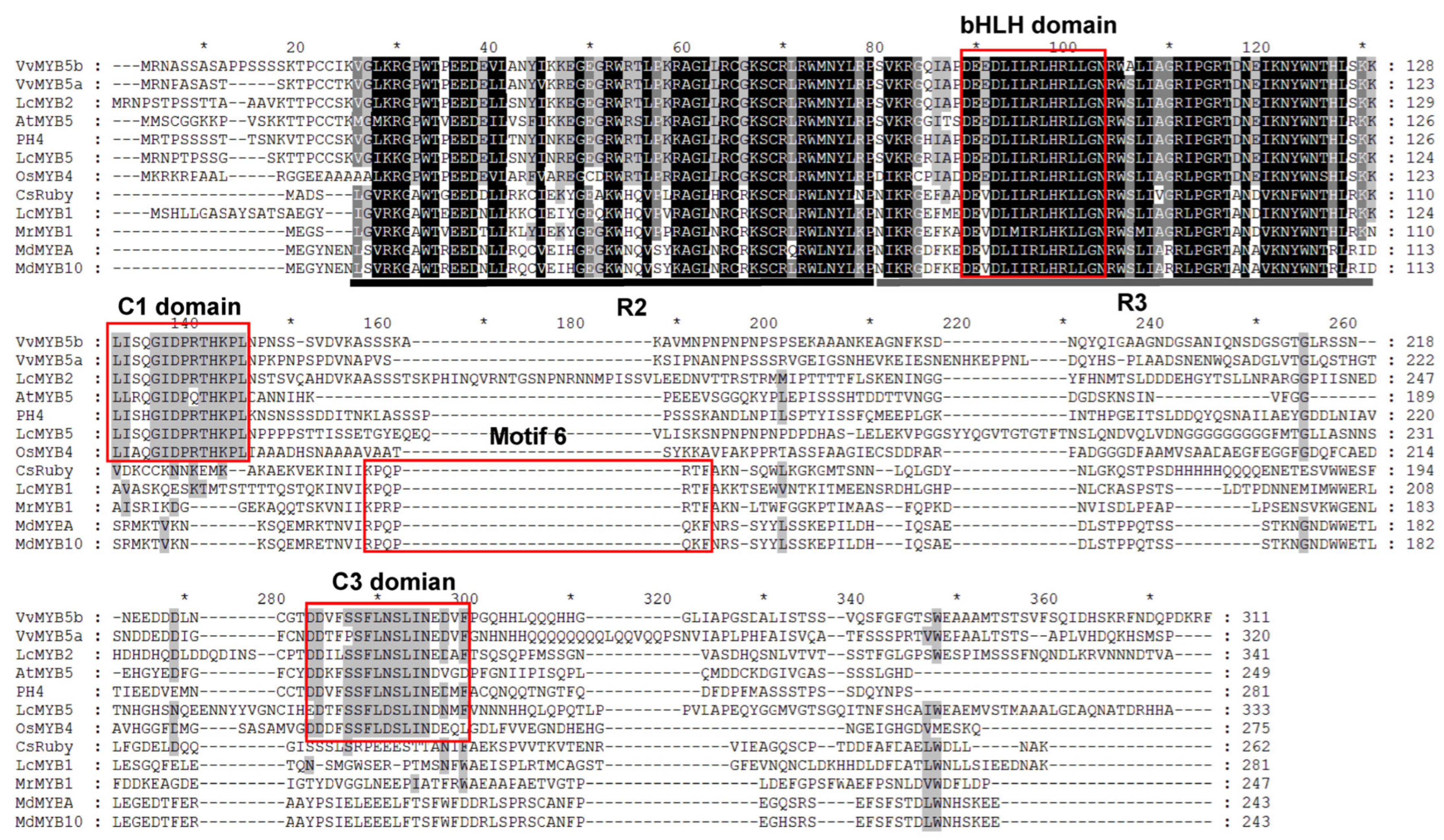
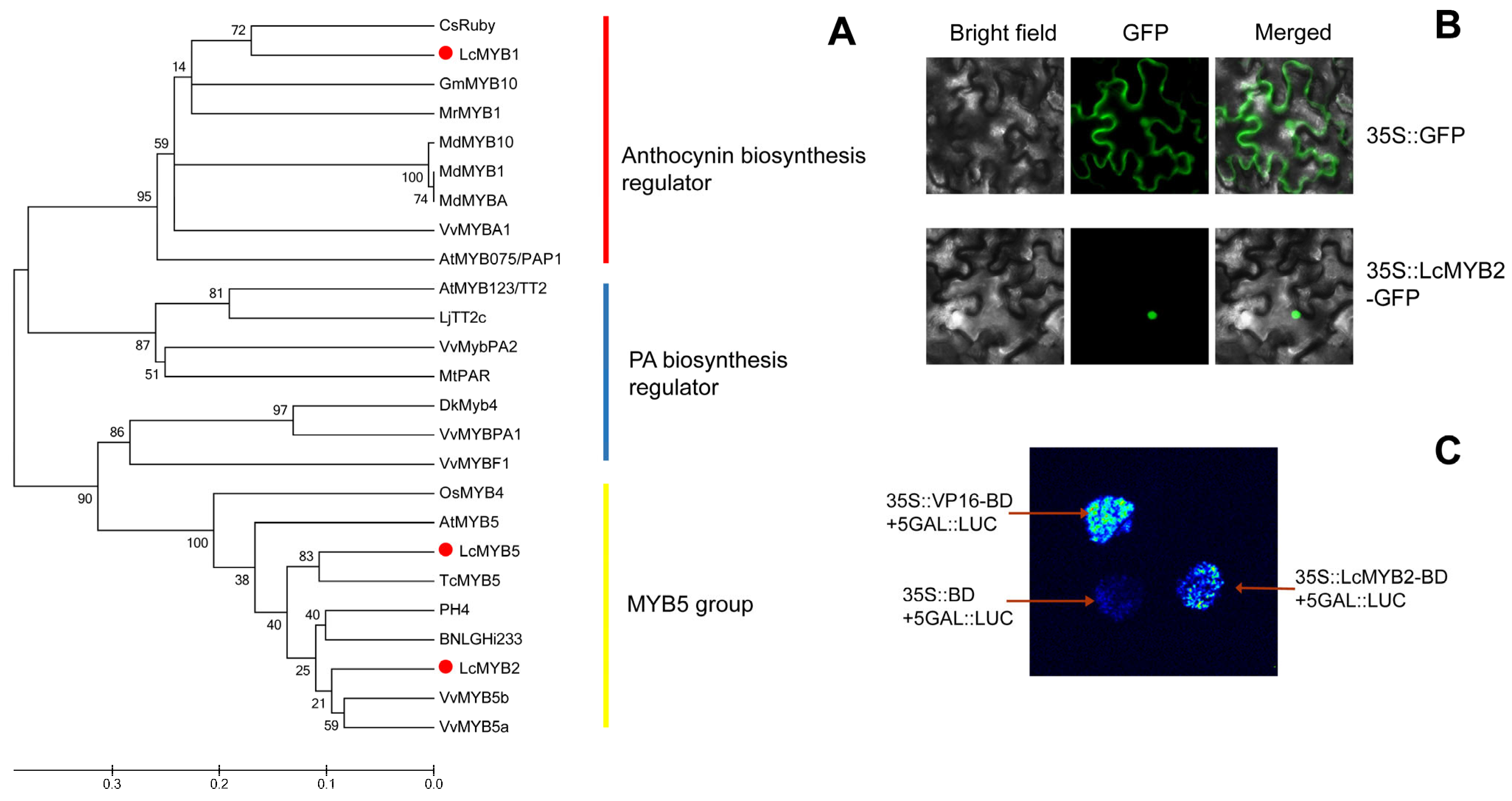
In litchi pericarp transcriptome data, an R2R3-MYB transcription factor named LcMYB2, which belongs to the MYB5 subgroup, was identified to regulate anthocyanin biosynthesis and acidification during fruit early development [18]. There is a bHLH interaction domain within the R3 domain of LcMYB2, indicating that it can interact with bHLH proteins. A C1 motif (Lx3GIDPxTHKPL) and a C3 motif (DDxF[S/P]SFL[N/D]SLIN[E/D]) were conserved between MYB5 group proteins, and motif 6 was conserved among anthocyanin regulator group members like LcMYB1 and CsRuby (Figure 1). From the phylogenetic tree (Figure 2A), it is clear that LcMYB2 was closer than LcMYB5 to VvMYB5a and VvMYB5b, which participate in regulating anthocyanin and PA biosynthesis in grape fruit [20].
As a transcription factor, LcMYB2 is speculated to be localized in the nucleus and to play a role in transcriptional regulation. A 35S::LcMYB2-GFP fusion vector was constructed and transiently expressed in tobacco leaves to detect the sub-cellular localization of LcMYB2-GFP in tobacco leaf cells. As shown in Figure 2B, the GFP fluorescence of LcMYB2-GFP was concentrated in the nucleus, indicating that LcMYB2 is localized in the nucleus. Further analysis of transcriptional activity in N. benthamiana leaf cells revealed that LcMYB2 possesses transcriptional activation ability. Consistent with the positive control 35S::VP16-BD, the relative luciferase activity of 35S::LcMYB2-BD was significantly higher than that of the negative control 35::BD (Figure 2C). These results indicate that LcMYB2, as a nucleus-localized protein, functions as a transcriptional activator.

3.2. Expression Level of Anthocyanin and PA Biosynthesis Related Genes During Fruit Developing Stages

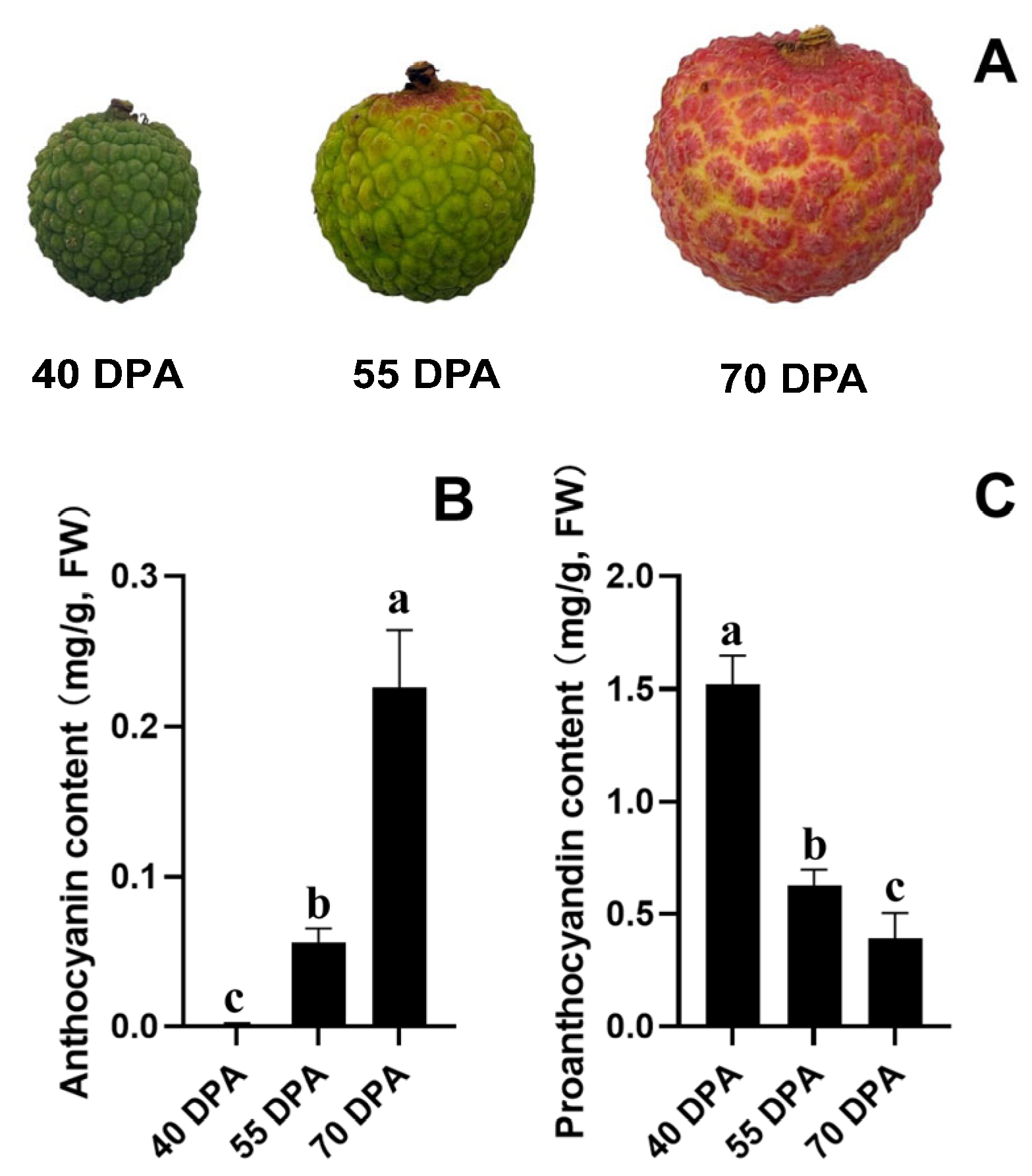
During fruit development at 40 DPA, 55 DPA, and 70 DPA, the anthocyanin and PA contents changed significantly. At 70 DPA, the fruit showed the highest anthocyanin content, approximately 0.25 mg/g, while the 40 DPA fruit had almost no detectable anthocyanin, and the 55 DPA fruit had a low anthocyanin content (about 0.05 mg/g). Regarding PA content, the 40 DPA fruit had the highest level, reaching about 1.52 mg/g. The 55 DPA fruit had a moderate PA content (around 0.63 mg/g), and the 70 DPA fruit had the lowest PA content, at roughly 0.40 mg/g (Figure 3). These findings suggest that as the fruit develops (from 40 DPA to 70 DPA), anthocyanin content increases, while PA content decreases, which is consistent with the fruit color changes from green to red during ripening.
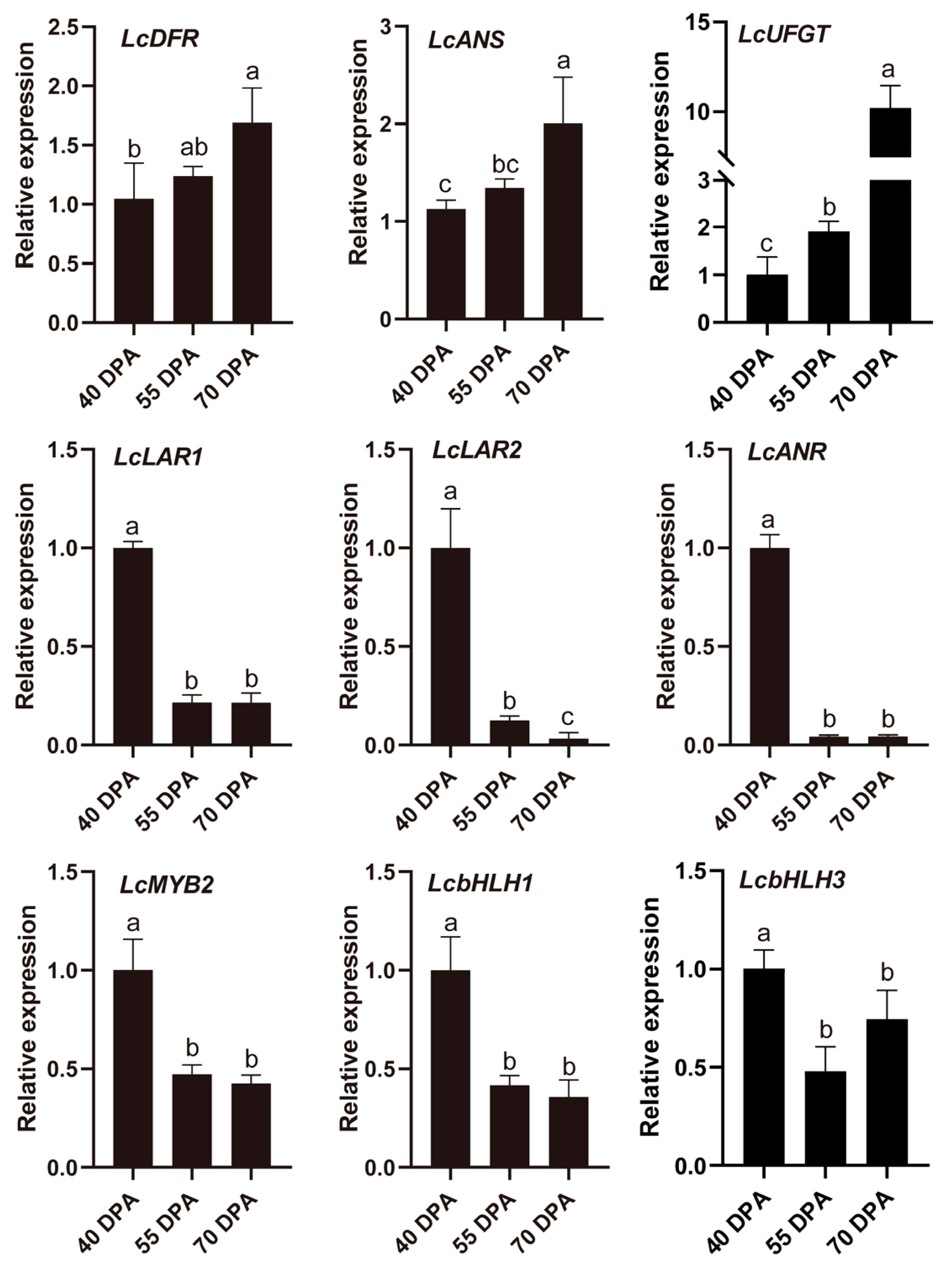
To investigate the potential role of LcMYB2 in regulating anthocyanin and PA biosynthesis, we first analyzed its temporal expression pattern in litchi fruit pericarp at 40, 55, and 70 days post-anthesis (DPA) using quantitative real-time PCR (qRT-PCR). For comparison, we also examined the expression dynamics of key structural genes involved in anthocyanin and PA biosynthesis during the same developmental stages. Anthocyanin synthesis genes (LcDFR, LcANS, LcUFGT) showed stage-specific upregulation, with peak expression at 70 DPA when the fruit is fully red (Figure 4). This late-stage activation is critical for anthocyanin accumulation during fruit ripening, directly contributing to the development of the characteristic red peel color. For PA synthesis, LcLAR1, LcLAR2 and LcANR exhibited higher expression at the early stage (40 DPA), indicating active PA biosynthesis during fruit development (Figure 4). The expression patterns of LcMYB2 and other regulatory genes across fruit developmental stages further support a complex regulatory network. LcMYB2 likely orchestrates the spatiotemporal expression of both anthocyanin and PA pathways in both pericarp and leaf.

3.3. Over-Expression of LcMYB2 in Tobacco

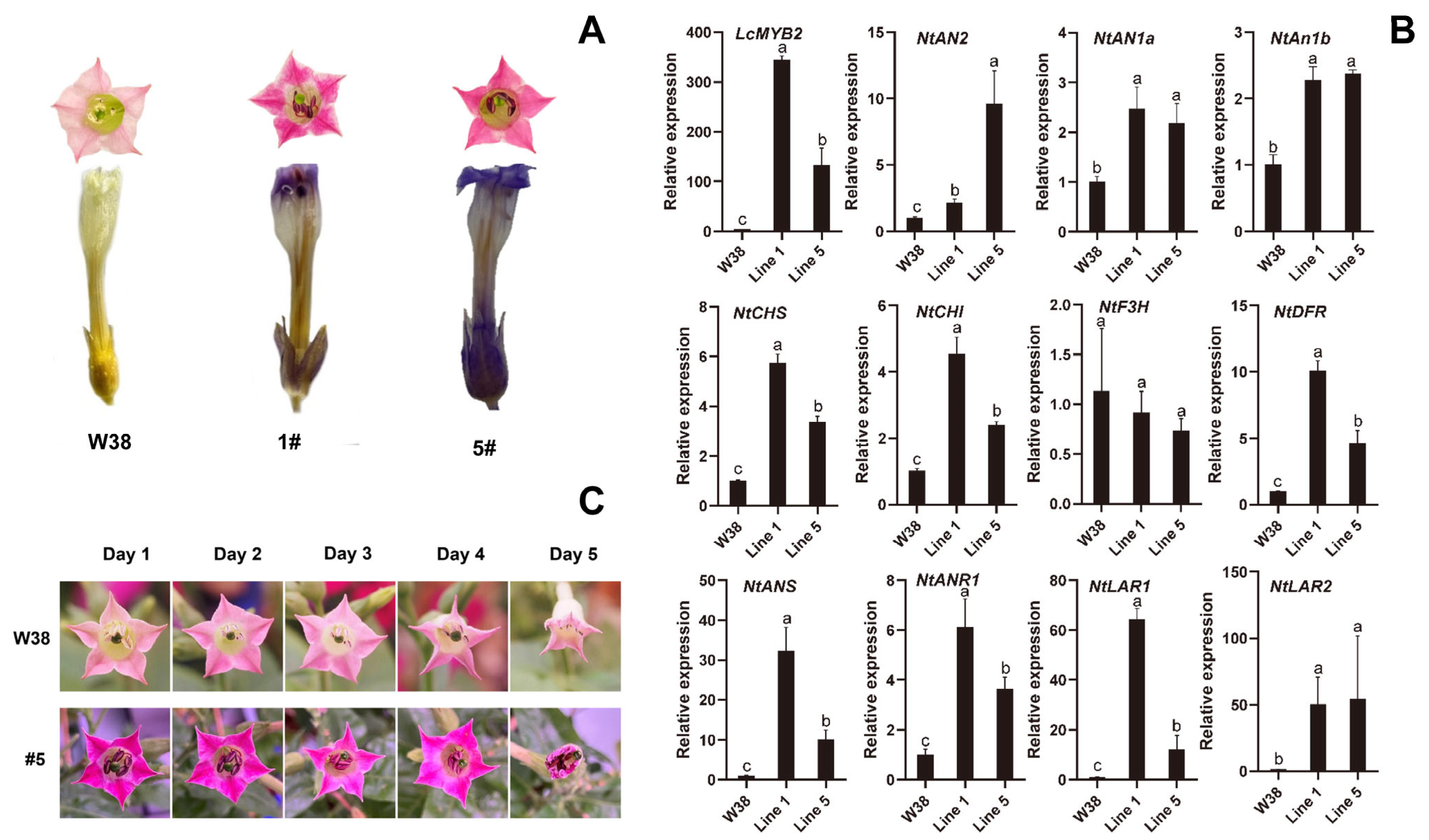
To further elucidate the functional roles of LcMYB2, an overexpression vector of LcMYB2 was constructed and introduced into tobacco via Agrobacterium-mediated transformation. Two independent transgenic lines (Line 1 and Line 5) were selected for further study. As demonstrated in Figure 5A, the petals of LcMYB2-overexpressing tobacco exhibited significantly enhanced red pigmentation compared to wild-type (WT) control (Figure S1), indicative of increased anthocyanin accumulation. Notably, anthocyanins were also detected in the anthers of transgenic plants, a phenotype absent in WT tobacco, suggesting LcMYB2 promotes anthocyanin biosynthesis in floral reproductive tissues.
To mechanistically dissect this phenomenon, we analyzed the expression profiles of endogenous anthocyanin-related genes in tobacco. Transgenic lines displayed upregulated expression of both regulatory genes (NtAN2, NtAN1a, NtAN1b) and structural genes (NtCHS, NtCHI, NtDFR, NtANS) compared to WT plants (Figure 5B). This coordinated activation of the anthocyanin pathway supports the observed pigmentation phenotype.
To investigate whether LcMYB2 also influences PA synthesis, DMACA staining was performed on transgenic flowers. A distinct blue coloration—characteristic of PA accumulation—was detected in transgenic petals, whereas WT flowers showed no staining (Figure 5A). The PA content in the petals of LcMYB2-overexpressing tobacco increased significantly, while the PA content in wild-type tobacco was very low (Figure S1). Concomitantly, quantitative analysis revealed strong induction of PA biosynthesis genes (NtANR1, NtLAR1, NtLAR2) in transgenic lines (Figure 5B). These results collectively demonstrate that LcMYB2 functions as a dual regulator of both anthocyanin and PA metabolic pathways, orchestrating flavonoid biosynthesis through transcriptional activation of key structural and regulatory genes in tobacco.
We unexpectedly observed a delay in anther dehiscence in LcMYB2-transgenic tobacco lines: from flowering to senescence (Day 5), transgenic anthers failed to release pollen, whereas wild-type anthers released pollen as early as Day 1 post-flowering (Figure 5C).

3.4. LcMYB2 Could Interact with LcbHLH Proteins

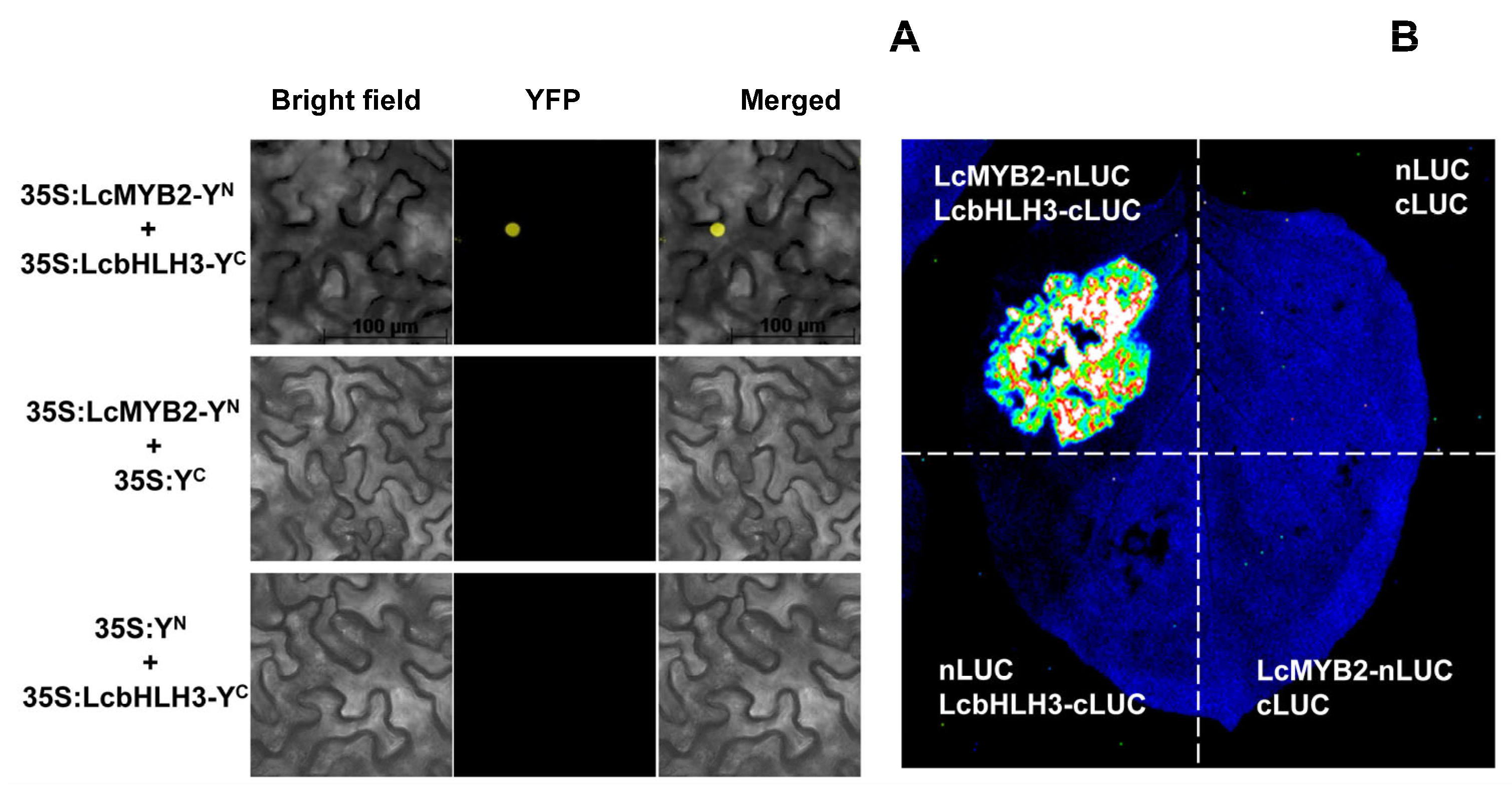
There is a binding site for bHLH transcription factors in the protein sequence of LcMYB2. To verify whether LcMYB2 can interact with the bHLH transcription factors identified in our previous study, LcMYB2 was fused with the N-terminal of YFP to generate the 35S:LcMYB2-YN construct. Combinations of LcMYB2-NYFP and LcbHLH1/3-CYFP were transiently expressed in tobacco leaves, respectively, to determine whether LcMYB2 interacts with LcbHLH. As shown in Figure 6A, when 35S:LcMYB2-YN and LcbHLH3-YC were co-expressed in tobacco leaves, YFP fluorescence was observed in the nuclei of tobacco leaf cells, indicating that LcMYB2 can interact with LcbHLH3. However, when 35S:LcMYB2-YN and LcbHLH1-YC were co-expressed, no YFP fluorescence was detected, suggesting that LcMYB2 cannot interact with LcbHLH1. In the luciferase complementary assay (LCA), when LcMYB2-nLUC (N-terminal half of luciferase fused to LcMYB2) was co-expressed with LcbHLH3-cLUC (C-terminal half of luciferase fused to LcbHLH3), a strong luminescence signal was detected in the specified quadrant of the tobacco leaf (Figure 6B). In contrast, the other quadrants, where either a non-interacting combination (nLUC and cLUC alone) was infiltrated, showed no significant lum inescence signal.
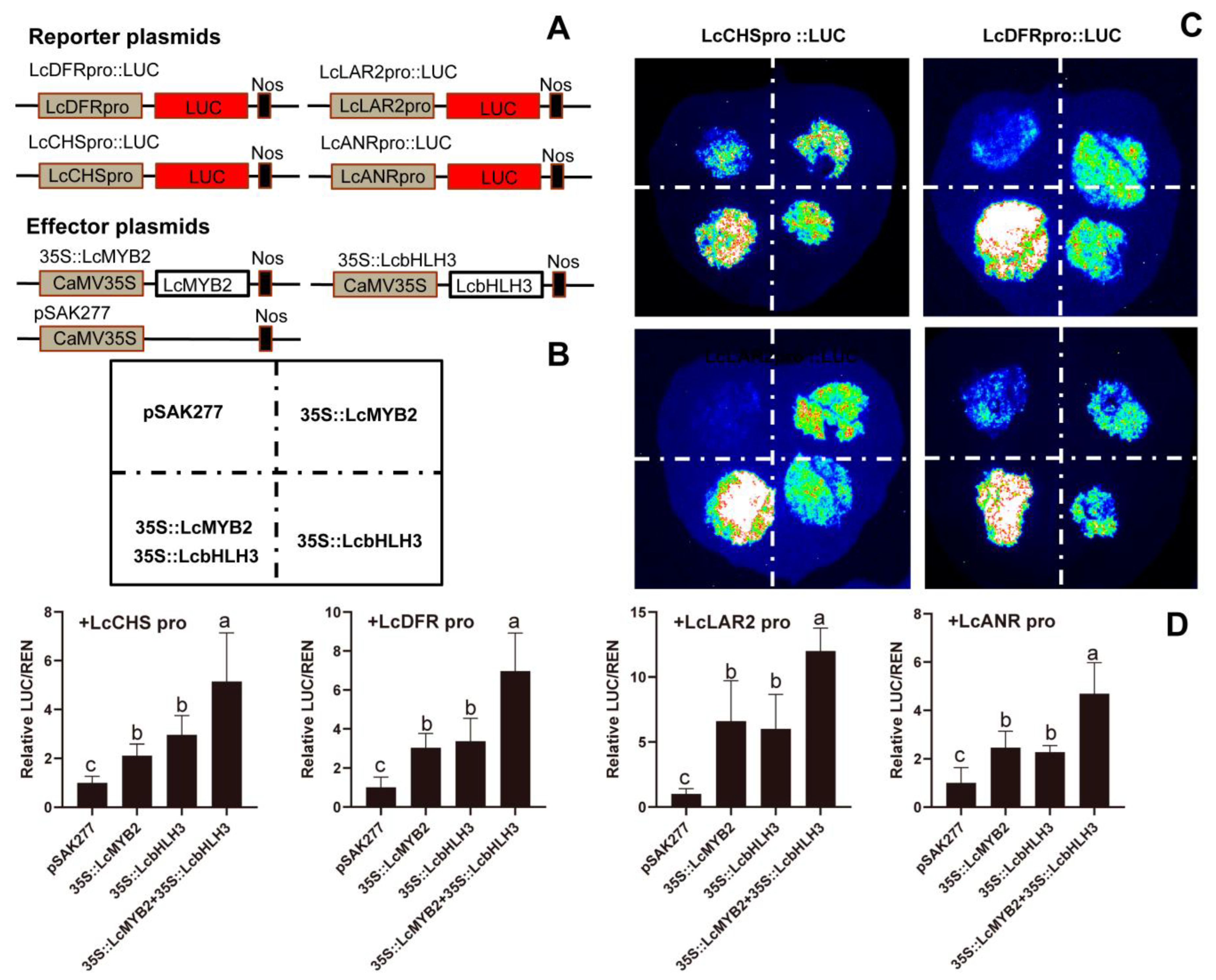
For this dual-luciferase assay, four reporter plasmids (LcDFRpro::LUC, LcCHSpro::LUC, LcLAR2pro::LUC, LcANRpro::LUC) were made. Each fuses the promoter of a litchi gene key to anthocyanin or PA biosynthesis with the luciferase gene, and has a Nos terminator. Three effector plasmids were utilized: 35S:LcMYB2 and 35S:LcbHLH3 driven by the CaMV35S promoter to express respective proteins, and pSAK277 as a control. When different effector combinations were co-infiltrated with the reporter plasmids, distinct luminescence patterns emerged. For all four reporter plasmids (LcCHSpro::LUC, LcDFRpro::LUC, LcLAR2pro::LUC, LcANRpro::LUC), the co-infiltration of 35S:LcMYB2 and 35S:LcbHLH3 led to the strongest luminescence signals. In contrast, single-effector infiltration or the control (pSAK277) resulted in weaker signals. To further quantify the activation effect, relative luciferase activity was measured (Figure 7D). For the LcCHSpro::LUC reporter, the combination of 35S:LcMYB2 and 35S:LcbHLH3 significantly elevated luciferase activity compared to pSAK277 (control), 35S:LcMYB2 alone, or 35S:LcbHLH3 alone. Similarly, for LcDFRpro::LUC, LcLAR2pro::LUC, and LcANRpro::LUC reporters, the co-infiltration of 35S:LcMYB2 and 35S:LcbHLH3 consistently induced the highest luciferase activity. These quantitative data corroborate the luminescence imaging results, providing compelling evidence that LcMYB2 and LcbHLH3 synergistically activate the transcription of anthocyanin and PA biosynthesis-related genes by activating their promoters.

4. Discussion

The identification of LcMYB2 as a key regulator of both anthocyanin and PA biosynthesis in litchi represents a significant step forward in understanding the molecular mechanisms that govern fruit quality and postharvest performance. The dual regulation of these two pathways by a single MYB transcription factor, LcMYB2, suggests a sophisticated regulatory network that allows for coordinated metabolic responses during fruit development. The high concentration of PAs in the early stage of fruit development may have multiple physiological significances: PAs possess potent antioxidant activity, which enables them to scavenge free radicals and alleviate the damage to plant cells caused by oxidative stress, inhibiting the invasion of pathogenic bacteria and pests, and preventing herbivory through bitterness and astringency [3,24,25,26]. Notably, the high PA content in the early-stage litchi pericarp may be associated with antioxidant and anti-pathogenic functions, which could protect young fruits by strengthening the PA barrier [8]. This dynamic mirrors Lotus japonicus seeds, where LjMYB5 peaks early to drive PA synthesis [27], and grape berries, where VvMYBPA1 regulates PAs pre-veraison before anthocyanin accumulation [28]. In contrast, the previously identified anthocyanin regulatory factor LcMYB1 in litchi is mainly expressed during the ripening stage [16,17]. This temporal division of labor forms a “metabolic switch” mechanism: LcMYB2 dominates PA synthesis in the early stage, while LcMYB1 drives anthocyanin accumulation in the later stage, ensuring the precise allocation of flavonoid metabolic flux during different developmental stages.
Phylogenetic clustering of LcMYB2 within the VvMYB5 subclade aligns it with functionally characterized MYBs that regulate both anthocyanin and PA pathways. This conservation is evident in Lotus corniculatus, where LcMYB5 (a VvMYB5 ortholog) acts as a master regulator, activating PA structural genes (e.g., CHS, LAR, ANR) and regulatory genes (e.g., TT8, TTG1) in hairy roots, leading to high PA accumulation [28]. Similarly, in Theobroma cacao, Tc-MYBPA—a TT2-like MYB—complements the Arabidopsis tt2 mutant, restoring PA synthesis in seeds and enhancing anthocyanin accumulation in hypocotyls, demonstrating dual functionality [29]. VvMYB5b in grape (Vitis vinifera) activates both anthocyanin-related genes (e.g., UFGT) and PA-related genes (e.g., LAR, ANR) during berry development [20]. Similarly, LcMYB2 activates the promoters of LcDFR and LcANS (anthocyanin biosynthesis) as well as LcLAR and LcANR (PA biosynthesis) in litchi, supporting the evolutionary conservation of VvMYB5-like MYBs as “dual-function” regulators. Notably, this dual regulation distinguishes VvMYB5 subclade members from specialized MYBs. For example, Gossypium hirsutum GhTT2 (a TT2-type MYB) specifically activates PA genes without affecting anthocyanins [30], while poplar MYB134 and MYB115 primarily control PA biosynthesis [31]. RtAN2, a MYBA-subgroup transcription factor in Rhodomyrtus tomentosa (rose myrtle). RtAN2 promotes anthocyanin accumulation by directly activating structural genes (e.g., RtCHI2, RtF3H) while suppressing PA biosynthesis through inhibiting RtMYB066, a key regulator of PA pathway genes [9]. A similar division of labor has been observed in poplar, where MYB134 activates PAs and MYB182 inhibits both PAs and anthocyanins [31,32]. CsMYB5a, CsMYB5b, and CsMYB5f from the tea plant (Camellia sinensis) promote PA synthesis while inhibiting anthocyanin synthesis. CsMYB5e enhances PA synthesis without affecting anthocyanin synthesis, whereas CsMYB5g has no effect on either. This functional divergence highlights the species-specific evolution of MYB5 subgroup transcription factors in regulating flavonoid metabolism [33].
The MBW complex typically consists of MYB, bHLH, and WD40 repeat proteins, and it functions by binding to specific cis-regulatory elements in the promoters of flavonoid structural genes [34]. Experiments confirmed that LcMYB2 is localized in the nucleus (Figure 2B), and its interaction with the bHLH transcription factor LcbHLH3 was verified using Luciferase Complementation Assay (LCA) and bimolecular fluorescence complementation (BiFC) assays (Figure 6). Further analysis via the dual-luciferase reporter (DLR) system revealed that the LcMYB2-LcbHLH3 complex significantly activates the promoters of LcANR and LcLAR (Figure 7C,D). This mechanism conforms to the classical MBW (MYB-bHLH-WD40) complex model and is highly homologous to the pathway by which TT2-TT8 regulates PA synthesis in Arabidopsis thaliana [12]. The bHLH transcription factor was shown to participate in both anthocyanin and PA regulation through interacting with different MYBs. Litchi LcbHLH3 interacts with LcMYB1 to regulate anthocyanin synthesis, and PAP1/MYB113 interacts with TT8 to regulate anthocyanin synthesis [16,35,36]. In apple, bHLH33 interacts with MdMYB10 to activate the structural genes of the anthocyanin pathway, and with MdMYB9/MdMYBPA1 to activate the structural genes of the PA pathway [23,37]. AaMYB5a together with AaMYC2a could promote PA accumulation by activating the AaLAR1 promoter in the shoots of cold-tolerant kiwifruit [38]. EjMYB5 from loquat (Eriobotrya japonica) could inhibit anthocyanin accumulation and promote PA accumulation in tomato [39]. In addition, petunia AN1 (a bHLH) interacts with AN2 and AN4 to regulate anthocyanin synthesis, while the interaction between AN1 and PH4 also regulates the acidification of cell vacuoles [40,41]. The formation of such a regulatory complex in litchi highlights the evolutionary conservation of flavonoid regulatory mechanisms.
Beyond its role in regulating flavonoid biosynthesis, LcMYB2 also exhibited an unexpected effect on reproductive development in transgenic tobacco, delaying anther dehiscence. In Arabidopsis thaliana, AtMYB26 regulates NAC transcription factors NST1 and NST2, which further activate a series of genes involved in the synthesis of cellulose, hemicellulose, and lignin, ultimately promoting the fibrous thickening of the endothecium cell wall and inhibiting anther dehiscence [42]. In Capsicum annuum, CaMYB108 has been shown to interact with JAZ proteins and regulate anther dehiscence [43]. Similarly, in Arabidopsis thaliana, MYB21 and MYB24 are known to be involved in the JA signaling pathway and affect anther development [44]. Although the direct link between flavonoid biosynthesis genes and anther dehiscence remains to be fully elucidated, previous studies have shown that VvMYB5b (a MYB transcription factor homologous to LcMYB2 in grape) also plays a role in the lignification of the anther endothecium cell wall and the delay of anther dehiscence in transgenic tobacco [20]. However, the specific molecular mechanism by which VvMYB5b regulates anther endothecium lignification remains unclear. It is plausible that the upregulation of anthocyanin/PA genes by LcMYB2 alters cell wall composition (e.g., lignin deposition) in the anther endothecium or modulates jasmonic acid signaling, thereby inhibiting pollen release. Further studies targeting the expression of cell wall modification genes (e.g., lignin synthases) and JA pathway genes in transgenic tobacco anthers will help clarify this mechanism. It should be noted that the pleiotropic role of LcMYB2 in reproductive development was observed in transgenic tobacco, a heterologous system. Further verification in litchi (e.g., via LcMYB2 silencing or overexpression in litchi reproductive organs) is needed to confirm its conserved function in the native species. This highlights MYB transcription factors’ pleiotropy—extending beyond secondary metabolism regulation to affect developmental processes. The interplay between flavonoid biosynthesis and reproductive development remains poorly explored, and LcMYB2’s dual involvement opens new research avenues into plant developmental mechanisms.

5. Conclusions

In summary, this research characterizes LcMYB2 as a versatile R2R3-MYB transcription factor in Litchi chinensis. Our data support its primary role as an activator of the PA pathway during early fruit development, where it forms a functional complex with LcbHLH3 to upregulate LcLAR and LcANR. Furthermore, its demonstrated ability to induce anthocyanin synthesis in a heterologous system and influence reproductive development highlights its multifunctional and pleiotropic nature. LcMYB2 appears to operate in concert with other regulators like LcMYB1 to fine-tune the complex metabolic and developmental programs of the litchi fruit, specializing in early-stage defense compound production while retaining a latent capacity to influence coloration and development. These findings not only deepen our understanding of flavonoid biosynthesis in litchi fruit but also provide a valuable genetic target for future improvement strategies aimed at optimizing fruit quality and stress resilience. From a production perspective, targeting LcMYB2 could enable the development of litchi varieties with enhanced early-stage disease resistance (via modulated PA accumulation) and improved pericarp coloration (via regulated anthocyanin synthesis), thereby reducing postharvest browning losses.

Supplementary Materials

The following supporting information can be downloaded at: https://www.mdpi.com/article/10.3390/horticulturae11111309/s1, Figure S1: Primers used in this study; Table S1: Anthocyanin and PA content in tobacco overexpressing LcMYB2.

Author Contributions

Experimental design and conception, L.D. and G.H. (Guibing Hu); experiment execution, B.L., L.J., Q.Z., C.X., H.W., G.H. (Guolu He), G.L., S.Z. and X.G.; data analysis, B.L. and L.D.; writing—original draft, B.L.; writing—review and editing, B.L. and L.D.; funding acquisition, B.L., L.D., and G.H. (Guibing Hu). All authors have read and agreed to the published version of the manuscript.

Funding

This study was supported by Chongqing Natural Science Foundation (Grant No. CSTB2025NSCQ-LZX0107), National Natural Science Fund of China (Grant Nos. 31872066 and 32272663), the Science and Technology Planning Project of Guangzhou (Grant No. 2023B01J2002), the Key Research and Development Program of Hainan (Grant No. ZDYF2023XDNY052), China Litchi and Longan Industry Technology Research System (No. CARS-32-05).

Data Availability Statement

The data that support the results are included in this article and its Supplementary Materials.

Conflicts of Interest

The authors declare no conflicts of interest.

References

  1. Rivera-López, J.; Ordorica-Falomir, C.E.S.; Wesche-Ebeling, P. Changes in anthocyanin concentration in lychee (Litchi chinensis sonn.) pericarp during maturation. Food Chem. 1999, 65, 195–200. [Google Scholar] [CrossRef]
  2. Lai, B.; Hu, B.; Qin, Y.; Zhao, J.; Wang, H.; Hu, G. Transcriptomic analysis of Litchi chinensis pericarp during maturation with a focus on chlorophyll degradation and flavonoid biosynthesis. BMC Genom. 2015, 16, 225. [Google Scholar] [CrossRef] [PubMed]
  3. Yu, D.; Huang, T.; Tian, B.; Zhan, J. Advances in biosynthesis and biological functions of proanthocyanidins in horticultural plants. Foods 2020, 9, 1774. [Google Scholar] [CrossRef]
  4. Fang, F.; Zhang, X.; Luo, H.; Zhou, J.; Gong, Y.; Li, W.; Shi, Z.; He, Q.; Wu, Q.; Li, L.; et al. An intracellular laccase is responsible for the epicatechin mediated anthocyanin degradation in litchi fruit pericarp. Plant Physiol. 2015, 169, 359–2015. [Google Scholar] [CrossRef]
  5. Wang, J.; Liu, B.; Xiao, Q.; Li, H.; Sun, J. Cloning and expression analysis of litchi (Litchi chinensis sonn.) Polyphenol oxidase gene and relationship with postharvest pericarp browning. PLoS ONE 2014, 9, e93982. [Google Scholar] [CrossRef]
  6. Rahim, M.A.; Misra, P.; Cairns, J.R.K. Editorial: Advances in metabolism and chemo diversity-focus-anthocyanin and proanthocyanin: Biosynthesis, accumulation, regulation. Front. Plant Sci. 2023, 14, 1222082. [Google Scholar] [CrossRef]
  7. Zhong, R.; Liu, B.; Wei, J.; Huang, X.; Zhang, Z.; Li, Y.; Fang, F.; Pang, X. Molecular and functional characterization of the key proanthocyanidin pathway enzymes anthocyanidin reductases and leucoanthocyanidin reductases in Litchi chinensis. J. Agric. Food Chem. 2024, 72, 25972–25986. [Google Scholar] [CrossRef]
  8. Zhong, R.; Wei, J.; Liu, B.; Luo, H.; Zhang, Z.; Pang, X.; Fang, F. Metabolite and transcriptome profiles of proanthocyanidin biosynthesis in the development of litchi fruit. Int. J. Mol. Sci. 2022, 24, 532. [Google Scholar] [CrossRef]
  9. Yang, L.; Wang, G.; Liu, T.; Deng, S. The MYB transcription factor RtAN2 promotes anthocyanin accumulation over proanthocyanidin during the fruit ripening of rose myrtle berries. Ind. Crop. Prod. 2025, 224, 120433. [Google Scholar] [CrossRef]
  10. Xu, W.; Dubos, C.; Lepiniec, L.C. Transcriptional control of flavonoid biosynthesis by MYB–bHLH–WDR complexes. Trends Plant Sci. 2015, 20, 176–185. [Google Scholar] [CrossRef]
  11. Yue, M.; Jiang, L.; Zhang, N.; Zhang, L.; Liu, Y.; Lin, Y.; Zhang, Y.; Luo, Y.; Zhang, Y.; Wang, Y.; et al. Regulation of flavonoids in strawberry fruits by FaMYB5/FaMYB10 dominated MYB-bHLH-WD40 ternary complexes. Front. Plant Sci. 2023, 14, 1145670. [Google Scholar] [CrossRef]
  12. Baudry, A.; Heim, M.A.; Dubreucq, B.; Caboche, M.; Weisshaar, B.; Lepiniec, L. TT2, TT8, and TTG1 synergistically specify the expression of BANYULS and proanthocyanidin biosynthesis in Arabidopsis thaliana. Plant J. 2004, 39, 366–380. [Google Scholar] [CrossRef]
  13. Nesi, N.; Jond, C.; Debeaujon, I.; Caboche, M.; Lepiniec, L. The Arabidopsis TT2 gene encodes an R2R3 MYB domain protein that acts as a key determinant for proanthocyanidin accumulation in developing seed. Plant Cell 2001, 13, 2099–2114. [Google Scholar] [CrossRef]
  14. Borevitz, J.O.; Xia, Y.; Blount, J.; Dixon, R.A.; Lamb, C. Activation tagging identifies a conserved MYB regulator of phenylpropanoid biosynthesis. Plant Cell 2000, 12, 2383–2394. [Google Scholar] [CrossRef]
  15. Zhao, J.; Chen, L.; Ma, A.; Wang, D.; Lu, H.; Chen, L.; Wang, H.; Qin, Y.; Hu, G. R3-MYB transcription factor LcMYBx from Litchi chinensis negatively regulates anthocyanin biosynthesis by ectopic expression in tobacco. Gene 2022, 812, 146105. [Google Scholar] [CrossRef]
  16. Lai, B.; Du, L.; Liu, R.; Hu, B.; Su, W.; Qin, Y.; Zhao, J.; Wang, H.; Hu, G. Two LcbHLH transcription factors interacting with LcMYB1 in regulating late structural genes of anthocyanin biosynthesis in Nicotiana and Litchi chinensis during anthocyanin accumulation. Front. Plant Sci. 2016, 7, 166. [Google Scholar] [CrossRef]
  17. Lai, B.; Li, X.J.; Hu, B.; Qin, Y.H.; Huang, X.M.; Wang, H.C.; Hu, G.B. LcMYB1 is a key determinant of differential anthocyanin accumulation among genotypes, tissues, developmental phases and ABA and light stimuli in Litchi chinensis. PLoS ONE 2014, 9, e86293. [Google Scholar] [CrossRef]
  18. Lai, B.; Du, L.; Hu, B.; Wang, D.; Huang, X.; Zhao, J.; Wang, H.; Hu, G. Characterization of a novel litchi R2R3-MYB transcription factor that involves in anthocyanin biosynthesis and tissue acidification. BMC Plant Biol. 2019, 19, 62. [Google Scholar] [CrossRef] [PubMed]
  19. Cavallini, E.; Zenoni, S.; Finezzo, L.; Guzzo, F.; Zamboni, A.; Avesani, L.; Tornielli, G.B. Functional diversification of grapevine MYB5a and MYB5b in the control of flavonoid biosynthesis in a petunia anthocyanin regulatory mutant. Plant Cell Physiol. 2014, 55, 517–534. [Google Scholar] [CrossRef] [PubMed]
  20. Deluc, L.; Bogs, J.; Walker, A.R.; Ferrier, T.; Decendit, A.; Merillon, J.M.; Robinson, S.P.; Barrieu, F. The transcription factor VvMYB5b contributes to the regulation of anthocyanin and proanthocyanidin biosynthesis in developing grape berries. Plant Physiol. 2008, 147, 2041–2053. [Google Scholar] [CrossRef] [PubMed]
  21. Wang, L.; Lu, W.; Ran, L.; Dou, L.; Yao, S.; Hu, J.; Fan, D.; Li, C.; Luo, K. R2R3-MYB transcription factor MYB6 promotes anthocyanin and proanthocyanidin biosynthesis but inhibits secondary cell wall formation in Populus tomentosa. Plant. J. 2019, 99, 14364. [Google Scholar] [CrossRef]
  22. Jiang, L.; Yue, M.; Liu, Y.; Zhang, N.; Lin, Y.; Zhang, Y.; Wang, Y.; Li, M.; Luo, Y.; Zhang, Y.; et al. A novel 2r3-MYB transcription factor FaMYB5 positively regulates anthocyanin and proanthocyanidin biosynthesis in cultivated strawberries (Fragaria × ananassa). Plant Biotechnol. J. 2023, 21, 1140–1158. [Google Scholar] [CrossRef]
  23. An, X.H.; Tian, Y.; Chen, K.Q.; Liu, X.J.; Liu, D.D.; Xie, X.B.; Cheng, C.G.; Cong, P.H.; Hao, Y.J. MdMYB9 and MdMYB11 are involved in the regulation of the JA-induced biosynthesis of anthocyanin and proanthocyanidin in apples. Plant Cell Physiol. 2015, 56, 650–662. [Google Scholar] [CrossRef] [PubMed]
  24. Pang, Y.; Abeysinghe, I.S.B.; He, J.; He, X.; Huhman, D.; Mewan, K.M.; Sumner, L.W.; Yun, J.; Dixon, R.A. Functional characterization of proanthocyanidin pathway enzymes from tea and their application for metabolic engineering. Plant Physiol. 2013, 161, 1103–1116. [Google Scholar] [CrossRef]
  25. Sun, Z.; Liu, Z.; Zhi, M.; Ran, Q.; Xue, W.; Tang, Y.; Wu, Y. Comparative genomics of lotus japonicus reveals insights into proanthocyanidin accumulation and abiotic stress response. Plants 2024, 13, 1151. [Google Scholar] [CrossRef]
  26. Mellway, R.D.; Tran, L.T.; Prouse, M.B.; Campbell, M.M.; Constabel, C.P. The wound-, pathogen-, and ultraviolet b-responsive MYB134 gene encodes an R2R3 MYB transcription factor that regulates proanthocyanidin synthesis in poplar. Plant Physiol. 2009, 150, 924–941. [Google Scholar] [CrossRef] [PubMed]
  27. Jiang, W.; Li, Q.; Xia, Y.; Yan, Y.; Yue, S.; Shen, G.; Pang, Y. The Lotus corniculatus MYB5 functions as a master regulator in proanthocyanidin biosynthesis and bioengineering. Plant Cell Rep. 2024, 43, 284. [Google Scholar] [CrossRef] [PubMed]
  28. Yue, L.; He, J.; Gan, T.; Jiu, S.; Khalil-Ur-Rehman, M.; Liu, K.; Bai, M.; Yang, G.; Xu, Y. Regulatory mechanism of proanthocyanidins in grape peels using vvi-mir828a and its target gene VvMYBPA1. Plants 2024, 13, 1688. [Google Scholar] [CrossRef]
  29. Liu, Y.; Shi, Z.; Maximova, S.N.; Payne, M.J.; Guiltinan, M.J. Tc-MYBPA is an Arabidopsis TT2-like transcription factor and functions in the regulation of proanthocyanidin synthesis in Theobroma cacao. BMC Plant Biol. 2015, 15, 160. [Google Scholar] [CrossRef]
  30. Mei, J.; Mu, R.; Niu, Q.; Zhu, H.; Chen, R.; Cai, X.; Miao, M.; Yu, D.; Ke, L.; Sun, Y. A MYB transcription factor GhTT2 of Gossypium hirsutum regulates proanthocyanidin accumulation and improves osmotic tolerance in Arabidopsis. Plant Cell Tissue Organ Cult. 2024, 157, 39. [Google Scholar] [CrossRef]
  31. James, A.M.; Ma, D.; Mellway, R.; Gesell, A.; Yoshida, K.; Walker, V.; Tran, L.; Stewart, D.; Reichelt, M.; Suvanto, J.; et al. Poplar MYB115 and MYB134 transcription factors regulate proanthocyanidin synthesis and structure. Plant Physiol. 2017, 174, 154–171. [Google Scholar] [CrossRef]
  32. Yoshida, K.; Ma, D.; Constabel, C.P. The MYB182 protein downregulates proanthocyanidin and anthocyanin biosynthesis in poplar by repressing both structural and regulatory flavonoid genes. Plant Physiol. 2015, 167, 693–710. [Google Scholar] [CrossRef] [PubMed]
  33. Jiao, T.; Huang, Y.; Wu, Y.; Jiang, T.; Li, T.; Liu, Y.; Liu, Y.; Han, Y.; Liu, Y.; Jiang, X.; et al. Functional diversity of subgroup 5 R2R3-MYBs promoting proanthocyanidin biosynthesis and their key residues and motifs in tea plant. Hortic. Res. 2023, 10, uhad135. [Google Scholar] [CrossRef]
  34. Zhang, D.; Zhou, H.; Zhang, Y.; Zhao, Y.; Zhang, Y.; Feng, X.; Lin, H. Diverse roles of MYB transcription factors in plants. J. Integr. Plant Biol. 2025, 67, 539–562. [Google Scholar] [CrossRef] [PubMed]
  35. Baudry, A.; Caboche, M.; Lepiniec, L. TT8 controls its own expression in a feedback regulation involving TTG1 and homologous MYB and bHLH factors, allowing a strong and cell-specific accumulation of flavonoids in Arabidopsis thaliana. Plant J. 2006, 46, 768–779. [Google Scholar] [CrossRef]
  36. Gonzalez, A.; Zhao, M.; Leavitt, J.M.; Lloyd, A.M. Regulation of the anthocyanin biosynthetic pathway by the TTG1/bHLH/myb transcriptional complex in Arabidopsis seedlings. Plant J. 2008, 53, 814–827. [Google Scholar] [CrossRef] [PubMed]
  37. Espley, R.V.; Hellens, R.P.; Putterill, J.; Stevenson, D.E.; Kutty-Amma, S.; Allan, A.C. Red colouration in apple fruit is due to the activity of the MYB transcription factor, MdMYB10. Plant J. 2007, 49, 414–427. [Google Scholar] [CrossRef]
  38. Sun, S.; Qi, X.; Zhang, Z.; Sun, L.; Wang, R.; Li, Y.; Chen, J.; Gu, H.; Fang, J.; Lin, M. A structural variation in the promoter of the leucoanthocyanidin reductase gene AaLAR1 enhances freezing tolerance by modulating proanthocyanidin accumulation in kiwifruit (Actinidia arguta). Plant Cell Environ. 2024, 47, 4048–4066. [Google Scholar] [CrossRef]
  39. Zhang, Y.; Hu, L.; Wang, S.; Gou, X.; Guo, Q.; Liang, G. Genome-wide identification of R2R3-MYB family in Eriobotrya japonica and functional analysis of EjMYB5 involved in proanthocyanidin biosynthesis. Plant Sci. 2024, 347, 112198. [Google Scholar] [CrossRef]
  40. Quattrocchio, F.; Verweij, W.; Kroon, A.; Spelt, C.; Mol, J.; Koes, R. PH4 of petunia is an R2R3 MYB protein that activates vacuolar acidification through interactions with basic-helix-loop-helix transcription factors of the anthocyanin pathway. Plant Cell 2006, 18, 1274–1291. [Google Scholar] [CrossRef]
  41. Quattrocchio, F.; Wing, J.; van der Woude, K.; Souer, E.; de Vetten, N.; Mol, J.; Koes, R. Molecular analysis of the anthocyanin2 gene of petunia and its role in the evolution of flower color. Plant Cell 1999, 11, 1433–1444. [Google Scholar] [CrossRef] [PubMed]
  42. Yang, C.; Xu, Z.; Song, J.; Conner, K.; Vizcay Barrena, G.; Wilson, Z.A. Arabidopsis MYB26/MALE STERILE35 regulates secondary thickening in the endothecium and is essential for anther dehiscence. Plant Cell 2007, 19, 534–548. [Google Scholar] [CrossRef]
  43. Sun, B.; Zhu, Z.; Chen, C.; Chen, G.; Cao, B.; Chen, C.; Lei, J. Jasmonate-inducible R2R3-MYB transcription factor regulates capsaicinoid biosynthesis and stamen development in Capsicum. J. Agric. Food. Chem. 2019, 67, 10891–10903. [Google Scholar] [CrossRef] [PubMed]
  44. Song, S.; Qi, T.; Huang, H.; Ren, Q.; Wu, D.; Chang, C.; Peng, W.; Liu, Y.; Peng, J.; Xie, D. The jasmonate-ZIM domain proteins interact with the R2R3-MYB transcription factors MYB21 and MYB24 to affect jasmonate-regulated stamen development in Arabidopsis. Plant Cell 2011, 23, 1000–1013. [Google Scholar] [CrossRef] [PubMed]
Figure 1. Amino acid sequence analysis and conserved domain alignment of LcMYB2 Amino acid sequence alignment of LcMYB2 with members of the MYB5 subfamily from other species (including VvMYB5a/b from grape, AtMYB5 from arabidopsis, PH4 from petunia, OsMYB4 from rice) reveals that LcMYB2 contains R2/R3-MYB domains, a bHLH interaction domain (in the R3 region), MYB5 subfamily-specific conserved C1 motif (Lx3GIDPxTHKPL) and C3 motif (DDxF[S/P]SFL[N/D]SLIN[E/D]), as well as motif 6 unique to anthocyanin regulators (LcMYB1 from litchi, CsRuby from blood orange, MdMYB10\MdMYBA from apple, MrMYB1 from Chinese bayberry).
Horticulturae 11 01309 g001
Figure 2. Phylogenetic analysis, subcellular localization, and transcriptional activation activity of LcMYB2. (A) The neighbor-joining phylogenetic tree of LcMYB2 and other MYBs from other species, the red dots indicate that the three proteins (LcMYB1, LcMYB5, and LcMYB2) are from litchi. (B) Subcellular localization of LcMYB2 in N. benthamiana leaves, the green dots represent GFP fluorescence in the nucleus. (C) Transcriptional activation activity assay: Compared with the negative control (35S::BD), 35S::LcMYB2-BD significantly activates the luciferase activity of 5×GAL::LUC in tobacco leaves, comparable to the positive control 35S::VP16-GAL4, indicating that LcMYB2 has transcriptional activation function.
Horticulturae 11 01309 g002
Figure 3. Changes in anthocyanin and PA contents during litchi fruit development. (A) Samples were collected from litchi (cv. ‘Huaizhi’) fruit pericarp at 40, 55, and 70 days post-anthesis (DPA). (B) Anthocyanin content in pericarp at different developmental stages; (C) PA content in pericarp at different developmental stages. Data are presented as means ± standard deviation (SD) of three biological replicates. Statistical significance was determined by one-way ANOVA followed by Tukey’s multiple comparison test (different lowercase letters indicate significant differences, p < 0.05).
Horticulturae 11 01309 g003
Figure 4. Expression of anthocyanin and PA biosynthesis-related genes during litchi fruit pericarp development. qRT-PCR was used to detect the relative expression levels of anthocyanin biosynthesis genes (LcDFR, LcANS, LcUFGT), PA biosynthesis genes (LcANR, LcLAR1, LcLAR2), and regulatory genes (LcMYB2, LcbHLH1, LcbHLH3). LcActin was used as the internal reference gene. Data are presented as means ± SD of three biological replicates. Statistical significance was determined by one-way ANOVA followed by Tukey’s multiple comparison test (different lowercase letters indicate significant differences, p < 0.05).
Horticulturae 11 01309 g004
Figure 5. Phenotypes of LcMYB2-overexpressing tobacco and expression analysis of anthocyanin and PA-related genes. Wild-type (WT) tobacco (cv. W38) and two independent LcMYB2-overexpressing transgenic lines (Line 1 and Line 5) were used in this experiment. (A) Flower phenotypes: upper panel shows petal and anther color comparison between WT and transgenic lines; lower panel shows DMACA staining of petals (blue color indicates PA accumulation). (B) Relative expression levels of anthocyanin biosynthesis genes (NtAN2, NtAN1a, NtAN1b, NtCHS, NtCHI, NtDFR, NtANS, NtF3H) and PA biosynthesis genes (NtANR1, NtLAR1, NtLAR2) in WT and transgenic lines. NtActin was used as the internal reference gene. (C) Pollen release dynamics from anthers of WT and Line 5 transgenic flowers from flowering to senescence (Day 1 to Day 5). Data are presented as means ± SD of three biological replicates. Statistical significance was determined by one-way ANOVA followed by Tukey’s multiple comparison test (different lowercase letters indicate significant differences, p < 0.05).
Horticulturae 11 01309 g005
Figure 6. Verification of protein interaction between LcMYB2 and LcbHLH3. (A) Bimolecular fluorescence complementation (BiFC) assay showing the interaction between LcMYB2 and LcbHLH3. From left to right: bright—field images, YFP fluorescence images, and merged images of tobacco leaf epidermal cells. (B) Luciferase complementation imaging assay demonstrating the interaction between LcMYB2 and LcbHLH3.
Horticulturae 11 01309 g006
Figure 7. Transient expression analysis of LcMYB2 and LcbHLH3 in regulating the promoters of anthocyanin and proanthocyanidin biosynthesis-related genes. (A), Schematic diagrams of reporter plasmids and effector plasmids. (B), Experimental design of co-transformation combinations for effector and reporter plasmids. (C), Luminescence imaging results showing the transient expression of LUC driven by different promoters (LcCHSpro, LcDFRpro, LcLAR2pro, LcANRpro) in response to effectors. (D), Quantification of relative LUC activity for different promoter-reporter plasmids co-transformed with various effector plasmids. Each combination was tested with six biological replicates, and data were analyzed by one-way ANOVA followed by Tukey’s multiple comparison test (different lowercase letters indicate significant differences, p < 0.05).
Horticulturae 11 01309 g007
Disclaimer/Publisher’s Note: The statements, opinions and data contained in all publications are solely those of the individual author(s) and contributor(s) and not of MDPI and/or the editor(s). MDPI and/or the editor(s) disclaim responsibility for any injury to people or property resulting from any ideas, methods, instructions or products referred to in the content.