
Article

Rumen Function and In Vitro Gas Production of Diets Influenced by Two Levels of Tannin-Rich Forage


by
Luis Vargas-Ortiz
1,
Debbie Chavez-Garcia
2,
Marcos Barros-Rodríguez
3,4,*,
Veronica Andrade-Yucailla
2,
Raciel Lima-Orozco
1,
Edis Macías-Rodríguez
5,
Carlos Guishca-Cunuhay
4 and
Abdelfattah Zeidan Mohamed Salem
6
1
Centro de Investigaciones Agropecuarias, Universidad Central “Marta Abreu” de Las Villas, Santa Clara 50100, Cuba
2
Centro de Investigaciones Agropecuarias, Facultad de Ciencias Agrarias, Universidad Estatal Península de Santa Elena, La Libertad, Santa Elena 204102, Ecuador
3
Facultad de Ciencias Agropecuarias, Universidad Técnica de Ambato, Sector el Tambo-La Universidad, Vía a Quero, Cevallos 1801334, Ecuador
4
Department of Animal Nutrition and Rumen Biotechnology, Ruminant Feedlot Ranch-PROCESA, Street Playita-Estero Hondo, La Mana 050202, Cotopaxi, Ecuador
5
Facultad de Ciencias Veterinarias, Universidad Técnica de Manabí, Portoviejo 130102, Ecuador
6
Facultad de Medicina Veterinaria Y Zootecnia, Universidad Autónoma del Estado de México, Toluca 50206, Estado de México, Mexico
*
Author to whom correspondence should be addressed.
Fermentation 2022, 8(11), 607; https://doi.org/10.3390/fermentation8110607

Submission received: 27 September 2022 / Revised: 21 October 2022 / Accepted: 1 November 2022 / Published: 4 November 2022
(This article belongs to the Special Issue Rumen Fermentation)

Abstract

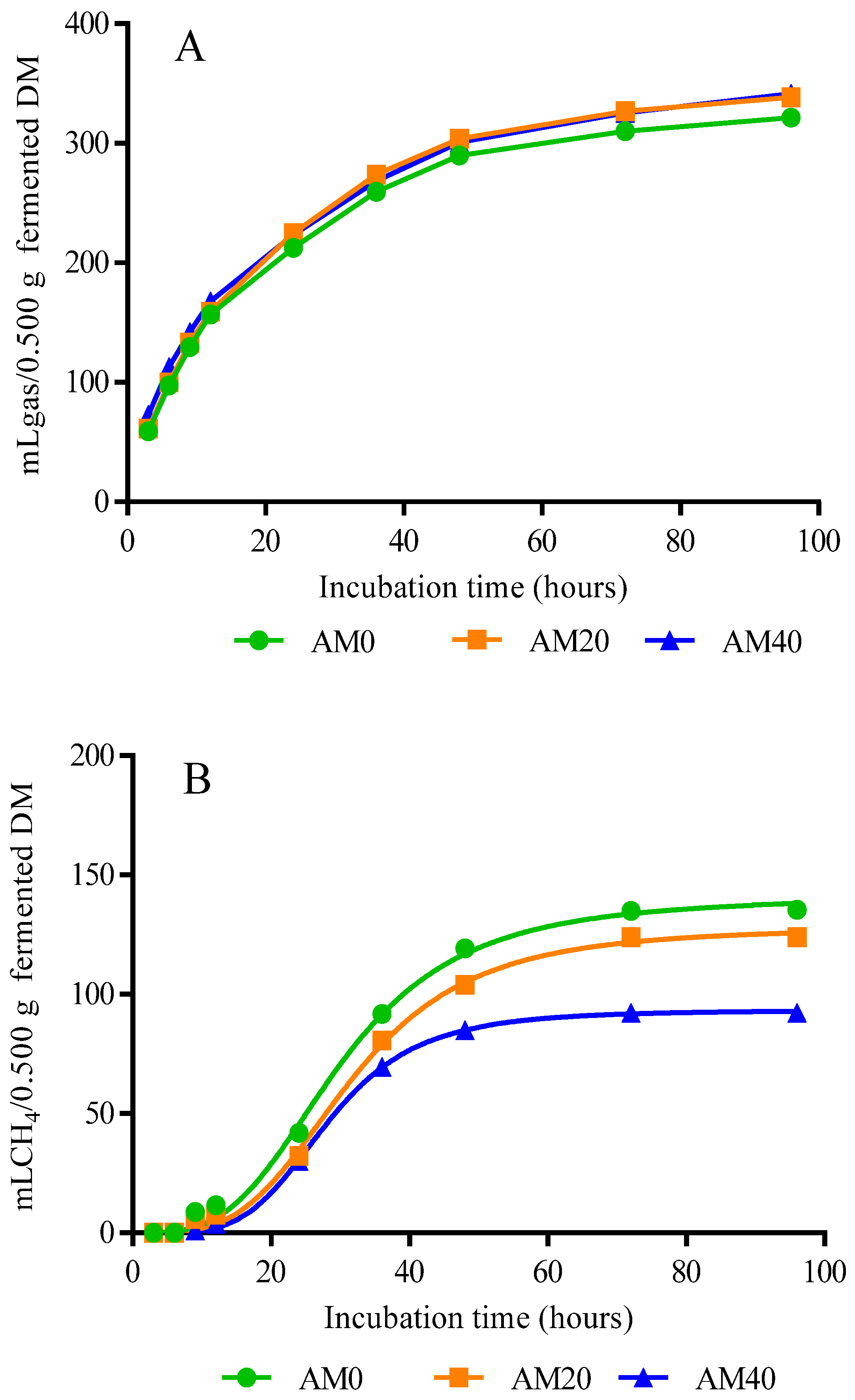
The aim of this research was to evaluate the effect of the inclusion of Acacia mearnsii (AM) at different levels of inclusion on ruminal digestion and in vitro gas production. A. mearnsii forage was incorporated in the diet at different levels of 0 (AM0), 20 (AM20), and 40 (AM40) %. In situ degradation of dry matter (DM) and organic matter (OM) showed differences between treatments (P < 0.05), obtaining the highest value of the degradation of soluble fraction (A), insoluble but potentially degradable fraction (B), degradation rate in % per hour (c), potential degradation (A + B), and effective degradation for all passage rates in % h (0.02, 0.05, and 0.08) in AM0 with respect to AM20 and AM40. The in vitro digestibility of DM and OM was higher (P < 0.05) in AM0 with approximately 23.6% and 22.8% of DM and OM, respectively, compared to treatments AM20 and AM40. Cumulative gas production (PG) and gas production asymptote (B) were lower at AM0 and AM20 versus AM40; however, gas production rate (c) and total CH4 production were lower at AM40 with about 40.1 mL CH4/0.500 g fermented DM versus AM0 and AM20. Under the conditions of this study, it is concluded that the incorporation of A. mearnsii (20% and 40%) in the feed of ruminants negatively affected the digestion of nutrients; however, it reduced the production of CH4, which may be associated with the low activity of microorganisms toward the substrate due to the possible tannin/nutrient complex. This shows that in animals with little history of consuming plants rich in tannin, more than 3% of tannin could not be incorporated into the diet.
Keywords: degradation; digestibility; methane emission; tannin; Acacia mearnsii degradation; digestibility; methane emission; tannin; Acacia mearnsii