
Truncation of CYR1 Promoter in Baker’s Yeast to Improve Freeze Tolerance

Abstract
1. Introduction
2. Materials and Methods
2.1. Strains, Plasmids and Media
2.2. Plasmid Construction
2.3. Construction of Engineered Strains
2.4. Hybridization Reaction and Diploid Formation
2.5. RT-qPCR Assay
2.6. Measurement of Adenylate Cyclase Activity
2.7. Determination of Cell Viability and Relative Leavening Ability After Freezing
2.8. Determination of Cellular Trehalose and Proline Contents
3. Results
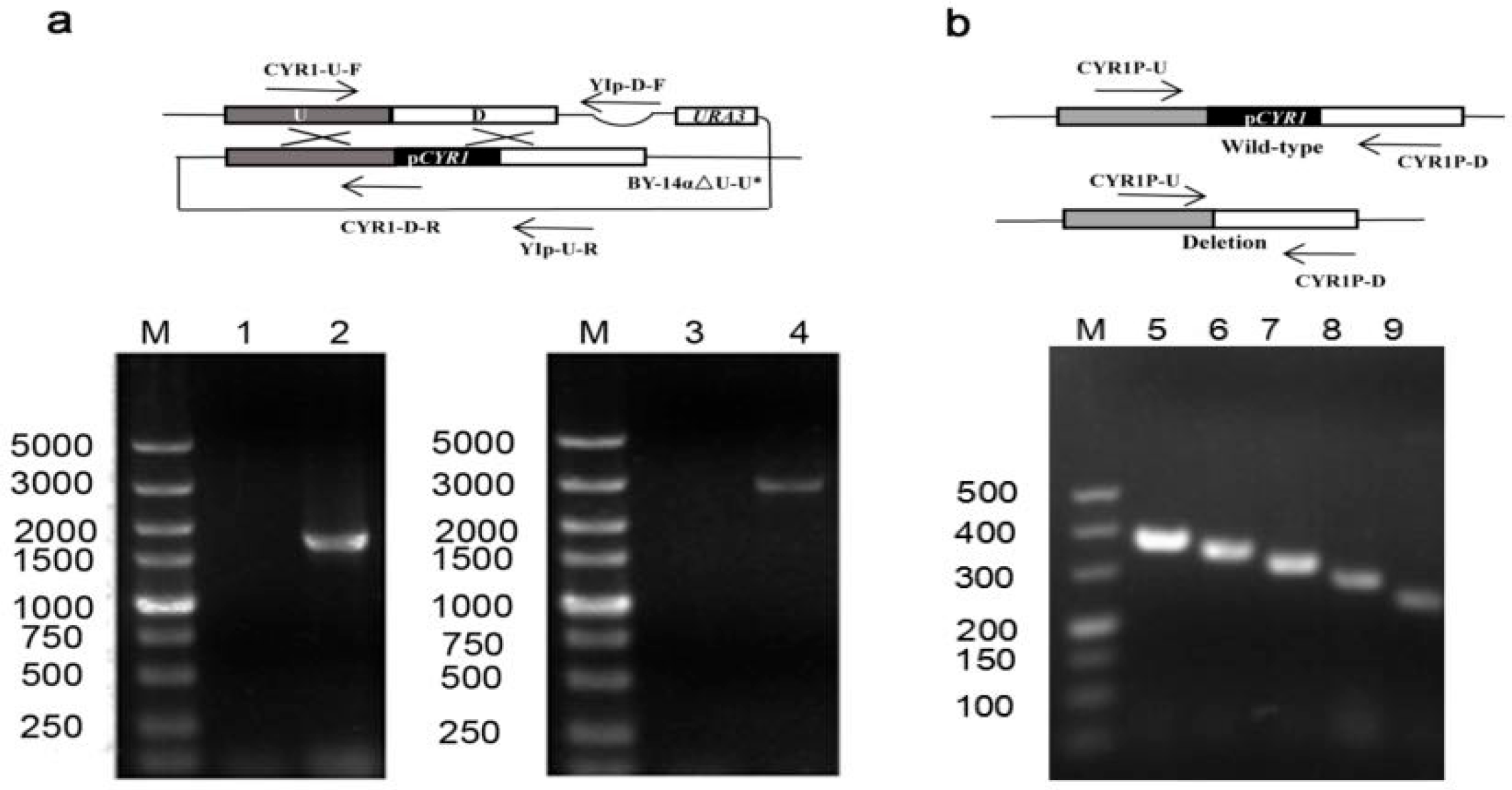
3.1. Seamless Truncation of the 3′ End of the CYR1 Promoter in Baker’s Yeast
3.2. Growth Performance of Parent and Engineered Strains
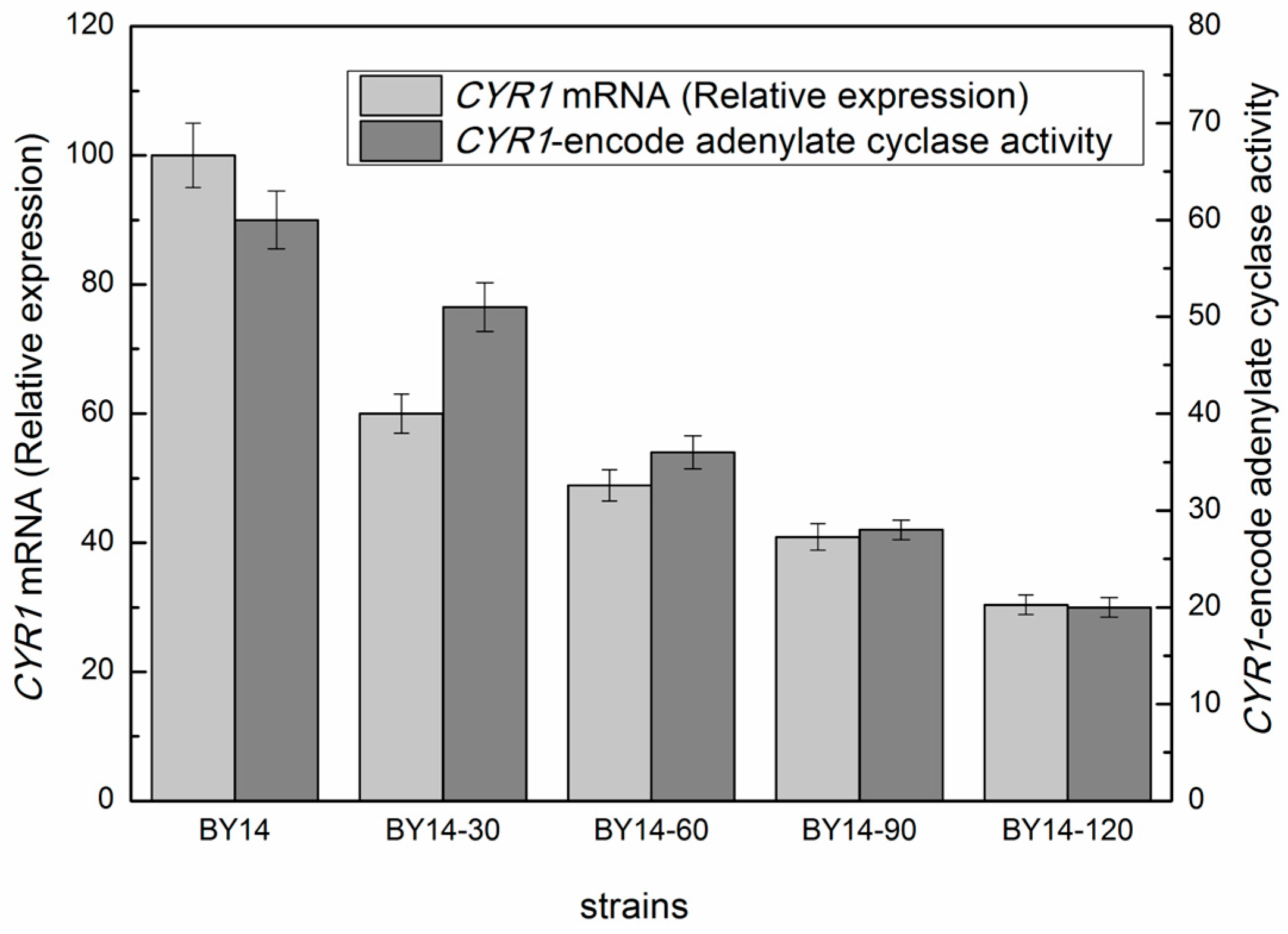
3.3. CYR1 Transcription Levels and Adenylate Cyclase Activity of Engineered Strains
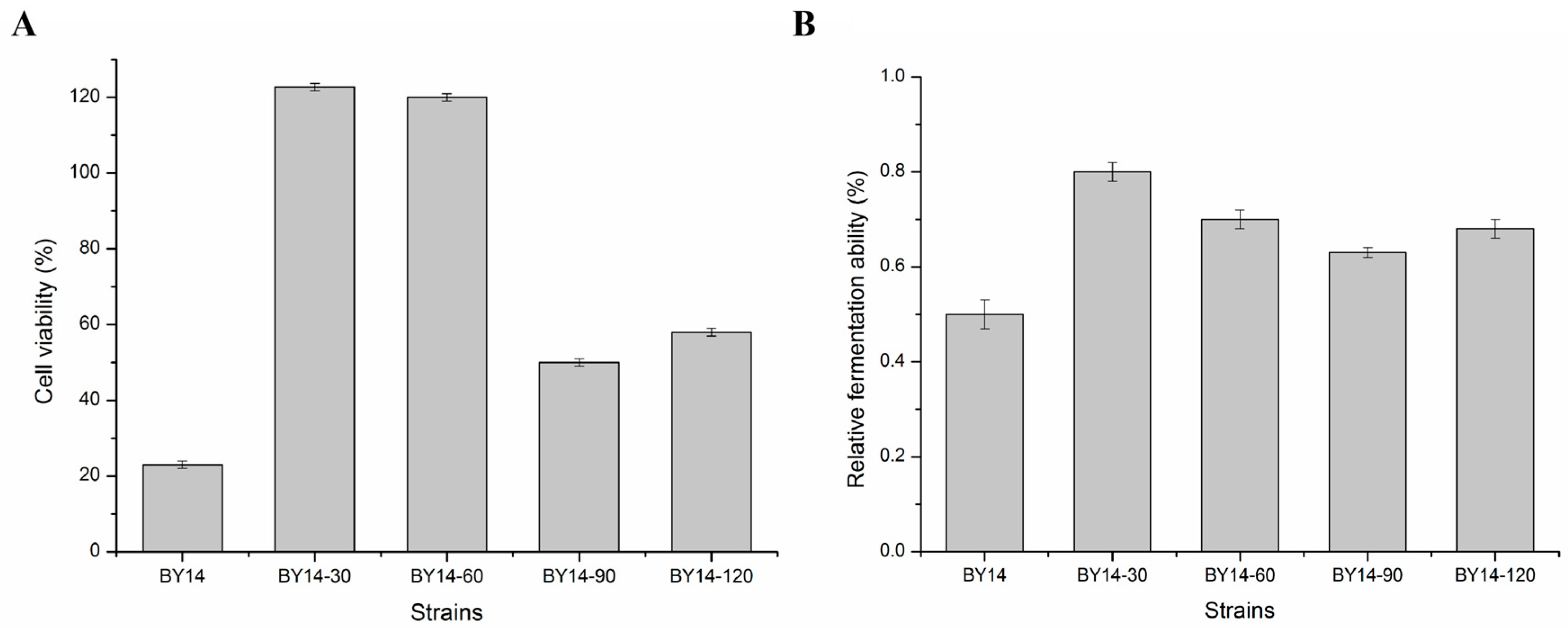
3.4. Measurement of Freeze Tolerance and Dough-Leavening Ability After Freezing
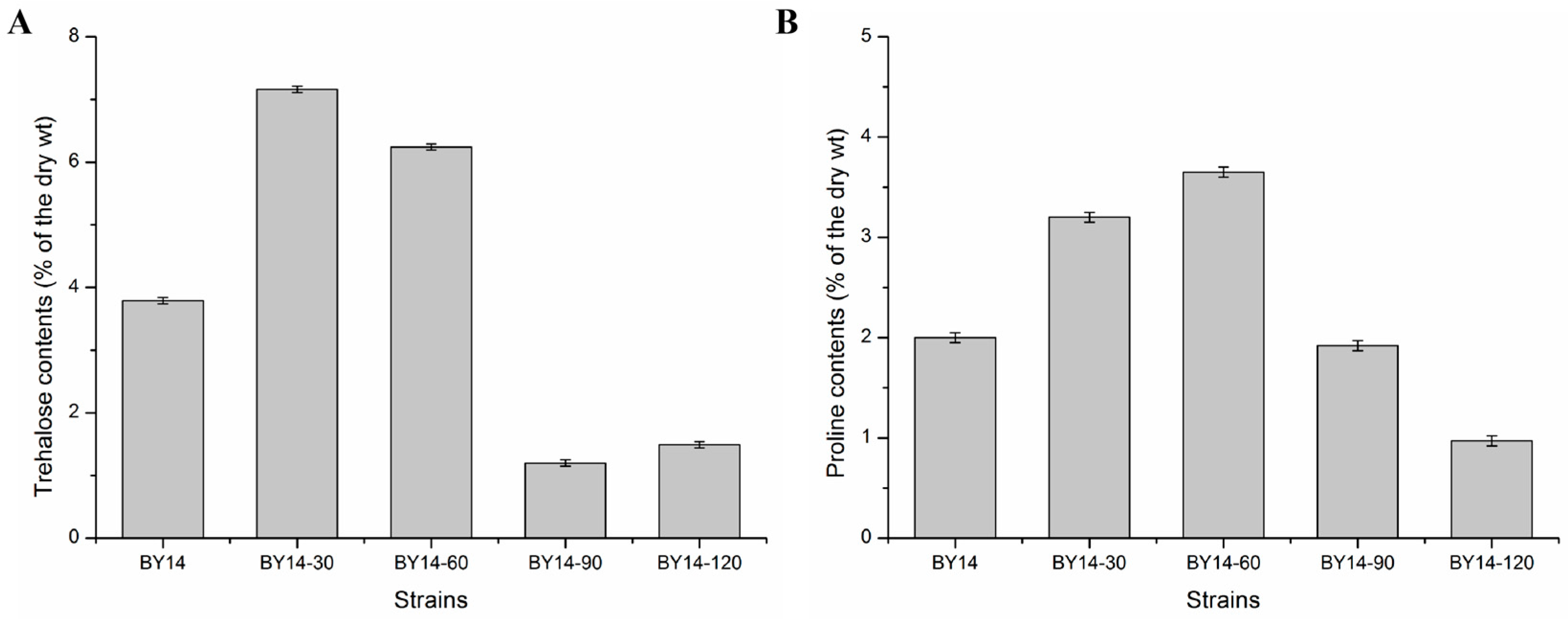
3.5. Determination of Intracellular Trehalose and Proline Contents
4. Discussion
5. Conclusions
Supplementary Materials
Author Contributions
Funding
Institutional Review Board Statement
Informed Consent Statement
Data Availability Statement
Conflicts of Interest
References
- Zhang, M.L.; Guo, X.N.; Sun, X.H.; Zhu, K.X. Frozen dough steamed products: Deterioration mechanism, processing technology, and improvement strategies. Compr. Rev. Food Sci. Food Saf. 2024, 23, e70028. [Google Scholar] [CrossRef] [PubMed]
- Lu, L.; Jiang, M.; Zong, A.; Xia, S.; Yang, L.; Peng, J.; Lin, Q. Mechanisms underlying quality deterioration in pre-fermented frozen dough during freeze-thaw cycles: Insights from yeast-dough interactions. Food Chem. 2026, 521, 149825. [Google Scholar] [CrossRef] [PubMed]
- Yang, L.; Wang, S.; Lu, L.; Peng, J.; Xiao, H.; Wu, Y.; Yin, X.; Gong, J.; Lin, Q. Effects of sugar alcohols on freeze-thaw tolerance of frozen dough: Focus on ice crystal growth, fermentation properties and gluten aggregation. Food Chem. 2026, 519, 149674. [Google Scholar] [CrossRef] [PubMed]
- Xie, D.; Li, X.; Zheng, J. Effect of freeze-thaw cycle on the calcium signaling pathway in yeast cells during different production of frozen dough. LWT 2026, 253, 119624. [Google Scholar] [CrossRef]
- Ozulku, G. Monitoring the Dough Properties, Quality Characteristics and Volatile Compounds of Whole Wheat Bread Made by Different Sourdough Types during Frozen Storage. Foods 2024, 13, 1388. [Google Scholar] [CrossRef] [PubMed]
- Lee, Y.J.; Shi, R.; Witt, S.N. The small molecule triclabendazole decreases the intracellular level of cyclic AMP and increases resistance to stress in Saccharomyces cerevisiae. PLoS ONE 2013, 8, e64337. [Google Scholar] [CrossRef] [PubMed]
- Crawford, R.A.; Pavitt, G.D. Translational regulation in response to stress in Saccharomyces cerevisiae. Yeast 2019, 36, 5–21. [Google Scholar] [PubMed]
- Galello, F.; Bermúdez-Moretti, M.; Martinez, M.P.; Rossi, S.; Portela, P. The cAMP-PKA signalling crosstalks with CWI and HOG-MAPK pathways in yeast cell response to osmotic and thermal stress. Microb. Cell 2024, 11, 90–105. [Google Scholar] [CrossRef] [PubMed]
- Tamaki, H. Glucose-stimulated cAMP-protein kinase a pathway in yeast Saccharomyces cerevisiae. J. Biosci. Bioeng. 2007, 104, 245–250. [Google Scholar] [CrossRef] [PubMed]
- Creamer, D.R.; Hubbard, S.J.; Ashe, M.P.; Grant, C.M. Yeast Protein Kinase A Isoforms: A Means of Encoding Specificity in the Response to Diverse Stress Conditions? Biomolecules 2022, 12, 958. [Google Scholar] [CrossRef] [PubMed]
- Plank, M.; Carmiol, N.; Mitri, B.; Lipinski, A.A.; Langlais, P.R.; Capaldi, A.P. Systems level analysis of time and stimuli specific signaling through PKA. Mol. Biol. Cell 2024, 35, ar60. [Google Scholar] [CrossRef] [PubMed]
- He, W.; Xue, M.; Yu, H.; Zhang, X.; Lin, Y.; Chen, Y.; Wang, L. Co-culture fermentation characteristics of antifreeze yeast and mining of related freezing-resistant genes. Eur. Food Res. Technol. 2023, 249, 1161–1172. [Google Scholar] [CrossRef]
- Sasano, Y.; Haitani, Y.; Hashida, K.; Ohtsu, I.; Shima, J.; Takagi, H. Simultaneous accumulation of proline and trehalose in industrial baker’s yeast enhances fermentation ability in frozen dough. J. Biosci. Bioeng. 2012, 113, 592–595. [Google Scholar] [CrossRef] [PubMed]
- Tanghe, A.; Van Dijck, P.; Colavizza, D.; Thevelein, J.M. Aquaporin-mediated improvement of freeze tolerance of Saccharomyces cerevisiae is restricted to rapid freezing conditions. Appl. Env. Microbiol. 2004, 70, 3377–3382. [Google Scholar] [CrossRef] [PubMed]
- Baroni, D.; Colombo, S.; Martegani, E. Antagonism between salicylate and the cAMP signal controls yeast cell survival and growth recovery from quiescence. Microb. Cell 2018, 5, 344–356. [Google Scholar] [CrossRef] [PubMed]
- Van Dijck, P.; Ma, P.; Versele, M.; Gorwa, M.F.; Colombo, S.; Lemaire, K.; Bossi, D.; Loïez, A.; Thevelein, J.M. A baker’s yeast mutant (fil1) with a specific, partially inactivating mutation in adenylate cyclase maintains a high stress resistance during active fermentation and growth. J. Mol. Microbiol. Biotechnol. 2000, 2, 521–530. [Google Scholar] [PubMed]
- Scherer, S.; Davis, R. Replacement of chromosome segments with altered DNA sequences constructed in vitro. Proc. Natl. Acad. Sci. 1979, 76, 4951–4955. [Google Scholar] [CrossRef] [PubMed]
- Wach, A.; Brachat, A.; Pöhlmann, R.; Philippsen, P. New heterologous modules for classical or PCR-based gene disruptions in Saccharomyces cerevisiae. Yeast 1994, 10, 1793–1808. [Google Scholar] [CrossRef] [PubMed]
- Gietz, R.; Schiestl, R.; Willems, A.; Woods, R. Studies on the transformation of intact yeast-cells by the LIAC/S-DNA/PEG procedure. Yeast 1995, 11, 355–360. [Google Scholar] [PubMed]
- Lin, X.; Zhang, C.-Y.; Bai, X.-W.; Feng, B.; Xiao, D.-G. Improvement of stress tolerance and leavening ability under multiple baking-associated stress conditions by overexpression of the SNR84 gene in baker’s yeast. Int. J. Food Microbiol. 2015, 197, 15–21. [Google Scholar] [CrossRef] [PubMed]
- Lee, M.R.; Kim, C.S.; Park, T.; Choi, Y.-S.; Lee, K.-H. Optimization of the ninhydrin reaction and development of a multiwell plate-based high-throughput proline detection assay. Anal. Biochem. 2018, 556, 57–62. [Google Scholar] [CrossRef] [PubMed]
- Lin, P.; Lan, X.; Chen, F.; Yang, Y.; Jin, Y.; Wang, A. Reference Gene Selection for Real-Time Quantitative PCR Analysis of the Mouse Uterus in the Peri-Implantation Period. PLoS ONE 2013, 8, e62462. [Google Scholar] [CrossRef] [PubMed]
- Matsumoto, K.; Uno, I.; Ishikawa, T. Identification of the structural gene and nonsense alleles for adenylate cyclase in Saccharomyces cerevisiae. J. Bacteriol. 1984, 157, 277–282. [Google Scholar] [CrossRef] [PubMed]
- Kocik, R.A.; Cytrynbaum, E.G.; Ahrens, J.M.; McClean, M.N.; Gasch, A.P. The importance of regulated resource reallocation during dynamic environmental shifts in yeast. EMBO J. 2026, 45, 2808–2830. [Google Scholar] [CrossRef] [PubMed]
- Iida, H. Multistress resistance of Saccharomyces cerevisiae is generated by insertion of retrotransposon Ty into the 5′ coding region of the adenylate cyclase gene. Mol. Cell Biol. 1988, 8, 5555–5560. [Google Scholar] [CrossRef]
- Verstrepen, K.J.; Derdelinckx, G.; Dufour, J.-P.; Winderickx, J.; Pretorius, I.S.; Thevelein, J.M.; Delvaux, F.R. The Saccharomyces cerevisiae alcohol acetyl transferase gene ATF1 is a target of the cAMP/PKA and FGM nutrient-signalling pathways. FEMS Yeast Res. 2003, 4, 285–296. [Google Scholar] [PubMed]
- de Bem, L.S.; Barreto, J.A.; de Souza, D.T.; Jordan, D.O.; de Souza, S.F.D.; Marin, D.C.; Da Silva, J.J.; Brienzo, M.; dos Santos, L.V.; Rabelo, S.C.; et al. QTL mapping, breeding, and debugging Saccharomyces cerevisiae strains through Reiterated Mass Selection and backcrosSing (ReMaSSing). Biotechnol. Biofuels Bioprod. 2026, 19, 29. [Google Scholar] [CrossRef] [PubMed]
- Hoffmann, S.A.; Cai, Y. Engineering stringent genetic biocontainment of yeast with a protein stability switch. Nat. Commun. 2024, 15, 1060. [Google Scholar] [CrossRef] [PubMed]
- Hong, K.-Q.; Hou, X.-Y.; Hao, A.-L.; Wang, P.-F.; Fu, X.-M.; Lv, A.; Dong, J. Truncation of CYR1 promoter in industrial ethanol yeasts for improved ethanol yield in high temperature condition. Process Biochem. 2018, 65, 37–45. [Google Scholar] [CrossRef]
- Sasano, Y.; Haitani, Y.; Ohtsu, I.; Shima, J.; Takagi, H. Proline accumulation in baker’s yeast enhances high-sucrose stress tolerance and fermentation ability in sweet dough. Int. J. Food Microbiol. 2012, 152, 40–43. [Google Scholar] [CrossRef] [PubMed]
- Takagi, H. Proline as a stress protectant in yeast: Physiological functions, metabolic regulations, and biotechnological applications. Appl. Microbiol. Biotechnol. 2008, 81, 211–223. [Google Scholar] [CrossRef] [PubMed]



| Strains and Plasmids | Relevant Characteristic | Reference or Source |
|---|---|---|
| Strains | ||
| BY14 | Industrial baker’s yeast | Angel Yeast Co., Ltd., Yichang, Hubei, China |
| BY14α | MATα (haploid derived from BY14 strain) | This study |
| BY14a | MATa (haploid derived from BY14 strain) | This study |
| BY14αΔU-U | MATα ura3− (containing YIplac211-pCYR1) | This study |
| BY14αΔU | MATa ura3− | This study |
| BY14αΔU-30 | MATα ura3− with 30 bp truncation of CYR1 | This study |
| BY14αΔU-60 | MATα ura3− with 60 bp truncation of CYR1 | This study |
| BY14αΔU-90 | MATα ura3− with 90 bp truncation of CYR1 | This study |
| BY14αΔU-120 | MATα ura3− with 120 bp truncation of CYR1 | This study |
| BY14-30 | Diploid with 30 bp truncation of CYR1 | This study |
| BY14-60 | Diploid with 60 bp truncation of CYR1 | This study |
| BY14-90 | Diploid with 90 bp truncation of CYR1 | This study |
| BY14-120 | Diploid with 120 bp truncation of CYR1 | This study |
| Plasmids | ||
| DH5α | Φ80 lacZΔM15 ΔlacU169 recA1 endA1 hsdR17 supE44 thi-1 gyrA relA1 | Stratagene, La Jolla, CA, USA |
| YIplac211 | AmpR URA3+ | [18] |
| YIplac211-pCYR1-30 | AmpR URA3+ (containing 30 bp truncation of CYR1) | This study |
| YIplac211-pCYR1-60 | AmpR URA3+ (containing 60 bp truncation of CYR1) | This study |
| YIplac211-pCYR1-90 | AmpR URA3+ (containing 9 0bp truncation of CYR1) | This study |
| YIplac211-pCYR1-120 | AmpR URA3+ (containing 120 bp truncation of CYR1) | This study |
Disclaimer/Publisher’s Note: The statements, opinions and data contained in all publications are solely those of the individual author(s) and contributor(s) and not of MDPI and/or the editor(s). MDPI and/or the editor(s) disclaim responsibility for any injury to people or property resulting from any ideas, methods, instructions or products referred to in the content. |
© 2026 by the authors. Licensee MDPI, Basel, Switzerland. This article is an open access article distributed under the terms and conditions of the Creative Commons Attribution (CC BY) license.
Share and Cite
Fu, X.; Zhang, L.; Wang, Y.; Zhou, J.; Xu, J.; Hong, K. Truncation of CYR1 Promoter in Baker’s Yeast to Improve Freeze Tolerance. Fermentation 2026, 12, 373. https://doi.org/10.3390/fermentation12080373
Fu X, Zhang L, Wang Y, Zhou J, Xu J, Hong K. Truncation of CYR1 Promoter in Baker’s Yeast to Improve Freeze Tolerance. Fermentation. 2026; 12(8):373. https://doi.org/10.3390/fermentation12080373
Chicago/Turabian StyleFu, Xiaomeng, Liangzi Zhang, Yong Wang, Jingru Zhou, Jingjing Xu, and Kunqiang Hong. 2026. "Truncation of CYR1 Promoter in Baker’s Yeast to Improve Freeze Tolerance" Fermentation 12, no. 8: 373. https://doi.org/10.3390/fermentation12080373
APA StyleFu, X., Zhang, L., Wang, Y., Zhou, J., Xu, J., & Hong, K. (2026). Truncation of CYR1 Promoter in Baker’s Yeast to Improve Freeze Tolerance. Fermentation, 12(8), 373. https://doi.org/10.3390/fermentation12080373