Article

Truncation of CYR1 Promoter in Baker’s Yeast to Improve Freeze Tolerance

1
College of Food Science and Technology, Wuhan Business University, Wuhan 430056, China
2
College of Chemical Engineering and Technology, Tianjin University, Tianjin 300350, China
3
College of Food Science and Engineering, Wuhan Polytechnic University, Wuhan 430023, China
*
Author to whom correspondence should be addressed.
Fermentation 2026, 12(8), 373; https://doi.org/10.3390/fermentation12080373
Submission received: 9 July 2026 / Revised: 31 July 2026 / Accepted: 1 August 2026 / Published: 9 August 2026
(This article belongs to the Collection Yeast Biotechnology)

Abstract

Baker’s yeast with high freeze tolerance is essential for frozen-dough technology. The CYR1 gene, which encodes adenylate cyclase, is a central element of the cyclic adenosine monophosphate (cAMP) signaling pathway that regulates cellular stress tolerance. In this study, we aimed to enhance the freeze tolerance by modulating the expression level of CYR1. A series of diploid strains (BY14-30, BY14-60, BY14-90, and BY14-120) were constructed via a two-step integration method, in which the CYR1 promoter was truncated by 30, 60, 90, and 120 base pairs, respectively. Compared with the parent strain, strains BY14-30 and BY14-60 exhibited 4.3- and 4.2-fold higher survival rates after freezing, 60.0% and 40.0% increases in post-thaw dough-leavening ability, 88.9% and 64.6% increases in trehalose content, and 60.0% and 82.5% increases in proline levels, respectively. Collectively, our results demonstrate a novel strategy for regulating freeze tolerance in baker’s yeast, leading to improved cell viability and fermentation activity after freezing.

1. Introduction

With the expansion and industrial-scale production of fermented foods, frozen-dough technology has emerged as an effective solution to challenges in dough preservation and transportation during fermentation. It also helps maintain product flavor throughout storage while reducing overall production costs [1]. The adoption of this technology in the baking industry has driven the demand for robust baker’s yeast strains. During frozen-dough fermentation, yeast cells are subjected to multiple baking-related stresses, including freeze–thaw cycles, air-drying, and high-sucrose concentrations [2,3]. Freezing and subsequent thawing can cause severe cellular damage and lead to unsatisfactory fermentation performance [4]. In recent years, frozen-dough technology has been widely adopted to extend the shelf life of baked goods and to provide consumers with access to fresh bread [5]. Consequently, baker’s yeast strains with superior stress tolerance are of great importance to the food industry.
Numerous studies have reported the regulation of stress tolerance in Saccharomyces cerevisiae through genetic engineering approaches. Activation of adenylate cyclase and protein kinase A (PKA) counteracts the function of the transcription factors Msn2 and Msn4, which normally promote the rapid transcription of genes encoding stress proteins that prevent and repair stress-induced cellular damage [6]. In addition, Msn2/Msn4 activate the transcription of genes carrying stress response elements (STRE) in their promoters [7]. STRE-regulated genes are implicated in various cellular processes, including freezing and osmotic stress responses, as well as growth regulation and carbohydrate metabolism.
In S. cerevisiae, the cAMP signaling pathway plays a pivotal role in modulating freeze tolerance by regulating intracellular cAMP levels [8]. cAMP is synthesized from ATP by adenylate cyclase, which is encoded by the CYR1 gene and is subject to regulation by Ras proteins [9]. Elevated cAMP levels stimulate PKA activity, leading to the phosphorylation of diverse target proteins involved in transcriptional control, metabolism, cell cycle progression, stress tolerance, and the accumulation of glycogen and trehalose [10,11]. As the central enzyme in the Ras-cAMP pathway, adenylate cyclase encoded by CYR1 represents a key target for engineering freeze tolerance. Therefore, we chose to modulate the expression of CYR1 to improve the freezing tolerance of our strains.
Trehalose and proline are well-known stress protectants that effectively mitigate freezing-induced damage, and their cellular levels can serve as indicators of stress tolerance [12,13]. Numerous studies have aimed to enhance freeze tolerance in yeast, often by reducing the activity of the Ras-cAMP signaling pathway. However, such mutant strains typically exhibit high freeze tolerance at the expense of slow growth [14]. Moreover, attenuation of adenylate cyclase or PKA activity has been shown to decrease cell viability, prolong the lag phase, and diminish fermentation rates [15]. In contrast, the fil1 mutant—which harbors a glutamate-to-lysine substitution at position 1682 of adenylate cyclase—displays strong stress tolerance while retaining a normal growth rate [16]. To minimize the adverse effects of altered PKA activity on growth and fermentation performance, we sought to enhance freeze tolerance through stepwise truncation of the CYR1 promoter, thereby achieving fine-tuned regulation of CYR1 expression.
Compared with previous studies, our work focuses on a single gene, which offers substantial advantages. Single-gene editing avoids adverse effects on growth and fermentation properties and reduces the occurrence of unknown mutations in the strain. Furthermore, it is easier to perform and more convenient than polygenic editing. The diploid strains BY14-30, BY14-60, BY14-90, and BY14-120 were obtained by backcrossing BY14a with BY14α-30, BY14α-60, BY14α-90, and BY14α-120, respectively. Backcrossing helps reduce potential mutations introduced during the engineering process, thereby enhancing the safety of industrial strains. Overall, the single-gene editing of CYR1 represents a promising attempt to harness the cAMP signaling pathway to improve the performance of industrial baker’s yeast strains.
In the present study, the native CYR1 promoter was serially truncated by 30-bp increments using a two-step integration method in the industrial baker’s yeast strain BY14 [17]. The resulting engineered strains, BY14-30 and BY14-60, exhibited reduced relative expression of CYR1 and decreased adenylate cyclase activity, along with significantly enhanced freeze tolerance, while cell growth remained unaffected. These strains hold great potential for advancing the development of freeze-tolerant baker’s yeast suitable for frozen-dough technology.

2. Materials and Methods

2.1. Strains, Plasmids and Media

The strains and plasmids used in this study are listed in Table 1, and the PCR primers are listed in Table S1. All primers were designed based on the S. cerevisiae S288c genome sequence (NCBI, http://www.ncbi.nlm.nih.gov/). BY14a and BY14α are haploid spore isolates derived from the industrial diploid strain BY14. The mutant ura3 allele was amplified from W303-1a (MATa ade2 ura3 leu2 trp1 his3 can1) and subsequently transformed into BY14α, a MATα haploid industrial strain commonly used in dough fermentation, yielding the uracil-auxotrophic mutant BY14αΔU.
For plasmid construction, Escherichia coli DH5α was cultured in Luria–Bertani (LB) medium (10 g L−1 tryptone, 5 g L−1 yeast extract, 5 g L−1 NaCl) supplemented with ampicillin (100 mg L−1). Yeast cells were grown in YEPD medium (10 g L−1 yeast extract, 20 g L−1 bacteriological peptone, 20 g L−1 glucose). Sporulation of diploid yeast was induced in KAC medium (20 g L−1 potassium acetate). Cane molasses medium contained 0.5 g L−1 (NH4)2SO4 and 5 g L−1 yeast extract; the cane molasses medium was prepared at 12°Brix, corresponding to approximately 120 g L−1 of total soluble sugar equivalents. Low-sugar model liquid dough (LSMLD) fermentation medium consisted of 40 g L−1 glucose, 2.5 g L−1 (NH4)2SO4, 5 g L−1 urea, 16 g L−1 KH2PO4, 5 g L−1 Na2HPO4, 0.6 g L−1 MgSO4, 0.0225 g L−1 nicotinic acid, 0.005 g L−1 Ca-pantothenate, 0.0025 g L−1 thiamine, 0.00125 g L−1 pyridoxine, 0.001 g L−1 riboflavin, and 0.0005 g L−1 folic acid.
After transformation with linearized recombinant plasmids, yeast cells were plated on SC-ura solid medium (20 g L−1 glucose, 20 g L−1 agar, 6.7 g L−1 yeast nitrogen base without amino acids, supplemented with all auxotrophic requirements except uracil) to select uracil prototrophic transformants. Uracil auxotrophic transformants were selected on 5-fluoroorotic acid medium (6.7 g L−1 yeast nitrogen base without amino acids, supplemented with all auxotrophic requirements, 20 g L−1 glucose, 1 g L−1 5-fluoroorotic acid). All solid media contained 2% (w/v) agar (Difco Laboratories, Detroit, MI, USA).

2.2. Plasmid Construction

Recombinant plasmids were constructed using the YIplac211 vector. The construction of recombinant plasmids harboring various 3′-truncated promoter variants was carried out in three steps. First, upstream homologous sequences (U-30, U-60, U-90, and U-120) were amplified from BY14α genomic DNA using the primer pairs pCYR1-U-SalI/rCYR1-U-Δ30, pCYR1-U-SalI/rCYR1-U-Δ60, pCYR1-U-SalI/rCYR1-U-Δ90, and pCYR1-U-SalI/rCYR1-U-Δ120, respectively (Table S1). Correspondingly, downstream homologous sequences (D-30, D-60, D-90, and D-120) were amplified using the primer pairs rCYR1-D-BamHI/pCYR1-D-Δ30, rCYR1-D-BamHI/pCYR1-D-Δ60, rCYR1-D-BamHI/pCYR1-D-Δ90, and rCYR1-D-BamHI/pCYR1-D-Δ120, respectively (Table S1). Subsequently, the upstream and downstream fragments were joined by fusion PCR, in which the overlapping sequences served as primers for extension of the chimeric products. Finally, the resulting fusion PCR products were purified by gel extraction, double-digested with SalI and BamHI, and ligated into the YIplac211 vector that had been digested with the same restriction enzymes. The resulting recombinant plasmids were designated YIplac211–pCYR1-30, YIplac211–pCYR1-60, YIplac211–pCYR1-90, and YIplac211–pCYR1-120 (Table 1).

2.3. Construction of Engineered Strains

Yeast transformation was performed as described previously [19]. The recombinant plasmids were linearized by digestion with BglII and then transformed into BY14αΔU. Transformants were plated on SC medium lacking uracil to select for uracil prototrophic clones. Colony PCR was carried out using the primer pairs CYR1-U-F/YIp-D-F and YIp-U-R/CYR1-D-R (Table S1) to verify successful integration of the constructs. For the second step of integration, the positive transformants from the first step were cultured in YEPD medium at 30 °C for 24 h. Then, 100 µL of the cell suspension (diluted 100-fold) was spread onto 5-fluoroorotic acid (5-FOA) plates to select for uracil auxotrophic recombinants that had lost the URA3 marker. Colony PCR was subsequently performed using the primer pair CYR1P-U/CYR1P-D (Table S1) to screen for strains carrying the 3′-truncated promoter variants. This screening yielded the strains BY14αΔU-30, BY14αΔU-60, BY14αΔU-90, and BY14αΔU-120. Finally, the mutant ura3 allele in these strains was restored by transformation with a wild-type URA3 fragment, which was amplified by PCR from BY14α genomic DNA. Consequently, the promoter regions were deleted without leaving any heterologous DNA at the target locus. The resulting final strains were designated BY14α-30, BY14α-60, BY14α-90, and BY14α-120 (Table 1).

2.4. Hybridization Reaction and Diploid Formation

Cells of strains BY14α-30 and BY14a were separately cultured in fresh YEPD liquid medium at 30 °C for 24 h. Equal amounts of the two cultures were then mixed and incubated in YEPD medium at 30 °C for 4–6 h (preferably overnight) to allow mating. After mating, the cell suspension was diluted 104-fold and spread onto YEPD solid medium to select diploid colonies. Putative diploids were screened by colony PCR using the primer set MAT/MAT-a/MAT-α (Table S1) to verify the presence of both mating-type alleles. To obtain haploid derivatives carrying the truncated promoter, the confirmed diploids were transferred to KAC sporulation medium to induce sporulation. The resulting haploid spores were isolated and subsequently screened with the same MAT primer set to identify strains of both mating types that retained the promoter truncation, yielding BY14α-30 and BY14a-30. These two haploid strains were then mated again using the same procedure, and the resulting diploids were selected on YEPD solid medium and confirmed by PCR with the MAT primers, giving rise to the homozygous diploid strain BY14-30. The other diploid strains BY14-60, BY14-90, and BY14-120 were constructed following the same protocol.

2.5. RT-qPCR Assay

The parent and engineered strains were cultured in YEPD liquid medium to the logarithmic phase. Cells were immediately chilled on ice and harvested by centrifugation at 3800× g for 5 min. The cell pellets were washed twice with ice-cold distilled water. Total RNA was extracted using the Fungal mRNA Out Kit (Tiandz Biotech, Beijing, China). First-strand cDNA was synthesized using the Quantscript RT Kit (Tiangen Biotech, Beijing, China) with oligo (dT) primers at 37 °C for 1 h. Quantitative real-time PCR (qRT-PCR) was performed using the SYBR Green PCR Kit (Tiangen Biotech, Beijing, China) to determine the relative mRNA levels of CYR1 and ACT1 (the latter serving as an internal control), with the primer pairs CYR1-F/CYR1-R and ACT1-F/ACT1-R, respectively. All qRT-PCR reactions were run on a LightCycler 480 Real-Time PCR System (Roche, Basel, Switzerland). The relative expression levels of CYR1 were calculated using the 2ΔΔCt method.

2.6. Measurement of Adenylate Cyclase Activity

Cells were cultivated in 100 mL of YEPD liquid medium at 30 °C with shaking at 180 rpm for 12 h. A 10 mL aliquot of the culture was transferred to a centrifuge tube and centrifuged at 12,000× g for 1 min. The pelleted cells were washed twice with sterile water, and the resulting yeast suspension was transferred to a pre-weighed Petri dish. The dish was dried at 75 °C for 12 h and reweighed to determine the cell dry weight.
For enzyme activity measurement, a 2 mL aliquot of the yeast suspension was centrifuged at 12,000× g for 1 min. The pellet was washed twice with 50 mmol L−1 Tris-HCl buffer (pH 7.5) and then resuspended in a mixture of 1 mL of the same Tris-HCl buffer and 200 μL of dimethyl sulfoxide (DMSO). DMSO was added to increase cell permeability, facilitating the release of intracellular cAMP. After centrifugation at 12,000× g for 1 min, the supernatant was discarded, and the pellet was washed twice with 0.3125 mol L−1 MES buffer (pH 6.0) and collected by centrifugation.
The resulting pellet was used for the adenylate cyclase activity assay. The reaction mixture contained 0.25 μmol Na2ATP, 0.25 μmol MnCl2, and 2.5 μmol piperazine-N,N′-bis(2-ethanesulfonic acid) (PIPES) buffer (pH 7.0), which were added to the pellet and mixed thoroughly. The reaction was initiated by incubation at 30 °C for 20 min and terminated by boiling in a water bath for 1 min. After cooling, the mixture was centrifuged, and the supernatant was filtered. The cAMP content in the filtrate was determined using a cyclic AMP [3H] assay kit (Amersham plc, Little Chalfont, Buckinghamshire, UK) with a liquid scintillation counter (Beckman Coulter, Inc., Brea, CA, USA). One unit of adenylate cyclase activity was defined as the amount of enzyme that catalyzes the production of 1 pmol of cAMP per milligram of protein per minute at 30 °C.
HPLC analysis was performed on a ZORBAX Eclipse Plus C18 column (250 mm × 4.6 mm, 5 μm particle size). The mobile phase consisted of acetonitrile and 50 mmol/L potassium dihydrogen phosphate solution at a ratio of 20:80 (v/v). The phosphate buffer solution was filtered sequentially through 0.45 μm and 0.22 μm membranes and prepared fresh before use. The detection wavelength was set at 254 nm, the flow rate at 0.8 mL/min, the column temperature at 25 °C, and the injection volume at 20 μL. Quantification was carried out using the external standard method based on peak area integration.

2.7. Determination of Cell Viability and Relative Leavening Ability After Freezing

The engineered strains and the parent strain were cultivated in YEPD liquid medium at 30 °C with shaking at 180 rpm for 36 h. The cultures were then transferred to molasses medium at an inoculum size of 10% (v/v) and incubated at 30 °C for an additional 2 h with shaking at 180 rpm until cells reached the stationary phase. Cells were harvested by centrifugation at 5000× g for 10 min, and the pellets were washed twice with sterile distilled water.
For freeze–thaw treatment, the freshly prepared yeast cells were resuspended in 100 mL of LSMLD fermentation medium and stored at −20 °C for 21 days. After freezing, the cells were thawed at 30 °C for 30 min, serially diluted, and spread onto YEPD solid plates for colony counting. Cell viability was calculated as the percentage of colony-forming units (CFU) after freezing relative to that before freezing.
The leavening ability of the yeast in frozen dough was evaluated according to the Chinese National Standards for yeast used in food processing. The lean dough formulation consisted of 280 g flour, 150 mL water, 4 g salt, and 9 g fresh yeast cells. The dough was mixed rapidly and evenly for 5 min at 30 ± 0.2 °C. The dough was then proofed at 30 °C for 60 min, followed by storage at −20 °C for 21 days. After storage, the frozen dough was thawed at 30 °C for 30 min and placed in a fermentograph (Type JM451, SJA Sales & Marketing AB, Malmö, Sweden) to measure CO2 production over 1 h. The relative leavening ability was expressed as the percentage of leavening capacity retained after freezing relative to that before freezing.

2.8. Determination of Cellular Trehalose and Proline Contents

Trehalose was extracted and quantified according to previously described methods [20]. Proline extraction and measurement were performed following the protocol of Lee et al. [21]. with minor modifications. Briefly, proline was extracted from 0.1 g of fresh yeast cells using 10 mL of 3% (w/v) aqueous sulfosalicylic acid, and the mixture was incubated in a boiling water bath for 10 min. After centrifugation at 15,000× g for 5 min, 1 mL of the supernatant was transferred to a colorimetric tube containing 2 mL of glacial acetic acid and 2 mL of acidic ninhydrin reagent. The solution was then heated in a boiling water bath for 30 min. Following cooling, 4 mL of toluene was added to the tube and shaken vigorously for 30 s to transfer the red chromophore completely into the upper toluene phase. The absorbance of the upper toluene phase was then measured as described.

3. Results

3.1. Seamless Truncation of the 3′ End of the CYR1 Promoter in Baker’s Yeast

Adenylate cyclase, encoded by CYR1, is the key enzyme in the Ras-cAMP signaling pathway and plays a pivotal role in regulating stress resistance in yeast cells. To enhance freeze tolerance, we constructed a series of strains carrying progressive 30-bp truncations at the 3′ end of the CYR1 promoter. Using a seamless gene deletion approach in the uracil-auxotrophic mutant BY14αΔU, we generated the haploid mutant strains BY14α-30, BY14α-60, BY14α-90, and BY14α-120. Successful construction of these strains was confirmed by DNA sequencing and colony PCR (Figure 1). Subsequently, the corresponding diploid strains were obtained through mating and sporulation, and the correct integration was verified by colony PCR. The final diploid strains, designated BY14-30, BY14-60, BY14-90, and BY14-120, each harboring the respective 3′-truncated CYR1 promoter, were thus successfully established.

3.2. Growth Performance of Parent and Engineered Strains

To evaluate whether truncation of the CYR1 promoter affected the growth phenotype, the parent strain and the engineered strains were cultured in YEPD liquid medium at 30 °C for 24 h. As shown in Figure S1, all strains exhibited similar growth profiles, indicating that the seamless truncation of the CYR1 promoter did not cause any detectable growth defect.

3.3. CYR1 Transcription Levels and Adenylate Cyclase Activity of Engineered Strains

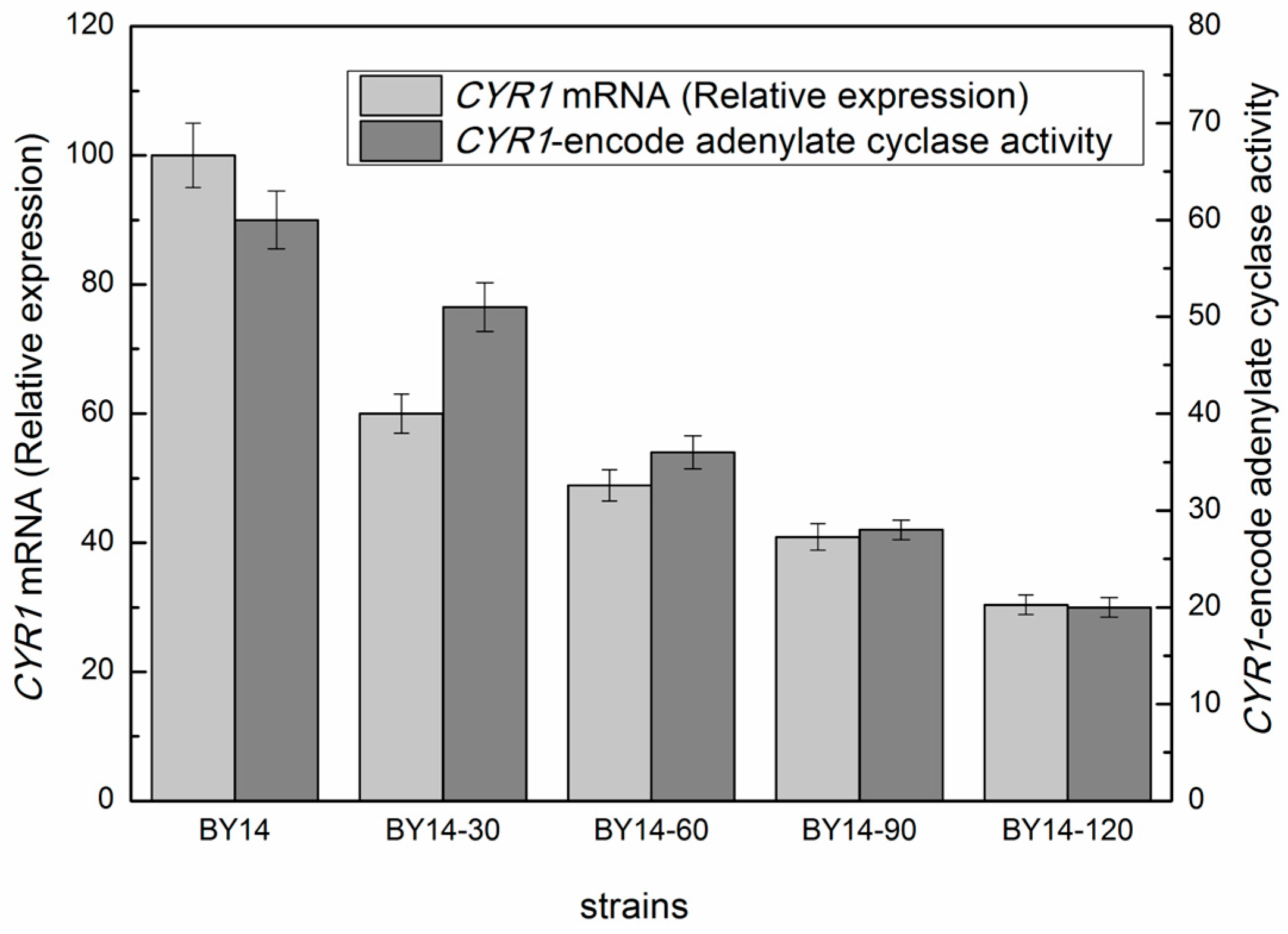
To investigate the relationship between CYR1 transcript levels and promoter truncation, quantitative real-time PCR (qRT-PCR) was performed [22]. Logarithmically growing cells in YEPD liquid medium at 30 °C were harvested for mRNA extraction and subsequent qRT-PCR analysis. As shown in Figure 2, the CYR1 mRNA levels in the mutant strains BY14-30, BY14-60, BY14-90, and BY14-120 were reduced by 40.0%, 51.1%, 59.1%, and 69.6%, respectively, compared with the parent strain BY14. These results indicated that the relative expression level of CYR1 decreased in a truncation-length-dependent manner, with longer promoter truncations leading to lower transcript abundance.
To further confirm the downregulation of Cyr1 protein levels resulting from CYR1 promoter truncation, we measured adenylate cyclase activity in both the engineered and parent strains (Figure 2). The activity assay was performed according to a previously described method [23] with minor modifications. Compared with the parent strain, adenylate cyclase activity in BY14-30, BY14-60, BY14-90, and BY14-120 decreased by 19.2%, 34.0%, 42.5%, and 50.0%, respectively, indicating that enzyme activity was positively correlated with both the length of the CYR1 promoter and the level of CYR1 transcription.
Collectively, the qRT-PCR and adenylate cyclase activity assays demonstrated that truncation of the CYR1 promoter led to significant reductions in both CYR1 gene transcription and protein activity (Figure 2). In addition, sequence analysis confirmed the successful truncation of the CYR1 promoter without any point mutations.

3.4. Measurement of Freeze Tolerance and Dough-Leavening Ability After Freezing

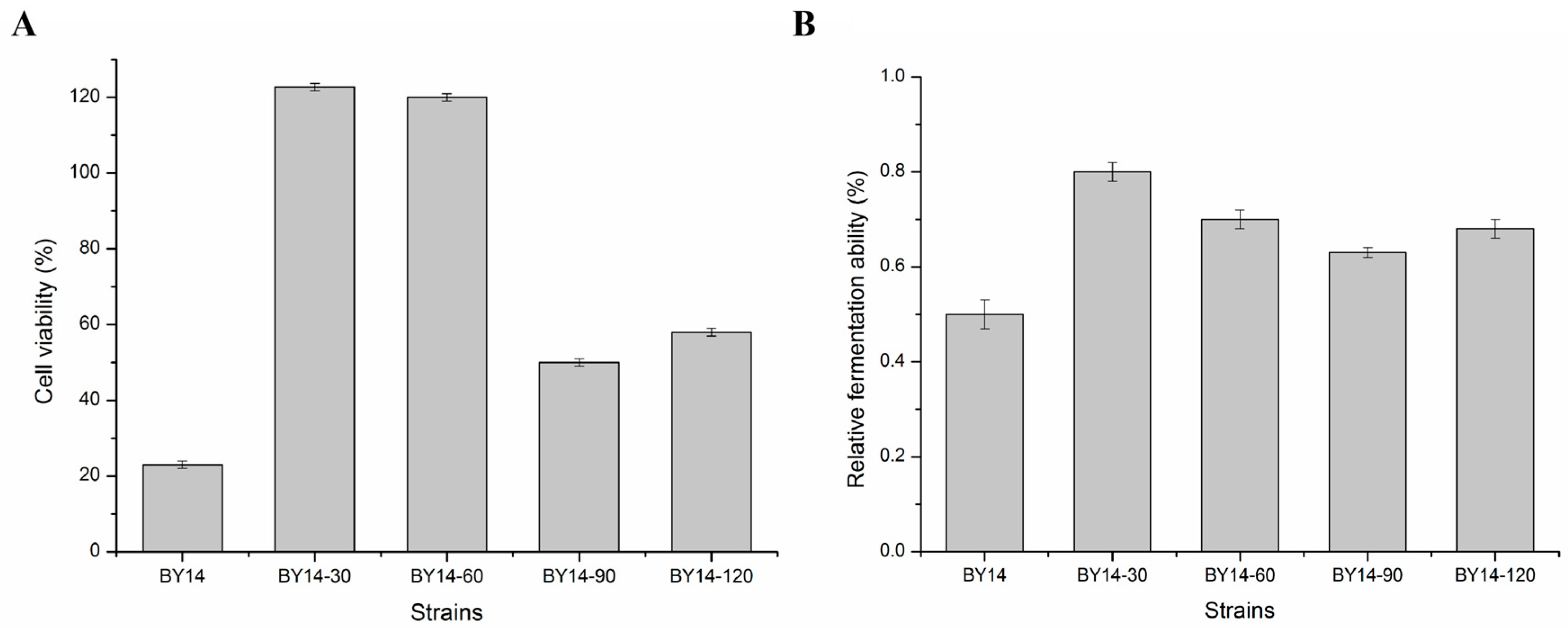
To evaluate the effect of serial truncation of the CYR1 promoter on freeze tolerance in our industrial yeast background, we measured both cell viability and dough-leavening ability of the constructed strains after freezing. Freeze tolerance was assessed by determining cell survival rates following freezing (Figure 3A). Fresh cells cultured in molasses medium for 24 h were used for these assays. The survival rates of BY14-30 and BY14-60 were 122.7% and 120.0%, respectively, corresponding to approximately 5.3- and 5.2-fold increases compared with the parent strain BY14. Strains BY14-90 and BY14-120 also showed improved viability, with increases of 27.2% and 35.7%, respectively, relative to BY14.
The dough-leavening capacity of the yeast strains was evaluated by measuring CO2 production. Before freezing, all engineered strains exhibited leavening activity comparable to that of BY14. However, after freezing, as shown in Figure 3B, BY14-30 and BY14-60 displayed 1.6- and 1.4-fold higher relative fermentation ability than BY14, respectively, whereas BY14-90 and BY14-120 showed 1.3- and 1.4-fold increases, respectively.
Collectively, these results indicate that serial truncation of the CYR1 promoter significantly enhanced the freeze tolerance of BY14. Notably, strains with 30-bp and 60-bp truncations exhibited the most pronounced improvements, while those with 90-bp and 120-bp truncations also showed increased tolerance, albeit to a lesser extent. These differences in freeze tolerance may be correlated with the intracellular levels of trehalose and proline in the engineered strains.

3.5. Determination of Intracellular Trehalose and Proline Contents

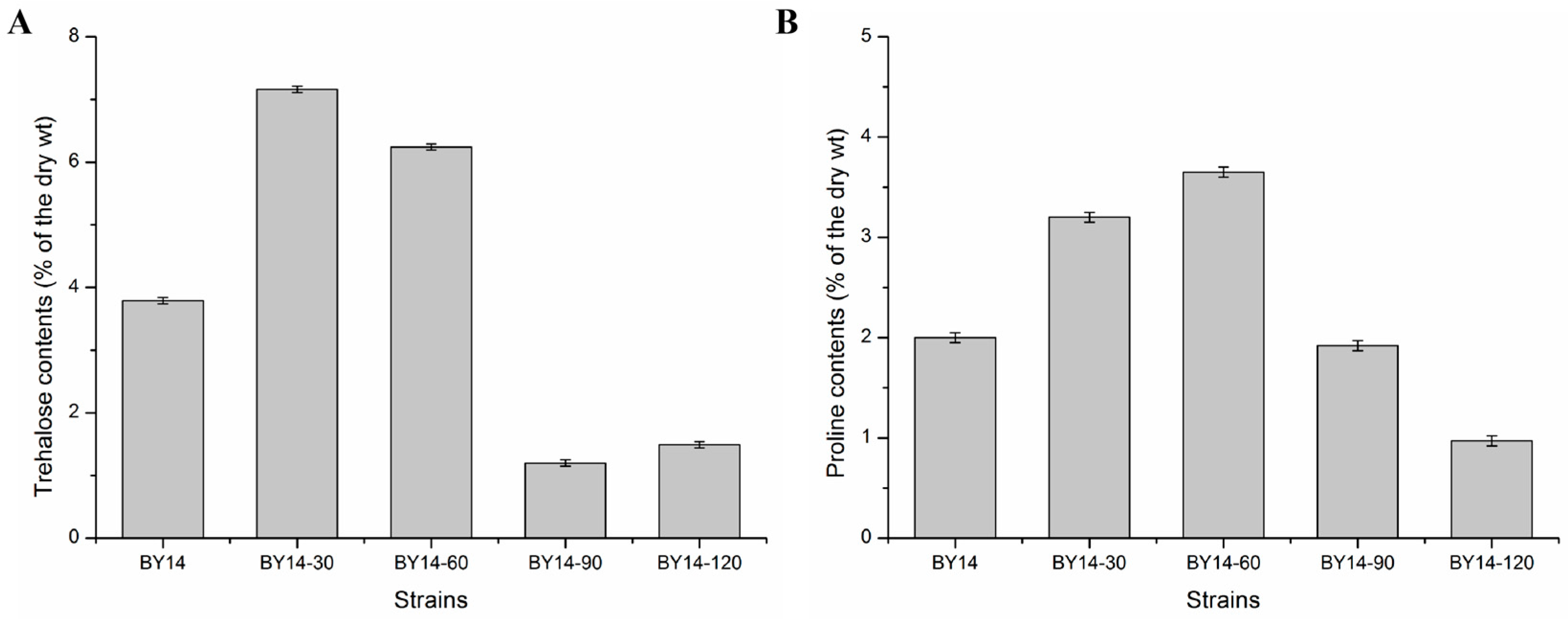
To further explore the correlation between reduced Cyr1 activity and freeze tolerance, we measured the intracellular levels of trehalose and proline in the engineered strains (BY14-30, BY14-60, BY14-90, and BY14-120) and the parent strain BY14. Fresh cells were cultured in molasses medium for 24 h prior to the assays. As shown in Figure 4A, the trehalose contents of BY14-30 and BY14-60 were approximately 1.9- and 1.7-fold higher than that of the parent strain (3.8%), corresponding to 60% and 48.9% of the parental CYR1 expression level, respectively. This result suggested that moderate reduction in CYR1 expression effectively inhibited trehalose degradation, leading to its intracellular accumulation. In contrast, the trehalose contents of BY14-90 and BY14-120 decreased by 2.6% and 2.3%, respectively, relative to the parent, indicating that more extensive promoter truncation (90 bp and 120 bp) failed to promote trehalose accumulation. Similarly, as presented in Figure 4B, the proline levels in BY14-30 and BY14-60 increased by approximately 60.0% and 82.5%, respectively, compared with the control strain BY14 (2.0%). However, the proline contents of BY14-90 and BY14-120 decreased by 4.0% and 51.5%, respectively, relative to the parent strain. Overall, these results demonstrate that truncation of the CYR1 promoter by 30 bp and 60 bp significantly enhanced the intracellular accumulation of both trehalose and proline in the industrial baker’s yeast strain BY14.

4. Discussion

It is well established that there is a striking inverse relationship between stress resistance and metabolic/proliferative activity in yeast cells, and incompatibility at the molecular level between high stress resistance and high metabolic activity has also been observed [24]. Although stress resistance and metabolic activity are governed by multiple genes, our engineered strains successfully achieved freeze tolerance while retaining normal fermentation activity and growth rate through the modulation of CYR1 expression. Previous studies have reported that cyr1 mutants can be used to modulate stress resistance and fermentation activity; however, the resulting strains often exhibited undesirable phenotypes [25,26]. In the present study, we therefore attempted to fine-tune adenylate cyclase activity via promoter engineering to obtain strains with both freeze tolerance and normal growth.
As baker’s yeast is an edible microorganism, safety is of paramount importance. In this work, diploid strains were constructed by backcrossing, which minimizes the risk of unknown point mutations introduced during genetic manipulation and ensures the absence of foreign DNA sequences in the final strains, thereby guaranteeing their safety [27]. Moreover, the mutant strains were generated using a seamless gene deletion method via a two-step integration protocol, leaving no heterologous DNA at the target locus. This strategy not only ensures biosafety but also facilitates further genetic engineering of other yeast strains. Although many studies have reported enhanced freeze tolerance and fermentation performance in baker’s yeast through modification of various genes, the introduction of exogenous genes often poses potential safety concerns [28]. In contrast, our approach achieved improved freeze tolerance, as well as elevated proline and trehalose accumulation, through single-gene modification of CYR1 (Figure 4).
Among the engineered strains, BY14-30 and BY14-60, carrying 30-bp and 60-bp promoter truncations, exhibited the highest freeze tolerance, while BY14-90 and BY14-120 also showed enhanced tolerance, albeit to a lesser extent. These findings are consistent with our previous work, in which AY15a-90 and AY15a-120 (carrying 90-bp and 120-bp CYR1 promoter truncations) showed stronger tolerance to thermal stress at 55 °C and to 8% (v/v) ethanol than the parent strain [29]. Collectively, these results indicate that appropriate attenuation of CYR1 promoter activity can influence stress tolerance in yeast, and that such tolerance exhibits cooperativity, suggesting that this strategy may be applicable to other organisms for achieving different tolerances. Mutants with reduced adenylate cyclase activity and elevated proline and trehalose levels were more tolerant to freezing, heat shock, and ethanol stress than the parent strain (Figure 4), which is in good agreement with previous reports [30,31]. Furthermore, the transcriptional levels and adenylate cyclase activity of the engineered strains correlated well with the truncation length of the CYR1 promoter, consistent with our earlier study on S. cerevisiae AY15 [29]. Given the conserved nature of the Ras-cAMP pathway, CYR1 may also serve as a target for engineering stress tolerance in other microorganisms.

5. Conclusions

This work demonstrates that freeze-tolerant baker’s yeast can be obtained by fine-tuning adenylate cyclase activity through promoter engineering. Owing to the cooperativity of stress tolerance, this approach may also be applicable to other yeast species. Furthermore, our findings may facilitate the production of high-quality bread at reduced costs and extend the storage life of frozen dough. This work also provides a valuable reference for elucidating the molecular mechanisms by which the Ras-cAMP pathway regulates freeze tolerance in baker’s yeast.

Supplementary Materials

The following supporting information can be downloaded at: https://www.mdpi.com/article/10.3390/fermentation12080373/s1, Figure S1: The 24 h growth curve of engineered strains; Table S1: PCR primers used in this study.

Author Contributions

Conceptualization: X.F. and K.H.; funding acquisition: K.H. and Y.W.; methodology and investigation: L.Z., J.Z. and J.X.; supervision: K.H. and L.Z.; data curation and analysis: X.F., J.Z. and J.X.; writing—original draft: X.F. All authors have read and agreed to the published version of the manuscript.

Funding

This research was funded by Natural Science Research Project of Wuhan Business University [2025KT02, ZXQD101], National Natural Science Foundation of China [32401228], China Postdoctoral Science Foundation [2025T180720], Hunan Provincial Natural Science Foundation Youth Fund [2025JJ60198], and Novel Food Resources Development and Utilization Team [JBGS2025009].

Institutional Review Board Statement

Not applicable.

Informed Consent Statement

Not applicable.

Data Availability Statement

The original contributions presented in the study are included in the article; further inquiries can be directed to the corresponding author.

Conflicts of Interest

The authors declare that they have no conflicts of interest.

References

  1. Zhang, M.L.; Guo, X.N.; Sun, X.H.; Zhu, K.X. Frozen dough steamed products: Deterioration mechanism, processing technology, and improvement strategies. Compr. Rev. Food Sci. Food Saf. 2024, 23, e70028. [Google Scholar] [CrossRef] [PubMed]
  2. Lu, L.; Jiang, M.; Zong, A.; Xia, S.; Yang, L.; Peng, J.; Lin, Q. Mechanisms underlying quality deterioration in pre-fermented frozen dough during freeze-thaw cycles: Insights from yeast-dough interactions. Food Chem. 2026, 521, 149825. [Google Scholar] [CrossRef] [PubMed]
  3. Yang, L.; Wang, S.; Lu, L.; Peng, J.; Xiao, H.; Wu, Y.; Yin, X.; Gong, J.; Lin, Q. Effects of sugar alcohols on freeze-thaw tolerance of frozen dough: Focus on ice crystal growth, fermentation properties and gluten aggregation. Food Chem. 2026, 519, 149674. [Google Scholar] [CrossRef] [PubMed]
  4. Xie, D.; Li, X.; Zheng, J. Effect of freeze-thaw cycle on the calcium signaling pathway in yeast cells during different production of frozen dough. LWT 2026, 253, 119624. [Google Scholar] [CrossRef]
  5. Ozulku, G. Monitoring the Dough Properties, Quality Characteristics and Volatile Compounds of Whole Wheat Bread Made by Different Sourdough Types during Frozen Storage. Foods 2024, 13, 1388. [Google Scholar] [CrossRef] [PubMed]
  6. Lee, Y.J.; Shi, R.; Witt, S.N. The small molecule triclabendazole decreases the intracellular level of cyclic AMP and increases resistance to stress in Saccharomyces cerevisiae. PLoS ONE 2013, 8, e64337. [Google Scholar] [CrossRef] [PubMed]
  7. Crawford, R.A.; Pavitt, G.D. Translational regulation in response to stress in Saccharomyces cerevisiae. Yeast 2019, 36, 5–21. [Google Scholar] [PubMed]
  8. Galello, F.; Bermúdez-Moretti, M.; Martinez, M.P.; Rossi, S.; Portela, P. The cAMP-PKA signalling crosstalks with CWI and HOG-MAPK pathways in yeast cell response to osmotic and thermal stress. Microb. Cell 2024, 11, 90–105. [Google Scholar] [CrossRef] [PubMed]
  9. Tamaki, H. Glucose-stimulated cAMP-protein kinase a pathway in yeast Saccharomyces cerevisiae. J. Biosci. Bioeng. 2007, 104, 245–250. [Google Scholar] [CrossRef] [PubMed]
  10. Creamer, D.R.; Hubbard, S.J.; Ashe, M.P.; Grant, C.M. Yeast Protein Kinase A Isoforms: A Means of Encoding Specificity in the Response to Diverse Stress Conditions? Biomolecules 2022, 12, 958. [Google Scholar] [CrossRef] [PubMed]
  11. Plank, M.; Carmiol, N.; Mitri, B.; Lipinski, A.A.; Langlais, P.R.; Capaldi, A.P. Systems level analysis of time and stimuli specific signaling through PKA. Mol. Biol. Cell 2024, 35, ar60. [Google Scholar] [CrossRef] [PubMed]
  12. He, W.; Xue, M.; Yu, H.; Zhang, X.; Lin, Y.; Chen, Y.; Wang, L. Co-culture fermentation characteristics of antifreeze yeast and mining of related freezing-resistant genes. Eur. Food Res. Technol. 2023, 249, 1161–1172. [Google Scholar] [CrossRef]
  13. Sasano, Y.; Haitani, Y.; Hashida, K.; Ohtsu, I.; Shima, J.; Takagi, H. Simultaneous accumulation of proline and trehalose in industrial baker’s yeast enhances fermentation ability in frozen dough. J. Biosci. Bioeng. 2012, 113, 592–595. [Google Scholar] [CrossRef] [PubMed]
  14. Tanghe, A.; Van Dijck, P.; Colavizza, D.; Thevelein, J.M. Aquaporin-mediated improvement of freeze tolerance of Saccharomyces cerevisiae is restricted to rapid freezing conditions. Appl. Env. Microbiol. 2004, 70, 3377–3382. [Google Scholar] [CrossRef] [PubMed]
  15. Baroni, D.; Colombo, S.; Martegani, E. Antagonism between salicylate and the cAMP signal controls yeast cell survival and growth recovery from quiescence. Microb. Cell 2018, 5, 344–356. [Google Scholar] [CrossRef] [PubMed]
  16. Van Dijck, P.; Ma, P.; Versele, M.; Gorwa, M.F.; Colombo, S.; Lemaire, K.; Bossi, D.; Loïez, A.; Thevelein, J.M. A baker’s yeast mutant (fil1) with a specific, partially inactivating mutation in adenylate cyclase maintains a high stress resistance during active fermentation and growth. J. Mol. Microbiol. Biotechnol. 2000, 2, 521–530. [Google Scholar] [PubMed]
  17. Scherer, S.; Davis, R. Replacement of chromosome segments with altered DNA sequences constructed in vitro. Proc. Natl. Acad. Sci. 1979, 76, 4951–4955. [Google Scholar] [CrossRef] [PubMed]
  18. Wach, A.; Brachat, A.; Pöhlmann, R.; Philippsen, P. New heterologous modules for classical or PCR-based gene disruptions in Saccharomyces cerevisiae. Yeast 1994, 10, 1793–1808. [Google Scholar] [CrossRef] [PubMed]
  19. Gietz, R.; Schiestl, R.; Willems, A.; Woods, R. Studies on the transformation of intact yeast-cells by the LIAC/S-DNA/PEG procedure. Yeast 1995, 11, 355–360. [Google Scholar] [PubMed]
  20. Lin, X.; Zhang, C.-Y.; Bai, X.-W.; Feng, B.; Xiao, D.-G. Improvement of stress tolerance and leavening ability under multiple baking-associated stress conditions by overexpression of the SNR84 gene in baker’s yeast. Int. J. Food Microbiol. 2015, 197, 15–21. [Google Scholar] [CrossRef] [PubMed]
  21. Lee, M.R.; Kim, C.S.; Park, T.; Choi, Y.-S.; Lee, K.-H. Optimization of the ninhydrin reaction and development of a multiwell plate-based high-throughput proline detection assay. Anal. Biochem. 2018, 556, 57–62. [Google Scholar] [CrossRef] [PubMed]
  22. Lin, P.; Lan, X.; Chen, F.; Yang, Y.; Jin, Y.; Wang, A. Reference Gene Selection for Real-Time Quantitative PCR Analysis of the Mouse Uterus in the Peri-Implantation Period. PLoS ONE 2013, 8, e62462. [Google Scholar] [CrossRef] [PubMed]
  23. Matsumoto, K.; Uno, I.; Ishikawa, T. Identification of the structural gene and nonsense alleles for adenylate cyclase in Saccharomyces cerevisiae. J. Bacteriol. 1984, 157, 277–282. [Google Scholar] [CrossRef] [PubMed]
  24. Kocik, R.A.; Cytrynbaum, E.G.; Ahrens, J.M.; McClean, M.N.; Gasch, A.P. The importance of regulated resource reallocation during dynamic environmental shifts in yeast. EMBO J. 2026, 45, 2808–2830. [Google Scholar] [CrossRef] [PubMed]
  25. Iida, H. Multistress resistance of Saccharomyces cerevisiae is generated by insertion of retrotransposon Ty into the 5′ coding region of the adenylate cyclase gene. Mol. Cell Biol. 1988, 8, 5555–5560. [Google Scholar] [CrossRef]
  26. Verstrepen, K.J.; Derdelinckx, G.; Dufour, J.-P.; Winderickx, J.; Pretorius, I.S.; Thevelein, J.M.; Delvaux, F.R. The Saccharomyces cerevisiae alcohol acetyl transferase gene ATF1 is a target of the cAMP/PKA and FGM nutrient-signalling pathways. FEMS Yeast Res. 2003, 4, 285–296. [Google Scholar] [PubMed]
  27. de Bem, L.S.; Barreto, J.A.; de Souza, D.T.; Jordan, D.O.; de Souza, S.F.D.; Marin, D.C.; Da Silva, J.J.; Brienzo, M.; dos Santos, L.V.; Rabelo, S.C.; et al. QTL mapping, breeding, and debugging Saccharomyces cerevisiae strains through Reiterated Mass Selection and backcrosSing (ReMaSSing). Biotechnol. Biofuels Bioprod. 2026, 19, 29. [Google Scholar] [CrossRef] [PubMed]
  28. Hoffmann, S.A.; Cai, Y. Engineering stringent genetic biocontainment of yeast with a protein stability switch. Nat. Commun. 2024, 15, 1060. [Google Scholar] [CrossRef] [PubMed]
  29. Hong, K.-Q.; Hou, X.-Y.; Hao, A.-L.; Wang, P.-F.; Fu, X.-M.; Lv, A.; Dong, J. Truncation of CYR1 promoter in industrial ethanol yeasts for improved ethanol yield in high temperature condition. Process Biochem. 2018, 65, 37–45. [Google Scholar] [CrossRef]
  30. Sasano, Y.; Haitani, Y.; Ohtsu, I.; Shima, J.; Takagi, H. Proline accumulation in baker’s yeast enhances high-sucrose stress tolerance and fermentation ability in sweet dough. Int. J. Food Microbiol. 2012, 152, 40–43. [Google Scholar] [CrossRef] [PubMed]
  31. Takagi, H. Proline as a stress protectant in yeast: Physiological functions, metabolic regulations, and biotechnological applications. Appl. Microbiol. Biotechnol. 2008, 81, 211–223. [Google Scholar] [CrossRef] [PubMed]
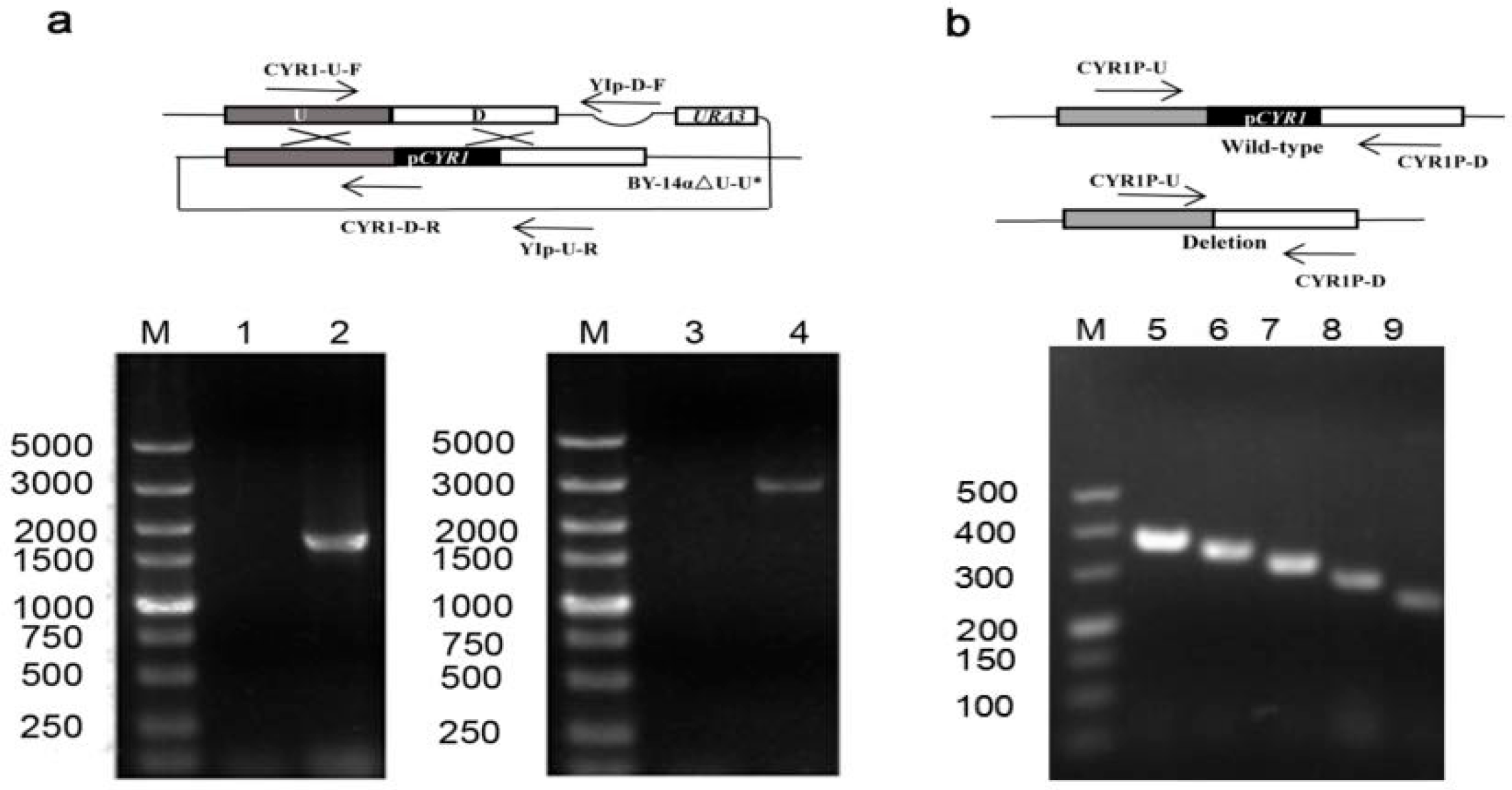
Figure 1. The verification of the recombinant strains. (a) The verification of the first-step recombinant strains. Lane 1: Strain BY14αΔU served as template; Lane 2: Strain BY14αΔU-U-30 (BY14αΔU-U-60, BY14αΔU-U-90, BY14αΔU-U-120) served as template (the primers used were CYR1-U-F and YIp-D-F; yielded a fragment of 1800 bp); Lane 3: Strain BY14αΔU served as template; Lane 4: Strain BY14αΔU-U-30 (BY14αΔU-U-60, BY14αΔU-U-90, and BY14αΔU-U-120) served as template (the primers used were CYR1-U-R and YIp-D-R; yielded a fragment of 3000 bp). (b) The verification of second-step recombinant strains. Lane 5: Stain BY14αΔU served as template using primer pairs CYR1P-U/CYR1P-D, yielded a fragment of 366 bp; Lane 6: Strain BY14αΔU-30 served as template using primer pairs CYR1P-U/CYR1P-D, yielded a fragment of 336 bp; Lane 7: Strain BY14αΔU-60 served as template using primer pairs CYR1P-U/CYR1P-D, yielded a fragment of 306 bp; Lane 8: Strain BY14αΔU-90 served as template using primer pairs CYR1P-U/CYR1P-D, yielded a fragment of 276 bp; Lane 9: Strain BY14αΔU-120 served as template using primer pairs CYR1P-U/CYR1P-D, yielded a fragment of 246 bp. “*” represents the complemented URA3 gene.
Fermentation 12 00373 g001
Figure 2. Relative expression level of CYR1 gene and adenylate cyclase activity in engineered strains with promoter truncated by 30, 60, 90, and 120 bp. Relative expression level of CYR1 gene was analyzed by RT-qPCR and the experiments were repeated thrice. Cells cultivated in YEPD medium for 24 h were used to measure the adenylate cyclase activity of strains. Data are the average of three independent experiments. Error bars represent ± SD.
Fermentation 12 00373 g002
Figure 3. Cell viability and relative fermentation ability after freezing. (A) The cell viability of engineered strains after freezing at −20 °C for 21 days. Data are the average of three independent experiments. Error bars represent ± SD. (B) The relative fermentation ability of engineered strains. Data are the average of three independent experiments. Error bars represent ± SD.
Fermentation 12 00373 g003
Figure 4. The contents of intracellular trehalose and proline. (A) The concentration of intracellular trehalose in engineered strains. Data are the average of three independent experiments. Error bars represent ± SD. (B) The concentration of intracellular proline in engineered strains. Data are the average of three independent experiments. Error bars represent ± SD.
Fermentation 12 00373 g004
Table 1. Microbial strains and plasmids used in the current study.
Strains and PlasmidsRelevant CharacteristicReference or Source
Strains
BY14Industrial baker’s yeastAngel Yeast Co., Ltd., Yichang, Hubei, China
BY14αMATα (haploid derived from BY14 strain)This study
BY14aMATa (haploid derived from BY14 strain)This study
BY14αΔU-U MATα ura3− (containing YIplac211-pCYR1)This study
BY14αΔUMATa ura3This study
BY14αΔU-30MATα ura3− with 30 bp truncation of CYR1This study
BY14αΔU-60MATα ura3− with 60 bp truncation of CYR1This study
BY14αΔU-90MATα ura3− with 90 bp truncation of CYR1This study
BY14αΔU-120MATα ura3− with 120 bp truncation of CYR1This study
BY14-30Diploid with 30 bp truncation of CYR1This study
BY14-60Diploid with 60 bp truncation of CYR1This study
BY14-90Diploid with 90 bp truncation of CYR1This study
BY14-120Diploid with 120 bp truncation of CYR1This study
Plasmids
DH5αΦ80 lacZΔM15 ΔlacU169 recA1 endA1 hsdR17 supE44 thi-1 gyrA relA1Stratagene, La Jolla, CA, USA
YIplac211AmpR URA3+[18]
YIplac211-pCYR1-30AmpR URA3+ (containing 30 bp truncation of CYR1)This study
YIplac211-pCYR1-60AmpR URA3+ (containing 60 bp truncation of CYR1)This study
YIplac211-pCYR1-90AmpR URA3+ (containing 9 0bp truncation of CYR1)This study
YIplac211-pCYR1-120AmpR URA3+ (containing 120 bp truncation of CYR1)This study
Disclaimer/Publisher’s Note: The statements, opinions and data contained in all publications are solely those of the individual author(s) and contributor(s) and not of MDPI and/or the editor(s). MDPI and/or the editor(s) disclaim responsibility for any injury to people or property resulting from any ideas, methods, instructions or products referred to in the content.