
Article

Bioconversion of Spent Green Tea Residues via Gamma Irradiation and Yeast Fermentation: Effects on Ruminal Fermentation, Degradability, and Methane Emissions


1
Animal Nutrition Laboratory, National School of Veterinary Medicine Sidi Thabet, University of Manouba, Ariana 2020, Tunisia
2
Department of Agricultural, Forest and Food Sciences, University of Turin, Largo P. Braccini 2, 10095 Turin, Italy
Fermentation 2026, 12(8), 372; https://doi.org/10.3390/fermentation12080372
Submission received: 29 June 2026 / Revised: 1 August 2026 / Accepted: 7 August 2026 / Published: 8 August 2026

Abstract

Spent green tea residues are an abundant lignocellulosic by-product that poses environmental disposal concerns, while its use in ruminant nutrition is constrained by low ruminal degradability associated with high fiber and phenolic contents. This study investigated the effects of gamma irradiation and solid-state fermentation using Saccharomyces cerevisiae, and their combination, on chemical composition and ruminal fermentation. Gamma irradiation reduced neutral detergent fiber (379 to 336 mg g−1 dry matter), acid detergent fiber (277 to 244 mg g−1 dry matter), and total phenolics (89 to 75 mg gallic acid equivalents g−1 dry matter) while increasing non-fiber carbohydrates (234 to 269 mg g−1 dry matter) and ash (32 to 44 mg g−1 dry matter). These modifications enhanced the gas production rate (3.26 to 3.37% h−1), neutral detergent fiber degradability (38.9 to 46.1%), and the acetate-to-propionate ratio (2.25 to 2.43) while reducing ammonia nitrogen (108 to 96 mg L−1), crude protein degradability (55.1 to 48.8%), and increasing rumen exoglycanase activity by 11% and xylanase activity by 15%. However, the methane proportion in total gas increased from 12.4 to 13.3% and methane yield per unit of degraded dry matter increased from 36.5 to 39.2 mL g−1 degraded dry matter. Solid-state fermentation using Saccharomyces cerevisiae alone did not change the chemical composition or ruminal fermentation of non-irradiated biomass. However, when applied to irradiated biomass, it increased the crude protein from 320 to 383 mg g−1 dry matter and ether extract from 31 to 49 mg g−1 dry matter, improved dry matter degradability (53.3 to 63.1%), organic matter degradability (55.3 to 64.3%), crude protein degradability (48.8 to 54.6%), total volatile fatty acids (49 to 57 mmol L−1), and net energy for lactation (2.43 to 3.02 MJ kg−1 dry matter), and maintained ammonia nitrogen at levels similar to the irradiated biomass. Although the combined treatment increased the methane yield per unit of incubated dry matter (19.2 to 23.4 mL g−1 dry matter), the methane yield per unit of degraded dry matter was lower than that of the irradiated biomass alone (37.0 vs. 39.2 mL g−1 dry matter degraded) and comparable to the untreated control (36.5 mL g−1 dry matter degraded). Overall, the integration of gamma irradiation as a pretreatment followed by solid-state fermentation with Saccharomyces cerevisiae enhances the nutritional value of spent green tea residues, supporting its valorization as a sustainable alternative ruminant feed resource.

1. Introduction

The sustainability of ruminant production systems is increasingly constrained by the rising cost and limited availability of conventional feed resources, which may account for up to 70% of the total production costs [1]. These pressures are further amplified by global challenges, including increasing demand for animal-derived products, competition for arable land and water resources, and climate change, all of which collectively undermine feed security, nutrient-use efficiency, and the environmental sustainability of livestock production systems [2,3].
In this context, the valorization of agro-industrial by-products represents a promising and increasingly relevant strategy to enhance feed availability while reducing environmental burdens associated with waste accumulation and greenhouse gas emissions [2,4]. Among these residues, spent tea (Camellia sinensis) is generated globally in quantities exceeding 7 million tons annually, representing nearly 90% of the original leaf dry matter after aqueous extraction [5,6]. However, this biomass is often discarded or incinerated, contributing to environmental pollution and greenhouse gas emissions [7,8].
Nevertheless, increasing evidence suggests that spent tea residues can partially replace conventional feed ingredients in ruminant diets without negatively affecting performance. In vivo studies have reported that inclusion levels up to 10% in dairy goats maintain milk yield while improving milk protein content [9], whereas incorporation at 15–20% in growing lambs and calves does not impair growth performance [10,11]. In vitro rumen fermentation studies further indicate that inclusion at approximately 10% in mixed rations may reduce methane production and ruminal ammonia nitrogen concentration [12]. In addition, phytochemicals derived from spent tea have been reported to exert antimicrobial and antiparasitic effects, potentially improving rumen microbial balance and animal health [13].
However, despite these promising effects, the use of spent tea residues in ruminant nutrition is constrained by their low ruminal degradability. Indeed, an in vitro study using bovine rumen fluid as a fermentation model demonstrated that only 40.7% of their organic matter is degraded in the rumen, which is lower than that reported for conventional forages [14]. This limited degradability is due to lignin–cellulose complexation and the persistence of anti-nutritional compounds that can impair microbial degradation and nutrient availability [14]. In addition, recent in vivo studies have shown that their incorporation at low levels (2–6% of diets as an alternative to alfalfa hay) causes linear declines in the apparent digestibility of dry matter, organic matter, and crude protein in lamb diets [15]. These constraints highlight the need for effective biotechnological processing strategies to improve their nutritional value and promote wider use in ruminant nutrition.
A recent study demonstrated that solid-state fermentation using Saccharomyces cerevisiae is a well-established, safe biotechnological approach in animal nutrition for upgrading various agro-industrial residues into functional feed resources through microbial metabolism and enzymatic bioconversion. This process increases the crude protein content and reduces anti-nutritional factors, thereby improving ruminal degradability and nutritional value [16,17]. However, it is not clear whether the increase in the CP concentration was accompanied by the proliferation of the Saccharomyces cerevisiae population and the increase in true microbial protein [17]. In parallel, gamma irradiation at 150 kGy has been reported as a safe, emerging innovative non-thermal pre-treatment within feed processing systems. Gamma irradiation alone can induce structural modifications in lignocellulosic biomass, including disrupting lignocellulosic structure, partial reduction in cellulose crystallinity, and increased porosity of the plant cell wall matrix, thereby improving microbial accessibility and enhancing ruminal fermentation and degradability [18,19]. In addition to its direct effects, gamma irradiation can act as an effective conditioning step that increases the susceptibility of lignocellulosic substrates to subsequent alkaline or enzymatic treatments. The structural disruption results in synergistic improvements in the overall nutritional value of low-quality plant biomass used for ruminant feeding [18,19]. However, the effectiveness of gamma irradiation is strongly influenced by irradiation dose. Several studies have demonstrated that 150 kGy represents an effective dose for improving the nutritive value of lignocellulosic feed materials. Soybean straw irradiated at 150 kGy exhibited a greater reduction in cellulose crystallinity and superior ruminal degradability compared with treatment at 100 kGy [18]. Similarly, alfalfa hay treated with 150 kGy irradiation exhibited significantly improved ruminal dry matter and fiber degradability compared with lower doses of 50 and 100 kGy [20]. Comparable improvements have been reported in barley straw, sorghum straw, wheat chaff, and maize cobs, where 150 kGy irradiation increased the digestible energy and digestible organic matter compared with lower irradiation doses (5–100 kGy) [21].
Therefore, the present study aims to evaluate the individual and combined effects of gamma irradiation at 150 kGy and solid-state fermentation with Saccharomyces cerevisiae on the chemical composition, in vitro ruminal fermentation characteristics, methane production, and degradability of spent green tea residues. We hypothesize that integrating these two complementary technologies will synergistically convert spent green tea into a sustainable ruminant feed resource.

2. Materials and Methods

2.1. Collection and Processing of Spent Green Tea Residues

Samples of spent green tea residues were collected from three industrial beverage facilities in Tunisia. To account for temporal variation in the characteristics of the residues, sampling was conducted on four independent occasions at weekly intervals. Each sampling occasion represented an independent biological batch and was considered one biological replicate of the study. Following collection, foreign materials from each sample from each facility were manually removed. The samples were then oven-dried at 40 °C for 48 h to reduce moisture content, facilitate grinding, and obtain a more homogeneous and representative substrate. The dried material was subsequently ground to pass through a 1-mm sieve using a laboratory mill (Retsch ZM200, Retsch GmbH, Haan, Germany). For each sampling occasion, the dried and ground residues obtained from the three industrial facilities were combined in equal proportions and thoroughly homogenized to generate a representative composite sample for that specific sampling period. This pooling strategy was applied only within the same sampling occasion to account for variation among industrial sources while maintaining the biological independence of sampling dates. Samples collected on different occasions were kept separate and were not pooled. Thus, the four sampling occasions remained as independent biological replicates throughout the experiment. The homogenized samples were subsequently sterilized by autoclaving at 121 °C for 30 min to eliminate potential contaminating microorganisms. After sterilization, the samples were cooled to room temperature under aseptic conditions and stored in sterile airtight containers until further processing.

2.2. Treatments

Each of the four independent biological batches was processed separately and subjected independently to experimental treatments. Therefore, treatment effects were evaluated using independent biological units rather than repeated measurements derived from a single processed sample. The biological batch was considered the experimental unit, resulting in four independent biological replicates per treatment (n = 4). For each biological batch, each treatment was prepared in three repetitions. These repetitions were considered technical replicates, were not considered additional experimental units, and were used to evaluate experimental precision, treatment consistency, and analytical variability.
Four treatments were applied to each biological batch of spent green tea residues: solid-state fermentation with Saccharomyces cerevisiae (SC), in which 100 g dry matter (DM) of spent green tea residues, adjusted to 67.8% moisture, was inoculated with Saccharomyces cerevisiae (Yea-Sacc® 1026; Alltech Inc., Lexington, KY, USA; 5 × 10¹⁰ CFU g−1 DM) at 100 mg per 100 g DM and incubated under aerobic conditions at 40 °C for 14 days, followed by oven-drying at 40 °C for 48 h and grinding to 1 mm [22]. The moisture content, incubation temperature, and fermentation period were selected based on the optimal growth conditions for Saccharomyces cerevisiae reported by Sechrist et al. [23]. During fermentation, samples were maintained in a humidified incubator to minimize moisture loss and maintain the target moisture level (67.8%). All substrates, fermentation containers, and equipment were sterilized prior to inoculation, and the fermentation process was conducted under controlled laboratory conditions to minimize the risk of microbial contamination. Gamma irradiation (γ), in which 100 g DM of spent green tea residues, adjusted to 67.8% moisture, was exposed to gamma irradiation at 150 kGy using a cobalt-60 gamma irradiator (Gamma Cell 220, Ottawa, ON, Canada) at a dose rate of 33 Gy/min, followed by equilibration at room temperature for 2 h and oven-drying at 40 °C for 48 h [18,19]. The moisture content was standardized across treatments to ensure comparable processing conditions and to facilitate the direct evaluation of treatment effects. The combined treatment (γ + SC), in which samples were first subjected to gamma irradiation and subsequently processed under solid-state fermentation with Saccharomyces cerevisiae as described above; and the control, consisting of 100 g DM, moistened to 67.8% with sterile distilled water, and oven-dried at 40 °C for 48 h. After treatment, the samples were stored in sterile airtight containers until further processing. Therefore, the control and gamma-irradiated samples were stored for an additional period corresponding to the 14-day solid-state fermentation period applied to the Saccharomyces cerevisiae treatments. This approach ensured that all treatments within each biological batch were evaluated at the same final experimental time point and under similar conditions during the subsequent in vitro ruminal fermentation assessment.

2.3. Chemical Analyses

Chemical analyses of samples from each treatment subgroup were performed in triplicate. The three analytical measurements obtained for each subgroup were averaged to generate a single representative value for each subgroup. Subsequently, values from subgroups belonging to the same treatment within each biological replicate were averaged to obtain the final value used for statistical analysis. The biological batch was defined as the experimental unit, resulting in four independent biological replicates per treatment (n = 4). Dry matter content was determined by oven-drying at 105 °C for 3 h to constant weight. Nitrogen content was quantified by the Kjeldahl method and converted to crude protein (CP) using a factor of 6.25. Ether extract (EE) was determined by Soxhlet extraction using petroleum ether as the solvent, whereas ash content was obtained by combustion at 550 °C for 6 h [24]. Neutral detergent fiber (NDF), acid detergent fiber (ADF), and acid detergent lignin (ADL) were determined using an ANKOM 200 Fiber Analyzer (ANKOM Technology, Macedon, NY, USA) [25]. Non-fiber carbohydrates (NFC) were calculated according to the National Research Council equation [26]:
NFC = 1000 − (NDF + CP + EE + Ash),
with all constituents expressed on a mg/g DM basis.
Total phenolic compounds were quantified using the Folin–Ciocalteu colorimetric method and expressed as mg gallic acid equivalents/g DM [27]. Total tannins were determined using the vanillin–HCl assay and expressed as mg tannic acid equivalents/g DM [28]. Condensed tannins were quantified according to the procedure of Makkar et al. [29] and expressed as mg catechin equivalents/g DM. The percentage weight change of each chemical component during gamma irradiation and solid-state fermentation was calculated by comparing the amount recovered after each treatment with the initial corresponding amount.

2.4. Rumen Fluid Collection and In Vitro Fermentation

For the in vitro ruminal fermentation assays, each biological batch (n = 4) was incubated independently. Rumen inoculum was collected during each experimental run from three clinically healthy adult dairy goats not in lactation (approximately 3 years of age; 45 ± 2 kg body weight) immediately after slaughter at a commercial abattoir in Tunis, Tunisia. Prior to slaughter, the animals were maintained on a standardized diet consisting of 0.5 kg DM oat hay and 0.5 kg DM commercial concentrate daily, with free access to water, for at least one month.
Rumen contents were sampled from the dorsal, ventral, and central ruminal sacs and transferred into a pre-warmed (39 °C) thermos previously flushed with CO2. Samples were transported to the laboratory within 10 min and filtered through four layers of cheesecloth under continuous CO2 flushing (50 mL/min) to maintain anaerobic conditions. Equal volumes of rumen fluid from the three donor animals were pooled to obtain a homogeneous inoculum, which constituted one biological replicate. A mineral buffer solution was prepared according to Menke and Steingass [30], continuously flushed with CO2 (50 mL/min), and maintained at 39 °C for 30 min before use. The buffered medium was mixed with rumen fluid at a ratio of 2:1 (v/v) under continuous CO2 flushing and homogenized in a shaking water bath (300 rpm). The pH of the resulting inoculum was adjusted to 6.8 ± 0.05. A 200 mg DM sample of spent green tea residue was accurately weighed into 120 mL amber serum bottles, followed by the addition of 30 mL buffered rumen inoculum for in vitro incubation.
Each treatment was incubated in nine technical replicates with three replicate bottles prepared from each subgroup of the treatment, while nine blank bottles containing inoculum only were included to correct for background fermentation and degradation. Bottles were flushed with CO2 for 10 s, sealed with butyl rubber stoppers and aluminum crimps, and incubated at 39 °C under continuous agitation (120 rpm).

2.5. Gas Production and Fermentation Kinetics

Headspace gas pressure was recorded after 2, 4, 6, 8, 12, 24, 48, 72, and 96 h of incubation using a digital pressure transducer (PX4200-0100GI, Omega Engineering, Montreal, QC, Canada) connected to a data logger (Data Tracker 200, Data Track Process Instruments Ltd., Christchurch, New Zealand). Following each measurement, accumulated gas was completely released using a sterile 23-gauge needle and collected in gas-tight sampling bags.
Gas volume (Gv, mL) was calculated according to the equation:
G v ( t ) = G p ( t ) × ( V f V i ) P a t m
where Gp represents the measured gas pressure, Vf is the total bottle volume, Vi is the incubation medium volume, and Patm is the atmospheric pressure.
Cumulative gas production data were fitted using a single-pool exponential model with a discrete lag phase:
Y t = A × ( 1 e C ( t L a g ) )
where Yt is the cumulative gas production (mL g−1 DM), A is the asymptotic gas production, C is the fractional rate constant of gas production (%/h−1), and Lag is the colonization lag time (h).
At the end of incubation, the concentration of methane in the total cumulative gas collected in gas-tight sampling bags was analyzed using a portable gas analyzer (Dräger X-am 8000, Drägerwerk AG & Co. KGaA, Lübeck, Germany), which had a CH4 measurement resolution of 0.1 vol.% [22]. Gas production parameters were corrected for blank incubations and expressed as mL g−1 DM incubated, mL g−1 DM degraded, and as a proportion (%) of total gas production.

2.6. Fermentation End Products, Nutrient Degradation, and Energy Utilization

At the end of the incubation period (96 h), ruminal pH was measured immediately using a portable pH meter (Orion Star A221, Thermo Scientific, Montreal, QC, Canada). Rumen protozoa from freshly collected rumen fluid was immediately fixed at the time of sampling by total direct count following the method described by Galyean [31]. Briefly, 0.5 mL of rumen fluid was fixed in 4.5 mL of 10% formalin-saline solution, and a 0.1 mL aliquot was counted using a Levy–Sedgewick–Rafter counting chamber (Pyser-SGI, Edenbridge, Kent, UK) under a light microscope at 100× magnification. Protozoal enumeration was performed due to their association with methane production [32,33].
Fermentation residues were recovered by filtration through Whatman No. 541 filter paper (Whatman Scientific Ltd., Maidstone, UK). For each treatment, three incubation bottles and three blank bottles were used to determine residual DM and organic matter (OM) contents [24]. These bottles consisted of one technical replicate from each treatment subgroup. A second set of three bottles per treatment (one technical replicate from each treatment subgroup) and three blanks was used to determine residual NDF contents [25] whereas a third set of three bottles per treatment, consisting of one technical replicate from each treatment subgroup and three blanks, was used to determine residual CP contents [24]. Ruminal degradability coefficients of DM (DMD), OM (OMD), NDF (NDFD), and CP (CPD) were calculated after correction for blank residues and expressed as the percentage difference between the amount of nutrient degraded and the corresponding nutrient incubated. For ammonia nitrogen (NH3–N) determination, a 5 mL aliquot of rumen fluid filtrate was centrifuged at 3000× g for 10 min. The resulting supernatant was acidified with 1 N H2SO4 (5:2, v/v), stored at −20 °C, and subsequently analyzed using the micro-Kjeldahl method [24]. For volatile fatty acid (VFA) analysis, an additional 5 mL aliquot of filtrate was centrifuged at 4000× g for 15 min at 4 °C. Subsequently, 2 mL of the supernatant was mixed with 0.2 mL of 250 g/L metaphosphoric acid, incubated at 4 °C for 30 min, and centrifuged at 10,000× g for 10 min at 4 °C. The supernatant was analyzed by gas chromatography (Shimadzu GC-2014, Kyoto, Japan) for the determination of individual and total VFA [34]. The liquid residue was first subjected to ultrasonic disruption at 4 °C (four cycles of 30 s sonication followed by 30 s rest intervals). The homogenized sample was then centrifuged at 20,000× g for 15 min at 4 °C to remove cellular debris and recover the soluble enzyme fraction. The resulting supernatant was stored at −80 °C until the enzymatic activity measurements [35]. Enzymatic assays were conducted following a short-term storage period of 24 h at −80 °C. This storage duration was selected to minimize potential alterations in enzyme stability and to maintain the integrity and reliability of the measured enzymatic activities. Enzyme activities were measured under conditions simulating the rumen environment (pH 6.6 and 39 °C) [36]. Endoglucanase and exoglucanase activities were determined according to the methods described by Wood and Bhat [37]. Xylanase activity was measured following the protocol of Bailey et al. [38]. Metabolizable energy (ME) and net energy for lactation (NEL) were estimated according to Menke and Steingass [30] using the following equations:
M E = 2.20 + 0.13570 × G P 24 + 0.0057 × C P + 0.000286 × E E 2 N E L = 0.0960 × G P 24 + 0.0038 × C P + 0.000173 × E E 2 + 0.540
ME: metabolizable energy (MJ/kg DM); NEL: net energy for lactation (MJ/kg DM); GP24: net gas production after 24 h (mL/200 mg DM); CP: crude protein content (g/kg DM); EE: ether extract content (g/kg DM).

2.7. Statistical Analysis

Prior to statistical analysis, all measurements obtained from technical replicates were averaged within each biological replicate to obtain a single representative value for each experimental unit. Technical replicates were therefore considered repeated measurements of the same biological sample and were used only to improve analytical precision. The biological replicate was defined as the experimental unit, with four independent biological replicates analyzed per treatment. Gas production kinetics were estimated by using nonlinear regression procedures in SAS software (version 9.1; SAS Institute Inc., Cary, NC, USA). All other data were analyzed by using analysis of variance (ANOVA) under a completely randomized design, with treatment considered as a fixed effect and the biological replicate as the experimental unit, according to the following general linear model:
Y i j = μ + T i + ε i j
where Yij represents the dependent variable, μ is the overall mean, Ti is the fixed effect of treatment, and εij is the random residual error term.
When significant treatment effects were detected, means were compared using Tukey’s honestly significant difference (HSD) post hoc test. Statistical significance was declared at p ≤ 0.05. Correlations between chemical components and ruminal degradability and methane emission parameters were assessed using Spearman correlation analysis using the cor.test function in R Studio (version 4.4.1). Correlations were calculated using biological replicate-level observations across treatments rather than treatment means, thereby avoiding pseudoreplication and accounting for variability among independent experimental units. Before analysis, the normality of residuals was assessed using the Shapiro–Wilk test (p-value > 0.05), and homogeneity of variances was evaluated using Levene’s test (p-value > 0.05).

3. Results

3.1. Chemical Composition

The effects of the SC and γ treatments, and their combination, on the chemical composition of spent green tea residues are presented in Table 1. CP and EE contents were significantly increased in the γ + SC treatments. NDF and ADF were significantly reduced following γ and γ + SC application, whereas ADL was not affected by any treatment. Ash content significantly increased in the γ and γ + SC treatments. NFC increased after γ treatment and decreased in γ + SC treatment. TP, TT, and CT were significantly reduced by the γ and γ + SC treatments.
The effects of the γ, SC, and γ + SC treatments on the percentage weight changes of spent green tea residue components are presented in Table 2. DM weight was reduced by all treatments, with the greatest reduction observed in γ + SC. CP weight decreased following γ and SC treatments but increased after γ + SC application. EE weight increased, particularly under γ + SC treatment. NDF and ADF weights were reduced by γ and γ + SC, while ADL showed the greatest reduction following γ + SC treatment. Ash weight increased after γ and γ + SC treatments. NFC weight increased with γ but decreased with SC and γ + SC. TP, TT, and CT weights were significantly reduced by all treatments, with the largest decreases observed in γ + SC.

3.2. In Vitro Ruminal Fermentation, Degradability, and Methane Emissions

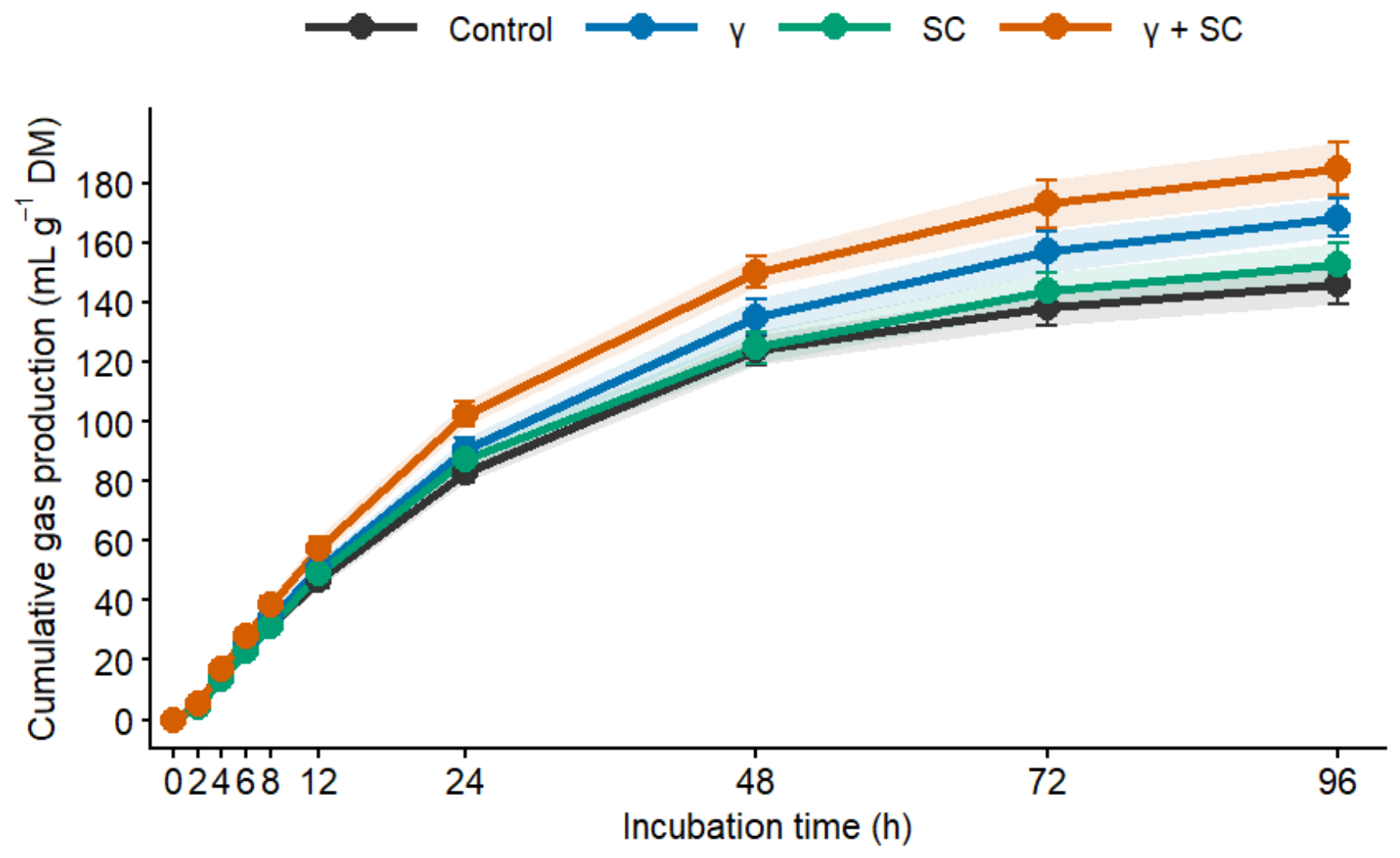
The effects of γ, SC, and their combination on ruminal fermentation characteristics, degradability, energy utilization, ruminal protozoa, ruminal fibrolytic enzyme activity and methane production are presented in Table 3 and Figure 1. The raw data for ruminal protozoa are provided in Table S1. Potential gas production increased significantly with the γ and γ + SC treatments, with the greatest improvement in the combined treatment, whereas the gas production rate increased similarly with γ and γ + SC, and the lag time was not affected by any treatment. NH3–N concentration was reduced similarly with γ and γ + SC, while TVFA increased significantly only with γ + SC, which increased the acetate-to-propionate ratio; however, the γ treatment increased the acetate-to-propionate ratio without modifying TVFA. DMD and OMD were significantly improved only with the γ + SC treatments. NDFD increased similarly in the γ and γ + SC treatments. CPD decreased following γ irradiation. ME and NEL increased significantly only with γ + SC. Methane proportion in total gas and yield relative to DMD and DM increased with γ irradiation, while the combination treatment increased only the methane yield relative to DM. However, none of the treatments affected rumen protozoa. Regarding ruminal fibrolytic enzyme activities, endoglucanase activity was not influenced by any treatment. In contrast, xylanase and exoglycanase activity increased with the γ and γ + SC treatments.
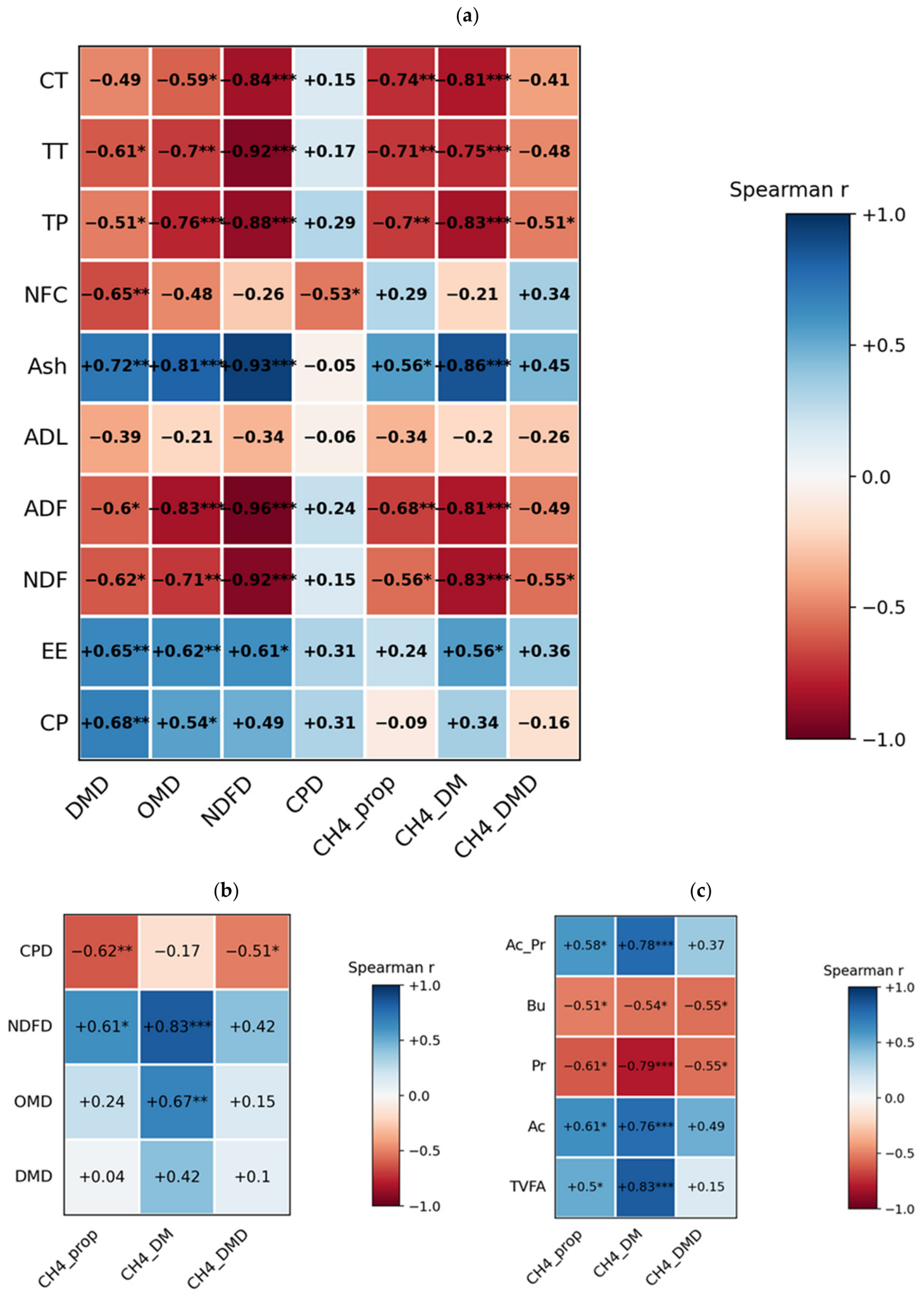
Spearman correlation analysis (Figure 2) showed that fiber fractions and tannin fractions were the main factors associated with ruminal degradability and methane emission characteristics. CT and TT negatively affected degradability, with strong negative correlations observed with NDFD (CT: r = −0.84, p < 0.001; TT: r = −0.92, p < 0.001), followed by OMD (CT: r = −0.59, p < 0.05; TT: r = −0.70, p < 0.01). Fiber fractions showed a comparable pattern, as ADF and NDF were both strongly and negatively correlated with NDFD (r = −0.96 and −0.92, respectively; p < 0.001) and with OMD (r = −0.83 and −0.71, respectively; p < 0.01–0.05), whereas ash and EE content were positively correlated with degradability (ash–NDFD: r = 0.93, p < 0.001; EE–DMD: r = 0.65, p < 0.01). Methane production traits followed a similar fiber- and tannin-dependent pattern: CT and TT were negatively correlated with both CH4_prop and CH4_DM (CT: r = −0.74 and −0.81; TT: r = −0.71 and −0.75, respectively; all p < 0.01), and ADF and NDF showed comparable negative associations with these traits (ADF–CH4_DM: r = −0.81; NDF–CH4_DM: r = −0.83; both p < 0.001), while ash content was positively correlated with methane traits (ash–CH4_DM: r = 0.86, p < 0.001). At the level of degradation–methane relationships, NDFD was positively correlated with CH4_DM (r = 0.83, p < 0.001) and CH4_prop (r = 0.61, p < 0.05), while CPD was negatively correlated with both CH4_prop (r = −0.62, p < 0.01) and CH4_DMD (r = −0.51, p < 0.05). Acetate concentration and the acetate-to-propionate ratio were positively correlated with CH4_DM (r = 0.76 and 0.78, respectively; p < 0.001), whereas propionate and butyrate were negatively correlated with CH4_prop, CH4_DM, and CH4_DMD (r range: −0.51 to −0.79).

4. Discussion

Gamma irradiation alone significantly altered the chemical composition and absolute weight of spent green tea residues through disrupting lignocellulosic complexes, as evidenced by the reduction in NDF and ADF contents and their corresponding absolute weights. Similar decreases in structural carbohydrate content have been reported in several lignocellulosic substrates, including cereal straws, maize by-products [39], sugarcane bagasse [40], and Typha biomass [19]. These changes are primarily attributed to the radiolytic cleavage of cellulose–hemicellulose linkages, resulting in the partial depolymerization of structural polysaccharides into more soluble carbohydrate fractions [41]. Consequently, the NFC content and their corresponding absolute weights increased following irradiation treatment. In addition, ash content and their corresponding absolute weights of spent green tea residues increased, which may be explained by irradiation induced degradation and the volatilization of organic matter, leading to a relative concentration of mineral constituents, as previously observed in irradiated Typha biomass [19]. In addition, gamma irradiation reduced the absolute weight of the ADL fraction, indicating partial lignin disruption or delignification. However, unlike NDF and ADF, the ADL concentration in the remaining residue was not significantly affected, indicating that irradiation primarily promoted the solubilization and depolymerization of the cellulose and hemicellulose fractions, rather than extensive lignin removal. Similar findings have been reported in previous studies showing that gamma irradiation at 150 kGy did not modify the proportion of ADL in Typha biomass [19], lentil straw, or apple pruning residues treated with the same irradiation dose [42]. Gamma irradiation also reduced the concentration of phenolic compounds and their corresponding absolute weights in spent green tea, likely through the oxidative degradation of phenolic structures mediated by highly reactive free radicals generated during irradiation [43]. A similar reduction in tannin content has been reported in pistachio hulls [43]. In contrast, increases in total phenolics and tannins have been observed in irradiated Typha biomass [19] and almond skins [44], suggesting that the response of phenolic compounds to irradiation is highly dependent on the chemical composition and structural characteristics of the treated biomass.
The chemical composition modifications were accompanied by significant changes in ruminal fermentation characteristics. Irradiated spent green tea exhibited a higher asymptotic gas production and fermentation rate, indicating improved microbial utilization of the substrate. Similar responses have been reported for irradiated sweet sorghum [45], Typha biomass [19], and alfalfa hay [20]. The improved degradation of structural carbohydrates may be attributed to both the reduction in condensed tannins and disruption of the lignocellulosic matrix. Condensed tannins are known to inhibit cellulolytic micro-organisms, reduce fibrolytic enzyme activity, and form complexes with cell wall carbohydrates, thereby limiting microbial access to structural polysaccharides [29]. The importance of these chemical modifications was further supported by the Spearman correlation analysis, which identified fiber and tannin fractions as major determinants of ruminal degradability, showing significant negative associations with degradation parameters. The increased NFC availability likely promoted microbial colonization and fermentation efficiency [46]. Moreover, previous studies have suggested that γ-irradiation of Typha biomass may alter the cow ruminal microbial ecosystem by promoting bacterial proliferation and reducing rumen protozoal populations [19]. However, in the present study, although γ-irradiation of spent green tea residues improved the fermentation kinetics and fiber degradability, it did not significantly modify the rumen protozoal abundance in goats. This suggests that the beneficial effects of irradiation were primarily related to improved substrate accessibility, enhanced microbial attachment, and/or may have increased fibrolytic bacterial activity rather than substantial modifications of protozoal communities. The absence of changes in ruminal protozoal abundance may indicate that the degree of tannin degradation and structural modification achieved through irradiation was insufficient to alter the ecological conditions regulating protozoal survival and proliferation. These findings highlight that the response of rumen protozoa to processed feed substrates may depend on multiple factors, including host species, ruminal microbial ecology, and the initial chemical characteristics of the feed material. The increased exoglycanase and xylanase activities in rumen may reflect a greater proliferation and/or metabolic activation of cellulolytic rumen microbiota, likely resulting from increased accessibility of cellulose and hemicellulose following disruption of the lignocellulosic structure and partial removal of inhibitory phenolic compounds. Conversely, γ-irradiation reduced CP degradability, consistent with observations in irradiated cottonseed meal and alfalfa hay [47,48]. Although reduced ruminal CP degradability may reflect decreased microbial proteolysis and protein breakdown within the rumen, it may also contribute to an increased supply of rumen-undegradable protein reaching the small intestine, thereby potentially improving post-ruminal amino acid availability, as previously observed in irradiated cottonseed meal [47]. The decrease in CP degradability was accompanied by lower ruminal NH3–N concentrations, suggesting reduced proteolysis and deamination during fermentation. Nevertheless, the decline in NH3–N concentration may not exclusively indicate reduced protein degradation, as it could also result from greater microbial assimilation of available nitrogen into microbial protein. Since microbial protein synthesis and microbial biomass production were not directly quantified in the present study, this hypothesis requires further investigation. Similar reductions in NH3–N concentration have been reported following the irradiation of Typha biomass in cattle [19]. Nevertheless, NH3–N concentrations remained within the optimal range required to sustain microbial growth and fermentation activity (50–250 mg L−1) [49]. The opposing effects of γ-irradiation on CP and NDF degradability likely explain the lack of changes in DM and OM degradability, as well as the absence of improvements in the overall energy utilization of spent green tea waste for goats. This response differs from previous findings obtained with irradiated Typha biomass, where increases in ME and NEL were observed in cattle [19]. Such discrepancies may be associated with differences in feed matrix composition, irradiation sensitivity of structural components, and variations in host animal characteristics, including ruminal environmental conditions and microbial community structure.
Although γ-irradiation did not modify TVFA concentration, it altered the fermentation profile by increasing acetate production and reducing propionate proportion. This shift is consistent with the enhanced degradation of structural carbohydrates, which favors acetate-producing fermentation pathways and generates CO2 and H2 as metabolic end-products [50]. The greater availability of hydrogen likely contributed to the increased methane production observed in irradiated samples, expressed as both the methane proportion of total gas and methane yield per unit of incubated or degraded dry matter. This interpretation was supported by the Spearman correlation analysis, which showed that propionate was negatively correlated with CH4_prop, CH4_DM, and CH4_DMD, whereas NDF degradability was positively correlated with CH4_prop and CH4_DM. In contrast, CP degradability was negatively associated with CH4_prop and CH4_DMD. These relationships indicate that enhanced fiber fermentation promoted methanogenesis, whereas protein degradation contributed less to methane formation. The reduction in tannin concentration may have further amplified this response, given that tannins can inhibit methanogenesis through direct effects on methanogenic archaea and by modifying interspecies hydrogen transfer pathways within the rumen ecosystem [51,52]. This interpretation was supported by the Spearman correlation analysis, which revealed negative associations between total phenolics, total tannins, condensed tannins, and methane-related parameters (CH4_prop and CH4_DM), indicating that higher concentrations of phenolic compounds were associated with reduced methane production. However, although the tannin concentrations were reduced, this change did not significantly alter the ruminal protozoal abundance, despite the well-established negative correlation between tannin levels and protozoal populations [32,33]. Given that ruminal protozoa contribute approximately 25% of total enteric methane emissions through their symbiotic association with methanogenic archaea [32,33], the absence of alterations in protozoal abundance indicated that the enhanced methane emissions were likely attributable to the greater availability of fermentable substrates, stimulation of fibrolytic fermentation, increased production and transfer of metabolic hydrogen to methanogens, and the mitigation of tannin-induced suppression of methanogenic activity. Similar increases in methane production have been reported following the irradiation of sweet sorghum bagasse [45]. Despite the substantial modifications in chemical composition and fermentation characteristics induced by γ-irradiation, the ruminal pH remained unaffected. This stability of pH values within the physiological range optimal for fibrolytic microbial activity [53] suggests that the enhanced fermentation observed in irradiated samples did not result in excessive acid accumulation that could impair microbial function or fiber degradation.
Solid-state fermentation with Saccharomyces cerevisiae changed the absolute weights of individual chemical components in non-irradiated spent green tea residues, indicating yeast-mediated substrate transformation. However, these changes did not significantly alter the overall chemical composition of the fermented biomass or improve ruminal degradability, fermentation characteristics, rumen protozoal abundance, utilizable energy, or methane production. The limited response of untreated residues to Saccharomyces cerevisiae fermentation suggests that despite microbial activity, the substrate did not provide favorable conditions for extensive yeast growth or efficient bioconversion. This contrasts with our previous study on almond hulls, where the same solid-state fermentation approach with Saccharomyces cerevisiae modified the chemical composition and improved ruminal fermentation and degradability [22]. This discrepancy is likely due to differences in substrate properties. Spent green tea residues form a highly recalcitrant lignocellulosic matrix, characterized by high concentrations of structural carbohydrates, lignin-associated compounds, and phenolic constituents, together with limited NFC. These characteristics may restrict yeast metabolism by limiting access to carbon sources required for cell proliferation and enzymatic activity, thereby reducing biochemical transformation and limiting improvements in ruminal degradation. Spearman correlation analysis further supported the role of substrate composition in regulating ruminal degradability and methane production. It should be acknowledged that the comparison of the SC treatment with the control and γ-irradiation treatments was not intended to isolate the individual contribution of Saccharomyces cerevisiae, but rather to evaluate the overall effectiveness of the applied solid-state fermentation strategy with Saccharomyces cerevisiae. Consequently, the observed responses reflect the combined effects of Saccharomyces cerevisiae inoculation and the associated fermentation conditions, including the 14-day aerobic incubation period at 40 °C. In the present study, the absence of significant alterations in chemical composition, ruminal fermentation characteristics, degradability, energy utilization, rumen protozoal abundance, and methane production following SC treatment indicates that the applied fermentation conditions were insufficient to induce substantial bioconversion of spent green tea residues. Therefore, the combination of Saccharomyces cerevisiae inoculation and aerobic incubation, under the conditions evaluated, appears to have limited potential for improving the nutritional accessibility and ruminal utilization of spent green tea residues.
Contrary to non-irradiated spent green tea residues, the effectiveness of solid-state fermentation with Saccharomyces cerevisiae became more evident when applied to γ-irradiated spent green tea residues. Compared with irradiation alone, the combined treatment increased the contents and absolute weights of ash, CP, and EE while reducing the NFC concentration and absolute weight and absolute weight of all other compounds. These modifications indicate that γ-irradiation improved substrate suitability for yeast colonization and metabolic activity by increasing the accessibility of nutrients and modifying the structural characteristics of the biomass. This finding supports the hypothesis that the efficacy of solid-state fermentation with Saccharomyces cerevisiae is strongly dependent on substrate structure and nutrient accessibility. By partially disrupting the lignocellulosic matrix, γ-irradiation increased the availability of fermentable carbohydrates, thereby promoting Saccharomyces cerevisiae growth and metabolic activity during solid-state fermentation. The reduction in NFC observed after solid-state fermentation with Saccharomyces cerevisiae can be attributed to carbohydrate utilization by Saccharomyces cerevisiae as a carbon and energy source for biomass synthesis and cellular metabolism [54]. Similar decreases in NFC have been reported in soybean meal [16] and almond hulls [22].
The reduction in NFC concentration following solid-state fermentation with Saccharomyces cerevisiae can be primarily attributed to the utilization of soluble carbohydrates as carbon and energy sources required for microbial growth, biomass synthesis, and cellular maintenance. During fermentation, these readily available carbohydrates are metabolized through glycolytic and fermentative pathways, resulting in the production of microbial biomass and metabolic end-products. Therefore, the decrease in NFC content reflects active microbial transformation rather than a loss of nutritional value, particularly considering the concurrent increases in CP and EE fractions. The lower NFC content observed in the combined γ-irradiation and Saccharomyces cerevisiae fermentation treatment compared with the untreated control or treated only with Saccharomyces cerevisiae likely reflects the enhanced utilization of readily available carbohydrates by yeast during solid-state fermentation due to disruption of the lignocellulosic matrix by irradiation that can improve the accessibility of previously entrapped carbohydrate fractions, facilitating their release and subsequent utilization by Saccharomyces cerevisiae. The increased accessibility of fermentable substrates likely promoted yeast colonization, growth, and metabolic activity, resulting in a greater conversion of available carbohydrates into microbial biomass and fermentation products. The increase in CP concentration and recovered CP weight following the combined treatment suggests substantial enrichment of the fermented substrate through microbial protein accumulation associated with yeast biomass development. In addition, the reduction in the absolute weights of other chemical fractions indicates that the increase in CP was not solely a consequence of a relative concentration effect caused by the loss of other components. Instead, it likely resulted from a combination of true microbial protein synthesis, the incorporation of nitrogen into fungal biomass, and the transformation of the original substrate components during fermentation. Similar increases in CP content following fermentation with S. cerevisiae have been reported in almond hulls, where microbial growth contributed to the nutritional enrichment of the fermented biomass [22]. These findings demonstrate that the effectiveness of solid-state fermentation with S. cerevisiae depends not simply on the initial carbohydrate concentration of the substrate but rather on the accessibility, chemical nature, and availability of fermentable nutrients. Therefore, γ-irradiation can be considered as a critical conditioning step that improves substrate susceptibility to microbial transformation and increases the efficiency of subsequent solid-state fermentation. These compositional changes were associated with marked improvements in ruminal utilization of spent green tea residues, as reflected by increased DMD, OMD, CPD, ME, NEL and the extent of fermentation. Notably, CPD of the combined treatment restored to values comparable to those of the untreated control, suggesting that S. cerevisiae fermentation mitigated the reduction in protein degradability caused by γ-irradiation alone. The recovery of CP availability may be associated with microbial protein enrichment during fermentation, structural modification of protein–carbohydrate associations, and improved accessibility of nitrogen-containing compounds to ruminal microorganisms. However, the combined treatment did not further increase NDF degradability compared with γ-irradiation alone. Compared with untreated control, the increase in NDFD together with the absence of a negative effect on CPD likely contributed to the improvements observed in DMD and OMD. The greater availability of degradable organic matter would provide ruminal microorganisms with increased quantities of fermentable substrates, thereby stimulating microbial activity and enhancing energy extraction from the substrate. This mechanism is supported by the increased ME and NEL values observed after the combined treatment, indicating that the improved nutritional value of spent green tea residues resulted from a more favorable balance between structural carbohydrate degradation and nutrient availability. The enhancement of degradability accompanied by increased TVFA production further confirms enhanced microbial fermentation activity and suggests that the treated substrate supplied ruminal microorganisms with increased quantities of accessible nutrients capable of supporting microbial metabolism. However, the absence of major changes in VFA molar proportions compared with the irradiated treatment indicates that yeast fermentation primarily increased the extent of fermentation rather than markedly altering the dominant metabolic pathways of carbohydrate fermentation. Similar responses have been observed in low-quality forages supplemented with Saccharomyces cerevisiae evaluated in vivo [54] and almond hulls evaluated in vitro [22], where yeast supplementation improved fermentation efficiency without consistently modifying the overall VFA profile.
Despite the increase in CP content and CPD following fermentation with S. cerevisiae, NH3–N concentrations remained unchanged compared with the irradiated substrate. This observation suggests that the additional nitrogen released from the fermented biomass was likely captured efficiently by ruminal microorganisms rather than accumulating as ammonia in the fermentation medium, as previously suggested for Saccharomyces cerevisiae-fermented almond hulls [22].
The combined treatment also influenced methane production patterns, although the response depended strongly on the expression basis used. Methane production increased when expressed per unit of incubated dry matter, indicating greater total methanogenic activity associated with the increased availability and fermentation of the treated substrate. Similar increases in methane production following S. cerevisiae supplementation have been reported in mixed ruminal microorganism fermentation systems [55]. The increased methane formation may be explained by the greater extent of substrate fermentation and the associated changes in fermentation end-products. Specifically, the combined treatment promoted a fermentation profile characterized by increased acetate formation and a reduced propionate proportion compared with the control. Since acetate synthesis generates metabolic hydrogen, whereas propionate formation competes for hydrogen through its role as a hydrogen sink, this shift may increase hydrogen availability for methanogenic archaea and favor methane formation [50]. Spearman correlation analysis showed that propionate was negatively correlated with CH4_prop, CH4_DM, and CH4_DMD. Compared with γ-irradiation alone, the higher CH4_DM observed following the combined treatment related to the greater VFA, as indicated by the Spearman correlation analysis, which showed the positive associations between CH4_DM and TVFA production. Although ruminal protozoa are estimated to contribute approximately 25% of ruminal methane production through their association with methanogenic archaea and interspecies hydrogen transfer [32,33], protozoal abundance was not affected by the combined treatment compared with the control or γ-irradiated samples. Therefore, the increased methane production was likely associated with enhanced substrate fermentation, greater acetate production, and increased hydrogen availability rather than alterations in the protozoal community. However, when methane production was expressed relative to degraded dry matter, the combined treatment produced lower methane values than γ-irradiation alone and values comparable to the untreated control. This distinction provides important insight into the efficiency of substrate conversion: the increase in methane production per unit of incubated substrate primarily resulted from the greater extent of degradation and fermentation achieved after combined processing rather than from increased methane generation per unit of degraded material. Further investigations integrating rumen microbiota analysis and fermentation pathway characterization are required to elucidate the biological mechanisms responsible for the observed methane responses. Finally, it should be emphasized that the comparison between the γ + SC treatment and the γ treatment was not intended to isolate the independent effect of Saccharomyces cerevisiae, but rather to assess the overall effectiveness of the solid-state fermentation process under the applied conditions, including the 14-day aerobic incubation period at 40 °C. Nevertheless, the absence of meaningful differences between the SC treatment and the untreated control suggests that the 14-day aerobic incubation period at 40 °C exerted only limited effects on the chemical characteristics and ruminal fermentation of spent green tea residues. Consequently, the improvements observed in the γ + SC treatment likely reflect the greater capacity of Saccharomyces cerevisiae to colonize and metabolize the irradiated substrate, where γ-irradiation increased nutrient accessibility and facilitated Saccharomyces cerevisiae transformation. This interpretation highlights the importance of substrate accessibility as a key determinant of solid-state fermentation efficiency with Saccharomyces cerevisiae.

5. Conclusions

Spent green tea residues are a lignocellulosic by-product characterized by low ruminal degradability due to their high fiber and phenolic contents. Gamma irradiation enhanced their nutritional value by reducing fiber and phenolic fractions and improving the NFC contents, as well as increasing ruminal fermentation and fiber degradability; however, it decreased protein degradability and increased methane production. Solid-state fermentation using Saccharomyces cerevisiae alone had no significant effect on untreated biomass. In contrast, its application to irradiated biomass improved CP content, DMD, OMD, CPD, and overall fermentation but increased methane production on a dry matter incubation basis. However, it reduced methane emissions per unit of degraded substrate compared to irradiated feed and restored values comparable to the untreated control. Overall, the integration of γ irradiation as a pretreatment followed by solid-state fermentation constitutes an effective bioprocessing strategy to improve the nutritive and fermentative value of spent green tea residues while mitigating the adverse effects of irradiation alone on ruminal methane production.
Nevertheless, the practical application of this approach requires further evaluation, particularly considering the economic limitations associated with high-dose irradiation (150 kGy), including energy consumption, processing costs, and scalability constraints. In addition, although the in vitro rumen fermentation technique used in this study is a well-established and validated approach for the comparative evaluation of feed treatments, it cannot completely replicate the dynamic conditions of the rumen ecosystem. Therefore, future research should focus on optimizing irradiation conditions, including the evaluation of lower doses and improved energy efficiency, as well as validating these findings through in vivo studies. Further investigations using advanced methane measurement techniques such as gas chromatography combined with integrated microbial, metagenomic, metatranscriptomic, and metabolomic approaches to elucidate the complex mechanisms underlying alterations in ruminal fermentation, microbial interactions, and nutrient utilization, including bacterial enumeration and functional profiling, to provide deeper insights into the contributions of individual microbial groups to fermentation efficiency, methane production, and host–microbe nutrient metabolism.

Supplementary Materials

The following supporting information can be downloaded at: https://www.mdpi.com/article/10.3390/fermentation12080372/s1, Table S1. Replicate raw data for the effects of gamma irradiation and/or solid-state fermentation with Saccharomyces cerevisiae of spent green tea residue on rumen protozoa at the end of rumen fermentation.

Funding

This research received no external funding.

Institutional Review Board Statement

The Animal Welfare and Use Committee of the Ethics Committee approved all procedures—National School of Veterinary Medicine (CEEA number: ENMV 35/21; 9 December 2021).

Informed Consent Statement

Not applicable.

Data Availability Statement

The data presented in this study are available on request from the corresponding author.

Conflicts of Interest

The author declares no conflicts of interest.

Abbreviations

The following abbreviations are used in this manuscript:
APotential gas production
AcAcetate
Ac/PrAcetate-to-propionate ratio
ADFAcid detergent fiber
ADLAcid detergent lignin
AshInorganic residue (ash content)
BuButyrate
CFractional gas production rate
CH4_DMMethane yield per gram dry matter incubated
CH4_DMDMethane yield per gram dry matter degraded
CH4_propMethane as percentage of total gas
CH4Methane
CPCrude protein
CPDCrude protein degradability
CTCondensed tannins
DMDry matter
DMDDry matter degradability
EEEther extract
γGamma irradiation
γ + SCGamma irradiation followed by solid-state fermentation with Saccharomyces cerevisiae
LagLag time
MEMetabolizable energy
NDFNeutral detergent fiber
NDFDNeutral detergent fiber degradability
NELNet energy for lactation
NFCNon-fiber carbohydrates
NH3–NAmmonia nitrogen
NSNot significant
OMDOrganic matter degradability
PrPropionate
SCSolid-state fermentation with Saccharomyces cerevisiae
SEMStandard error of the mean
TPTotal phenolics
TTTotal tannins
TVFATotal volatile fatty acids

References

  1. Almahdawi, M. Using Tea Waste as A Source of Protein in the Ration and Its Impact on Productive Performance, Growth and Some Blood Parameters of Awassi Lambs. Adv. Anim. Vet. Sci. 2018, 6, 499–508. [Google Scholar] [CrossRef]
  2. Malenica, D.; Kass, M.; Bhat, R. Sustainable Management and Valorization of Agri-Food Industrial Wastes and By-Products as Animal Feed: For Ruminants, Non-Ruminants and as Poultry Feed. Sustainability 2022, 15, 117. [Google Scholar] [CrossRef]
  3. Xiao, D.; Meng, T. Nutritional Value Evaluation and Processing Technology of Feed and Nutrition Regulation Measures for Ruminants. Animals 2024, 14, 3153. [Google Scholar] [CrossRef] [PubMed]
  4. Ahmed, E.; Gaafar, A.; Nishida, T. Agro-industrial By-products as Ruminant Feed: Nutritive Value and in Vitro Rumen Fermentation Evaluation. Anim. Sci. J. 2024, 95, e13974. [Google Scholar] [CrossRef] [PubMed]
  5. Statista. Global: Annual Tea Consumption 2018–2025; Statista Inc.: New York, NY, USA, 2026. [Google Scholar]
  6. Hussain, S.; Anjali, K.P.; Hassan, S.T.; Dwivedi, P.B. Waste Tea as a Novel Adsorbent: A Review. Appl. Water Sci. 2018, 8, 165. [Google Scholar] [CrossRef]
  7. Kondo, M.; Kita, K.; Yokota, H. Feeding Value to Goats of Whole-Crop Oat Ensiled with Green Tea Waste. Anim. Feed Sci. Technol. 2004, 113, 71–81. [Google Scholar] [CrossRef]
  8. Seth, D.; Athparia, M.; Singh, A.; Rathore, D.; Venkatramanan, V.; Channashettar, V.; Prasad, S.; Maddirala, S.; Sevda, S.; Kataki, R. Sustainable Environmental Practices of Tea Waste—A Comprehensive Review. Env. Sci. Pollut. Res. 2023, 32, 7449–7467. [Google Scholar] [CrossRef] [PubMed]
  9. Sundod, R.; Poothong, S.; Nuengjamnong, C. Substitution Effect of Protein Source with Tea Waste on Productive Performances and Ruminal Fermentation in Crossbred Saanen Lactating Goats. Ital. J. Anim. Sci. 2023, 22, 453–462. [Google Scholar] [CrossRef]
  10. Ramdani, D.; Chaudhry, A.S. Can Green Tea Leaf Supplementation of Ensiled Grass-Consuming Lambs Impact Their Growth and Nutrient Digestibility. J. Appl. Anim. Res. 2025, 53, 2576074. [Google Scholar] [CrossRef]
  11. Begum, J.; Reza, A.; Islam, M.R.; Rahman, M.M.; Zaman, M.S. Effect of Supplementation of Different Levels of Tea Waste on the Performance of Growing Calves. Asian Australas. J. Anim. Sci. 1996, 9, 175–180. [Google Scholar] [CrossRef]
  12. Ramdani, D.; Jayanegara, A.; Chaudhry, A.S. Biochemical Properties of Black and Green Teas and Their Insoluble Residues as Natural Dietary Additives to Optimize In Vitro Rumen Degradability and Fermentation but Reduce Methane in Sheep. Animals 2022, 12, 305. [Google Scholar] [CrossRef] [PubMed]
  13. Ishihara, N.; Chu, D.-C.; Akachi, S.; Juneja, L.R. Improvement of Intestinal Microflora Balance and Prevention of Digestive and Respiratory Organ Diseases in Calves by Green Tea Extracts. Livest. Prod. Sci. 2001, 68, 217–229. [Google Scholar] [CrossRef]
  14. Sezmis, G.; Kaya, A.; Kaya, H.; Macit, M.; Erten, K.; Palangi, V.; Lackner, M. Comparison of Black Tea Waste and Legume Roughages: Methane Mitigation and Rumen Fermentation Parameters. Metabolites 2023, 13, 731. [Google Scholar] [CrossRef] [PubMed]
  15. Nasehi, M.; Torbatinejad, N.M.; Rezaie, M.; Ghoorchi, T. Effects of Partial Substitution of Alfalfa Hay with Green Tea Waste on Growth Performance and in Vitro Methane Emission of Fat-Tailed Lambs. Small Rumin. Res. 2018, 168, 52–59. [Google Scholar] [CrossRef]
  16. Hassaan, M.S.; Soltan, M.A.; Abdel-Moez, A.M. Nutritive Value of Soybean Meal after Solid State Fermentation with Saccharomyces Cerevisiae for Nile Tilapia, Oreochromis Niloticus. Anim. Feed Sci. Technol. 2015, 201, 89–98. [Google Scholar] [CrossRef]
  17. Zhou, X.; Ouyang, Z.; Zhang, X.; Wei, Y.; Tang, S.; Ma, Z.; Tan, Z.; Zhu, N.; Teklebrhan, T.; Han, X. Sweet Corn Stalk Treated with Saccharomyces Cerevisiae Alone or in Combination with Lactobacillus Plantarum: Nutritional Composition, Fermentation Traits and Aerobic Stability. Animals 2019, 9, 598. [Google Scholar] [CrossRef] [PubMed]
  18. Aslaniyan, A.; Ghanbari, F.; Kouhsar, J.B.; Shahraki, B.K. Comparing the Effects of Gamma Ray and Alkaline Treatments of Sodium Hydroxide and Calcium Oxide on Chemical Composition, Ruminal Degradation Kinetics and Crystallinity Degree of Soybean Straw. Appl. Radiat. Isot. 2023, 191, 110524. [Google Scholar] [CrossRef] [PubMed]
  19. Abid, K. Effects of Gamma Irradiation Pretreatment and Exogenous Fibrolytic Enzyme Supplementation on the Ruminal Fermentation and Nutritional Value of Typha Latifolia. Fermentation 2025, 11, 301. [Google Scholar] [CrossRef]
  20. Shahbazi, H.R.; Sadeghi, A.A.; Shawrang, P.; Raisali, G. Effects of Gamma Irradiation on Ruminal DM and NDF Degradation Kinetics of Alfalfa Hay. Pak. J. Biol. Sci. 2008, 11, 1165–1168. [Google Scholar] [CrossRef] [PubMed][Green Version]
  21. Al-Masri, M.R.; Zarkawi, M. Changes in Digestible Energy Values of Some Agricultural Residues Treated with Gamma Irradiation. Appl. Radiat. Isot. 1999, 50, 883–885. [Google Scholar] [CrossRef]
  22. Abid, K. Biotechnological Valorization of Almond Hulls via Solid-State Fermentation with Saccharomyces Cerevisiae and Fibrolytic Enzyme Supplementation: Enhancing Ruminal Fermentation and Reducing Greenhouse Gas Emissions. Fermentation 2026, 12, 106. [Google Scholar] [CrossRef]
  23. Sechrist, E. Investigating the Potential of Almond Hulls as a Feedstock for Fermented Cattle Feed. Master’s Thesis, University of California, Davis, CA, USA, 2022. [Google Scholar]
  24. AOAC. Official Methods of Analysis; AOAC: Arlington, VA, USA, 2000. [Google Scholar]
  25. Van Soest, P.J.; Robertson, J.B.; Lewis, B.A. Methods for Dietary Fiber, Neutral Detergent Fiber, and Nonstarch Polysaccharides in Relation to Animal Nutrition. J. Dairy Sci. 1991, 74, 3583–3597. [Google Scholar] [CrossRef] [PubMed]
  26. National Research Council. Nutrient Requirements of Dairy Cattle, 2001; National Academies Press: Washington, DC, USA, 2001.
  27. Cosmulescu, S.; Trandafir, I.; Nour, V.; Botu, M. Total Phenolic, Flavonoid Distribution and Antioxidant Capacity in Skin, Pulp and Fruit Extracts of Plum Cultivars: Phenolic, Flavonoids, Antioxidant Capacity in Plum. J. Food Biochem. 2015, 39, 64–69. [Google Scholar] [CrossRef]
  28. Alkowni, R.; Jaradat, N.; Fares, S. Total Phenol, Flavonoids, and Tannin Contents, Antimicrobial, Antioxidant, Vital Digestion Enzymes Inhibitory and Cytotoxic Activities of Verbascum Fruticulosum. Eur. J. Integr. Med. 2023, 60, 102256. [Google Scholar] [CrossRef]
  29. Makkar, H.P.S.; Francis, G.; Becker, K. Bioactivity of Phytochemicals in Some Lesser-Known Plants and Their Effects and Potential Applications in Livestock and Aquaculture Production Systems. Animal 2007, 1, 1371–1391. [Google Scholar] [CrossRef] [PubMed]
  30. Menke, K.H.; Steingass, H. Estimation of the Energetic Feed Value Obtained from Chemical Analysis and in Vitro Gas Production Using Rumen Fluid. Anim. Res. Dev. 1988, 28, 7–55. [Google Scholar]
  31. Galyean, M.L. Laboratory Procedures in Animal Nutrition Research; Department of Animal and Food Sciences Texas Tech University: Lubbock, TX, USA, 2010. [Google Scholar]
  32. López-García, A.; Saborío-Montero, A.; Gutiérrez-Rivas, M.; Atxaerandio, R.; Goiri, I.; García-Rodríguez, A.; Jiménez-Montero, J.A.; González, C.; Tamames, J.; Puente-Sánchez, F.; et al. Fungal and Ciliate Protozoa Are the Main Rumen Microbes Associated with Methane Emissions in Dairy Cattle. GigaScience 2022, 11, giab088. [Google Scholar] [CrossRef] [PubMed]
  33. Spanghero, M.; Braidot, M.; Fabro, C.; Romanzin, A. A Meta-Analysis on the Relationship between Rumen Fermentation Parameters and Protozoa Counts in In Vitro Batch Experiments. Anim. Feed Sci. Technol. 2022, 293, 115471. [Google Scholar] [CrossRef]
  34. Lima, P.M.T.; Moreira, G.D.; Sakita, G.Z.; Natel, A.S.; Mattos, W.T.; Gimenes, F.M.A.; Gerdes, L.; McManus, C.; Abdalla, A.L.; Louvandini, H. Nutritional Evaluation of the Legume Macrotyloma axillare Using In Vitro and In Vivo Bioassays in Sheep. Anim. Physiol. Nutr. 2018, 102, e669–e676. [Google Scholar] [CrossRef] [PubMed]
  35. Rey, M.; Enjalbert, F.; Monteils, V. Establishment of Ruminal Enzyme Activities and Fermentation Capacity in Dairy Calves from Birth through Weaning. J. Dairy Sci. 2012, 95, 1500–1512. [Google Scholar] [CrossRef] [PubMed]
  36. Abid, K.; Jabri, J.; Yaich, H.; Malek, A.; Rekhis, J.; Kamoun, M. Improving the Nutritional Value and Rumen Fermentation Characteristics of Sesame Seed Coats Through Bioconversion Approach Using Exogenous Fibrolytic Enzymes Produced by Trichoderma Longibrachiatum. Biomass Conv. Bioref. 2023, 13, 14917–14925. [Google Scholar] [CrossRef]
  37. Wood, T.M.; Bhat, K.M. Methods for Measuring Cellulase Activities. In Methods in Enzymology; Elsevier: Amsterdam, The Netherlands, 1988; Volume 160, pp. 87–112. [Google Scholar]
  38. Bailey, M.J.; Biely, P.; Poutanen, K. Interlaboratory Testing of Methods for Assay of Xylanase Activity. J. Biotechnol. 1992, 23, 257–270. [Google Scholar] [CrossRef]
  39. Al-Masri, M.R.; Zarkawi, M. Effects of Gamma Irradiation on Chemical Compositions of Some Agricultural Residues. Radiat. Phys. Chem. 1994, 43, 257–260. [Google Scholar] [CrossRef]
  40. Kapoor, K.; Tyagi, A.K.; Diwan, R.K. Effect of Gamma Irradiation on Recovery of Total Reducing Sugars from Delignified Sugarcane Bagasse. Radiat. Phys. Chem. 2020, 170, 108643. [Google Scholar] [CrossRef]
  41. Moradi, M.; Afzalzadeh, A.; Behgar, M.; Norouzian, M.A. Effects of Electron Beam, NaOH and Urea on Chemical Composition, Phenoliccompounds, In Situ Ruminal Degradability and In Vitro Gas Production Kineticsof Pistachio by-Products. Vet. Res. Forum Int. Q. J. 2015, 6, 111–116. [Google Scholar]
  42. Al-Masri, M.R.; Zarkawi, M. Effects of Gamma Irradiation on Cell-Wall Constituents of Some Agricultural Residues. Radiat. Phys. Chem. 1994, 44, 661–663. [Google Scholar] [CrossRef]
  43. Behgar, M.; Ghasemi, S.; Naserian, A.; Borzoie, A.; Fatollahi, H. Gamma Radiation Effects on Phenolics, Antioxidants Activity and In Vitro Digestion of Pistachio (Pistachia vera) Hull. Radiat. Phys. Chem. 2011, 80, 963–967. [Google Scholar] [CrossRef]
  44. Harrison, K.; Were, L. Effect of Gamma Irradiation on Total Phenolic Content Yield and Antioxidant Capacity of Almond Skin Extracts. Food Chem. 2007, 102, 932–937. [Google Scholar] [CrossRef]
  45. Wahyono, T.; Lelananingtyas, N.; Sihono, S. Effects of Gamma Irradiation on Ruminal Degradation of Samurai 1 Sweet Sorghum Bagasse. At. Indones. 2017, 43, 35. [Google Scholar] [CrossRef][Green Version]
  46. Li, J.; Guan, F.; Liu, P.; Ma, H.; Zhang, J.; Ma, Y.; Mao, S.; Xiang, X.; Jin, W. Effects of Dietary NDF/NFC Ratios on In Vitro Rumen Fermentation, Methane Emission, and Microbial Community Composition. Front. Vet. Sci. 2025, 12, 1588357. [Google Scholar] [CrossRef] [PubMed]
  47. Shawrang, P.; Nikkhah, A.; Zare-Shahneh, A.; Sadeghi, A.A.; Raisali, G.; Moradi-Shahrebabak, M. Effects of Gamma Irradiation on Protein Degradation of Soybean Meal in the Rumen. Anim. Feed Sci. Technol. 2007, 134, 140–151. [Google Scholar] [CrossRef]
  48. Taghinejad-Roudbaneh, M.; Kazemi-Bonchenari, M.; Salem, A.Z.M.; Kholif, A.E. Influence of Roasting, Gamma Ray Irradiation and Microwaving on Ruminal Dry Matter and Crude Protein Digestion of Cottonseed. Ital. J. Anim. Sci. 2016, 15, 144–150. [Google Scholar] [CrossRef]
  49. Dagaew, G.; Cherdthong, A.; Wongtangtintharn, S.; Wanapat, M.; Suntara, C. Manipulation of In Vitro Ruminal Fermentation and Feed Digestibility as Influenced by Yeast Waste-Treated Cassava Pulp Substitute Soybean Meal and Different Roughage to Concentrate Ratio. Fermentation 2021, 7, 196. [Google Scholar] [CrossRef]
  50. Wei, Y.-Q.; Long, R.-J.; Yang, H.; Yang, H.-J.; Shen, X.-H.; Shi, R.-F.; Wang, Z.-Y.; Du, J.-G.; Qi, X.-J.; Ye, Q.-H. Fiber Degradation Potential of Natural Co-Cultures of Neocallimastix frontalis and Methanobrevibacter ruminantium Isolated from Yaks (Bos grunniens) Grazing on the Qinghai Tibetan Plateau. Anaerobe 2016, 39, 158–164. [Google Scholar] [CrossRef] [PubMed]
  51. Goel, G.; Makkar, H.P.S. Methane Mitigation from Ruminants Using Tannins and Saponins. Trop. Anim. Health Prod. 2012, 44, 729–739. [Google Scholar] [CrossRef] [PubMed]
  52. Pazla, R.; Antonius, A.; Mohd-Aris, A.; Ikhlas, Z.; Fitri, Y.; Bansi, H.; Dewi, Y.; Hadiatry, M.; Qomariyah, N.; Wahyuwardani, S.; et al. The Role of Tannin-Based Products in Mitigating Enteric Methane Emissions in Ruminant Livestock: A Review. J. Adv. Vet. Anim. Res. 2026, 13, 192–206. [Google Scholar] [CrossRef] [PubMed]
  53. Dijkstra, J.; Van Gastelen, S.; Dieho, K.; Nichols, K.; Bannink, A. Review: Rumen Sensors: Data and Interpretation for Key Rumen Metabolic Processes. Animal 2020, 14, s176–s186. [Google Scholar] [CrossRef] [PubMed]
  54. Mirsalami, S.M.; Mirsalami, M. Impact of Solid-State Fermentation Utilizing Saccharomyces Boulardii on the Chemical Composition and Bioactive Constituents of Rice Husk. J. Agric. Food Res. 2024, 15, 100957. [Google Scholar] [CrossRef]
  55. Lynch, H.A.; Martin, S.A. Effects of Saccharomyces Cerevisiae Culture and Saccharomyces Cerevisiae Live Cells on In Vitro Mixed Ruminal Microorganism Fermentation. J. Dairy Sci. 2002, 85, 2603–2608. [Google Scholar] [CrossRef] [PubMed]
Figure 1. Effects of gamma irradiation and/or solid-state fermentation with Saccharomyces cerevisiae on the cumulative gas production kinetics of spent green tea residues. γ: gamma irradiation; SC: solid-state fermentation with Saccharomyces cerevisiae; γ + SC: gamma irradiation followed by solid-state fermentation with Saccharomyces cerevisiae.
Fermentation 12 00372 g001
Figure 2. Spearman correlation analysis based on biological replicate-level observations of spent green tea residues. (a) Relationships among chemical composition, ruminal degradation characteristics, and methane emission parameters, (b) relationships between ruminal degradation characteristics, and methane emission parameters, (c) relationships between volatile fatty acids and methane emission parameters. CP: crude protein; EE: ether extract; NDF: neutral detergent fiber; ADF: acid detergent fiber; ADL: acid detergent lignin; NFC: non-fiber carbohydrates; TP: total phenolics; TT: total tannins; CT: condensed tannins; DMD: dry matter degradability (%); OMD: organic matter degradability (%); NDFD: neutral detergent fiber degradability (%); CPD: crude protein degradability (%); Ac: acetate (%total volatile fatty acids); Pr: propionate (%total volatile fatty acids); Bu: butyrate (%total volatile fatty acids); Ac_Pr: acetate-to-propionate ratio; TVFA: total volatile fatty acids (mmol/g dry matter), CH4_prop: CH4 as percentage of total gas, CH4_DM: CH4 yield per gram dry matter incubated; CH4_DMD: CH4 yield per gram degraded dry matter (CH4/g degraded dry matter); r: Spearman correlation coefficient. * p-value < 0.05; ** p-value < 0.01; *** p-value < 0.001.
Fermentation 12 00372 g002
Table 1. Effects of gamma irradiation and/or solid-state fermentation with Saccharomyces cerevisiae on the chemical composition of spent green tea residue.
ItemControlγSCγ + SCSEMp-Value
CP325 b320 b328 b383 a8.2**
EE30 b31 b33 b49 a6.1***
NDF379 a336 b368 a326 b8.4**
ADF277 a244 b260 a238 b5.9**
ADL888588843.8NS
Ash32 b44 a35 b50 a5.8*
NFC234 b269 a236 b192 c7.1***
TP89 a75 b86 a74 b5.6*
TT79 a68 b76 a66 b4.3*
CT51 a44 b50 a42 b3.0*
a,b,c Within each row, values with different superscript letters differ significantly (p-value < 0.05); γ: gamma irradiation; SC: solid-state fermentation with Saccharomyces cerevisiae; γ + SC: gamma irradiation followed by solid-state fermentation with Saccharomyces cerevisiae; CP: crude protein (mg g−1 DM); EE: ether extract (mg g−1 DM); NDF: neutral detergent fiber (mg g−1 DM); ADF: acid detergent fiber (mg g−1 DM); ADL: acid detergent lignin (mg g−1 DM); Ash: inorganic residue (mg g−1 DM); NFC: non-fiber carbohydrates (mg g−1 DM); TP: total phenolics (mg gallic acid equivalents g−1 DM); TT: total tannins (mg tannic acid equivalents g−1 DM); CT: condensed tannins (mg catechin equivalents g−1 DM); SEM: standard error of the mean; NS: not significant. * p-value < 0.05; ** p-value < 0.01; *** p-value < 0.001.
Table 2. Weight changes of spent green tea residue components following gamma irradiation and/or solid-state fermentation with Saccharomyces cerevisiae (% of initial weight).
ItemγSCγ + SCSEMp-Value
DM−3.86 a−5.99 b−11.60 c0.21***
CP−5.34 b−5.12 b4.18 a0.23***
EE−0.65 c3.42 b44.39 a0.29***
NDF−14.76 b−8.71 a−23.96 c0.20***
ADF−15.31 b−11.75 a−24.04 c0.19***
ADL−7.13 a−5.99 a−15.61 b0.21***
Ash32.20 b2.83 c38.13 a0.28***
NFC10.52 a−5.18 b−27.46 c0.20***
TP−18.98 b−9.15 a−26.50 c0.19***
TT−17.24 b−9.56 a−26.14 c0.19***
CT−17.05 b−7.83 a−27.20 c0.19***
a,b,c Within each row, values with different superscript letters differ significantly (p-value < 0.05); γ: gamma irradiation; SC: solid-state fermentation with Saccharomyces cerevisiae; γ + SC: gamma irradiation followed by solid-state fermentation with Saccharomyces cerevisiae; CP: crude protein; EE: ether extract; NDF: neutral detergent fiber; ADF: acid detergent fiber; ADL: acid detergent lignin; Ash: inorganic residue; NFC: non-fiber carbohydrates; TP: total phenolics; TT: total tannins; CT: condensed tannins; SEM: standard error of the mean; *** p-value < 0.001.
Table 3. Effects of gamma irradiation and/or solid-state fermentation with Saccharomyces cerevisiae on ruminal fermentation, degradability, energy utilization, fibrolytic enzymes activities, microbiota, and methane emissions of spent green tea residues.
ItemControlγSCγ + SCSEMp-Value
Gas kinetics
A158 c165 b160 c184 a5.5**
C3.26 b3.37 a3.24 b3.35 a0.042*
Lag1.211.121.221.180.109NS
Fermentation parameters
pH6.636.626.616.630.052NS
NH3–N108 a96 b111 a99 b4.5*
TVFA47 b49 b50 b57 a2.5*
Ac58.8 b60.1 a58.1 b60.9 a1.09**
Pr26.0 a24.8 b26.2 a23.9 b0.54**
Bu15.11515.6150.43NS
Ac/Pr2.25 b2.43 a2.21 b2.53 a0.085**
Degradability
DMD52.6 b53.3 b54.1 b63.1 a3.1**
OMD54.1 b55.3 b55.9 b64.3 a3.3**
NDFD38.9 b46.1 a40.1 b47.2 a2.9**
CPD53.4 a48.8 b55.1 a54.6 a2.1*
Energy utilization
ME4.72 b4.86 b4.78 b5.56 a0.302**
NEL2.32 b2.43 b2.37 b3.02 a0.212**
Enzyme activities
Endoglucanase4.454.594.414.680.212NS
Exoglycanase27.33 b30.20 a27.01 b31.04 a1.331**
Xylanase1.43 b1.65 a1.48 b1.71 a0.106*
Microbiota
Protozoa3.323.223.423.40.35NS
Methane emissions
CH4 proportion in total gas12.4 b13.3 a12.3 b13.0 ab0.51*
CH4 yield per gram DM19.2 c21.2 b19.4 c23.4 a0.92*
CH4 yield per gram DMD36.5 b39.2 a35.9 b37.0 b1.56*
a,b,c Within each row, values with different superscript letters differ significantly (p-value < 0.05). C: control; γ: gamma irradiation; SC: solid-state fermentation with Saccharomyces cerevisiae; γ + SC: gamma irradiation followed by solid-state fermentation with Saccharomyces cerevisiae; A: potential gas production (mL g−1 DM), C: fractional gas production rate (%/h−1); lag: lag time (h); NH3–N: ammonia nitrogen (mg L−1); TVFA: total volatile fatty acids (mmol/g dry matter), Ac: Acetate (%total volatile fatty acids); Pr: Propionate (%total volatile fatty acids); Bu: Butyrate (%total volatile fatty acids); Ac/Pr: acetate-to-propionate ratio; DMD: dry matter degradability (%); OMD: organic matter degradability (%); NDFD: neutral detergent fiber degradability (%); CPD: crude protein degradability (%); ME: metabolizable energy (MJ/kg DM); NEL: net energy for lactation (MJ/kg DM); Endoglucanase (units per mL); Exoglycanase (units per mL); Xylanase (units per mL); Protozoa (105 cells/mL); CH4 as percentage of total gas (%), CH4 yield per gram DM incubated (mL/g dry matter); CH4 yield per gram DMD (CH4/g degraded dry matter), SEM: standard error of the mean; NS: not significant (p ≥ 0.05). * p-value < 0.05; ** p-value < 0.01.
Disclaimer/Publisher’s Note: The statements, opinions and data contained in all publications are solely those of the individual author(s) and contributor(s) and not of MDPI and/or the editor(s). MDPI and/or the editor(s) disclaim responsibility for any injury to people or property resulting from any ideas, methods, instructions or products referred to in the content.