1. Introduction
Recently, increasing consumer demand for food products with improved nutritional quality and health benefits that also offer good sensory properties has posed new challenges to the baking industry. In this context, sourdough has gained renewed attention as a traditional bread-making method involving the natural fermentation of a mixture of flour and water [
1]. It improves the nutritional value, taste, aroma, texture, and storage stability of bread but also induces changes in carbohydrate composition [
2]. The bread-making process is highly dependent on the type of flour, the fermentation agent, and the fermentation time. These conditions may influence both bread quality and nutritional composition [
3]. The fermentation process of sourdough involves the back-slopping technique. In this method, a small amount of the original fermentation product is used as a starter culture during the subsequent fermentation, promoting the synthesis of organic acids, enzymes, antifungal compounds, exopolymers, and saccharides, as well as proteolysis [
4]. Mature sourdough is dominated by a microbial consortium comprised mainly of lactobacilli, obliged and/or facultative heterofermentative, and yeasts [
5] that produce new nutritionally relevant compounds, such as peptides, amino acid derivatives, and potentially prebiotic exopolysaccharides, through their metabolism [
6,
7]. In this respect, for the health benefits of the final product, it is crucial that the positive nutrients are bio-accessible and bioavailable [
8,
9].
Fermentation is also widely used to recover food industry by-products that would otherwise go to waste. By using microorganisms, it may be possible to valorise by-products and implement low-cost bioprocesses, obtaining functional ingredients that can be used to produce traditional [
10] as well as innovative foods [
11]. The production of vegetable-based beverages, such as those made with oats, generates residues generally consisting of the insoluble part of the starting material: fibre, lipids, protein, and ashes. The high content of fibre and bioactive compounds, such as polyphenols and amino acids, makes these residues interesting by-products for use in the food sector. For each kilogram of oat-based beverage produced, approximately 0.85 kg of wet oat residue is generated, corresponding to 17–34% on a dry matter basis [
12,
13].
Oats (
Avena sativa) are a nutritionally attractive cereal, and their use in food products has grown significantly in recent years due to the absence of gluten and high presence of dietary fibre, protein, vitamins, minerals, unsaturated fatty acids, and phenolic compounds [
14,
15]. While the absence of gluten protein makes oat-based products accessible to the celiac population, their application in baking remains challenging [
16,
17]. This is due to specific starch properties and the tendency of lipids to form off flavours. In fact, oats pose a higher risk for acrylamide formation than other cereals, such as wheat, due to their elevated levels of reducing sugars, amino acids (such as asparagine), and lipids. Okara, a by-product of vegetable beverage production, most commonly from soybeans, is rich in valuable components such as proteins, fibres, and lipids [
18,
19]. Oat okara is especially promising due to its gluten-free nature and the presence of beta-glucans, which may act as a natural alternative to commercial hydrocolloids [
20,
21], highlighting that oats are a rich source of high-quality protein, dietary fibre, and phytochemicals, offering a more balanced nutritional profile than animal-derived products. Oat protein is also emerging as a valid alternative to soy protein, with a quality profile like that of hulled soy flour [
22]. Additionally, unlike many cereal prolamins that can trigger allergic reactions due to their high proline and glutamine content, oats predominantly contain globulin, which lacks allergenic potential, as their main storage protein [
23].
Given the by-products of oat beverages, the formation of a sourdough and subsequent bread production could reduce acrylamide levels, because most of these molecules end up in the plant-based drink and therefore do not persist in the by-product. Furthermore, fermentation could also be an effective technique to reduce the accumulation of these substances, which are consumed by microbial metabolism. Therefore, considering that the microflora of sourdough and the production processes of leavened products are strongly influenced by the raw material used, it can be hypothesised that oat okara sourdough, with its ecological niches and nutritional composition, could produce quality baked goods with desirable nutritional characteristics.
To date, research on oat-based sourdoughs and okara derived from plant-based beverages has mainly addressed isolated technological or composition aspects, while an integrated evaluation is still lacking.
Following our previous work [
24], traditional sourdough fermentation based on repeated back-slopping was adopted to obtain a stable sourdough system. This approach relies on the selection and adaptation of autochthonous microorganisms, which are known to enhance ecosystem robustness and process stability in Type I sourdoughs, according to the model described by De Vuyst et al. [
25].
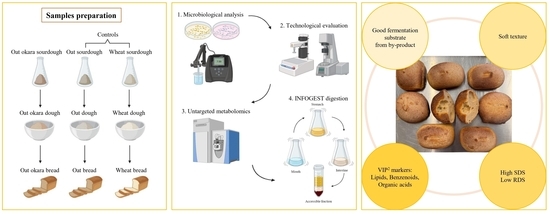
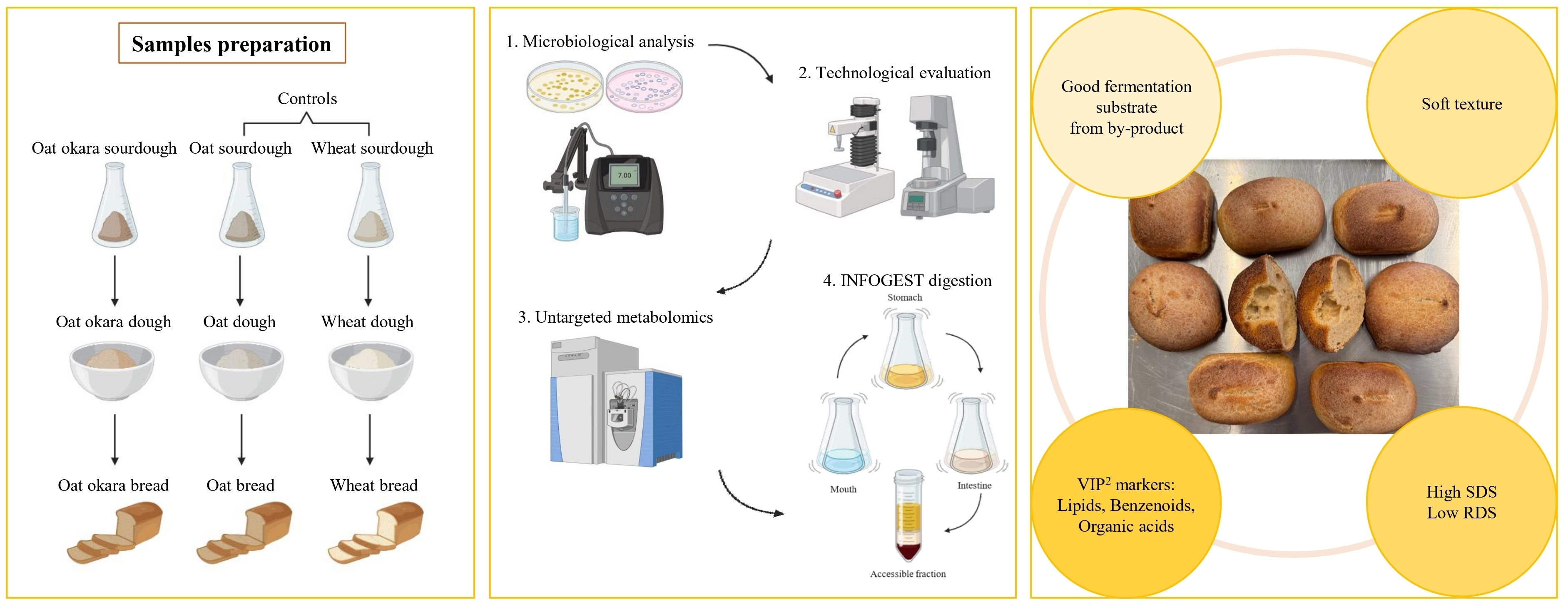
The aim of the present research was to evaluate the potential of a sourdough produced from oat okara flour for application in baked goods, with a focus on its rheological and functional properties. To gain a comprehensive understanding of its behaviour, the oat okara sourdough was compared with both wheat-based and oat-based sourdoughs. The study included a multidisciplinary set of analyses: microbiological profiling to assess the development of the sourdough microbiota, rheological tests to evaluate dough structure and performance, in vitro digestion assay to simulate gastrointestinal conditions, and metabolomic analyses to investigate biochemical transformations during fermentation.
2. Materials and Methods
2.1. Raw Materials
Oat okara flour, supplied by Packtin srl (Reggio Emilia, Italy), was used to produce the oat okara sourdough. According to the manufacturer’s specifications, the nutritional composition of the oat okara flour is as follows: energy 332 kcal, fat 3.93 g (of which saturated 0.71 g), carbohydrates 19.5 g (of which sugars 13.2 g), fibre 22.7 g, and protein 43.3 g. Two additional sourdoughs were prepared using oat flour and common white wheat flour type 00, both purchased from local markets. Buns were then produced by mixing each sourdough with flour, salt, extra virgin olive oil, and white refined sugar, all of which were also purchased from local markets.
2.2. Sourdough Preparation
The oat okara flour (OOF) sample was used to produce the oat okara sourdough (OOS), with only tap water added. The mixture of water and flour was prepared in a 2:1 proportion. The control sourdoughs (oat sourdough, OS; wheat sourdough, WS) were prepared with approximately the same OOS texture characteristics. The proportions used were as follows: oat sourdough with a water-to-flour ratio of 1:1, and wheat sourdough with a water-to-flour ratio of 2:1. Sourdough ingredients were mixed with a TK20 kneading machine (Tekno Stamap, Vicenza, Italy) for 5 min and kept at room temperature (25 ± 2 °C) for 24 h, enabling spontaneous fermentation. Sourdoughs were refreshed daily over a period of 30 days. At each refreshment step, a defined portion of fermented dough was used as an inoculum and mixed with fresh flour and water at the same formulation ratios described above.
2.3. Bread Making
Three different bread doughs were investigated in this study, obtained using oat okara sourdough (OOD), oat sourdough (OD), and wheat sourdough (WD). The doughs were prepared by mixing the ingredients in the proportions reported in
Table 1 using a professional mixer (Tk20 Tekno Stamap, Vicenza, Italy) until a homogeneous dough was obtained. The dough was leavened at 30 °C for 2 h (Polin Proofer, Verona, Italy) and then divided to form buns weighing 80 g each. Samples for subsequent analyses were taken every 30 min from the start of levitation: T0, T30, T60, T90, and T120. Finally, the bread doughs were baked at 190 °C for 27 min in a professional oven (Polin Wind 6040/5, Verona, Italy).
2.4. Microbiological Analyses
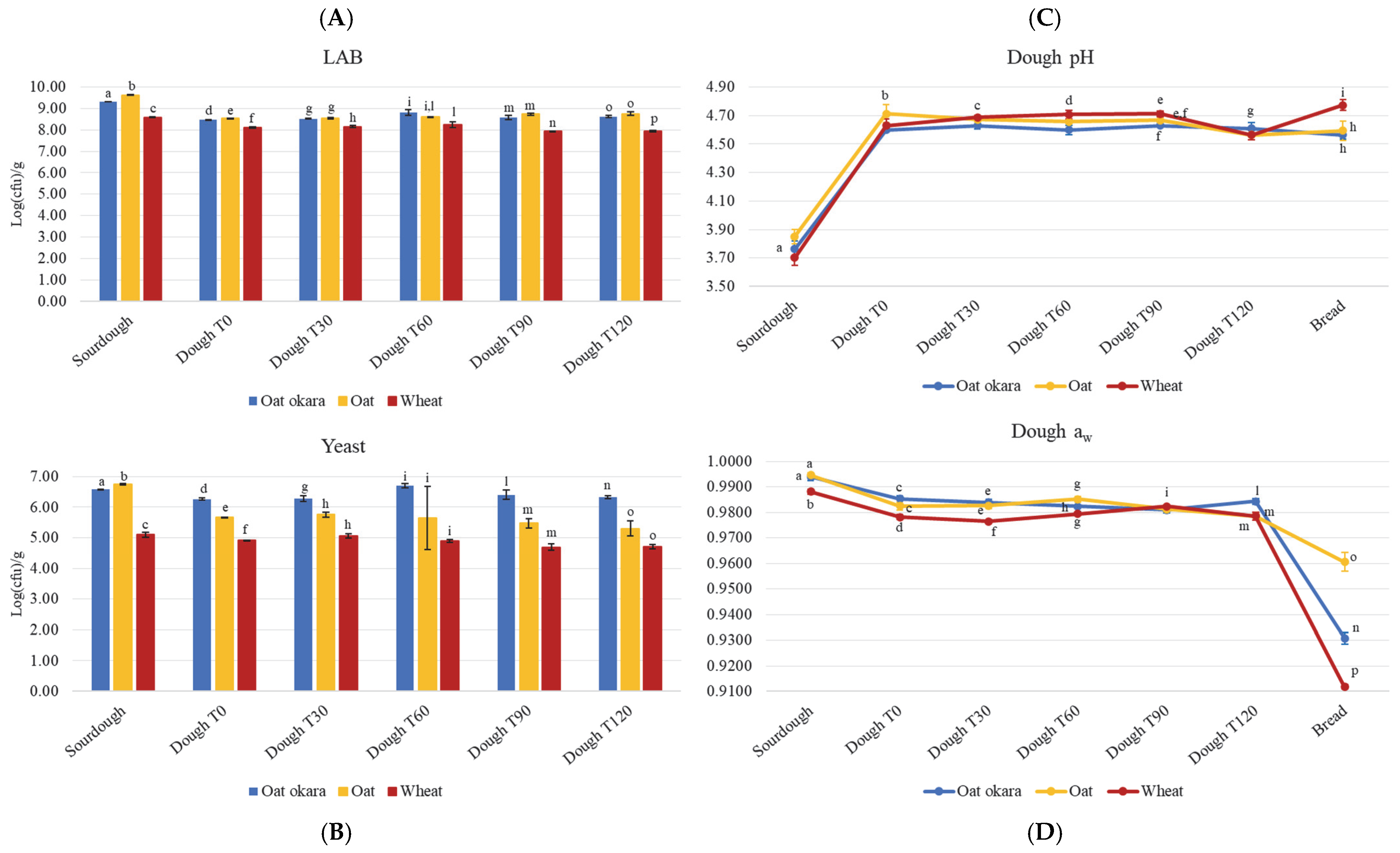
Microbiological analyses were performed on the sourdoughs (OOS, OS, and WS) and the doughs (OOD, OD, and WD) at various fermentation times (T0, T30, T60, T90, and T120). A total of 10 g of each sample was homogenised in 90 mL of physiological water (NaCl, 9 g/L) using a Stomacher machine (400 Circulator, International PBI, Milan, Italy) at 260 rpm for 120 s; this step was repeated twice. The decimal dilutions were executed and then plated on the following agar media: for yeast and mould counts, Rosa Bengala (RB, Oxoid, Italy) with the addition of chloramphenicol 0.01% (w/v) (Boehringer Ingelheim, Germany) was used, and the plates were incubated for 5 days at 25 °C; meanwhile lactic acid bacteria (LABs) were counted on MRS Agar (Oxoid) supplemented with cycloheximide 1% (w/v) (Oxoid), with the plates incubated at 37 °C for 48 h in anaerobic conditions using Anaerocult A (Merck, Darmstadt, Germany). Microbiological analyses were performed on three replicates for each sample.
2.5. Physical-Chemical Analyses Chemical–Physical Analyses
The physical-chemical analyses included measuring the pH and water activity (aw) of all sourdough, dough, and bread samples. pH was measured with a HANNA pH meter HI-2202 Edge®blu (Hanna Instruments, Padova, Italy) by putting the electrode directly in contact with each sample. pH measurements were done on the fresh doughs immediately after their preparation and once every 30 min until reaching 2 h leavening, as well as on the breads after cooling. For each sampling, three separate pH measurements were performed after calibration with commercial standard buffer solutions (pH 4.01, pH 7.00, and pH 9.21) and temperature compensation. Water activity (aw) was measured using the Aqualab 4TE device (Meter Group, Munich, Germany). About 1 g of each sample was placed inside a small plastic holder. The analysis was carried out in triplicate, and each sample was analysed three times on each measurement.
2.6. Technological Evaluation
Samples were monitored in terms of moisture content, colour, texture, and viscoelasticity.
2.6.1. Moisture Content
Moisture content was determined following the AOAC official method 931.04 (AOAC, 2005). In detail, 3 g of fresh dough or bread was weighed in a crucible and maintained at 105 °C for 24 h up to a constant weight value. The moisture content percentage was evaluated by Equation (1):
where M
1 represents the net weight (g) after 24 h in the oven and M
0 is the net initial weight of sample (g).
The dry matter content percentage was calculated through Equation (2):
Each measurement was carried out in triplicate.
2.6.2. Weight Loss
Bread weight loss after baking was measured by weighing breads before and after baking (parameters specified in Paragraph 2.3), using Equation (3):
where W
1 represents the weight of the baked bread (g) and W
0 is the weight of sample before baking (g).
The analysis was conducted using three replicates.
2.6.3. Specific Volume
The specific volume of the obtained bread was calculated with a geometric method. Given the flattened cylindrical shape and the fact that the bread had an oval cross-section, the formula for a cylinder with an elliptical base was used to calculate its volume, as shown in Equation (4).
where L is the length (cm), l is the width (cm), and h is the height (cm) of the obtained breads.
The specific volume was indeed calculated using Equation (5).
2.6.4. Colour Test
Colour evaluation of the fresh doughs was done using the Colorflex EZ colorimeter (HunterLab, Reston, Virginia), while the D25 NC colorimeter (HunterLab, Reston, Virginia) was employed for the measurements on the bread. Colorimeters provided the CIE
L*a*b* colour space trichromatic coordinates:
L* represents the lightness from 0 (black) to 100 (white);
a* measures greenness (negative values, -
a*) or redness (positive values, +
a*); and
b* measures blueness (negative values, -
b*) or yellowness (positive values, +
b*). Chroma (
C*) and hue angle (
h°) were also considered:
C* represents the colour saturation and purity, and it is the distance from the
L* axis (Equation (6)); meanwhile
h° characterises the amplitude of the angle formed by taking the +
a* axis as the x-axis (e.g., 0° is +
a*, or red; 90° is +
b*, or yellow) explaining the more dominant colour tones (Equation (7)). The colour evaluation was carried out taking five measurements for each sample.
∆E value was also calculated through Equation (8) to determine if there was any colour difference between a sample and a reference.
∆E can assume different values. According to Mokrzycki et al. [
26], the difference between two samples is not noticeable when ∆E is between 0 and 1; if 1 < ∆E < 2, the difference is noticeable only to experienced observers; when ∆E is between 2 and 3.5, the difference is also noticeable to inexperienced observers; if ∆E is between 3.5 and 5, there is a clear difference; and if ∆E > 5, the observer can notice two different colours.
2.6.5. Rheological Analysis
Rheological determinations were performed with a controlled stress and strain rheometer (302 MRC, Anton Paar, Gratz, Austria) thermally regulated by a Peltier plate and a circulating water bath (FP 50, Julabo, Milan, Italy). Dynamic state flow tests were done using a rough parallel plate geometry (PP25) with a 25 mm diameter probe and a gap size of 3 mm. Measurements were taken at 25 °C after a resting time of 120 s following Gruppi et al.’s [
27] method. The amplitude sweep test was conducted by applying a constant frequency of 1 Hz and varying the strain amplitude from 0.01 to 100%. Based on the obtained linear viscoelastic region (LVER) results, a strain amplitude of 0.01% was set for the subsequent frequency sweep test, while varying frequency between 0.01 and 100 Hz. Measurements were taken immediately after the dough preparation (T0) and after 2 h leavening (T2), in duplicate. Obtained data were then elaborated by applying the power law model as a function of frequency (Equation (9)) according to Upadhyay et al. [
28] to obtain more information about the flow properties of the doughs.
where G′ is the storage modulus, G′
0 is the intercept of the power law model for frequency sweep, ω is frequency (Hz), and
n represents the slope of G′.
2.6.6. Texture Evaluation
The breads’ textural characteristics were measured with a “holding-until-time” compression test, performed using the TVT 6700 Texture Analyser (Perten Instruments, Hägersten, Sweden). A single compression was applied to the bread without crust using a cylindric probe with a 36 mm diameter (part n°673036), applying 25% compression and a hold time of 60 s. The probe was set 5 mm away from the sample, which was previously prepared by removing the crust and cutting to obtain a bread slice of 25 mm height; measurement was done at 1 mm/s speed applying a trigger force of 5 g. This test was conducted to obtain information such as the firmness (g), denoted as the maximum force applied to compress the bread, and the springiness (%), represented by the sample recovery calculated as the force required for the sample to return to its initial shape after 60 s holding time. Texture analysis was carried out on seven measurements to ensure adequate data reliability.
2.7. In Vitro Starch Digestion
The standardised INFOGEST static in vitro digestion method [
29] was applied, comprising sequential oral (2 min; 37 °C; pH 7.0), gastric (120 min; 37 °C; pH 3.0), and intestinal (120 min; 37 °C; pH 7.0) phases, as previously described and justified by Minekus et al. [
30]. Rabbit gastric lipase (60 U/mL; Lypolytech, France) was included in the gastric phase. The protocol was scaled up to 50 g of sample, and aliquots (n = 3) were collected after each digestion phase and stored at −18 °C for subsequent analysis. In addition, rapidly digestible starch (RDS) and slowly digestible starch (SDS) fractions were assessed using the enzymatic method detailed by Englyst et al. [
31]. RDS was measured by calculating the glucose released after 20 min, while SDS was measured as the glucose released after 100 min incubation. The resistant starch content (RS) was evaluated using a commercial assay kit (K-RSTAR 05/19, Megazyme International, Wicklow, Ireland; based on the AOAC official method 2002.02). Analyses were run in triplicate.
2.8. Extraction Method and Untargeted Metabolomics Analysis
A total of six different sourdough and dough formulations—including oat okara sourdough (OOS), oat flour sourdough (OS), wheat flour sourdough (WS), and doughs fermented for 120 h, comprising oat okara dough (OODT120), oat flour dough (ODT120) and wheat flour dough (WDT120)—were extracted in triplicate, following the procedure previously described by García-Pérez et al. [
32]. Briefly, 1 g of each sample was combined with 10 mL of 80% (
v/
v) aqueous methanol acidified with 0.1% (
v/
v) formic acid. The mixture was then subjected to ultrasound-assisted extraction for 10 min at room temperature with a maximum power of 120 watts. Subsequently, samples were centrifuged at 5500 rpm for 15 min at 4 °C and stored at −18 °C overnight. The resulting supernatant was filtered through 0.22 μm cellulose syringe filters and collected in vials for metabolomics analysis. Afterwards, quality control (QC) samples were prepared by pooling equal aliquots of each sample into the same vial.
The untargeted metabolomics analysis of sourdough and dough samples was carried out through high-resolution mass spectrometry (HRMS) performed on a Q-Exactive™Focus Hybrid Quadrupole-Orbitrap Mass Spectrometer (Thermo Scientific, Waltham, MA, USA) coupled to a Vanquish ultra-high-pressure liquid chromatography (UHPLC) pump and equipped with heated electrospray ionisation (HESI)-II probe (Thermo Scientific, MA, USA). Chromatographic separation was performed using a gradient elution from 6 to 94% acetonitrile over 35 min. The mobile phase consisted of LC-MS-grade water–acetonitrile (Sigma-Aldrich, Milan, Italy), containing 0.1% formic acid as a phase modifier on a BEH C18 analytical column (2.1 × 100 mm, 1.7 μm), maintained at 35 °C. A sample volume of 6 µL was injected with a constant flow rate of 200 µL/min. Mass spectrometric detection was carried out in positive ionisation mode, with full scan acquisition over the m/z mass range 80–1200 and a mass resolution of 70,000 FWHM. Samples were injected in triplicate, following a randomised injection of pooled quality control (QC) in a data-dependent (Top N = 3) MS/MS mode. Afterwards, MS-DIAL software (version 4.80) was employed for automatic peak finding, LOWESS normalisation, and annotation via spectral matching against the comprehensive library FooDB.
2.9. Statistical Analysis
For each measurement, mean values and standard deviations were calculated and then analysed through analysis of variance (one-way ANOVA) followed by Tukey’s post hoc test performed at a p ≤ 0.05 level using the statistical software IBM SPSS® (version Statistics 29.0, SPSS Inc., Chicago, IL, USA). Prior to one-way ANOVA, data were checked for homogeneity of variances using Levene’s test. The statistical evaluation of pH, water activity (aw), and microbiological counts was performed by assessing significant differences at each sampling time.
The statistical multivariate analysis was performed using Mass Profiler Professional software (Agilent ®, Santa Clara, CA, USA) for unsupervised hierarchical cluster (HCA) and principal component analysis (PCA) to compare samples based on treatments and fermentation metabolic profile (Euclidean distances and Ward’s algorithm). The raw data were normalised at the 75 h percentile, log2-transformed, and baselined against the median values.
Additionally, the effects of treatment, fermentation, and their interaction were analysed using supervised multi-block orthogonal partial least squares (AMOPLS), implemented through the “rAMOPLS” package (version 0.2) on R studio (version 4.2.3) software. The model was built based on 100 permutations. The results were expressed according to the following parameters: the relative sum of squares (RSS), representing the percentage of variability of each effect; residual structure ratio (RSR), indicating the ANOVA consistency of each effect with respect to residuals; p-value, which provides the statistical significance of each factor; and the principal predictive components, which represent the significant block contributions, in percentages, associated with each effect, and the contribution of the orthogonal predictive component. Furthermore, the variable importance in the projection (VIP) scores was employed to select the metabolites with the highest discriminant potential, selecting the top 30 VIP2 markers. Finally, the application of these comprehensive statistical approaches enabled the identification of key metabolites, discriminating between fermentation and treatment conditions.
4. Conclusions
This study demonstrated the potential of oat okara sourdough as a functional and sustainable ingredient in bread making. Compared to sourdoughs prepared with oat and wheat flours, oat okara sourdough exhibited high lactobacilli content and yeast count in all samples, indicating an excellent fermentation substrate. Similar results were obtained for oat sourdough, suggesting that the fermentable fibres present in oat-based flours, such as β-glucans, may serve as an effective carbon source supporting microbial growth in oat okara sourdough. Technological evaluations of texture and colour, supported by metabolomic profiling, showed that breads made with oat okara and oat flour performed better than wheat flour controls in terms of dough softness and the presence of positive metabolites. Metabolomic profiling further revealed differences among treatments. The VIP2 analysis identified lipids as the main discriminant metabolites, followed by benzenoids and organic acids and their derivatives. Within the lipid fraction, steroidal glycosides (saponins) and fatty acyls were strongly influenced by fermentation, suggesting enhanced formation of bioactive compounds and modifications in the fatty acid profile. These changes indicate that the inclusion of oat okara in sourdough formulations can modulate the metabolic composition of the dough, improving its functional and nutritional potential. In vitro digestion analysis further revealed that bread made with oat okara sourdough exhibited a higher SDS content, which could be associated with an improved post-prandial glycaemic response and potential health benefits, although further research is needed in this area. Selecting specific microorganisms and optimising the fermentation time of the dough could possibly further enhance the quality of bread produced with okara sourdough. Overall, these findings support the use of oat okara in sourdough formulations as a promising strategy to improve the nutritional and functional quality of bread. This approach not only enhances the health potential of bakery products but also contributes to sustainable food production by upcycling oat by-products into high-value products, aligning with circular economy principles.




 ,
,