Article

The In Vitro Evaluation of Cecal and Colonic Fermentation Kinetics of Locally Sourced Feedstuffs from Shandong Province in China for Donkeys


College of Agriculture and Biology, Liaocheng University, Liaocheng 252000, China
*
Authors to whom correspondence should be addressed.
Fermentation 2026, 12(6), 271; https://doi.org/10.3390/fermentation12060271
Submission received: 23 April 2026 / Revised: 19 May 2026 / Accepted: 29 May 2026 / Published: 2 June 2026
(This article belongs to the Section Animal and Feed Fermentation)

Abstract

Locally sourced roughages constitute the dietary foundation of donkey production in northern China, yet their fermentation behavior in the donkey hindgut remains poorly characterized. The present study employed in vitro batch cultures to compare the dry matter disappearance (IVDMD), gas production (GP) kinetics and short-chain volatile fatty acid (VFA) profiles of five locally available feedstuffs—peanut vine (PNV), soybean straw (SBS), wheat shell (WS), reed grass (RG) and bamboo leaf (BL)—when incubated separately with cecal or colonic microbial inocula obtained from Dezhou donkeys. After 40 h incubation, both IVDMD and total VFA concentrations ranked identically across the two hindgut segments: PNV > SBS > WS > RG > BL (p < 0.05), and all indices were consistently higher in the cecal than in the colonic fermentation system (p < 0.05). The asymptotic gas production (A) and the time required to reach half of A (T1/2) followed the same ranking as IVDMD (p < 0.01), indicating that feedstuffs with greater fermentable substrate availability sustained fermentation for longer periods. In contrast, the fractional gas production rate (c) and the average gas production rate (AGPR) in RG and BL exceeded those of PNV, SBS, and WS under cecal incubation (p < 0.05), reflecting rapid utilization of a small pool of readily fermentable components in these fibrous substrates. Regarding VFA stoichiometry, BL yielded the highest molar proportion of acetate and PNV the lowest in the colonic system (p < 0.05), whereas the propionate proportion followed the order PNV > SBS > WS > RG > BL (p < 0.01). Consequently, the acetate-to-propionate (A:P) ratio and the non-glucogenic-to-glucogenic (NGR) ratio were highest in BL (p < 0.05). The molar proportions of butyrate and branched-chain VFAs (BCVFAs) in WS, RG, and BL were greater than those in PNV (p < 0.05). Collectively, the five feedstuffs differed markedly in their fermentability, kinetic behavior, and VFA yield profiles, reflecting distinct energy-supply potentials for the donkey host. PNV and SBS exhibited superior overall in vitro fermentation performance and are therefore recommended as preferred roughage sources, whereas BL and RG may serve complementary roles by supporting hindgut epithelial health through elevated butyrate production. These findings provide a mechanistic basis for the rational selection and combination of locally sourced roughages to optimize feeding strategies and improve feed-use efficiency in donkey production.

1. Introduction

Donkeys (Equus asinus) have evolved a highly developed cecum and colon that together function as the principal site of microbial fiber fermentation, enabling efficient digestion and utilization of fibrous feeds [1]. These hindgut compartments harbor a diverse and complex microbial community, comprising abundant anaerobic bacteria, fungi, archaea, protozoa, and phage. Collectively, these microorganisms exert a pivotal role in dietary fiber degradation, microbial protein synthesis, and host energy supply via anaerobic fermentation processes. Short-chain volatile fatty acids (VFAs) are the principal end-products produced by these fermentations [2].
In practical donkey production, roughages serve as the dietary foundation, with locally sourced roughages such as peanut vine (Arachis hypogaea L.), soybean straw (Glycine max (L.) Merr), corn straw (Zea mays L.), and wheat straw (WS, Triticum aestivum L.) being widely utilized due to their abundant availability, low cost, and easy accessibility [1,3]. These locally sourced roughages are important feed resources that can reduce donkey feeding costs and promote the sustainable development of the local donkey industry [4]. However, different locally sourced roughages vary enormously in nutritional composition and structural characteristics, which directly affects their degradation efficiency by donkey hindgut microorganisms and further influences the nutritional supply and production performance of donkeys [5,6]. For instance, peanut vine is characterized by high crude protein and calcium content, while soybean straw has moderate crude protein and high fiber content [7,8]; these differences may lead to distinct degradation patterns by donkey cecal and colonic microorganisms. Currently, research on donkey nutrition has mainly focused on the evaluation of feed nutritional value and feeding effects [9,10], while studies on the degradation patterns of different locally sourced roughages by donkey cecal and colonic microbiota are relatively limited. Although some studies have explored the composition and function of donkey hindgut microbiota [11,12,13], the specific degradation characteristics of different locally sourced roughages by cecal and colonic microorganisms, as well as the differences in degradation efficiency and fermentation products between the cecum and colon, remain unclear.
As a reliable technical approach, the in vitro batch fermentation method can effectively simulate the fermentation process of feed in the animal digestive tract [14,15], thereby facilitating rapid exploration of feed degradation characteristics by gastrointestinal tract microbiota. In addition, the gas production during the fermentation process is also an important indicator reflecting the feed degradation rate and microbial fermentation activity, which can provide accurate data support for the evaluation of feed degradation patterns [14]. However, to the best of our knowledge, no literature has been reported regarding the cecal and colonic gas production parameters of donkeys as far as we know.
Accordingly, using the in vitro batch fermentation technique, the objective of the present study was to evaluate the gas production kinetics, dry matter disappearance, and VFA profiles of five locally sourced roughages (peanut vine, soybean straw, wheat shell, reed grass, and bamboo leaf) when separately inoculated with cecal or colonic microorganisms of Dezhou donkeys. It was hypothesized that the fermentation behavior of these feedstuffs would differ substantially between hindgut segments owing to well-documented differences in microbial composition and functional capacity, and that these differences would be reflected in segment-specific patterns of VFA production and kinetic parameters. The findings will provide a theoretical basis for the rational utilization of locally sourced roughage resources, optimization of donkey feeding formulas, and improvement of feed utilization efficiency in donkey production. However, it should be noted that the present study has a potential limitation in feed processing: the experimental feeds were not subjected to simulated foregut digestion, which may lead to differences between the feed form reaching the hindgut in the experiment and the natural physiological state of donkeys.

2. Materials and Methods

2.1. Feedstuffs

Five locally sourced feedstuffs—peanut vine (PNV), soybean straw (SBS), wheat shell (WS), reed grass (RG), and bamboo leaf (BL)—that are routinely used in large-scale donkey farms were collected and served as substrates in the present study. Each feed sample was dried at 65 °C to constant weight in a forced-air oven and ground in a hammer mill (Wiley, ZKNM-326, Zhongke Machinery Co., Ltd., Chengdu, China) to pass through a 0.42-mm mesh sieve. Feedstuffs were analyzed according to the standard methods of AOAC (1999) [16] for dry matter (DM; #930.05), ash/organic matter (OM, #942.05), crude protein (CP; #984.13), ether extract (EE; #920.39), calcium (Ca, #985.35), and phosphorus (P, #958.03). Neutral detergent fibre (NDF) and acid detergent fibre (ADF) were determined following the procedure of Van Soest et al. (1991) [17] using a Ringbio R-2000i fibre analyzer (UK Ringbio Instrument Group Co., Ltd., London, UK). The chemical composition of the feed substrates is shown in Table 1.

2.2. Experimental Design

A completely randomized block design was applied to the in vitro batch cultures, with two hindgut segments (cecum vs. colon) and five feedstuffs (PNV, SBS, WS, RG, and BL) as the main factors. Within each feedstuff, nine fermentation replicates were arranged per run for both the cecum and the colon. Three of these replicates were assigned to an automated gas production recording system (ANKOM RFS, ANKOM Technology, Macedon, NY, USA) for continuous monitoring of gas production (GP) throughout the incubation. Triplicate blank fermentations without added substrate were included in each run to correct for run-to-run variation in the inoculum.

2.3. Collection of Cecal and Colonic Fluids and Preparation of the Incubation Medium

Three Dezhou donkeys (2.5 years of age; body weight 295 ± 18 kg), housed in group pens at a stocking density of 15 animals per pen, served as donor animals for the collection of cecal and colonic fluids. Donkeys were fed twice daily at 08:00 and 18:00 and had free access to fresh water. The diet consisted of wheat shell offered ad libitum together with a commercial concentrate. All donors were clinically healthy and were slaughtered in a local abattoir by electronarcosis (220 V, 20 s) for non-research purposes, specifically for animal and human consumption; animals were fasted for 12 h prior to slaughter. Samples were collected from the caecum and dorsal colon segments in the donkey hindgut for content extraction. Cecal and colonic fluids were immediately filtered through four layers of cheesecloth and pooled in equal proportions by segment. The pooled fluids (1.5 L each) were then maintained under a nitrogen (N2) atmosphere in a 39 °C water bath and transferred to the laboratory for in vitro batch culture without delay.
The buffer solution was prepared as described by Menke and Steingass (1988) [18]. The pH was adjusted to 6.8 by bubbling with CO2 to saturation prior to the fermentation experiment.

2.4. In Vitro Batch Culture and Sampling Procedure

Batch cultures were conducted in 120-mL glass bottles sealed with rubber stoppers and Hungate screw caps. In accordance with the experimental design, 93 bottles were used per incubation run. Each bottle was charged anaerobically with 0.5 g of the respective feedstuff, 25 mL of strained cecal or colonic fluid (filtered through four layers of cheesecloth), and 50 mL of pre-warmed buffer solution (pH 6.8) and incubated at 39 °C. Incubations were carried out in both manual and automated systems maintained at 39 °C. Manual incubations were conducted in a thermostat (DHP-9052B, Shanghai Yiheng Electromechanical Technology Co., Ltd., Shanghai, China) for 40 h. For the automated system, cumulative gas production (GP) was recorded continuously via an automated gas recording system over the same 40-h period.
After 40 h of incubation, cumulative gas production profiles were exported to a desktop computer. The pH of culture fluid from each bottle was measured immediately. A 1.0-mL aliquot of culture fluid was mixed with 0.3 mL of 25 mg/mL metaphosphoric acid and held for 30 min at 4 °C, then centrifuged at 10,000× g for 15 min at 4 °C; the supernatant was retained for VFA analysis. After sampling, the remaining fermentation residue in each bottle was filtered through a nylon bag (150 × 2.1 cm2, 42 μm pore size) [2] and dried at 65 °C for 48 h to determine IVDMD.

2.5. Chemical Analysis

VFA concentrations were quantified by gas chromatography using 2-ethylbutyric acid (Sigma-Aldrich, Saint Louis, MO, USA) as the internal standard. IVDMD was determined according to the method of Zhang et al. (2022) [2]. Briefly, all culture contents were transferred to pre-weighed nylon bags and rinsed for 45 min in a washing machine. The supernatant was discarded, and residues were dried at 65 °C to constant weight for residual DM determination. IVDMD was calculated as the difference between the initial incubated DM and the residual DM, corrected against the blank bottles.

2.6. Curve Fitting and Calculation

Cumulative gas production data were fitted to the monophasic model of France et al. (2000) [19] (Equation (1)):
GPt (mL/g DM) = A/[1 − e–cÍ(t−L)];
where GPt is the cumulative gas production (mL/g DM) at incubation time t (h), A is the asymptotic gas production (mL/g DM), c is the fractional gas production rate (/h), and L is the lag time phase before GP commenced.
The average gas production rate (AGPR, mL/h) between the start of incubation and T1/2 was calculated following García-Martínez et al. (2005) [20] (Equation (2)):
AGPR   =   A ×   c 2 × ( L n 2 + c × L ) ;
The time when half of A occurred (T1/2) was calculated as (Equation (3)):
T 1 / 2   =   log   ( 1 c )   +   L ;
The ratio of non-glucogenic to glucogenic acids (NGR), as described by Ørskov (1975) [21], was calculated as (Equation (4)):
NGR     a c e t a t e   +   2   ×   b u t y r a t e   +   v a l e r a t e p r o p i o n a t e   +   v a l e r a t e ;
where individual VFAs in the equation were expressed in molar proportions (mmol/mol) of total volatile fatty acid production.
The predicted methane (CH4) production was calculated by the molar proportion of VFAs following Moss et al. (2000) [22] (Equation (5)):
CH4e = (0.45 × acetate) − (0.275 × propionate) + (0.40 × butyrate);

2.7. Statistical Analyses

Data were analyzed with the general linear model (GLM) procedure of SAS 9.4 (1999) using the following model:
Yijk = μ + Ri + Fj + Gk + εijk;
where Yijk is the dependent variable under examination, μ is the overall mean, Ri is the experimental run effect (i = 3), Fj is the fixed treatment effect of feedstuff (j = 5), Gk is the donkey hindgut segment effect (k = 2), and εijk is the error term.
Multiple comparisons were performed with the Tukey–Kramer test. Orthogonal contrasts were used to test the hindgut segment effect (cecum vs. colon), and orthogonal polynomial contrasts tested linear and quadratic effects across feedstuffs. Least-squares means and standard errors (SEM) were generated using the LSMEANS option of the GLM procedure. Significance was declared at p < 0.05.

3. Results

3.1. In Vitro Dry Matter Disappearance

As shown in Figure 1, in the cecum, the IVDMD of PNV and SBS were higher than WS, and the IVDMD of WS was higher than RG and BL (p < 0.05). In the colon, the IVDMD of the five feedstuffs followed the ranking: PNV > SBS > WS > RG > BL (p < 0.05). Furthermore, IVDMD values obtained with cecal inoculum were consistently higher than those obtained with colonic inoculum for all feedstuffs (p < 0.05).

3.2. Gas Production Kinetics

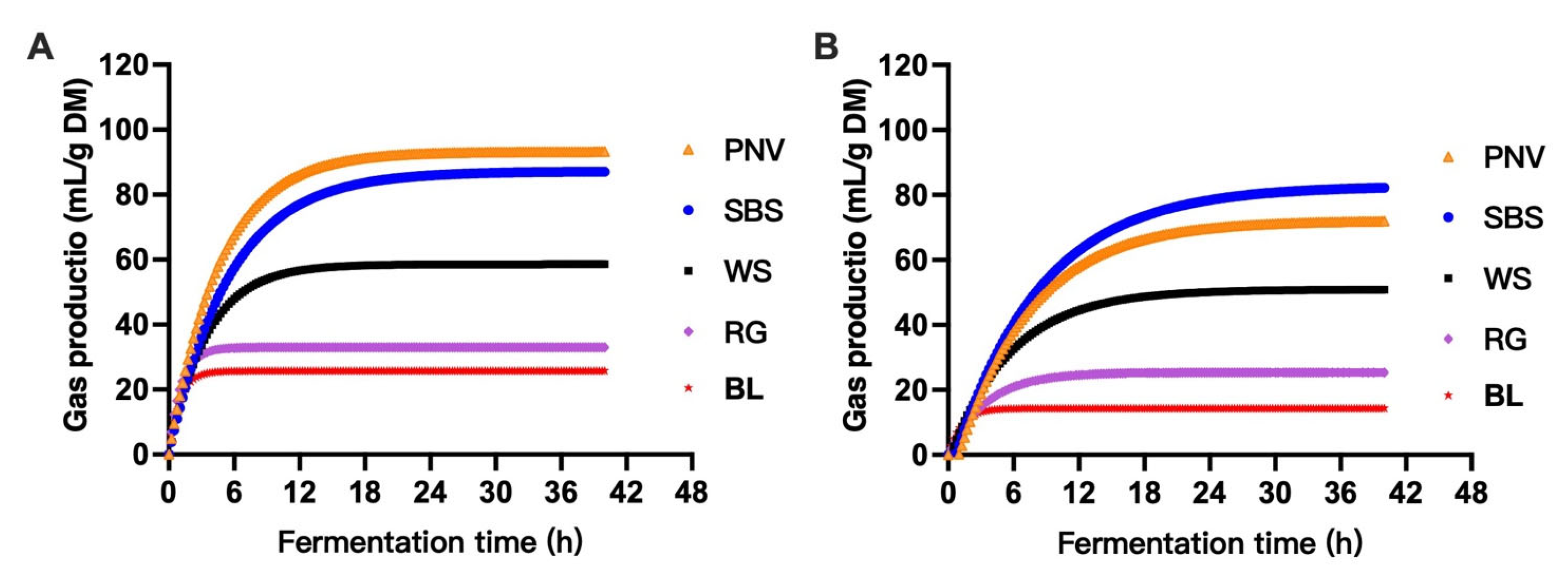
As shown in Table 2 and Figure 2, GP40 varied significantly across the five feedstuffs (p < 0.05). In the cecum, the highest GP40 occurred in PNV and SBS, followed by WS and RG, and the lowest occurred in BL (p < 0.05). In the colon, GP40 followed the ranking: SBS > PNV > WS > RG > BL (p < 0.05); again, all feedstuffs yielded greater GP40 with cecal than with colonic inoculum (p < 0.01).
With regard to GP kinetics, the asymptotic gas production (A) and T1/2 showed the same trend as GP40 (p < 0.01). Conversely, the fractional gas production rate (c) and the AGPR for RG and BL exceeded those of PNV, SBS and WS in the cecal system (p < 0.05); specifically, c of RG and BL in the cecum were higher than PNV, SBS and WS (p < 0.05), and it ranked as BL > RG > WS > SBS > PNV in the colon (p < 0.05). The highest AGPR was observed for BL and the lowest for RG (p = 0.05), while no difference was detected between PNV and SBS.

3.3. Fermentation Characteristics

For total VFA, PNV in the cecum had the highest total VFA concentration, which was similar to SBS but significantly higher than WS, RG, and BL (Table 3, p < 0.05). In addition, RG and BL did not differ significantly (p > 0.05). In the colon, PNV and SBS had comparable and significantly higher VFA concentrations than WS, RG, and BL (p < 0.05), with RG and BL showing the lowest values (p < 0.05). Regarding the VFA stoichiometry, no differences in the molar proportion of acetate were observed among feedstuffs in the cecal system (p > 0.05). In the colon, the highest acetate proportion was observed for BL and the lowest for PNV (p < 0.01), while SBS, WS, and RG did not differ significantly from each other (p > 0.05). For propionate, RG yielded the highest molar proportion in the cecal system, which was significantly greater than that of BL, whereas no differences were detected among PNV, SBS, and WS (p > 0.01). In the colon, the propionate proportion ranked PNV > SBS > WS > RG > BL (p < 0.01). Consequently, the acetate-to-propionate ratio (A:P) and NGR of BL were higher than those of the other feedstuffs in the cecal system; in the colon, both ratios ranked BL > WS > RG > SBS > PNV (p < 0.05). The molar proportions of butyrate in WS, RG, and BL exceeded those of PNV in both the cecum and colon (p < 0.05). For BCVFAs, no significant differences were observed among feedstuffs in the cecal system, whereas BL displayed a higher BCVFA proportion than the other feedstuffs in the colon (p < 0.05). Finally, predicted CH4 production (CH4e) of PNV and SBS were significantly higher than WS, RG, and BL, and there was no difference between RG and BL for the CH4e in both the cecum and colon (p < 0.05).

4. Discussion

The donkey hindgut functions as a highly evolved microbial bioreactor in which cecal and colonic consortia convert structural carbohydrates into absorbable energy substrates. While this physiological role is well recognized [1,2], comparative data describing how locally sourced roughages are processed along this fermentation continuum remain scarce. The present investigation addresses this gap by concurrently profiling dry matter disappearance, gas production kinetics, and volatile fatty acid (VFA) stoichiometry of five commonly used roughages in cecal and colonic batch cultures derived from Dezhou donkeys. Three features of the dataset warrant integrated mechanistic discussion: the convergent substrate ranking observed across both hindgut segments, the cecum-biased fermentation intensity, and the substrate-specific divergence in kinetic and stoichiometric behaviour that together define distinct nutritional niches for each feedstuff.

4.1. IVDMD of Locally Sourced Feedstuffs in the Cecum and Colon of Donkeys

The IVDMD is a key indicator reflecting the degradation degree of feed by gastrointestinal microorganisms, which directly reflects the nutritional availability of feed for donkeys and provides an important basis for evaluating the feeding value of feedstuffs [23]. The preservation of the IVDMD ranking across both cecal and colonic inocula indicates that the intrinsic biochemical architecture of each substrate—rather than segment-specific microbial specialization—constitutes the dominant driver of fermentability. Such functional convergence across anatomically distinct hindgut compartments has been reported previously [2,24] and reflects a degree of ecological redundancy in which compositionally different microbial consortia nonetheless arrive at comparable metabolic outputs when presented with identical substrates. The underlying biochemical explanation is straightforward: PNV and SBS possess relatively high crude protein together with accessible soluble carbohydrates and loosely structured cell-wall components that favor rapid microbial attachment, biofilm formation and extracellular enzyme deployment [25,26], whereas BL is encased within a densely lignified matrix in which lignin cross-links hemicellulose through ether and ester linkages, generating a recalcitrant shield that physically occludes fibrolytic enzymes from the cellulose microfibrils they would otherwise hydrolyze [27,28]. Analogous lignin-driven constraints on DM digestibility have been documented even in the more fibrolytically aggressive rumen environment [29], underscoring that lignification—not total fiber content per se—governs the ceiling of microbial accessibility. This mechanistic insight carries immediate practical implications, since strategies that disrupt the lignin–hemicellulose network, such as alkaline, steam-explosion, or biological pre-treatment, should selectively unlock the fermentable potential of BL and RG and warrant systematic evaluation in donkey nutrition. It should, however, be acknowledged that the proximate analysis presented in Table 1 was confined to DM, OM, CP, EE, NDF, ADF, Ca, and P, and did not include direct measurement of acid detergent lignin (ADL) or of soluble (non-structural) carbohydrate fractions. The above inferences regarding the soluble-carbohydrate pool of PNV and SBS and the lignified architecture of BL are therefore drawn from published compositional data reported for these forages [25,26,27,28] rather than from our own analyses; for example, bamboo leaf has been reported to contain 11–20% ADL on a DM basis [27], a level that is consistent with the observed recalcitrance even though the ADF of BL in the present study (37.1% DM) was numerically the lowest among the five substrates, reflecting the fact that ADF integrates cellulose and lignin and does not resolve their relative proportions. The absence of ADL and soluble-carbohydrate values in Table 1 is consequently a limitation of the present study, and direct quantification of these fractions is recommended in future work to permit a fully data-driven mechanistic interpretation.
Superimposed on this shared substrate ranking, IVDMD, cumulative gas production, and total VFA yield were systematically elevated in cecal relative to colonic cultures. This segmental gradient concurs with anatomical and microbiological evidence that the donkey cecum harbors denser populations of fibrolytic taxa (notably Fibrobacter spp.) and anaerobic fungi, operates at a pH closer to the cellulolytic optimum, and preferentially retains particulate digesta—conditions that collectively favor primary fiber degradation [2,24,30]. The colon, in turn, appears to function principally as a secondary fermenter that processes the residual substrate fraction escaping cecal hydrolysis and that sustains cross-feeding of fermentation intermediates [30]. This functional compartmentalization has rarely been characterized quantitatively in donkeys, and the present data therefore provide direct in vitro confirmation of cecal dominance in hindgut fiber fermentation for this species. Placing these findings in a comparative context is informative because, while quantitative cecum-versus-colon contrasts remain scarce in donkeys, broadly analogous patterns have been documented in other hindgut fermenters. In the horse, the phylogenetically closest large herbivore to the donkey, fiber digestion is similarly concentrated in the cecum and right ventral colon, with the cecum supporting higher fibrolytic activity and microbial density than more distal compartments [30,31]; the cecum-biased fermentation reported here therefore mirrors what has been described in equids generally. In the rabbit, a small monogastric hindgut fermenter, dietary fiber source likewise modulates cecal microbial composition and VFA output in a manner that parallels the substrate-driven differences we observed [8], indicating that the substrate-rank effect on IVDMD is conserved across hindgut anatomies of very different scale. Direct comparisons with ruminants must be made cautiously because foregut fermentation operates under continuous substrate flow and tightly regulated pH, but the convergent ranking of forages by NDF and lignification—with legume hays such as peanut vine consistently outperforming grass straws and bamboo leaf in extent of fermentation—has also been reported in cattle and sheep [23,29]. The cecum-to-colon gradient observed in the present study is thus consistent with the broader literature on hindgut fermenters, while the magnitude of this gradient and its substrate-specific modulation in donkeys remain insufficiently characterized in vivo, identifying a clear gap for future work.

4.2. Gas Production Kinetics of Locally Sourced Feedstuffs in the Cecum and Colon of Donkeys

Beyond the extent of fermentation, the kinetic descriptors reveal that not all roughages conform to a single fermentation trajectory. Cumulative gas production integrates both the magnitude and the temporal dynamics of microbial carbohydrate metabolism [32], and the partial decoupling of asymptotic gas production from fractional rate observed in the present study points to two contrasting fermentation strategies. PNV and SBS supported a high terminal gas yield but comparatively modest rate constants and extended T1/2 values, consistent with substrates dominated by slowly but extensively fermentable structural polysaccharides that require progressive enzymatic dismantling [25]. BL and, to a lesser extent, RG displayed the inverse signature—elevated fractional rate and AGPR coupled with low cumulative output—which is best interpreted as the rapid fermentation of a small, readily accessible pool of non-structural carbohydrates, pectin-like polymers, and soluble phenolics [31], followed by premature plateauing once the lignin-encrusted fiber fraction becomes rate-limiting. This dual kinetic behavior is diagnostic of substrates whose total fermentable capacity is constrained by cell-wall encrustation rather than by microbial accessibility to the soluble fraction. Nutritionally, the two strategies carry complementary implications: slow-fermenting, high-yielding roughages deliver a stable postprandial VFA flux along the proximal-to-distal axis of the hindgut, whereas rapidly fermenting, low-yielding substrates generate an early-phase VFA pulse that may synchronize microbial protein synthesis with soluble nitrogen release. This reasoning provides a rational basis for formulating mixed rations that exploit temporal complementarity between fast- and slow-fermenting components to smooth the kinetics of energy delivery to the donkey. The two-strategy kinetic pattern observed here is not unique to donkeys but echoes results obtained in other species, although direct comparative data for the donkey hindgut remain limited. In vitro fermentation of structurally similar forages with equine fecal inocula has likewise yielded high asymptotic gas production and prolonged T1/2 for legume-rich substrates and low cumulative yield with elevated fractional rate for highly lignified materials [5], suggesting that the kinetic phenotypes we report are a general property of equid hindgut microbiomes rather than donkey-specific. In ruminants, where gas-production modelling has been most extensively applied, the same monophasic model of France et al. [19] has consistently distinguished slowly but extensively fermentable forages (alfalfa, peanut vine, legume hays) from rapidly but incompletely fermentable bamboo and tropical fibrous materials [27,32], reinforcing the substrate-driven nature of these kinetic signatures. Where donkey-specific evidence is lacking is in the in vivo translation of these in vitro kinetic phenotypes into segmental VFA absorption profiles and postprandial energy supply curves, parameters that have been characterized in cattle and sheep but not, to our knowledge, quantitatively measured in donkeys. The present kinetic data, therefore, provide a useful first reference frame for the donkey but must be validated in vivo before they can be applied with confidence to feeding strategy design.

4.3. VFA Production of Locally Sourced Feedstuffs in the Cecum and Colon of Donkeys

The stoichiometry of individual VFAs extends these functional distinctions into the domain of host metabolism. Because hindgut VFAs supply 60–70% of the maintenance energy of donkeys [1,33], shifts in VFA concentration and molar composition translate directly into altered energy economy, and the concomitant depression of luminal pH that accompanies elevated VFA output exerts a selective pressure that suppresses acid-sensitive pathobionts while favoring acid-tolerant commensals [34], reinforcing the nutritional and health advantages of fermentable roughages such as PNV and SBS. The comparatively higher propionate proportion generated by PNV and SBS is particularly relevant in this context, because propionate is the principal glucogenic VFA and the dominant precursor for hepatic gluconeogenesis [35]; in non-ruminant herbivores, colonically absorbed propionate contributes to plasma glucose homeostasis during inter-meal intervals and supports the elevated glucose flux associated with growth, lactation, and physical work. Propionate enrichment in PNV and SBS fermentations is mechanistically consistent with the greater abundance of readily fermentable non-structural carbohydrates and pectin-type polysaccharides in these feedstuffs, which preferentially fuel the succinate and acrylate pathways operated by Bacteroidetes and selenomonad-like taxa.
The contrasting VFA signature generated by BL—simultaneously enriched in acetate, butyrate, and BCVFAs—reflects a mechanistically distinct fermentation ecology. Acetate dominance is the canonical output of cellulolytic consortia that evolve acetate and hydrogen as primary end-products when confronted with structural polysaccharides depleted of rapidly fermentable sugars. The concurrent enrichment of butyrate is of particular physiological significance because butyrate is the preferred energy source of colonocytes and a well-characterized regulator of epithelial proliferation, tight-junction integrity, mucus secretion, and anti-inflammatory signalling [36]. This stoichiometric signature suggests that BL, despite its modest bulk energy contribution, may exert a disproportionate influence on mucosal trophicity when incorporated as a minor ration component—a functional role that would be overlooked if feedstuff evaluation relied exclusively on IVDMD or total VFA yield. The elevated BCVFA pool detected in BL colonic cultures further supports this interpretation. BCVFAs arise from microbial deamination and decarboxylation of the branched-chain amino acids valine, leucine, and isoleucine, respectively [37], and their accumulation indicates active proteolytic metabolism of nitrogenous substrates, a pattern consistent with the comparatively high crude protein content of BL documented in Table 1. Because BCVFAs also serve as essential growth factors for several fibrolytic bacteria, their release from BL may feed forward to sustain cellulolysis of co-incubated substrates within mixed rations. BL thus emerges not merely as a low-grade energy source but as a nitrogen donor and ecological modulator within the hindgut consortium. Placed in a broader cross-species context, the acetate-dominant, low-propionate profile we observed for BL closely resembles the stoichiometry reported for highly lignified or low-quality forages fermented with equine fecal inocula [5,31] and with rumen fluid from cattle and sheep [29,32], indicating that the basic VFA response to substrate quality is conserved between hindgut fermenters and ruminants. The propionate enrichment associated with PNV and SBS likewise parallels observations in the equine cecum and the bovine rumen when legume hays or pectin-rich forages are offered, where readily fermentable non-structural carbohydrates drive the succinate–propionate pathway [35]. By contrast, the butyrogenic and BCVFA-enriched signature of BL has been most clearly documented in monogastric and hindgut fermenter colons (rabbits, pigs, and horses), where butyrate-mediated colonocyte trophicity and BCVFA-driven cross-feeding are well established [8,36]; whether the same epithelial and microbial benefits operate in the donkey colon at the magnitudes implied by our in vitro data has not been demonstrated experimentally and represents a substantive evidence gap. Similarly, the predicted methane gradient (PNV ≈ SBS > WS > RG ≈ BL) is consistent with the well-described stoichiometric link between acetate/butyrate generation and methanogenesis in ruminants [22,38], but published in vivo measurements of enteric CH4 emissions from donkeys offered different roughages remain sparse, leaving the quantitative environmental footprint of donkey production poorly resolved. Future work integrating in vivo VFA absorption measurements, headspace CH4 quantification, and 16S rRNA/metagenomic profiling in donkeys will be required to determine the extent to which the patterns reported here for hindgut fermenters and ruminants in general apply to the donkey specifically.
The acetate-to-propionate (A:P) and non-glucogenic-to-glucogenic (NGR) ratios consolidate these stoichiometric differences into integrated indices of fermentation type. Elevated A:P and NGR values, characteristic of BL and of colonic cultures more generally, denote a fermentation regime biased toward non-glucogenic end-products—that is, one with reduced capacity to generate glucose precursors but enhanced potential for direct oxidative energy provision and for colonocyte support via butyrate [39]. Conversely, the lower NGR values recorded for PNV and SBS signal a more glucogenic fermentation, better aligned with the metabolic demands of productive animals. A parallel gradient emerged for estimated methane output, which followed the total VFA ranking—a stoichiometric consequence of acetate- and butyrate-biased fermentation, both of which generate metabolic hydrogen that is ultimately disposed of through methanogenesis. Although donkey hindgut methane emissions are modest compared with those of ruminants, enteric CH4 nonetheless represents a gross energy loss of approximately 2–12% in hindgut fermenters and contributes to the greenhouse-gas footprint of livestock production [38]. The higher predicted CH4 associated with PNV and SBS therefore constitutes a genuine, if ecologically modest, counterweight to their nutritional superiority and identifies an avenue for targeted mitigation—for example, through tannin supplementation or selective methanogen inhibitors that are compatible with high-quality roughage feeding.
Taken as a whole, the dataset delineates a continuum of fermentation phenotypes among locally sourced roughages that maps coherently onto distinct nutritional functions. PNV and SBS define the high-yield, glucogenic extreme of this continuum and are best suited to serve as primary roughages that sustain systemic energy supply; BL—and to a lesser degree RG—occupy the opposite, acetogenic and butyrogenic extreme, where modest bulk energy is offset by potential benefits to hindgut epithelial health and microbial cross-feeding; WS occupies an intermediate position on most indices. This functional partitioning implies that no single roughage is nutritionally optimal in isolation and that deliberate combinations can exploit complementary kinetics and VFA profiles to simultaneously meet the energy, glucose-precursor, and epithelial-trophic requirements of the donkey. The robust cecum-to-colon fermentation gradient further suggests that management practices affecting digesta retention time and luminal environment—particle size, feeding frequency, and hydration status—may amplify the nutritional returns from any given roughage and warrant targeted investigation. Several limitations must nonetheless temper these inferences: the 40-h batch system captures net fermentation outputs but cannot recapitulate the continuous substrate flux, pH regulation, and microbial turnover of the in vivo hindgut; microbial taxonomic and functional composition was inferred rather than directly measured; and methane production was derived stoichiometrically rather than quantified in the headspace. Addressing these limitations through in vivo validation trials integrated with 16S rRNA and metagenomic profiling will be essential to confirm whether the fermentation signatures reported here translate into measurable differences in donkey growth, reproductive performance, and gut health, and to identify the specific microbial taxa and metabolic pathways underpinning the substrate- and segment-specific patterns observed. A further limitation is that the experimental feeds were not subjected to simulated foregut digestion: in the natural digestive process of donkeys, soluble carbohydrates and a large fraction of dietary protein would be degraded and absorbed in the foregut, whereas in this experiment the feeds were introduced to the hindgut in their original form, which may have affected the protein and carbohydrate content reaching the hindgut and thereby influenced the observed fermentation patterns. Future studies could therefore employ in vivo sampling techniques (e.g., cannulation of the ileum) to collect feed residues after foregut digestion, ensuring that the substrates used in hindgut fermentation experiments are consistent with the natural state. Nevertheless, it is worth noting that all the experimental substrates used in the present study were roughages, which contain limited soluble carbohydrates and protein.

5. Conclusions

The present study provides the first systematic comparison of in vitro fermentation kinetics, dry matter disappearance, and VFA profiles of five locally sourced feedstuffs (PNV, SBS, WS, RG, and BL) using separate cecal and colonic inocula from Dezhou donkeys. Three key conclusions were drawn: First, a consistent ranking of fermentability (PNV > SBS > WS > RG > BL) was observed across both hindgut segments, and all indices were systematically higher with cecal than with colonic inoculum, confirming the donkey cecum as the dominant site of fiber fermentation. Second, PNV and SBS supported sustained, high-yielding fermentation suited to long-term energy supply, whereas BL and RG exhibited rapid but limited fermentation. Third, the VFA stoichiometry diverged meaningfully among feedstuffs, with PNV and SBS favoring a glucogenic profile and BL favoring acetogenic and butyrogenic fermentation with elevated BCVFAs, a signature of potential benefit to hindgut epithelial health. Taken together, PNV and SBS are preferred roughages for donkeys, with BL and RG as complementary in mixed rations. Future in vivo studies are warranted to validate these findings and clarify the underlying microbial and metabolic mechanisms.

Author Contributions

Conceptualization, writing—original draft preparation, C.W. and Z.Z.; methodology, writing—review and editing, data curation, investigation, Z.Z., X.C., X.L., C.W., H.Z., Q.X., L.W., J.W., M.H., Y.W. and M.Z.K.; supervision and visualization, M.Z.K. and C.W.; funding acquisition, Z.Z. and C.W. All authors have read and agreed to the published version of the manuscript.

Funding

This study was funded by the National Key R&D Program of China (grant number 2023YFD1302004), Shandong Province Modern Agricultural Technology System Donkey Industrial Innovation Team (grant number SDAIT-27), Livestock and Poultry Breeding Industry Project of the Ministry of Agriculture and Rural Affairs (grant number 19211162), Shandong Province Agricultural Major Technology Collaborative Promotion Plan (SDNYXTTG-2024-13); The Open Project of Liaocheng University Animal Husbandry Discipline (grant number 319312101–14), The Open Project of Shandong Collaborative Innovation Center for Donkey Industry Technology (grant number 3193308), Research on Donkey Pregnancy Improvement (grant number K20LC0901), Key R&D Program Project of Shandong Province (2021TZXD012), Liaocheng University Scientific Research Fund (grant number 318052025).

Institutional Review Board Statement

The animal study protocol was approved by the Animal Care Committee at Liaocheng University (Permit No. DFG21010103-1, 5 January 2021).

Informed Consent Statement

Not applicable.

Data Availability Statement

Although all the generated data are available within the article, if needed, the data presented in this study are available on request from the corresponding author.

Conflicts of Interest

The authors declare no conflicts of interest.

References

  1. Wei, L.; Wei, J.; Liu, X.; Chen, W.; Wang, C.; Khan, M.Z.; Zhang, Z. Effects of Feeding Strategies on Gut Microbial Communities in Donkeys: A Comprehensive Narrative Review. Vet. Sci. 2025, 13, 7. [Google Scholar] [CrossRef]
  2. Zhang, Z.; Wang, Y.; Zhu, M.; Wang, C. The In Vitro Digestion and Fermentation Characteristics of Feedstuffs Inoculated With Cecal or Colic Fluid of Dezhou Donkey. J. Equine Vet. Sci. 2022, 110, 103864. [Google Scholar] [CrossRef]
  3. Raspa, F.; Cavallarin, L.; McLean, A.K.; Bergero, D.; Valle, E. A Review of the Appropriate Nutrition Welfare Criteria of Dairy Donkeys: Nutritional Requirements, Farm Management Requirements and Animal-Based Indicators. Animals 2019, 9, 315. [Google Scholar] [CrossRef]
  4. Zhang, Z.; Gao, X.; Dong, W.; Huang, B.; Wang, Y.; Zhu, M.; Wang, C. Plant Cell Wall Breakdown by Hindgut Microorganisms: Can We Get Scientific Insights From Rumen Microorganisms? J. Equine Vet. Sci. 2022, 115, 104027. [Google Scholar] [CrossRef]
  5. Elghandour, M.M.Y.; Vázquez Chagoyán, J.C.; Salem, A.Z.M.; Kholif, A.E.; Martínez Castañeda, J.S.; Camacho, L.M.; Buendía, G. In Vitro Fermentative Capacity of Equine Fecal Inocula of 9 fibrous Forages in the Presence of Different Doses of Saccharomyces cerevisiae. J. Equine Vet. Sci. 2014, 34, 619–625. [Google Scholar] [CrossRef]
  6. Smith, D.G.; Pearson, R.A. A review of the factors affecting the survival of donkeys in semi-arid regions of sub-Saharan Africa. Trop. Anim. Health Prod. 2005, 37, 1–19. [Google Scholar] [CrossRef]
  7. Ma, J.; Liu, H.; Liu, M.; Xu, J.; Lu, J.; Cao, S.; Li, S.; Ma, S.; Wang, Z.; Zhu, X.; et al. Effects of Diets Combining Peanut Vine and Whole-Plant Corn Silage on Growth Performance, Meat Quality and Rumen Microbiota of Simmental Crossbred Cattle. Foods 2023, 12, 3786. [Google Scholar] [CrossRef]
  8. Liu, G.; Sun, H.; Liu, C.; Bai, L.; Yang, L.; Jiang, W.; Gao, S. Impact of different dietary fiber sources on production performance, bacterial composition and metabolites in the caecal contents of rabbits. J. Anim. Physiol. Anim. Nutr. 2023, 107, 1279–1293. [Google Scholar] [CrossRef] [PubMed]
  9. Huang, B.; Khan, M.Z.; Chen, Y.; Liang, H.; Kou, X.; Wang, X.; Ren, W.; Wang, C.; Zhang, Z. Yeast polysaccharide supplementation: Impact on lactation, growth, immunity, and gut microbiota in Dezhou donkeys. Front Microbiol. 2023, 14, 1289371. [Google Scholar] [CrossRef] [PubMed]
  10. Cai, C.; Xie, L.; Xing, J.; Lu, T.; Qi, X.; Li, L.; Chen, X.; Akhtar, M.F.; Jin, Y.; Liu, G. Effects of concentrate feeding sequence on VFA production, and cecal microbiota of Dezhou donkeys by metagenomic technology. Front Vet. Sci. 2024, 11, 1401980. [Google Scholar] [CrossRef]
  11. Sha, Y.; Yu, J.; Xia, D.; Zhang, Y.; Liu, J.; Wang, H. Remodeling of intestinal bacterial community and metabolome of Dezhou donkey induced by corn silage. Sci. Rep. 2014, 14, 17032. [Google Scholar] [CrossRef] [PubMed]
  12. Wang, Y.; Li, X.; Li, Z.; Han, Q.; Hu, T.; Zhang, Q.; Qu, H.; Zhang, H.; Qu, Y.; Shi, D.; et al. Comparative analysis of composition and spatial variations in the foregut microbiota of male and female donkeys. Front. Microbiol. 2025, 16, 1532265. [Google Scholar] [CrossRef] [PubMed]
  13. Xing, J.; Jia, M.; Zhang, G.; Li, L.; Liu, S.; Li, G.; Liu, G. Correction: The composition and predictive function of the fecal microbiota in female donkeys across different reproductive cycles. Front. Microbiol. 2025, 16, 1658709. [Google Scholar] [CrossRef]
  14. Zhang, F.; Zhang, Z.; Wen, Y.; Wu, Q.; Zhang, L.; Li, S.; Yang, H. The Action Potential of Antioxidant Grape Seed Proanthocyanidin as a Rumen Modifier to Mitigate Rumen Methanogenesis In Vitro. Fermentation 2023, 9, 513. [Google Scholar] [CrossRef]
  15. Zhang, Y.; Ding, Z.; Chen, X.; Wen, M.; Wang, Q.; Wang, Z. Effects of Oligosaccharide Fermentation on Canine Gut Microbiota and Fermentation Metabolites in an In Vitro Fecal Fermentation Model. Fermentation 2023, 9, 722. [Google Scholar] [CrossRef]
  16. AOAC. Official Methods of Analysis, 16th ed.; Association of Analytical Chemists: Washington, DC, USA, 1999. [Google Scholar]
  17. Van Soest, P.J.; Robertson, J.B.; Lewis, B.A. Methods for dietary fiber, neutral detergent fiber, and nonstarch polysaccharides in relation to animal nutrition. J. Dairy Sci. 1991, 74, 3583–3597. [Google Scholar] [CrossRef]
  18. Menke, K.H.; Steingass, H. Estimation of the energetic feed value obtained from chemical analysis and in vitro gas production using rumen fluid. Anim. Res. Dev. 1988, 28, 7–55. [Google Scholar]
  19. France, J.; Dijkstra, J.; Dhanoa, M.S.; Lopez, S.; Bannink, A. Estimating the extent of degradation of ruminant feeds from a description of their gas production profiles observed in vitro: Derivation of models and other mathematical considerations. Br. J. Nutr. 2000, 83, 143–150. [Google Scholar] [CrossRef] [PubMed]
  20. Garcia-Martinez, R.; Ranilla, M.J.; Tejido, M.L.; Carro, M.D. Effects of disodium fumarate on in vitro rumen microbial growth, methane production and fermentation of diets differing in their forage:concentrate ratio. Br. J. Nutr. 2005, 94, 71–77. [Google Scholar] [CrossRef] [PubMed]
  21. Orskov, E.R. Manipulation of rumen fermentation for maximum food utilization. World Rev. Nutr. Diet. 1975, 22, 152–182. [Google Scholar]
  22. Moss, A.R.; Jouany, J.P.; Newbold, J.C. Methane production by ruminants: Its contribution to global warming. Ann. Zootech. 2000, 49, 231–253. [Google Scholar] [CrossRef]
  23. Gomaa, W.M.S.; Saleem, A.M.; McGeough, E.J.; Ominski, K.; Chen, L.Y.; Yang, W.Z. Effect of red osier dogwood extract on in vitro gas production, dry matter digestibility, and fermentation characteristics of forage-based diet or grain-based diet. Heliyon 2024, 10, e27991. [Google Scholar] [CrossRef]
  24. Zhang, Z.; Huang, B.; Shi, X.; Wang, T.; Wang, Y.; Zhu, M.; Wang, C. Comparative Analysis of Bacterial Diversity between the Liquid Phase and Adherent Fraction within the Donkey Caeco-Colic Ecosystem. Animals 2022, 12, 116. [Google Scholar] [CrossRef]
  25. Yi, X.; Li, Y.; Liu, Y.; Zhang, M.; Zhou, Z.; Meng, Q.; Wu, H. Replacing rice straw with peanut vine and Broussonetia papyrifera silage in beef cattle feed reduced the use of soybean meal. Anim. Nutr. 2025, 20, 42–53. [Google Scholar] [CrossRef] [PubMed]
  26. Aslaniyan, A.; Ghanbari, F.; Kouhsar, J.B.; Shahraki, B.K. Comparing the effects of gamma ray and alkaline treatments of sodium hydroxide and calcium oxide on chemical composition, ruminal degradation kinetics and crystallinity degree of soybean straw. Appl. Radiat. Isot. 2023, 191, 110524. [Google Scholar] [CrossRef]
  27. Altamirano-Gutierrez, W.; Molina-Botero, I.C.; Fuentes-Navarro, E.; Arango, J.; Salazar-Cubillas, K.; Paucar, R.; Gomez-Bravo, C. Bamboo forage in Peruvian Amazon: A potential feed for cattle. Trop. Anim. Health Prod. 2023, 55, 288. [Google Scholar] [CrossRef] [PubMed]
  28. Sun, Z.; Liu, Q.; Li, Y.; Mazarji, M.; Feng, L.; Pan, J. Deciphering the Impact of Lignin on Anaerobic Digestion: Focus on Inhibition Mechanisms and Methods for Alleviating Inhibition. ACS Omega 2024, 9, 44033–44041. [Google Scholar] [CrossRef]
  29. Lambo, M.T.; Liu, R.; Zhang, X.; Zhang, Y.; Li, Y.; Sun, M. Nutritional Evaluation of Milk Thistle Meal as a Protein Feedstuff for Diets of Dairy Cattle. Animals 2024, 14, 1864. [Google Scholar] [CrossRef]
  30. Moore, B.E.; Dehority, B.A. Effects of diet and hindgut defaunation on diet digestibility and microbial concentrations in the cecum and colon of the horse. J. Anim. Sci. 1993, 71, 3350–3358. [Google Scholar] [CrossRef] [PubMed][Green Version]
  31. Scoma, A.; Khor, W.C.; Coma, M.; Heyer, R.; Props, R.; Schoelynck, J.; Bouts, T.; Benndorf, D.; Li, D.; Zhang, H.; et al. Substrate-Dependent Fermentation of Bamboo in Giant Panda Gut Microbiomes: Leaf Primarily to Ethanol and Pith to Lactate. Front. Microbiol. 2020, 11, 530. [Google Scholar] [CrossRef]
  32. Li, Z.; Zhao, G.; Talukder, S.; Dunshea, F.; Chauhan, S.; Jhajj, R.; Cheng, L. In vitro fermentation characteristics of seven commonly used dairy roughages with relatively high and low nutritive values. Grass Forage Sci. 2025, 80, e70000. [Google Scholar] [CrossRef]
  33. Edwards, J.E.; Schennink, A.; Burden, F.; Long, S.; van Doorn, D.A.; Pellikaan, W.F.; Dijkstra, J.; Saccenti, E.; Smidt, H. Domesticated equine species and their derived hybrids differ in their fecal microbiota. Anim. Microbiome 2020, 2, 8. [Google Scholar] [CrossRef] [PubMed]
  34. Peterson, C.T.; Perez Santiago, J.; Iablokov, S.N.; Chopra, D.; Rodionov, D.A.; Peterson, S.N. Short-chain fatty acids modulate healthy gut microbiota composition and functional potential. Curr. Microbiol. 2022, 79, 128. [Google Scholar] [CrossRef] [PubMed]
  35. Wang, G.Y.; Qin, S.L.; Zheng, Y.N.; Geng, H.J.; Chen, L.; Yao, J.H.; Deng, L. Propionate promotes gluconeogenesis by regulating mechanistic target of rapamycin (mTOR) pathway in calf hepatocytes. Anim. Nutr. 2023, 15, 88–98. [Google Scholar] [CrossRef] [PubMed]
  36. Chen, W.; Ma, Q.; Li, Y.; Wei, L.; Zhang, Z.; Khan, A.; Khan, M.Z.; Wang, C. Butyrate supplementation improves intestinal health and growth performance in livestock: A Review. Biomolecules 2025, 15, 85. [Google Scholar] [CrossRef]
  37. Apajalahti, J.; Vienola, K.; Raatikainen, K.; Holder, V.; Moran, C.A. Conversion of Branched-Chain Amino Acids to Corresponding Isoacids—An in vitro Tool for Estimating Ruminal Protein Degradability. Front. Vet. Sci. 2019, 6, 311. [Google Scholar] [CrossRef]
  38. Malyugina, S.; Holik, S.; Horky, P. Mitigation strategies for methane emissions in ruminant livestock: A comprehensive review of current approaches and future perspectives. Front. Anim. Sci. 2025, 6, 1610376. [Google Scholar] [CrossRef]
  39. Takizawa, S.; Shinkai, T.; Kobayashi, Y.; Masuda, M.; Hashiba, K.; Uchisawa, K.; Terada, F. Rumen microbial composition associated with the non-glucogenic to glucogenic short-chain fatty acids ratio in Holstein cows. Anim. Sci. J. 2023, 94, e13829. [Google Scholar] [CrossRef]
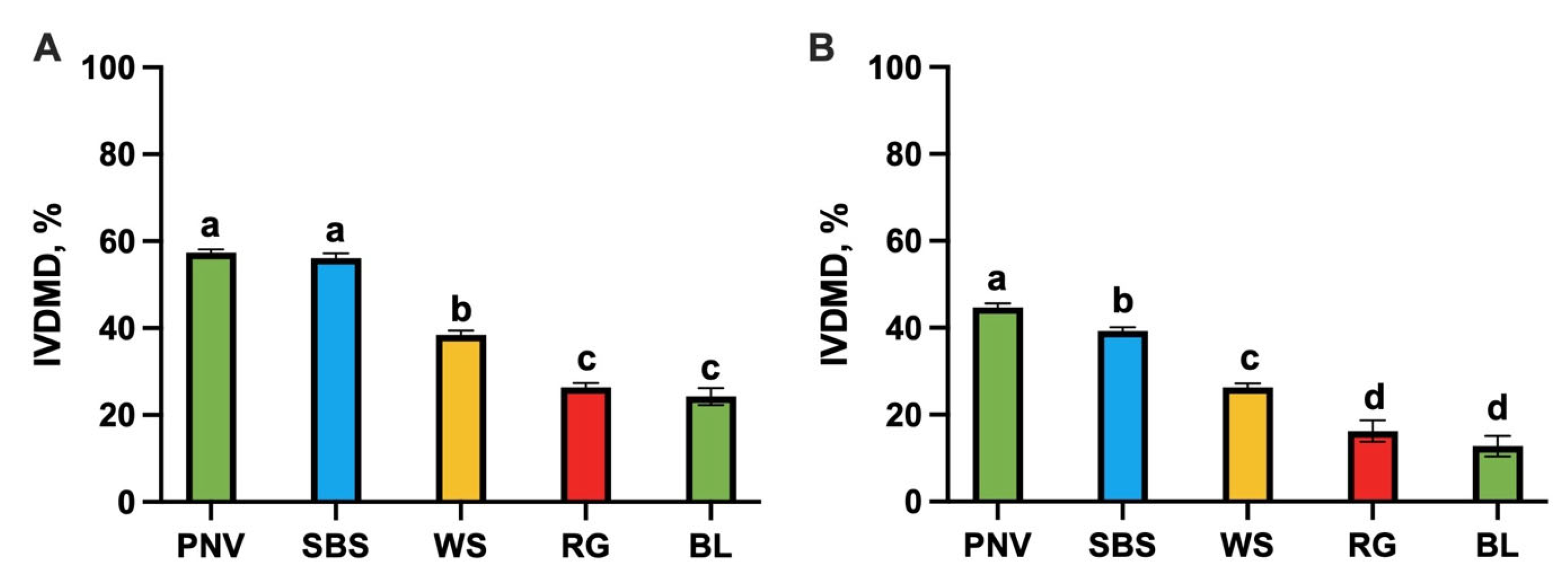
Figure 1. In vitro dry matter disappearance (IVDMD) of different feedstuffs incubated with cecal (A) and colonic (B) fluids obtained from donkeys. Within each hindgut segment, bars with different lowercase letters differ at p < 0.05. PNV, peanut vine; SBS, soybean straw; WS, wheat shell; RG, reed grass; BL, bamboo leaf.
Fermentation 12 00271 g001
Figure 2. Gas production of different feedstuffs incubated with the cecal (A) and colonic (B) fluids obtained from donkeys. PNV, peanut vine; SBS, soybean straw; WS, wheat shell; RG, reed grass; BL, bamboo leaf.
Fermentation 12 00271 g002
Table 1. The chemical composition of the feedstuffs incubated in vitro (% of DM basis, except for DM, which is expressed on an as-fed basis).
Feedstuff 1DMOMCPEENDFADFCaP
PNV93.188.49.82.158.049.02.500.11
SBS93.692.010.71.662.745.40.690.18
WS94.189.45.81.669.042.30.320.12
RG94.291.69.81.270.242.00.180.13
BL94.490.114.53.064.937.10.450.10
1 DM, dry matter; OM, organic matter; CP, crude protein; EE, ether extract; NDF, neutral detergent fiber; ADF, acid detergent fiber; Ca, calcium; P, phosphorus; PNV, peanut vine; SBS, soybean straw; WS, wheat shell; RG, reed grass; BL, bamboo leaf.
Table 2. Gas production of different feedstuffs incubated with the cecal and colonic fluids obtained from donkeys.
Items 1HindgutPNVSBSWSRGBLSEMp-Value
GP40, mL/g DMCecum98.8 a95.2 a68.2 b36.7 c26.5 d1.30<0.01
Colon70.2 b80.4 a50.0 c29.0 d10.2 e1.68<0.01
Gas production kinetics parameters
        A, mL/g DMCecum93.3 a87.1 b58.6 c33.0 d25.8 e1.29<0.01
Colon72.2 b82.8 a50.9 c25.3 d14.4 e1.67<0.01
        c, h−1Cecum0.22 b0.18 b0.28 b0.96 a1.03 a0.101<0.01
Colon0.13 e0.15 d0.18 c0.29 b0.86 a0.004<0.01
        T1/2, hCecum2.23 ab2.41 a1.95 b0.76 c0.68 c0.106<0.01
Colon3.57 a3.46 a2.63 b1.93 c0.84 d0.119<0.01
        AGPR, mL/hCecum28.9 bc22.6 c24.1 c45.1 a37.6 ab3.5140.03
Colon12.8 b13.4 b12.3 bc10.6 c17.9 a0.4950.01
1 GP40, cumulative gas production at 72 h; A, the asymptotic gas production (ml/g DM); c, the fractional gas production rate (/h); T1/2, the time when half of A occurred (h); AGPR, the average gas production rate (ml/h) between the start of the incubation and the time when half of A occurred. PNV, peanut vine; SBS, soybean straw; WS, wheat shell; RG, reed grass; BL, bamboo leaf; SEM, standard error of the mean. Means within a row without a common superscript differ (p < 0.05).
Table 3. Short-chain volatile fatty acids production of different feedstuffs incubated with the cecal and colonic fluids obtained from donkeys.
Items 1HindgutPNVSBSWSRGBLSEMp-Value
Total VFA, mmol/LCecum48.9 a46.5 ab40.4 b33.8 c30.6 c2.24<0.01
Colon48.6 a45.5 a39.9 b34.3 c31.8 c1.11<0.01
VFA pattern (molar percentage, mmol/100 mmol)
      AcetateCecum66.065.864.063.365.60.900.16
Colon67.6 c68.8 b69.6 b69.3 b71.1 a0.40<0.01
      PropionateCecum21.3 ab21.1 b21.6 ab21.9 a19.7 c0.19<0.01
Colon20.1 a19.0 b17.9 c18.4 c14.9 d0.21<0.01
      ButyrateCecum9.84 b10.60 ab11.77 a11.92 a12.15 a0.5940.04
Colon7.95 b8.24 ab8.34 a8.25 ab8.58 a0.1230.02
      BCVFACecum1.991.721.801.541.680.2160.68
Colon3.44 b3.14 b3.40 b3.46 b4.45 a0.121<0.01
A:PCecum3.10 b3.12 b2.97 bc2.83 c3.34 a0.066<0.01
Colon3.37 d3.62 c3.89 b3.77 bc4.77 a0.068<0.01
NGRCecum3.90 bc4.01 b3.94 b3.80 c4.42 a0.046<0.01
Colon4.02 d4.35 c4.68 b4.55 b5.62 a0.066<0.01
CH4e, mmol/LCecum13.6 a13.1 ab11.2 b9.2 c8.9 c0.669<0.01
Colon13.7 a13.2 a11.9 b10.1 c10.0 c0.344<0.01
1 BCVFA, Branch-chained volatile fatty acids; AP, the ratio of acetate to propionate; NGR, the ratio of non-glycemic volatile acids to glycemic fatty acids; CH4e, methane production estimated from volatile fatty acids; PNV, peanut vine; SBS, soybean straw; WS, wheat shell; RG, reed grass; BL, bamboo leaf; SEM, standard error of the mean. Means within a row without a common superscript differ (p < 0.05).
Disclaimer/Publisher’s Note: The statements, opinions and data contained in all publications are solely those of the individual author(s) and contributor(s) and not of MDPI and/or the editor(s). MDPI and/or the editor(s) disclaim responsibility for any injury to people or property resulting from any ideas, methods, instructions or products referred to in the content.