
Review

Lactic Acid Bacteria Exopolysaccharides as Next-Generation Clean-Label Texturizers and Prebiotics in Dairy Systems

1
Engineering Research Center of Agricultural Microbiology Technology, Ministry of Education & Heilongjiang Provincial Key Laboratory of Plant Genetic Engineering and Biological Fermentation Engineering for Cold Region & Key Laboratory of Microbiology, College of Heilongjiang Province & School of Life Sciences, Heilongjiang University, Harbin 150080, China
2
Chifeng Agricultural and Livestock Products Quality and Safety Center, Chifeng 024000, China
*
Authors to whom correspondence should be addressed.
Fermentation 2026, 12(5), 245; https://doi.org/10.3390/fermentation12050245
Submission received: 21 April 2026 / Revised: 13 May 2026 / Accepted: 15 May 2026 / Published: 19 May 2026
(This article belongs to the Special Issue The Roles of Lactic Acid Bacteria in Food Fermentation)

Abstract

Exopolysaccharides (EPSs) produced by lactic acid bacteria (LAB) are natural high-molecular-weight polymers secreted extracellularly during growth. They possess unique rheological properties and emulsifying stability and may exhibit prebiotic-related functionalities. In food systems, EPSs exhibit multiple functional values. In recent years, driven by the global “Clean Label” movement and increasing consumer demand for natural and healthy foods, EPSs, as safe and traceable natural food-grade prebiotics, have attracted extensive attention in the dairy industry. This review summarizes EPSs’ structure, properties, and mechanisms in dairy systems. It focuses on their functional effects and mechanisms in typical dairy products such as yogurt, cheese, and ice cream, and analyzes the technical bottlenecks limiting large-scale production, including low yield, high cost, and challenges in separation and purification. This review further outlines several promising research directions for EPS research. These include strain modification via synthetic biology strategies, fermentation optimization using high-throughput screening technologies, and targeted application based on structure–function relationships. It aims to provide systematic theoretical references and practical guidance for the efficient development and innovative application of EPSs in the food industry.

1. Introduction

Exopolysaccharides (EPSs) are biopolymer polysaccharides synthesized and secreted by microorganisms, especially lactic acid bacteria (LAB), into the extracellular environment during growth [1]. They are widely present in fermented dairy products. Based on monosaccharide composition and structural heterogeneity, EPSs can be classified into homopolysaccharides (HoPSs) (such as glucans and fructans) and heteropolysaccharides (HePSs) (composed of multiple monosaccharide units and having a more complex structure) [2]. The biosynthesis of EPSs relies on the coordinated action of a series of intracellular glycosyltransferases and polymerases, completing the activation of monosaccharides, polymerization, and ultimately secretion into the extracellular environment through transport systems. Many LAB can synthesize EPSs, with well-characterized EPS-producing strains commonly found in genera such as Lactococcus, Lactobacillus, Streptococcus, Leuconostoc, etc. [3,4]. For example, L. lactis is commonly used for producing HoPSs, while L. casei and L. delbrueckii subsp. bulgaricus often synthesize HePSs with diverse structures, playing an important role in traditional fermented dairy products such as yogurt and cheese [5]. Recent evidence highlights the vital contribution of yeasts to EPS biosynthesis. Typical dairy-associated yeast strains, including Saccharomyces cerevisiae and Kluyveromyces marxianus, can produce EPSs with unique structural characteristics and functional properties [6]. Beyond yeasts, certain fungi are also capable of EPS synthesis; their products differ notably from LAB-derived EPSs in monosaccharide composition, molecular weight, and bioactivity, greatly expanding the resource diversity of EPSs for dairy industrial utilization. For instance, the complex microbial community in kefir granules (containing lactic acid bacteria and yeast) can also synergistically produce EPS mixtures with unique texture and functional properties [7,8].
As the global food industry shifts towards “clean labels” and natural, healthy directions, the application of traditional chemical synthesis or semi-synthetic additives (such as gelatin, carboxymethyl cellulose, etc.) in dairy products is gradually restricted, prompting the industry to seek more natural alternative components that conform to the trend of clean labels [9]. In this context, EPSs derived from LABs have rapidly become a research hotspot in the field of dairy science and industry due to their natural, safe, and edible characteristics, as well as their excellent textural improvement function and potential health value [10,11]. EPSs can not only effectively improve the rheological properties, water-holding capacity, and stability of products, but also serve as prebiotics or components with immunomodulatory activity, endowing dairy products with additional functional attributes, thereby meeting the multiple demands of modern consumers for “safety, nutrition, and functionality” of food [12,13,14]. Currently, EPSs have shown good application potential in products such as yogurt, cheese, and fermented milk beverages, and are gradually expanding to new fields such as plant-based dairy products, low-fat dairy products, and functional dairy products. However, EPSs still face many challenges in actual large-scale applications, including low production yield, high extraction and purification costs, incomplete understanding of the structural–function relationship, and the need for further clarification of their mechanism of action in complex food systems [15]. Therefore, systematically reviewing the synthesis mechanism, structural characteristics, functional performance in dairy products, and industrialization progress of EPSs is of great practical significance for promoting the scientific application and technological innovation of this type of component in dairy products. This review aims to systematically elaborate on the characteristics, mechanism of action, application status, and future development trends of lactic acid bacteria EPSs, with the aim of providing theoretical references and practical guidance for research and development in related fields and further promoting their innovative application and value enhancement in healthy and sustainable dairy product systems.

2. Characteristics and Functions of EPSs of LAB

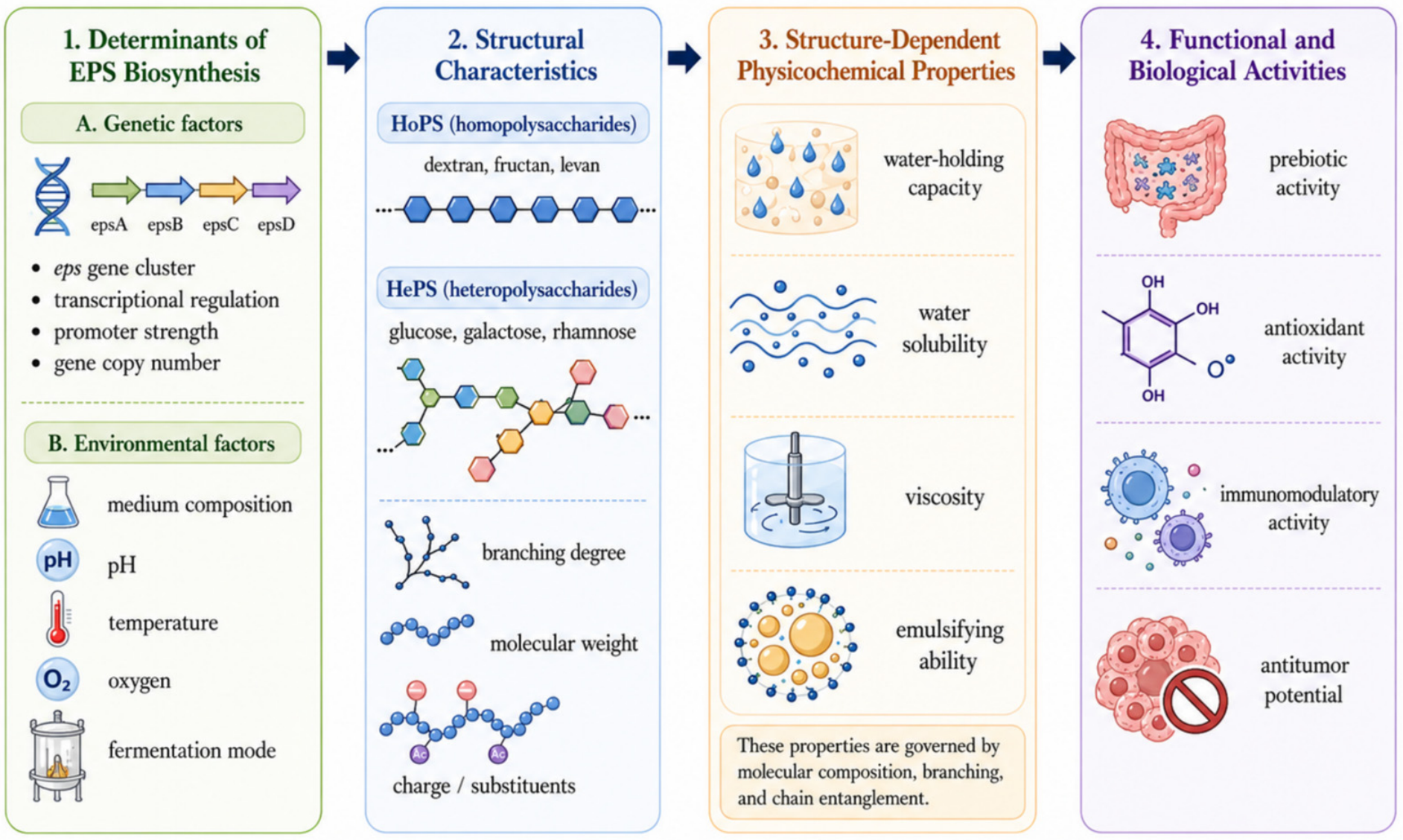
LAB EPSs, as a type of high-molecular polysaccharide synthesized and secreted by LAB into the extracellular environment, exhibit diverse structures and functions, which form the basis for their application in food systems. A thorough understanding of the composition, properties, and synthesis regulation mechanisms of EPSs is essential for achieving their efficient and precise application. The biosynthesis regulation, structure, and function of LAB EPSs are systematically illustrated in Figure 1.

2.1. Structural Diversity

The structural differences of EPSs are the key factors determining their functional diversity. Table 1 compares the structural characteristics, yields, and functional properties of EPSs from different LAB. Based on the composition of monosaccharides and the connection mode, EPSs can be classified into HoPSs and HePSs. HoPSs, such as the dextran synthesized by L. lactis, consist of a single monosaccharide repeating unit and have a relatively simple structure, often showing significantly high viscosity and shear-thinning behavior, which is suitable for food scenarios that require enhancing the system’s viscosity and oral coating sensation [16]. On the other hand, HePSs, such as the EPSs produced by L. casei, are usually composed of two or more monosaccharides (such as glucose, galactose, and rhamnose) connected by different glycosidic bonds, with a complex structure and often containing branches or substituents. These EPSs, due to their diverse structures, not only possess good emulsifying stability but can also interact with biological receptors through specific spatial conformations, demonstrating stronger biological activities (such as immunomodulation, antioxidant properties, etc.) [17,18]. The biological activities of EPSs produced by LAB are intrinsically linked to their structural features. These include monosaccharide composition, molecular weight, glycosidic linkage configuration, and three-dimensional conformation. Monosaccharide composition and glycosidic bond type govern the viscosity, solubility, and rheological characteristics of EPSs. Molecular weight and degree of branching serve as critical regulators of their rheological behavior, gelation capacity, and emulsion stability. Charged functional groups, such as uronic acids and phosphate groups, further modulate both the biological activities and physicochemical properties of these polymers. Recent studies indicate that the functional characteristics of HePSs are not consistent across different strains and production conditions. For example, the EPSs produced by L. brevis AM7 [19] and L. casei LDMB03 [18] may have slight differences in monosaccharide ratio, molecular weight distribution, and chain conformation, which can significantly affect their rheological properties and functional performance. This further highlights the necessity of resolving the structure of EPSs at the molecular level. Therefore, systematically analyzing the primary structure, advanced conformation, and the intrinsic relationship between EPSs and their function at the molecular level is of great significance for achieving targeted regulation of EPS functions and efficient application.

2.2. Prebiotic Activity

Microbial EPSs are a class of microbial-derived biomacromolecules with promising prebiotic potential. According to the stringent definition established by the International Scientific Association for Probiotics and Prebiotics (ISAPP), only EPSs that resist digestion by the host, are selectively utilized by the gut microbiota, and confer health benefits to the host can be classified as prebiotics [28]. Representative EPS-producing strains that meet the ISAPP criteria include W. confusa, L. kefiranofaciens, and others [29]. Owing to their high molecular weight, β-glycosidic linkages, extensive branching, and unique monosaccharide composition, EPSs can withstand the acidic environment, bile salts, and digestive enzymes in the upper gastrointestinal tract and reach the colon intact. Via carbohydrate-active enzymes (CAZymes) and polysaccharide utilization loci (PULs) specifically expressed by beneficial gut bacteria, EPSs undergo precise selective fermentation [30]. This process promotes the proliferation of beneficial gut microbiota, including Bifidobacterium, Lactobacillus, Faecalibacterium, and Roseburia. Meanwhile, it drives microbial metabolic cross-feeding, leading to the production of short-chain fatty acids (SCFAs) such as acetate, propionate, and butyrate. As key effector molecules, SCFAs served as the primary energy source for colonocytes and enhanced intestinal barrier integrity. They also lower intestinal luminal pH to suppress pathogenic bacteria and regulate immune responses, as well as glycolipid metabolism. These combined effects contribute to multiple health benefits, such as relieving constipation, reducing obesity and insulin resistance, and alleviating chronic inflammation [31]. Compared with conventional prebiotics, microbial EPSs exhibit higher structural diversity, stronger prebiotic selectivity, and additional techno-functional properties such as emulsification, thickening, and stabilization. They can also be tailor-designed through synthetic biology, which makes them sustainable next-generation prebiotic ingredients for functional foods.

2.3. Antioxidant Activity

Oxidative stress induced by ROS metabolic imbalance can trigger biomacromolecule damage, cell apoptosis, and aging-related diseases. EPSs exert antioxidant effects via synergistic pathways, mainly including direct free radical scavenging, enhancement of endogenous antioxidant defense, and repair of oxidative damage. Rich in hydroxyl and aldehyde functional groups, EPS molecules can neutralize various free radicals by donating protons or electrons, blocking oxidative chain reactions, and inhibiting excessive ROS accumulation. EPSs derived from Bacillus, Rhizobia, and Lactobacillus exhibit concentration-dependent antioxidant activity. Specifically, EPSs from Rhizobium VF39 present DPPH and hydroxyl radical scavenging rates of 78.5% and 62.4%, respectively, and sulfation modification can further improve the antioxidant capacity of LAB EPSs [32]. In terms of indirect antioxidant regulation, EPSs activate the endogenous antioxidant system to restore cellular redox homeostasis. They upregulate the activity and expression of core antioxidant enzymes, including SOD, CAT, and GSH-Px, accelerate the decomposition of toxic ROS, and maintain the homeostasis of intracellular non-enzymatic antioxidants, thereby reducing the accumulation of lipid peroxidation products such as MDA and lipofuscin [33]. In addition, EPSs possess excellent cytoprotective and oxidative damage repair capabilities against ultraviolet radiation, heavy metals, and oxidative stimuli. They can stabilize cell membranes and mitochondrial structures, inhibit cell apoptosis, and protect DNA and damaged biological macromolecules while physically adsorbing harmful stress factors. Meanwhile, they regulate the expression of antioxidant genes, including SodB, SodC, and Tpx, thereby synergistically enhancing cellular stress resistance through both physical protection and molecular regulation [34].

2.4. Antibacterial Activity

Numerous studies have confirmed that EPSs from LAB exhibit broad-spectrum inhibitory activity against a variety of foodborne pathogens. These pathogens include Gram-positive bacteria such as S. aureus and Listeria monocytogenes, Gram-negative bacteria, including Escherichia coli and Salmonella Typhimurium, as well as pathogenic fungi like Candida albicans. Regarding the mechanisms of action, LAB EPSs exert a synergistic antimicrobial effect through direct bacteriostasis and indirect immunomodulation. They can damage the cell wall and membrane structures of pathogenic bacteria, interfere with cell division, and block pathogen adhesion and colonization by masking host cell receptors. Meanwhile, they activate the host mucosal immune system and induce the secretion of antimicrobial cytokines and immunoglobulins [35]. In addition, the antibacterial activity of EPSs is directly influenced by structural factors, including monosaccharide composition, molecular weight, and charge properties. Negatively charged EPSs rich in acidic groups show superior antimicrobial efficacy, and chemical modifications such as sulfation and phosphorylation can further enhance their antibacterial and antibiofilm properties. With the continuous deepening of research into the structure–activity relationship of EPSs and the ongoing optimization of efficient preparation technologies, LAB EPSs are expected to serve as a safe and natural biological preservative and functional component, playing vital roles in bacteriostasis, flavor maintenance, and shelf-life extension in fermented dairy products, dairy preservation, and the development of functional dairy products.

2.5. Factors Affecting EPS Production

Biosynthesis of EPSs relies on the coordinated action of a series of key enzymes to complete the entire process, including sugar activation, repeating unit assembly, chain elongation, polymerization, and transmembrane secretion. Phosphoglucomutase (PGM) catalyzes the conversion of glucose-6-phosphate to glucose-1-phosphate, providing precursors for nucleotide sugar synthesis. Nucleotide sugar pyrophosphorylases (UGP, GalU, GDP-mannose pyrophosphorylase) synthesize activated sugar donors such as UDP-glucose, UDP-galactose, and GDP-mannose, representing the rate-limiting step of biosynthesis. Glycosyltransferases (GTs) transfer monosaccharide units sequentially to lipid carriers, determining the monosaccharide composition and glycosidic bond types of EPSs. Polymerases control the polymerization of repeating units and chain length, directly affecting molecular weight and rheological properties. Flippases/translocases mediate the transmembrane export of EPS chains. Regulatory proteins of the eps gene cluster control transcription efficiency, influencing yield and structural stability. The expression and activity of these key enzymes collectively determine the biosynthesis efficiency, molecular weight, branching degree, and functional properties of EPSs [36]. Furthermore, the yield and structure of EPSs are jointly regulated by the genetic background of strains and environmental factors. At the genetic level, the biosynthesis of EPSs is controlled by the eps gene cluster located on the chromosome, and its expression level is influenced by transcriptional regulatory factors, promoter strength, and gene copy number, directly determining the synthesis ability and basic structure of EPSs [37]. For example, the homology differences of different eps gene clusters in L. plantarum and S. thermophilus can directly lead to significant differentiation in the composition of monosaccharides, branching degree, and molecular weight of the EPSs they synthesize, thereby exhibiting completely different rheological and functional characteristics [38,39]. In terms of environmental regulation, the composition of the culture medium (especially the type of carbon source and the carbon–nitrogen ratio), pH, temperature, dissolved oxygen, and fermentation mode (batch, fed-batch, or continuous fermentation) all significantly affect the metabolic flow of the bacteria and the accumulation of EPSs [40]. For instance, under nitrogen limitation conditions, the carbon metabolism of some strains may shift more towards EPS synthesis, thereby increasing production by more than 30%; different carbon sources (such as glucose, sucrose, and lactose) not only affect their production but may also influence the monosaccharide composition and chain length distribution of EPSs by changing the utilization rate of sugar donors [41]. Therefore, systematic optimization of strain selection and fermentation processes to achieve efficient and controllable production of EPSs is an important prerequisite for promoting their industrial application, and it is also one of the current research hotspots in the field of food microbial manufacturing.

3. The Application Mechanism of EPSs in Dairy Products

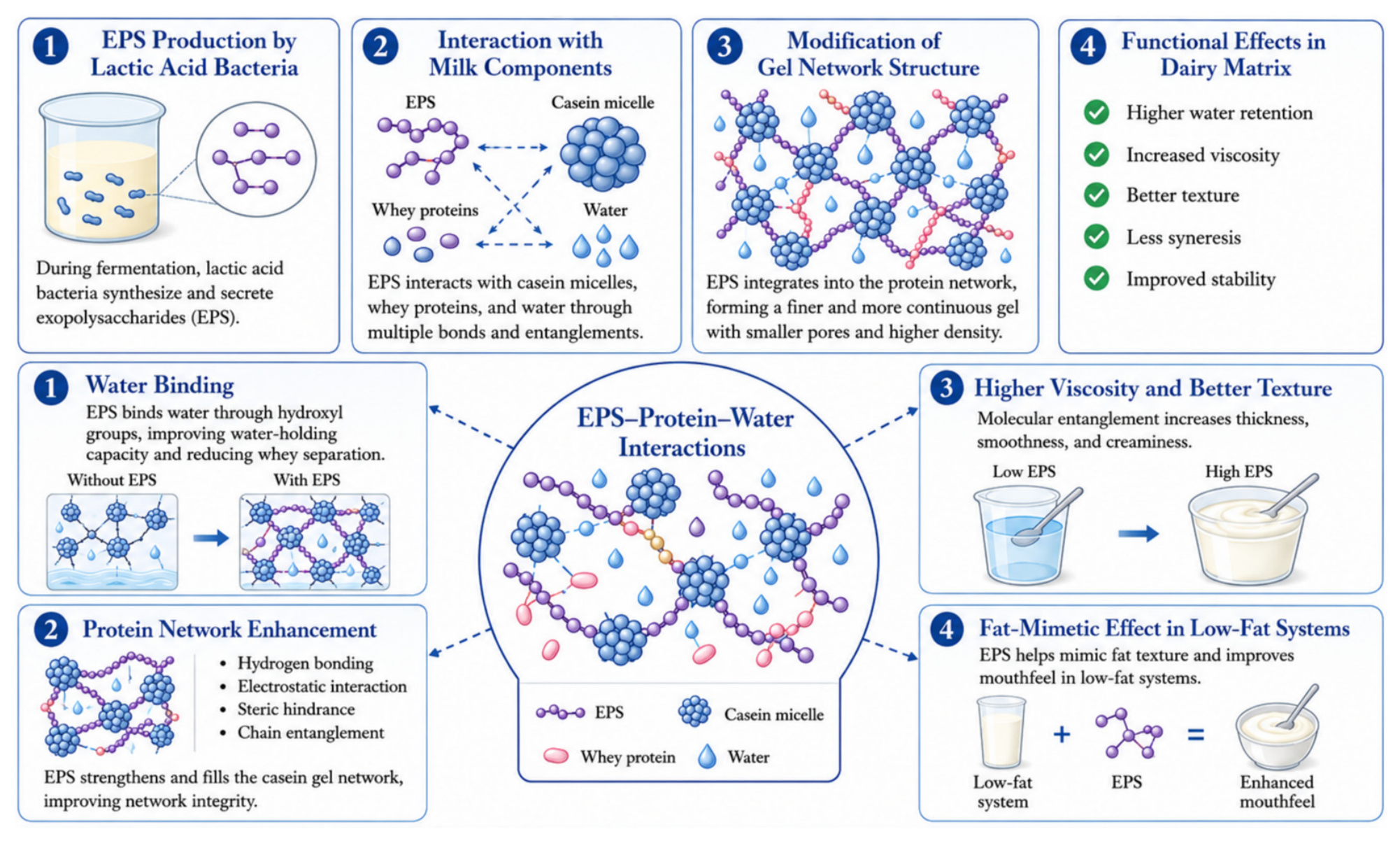
In the dairy product system, LAB EPSs mainly exert their effects through the following four mechanisms, and their comprehensive value in terms of product texture, stability, health attributes, and clean labeling is increasingly prominent. As shown in Figure 2, the complete mechanism of this process is presented, outlining the key pathway of EPSs from production to their impact on dairy product characteristics.

3.1. As a Texture Modifier

The core mechanism of EPSs as a texture modifier lies in their ability to significantly alter the rheological properties of the dairy product system. EPSs modify texture by forming weak gel networks that increase viscosity and improve mouthfeel. The EPSs of different structures exhibit significant differences in regulating the rheology and texture of dairy products. For example, linear HoPSs with high molecular weight are more inclined to enhance the viscosity and consistency of the system, while HePSs with branched structures are more conducive to improving whey separation and sensory lubricity. Among them, EPSs produced by L. plantarum show excellent anti-dewatering contraction ability in stirred yogurt [42]. In low-fat or skimmed dairy products, EPSs can exhibit reversible rheological behavior under oral shear, thereby significantly enhancing the sensory acceptance of consumers [43]. Furthermore, for fermented products such as yogurt and fresh cheese, EPSs can act synergistically with the casein gel network produced by LAB fermentation. This interaction enhances gel strength and structural stability, reduces whey separation, improves texture uniformity, and effectively prolongs the shelf life [44]. Current mechanistic studies remain largely focused on macroscopic rheological characterization, and direct evidence is lacking for molecular recognition, binding sites, chain conformational transitions, and the dynamic gel network formation process between EPSs and milk proteins. Future research should elucidate the intrinsic structure–texture functionality relationship of EPSs at the microscopic and molecular levels and establish predictable quantitative structure–activity relationship models.

3.2. As a Stabilizer

EPSs can effectively stabilize dairy products through steric hindrance and electrostatic interactions. Casein micelles and fat globules tend to aggregate, flocculate, and even phase-separate under acidic conditions and mechanical processing [45]. However, EPS molecules can exert stabilizing effects from both interface and colloid network aspects. For example, the negatively charged capsule-type EPSs produced by L. lactis can enhance the connectivity and gel rigidity of the casein network [46]. Its long-chain molecules can adsorb onto the surface of casein micelles, forming a hydrophilic protective layer that inhibits the proximity and aggregation of micelles through stereoscopic obstruction. At the same time, some charged EPSs can further prevent particle coagulation through electrostatic repulsion. Additionally, the novel HePSs synthesized in situ by L. helveticus MB2-1 in cow milk can closely combine with the casein network, significantly improving the viscosity and structural stability of yogurt [47]. This dual stabilization mechanism significantly delays whey precipitation, phase separation, and precipitation phenomena, and shows excellent stability in stirred yogurt, liquid fermented milk, and dairy beverages. Studies have shown that stirred yogurt with appropriate EPSs added can reduce the whey precipitation rate by more than 50% during storage, and the shelf life can be extended [48]. Existing studies still provide limited quantitative descriptions of the interfacial adsorption behavior, adsorbed layer thickness, conformational changes of EPSs, and the interparticle repulsive forces. Therefore, techniques such as rheological characterization, confocal microscopy, zeta potential measurement, and molecular dynamics simulation should be employed to more precisely reveal the stabilization mechanism of EPSs in milk-based multiphase systems.

3.3. As Functional Components

In addition to their physical and chemical functions, some EPSs also exhibit prebiotic and health regulation potential, adding functional value to dairy products. These EPSs can withstand the effects of stomach acid and digestive enzymes and reach the colon in their intact or partially degraded forms. They selectively promote the proliferation of beneficial bacteria such as Bifidobacterium and Lactobacillus as microbial fermentation substrates, thereby regulating the structure of the intestinal microbiota. Studies have shown that EPSs with α-(1-3) and α-(1-6) glycosidic linkages exhibit potential prebiotic properties. In chocolate pudding systems, such EPSs could moderately promote the proliferation of L. rhamnosus GG, alleviate whey separation to a certain extent, and may simultaneously exert dual functions of prebiotic activity and texture stabilization [49]. Some EPSs are considered to possess potential immunomodulatory activity, which may regulate cytokine secretion by interacting with intestinal immune cells and enhance mucosal immune responses [50]. The application of such EPSs in dairy products can achieve an effective combination of nutritional carriers and functional factors, promoting the development of products towards functionalization and precise nutrition.

3.4. Replacement of Artificial Additives

With the rise of the clean label movement worldwide, consumers’ demands for simple, natural, and identifiable food ingredients have been continuously increasing. EPSs, as a polysaccharide produced by the natural fermentation of food-grade microorganisms, have outstanding advantages such as being a safe source, as well as biodegradability and biocompatibility. They fully meet the requirements of the clean label and can effectively replace traditional synthetic or semi-synthetic stabilizers and thickening agents like gelatin, carboxymethyl cellulose, and modified starch. This not only makes the ingredient list of the product more concise and transparent but also avoids the concerns that some artificial additives may bring to consumers. Its large molecular chains are able to form a dynamic three-dimensional network in the aqueous phase via hydrogen bonds, hydrophobic interactions, and ionic cross-linking. This enables EPSs to simultaneously perform multiple roles, including thickening, gelation, water retention, emulsion stabilization, and prebiotic effects within the same food matrix. Such multifunctional properties help simplify ingredient formulations and reduce compounding complexity, which is well in line with the current trend of the food industry toward natural, clean-label and sustainable development [51].
EPSs exert synergistic effects in dairy products through multiple mechanisms. They not only improve product quality in terms of texture and stability but also endow dairy products with the high-value-added characteristics pursued by modern foods in terms of health benefits and ingredient cleanliness. The quantitative structure–function relationship between structural features and functional performance of EPSs is presented in Table 2.

4. Specific Applications of Lactic Acid Bacteria EPSs in Different Dairy Products

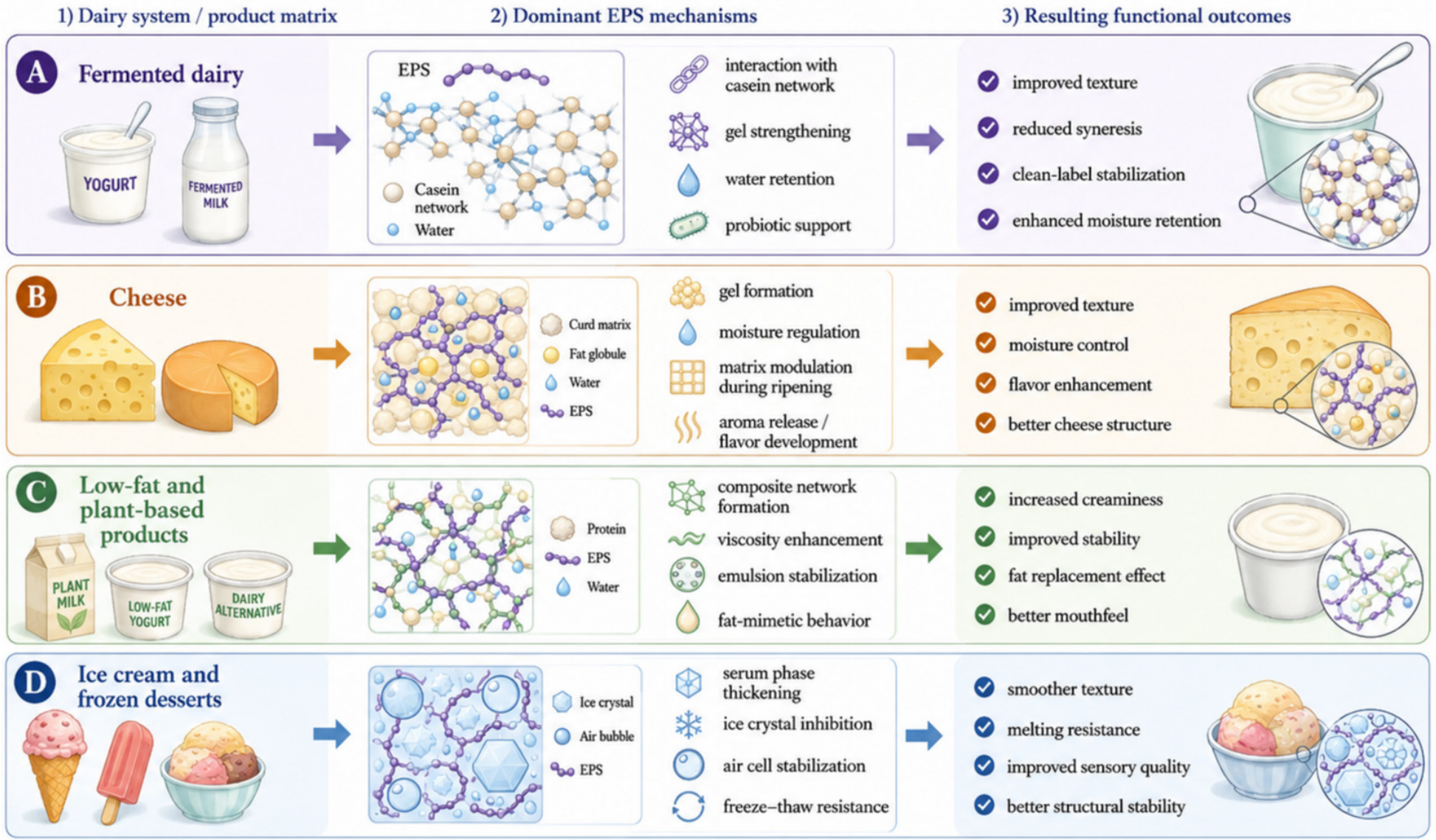
The application of LAB EPSs has expanded from traditional yogurt and cheese to various products such as ice cream and plant-based alternatives. The multifunctionality demonstrated by EPSs in various products is driving the dairy industry towards better texture, stronger stability, and cleaner ingredients. The mechanisms and functional effects of LAB EPSs in different dairy systems are further shown in Figure 3.

4.1. Fermented Dairy Products

In yogurt and other fermented dairy products, EPSs mainly function through in situ synthesis. EPS-producing starters secrete EPSs during fermentation. These EPSs interact with milk proteins to form a denser, more uniform gel network, improving curd strength, water retention, and whey stability [52,53]. Studies have found that when L. plantarum HMX2 produces EPSs and is combined with polymerized whey protein, it can further optimize the gel network structure through the synergistic cross-linking of the two with bovine milk proteins, significantly improving water retention and reducing sensitivity to whey separation [54]. This characteristic not only helps reduce or even replace the use of exogenous stabilizers such as gelatin and pectin but also aligns with the market trend of clean labels. Different types of EPSs exert distinct effects on product texture. High-viscosity EPSs are more suitable for stirred yogurt and endow it with a smooth and dense texture [55], whereas high-gel EPSs are commonly applied in solid-set yogurt to improve structural stability and spoonable properties [56]. Additionally, in traditional fermented dairy products such as kefir, the EPS complexes synthesized by mixed microbial communities provide the product with a unique silky texture and mild foaming characteristic [57]. These complexes also endow potential prebiotic properties, further reflecting the comprehensive value of EPS in natural fermentation systems.

4.2. Cheese

In cheese production, EPSs plays a major role during the curd formation and maturation stages. During coagulation, EPSs fill gel pores and bind free water, thereby improving the slicing property and texture uniformity of the final product. When preparing Requeson-type cheese using whey, a by-product of the dairy industry, as the raw material, and using a co-culture method of L. delbrueckii subsp. bulgaricus and S. thermophilus, in situ fermentation by LAB generates EPSs, which enhance the product’s storage stability [58]. Additionally, some EPSs can be slowly degraded by microbial enzymes or endogenous enzyme systems during cheese maturation, generating reducing sugars or oligosaccharide substances. These components can participate in the Maillard reaction or microbial metabolism as flavor precursors, gradually enriching the flavor layers and complexity of the cheese [59]. This characteristic provides new ideas for developing flavor-enhanced or accelerated-maturation cheese products.

4.3. Ice Cream and Frozen Dairy Products

In ice cream and other frozen dairy products, EPSs mainly improve product quality by inhibiting ice crystal growth, stabilizing emulsions and bubble structures. Their high-molecular chains can adsorb on the surface of ice crystals to form a physical barrier, delaying Ostwald ripening of ice crystals, thus enabling the product to maintain a delicate texture during storage and consumption. At the same time, EPSs can interact synergistically with milk proteins, enhancing the viscoelasticity of the mixture, which helps form and stabilize fine bubble structures during freezing, delaying the melting deformation and volume contraction of ice cream [60]. Relevant studies have optimized fermentation strains and process conditions using response surface methodology. It was found that by fermenting S. thermophilus at 40–42 °C for 4 h, a fermented ice cream without exogenous stabilizers and with high EPS content and viscosity can be produced [61]. In actual production, EPSs are often used in combination with other hydrophilic gels to achieve ideal anti-melting properties and texture performance with a lower addition amount, conforming to the trend of food formulation towards efficiency and simplification.

4.4. Other Innovative Applications

As the food industry continues to evolve towards plant-based, low-fat, and functional products, the application of EPSs beyond traditional dairy products has also gained increasing attention. Some EPSs can partially mask the undesirable flavors of plant proteins [62]. In low-fat or fat-free dairy products, EPSs can effectively compensate for the texture loss caused by the reduction of fat by mimicking the lubricity and oral coating sensation of fat, enhancing the overall acceptability of the product. Additionally, EPSs also show good applicability and expansion potential in dairy-based desserts, reconstituted cheese, milk beverages, and functional dairy products [63]. In-depth research into the structure–activity relationship and metabolic characteristics of EPSs will facilitate their more personalized and precise application. Relevant developments include designing EPS–lactose composite systems with tailored functions and sensory properties to meet the health and texture demands of specific populations.

5. Technical Challenges and Production Optimization

Although LAB EPSs show great potential for application in dairy products, their industrialization process still faces several key technical challenges. From production to application, there are numerous issues that need to be addressed, and systematic optimization can be achieved through interdisciplinary integration and technology integration.

5.1. EPS Production Efficiency and Cost Control

Currently, the EPS production efficiency of most wild-type LAB is generally low, typically below 1 g per liter of fermentation broth. This leads directly to high production costs, limiting its large-scale industrial application. There are significant differences in EPS synthesis capacity among various LAB strains under different fermentation processes, showing distinct hierarchical differentiation in industrialization potential. L. lactis and L. mesenteroides can achieve EPS yields of 1.0–2.5 g/L when using sucrose and molasses as low-cost carbon sources under conventional batch and fed-batch fermentation, which are regarded as high-yield dominant strains with strong industrial applicability [64]. In contrast, most strains such as L. plantarum, L. brevis, P. pentosaceus, and W. cibaria generally present low yield levels at the milligram grade or below 0.5 g/L, with limited inherent synthetic capacity [25,65]. Meanwhile, fermentation process optimization can effectively break through the yield bottleneck. The EPS yield of L. hircilactis CH4 can reach up to 2.92 g/L under optimized batch fermentation, which is remarkably higher than that of the conventional batch fermentation system [27]. In addition, the extraction recovery rate of EPSs from different strains ranges from 45% to 80%, and high-yield strains possess a higher matching recovery efficiency (60–80%), which further widens the gap in industrialization feasibility among different bacterial species. Improving EPS production efficiency is the core issue of industrialization. On one hand, the yield can be increased through fermentation process optimization, such as using food industry by-products like whey and molasses as cheap carbon sources to reduce the cost of the medium, and maintaining bacterial metabolism in a good state through supplementary feeding fermentation and pH regulation to promote polysaccharide synthesis [66]. Relevant studies have confirmed that culturing L. mesenteroides with sugarcane as the substrate can achieve efficient EPS accumulation while controlling costs [67]. On the other hand, starting from the strain itself, metabolic engineering can be used to enhance the expression and activity of key enzymes in the EPS synthesis pathway or knockout competitive metabolic branches to direct more carbon flow to EPS synthesis. By modifying the UDP–glyceraldehyde synthesis pathway of S. thermophilus AR333 and co-expressing lacZ and galE1, EPS production can be increased by 49% [68].

5.2. Potential Effects on Fermentation Process and Product Flavor

EPSs may have some unintended effects during the fermentation and application of dairy products. During the fermentation stage, excessively high concentrations of EPSs can increase the viscosity of the culture medium, hindering the diffusion of nutrients and the expulsion of metabolic products, which may slow down the growth of bacteria and the rate of acid production, and affect the synchronicity and controllability of the fermentation process [69]. For example, in the fermentation of stirred skimmed milk by S. thermophilus with high EPS production, excessively high viscosity can hinder mass transfer, interfere with acidification, and excessive synthesis can disrupt gel stability [55]. In terms of product flavor, although EPSs have a mild flavor, their high-molecular network structure may affect the release of volatile flavor compounds through adsorption or encapsulation, changing the intensity and perception timing of the product flavor [70]. Some EPSs may also subtly affect the balance of basic tastes such as sweet, sour, bitter, and salty through interaction with flavor substances. Therefore, in practical applications, EPS types need to be selected, the addition amount optimized, and the process adjusted to seek the best balance point between texture improvement and flavor retention.

5.3. Bottlenecks in Industrial Extraction and Purification Technologies

Efficient separation and purification of EPSs from complex fermentation broth is another major challenge in industrialization. The fermentation broth is usually highly viscous and complex, containing bacterial cells, proteins, nucleic acids, and other metabolites, making the separation of EPSs difficult. Currently, mainstream methods mostly use centrifugation or membrane filtration for preliminary clarification, followed by ethanol or isopropanol precipitation for polysaccharide recovery [71]. However, this method has high solvent consumption and high energy consumption, and there are issues with solvent recovery and environmental pollution. Moreover, some EPSs may undergo structural changes during precipitation, affecting their functional properties. Emerging extraction technologies such as biphasic extraction, ultrafiltration concentration, and column chromatography purification show certain potential, but they still need further optimization in terms of scale, cost, and efficiency [72]. Developing efficient, green, and low-cost EPS separation and purification processes is a key step in promoting their industrial application.

5.4. Strain Screening and Genetic Engineering Modification Strategies

Traditional strain screening methods relying on phenotypic analysis are inefficient and labor-intensive, making it difficult to meet the industrial demands for high-yield and high-quality strains. With the development of genomics and proteomics technologies, by mining EPS biosynthesis gene clusters (such as the eps gene cluster), the synthetic regulatory mechanism can be deeply understood, providing targets for rational selection. The application of CRISPR-Cas9 and other gene editing technologies makes it possible to precisely modify the EPS synthesis pathway of lactic acid bacteria, such as enhancing promoter activity, regulating gene expression levels, and modifying the specificity of glycosyltransferases, thereby constructing engineered strains with high yield, stability, and compliance with food safety standards [73]. However, the safety assessment of genetically engineered strains, regulatory recognition, and consumer acceptance remain practical challenges. In the future, a comprehensive and scientific safety evaluation system needs to be established, and transparent communication should be enhanced to increase public awareness, in order to promote the compliant application of innovative strains.
Although the industrialization of LAB EPSs faces many challenges, through collaborative innovation in fermentation engineering, process control, separation technology, and strain improvement, it is expected to gradually overcome the bottlenecks. In the future, emphasis should be placed on the deep integration of industry, academia, and research, promoting the effective transformation from laboratory research to large-scale production, so that EPSs, a natural multifunctional ingredient, can play a greater role in the dairy industry.

6. Future Outlook

With the interdisciplinary integration of food science, microbiology, and materials science, the research and application of LAB EPSs are entering a new stage that emphasizes systematicness, precision, and sustainability. In the future, the development of this field will focus on four dimensions: strain creation, structure–function analysis, product innovation, and green manufacturing. This will further expand the value space of EPSs in dairy products and the entire food system.

6.1. High-Throughput Screening and Synthetic Biology Improvement of EPS-Producing Strains

The traditional method of relying on phenotypic screening has been unable to meet the demand for high-performance EPS-producing strains. In the future, by combining microfluidic chips, fluorescence labeling (such as using EPS-specific binding probes or extracellular polysaccharide staining techniques) and image automatic analysis systems, rapid and high-throughput screening of EPS-producing capabilities at the single-cell level can be achieved, significantly improving the efficiency of discovering superior strains. On this basis, synthetic biology provides a new tool for the rational design of EPSs. By modularly reconstructing EPS synthesis gene clusters and regulating the expression and activity of glycosyltransferases, polymerases, and output systems, the molecular weight, monosaccharide composition, branched structure, and functional groups of polysaccharides can be directly modified, thereby obtaining EPSs with specific functional properties (such as high viscoelasticity, acid resistance, thermal stability, or specific in vitro beneficial properties) [74]. Such “design-type polysaccharides” are expected to break through the functional limitations of natural products and promote more precise applications of EPSs in complex food systems.

6.2. In-Depth Analysis of the Relationship Between EPS Structure and Function

Currently, there is a lack of systematic and quantitative structure–function relationship models between EPS structure and function, which limits the prediction and precise regulation of EPS functions. Future research can utilize techniques such as atomic force microscopy and cryo-electron microscopy to visually observe the microscopic morphology and aggregated structure of polysaccharide chains; combined with techniques such as small-angle X-ray scattering and nuclear magnetic resonance, the solution conformation and dynamic changes of EPSs can be analyzed [75]. At the same time, molecular dynamics simulations can reveal the interaction mechanisms between EPSs and milk proteins, fat globules, and water molecules at the atomic level, and predict their rheological properties, stability behavior, and digestive characteristics [76]. By integrating multi-scale structural and functional data, a “structure-rheology-function” database and prediction model for EPSs can be constructed, providing theoretical guidance for rational selection and compounding design of EPSs in specific dairy products, and achieving the leap from “empirical addition” to “precise design”.

6.3. Personalized Nutrition and Development of Functional Dairy Products

As nutrition science enters the era of personalization and precision, EPSs, due to their designability of structure and function, are expected to become an important module in the development of functional dairy products. For the elderly population, EPSs with high water retention, easy swallowing, and the ability to regulate intestinal peristalsis can be designed to develop elderly friendly dairy products; for patients with diabetes or metabolic syndrome, EPS types that can delay glucose absorption and regulate insulin sensitivity can be screened or modified. Combined with individual health data analysis such as gut microbiome sequencing and metabolomics, in the future, functional dairy products containing specific EPSs can even be customized for different consumer groups to achieve “one product, one effect” nutritional intervention. In addition, the synergistic combination of EPSs with prebiotics, prebiotic, and postbiotics will further expand the functional depth of fermented dairy products in terms of intestinal health, immune regulation, etc.

6.4. Exploration of Sustainable Production and Circular Economy Model

In the global context of carbon neutrality and sustainable development, the production of EPSs also needs to transform towards a green and low-carbon direction. Utilizing food industry waste such as whey, molasses, and by-products from fruit and vegetable processing as fermentation substrates not only reduces production costs but also enables the resource utilization of waste, constructing a “from waste to treasure” circular production chain. Moreover, EPSs, as a natural and biodegradable polymer material, demonstrate potential application value in the field of food packaging. For instance, by combining EPSs with chitosan, cellulose, etc., to prepare edible membranes or active coatings, they can be used for the preservation packaging of dairy products, extending shelf life while reducing plastic usage [77]. Such cross-domain applications not only expand the value chain of EPSs but also provide material support for the green transformation of the food industry.
Overall, the future development of LAB EPSs will present a distinct trend of “intelligent strain, precise structure, functional products, and green production”. Through multidisciplinary collaboration and technology integration, EPSs are expected to gradually evolve from a high-quality food ingredient to a multifunctional biological resource covering health intervention, precise nutrition, and sustainable materials. Their in-depth application in dairy products will not only promote product innovation and industrial upgrading but also provide strong support for building a healthier, more personalized, and sustainable food system.

7. Conclusions

LAB EPSs, as biopolymers with natural sources and diverse functions, demonstrate significant effects in improving texture, enhancing stability, and enriching nutrition in dairy products. They have broad application prospects. Their successful application in products such as yogurt, cheese, and ice cream indicates that EPSs can not only effectively replace traditional artificial additives, conform to the trend of clean labels, but also provide better sensory experience and health value to the products through their unique rheological properties and prebiotic functions. However, the current industrialization of EPSs still faces multiple technical challenges such as low production efficiency, high extraction costs, and unclear relationships between structure and function. To achieve their large-scale application, systematic optimization must be carried out in multiple aspects, including strain selection, fermentation process, separation and purification, and safety evaluation. It is anticipated that with the cross-fusion of multidisciplinary methods such as synthetic biology, high-throughput screening technology, food genomics, and structural biology, in the future, rational design of EPS synthesis pathways, precise construction of high-yield and high-quality engineered strains, and in-depth analysis of the structure–activity relationship of polysaccharides are expected to be achieved, thereby promoting EPSs towards efficient, controllable, and targeted production and application stages.
EPSs will not only continue to drive the upgrading of dairy products towards cleanliness, functionality and personalization, but also are expected to achieve green manufacturing using by-products from the food industry as raw materials through the establishment of a circular economy model. This will further expand their application scope in sustainable food systems such as active packaging and functional coatings. Therefore, strengthening the connection between basic research and industrial transformation, and establishing a collaborative innovation system involving industry, academia and research institutions, will be the key path to unlocking the full potential of EPSs in the food industry.

Author Contributions

Y.Q.: writing—original draft; T.W.: visualization; Q.Y.: formal analysis; X.L.: investigation; C.S.: writing—review and editing, resources, supervision; R.D.: writing—review and editing, resources, supervision, funding acquisition. All authors have read and agreed to the published version of the manuscript.

Funding

This work was financially supported by the Heilongjiang Provincial Natural Science Foundation of China [No. PL2025C077] (Renpeng Du), the “New Era Longjiang Excellent Master’s and Doctoral Dissertations” [No. LJYXL2022-020] (Renpeng Du), and the Young Talents of Basic Research in Universities of Heilongjiang Province [No. YQJH2024199] (Renpeng Du).

Institutional Review Board Statement

Not applicable.

Informed Consent Statement

Not applicable.

Data Availability Statement

No new data were created or analyzed in this study. Data sharing is not applicable to this article.

Acknowledgments

During the preparation of this manuscript, the authors used Doubao (Doubao-Seed-2.0-Lite) to assist with the design of schematic diagrams. All AI-generated outputs were reviewed and edited by the authors, who take full responsibility for the accuracy and integrity of the content presented in this publication.

Conflicts of Interest

The authors have declared no conflicts of interest.

References

  1. Kichemazova, N.; Bukharova, E.; Selivanov, N.; Bukharova, I.; Karpunina, L. Preparation, properties and potential applications of exopolysaccharides from bacteria of the Genera Xanthobacter and Ancylobacter. Appl. Biochem. Microbiol. 2017, 53, 325–330. [Google Scholar] [CrossRef]
  2. Waoo, A.; Singh, S.; Pandey, A.; Kant, G.; Choure, K.; Amesho, K.; Srivastava, S. Microbial exopolysaccharides in the biomedical and pharmaceutical industries. Heliyon 2023, 9, e18613. [Google Scholar] [CrossRef]
  3. Patel, S.; Majumder, A.; Goyal, A. Potentials of exopolysaccharides from lactic acid bacteria. Indian J. Microbiol. 2012, 52, 3–12. [Google Scholar] [CrossRef]
  4. Díaz-Cornejo, S.; Otero, M.; Banerjee, A.; Gordillo-Fuenzalida, F. Biological properties of exopolysaccharides produced by Bacillus spp. Microbiol. Res. 2023, 268, 127276. [Google Scholar] [CrossRef]
  5. Pandey, K.; Prakash, T.; Gosai, H.; Bhatia, D.; Patel, R. Microbial exopolysaccharides as postbiotics: Structure, function, and translational potential. Int. J. Biol. Macromol. 2025, 330, 147956. [Google Scholar] [CrossRef]
  6. Yong, Y.; Ahmad, H.; Zhang, H.; Gu, Y.; Zhu, J. Topological structure, rheological characteristics and biological activities of exopolysaccharides produced by Saccharomyces cerevisiae ADT. Int. J. Biol. Macromol. 2025, 286, 138297. [Google Scholar] [CrossRef]
  7. Fels, L.; Jakob, F.; Vogel, R.; Wefers, D. Structural characterization of the exopolysaccharides from water kefir. Carbohydr. Polym. 2018, 189, 296–303. [Google Scholar] [CrossRef]
  8. Lynch, K.; Wilkinson, S.; Daenen, L.; Arendt, E. An update on water kefir: Microbiology, composition and production. Int. J. Food Microbiol. 2021, 345, 109128. [Google Scholar] [CrossRef] [PubMed]
  9. Chauhan, K.; Rao, A. Clean-label alternatives for food preservation: An emerging trend. Heliyon 2024, 10, e35815. [Google Scholar] [CrossRef]
  10. Ouarabi, L.; Ouarabi, L.; Hamma-Faradji, S.; Mohedano, M.; López, P.; Drider, D. Exopolysaccharides from lactic acid bacteria: Structure, biosynthesis, and health benefits. Microbes Infect. 2025, 27, 105581. [Google Scholar] [CrossRef] [PubMed]
  11. Hernández-Figueroa, R.; López-Malo, A.; Mani-López, E. Lactic acid bacteria-derived exopolysaccharides: Dual roles as functional ingredients and fermentation agents in food applications. Fermentation 2025, 11, 538. [Google Scholar] [CrossRef]
  12. Lynch, K.; Zannini, E.; Coffey, A.; Arendt, E. Lactic acid bacteria exopolysaccharides in foods and beverages: Isolation, properties, characterization, and health benefits. Annu. Rev. Food Sci. Technol. 2018, 9, 155–176. [Google Scholar] [CrossRef]
  13. Son, H.; Yoon, W.; Park, M.; Jeong, Y.; Choi, I.; Park, H. Microbial exopolysaccharides as a sustainable food ingredient and their health benefits. Food Sci. Biotechnol. 2025, 34, 3779–3790. [Google Scholar] [CrossRef]
  14. Chinta, S.; Sonali, L.; Pavithra, R.; Drisya Raj, M.P.; Kanimozhi, N.V.; Sukumar, M. Dietary glycans and their role in human health: Implications for gut health, metabolism, and functional foods. Glycosci. Ther. 2025, 1, 100004. [Google Scholar] [CrossRef]
  15. Ge, Z.; Wang, D.; Zhao, W.; Wang, P.; Zhao, X. Advancements in the structure, spatial configuration, functional properties, and dairy applications of lactic acid bacteria exopolysaccharides. Food Rev. Int. 2026, 42, 1–30. [Google Scholar] [CrossRef]
  16. Das, D.; Goyal, A. Characterization and biocompatibility of glucan: A safe food additive from probiotic Lactobacillus plantarum DM5. J. Sci. Food Agric. 2014, 94, 683–690. [Google Scholar] [CrossRef]
  17. Mariyani, N.; Nuraida, L.; Lioe, H.N.; Dewanti-Hariyadi, R. Hypoglycemic and antioxidant activities of exopolysaccharides produced by lactic acid bacteria: A systematic review. Prev. Nutr. Food Sci. 2025, 30, 509–528. [Google Scholar] [CrossRef]
  18. Tahmid, M.; Abunaser, M.; Masum, A.; Islam, M.; Harun-ur-Rashid, M. Exopolysaccharides and conjugated linoleic acids produced by selected lactic acid bacteria: Physicochemical attributes, antimicrobial activity, and techno-functional properties of exopolysaccharides. Sustain. Food Technol. 2026; early access. [CrossRef]
  19. Wang, Y.; Mehmood, S.; Maina, N.; Katina, K.; Coda, R. Synthesis in situ of heteropolysaccharide by Levilactobacillus brevis AM7 during fermentation of oat and hemp and its effect on the techno-functional properties of oat yogurt type model. Food Hydrocoll. 2024, 147, 109416. [Google Scholar] [CrossRef]
  20. Zhang, J.; Hu, T.; Ma, Y.; Ma, Y.; Sun, Q. Characterisation and bioactivity analysis of exopolysaccharides from Lactiplantibacillus plantarum L3. Carbohydr. Polym. Technol. Appl. 2025, 10, 100830. [Google Scholar] [CrossRef]
  21. Karaca, B.; Haliscelik, O.; Gursoy, M.; Kiran, F.; Loimaranta, V.; Söderling, E.; Gursoy, U. Analysis of chemical structure and antibiofilm properties of exopolysaccharides from Lactiplantibacillus plantarum EIR/IF-1 postbiotics. Microorganisms 2022, 10, 2200. [Google Scholar] [CrossRef]
  22. Shankar, T.; Palpperumal, S.; Kathiresan, D.; Sankaralingam, S.; Balachandran, C.; Baskar, K.; Hashem, A.; Alqarawi, A.; Abd-Allah, E. Biomedical and therapeutic potential of exopolysaccharides by Lactobacillus paracasei isolated from sauerkraut: Screening and characterization. Saudi J. Biol. Sci. 2021, 28, 2943–2950. [Google Scholar] [CrossRef] [PubMed]
  23. Ibrahim, H.; Abou Elhassayeb, H.; El-Sayed, W. Potential functions and applications of diverse microbial exopolysaccharides in marine environments. J. Genet. Eng. Biotechnol. 2022, 20, 151. [Google Scholar] [CrossRef]
  24. Özdemir, N.; Enkhtur, B.; Aydin-Sagiroglu, A.; Mohammed, S.; Çon, A. Potential of Lactiplantibacillus plantarum, Levilactobacillus brevis and Lactococcus lactis strains as functional cultures for dairy industry. Mljekarstvo 2025, 75, 240–253. [Google Scholar] [CrossRef]
  25. Fan, Y.; Li, X.; Tian, R.; Tang, R.; Zhang, J. Characterization and biological activity of a novel exopolysaccharide produced by Pediococcus pentosaceus SSC-12 from silage. Microorganisms 2022, 10, 18. [Google Scholar] [CrossRef]
  26. Wang, X.; Zhang, F.; Wang, L.; Pan, L. Structure and effect onBifidobacterium longumof exopolysaccharide produced byWeissella cibariausing cost-effective substrates. Food Qual. Saf. 2023, 7, fyad012. [Google Scholar] [CrossRef]
  27. Srinivash, M.; Krishnamoorthi, R.; Mahalingam, P.; Malaikozhundan, B. Exopolysaccharide from Lactococcus hircilactis CH4 and Lactobacillus delbrueckii GRIPUMSK as new therapeutics to treat biofilm pathogens, oxidative stress and human colon adenocarcinoma. Int. J. Biol. Macromol. 2023, 250, 126171. [Google Scholar] [CrossRef]
  28. Hutkins, R.; Walter, J.; Gibson, G.R.; Bedu-Ferrari, C.; Scott, K.; Tancredi, D.J.; Wijeyesekera, A.; Sanders, M.E. Classifying compounds as prebiotics—Scientific perspectives and recommendations. Nat. Rev. Gastroenterol. Hepatol. 2025, 22, 54–70. [Google Scholar] [CrossRef]
  29. Fan, S.; Zhang, Z.; Zhao, Y.; Daglia, M.; Zhang, J.; Zhu, Y.; Bai, J.; Zhu, L.; Xiao, X. Recent advances in targeted manipulation of the gut microbiome by prebiotics: From taxonomic composition to metabolic function. Curr. Opin. Food Sci. 2023, 49, 100959. [Google Scholar] [CrossRef]
  30. Payling, L.; Fraser, K.; Loveday, S.M.; Sims, L.; Roy, N.; McNabb, W. The effects of carbohydrate structure on the composition and functionality of the human gut microbiota. Trends Food Sci. Technol. 2020, 97, 233–248. [Google Scholar] [CrossRef]
  31. Culp, E.J.; Goodman, A.L. Cross-feeding in the gut microbiome: Ecology and mechanisms. Cell Host Microbe 2023, 31, 485–499. [Google Scholar] [CrossRef] [PubMed]
  32. Park, S.; Shin, Y.; Jung, S. Structural, rheological properties and antioxidant activities analysis of the exopolysaccharide produced by Rhizobium leguminosarum bv. viciae VF3. Int. J. Biol. Macromol. 2024, 257, 128811. [Google Scholar] [CrossRef] [PubMed]
  33. Sun, Q.; Liu, P.; You, S.; Zhao, D.; Wang, C.; Zhang, J.; Wang, D.; Li, M. Protective effects of LPL-EPS-02 on human dermal fibroblasts damaged by UVA radiation. J. Funct. Foods. 2021, 83, 104544. [Google Scholar] [CrossRef]
  34. Wei, H.; Li, Y.; Wei, L.; Peng, S.; Zhang, B.; Xu, D.; Cheng, X. Exploring the mechanism of exopolysaccharides in mitigating cadmium toxicity in rice through analyzing the changes of antioxidant system. J. Hazard. Mater. 2024, 461, 132678. [Google Scholar] [CrossRef]
  35. Aziz, T.; Naveed, M.; Jabeen, K.; Shabbir, M.A.; Sarwar, A.; Zhennai, Y.; Alharbi, M.; Alshammari, A.; Alasmari, A.F. Alasmari, Integrated genome based evaluation of safety and probiotic characteristics of Lactiplantibacillus plantarum YW11 isolated from Tibetan kefir. Front. Microbiol. 2023, 14, 1157615. [Google Scholar] [CrossRef]
  36. Wu, J.; Han, X.; Ye, M.; Li, Y.; Wang, X.; Zhong, Q. Exopolysaccharides synthesized by lactic acid bacteria: Biosynthesis pathway, structure-function relationship, structural modification and applicability. Crit. Rev. Food Sci. Nutr. 2023, 63, 7043–7064. [Google Scholar] [CrossRef]
  37. Liu, W.; Wei, Y.; Xiang, R.; Dong, B.; Yang, X. Lactic acid bacteria exopolysaccharides unveiling multifaceted insights from structure to application in foods and health promotion. Foods 2025, 14, 823. [Google Scholar] [CrossRef]
  38. Panwar, D.; Kapoor, M. Transcriptional analysis of galactomannooligosaccharides utilization by Lactobacillus plantarum WCFS1. Food Microbiol. 2020, 86, 103336. [Google Scholar] [CrossRef]
  39. Wang, Y.; Peng, Q.; Liu, Y.; Wu, N.; He, Y.; Cui, X.; Dan, T. Genomic and transcriptomic analysis of genes involved in exopolysaccharide biosynthesis by Streptococcus thermophilus IMAU20561 grown on different sources of nitrogen. Front. Microbiol. 2024, 14, 1328824. [Google Scholar] [CrossRef]
  40. Fu, G.; Li, Y.; He, Y.; Zhang, H.; Ma, X. Extraction, structure and bioactivity of Tremella Fuciformis polysaccharides: A review. Food Med. Homol. 2025, 2, 9420038. [Google Scholar] [CrossRef]
  41. Zipori, D.; Brychcy, M.; Weiss, A.; Schmidt, H. Selection and characterization of exopolysaccharide producing lactic acid bacteria as potential food starter cultures. Food Microbiol. 2026, 133, 104862. [Google Scholar] [CrossRef] [PubMed]
  42. Zang, J.; Yan, B.; Liu, Z.; Tang, D.; Liu, Y.; Chen, J.; Yin, Z. Current state, challenges and future orientations of the applications of lactic acid bacteria exopolysaccharide in foods. Food Microbiol. 2025, 126, 104678. [Google Scholar] [CrossRef]
  43. Ibrahim, A. Effects of exopolysaccharide-producing starter cultures on physicochemical, rheological and sensory properties of fermented camel’s milk. Emir. J. Food Agric. 2015, 27, 374–383. [Google Scholar] [CrossRef]
  44. Darilmaz, D.; Beyatli, Y. Investigating hydrophobicity and the effect of exopolysaccharide on aggregation properties of dairy propionibacteria isolated from turkish homemade cheeses. J. Food Prot. 2012, 75, 359–365. [Google Scholar] [CrossRef]
  45. Alehosseini, E.; McSweeney, P.L.H.; Miao, S. Formulation factors influencing the production of dairy-free cheese alternatives. J. Future Foods 2026, 6, 1024–1036. [Google Scholar] [CrossRef]
  46. Brüls, M.; Foroutanparsa, S.; Olsthoorn, M.; Tas, R.; Voets, I. Investigating the impact of exopolysaccharides on yogurt network mechanics and syneresis through quantitative microstructural analysis. Food Hydrocoll. 2024, 150, 109629. [Google Scholar] [CrossRef]
  47. Ge, Z.; Bao, X.; Li, Z.; Chen, X.; Li, W.; Rui, X.; Wu, J.; Zhang, Q.; Dong, M. In situ exopolysaccharides produced by Lactobacillus helveticus MB2-1 and its effect on gel properties of Sayram ketteki yoghurt. Int. J. Biol. Macromol. 2022, 208, 314–323. [Google Scholar] [CrossRef] [PubMed]
  48. Gentès, M.; St-Gelais, D.; Turgeon, S. Exopolysaccharide-milk protein interactions in a dairy model system simulating yoghurt conditions. Dairy Sci. Technol. 2013, 93, 255–271. [Google Scholar] [CrossRef]
  49. Ispirli, H.; Demirbas, F.; Dertli, E. Glucan type exopolysaccharide (EPSs) shows prebiotic effect and reduces syneresis in chocolate pudding. J. Food Sci. Technol. Mys. 2018, 55, 3821–3826. [Google Scholar] [CrossRef]
  50. Shen, Y.; Zhao, H.; Wang, X.; Wu, S.; Wang, Y.; Wang, C.; Zhang, Y.; Zhao, H. Unraveling the web of defense: The crucial role of polysaccharides in immunity. Front. Immunol. 2024, 15, 1406213. [Google Scholar] [CrossRef] [PubMed]
  51. Hamdaoui, N.; Sabbahi, R.; Azzaoui, K.; Meziane, M.; Hammouti, B. Exopolysaccharides from lactic acid bacteria: Functional ingredients with biotechnological potential—A critical review. Int. Microbiol. 2026, 29, 1–22. [Google Scholar] [CrossRef] [PubMed]
  52. Zhang, M.; Lai, T.; Yao, M.; Zhang, M.; Yang, Z. Interaction of the exopolysaccharide from Lactobacillus plantarum YW11 with casein and bioactivities of the polymer complex. Foods 2021, 10, 1153. [Google Scholar] [CrossRef] [PubMed]
  53. Hassan, A.N.; Ipsen, R.; Janzen, T.; Qvist, K.B. Microstructure and rheology of yogurt made with cultures differing only in their ability to produce exopolysaccharides. J. Dairy Sci. 2003, 86, 1632–1638. [Google Scholar] [CrossRef] [PubMed]
  54. Hu, G.; Hao, R.; Aziz, T.; Yang, Z.; Yang, Z.; Alamri, A.S.; Alsanie, W.F.; Alhomrani, M. Physicochemical properties of yogurt affected by combinational exopolysaccharide from Lactiplantibacillus plantarum HMX2 and polymerized whey protein. Food Chem. X 2025, 31, 103219. [Google Scholar] [CrossRef]
  55. Surber, G.; Rohm, H.; Jaros, O. The Role of exopolysaccharide-producing Streptococcus thermophilus on physical properties of stirred skim milk gel. Dairy 2022, 3, 761–775. [Google Scholar] [CrossRef]
  56. Ramos, I.; Seseña, S.; Poveda, J.; Palop, M. Screening of lactic acid bacteria strains to improve the properties of non-fat set yogurt by in situ EPSs production. Food Bioprocess Technol. 2023, 16, 2541–2558. [Google Scholar] [CrossRef]
  57. Pendón, M.; Bengoa, A.; Iraporda, C.; Medrano, M.; Garrote, G.; Abraham, A. Water kefir: Factors affecting grain growth and health-promoting properties of the fermented beverage. J. Appl. Microbiol. 2023, 133, 162–180. [Google Scholar] [CrossRef]
  58. Patlan-Velázquez, L.; González-Olivares, L.; García-Garibay, M.; Alatorre-Santamaría, S.; Gómez-Ruiz, L.; Rodríguez-Serrano, G.; Cruz-Guerrero, A. Effect of biogenic exopolysaccharides in characteristics and stability of a novel Requeson-type cheese. Food Biosci. 2024, 59, 103896. [Google Scholar] [CrossRef]
  59. Puentes, S.C.; Pérez, C.J.; Rodríguez, F.G.; Ruiz, L.G.; Santamaría, S.A.; Serrano, G.R.; Garibay, M.M.G.; Fuenmayor, C.; Guerrero, A.C. Effect of an exopolysaccharide-producing strain of Lactobacillus delbrueckii subsp. bulgaricus NCFB 2772 on the yield and quality of Requeson (Mexican cheese) added with a probiotic. J. Dairy Res. 2025, 92, 566–573. [Google Scholar] [CrossRef]
  60. Demarinis, C.; Verni, M.; Koirala, P.; Cera, S.; Rizzello, C.; Coda, R. Effect of LAB starters on technological and functional properties of composite carob and chickpea flour plant-based gurt. Future Foods 2024, 9, 100289. [Google Scholar] [CrossRef]
  61. Dertli, E.; Toker, O.; Durak, M.; Yilmaz, M.; Tatlisu, N.; Sagdic, O.; Cankurt, H. Development of a fermented ice-cream as influenced by in situ exopolysaccharide production: Rheological, molecular, microstructural and sensory characterization. Carbohydr. Polym. 2016, 136, 427–440. [Google Scholar] [CrossRef]
  62. Cázares-Vásquez, M.; Rodríguez-Herrera, R.; Aguilar-González, C.; Sáenz-Galindo, A.; Solanilla-Duque, J.; Contreras-Esquivel, J.; Flores-Gallegos, A. Microbial exopolysaccharides in traditional mexican fermented beverages. Fermentation 2021, 7, 249. [Google Scholar] [CrossRef]
  63. Shi, S.; Zhang, X.; Chang, Z.; Li, P.; Shang, N. Optimized production of a probiotic exopolysaccharide and its application as a natural stabilizer in fermented milk. LWT 2026, 246, 119251. [Google Scholar] [CrossRef]
  64. Tian, H.; Wang, W.; Liu, W.; Lv, Z.; Wang, L. Exopolysaccharide from Leuconostoc mesenteroides XR1: Yield optimization, partial characterization and properties. Int. J. Biol. Macromol. 2024, 279, 135225. [Google Scholar] [CrossRef]
  65. Mao, Y.; Wang, W.; Mo, W.; Yang, B.; Han, Y.; Guo, Y.; Li, S. Purification, characterization, and hypoglycemic activity of exopolysaccharides from Lactiplantibacillus plantarum MY04. Int. J. Biol. Macromol. 2024, 282, 137008. [Google Scholar] [CrossRef] [PubMed]
  66. Sakr, E.; Massoud, M.; Ragaee, S. Food wastes as natural sources of lactic acid bacterial exopolysaccharides for the functional food industry: A review. Int. J. Biol. Macromol. 2021, 189, 232–241. [Google Scholar] [CrossRef]
  67. Yang, Y.; Wang, Z.; Chen, Z.; Qiu, Y.; Zhao, D.; Du, R.; Ge, J.; Ping, W. Exploring exopolysaccharide production from sugarcane bagasse: Mechanisms and processes involving Leuconostoc mesenteroides. Chem. Eng. J. 2025, 516, 164155. [Google Scholar] [CrossRef]
  68. Fan, Y.; Shi, J.; Song, X.; Wang, G.; Xia, Y.; Ai, L.; Xiong, Z. Engineering UDP-sugar synthesis pathways for exopolysaccharide biosynthesis in Streptococcus thermophilus AR333. J. Sci. Food Agric. 2025, 105, 4657–4664. [Google Scholar] [CrossRef]
  69. Wang, S.; Wang, H.; Zhao, Y.; Pei, Z.; Lu, W.; Zhao, J.; Lu, S. Enhanced quality and metabolic profile of fermented milk through fucose supplementation with Lactobacillus helveticus. Molecules 2026, 31, 990. [Google Scholar] [CrossRef]
  70. Madjirebaye, P.; Peng, F.; Huang, T.; Liu, Z.; Mueed, A.; Pahane, M.; Guan, Q.; Xiao, M.; Du, T.; Wei, B.; et al. Effects of fermentation conditions on bioactive substances in lactic acid bacteria-fermented soymilk and its storage stability assessment. Food Biosci. 2022, 50, 102207. [Google Scholar] [CrossRef]
  71. Jiang, B.; Chen, P.; Guo, J.; Han, B.; Jin, H.; Li, D.; Liu, C.; Feng, Z. Structural characteristics and biological activity of lactic acid bacteria exopolysaccharides separated by ethanol/(NH4)2SO4 ATPS. Int. J. Biol. Macromol. 2023, 244, 125451. [Google Scholar] [CrossRef]
  72. Antunes, E.; Cintra, B.; Bredel, M.; Temmink, H.; Schuur, B. Fractionation of extracellular polymeric substances by aqueous three-phase partitioning systems. Ind. Eng. Chem. Res. 2024, 63, 10748–10760. [Google Scholar] [CrossRef]
  73. Zhang, J.; Hu, T.; Sun, Q. A review of structure-activity relationship, enzymatic and genetic modulation of exopolysaccharides from lactic acid bacteria. Food Sci. Hum. Wellness 2025, 14, 9250368. [Google Scholar] [CrossRef]
  74. Schmid, J.; Sieber, V.; Rehm, B. Bacterial exopolysaccharides: Biosynthesis pathways and engineering strategies. Front. Microbiol. 2015, 6, 496. [Google Scholar] [CrossRef] [PubMed]
  75. Zhang, X.; Xia, J.; Zhang, Q.; Huo, C.; Shan, P.; Chen, N.; Fung, H.; Zhao, W.; Li, J.; Qi, S.; et al. Enzyme diagnostic criteria for polysaccharide purity: A model study using polymer reference standards. Glycosci. Ther. 2026, 2, 100037. [Google Scholar] [CrossRef]
  76. Abarquero, D.; Renes, E.; Fresno, J.; Tornadijo, M. Study of exopolysaccharides from lactic acid bacteria and their industrial applications: A review. Int. J. Food Sci. Technol. 2022, 57, 16–26. [Google Scholar] [CrossRef]
  77. Du, R.; Yimuran, Z.; Cai, H.; Zhou, B.; Ning, Y.; Ping, W.; Jiang, B.; Ge, J. Characterization of exopolysaccharide/potato starch nanocomposite films loading g-C3N4 and Ag and their potential applications in food packaging. Int. J. Biol. Macromol. 2024, 281, 136574. [Google Scholar] [CrossRef]
Figure 1. A schematic diagram illustrating the regulation, structural characteristics, physicochemical properties, and biological activities of EPSs of lactic acid bacteria. EPSs are regulated by genetic and environmental factors and are classified into homotypic/heterotypic polysaccharides. The physicochemical properties dependent on the structure confer probiotic, antioxidant, immunomodulatory, and anti-tumor activities.
Fermentation 12 00245 g001
Figure 2. The mechanism of LAB EPSs in dairy products.
Fermentation 12 00245 g002
Figure 3. Application of LAB EPSs in dairy products.
Fermentation 12 00245 g003
Table 1. Comparison of EPS-producing LAB, yield, structure and dairy applications.
Producer StrainEPS YieldMonosaccharide CompositionKey Structural CharacteristicsBiofunctional PropertiesApplicationReference
Lactiplantibacillus plantarum L3325
mg/L
Glucos, glucosamine,
mannose, galactosamine, glucuronic acid, galactose, rhamnose,
xylose, galacturonic acid, L-fucose, guluronic acid, mannuronic
acid, and ribose residues
Main chain with 1,4-linkage and side chains containing β-1,6 branches; Exhibits triple-helix conformationImmunomodulatory and antioxidant activityApplied in functional foods such as fermented dairy products, and can be developed as natural immunomodulators and antioxidant agents in pharmaceutical and biomedical fields[20]
L. plantarum EIR/IF-1Not determinedGlucose, galactose, fructoseBimodal molecular weight (51 kDa and 841 kDa); α-D-glucanAntibiofilm activity against oral pathogenic bacteria; inhibits auto-/co-aggregation; reduces cell surface hydrophobicityOral care products, antibiofilm agents, periodontal health maintenance[21]
L. paracasei258 mg/100 mLMannose, glucosamine, lyxose, rhamnose, ribose, erythrose, glucuronic acid, galacturonic acid, glucose, galactose, xylose, fucoseContains sulfate groups, carboxyl groups, and hydrogen-bonded structures; elemental composition: C 54.36%, H 21.74%, N 9.63%, S 18.03%; α-D-galactoseAntioxidant activity, emulsifying activityDevelopment of novel antibiotics and antioxidant agents[22]
Leuconostoc mesenteroidesNot determinedGlucose (dextran)Homopolysaccharide; α-glucanDextran production; emulsifying; thickening; stabilizingFood industry, thickeners, stabilizers, functional foods[23]
Levilactobacillus brevis EL10.96 g/LMaltose; glucose; galactose; fructoseα-D-glucosidic linkagesShear-thinning behaviorSignificant rheological contribution in dairy applications[24]
Pediococcus pentosaceus SSC–12276.6 mg/LGlucose, mannose, galactose, arabinose, rhamnoseNo uronic acid; sugar units mainly in β-configuration; containing amide groups (N–H); pyranoid polysaccharideAntioxidant activity, especially the activity of scavenging hydroxyl free radicals. Strong antibacterial ability, and inhibits the growth of Staphylococcus aureusApplied in the feed, food, and pharmaceutical industries, as well as in the development of new natural antibiotic substitutes[25]
Weissella cibariaNot determinedGlucoseLinear α-1,6 glucan with irregular flake-like stacked structurePrebiotic activityPotential for prebiotic application[26]
L. hircilactis CH42.92 g/LGlucoseLinear α-1,6 glucan, partially crystalline, porous network, rich in –OH and –COOH groupsAntibacterial, antibiofilm, antioxidant, and anti-colon cancer activitiesFood, health products, and biomedical fields[27]
Table 2. Quantitative structure–function relationship of EPSs.
Structural FeatureTypical ChangeEffect on Rheology/TextureEffect on BioactivityMolecular MechanismDairy Application Target
Molecular weightIncreaseViscosity ↑, water-holding capacity ↑, gel strength ↑, syneresis resistance ↑Antioxidant/immunomodulatory activity ↑ (excess may reduce transport)Chain entanglement forming 3D networkStirred yogurt, set yogurt, ice cream (anti-melting)
DecreaseSolubility ↑, fluidity ↑, more obvious shear-thinningIntestinal utilization ↑, stable prebiotic effectFermented milk drinks, plant-based dairy
Degree of branchingHigh branchingEmulsification ↑, stability ↑, smooth mouthfeel ↑, flexible gelHigher prebiotic selectivity, inhibition of pathogen adhesion ↑Chain stretching, stronger interfacial adsorptionLow-fat cheese, plant-based yogurt
LinearConsistency ↑, rigid gel ↑, compact network ↑Higher free radical scavenging efficiencySet yogurt, processed cheese
Charge propertyNegative (uronic acid/phosphate groups)Casein binding ↑, dispersion stability ↑, flocculation inhibition ↑Antibacterial ↑, antioxidant ↑, intestinal adhesion ↑Electrostatic repulsion + receptor bindingLong-shelf-life fermented milk
NeutralModerate viscosity, clean mouthfeelMild prebiotic, low irritationLight yogurt, milk-based desserts
Monosaccharide and glycosidic bondHePS (galactose/rhamnose)Emulsification, stabilization, weak gelImmunomodulation ↑, intestinal targeting ↑Resistant to digestion, targeted intestinal fermentationFunctional yogurt
HoPS (glucan/fructan)High viscosity, thickening, shear-thinningDefined prebiotic, digestion-resistantClean-label stabilizer
Spatial conformationTriple helix/orderedThermal stability ↑, structural toughness ↑Higher bioactivity retentionMulti-target interactionHeat-treated dairy, long-shelf-life products
Random coilGood water solubility, soft mouthfeelEasily utilized by gut microbiotaFresh fermented milk, kefir
↑ indicates an increase or enhancement of the corresponding property or activity.
Disclaimer/Publisher’s Note: The statements, opinions and data contained in all publications are solely those of the individual author(s) and contributor(s) and not of MDPI and/or the editor(s). MDPI and/or the editor(s) disclaim responsibility for any injury to people or property resulting from any ideas, methods, instructions or products referred to in the content.