
Article

Biological Pretreatment of Cynodon sp. Using Trametes hirsuta: Influence on Enzymatic Activity and Anaerobic Bioconversion


by
Sergio Hernández-Suárez
1,
Jennifer López-Sánchez
1,
Julio César García-Martínez
2,
Paulina Gutiérrez-Macías
3 and
Odín Rodríguez-Nava
1,*
1
Laboratorio de Calidad del Aire, Departamento de Ingeniería en Sistemas Ambientales, Escuela Nacional de Ciencias Biológicas, Instituto Politécnico Nacional, Av. Wilfrido Massieu 399, Col. Nueva Industrial Vallejo, Alcaldía Gustavo A. Madero, Mexico City C.P. 07738, Mexico
2
Departamento de Biofísica, Escuela Nacional de Ciencias Biológicas, Instituto Politécnico Nacional, Prolongación de Carpio y Plan de Ayala s/n, Col. Santo Tomás, Alcaldía Miguel Hidalgo, Mexico City C.P. 11340, Mexico
3
Departamento de Biociencias e Ingeniería, Centro Interdisciplinario de Investigaciones y Estudios Sobre Medio Ambiente y Desarrollo, Instituto Politécnico Nacional, Calle 30 de Junio de 1520, Col. La Laguna Ticomán, Alcaldía Gustavo A. Madero, Mexico City C.P. 07340, Mexico
*
Author to whom correspondence should be addressed.
Fermentation 2026, 12(5), 217; https://doi.org/10.3390/fermentation12050217
Submission received: 24 March 2026 / Revised: 23 April 2026 / Accepted: 24 April 2026 / Published: 28 April 2026

Abstract

Garden pruning waste from Cynodon sp. is a lignocellulosic resource with high lignin content, which limits anaerobic digestion efficiency. White-rot fungi degrade biomass through solid-state fermentation (SSF). The efficacy of these organisms, however, depends on the balanced removal of lignin and the subsequent preservation of fermentable carbohydrates. The present study evaluated the effect of SSF durations (8, 21, and 36 days) with Trametes hirsuta on enzymatic activity and subsequent biogas production. Laccase activity increased progressively, reaching 983.84 U/L at 36 days, while manganese and versatile peroxidases peaked at 21 days. Fungal-pretreated samples exhibited reduced methane yields, with a maximum of 225.32 NmL/gVS at 8 days, compared with untreated biomass (381.66 NmL/gVS). The total lignin content increased across treatments, suggesting the formation of pseudo-lignin during autoclave sterilization, while glucose and xylose decreased. These results underscore the complexity of optimizing fungal pretreatment and highlight the need to balance fermentation time to preserve carbohydrates while modifying lignin structure.

1. Introduction

Since the late 19th century, global society has utilized fossil fuels in combustion processes to generate electricity and heat on a worldwide scale [1]. Nevertheless, this practice contributes to environmental degradation by emitting greenhouse gases. The effects of these emissions include global warming, which, in turn, has led to increased desertification, erosion, and reduced biodiversity. According to reports by the International Renewable Energy Agency (IRENA), the average price of European fossil gas increased by 4.9 times from January to April 2022 compared to the same period in 2021, rising from 90 to 147 USD/MWh [2].
Conversely, the inadequate management of municipal solid waste (MSW) has emerged as a pervasive global concern. According to Kaza et al. [3], approximately 2,010,000,000 tons of MSW are generated each year, representing an average of 0.74 kg per capita per day. Therefore, one alternative is to convert MSW into biogas, such as biomethane. Biomethane is recognized as the most cost-effective and environmentally sustainable biofuel and has been shown to reduce greenhouse gas emissions significantly. Biomethane is produced through anaerobic digestion (AD) using diverse feedstocks.
Lignocellulosic biomass has garnered considerable attention as a prospective feedstock for the production of biofuels, biochemicals, and other value-added products to achieve carbon neutrality [4,5]. Consequently, researchers are directing their efforts towards two primary areas: identifying novel biomass sources and enhancing process efficiency. MSW encompasses the practice of pruning waste from urban gardens, which is classified as lignocellulosic waste. Lignocellulosic biomass is defined as a category of plant-derived materials that comprises cellulose, hemicellulose, and lignin [6]. These three primary components serve as the structural building blocks of plant cell walls, and their relative composition exhibits variation among biomass sources [7,8]. Garden pruning waste poses an environmental challenge due to its accumulation and high lignocellulose content, which hinders natural degradation [9]. These residues contain substantial concentrations of cellulose and hemicellulose, which could be valorized through biogas production. However, their lignin content (11–45% dry weight) reduces bioavailability for anaerobic microorganisms [10,11,12,13].
Lignocellulosic waste requires pretreatment to degrade lignin, a recalcitrant compound that protects polysaccharides. White-rot fungi offer a viable alternative due to their unique enzymatic system for lignin degradation [14]. Solid-state fermentation by White-Rot Fungi (WRF) has been shown to enhance the porosity of lignocellulosic biomass, thereby exposing its polysaccharides to enzymatic hydrolysis [15]. A number of these fungi produce oxidase and peroxidase enzymes that degrade lignin. These enzymes include laccase (Lac), manganese peroxidase (MnP), versatile peroxidase (VP), and lignin peroxidase (LiP). At the same time, polysaccharides are hydrolyzed by enzymes such as cellulases and amylases, yielding monosaccharides, including glucose, mannose, xylose, cellobiose and galactose. These monosaccharides are primarily derived from cellulose and hemicellulose. The use of Trametes hirsuta in solid-state fermentation has been widely recognized as a successful approach for producing lignocellulolytic enzymes [16].
The monosaccharides released during solid-state fermentation can be converted into biofuels, such as methane, ethanol, or hydrogen, through distinct fermentative pathways. In the context of anaerobic digestion, fungal pretreatment aims to balance two conflicting phenomena. On the one hand, it seeks to remove sufficient lignin to enhance substrate accessibility. On the other hand, it aims to minimize the consumption of easily degradable carbohydrates. These carbohydrates, if not consumed in sufficient amounts, could otherwise serve as substrates for methanogenesis. Therefore, the efficacy of this biological pretreatment depends on fermentation time, which governs both the extent of delignification and the availability of soluble sugars for subsequent anaerobic conversion.
While the conversion of sugars into biofuels is the ultimate objective, the utilization of fungal pretreatment to enhance anaerobic digestion has yielded equivocal outcomes in the extant literature. As reported by several researchers, fungal pretreatment of diverse feedstocks has been shown to enhance methane yields [17,18]. Conversely, other studies have identified deleterious effects; for instance, Caroca et al. [8] observed a reduced methane yield in bean pods treated for 30 days with T. versicolor, presumably due to the fungus’s excessive consumption of readily fermentable sugars during the prolonged process. In a similar vein, Montoya et al. [19] underscored the intricate interplay among aeration, biomass yield, and lignocellulosic deconstruction. Their findings underscore the importance of cultivation parameters that can influence the bioavailability of fermentable sugars. The findings indicate that the efficacy of fungal pretreatment depends on a delicate balance between lignin removal and the preservation of soluble carbohydrates. Consequently, further optimization of parameters such as incubation time, aeration, and fungal species selection is imperative. The present study aims to elucidate the function of SSF as a pretreatment for lignocellulosic biomass. To this end, an evaluation of the effect of solid-state fermentation time with Trametes hirsuta on Cynodon sp. residues is conducted. The emphasis of this study is on the roles of simple sugar assimilation and lignin transformation, with consideration of both biological processes and abiotic degradation. The investigation further explores the impact of these processes on the efficiency of anaerobic digestion for biogas production.

2. Materials and Methods

2.1. Chemicals

All chemicals and reagents used in this study were of analytical grade. Malt extract agar (MEA) was purchased from Difco BD (Sparks, MD, USA). Sulfuric acid (72%) and sodium lactate were obtained from JT Baker (Center Valley, PA, USA). ABTS (2,2′-azino-bis(3-ethylbenzothiazoline-6-sulfonic acid)), resazurin sodium salt, ammonium molybdate tetrahydrate, HCl-cysteine, and all components of the vitamin solution (biotin, folic acid, pyridoxine acid, riboflavin, thiamin hydrochloride, cyanocobalamin, nicotinic acid, p-aminobenzoic acid, lipoic acid, and DL-pantothenic acid) were supplied by Sigma-Aldrich (St. Louis, MO, USA). Phenol red was acquired from Hycel (Ciudad de México, México). Sodium succinate buffer was purchased from Merck (Darmstadt, Germany). Hydrochloric acid (concentrated) and hydrogen peroxide were obtained from Fermont (Monterrey, Nuevo León, Mexico). All other chemicals used for the study were provided by Meyer S.A. de C.V. (Tlahuac, Ciudad de México, México).

2.2. Lignocellulose Residue

The pruning residue of Cynodon sp. was collected in October 2024 and dried using solar radiation. The material was subsequently pulverized in a hammer-and-knife pulverizer mill model TH3000, equipped with a 7.5-horsepower electric motor (Comesa-México, Ciudad de México, México). The material was then sieved through a 5.6 mm mesh. The particles retained by this mesh were utilized for experimental testing. The biomass was stored in hermetically sealed, airless bags and refrigerated at 4 °C.

2.3. Microorganisms Used in Fermentation

The T. hirsuta carpophore was collected in the Jilotzingo municipality, State of Mexico, Mexico, and isolated at the Escuela Nacional de Ciencias Biológicas. The strain was reactivated on malt extract agar (MEA) plates and maintained at 4 °C until use.

2.4. Solid-State Fermentation

In 250 mL Erlenmeyer flasks, 15 g of dry grass waste was added, and the modified Sivakumar medium was poured to achieve 85% moisture. The medium had the following composition (mg/L): KH2PO4, 1000; (NH4)2SO4, 50; CaCl2, 10; MgSO4, 500; FeSO4, 10; MnSO4, 1; ZnSO4, 1; and CuSO4, 2 [20] (Meyer). The flasks were covered with cotton and aluminum foil and sterilized at 120 °C for 20 min at 15 psi. The flasks were then inoculated under aseptic conditions with six pellets (4 mm) of mycelia from the T. hirsuta PDA plate, each inoculated individually. Finally, the flasks were incubated at 20 °C for three distinct fermentation periods (8, 21, and 36 days). To evaluate the effect of fungal treatment, time-control samples were set up; these were not inoculated with Trametes hirsuta.

2.5. Determination of Enzymatic Activities

To assess Lac enzyme activity, 2 g of the wet sample was added at each designated fermentation time under strictly aseptic conditions. Afterward, 10 milliliters of 0.1 M acetate buffer, adjusted to pH 4, was added to a 50-milliliter beaker. The fermented grass and buffer mixture was agitated for 24 h at 20 rpm, then maintained at 4 °C. Then, the liquid was decanted into 20 mL bottles for enzyme activity determination. The activities of Lac, MnP, and VP were determined as described by Camarillo et al. [21]. Lac activity was measured by the oxidation method using ABTS (2,2′-azino-bis (3-ethylbenzothiazoline-6-sulfonic acid)) (Sigma-Aldrich, St. Louis, MO, USA). The reaction mixture (1 mL) contained 100 μL of 0.5 mM ABTS, 800 μL of 100 mM acetate buffer at pH 4.5, and 100 μL of enzyme extract, for a final volume of 1 mL. Absorbance was measured using a HACH model DR5000 spectrophotometer (HACH Company, Loveland, CO, USA) at 420 nm for 4 min, with a molar extinction coefficient of ε = 3.6 × 10⁴ M−1 cm−1. One unit of enzymatic activity (U) was defined as the production of 1 µmol of the ABTS radical per mL per minute. MnP activity was determined at 610 nm, with ε = 4460 abs/M cm. The reaction was carried out in 50 μL of sodium succinate buffer (20 mM) at pH 4.5 for 5 min, and the reaction mixture contained 700 μL of enzyme extract, 50 μL of 0.2% phenol red, 50 μL of 0.5 mM sodium lactate, 50 μL of 0.1% egg albumin, 50 μL of 2 mM manganese sulfate, and 50 μL of 2 mM hydrogen peroxide. The reaction was stopped by adding 50 μL of 2N NaOH. One unit was defined as 1 μmol of product formed per min per g of dry mass. VP activity was determined similarly to MnP, replacing 50 μL of manganese sulfate with 50 μL of deionized water, under the same reaction and measurement conditions.

2.6. Analytical Determination of Lignin Content and Free Sugar Composition

The structural carbohydrate and lignin contents were determined for the initial feedstock and the products of solid-state fermentation and anaerobic digestion at the three selected time points. The two-step acid hydrolysis method, as described in the National Renewable Energy Laboratory (NREL) protocol [22], was employed. The samples were subjected to an initial hydrolysis procedure; 3 mL of 72% sulfuric acid was added and incubated at 30 °C for 1 h. Subsequently, 84 milliliters of deionized water was poured, and the mixture was autoclaved at 121 °C for 1 h in pressure tubes. The sample was then filtered through a Gooch crucible, and the solid fraction was used to quantify insoluble lignin by gravimetric analysis. The filtrate was used to measure soluble lignin and structural sugars. The pH of the sample was adjusted to approximately 7 using calcium carbonate (CaCO3). The quantification of simple structural sugars was performed using a capillary electrophoresis method (Beckman MDQ; Beckman Coulter Inc., Brea, CA, USA). The method was described by Rovio et al. [23]. A large silica column, 60 cm long and 50 µm in internal diameter, was used. The sample was injected for 4 s at 0.5 psi, and 16 kV was applied to separate the sample. A buffer of 130 mM NaOH and 36 mM Na2HPO4•2H2O was used (pH 12.6). Peaks were measured with a PDA detector at 270 nm.

2.7. Biomethane Production by Anaerobic Digestion

The biochemical methane potential (BMP) assay was conducted in 60 mL serum bottles. One gram of wet fermentation product from T. hirsuta was added; the agar pellets were removed prior to anaerobic digestion assays to avoid adding additional organic load; blanks were performed using time-controls (without fermentation); one gram of wet cow manure provided by a local farmer was added to the samples and controls as inoculum. Then, 20 mL of medium was added, prepared as described by Angelidaki et al. [24]. Five solutions were prepared; the first (A) contained, in g/L, NH4Cl, 100; NaCl, 10; MgCl2•6H2O, 10; and CaCl2•2H2O, 5. Solution B contained 200 g/L of K2HPO4•3H2O. Solution C contained resazurin, 0.5 g/L. The trace elements and selenite solution (D) contained, in (g/L): FeCl2•4H2O, 2; H3BO3, 0.05; ZnCl2, 0.05; CuCl2•2H2O, 0.038; MnCl2•4H2O, 0.05; (NH4)6Mo7O24•4H2O, 0.05; AlCl3, 0.05; CoCl2•6H2O, 0.05; NiCl2•6H2O, 0.092; ethylenediaminetetraacetate, 0.5; concentrated HCl, 1mL; Na2SeO3•5H2O, 0.1. The vitamin solution (E) contained in mg/L: Biotin, 2; folic acid, 2; pyridoxine acid, 10; riboflavin, 5; thiamin hydrochloride, 5; cyanocobalamin, 0.1; nicotinic acid, 5; p-aminobenzoic acid, 5; lipoic acid, 5, and DL-pantothenic acid, 5. In a 1 L volumetric flask, 975 mL of distilled water was added. After adding 10 mL of solution A, 2 mL of solution B, and 1 mL each of solutions C, D, and E, the flask was filled to the mark. Finally, 0.5 g HCl-cysteine and 2.6 g NaHCO3 were dissolved. The experiment was conducted at 35 °C and 120 rpm for 90 days. The volume of methane produced during anaerobic digestion of the solid-state fermentation product was measured using an inverted column and 3N NaOH by volume displacement.

3. Results and Discussion

3.1. Enzymatic Activity

Lac, MnP, and VP activities were measured at 8, 21, and 36 days of solid-state fermentation. Lac activity exhibited an increase throughout the fermentation period, reaching 68 ± 5.2 U/L at 8 days, 671.2 ± 28.9 U/L at 21 days, and 983.84 ± 107.92 U/L at 36 days of pretreatment. In contrast, the activities of MnP and VP peaked at 21 days, with values of 76.61 ± 0.7 and 51.61 ± 0.6 U/L, respectively. Thereafter, a decline in activity was observed at 36 days, as illustrated in Figure 1.
These results are consistent with those of Caroca et al. [8], who reported higher Lac activity than MnP during solid-state fermentation of bean pods with Trametes versicolor and Pleurotus ostreatus as pretreatments for anaerobic digestion. Specifically, with T. versicolor, a maximum Lac activity of 1588 U/L was achieved after 12 days. In contrast, with P. ostreatus, they observed a predominance of MnP over Lac, reaching 820 U/L at 12 days. The predominance of Lac activity over peroxidases during extended fermentation periods has been associated with the oxidative capacity required for lignin depolymerization. This theoretical process should enhance substrate accessibility for subsequent anaerobic digestion [16,25].
Several studies have established a positive correlation between elevated ligninolytic enzyme activity and augmented methane production. For instance, Scroyen et al. [25] demonstrated that Lac pretreatment detoxified lignocellulosic substrates, and Albornoz et al. [13] reported a 25% increase in methane generation under similar conditions. In comparison, Wyman et al. [26] found that Pleurotus eryngii strains with elevated Lac activity improved biogas yields by 19% after 30 days of pretreatment. This indicates that enzymatic delignification facilitates polysaccharide accessibility, thereby increasing the availability of fermentable sugars for methanogenesis. However, the relationship between enzyme production and methane yield is not invariably linear, as fungal metabolism may simultaneously consume the liberated sugars, reducing the carbon available for anaerobic conversion [13,17].

3.2. Biogas Production

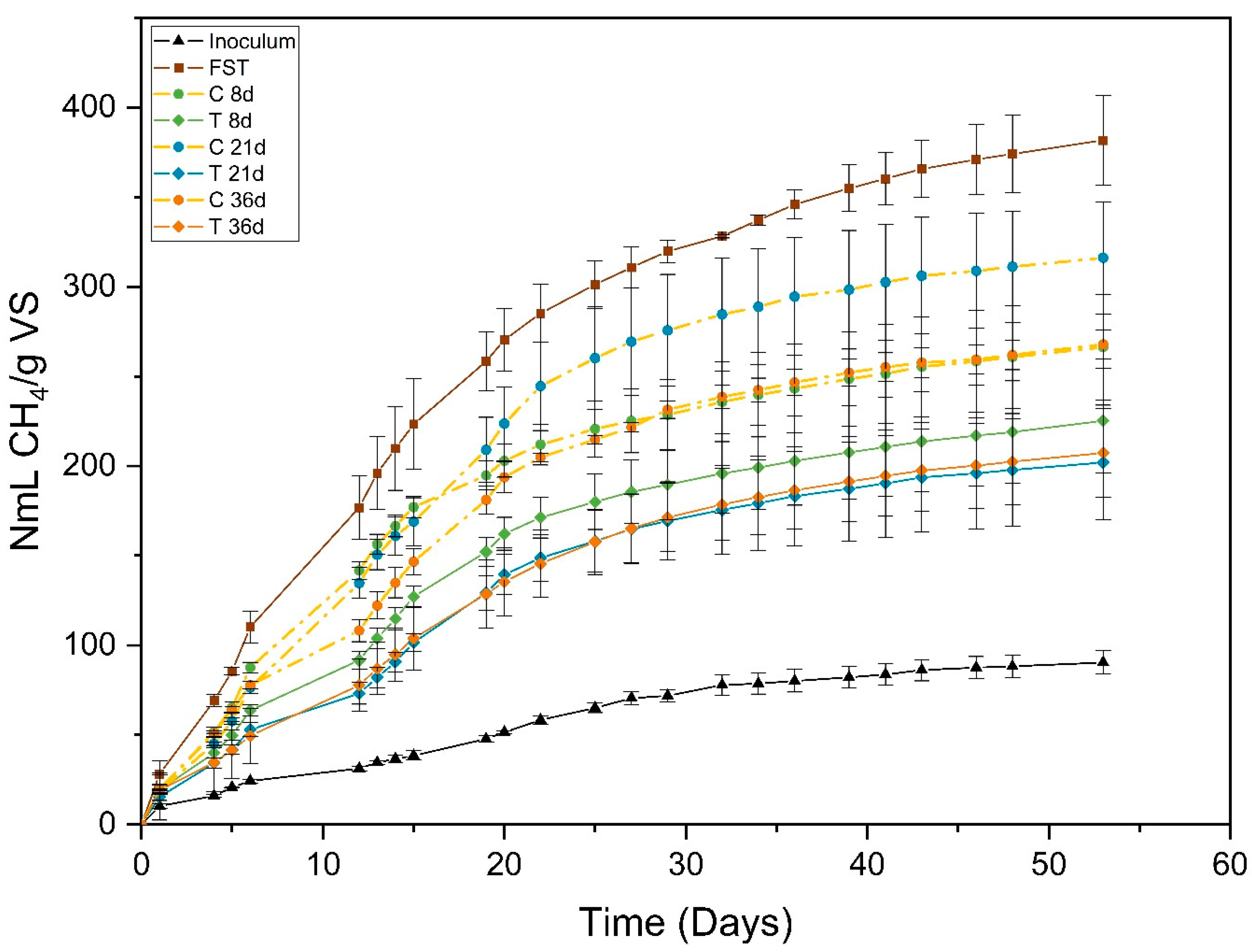
For the methane production test, Cynodon sp. pretreated by solid-state fermentation with T. hirsuta over varying durations was evaluated for its effect on biochemical methane potential (BMP). Cumulative biogas production kinetics are shown in Figure 2. Untreated pruning residue achieved the highest yield, 381.66 ± 24.9 NmL/gVS, followed by the sterilized controls: C 21d at 316.12 ± 31.27, C 36d at 267.72 ± 8.1, and C 8d at 266.23 ± 3.18 NmL/gVS. The pretreated samples showed the lowest methane yields, with T 8d yielding the highest at 225.32 ± 29.2 NmL/gVS, followed by T 36d at 207.31 ± 24.9 and T 21d at 201.9 ± 31.9 NmL/gVS. The inoculum-only production reached 90.84 ± 6.5 NmL/gVS, serving as a baseline for BMP calculations.
This result contrasts with that reported by Mustafa et al. [17], who employed similar autoclave sterilization conditions, followed by solid fermentation with P. ostreatus at 75% moisture content for 20 days at 28 °C on rice straw, resulting in a significant increase in methane production (263 NmL/gVS). The same authors reported that rice straw pre-treated with Trichoderma reesei for 20 days achieved 214 NmL/gVS at 75% moisture content and 28 °C. Similarly, Kainthola et al. [27] demonstrated that pretreatment with P. ostreatus led to a substantial acceleration in the hydrolysis of lignocellulosic biomass, resulting in an enhancement of methane yield from rice straw to 270 mL/gVS compared to the untreated substrate, while Rétfalvi-Szabó et al. [28] observed significant benefits in daily and specific methane yields using fungal pretreatment on poplar biomass (205 mL d−1 L−1 and 44 mL gVS−1 L−1 for pretreated versus 98 mL d−1 L−1 and 26 mL gVS−1 L−1 for control fermenters).
Another important point is that prolonged fermentation times result in lower methane yields. Basinas et al. [12] reported that a 10-day incubation period of SSF with P. ostreatus led to optimal methane production, while longer pretreatments (30 and 60 days) yielded lower methane yields when using corn silage as biomass. This may be attributed to the loss of organic matter during extended fungal growth, which reduces the available substrate for anaerobic digestion [13].
The results with T. hirsuta showed that fermentation times longer than 8 days decreased methane production. These findings are consistent with the observations reported by Jin et al. [29], who noted that a very short pretreatment (3 days) with Trametes sp. W-4 on barley straw increased methane production by 63.81% compared to the control (111.51 mL/gVS vs. 68.07 mL/gVS). The authors concluded that the diminished biogas production observed under longer pretreatment conditions could be attributed to nutrient consumption by the fungus or the production of phenolic compounds, as this strain exhibits high Lac activity that may inhibit methanogen growth or activity.

3.3. Lignin Content and Composition

Furthermore, enzymatic activity is crucial for achieving substantial biogas yields from lignocellulosic biomass. In this study, the degradation of lignin and polysaccharides by T. hirsuta exhibited effective hemicellulose removal, while the degradation rates of cellulose and lignin were consistent with previous reports [30,31]. To explain the results obtained in the present study, fermentation time negatively affected the BMP of Cynodon sp. residues; sugar and lignin content were also analyzed.
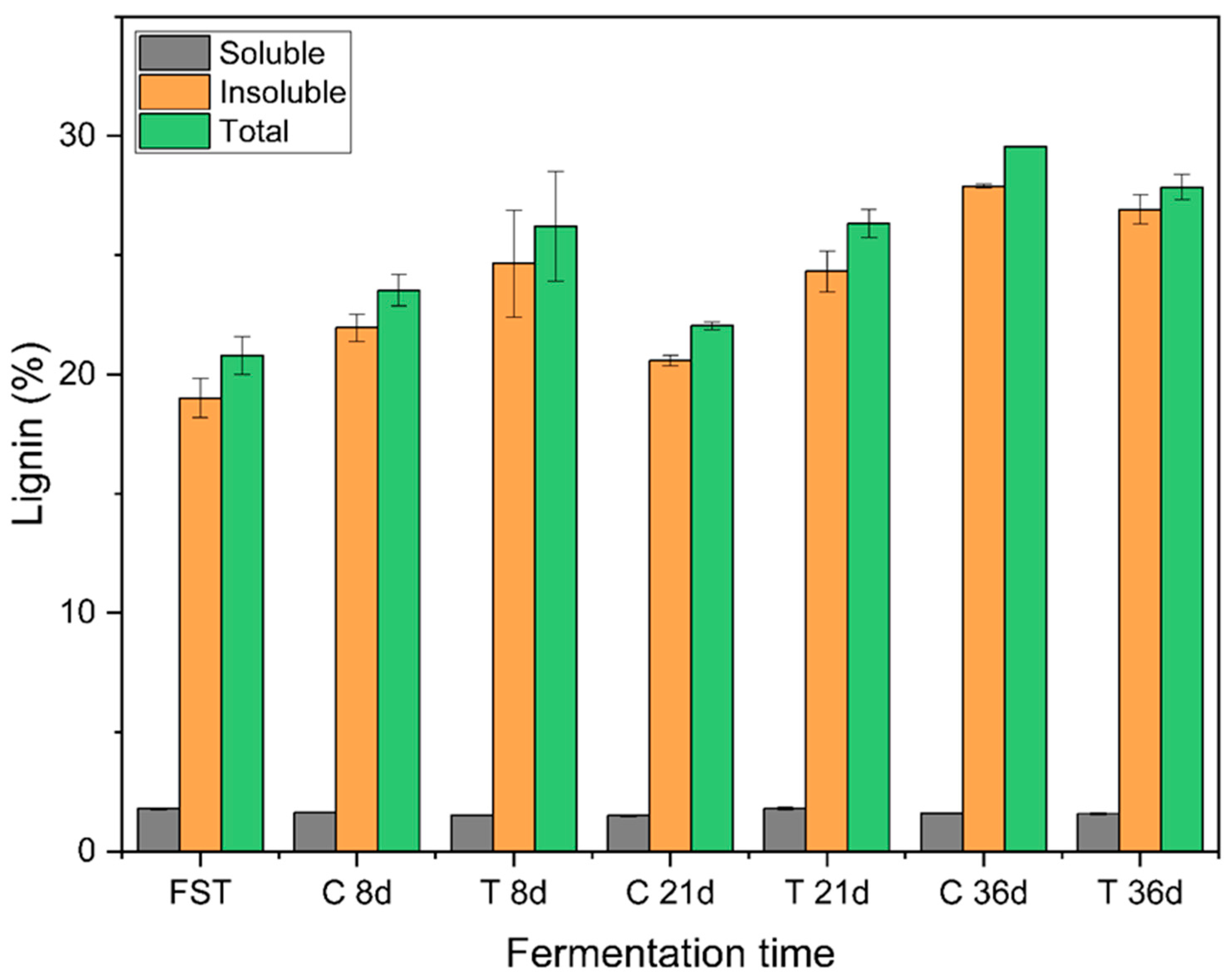
The Lac activity documented in this study was associated with changes in lignin content. Figure 3 shows that total lignin content increased at all experimental time points compared to the feedstock (Cynodon sp. non-sterilized). The lignin content of the feedstock was 20.79 ± 0.78%, while that of C 8d was 23.52 ± 0.65%, and that of T 8d was 25.2 ± 2.2%, representing increases of 2.27 and 5.4%, respectively. At 21 days, C 21d (22.04 ± 0.16%) and T 21d (26.32 ± 0.58%) exhibited increases of 1.24% and 5.52%, respectively. Finally, at 36 days, lignin content was 29.54 ± 0.02% for C 36d and 27.84 ± 0.53% for T 36d, representing increases of 8.75% and 7.05% above the feedstock, respectively.
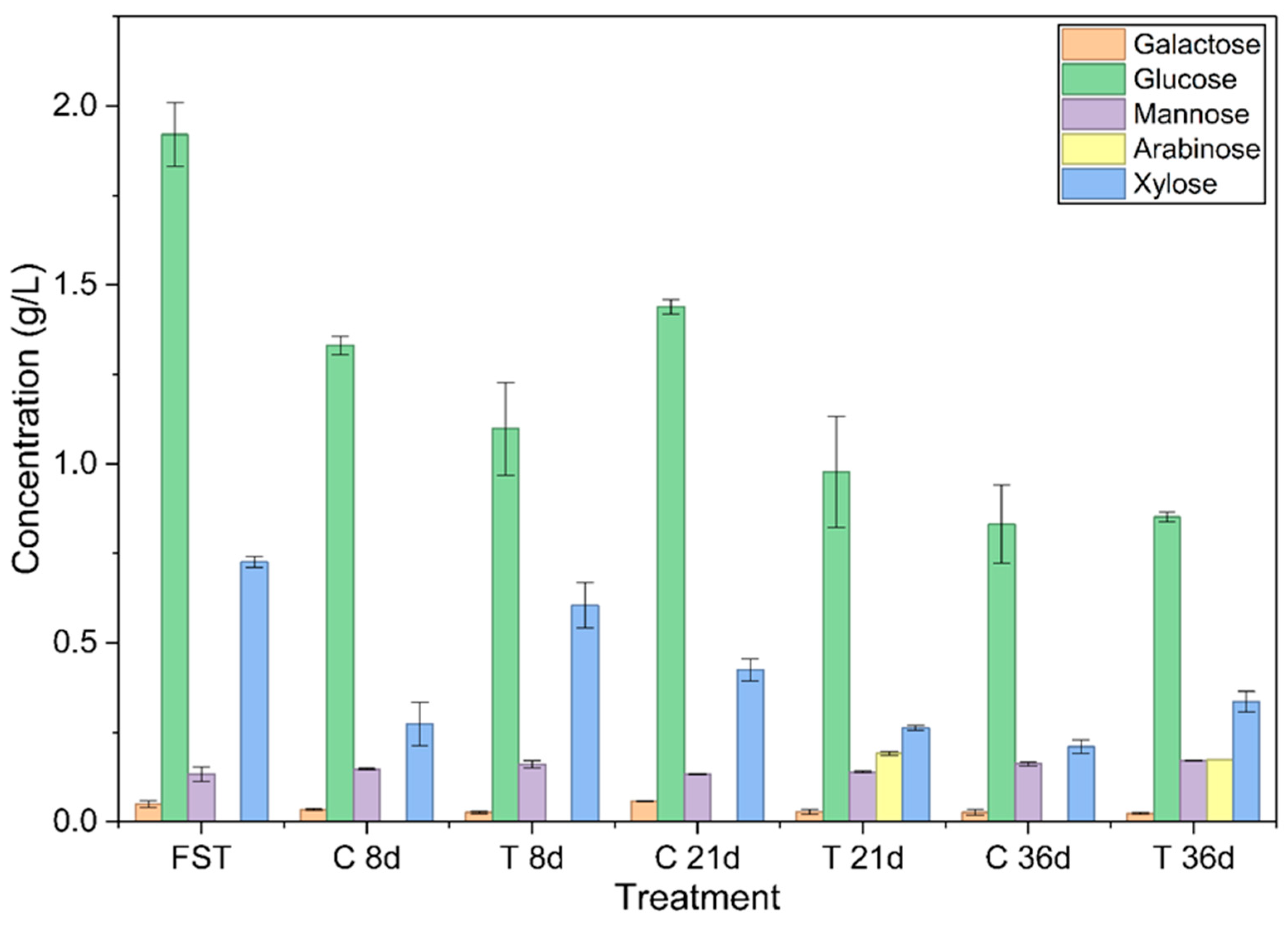
The Klason method reports values expressed as a relative percentage of the total dry weight, not as an absolute concentration; therefore, the apparent increase in lignin content suggests recalcitrant behavior due to the stability of this compound during solid-state fermentation. However, this observation requires careful interpretation. Figure 3 shows that the percentage composition of different lignin types varies with fermentation time points: total and insoluble lignin increase, while soluble lignin remains relatively stable. Untreated pruning residue (20.79 ± 0.78%) had a significantly lower total lignin content than all pretreated samples. The variation in the lignin content trend at C 21 d and the other time controls represents an atypical variation, probably resulting from the initial substrate heterogeneity. This hypothesis is corroborated by the sugar data (Figure 4) and methane production, where C 21 d also deviates from the descending pattern observed in the other controls.
Notably, sterilized controls—which underwent autoclave processing without microbial interaction—maintained higher lignin percentages than untreated samples. This reduction suggests that thermal treatment may induce autohydrolysis or degradation of fermentable sugars.
This phenomenon can be attributed to the formation of pseudo-lignin during thermal processing. Schmatz et al. [32] demonstrated that lignocellulosic biomass treated at elevated temperatures with water or dilute acid promoted the generation of pseudo-lignin and reduced the efficiency of enzymatic hydrolysis. Pseudo-lignin is an aromatic material containing hydroxyl and carbonyl functional groups that contributes to Klason lignin values but is not derived from native lignin; it arises from polymerization/condensation reactions of intermediates such as 3,8-dihydroxy-2-methylchromone and 1,2,4-benzenetriol, which are derived from furfural (FF) and 5-hydroxymethylfurfural (5-HMF), respectively [33,34]. Furthermore, the presence of pseudo-lignin retards biological conversion by unproductive binding to enzymes/microbes and by physically blocking active cellulose surface binding sites.
Maulita et al. [35] investigated lignin structural changes during degradation via physical/chemical pretreatments and T. hirsuta Lac action, demonstrating that chemical treatments generate furanone, apocynin, furfural, hydroxymethylfurfural, and furaldehyde. In contrast, water pretreatment followed by Lac treatment yields additional furan and phenolic degradation products. These results align with reports [13,16,17] that note that although high enzyme production enhances lignin degradation, it also enables fungal metabolism of simpler organic compounds into CO2 and water, ultimately reducing fermentable sugar availability for subsequent anaerobic digestion.

3.4. Free Sugar Composition

The concentrations of simple sugars in Cynodon sp. were evaluated during the solid-state fermentation process. The feedstock sugars without a sterilization process were also assessed (Figure 4). The predominant compounds in all samples were glucose and xylose. The feedstock that had not undergone sterilization had the highest concentrations of glucose (1.92 g/L) and xylose (0.72 g/L), showing significant differences (p < 0.05) from treated samples. Control 2 demonstrated a distinct behavioral pattern in comparison to controls 1 and 3. This variation may be attributed to substrate heterogeneity or uneven thermal exposure.
Glucose levels decreased in both controls and treatments; C1 was 1.4 g/L, C3 was 0.9 g/L, T1 was 1.1 g/L, T2 was 0.95 g/L, and T3 was 0.8 g/L. However, the treatments did not differ significantly from their respective controls. Xylose did not demonstrate a discernible trend between the controls and treatments. The observed reduction in reducing sugar levels can be attributed to abiotic processes, particularly auto-hydrolysis phenomena induced during the sterilization stage. The plant residue of Cynodon sp. was subjected to a thermal treatment in an autoclave (120 °C, 15 psi, 20 min), conditions that, in the presence of moisture, favor spontaneous acid hydrolysis reactions in the absence of external catalysts. The process in question has been shown to yield monosaccharides, such as glucose and xylose. However, it has also been observed to generate secondary degradation products, including acetic acid, furfural, and 5-hydroxymethylfurfural (5-HMF). These byproducts can reduce the availability of fermentable carbon, thereby hindering the efficiency of anaerobic digestion processes, particularly at elevated concentrations [36,37].
Another abiotic factor, such as sunlight exposure, could induce chemical transformations affecting sugar stability. In their study, Mozafari et al. [38] examined the impact of diverse drying techniques on the phytochemical composition of Cynodon dactylon leaves and rhizomes. The study identified the formation of compounds such as 5-hydroxymethylfurfural (5-HMF) and maltol, which are derived from the thermal degradation of sugars during drying, confirming that even moderate thermal conditions can induce dehydration and oxidation reactions of hexoses.
The decrease in glucose levels observed during SSF can also be attributed to fungal consumption. It has been reported that T. hirsuta synthesizes ligninolytic enzymes during the secondary metabolism phase, after simple sugars are consumed. Furthermore, fungal growth stages affect the synthesis and secretion of both intracellular and extracellular enzymes [39]. The fungus may metabolize liberated sugars for biomass production and enzyme synthesis, thereby reducing the fermentable substrate available for methanogenesis.

3.5. Mechanisms of Inhibition and Hypotheses

The low biogas production observed in this study is primarily attributable to the limited availability of fermentable sugars for anaerobic digestion. However, some assays showed sugar levels comparable to or even exceeding those of the control. Nonetheless, this did not result in an elevated methane yield. This could be due to the presence of inhibitory compounds generated during pretreatment, such as furfural and hydroxymethylfurfural (HMF), as well as lignin- and hemicellulose-derived phenolic derivatives identified by Maulita et al. [35] as fermentation inhibitors. Similarly, Monlau et al. [36] demonstrated that different concentrations of furanic and phenolic compounds can affect methanogenesis in an anaerobic mixed culture. Furthermore, mushrooms are known to synthesize various secondary metabolites with potent antimicrobial and antibacterial properties, which support their natural survival [40]. In particular, species belonging to the genus Trametes have been reported to produce high levels of bioactive compounds, including phenols, flavonoids, saponins, and anthraquinones, which exhibit recognized antimicrobial activity [41]. The presence of these metabolites may suppress methanogenic activity despite the availability of sugars. Additionally, Tan et al. [42] reviewed the inhibition and disinhibition effects of 5-hydroxymethylfurfural in anaerobic fermentation, noting that this compound can inhibit hydrogen and methane production, interfere with microbial growth, and alter the structure of the microbial community in anaerobic sludge.
In this study, solid-state fermentation pretreatment with T. hirsuta was found to reduce methane production in anaerobic digestion tests of Cynodon sp. The following four hypotheses were considered: (i) the reduced availability of sugars due to fungal consumption during prolonged SSF, (ii) transformation of sugars into inhibitory compounds such as furfural or HMF during thermal processing, (iii) production of phenolic compounds and secondary metabolites by T. hirsuta that inhibit the activity of methanogenic archaea, or (iv) formation of pseudo-lignin during autoclave sterilization, which has been observed to mask true lignin degradation and creates additional physical barriers to enzymatic attack.

4. Conclusions

In summary, the effectiveness of biological pretreatment with T. hirsuta depends on critical parameters, such as fermentation time. These parameters determine the extent of delignification and the availability of soluble sugars for subsequent anaerobic conversion. Although high Lac activity was achieved, the theoretical benefits of lignin degradation were negated by a combination of biotic and abiotic factors: the simultaneous consumption of fermentable sugars by fungal metabolism and the formation of inhibitory compounds and pseudo-lignin during thermal sterilization. The findings of this study underscore the complexity of optimizing fungal pretreatment for anaerobic digestion. They further underscore the need to balance enzymatic lignin modification with the preservation of fermentable carbohydrates. Consequently, future scaling efforts and research should focus on reducing pre-treatment times or establishing non-sterile conditions to avoid thermal degradation and maximize biomethane yields.

Author Contributions

Conceptualization, S.H.-S. and O.R.-N.; methodology, P.G.-M., O.R.-N. and S.H.-S.; software, P.G.-M.; validation, S.H.-S., J.L.-S., J.C.G.-M., P.G.-M. and O.R.-N.; formal analysis, S.H.-S., J.L.-S. and O.R.-N.; investigation, S.H.-S., J.L.-S. and O.R.-N.; resources, O.R.-N.; data curation, S.H.-S., J.L.-S., J.C.G.-M., P.G.-M. and O.R.-N.; writing—original draft preparation, S.H.-S., J.L.-S. and O.R.-N.; writing—review and editing, J.L.-S., J.C.G.-M. and O.R.-N.; visualization, S.H.-S., J.L.-S., J.C.G.-M., P.G.-M. and O.R.-N.; supervision, O.R.-N.; project administration, O.R.-N.; funding acquisition, O.R.-N. All authors have read and agreed to the published version of the manuscript.

Funding

This research was funded by the Secretaría de Educación, Ciencia, Tecnología e Innovación (SECTEI) de la Ciudad de México, grant number SECTEI/033/2024, And The APC was funded by the Instituto Politécnico Nacional.

Institutional Review Board Statement

Not applicable.

Informed Consent Statement

Not applicable.

Data Availability Statement

The data presented in this study are available on request from the corresponding author due to privacy concerns related to the patenting process or future collaborations.

Acknowledgments

The authors extend their sincere gratitude to the Secretaría de Educación, Ciencia, Tecnología e Innovación (SECTEI) de la Ciudad de México for their support in the completion of this research work under project SECTEI/033/2024.

Conflicts of Interest

The authors declare no conflicts of interest.

References

  1. Du, L.; Wei, C.; Cai, S. Economic development and carbon dioxide emissions in China: Provincial panel data analysis. China Econ. Rev. 2012, 23, 371–384. [Google Scholar] [CrossRef]
  2. IRENA. Renewable Power Generation Costs in 2021; International Renewable Energy Agency, Ed.; IRENA: Abu Dhabi, United Arab Emirates, 2022. [Google Scholar]
  3. Silpa, K.; Yao, L.C. What a Waste 2.0: A Global Snapshot of Solid Waste Management to 2050; World Bank Publications: Washington, DC, USA, 2018. [Google Scholar]
  4. Harindintwali, J.D.; Wang, F.; Yang, W.; Zhou, J.; Muhoza, B.; Mugabowindekwe, M.; Yu, X. Harnessing the power of cellulolytic nitrogen-fixing bacteria for biovalorization of lignocellulosic biomass. Ind. Crops Prod. 2022, 186, 115235. [Google Scholar] [CrossRef]
  5. Jain, T.; VanGerpen, J. Criteria for Locating a Lignocellulosic Ethanol Plant in Idaho; 2010 Pittsburgh, Pennsylvania, 20–23 June 2010; American Society of Agricultural and Biological Engineers: St. Joseph, MI, USA, 2010. [Google Scholar]
  6. Qin, L.; Li, O.L. Recent progress of low-temperature plasma technology in biorefining process. Nano Converg. 2023, 10, 38. [Google Scholar] [CrossRef]
  7. Kresnowati, M.T.A.P.; Januardi, D.C.; Utomo, S.V. Estimation of xylose recovery from lignocellulosic biomass. IOP Conf. Ser. Mater. Sci. Eng. 2021, 1143, 012022. [Google Scholar] [CrossRef]
  8. Caroca, E.; Elorrieta, M.; Palma, C.; Navia, D.; Lebrero, R.; Carvajal, A. Lignocellulosic residue valorization in a sequential process of solid-state fermentation and solid substrate anaerobic digestion. J. Chem. Technol. Biotechnol. 2022, 97, 1575–1584. [Google Scholar]
  9. Zhang, Y.; Chen, M.; Guo, J.; Liu, N.; Yi, W.; Yuan, Z.; Zeng, L. Study on dynamic changes of microbial community and lignocellulose transformation mechanism during green waste composting. Eng. Life Sci. 2022, 22, 376–390. [Google Scholar] [CrossRef]
  10. Arreola-Vargas, J.; Ojeda-Castillo, V.; Snell-Castro, R.; Corona-González, R.I.; Alatriste-Mondragón, F.; Méndez-Acosta, H.O. Methane production from acid hydrolysates of Agave tequilana bagasse: Evaluation of hydrolysis conditions and methane yield. Bioresour. Technol. 2015, 181, 191–199. [Google Scholar] [CrossRef]
  11. Valdebenito, F.; Ramírez-Álvarez, R.; Muñoz, M.A.; Pecchi, G.; Canales, R.; Ormazabal, S.; Muñoz, R.; Alejandro-Martín, S.; Quero, F.; Adam, R.; et al. Biomass characterization and solvent extraction as tools to promote phenol production from urban pruning. Fuel 2024, 362, 130830. [Google Scholar] [CrossRef]
  12. Basinas, P.; Chamrádová, K.; Rusín, J.; Kaldis, S.P. Anaerobic digestion performance and kinetics of biomass pretreated with various fungal strains utilizing exponential and sigmoidal equation models. Renew. Energy 2024, 235, 121390. [Google Scholar] [CrossRef]
  13. Albornoz, S.; Wyman, V.; Palma, C.; Carvajal, A. Understanding of the contribution of the fungal treatment conditions in a wheat straw biorefinery that produces enzymes and biogas. Biochem. Eng. J. 2018, 140, 140–147. [Google Scholar] [CrossRef]
  14. Méndez-Hernández, J.E.; Loera, O. Biotechnological potential of ligninolytic enzymes for pollutant biodegradation in water: From test tubes to pilot-scale enzymatic reactors. Rev. Mex. Ing. Quim. 2018, 18, 397–417. [Google Scholar] [CrossRef]
  15. Fan, J.; Lu, Y.; An, N.; Zhu, W.; Li, M.; Gao, M.; Wang, X.; Wu, C.; Wang, Y. Pretreatment technologies for lignocellulosic biomass: Research progress, mechanisms, and prospects. Bioresources 2025, 20, 4897. [Google Scholar] [CrossRef]
  16. Chablé-Villacis, R.; Olguin-Maciel, E.; Toledano-Thompson, T.; Alzate-Gaviria, L.; Ruiz, H.A.; Tapia-Tussell, R. Enzymatic hydrolysis assisted with ligninocellulolytic enzymes from Trametes hirsuta produced by pineapple leaf waste bioconversion in solid-state fermentation. Biomass Convers. Biorefin. 2021, 13, 9095–9106. [Google Scholar] [CrossRef]
  17. Mustafa, A.M.; Poulsen, T.G.; Sheng, K. Fungal pretreatment of rice straw with Pleurotus ostreatus and Trichoderma reesei to enhance methane production under solid-state anaerobic digestion. Appl. Energy 2016, 180, 661–671. [Google Scholar] [CrossRef]
  18. Mustafa, A.M.; Poulsen, T.G.; Xia, Y.; Sheng, K. Combinations of fungal and milling pretreatments for enhancing rice straw biogas production during solid-state anaerobic digestion. Bioresour. Technol. 2017, 224, 174–182. [Google Scholar] [CrossRef]
  19. Montoya, S.; Patiño, A.; Sánchez, Ó.J. Production of lignocellulolytic enzymes and biomass of Trametes versicolor from Agro-industrial residues in a novel fixed-bed bioreactor with natural convection and forced aeration at pilot scale. Processes 2021, 9, 397. [Google Scholar] [CrossRef]
  20. Sivakumar, S.; Palsamy, P.; Subramanian, S.P. Impact of D-pinitol on the attenuation of proinflammatory cytokines, hyperglycemia-mediated oxidative stress and protection of kidney tissue ultrastructure in streptozotocin-induced diabetic rats. Chem. Biol. Interact. 2010, 188, 237–245. [Google Scholar] [CrossRef]
  21. Camarillo Ravelo, D.; Loera Corral, O.; González-Martínez, I.; Chan Cupul, W.; Rodríguez Nava, C.O. Evaluation of bezafibrate, gemfibrozil, indomethacin, sulfamethoxazole, and diclofenac removal by ligninolytic enzymes. Prep. Biochem. Biotechnol. 2020, 50, 592–597. [Google Scholar] [CrossRef]
  22. Sluiter, J.; Sluiter, A.; Scarlata, C.; Templeton, D.; Crocker, D.; Hames, B. Determination of Structural Carbohydrates and Lignin in Biomass; Laboratory Analytical Procedure (LAP); National Renewable Energy Laboratory: Golden, CO, USA, 2012. [Google Scholar]
  23. Rovio, S.; Yli-Kauhaluoma, J.; Sirén, H. Determination of neutral carbohydrates by CZE with direct UV detection. Electrophoresis 2007, 28, 3129–3135. [Google Scholar] [CrossRef]
  24. Angelidaki, I.; Alves, M.; Bolzonella, D.; Borzacconi, L.; Campos, J.L.; Guwy, A.J.; Kalyuzhnyi, S.; Jenicek, P.; Van Lier, J.B. Defining the biomethane potential (BMP) of solid organic wastes and energy crops: A proposed protocol for batch assays. Water Sci. Technol. 2009, 59, 927–934. [Google Scholar] [CrossRef] [PubMed]
  25. Schroyen, M.; Vervaeren, H.; Vandepitte, H.; Van Hulle, S.W.H.; Raes, K. Effect of enzymatic pretreatment of various lignocellulosic substrates on production of phenolic compounds and biomethane potential. Bioresour. Technol. 2015, 192, 696–702. [Google Scholar] [CrossRef]
  26. Wyman, V.; Henríquez, J.; Palma, C.; Carvajal, A. Lignocellulosic waste valorisation strategy through enzyme and biogas production. Bioresour. Technol. 2018, 247, 402–411. [Google Scholar] [CrossRef]
  27. Kainthola, J.; Kalamdhad, A.S.; Goud, V.V.; Goel, R. Fungal pretreatment and associated kinetics of rice straw hydrolysis to accelerate methane yield from anaerobic digestion. Bioresour. Technol. 2019, 286, 121368. [Google Scholar] [CrossRef]
  28. Rétfalvi-Szabó, P.; Lakatos, F.; Jakab, J.; Rétfalvi, T. Boosting Methane Production by Fungal Pretreatment of Poplar in Anaerobic Digestion. Chem. Eng. Trans. 2023, 107, 661–666. [Google Scholar]
  29. Jin, X.; Wei, S. Efficient short time pretreatment on lignocellulosic waste using an isolated fungus Trametes sp. W-4 for the enhancement of biogas production. Heliyon 2023, 9, e14573. [Google Scholar] [CrossRef] [PubMed]
  30. Kainthola, J.; Podder, A.; Fechner, M.; Goel, R. An overview of fungal pretreatment processes for anaerobic digestion: Applications, bottlenecks and future needs. Bioresour. Technol. 2021, 321, 124397. [Google Scholar] [CrossRef] [PubMed]
  31. Noonari, A.A.; Mahar, R.B.; Sahito, A.R.; Brohi, K.M. Effects of isolated fungal pretreatment on bio-methane production through the co-digestion of rice straw and buffalo dung. Energy 2020, 206, 118107. [Google Scholar]
  32. Schmatz, A.A.; Tyhoda, L.; Brienzo, M. Sugarcane biomass conversion influenced by lignin. Biofuel Bioprod. Biorefin. 2020, 14, 469–480. [Google Scholar]
  33. Hu, F.; Jung, S.; Ragauskas, A. Impact of pseudolignin versus dilute acid-pretreated lignin on enzymatic hydrolysis of cellulose. ACS Sust. Chem. Eng. 2013, 1, 62–65. [Google Scholar]
  34. Li, J.; Henriksson, G.; Gellerstedt, G. Lignin depolymerization/repolymerization and its critical role for delignification of aspen wood by steam explosion. Biores. Technol. 2007, 98, 3061–3068. [Google Scholar]
  35. Maulita, F.; Meryandini, A.; Yanto, D.H.Y.; Listiyowati, S.; Oktaviani, M.; Nurhayat, O.D. Enzymatic degradation of oil palm empty fruit bunch fiber using laccase from Trametes hirsuta EDN 082. In AIP Conference Proceedings; AIP Publishing: Melville, NY, USA, 2025; p. 020048. [Google Scholar]
  36. Monlau, F.; Sambusiti, C.; Barakat, A.; Quéméneur, M.; Trably, E.; Steyer, J.P.; Carrère, H. Do furanic and phenolic compounds of lignocellulosic and algae biomass hydrolyzate inhibit anaerobic mixed cultures? A comprehensive review. Biotechnol. Adv. 2014, 32, 934–951. [Google Scholar] [CrossRef]
  37. Chen, Q.; Chen, K.; Wang, K.; Ma, J.; Yang, H.; Chen, J. The effects of time and temperature in hydrothermal pretreatment on the enzymatic efficiency of wheat straw. Bioresources 2018, 13, 5193–5203. [Google Scholar] [CrossRef]
  38. Mozafari, A.A.; Vafaee, Y.; Shahyad, M. Phytochemical composition and in vitro antioxidant potential of Cynodon dactylon leaf and rhizome extracts as affected by drying methods and temperatures. J. Food Sci. Technol. 2018, 55, 2220–2229. [Google Scholar] [CrossRef] [PubMed]
  39. Janusz, G.; Kucharzyk, K.H.; Pawlik, A.; Staszczak, M.; Paszczynski, A.J. Fungal laccase, manganese peroxidase and lignin peroxidase: Gene expression and regulation. Enzyme Microb. Technol. 2013, 52, 1–12. [Google Scholar] [CrossRef] [PubMed]
  40. Yadav, D.; Negi, P.S. Bioactive components of mushrooms: Processing effects and health benefits. Food Res. Int. 2021, 148, 110599. [Google Scholar] [CrossRef]
  41. Srivastava, M.; Kumari, M.; Karn, S.K.; Bhambri, A.; Mahale, V.G.; Mahale, S. Submerged cultivation and phytochemical analysis of medicinal mushrooms (Trametes sp.). Front. Fungal Biol. 2024, 5, 1414349. [Google Scholar] [CrossRef] [PubMed]
  42. Tan, Z.; Li, X.; Yang, C.; Liu, H.; Cheng, J.J. Inhibition and disinhibition of 5-hydroxymethylfurfural in anaerobic fermentation: A review. Chem. Eng. J. 2021, 424, 130560. [Google Scholar] [CrossRef]
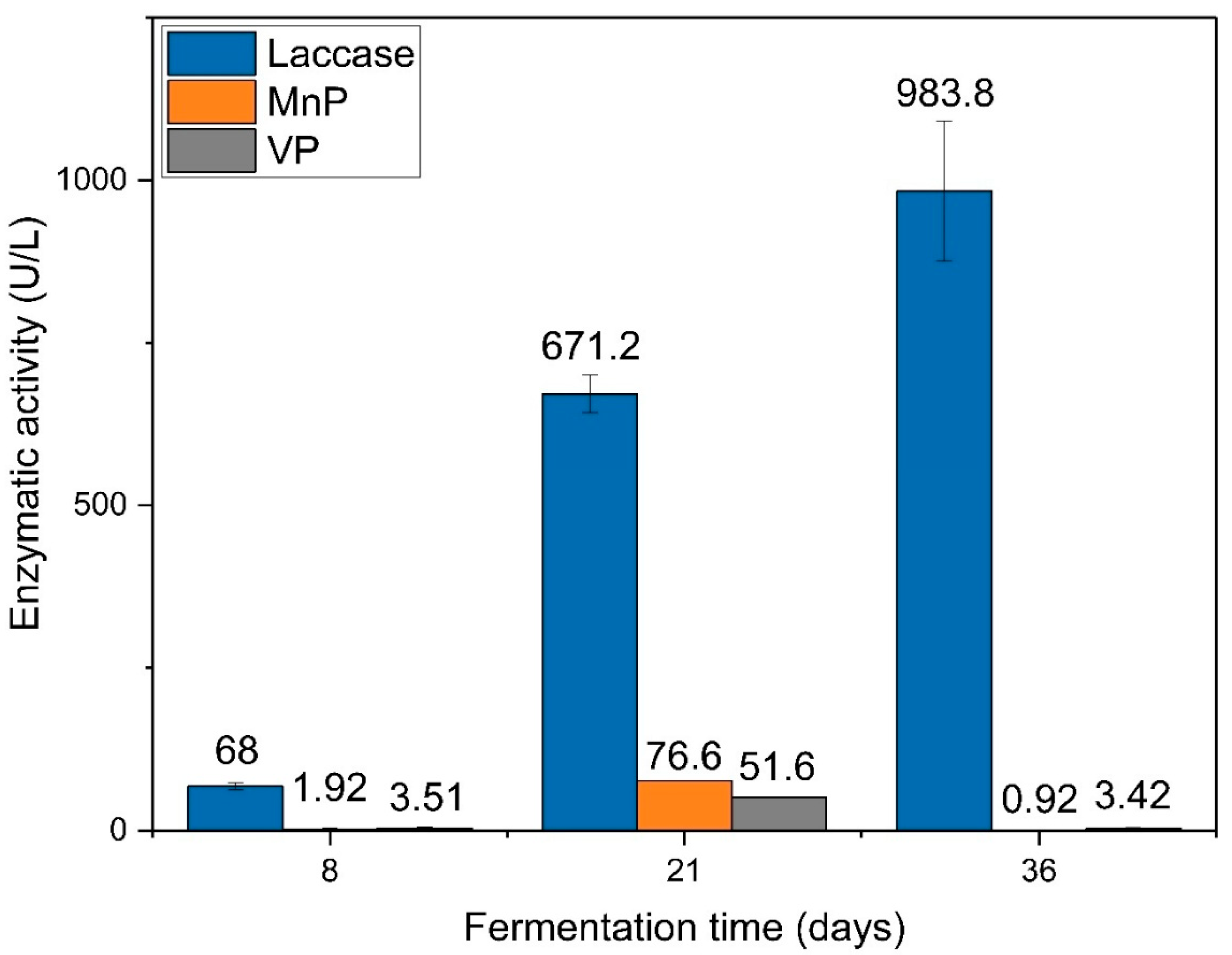
Figure 1. Enzymatic production by Trametes hirsuta during solid-state fermentation of Cynodon sp. at different times (8, 21, and 36 days): Lac (blue), manganese peroxidase (orange), and versatile peroxidase (gray) activities (U/L).
Fermentation 12 00217 g001
Figure 2. Cumulative biogas production from different substrates: Untreated Cynodon sp. (FST), time-control samples (C 8d, C 21d, C 36d; yellow), and solid-state fermented substrates at 8 (T 8d; green), 21 (T 21d; blue), and 36 (T 36d; orange) days.
Fermentation 12 00217 g002
Figure 3. Soluble, insoluble, and total lignin content (%) at different pretreatment times: untreated substrate (FST), sterilized controls (C 8d, C 21d, C 36d), and fungal-treated samples (T8, T21, T36) following solid-state fermentation.
Fermentation 12 00217 g003
Figure 4. Changes in the composition of different sugars during SSF pretreatment at different times, along with their respective controls, including the residue without pretreatment, and their significant differences (p < 0.05).
Fermentation 12 00217 g004
Disclaimer/Publisher’s Note: The statements, opinions and data contained in all publications are solely those of the individual author(s) and contributor(s) and not of MDPI and/or the editor(s). MDPI and/or the editor(s) disclaim responsibility for any injury to people or property resulting from any ideas, methods, instructions or products referred to in the content.