Article

Bioremediation and Biofuel Production Potential of Microalgae and Cyanobacteria from Lake Xochimilco


by
Nancy Nayeli Domínguez-Alfaro
1,
Mónica Cristina Rodríguez-Palacio
2,
Diana Guerra-Ramírez
3 and
Patricia Castilla-Hernández
4,*
1
Doctorado en Ciencias Biológicas y de la Salud, Universidad Autónoma Metropolitana, Mexico City C.P. 14386, Mexico
2
Laboratorio de Ficología Aplicada, Departamento de Hidrobiología, Universidad Autónoma Metropolitana-Iztapalapa, Av. Ferrocarril San Rafael Atlixco 186, Col. Leyes de Reforma 1 A Sección, Iztapalapa, Mexico City C.P. 09310, Mexico
3
Laboratorio de Productos Naturales, Departamento de Preparatoria Agrícola, Universidad Autónoma Chapingo, km 38.5 Carretera México-Texcoco, Texcoco de Mora C.P. 56230, Mexico
4
Laboratorio de Biotecnología Ambiental, Departamento El Hombre y su Ambiente, Universidad Autónoma Metropolitana–Xochimilco, Calzada del Hueso 1100, Col. Villa Quietud, Coyoacán, Mexico City C.P. 04960, Mexico
*
Author to whom correspondence should be addressed.
Fermentation 2026, 12(5), 209; https://doi.org/10.3390/fermentation12050209
Submission received: 16 March 2026 / Revised: 18 April 2026 / Accepted: 18 April 2026 / Published: 22 April 2026
(This article belongs to the Special Issue Cyanobacteria and Eukaryotic Microalgae (2nd Edition))

Abstract

Microalgae and cyanobacteria are photosynthetic microorganisms capable of removing nutrients from eutrophic waters and producing biomass. Therefore, the aim of this study was to evaluate the bioremediation performance of three microalgae and one cyanobacterium native to Lake Xochimilco and to assess their potential for biofuel production (biodiesel and biogas) from biomass generated. In photobioreactors, ammonium (96.61–97.06%), nitrate (82.4–100%), and phosphate (83.95–89.71%) were effectively removed from the lake water. The specific growth rates ranged from 0.041 to 0.144 d−1 and biomass productivities from 0.016 to 0.049 g L−1 d−1, with high biomass yield on the substrate. The estimated CO2 fixation rates ranged from 0.024 to 0.092 g L−1 d−1. Chlorella sp. achieved the highest yield of fatty acid methyl esters (FAMEs) with 91.24% of the extracted lipids. Overall, saturated FAMEs were predominant in the biodiesel; however, the presence of monounsaturated FAMEs such as methyl palmitoleate and methyl oleate enhances their fluidity and oxidative stability. Synechocystis sp. and Chlorella sp. produced the most biogas using biomass after lipid extraction, at 429.5 L kg−1 VS and 404.9 L kg−1 VS, respectively, with over 60% biomethane. These strains represent a sustainable and promising possibility for water bioremediation and generating biofuels.

1. Introduction

Water pollution is a global problem that impacts the supply of drinking water and harms aquatic and terrestrial life [1]. The discharge of municipal wastewater into water bodies leads to environmental problems. It increases the presence of various forms of nitrogen (ammonium, nitrite, nitrate) and phosphorus (e.g., phosphate), which ultimately leads to eutrophication [2]. Consequently, this results in the excessive proliferation of certain photosynthetic microorganisms such as microalgae and cyanobacteria. These microorganisms are part of microbial diversity and play an important role in the natural purification of water bodies under favorable conditions.
Phycoremediation is a bioremediation process that uses macro- and microalgae to remove nutrients from the environment and restore contaminated sites. It is an ideal and ecofriendly alternative that also simultaneously captures and stores CO2, a greenhouse gas [1,3,4]. Cyanobacteria also have the potential for bioremediation [5,6]. The use of microalgae and cyanobacteria for this purpose represents a sustainable alternative with added benefits. This is because the biomass from these microorganisms contains compounds such as peptides, carbohydrates, lipids, pigments, vitamins, and minerals, which are valuable in medicine, human and animal nutrition, aquaculture, and agriculture [7,8].
Microalgae and cyanobacteria are also sources for the generation of biofuels such as bioethanol, biomethane, and biodiesel [9,10]. Microalgae have been extensively studied for their ability to produce oils (triglycerides) and carbohydrates, which are precursors of biodiesel and biomethane. Biofuels derived from microbial and microalgal biomass are classified as third-generation biofuels [11] and represent an environmentally friendly energy alternative [7]. Examples of species that typically contain a higher amount of lipids and are therefore excellent candidates for the industrial production of biodiesel include Chlorella vulgaris and Tetradesmus obliquus (formerly Scenedesmus obliquus), which contain 30–48% of lipids by dry weight [12]. Cyanobacteria are also capable of producing lipids, with yields ranging from 0.4 to 45% depending on the species. Among these, Nostoc sp. and Limnotrix sp. are considered the most promising [8,13]. The biomass from these photosynthetic microorganisms, after lipid extraction, can be used to generate biomethane. The biomethane content in biogas is around 60%, with a yield of 400 L Kg−1 VS from raw biomass [14,15].
Native strains from contaminated sites are already adapted to these environmental conditions [16]. Strains isolated from these environments are frequently better suited for bioremediation processes, because they have undergone natural selection under fluctuating physicochemical conditions, including high nutrient loads, variable light intensity, and microbial competition. This ecological adaptation enables native microorganisms to exhibit enhanced resilience, metabolic efficiency, and stability when reintroduced into similar environments, reducing the need for long acclimation periods. Furthermore, locally adapted microalgae and cyanobacteria tend to maintain higher nutrient removal efficiencies and biomass productivity under real wastewater conditions compared with non-native or model strains [17,18], making them promising candidates for biofuel production.
Lake Xochimilco is situated in Mexico City and is renowned for its canals and chinampas—floating gardens—used for agriculture. It is an important site due to its rich biodiversity and is recognized as a protected area, a cultural heritage site, and a source of livelihood for the local community [19]. Among the photosynthetic microorganisms inhabiting the lake due to its eutrophic state, cyanobacteria and microalgae such as chlorophytes, euglenophytes, and diatoms stand out, playing a crucial role in the production of oxygen and forming the base of the aquatic food chain [20,21]. The lake’s ongoing trophic status encourages the exploration of sustainable alternatives to improve its condition. Thus, the aim of this study was to evaluate the bioremediation performance of three microalgae and one cyanobacterium native to Lake Xochimilco, followed by assessing the biofuel production potential (biodiesel and biogas) from the biomass generated during bioremediation. This study demonstrates that native strains of microalgae and cyanobacteria from Lake Xochimilco can be used for water bioremediation, highlighting Synechocystis sp. and Chlorella sp. due to their favorable balance between nutrient removal and energy recovery potential.

2. Materials and Methods

2.1. Bioremediation Assays

Four native strains from Lake Xochimilco were used for phycoremediation: Chlorella sp., isolated from the Cuemanco Canal, where the Center of Biological and Aquaculture Research of Cuemanco (CIBAC) is located; Chlamydomonas sp. and Scenedesmus sp. from Tlilac Lagoon; and Synechocystis sp. from the Cuemanco Wharf.
The strains were maintained individually using a commercial fertilizer Bayfolan® Forte (Bayer AG, Leverkusen, Germany) as a culture medium, with 1 mL of fertilizer added per liter of distilled water, as previously reported [22]. The composition of Bayfolan® Forte (% w/v) was as follows: 11.47 total nitrogen (N), 8.0 phosphoric oxide (P2O5), 6.0 potassium oxide (K2O), 0.025 calcium oxide (CaO), 0.230 sulfur (S), 0.050 iron (Fe), 0.080 zinc (Zn), 0.040 copper (Cu), 0.036 boron (B), 0.005 molybdenum (Mo), and 0.002 cobalt (Co), supplemented with 0.004 thiamine hydrochloride.
Phycoremediation assays for each strain were conducted using 4 L photobioreactors with 10% inoculum. Water from the Cuemanco Canal—CIBAC, previously sterilized using UV light (1 h d−1 for 3 d), with pH 7.6 and a salinity < 0.5 PSU, was used as the culture medium. The strains in the photobioreactors were maintained under continuous aeration at a flow rate of 2.0 L min−1 using aquarium air pumps and 12 h light–dark cycles, with the light supplied by white T8 fluorescent lamps (40 W, 50–90 µmol m−2 s−1); the photobioreactors were maintained at ambient temperature (21.9 ± 7.9 °C). The experiments were conducted in duplicate (n = 2), although a greater number of replications would have been desirable.
Every third day over a 26-day period, the following nutrients were quantified using the colorimetric methods described by the APHA [23]: ammonium nitrogen (NH4+-N), nitrate nitrogen (NO3-N), and phosphorus as phosphate (PO43−-P). Hereafter, these are referred to simply by the name of the ion. Cell counts were performed using a Neubauer chamber, and initial and final biomass concentrations were determined by dry weight. Biomass productivity, biomass yield on substrate, specific growth rate, and estimated CO2 biofixation rate were subsequently calculated.

2.2. Production and Characterization of Fatty Acid Methyl Esters (FAMEs)

The lipid content of the biomass harvested after phycoremediation was exhaustively extracted using chloroform in a Soxtec™ Automatic System (Model 2050) (Foss, Hillerød, Denmark) for 15 min over five cycles. The solvent temperature during extraction corresponded to the boiling point of chloroform (approximately 61–62 °C at atmospheric pressure). To determine the fatty acid composition of the extracted lipids, fatty acid methyl esters (FAMEs), commonly referred to as the biodiesel fraction, were obtained via esterification reactions, followed by biodiesel production via transesterification, according to the procedure described by López-Yerena et al. [24]. For esterification, the sample was first mixed with a 5% H2SO4-acidified methanol solution at a 1:8 w/v ratio. The reaction mixture was then refluxed for 2 h at 60 °C. Subsequently, it was transferred to a separatory funnel, where the upper phase, containing sulfuric acid, excess alcohol, and impurities, was removed. The remaining lower phase was washed until it reached a neutral pH and dried with anhydrous sodium sulfate. The transesterification reaction was carried out using a 6:1 M ratio of methanol/esterified oil and 0.7% KOH w/w (of esterified oil); the mixture was refluxed for 1 h at 70 °C. Then, the reaction mixture was transferred into a separatory funnel, which yielded two separate phases. The upper phase contained the FAMEs, and the lower phase contained glycerol with impurities. After discarding the lower phase, the upper phase was washed with hot water (40 °C). Finally, the FAMEs were dried using anhydrous sodium sulfate and analyzed using a gas chromatograph 6890 (Agilent Technologies, INC. Wilmington, DE, USA) equipped with a flame ionization detector (FID) and an ATSilar column (30 m, 0.25 mm internal diameter, 0.25 µm film thickness). The initial oven temperature was 170 °C, increasing at 10 °C per minute to a final temperature of 240 °C. The temperature of the injector and detector was 260 °C. Hydrogen was used as the carrier gas at a flow rate of 1.8 mL min−1. A standard mixture of 37 FAMEs was used for their identification and relative compositional analysis in the sample. Biodiesel quality was assessed based on FAME composition, which was expressed as the relative percentage of total fatty acids.

2.3. Biogas Production Assays

Anaerobic digestion reactors with a total volume of 60 mL were used, comprising a 20 mL headspace and a 40 mL working volume. The substrate-to-inoculum ratio was 1.0 (0.4 g volatile solids [VS] each). The biomass remaining after lipid extraction from each harvested strain during the phycoremediation process was used as the substrate. The inoculum consisted of 25% cow manure obtained from a cattle farm located in the Municipality of Chalco (State of Mexico) and 75% anaerobic sludge from a 50 m3 pilot reactor UASB used for wastewater treatment at the Universidad Autónoma Metropolitana, Campus Iztapalapa. Microcrystalline cellulose (Meyer®, Mexico City, Mexico) was used as a positive control, and controls containing only the inoculum were implemented. To achieve the working volume, a phosphate solution supplemented with 2 g L−1 of sodium bicarbonate was used. The reactors were implemented in triplicate (n = 3) and maintained at 35 °C. Biogas production was measured every three days over a period of 56 days by displacement of a saturated saline solution at pH 2.0 [25]. The biomethane concentration was determined at least three times during the phase of maximum biogas production. Biomethane was analyzed using a PerkinElmer® Clarus 580 gas chromatograph (PerkinElmer Inc., Waltham, MA, USA) equipped with an Elite PLOT-Q column and a thermal conductivity detector (TCD), with helium as the carrier gas.

2.4. Data Analysis

Biomass productivity based on dry weight (BP, g L−1 d−1) was calculated using Equation (1) [26], where ΔX is the difference in the biomass concentration (g L−1) between Δt, the cultivation time (d).
B i o m a s s   p r o d u c t i v i t y = Δ X Δ t
Biomass yield on substrate (YX/S, g g−1) was calculated using Equation (2), according to Mohd et al. [27], where X is the biomass (g L−1) and S is the concentration of the substrate (ammonium, nitrate, or phosphate) (g L−1). The initial and final biomass or substrate concentration are represented as 0 and f.
B i o m a s s   y i e l d   o n   s u b s t r a t e = X f X 0 S 0 S f
The specific growth rate (µ, d−1) was calculated using Equation (3) [25], where X0 is the initial cell density (cel mL−1) at time t0 (d), and Xt is the cell density at any time.
S p e c i f i c   g r o w t h   r a t e = ( ln X t ln X 0 ) t t 0
The estimated CO2 biofixation rate (g L−1 d−1) was calculated using Equation (4) [23], where biomass productivity (BP, g L−1 d−1) was multiplied by the carbon content (C, g g−1 biomass) reported in the literature [28,29,30], and then by the molecular weight of carbon dioxide ( M C O 2 ) divided by the molecular weight of carbon (MC).
E s t i m a t e d   C O 2   b i o f i x a t i o n   r a t e = B P + C + M C O 2 M C .
This calculation provides an estimated CO2 biofixation rate because neither an elemental CHN analysis of the biomass nor a direct quantification of CO2 input and output in the gas phase was performed.
Biogas and biomethane are expressed as liters (under standard temperature and pressure conditions, STP: 0 °C, 1 atm) per kilogram of VS of the substrate added to the reactor (L kg−1 VS). Net biogas production was estimated by subtracting the biogas produced in the inoculum control from the total biogas produced.
The results are shown as means with standard deviation. A one-way analysis of variance (ANOVA) was performed to evaluate differences in the growth, biomass productivity, specific growth rate, estimated CO2 biofixation rate, lipid extraction percentage, biogas production, and biomethane content among the studied strains. Tukey’s honestly significant difference (HSD) post hoc test was performed when significant differences were detected. Friedman’s test (a non-parametric alternative to repeated-measures ANOVA) and the Wilcoxon signed-rank test were used to analyze nutrient removal. A significance level of 0.05 was used for all tests.

3. Results and Discussion

3.1. Bioremediation Performance

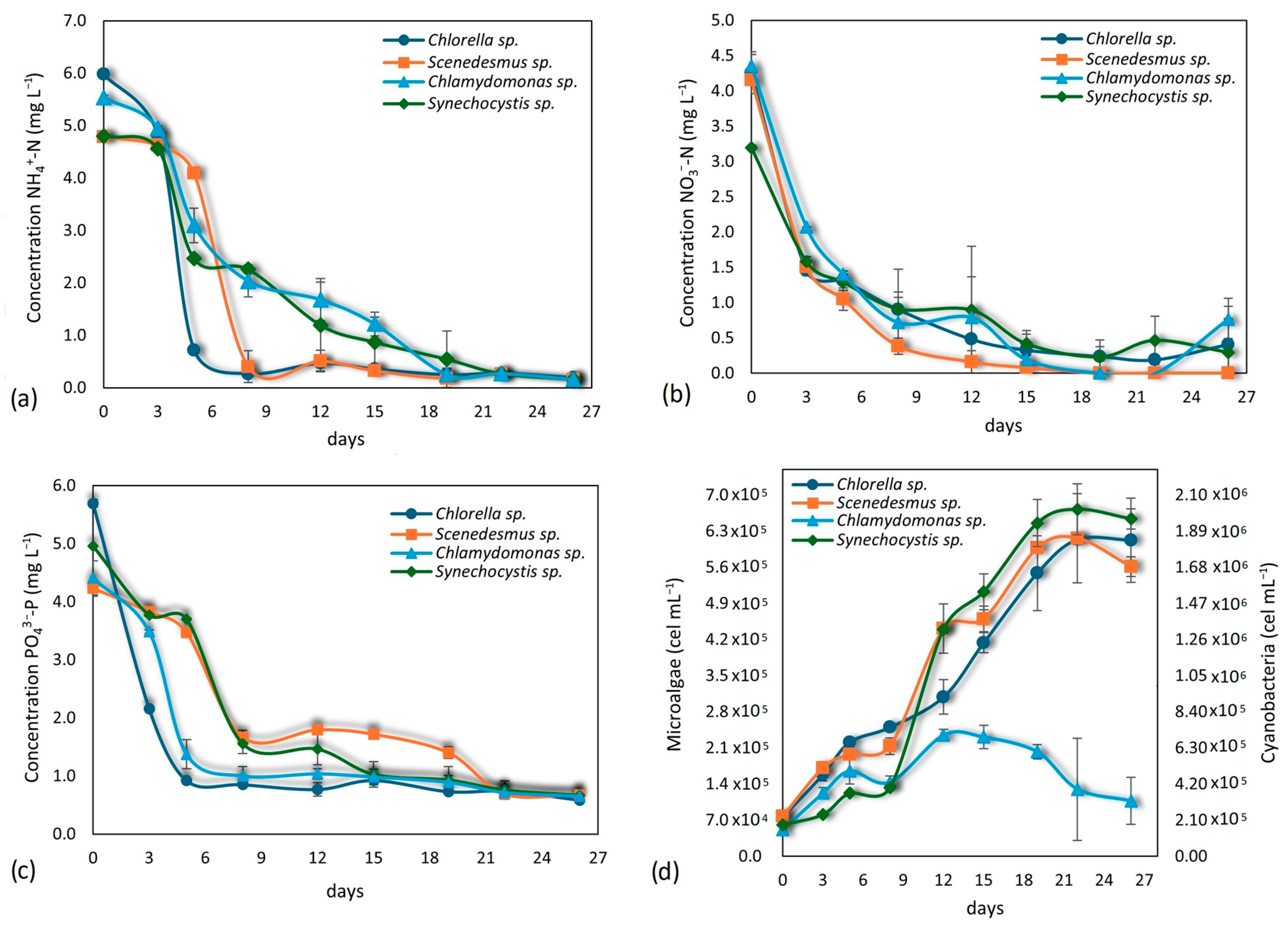
In the photobioreactors, significant nutrient removal was observed during the first 8 days. During this period, ammonium removal was 5.72 mg L−1, which corresponds to 95.5% by Chlorella sp., 4.38 mg L−1 (91.6%) by Scenedesmus sp., 3.50 mg L−1 (63.2%) by Chlamydomonas sp., and 2.54 mg L−1 (52.9%) by Synechocystis sp. (Figure 1a). As shown in Figure 1b, nitrate removal was 3.77 mg L−1 (90.7%) by Scenedesmus sp., 3.64 mg L−1 (83.5%) by Synechocystis sp., 3.35 mg L−1 (78.8%) by Chlorella sp., and 2.28 mg L−1 (71.5%) by Chlamydomonas sp. Finally, Chlorella sp. removed 4.85 mg L−1 (85.0%) of phosphate (Figure 1c); Chlamydomonas sp. and Synechocystis sp. both removed 3.40 mg L−1, corresponding to a removal of 77.3% and 68.6%, respectively; and Scenedesmus sp. removed 2.57 mg L−1 (60.6%).
By the final time point (day 26), the maximum nutrient removal in the photobioreactors ranged from 96.61 to 97.06% for ammonium, 82.4 to 100% for nitrate, and 83.95 to 89.71% for phosphate (Table 1). Chlorella sp. showed significantly higher ammonium removal compared to Synechocystis sp. Similarly, Scenedesmus sp. exhibited higher nitrate removal than Synechocystis sp., while no significant differences were observed among the remaining strains. Chlorella sp. exhibited greater phosphate removal than Scenedesmus sp., while both showed similar removal compared to the other strains.
The results obtained by these native strains using water from Lake Xochimilco are consistent with those reported in the literature. For example, Mostafaei et al. [31] showed that Chlorella vulgaris removed nutrients from urban water, removing approximately 100% of ammonium (31.06 mg L−1), 91.6% of nitrate (12.42 mg L−1), and 92.8% of phosphate (2.12 mg L−1). Qader and Shekha [32] used Desmodesmus quadricauda (Scenedesmus quadricauda) to examine the efficacy of nutrient removal from a wastewater channel, which removed 96.7% of ammonium (14.50 mg L−1), 95.7% of nitrate (5.47 mg L−1), and 92.9% of phosphate (3.26 mg L−1). Mohd et al. [27] used Chlamydomonas sp. and a pretreated anaerobic effluent from a palm oil mill and removed 100% of ammonium (113.40 mg L−1), 82% of nitrate (4.55 mg L−1), and 68% of phosphate (37.77 mg L−1). Senatore et al. [33] used Synechocystis sp. growing in secondary effluent from municipal wastewater treatment, showing 89.6% removal of ammonium (38.67 mg L−1).
The greatest growth in most strains was observed on day 22 (Figure 1d); Synechocystis sp. reached a significantly higher growth of 18.3 × 10⁵ cel mL−1, while for Chlorella sp. and Scenedesmus sp., it was similar at 5.37 × 10⁵ cel mL−1 and 5.20 × 10⁵ cel mL−1, respectively. Chlamydomonas sp. showed maximum growth by day 12; however, it was the lowest among the strains.
Biomass productivity ranged from 0.016 to 0.049 g L−1 d−1, with significantly higher values observed for Chlorella sp. and Synechocystis sp. Specific growth rates (µ) ranged from 0.041 to 0.144 d−1, with Synechocystis sp. exhibiting significantly higher values compared to the other strains. There were no significant differences between Chlorella sp. and Scenedesmus sp., while Chlamydomonas sp. presented the lowest rate (Table 2).
The specific growth rates obtained in this study were comparable in magnitude to those reported in the literature for Chlorella sp. (0.288 d−1; [34]), Scenedesmus sp. (0.13 to 0.48 d−1; [35]), Synechocystis sp. (0.095 d−1; [36]), and Chlamydomonas sp. (0.422 d−1; [37]). Variations among studies are expected due to differences in cultivation conditions [38].
Beyond nutrient removal, growth dynamics revealed that biomass yields on the substrate ranged from 36.61 to 116.74 g g−1 for ammonium, 48.06 to 201.09 g g−1 for nitrate, and 52.04 to 126.09 g g−1 for phosphate (Table 2). Significant differences among strains were observed for all nutrients; Synechocystis sp. generally exhibited the highest biomass yields on the substrate, although for nitrate, its values were not significantly different from those of Chlorella sp. These elevated yields are likely attributable to the use of nutrient-rich Bayfolan®-acclimated inocula, the natural adaptation of strains to a contaminated environment, and the extended experimental period (26 d), which likely promoted the contribution of intracellular nutrient reserves, nutrient recycling, and luxury uptake, particularly for phosphorus.
An interesting observation was the markedly higher biomass accumulation exhibited by Synechocystis sp. compared with the microalgal strains, despite showing comparatively lower nutrient removal efficiencies. This apparent trade-off may reflect differences in physiological strategies between cyanobacteria and chlorophyte microalgae. Cyanobacteria are known to efficiently allocate resources toward rapid cell division and light utilization, which may favor biomass accumulation rather than maximal nutrient uptake from the surrounding medium [39]. Synechocystis species can also rely on internal nutrient recycling and storage mechanisms, allowing sustained growth even when external nutrient removal rates are moderate [8,39].
The reported biomass yield on substrate for Chlorella sp., Scenedesmus sp., and Chlamydomonas sp. vary widely in the literature, ranging from 0.062 to 13.27 g g−1 for ammonium, 0.68 to 21.9 g g−1 for nitrate, and 0.04 to 62.70 g g−1 for phosphate, depending on the nutrient and culture conditions [27,40,41]. The higher yields observed in the present study likely reflect differences in inoculum history, the nature of the water used as the culture medium, and cultivation time.
Based on biomass productivity, the estimated CO2 biofixation rate was 0.092 g L−1 d−1 for Synechocystis sp. and 0.079 g L−1 d−1 for Chlorella sp., with no significant differences between these strains, and 0.031 and 0.024 g L−1 d−1 for Chlamydomonas sp. and Scenedesmus sp., respectively (Table 2). According to the literature, Synechocystis sp. can fix up to 1.5 g L−1 d−1 [42], Scenedesmus sp. from 0.57 to 0.73 g L−1 d−1, and Chlorella sp. from 0.03 to 4.11 g L−1 d−1 [42,43].

3.2. FAME Production from Extracted Lipids

The biomass production among the strains ranged from 0.19 to 0.54 g L−1, while the lipid content was 43.05% for Chlorella sp., 29.10% for Scenedesmus sp., 24.17% for Synechocystis sp., and 21.42% for Chlamydomonas sp., with Chlorella sp. showing significantly higher lipid accumulation (Table 3). Biodiesel yield was evaluated based on the conversion efficiency of extracted lipids into fatty acid methyl esters (FAMEs). Biodiesel yield ranged from 41 to 91%, with Chlorella sp. achieving the highest conversion yield (91.24%), followed by Synechocystis sp. (67.47%).
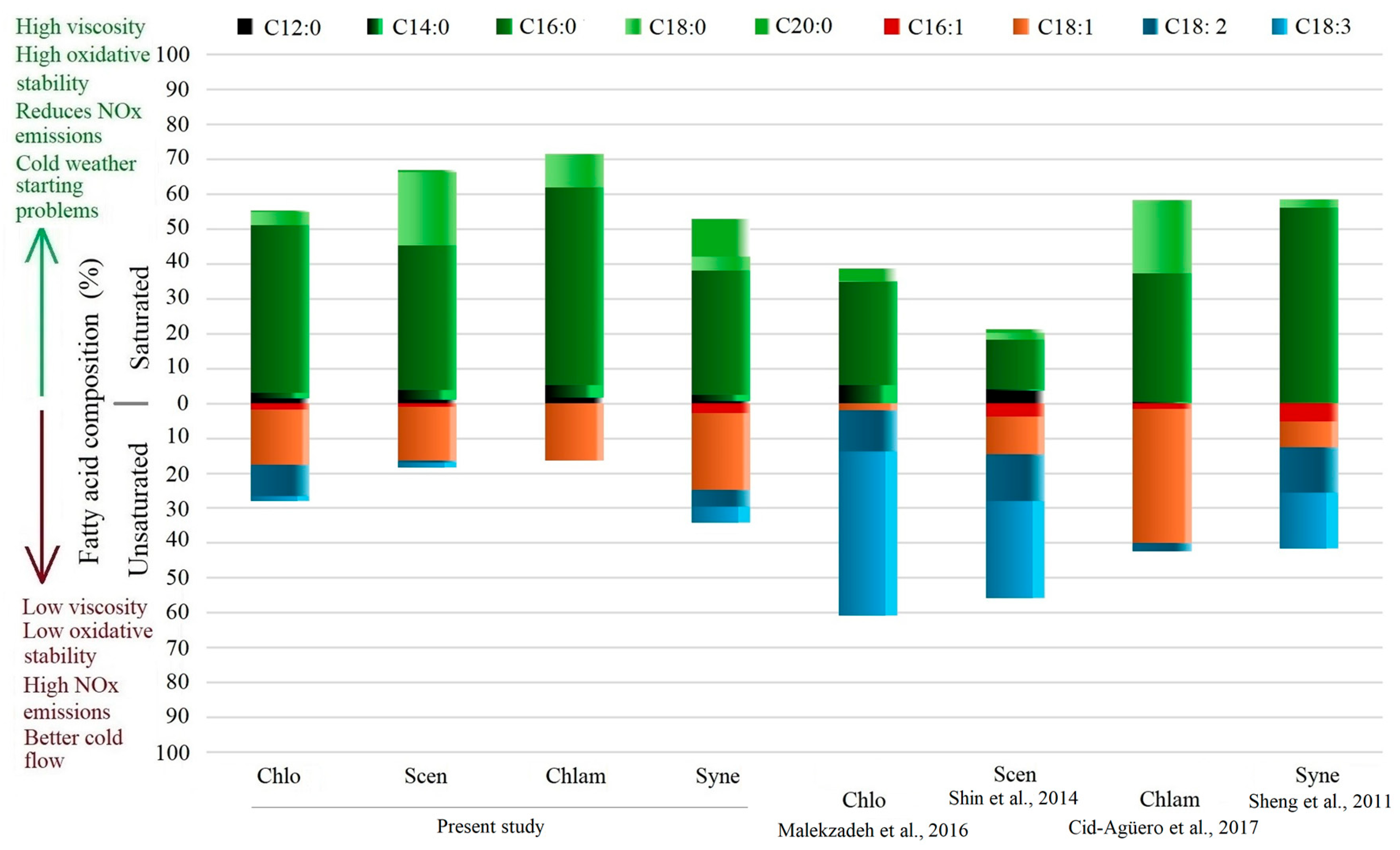
The FAME composition of each strain is shown in Table 4. Saturated and monounsaturated FAMEs predominate in all cases, particularly methyl palmitate and methyl oleate, respectively. A distinct fatty acid profile was observed for the cyanobacterium Synechocystis sp., with higher proportions of linoleate (C18:2) and methyl linolenate (C18:3). Additionally, methyl arachidinate (C20:0) was present, which is practically absent in Chlorella sp., Scenedesmus sp., and Chlamydomonas sp. Figure 2 compares the FAME composition of the different strains in the present study with that reported in the literature for the same microorganisms grown under varying conditions. Malekzadeh et al. [44] reported a higher content of unsaturated FAMEs (~59.5%) from C. vulgaris grown on Bold’s Basal medium followed by a medium starved of nitrogen, with methyl linoleate being predominant. The profile also included saturated FAMEs (~38.7%), mainly methyl palmitate and methyl myristate, and monounsaturated FAMEs (1.9%), such as methyl oleate. Shin et al. [45] obtained biodiesel at 68% with Scenedesmus sp. cultivated using a urea-based medium, with hexane employed for oil extraction. The biodiesel contained a higher proportion of unsaturated FAMEs (53.3%), predominantly linoleate and methyl linolenate. Saturated FAMEs accounted for 29%, with palmitic acid methyl ester being the most abundant, while monounsaturated FAMEs made up 17%, with methyl oleate standing out. Cid-Agüero et al. [46] used a strain of Chlamydomonas sp. cultivated in Bristol medium and obtained biodiesel with 58% saturated fatty acid esters, primarily methyl palmitate. It also contained 39.9% monounsaturated fatty acid esters, mostly methyl oleate, and 2.42% methyl linolenate. Sheng et al. [47] identified the principal FAMEs in Synechocystis sp., finding that 58.5% were saturated, 29% unsaturated, and 12.6% monounsaturated, with methyl palmitate, methyl linolenate, and methyl oleate being the most prominent, respectively. The differences observed in the fatty acid profile between the microorganisms in this study and those previously described can be attributed to environmental and nutritional factors, as well as lipid extraction conditions. According to Chen et al. [48], nitrogen deprivation increases the accumulation of both saturated and unsaturated fatty acids. Temperature is another determining factor; lower temperatures during the lipid accumulation phase favor the synthesis of unsaturated fatty acids and decrease saturated fatty acids [49]. The proportion of unsaturated fatty acid methyl esters is a key factor influencing the oxidative stability of biodiesel derived from any triglyceride source. According to Pinzi et al. [50], biodiesel should contain a higher proportion of monounsaturated fatty acid methyl esters, such as methyl oleate, than methyl linoleate and linolenate. Furthermore, the presence of saturated FAMEs such as methyl palmitate (C16:0) and methyl stearate (C18:0) is associated with higher cetane numbers. The cetane number is a parameter that indicates combustion quality and provides information on the ignition delay of a diesel fuel after injection into the combustion chamber [51]. Fuels with a low cetane number tend to cause diesel knock and the emission of gases and particles due to incomplete combustion [52].
Studies on microalgae and oilseed plants indicate that FAME profiles with low content of both long-chain saturated and polyunsaturated FAMEs are the most suitable. This is because they offer a good balance between oxidative stability and operability at low temperatures [53]. As shown in Table 4, the microorganisms analyzed—particularly Chlamydomonas sp.—exhibit a high proportion of saturated fatty acids; however, a biodiesel with a high content of saturated FAMEs is generally considered undesirable. These esters tend to crystallize at low temperatures, which can negatively affect the fluidity and performance of the fuel in cold climates. Therefore, cultivation conditions can be adjusted to optimize the fatty acid profile and improve the quality of the resulting biodiesel. Another approach is to prepare biodiesel blends from different sources to meet international biodiesel quality standards [54]. In this study, FAMEs were analyzed as chemical indicators of biodiesel potential rather than as finished biodiesel fuel.

3.3. Biogas Production

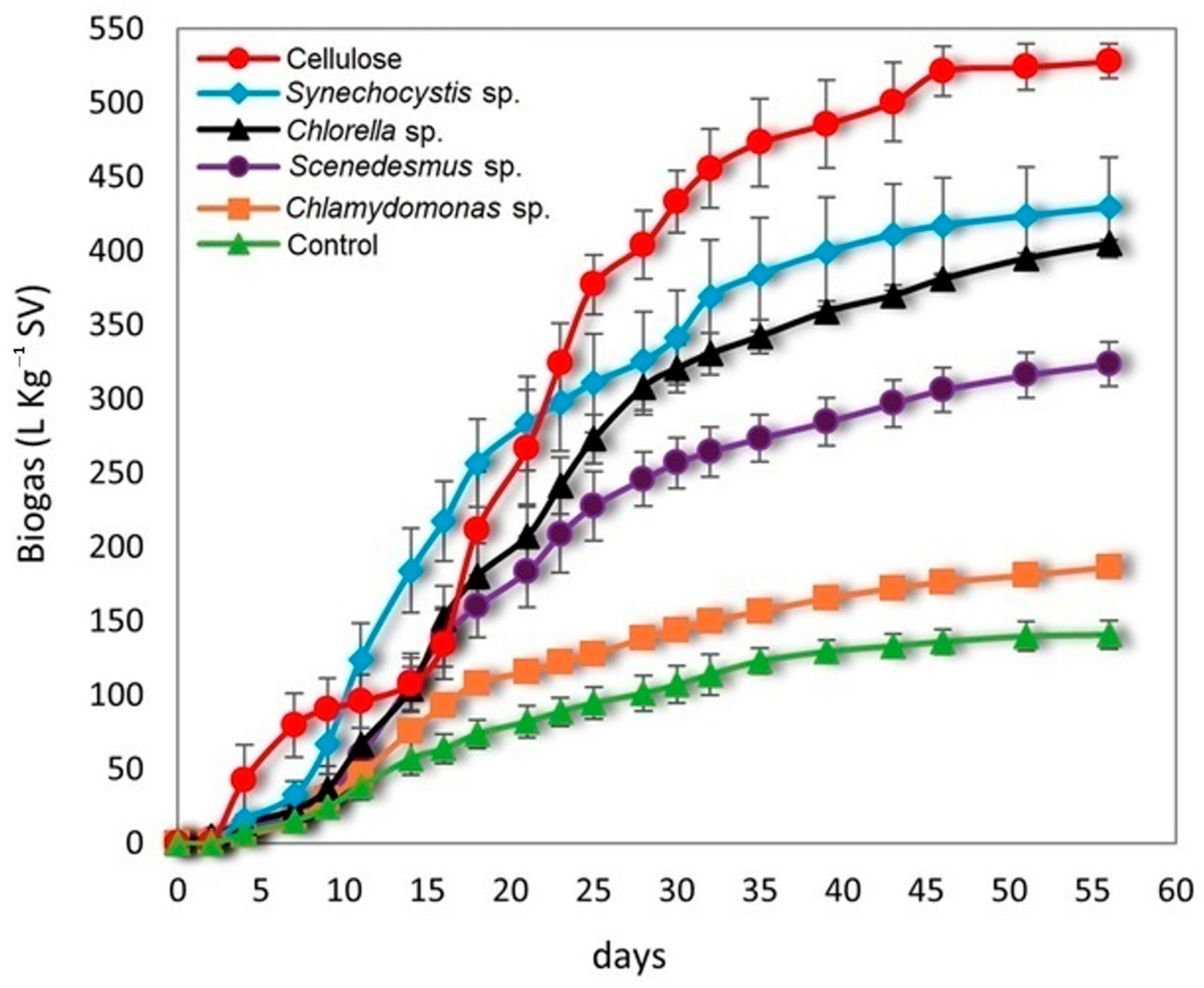
Regarding the residual biomass after lipid extraction, the highest biogas production was observed for Synechocystis sp. at 429.5 L kg−1 VS and Chlorella sp. at 404.9 L kg−1 VS (Figure 3). The positive cellulose control reached 528.2 L kg−1 VS, while the inoculum control yielded 140.7 L kg−1 VS.
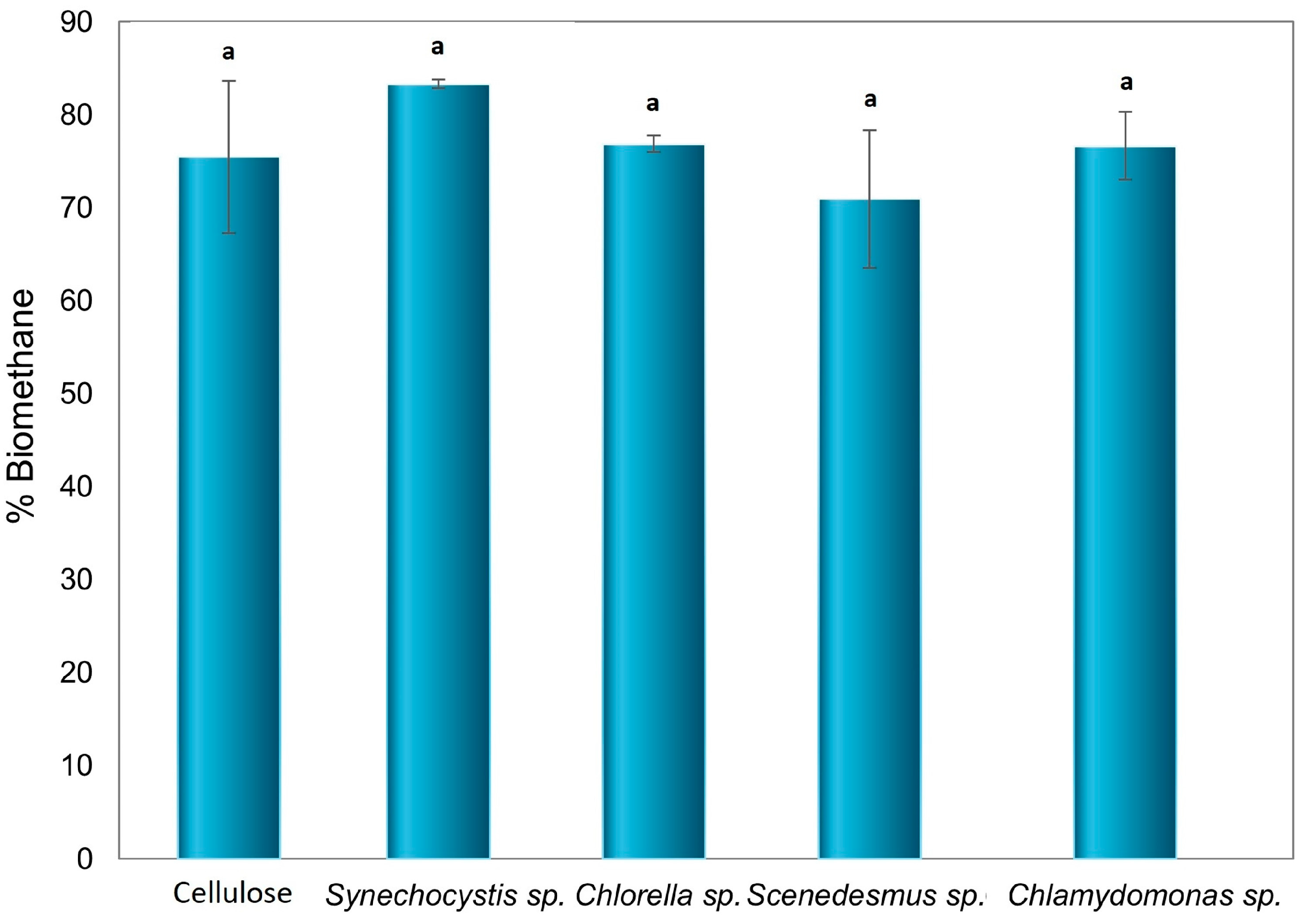
The highest biomethane content was observed in biogas produced from the biomass of Synechocystis sp. (83.3%), followed by Chlorella sp. (76.9%), Chlamydomonas sp. (76.6%), and Scenedesmus sp. (70.9%); however, no significant differences were observed among the strains (Figure 4). All of these values exceed 60%, indicating favorable biogas quality. With cellulose, 75.5% biomethane was obtained, demonstrating the inoculum’s adequate capacity for degradation and high-quality biogas.
Among the strains, Synechocystis sp. and Chlorella sp. stood out by achieving the highest total biogas and net biogas production. Likewise, the highest biomethane production was obtained with Synechocystis sp., followed by Chlorella sp., representing 82.2% and 69.4% of the positive cellulose control, respectively (Table 5).
The higher biogas production observed for Synechocystis sp. and Chlorella sp. may be associated with differences in biomass biochemical composition. Anaerobic digestion efficiency is strongly influenced by the relative proportions of carbohydrates, proteins, and residual lipids present in the biomass. Cyanobacteria such as Synechocystis sp. typically contain readily available biodegradable carbohydrates and relatively less recalcitrant cell wall structures, which can enhance microbial accessibility during digestion [55]. Likewise, Chlorella sp., due to its robust growth, can accumulate substantial carbohydrate reserves [56]. These characteristics may explain the higher biomethane yields observed with these strains compared with the other strains evaluated.
The maximum net biogas production obtained with Chlorella sp. was 264.2 L kg−1 VS (Table 5) with 76.9% biomethane. This is comparable to the 254.41 L kg−1 VS net and 71.07% biomethane reported by Torres et al. [57], who used sewage sludge as the inoculum and biomass from the same genus after oil extraction. In the present study, 203.1 L kg−1 VS of biomethane was obtained, whereas Mendez et al. [58] reported 240.5 L kg−1 VS using anaerobic sludge from a wastewater treatment plant (WWTP) as the inoculum and biomass of Chlorella sp. This is likely because their strain was grown in Bold’s Basal medium, and they used raw biomass as the substrate. Mendez et al. also used Synechocystis sp., obtaining a methane production of 380 L kg−1 VS with raw biomass. In contrast, in the present study, using residual Synechocystis sp. biomass, a biomethane production of 240.5 L kg−1 VS was achieved.
Perazzoli et al. [59] obtained 389.0 L kg−1 VS of biomethane from Scenedesmus sp. cultivated in swine wastewater, using a mixture of sludge from UASB reactors and cattle manure as the inoculum, attributing this high production to the microalgae’s high protein content. However, contrasting results have been reported. Mussgnug et al. [60] found inefficient biogas production from Scenedesmus obliquus biomass. For Chlamydomonas sp., Klassen et al. [61] reported that Chlamydomonas reinhardtii produced 634 L kg−1 VS and 761 L kg−1 VS of biogas with a biomethane concentration of 65.6% and 60.9%, using biomass with low and high nitrogen content, respectively. Moreover, Mussgnug et al. [60] achieved 587 L kg−1 VS of biogas with 66% biomethane using C. reinhardtii grown in Tris–acetate–phosphate (TAP) medium as the substrate and sewage sludge as the inoculum. In the present study, using Chlamydomonas sp., we obtained lower biogas production than both previous studies, but observed a higher biomethane content (76.6%). This suggests that the cultivation medium influences the amount of biogas produced. However, biogas production may also be affected by the use of residual biomass after lipid extraction, since lipids serve as an important source of organic matter for this process.

3.4. Process Assessment: From Bioremediation to Biofuel Production

All strains demonstrated an effective capacity for the bioremediation of lake water, achieving high nutrient removal efficiencies under the evaluated conditions. Rather than a single strain consistently outperforming the others in nutrient removal, the results indicate comparable overall performance, supporting the suitability of all strains for bioremediation purposes.
In addition to nutrient removal, the strains differed significantly in growth-related parameters, with Chlorella sp. and Synechocystis sp. consistently exhibiting higher biomass productivity, biomass yields on substrate, and estimated CO2 biofixation rates; Synechocystis sp. also showed the highest specific growth rate.
When extending the assessment toward biofuel production, clearer differences among strains emerged. Chlorella sp. and Synechocystis sp. stood out due to their higher biomass productivity and energy recovery potential, although through different pathways. Chlorella sp. showed the highest lipid content and biodiesel yield, whereas Synechocystis sp. exhibited the highest biomethane production from residual biomass after lipid extraction, in addition to a more balanced biodiesel FAME profile. Scenedesmus sp. presented intermediate performance in both biodiesel and biogas production, while Chlamydomonas sp., despite producing a biodiesel with high oxidative stability, exhibited the lowest overall biomass and biomethane yields.
From an integrated bioremediation–bioenergy perspective, Synechocystis sp. emerges as the most favorable strain under the evaluated conditions, followed by Chlorella sp., which remains highly attractive due to its lipid productivity.

4. Conclusions

This study demonstrates the potential of native microalgae and cyanobacteria from Lake Xochimilco for water bioremediation under controlled conditions, confirming their suitability for mitigating eutrophication while simultaneously generating biomass as a valuable byproduct. Differences among strains were observed in biomass productivity and energy recovery potential. Synechocystis sp. and Chlorella sp. exhibited the most balanced performance, combining efficient nutrient removal with greater potential for biogas production and favorable fatty acid methyl ester (FAME) profiles for biodiesel applications.
Although this study represents a small-scale evaluation, the integration of bioremediation with biofuel production may enhance the economic feasibility of these systems through biomass valorization. The use of native strains, adapted to local environmental conditions, further strengthens the sustainability and scalability of this approach.
Overall, these findings support the development of integrated strategies that simultaneously address eutrophic ecosystem restoration and renewable energy generation, highlighting strains from Lake Xochimilco as promising biological resources for circular bioeconomy applications.

Author Contributions

Conceptualization: M.C.R.-P. and P.C.-H.; methodology: N.N.D.-A.; validation: M.C.R.-P., D.G.-R. and P.C.-H.; formal analysis: N.N.D.-A. and P.C.-H.; investigation: N.N.D.-A., D.G.-R. and P.C.-H.; resources: M.C.R.-P., D.G.-R. and P.C.-H.; data curation: P.C.-H. and N.N.D.-A.; writing—original draft preparation: N.N.D.-A.; writing—review and editing: M.C.R.-P., D.G.-R. and P.C.-H.; visualization: N.N.D.-A.; supervision: P.C.-H.; project administration: M.C.R.-P., D.G.-R. and P.C.-H. All authors have read and agreed to the published version of the manuscript.

Funding

Universidad Autónoma Metropolitana. DCBS Project “Bioremediation, bioenergy, biofertilization: contribution towards a sustainable bioeconomy”. Agreement 4/24.6.8, UAM-Xochimilco.

Institutional Review Board Statement

Not applicable.

Informed Consent Statement

Not applicable.

Data Availability Statement

All data generated or analyzed during this study are included in this published article; further inquiries can be directed to the corresponding author.

Acknowledgments

The first author thanks the Secretariat of Science, Humanities, Technology, and Innovation (SECIHTI) for the scholarship granted to pursue doctoral studies in Biological and Health Sciences at the Universidad Autónoma Metropolitana.

Conflicts of Interest

The authors declare no competing interests.

Abbreviations

The following abbreviations are used in this manuscript:
ANOVAAnalysis of variance
APHAAmerican Public Health Association
BPBiomass productivity
CElemental carbon
CHNElemental content of carbon, hydrogen, and nitrogen
CIBACCenter of Biological and Aquaculture Research of Cuemanco
CO2Carbon dioxide
dwDry weight
H2SO4Sulfuric acid
HSDHonestly significant difference
FAMEFatty acid methyl ester
FAMEsFatty acid methyl esters
FIDFlame ionization detector
KOHPotassium hydroxide
µSpecific growth rate
MCDivided by the molecular weight of carbon
MCO2Molecular weight of carbon dioxide
PLOT-QOpen tubular porous-layer gas chromatography column
SSubstrate
SDStandard deviation
tTime
TAPTris–acetate–phosphate
TCDThermal conductivity detector
UASBUpflow anaerobic sludge blanket reactor
VSVolatile solids
WWTPWastewater treatment plant
XBiomass or cell density, according to the equation
YX/SBiomass yield on substrate

References

  1. Kumar, R.; Kundu, D.; Kormoker, T.; Joshid, S.; Rosef, P.K.; Kumarg, S.; Sahooh, P.K.; Sharmai, P.; Lamba, J. Phycoremediation of potentially toxic elements for agricultural and industrial wastewater treatment: Recent advances, challenges, and future prospects. Desal. Water Treat. 2024, 319, 100505. [Google Scholar] [CrossRef]
  2. Kumar, A.; Sweety. Phycoremediation of wastewater—An approach used microalgae for bioremediation. Int. J. Curr. Microbiol. Appl. Sci. 2024, 13, 28–34. [Google Scholar] [CrossRef]
  3. Molazadeh, M.; Ahmadzadeh, H.; Pourianfar, H.R.; Lyon, S.; Rampelotto, P.H. The use of microalgae for coupling wastewater treatment with CO2 biofixation. Front. Bioeng. Biotechnol. 2019, 7, 42. [Google Scholar] [CrossRef] [PubMed]
  4. Daneshvar, E.; Wicker, R.J.; Show, P.L.; Bhatnagar, A. Biologically-mediated carbon capture and utilization by microalgae towards sustainable CO2 biofixation and biomass valorization—A review. Chem. Eng. J. 2022, 427, 130884. [Google Scholar] [CrossRef]
  5. Ahmad, I.Z. The usage of cyanobacteria in wastewater treatment: Prospects and limitations. Lett. Appl. Microbiol. 2021, 75, 718–730. [Google Scholar] [CrossRef]
  6. Dudeja, C.; Masroor, S.; Mishra, V.; Kumar, K.; Sansar, S.; Yadav, P.; Chaturvedi, N.; Singh, R.; Kumar, A. Cyanobacteria-based bioremediation of environmental contaminants: Advances and computational insights. Discov. Agric. 2025, 3, 42. [Google Scholar] [CrossRef]
  7. Srimongkol, P.; Sangtanoo, P.; Songserm, P.; Watsuntorn, W.; Karnchanatat, A. Microalgae-based wastewater treatment for developing economic and environmental sustainability: Current status and future prospects. Front. Bioeng. Biotechnol. 2022, 10, 904046. [Google Scholar] [CrossRef]
  8. Passos, L.S.; de Freitas, P.N.N.; Menezes, R.B.; de Souza, A.O.; da Silva, M.F.; Converti, A.; Pinto, E. Content of lipids, fatty acids, carbohydrates, and proteins in continental cyanobacteria: A systematic analysis and database application. Appl. Sci. 2023, 13, 3162. [Google Scholar] [CrossRef]
  9. Mishra, S.; Kumari, N.; Singh, V.K.; Sinha, R.P. Cyanobacterial biofuel: A platform for green energy. Adv. Environ. Eng. Res. 2023, 4, 41. [Google Scholar] [CrossRef]
  10. Renganathan, P.; Gaysina, L.A.; Holguín-Peña, R.J.; Sainz-Hernández, J.C.; Ortega-García, J.; Rueda-Puente, E.O. Phycoremediated microalgae and cyanobacteria biomass as biofertilizer for sustainable agriculture: A holistic biorefinery approach to promote circular bioeconomy. Biomass 2024, 4, 1047–1077. [Google Scholar] [CrossRef]
  11. Anisha, G.S.; Rojan, P.J. Microalgae as an alternative feedstock for green biofuel technology. In Microalgae: Biotechnology, Microbiology and Energy; Johansen, M.N., Ed.; Nova Science Publishers Inc.: New York, NY, USA, 2012; pp. 277–294. [Google Scholar]
  12. Velázquez-Lucio, J.; Rodríguez-Jasso, R.M.; Colla, L.M.; Sáenz-Galindo, A.; Cervantes-Cisneros, D.E.; Aguilar, C.N.; Fernandes, B.D.; Ruiz, H.A. Microalgal biomass pretreatment for bioethanol production: A review. Biofuel Res. J. 2018, 17, 780–791. [Google Scholar] [CrossRef]
  13. Madusanka, D.A.T.; Manage, P.M. Biodiesel production from microalgae and cyanobacteria: A short review. Int. Res. Environ. Agric. 2022, 10, 87–95. [Google Scholar] [CrossRef]
  14. Jones, C.S.; Mayfield, S.P. Algae biofuels: Versatility for the future of bioenergy. Curr. Opin. Biotechnol. 2012, 23, 346–351. [Google Scholar] [CrossRef] [PubMed]
  15. González-González, L.M.; Correa, D.F.; Ryan, S.; Jensenb, P.D.; Prattc, S.; Schenk, P.M. Integrated biodiesel and biogas production from microalgae: Towards a sustainable closed loop through nutrient recycling. Renew. Sustain. Energy Rev. 2018, 82, 1137–1148. [Google Scholar] [CrossRef]
  16. Osundeko, O.; Davies, H.; Pittman, J.K. Oxidative stress-tolerant microalgae strains are highly efficient for biofuel feedstock production on wastewater. Biomass Bioenerg. 2013, 56, 284–294. [Google Scholar] [CrossRef]
  17. Maltsev, Y.; Maltseva, K.; Kulikovskiy, M.; Maltseva, S. Influence of light conditions on microalgae growth and content of lipids, carotenoids, and fatty acid composition. Biology 2021, 10, 1060. [Google Scholar] [CrossRef]
  18. Phyu, K.; Zhi, S.; Graham, D.W.; Cao, Y.; Xu, X.; Liu, J.; Wang, H.; Zhang, K. Impact of indigenous vs. cultivated microalgae strains on biomass accumulation, microbial community composition, and nutrient removal in algae-based dairy wastewater treatment. Bioresour. Technol. 2025, 426, 132349. [Google Scholar] [CrossRef]
  19. Figueroa-Torres, M.G.; Linares-Jauregui, F.; Ferrara-Guerrero, M.J.; Castro Mejía, J. Manejo Integral de la Cuenca de Xochimilco y sus Afluentes; E-Bios, Universidad Autónoma Metropolitana, Unidad Xochimilco: Mexico City, Mexico, 2014; Available online: http://cbs1.xoc.uam.mx/e_bios/docs/2014/Manejo_Integral_Cuenca_Xochimilco.pdf (accessed on 16 April 2026).
  20. Figueroa-Torres, M.G.; Arana-Magallón, F.; Almanza-Encarnación, S.; Ramos-Espinosa, M.G.; Ferrara-Guerrero, M.J. Microalgas del área natural protegida Ejidos de Xochimilco San Gregorio Atlapulco, México. CienciaUAT 2015, 9, 15–29. [Google Scholar]
  21. Almanza-Encarnación, S.; Figueroa-Torres, M.G.; Ferrara-Guerrero, M.J.; Malpica-Sánchez, A.R.; Ángeles-Vázquez, J.R. Microalgas asociadas a un vertedero de la planta de tratamiento de aguas residuales Cerro de la Estrella, sobre un canal de Xochimilco, Ciudad de México. Hidrobiológica 2023, 33, 73–89. [Google Scholar]
  22. Rodríguez-Palacio, M.C.; Cabrera-Cruz, R.B.E.; Rolón-Aguilar, J.C.; Lozano-Ramírez, C.; Galeana-Hurtado, L.J.; Morales-Avendaño, E.D. Comparative study of the efficiency of removal of N and P of municipal wastewater and leached of vermicomposting with five strains of micro algae. Desalin Water Treat. 2018, 131, 180–186. [Google Scholar] [CrossRef]
  23. American Public Health Association. Standard Methods for the Examination of Water and Wastewater, 23rd ed.; American Public Health Association: Washington, DC, USA, 2017; 1976p. [Google Scholar]
  24. López-Yerena, A.; Guerra-Ramírez, D.; Reyes-Trejo, B.; Salgado-Escobar, I.; Cruz-Castillo, J.G. Waste from Persea schiedeana fruits as potential alternative for biodiesel production. Plants 2022, 11, 252. [Google Scholar] [CrossRef]
  25. Filer, J.; Ding, H.H.; Chang, S. Biochemical methane potential (BMP) assay method for anaerobic digestion research. Water 2019, 11, 921. [Google Scholar] [CrossRef]
  26. Singh, D.; Yadav, K.; Deepshikha; Singh, R.S. Biofixation of carbon dioxide using mixed culture of microalgae. Indian J. Biotechnol. 2015, 14, 228–232. [Google Scholar]
  27. Mohd, N.; Yasin, N.H.M.; Osman, W.H.W.; Takriff, M.S. Unlocking the potential of Chlamydomonas sp. for sustainable nutrient removal from POME: A biokinetic investigation. J. Water Process. Eng. 2024, 57, 104590. [Google Scholar] [CrossRef]
  28. Toledo-Cervantes, A.; Morales, M.; Novelo, E.; Revah, S. Carbon dioxide fixation and lipid storage by Scenedesmus obtusiusculus. Bioresour. Technol. 2013, 130, 652–658. [Google Scholar] [CrossRef] [PubMed]
  29. Yu, Y.; You, L.; Liu, D.; Hollinshead, W.; Tang, Y.J.; Zhang, F. Development of Synechocystis sp. PCC 6803 as a phototrophic cell factory. Mar. Drugs 2013, 11, 2894–2916. [Google Scholar] [CrossRef]
  30. Picardo, M.C.; de Medeiros, J.L.; Garcia, J.M.M.; Chaloub, R.M.; Giordano, M.; Araújo, O.Q.F. A methodology for screening of microalgae as a decision-making tool for energy and green chemical process applications. Clean Technol. Environ. Policy 2013, 15, 275–291. [Google Scholar] [CrossRef]
  31. Mostafaei, H.; Samimi, A.; Shokrollahzadeh, S.; Yazdanabad, S.K.; Sheikhinejad, A. Nutrients removal from raw municipal wastewater using Chlorella vulgaris microalgae. Adv. Environ. Technol. 2023, 1, 47–57. [Google Scholar] [CrossRef]
  32. Qader, M.Q.; Shekha, Y.A. Using microalga Scenedesmus quadricauda for the improvement of municipal wastewater quality. Iraqi J. Sci. 2023, 64, 2178–2188. [Google Scholar] [CrossRef]
  33. Senatore, V.; Rueda, E.; Bellver, M.; Díez-Montero, R.; Ferrer, I.; Zarra, T.; Naddeo, V.; García, J. Production of phycobiliproteins, bioplastics and lipids by the cyanobacteria Synechocystis sp. treating secondary effluent in a biorefinery approach. Sci. Total Environ. 2023, 857, 159343. [Google Scholar] [CrossRef]
  34. Robles-Heredia, J.C.; Sacramento-Rivero, J.C.; Ruiz-Marín, A.; Baz-Rodríguez, S.; Canedo-López, Y.; Narváez-García, A. Evaluación de crecimiento celular, remoción de nitrógeno y producción de lípidos por Chlorella vulgaris a diferentes condiciones de aireación en dos tipos de fotobiorreactores anulares. Rev. Mex. Ing. Quím. 2016, 15, 361–377. [Google Scholar]
  35. Silveira Júnior, A.M.; Mathes Faustino, S.M.; Holanda e Holanda, F.; Maciel Ferreira, I.; Cavalcanti da Cunha, A. Kinetic parameters of Scenedesmus obliquus (Chlorophyceae) growth and yield under different cultivation conditions in vitro. PeerJ 2022, 13, e17879. [Google Scholar] [CrossRef]
  36. Kamravamanesh, D.; Pflügl, S.; Nischkauer, W.; Limbeck, A.; Lackner, M.; Herwig, C. Photosynthetic poly-β-hydroxybutyrate accumulation in unicellular cyanobacterium Synechocystis sp. PCC 6714. AMB Express 2017, 7, 143. [Google Scholar] [CrossRef] [PubMed]
  37. Lee, H.E.; Lee, J.H.; Park, S.M.; Kim, D.G. Symbiotic relationship between filamentous algae (Halomicronema sp.) and extracellular polymeric substance-producing algae (Chlamydomonas sp.) through biomimetic simulation of natural algal mats. Front. Microbiol. 2023, 14, 1176069. [Google Scholar] [CrossRef] [PubMed]
  38. Ma, X.; Jian, W. Growth conditions and growth kinetics of Chlorella vulgaris cultured in domestic sewage. Sustainability 2023, 15, 2162. [Google Scholar] [CrossRef]
  39. Saleem, A.; Anwar, S.; Saud, S.; Kamal, T.; Fahad, S.; Nawaz, T. Cyanobacteria diversity and ecological roles: Insights into cyanobacterial adaptations and environmental implications. J. Umm Al-Qura Univ. Appl. Sci. 2025. Article in Press. [Google Scholar] [CrossRef]
  40. Esteves, A.F.; Soares, S.M.; Salgado, E.M.; Boaventura, R.A.R.; Pires, J.C.M. Microalgal growth in aquaculture effluent: Coupling biomass valorisation with nutrients removal. Appl. Sci. 2022, 12, 12608. [Google Scholar] [CrossRef]
  41. Sánchez-Bayo, A.; Morales, V.; Rodríguez, R.; Vicente, G.; Bautista, L.F. Cultivation of microalgae and cyanobacteria: Effect of operating conditions on growth and biomass composition. Molecules 2020, 25, 2834. [Google Scholar] [CrossRef]
  42. Singh, S.P.; Singh, P. Effect of CO2 concentration on algal growth: A review. Renew. Sustain. Energy Rev. 2014, 38, 172–179. [Google Scholar] [CrossRef]
  43. Li, G.; Xiao, W.; Yang, T.; Lyu, T. Optimization and process effect for microalgae carbon dioxide fixation technology applications based on carbon capture: A comprehensive review. C 2023, 9, 35. [Google Scholar] [CrossRef]
  44. Malekzadeh, M.; Najafabadi, H.A.; Hakim, M.; Feilizadeh, N.; Vossoughi, M.; Rashtchian, D. Experimental study and thermodynamic modeling for determining the effect of non-polar solvent (hexane)/polar solvent (methanol) ratio and moisture content on the lipid extraction efficiency from Chlorella vulgaris. Bioresour. Technol. 2016, 201, 304–311. [Google Scholar] [CrossRef] [PubMed]
  45. Shin, H.-Y.; Ryu, J.-H.; Bae, S.-Y.; Crofcheck, C.; Crocker, M. Lipid extraction from Scenedesmus sp. microalgae for biodiesel production using hot compressed hexane. Fuel 2014, 130, 66–69. [Google Scholar] [CrossRef]
  46. Cid-Agüero, P.; Cuello, J.; Ruiz, S.; Sanchez, G. Growth and lipid profiles of the Antarctic snow microalga Chlamydomonas sp. in response to changes in temperature, photoperiod, salinity and substrate. An. Inst. Patagon. 2017, 45, 45–58. [Google Scholar] [CrossRef]
  47. Sheng, J.; Kim, H.W.; Badalamenti, J.P.; Zhou, C.; Sridharakrishnan, S.; Krajmalnik-Brown, R.; Rittmann, B.E.; Vannela, R. Effects of temperature shifts on growth rate and lipid characteristics of Synechocystis sp. PCC 6803 in a bench-top photobioreactor. Bioresour. Technol. 2011, 102, 11218–11225. [Google Scholar] [CrossRef]
  48. Chen, X.; He, Y.; Liu, L.; Zhu, X.; Sen, B.; Wang, G. Nitrogen starvation enhances the production of saturated and unsaturated fatty acids in Aurantiochytrium sp. PKU#SW8 by regulating key biosynthetic genes. Mar. Drugs 2022, 20, 621. [Google Scholar] [CrossRef]
  49. Wang, X.; Li, Z.; Wang, D.; Yuan, X.; Guo, X.; Xue, H.; Gao, X. Temperature-dependent two-stage cultivation: A strategy for lipid and fatty acids production in the terrestrial oleaginous microalga Vischeria sp. WL1. J. Appl. Phycol. 2024, 37, 97–107. [Google Scholar] [CrossRef]
  50. Pinzi, S.; Garcia, I.L.; Lopez-Gimenez, F.J.; Luque de Castro, M.D.; Dorado, G.; Dorado, M.P. The ideal vegetable oil-based biodiesel composition: A review of social, economical and technical implications. Energy Fuels 2009, 23, 2325–2341. [Google Scholar] [CrossRef]
  51. Knothe, G. Analyzing biodiesel: Standards and other methods. J. Am. Oil Chem. Soc. 2006, 83, 823–833. [Google Scholar] [CrossRef]
  52. Mittelbach, M.; Remschmidt, C. Biodiesel: The Comprehensive Handbook, 1st ed.; Martin Mittelbach: Graz, Austria, 2004; 332p. [Google Scholar]
  53. Bharti, R.; Kaushal, C.; Singh, A.; Dhar, D.W.; Babu, R.; Kaushik, A. Evaluation of fuel properties for possible biodiesel output based on the fatty acid composition of oleaginous plants and microalgae. Sci. Total Environ. 2024, 918, 170448. [Google Scholar] [CrossRef]
  54. Dugala, N.; Goindi, G.; Sharma, A. Evaluation of physicochemical characteristics of Mahua (Madhuca indica) and Jatropha (Jatropha curcas) dual biodiesel blends with diesel. J. King Saud. Univ. Eng. Sci. 2020, 33, 424–436. [Google Scholar] [CrossRef]
  55. Hays, S.G.; Ducat, D.C. Engineering cyanobacteria as photosynthetic feedstock factories. Photosynth. Res. 2015, 123, 285–295. [Google Scholar] [CrossRef]
  56. Narayanan, I.; Pandey, S.; Vinayagam, R.; Selvaraj, R.; Varadavenkatesan, T. A recent update on enhancing lipid and carbohydrate accumulation for sustainable biofuel production in microalgal biomass. Discov. Appl. Sci. 2025, 7, 195. [Google Scholar] [CrossRef]
  57. Torres, A.; Padrino, S.; Brito, A.; Díaz, L. Biogas production from anaerobic digestion of solid microalgae residues generated on different processes of microalgae-to-biofuel production. Biomass Convers. Biorefin. 2023, 13, 4659–4672. [Google Scholar] [CrossRef]
  58. Mendez, L.; Mahdy, A.; Ballesteros, M.; González-Fernández, C. Chlorella vulgaris vs cyanobacterial biomasses: Comparison in terms of biomass productivity and biogas yield. Energy Convers. Manag. 2015, 92, 137–142. [Google Scholar] [CrossRef]
  59. Perazzoli, S.; Bruchez, B.M.; Michelon, W.; Steinmetz, R.L.R.; Mezzari, M.P.; Nunes, E.O.; da Silva, M.L.B. Optimizing biomethane production from anaerobic degradation of Scenedesmus spp. biomass harvested from algae-based swine digestate treatment. Int. Biodeterior. Biodegrad. 2016, 109, 23–28. [Google Scholar] [CrossRef]
  60. Mussgnug, J.H.; Klassen, V.; Schlüter, A.; Kruse, O. Microalgae as substrates for fermentative biogas production in a combined biorefinery concept. J. Biotechnol. 2010, 150, 51–56. [Google Scholar] [CrossRef]
  61. Klassen, V.; Blifernez-Klassen, O.; Wibberg, D.; Winkler, A.; Kalinowski, J.; Posten, C.; Kruse, O. Highly efficient methane generation from untreated microalgae biomass. Biotechnol. Biofuels 2017, 10, 186. [Google Scholar] [CrossRef]
Figure 1. Nitrogen removal from ammonium (a), nitrate (b), phosphorus as phosphate (c), and growth curves of the strains (d). Values are presented as mean ± standard deviation (SD) (n = 2).
Fermentation 12 00209 g001
Figure 2. Comparison of the relative FAME composition obtained in this study from Chlorella sp. (Chlo), Scenedesmus sp. (Scen), Chlamydomonas sp. (Chlam), and Synechocystis sp. (Syne), with that reported by Malekzadeh et al. [44], Shin et al. [45], Cid-Agüero et al. [46], and Sheng et al. [47].
Fermentation 12 00209 g002
Figure 3. Biogas production from the residual biomass of the strains after lipid extraction, compared with cellulose and inoculum controls. Values are presented as mean ± SD (n = 3).
Fermentation 12 00209 g003
Figure 4. Biomethane content from the biomass of the cultivated strains compared with the cellulose control. Values are presented as mean ± SD (n = 3). Statistical analysis was performed using one-way ANOVA; p > 0.05. The same letters indicate no significant differences among strains.
Fermentation 12 00209 g004
Table 1. Percentage of nutrient removal and growth of the cultivated strains.
Cultivated StrainsNutrient RemovalGrowth
NH4+-NNO3-NPO43−-P
%cel mL−1, ×105
Chlorella sp.* 96.79* 90.37* 89.715.37
** 94.06 a** 88.66 a,b** 85.03 a±0.03 a
Scenedesmus sp.* 96.61* 100.00* 83.955.20
** 91.59 a,b** 96.17 a** 59.39 b±0.10 a
Chlamydomonas sp.* 97.06* 82.40* 85.142.35
** 75.07 a,b** 82.40 a,b** 77.31 a,b±0.11 b
Synechocystis sp.* 96.62* 90.72* 86.5118.3
** 69.63 b** 71.97 b** 70.49 a,b±1.4 c
* Maximum removal achieved for each nutrient at the final time point (day 26). Nutrient removal was statistically analyzed using Friedman’s test followed by the Wilcoxon signed-rank test; p < 0.05; ** median values. Growth values are expressed as mean ± standard deviation (SD) (n = 2) and were analyzed by one-way ANOVA followed by Tukey’s HSD test; p < 0.05. Different letters indicate significant differences among strains.
Table 2. Biomass productivity, specific growth rate, biomass yield on substrate (YX/S), and estimated CO2 biofixation rate for each strain.
Cultivated StrainBiomass Productivity 1Specific Growth Rate (µ)YX/SEstimated CO2 Biofixation Rate
NH4+-NNO3-NPO43−-P
g L−1 d−1d−1g·g−1g L−1 d−1
Chlorella sp.0.0400.07972.99111.8182.750.079
±0.005 ᵃ±0.002 a±2.60 a±23.04 a,b±5.73 a±0.010 a
Scenedesmus sp.0.0160.08943.1748.0656.080.024
±0.004 b±0.015 a±3.50 b±6.19 a±1.54 b±0.006 b
Chlamydomonas sp.0.0160.04136.6154.7652.040.031
±0.001 b±0.003 b±2.01 b±8.80 a±2.19 b±0.001 b
Synechocystis sp.0.0490.144116.74201.09126.090.092
±0.002 ᵃ±0.003 c±5.52 c±13.14 b±3.26 c±0.004 a
1 Biomass dry weight. Values are presented as mean ± SD (n = 2). Statistical analysis was performed using one-way ANOVA followed by Tukey’s HSD test; p < 0.05. Different letters indicate significant differences among strains.
Table 3. Biomass obtained, percentage of lipids extracted, and biodiesel yield from the cultivated strains. Biodiesel yield corresponds to the percentage conversion of extracted lipids into fatty acid methyl esters (FAMEs).
Cultivated StrainsBiomassLipidsBiodiesel
Yield
g L−1% dw%
Chlorella sp.0.4243.0591.24
±0.02 a±0.84 a
Scenedesmus sp.0.2029.1042.24
±0.02 b±2.06 b
Chlamydomonas sp.0.1921.4241.16
±0.01 b±2.06 b
Synechocystis sp.0.5424.1767.47
±0.02 c±3.63 b
dw: dry weight. Values are presented as mean ± SD (n = 2). Statistical analysis was performed using one-way ANOVA followed by Tukey’s HSD test; p < 0.05. Different letters indicate significant differences among strains.
Table 4. Relative fatty acid methyl ester (FAME) composition of biodiesel obtained from the cultivated strains.
FAMEsChlorella sp.Scenedesmus sp.Chlamydomonas sp.Synechocystis sp.
Methyl laurate (C12:0)1.51.01.60.6
Methyl myristate (C14:0)1.62.83.61.8
Methyl palmitate (C16:0)47.941.556.635.7
Methyl stearate (C18:0)3.820.99.73.9
Methyl arachidate (C20:0)0.50.6-10.8
Methyl palmitoleate (C16:1)1.80.9-2.8
Methyl oleate (C18:1)15.715.416.322.0
Methyl linoleate (C18:2)9.10.6-4.7
Methyl linolenate (C18:3)1.31.4-4.7
% Saturated55.366.871.552.8
% Monounsaturated17.516.316.324.8
% Polyunsaturated10.42.00.09.4
% Others16.814.912.213.0
Table 5. Total biogas, net biogas, and biomethane production from the residual biomass after lipid extraction of the cultivated strains.
Cultivated StrainsTotal Biogas 1Net BiogasBiomethane
L kg−1 VS
Cellulose528.2387.5292.5
±11.5 a±8.2 a±6.2 a
Synechocystis sp.429.5288.7240.5
±34.0 b±25.9 b±21.6 b
Chlorella sp.404.9264.2203.1
±2.7 b±7.3 b±5.6 c
Scenedesmus sp.323.8183.1129.81
±15.0 c±6.7 c±4.79 d
Chlamydomonas sp.186.445.734.9
±6.7 d±3.9 d±3.0 e
1 Total biogas includes that produced by the inoculum. Inoculum control: 140.7 ± 9.6 L kg−1 VS. VS: volatile solids. Values are presented as mean ± SD (n = 3). Statistical analysis was performed using one-way ANOVA followed by Tukey’s HSD test; p < 0.05. Different letters indicate significant differences among strains.
Disclaimer/Publisher’s Note: The statements, opinions and data contained in all publications are solely those of the individual author(s) and contributor(s) and not of MDPI and/or the editor(s). MDPI and/or the editor(s) disclaim responsibility for any injury to people or property resulting from any ideas, methods, instructions or products referred to in the content.