
Article

Pathway-Guided Medium Engineering for Enhanced Prodiginine Production in Spartinivicinus ruber MCCC 1K03745T

1
Fujian Province Key Laboratory for the Development of Bioactive Material from Marine Algae, Quanzhou Normal University, Quanzhou 362000, China
2
College of Oceanology and Food Science, Quanzhou Normal University, Quanzhou 362000, China
*
Authors to whom correspondence should be addressed.
Fermentation 2026, 12(4), 192; https://doi.org/10.3390/fermentation12040192
Submission received: 10 March 2026 / Revised: 1 April 2026 / Accepted: 5 April 2026 / Published: 9 April 2026
(This article belongs to the Section Fermentation Process Design)

Abstract

Cycloheptylprodigiosin is a promising anticancer candidate that induces cancer cell death accompanied by severe Golgi stress. Although the soybean oil-based optimized MB2216 medium produced a total prodiginine titer approximately three times that of the basal MB2216 medium, the overall production level remained limited. In addition, a substantial fraction of the pigments partitioned into floating oil droplets, hindering efficient recovery by simple centrifugation. In this study, a novel medium was rationally formulated based on genomic insights derived from homology analysis of conserved biosynthetic genes involved in cycloheptylprodigiosin production in Spartinivicinus ruber MCCC 1K03745T. Sequential optimization through single-factor experiments, full factorial designs, steepest ascent experiments and response surface methodology identified an optimal medium consisting of peptone (5 g/L), yeast extract (1 g/L), peanut meal (7.611 g/L), and L-Proline (0.695 g/L) prepared in seawater at pH 7.6. Under the optimized conditions, the total prodiginine titer reached 53.33 mg/L, which was 11.37 times that of the basal MB2216 medium and 3.29 times that of the soybean oil-based MB2216 medium. Moreover, the pigment-associated biomass could be efficiently recovered by centrifugation. This study provides a genomics-informed strategy for improving prodiginine production in S. ruber and facilitates downstream pigment recovery.

1. Introduction

Prodiginines are a class of red secondary metabolites produced by diverse microorganisms, including Serratia spp., actinomycetes and certain marine bacteria. These pigments have attracted considerable interest owing to their broad spectrum of biological activities, including anticancer, antifungal and antibacterial effects, while exhibiting relatively low cytotoxicity toward normal tissues [1]. In addition, prodiginines are not substrates of multidrug resistance proteins, which frequently contribute to chemotherapy failure [2,3,4]. Collectively, these properties highlight their potential as promising drug candidates.
Structurally, prodiginines share a conserved tripyrrole scaffold, with structural diversity primarily arising from modifications in the C-ring moiety. The biosynthesis of prodigiosin in Serratia marcescens has been extensively characterized and proceeds via a bifurcated pathway involving the independent formation of 2-methyl-3-n-amyl-pyrrole (MAP) and 4-methoxy-2,2′-bipyrrole-5-carbaldehyde (MBC), followed by enzymic condensation catalyzed by PigC. The MAP branch originates from 2-octenal and involves sequential reactions mediated by PigD, PigE and PigB. In contrast, the MBC branch begins with L-proline and proceeds through a series of enzymatic steps catalyzed by PigI, PigA, PigJ, PigH, PigM and PigF/PigN. A related yet distinct pathway has been described in Streptomyces coelicolor, in which the MBC module is conserved, whereas the monopyrrole moiety is synthesized from acetyl-CoA and malonyl-CoA to generate undecylprodigiosin [1]. These studies collectively illustrate the modular and evolutionarily conserved nature of prodiginine biosynthesis.
Cycloheptylprodigiosin represents a distinctive member of the prodiginine family and has been reported to induce cancer cell death accompanied by severe Golgi stress [5]. However, the underlying molecular mechanism remains unclear necessitating sufficient quantities of the compound for detailed mechanistic and in vivo pharmacological investigations. To date, the only known producer, Spartinivicinus ruber MCCC 1K03745T, generates approximately 5 mg/L of total prodiginines (including cycloheptylprodigiosin and heptylprodigiosin at a ratio of 1:1.5) when cultured in basal Marine Broth 2216 (MB2216) medium [6]. Although supplementation with soybean oil increased the titer to 14.64 mg/L in our previous study, a substantial proportion of the pigments partitioned into the floating oil droplets, complicating downstream recovery [7]. Therefore, an improved strategy is required to enhance production while simplifying product isolation.
Genome analysis of S. ruber revealed conserved homologs of key prodiginine biosynthetic genes, suggesting that prodiginines in this strain are likely synthesized via a pathway analogous to the bifurcated MAP-MBC architecture described in other prodiginine-producing bacteria [6]. Based on this genomic inference, we hypothesized that precursor availability in the MAP-like and MBC branches may constitute a limiting factor for cycloheptylprodigiosin production. Accordingly, candidate substrates potentially associated with these two biosynthetic modules were rationally selected and systematically evaluated.
In the present study, we developed a genomics-informed medium optimization strategy integrating targeted precursor supplementation with statistical experimental design. This approach led to a novel medium formulation that significantly enhanced prodiginine production while enabling efficient recovery of pigment-associated biomass. Our findings demonstrate that genome-guided rational design can complement conventional empirical optimization for improving prodiginine biosynthesis in S. ruber.

2. Materials and Methods

2.1. Reagents

S. ruber was preserved in our lab, and it is also available from China Marine Culture Collection Center, accession No. MCCC 1K03745. Peptone (Cat No. P8450) was purchased from Solarbio (Beijing, China). Yeast extract (Cat No. LP0021B) was from Oxoid (Basingstoke, UK). Glycerol (Cat No. 10010618), D-(+)-glucose (Cat No. 63005518), sucrose (Cat No. 10021463), were from Sinopharm Chemical Reagent Co., Ltd. (Shanghai, China). D-(+)-trehalose (Cat No. D110019-5g), glycine (Cat No. A110752-500g), L-proline (Cat No. P108709-500g), L-methionine (Cat No. M101130-500g), L-serine (Cat No. S103483-500g) were from Aladdin Scientific (Shanghai, China). Peanut meal (Cat No. Y039), cottonseed meal (Cat No. Y031), rapeseed meal (Cat No. Y040), and soybean meal (Cat No. Y030A) were from Hongrun Baoshun Technology (Beijing, China).

2.2. Bioinformatic Analysis

Amino acid sequences of PigD (Q5W251), PigB (Q5W253), PigE (Q5W250) from S. marcescens and RedP (O54151) from S. coelicolor were retrieved from the UniProt database (https://www.uniprot.org). Homologous sequences were identified by BLASTP searches against the annotated genome of S. ruber (https://blast.ncbi.nlm.nih.gov/Blast.cgi, accessed on 26 February 2026) [8,9]. Sequence alignment was generated and visualized using the ESPript 3.2 online server (https://espript.ibcp.fr/ESPript/cgi-bin/ESPript.cgi, accessed on 26 February 2026) [10].

2.3. Fermentation Conditions

Fermentation was carried out as previously described in our earlier study [7], with minor modifications. The basal medium consisted of peptone (5 g/L) and yeast extract (1 g/L) prepared in natural seawater collected from Quanzhou Bay.
A single colony was picked and inoculated into 10 mL of MB2216 medium, followed by incubation at 35 °C and 140 rpm for 16 h to prepare the seed culture. For fermentation, the seed culture was inoculated at 1% (v/v) into 30 mL of sterile medium in Erlenmeyer flasks and incubated at 30 °C and 140 rpm for 30 h. Carbon sources were added prior to inoculation, whereas sterile amino acid stocks solutions were supplemented 12 h after inoculation, corresponding to the early stage of prodiginine production in S. ruber.

2.4. Sequential Design Strategy for Fermentation Optimization

A sequential experimental design strategy was employed, in which single-factor experiments, full factorial design, steepest ascent, and central composite design (CCD) were applied in a stepwise manner to ensure efficient and reliable optimization.

2.4.1. Single-Factor Experiments for Preliminary Range Determination

Single-factor experiments were conducted to evaluate the effects of individual medium components and provide rational ranges for subsequent full factorial design. In each experiment, one component was supplemented to the basal medium while all other conditions were kept constant. The tested components included carbon sources, slow-release nitrogen sources and amino acid precursors. Carbon sources and amino acid precursors were sterilized by filtration through 0.22 μm membrane filters.

2.4.2. Full Factorial Design and Steepest Ascent Experiments for Interaction Analysis and Region Exploration

A full factorial design (Table 1 and Table 2) was employed to identify significant factors and their interactions affecting prodiginine production. Based on the results, a steepest ascent experiment (Table 3) was performed to approach the region of maximum response prior to CCD based on response surface methodology.

2.4.3. Response Surface Methodology for Final Optimization

Based on the results of the steepest ascent experiment, the center point for the CCD was selected from the region showing the highest response, so that the response surface analysis could be conducted in the vicinity of the optimal region. The effects of medium components, including peanut meal and L-proline, were evaluated at the levels listed in Table 4, and the experimental design (Table 5) and statistical analysis were performed using Design-Expert 13 software (Stat-Ease, Minneapolis, MN, USA).

2.5. Extraction and Quantification of Prodiginine

Prodiginines were extracted and quantified as previously described [7]. Briefly, cultures were centrifuged to collect cell pellets, which were extracted with acidified methanol assisted by sonication. After removal of cellular debris by centrifugation, the supernatants were adjusted to defined volume, and optical density was measured at 535 nm using an Infinite M200 Pro microplate reader (Tecan, Männedorf, Switzerland).
Prodiginine concentration was calculated according to the calibration equation [7]:
y = 0.0414x + 0.0446,
where x represents prodiginine concentration and y represents the corresponding OD535nm value.

2.6. Statistical Analysis

All quantitative results are expressed as mean ± standard deviation (SD) from three independent experiments (n = 3). Statistical significance was evaluated by one-way analysis of variance (ANOVA) followed by the Holm–Sidak post hoc test. Differences were considered statistically significant at p < 0.05.

3. Results

3.1. Homology Analysis Reveals a Putative Prodiginine Biosynthetic Pattern in S. ruber

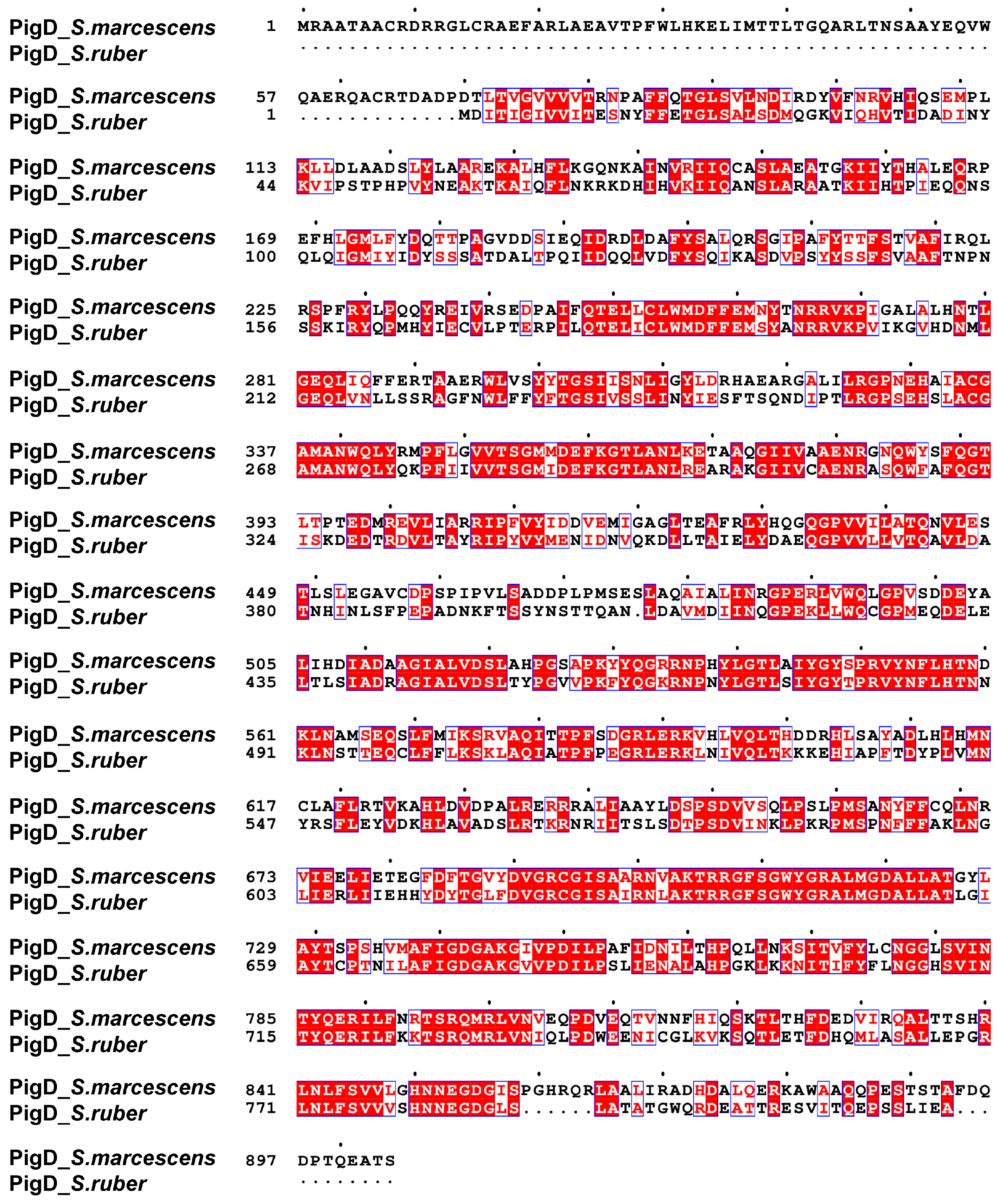
The biosynthesis of known prodiginines generally follows bifurcated pathways. While the synthesis of the bipyrrole intermediate MBC is conserved in both S. marcescens and S. coelicolor, the formation of the monopyrrole moiety differs substantially between these organisms, as none of the MAP-associated genes in S. marcescens is conserved in S. coelicolor. Homology analysis revealed that the PigD (UniProt Accession No. Q5W251) from S. marcescens, which catalyses the initial step of MAP biosynthesis, shares 51% sequence identity and 68% similarity with its homolog in S. ruber (Figure 1). Other MAP-associated enzymes in S. marcescens were likewise conserved in S. ruber (Table A1), with substantial query coverage and statistically significant E-values. In contrast, RedP (UniProt Accession No. O54151), which is essential for undecylprodigiosin biosynthesis in S. coelicolor, exhibited no significant homologs in S. ruber under the applied BLASTP criteria. Collectively, the conservation of MAP branch enzymes and the absence of RedP-like homologs suggest that cycloheptylprodigiosin and heptylprodigiosin biosynthesis in S. ruber more likely resembles the prodigiosin-type condensation of a MAP-like intermediate with MBC, although alternative catalytic strategies cannot be fully excluded. These findings suggest that the biosynthesis of prodiginines in S. ruber likely relies on metabolic precursors similar to those in S. marcescens. This information provided a rationale for considering key nutritional factors, such as carbon and nitrogen sources, in the subsequent fermentation optimization.

3.2. Effects of Single Factors on Prodiginine Production

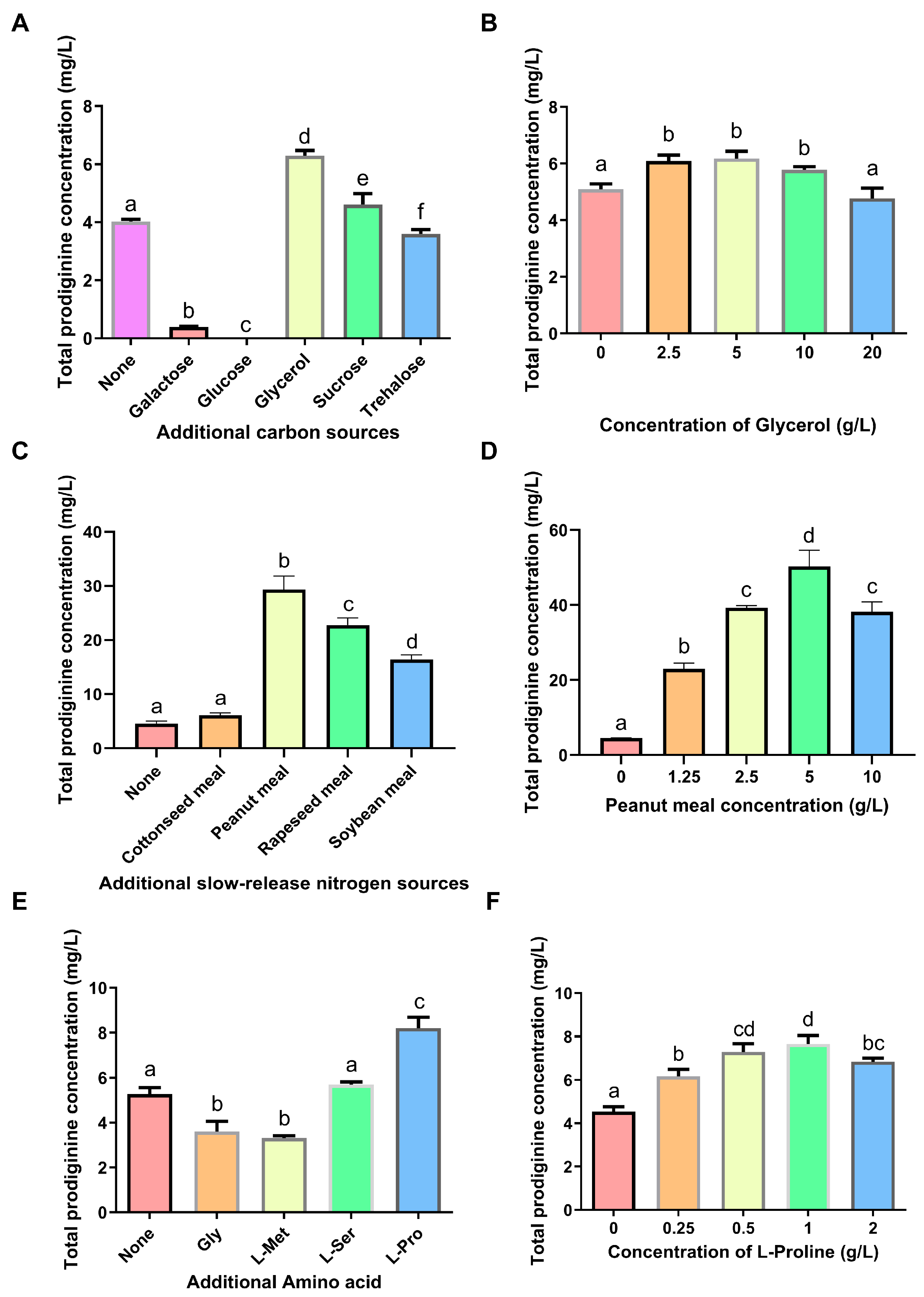
In our previous study, soybean oil markedly enhanced prodiginines production in S. ruber. However, a substantial portion of the pigments partitioned into floating lipid droplets, which interfered with efficient recovery by centrifugation. Therefore, alternative carbon souces were evaluated for their effects on fermentation titer. As shown in Figure 2A, supplementation with glycerol increased the prodiginine titer to 1.56-fold compared with the basal MB2216 medium. Based on this result, glycerol was selected as the carbon source for subsequent optimization. Further investigation revealed that the optimal glycerol concentration ranged from 2.5 to 10 g/L, whereas higher dosages did not further enhance prodiginine production (Figure 2B).
Given that S. ruber may synthesize prodiginines via a pathway resembling that of S. marcescens, precursor-related subtrates were evaluated for their potential influence on production. Enals, such as 2-decenal and 2-octenal can be generated through the autoxidation of linoleic acid [11]. To maintain precursor availability while avoiding complications associated with oil-based media, oilseed meals—commonly used slow-releasing nitrogen sources containing minor residual oil—were tested instead. As shown in Figure 2C, supplementation of peanut meal, rapeseed meal and soybean meal substaintially increased prodiginine production. Among these, peanut meal at 5 g/L elevated the titer to 50.29 mg/L (Figure 2D) and was selected for further study.
In addition, several amino acids potentially involved in prodiginine biosynthesis were examined. As shown in Figure 2E, only L-proline significantly promoted prodiginine production. The maximal titer was observed at appoximately 1 g/L L-proline supplementation (Figure 2F).
Collectively, glycerol, peanut meal and L-proline were identified as key factors for subsequent statistical optimization.

3.3. Analysis of Main Effects and Interactions Using a Full Factorial Design

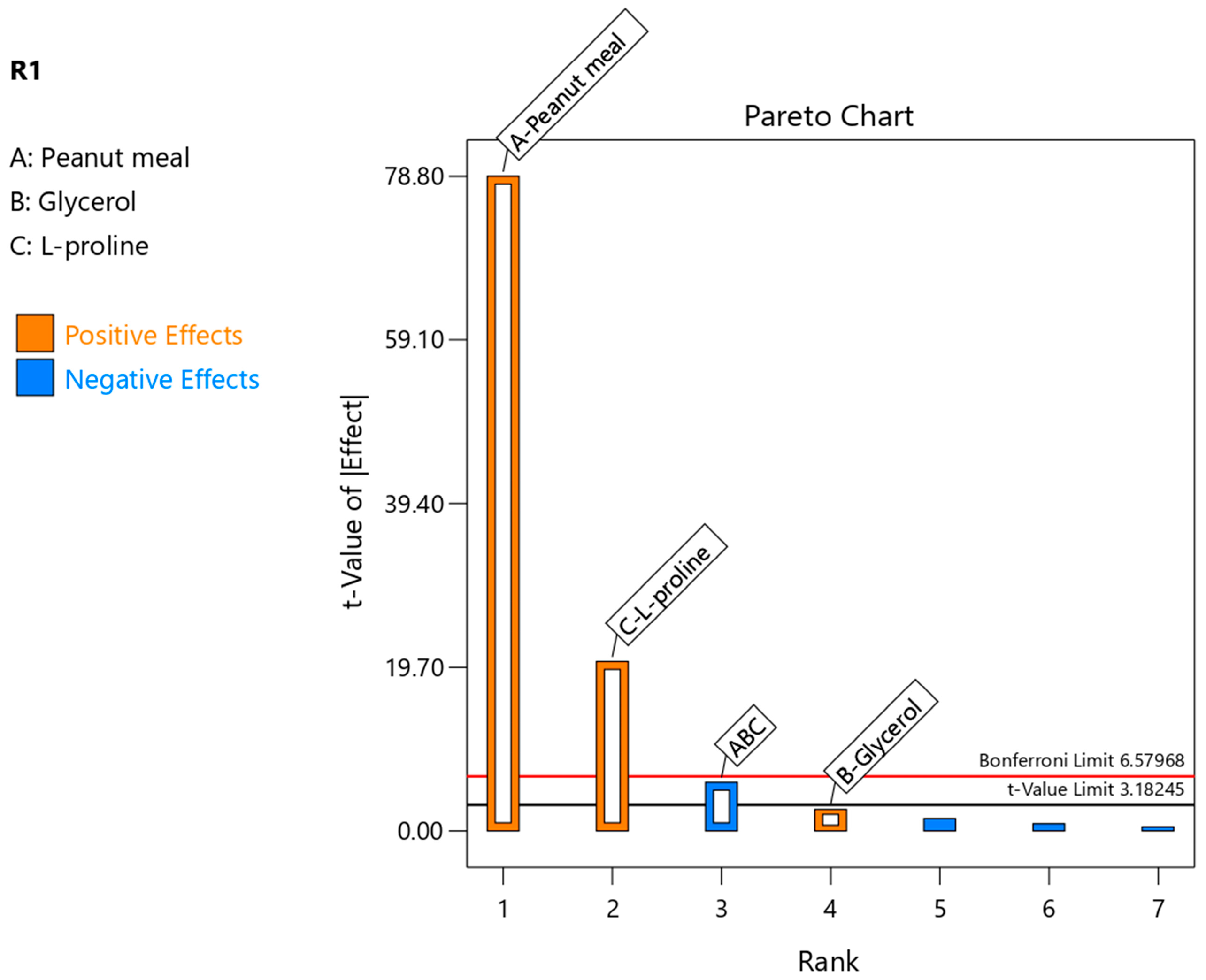
To evaluate the direct effects and potential interactions among glycerol, peanut meal and L-proline, a full factorial design was performed (Table 1 and Table 2). As shown in Table 6, factor A (peanut meal) and factor C (L-proline) significantly affect prodiginine production in S. ruber, and the three-factor interation term (ABC) was also statistically significant. Factor B (glycerol) exhibited a marginally significant effect, whereas the two-factor interactions (AB, AC and BC) were not significant. As illustrated in Figure 3, factor A and C exerted positive effects, while the ABC interaction showed a negative contribution.
Factor B did not exhibit a statistically significant main effect (p = 0.0789) and explained less than 0.2% of the total variance. Although the ABC interaction reached statistical significance, its contribution was minor compared with the dominant effects of factors A and C. To simplify the model and improve optimization efficiency, factor B was fixed at its relatively favorable level.
The highest prodiginine titer was obtained when both factors A and C were at the +1 level. Under this condition, the yield at B = −1 (Run 2, Table 2) exceeded that at B = +1 (Run 6). Accordingly, the medium composition corresponding to Run 2 was selected as the starting point for the steepest ascent experiments, with factor B fixed at the −1 level.

3.4. Approaching the Optimal Region via Steepest Ascent

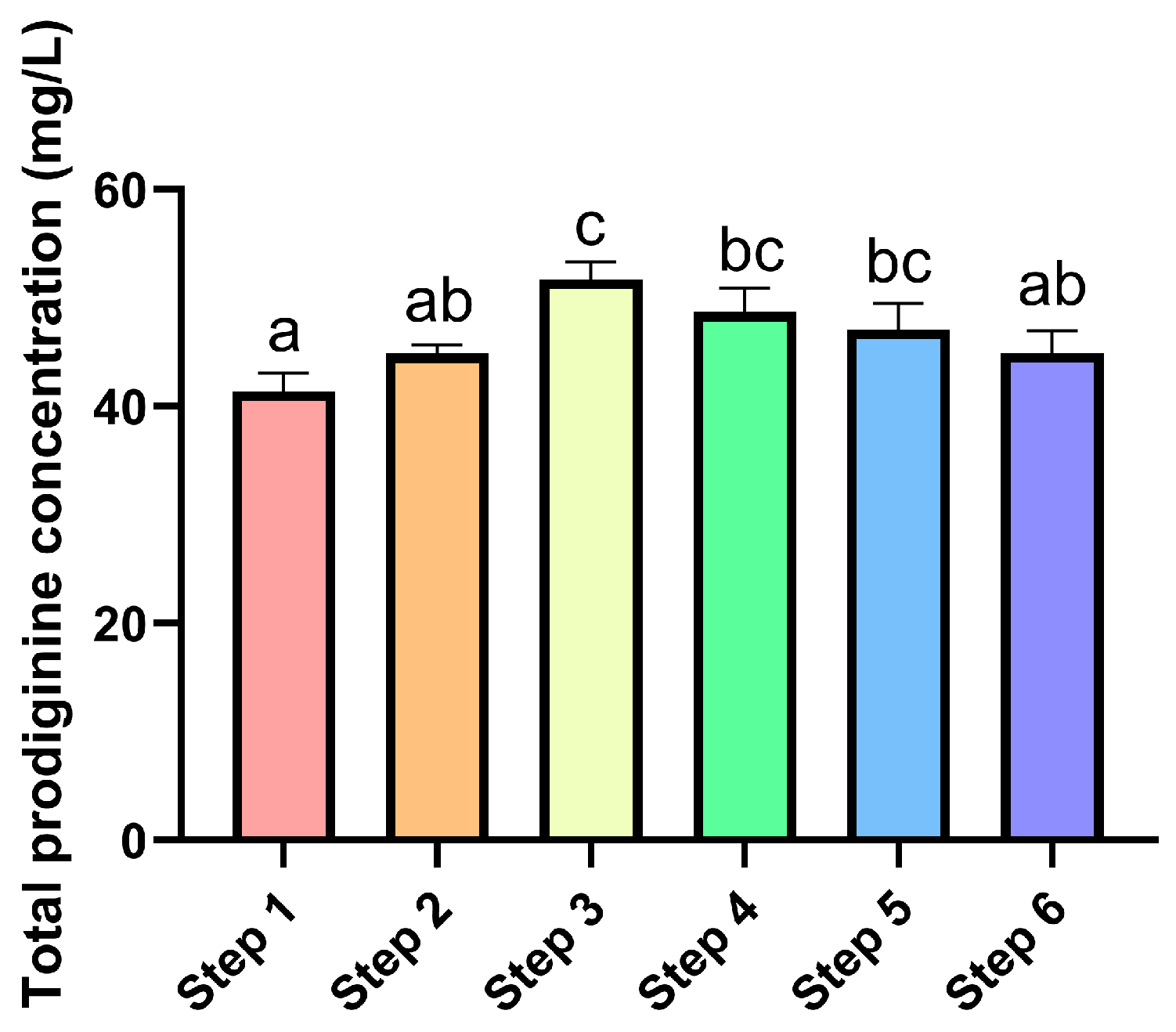
Starting from the composition corresponding to Run 2 (Table 2), a steepest ascent experiment was performed (Table 3) to approach the region of maximal response. As shown in Figure 4, the highest prodiginine production was observed between step 3 and step 4. The relatively small differences among steps suggest the presence of a plateau-like region near the optimum.

3.5. Optimization by Response Surface Methodology

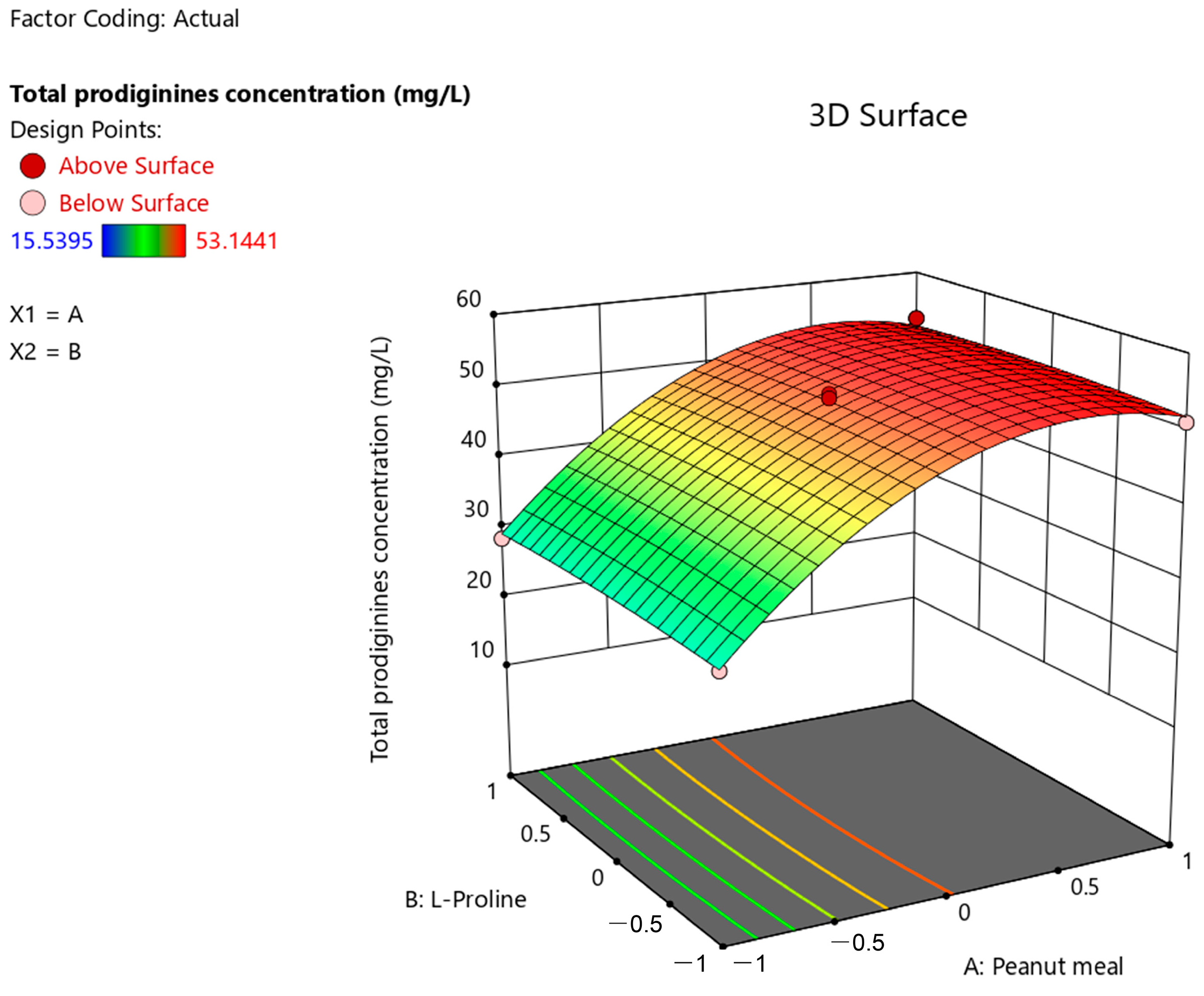
The midpoint between step 3 and step 4 was selected as the center point. A central composite design (CCD) was subsequently employed for the final optimization (Table 4 and Table 5). In the initial model, the interaction term AB was not significant (p = 0.2159) and was therefore pooled into the residual error. ANOVA of the final quadratic model (Table 7) demonstrated that factor A (peanut meal) and its quadratic term (A2) significantly affected prodiginine production. Factor B showed no significant linear effect, whereas its quadratic term (B2) was marginally significant. The final predictive model was:
y = 50.83 + 11.46A + 0.1393B − 9.82A2 − 0.5590B2.
The coefficients of determination (R2, adjusted R2 and predicted R2) were 0.9962, 0.9942 and 0.9900, respectively. The lack-of-fit test was not significant (p = 0.5527) indicating that the model adequately described the experimental data.
As shown in the three-dimensional response surface (Figure 5), a plateau-like region was observed around the maximal response, consistent with the steepest ascent results. According to the regression model, the optimal medium formulation consisted of: peptone (5 g/L), yeast extract (1 g/L), peanut meal (7.611 g/L), and L-Proline (0.695 g/L) in seawater at pH 7.6.
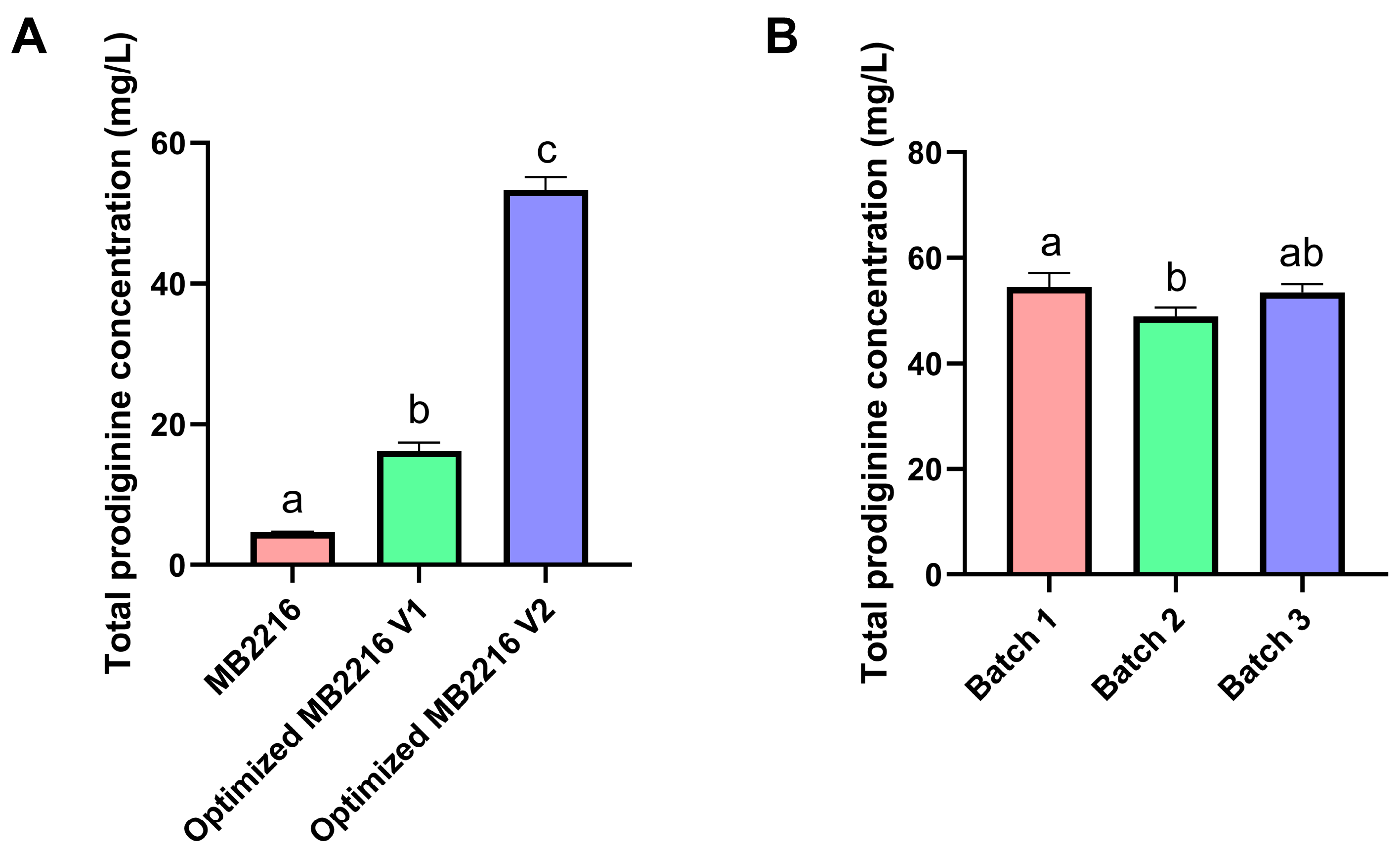
Verification experiments confirmed that under this optimal formulation (designated as optimized MB2216 V2 in Figure 6A), the prodiginine titer reached up to 53.33 mg/L, which was comparable to the predicted 54.18 mg/L. This represented 11.37-fold and 3.29-fold the titer obtained with the basal and soybean oil-based MB2216 (designated as optimized MB2216 V1), respectively.
To assess robustness, fermentation performance across different seawater batches was analyzed (Figure 6B). Although overall ANOVA indicated a significant difference among batches (p < 0.05), post hoc analysis revealed that significant differences were confined to the comparison between Batch 1 and Batch 2. No significant differences were observed between Batch 2 and Batch 3 or between Batch 1 and Batch 3, suggesting generally stable fermentation performance with limited batch-to-batch variability.

4. Discussion

Increasing attention has been directed toward prodiginines in recent decades due to their diverse biological activities, particularly their anticancer potential. Cancer remains one of the leading causes of mortality worldwide, with an estimated 18.5 million new cases and 10.4 million cancer deaths reported in 2023 [12]. Preclinical studies have demonstrated that prodiginines disrupt multiple cellular processes, including autophagy modulation [13,14], cytoplasmic acidification [15,16], induction of endoplasmic reticulum stress [17,18], and dysregulation of signaling pathways [16,19], ultimately leading to cell death.
To date, at least 33 prodiginine analogs have been identified [20], although most investigations have been focused on prodigiosin, cycloprodigiosin and undecylprodigiosin. In our previous work, we characterized the anticancer mechanism for cycloheptylprodigiosin in non-small-cell lung cancer models. Notably, cycloheptylprodigiosin induced cell death via a mechanism distinct from canonical pathways such as apoptosis, autophagic cell death, necroptosis, pyroptosis, and ferroptopsis [5]. These properties highlight its potential not only as a pharmacological candidate but also as a valuable probe for studying noncanonical cell death mechanism. However, the low fermentation titer of S. ruber cultured in basal MB2216 medium limited further mechanistic and translational investigations, thereby necessitating medium optimization.
Carbon and nitrogen sources are primary determinants of fermentation yield. Previous studies have reported that sucrose [21], starch [22,23] and vegetable oils [7,24] can enhance prodiginine production. However, the relative effectiveness of these substrates varies among strains and experimental conditions. In our prior study, soybean oil promoted prodiginine production more effectively than sucrose or glycerol at 5 g/L. Nevertheless, a substantial fraction of pigments partitioned into the floating lipid droplets, complicating downstream recovery. Therefore, alternative carbon sources were evaluated in the present study. Glycerol modestly enhanced prodiginine production, whereas trehalose had no significant effect. In contrast, galactose reduced the fermentation titer. Collectively, these results suggest that glycerol represents a more suitable carbon source when vegetable oils are excluded, balancing production performance and process feasibility.
Organic nitrogen sources generally outperform inorganic counterparts in supporting prodiginine biosynthesis. For example, glycine increased prodigiosin production in S. marcescens compared with ammonium sulfate [21], and peptone was also superior to various ammonium salts [22,25]. Oilseed meals, widely used as slow-release nitrogen sources, have also been reported to enhance prodiginine fermentation [23]. In this study, peanut meal markedly increased the titer to approximately 50.29 mg/L at 5 g/L supplementation. This effect may be partially attributed to the residual lipids present in peanut meals, which could serve as precursors for enal formation and thereby facilitate the biosynthesis of the MAP-like monopyrrole branch. However, the precise metabolic contribution warrants further investigation.
Amino acids have been reported to influence prodiginine production through both precursor supplementation and metabolic regulation [26,27,28,29]. L-proline serves as a direct substrate in MBC biosynthesis and consistently promoted production in multiple strains [26,28]. In contrast, certain amino acids enhance production without direct incorporation into the molecule, suggesting regulatory effects [30,31]. In the present study, L-proline significantly increased prodiginine titer, whereas L-serine showed no stimulatory effect. Glycine and L-methionine exhibited inhibitory effects under our experimental conditions. These findings indicate that amino acid supplementation influences prodiginine biosynthesis in a strain-specific manner and may involve both precursor availability and broader metabolic regulation.
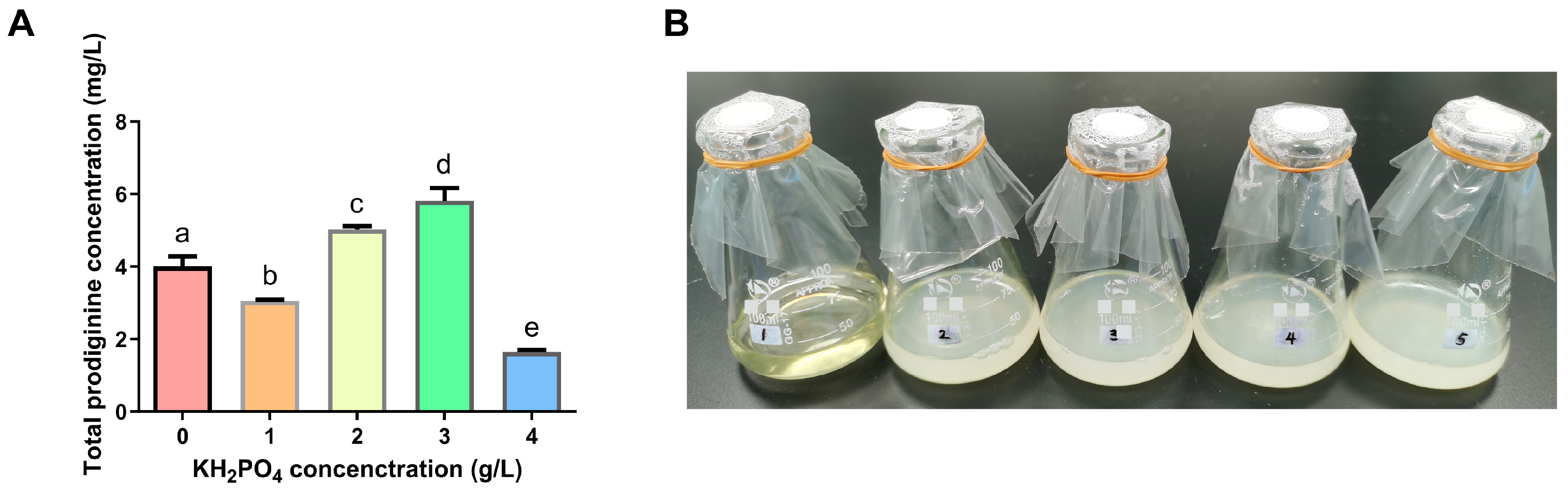
Inorganic salts have been reported to modulate prodigiosin biosynthesis, although their impact is generally less pronounced than that of carbon and nitrogen sources [7,21,22]. Our previous experiments indicated that Fe3+ had no effect and Mg2+ was less impactful than nitrogen sources; hence, these variables were not further examined in this study [7]. While KH2PO4 increased prodiginine production in our system (Figure A1), its addition to the seawater-based medium resulted in substantial precipitation, likely due to interactions with divalent metal cations such as Mg2+ and Ca2+ under near-neutral pH conditions. These changes in medium appearance suggested that nutrient availability in the culture system may have been altered. Therefore, KH2PO4 was also excluded from subsequent optimization to ensure medium stability and robustness.
Statistical optimization further clarified the relative contributions of the selected factors. In the full factorial design, peanut meal and L-proline significantly influenced prodiginine production, whereas glycerol exerted a minor effect. However, in the response surface model, only peanut meal remained statistically significant. This shift suggests that the contribution of L-proline became less pronounced as production approached the optimal region. Two possible explanations may account for this observation. First, lipid-derived precursors from peanut meal may enhance MAP-like branch flux to a level that exceeds the condensation capacity of PigC, thereby limiting further increases through MBC precursor supplementation. Alternatively, peanut meal may simultaneously stimulate both MAP-like and MBC branches by increasing acetyl-CoA availability via β-oxidation, thus elevating malonyl-CoA pools. In this scenario, prodiginine biosynthesis may become constrained by feedback regulation at higher titers [32]. Future studies involving PigC overexpression or in situ absorption strategies using resin supplementation may provide mechanistic insight into these alternative explanations [32,33].
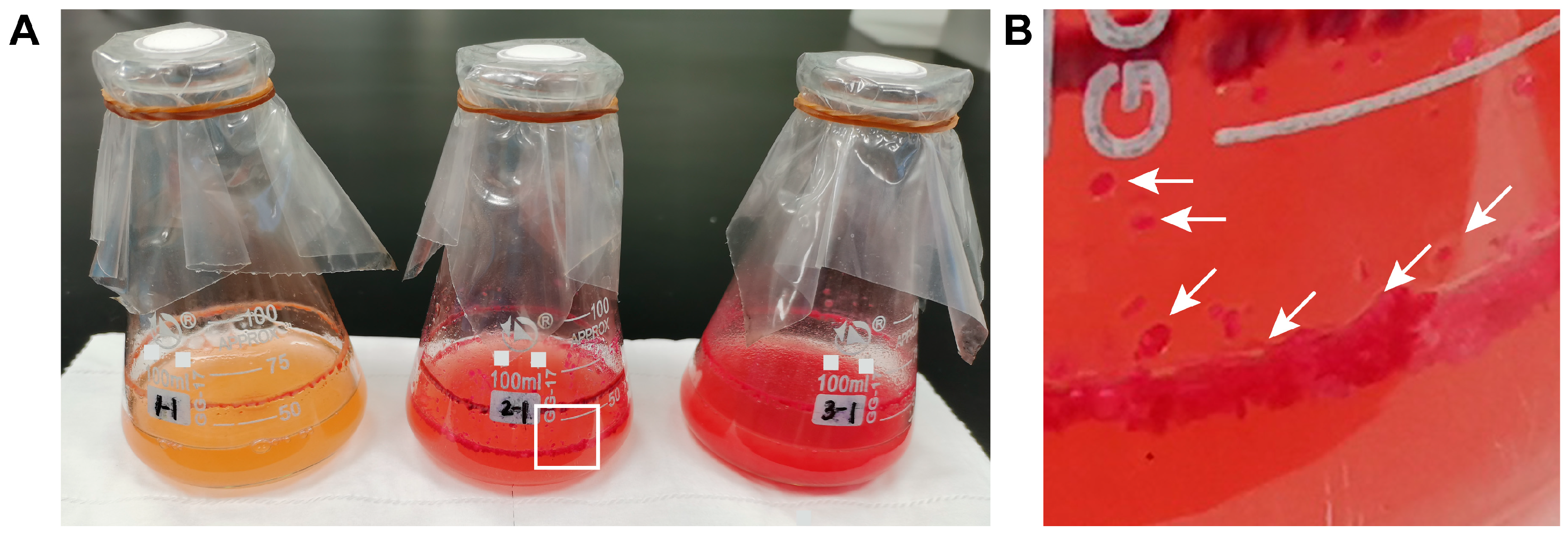
From an industrial perspective, an optimal medium must balance productivity, cost, and downstream processability. The optimized MB2216 V2 developed in this study costs CNY 3.14 per liter (Chinese yuan, RMB), substantially lower than optimized MB2216 V1 (CNY 5.04 per liter) and commercial MB2216 (CNY 68.82 per liter) (Table A2 and Table A3). Importantly, optimized MB2216 V2 supported a prodiginine titer of 53.33 mg/L, representing 11.37 and 3.29 times the titer obtained with the basal MB2216 and optimized MB2216 V1, respectively. Unlike oil-based formulations, optimized MB2216 V2 yielded a homogeneous suspension without floating pigment-containing droplets, thereby simplifying downstream recovery (Figure A2). Collectively, these findings demonstrate that optimized MB2216 V2 provides a cost-effective and operationally robust platform for prodiginine production in S. ruber.
To directly compare the newly designed medium with our previously optimized formulation, this study focused solely on medium composition while keeping other fermentation parameters, including temperature, shaking speed, and duration, consistent with prior work [7]. Further optimization of temperature, aeration, or extended fermentation may improve prodiginine yield. Nevertheless, S. ruber still produced substantially less prodiginine than S. marcescens, consistent with generally low yields reported for marine bacteria such as Hahella chejuensis KCTC 2396 (0.028 g/L) and Zooshikella rubidus S1-1 (0.048 g/L) [34,35]. Further integrative analyses combining metabolomics and proteomics would not only help validated the molecular mechanisms underlying the enhanced prodiginine production achieved in this study, but also provide insights into the inherently low production levels observed in marine bacteria. Importantly, the genome-guided strategy applied here, leveraging predicted bifurcated prodiginine pathways, could inform medium optimization in other prodiginine-producing strains, although its broader applicability remains to be validated. While industrial-scale production of prodiginine is extremely limited, its potential in biomedical applications and as a natural dye suggests a growing market.

5. Conclusions

In this study, homology analysis suggested that the putative biosynthetic pathway of prodiginines in S. ruber likely resembles that of prodigiosin in S. marcescens. Based on this inference, a rational medium design strategy was implemented to enhance prodiginine production through single-factor experiments, full factorial design, steepest ascent experiments and central composite design under response surface methodology. The optimized medium consisted of peptone (5 g/L), yeast extract (1 g/L), peanut meal (7.611 g/L), and L-Proline (0.695 g/L) in seawater at pH 7.6. Under these conditions, the fermentation titer reached 53.33 mg/L, representing 11.37 and 3.29 times the titer obtained with the basal MB2216 and optimized MB2216 V1, respectively. These findings establish a cost-effective and operationally feasible medium formulation for prodiginine production in S. ruber and provide a foundation for further process optimization and potential scale-up applications.

Author Contributions

Investigation, formal analysis, conceptualization, writing—original draft, writing—review and editing, X.L.; investigation, methodology, L.X.; investigation, methodology, J.X.; conceptualization, funding acquisition, writing—review and editing, C.D. All authors have read and agreed to the published version of the manuscript.

Funding

The project was funded by FuXiaQuan National Independent Innovation Demonstration Zone Collaborative Innovation Platform Project (2023FX0001).

Institutional Review Board Statement

Not applicable.

Informed Consent Statement

Not applicable.

Data Availability Statement

The original data presented in the study are deposited in FigShare at https://doi.org/10.6084/m9.figshare.31562587 (accessed on 4 April 2026).

Conflicts of Interest

The authors declare no conflicts of interest.

Appendix A

Appendix A.1

Homology analysis was conducted to investigate the putative prodiginine biosynthetic pattern in S. ruber. The amino acid sequences of key enzymes involved in MAP-like biosynthesis in S. marcescens were used as queries to search for homologs in the genome of S. ruber.
Table A1. Homology analysis of key enzymes involved in MAP-like biosynthesis in S. marcescens and S. ruber.
Enzymes in
S. marcescens
(UniProt Accession No.)
Homologs in
S. ruber
(NCBI Reference Sequence Accession No.)
Sequence
Identities
Sequence
Positives
Query CoverageE Value
PigD (Q5W251)prodigiosin MAP biosynthesis protein PigD (WP_163833139.1)51%68%90%0.0
PigB (Q5W253)NAD(P)/FAD-dependent oxidoreductase (WP_163833141.1)42%59%79%2e−140
PigE (Q5W250)prodigiosin MAP biosynthesis aminotransferase PigE (WP_163833138.1)59%76%100%0.0

Appendix A.2

The effect of KH2PO4 supplementation on prodiginine fermentation by S. ruber was evaluated. Supplementation with KH2PO4 caused substantial precipitation in the seawater-based medium, possibly due to interactions between phosphate ions and metal cations present in seawater. The observed changes in the medium suggested potential alterations in nutrient availability.
Figure A1. Effect of KH2PO4 supplementation on prodiginine fermentation by S. ruber and the physical appearance of culture medium. (A) Effect of KH2PO4 on prodiginine production. Different letters above the bars indicate significant differences (p < 0.05). (B) Changes in medium appearance following KH2PO4 supplementation. From left to right, the supplemented KH2PO4 concentrations were 0, 1, 2, 3, and 4 g/L.
Fermentation 12 00192 g0a1

Appendix A.3

The cost per liter of optimized MB2216 V1 and V2 was calculated based on the quantities and unit prices of individual components. Reagent grades are listed in Table A2 and Table A3, and all prices were obtained from local suppliers in March 2026. Costs are expressed in Chinese Yuan (CNY) and reflect small-scale laboratory purchase prices. In March 2026, the price of DIFCO™ MB2216 dehydrated medium (500 g) was CNY 920. As 37.4 g of powder is required per liter, the calculated cost per liter was CNY 68.82.
Table A2. Medium cost per liter of optimized MB2216 V1.
ComponentAmount
(/L)
GradeSupplierUnit Price (CNY/g or mL)Quotation DateCost (CNY/L)
Peptone11 g-Solarbio0.400March 20264.40
Yeast extract1 g-Oxoid0.350March 20260.35
Soybean oil5 mLFoodYihai Kerry0.018March 20260.09
MgCl2·6H2O3 gAnalyticalSinopharm0.068March 20260.20
total 5.04
Table A3. Medium cost per liter of optimized MB2216 V2.
ComponentAmount
(/L)
GradeSupplierUnit Price (CNY/g or mL)Quotation DateCost (CNY/L)
Peptone5 g-Solarbio0.400March 20262.00
Yeast extract1 g-Oxoid0.350March 20260.35
Peanut meal7.611 gFermentationHongrun Baoshun0.080March 20260.61
L-Proline0.695 gAnalyticalAladdin0.260March 20260.18
total 3.14

Appendix A.4

The appearance of cell cultures grown in optimized MB2216 V1 and V2 media was also compared. Cultures in optimized MB2216 V1 exhibited visible oil droplets, with a substantial portion of prodiginine partitioned into the floating lipid phase. In contrast, cultures grown in optimized MB2216 V2 formed a homogeneous red suspension.
Figure A2. Comparison of fermentation appearance of S. ruber cultured in different media. (A) Fermentation products obtained using basal MB2216, optimized MB2216 V1, and optimized MB2216 V2 (from left to right). (B) Enlarged view of the boxed region in (A). White arrows indicate oil droplets containing prodiginine.
Fermentation 12 00192 g0a2

References

  1. Williamson, N.R.; Fineran, P.C.; Leeper, F.J.; Salmond, G.P. The biosynthesis and regulation of bacterial prodiginines. Nat. Rev. Microbiol. 2006, 4, 887–899. [Google Scholar] [CrossRef]
  2. Llagostera, E.; Soto-Cerrato, V.; Joshi, R.; Montaner, B.; Gimenez-Bonafe, P.; Perez-Tomas, R. High cytotoxic sensitivity of the human small cell lung doxorubicin-resistant carcinoma (GLC4/ADR) cell line to prodigiosin through apoptosis activation. Anticancer Drugs 2005, 16, 393–399. [Google Scholar] [CrossRef] [PubMed]
  3. Elahian, F.; Moghimi, B.; Dinmohammadi, F.; Ghamghami, M.; Hamidi, M.; Mirzaei, S.A. The anticancer agent prodigiosin is not a multidrug resistance protein substrate. DNA Cell Biol. 2013, 32, 90–97. [Google Scholar] [CrossRef] [PubMed]
  4. Soto-Cerrato, V.; Llagostera, E.; Montaner, B.; Scheffer, G.L.; Perez-Tomas, R. Mitochondria-mediated apoptosis operating irrespective of multidrug resistance in breast cancer cells by the anticancer agent prodigiosin. Biochem. Pharmacol. 2004, 68, 1345–1352. [Google Scholar] [CrossRef]
  5. Lin, X.; Dong, L.; Miao, Q.; Huang, Z.; Wang, F. Cycloheptylprodigiosin from marine bacterium Spartinivicinus ruber MCCC 1K03745T induces a novel form of cell death characterized by Golgi disruption and enhanced secretion of cathepsin D in non-small cell lung cancer cell lines. Eur. J. Pharmacol. 2024, 974, 176608. [Google Scholar] [CrossRef]
  6. Huang, Z.; Dong, L.; Lai, Q.; Liu, J. Spartinivicinus ruber gen. nov., sp. nov., a Novel Marine Gammaproteobacterium Producing Heptylprodigiosin and Cycloheptylprodigiosin as Major Red Pigments. Front. Microbiol. 2020, 11, 2056. [Google Scholar] [CrossRef]
  7. Lin, X.; Wu, P.; Huang, Y.; Dai, C. Optimization of Fermentation Parameters and Medium Composition for Producing Prodiginines from Marine Bacterium Spartinivicinus ruber MCCC 1K03745T. Fermentation 2025, 11, 629. [Google Scholar] [CrossRef]
  8. Altschul, S.F.; Madden, T.L.; Schaffer, A.A.; Zhang, J.; Zhang, Z.; Miller, W.; Lipman, D.J. Gapped BLAST and PSI-BLAST: A new generation of protein database search programs. Nucleic Acids Res. 1997, 25, 3389–3402. [Google Scholar] [CrossRef]
  9. Altschul, S.F.; Wootton, J.C.; Gertz, E.M.; Agarwala, R.; Morgulis, A.; Schaffer, A.A.; Yu, Y.K. Protein database searches using compositionally adjusted substitution matrices. FEBS J. 2005, 272, 5101–5109. [Google Scholar] [CrossRef]
  10. Gouet, P.; Robert, X.; Courcelle, E. ESPript/ENDscript: Extracting and rendering sequence and 3D information from atomic structures of proteins. Nucleic Acids Res. 2003, 31, 3320–3323. [Google Scholar] [CrossRef] [PubMed]
  11. Yang, Y.; Liu, D.; Xing, W.; Tang, C.; Feng, X.; Zhang, J. Simulating fatty acid autoxidation and exploring the related volatiles formation mechanism. LWT 2024, 214, 117083. [Google Scholar] [CrossRef]
  12. Luo, Q.; Smith, D.P. Global cancer burden: Progress, projections, and challenges. Lancet 2025, 406, 1536–1537. [Google Scholar] [CrossRef]
  13. Zhao, C.; Qiu, S.; He, J.; Peng, Y.; Xu, H.; Feng, Z.; Huang, H.; Du, Y.; Zhou, Y.; Nie, Y. Prodigiosin impairs autophagosome-lysosome fusion that sensitizes colorectal cancer cells to 5-fluorouracil-induced cell death. Cancer Lett. 2020, 481, 15–23. [Google Scholar] [CrossRef]
  14. McCoy, F.; Hurwitz, J.; McTavish, N.; Paul, I.; Barnes, C.; O’Hagan, B.; Odrzywol, K.; Murray, J.; Longley, D.; McKerr, G.; et al. Obatoclax induces Atg7-dependent autophagy independent of beclin-1 and BAX/BAK. Cell Death Dis. 2010, 1, e108. [Google Scholar] [CrossRef] [PubMed]
  15. Yamamoto, C.; Takemoto, H.; Kuno, K.; Yamamoto, D.; Tsubura, A.; Kamata, K.; Hirata, H.; Yamamoto, A.; Kano, H.; Seki, T.; et al. Cycloprodigiosin hydrochloride, a new H+/Cl symporter, induces apoptosis in human and rat hepatocellular cancer cell lines in vitro and inhibits the growth of hepatocellular carcinoma xenografts in nude mice. Hepatology 1999, 30, 894–902. [Google Scholar] [CrossRef]
  16. Yamamoto, D.; Uemura, Y.; Tanaka, K.; Nakai, K.; Yamamoto, C.; Takemoto, H.; Kamata, K.; Hirata, H.; Hioki, K. Cycloprodigiosin hydrochloride, H+/CL symporter, induces apoptosis and differentiation in HL-60 cells. Int. J. Cancer 2000, 88, 121–128. [Google Scholar] [CrossRef]
  17. Wang, J.; Liu, H.; Zhu, L.; Wang, J.; Luo, X.; Liu, W.; Ma, Y. Prodigiosin from Serratia marcescens in Cockroach Inhibits the Proliferation of Hepatocellular Carcinoma Cells through Endoplasmic Reticulum Stress-Induced Apoptosis. Molecules 2022, 27, 7281. [Google Scholar] [CrossRef] [PubMed]
  18. Cheng, S.Y.; Chen, N.F.; Kuo, H.M.; Yang, S.N.; Sung, C.S.; Sung, P.J.; Wen, Z.H.; Chen, W.F. Prodigiosin stimulates endoplasmic reticulum stress and induces autophagic cell death in glioblastoma cells. Apoptosis 2018, 23, 314–328. [Google Scholar] [CrossRef] [PubMed]
  19. Montaner, B.; Perez-Tomas, R. The cytotoxic prodigiosin induces phosphorylation of p38-MAPK but not of SAPK/JNK. Toxicol. Lett. 2002, 129, 93–98. [Google Scholar] [CrossRef] [PubMed]
  20. Li, P.; He, S.; Zhang, X.; Gao, Q.; Liu, Y.; Liu, L. Structures, biosynthesis, and bioactivities of prodiginine natural products. Appl. Microbiol. Biotechnol. 2022, 106, 7721–7735. [Google Scholar] [CrossRef]
  21. Su, W.T.; Tsou, T.Y.; Liu, H.L. Response surface optimization of microbial prodigiosin production from Serratia marcescens. J. Taiwan Inst. Chem. Eng. 2011, 42, 217–222. [Google Scholar] [CrossRef]
  22. Chen, W.C.; Yu, W.J.; Chang, C.C.; Chang, J.S.; Huang, S.H.; Chang, C.H.; Chen, S.Y.; Chien, C.C.; Yao, C.L.; Chen, W.M.; et al. Enhancing production of prodigiosin from Serratia marcescens C3 by statistical experimental design and porous carrier addition strategy. Biochem. Eng. J. 2013, 78, 93–100. [Google Scholar] [CrossRef]
  23. Li, X.P.; Zhang, G.J.; Zhu, T.J.; Li, D.H.; Gu, Q.Q. Strain and Culture Medium Optimization for Production Enhancement of Prodiginines from Marine-Derived Streptomyces sp. GQQ-10. J. Ocean. Univ. China 2012, 11, 361–365. [Google Scholar] [CrossRef]
  24. Giri, A.V.; Anandkumar, N.; Muthukumaran, G.; Pennathur, G. A novel medium for the enhanced cell growth and production of prodigiosin from Serratia marcescens isolated from soil. BMC Microbiol. 2004, 4, 11. [Google Scholar] [CrossRef]
  25. Wang, X.; Cui, Z.; Zhang, Z.; Zhao, J.; Liu, X.; Meng, G.; Zhang, J.; Zhang, J. Two-Step Optimization for Improving Prodigiosin Production Using a Fermentation Medium for Serratia marcescens and an Extraction Process. Fermentation 2024, 10, 85. [Google Scholar] [CrossRef]
  26. Qadri, S.M.; Williams, R.P. Induction of prodigiosin biosynthesis after shift-down in temperature of nonproliferating cells of Serratia marcescens. Appl. Microbiol. 1972, 23, 704–709. [Google Scholar] [CrossRef] [PubMed]
  27. Qadri, S.M.; Williams, R.P. Role of methionine in biosynthesis of prodigiosin by Serratia marcescens. J. Bacteriol. 1973, 116, 1191–1198. [Google Scholar] [CrossRef]
  28. Wei, Y.H.; Yu, W.J.; Chen, W.C. Enhanced undecylprodigiosin production from Serratia marcescens SS-1 by medium formulation and amino-acid supplementation. J. Biosci. Bioeng. 2005, 100, 466–471. [Google Scholar] [CrossRef] [PubMed]
  29. Siva, R.; Subha, K.; Bhakta, D.; Ghosh, A.R.; Babu, S. Characterization and enhanced production of prodigiosin from the spoiled coconut. Appl. Biochem. Biotechnol. 2012, 166, 187–196. [Google Scholar] [CrossRef]
  30. Lim, D.V.; Qadri, S.M.; Nichols, C.; Williams, R.P. Biosynthesis of prodigiosin by non-proliferating wild-type Serratia marcescens and mutants deficient in catabolism of alanine, histidine, and proline. J. Bacteriol. 1977, 129, 124–130. [Google Scholar] [CrossRef]
  31. Williams, R.P.; Scott, R.H.; Lim, D.V.; Qadri, S.M. Macromolecular syntheses during biosynthesis of prodigiosin by Serratia marcescens. Appl. Environ. Microbiol. 1976, 31, 70–77. [Google Scholar] [CrossRef]
  32. Kim, C.H.; Kim, S.W.; Hong, S.I. An integrated fermentation–separation process for the production of red pigment by Serratia sp. KH-95. Process Biochem. 1999, 35, 485–490. [Google Scholar] [CrossRef]
  33. Domrose, A.; Klein, A.S.; Hage-Hulsmann, J.; Thies, S.; Svensson, V.; Classen, T.; Pietruszka, J.; Jaeger, K.E.; Drepper, T.; Loeschcke, A. Efficient recombinant production of prodigiosin in Pseudomonas putida. Front. Microbiol. 2015, 6, 972. [Google Scholar] [CrossRef] [PubMed]
  34. Kim, D.; Lee, J.S.; Park, Y.K.; Kim, J.F.; Jeong, H.; Oh, T.K.; Kim, B.S.; Lee, C.H. Biosynthesis of antibiotic prodiginines in the marine bacterium Hahella chejuensis KCTC 2396. J. Appl. Microbiol. 2007, 102, 937–944. [Google Scholar] [CrossRef] [PubMed]
  35. Lee, J.S.; Kim, Y.S.; Park, S.; Kim, J.; Kang, S.J.; Lee, M.H.; Ryu, S.; Choi, J.M.; Oh, T.K.; Yoon, J.H. Exceptional production of both prodigiosin and cycloprodigiosin as major metabolic constituents by a novel marine bacterium, Zooshikella rubidus S1-1. Appl. Environ. Microbiol. 2011, 77, 4967–4973. [Google Scholar] [CrossRef]
Figure 1. Homology analysis of PigD from S. marcescens and S. ruber.
Fermentation 12 00192 g001
Figure 2. Effects of medium composition on the prodiginine production by S. ruber. (A) Carbon sources supplemented at 5 g/L; (B) Glycerol concentration; (C) Slow-release nitrogen sources supplemented at 10 g/L; (D) Peanut meal concentration; (E) Amino acid supplemented at 2 g/L; (F) L-proline concentration. Data are presented as mean ± SD of three independent replicates. Different letters above the bars indicate significant differences (p < 0.05).
Fermentation 12 00192 g002
Figure 3. Pareto Chart of factors affecting prodiginine production by S. ruber in full factorial design.
Fermentation 12 00192 g003
Figure 4. Steepest ascent experiment for prodiginine fermentation. The maximal prodiginine production was observed between step 3 and step 4. Data are presented as mean ± SD of three independent replicates. Different letters above the bars indicate significant differences (p < 0.05).
Fermentation 12 00192 g004
Figure 5. Three-dimensional response surface plot of predictive model for prodiginine production by S. ruber.
Fermentation 12 00192 g005
Figure 6. Prodiginine production by S. ruber under different medium formulations. (A) Comparison of prodiginine titers in basal MB2216, optimized MB2216 V1 and optimized MB2216 V2. (B) Assessment of robustness of optimized MB2216 V2 across three independent seawater batches. Data are presented as mean ± SD of three independent replicates. Different letters above the bars indicate significant differences (p < 0.05).
Fermentation 12 00192 g006
Table 1. Factors and levels used in full factorial design.
FactorsLow Level (−1)High Level (+1)
A-peanut meal (g/L)13
B-glycerol (g/L)05
C-L-proline (g/L)00.5
Table 2. Full factorial design of prodiginine fermentation by Spartinivicinus ruber MCCC 1K03745T.
RunA-
Peanut Meal
B-
Glycerol
C-
L-Proline
Prodiginine
Concentration (mg/L)
1+1−1−139.26
2+1−1+146.53
3−1−1+123.13
4+1+1−141.41
5−1+1−118.55
6+1+1+145.03
7−1+1+125.61
8−1−1−118.80
Table 3. Factors and levels used in the steepest ascent experiment.
StepPeanut Meal (g/L)L-Proline (g/L)
130.500
240.567
350.633
460.700
570.767
680.833
Table 4. Factors and levels used in the central composite design (CCD).
LevelFactors
A-Peanut Meal (g/L)B-L-Proline (g/L)
−1.414210.550.337
−120.433
05.50.667
+190.900
+1.4142110.450.997
Table 5. CCD matrix and corresponding prodiginine production in S. ruber.
RunFactorsProdiginine Concentration (mg/L)
A-Peanut MealB-L-Proline
10+1.4142149.57
20051.87
3+1−151.03
4+1+153.14
50051.26
60050.08
70−1.4142150.10
8−1.41421015.54
90049.61
100051.31
11−1−128.69
12−1+128.44
13+1.41421047.11
Table 6. One-way analysis of variance (ANOVA) for the full factorial model.
SourceSum of SquaresdfMean SquareF-Valuep-Value
Model995.63 a4248.911666.39<0.0001significant
A-peanut meal927.411927.416208.82<0.0001significant
B-glycerol1.0311.036.880.0789
C-L-proline62.09162.09415.660.0003significant
ABC5.1115.1134.200.0100significant
Residual0.448130.1494
Cor Total996.087
a R2 = 0.9996; adjusted R2 = 0.9990; predicted R2 = 0.9968.
Table 7. ANOVA for response surface quadratic model.
SourceSum of SquaresdfMean SquareF-Valuep-Value
Model1725.13 a4431.28518.40<0.0001significant
A-peanut meal1051.1111051.111263.44<0.0001significant
B-L-proline0.155110.15510.18650.6773
A2670.191670.19805.57<0.0001significant
B22.1712.172.610.1446
Residual6.6680.8319
Lack of Fit3.0940.77340.86850.5527not significant
Pure Error3.5640.8905
Cor Total1731.7912
a R2 = 0.9962; adjusted R2 = 0.9942; predicted R2 = 0.9900.
Disclaimer/Publisher’s Note: The statements, opinions and data contained in all publications are solely those of the individual author(s) and contributor(s) and not of MDPI and/or the editor(s). MDPI and/or the editor(s) disclaim responsibility for any injury to people or property resulting from any ideas, methods, instructions or products referred to in the content.