Article

A Rare Actinomycete from Sicilian Soil: Antimicrobial Potential and Spore Conditioning-Driven Antibiotic Production in Kitasatospora sp. SeTe27


by
Fanny Claire Capri
1,2,
Enrico Tornatore
1,
Andrea Firrincieli
3,
Gemma Fernánez-García
4,
Rosa Alduina
1,2,*,
Angel Manteca
4 and
Alessandro Presentato
1
1
Dipartimento Scienze e Tecnologie Biologiche, Chimiche e Farmaceutiche, University of Palermo, Viale delle Scienze, 90133 Palermo, Italy
2
National Biodiversity Future Center (NBFC), Piazza Marina, 61, 90133 Palermo, Italy
3
Department for Innovation in Biological, Agro-Food and Forest Systems (DIBAF), University of Tuscia, Via San Camillo de Lellis snc, 01100 Viterbo, Italy
4
Department of Functional Biology, Microbiology Area, IUOPA and ISPA, Faculty of Medicine, Universidad de Oviedo, c/Julian Claveria 6, 33006 Oviedo, Spain
*
Author to whom correspondence should be addressed.
Fermentation 2026, 12(4), 185; https://doi.org/10.3390/fermentation12040185
Submission received: 27 February 2026 / Revised: 20 March 2026 / Accepted: 31 March 2026 / Published: 3 April 2026

Abstract

Actinomycetes are among the richest sources of bioactive secondary metabolites in biotechnology, owing to their remarkable metabolic diversity. Although the genus Streptomyces has been extensively explored and has yielded many clinically important antibiotics, rare actinomycetes remain comparatively underinvestigated. In this study, Kitasatospora sp. SeTe27, isolated from uncontaminated soil in Sicily (Italy), was investigated for its antibacterial activity and fermentation-driven enhancement of secondary metabolite production. The strain inhibited Staphylococcus aureus ATCC 25923, prompting physiological and genomic analyses. Spore conditioning was evaluated in four media (R5A, GYM, TSB, and YEME) to enhance antibiotic production. Conditioned cultures exhibited markedly increased antibacterial activity in TSB and YEME, moderate production in R5A, and no detectable activity in GYM. Whole-genome sequencing revealed an 8.5 Mb genome (73.5% GC) containing 48 biosynthetic gene clusters (BGCs), including NRPS, PKS, terpene, and hybrid pathways. Several clusters showed high similarity to known antibiotic-associated BGCs, such as clifednamide- and phenazine-related pathways, while numerous orphan clusters indicated significant unexplored biosynthetic potential. These findings identify Kitasatospora sp. SeTe27 as a promising antimicrobial producer and demonstrate that spore conditioning in complex media is an effective strategy to enhance antibiotic production in rare actinomycetes.

1. Introduction

The rapid emergence and global spread of antimicrobial resistance (AMR) poses a major threat to public health, as multidrug-resistant (MDR) pathogens increasingly reduce the effectiveness of existing antibiotics, leading to higher morbidity, mortality, and healthcare costs worldwide [1,2]. Consequently, there is an urgent need to discover new antimicrobial compounds with novel structures and mechanisms of action. In this context, microorganisms remain a key source of bioactive natural products and continue to play a central role in antibiotic discovery [3]. Actinomycetes are particularly notable for their metabolic diversity and biosynthetic capabilities, making them among the most biotechnologically relevant groups for producing biologically active secondary metabolites [4,5,6]. This group of filamentous, soil-dwelling bacteria is widely distributed in natural habitats and is responsible for producing approximately two-thirds of clinically used antibiotics, as well as numerous antifungals, anticancer, and immunosuppressive agents [3,7]. Within this group, the family Streptomycetaceae, including the genera Streptomyces, Micromonospora, Nocardia, and Kitasatospora, is a key resource for biotechnology and pharmaceutical applications [8,9,10].
While the genus Streptomyces has been extensively explored and has yielded many clinically important antibiotics, rare Actinomycetes remain largely unexplored despite their significant biosynthetic potential. These microorganisms, which are infrequently isolated using conventional cultivation techniques, inhabit diverse ecological niches and represent a promising reservoir of novel natural products [11].
The genus Kitasatospora is among the rare actinomycete genera isolated less frequently than Streptomyces [12]. It produces a wide range of bioactive secondary metabolites, including antibiotics, antitumor agents, herbicides, and enzyme inhibitors [13,14,15]. To date, at least 50 bioactive compounds have been identified from Kitasatospora strains, including propioxatins (enkephalinase B inhibitor), terpentecin (antitumor activity), setamycin (nematicidal and antifungal activity), and fosalacin (herbicidal activity), as well as endofenaside antibiotics [13,16,17]. Nevertheless, the biosynthetic potential of this genus remains underexplored, largely due to limitations in isolation methods and the bias of traditional screening approaches toward fast-growing, commonly encountered taxa [18,19]. Advances in multi-omics approaches (e.g., genomic, metabolomic) now enable more efficient identification of novel compounds and provide insights into the extensive repertoire of biosynthetic gene clusters encoded in actinomycete genomes [20,21]. The genomes of actinomycetes are rich in biosynthetic gene clusters (BGCs) that encode nonribosomal peptide synthases (NRPSs), polyketide synthases (PKSs), and hybrid systems.
Notably, the biosynthetic capacity of actinomycetes is significantly greater than that observed under laboratory conditions, likely due to downregulation or silencing of biosynthetic genes. The presence of silent or cryptic BGCs suggests that actinomycetes possess a largely untapped metabolic reservoir, whose activation requires specific environmental, nutritional, or physiological stimuli [20,21,22]. In addition to discovering novel antibiotic-producing strains, optimizing fermentation processes is crucial for increasing metabolite yield and ensuring the scalability of antimicrobial production. Strategies such as medium optimization, control of physicochemical parameters, and spore conditioning have been shown to significantly improve antibiotic productivity in actinomycetes [23,24,25,26]. Especially, spores represent a key developmental stage that can influence subsequent mycelial differentiation and the onset of secondary metabolism; therefore, manipulating the physiological state of spores before inoculation, through conditioning, may play a critical role in modulating antibiotic production [23].
Soil ecosystems represent a rich and largely untapped source of actinomycete diversity. In this study, Kitasatospora sp. SeTe27, isolated from uncontaminated soil in Sicily (Italy), exhibited notable antibacterial activity against Staphylococcus aureus ATCC 25923. To further investigate its metabolic potential, whole-genome sequencing was performed, and spore conditioning was employed to optimize antibiotic production.

2. Materials and Methods

2.1. Isolation of Kitasatospora sp. SeTe27

The Kitasatospora sp. SeTe27 strain was isolated from uncontaminated soil collected at the Tenuta Manchi biological farm (Caccamo, Sicily, Italy; 37.931377° N, 13.665214° E). The soil sampling was carried out at a depth of 15 cm, after removing ~3.0 cm of soil from the surface, and after 5 days of drought at three points. Five grams of soil were suspended in 50 mL of sterile physiological solution (0.9% NaCl in dH2O). The soil was heat-treated at 50 °C for 60 min with shaking (500 rpm) in a thermomixer. Serial dilutions (up to 10−6) were plated in a selective medium [i.e., Starch-casein agar (SC, 10 g/L starch, 0.3 g/L casein, 2 g/L KNO3, 0.05 g/L MgSO4⋅7H2O, 2 g/L K2HPO4, 2 g/L NaCl, 2 g/L CaCO3, and 0.01 g/L FeSO4⋅7H2O) with 0.5% NaCl (w/v) and amended with acid nalidixic (25 µg/mL) to inhibit the Gram-negative bacteria growth, as well as cycloheximide (10 µg/mL) to inhibit fungal growth] for actinomycetes. All inoculated plates were incubated at 30 °C for 7–14 days.

2.2. Genome Sequencing, Assembly, and Functional Annotation of Biosynthetic Gene Clusters (BGCs)

Kitasatospora sp. SeTe27 chromosome was sequenced in a paired-end mode (PE X 150 bp) to a final coverage of 144X with an Illumina NovaSeq, as described elsewhere [27]. Reads were checked for adapter contamination and assembled into contigs using Unicycler v0.5.0. The stand-alone version of the NCBI Prokaryotic Genome Annotation Pipeline (PGAP) allowed annotating the resulting contigs (158). The Whole Genome Shotgun project has been deposited at DDBJ/ENA/GenBank under the accession JAXCLC000000000.1. The digital DNA–DNA hybridization (dDDH) values were determined using the Type Strain Genome Server (TYGS, https://tygs.dsmz.de; accessed on 20 January 2026) platform [28]. The tree was inferred using FastME 2.1.6.1 [29] based on GBDP distances derived from genome sequences. Average Nucleotide Identity (ANI) scores were determined using the OrthoANI tool [30], which is available through EzBioCloud (www.ezbiocloud.net/tools/ani; accessed on 15 January 2026). After sequencing, the genome was analyzed using antiSMASH version 7.1.0 (accessed on 12 February 2026) [31] to identify clusters encoding antibiotics. The circular genome map of Kitasatospora sp. SeTe27 was generated using Proksee (https://proksee.ca; accessed on 11 February 2026), which was employed to visualize genomic features including coding sequences, GC content, GC skew, and the distribution of biosynthetic gene clusters.

2.3. Bacterial Growth Profile and Spore Conditioning Experiments

To determine the growth profile of Kitasatospora sp. SeTe27, 107 spores/mL (non-conditioned cultures) were cultivated in 25 mL of R5A (0.25 g/L K2SO4, 10.12 g/L MgCl2·6H2O, 10 g/L glucose, 0.1 g/L casaminoacids, 2 mL/L trace element solution [0.04 g/L ZnCl2, 0.2 FeCl3·6H2O, 0.01 CuCl2·2H2O, 0.01 MnCl2·4H2O, 0.01 Na2B4O7·10H2O, 0.01 (NH4)6Mo7O244H2O], 5 g/L yeast extract, 21 g/L MOPS, pH 6.8 with KOH), GYM (5 g/L glucose, 4 g/L yeast extract, 5 g/L maltose extract, 0.5 g/L MgSO4·7H2O, amended with 0.5 g/L K2HPO4 after autoclave), YEME (3 g/L yeast extract, 3 g/L maltose extract, 5 g/L peptone, 10 g/L glucose) or TSB (tryptic soy broth, Scharlau) media using 250 mL baffled flasks, at 30 °C with shacking (180 rpm) for 6 days. All cultivations were performed in biological triplicate.
Spore conditioning involved incubating a suspension of 108 spores/mL in 5 mL of R5A medium for 10 days at 30 °C with shaking (250 rpm) in a 50 mL flask [23]. This incubation was aimed at inducing spore germination in a high-density culture. These spores were used to inoculate 25 mL of production medium in conditioned cultures.
Protein content was used as an indirect proxy for bacterial growth. Conventional growth measurements, such as optical density (OD600) or colony-forming unit (CFU) counts, are generally not the best methods for filamentous bacteria, as they tend to form mycelial aggregates in liquid culture, which can lead to unreliable turbidity-based estimates and inaccurate CFU quantification. Thus, every 24 h, 100 μL aliquots were collected for protein quantification using the Bradford method with bovine serum albumin (Sigma, St. Louis, MO, USA) as the calibration standard. Before analysis, samples were treated with 0.5 M NaOH and boiled, followed by centrifugation (at 10,000× g for 15 min) to remove cell debris and recover the protein fraction. All experiments were performed in triplicate. Data are reported as the average (n = 3) protein content (mg/mL, estimated every 24 h) with standard deviations (SDs). Aliquots (30 μL) of the conditioned cultures were inoculated into 25 mL of each medium in a 250 mL baffled flask (triplicate). All cultures were incubated as described above and sampled every 24 h for confocal microscopy, protein quantification, and a cell-free spent media antimicrobial activity assay.

2.4. Antibacterial Activity of Cell-Free Spent Media

Primary screening to evaluate the antimicrobial potential of the axenic culture of Kitasatospora sp. SeTe27 was performed using the Kirby–Bauer assay [32] against Staphylococcus aureus ATCC 25923. Following Kitasatospora sp. SeTe27 growth at 30 °C for 5 days in SC, cell-free spent medium was removed from the pellets by centrifugation (10,000× g for 15 min), and a 20 μL aliquot was used for the bioassay.
Subsequently, supernatants were collected from different media (R5A, GYM, YEME, and TSB, as described in Section 2.3) every 24 h up to 120 h. Following centrifugation at 10,000× g for 15 min, 20 μL of the resulting supernatants was used for the bioassay against S. aureus ATCC 25923. The inhibitory effect of Kitasatospora sp. SeTe27 cell-free spent medium was assessed using the well diffusion assay (WDA) as described by Holder and colleagues [33]. All experiments were conducted in triplicate.

2.5. Laser Scanning Fluorescence Microscopy

To assess the physiological state and structural differentiation of Kitasatospora sp. SeTe27, samples were collected from 24 h until 120 h. The viability of bacterial hyphae was evaluated using the LIVE/DEAD BacLight Bacterial Viability Kit (Invitrogen, Carlsbad, CA, USA) employing a dual-staining approach. Specifically, the green fluorescent nucleic acid stain SYTO-9 was used to identify intact, viable hyphae, while propidium iodide (PI), which only penetrates damaged cell membranes, served as a marker for non-viable or dying mycelium. Fluorescence imaging was performed using a Leica TCS-SP2-AOBS laser scanning microscope (Leica Microsystems, Wetzlar, Germany) at 488 nm (for SYTO9) and 568 nm (for PI), with emission collected at 530 and 630 nm (optical sections of about 0.2 μm). Living mycelium emitted green fluorescence (SYTO9 staining) while non-viable one featured red fluorescence (PI staining). Septa are visible as discontinuities in the SYTO9/PI-stained hyphae. The strain’s developmental transition was monitored using the spatial distribution of these fluorophores and the frequency of septation. In this context, the primary mycelium (MI), characterized as the early vegetative stage, appeared as a highly compartmentalized structure with frequent septa visible as distinct discontinuities in the staining. Conversely, the secondary metabolite-producing mycelium (MII) exhibited the typical multinucleated architecture of advanced developmental stages, displaying only sporadic septa across the hyphal filaments [34].

2.6. Statistical Analysis

Statistical comparisons between conditioned and non-conditioned cultures were performed using an unpaired two-tailed Student’s t-test, and p-values were adjusted using the Bonferroni correction. For growth curve analysis and antibacterial activity, statistical significance was evaluated independently at each time point. Differences were considered statistically significant at p ≤ 0.05. Levels of significance were indicated as follows: * p ≤ 0.05, ** p ≤ 0.01, and *** p ≤ 0.001.

3. Results and Discussion

3.1. Sequencing and Phylogenetic Analysis of Kitasatospora sp. SeTe27

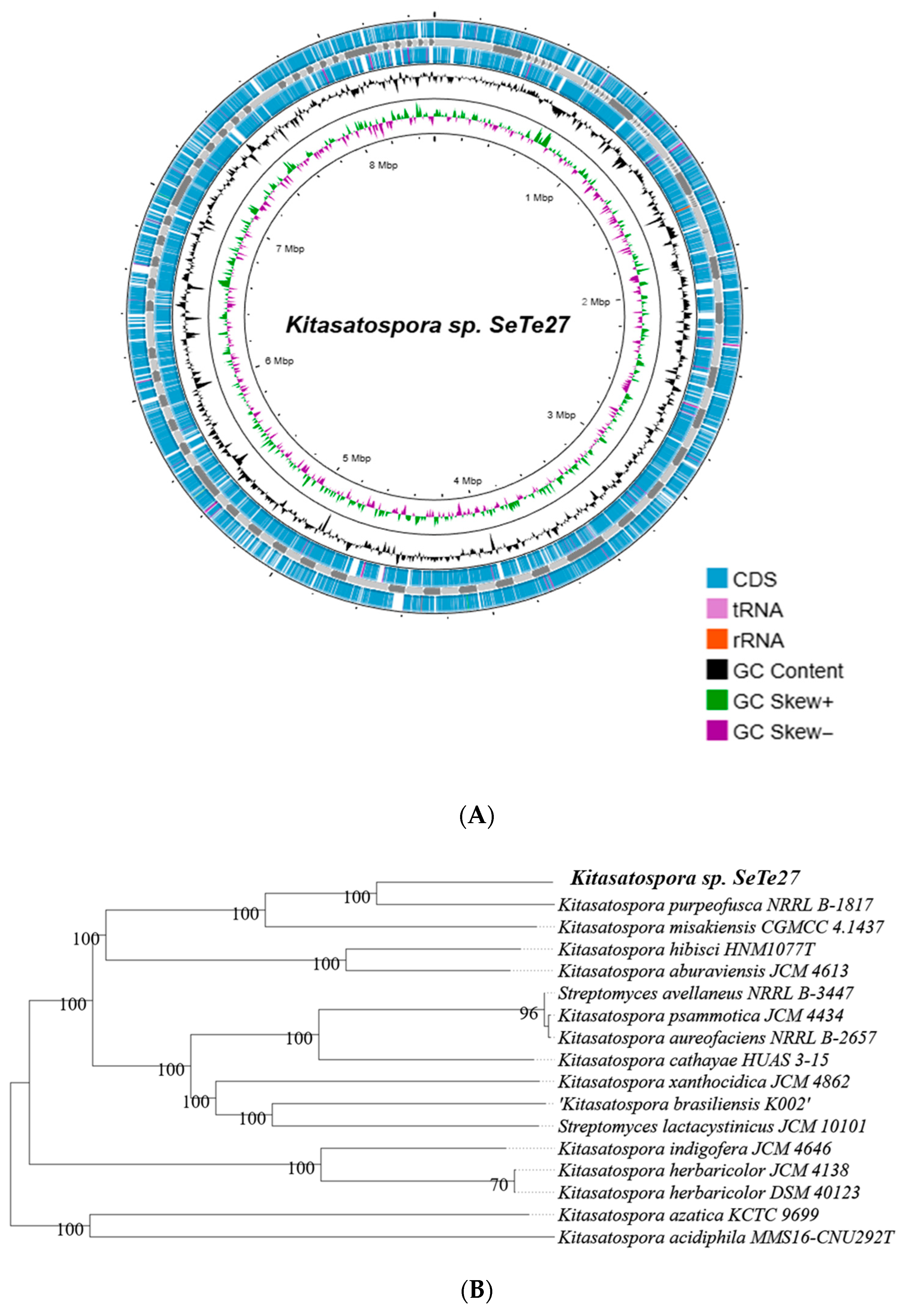
The draft genome of Kitasatospora sp. SeTe27 has a total size of 8.5 Mb and a high G+C content of 73.5%, consistent with members of the genus Kitasatospora. The genome contains one linear chromosome with 6 rRNA operons, 70 tRNA genes, and 7543 protein-coding genes (CDSs). It comprises 158 contigs, as represented in the circular map for visualization (Figure 1A).
The phylogenetic analysis is based on whole-genome sequence comparisons between Kitasatospora sp. SeTe27 and closely related reference taxa (Figure 1B). The resulting phylogenetic trees show that each isolate clusters within a well-defined clade, with high bootstrap values indicating robust evolutionary relationships. The strain Kitasatospora sp. SeTe27 formed a robustly supported branch closely associated with a subcluster containing Kitasatospora purpeofusca NRRL B-1817, embedded in a broader, well-resolved clade that also includes K. misakiensis CGMCC 4.1437 and the K. hibisciK. aburaviensis lineage, with most internal nodes showing strong pseudo-bootstrap support. The digital DNA-DNA hybridization (dDDH) values between the strain Kitasatospora sp. SeTe27 and its closest relatives, Kitasatospora purpeofusca NRRL B-1817 and Kitasatospora aburaviensis JCM 4613, were 52.1% (ANI score: 93.53%) and 28.6% (ANI score: 79.20%), respectively (Supplementary Material-Table S1). These values remain well below the 70% species boundary, despite a minimal G+C content difference relative to NRRL B-1817 (0.07%), supporting that it is a genomically distinct taxon rather than a strain-level variant [35].

3.2. Identification of Secondary Metabolic Biosynthetic Gene Clusters

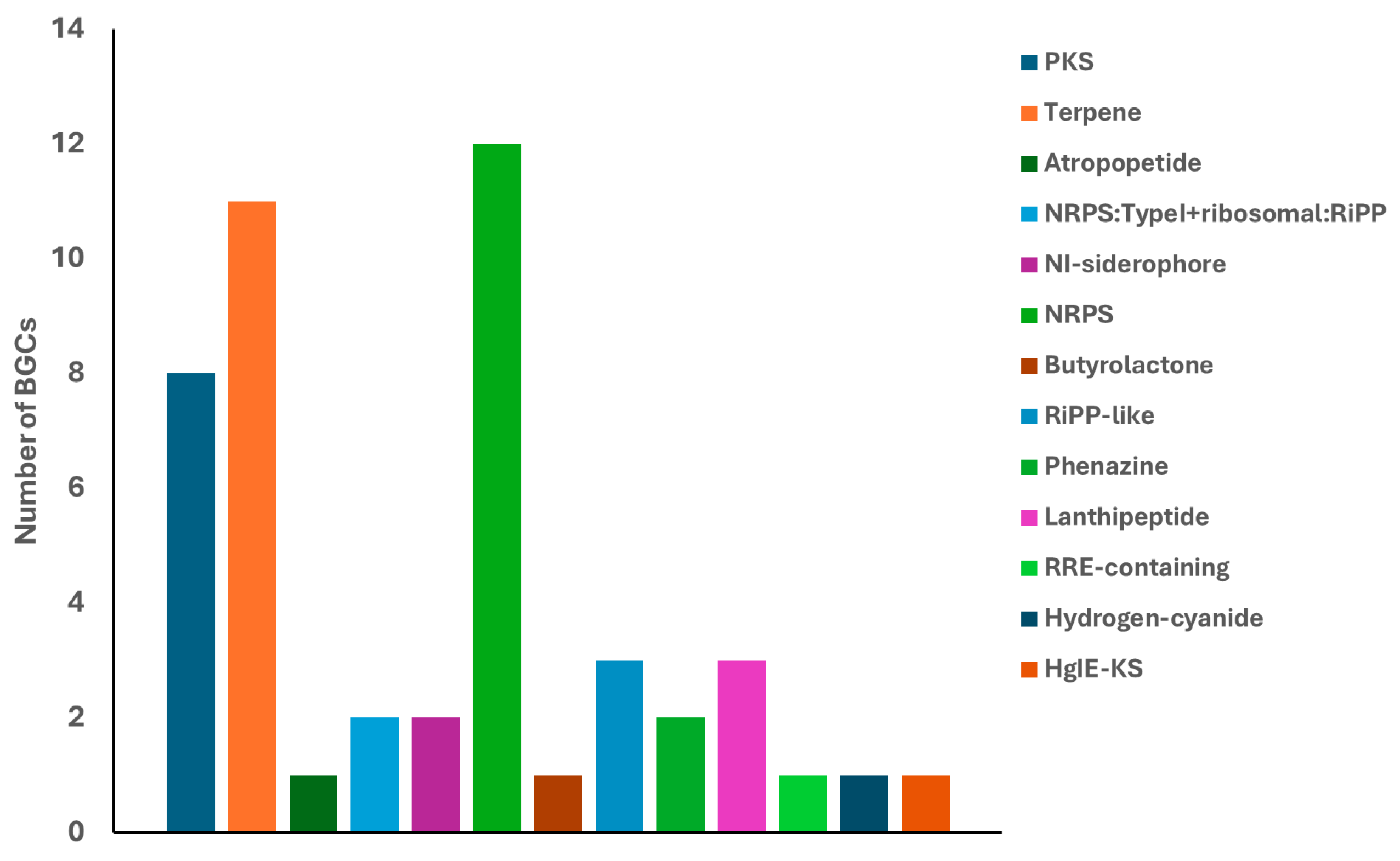
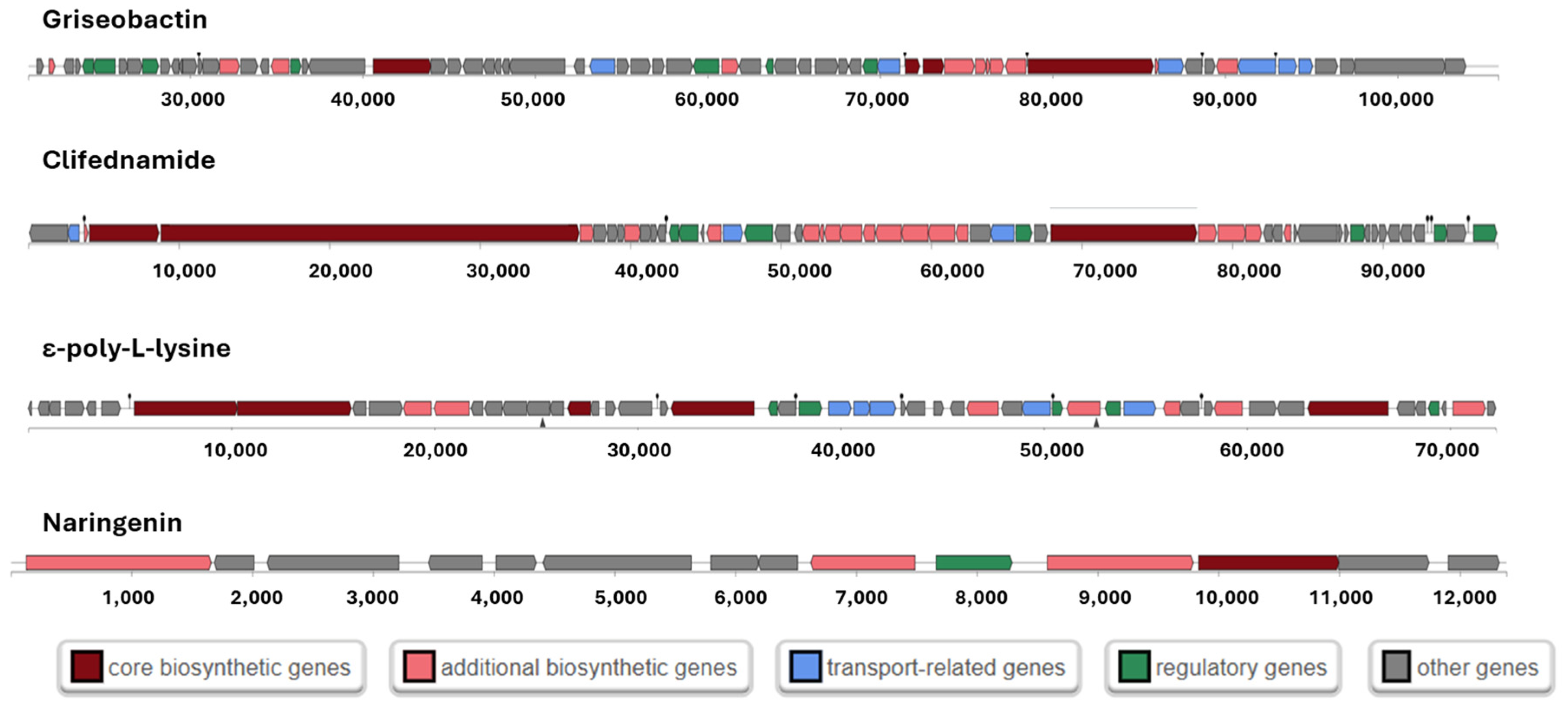
Kitasatospora sp. SeTe27 harbors 48 biosynthetic gene clusters (BGCs), accounting for approximately 17.8% (1.51 Mbp) of the genome (Figure 2, Table S2-Supplementary Material). These clusters encompass a wide range of secondary metabolite pathways, with a predominance of NRPS (12), terpene (11), and PKS (8) pathways. Four BGCs (15.1, 18.1, 47.1, and 119.1) showed high similarity to previously characterized clusters associated with griseobactin, clifednamide, ε-poly-L-lysine, and naringenin, suggesting that Kitasatospora sp. SeTe27 can produce several known bioactive metabolites (Figure 3). Several studies have detected clusters associated with the production of clifednamide (belonging to the family of polycyclic tetramate macrolactams (PTM), with antibacterial, antifungal, and cytotoxic activities) [36], ε-poly-L-lysine (a cationic monomer with applications as a food preservative and antimicrobial) [37,38,39], and naringenin (a flavonoid) [40]. While griseobactin is a catechol-peptide siderophore primarily associated with Streptomyces species, particularly Streptomyces sp. ATCC 700,974 [41], this BGC has not been found in the genus Kitasatospora to date.
Two clusters showed medium similarity to those for hopene, a triterpene precursor of hopanoids (membrane structural lipids), whose production is mediated by specific BGCs encoding squalene-hopene cyclase (SHC) [42], and to endophenazine. Specifically, the phenazine-related biosynthetic genes were detected in two distinct genomic regions, likely reflecting the modular organization of phenazine biosynthesis, where core genes and tailoring enzymes are encoded separately. Alternatively, this separation may result from genome fragmentation in the draft assembly. The identification of phenazine-related biosynthetic gene clusters in Kitasatospora sp. SeTe27 is consistent with previous reports describing bioactive endophenazine derivatives from this genus. Heine and colleagues [43] identified several endophenazine analogues from Kitasatospora sp. HKI 714, which exhibited antibacterial activity against methicillin-resistant Staphylococcus aureus and rapidly growing Mycobacterium species, thus highlighting the therapeutic potential of phenazine scaffolds. Similarly, Wu and colleagues [17] reported glycosylated and prenylated endophenazines from Kitasatospora sp. MBT66 show activity against both Gram-positive and Gram-negative bacteria, demonstrating that tailoring modifications, such as glycosylation and methylation, can expand the bioactivity spectrum of phenazine metabolites.
Moreover, in Kitasatospora sp. SeTe27, eight clusters (6.1, 7.1, 19.1, 21.2, 30.1, 49.1, 58.1, and 76.1) (Table S2-Supplementary Material) showed low similarity to any reference BGCs, while 33 BGCs showed no detectable homology, suggesting the existence of entirely unexplored biosynthetic pathways and the potential for novel metabolite production.

3.3. Spore Conditioning as a Tool to Improve Secondary Metabolite Production

A primary screening was conducted to test the antibacterial activity of the supernatant of Kitasatospora sp. SeTe27. After five days of growth in SC, the cell-free spent medium showed clear inhibition of S. aureus ATCC 25923, confirming antibiotic production.
In this context, among the predicted pathways in SeTe27, the presence of clifednamide-related polycyclic tetramate macrolactams (PTMs), ε-poly-L-lysine, and phenazine/endophenazine-like compounds suggests that these derivatives may contribute to the observed antibacterial activity against Staphylococcus sp. PTMs are known to interfere with bacterial membrane integrity and lipid homeostasis, leading to increased permeability and impaired cellular function [44]. In contrast, phenazine derivatives act as redox-active molecules that generate reactive oxygen species (ROS), thereby inducing oxidative stress, damaging DNA and proteins, and disrupting respiratory processes [45]. In addition, the genome annotation suggested the presence of an ε-poly-L-lysine–like cluster; this cationic polymer could further contribute to antibacterial activity through electrostatic interactions with negatively charged cell surfaces, leading to membrane destabilization and leakage of intracellular contents [46].
To improve the antibiotic production of Kitasatospora sp. SeTe27, spore conditioning experiments were conducted in R5A, GYM, TSB, and YEME media, with supernatants tested every 24 h for up to 120 h against S. aureus ATCC 25923. In the R5A medium, the conditioned bacterial strains grew well and produced more bacterial biomass, accelerating production to 24 h compared to the control (Figure S1-Supplementary Material). In GYM medium, Kitasatospora sp. SeTe27 did not produce antibiotic compounds in either the control or conditioned experiments (Figure S2-Supplementary Material). CLSM images revealed a high amount of dead mycelium at 48 h (control) and 24 h (conditioned), indicating non-viable hyphae and severely impaired growth. This physiological stress likely impaired metabolic capacity, preventing secondary metabolite biosynthesis (Figure S2-Supplementary Material).
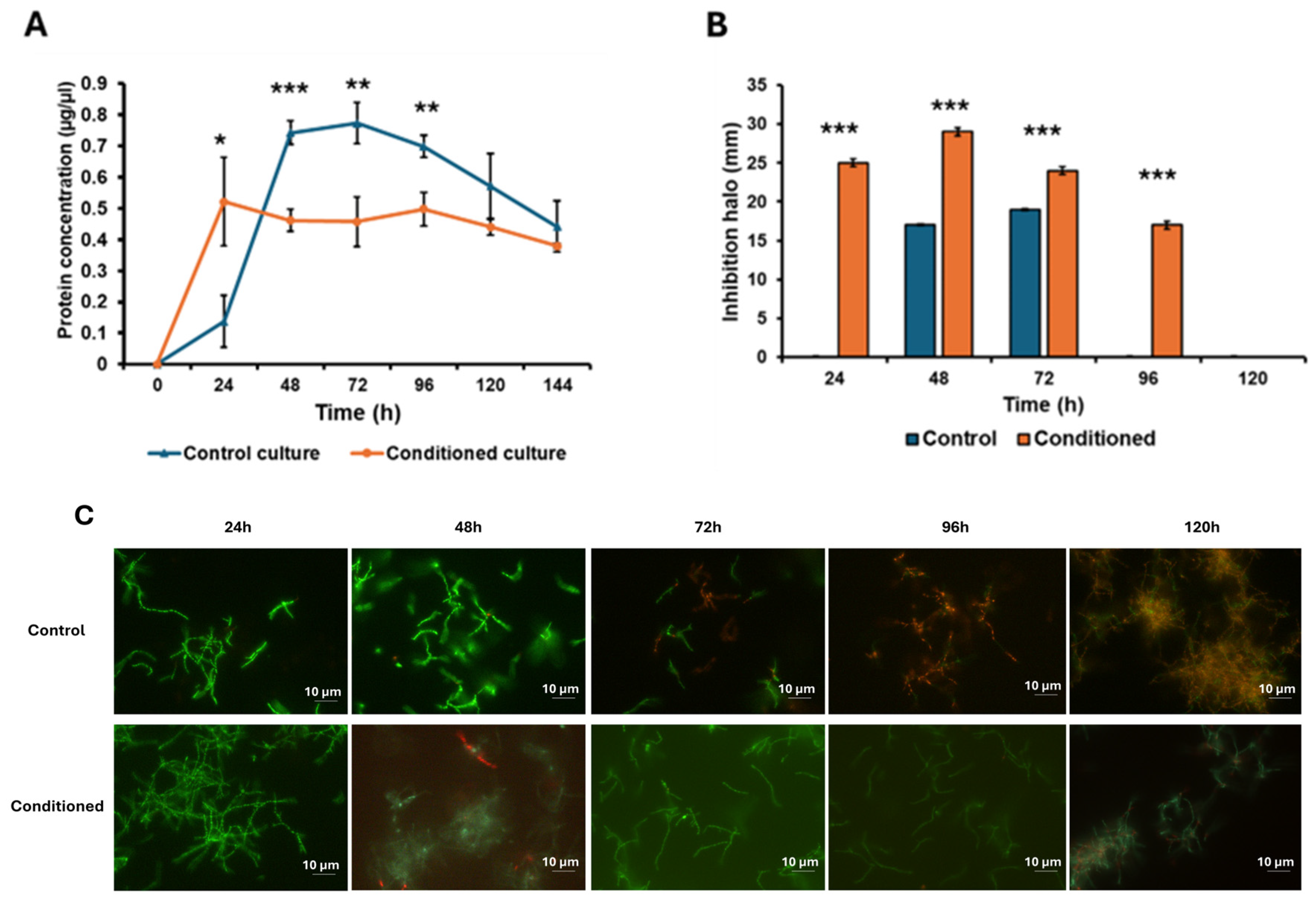
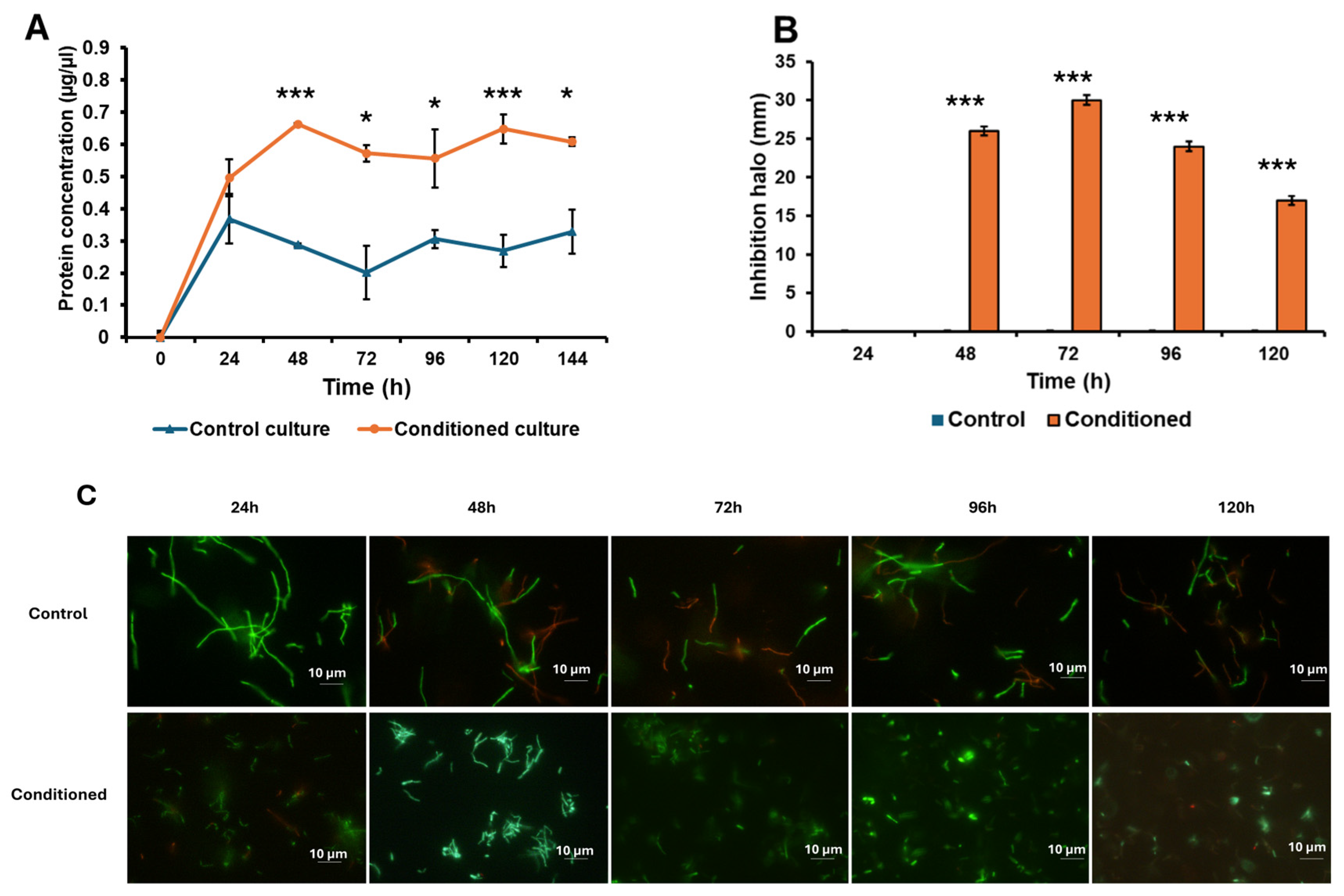
In the TSB medium, Kitasatospora sp. SeTe27 grew more rapidly in the conditioned culture at 24 h, whereas growth was reduced in the control (Figure 4A). Similarly, in the YEME medium, the conditioned culture showed a rapid growth phase up to 48 h (Figure 5A). In both TSB and YEME conditioned experiments, cell-free spent media produced larger inhibition halos at 48, 72, and 96 h (Figure 4B and Figure 5B). Inocula from conditioned cultures contained high amounts of dead mycelium pellets (red staining), non-germinated spores, and quiescent MII (green staining). By contrast, control cultures (non-conditioned inocula) contained only spores (Figure 4C and Figure 5C).
Spore conditioning significantly influences the growth and antibiotic production of Kitasatospora sp. SeTe27 by providing both physiological signals and recycled nutrients that shorten the lag phase and promote earlier metabolic differentiation.
In actinomycetes, spores represent a critical developmental stage that can shape the mycelial differentiation and secondary metabolism. In this study, spore conditioning was used to induce spore germination, generating a high-density culture in which hyphae in the MI phase undergo programmed cell death to sustain MII development [23,34]. In the actinomycetes life cycle, development and differentiation generally occur in response to nutrient starvation. Thus, this conditioned mycelium (MII) exhibits limited biomass accumulation, remaining quiescent until it is inoculated into fresh medium. Upon inoculation, it restarts the life cycle, develops as mycelium MI, and rapidly differentiates into mycelium MII—the latter being the mycelial state responsible for secondary metabolite production [34]. In Kitasatospora sp. SeTe27, spore conditioning appears to accelerate this transition, leading to earlier and more intense antibiotic production in TSB and YEME. This is in agreement with studies demonstrating that physiologically “pre-differentiated” inocula can reduce the lag phase and improve fermentative yield in filamentous actinomycetes [25,47].
The enhanced antibacterial activity in TSB and YEME relative to R5A and GYM suggests that BGC expression in this strain is strongly influenced by the carbon-to-nitrogen (C/N) ratio. TSB and YEME are rich in peptides and amino acids, as well as growth factors derived from tryptone, peptone, and yeast extract, which support rapid biomass accumulation during early growth phases while providing precursors for secondary metabolite biosynthesis [25,48]. In actinomycetes, nitrogen sources modulate global regulatory networks, including GlnR, DasR, and PhoP-mediated pathways, which coordinate the transition from primary to secondary metabolism [23,49]. The availability of readily assimilable amino acids in TSB and YEME may facilitate the biosynthesis of nitrogen-containing secondary metabolites encoded by NRPS and hybrid PKS–NRPS clusters identified in the Kitasatospora sp. SeTe27 genome, including clifednamide and phenazine-related pathways. These metabolites require substantial nitrogen input for the assembly of tetramate macrolactams and heterocyclic scaffolds, making peptide-rich media particularly favorable for their production [35,44]. Since actinomycetes often delay secondary metabolism by repressing carbon and nitrogen catabolism [25,47], the limited nitrogen availability in GYM, combined with carbon catabolite repression, may have led to the observed lack of antimicrobial production [48].
Furthermore, the presence of numerous clusters with low similarity or no homology to known BGCs, including abyssomicin-like and lankacidin-like clusters, suggests that fermentative conditions and spore conditioning may act as regulatory switches able to unravel cryptic pathways. These conditions likely mimic ecological signals, such as competition and nutritional limitation, typical of soil environments [50].

4. Conclusions

Kitasatospora sp. SeTe27, isolated from a Sicilian soil, demonstrated notable antibacterial activity against Staphylococcus aureus and a substantial biosynthetic potential, as revealed by genome mining. The identification of 48 BGCs, including NRPS, PKS, and hybrid pathways related to clifednamide and phenazine-type metabolites, highlights this rare actinomycete as a promising source of antimicrobial compounds. Moreover, the large amount of orphan and low-similarity clusters suggests the presence of unexplored metabolic pathways that may encode novel bioactive molecules. From a fermentation perspective, this study demonstrates that spore conditioning is an effective strategy to enhance antibiotic production in Kitasatospora. Conditioned inocula significantly improved antibacterial activity in peptide-rich media (TSB and YEME), indicating that nutrient composition and the carbon-to-nitrogen balance play key roles in regulating secondary metabolism. These findings support the hypothesis that physiological pre-differentiation and nutrient recycling accelerate the transition to metabolite-producing mycelium, enabling earlier and more intense production of antibacterial compounds. Future studies should integrate chemical profiling, metabolomic analyses, targeted gene expression profiling, and controlled bioreactor experiments to confirm metabolite identities, elucidate regulatory mechanisms, and optimize production. Such approaches will be essential to fully exploit the biosynthetic potential of Kitasatospora sp. SeTe27 and to develop sustainable fermentation strategies for the discovery of novel antimicrobials.

Supplementary Materials

The following supporting information can be downloaded at: https://www.mdpi.com/article/10.3390/fermentation12040185/s1, Table S1. Pairwise genome comparisons between Kitasatospora sp. SeTe27 and type strain genomes were compared using the TYGS platform (https://tygs.dsmz.de/). (* dDDH formula d4 is independent of genome size); Table S2. Biosynthetic gene clusters identified in the genome of Kitasatospora sp. SeTe27 using antiSMASH; Figure S1. Kitasatospora sp. SeTe27 growth curves in R5A medium (A) and antibiotic production for control and conditioned cultures (B). CLSM images (C) were taken after staining the cells with the LIVE/DEAD Bac-Light bacterial viability kit. Statistical significance between conditioned and non-conditioned cultures at each time point was determined using an unpaired two-tailed Student’s t-test (* p ≤ 0.05, ** p ≤ 0.01, *** p ≤ 0.001); Figure S2. Kitasatospora sp. SeTe27 growth curves in GYM medium (A). CLSM images (B) were taken after staining the cells with the LIVE/DEAD Bac-Light bacterial viability kit. Statistical significance between conditioned and non-conditioned cultures at each time point was determined using an unpaired two-tailed Student’s t-test (* p ≤ 0.05, ** p ≤ 0.01, *** p ≤ 0.001).

Author Contributions

Conceptualization, F.C.C., A.P., A.M. and R.A.; methodology, F.C.C., A.P., E.T., G.F.-G., A.M. and R.A.; software, A.F.; validation, A.P., A.M. and R.A.; writing—original draft preparation, F.C.C.; writing—review and editing, A.P., A.M. and R.A. All authors have read and agreed to the published version of the manuscript.

Funding

Project funded under the National Recovery and Resilience Plan (NRRP), Mission 4 Component 2 Investment 1.4—Call for tender No. 3138 of 16 December 2021, rectified by Decree n.3175 of 18 December 2021 of Italian Ministry of University and Research funded by the European Union—NextGenerationEU; Project code CN_00000033, Concession Decree No. 1034 of 17 June 2022 adopted by the Italian Ministry of University and Research, CUP B73D20005170001, Project title “National Biodiversity Future Center—NBFC”. This research was funded by Project SUS-MIRRI.IT “Strengthening the MIRRI Italian Research Infrastructure for Sustainable Bioscience and Bioeconomy”, code n. IR0000005PO. Work carried out in the laboratory of A. Manteca was funded by the ”Ministerio de Ciencia, Innovación Universidades/Agencia Estatal de Investigacion/Fondo Europeo de Desarrollo Regional” (PID2021-122911OB-I00, PID2024-156811OB) and the “Consejería de Empleo, Industria y Turismo del Principado de Asturias” (IDE/2024/000742). Gemma Fernandez-García was supported by a postdoctoral grant from the “Instituto de Investigación Sanitaria del Principado de Asturias” (ISPA; grant no. ITM25-POS-N2-0334).

Institutional Review Board Statement

Not applicable.

Informed Consent Statement

Not applicable.

Data Availability Statement

The data presented in this study are openly available in DDBJ/ENA/GenBank at https://www.ncbi.nlm.nih.gov/genbank/ (accessed on 12 November 2025), accession number JAXCLC000000000.1.

Conflicts of Interest

The authors declare no conflicts of interest.

References

  1. WHO. Antimicrobial Resistance: Global Report on Surveillance; World Health Organization: Geneva, Switzerland, 2014; Available online: https://www.who.int/publications/i/item/9789241564748 (accessed on 18 March 2026).
  2. O’Neill, J. Tackling Drug-Resistant Infections Globally: Final Report and Recommendations; Review on Antimicrobial Resistance: London, UK, 2016; Available online: https://amr-review.org (accessed on 18 March 2026).
  3. Newman, D.J.; Cragg, G.M. Natural Products as Sources of New Drugs over the Nearly Four Decades from 01/1981 to 09/2019. J. Nat. Prod. 2020, 83, 770–803. [Google Scholar] [CrossRef]
  4. Bhatti, A.A.; Haq, S.; Bhat, R.A. Actinomycetes benefaction role in soil and plant health. Microb. Pathog. 2017, 111, 458–467. [Google Scholar] [CrossRef]
  5. Kekuda, P.T.R.; Onkarappa, R.; Jayanna, N.D. Characterization and antibacterial activity of a glycoside antibiotic from Streptomyces variabilis PO-178. Sci. Technol. Arts Res. J. 2014, 3, 116–121. [Google Scholar] [CrossRef]
  6. Claessen, D.; Rozen, D.E.; Kuipers, O.P.; Søgaard-Andersen, L.; van Wezel, G.P. Bacterial solutions to multicellularity: A tale of biofilms, filaments and fruiting bodies. Nat. Rev. Microbiol. 2014, 12, 115–124. [Google Scholar] [CrossRef] [PubMed]
  7. Barka, E.A.; Vatsa, P.; Sanchez, L.; Gaveau-Vaillant, N.; Jacquard, C.; Meier-Kolthoff, J.P.; Klenk, H.P.; Clément, C.; Ouhdouch, Y.; van Wezel, G.P. Taxonomy, physiology, and natural products of Actinobacteria. Microbiol. Mol. Biol. Rev. 2016, 80, 1–43. [Google Scholar] [CrossRef] [PubMed]
  8. Pisciotta, A.; Manteca, Á.; Alduina, R. The SCO1731 methyltransferase modulates actinorhodin production and morphological differentiation of Streptomyces coelicolor A3(2). Sci. Rep. 2018, 8, 13686. [Google Scholar] [CrossRef]
  9. Donald, L.; Pipite, A.; Subramani, R.; Owen, J.; Keyzers, R.A.; Taufa, T. Streptomyces: Still the Biggest Producer of New Natural Secondary Metabolites, a Current Perspective. Microbiol. Res. 2022, 13, 418–465. [Google Scholar] [CrossRef]
  10. De Simeis, D.; Serra, S. Actinomycetes: A Never-Ending Source of Bioactive Compounds-An Overview on Antibiotics Production. Antibiotics 2021, 10, 483. [Google Scholar] [CrossRef]
  11. Tiwari, K.; Gupta, R.K. Rare actinomycetes: A potential storehouse for novel antibiotics. Crit. Rev. Biotechnol. 2012, 32, 108–132. [Google Scholar] [CrossRef]
  12. Tiwari, K.; Gupta, R.K. Diversity and isolation of rare actinomycetes: An overview. Crit. Rev. Microbiol. 2013, 39, 256–294. [Google Scholar] [CrossRef] [PubMed]
  13. Takahashi, Y. Genus Kitasatospora, taxonomic features and diversity of secondary metabolites. J. Antibiot. 2017, 70, 506–513. [Google Scholar] [CrossRef] [PubMed]
  14. Wei, B.; Du, A.Q.; Zhou, Z.Y.; Lai, C.; Yu, W.C. An atlas of bacterial secondary metabolite biosynthesis gene clusters. Environ. Microbiol. 2021, 23, 6981–6992. [Google Scholar] [CrossRef] [PubMed]
  15. Zimmermann, A.; Nouioui, I.; Pötter, G.; Neumann-Schaal, M.; Wolf, J.; Wibberg, D.; Mast, Y. Kitasatospora fiedleri sp. nov., a novel antibiotic-producing member of the genus Kitasatospora. Int. J. Syst. Evol. Microbiol. 2023, 73, 006137. [Google Scholar] [CrossRef]
  16. Yun, B.R.; Malik, A.; Kim, S.B. Genome-based characterization of Kitasatospora sp. MMS16-BH015, a multiple heavy metal resistant soil actinobacterium with high antimicrobial potential. Gene 2020, 733, 144379. [Google Scholar] [CrossRef]
  17. Wu, C.; van Wezel, G.P.; Choi, Y.H. Identification of novel endophenaside antibiotics produced by Kitasatospora sp. MBT66. J. Antibiot. 2015, 68, 445–452. [Google Scholar] [CrossRef]
  18. Singh, S.B.; Pelaez, F. Biodiversity, chemical diversity and drug discovery. Prog. Drug Res. 2008, 65, 141–174. [Google Scholar] [CrossRef]
  19. Bérdy, J. Bioactive microbial metabolites. J. Antibiot. 2005, 58, 1–26. [Google Scholar] [CrossRef]
  20. Hao, X.; Yu, J.; Wang, Y.; Connolly, J.A.; Liu, Y.; Zhang, Y.; Yu, L.; Cen, S.; Goss, R.J.; Gan, M. Zelkovamycins B–E, cyclic octapeptides containing rare amino acid residues from an endophytic Kitasatospora sp. Org. Lett. 2020, 22, 9346–9350. [Google Scholar] [CrossRef]
  21. Medema, M.H.; Fischbach, M.A. Computational approaches to natural product discovery. Nat. Chem. Biol. 2015, 11, 639–648. [Google Scholar] [CrossRef]
  22. Scherlach, K.; Hertweck, C. Mining and unearthing hidden biosynthetic potential. Nat. Commun. 2021, 12, 3864. [Google Scholar] [CrossRef]
  23. Marín, L.; Gutiérrez-Del-Río, I.; Yagüe, P.; Manteca, Á.; Villar, C.J.; Lombó, F. De Novo Biosynthesis of Apigenin, Luteolin, and Eriodictyol in the Actinomycete Streptomyces albus and Production Improvement by Feeding and Spore Conditioning. Front. Microbiol. 2017, 8, 921. [Google Scholar] [CrossRef] [PubMed]
  24. Demain, A.L.; Sánchez, S. Microbial drug discovery: 80 years of progress. J. Antibiot. 2009, 62, 5–16. [Google Scholar] [CrossRef]
  25. van Wezel, G.P.; McDowall, K.J. The regulation of the secondary metabolism of Streptomyces: New links and experimental advances. Nat. Prod. Rep. 2011, 28, 1311–1333. [Google Scholar] [CrossRef]
  26. Olano, C.; Méndez, C.; Salas, J.A. Antitumor compounds from marine actinomycetes. Mar. Drugs 2009, 7, 210–248. [Google Scholar] [CrossRef]
  27. Firrincieli, A.; Tornatore, E.; Piacenza, E.; Cappelletti, M.; Saiano, F.; Pavia, F.C.; Alduina, R.; Zannoni, D.; Presentato, A. The actinomycete Kitasatospora sp. SeTe27, subjected to adaptive laboratory evolution (ALE) in the presence of selenite, varies its cellular morphology, redox stability, and tolerance to the toxic oxyanion. Chemosphere 2024, 354, 141712. [Google Scholar] [CrossRef]
  28. Meier-Kolthoff, J.P.; Göker, M. TYGS is an automated high-throughput platform for state-of-the-art genome-based taxonomy. Nat. Commun. 2019, 10, 2182. [Google Scholar] [CrossRef]
  29. Lefort, V.; Desper, R.; Gascuel, O. FastME 2.0: A comprehensive, accurate, and fast distance-based phylogeny inference program. Mol. Biol. Evol. 2015, 32, 2798–2800. [Google Scholar] [CrossRef] [PubMed]
  30. Lee, I.; Kim, Y.O.; Park, S.C.; Chun, J. OrthoANI: An improved algorithm and software for calculating average nucleotide identity. Int. J. Syst. Evol. Microbiol. 2016, 66, 1100–1103. [Google Scholar] [CrossRef]
  31. Blin, K.; Medema, M.H.; Kazempour, D.; Fischbach, M.A.; Breitling, R.; Takano, E.; Weber, T. antiSMASH 2.0—A versatile platform for genome mining of secondary metabolite producers. Nucleic Acids Res. 2013, 41, W204–W212. [Google Scholar] [CrossRef] [PubMed]
  32. Bauer, A.W.; Kirby, W.M.; Sherris, J.C.; Turck, M. Antibiotic susceptibility testing by a standardized single disk method. Am. J. Clin. Pathol. 1966, 45, 493–496. [Google Scholar] [CrossRef]
  33. Holder, I.A.; Boyce, S.T. Agar well diffusion assay testing of bacterial susceptibility to various antimicrobials in concentrations non-toxic for human cells in culture. Burns 1994, 20, 426–429. [Google Scholar] [CrossRef]
  34. Manteca, Á.; Fernández, M.; Sánchez, J. A death round affecting a young compartmentalized mycelium precedes aerial mycelium dismantling in confluent surface cultures of Streptomyces antibioticus. Microbiology 2008, 151, 3689–3697. [Google Scholar] [CrossRef]
  35. Wayne, L.G.; Brenner, D.J.; Colwell, R.R.; Grimont, P.A.D.; Kandler, O.; Krichevsky, M.I.; Moore, L.H.; Moore, W.E.C.; Murray, R.G.E.; Stackebrandt, E.; et al. Report of the ad hoc committee on reconciliation of approaches to bacterial systematics. Int. J. Syst. Bacteriol. 1987, 37, 463–464. [Google Scholar] [CrossRef]
  36. Jiao, Y.J.; Liu, Y.; Wang, H.X.; Zhu, D.Y.; Shen, Y.M.; Li, Y.Y. Expression of the clifednamide biosynthetic pathway in Streptomyces generates 27,28-seco-derivatives. J. Nat. Prod. 2020, 83, 2803–2808. [Google Scholar] [CrossRef]
  37. Zhang, Z.H.; Yin, L.; Wang, Y.M. Catalysis by L-lysine: A green method for the condensation of aromatic aldehydes with acidic methylene compounds in water at room temperature. Chin. J. Chem. 2010, 28, 2223–2228. [Google Scholar] [CrossRef]
  38. Ouyang, J.; Xu, H.; Li, S.; Zhu, H.; Chen, W.; Zhou, J.; Wu, Q.; Xu, L.; Ouyang, P. Production of ε-poly-L-lysine by newly isolated Kitasatospora sp. PL6-3. Biotechnol. J. 2006, 1, 1459–1463. [Google Scholar] [CrossRef]
  39. Xue, Y.; Zhou, Z.; Feng, F.; Zhao, H.; Tan, S.; Li, J.; Wu, S.; Ju, Z.; He, S.; Ding, L. Genomic analysis of Kitasatospora setae to explore its biosynthetic potential regarding secondary metabolites. Antibiotics 2024, 13, 459. [Google Scholar] [CrossRef] [PubMed]
  40. Martín, J.F.; Liras, P. Comparative molecular mechanisms of biosynthesis of naringenin and related chalcones in Actinobacteria and plants: Relevance for the obtention of potent bioactive metabolites. Antibiotics 2022, 11, 82. [Google Scholar] [CrossRef] [PubMed]
  41. Patzer, S.I.; Braun, V. Gene cluster involved in the biosynthesis of griseobactin, a catechol-peptide siderophore of Streptomyces sp. ATCC 700974. J. Bacteriol. 2010, 192, 426–435. [Google Scholar] [CrossRef] [PubMed]
  42. Ko, M.S.; Moon, M.Y.; Hyun, C.G. Genomic and metabolomic characterization of Kitasatospora griseola JNUCC 62 from Mulyeongari Oreum and its cosmeceutical potential. Fermentation 2025, 11, 671. [Google Scholar] [CrossRef]
  43. Heine, D.; Martin, K.; Hertweck, C. Genomics-guided discovery of endophenazines from Kitasatospora sp. HKI 714. J. Nat. Prod. 2014, 77, 1083–1087. [Google Scholar] [CrossRef] [PubMed]
  44. Cao, S.; Blodgett, J.A.V.; Clardy, J. Targeted discovery of polycyclic tetramate macrolactams from an environmental Streptomyces strain. Org. Lett. 2010, 12, 4652–4654. [Google Scholar] [CrossRef]
  45. Mavrodi, D.V.; Blankenfeldt, W.; Thomashow, L.S. Phenazine compounds in fluorescent Pseudomonas spp.: Biosynthesis and regulation. Annu. Rev. Phytopathol. 2006, 44, 417–445. [Google Scholar] [CrossRef]
  46. Hyldgaard, M.; Mygind, T.; Vad, B.S.; Stenvang, M.; Otzen, D.E.; Meyer, R.L. The antimicrobial mechanism of action of epsilon-poly-l-lysine. Appl. Environ. Microbiol. 2014, 80, 7758–7770. [Google Scholar] [CrossRef] [PubMed]
  47. van Dissel, D.; Claessen, D.; van Wezel, G.P. Morphogenesis of Streptomyces in submerged cultures. Adv. Appl. Microbiol. 2014, 89, 1–45. [Google Scholar] [CrossRef] [PubMed]
  48. Sánchez, S.; Demain, A.L. Metabolic regulation of fermentation processes. Enzyme Microb. Technol. 2002, 31, 895–906. [Google Scholar] [CrossRef]
  49. Rigali, S.; Nothaft, H.; Noens, E.E.; Schlicht, M.; Colson, S.; Müller, M.; Joris, B.; Koerten, H.K.; Hopwood, D.A.; Titgemeyer, F.; et al. The sugar phosphotransferase system of Streptomyces coelicolor is regulated by the GntR-family regulator DasR and links N-acetylglucosamine metabolism to the control of development. Mol. Microbiol. 2006, 61, 1237–1251. [Google Scholar] [CrossRef]
  50. Rutledge, P.J.; Challis, G.L. Discovery of microbial natural products by activation of silent biosynthetic gene clusters. Nat. Rev. Microbiol. 2015, 13, 509–523. [Google Scholar] [CrossRef]
Figure 1. Genomic features of Kitasatospora sp. SeTe27. (A) Circular draft genome map of Kitasatospora sp. SeTe27 showing coding sequences (CDS) on the forward and reverse strands, tRNA, rRNA, GC content, and GC skew. (B) Phylogenetic analysis of Kitasatospora sp. SeTe27, based on the whole genome, shows the relationships with Kitasatospora sp. SeTe27 and closely related type strains. Bootstrap values are shown at branch nodes, and the isolates are indicated in bold. The scale bar represents nucleotide substitutions per site, supporting the taxonomic placement of the isolates within well-defined actinobacterial lineages.
Fermentation 12 00185 g001
Figure 2. Distribution of predicted biosynthetic gene clusters (BGCs) identified by antiSMASH analysis.
Fermentation 12 00185 g002
Figure 3. Organization of selected high-similarity biosynthetic gene clusters in Kitasatospora sp. SeTe27. Gene cluster architectures for griseobactin, clifednamide, ε-poly-L-lysine, and naringenin are shown. Core biosynthetic genes, tailoring enzymes, transporters, and regulatory genes are indicated by different colors.
Fermentation 12 00185 g003
Figure 4. Kitasatospora sp. SeTe27 growth curves in TSB medium (A) and antibiotic production for control and conditioned cultures (B). CLSM images (C) were taken after staining the cells with the LIVE/DEAD Bac-Light bacterial viability kit. Data represent mean ± SD (n = 3). Statistical significance between conditioned and non-conditioned cultures at each time point was determined using an unpaired two-tailed Student’s t-test (* p ≤ 0.05, ** p ≤ 0.01, *** p ≤ 0.001).
Fermentation 12 00185 g004
Figure 5. Kitasatospora sp. SeTe27 growth curves in YEME medium (A) and antibiotic production for control and conditioned cultures (B). CLSM images (C) were taken after staining the cells with the LIVE/DEAD Bac-Light bacterial viability kit. Data represent mean ± SD (n = 3). Statistical significance between conditioned and non-conditioned cultures at each time point was determined using an unpaired two-tailed Student’s t-test (* p ≤ 0.05, *** p ≤ 0.001).
Fermentation 12 00185 g005
Disclaimer/Publisher’s Note: The statements, opinions and data contained in all publications are solely those of the individual author(s) and contributor(s) and not of MDPI and/or the editor(s). MDPI and/or the editor(s) disclaim responsibility for any injury to people or property resulting from any ideas, methods, instructions or products referred to in the content.