
Phenyllactic Acid from Lactic Acid Bacteria: A Natural Antimicrobial for Food Biopreservation


Abstract
1. Introduction
2. Genera and Species of LAB Producing Phenyllactic Acid

| LAB | Source | PLA Production | Reference |
|---|---|---|---|
| Lactobacillus plantarum ITM21B, ITM21A, ITM20B, ATCC 4008, and ICMP 5826; Lactobacillus alimentarius ATCC 29643, Lactobacillus brevis ATCC 14869, Lactobacillus hilgardii IDM51B, Leuconostoc mesenteroides ITMY30, Leuconostoc citreum ITM22A | Different culture collections | 0.34, 0.35, 0.33, 0.26, 0.27, 0.37, 0.46,0.33, 0.57, and 0.43 mM (56.5, 58.1, 54.8, 43.2, 44.8, 61.4, 76.4, 54.8, 94.7, and 71.4 mg/L), respectively | [5] |
| Lb. plantarum 21B, VLT01, SK007, IMAU10124, UM55, WIKIM18 | Sourdough, DIPROVAL collection, pickled vegetables, koumiss, milk, and kimchi, respectively | 0.056, 0.083, 0.091, 0.229, 0.0748 g/L and 173 μM (28.7 mg/L), respectively | [29,30,31,32,33,34] |
| Lactobacillus sp. SK007 | Chinese traditional pickles | 2.3 g/L in an optimized culture medium (30 g/L glucose, 5 g/L phenylpyruvic acid, 47 g/L corn steep liquor, 3 g/L K2HPO4, 3 g/L CH3COONa, 30 g/L yeast powder and 3 mL/L Tween 80) | [26] |
| Lactobacillus casei 21/1, Lb. casei NRRL B-1922, Lb. casei 12A, Lb. casei DPC3968, Lb. casei ATCC 334, Lactobacillus fermentum NRRL B-1932, Lb. fermentum ATCC 11976, Lactobacillus rhamnosus ATCC 13075, Lb. rhamnosus NRRL B-442, Lactobacillus reuteri NRRL B-14171, Lactobacillus sakei NRRL b-1917 | Different culture collections | 0.275, 0.028, 0.131, 0.114, 0.117, 0.120, 0.129, 0.242, 0.086, 0.124, 0.021 mM (45.7, 4.6, 21.7, 18.9, 19.4, 19.9, 21.4, 40.2, 14.3, 20.6, 3.5 mg/L) in MRS broth | [35] |
| Pediococcus pentosaceus SK25 | Traditional Chinese pickles | 0.81 mM (135.6 mg/L) in MRS broth and 47.2 mg/L in milk + 2% glucose | [36] |
| Lactobacillus zeae Y44 | Coffee beans | 0.81 mM (135.6 mg/L) in MRS broth | [37] |
| Pediococcus acidilactici CRL 1753 | Silage | 157.8 mg/L in MRS broth | [38] |
| Lb. plantarum YM-4-3 | Traditional Chinese fermented soybeans | 55.63 mg/L in MRS broth after 24 h | [39] |
| Lb. plantarum KP3 | Commercial fermented foods | 0.229 mg/mL after 120 h and 0.087 mg/mL after 12 h in medium formulated using 8% Porphyra sp. residues pretreated with cellulase (2000 U) added with 1.36% phenylalanine and 0.5% yeast extract | [27] |
| Lactobacillus crustorum NWAFU 1019, NWAFU 1060, and NWAFU 1078 | Chinese fermented vegetables | 1.2 mM (199.4 mg/L) in basal MRS broth | [40] |
| Sporolactobacillus inulinus ATCC 15538 | ---- | 47 mM (7.8 g/L) in glucose–yeast–peptone medium | [25] |
| Lactiplantibacillus plantarum CXG9 | Chinese fermented vegetable (stinky xiancaigeng) | 0.6 mM (99.7 mg/L) in MRS broth | [7] |
| Weissella confusa DY2 | Fish intestines | 2.45 mg/mL | [41] |
| Co-culture of Lpb. plantarum, Lactobacillus delbrueckii, and Pediococcus pentosaceus at 1:1:1 | Fresh raw cow milk | 1225 mg/L in cheese whey: MRS broth (5:2) supplemented with 2.69% phenylalanine, 9.6% glucose, and 5 g/L CaCO3 | [42] |
3. Biosynthesis of Phenyllactic Acid in Lactic Acid Bacteria
3.1. Primary Precursors on PLA
3.2. Enzymes Involved (Aromatic Amino Acid Transaminase, Lactate Dehydrogenase)
4. Factors Affecting PLA Production
4.1. Fermentation Conditions (pH, Temperature, Inoculum Size, and Matrix)
4.2. Substrate Availability (Phenylalanine-Rich Culture Media and PPA Supplementation)
| LAB | Culture Medium and Fermentation Time | Substrate | Main Findings | Reference |
|---|---|---|---|---|
| Lactobacillus plantarum CECT-221 | MRS 31.5 °C, 72 h | Phenylalanine (Phe) 0.1 g/L | 1.38 mM of PLA was produced (229.3 mg/L). | [58] |
| Leuconostoc mesenteroides ATCC 8293 | MRS 30 °C, 24 h | Phenylpyruvic acid (PPA) (10, 20, 30, 40, 50, and 60 mmol/L) | The best PLA (35 mmol/L, 5.8 g/L) production was obtained at 50 mmol/L, while the best yield conversion (83.3%) was at 20 mmol/L. | [23] |
| Lb. plantarum IMAU10124 | MRS 48 h | Phe (0, 0.2, 0.5, 1.0, 1.5, 2.0 g/L) PPA (1.0, 2.0, 2.5, 3.0, 4.0 g/L) | 1.5 g/L Phe increased PLA production 2.3-fold (0.518 g/L) with 47.97% of Phe conversion, while 3.0 g/L PPA enhanced PLA production by 12.7-fold (2.9 g/L) with a conversion of 96.05% of PPA; higher PPA concentrations acted as substrate inhibitors. | [32] |
| Pediococcus pentosaceus SK25 | Milk + 2% glucose 6–12 h | 1 mg/mL Phe | Phe enhanced PLA production (47.2 mg/L) between 1.6- and 1.8-fold (82.5 mg/L) during fermentation time (6 to 12 h). | [36] |
| Lactobacillus zeae Y44 | MRS 24 h | Phe and PPA 5 mM | The production of PLA was 1.43 mM (237.6 mg/L) and 4.23 mM (702 mg/L) for Phe and PPA, respectively. PLA at 0 mM of supplements was 0.80 mM (132.9 mg/L). | [37] |
| Lb. plantarum 21B, 19A, 5BG; Lactobacillus paracasei IMPC2.1 | Synthetic medium (SM) 72 h | PPA 6.1 mM | PPA enhanced PLA production by 2- or 6-fold compared with SM alone. The improved PLA concentrations were 2.4, 1.1, 1.2, and 1.9 mM (398.8, 182.8, 199.4, and 315.7 mg/L), respectively. | [44] |
| Lactobacillus reuteri R29 | MRS 0, 24, and 48 h | Phe (0, 0.5, 1.0, 1.5, 2.0 g/L) | PLA increased concentration as Phe did. 1.5 and 2.0% of Phe stimulated PLA production by 3- and 4.2-fold (reaching 113.2 and 116.4 mg/L after 24 h and 361.2 and 363.8 mg/L after 48 h, respectively) without a significant difference between both tested concentrations. | [59] |
| Lb. plantarum BLCC2-0069 | MRS broth 24 h | Phenylpyruvate (3 g/L) | The PLA production was 3.96 g/L. | [60] |
| Lactiplantibacillus plantarum WIKIM18 from kimchi | MRS broth 6 h | Phe (0, 1, 5, 10 mM) | PLA was 173, 207.8, 316.6, and 442.5 μM (28.7, 34.5, 52.6, and 73.5 mg/L). | [34] |
4.3. Technological Approaches to Improve PLA Production
5. PLA Detection and Quantification (HPLC, LC-MS/MS, and Enzymatic Methods)
5.1. HPLC-UV as the Workhorse Method
5.2. LC-MS/MS and UPLC-MS for Confirmation and Discovery
5.3. Enzymatic Methods (Current Role and Limitations for PLA)
6. Antimicrobial Activity of PLA and Mechanisms of Action
6.1. Antifungal Activity
6.2. Antibacterial Activity
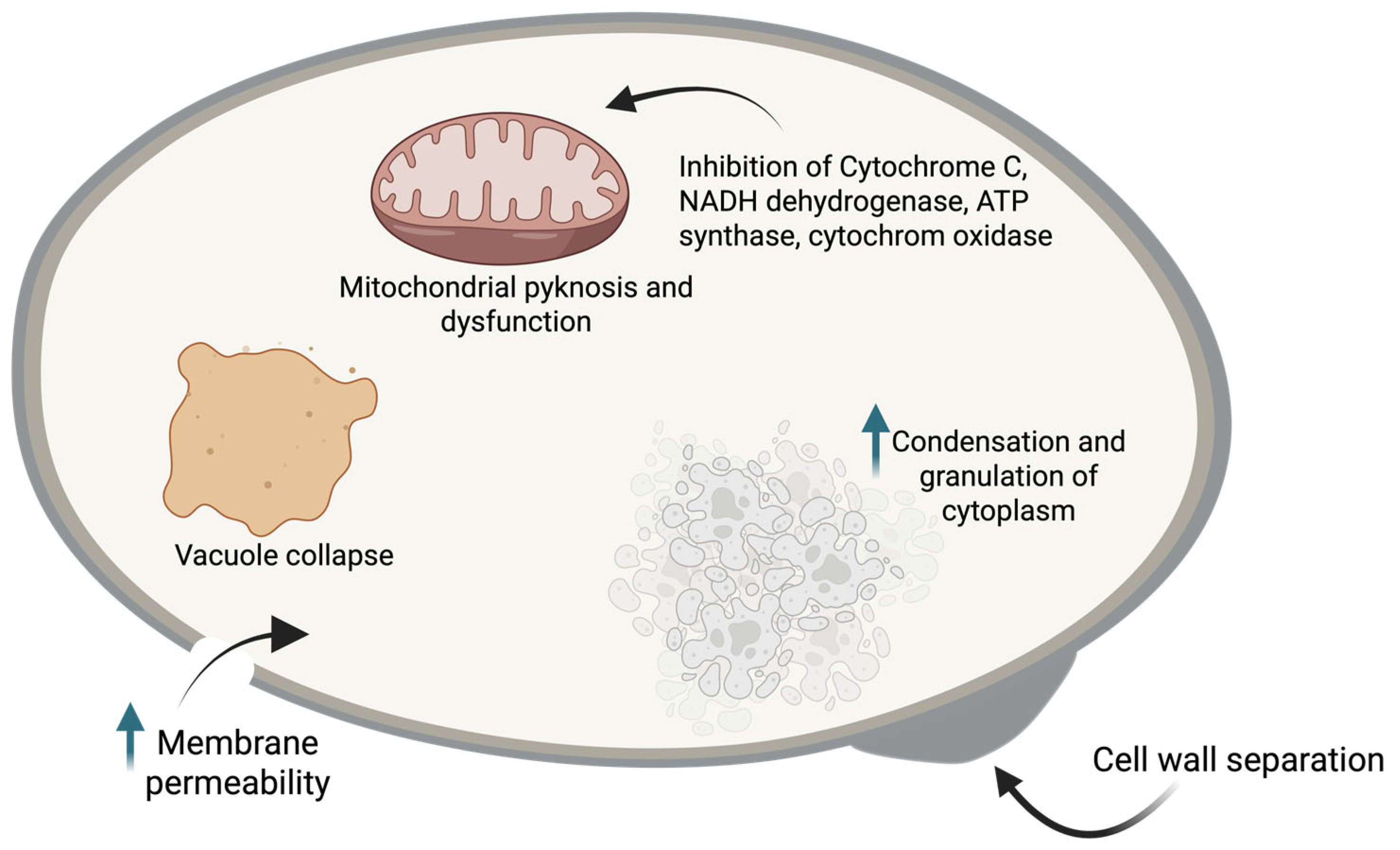
6.3. Antifungal Mechanisms of Action
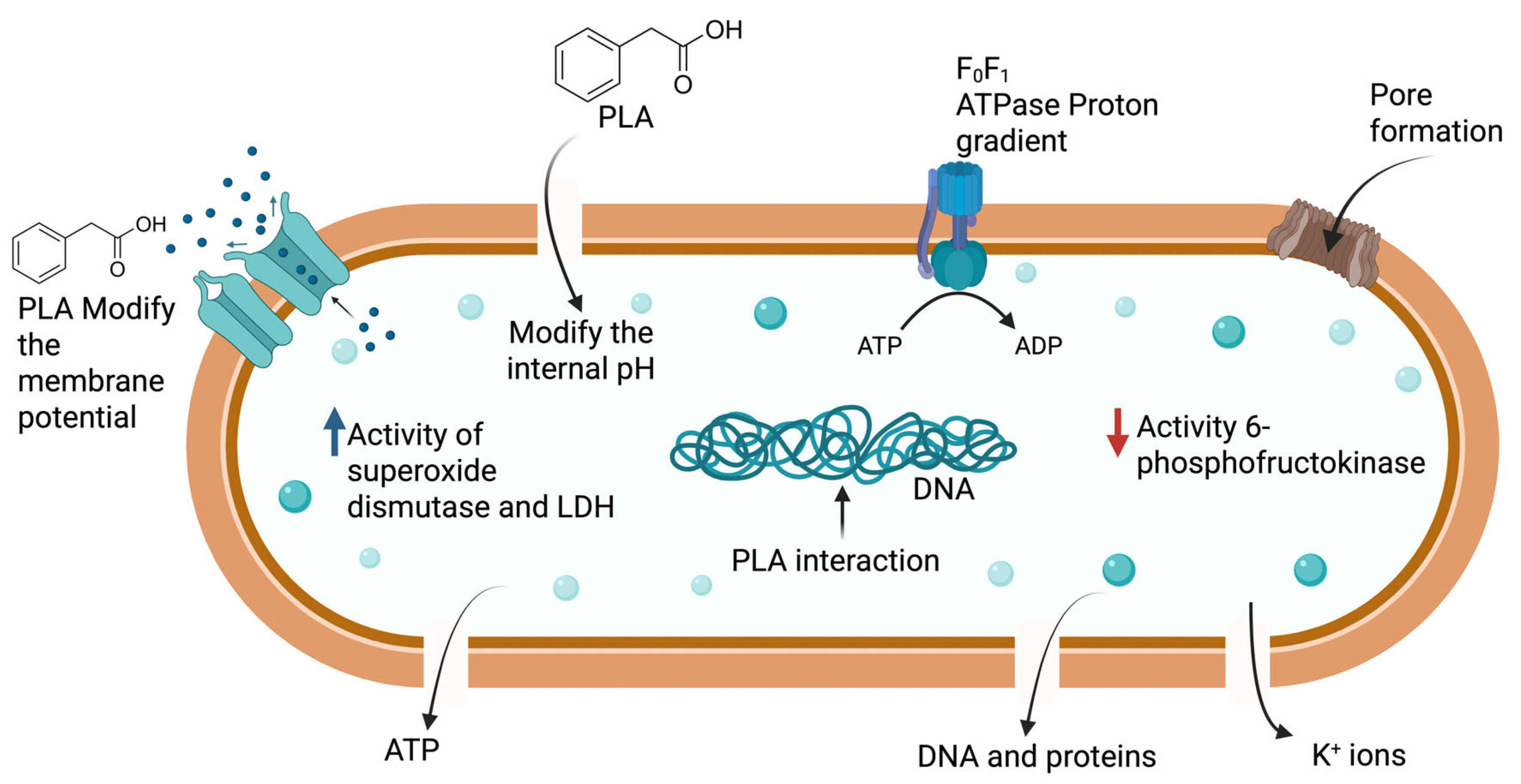
6.4. Antibacterial Mechanisms of Action
7. Applications in Food Systems
7.1. Dairy Products
7.2. Fruit and Vegetables
7.3. Bakery Products
7.4. Meat, Fish, and Poultry Products
7.5. Efficacy in Extending Shelf Life and Preserving Sensory Quality
7.6. Active Packaging
8. Regulatory and Safety Aspects
8.1. GRAS and QPS Status of LAB
| Entity/Aspect | Scope | Status/Key Points | Implications for PLA in Foods |
|---|---|---|---|
| EFSA (EU) | LAB strains (QPS list) | Many LAB taxa (Lactobacillus sensu lato, Leuconostoc, Pediococcus, Sporolactobacillus) included under QPS [9] | PLA produced in situ during fermentation by QPS strains is generally acceptable in foods |
| European Commission Regulation (EC) No 1333/2008 | Food additives | Food additives must be included in the EU list following a scientific risk assessment by EFSA and authorization granted by the EU [111] | Purified PLA, intended as an additive, would require EFSA evaluation and approval |
| FDA (US) | GRAS and food additive framework | Several LAB species are recognized as GRAS for use as starter cultures or probiotics [8] | PLA produced in situ during fermentation by GRAS microorganisms is generally allowed within its intended use; however, purified PLA used as an ingredient would need either FDA approval (food additive petition) or support through a GRAS determination or notice submitted to the FDA |
| Toxicological evidence | PLA metabolite | In vitro studies demonstrate low cytotoxicity at food-relevant concentrations; however, limited subchronic/in vivo data are available [3,21,84] | Supports in situ use in fermented foods, but purified PLA as an additive needs a complete toxicological dossier |
| Clean-label positioning | Consumer perception | “Clean-label” is not legally defined but is understood to imply natural, minimally processed foods [112,113] | In situ PLA aligns with clean-label strategies; exogenous purified PLA may face consumer skepticism |
8.2. Toxicological Considerations of PLA
8.3. Clean-Label Applications
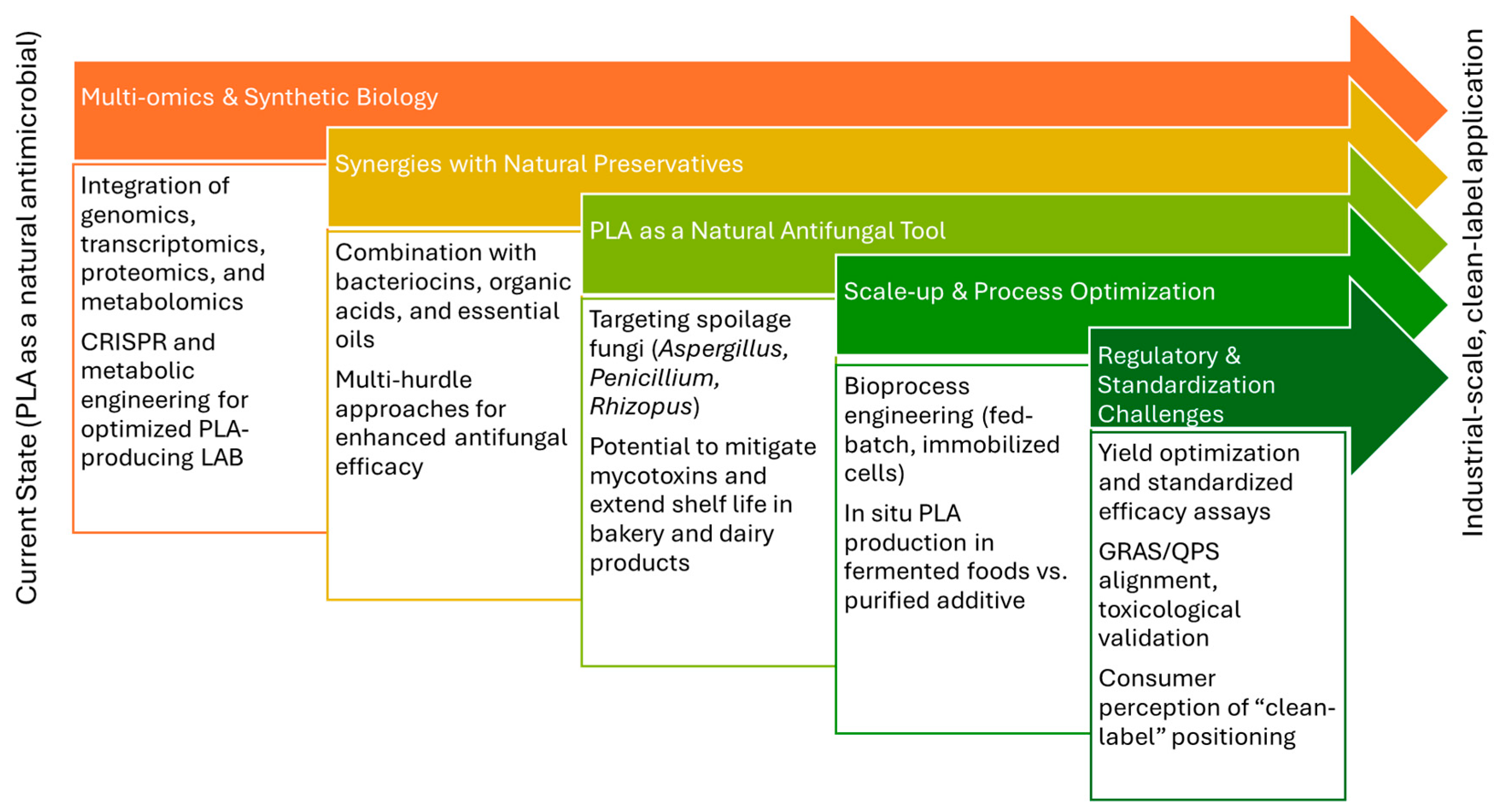
9. Future Perspectives and Challenges
9.1. Multi-Omics to Optimize PLA-Producing LAB
9.2. Combination with Other Natural Preservatives
9.3. Challenges in Scaling up PLA Production
10. Concluding Remarks
Supplementary Materials
Author Contributions
Funding
Institutional Review Board Statement
Informed Consent Statement
Data Availability Statement
Acknowledgments
Conflicts of Interest
Appendix A
| Abbreviation | Microbial Genus |
|---|---|
| A. | Aspergillus |
| E. | Escherichia |
| Ent. | Enterococcus |
| F. | Fusarium |
| K. | Klebsiella |
| L. | Listeria |
| Lb. | Lactobacillus |
| Lc. | Lactococcus |
| Leuc. | Leuconostoc |
| Lpb. | Lactiplantibacillus |
| M. | Mucor |
| P. | Penicillium |
| Ped. | Pediococcus |
| R. | Rhizopus |
| S. | Salmonella |
| Sh. | Shigella |
| Sp. | Sporolactobacillus |
| Staph | Staphylococcus |
| V. | Vibrio |
References
- Li, T.; Qin, Z.; Wang, D.; Xia, X.; Zhou, X.; Hu, G. Coenzyme Self-Sufficiency System-Recent Advances in Microbial Production of High-Value Chemical Phenyllactic Acid. World J. Microbiol. Biotechnol. 2023, 39, 36. [Google Scholar] [CrossRef] [Scilit]
- Rajanikar, R.V.; Nataraj, B.H.; Naithani, H.; Ali, S.A.; Panjagari, N.R.; Behare, P.V. Phenyllactic Acid: A Green Compound for Food Biopreservation. Food Control 2021, 128, 108184. [Google Scholar] [CrossRef] [Scilit]
- Sun, Y.; Zhu, J.; Wang, T.; Liu, Z.; Chu, C.; Yi, J. Recent Advances and Potentiality of Phenyllactic Acid: Source, Antimicrobial Mechanism, and Applications. Trends Food Sci. Technol. 2025, 158, 104926. [Google Scholar] [CrossRef] [Scilit]
- Peters, A.; Krumbholz, P.; Jäger, E.; Heintz-Buschart, A.; Çakir, M.V.; Rothemund, S.; Gaudl, A.; Ceglarek, U.; Schöneberg, T.; Stäubert, C. Metabolites of Lactic Acid Bacteria Present in Fermented Foods Are Highly Potent Agonists of Human Hydroxycarboxylic Acid Receptor 3. PLoS Genet. 2019, 15, e1008145. [Google Scholar] [CrossRef] [Scilit]
- Valerio, F.; Lavermicocca, P.; Pascale, M.; Visconti, A. Production of Phenyllactic Acid by Lactic Acid Bacteria: An Approach to the Selection of Strains Contributing to Food Quality and Preservation. FEMS Microbiol. Lett. 2004, 233, 289–295. [Google Scholar] [CrossRef]
- Arrieta-Echeverri, M.C.; Fernandez, G.J.; Duarte-Riveros, A.; Correa-Álvarez, J.; Bardales, J.A.; Villanueva-Mejía, D.F.; Sierra-Zapata, L. Multi-Omics Characterization of the Microbial Populations and Chemical Space Composition of a Water Kefir Fermentation. Front. Mol. Biosci. 2023, 10, 1223863. [Google Scholar] [CrossRef] [Scilit]
- Zhang, J.; Zhang, C.; Lei, P.; Xin, X.; Liu, D.; Yi, H. Isolation, Purification, Identification, and Discovery of the Antibacterial Mechanism of LD-Phenyllactic Acid Produced by Lactiplantibacillus plantarum CXG9 Isolated from a Traditional Chinese Fermented Vegetable. Food Control 2022, 132, 108490. [Google Scholar] [CrossRef] [Scilit]
- US Food And Drug Administration (FDA). Recently Published GRAS Notices and FDA Letters; US Food And Drug Administration (FDA): Silver Spring, MD, USA, 2026.
- EFSA Panel on Biological Hazards (BIOHAZ); Allende, A.; Alvarez-Ordóñez, A.; Bortolaia, V.; Bover-Cid, S.; De Cesare, A.; Dohmen, W.; Guillier, L.; Jacxsens, L.; Nauta, M.; et al. Update of the List of Qualified Presumption of Safety (QPS) Recommended Microbiological Agents Intentionally Added to Food or Feed as Notified to EFSA 22: Suitability of Taxonomic Units Notified to EFSA until March 2025. EFSA J. 2025, 23, e9510. [Google Scholar] [CrossRef] [Scilit]
- Hernández Figueroa, R.H.; López-Malo, A.; Mani-López, E. Antimicrobial Activity and Applications of Fermentates from Lactic Acid Bacteria—A Review. Sustain. Food Technol. 2024, 2, 292–306. [Google Scholar] [CrossRef] [Scilit]
- Ning, Y.; Yan, A.; Yang, K.; Wang, Z.; Li, X.; Jia, Y. Antibacterial Activity of Phenyllactic Acid against Listeria Monocytogenes and Escherichia coli by Dual Mechanisms. Food Chem. 2017, 228, 533–540. [Google Scholar] [CrossRef] [Scilit] [PubMed]
- Wang, F.; Wu, H.; Jin, P.; Sun, Z.; Liu, F.; Du, L.; Wang, D.; Xu, W. Antimicrobial Activity of Phenyllactic Acid Against Enterococcus faecalis and Its Effect on Cell Membrane. Foodborne Pathog. Dis. 2018, 15, 645–652. [Google Scholar] [CrossRef] [Scilit]
- Prema, P.; Smila, D.; Palavesam, A.; Immanuel, G. Production and Characterization of an Antifungal Compound (3-Phenyllactic Acid) Produced by Lactobacillus plantarum Strain. Food Bioprocess Technol. 2010, 3, 379–386. [Google Scholar] [CrossRef] [Scilit]
- Zhang, C.; Guo, M.; Kong, Y.; Zhang, J.; Wang, J.; Sun, S.; Li, X.; Zeng, X.; Gong, H.; Fan, X. Antifungal Mechanism of Phenyllactic Acid against Mucor Investigated through Proteomic Analysis. Food Chem. 2024, 452, 139525. [Google Scholar] [CrossRef] [Scilit]
- Zhang, D.; Tong, D.; Wang, Z.; Wang, S.; Jia, Y.; Ning, Y. Inactivation Mechanism of Phenyllactic Acid against Bacillus Cereus Spores and Its Application in Milk Beverage. Food Chem. 2024, 453, 139601. [Google Scholar] [CrossRef] [Scilit]
- Fan, W.; Li, B.; Du, N.; Hui, T.; Cao, Y.; Li, X.; Ren, H. Energy Metabolism as the Target of 3-Phenyllactic Acid against Rhizopus Oryzae. Int. J. Food Microbiol. 2022, 369, 109606. [Google Scholar] [CrossRef] [Scilit]
- Zhou, H.; Pang, X.; Han, P.; Wang, Z.; Wang, S.; Jia, Y.; Ning, Y. Mechanism and Application of Phenyllactic Acid on the Control of Yogurt Post-Acidification Caused by Lactobacillus bulgaricus. Food Res. Int. 2025, 214, 116688. [Google Scholar] [CrossRef] [Scilit]
- Liu, F.; Wang, F.; Du, L.; Zhao, T.; Doyle, M.P.; Wang, D.; Zhang, X.; Sun, Z.; Xu, W. Antibacterial and Antibiofilm Activity of Phenyllactic Acid against Enterobacter Cloacae. Food Control 2018, 84, 442–448. [Google Scholar] [CrossRef] [Scilit]
- Zhou, Q.; Gu, R.; Li, P.; Lu, Y.; Chen, L.; Gu, Q. Anti-Salmonella Mode of Action of Natural l-Phenyl Lactic Acid Purified from Lactobacillus plantarum ZJ316. Appl. Microbiol. Biotechnol. 2020, 104, 5283–5292. [Google Scholar] [CrossRef] [Scilit] [PubMed]
- Fang, M.; Wang, R.; Agyekumwaa, A.K.; Yu, Y.; Xiao, X. Antibacterial Effect of Phenyllactic Acid against Vibrio Parahaemolyticus and Its Application on Raw Salmon Fillets. LWT 2022, 154, 112586. [Google Scholar] [CrossRef] [Scilit]
- Wu, H.; Guang, C.; Zhang, W.; Mu, W. Recent Development of Phenyllactic Acid: Physicochemical Properties, Biotechnological Production Strategies and Applications. Crit. Rev. Biotechnol. 2023, 43, 293–308. [Google Scholar] [CrossRef] [Scilit]
- Mani-López, E.; Arrioja-Bretón, D.; López-Malo, A. The Impacts of Antimicrobial and Antifungal Activity of Cell-Free Supernatants from Lactic Acid Bacteria in Vitro and Foods. Compr. Rev. Food Sci. Food Saf. 2021, 21, 604–641. [Google Scholar] [CrossRef] [Scilit] [PubMed]
- Li, L.; Shin, S.-Y.; Lee, K.W.; Han, N.S. Production of Natural Antimicrobial Compound d-Phenyllactic Acid Using Leuconostoc Mesenteroides ATCC 8293 Whole Cells Involving Highly Active d-Lactate Dehydrogenase. Lett. Appl. Microbiol. 2014, 59, 404–411. [Google Scholar] [CrossRef] [Scilit] [PubMed]
- Lee, W.; Park, Y.-T.; Lim, S.; Yeom, S.H.; Jeon, C.; Lee, H.-S.; Yeon, Y.J. Efficient Production of Phenyllactic Acid by Whole-Cell Biocatalysis with Cofactor Regeneration System. Biotechnol. Bioprocess Eng. 2021, 26, 402–407. [Google Scholar] [CrossRef] [Scilit]
- Cheng, Y.; Park, T.H.; Seong, H.; Kim, T.; Han, N.S. Biological Characterization of D-lactate Dehydrogenase Responsible for High-yield Production of D-phenyllactic Acid in Sporolactobacillus inulinus. Microb. Biotechnol. 2022, 15, 2717–2729. [Google Scholar] [CrossRef] [Scilit]
- Mu, W.; Chen, C.; Li, X.; Zhang, T.; Jiang, B. Optimization of Culture Medium for the Production of Phenyllactic Acid by Lactobacillus sp. SK007. Bioresour. Technol. 2009, 100, 1366–1370. [Google Scholar] [CrossRef] [Scilit]
- Huang, C.-H.; Chen, W.-C.; Gao, Y.-H.; Hsiao, H.-I.; Pan, C.-L. Production of Phenyllactic Acid from Porphyra Residues by Lactic Acid Bacterial Fermentation. Processes 2021, 9, 678. [Google Scholar] [CrossRef] [Scilit]
- Rahman, N.A.; Ngaini, Z.; Farooq, S.; Ai Ling, S.C.; Shahren, P.N.J. Sustainable Lactic Acid Production from Agricultural Waste: A Review of Current Techniques, Challenges and Future Directions. Bioresour. Bioprocess. 2025, 12, 81. [Google Scholar] [CrossRef] [Scilit]
- Lavermicocca, P.; Valerio, F.; Evidente, A.; Lazzaroni, S.; Corsetti, A.; Gobbetti, M. Purification and Characterization of Novel Antifungal Compounds from the Sourdough Lactobacillus plantarum Strain 21B. Appl. Environ. Microbiol. 2000, 66, 4084–4090. [Google Scholar] [CrossRef] [Scilit]
- Armaforte, E.; Carri, S.; Ferri, G.; Caboni, M.F. High-Performance Liquid Chromatography Determination of Phenyllactic Acid in MRS Broth. J. Chromatogr. A 2006, 1131, 281–284. [Google Scholar] [CrossRef] [Scilit]
- Li, X.; Jiang, B.; Pan, B. Biotransformation of Phenylpyruvic Acid to Phenyllactic Acid by Growing and Resting Cells of a Lactobacillus sp. Biotechnol. Lett. 2007, 29, 593–597. [Google Scholar] [CrossRef] [Scilit]
- Zhang, X.; Zhang, S.; Shi, Y.; Shen, F.; Wang, H. A New High Phenyl Lactic Acid-Yielding Lactobacillus plantarum IMAU10124 and a Comparative Analysis of Lactate Dehydrogenase Gene. FEMS Microbiol. Lett. 2014, 356, 89–96. [Google Scholar] [CrossRef] [Scilit]
- Guimarães, A.; Santiago, A.; Teixeira, J.A.; Venâncio, A.; Abrunhosa, L. Anti-Aflatoxigenic Effect of Organic Acids Produced by Lactobacillus plantarum. Int. J. Food Microbiol. 2018, 264, 31–38. [Google Scholar] [CrossRef] [Scilit]
- Kim, H.-S.; Jung, S.; Kim, M.J.; Jeong, J.Y.; Hwang, I.M.; Lee, J.-H. Comparative Analysis of N -Lactoyl-Phenylalanine and 3-Phenyllactic Acid Production in Lactic Acid Bacteria from Kimchi: Metabolic Insights and Influencing Factors. J. Agric. Food Chem. 2024, 72, 27177–27186. [Google Scholar] [CrossRef] [Scilit] [PubMed]
- Cortés-Zavaleta, O.; López-Malo, A.; Hernández-Mendoza, A.; García, H.S. Antifungal Activity of Lactobacilli and Its Relationship with 3-Phenyllactic Acid Production. Int. J. Food Microbiol. 2014, 173, 30–35. [Google Scholar] [CrossRef] [Scilit] [PubMed]
- Yu, S.; Zhou, C.; Zhang, T.; Jiang, B.; Mu, W. 3-Phenyllactic Acid Production in Milk by SK25 during Laboratory Fermentation Process. J. Dairy Sci. 2015, 98, 813–817. [Google Scholar] [CrossRef] [Scilit] [PubMed]
- Yoo, J.A.; Lim, Y.M.; Yoon, M.H. Production and Antifungal Effect of 3-Phenyllactic Acid (PLA) by Lactic Acid Bacteria. J. Appl. Biol. Chem. 2016, 59, 173–178. [Google Scholar] [CrossRef] [Scilit]
- Bustos, A.Y.; Font De Valdez, G.; Gerez, C.L. Optimization of Phenyllactic Acid Production by Pediococcus Acidilactici CRL 1753. Application of the Formulated Bio-Preserver Culture in Bread. Biol. Control 2018, 123, 137–143. [Google Scholar] [CrossRef] [Scilit]
- Wu, W.; Deng, G.; Liu, C.; Gong, X.; Ma, G.; Yuan, Q.; Yang, E.; Li, X.; Luo, Y. Optimization and Multiomic Basis of Phenyllactic Acid Overproduction by Lactobacillus plantarum. J. Agric. Food Chem. 2020, 68, 1741–1749. [Google Scholar] [CrossRef] [Scilit]
- Xu, J.-J.; Sun, J.-Z.; Si, K.-L.; Guo, C.-F. 3-Phenyllactic Acid Production by Lactobacillus crustorum Strains Isolated from Naturally Fermented Vegetables. LWT 2021, 149, 111780. [Google Scholar] [CrossRef] [Scilit]
- Lv, M.; Bai, F.; Cui, F.; Tan, X.; Lv, X.; Li, J.; Guo, X. Screening, Identification of High-Yield Phenyllactic Acid Lactic Bacteria from Fish Intestines and Optimization of Fermentation Conditions. China Brew. 2023, 42, 125–130. [Google Scholar]
- Meruvu, H. Enhanced Production of 3-Phenyllactic Acid from Novel Non-Axenic Coculture: Adaptive Evolution and Statistical Fermentation Studies. Biomass Convers. Biorefinery 2024, 14, 31259–31271. [Google Scholar] [CrossRef] [Scilit]
- Chaudhari, S.S.; Gokhale, D.V. Phenyllactic Acid: A Potential Antimicrobial Compound in Lactic Acid Bacteria. J. Bacteriol. Mycol. Open Access 2016, 2, 121–125. [Google Scholar] [CrossRef] [Scilit]
- Valerio, F.; Di Biase, M.; Lattanzio, V.M.T.; Lavermicocca, P. Improvement of the Antifungal Activity of Lactic Acid Bacteria by Addition to the Growth Medium of Phenylpyruvic Acid, a Precursor of Phenyllactic Acid. Int. J. Food Microbiol. 2016, 222, 1–7. [Google Scholar] [CrossRef] [Scilit] [PubMed]
- Lavermicocca, P.; Valerio, F.; Visconti, A. Antifungal Activity of Phenyllactic Acid against Molds Isolated from Bakery Products. Appl. Environ. Microbiol. 2003, 69, 634–640. [Google Scholar] [CrossRef] [Scilit]
- Li, X.; Jiang, B.; Pan, B.; Mu, W.; Zhang, T. Purification and Partial Characterization of Lactobacillus Species SK007 Lactate Dehydrogenase (LDH) Catalyzing Phenylpyruvic Acid (PPA) Conversion into Phenyllactic Acid (PLA). J. Agric. Food Chem. 2008, 56, 2392–2399. [Google Scholar] [CrossRef] [Scilit]
- Wang, P.; Yang, X.; Lin, B.; Huang, J.; Tao, Y. Cofactor Self-Sufficient Whole-Cell Biocatalysts for the Production of 2-Phenylethanol. Metab. Eng. 2017, 44, 143–149. [Google Scholar] [CrossRef] [Scilit]
- Dallagnol, A.M.; Catalán, C.A.N.; Mercado, M.I.; Font De Valdez, G.; Rollán, G.C. Effect of Biosynthetic Intermediates and Citrate on the Phenyllactic and Hydroxyphenyllactic Acids Production by Lactobacillus plantarum CRL 778: Antifungal Compounds from Lactobacilli. J. Appl. Microbiol. 2011, 111, 1447–1455. [Google Scholar] [CrossRef] [Scilit]
- Zheng, Z.; Zhao, M.; Zang, Y.; Zhou, Y.; Ouyang, J. Production of Optically Pure L-Phenyllactic Acid by Using Engineered Escherichia coli Coexpressing l-Lactate Dehydrogenase and Formate Dehydrogenase. J. Biotechnol. 2015, 207, 47–51. [Google Scholar] [CrossRef] [Scilit]
- Zhu, Y.; Wang, Y.; Xu, J.; Chen, J.; Wang, L.; Qi, B. Enantioselective Biosynthesis of L-Phenyllactic Acid by Whole Cells of Recombinant Escherichia coli. Molecules 2017, 22, 1966. [Google Scholar] [CrossRef] [Scilit]
- Qin, Z.; Wang, D.; Luo, R.; Li, T.; Xiong, X.; Chen, P. Using Unnatural Protein Fusions to Engineer a Coenzyme Self-Sufficiency System for D-Phenyllactic Acid Biosynthesis in Escherichia coli. Front. Bioeng. Biotechnol. 2021, 9, 795885. [Google Scholar] [CrossRef] [Scilit] [PubMed]
- Wada, Y.; Iwai, S.; Tamura, Y.; Ando, T.; Shinoda, T.; Arai, K.; Taguchi, H. A New Family of D -2-Hydroxyacid Dehydrogenases That Comprises D -Mandelate Dehydrogenases and 2-Ketopantoate Reductases. Biosci. Biotechnol. Biochem. 2008, 72, 1087–1094. [Google Scholar] [CrossRef] [Scilit]
- Hummel, W.; Schütte, H.; Kula, M.-R. D-2-Hydroxyisocaproate Dehydrogenase from Lactobacillus casei: A New Enzyme Suitable for Stereospecific Reduction of 2-Ketocarboxylic Acids. Appl. Microbiol. Biotechnol. 1985, 21, 7–15. [Google Scholar] [CrossRef] [Scilit]
- Jung, S.; Hwang, H.; Lee, J.-H. Effect of Lactic Acid Bacteria on Phenyllactic Acid Production in Kimchi. Food Control 2019, 106, 106701. [Google Scholar] [CrossRef] [Scilit]
- Mu, W.; Yu, S.; Zhu, L.; Zhang, T.; Jiang, B. Recent Research on 3-Phenyllactic Acid, a Broad-Spectrum Antimicrobial Compound. Appl. Microbiol. Biotechnol. 2012, 95, 1155–1163. [Google Scholar] [CrossRef] [Scilit] [PubMed]
- Hernández-Figueroa, R.H.; López-Malo, A.; Mani-López, E. Lactic Acid Bacteria-Derived Exopolysaccharides: Dual Roles as Functional Ingredients and Fermentation Agents in Food Applications. Fermentation 2025, 11, 538. [Google Scholar] [CrossRef] [Scilit]
- Mu, W.; Yu, S.; Jiang, B.; Li, X. Characterization of D-Lactate Dehydrogenase from Pediococcus Acidilactici That Converts Phenylpyruvic Acid into Phenyllactic Acid. Biotechnol. Lett. 2012, 34, 907–911. [Google Scholar] [CrossRef] [Scilit] [PubMed]
- Rodríguez, N.; Salgado, J.M.; Cortés, S.; Domínguez, J.M. Antimicrobial Activity of D-3-Phenyllactic Acid Produced by Fed-Batch Process against Salmonella Enterica. Food Control 2012, 25, 274–284. [Google Scholar] [CrossRef] [Scilit]
- Schmidt, M.; Lynch, K.M.; Zannini, E.; Arendt, E.K. Fundamental Study on the Improvement of the Antifungal Activity of Lactobacillus reuteri R29 through Increased Production of Phenyllactic Acid and Reuterin. Food Control 2018, 88, 139–148. [Google Scholar] [CrossRef] [Scilit]
- Hou, N.; Xie, Q.; Wang, M.; Lu, Q.; Zhou, H.; Gu, W. Safety Evaluation and Fermentation Process Optimization of a High-Yield Phenyllactic Acid Strain. Mod. Food Sci. Technol. 2020, 37, 67–75. [Google Scholar]
- Yang, X.; Li, J.; Shi, G.; Zeng, M.; Liu, Z. Improving 3-Phenyllactic Acid Production of Lactobacillus plantarum AB-1 by Enhancing Its Quorum-Sensing Capacity. J. Food Sci. Technol. 2019, 56, 2605–2610. [Google Scholar] [CrossRef] [Scilit]
- Lou, X.; Jiang, Y.; Zhao, F.; Zhang, Y.; Qu, X.; Liu, T.; Zhang, W.; Zhu, L.; Yun, J. Preparation and Characterization of Semi-Hydrophobic Cryogels for Culture of Lactobacillus Strains and Bioconversion towards Phenyllactic Acid Bioproduction. Biochem. Eng. J. 2022, 179, 108312. [Google Scholar] [CrossRef] [Scilit]
- Liu, J.; Huang, R.; Song, Q.; Xiong, H.; Ma, J.; Xia, R.; Qiao, J. Combinational Antibacterial Activity of Nisin and 3-Phenyllactic Acid and Their Co-Production by Engineered Lactococcus lactis. Front. Bioeng. Biotechnol. 2021, 9, 612105. [Google Scholar] [CrossRef] [Scilit] [PubMed]
- Sarkissian, C.N.; Scriver, C.R.; Mamer, O.A. Measurement of Phenyllactate, Phenylacetate, and Phenylpyruvate by Negative Ion Chemical Ionization–Gas Chromatography/Mass Spectrometry in Brain of Mouse Genetic Models of Phenylketonuria and Non-Phenylketonuria Hyperphenylalaninemia. Anal. Biochem. 2000, 280, 242–249. [Google Scholar] [CrossRef] [Scilit] [PubMed]
- Ryan, L.A.M.; Bello, F.D.; Czerny, M.; Koehler, P.; Arendt, E.K. Quantification of Phenyllactic Acid in Wheat Sourdough Using High Resolution Gas Chromatography−Mass Spectrometry. J. Agric. Food Chem. 2009, 57, 1060–1064. [Google Scholar] [CrossRef] [Scilit]
- Zhang, D.; Li, W.; Zhang, J.; Tang, W.; Chen, X.; Cao, K.; Chu, Q.; Ye, J. Determination of Unconjugated Aromatic Acids in Urine by Capillary Electrophoresis with Dual Electrochemical Detection—Potential Application in Fast Diagnosis of Phenylketonuria. Electrophoresis 2010, 31, 2989–2996. [Google Scholar] [CrossRef] [Scilit] [PubMed]
- Tuberoso, C.I.G.; Bifulco, E.; Caboni, P.; Sarais, G.; Cottiglia, F.; Floris, I. Lumichrome and Phenyllactic Acid as Chemical Markers of Thistle (Galactites tomentosa Moench) Honey. J. Agric. Food Chem. 2011, 59, 364–369. [Google Scholar] [CrossRef] [Scilit]
- Cheng, Z.; Ran, Q.; Liu, J.; Deng, X.; Qiu, H.; Jia, Z.; Su, X. Rapid Determination for Benzoic Acid, Sorbic Acid, Phenyllactic Acid, Phenylalanine, and Saccharin Sodium in Vinegar by High-Performance Liquid Chromatography–UV. Food Anal. Methods 2020, 13, 1673–1680. [Google Scholar] [CrossRef] [Scilit]
- Lee, M.; Kim, D.; Chang, J.Y. Metabolites of Kimchi Lactic Acid Bacteria, Indole-3-Lactic Acid, Phenyllactic Acid, and Leucic Acid, Inhibit Obesity-Related Inflammation in Human Mesenchymal Stem Cells. J. Microbiol. Biotechnol. 2024, 34, 306–313. [Google Scholar] [CrossRef] [Scilit]
- Dopazo, V.; Luz, C.; Quiles, J.M.; Calpe, J.; Romano, R.; Mañes, J.; Meca, G. Potential Application of Lactic Acid Bacteria in the Biopreservation of Red Grape from Mycotoxigenic Fungi. J. Sci. Food Agric. 2022, 102, 898–907. [Google Scholar] [CrossRef] [Scilit]
- Gao, Y.; Li, Y.; Li, F.; Zhang, H.; Chen, J.; Yuan, D. Phenyllactic Acid Treatment for Controlling Anthracnose Disease (Colletotrichum musae) and Preserving Banana Fruit Quality during Storage. Physiol. Mol. Plant Pathol. 2024, 129, 102181. [Google Scholar] [CrossRef] [Scilit]
- Zhao, C.; Penttinen, P.; Zhang, L.; Dong, L.; Zhang, F.; Li, Z.; Zhang, X. Mechanism of Inhibiting the Growth and Aflatoxin B1 Biosynthesis of Aspergillus flavus by Phenyllactic Acid. Toxins 2023, 15, 370. [Google Scholar] [CrossRef] [Scilit]
- Dieuleveux, V.; Guéguen, M. Antimicrobial Effects of D-3-Phenyllactic Acid on Listeria Monocytogenes in TSB-YE Medium, Milk, and Cheese. J. Food Prot. 1998, 61, 1281–1285. [Google Scholar] [CrossRef] [Scilit] [PubMed]
- Yu, J.; Hong, C.; Yin, L.; Ping, Q.; Hu, G. Antimicrobial Activity of Phenyllactic Acid against Klebsiella pneumoniae and Its Effect on Cell Wall Membrane and Genomic DNA. Braz. J. Microbiol. 2023, 54, 3245–3255. [Google Scholar] [CrossRef] [Scilit] [PubMed]
- Jiang, Y.-H.; Yang, L.-Y.; Xin, W.-G.; Zhang, Q.-L. Combined Antibacterial and Antibiofilm Activity of Phenyllactic Acid and Bacteriocin XJS01 against Shigella Flexneri. Food Biosci. 2022, 45, 101512. [Google Scholar] [CrossRef] [Scilit]
- Liu, F.; Du, L.; Zhao, T.; Zhao, P.; Doyle, M.P. Effects of Phenyllactic Acid as Sanitizing Agent for Inactivation of Listeria Monocytogenes Biofilms. Food Control 2017, 78, 72–78. [Google Scholar] [CrossRef] [Scilit]
- Jiang, X.; Jiang, C.; Yu, T.; Jiang, X.; Kang, R.; Ren, S.; Chen, H.; Zhang, Y.; Li, Y.; Meng, H.; et al. Phenyllactic Acid Application to Control Listeria Monocytogenes Biofilms and Its Growth in Milk and Spiced Beef. Int. J. Food Microbiol. 2022, 381, 109910. [Google Scholar] [CrossRef] [Scilit]
- Sorrentino, E.; Tremonte, P.; Succi, M.; Iorizzo, M.; Pannella, G.; Lombardi, S.J.; Sturchio, M.; Coppola, R. Detection of Antilisterial Activity of 3-Phenyllactic Acid Using Listeria Innocua as a Model. Front. Microbiol. 2018, 9, 1373. [Google Scholar] [CrossRef] [Scilit]
- Jiang, Y.-H.; Ying, J.-P.; Xin, W.-G.; Yang, L.-Y.; Li, X.-Z.; Zhang, Q.-L. Antibacterial Activity and Action Target of Phenyllactic Acid against Staphylococcus Aureus and Its Application in Skim Milk and Cheese. J. Dairy Sci. 2022, 105, 9463–9475. [Google Scholar] [CrossRef] [Scilit]
- Cai, R.; Gao, L.; Zhang, Y.; Cui, L.; Yuan, Y.; Wang, Z.; Yue, T. Inactivation Activity and Mechanism of Natural Antimicrobial Agents against Alicyclobacillus spp. in Apple Juice. Food Control 2025, 171, 111119. [Google Scholar] [CrossRef] [Scilit]
- Liu, F.; Sun, Z.; Wang, F.; Liu, Y.; Zhu, Y.; Du, L.; Wang, D.; Xu, W. Inhibition of Biofilm Formation and Exopolysaccharide Synthesis of Enterococcus faecalis by Phenyllactic Acid. Food Microbiol. 2020, 86, 103344. [Google Scholar] [CrossRef] [Scilit]
- Zheng, R.; Zhao, T.; Hung, Y.-C.; Adhikari, K. Evaluation of Bactericidal Effects of Phenyllactic Acid on Escherichia coli O157:H7 and Salmonella Typhimurium on Beef Meat. J. Food Prot. 2019, 82, 2016–2022. [Google Scholar] [CrossRef] [Scilit]
- Pius Bassey, A.; Pei Liu, P.; Chen, J.; Kabir Bako, H.; Frimpong Boateng, E.; Isaiah Ibeogu, H.; Ye, K.; Li, C.; Zhou, G. Antibacterial Efficacy of Phenyllactic Acid against Pseudomonas Lundensis and Brochothrix Thermosphacta and Its Synergistic Application on Modified Atmosphere/Air-Packaged Fresh Pork Loins. Food Chem. 2024, 430, 137002. [Google Scholar] [CrossRef] [Scilit]
- Maione, A.; Buonanno, A.; Imparato, M.; Maglione, G.; Rossetti, C.; Montone, A.M.I.; Guida, M.; Galdiero, E.; Zinno, P. Antibacterial and Antibiofilm Efficacy of Phenyllactic Acid Against Foodborne Pathogens Salmonella Enterica Serotype Derby and Escherichia coli O26. Molecules 2025, 30, 1738. [Google Scholar] [CrossRef] [Scilit]
- Chatterjee, M.; D’Morris, S.; Paul, V.; Warrier, S.; Vasudevan, A.K.; Vanuopadath, M.; Nair, S.S.; Paul-Prasanth, B.; Mohan, C.G.; Biswas, R. Mechanistic Understanding of Phenyllactic Acid Mediated Inhibition of Quorum Sensing and Biofilm Development in Pseudomonas Aeruginosa. Appl. Microbiol. Biotechnol. 2017, 101, 8223–8236. [Google Scholar] [CrossRef] [Scilit]
- Chen, H.; Bi, M.; Li, S.; Yang, S.; Zhang, Y.; Zhao, L.; Jiang, X.; Yu, T. Inhibition of Listeria Monocytogenes Biofilm Formation by Phenyllactic Acid in Pasteurized Milk Is Associated with Suppression of the Agr System. Int. J. Food Microbiol. 2026, 444, 111440. [Google Scholar] [CrossRef] [Scilit]
- Abdul-Rahim, O.; Wu, Q.; Price, T.K.; Pistone, G.; Diebel, K.; Bugni, T.S.; Wolfe, A.J. Phenyl-Lactic Acid Is an Active Ingredient in Bactericidal Supernatants of Lactobacillus crispatus. J. Bacteriol. 2021, 203, JB0036021. [Google Scholar] [CrossRef] [Scilit]
- Svanström, Å.; Boveri, S.; Boström, E.; Melin, P. The Lactic Acid Bacteria Metabolite Phenyllactic Acid Inhibits Both Radial Growth and Sporulation of Filamentous Fungi. BMC Res. Notes 2013, 6, 464. [Google Scholar] [CrossRef] [Scilit] [PubMed]
- Hassan, Y.I.; Zhou, T.; Bullerman, L.B. Sourdough Lactic Acid Bacteria as Antifungal and Mycotoxin-Controlling Agents. Food Sci. Technol. Int. 2016, 22, 79–90. [Google Scholar] [CrossRef] [Scilit]
- Debonne, E.; Vermeulen, A.; Bouboutiefski, N.; Ruyssen, T.; Van Bockstaele, F.; Eeckhout, M.; Devlieghere, F. Modelling and Validation of the Antifungal Activity of DL-3-Phenyllactic Acid and Acetic Acid on Bread Spoilage Moulds. Food Microbiol. 2020, 88, 103407. [Google Scholar] [CrossRef] [Scilit] [PubMed]
- Ricci, A.; Cirlini, M.; Maoloni, A.; Del Rio, D.; Calani, L.; Bernini, V.; Galaverna, G.; Neviani, E.; Lazzi, C. Use of Dairy and Plant-Derived Lactobacilli as Starters for Cherry Juice Fermentation. Nutrients 2019, 11, 213. [Google Scholar] [CrossRef] [Scilit]
- Ricci, A.; Cirlini, M.; Calani, L.; Bernini, V.; Neviani, E.; Del Rio, D.; Galaverna, G.; Lazzi, C. In Vitro Metabolism of Elderberry Juice Polyphenols by Lactic Acid Bacteria. Food Chem. 2019, 276, 692–699. [Google Scholar] [CrossRef] [Scilit]
- Ricci, A.; Levante, A.; Cirlini, M.; Calani, L.; Bernini, V.; Del Rio, D.; Galaverna, G.; Neviani, E.; Lazzi, C. The Influence of Viable Cells and Cell-Free Extracts of Lactobacillus casei on Volatile Compounds and Polyphenolic Profile of Elderberry Juice. Front. Microbiol. 2018, 9, 2784. [Google Scholar] [CrossRef] [Scilit]
- Rizzi, F.; Juan, B.; Espadaler-Mazo, J.; Capellas, M.; Huedo, P. Lactiplantibacillus plantarum KABP051: Stability in Fruit Juices and Production of Bioactive Compounds During Their Fermentation. Foods 2024, 13, 3851. [Google Scholar] [CrossRef] [Scilit]
- Ren, H.; Du, N.; Niu, X.; Wang, Y.; Tian, H.; Cao, Y.; Zhang, B.; Fan, W. Inhibitory Effects of L-3-Phenyllacitc Acid on the Activity of Mushnroom Pholyphenol Oxidase. Food Sci. Technol. 2021, 41, 343–351. [Google Scholar] [CrossRef] [Scilit]
- Xu, H.; Liu, J.; Jin, Y.; Zhang, F.; Li, C.; Ge, Y. Phenyllactic Acid Maintains the Postharvest Quality of Winter Jujube Fruit via Activating Ascorbic Acid Metabolism. Sci. Hortic. 2023, 322, 112443. [Google Scholar] [CrossRef] [Scilit]
- Zhang, C.; Wang, Y.; Wang, M.; Kong, Y.; Li, X.; Song, D.; Zeng, X.; Yang, Y.; Fan, X.; Gong, H. Improvement of Antioxidant Capacity, Aroma Quality, and Antifungal Ability of Cherry by Phenyllactic Acid Treatment during Low Temperature Storage. Front. Plant Sci. 2024, 15, 1529127. [Google Scholar] [CrossRef] [Scilit]
- Zhang, S.; Li, C.; Wang, M.; Xu, H.; Guo, Y.; Ge, Y. Phenyllactic Acid Maintains the Storage Quality of ‘Zaosu’ Pears by Regulating Respiration and Energy Metabolism. Postharvest Biol. Technol. 2024, 207, 112607. [Google Scholar] [CrossRef] [Scilit]
- Yang, Y.; Li, A.; Guo, M.; Kong, Y.; Zhang, J.; Wang, J.; Sun, S.; Li, X.; Zeng, X.; Gong, H.; et al. Improving the Storage Quality and Aroma Quality of Sweet Cherry by Postharvest 3-Phenyllactic Acid Treatment. Sci. Hortic. 2024, 338, 113661. [Google Scholar] [CrossRef] [Scilit]
- Yan, H.; Xia, M.; Liao, Q.; Huang, L.; Li, W.; Yao, T. Phenyllactic Acid Inhibits Softening, Lignification and Quality Deterioration of Postharvest Pea Sprouts. Postharvest Biol. Technol. 2025, 230, 113803. [Google Scholar] [CrossRef] [Scilit]
- Xu, J.; Kong, J.; Zheng, X.; Chu, Z.; Osei, P.O.; Wu, P.; Peng, S.; Yang, D.; Wu, S.; Zhao, L.; et al. Discovery of Novel Key Non-Volatile Metabolites Linked to Lactiplantibacillus plantarum in Pickled Chili Peppers Fermentation: DL-p-Hydroxyphenyllactic Acid, 3-Phenyllactic Acid, Catechol, and Acetylcholine. J. Future Foods 2025, S2772566925001582. [Google Scholar] [CrossRef] [Scilit]
- Liu, Y.; Wang, R.; Wang, D.; Sun, Z.; Liu, F.; Zhang, D.; Wang, D. Development of a Food Packaging Antibacterial Hydrogel Based on Gelatin, Chitosan, and 3-Phenyllactic Acid for the Shelf-Life Extension of Chilled Chicken. Food Hydrocoll. 2022, 127, 107546. [Google Scholar] [CrossRef] [Scilit]
- Huang, Q.; Wang, S.; Hu, C.; Liu, D.; Qiao, Y.; Xiong, G.; Wang, C. Effect of Phenyllactic Acid Treatment on the Quality of Channel Catfish during Low Temperature Storage. Meat Res. 2023, 37, 35–41. [Google Scholar]
- Zhang, J.; Chen, J.; Zhang, C.; Yi, H.; Liu, D.; Liu, D. Characterization and Antibacterial Properties of Chitosan–Polyvinyl Alcohol-3-Phenyllactic Acid as a Biodegradable Active Food Packaging. Food Packag. Shelf Life 2022, 34, 100963. [Google Scholar] [CrossRef] [Scilit]
- Zhu, D.; Xiong, G.; Tang, W.; Tang, J.; Liu, J.; Chen, Z.; Sun, M.; Fan, X.; Dong, C.; Song, Y.; et al. Preparation of D-Phenyllactic Acid-Chitosan Biodegradable Composite Coating and Its Preservation Effect on Shine-Muscat Grape. Am. J. Biochem. Biotechnol. 2025, 21, 76–89. [Google Scholar] [CrossRef] [Scilit]
- Hernández-Figueroa, R.H.; Mani-López, E.; Palou, E.; López-Malo, A. Sourdoughs as Natural Enhancers of Bread Quality and Shelf Life: A Review. Fermentation 2023, 10, 7. [Google Scholar] [CrossRef] [Scilit]
- Hernández-Figueroa, R.H.; López-Malo, A.; Mani-López, E. Sourdough Fermentation and Gluten Reduction: A Biotechnological Approach for Gluten-Related Disorders. Microbiol. Res. 2025, 16, 161. [Google Scholar] [CrossRef] [Scilit]
- Soto-Reyes, N.; Dávila-Rodríguez, M.; Lorenzo-Leal, A.C.; Reyes-Jurado, F.; Mani-López, E.; Hernández-Figueroa, R.; Morales-Camacho, J.I.; López-Malo, A. Prospects for Food Applications of Products from Microorganisms. In Research and Technological Advances in Food Science; Elsevier: Amsterdam, The Netherlands, 2022; pp. 195–229. ISBN 978-0-12-824369-5. [Google Scholar]
- Roberts, A.; Haighton, L.A. A Hard Look at FDA’s Review of GRAS Notices. Regul. Toxicol. Pharmacol. 2016, 79, S124–S128. [Google Scholar] [CrossRef] [Scilit]
- US Food And Drug Administration (FDA). Generally Reorganized as Safe (GRAS); US Food And Drug Administration (FDA): Silver Spring, MD, USA, 2023.
- European Commission Directorate-General for Health and Food Safety. Food Additives Database. Available online: https://ec.europa.eu/food/food-feed-portal/screen/food-additives/search (accessed on 12 February 2026).
- Chauhan, K.; Rao, A. Clean-Label Alternatives for Food Preservation: An Emerging Trend. Heliyon 2024, 10, e35815. [Google Scholar] [CrossRef] [Scilit]
- Chen, A.; Kayrala, N.; Trapeau, M.; Aoun, M.; Bordenave, N. The Clean Label Trend: An Ineffective Heuristic That Disserves Both Consumers and the Food Industry? Compr. Rev. Food Sci. Food Saf. 2022, 21, 4921–4938. [Google Scholar] [CrossRef] [Scilit]
- Peng, J.-N.; He, H.-R.; Lu, Y.; Lin, L.-B.; Wang, F. Lacticaseibacillus Zeae PW3 Combats Multiple Foodborne Pathogens: Antibacterial Activity and Metabolomics Analysis. LWT 2025, 223, 117666. [Google Scholar] [CrossRef] [Scilit]
- Ponzio, A.; Rebecchi, A.; Zivoli, R.; Morelli, L. Reuterin, Phenyllactic Acid, and Exopolysaccharides as Main Antifungal Molecules Produced by Lactic Acid Bacteria: A Scoping Review. Foods 2024, 13, 752. [Google Scholar] [CrossRef] [Scilit]
- Zhao, C.J.; Schieber, A.; Gänzle, M.G. Formation of Taste-Active Amino Acids, Amino Acid Derivatives and Peptides in Food Fermentations—A Review. Food Res. Int. 2016, 89, 39–47. [Google Scholar] [CrossRef] [Scilit]
- Anand, G.; Clark-Dinovo, C.; Perry, A.M.; Goodwin, V.M.; St. Raymond, E.; Sakleshpur, S.; Steed, A.L. Aromatic Amino Acid Metabolites Alter Interferon Signaling and Influenza Pathogenesis. Front. Mol. Biosci. 2024, 10, 1232573. [Google Scholar] [CrossRef] [Scilit]
- Balasubramaniam, V.M.; Lee, J.; Serventi, L. Understanding New Foods: Development of Next Generation of Food Processing, Packaging, and Ingredients Technologies for Clean Label Foods. In Sustainable Food Innovation; Serventi, L., Ed.; Sustainable Development Goals Series; Springer International Publishing: Cham, Switzerland, 2023; pp. 157–167. ISBN 978-3-031-12357-3. [Google Scholar]
- Rodríguez-Pazo, N.; Vázquez-Araújo, L.; Pérez-Rodríguez, N.; Cortés-Diéguez, S.; Domínguez, J.M. Cell-Free Supernatants Obtained from Fermentation of Cheese Whey Hydrolyzates and Phenylpyruvic Acid by Lactobacillus plantarum as a Source of Antimicrobial Compounds, Bacteriocins, and Natural Aromas. Appl. Biochem. Biotechnol. 2013, 171, 1042–1060. [Google Scholar] [CrossRef] [Scilit]
- Ahansaz, N.; Tarrah, A.; Pakroo, S.; Corich, V.; Giacomini, A. Lactic Acid Bacteria in Dairy Foods: Prime Sources of Antimicrobial Compounds. Fermentation 2023, 9, 964. [Google Scholar] [CrossRef] [Scilit]
- Mishra, B.; Mishra, A.K.; Kumar, S.; Mandal, S.K.; Nsv, L.; Kumar, V.; Baek, K.-H.; Mohanta, Y.K. Antifungal Metabolites as Food Bio-Preservative: Innovation, Outlook, and Challenges. Metabolites 2021, 12, 12. [Google Scholar] [CrossRef] [Scilit]
- Banicod, R.J.S.; Tabassum, N.; Javaid, A.; Kim, Y.-M.; Khan, F. Lactic Acid Bacteria–Derived Secondary Metabolites: Emerging Natural Alternatives for Food Preservation. Probiotics Antimicrob. Proteins 2025, 18, 3113–3150. [Google Scholar] [CrossRef] [Scilit]
- Wang, X.; Hou, Y.; Liu, L.; Li, J.; Du, G.; Chen, J.; Wang, M. A New Approach for Efficient Synthesis of Phenyllactic Acid from L-Phenylalanine: Pathway Design and Cofactor Engineering. J. Food Biochem. 2018, 42, e12584. [Google Scholar] [CrossRef] [Scilit]
- Meruvu, H. Redefining Methods for Augmenting Lactic Acid Bacteria Robustness and Phenyllactic Acid Biocatalysis: Integration Valorizes Simplicity. Crit. Rev. Food Sci. Nutr. 2024, 64, 4397–4409. [Google Scholar] [CrossRef] [Scilit] [PubMed]
- Zheng, Z.; Xia, M.; Fang, X.; Jiang, T.; Ouyang, J. Enhanced Biosynthesis of Chiral Phenyllactic Acid from L-Phenylalanine through a New Whole-Cell Biocatalyst. Bioprocess Biosyst. Eng. 2018, 41, 1205–1212. [Google Scholar] [CrossRef] [Scilit] [PubMed]
- Wen, L.; Yang, L.; Chen, C.; Li, J.; Fu, J.; Liu, G.; Kan, Q.; Ho, C.-T.; Huang, Q.; Lan, Y.; et al. Applications of Multi-Omics Techniques to Unravel the Fermentation Process and the Flavor Formation Mechanism in Fermented Foods. Crit. Rev. Food Sci. Nutr. 2024, 64, 8367–8383. [Google Scholar] [CrossRef] [Scilit]
- Sarkar, S.; Sha, S.P.; Ghatani, K. Metabolomics of Ethnic Fermented Foods and Beverages: Understanding New Aspects through Omic Techniques. Front. Sustain. Food Syst. 2023, 7, 1040567. [Google Scholar] [CrossRef] [Scilit]
- O’Donnell, S.T.; Ross, R.P.; Stanton, C. The Progress of Multi-Omics Technologies: Determining Function in Lactic Acid Bacteria Using a Systems Level Approach. Front. Microbiol. 2020, 10, 3084. [Google Scholar] [CrossRef] [Scilit]
- Tanaka, K.; Bamba, T.; Kondo, A.; Hasunuma, T. Metabolomics-Based Development of Bioproduction Processes toward Industrial-Scale Production. Curr. Opin. Biotechnol. 2024, 85, 103057. [Google Scholar] [CrossRef] [Scilit]
- Wu, W.; Chen, M.; Li, C.; Zhong, J.; Xie, R.; Pan, Z.; Lin, J.; Qi, F. Efficient Production of Phenyllactic Acid in Escherichia coli via Metabolic Engineering and Fermentation Optimization Strategies. Front. Microbiol. 2024, 15, 1457628. [Google Scholar] [CrossRef] [Scilit]
- Kahraman Ilıkkan, Ö. Lactobacillomics as a New Notion in Lactic Acid Bacteria Research through Omics Integration. World J. Microbiol. Biotechnol. 2025, 41, 68. [Google Scholar] [CrossRef] [Scilit] [PubMed]
- Mun, S.Y.; Kim, S.K.; Woo, E.R.; Chang, H.C. Purification and Characterization of an Antimicrobial Compound Produced by Lactobacillus plantarum EM Showing Both Antifungal and Antibacterial Activities. LWT 2019, 114, 108403. [Google Scholar] [CrossRef] [Scilit]
- Fugaban, J.I.I.; Jung, E.S.; Todorov, S.D.; Holzapfel, W.H. Evaluation of Antifungal Metabolites Produced by Lactic Acid Bacteria. Probiotics Antimicrob. Proteins 2023, 15, 1447–1463. [Google Scholar] [CrossRef] [Scilit]
- Siedler, S.; Balti, R.; Neves, A.R. Bioprotective Mechanisms of Lactic Acid Bacteria against Fungal Spoilage of Food. Curr. Opin. Biotechnol. 2019, 56, 138–146. [Google Scholar] [CrossRef] [Scilit]
- Pouris, J.; Kolyva, F.; Bratakou, S.; Vogiatzi, C.A.; Chaniotis, D.; Beloukas, A. The Role of Fungi in Food Production and Processing. Appl. Sci. 2024, 14, 5046. [Google Scholar] [CrossRef] [Scilit]
- Sadiq, F.A.; Yan, B.; Tian, F.; Zhao, J.; Zhang, H.; Chen, W. Lactic Acid Bacteria as Antifungal and Anti-Mycotoxigenic Agents: A Comprehensive Review. Compr. Rev. Food Sci. Food Saf. 2019, 18, 1403–1436. [Google Scholar] [CrossRef] [Scilit] [PubMed]
- Liu, Y.; Sun, J.; Liu, X.; Zheng, M.; Ma, W.; Jin, G. A Multi-Omics Technology to the Study of Lactic Acid Bacteria Responses to Environmental Stress: The Past, Current and Future Trends. Food Sci. Hum. Wellness 2025, 14, 9250152. [Google Scholar] [CrossRef] [Scilit]
- Zang, J.; Lin, T.; Xu, C.; Lin, Y.; Ma, K.; Zhang, C.; Rui, X.; Gan, D.; Li, W. Advances in Lactic Acid Bacteria and Their Metabolites in Fermented Foods: Mechanisms of Food Quality Enhancement, Gut Microbiota Modulation, and Future Prospects. Food Rev. Int. 2025, 1–35. [Google Scholar] [CrossRef] [Scilit]
- Sun, D.; Li, H.; Song, D.; Zhang, L.; Zhao, X.; Xu, X. Genome, Transcriptome and Fermentation Analyses of Lactobacillus plantarum LY-78 Provide New Insights into the Mechanism of Phenyllactate Biosynthesis in Lactic Acid Bacteria. Biochem. Biophys. Res. Commun. 2019, 519, 351–357. [Google Scholar] [CrossRef] [Scilit] [PubMed]


| Source of Variability | Quantification/Comparability | Concrete Examples Reported in the Literature | Practical Standardization Recommendation |
|---|---|---|---|
| Sample preparation strategy (direct injection vs. extraction/cleanup) | Extraction introduces recovery losses and matrix effects; direct injections can improve throughput, but may increase co-elution risk if chromatography selectivity is insufficient | LLE (liquid–liquid extraction) after acidification to pH 2.0 + ethyl acetate (4×) reports matrix-dependent recoveries for PLA (e.g., ~97% in MRS vs. ~88% in synthetic medium) and defines LOD by S/N = 3:1 [5]. Direct microfiltration-only HPLC method reports ~98.7% recovery without extraction [30]. | Report recovery (spike) in the same matrix (culture medium/food matrix), and explicitly state whether results are recovery corrected. Include a minimal QC set: blank matrix, spiked matrix, and process replicate. |
| Matrix composition (culture medium and/or food matrix) | PLA recovery, ion suppression (MS), and baseline interferences vary by matrix → studies can report different PLA for the same strain/condition if matrices differ | Recovery differs between MRS and synthetic medium under the same LLE–HPLC workflow (PLA ~97% vs. ~88%) [5]. | Specify medium composition and pH at sampling; when comparing strains/studies, normalize to a common matrix or include a matrix-matched calibration/standard addition. |
| Chromatographic selectivity (column chemistry + gradient program) | Changes in the stationary phase/gradient alter resolution (co-elution risk) and retention; can inflate/deflate PLA if nearby peaks overlap | LLE workflow separates PLA/OH-PLA on C2/C18 with MeOH/H2O + 0.05% TFA and UV at 210/220 nm. Another workflow uses phenyl–hexyl with direct injection and UV 210/220 nm. Alternative HPLC uses Zorbax SB-C18 with a defined gradient and reported retention times (PLA 6.3 min) [44]. | Report column type/dimensions, mobile phase additives, and gradient table, and demonstrate peak purity (PDA) or confirmatory MS when matrices are complex. |
| Detection mode (UV/PDA vs. LC–MS/MS) | UV is vulnerable to co-eluting UV-active compounds; MS improves selectivity but introduces ion suppression/enhancement and requires careful internal standards | PDA/UV detection at 210 nm is common across HPLC methods [5]. LC–MS/MS used to identify an unknown co-occurring metabolite (polyporic acid) that could otherwise confound UV quantification [44]. | For UV-only methods, add a confirmatory identity step (PDA spectral match + spiking). For MS methods, use isotope-labeled internal standard if available; otherwise, a structurally close surrogate + matrix effect evaluation. |
| Filtration pore size + injection volume | Filtration affects particulate removal and potential analyte adsorption; injection volume influences sensitivity and peak shape, affecting quant precision at low levels | Studies report 0.22–0.45 μm filtration and injection volumes ranging from 20 to 100 μL, depending on method [5,33,44,59]. | Standardize filtration (material + pore size) and injection volume, or validate equivalency (recovery/precision) if changing either. |
| Stereochemistry (D-/L-PLA not always distinguished) | Non-chiral methods quantify “total PLA” (racemate) and can mask biologically relevant differences; cross-study comparisons become ambiguous if one study reports total and another the enantiomer | Enantiomeric separations reported using cyclodextrin-modified CE or chiral HPLC for PLA [59]. | State explicitly whether PLA is DL-total or enantiomer-resolved. If not chiral, report as “total PLA (DL)”; for mechanistic work, adopt chiral separation or at least justify non-chiral reporting. |
| Throughput-oriented UPLC conditions vs. conventional HPLC | Faster gradients can improve throughput but may compromise separation unless selectivity is adequate; MS details are sometimes reported elsewhere, limiting reproducibility. | Targeted UPLC profiling uses ammonium acetate (A)/methanol (B), low flow, cooled autosampler, and short gradients (high-throughput trend) [30]. | When adopting fast UPLC, provide the full gradient table + MS acquisition parameters (if MS is used) and demonstrate resolution vs. nearest neighbors (e.g., ILA/OH-PLA) |
| LAB | Culture Medium and PLA Concentration | Matrix, pH Assay and Antifungal Test | Target Fungi | Main Findings | Reference |
|---|---|---|---|---|---|
| Lactobacillus plantarum ITM21B and ITM20B | Cell-free supernatant (CFS) from MRS containing 0.34 mM (56.5 mg/L) and 0.33 mM (54.8 mg/L) of PLA, respectively | pH of culture medium not specified. Conidial germination assay. | Aspergillus niger, Aspergillus flavus, Eurotium rubrum, Eurotium repens, Endomyces fibuliger, Penicillium corylophilum, Penicillium roqueforti, Monilia sitophila | Inhibition of spore germination ranged from 55 to 100%. Most sensitive molds were Eurotium repens, Endomyces fibuliger, P. corylophilum, and Monilia sitophila, and more resistant A. flavus and P. roqueforti. | [5] |
| Lb. plantarum isolated from grass silage | CFS from MRS broth after incubation at 30 °C for 48 h | Malt extract soft agar pH of culture medium not specified. Overlay and well diffusion method. | A. niger, Aspergillus terreus, A. flavus, A. fumigatus, Rhizopus stolonifer, Aspergillus nidulans, Penicillium corylophilum, P. expansum, P. camemberti, and P. roqueforti | A. fumigatus and R. stolonifer were the more sensitive molds (inhibition ~100%). A. niger, A. flavus, A. terreus, and A. nidulans were delayed between 86.8 and 89.7%. P. expamsun growth was reduced by 85.8%, P. camemberti by 79%, P. corylophilum by 66.3%, and P. roqueforti by 50%. | [13] |
| Lb. plantarum IMAU10124 | CFS from MRS broth enriched with 3 g/L of PPA (~2.9 g/L PLA), 20 times concentrated | Soft agar. The pH of the culture medium is not specified. Agar diffusion assay. | P. roqueforti | Inhibition zone was 20.6 mm. | [32] |
| Lb. plantarum 21B, 19A, 5BG; Lactobacillus paracasei IMPC2.1 | CFS containing 2.4 (398 mg/L), 1.1 (182.8 mg/L), 1.2 (199.4 mg/L), and 1.9 mM (315.7 mg/L) PLA, respectively | CFS from synthetic medium DM. pH of medium 3.5–3.8. Microdilution test. | A. niger ITEM 5132, P. roqueforti DTU18687, Endomyces fibuliger DTU605 | Mold inhibition was PLA-concentration-dependent and ranged from 36 to 68% for A. niger, 35–71% for P. roqueforti, 55–97% for Endomyces fibuliger. | [44] |
| Lb. plantarum UM55 | CFS from MRS broth containing 74.8 mg/L PLA | Malt extract agar. The pH of the culture medium is not specified. Poisoned food technique. | A. flavus MUM 17.14 | Fungal colony diameter was reduced by 50%. | [33] |
| Lactobacillus reuteri R29 | CFS from MRS broth containing 361 mg/L (ppm) PLA | CFS from MRS broth. The pH of the culture medium is not specified. | P. expansum FST 4.22, A. niger FST4.21, and Fusarium culmorum TMW4.2043 | Fungal growth was reduced by 32.7%, 63.5%, and 84.1% of P. expansum, A. niger, and F. culmorum, respectively, after 120 h. | [59] |
| Lb. plantarum BN16, BN17, E3 and E4 | CFS from MRS broth contains between 8.15 and 9.55 mg/L PLA | Potato dextrose broth. The pH of the culture medium is not specified. Minimal inhibitory concentration. | Botrytis cinerea CECT 20973 and Aspergillus (A. carbonarius ISPA 5010, A. niger CECT 2088, A. ochraceus CECT 2093, A. niger CECT 2915, A. tubingensis CECT 20543 and A. tubingensis CECT 20545) | MIC for Botrytis cinerea was 3.1–6.3 g/L and for Aspergillus 12.5–100 g/L. Minimal fungicidal concentrations for Botrytis cinerea ranged from 6 to 25 g/L. | [70] |
| Target Bacteria | PLA Minimal Inhibitory Concentration (MIC) or Microbial Reductions | Reference |
|---|---|---|
| Listeria monocytogenes UCMA L205 L. monocytogenes 10403S L. monocytogenes ATCC 5779 L. monocytogenes L. monocytogenes 10423S | 7 mg/mL reduced by 3 log10 after 15 h and 1 CFU/mL after 27 h; MIC 1.25 mg/mL; 0.5 and 0.25% PLA inactivated ~7 log10 CFU/mL after 30 and 60 min, respectively; 1% PLA for 1 min reduced to undetectable levels; MIC 2.4 mg/L; MIC 6 mg/mL | [7,11,73,76,77] |
| Listeria innocua ATCC 33090 | MIC ranged from 1.6 mM (265.9 mg/L) to 45 mM (7478.1 mg/L) for pH 4.5–7.0 | [78] |
| Enterobacter cloacae | Reduced 6 log10 CFU/mL using 1% in 10 min | [18] |
| Staphylococcus xylosus | Inhibition halo 10.88 mm at 10 mg/mL | [63] |
| Micrococcus luteus ATCC 10240 | 10.12 mm of inhibition at 10 mg/mL | [63] |
| Staphylococcus aureus CICC10145 | MIC 3.5 mg/mL | [79] |
| Alicyclobacillus spp. (Alicyclobacillus acidoterrestris DSM-3923, Alicyclobacillus acidiphilus DSM-14558, Alicyclobacillus cycloheptanicus DSM-4006, Alicyclobacillus acidocaldarius SD-76 and Alicyclobacillus acidocaldarius SD-94) | The Alicyclobacillus spp. MICs were 0.25–0.50 mg/mL, and the minimal bactericidal concentrations (MBCs) were 0.5–16.0 mg/mL | [80] |
| Lactobacillus bulgaricus CGMCC 1.6970 | MIC 1.25 mg/mL reduced growth in a concentration-dependent manner. 1/2 MIC and 2 MIC reduced growth by 0.55 log10 CFU/mL while 0.19 log10 CFU/mL inactivated it, respectively, compared with the control; falling acid production was also observed | [17] |
| Enterococcus faecalis R612-Z1 | MIC 5 mg/mL Reduced by ~6 log10 CFU/mL after 60 and 30 min application of 5 or 10 mg/mL, respectively | [12,81] |
| Escherichia coli 44752 | MIC 2.5 mg/mL | [11] |
| E. coli O157:H7 and STEC | 1.5% PLA killed bacteria (>6 log10 CFU/mL) within 1 min | [82] |
| Pseudomonas lundensis Sneb47 and Brochothrix thermosphacta 24d-s13 | MIC 10 mg/mL for both bacteria | [83] |
| Salmonella enterica CECT 724 | At 0.1, 1, and 2 g/L PLA, biomass gradually decreased to 1.6, 1.3, and 1.1 g/L (the corresponding growth inhibitions were 4.4, 23.5, and 38.3%, respectively), which was lower than the control (1.7 g/L) | [58] |
| Salmonella Typhimurium DT104 S. Typhimurium ATCC 14028, S. Arizonae CMCC 47001, and S. Paratyphi-A CMCC 50093 | 1.5% PLA killed bacteria (>6 log10 CFU/mL) within 1 min MIC 1.5 mg/mL for S. Typhimurium and Arizonae MIC 2.5 mg/mL for S. Paratyphi-B | [19,82] |
| Vibrio parahaemolyticus | MIC 3.2 mg/mL for 12 strains, ~6 log10 CFU/mL reduction was obtained after 1 h using 2 MIC | [20] |
| Shigella flexneri BDS14 | MIC 2.45 mg/mL and 2 MIC reduced to 3.86 log10 CFU/mL after 2 h of treatment | [75] |
| Salmonella enterica Derby, S. Typhimurium DSMZ 18522, and E. coli O26 | MICs were 2, 2.5, and 2.75 μg/mL, respectively; and the MBCs were 5, 5, and 5.5 μg/mL, respectively | [84] |
| Lactic Acid Bacteria/Compound | Food and PLA Production or Application | Main Findings | Reference |
|---|---|---|---|
| Lactobacillus plantarum | Kimchi | The supplementation of Lb. plantarum enhanced PLA production 1.7-fold, reaching a maximum after 14 days | [54] |
| Lactobacillus plantarum 1LE1, 285, C1 and POM1 | Sweet cherry (Prunus avium L.) juice | PLA production ranged between 1.21 and 2.09 μg/mL after 48 h of fermentation and remained for 14 days (1.49–2.20 μg/mL) of storage | [91] |
| Phenyllactic acid (PLA) | Strawberry treated with 0.1% PLA solution | Strawberry rooting was suppressed by ~45% when the fruit was dipped into PLA solution and stored for 4 days at room temperature, compared with untreated fruits | [63] |
| PLA | Fresh-cut Agaricus bisporus dipped into PLA (0.03 and 0.05 mol/L, 4.98 and 8.3 g/L), drained, packaged in polypropylene boxes, and stored at 4 °C for 12 days | 0.05 mol/L (8.3 g/L) PLA inhibited mushroom browning via lowering polyphenol oxidase activity and reducing luminosity losses during storage | [95] |
| Lb. plantarum BN17 | Cell-free supernatant containing 9.15 mg/L PLA and other acids and phenolic compounds was sprayed on red grapes at 33.3 g/kg | Contaminated grapes were 40% for Aspergillus niger CECT 2088 and 5% for Botrytis cinerea CECT 20973 compared with 100 and 50% in the control, respectively, after 7 days at room temperature | [70] |
| PLA | Winter jujube (Ziziphus jujuba cv. Dongzao) immersed in a PLA (1 g/L) solution for 5 min, packaged in polyethylene bags, and stored at 23 °C, 80% RH for 15 days | The weight loss was reduced, color change (Luminosity, yellowness, ΔE) increased, and chlorophyll a and b, TSS, and ascorbic acid were maintained during the storage | [96] |
| PLA | Banana (Musa acuminate L.) dipped into 2.5 g/L PLA for 3 min, inoculated with 20 μL (106 spores Colletotrichum musae), stored at 25 °C and RH 85–90% | PLA treatment reduced the anthracnose incidence (5.38%) compared with the control (30.63%) on day 7, while peel color, firmness, and total soluble solids (TSSs) were preserved, and ethylene production and respiration rate were delayed, prolonging fruit senescence | [71] |
| PLA | Stella sweet cherry (Prunus avium L.) treated with 0, 2, 4, 8, and 16 mmol/L (0, 332.36, 664.72, 1329.44, and 2658.88 mg/L); fruits were punctured and 10 μL PLA and 10 μL Mucor racemosus LD3.0026 (106 spores) were added, and stored at 4 °C for 7 days | 8 mmol/L (1329.44 mg/L) PLA inhibited mold growth and maintained the appearance of cherries for up to 28 days; PLA (8 mmol/L, 1329.44 mg/L) promoted antioxidant enzyme activity and maintained cherry quality by reducing weight loss and decay of cherries, delaying the decline of firmness, maintaining the sugar content and acidity, slowing down respiration, and preserving the color of fruit skin (delay discoloration and oxidation) while enhancing antioxidant capacity and flavor stability | [97] |
| PLA | Zaosu pears were immersed in 1 g/L PLA solution for 10 min, drained for 2 h, and stored at 21 °C and 80 RH in semi-sealed PE bags for 8 days | PLA treatment preserved color, flesh firmness, total acidity, TSS, ascorbic acid, soluble sugar content, and chlorophyll, whereas mass loss reduced compared with the control, during storage | [98] |
| PLA | Sweet cherries (Prunus avium L. cv. Youyi and Teiton) Fruits were immersed for 3 min in PLA solutions (3, 6, 12, and 24 mmol/L, 498.54, 997.08, 1994.16, 3988.32 mg/L), air-dried, packaged in polypropylene trays with a modified atmosphere (3% O2, 10% CO2, 87% N2 for Youyi cherries and 7% O2, 15% CO2, 78% N2 for Tieton) and stored at 1 °C and 80–85% RH | 12 mmol/L (1994.16 mg/L) PLA effectively reduced cherry respiration rates, maintained quality attributes (surface color, TSS, total acidity, and firmness, and prevented weight loss) during storage (60 days) | [99] |
| PLA | Apple juice (12 °Brix) was inoculated with 105 CFU/mL of Alicyclobacillus and incubated at 45 °C for 24 h; for physicochemical properties, apple juice was mixed with the MBC of L-PLA | The MBC of L-PLA was 0.25 mg/mL for Alicyclobacillus cycloheptanicus DSM 4006 and A. acidocaldarius SD-76 and 16 mg/mL for A. acidoterrestris DSM 3923, A. acidiphilus DSM 14558, and A. acidocaldarius SD-94. pH decreased from 4.05 to 3.20, total acidity rose (6.52 g/L), total phenols increased by 40.82 mg/L, and color change was minimal (ΔE = 1.66) | [80] |
| PLA | Pea (Pisum sativum L.) sprouts immersed for 5 min in 4 mM (664.72 mg/L) PLA solution and stored at 10 °C for 12 days | Commercial acceptability (sensory test scores) after 12 days was improved (91%) compared with the control (84%); Vitamin C after 9 days was 1.18-fold higher than control; protein content after 6 days was 1.14-fold superior to control; overall odor intensity was significantly higher in treated sprouts, the weight loss was 15% (1% less than control), lower gumminess and chewiness were obtained in sprouts with PLA for 12 days | [100] |
| Lactiplantibacillus plantarum | 1.54 mg/kg Guizhou traditional pickled chili peppers | PLA and six non-volatile metabolites (linoleic acid, phytosphingosine, pyroglutamic acid, DL-p-hydroxyphenyllactic acid, catechol, and acetylcholine) were considered key compounds for the nutritional and taste profile produced during spontaneous pickling | [101] |
| Bakery Product | PLA Treatment Condition | Mold Target | Main Findings | Reference |
|---|---|---|---|---|
| Bread packaged into polyethylene bags and stored at 30 °C | Culture of Pediococcus acidilactici CRL 1753 from an optimized medium (107 CFU/mL) was used to replace 35% of the water formulation of bread. PLA content after 24 and 48 h was 186.5 and 196.4 mg/L, respectively. | Aspergillus japonicus (1 mL of 103 conidia/mL was sprayed on the bread surface) | Cultures of 24 and 48 h delayed mold growth for 12 and 13 days, respectively. The pH of bread was lowered to ~4.9, and the organoleptic characteristics were good. | [38] |
| Bread | Cell-free supernatant (CFS) from Lactobacillus reuteri R29 (MRS + 1.5% phenylalanine fermented for 48 h) was used to replace water in the bread formulation. CFS contained 361.2 ppm PLA. | Bread spoilage molds | Molds were inhibited for 8 days compared with 4 days in the control. Moreover, after 13 days, the spread of mold was slowed by 53%. | [59] |
| Part-baked wheat bread stored at 20 °C in modified-atmosphere packaging | 100 mM (16.61 g/L) DL-3-PLA, which corresponds to 12 mM (1.99 g/L) undissociated PLA in the dough. | Molds from natural post-baking contamination | Mold growth was inhibited for 9 days of storage, similar to bread with calcium propionate. pH was drastically reduced. | [90] |
| Food | PLA Treatment | Microbial Target | Main Findings | Reference |
|---|---|---|---|---|
| Beef pieces (150 g) | 1 mL of 1.5% PLA sprayed | Two pathogens (Escherichia coli O157:H7 and Salmonella Typhimurium DT104) | Marginal inactivation levels (0.34–0.86 log10 CFU/g) were achieved after 24 h of storage at 4 °C on inoculated (2.91 or 3.73 log10 CFU/g, respectively). | [82] |
| Ground pork | 0.1% of PLA | None | Total mesophilic bacteria counts were slightly delayed during 3 days of storage at 4 °C. | [63] |
| Raw salmon fillets | 8 MIC (25.6 mg/mL) | Vibrio parahaemolyticus was inoculated (~7.7 log10 CFU/g) | Reduced the total microbial load to under detectable counts, while 4 MIC to 1 MIC slowed down 99.82–95.72%. PLA at 2 MIC remained V. parahaemolyticus counts < 5 log10 CFU/g on salmon fillets after 6 days at 4 °C. | [20] |
| Spiced beef | The application of 6 and 12 mg/mL PLA by dipping | Listeria monocytogenes | Initial counts (5 log10 CFU/g) of L. monocytogenes after 3 days of storage (4 °C) between 1 and 2 log10 CFU/g, then constant increases were recorded up to 15 days. The final counts were 5 and 6.5 log10 CFU/g for the two tested concentrations of PLA. | [77] |
| Channel catfish | 2.5 g/100 mL PLA | None | The treatment significantly prolonged the shelf life at 4 °C (12 days) with little effect on microbial quality (total bacterial count), physicochemical, and sensory properties. | [103] |
| Fresh pork loins | Meat pieces (15 g) were soaked in PLA solutions (10 or 20 mg/mL, 1 MIC and 2 MIC, respectively) for 30 s, packaged in air or modified-atmosphere packaging (MAP, 70%N2/30%CO2), and stored for 14 days at 4 °C | Pseudomonas lundensis Sneb47 or Brochothrix thermosphacta 24d-s13, and a mixture of bacteria | Loin pieces treated with 2 MIC PLA + MAP maintained microbial counts between 2 and 3.5 log10 CFU/g in individual or combined bacteria after 14 days. Spoilage indicators (muscle glucose, pH, total volatile basic nitrogen, lipid oxidation) showed minimal changes after 14 days, while sensory attributes (appearance, texture, odor, water-holding capacity) were acceptable. | [83] |
| Minced beef | PLA at 1 μg/mL on meat stored at 4 °C for 7 days | Salmonella enterica Derby, S. Typhimurium DSMZ 18522, and E. coli O26 inoculated at approximately 1 × 10⁴ CFU/g | E. coli counts dropped ~1.5 log10 CFU/g after 24 h and were maintained (~4 log10 CFU/g) for 7 days; S. Derby reduced ~1 log10 after 48 h and remained at constant levels; S. Typhimurium decreased ~1.5 log10 CFU/g after 24 h and remained steady after 7 days. | [84] |
| Strain/Host | Approach | Key Intervention(s) | Yield/Impact | Reference |
|---|---|---|---|---|
| Lactobacillus crustorum (vegetable isolates) | Natural strain screening + whole-cell biocatalysis | Selection of high-yielding isolates; repeated batches in optimized culture media | Significant PLA increases; stable semi-continuous production | [40] |
| Lactiplantibacillus plantarum (Porphyra residues) | Biorefinery + process optimization | Enzymatic hydrolysis of algal residues; strain selection | ~2.5× higher PLA vs. MRS | [27] |
| Lactiplantibacillus plantarum AB-1 | Fed-batch + precursor feeding | pH-controlled fed-batch with staged phenylalanine/phenylpyruvate addition | PLA substantially higher than batch | [39] |
Disclaimer/Publisher’s Note: The statements, opinions and data contained in all publications are solely those of the individual author(s) and contributor(s) and not of MDPI and/or the editor(s). MDPI and/or the editor(s) disclaim responsibility for any injury to people or property resulting from any ideas, methods, instructions or products referred to in the content. |
© 2026 by the authors. Licensee MDPI, Basel, Switzerland. This article is an open access article distributed under the terms and conditions of the Creative Commons Attribution (CC BY) license.
Share and Cite
Mani-López, E.; Mejía-Garibay, B.; Hernández-Figueroa, R.H.; López-Malo, A. Phenyllactic Acid from Lactic Acid Bacteria: A Natural Antimicrobial for Food Biopreservation. Fermentation 2026, 12, 184. https://doi.org/10.3390/fermentation12040184
Mani-López E, Mejía-Garibay B, Hernández-Figueroa RH, López-Malo A. Phenyllactic Acid from Lactic Acid Bacteria: A Natural Antimicrobial for Food Biopreservation. Fermentation. 2026; 12(4):184. https://doi.org/10.3390/fermentation12040184
Chicago/Turabian StyleMani-López, Emma, Beatriz Mejía-Garibay, Ricardo H. Hernández-Figueroa, and Aurelio López-Malo. 2026. "Phenyllactic Acid from Lactic Acid Bacteria: A Natural Antimicrobial for Food Biopreservation" Fermentation 12, no. 4: 184. https://doi.org/10.3390/fermentation12040184
APA StyleMani-López, E., Mejía-Garibay, B., Hernández-Figueroa, R. H., & López-Malo, A. (2026). Phenyllactic Acid from Lactic Acid Bacteria: A Natural Antimicrobial for Food Biopreservation. Fermentation, 12(4), 184. https://doi.org/10.3390/fermentation12040184