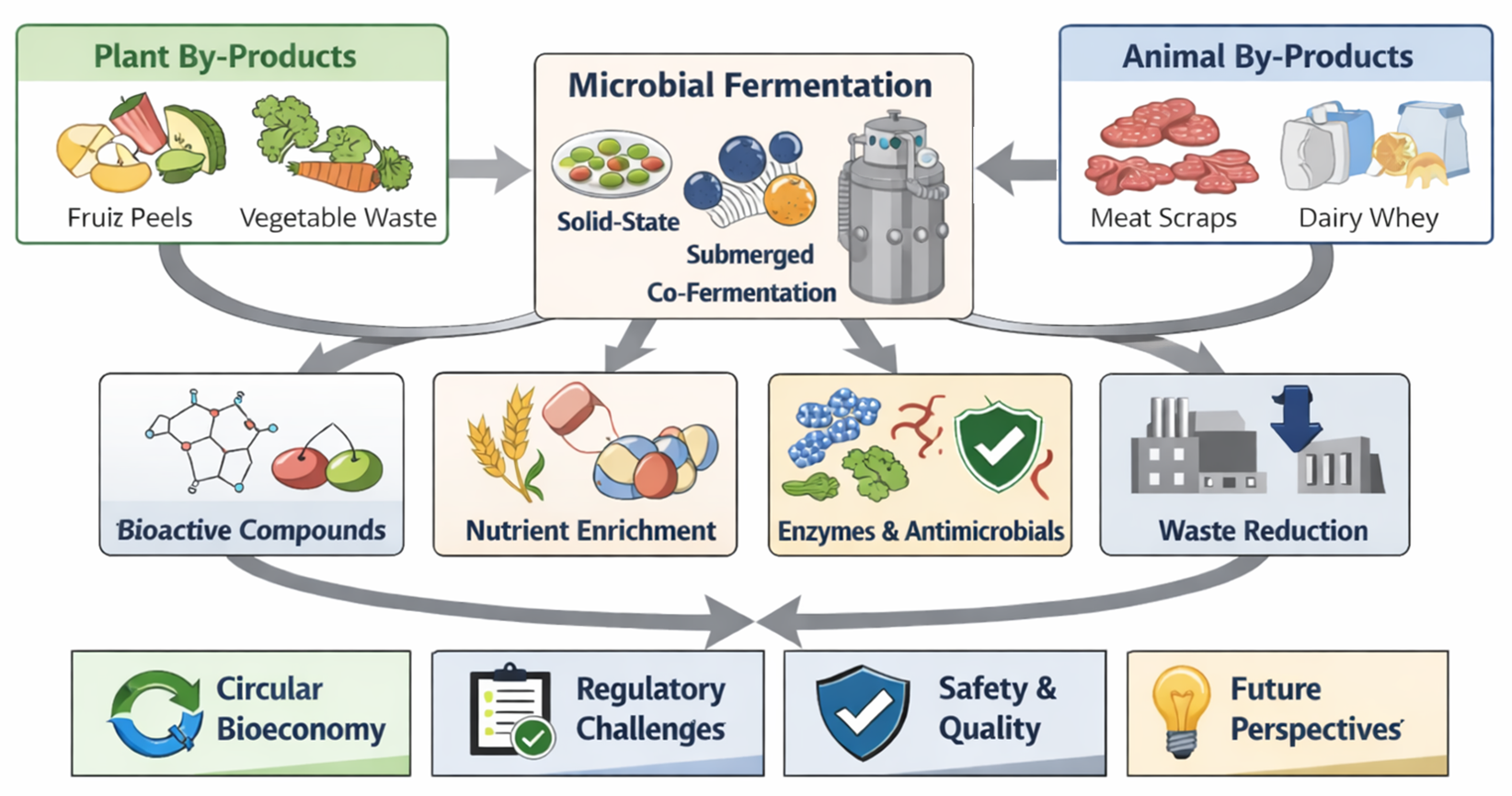


Fermenting the Unused: Microbial Biotransformation of Food Industry By-Products for Circular Bioeconomy Valorisation




Abstract
1. Introduction
2. Overview of Major Food Industry By-Products
2.1. Fruits and Vegetable Industry By-Products
2.2. Dairy Industry By-Products
2.3. Meat Industry By-Products
2.4. Fish and Seafood Industry By-Products
2.5. Comparative Overview of Compositional Attributes
3. Fermentation Technologies and Strategies for By-Product Valorisation
3.1. Solid-State Fermentation (SSF)
3.2. Submerged Fermentation (SmF)
3.3. Co-Fermentation and Mixed Microbial Cultures
3.4. Pre-Treatments and Bioprocess Intensification
3.5. Microbial Selection and Process Optimisation
3.6. Comparative Evaluation of Fermentation Strategies
3.7. Non-Conventional Microbial Platforms: Microalgae and Thraustochytrids
4. Bioproducts and Functional Outputs of Fermentative Valorisation
4.1. Functional Molecules and Ingredient Fractions
4.2. Food and Beverage Applications
4.3. Feed Applications
4.4. Biochemicals, Biomaterials, and Packaging-Oriented Outputs
4.5. Comparative Overview of Bioproducts from Fermented By-Products
4.6. Concluding Remarks on Functional Outputs
5. Circular Economy, Sustainability, and Regulatory Dimensions of Fermentative By-Product Valorisation
5.1. Fermentation and the Circular Bioeconomy
5.2. Environmental Sustainability and Resource Efficiency
5.3. Economic Feasibility and Industrial Symbiosis
5.4. Regulatory Context and Safety Governance
5.5. Market Acceptance and Societal Integration
5.6. Outlook: Opportunities and Remaining Barriers
5.7. Pilot- and Demonstration-Scale Examples of Fermentation-Based Valorisation
6. Research Gaps and Future Directions
6.1. Need for Standardised Substrate Characterisation and Harmonised Databases
6.2. Limited Scale-Up Studies and Industrial Pilot Demonstrations
6.3. Integration with Biorefinery Concepts and Multi-Product Recovery
6.4. Challenges in Co-Fermentation and Mixed Culture Stability
6.5. Incomplete Understanding of Safety, Allergenicity, and Chemical Risks
6.6. Limited Research on Fermentation of Animal-Origin By-Products for Human Food
6.7. Regulatory Uncertainty and Need for Harmonisation
6.8. Insufficient Life Cycle and Techno-Economic Analyses
6.9. Consumer Acceptance and Market Positioning Research
6.10. Digitalisation, Artificial Intelligence, and Machine Learning for Process Optimisation
6.11. Advanced Monitoring, Modelling, and Digital Control in Fermentation-Based Valorisation
6.12. Opportunities for Precision Fermentation and Metabolic Engineering
6.13. Future Directions for Fermentation-Based Valorisation
6.14. Concluding Remarks
7. Conclusions
Supplementary Materials
Author Contributions
Funding
Institutional Review Board Statement
Informed Consent Statement
Data Availability Statement
Acknowledgments
Conflicts of Interest
References
- Girotto, F.; Alibardi, L.; Cossu, R. Food Waste Generation and Industrial Uses: A Review. Waste Manag. 2015, 45, 32–41. [Google Scholar] [CrossRef] [Scilit]
- Roy, P.; Mohanty, A.K.; Dick, P.; Misra, M. A Review on the Challenges and Choices for Food Waste Valorization: Environmental and Economic Impacts. ACS Environ. Au 2023, 3, 58–75. [Google Scholar] [CrossRef] [Scilit]
- Pal, P.; Singh, A.K.; Srivastava, R.K.; Rathore, S.S.; Sahoo, U.K.; Subudhi, S.; Sarangi, P.K.; Prus, P. Circular Bioeconomy in Action: Transforming Food Wastes into Renewable Food Resources. Foods 2024, 13, 3007. [Google Scholar] [CrossRef] [Scilit]
- Socas-Rodríguez, B.; Álvarez-Rivera, G.; Valdés, A.; Ibáñez, E.; Cifuentes, A. Food By-Products and Food Wastes: Are They Safe Enough for Their Valorization? Trends Food Sci. Technol. 2021, 114, 133–147. [Google Scholar] [CrossRef] [Scilit]
- Caponio, F.; Piga, A.; Poiana, M. Valorization of Food Processing By-Products. Foods 2022, 11, 3246. [Google Scholar] [CrossRef] [Scilit] [PubMed]
- Faria, D.J.; de Carvalho, A.P.A.; Conte-Junior, C.A. Valorization of Fermented Food Wastes and Byproducts: Bioactive and Valuable Compounds, Bioproduct Synthesis, and Applications. Fermentation 2023, 9, 920. [Google Scholar] [CrossRef] [Scilit]
- Sawant, S.S.; Park, H.-Y.; Sim, E.-Y.; Kim, H.-S.; Choi, H.-S. Microbial Fermentation in Food: Impact on Functional Properties and Nutritional Enhancement—A Review of Recent Developments. Fermentation 2025, 11, 15. [Google Scholar] [CrossRef] [Scilit]
- Siddiqui, S.A.; Erol, Z.; Rugji, J.; Taşçı, F.; Kahraman, H.A.; Toppi, V.; Musa, L.; Di Giacinto, G.; Bahmid, N.A.; Mehdizadeh, M.; et al. An Overview of Fermentation in the Food Industry-Looking Back from a New Perspective. Bioresour. Bioprocess. 2023, 10, 85. [Google Scholar] [CrossRef] [Scilit]
- Yang, F.; Chen, C.; Ni, D.; Yang, Y.; Tian, J.; Li, Y.; Chen, S.; Ye, X.; Wang, L. Effects of Fermentation on Bioactivity and the Composition of Polyphenols Contained in Polyphenol-Rich Foods: A Review. Foods 2023, 12, 3315. [Google Scholar] [CrossRef] [Scilit]
- Guo, Q.; Chen, P.; Chen, X. Bioactive Peptides Derived from Fermented Foods: Preparation and Biological Activities. J. Funct. Foods 2023, 101, 105422. [Google Scholar] [CrossRef] [Scilit]
- Jiang, Y.; Sun, J.; Chandrapala, J.; Majzoobi, M.; Brennan, C.; Zeng, X.; Sun, B. Recent Progress of Food-derived Bioactive Peptides: Extraction, Purification, Function, and Encapsulation. Food Front. 2024, 5, 1240–1264. [Google Scholar] [CrossRef] [Scilit]
- Foti, P.; Caggia, C.; Romeo, F.V. New Insight into Microbial Exploitation to Produce Bioactive Molecules from Agrifood and By-Products’ Fermentation. Foods 2025, 14, 1439. [Google Scholar] [CrossRef] [Scilit]
- Guiné, R.P.F.; Florença, S.G.; Barroca, M.J.; Anjos, O. The Link between the Consumer and the Innovations in Food Product Development. Foods 2020, 9, 1317. [Google Scholar] [CrossRef] [Scilit]
- Banovic, M.; Grunert, K.G. Consumer Acceptance of Precision Fermentation Technology: A Cross-Cultural Study. Innov. Food Sci. Emerg. Technol. 2023, 88, 103435. [Google Scholar] [CrossRef] [Scilit]
- Tsegaye, B.; Jaiswal, S.; Jaiswal, A.K. Food Waste Biorefinery: Pathway towards Circular Bioeconomy. Foods 2021, 10, 1174. [Google Scholar] [CrossRef] [Scilit]
- Costa, S.; Summa, D.; Semeraro, B.; Zappaterra, F.; Rugiero, I.; Tamburini, E. Fermentation as a Strategy for Bio-Transforming Waste into Resources: Lactic Acid Production from Agri-Food Residues. Fermentation 2020, 7, 3. [Google Scholar] [CrossRef] [Scilit]
- Estévez, S.; Rebolledo-Leiva, R.; Hernández, D.; González-García, S.; Feijoo, G.; Moreira, M.T. Benchmarking Composting, Anaerobic Digestion and Dark Fermentation for Apple Vinasse Management as a Strategy for Sustainable Energy Production. Energy 2023, 274, 127319. [Google Scholar] [CrossRef] [Scilit]
- Tlais, A.Z.A.; Fiorino, G.M.; Polo, A.; Filannino, P.; Di Cagno, R. High-Value Compounds in Fruit, Vegetable and Cereal Byproducts: An Overview of Potential Sustainable Reuse and Exploitation. Molecules 2020, 25, 2987. [Google Scholar] [CrossRef] [Scilit] [PubMed]
- Rashwan, A.K.; Bai, H.; Osman, A.I.; Eltohamy, K.M.; Chen, Z.; Younis, H.A.; Al-Fatesh, A.; Rooney, D.W.; Yap, P.-S. Recycling Food and Agriculture By-Products to Mitigate Climate Change: A Review. Environ. Chem. Lett. 2023, 21, 3351–3375. [Google Scholar] [CrossRef] [Scilit]
- Sagar, N.A.; Pareek, S.; Sharma, S.; Yahia, E.M.; Lobo, M.G. Fruit and Vegetable Waste: Bioactive Compounds, Their Extraction, and Possible Utilization. Compr. Rev. Food Sci. Food Saf. 2018, 17, 512–531. [Google Scholar] [CrossRef] [Scilit] [PubMed]
- Nawirska-Olszańska, A.; Oziembłowski, M. Fruit and Vegetable Processing Waste as Potential Raw Material for Food Enrichment With Dietary Fiber. Food Sci. Nutr. 2025, 13, e70766. [Google Scholar] [CrossRef] [Scilit]
- Kandemir, K.; Piskin, E.; Xiao, J.; Tomas, M.; Capanoglu, E. Fruit Juice Industry Wastes as a Source of Bioactives. J. Agric. Food Chem. 2022, 70, 6805–6832. [Google Scholar] [CrossRef] [Scilit]
- Mitrea, L.; Calinoiu, L.F.; Teleky, B.E.; Szabo, K.; Martău, A.G.; Nemes, S.A.; Plamada, D.; Pascuta, M.S.; Barta, G.; Varvara, R.A.; et al. Fruit and Vegetable Wastes for Biobased Chemicals. In Fruit and Vegetable Waste Utilization and Sustainability; Elsevier: Amsterdam, The Netherlands, 2023; pp. 43–76. [Google Scholar]
- Garcia-Amezquita, L.E.; Tejada-Ortigoza, V.; Serna-Saldivar, S.O.; Welti-Chanes, J. Dietary Fiber Concentrates from Fruit and Vegetable By-Products: Processing, Modification, and Application as Functional Ingredients. Food Bioprocess Technol. 2018, 11, 1439–1463. [Google Scholar] [CrossRef] [Scilit]
- Fernandes, A.; Mateus, N.; de Freitas, V. Polyphenol-Dietary Fiber Conjugates from Fruits and Vegetables: Nature and Biological Fate in a Food and Nutrition Perspective. Foods 2023, 12, 1052. [Google Scholar] [CrossRef] [Scilit] [PubMed]
- Erskine, E.; Ozkan, G.; Lu, B.; Capanoglu, E. Effects of Fermentation Process on the Antioxidant Capacity of Fruit Byproducts. ACS Omega 2023, 8, 4543–4553. [Google Scholar] [CrossRef] [Scilit]
- Salas-Millán, J.Á.; Aguayo, E. Fermentation for Revalorisation of Fruit and Vegetable By-Products: A Sustainable Approach Towards Minimising Food Loss and Waste. Foods 2024, 13, 3680. [Google Scholar] [CrossRef] [Scilit]
- Samad, N.; Okonkwo, C.E.; Ayyash, M.; Al-Marzouqi, A.H.; Yuliarti, O.; Kamal-Eldin, A. Valorization of Fruit Pomace by Enzymatic Treatment and Microbial Fermentation. Fermentation 2025, 11, 376. [Google Scholar] [CrossRef] [Scilit]
- EUROSTAT Milk Production Growth Comes to a Standstill in 2022. 2023. Available online: https://ec.europa.eu/eurostat/web/products-eurostat-news/w/ddn-20231120-3 (accessed on 28 November 2025).
- Pires, A.F.; Marnotes, N.G.; Rubio, O.D.; Garcia, A.C.; Pereira, C.D. Dairy By-Products: A Review on the Valorization of Whey and Second Cheese Whey. Foods 2021, 10, 1067. [Google Scholar] [CrossRef] [Scilit] [PubMed]
- Poonia, A.; Rao, V.; Mann, B. Whey Production Status, Types, Characterization and Functional Properties. In Whey Valorization; Springer Nature: Singapore, 2023; pp. 1–27. [Google Scholar]
- Sukmana, H.; Rizwana, I.; Dobozi, R.; Al-Tayawi, A.N.; Szabó, B.P.; Özer, B.; Kertész, S. A Review of Various Protein Separation Techniques and Valorization of Cheese Whey and Buttermilk. Eur. Food Res. Technol. 2025, 251, 4263–4279. [Google Scholar] [CrossRef] [Scilit]
- Sciuto, G.; Russo, N.; Randazzo, C.L.; Caggia, C. Valorization of Second Cheese Whey Through Microalgae-Based Treatments: Advantages, Limits, and Opportunities. BioTech 2025, 14, 79. [Google Scholar] [CrossRef] [Scilit]
- Usmani, Z.; Sharma, M.; Gaffey, J.; Sharma, M.; Dewhurst, R.J.; Moreau, B.; Newbold, J.; Clark, W.; Thakur, V.K.; Gupta, V.K. Valorization of Dairy Waste and By-Products through Microbial Bioprocesses. Bioresour. Technol. 2022, 346, 126444. [Google Scholar] [CrossRef] [Scilit]
- Sar, T.; Harirchi, S.; Ramezani, M.; Bulkan, G.; Akbas, M.Y.; Pandey, A.; Taherzadeh, M.J. Potential Utilization of Dairy Industries By-Products and Wastes through Microbial Processes: A Critical Review. Sci. Total Environ. 2022, 810, 152253. [Google Scholar] [CrossRef] [Scilit] [PubMed]
- Tunick, M.H.; Renye, J.A.; Garcia, R.A. Conversion of Whey and Other Dairy Waste into Antimicrobial and Immunoregulatory Compounds by Fermentation. Front. Food Sci. Technol. 2025, 5, 1542284. [Google Scholar] [CrossRef] [Scilit]
- Delgado-Macuil, R.J.; Perez-Armendariz, B.; Cardoso-Ugarte, G.A.; Tolibia, S.E.M.; Benítez-Rojas, A.C. Recent Biotechnological Applications of Whey: Review and Perspectives. Fermentation 2025, 11, 217. [Google Scholar] [CrossRef] [Scilit]
- Giulianetti de Almeida, M.P.; Mockaitis, G.; Weissbrodt, D.G. Got Whey? Sustainability Endpoints for the Dairy Industry through Resource Biorecovery. Fermentation 2023, 9, 897. [Google Scholar] [CrossRef] [Scilit]
- Toldrá, F.; Reig, M.; Mora, L. Management of Meat By- and Co-Products for an Improved Meat Processing Sustainability. Meat Sci. 2021, 181, 108608. [Google Scholar] [CrossRef] [Scilit] [PubMed]
- Limeneh, D.Y.; Tesfaye, T.; Ayele, M.; Husien, N.M.; Ferede, E.; Haile, A.; Mengie, W.; Abuhay, A.; Gelebo, G.G.; Gibril, M.; et al. A Comprehensive Review on Utilization of Slaughterhouse By-Product: Current Status and Prospect. Sustainability 2022, 14, 6469. [Google Scholar] [CrossRef] [Scilit]
- Stadnik, J.; Kęska, P. Meat and Fermented Meat Products as a Source of Bioactive Peptides. Acta Sci. Pol. Technol. Aliment. 2015, 14, 181–190. [Google Scholar] [CrossRef] [Scilit]
- Bou, R.; Pinotti, L.; Zeugolis, D.; Watigny, A.; Álvarez, C. Advancing the Valorisation of Meat Co-Products in Food, Pet Food, and Biomedicine Applications. Waste Manag. 2025, 204, 114948. [Google Scholar] [CrossRef] [Scilit]
- Gagaoua, M.; Das, A.K.; Fu, Y.; Dib, A.L.; Nanda, P.K. Meat By-Products as a Source of Bioactive Peptides and Functional Ingredients: Regulatory and Safety Barriers to Valorization. Curr. Opin. Green Sustain. Chem. 2024, 47, 100910. [Google Scholar] [CrossRef] [Scilit]
- Lafarga, T.; Hayes, M. Bioactive Peptides from Meat Muscle and By-Products: Generation, Functionality and Application as Functional Ingredients. Meat Sci. 2014, 98, 227–239. [Google Scholar] [CrossRef] [Scilit]
- EUROSTAT EU Fisheries Remained Ahead of Aquaculture in 2022. 2024. Available online: https://ec.europa.eu/eurostat/de/web/products-eurostat-news/w/ddn-20240731-1 (accessed on 15 November 2025).
- Välimaa, A.-L.; Mäkinen, S.; Mattila, P.; Marnila, P.; Pihlanto, A.; Mäki, M.; Hiidenhovi, J. Fish and Fish Side Streams Are Valuable Sources of High-Value Components. Food Qual. Saf. 2019, 3, 209–226. [Google Scholar] [CrossRef] [Scilit]
- Maritime Affairs and Fisheries EUMOFA-European Market Observatory for Fisheries and Aquaculture Products. Highlights the EU in the World Market Supply Consumption Import-Export Landings in the EU Aquaculture; EUMOFA: Luxembourg, 2023. [Google Scholar] [CrossRef]
- EUMOFA-European Market Observatory for Fisheries and Aquaculture Products. The EU Fish Market-Highights; EUMOFA: Brussels, Belgium, 2025. [Google Scholar]
- Shahidi, F.; Varatharajan, V.; Peng, H.; Senadheera, R. Utilization of Marine By-Products for the Recovery of Value-Added Products. J. Food Bioact. 2019, 6, 10–61. [Google Scholar] [CrossRef] [Scilit]
- Venugopal, V. Green Processing of Seafood Waste Biomass towards Blue Economy. Curr. Res. Environ. Sustain. 2022, 4, 100164. [Google Scholar] [CrossRef] [Scilit]
- Marti-Quijal, F.J.; Remize, F.; Meca, G.; Ferrer, E.; Ruiz, M.-J.; Barba, F.J. Fermentation in Fish and By-Products Processing: An Overview of Current Research and Future Prospects. Curr. Opin. Food Sci. 2020, 31, 9–16. [Google Scholar] [CrossRef] [Scilit]
- Jimenez-Champi, D.; Romero-Orejon, F.L.; Muñoz, A.M.; Ramos-Escudero, F. The Revalorization of Fishery By-Products: Types, Bioactive Compounds, and Food Applications. Int. J. Food Sci. 2024, 2024, 6624083. [Google Scholar] [CrossRef] [Scilit]
- Kuley, E.; Özyurt, G.; Özogul, I.; Boga, M.; Akyol, I.; Rocha, J.M.; Özogul, F. The Role of Selected Lactic Acid Bacteria on Organic Acid Accumulation during Wet and Spray-Dried Fish-Based Silages. Contributions to the Winning Combination of Microbial Food Safety and Environmental Sustainability. Microorganisms 2020, 8, 172. [Google Scholar] [CrossRef] [Scilit]
- Li, H.; Li, G.; Bi, Y.; Liu, S. Fermented Fish Products: Balancing Tradition and Innovation for Improved Quality. Foods 2024, 13, 2565. [Google Scholar] [CrossRef] [Scilit]
- Olsen, R.L.; Toppe, J. Fish Silage Hydrolysates: Not Only a Feed Nutrient, but Also a Useful Feed Additive. Trends Food Sci. Technol. 2017, 66, 93–97. [Google Scholar] [CrossRef] [Scilit]
- FAO. Global Food Losses and Food Waste–Extent. In Causes and Prevention; FAO: Rome, Italy, 2011. [Google Scholar]
- United Nations Environment Programme. Food Waste Index Report 2021; UN Environment Programme: Nairobi, Kenya, 2021; Available online: https://wedocs.unep.org/handle/20.500.11822/35280 (accessed on 18 November 2025).
- Nguyen, T.H.; Wang, X.; Utomo, D.; Gage, E.; Xu, B. Circular Bioeconomy and Sustainable Food Systems: What Are the Possible Mechanisms? Clean. Circ. Bioecon. 2025, 11, 100145. [Google Scholar] [CrossRef] [Scilit]
- Naresh Kumar, A.; Sarkar, O.; Chandrasekhar, K.; Raj, T.; Narisetty, V.; Mohan, S.V.; Pandey, A.; Varjani, S.; Kumar, S.; Sharma, P.; et al. Upgrading the Value of Anaerobic Fermentation via Renewable Chemicals Production: A Sustainable Integration for Circular Bioeconomy. Sci. Total Environ. 2022, 806, 150312. [Google Scholar] [CrossRef] [Scilit] [PubMed]
- Pandey, V.K.; Shafi, Z.; Tripathi, A.; Singh, G.; Singh, R.; Rustagi, S. Production of Biodegradable Food Packaging from Mango Peel via Enzymatic Hydrolysis and Polyhydroxyalkanoates Synthesis: A Review on Microbial Intervention. Curr. Res. Microb. Sci. 2024, 7, 100292. [Google Scholar] [CrossRef] [Scilit]
- Ajanaku, P.O.; Olojede, A.O.; Ajanaku, C.O.; Egharevba, G.O.; Agaja, F.O.; Joseph, C.B.; Thomas, R.M. Novel Fermentation Techniques for Improving Food Functionality: An Overview. Fermentation 2025, 11, 509. [Google Scholar] [CrossRef] [Scilit]
- Shahryari, Z.; Niknezhad, S.V. Production of Industrial Enzymes by Filamentous Fungi. In Current Developments in Biotechnology and Bioengineering; Elsevier: Amsterdam, The Netherlands, 2023; pp. 293–323. [Google Scholar]
- Holker, U.; Hofer, M.; Lenz, J. Biotechnological Advantages of Laboratory-Scale Solid-State Fermentation with Fungi. Appl. Microbiol. Biotechnol. 2004, 64, 175–186. [Google Scholar] [CrossRef] [Scilit] [PubMed]
- Karimi, S.; Mahboobi Soofiani, N.; Mahboubi, A.; Taherzadeh, M.J. Use of Organic Wastes and Industrial By-Products to Produce Filamentous Fungi with Potential as Aqua-Feed Ingredients. Sustainability 2018, 10, 3296. [Google Scholar] [CrossRef] [Scilit]
- Wang, Z.; Svyantek, A.; Miller, Z. Apple and Grape Waste Pomace Fermentation and Co-Ferment Product Chemistry. Fermentation 2025, 11, 126. [Google Scholar] [CrossRef] [Scilit]
- de Oliveira, R.M.d.S.F.; dos Santos, H.M.L.; Fernandes, S.S.; Egea, M.B. Exploring Plant Agro-Industrial By-Products as a Source of Fibrous Food Ingredients: A Review of Extraction Methods and Technological Properties. J. Food Sci. 2025, 90, e70408. [Google Scholar] [CrossRef] [Scilit]
- Nicolescu, C.M.; Bumbac, M.; Buruleanu, C.L.; Popescu, E.C.; Stanescu, S.G.; Georgescu, A.A.; Toma, S.M. Biopolymers Produced by Lactic Acid Bacteria: Characterization and Food Application. Polymers 2023, 15, 1539. [Google Scholar] [CrossRef] [Scilit]
- Murata, R.; Shim, Y.Y.; Kim, Y.J.; Reaney, M.J.T.; Tse, T.J. Exploring Lactic Acid Bacteria in Food, Human Health, and Agriculture. Crit. Rev. Food Sci. Nutr. 2025, 65, 8122–8148. [Google Scholar] [CrossRef] [Scilit]
- Obinwanne Okoye, C.; Chidi Ezenwanne, B.; Olasoji, O. Mechanisms of Preservation by Lactic Acid Bacteria in Food Fermentation. In Fermentation in the Food Industry; IntechOpen: London, UK, 2025. [Google Scholar]
- Jurášková, D.; Ribeiro, S.C.; Silva, C.C.G. Exopolysaccharides Produced by Lactic Acid Bacteria: From Biosynthesis to Health-Promoting Properties. Foods 2022, 11, 156. [Google Scholar] [CrossRef] [Scilit] [PubMed]
- Drężek, K.; Sobczyk, M.K.; Kállai, Z.; Detman, A.; Bardadyn, P.; Mierzejewska, J. Valorisation of Whey Permeate in Sequential Bioprocesses towards Value-Added Products–Optimisation of Biphasic and Classical Batch Cultures of Kluyveromyces Marxianus. Int. J. Mol. Sci. 2023, 24, 7560. [Google Scholar] [CrossRef] [Scilit] [PubMed]
- Silva, M.; Vida, M.; Ramos, A.C.; Roseiro, L.C.; Alvarenga, N.; Gomes, S.; Lidon, F.C.; Reboredo, F.H.; Gonçalves, E.M. Biopreservation of Hericium Erinaceus By-Products via Lactic Acid Fermentation: Effects on Functional and Technological Properties. Foods 2025, 14, 3721. [Google Scholar] [CrossRef] [Scilit] [PubMed]
- Narvhus, J. The Role of Interaction between Yeasts and Lactic Acid Bacteria in African Fermented Milks: A Review. Int. J. Food Microbiol. 2003, 86, 51–60. [Google Scholar] [CrossRef] [Scilit]
- Canon, F.; Nidelet, T.; Guédon, E.; Thierry, A.; Gagnaire, V. Understanding the Mechanisms of Positive Microbial Interactions That Benefit Lactic Acid Bacteria Co-Cultures. Front. Microbiol. 2020, 11, 2088. [Google Scholar] [CrossRef] [Scilit]
- Chessa, L.; Paba, A.; Dupré, I.; Addis, M.; Piga, C.; Pes, M.; Comunian, R. From Raw Milk Microbiome to Cheese: The Challenge of Indigenous Natural Starter Culture Exploitation. Fermentation 2025, 11, 660. [Google Scholar] [CrossRef] [Scilit]
- Liu, Y.; Tang, Y.; Mei, H.; Liu, Z.; Li, Z.; Ma, X.; Luo, Z.; Huang, W.; Li, Y.; Yu, M. Feeding Citrus Pomace Fermented with Combined Probiotics Improves Growth Performance, Meat Quality, Fatty Acid Profile, and Antioxidant Capacity in Yellow-Feathered Broilers. Front. Vet. Sci. 2024, 11, 1469947. [Google Scholar] [CrossRef] [Scilit]
- Palavecino Prpich, N.Z.; Camprubí, G.E.; Cayré, M.E.; Castro, M.P. Indigenous Microbiota to Leverage Traditional Dry Sausage Production. Int. J. Food Sci. 2021, 2021, 6696856. [Google Scholar] [CrossRef] [Scilit]
- Singh, A.; Kumar, S. Exploring the Functionality of Microbes in Fermented Foods: Technological Advancements and Future Directions. Fermentation 2025, 11, 300. [Google Scholar] [CrossRef] [Scilit]
- Praveen, M.; Brogi, S. Microbial Fermentation in Food and Beverage Industries: Innovations, Challenges, and Opportunities. Foods 2025, 14, 114. [Google Scholar] [CrossRef] [Scilit]
- Mitra, S.; Murthy, G.S. Bioreactor Control Systems in the Biopharmaceutical Industry: A Critical Perspective. Syst. Microbiol. Biomanuf. 2022, 2, 91–112. [Google Scholar] [CrossRef] [Scilit]
- Durand, A. Bioreactor Designs for Solid State Fermentation. Biochem. Eng. J. 2003, 13, 113–125. [Google Scholar] [CrossRef] [Scilit]
- Kalaiselvan, P.; Devi, N.C.; Deepti, M.; Devi, A.A.; Akamad, K.; Dheeran, P.; Debbarma, S.; Vadivel, D.; Rajesh, D. Solid-State Fermentation—A Sustainable Future Technology in Aquafeeds? Front. Mar. Sci. 2025, 12, 1669719. [Google Scholar] [CrossRef] [Scilit]
- Bamidele, M.O.; Bamikale, M.B.; Cárdenas-Hernández, E.; Bamidele, M.A.; Castillo-Olvera, G.; Sandoval-Cortes, J.; Aguilar, C.N. Bioengineering in Solid-State Fermentation for next Sustainable Food Bioprocessing. Next Sustain. 2025, 6, 100105. [Google Scholar] [CrossRef] [Scilit]
- Oiza, N.; Moral-Vico, J.; Sánchez, A.; Oviedo, E.R.; Gea, T. Solid-State Fermentation from Organic Wastes: A New Generation of Bioproducts. Processes 2022, 10, 2675. [Google Scholar] [CrossRef] [Scilit]
- Mehra, M.K.; VS, B.S.; B, S.; Avanthi, A. Scale-up Strategies for Solid-State Fermentation. In Biotechnology Engineering; Elsevier: Amsterdam, The Netherlands, 2025; pp. 345–374. [Google Scholar]
- Amaro, H.M.; Salgado, E.M.; Nunes, O.C.; Pires, J.C.M.; Esteves, A.F. Microalgae Systems-Environmental Agents for Wastewater Treatment and Further Potential Biomass Valorisation. J. Environ. Manag. 2023, 337, 117678. [Google Scholar] [CrossRef] [Scilit]
- Alavianghavanini, A.; Shayesteh, H.; Bahri, P.A.; Vadiveloo, A.; Moheimani, N.R. Microalgae Cultivation for Treating Agricultural Effluent and Producing Value-Added Products. Sci. Total Environ. 2024, 912, 169369. [Google Scholar] [CrossRef] [Scilit] [PubMed]
- López-Hortas, L.; Flórez-Fernández, N.; Torres, M.D.; Ferreira-Anta, T.; Casas, M.P.; Balboa, E.M.; Falqué, E.; Domínguez, H. Applying Seaweed Compounds in Cosmetics, Cosmeceuticals and Nutricosmetics. Mar. Drugs 2021, 19, 552. [Google Scholar] [CrossRef] [Scilit] [PubMed]
- Zieliński, M.; Dębowski, M.; Kazimierowicz, J. Outflow from a Biogas Plant as a Medium for Microalgae Biomass Cultivation—Pilot Scale Study and Technical Concept of a Large-Scale Installation. Energies 2022, 15, 2912. [Google Scholar] [CrossRef] [Scilit]
- Zhao, J.; Xu, Y.; Wang, W.; Griffin, J.; Wang, D. Conversion of Liquid Hot Water, Acid and Alkali Pretreated Industrial Hemp Biomasses to Bioethanol. Bioresour. Technol. 2020, 309, 123383. [Google Scholar] [CrossRef] [Scilit]
- Gupta, A.; Barrow, C.J.; Puri, M. Omega-3 Biotechnology: Thraustochytrids as a Novel Source of Omega-3 Oils. Biotechnol. Adv. 2012, 30, 1733–1745. [Google Scholar] [CrossRef] [Scilit]
- Yang, Y.; Jalalah, M.; Alsareii, S.A.; Harraz, F.A.; Thakur, N.; Zheng, Y.; Alalawy, A.I.; Koutb, M.; Salama, E.-S. Potential of Oleaginous Microbes for Lipid Accumulation and Renewable Energy Generation. World J. Microbiol. Biotechnol. 2024, 40, 337. [Google Scholar] [CrossRef] [Scilit] [PubMed]
- Russo, G.L.; Langellotti, A.L.; Sacchi, R.; Masi, P. Techno-Economic Assessment of DHA-Rich Aurantiochytrium Sp. Production Using Food Industry by-Products and Waste Streams as Alternative Growth Media. Bioresour. Technol. Rep. 2022, 18, 100997. [Google Scholar] [CrossRef] [Scilit]
- Liu, Y.; Cheng, J.J. Utilization of Microalgae and Thraustochytrids for the Production of Biofuel and Nutraceutical Products. In Sustainable Resource Management; Wiley: Hoboken, NJ, USA, 2021; Volume I, pp. 167–197. [Google Scholar]
- Wagh, M.S.; S, S.; Nath, P.C.; Chakraborty, A.; Amrit, R.; Mishra, B.; Mishra, A.K.; Mohanta, Y.K. Valorisation of Agro-Industrial Wastes: Circular Bioeconomy and Biorefinery Process–A Sustainable Symphony. Process Saf. Environ. Prot. 2024, 183, 708–725. [Google Scholar] [CrossRef] [Scilit]
- Kowalski, Z.; Kulczycka, J.; Makara, A.; Mondello, G.; Salomone, R. Industrial Symbiosis for Sustainable Management of Meat Waste: The Case of Śmiłowo Eco-Industrial Park, Poland. Int. J. Environ. Res. Public Health 2023, 20, 5162. [Google Scholar] [CrossRef] [Scilit]
- Kowalski, S.; Gumul, D. The Use of Waste Products from the Food Industry to Obtain High Value-Added Products. Foods 2024, 13, 847. [Google Scholar] [CrossRef] [Scilit]
- Zhao, Y.; Liu, D.; Zhang, J.; Shen, J.; Cao, J.; Gu, H.; Cui, M.; He, L.; Chen, G.; Liu, S.; et al. Improving Soluble Phenolic Profile and Antioxidant Activity of Grape Pomace Seeds through Fungal Solid-State Fermentation. Foods 2024, 13, 1158. [Google Scholar] [CrossRef] [Scilit] [PubMed]
- Plakantonaki, S.; Roussis, I.; Bilalis, D.; Priniotakis, G. Dietary Fiber from Plant-Based Food Wastes: A Comprehensive Approach to Cereal, Fruit, and Vegetable Waste Valorization. Processes 2023, 11, 1580. [Google Scholar] [CrossRef] [Scilit]
- Ewing, T.A.; Nouse, N.; van Lint, M.; van Haveren, J.; Hugenholtz, J.; van Es, D.S. Fermentation for the Production of Biobased Chemicals in a Circular Economy: A Perspective for the Period 2022–2050. Green Chem. 2022, 24, 6373–6405. [Google Scholar] [CrossRef] [Scilit]
- Anumudu, C.K.; Miri, T.; Onyeaka, H. Multifunctional Applications of Lactic Acid Bacteria: Enhancing Safety, Quality, and Nutritional Value in Foods and Fermented Beverages. Foods 2024, 13, 3714. [Google Scholar] [CrossRef] [Scilit]
- Liang, S.; Wang, X.; Li, C.; Liu, L. Biological Activity of Lactic Acid Bacteria Exopolysaccharides and Their Applications in the Food and Pharmaceutical Industries. Foods 2024, 13, 1621. [Google Scholar] [CrossRef] [Scilit]
- Gao, Y.; Liu, Y.; Ma, T.; Liang, Q.; Sun, J.; Wu, X.; Song, Y.; Nie, H.; Huang, J.; Mu, G. Fermented Dairy Products as Precision Modulators of Gut Microbiota and Host Health: Mechanistic Insights, Clinical Evidence, and Future Directions. Foods 2025, 14, 1946. [Google Scholar] [CrossRef] [Scilit]
- Wang, X.; Wang, L.; Wei, X.; Xu, C.; Cavender, G.; Lin, W.; Sun, S. Invited Review: Advances in Yogurt Development—Microbiological Safety, Quality, Functionality, Sensory Evaluation, and Consumer Perceptions across Different Dairy and Plant-Based Alternative Sources. J. Dairy Sci. 2025, 108, 33–58. [Google Scholar] [CrossRef] [Scilit] [PubMed]
- Spaccasassi, A.; Ye, L.; Rincón, C.; Börner, R.A.; Bogicevic, B.; Glabasnia, A.; Hofmann, T.; Dawid, C. Sensoproteomic Characterization of Lactobacillus Johnsonii-Fermented Pea Protein-Based Beverage: A Promising Strategy for Enhancing Umami and Kokumi Sensations While Mitigating Bitterness. J. Agric. Food Chem. 2024, 72, 15875–15889. [Google Scholar] [CrossRef] [Scilit]
- Barakat, N.; Bouajila, J.; Beaufort, S.; Rizk, Z.; Taillandier, P.; El Rayess, Y. Development of a New Kombucha from Grape Pomace: The Impact of Fermentation Conditions on Composition and Biological Activities. Beverages 2024, 10, 29. [Google Scholar] [CrossRef] [Scilit]
- Al-Kharousi, Z.S. Highlighting Lactic Acid Bacteria in Beverages: Diversity, Fermentation, Challenges, and Future Perspectives. Foods 2025, 14, 2043. [Google Scholar] [CrossRef] [Scilit]
- Mishra, S.; Singh, R.; Upadhyay, A.; Mishra, S.; Shukla, S. Emerging Trends in Processing for Cereal and Legume-Based Beverages: A Review. Future Foods 2023, 8, 100257. [Google Scholar] [CrossRef] [Scilit]
- Kuo, C.-C.; Chen, D.; Jiménez-Flores, R.; Wick, M.; Campanella, O. Sustainable Valorization of Fish Byproducts and Acid Whey through Lactic Acid Bacteria Fermentation into Bioactive Hydrolysates. Sustain. Food Technol. 2025, 3, 1766–1780. [Google Scholar] [CrossRef] [Scilit]
- Toppe, J.; Olsen, R.L. Fish Silage Production by Fermentation; FAO: Rome, Italy, 2024. [Google Scholar]
- Schingoethe, D.J. Whey Utilization in Animal Feeding: A Summary and Evaluation. J. Dairy Sci. 1976, 59, 556–570. [Google Scholar] [CrossRef] [Scilit]
- Santos, J.E.P.; Huber, J.T. Feed Proteins. In Encyclopedia of Dairy Sciences; Elsevier: Amsterdam, The Netherlands, 2002; pp. 494–502. [Google Scholar]
- Dai, Z.; Cui, L.; Li, J.; Wang, B.; Guo, L.; Wu, Z.; Zhu, W.; Wu, G. Fermentation Techniques in Feed Production. In Animal Agriculture; Elsevier: Amsterdam, The Netherlands, 2020; pp. 407–429. [Google Scholar]
- He, D.; Cui, C. Fermentation of Organic Wastes for Feed Protein Production: Focus on Agricultural Residues and Industrial By-Products Tied to Agriculture. Fermentation 2025, 11, 528. [Google Scholar] [CrossRef] [Scilit]
- Nguyen, Q.; Nguyen, L. Nutritive and Therapeutic Value of Fermented Rice Bran as a Feed Additive for Enhancing Performance and Health in Chickens: A Review. Open Vet. J. 2025, 15, 3439. [Google Scholar] [CrossRef] [Scilit]
- Álvarez, A.; Rodríguez, A.; Chaparro, S.; Borrás, L.M.; Rache, L.Y.; Brijaldo, M.H.; Martínez, J.J. Solid-State Fermentation as a Biotechnological Tool to Reduce Antinutrients and Increase Nutritional Content in Legumes and Cereals for Animal Feed. Fermentation 2025, 11, 359. [Google Scholar] [CrossRef] [Scilit]
- Kwan, T.H.; Pleissner, D.; Lau, K.Y.; Venus, J.; Pommeret, A.; Lin, C.S.K. Techno-Economic Analysis of a Food Waste Valorization Process via Microalgae Cultivation and Co-Production of Plasticizer, Lactic Acid and Animal Feed from Algal Biomass and Food Waste. Bioresour. Technol. 2015, 198, 292–299. [Google Scholar] [CrossRef] [Scilit]
- Reddy, C.A.; Henderson, H.E.; Erdman, M.D. Bacterial Fermentation of Cheese Whey for Production of a Ruminant Feed Supplement Rich in Curde Protein. Appl. Environ. Microbiol. 1976, 32, 769–776. [Google Scholar] [CrossRef] [Scilit]
- Missotten, J.A.; Michiels, J.; Degroote, J.; De Smet, S. Fermented Liquid Feed for Pigs: An Ancient Technique for the Future. J. Anim. Sci. Biotechnol. 2015, 6, 4. [Google Scholar] [CrossRef] [Scilit] [PubMed]
- Joy, J.M.; Padmaprakashan, A.; Pradeep, A.; Paul, P.T.; Mannuthy, R.J.; Mathew, S. A Review on Fish Skin-Derived Gelatin: Elucidating the Gelatin Peptides—Preparation, Bioactivity, Mechanistic Insights, and Strategies for Stability Improvement. Foods 2024, 13, 2793. [Google Scholar] [CrossRef] [Scilit]
- Mohd Basri, M.S.; Abdul Karim Shah, N.N.; Sulaiman, A.; Mohamed Amin Tawakkal, I.S.; Mohd Nor, M.Z.; Ariffin, S.H.; Abdul Ghani, N.H.; Mohd Salleh, F.S. Progress in the Valorization of Fruit and Vegetable Wastes: Active Packaging, Biocomposites, By-Products, and Innovative Technologies Used for Bioactive Compound Extraction. Polymers 2021, 13, 3503. [Google Scholar] [CrossRef] [Scilit] [PubMed]
- Chen, H.; Wang, J.; Cheng, Y.; Wang, C.; Liu, H.; Bian, H.; Pan, Y.; Sun, J.; Han, W. Application of Protein-Based Films and Coatings for Food Packaging: A Review. Polymers 2019, 11, 2039. [Google Scholar] [CrossRef] [Scilit] [PubMed]
- Anbesaw, M.S. Bioconversion of Keratin Wastes Using Keratinolytic Microorganisms to Generate Value-Added Products. Int. J. Biomater. 2022, 2022, 2048031. [Google Scholar] [CrossRef] [Scilit]
- Bastidas-Oyanedel, J.-R.; Schmidt, J. Increasing Profits in Food Waste Biorefinery—A Techno-Economic Analysis. Energies 2018, 11, 1551. [Google Scholar] [CrossRef] [Scilit]
- Makepa, D.C.; Chihobo, C.H. Barriers to Commercial Deployment of Biorefineries: A Multi-Faceted Review of Obstacles across the Innovation Chain. Heliyon 2024, 10, e32649. [Google Scholar] [CrossRef] [Scilit]
- Aït-Kaddour, A.; Hassoun, A.; Tarchi, I.; Loudiyi, M.; Boukria, O.; Cahyana, Y.; Ozogul, F.; Khwaldia, K. Transforming Plant-Based Waste and by-Products into Valuable Products Using Various “Food Industry 4.0” Enabling Technologies: A Literature Review. Sci. Total Environ. 2024, 955, 176872. [Google Scholar] [CrossRef] [Scilit]
- Dhar, P.; Deka, S.C.; Panigrahi, R.; Roopashree, R.; Chennakesavulu, K.; Sharma, R.; Sinha, A.; Abate, L. Circular Bioeconomy of Fruits and Vegetable Waste Into Biosolvents and Bioresources: Advancement in Sustainable Bioremediation Technologies. Eng. Rep. 2025, 7, e70396. [Google Scholar] [CrossRef] [Scilit]
- Sánchez, A. The Role of Chemical Engineering in the Organic Waste-Based Circular Bioeconomy: What Has Been Done and What Still Needs to Be Done. A Perspective. Front. Chem. Eng. 2025, 7, 1730182. [Google Scholar] [CrossRef] [Scilit]
- Ahn, S. Bioplastics from Food By-Products. In Bioplastics within the Circular Bioeconomy; IntechOpen: London, UK, 2025. [Google Scholar]
- Jones, R.E.; Speight, R.E.; Blinco, J.L.; O’Hara, I.M. Biorefining within Food Loss and Waste Frameworks: A Review. Renew. Sustain. Energy Rev. 2022, 154, 111781. [Google Scholar] [CrossRef] [Scilit]
- Abinandan, S.; Praveen, K.; Venkateswarlu, K.; Megharaj, M. Eco-Innovation Minimizes the Carbon Footprint of Wine Production. Commun. Earth Environ. 2024, 5, 618. [Google Scholar] [CrossRef] [Scilit]
- Lee, S.; Ahn, S.; Zong, J.H.; Oh, C.; Suh, S.; Hwang, D.S. Sustainable Valorization of Fish Head Wastes into Nitrogen-Based Nutrients: A Comparative Life Cycle Assessment. J. Biol. Eng. 2025, 19, 87, Correction in J. Biol. Eng. 2025, 19, 110. https://doi.org/10.1186/s13036-025-00589-7. [Google Scholar] [CrossRef] [Scilit] [PubMed]
- Kaya Akça, M.; Gündoğan, M.; Budak, G. An Integrated Symbiotic Production System Design of Agro-Based Industries with Profit and Environmental Objectives. Sustainability 2025, 17, 6396. [Google Scholar] [CrossRef] [Scilit]
- Nasser, M.; Sharma, M.; Kaur, G. Advances in the Production of Biosurfactants as Green Ingredients in Home and Personal Care Products. Front. Chem. 2024, 12, 1382547. [Google Scholar] [CrossRef] [Scilit]
- Venkatesh, G. Circular Bio-Economy—Paradigm for the Future: Systematic Review of Scientific Journal Publications from 2015 to 2021. Circ. Econ. Sustain. 2022, 2, 231–279. [Google Scholar] [CrossRef] [Scilit]
- Fidelis, M.; de Moura, C.; Kabbas Junior, T.; Pap, N.; Mattila, P.; Mäkinen, S.; Putnik, P.; Bursać Kovačević, D.; Tian, Y.; Yang, B.; et al. Fruit Seeds as Sources of Bioactive Compounds: Sustainable Production of High Value-Added Ingredients from By-Products within Circular Economy. Molecules 2019, 24, 3854. [Google Scholar] [CrossRef] [Scilit]
- Kossalbayev, B.D.; Belkozhayev, A.M.; Abaildayev, A.; Kadirshe, D.K.; Tastambek, K.T.; Kurmanbek, A.; Toleutay, G. Biodegradable Packaging from Agricultural Wastes: A Comprehensive Review of Processing Techniques, Material Properties, and Future Prospects. Polymers 2025, 17, 2224. [Google Scholar] [CrossRef] [Scilit] [PubMed]
- Saha Turna, N.; Chung, R.; McIntyre, L. A Review of Biogenic Amines in Fermented Foods: Occurrence and Health Effects. Heliyon 2024, 10, e24501. [Google Scholar] [CrossRef] [Scilit] [PubMed]
- Gombas, D.E. Biological Competition as a Preserving Mechanism. J. Food Saf. 1989, 10, 107–117. [Google Scholar] [CrossRef] [Scilit]
- Xiang, H.; Sun-Waterhouse, D.; Waterhouse, G.I.N.; Cui, C.; Ruan, Z. Fermentation-Enabled Wellness Foods: A Fresh Perspective. Food Sci. Hum. Wellness 2019, 8, 203–243. [Google Scholar] [CrossRef] [Scilit]
- Fan, Y.; Gan, R.; Zhang, Z.; Xu, J.; Liu, S.; Bu, Y.; Cao, C.; Liu, Q.; Xia, X.; Kong, B.; et al. Flavor Effect, Application Status, and Research Trend of Umami Peptides Based on Microbial Fermentation in Food. Food Microbiol. 2025, 130, 104769. [Google Scholar] [CrossRef] [Scilit]
- Uribe-Velázquez, T.; Najar-Almanzor, C.E.; Osuna-Orozco, F.R.; Arto-Paz, F.; Valdés, C.; Garcia-Amezquita, L.E.; Carrillo-Nieves, D.; García-Cayuela, T. Cheese Whey Valorization via Microbial Fermentation (Lactic Acid Bacteria, Yeasts/Fungi, and Microalgae), Postbiotic Production, and Whey-Based Encapsulation Strategies. Fermentation 2026, 12, 42. [Google Scholar] [CrossRef] [Scilit]
- Alexandri, M.; Schneider, R.; Venus, J. Membrane Technologies for Lactic Acid Separation from Fermentation Broths Derived from Renewable Resources. Membranes 2018, 8, 94. [Google Scholar] [CrossRef] [Scilit]
- Kaushik, R.; Morya, S.; Bashir, O.; Bhadha, J.H.; Kasankala, L.M. Valorization of Fruit Waste Through Reutilization Approach: A Comprehensive Review. eFood 2025, 6, e70073. [Google Scholar] [CrossRef] [Scilit]
- Macaluso, M.; Mercanti, N.; Pieracci, Y.; Marianelli, A.; Scappaticci, G.; Fratacci, A.; Nicolella, C.; Zinnai, A. Development of a Process for Polyphenol Extraction and the Production of a Functional Powder for Food Fortification. Appl. Sci. 2024, 14, 10712. [Google Scholar] [CrossRef] [Scilit]
- Błaszczyk, A.; Sady, S.; Pachołek, B.; Jakubowska, D.; Grzybowska-Brzezińska, M.; Krzywonos, M.; Popek, S. Sustainable Management Strategies for Fruit Processing Byproducts for Biorefineries: A Review. Sustainability 2024, 16, 1717. [Google Scholar] [CrossRef] [Scilit]
- Nikoo, M.; Regenstein, J.M.; Yasemi, M. Protein Hydrolysates from Fishery Processing By-Products: Production, Characteristics, Food Applications, and Challenges. Foods 2023, 12, 4470. [Google Scholar] [CrossRef] [Scilit]
- Waqar, M.; Sajjad, N.; Ullah, Q.; Vasanthkumar, S.S.; Ahmed, F.; Panpipat, W.; Aluko, R.E.; Kaur, L.; Chaijan, M.; Ageru, T.A. Fish By-Products Utilization in Food and Health: Extraction Technologies, Bioactive, and Sustainability Challenges. Food Sci. Nutr. 2025, 13, e71184. [Google Scholar] [CrossRef] [Scilit]
- Svendsen, C.; Skov, T.; van den Berg, F.W.J. Monitoring Fermentation Processes Using In-process Measurements of Different Orders. J. Chem. Technol. Biotechnol. 2015, 90, 244–254. [Google Scholar] [CrossRef] [Scilit]
- Yee, C.S.; Zahia-Azizan, N.A.; Abd Rahim, M.H.; Mohd Zaini, N.A.; Raja-Razali, R.B.; Ushidee-Radzi, M.A.; Ilham, Z.; Wan-Mohtar, W.A.A.Q.I. Smart Fermentation Technologies: Microbial Process Control in Traditional Fermented Foods. Fermentation 2025, 11, 323. [Google Scholar] [CrossRef] [Scilit]
- Luo, Y.; Kurian, V.; Ogunnaike, B.A. Bioprocess Systems Analysis, Modeling, Estimation, and Control. Curr. Opin. Chem. Eng. 2021, 33, 100705. [Google Scholar] [CrossRef] [Scilit]
- Espinel-Ríos, S.; Bettenbrock, K.; Klamt, S.; Findeisen, R. Maximizing Batch Fermentation Efficiency by Constrained Model-based Optimization and Predictive Control of Adenosine Triphosphate Turnover. AIChE J. 2022, 68, e17555. [Google Scholar] [CrossRef] [Scilit]
- Shariatifar, M.; Rizi, M.S.; Sotudeh-Gharebagh, R.; Zarghami, R.; Mostoufi, N. On Digital Twins in Bioprocessing: Opportunities and Limitations. Process Biochem. 2025, 156, 274–299. [Google Scholar] [CrossRef] [Scilit]
- Appl, C.; Moser, A.; Baganz, F.; Hass, V.C. Digital Twins for Bioprocess Control Strategy Development and Realisation. In Digital Twins; Springer: Cham, Switzerland, 2020; pp. 63–94. [Google Scholar]
- Šelo, G.; Planinić, M.; Tišma, M.; Grgić, J.; Perković, G.; Koceva Komlenić, D.; Bucić-Kojić, A. A Comparative Study of the Influence of Various Fungal-Based Pretreatments of Grape Pomace on Phenolic Compounds Recovery. Foods 2022, 11, 1665. [Google Scholar] [CrossRef] [Scilit]
- Wang, M.; Yin, Y. Fermented Foods: Raw Materials, Microorganisms, Emerging Technologies, and Novel Products. Foods 2025, 14, 3775. [Google Scholar] [CrossRef] [Scilit]
- Ghasemi, A.; Karboune, S.; Groleau, D.; Fliss, I. Fermentation-Assisted Valorization: A Sustainable Strategy for Turning Fruit By-Products Into Value-Added Food Supplements. Food Front. 2026, 7, e70099. [Google Scholar] [CrossRef] [Scilit]
- Sheng, F.; Hu, X.; Zeng, J.; Tian, X.; Wu, Z. Citrus Pomace Co-Fermentation Improved Its Protein and Amino Acids by Bacillus Amyloliquefaciens and Candida Utilis. Process Biochem. 2023, 130, 545–554. [Google Scholar] [CrossRef] [Scilit]
- Mia, M.S.; Ahmed, M.M.; Zzaman, W. Valorization of Food Waste into Functional Ingredients Supports a Sustainable Strategy for the Food Industry. Discov. Food 2025, 5, 275. [Google Scholar] [CrossRef] [Scilit]
- Vidal, N.P.; Roman, L.; Swaraj, V.J.S.; Ragavan, K.V.; Simsek, S.; Rahimi, J.; Kroetsch, B.; Martinez, M.M. Enhancing the Nutritional Value of Cold-Pressed Oilseed Cakes through Extrusion Cooking. Innov. Food Sci. Emerg. Technol. 2022, 77, 102956. [Google Scholar] [CrossRef] [Scilit]
- García-Depraect, O.; Vargas-Estrada, L.; Muñoz, R.; Castro-Muñoz, R. Membrane-Assisted Dark Fermentation for Integrated Biohydrogen Production and Purification: A Comprehensive Review. Fermentation 2025, 11, 19. [Google Scholar] [CrossRef] [Scilit]
- Rodríguez-Pérez, M.; García-Béjar, B.; Burgos-Ramos, E.; Silva, P. Valorization of Olive Oil and Wine Industry Byproducts: Challenges and Opportunities in Sustainable Food Applications. Foods 2025, 14, 2475. [Google Scholar] [CrossRef] [Scilit]
- Buljeta, I.; Šubarić, D.; Babić, J.; Pichler, A.; Šimunović, J.; Kopjar, M. Extraction of Dietary Fibers from Plant-Based Industry Waste: A Comprehensive Review. Appl. Sci. 2023, 13, 9309. [Google Scholar] [CrossRef] [Scilit]
- Kotsaki, P.; Aspri, M.; Papademas, P. Novel Whey Fermented Beverage Enriched with a Mixture of Juice Concentrates: Evaluation of Antimicrobial, Antioxidant, and Angiotensin I Converting Enzyme Inhibitory (ACE) Activities Before and After Simulated Gastrointestinal Digestion. Microorganisms 2025, 13, 1490. [Google Scholar] [CrossRef] [Scilit]
- de Mello, D.L.L.; Sumera, L.C.; Sampaio, A.R.; Barros, B.C.B. Effect of Whey and Grape Pomace Addition on the Physicochemical and Sensory Characteristics of Fermented Dairy Beverages. Food Humanit. 2025, 4, 100628. [Google Scholar] [CrossRef] [Scilit]
- Maksimenko, A.; Belyi, L.; Podvolotskaya, A.; Son, O.; Tekutyeva, L. Exploring Sustainable Aquafeed Alternatives with a Specific Focus on the Ensilaging Technology of Fish Waste. Fermentation 2024, 10, 258. [Google Scholar] [CrossRef] [Scilit]
- Shabani, A.; Boldaji, F.; Dastar, B.; Ghoorchi, T.; Zerehdaran, S. Preparation of Fish Waste Silage and Its Effect on the Growth Performance and Meat Quality of Broiler Chickens. J. Sci. Food Agric. 2018, 98, 4097–4103. [Google Scholar] [CrossRef] [Scilit]
- Santana, T.M.; Dantas, F.d.M.; Monteiro Dos Santos, D.K.; Kojima, J.T.; Pastrana, Y.M.; De Jesus, R.S.; Gonçalves, L.U. Fish Viscera Silage: Production, Characterization, and Digestibility of Nutrients and Energy for Tambaqui Juveniles. Fishes 2023, 8, 111. [Google Scholar] [CrossRef] [Scilit]

| Food Sector | Representative By-Products | Typical Compositional Attributes | Major Valorisation Challenges |
|---|---|---|---|
| Fruits and vegetables | Peels, pomace, seeds, skins, trimming residues, pulp fractions | High moisture content; rich in carbohydrates, dietary fibre (cellulose, hemicellulose, pectin), soluble sugars, polyphenols, carotenoids, vitamins, and organic acids | High perishability and seasonal availability; microbial spoilage due to high water activity; heterogeneity of composition; presence of bound phenolics requiring enzymatic or microbial release; need for rapid stabilisation |
| Dairy | Whey, whey permeate, buttermilk, skim milk fractions, spent starter cultures | High lactose content; whey proteins and peptides; minerals (Ca, P); water-soluble vitamins; low fat (in most streams) | Very high COD/BOD; rapid microbial spoilage; storage and transport constraints; lactose crystallisation; regulatory requirements for feed/food reuse |
| Meat | Blood, offal, bones, collagen-rich tissues, trimming residues, meat slurries | High protein and lipid content; collagen and gelatin precursors; bioavailable iron and zinc; peptides and amino acids | Stringent hygiene and animal by-product regulations; odour and sensory issues; pathogen risks; high fat oxidation potential; need for pre-treatment (thermal or enzymatic) |
| Fish and seafood | Heads, skins, frames, viscera, scales, shells | High-quality proteins; collagen and gelatin; omega-3 fatty acids; minerals (Ca, P); endogenous proteases | Rapid autolysis; lipid oxidation; strong marine odours; microbial instability; cold-chain dependency; regulatory constraints for feed and food applications |
| Cereals and oilseeds | Bran, husks, press cakes, spent grains | Dietary fibre (arabinoxylans, β-glucans); residual proteins; starch fractions; phenolic acids | High fibre recalcitrance; anti-nutritional factors (phytates, tannins); low solubility; variable moisture depending on processing |
| Mixed/composite streams | Co-processed plant–animal residues, blended side streams | Complementary nutrient profiles (carbohydrates + nitrogen); improved C/N balance | Process control complexity; microbial competition; regulatory classification across sectors |
| Food Sector | Primary Production Context (EU) | Typical By-Product Generation Rate | Estimated Annual By-Product Availability (EU) | Valorisation Relevance for Fermentation |
|---|---|---|---|---|
| Fruits and vegetables | Fresh and processed fruits and vegetables (~80–90 million tonnes·year−1 combined) | ~20–50% of raw material, depending on species and processing intensity | Several million tonnes·year−1 of pomace, peels, seeds, and trimmings | Abundant carbohydrate- and fibre-rich substrates; strong potential for SSF and SmF to produce organic acids, phenolic-rich ingredients, enzymes, and fermented foods |
| Dairy | Raw milk production (~160 million tonnes·year−1) | Whey accounts for ~85–90% of milk volume used for cheesemaking | ~15 million tonnes·year−1 of whey and permeates | High-strength liquid stream; ideal for SmF to produce lactic acid, microbial biomass, peptides, EPS, and feed ingredients |
| Meat | Slaughtering and meat processing (>20 million tonnes·year−1 of animal by-products) | ~30–40% of carcass weight as by-products (blood, bones, offal, trimmings) | >20 million tonnes·year−1 (all categories combined) | Protein- and collagen-rich substrates suitable for fermentation-assisted hydrolysis, peptide production, and feed applications, subject to regulatory constraints |
| Fish and seafood | Capture fisheries and aquaculture (~10–11 million tonnes·year−1 consumption equivalent) | ~50–70% of biomass as heads, frames, skins, and viscera | Several million tonnes·year−1 of seafood by-products | High-quality proteins and lipids; suitable for silage fermentation, peptide-rich hydrolysates, and feed ingredients |
| Cereals and oilseeds | Milling, brewing, and oil extraction | ~10–30% of processed material as bran, husks, press cakes, or spent grains | Millions of tonnes·year−1 | Fibre- and protein-rich residues; well suited for SSF and co-fermentation to improve digestibility and functional properties |
| Mixed/composite streams | Regional food processing clusters | Variable; dependent on co-location and symbiosis | Site-specific but significant at regional scale | Enable nutrient-balanced co-fermentation systems and decentralised biorefineries |
| Criterion | Solid-State Fermentation (SSF) | Submerged Fermentation (SmF) | Co-Fermentation/Mixed-Substrate Systems |
|---|---|---|---|
| Typical substrates | Solid or semi-solid residues (pomace, bran, press cakes, dried animal by-products) | Liquid or slurry streams (whey, hydrolysates, effluents) | Blends of plant and/or animal by-products |
| Water and energy demand | Low water use; generally lower energy input | High water use; higher energy for mixing, aeration, and temperature control | Intermediate; depends on dominant phase |
| Product concentration | High (concentrated enzymes, peptides, metabolites) | Low to moderate; often dilute broths | Variable; often improved relative to single substrates |
| Process control and monitoring | Limited; indirect monitoring | High; precise control of pH, aeration, and temperature | Moderate to complex; requires multi-parameter monitoring |
| Scalability and industrial maturity | Moderate; scale-up technically challenging | High; widely established at industrial scale | Emerging; increasing interest but limited standardisation |
| Microbial diversity | Primarily filamentous fungi; some bacteria | Bacteria and yeasts dominate | Mixed consortia (LAB, yeasts, fungi) |
| Downstream processing needs | Minimal; reduced wastewater | High; concentration and purification required | Moderate; depends on product profile |
| Major advantages | Resource efficiency; high yields; strong enzyme induction | Process robustness; reproducibility; industrial familiarity | Nutrient complementarity; enhanced yields and functionality |
| Key limitations | Heat build-up; aeration and moisture gradients | Dilution effects; foaming; wastewater generation | Microbial competition; stability and reproducibility challenges |
| Typical applications | Enzymes, bioactive peptides, phenolic-rich extracts, feed ingredients | Organic acids, microbial biomass, EPS, beverages | Functional ingredients, flavour development, balanced feed products |
| Bioproduct Category | Main By-Product Sources | Fermentation Role/Transformation Mechanism | Representative Applications | Key Challenges and Constraints |
|---|---|---|---|---|
| Bioactive peptides and protein hydrolysates | Whey, buttermilk, blood, collagen-rich tissues, fish skins and frames | Microbial and/or endogenous proteolysis releases peptides and free amino acids | Functional foods, nutraceuticals, feed ingredients, flavour enhancers | Control of peptide profile; bitterness; regulatory approval for health claims; allergen labelling |
| Phenolic-rich extracts and antioxidant fractions | Fruit pomace (grape, apple, citrus), vegetable peels and trimmings | Enzymatic deglycosylation and depolymerisation increase phenolic bioaccessibility | Natural antioxidants, functional ingredients, food stabilisers | Variability in phenolic composition; oxidation sensitivity; extraction efficiency |
| Organic acids (e.g., lactic, acetic, succinic) | Whey, fruit and vegetable residues, carbohydrate-rich effluents | Microbial conversion of sugars into organic acids | Food acidulants, preservatives, bioplastic precursors (PLA), chemical intermediates | Product dilution in SmF; downstream purification costs; market price competition |
| Microbial biomass and single-cell protein | Whey, plant hydrolysates, mixed substrates | Microbial growth converts nutrients into protein-rich biomass | Feed ingredients, protein supplementation | Digestibility and safety validation; regulatory approval for feed use |
| Exopolysaccharides and texture-active polymers | Whey, fruit-derived substrates | Microbial synthesis of EPS during fermentation | Food thickening, stabilisation, mouthfeel enhancement | Strain specificity; yield variability; process optimisation |
| Fermented feed ingredients and silage | Fish viscera, plant pomace, mixed agricultural residues | Acidification and partial hydrolysis stabilise biomass and improve digestibility | Aquaculture and livestock feeds | Odour management; lipid oxidation (fish); regulatory constraints |
| Flavour and aroma compounds | Meat, fish and dairy by-products; plant residues | Amino acid metabolism and secondary fermentation pathways | Savoury bases, seasonings, fermented foods | Sensory consistency; consumer acceptance |
| Platform biochemicals | Sugar- and protein-rich by-products | Fermentation produces intermediates for downstream processing | Bio-based chemicals, solvents, resins | Economic competitiveness with petrochemicals |
| Biopolymers (PHA, bacterial cellulose) | Whey permeates, fruit by-product hydrolysates, sugar-rich plant streams | Microbial synthesis of intracellular or extracellular polymers | Biodegradable packaging, biomedical materials | Feedstock pre-treatment; scale-up complexity; production cost |
| Functional packaging and biofilms | Whey proteins, fish gelatin, plant polysaccharides | Fermentation-assisted modification improves film-forming properties | Edible films, biodegradable packaging | Mechanical strength; moisture sensitivity; industrial scalability |
Disclaimer/Publisher’s Note: The statements, opinions and data contained in all publications are solely those of the individual author(s) and contributor(s) and not of MDPI and/or the editor(s). MDPI and/or the editor(s) disclaim responsibility for any injury to people or property resulting from any ideas, methods, instructions or products referred to in the content. |
© 2026 by the authors. Licensee MDPI, Basel, Switzerland. This article is an open access article distributed under the terms and conditions of the Creative Commons Attribution (CC BY) license.
Share and Cite
Gonçalves, E.M.; Pestana, J.M.; Alvarenga, N. Fermenting the Unused: Microbial Biotransformation of Food Industry By-Products for Circular Bioeconomy Valorisation. Fermentation 2026, 12, 73. https://doi.org/10.3390/fermentation12020073
Gonçalves EM, Pestana JM, Alvarenga N. Fermenting the Unused: Microbial Biotransformation of Food Industry By-Products for Circular Bioeconomy Valorisation. Fermentation. 2026; 12(2):73. https://doi.org/10.3390/fermentation12020073
Chicago/Turabian StyleGonçalves, Elsa M., José M. Pestana, and Nuno Alvarenga. 2026. "Fermenting the Unused: Microbial Biotransformation of Food Industry By-Products for Circular Bioeconomy Valorisation" Fermentation 12, no. 2: 73. https://doi.org/10.3390/fermentation12020073
APA StyleGonçalves, E. M., Pestana, J. M., & Alvarenga, N. (2026). Fermenting the Unused: Microbial Biotransformation of Food Industry By-Products for Circular Bioeconomy Valorisation. Fermentation, 12(2), 73. https://doi.org/10.3390/fermentation12020073