Article

Influence of Global Regulatory Factors on Fengycin Synthesis by Bacillus amyloliquefaciens TF28

1
Institute of Microbiology, Heilongjiang Academy of Sciences, Harbin 150010, China
2
College of Food Science, Northeast Agricultural University, Harbin 150030, China
*
Authors to whom correspondence should be addressed.
These authors contributed equally to this work.
Fermentation 2026, 12(2), 72; https://doi.org/10.3390/fermentation12020072
Submission received: 7 January 2026 / Revised: 21 January 2026 / Accepted: 25 January 2026 / Published: 27 January 2026
(This article belongs to the Section Microbial Metabolism, Physiology & Genetics)

Abstract

Fengycin, a lipopeptide synthesized by Bacillus species, exhibits pronounced antifungal activity; however, its low production titer remains a primary constraint to broader application. Global regulatory factors constitute key actionable targets for enhancing microbial synthesis. Here, we verified the ability of Bacillus amyloliquefaciens TF28 to produce fengycin with potent inhibitory activity. Transcriptomic analysis identified five global regulators linked to fengycin biosynthesis in this strain. Following their overexpression, fermentation kinetics indicated that while these regulators generally did not affect glucose utilization, each exerted a distinct effect on cell growth and fengycin production. Specifically, degQ overexpression increased fengycin production to 116.0 mg/L, corresponding to a 23.40% increase relative to the strain without degQ overexpression, whereas overexpression of degU, sigmaH, phoP, and abrB reduced it. Moreover, degQ and abrB overexpression modulated the expression of key fengycin synthetase genes, including fenA and fenB. Collectively, these findings establish that degQ, degU, sigmaH, phoP, and abrB functionally regulate fengycin biosynthesis in B. amyloliquefaciens TF28, providing a conceptual framework for the rational design of engineered strains with enhanced fengycin productivity.

1. Introduction

Fengycin comprises a class of structurally stable cyclic lipopeptides biosynthesized specifically by Bacillus species through the non-ribosomal peptide synthetase (NRPS) pathway [1]. Characterized by a β-hydroxy fatty acid side chain of 16 to 19 carbon atoms, it exerts its antifungal activity by interacting with the lipid bilayer and sterol components of fungal cell membranes, thereby disrupting membrane integrity and permeability [2,3]. This mechanism leads to potent inhibition of fungal growth, including pathogens such as Fusarium moniliforme [4], Botrytis cinerea [5], and Rhizoctonia solani [6]. Owing to its efficacy and favorable safety profile, fengycin presents considerable potential for applications in food preservation, plant protection, and microbial infection control [7].
Fengycin is primarily obtained through biosynthetic extraction from microbial strains, and its structurally complex nature has rendered efficient chemical synthesis largely elusive. Fengycin production has been reported in several species, such as B. subtilis [8], B. amyloliquefaciens [9], and B. licheniformis [10]; however, the low fengycin production of wild-type strains pose a major constraint on industrial scale development. The biosynthesis of fengycin involves multiple enzymatic steps governed by a sophisticated regulatory network [11], which complicates efforts to enhance its production. Consequently, the central challenge impeding the commercial application of fengycin remains the development of high-performance cellular factories capable of achieving substantially improved fermentation titers.
Global regulators orchestrate a broad spectrum of cellular physiological and metabolic processes, encompassing the biosynthesis of diverse secondary metabolites. Several global regulators, including degQ [12], degU [13], phoP [14], sigmaH [15], and spo0A [16], modulate lipopeptide production in Bacillus species. For instance, under phosphate limited conditions, the PhoR/PhoP two-component system regulates fengycin output by controlling the transcription of its synthetase genes, whereas the signaling protein degQ enhances fengycin biosynthesis through transcriptional activation of the corresponding gene cluster. Furthermore, specific transcription factors can bind directly to promoter regions of NRPS genes, influencing transcriptional efficiency and ultimately governing fengycin production [17]. A systematic investigation into the potency and interplay of these regulatory factors will establish a critical theoretical framework for rational metabolic engineering, thereby facilitating the development of high-yielding microbial strains and the optimization of fermentative fengycin production.
This study confirms the fengycin biosynthetic capacity of Bacillus amyloliquefaciens TF28, a strain recognized for its biocontrol properties. Transcriptomic sequencing was performed to compare differential gene expression under normal versus high fengycin culture conditions, simultaneously identifying global regulators involved in the fengycin synthesis pathway. The functional impact of overexpressing these identified regulators was subsequently examined, with a focus on their effects on fengycin titer and the transcription levels of associated biosynthetic genes. The central goal of this investigation is to evaluate the strategic potential of modulating global regulatory factors to indirectly enhance fengycin output, thereby establishing a conceptual framework for the rational design of industrial production strains.

2. Materials and Methods

2.1. Strain Culture and Preparation

Bacillus amyloliquefaciens TF28, isolated from soybean roots, is deposited by the Microbial Culture Collection Center of Institute of Microbiology Heilongjiang Academy of Sciences and publicly shared in the China General Microbiological Culture Collection Center (CGMCC No. 4038) [18]. The complete genome sequence of this strain has been uploaded to the Genbank database under the accession number GCF_000817575.1.
The stored B. amyloliquefaciens TF28 strain was initially activated and spread on NYD (nutrient dextrose-yeast extract) solid medium (beef extract 3 g/L, yeast extract 5 g/L, peptone 5 g/L, dextrose 10 g/L, agar 15 g/L) for culture under conditions of 30 °C for 16 h. Subsequently, the strain was inoculated into NYD liquid medium for cultivation till OD600 reached 0.8, it was added to the antimicrobial lipopeptide fermentation medium (glucose 20 g/L, yeast paste 10 g/L, ammonium sulfate 2 g/L, magnesium sulfate 2.11 g/L, calcium chloride 0.1 g/L, manganese sulfate 0.1 g/L, potassium dihydrogen phosphate 1.5 g/L, disodium hydrogen phosphate 3 g/L, glutamic acid 10 g/L, pH 7.2) at a 5% inoculation rate, and fermentation was carried out using a 5 L parallel bioreactor. The strain was cultured at 30 °C for 72 h for the fermentation production of fengycin. Fusarium graminearum used for detecting fengycin activity was maintained in our laboratory. A mycelial plug was inoculated onto a PDA (Potato Dextrose Agar) solid plate and cultivated for 7 days until mycelial growth was sufficient for use.

2.2. Antibacterial Assay

The agar disk diffusion method was employed to evaluate the antifungal activity of the fengycin sample against F. graminearum. An approximately 8 mm-diameter mycelial plug was placed at the center of a 100 mm PDA plate. Sterile Oxford cups were positioned equidistantly at a distance of 3 cm from the plug. The fengycin sample was diluted with sterile water to a final concentration of 10% (v/v), and 20 μL was pipetted into each Oxford cup; the solvent alone served as the control. Plates were incubated at 28 °C for 5 days, after which antifungal activity was assessed by observing inhibition around the cups.

2.3. Analytic Methods

Cell growth was determined by measuring the optical density at 600 nm (OD600) using a microbial growth analyzer (Ningbo Xinzhi Biotechnology Co., Ltd., Ningbo, China). Glucose levels were measured by the glucose oxidase-peroxidase (GOD-POD) method.
Crude antimicrobial lipopeptides were obtained using a hydrochloric acid precipitation method [19]. The bacterial culture was centrifuged at 4970× g for 20 min, and the supernatant was collected. The pH was adjusted to 2.0 to 2.5 with 5 mol/L HCl, and the mixture was left to precipitate overnight at 4 °C. After centrifugation at 4970× g for 20 min, the precipitate was collected and air-dried. The dried precipitate was extracted once with 10 mL methanol and then extracted with an ethyl acetate-water mixture. Following solvent evaporation and drying, the residue was re-dissolved in 10 mL methanol to obtain the lipopeptide sample.
Fengmycin was quantified using high-performance liquid chromatography (HPLC) with an Agilent 1260 Infinity II LC System (Santa Clara, CA, USA). An Ultimate AQ-C18 column (5 μm, 4.6 mm × 250 mm) from Welch Materials, Inc. (Shanghai, China) was employed for the separation. The mobile phase consisted of ultrapure water (solvent A) and acetonitrile containing 0.1% TFA (solvent B), and detection was carried out at 210 nm. The HPLC conditions are listed in Table 1 [20]. In this study, the Fengycin yield was determined based on: Fengycin content (mg/L) = Reference sample concentration (mg/L) × ∑(Peak area of detected sample chromatogram)/(Peak area of reference sample chromatogram).
The antifungal active components were analyzed and identified using matrix-assisted laser desorption/ionization time-of-flight mass spectrometry (MALDI-TOF-MS) [21]. The CHCA (α-cyano-4-hydroxycinnamic acid) matrix was dissolved in a 30% acetonitrile aqueous solution containing 0.1% TFA (trifluoroacetic acid). Spectra were acquired in positive ion reflection mode.

2.4. Sample Preparation and Analysis for Transcriptome Sequencing

For transcriptomic analysis, B. amyloliquefaciens TF28 was cultivated in NYD liquid medium under two conditions: medium without fengycin supplementation (0 g/L, control group) and medium pre-supplemented with 2 g/L fengycin (experimental group). The addition of fengycin was designed to simulate a high-fengycin feedback environment and to investigate transcriptional responses to elevated extracellular fengycin levels. After 24 h of incubation, cells from each group were harvested with three independent biological replicates for transcriptome sequencing, which was performed by Magigene Co., Ltd. (Shenzhen, China) using Illumina NovaSeq 6000 sequencing platform (Illumina, Inc., San Diego, CA, USA), aiming to identify global regulators responsive to high concentrations of fengycin.
Raw sequencing reads were first processed for quality: Trimmomatic was employed to trim adapter sequences and filter out low-quality bases [22]. The cleaned reads, after ribosomal RNA removal, were mapped to the B. amyloliquefaciens TF28 reference genome (assembly accession: GCF_000817575.1) using Bowtie 2 in end-to-end alignment mode [23]. Transcript quantification was conducted with RSEM to generate expected read counts, which were subsequently aggregated at the gene level utilizing the tximport package in R 4.3.0 software [24,25]. Normalized expression values were obtained using the Transcripts Per Million (TPM) metric, calculated as follows:
TPM = Actual gene counts/Total counts of clean reads × 106
Differential expression analysis was conducted with the DESeq2 package 1.45.0, data obtained from culture medium without fengycin supplementation served as the control group, while those from medium supplemented with 2 g/L fengycin constituted the experimental group. Significantly differentially expressed genes (DEGs) were identified using a dual threshold of log2 fold change (log2FC) ≥ 2 and a false discovery rate (FDR) < 0.05 [26]. Subsequently, the obtained DEGs were functionally annotated by assigning Gene Ontology (GO) terms via the WEGO platform (https://wego.genomics.cn/ (accessed on 6 August 2024)). These GO terms were categorized based on their functional and locational attributes. Finally, to identify biological functions specifically over-represented among the DEGs, a hypergeometric test was employed to evaluate the statistical significance of GO term enrichment against the genomic background. The corresponding p-value was calculated using the following formula:
P = 1 i = 0 m = 1 M i N M n i N n
where N represents the number of all genes with GO annotations, M is the total number of annotated genes to the specific GO terms, and m is the number of DEGs in M. The p-value was FDR-corrected, and an FDR of ≤0.05 was used as the threshold.
Kyoto Encyclopedia of Genes and Genomes (KEGG) pathway enrichment analysis was conducted with Cluster Profiler, quantifying DEGs enriched at different pathway levels. The method for calculating the p-value was the same as that in used in the GO analysis. Both GO and KEGG analyses covered the entire genome.

2.5. Construction of Recombinant Strains

The construction of all recombinant plasmids was performed using the In-Fusion cloning system (Vazyme Biotech Co., Ltd., Nanjing, China) for one-step homologous recombination. PCR amplification of the abrB, sigmaH, phoP, degQ, and degU genes was carried out with B. amyloliquefaciens FZB42 genomic DNA as the template. All plasmids and primers utilized are documented in Tables S1 and S2.
Electrocompetent cells of strain TF28 were prepared from cultures grown to an OD600 of 0.8–1.0. After three washes with electroporation buffer (8.5% sorbitol, 8.5% mannitol, 10% glycerol), the cells were resuspended in the same buffer to a density of 109 to 2 × 10⁹ CFU/mL. Electroporation was conducted at settings of 2000 V, 25 μF, and 100 Ω. Positive transformants were isolated by plating on selective NYD agar containing the relevant antibiotic.

2.6. QRT-PCR Analysis

To investigate the effects of global regulator overexpression on the expression of genes within the fengycin biosynthetic gene cluster, bacterial cells were harvested at 48 h of fermentation. The expression levels of relevant genes at this fermentation time point were then analyzed by quantitative reverse transcription PCR (qRT-PCR) using the 2−ΔΔCt method. Primer sequences are listed in Table S2.

2.7. Statistical Analysis

All experiments, including fermentation tests, transcriptome analysis, and gene expression analysis, were independently conducted in triplicate. The results are presented as the mean ± standard deviation (SD). Statistical analyses, i.e., one-way analyses, were performed using SPSS Statistics 28. The significance levels in the analyses are denoted as * p < 0.05, ** p < 0.01, and *** p < 0.001.

3. Results

3.1. Identification of Fengycin Production in the Strain and Its Inhibitory Effect on Crop Pathogenic Fungi

After isolating and purifying the fermentation products of B. amyloliquefaciens TF28, the methanol-dissolved substances were identified by liquid chromatography (Figure 1). Fengycin analogues displayed chromatographic peaks at retention times between 18 and 19.5 min. Each peak corresponding component was collected separately for mass spectrometry analysis, revealing m/z ratios ranging from 1447.78 to 1519.83, which is close to the molecular weight of fengycin (approximately 1463.71). Under these HPLC conditions, the chromatographic peak of iturin should appear before that of fengycin; however, no iturin peak was observed in Figure 1. This indicates that strain TF28 cannot synthesize iturin using this fermentation medium but is capable of producing fengycin.
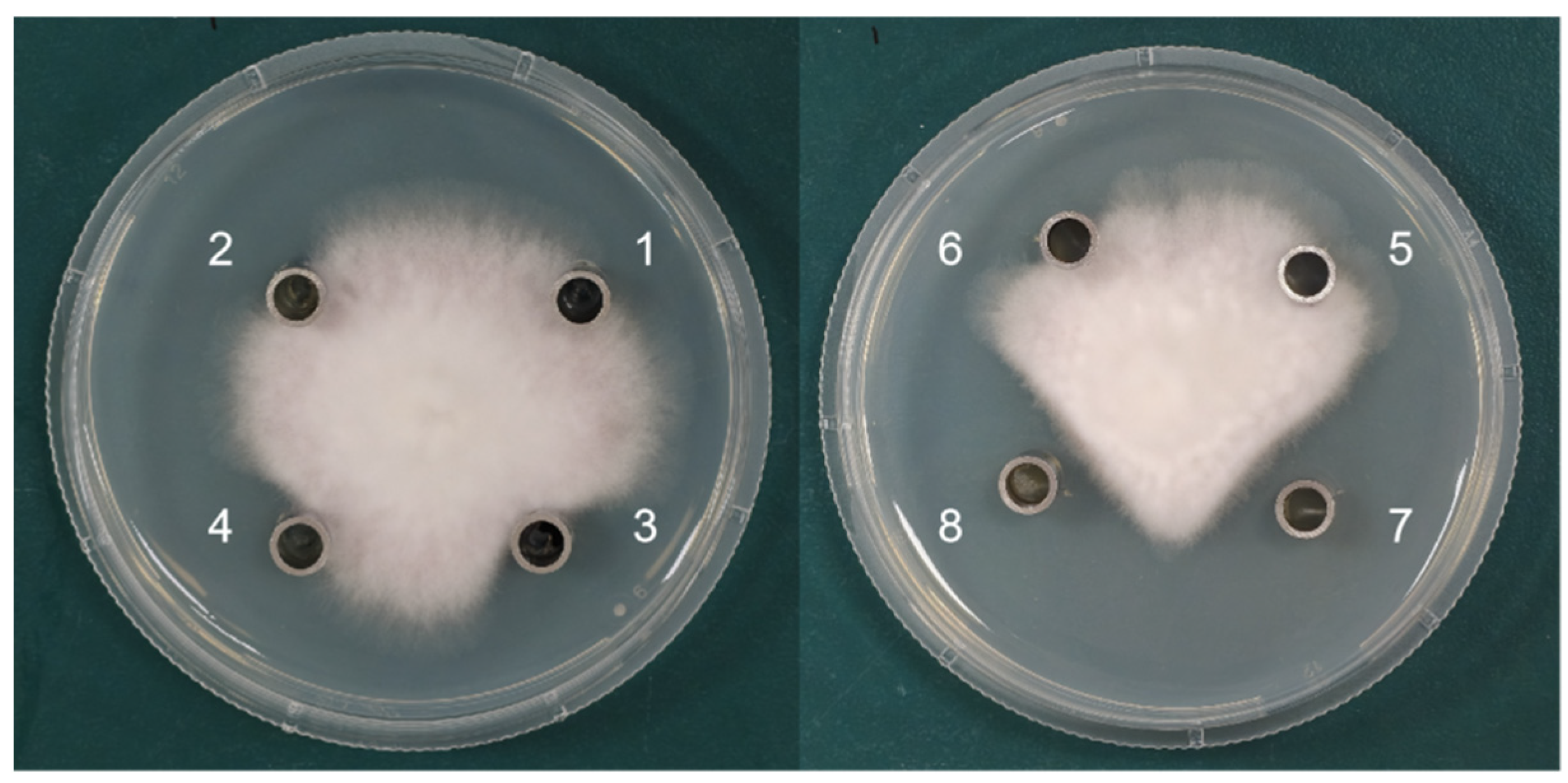
To evaluate the antifungal activity of fengycin, its inhibitory effect on Fusarium graminearum growth was assessed using a plate inoculation assay (Figure 2). The inhibitory effect was proportional to the fengycin concentration. At concentrations below 30 μg/mL, inhibition was minimal. However, at 60 μg/mL and above, fungal growth was significantly suppressed. Although the optimal inhibitory concentration could not be precisely determined due to fengycin diffusion through the agar, the results clearly demonstrate its strong inhibitory activity against F. graminearum.

3.2. Identification of Global Regulators Associated with Fengycin Synthesis in B. amyloliquefaciens

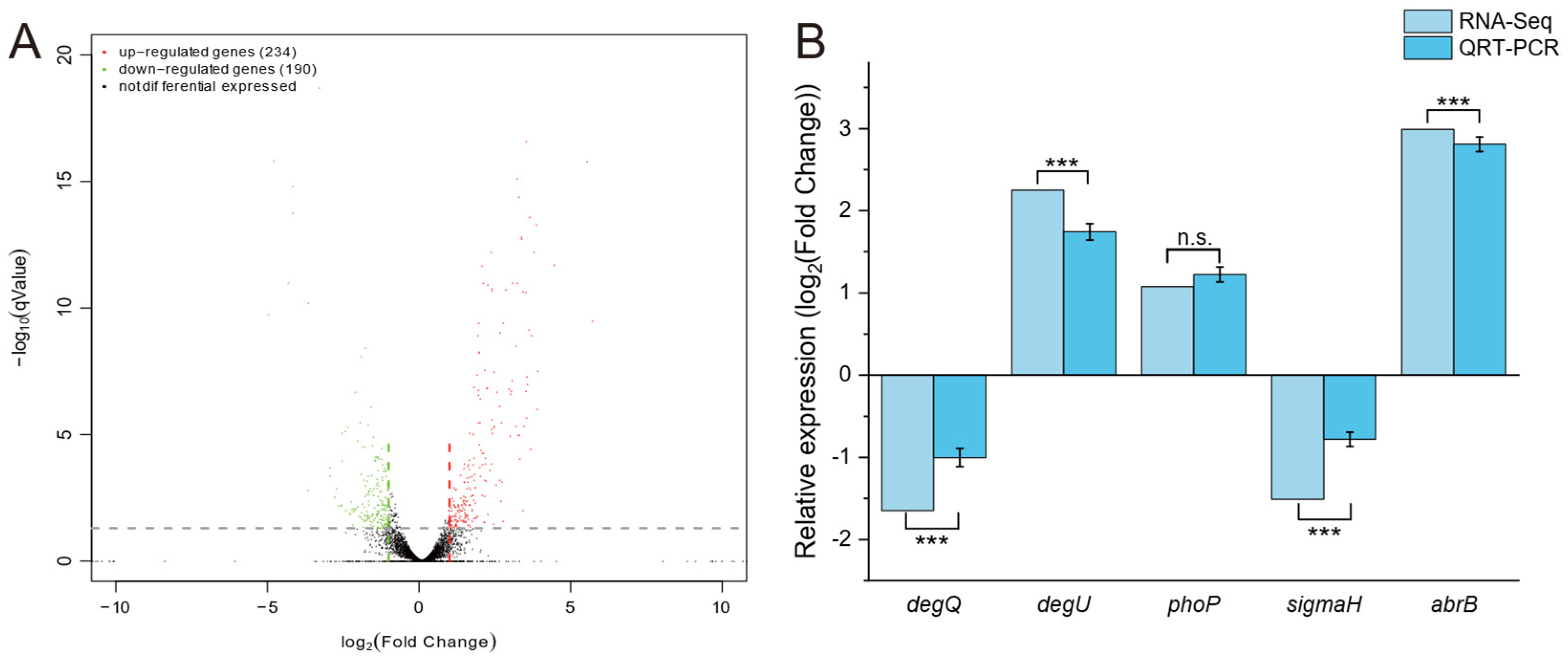
The rRNA-depleted data were aligned to the reference genome using Bowtie 2. B. amyloliquefaciens TF28 was selected as the reference genome for comparative genomic analysis. Sequence identity was first analyzed for the experimental group grown in the presence of 2 g/L fengycin compared to control group. As a result, sequence identity to the B. amyloliquefaciens TF28 genome was 99.16% for the control group and 98.75% for the experimental group (Table S3). Given the gaps present in the genome assembly of the strain, this level of divergence is acceptable. Differential gene expression analysis was performed using the DESeq2 software. The analysis identified 424 differentially expressed genes (DEGs), consisting of 190 downregulated and 234 upregulated genes (Figure 3 and Table S4), which may be associated with fengycin synthesis. Through sequence alignment analysis, five global regulators were confirmed among all DEGs: degQ (TH57_RS01125), degU (TH57_RS10795), phoP (TH57_RS12140), sigmaH (TH57_RS16510), and abrB (TH57_RS17680). Among these, three genes were upregulated and two were downregulated. The accuracy of the transcriptomic sequencing results was successfully validated by quantitative real-time PCR (qRT-PCR).

3.3. Effect of Overexpression of Global Regulatory Factors on Fengycin Synthesis Level

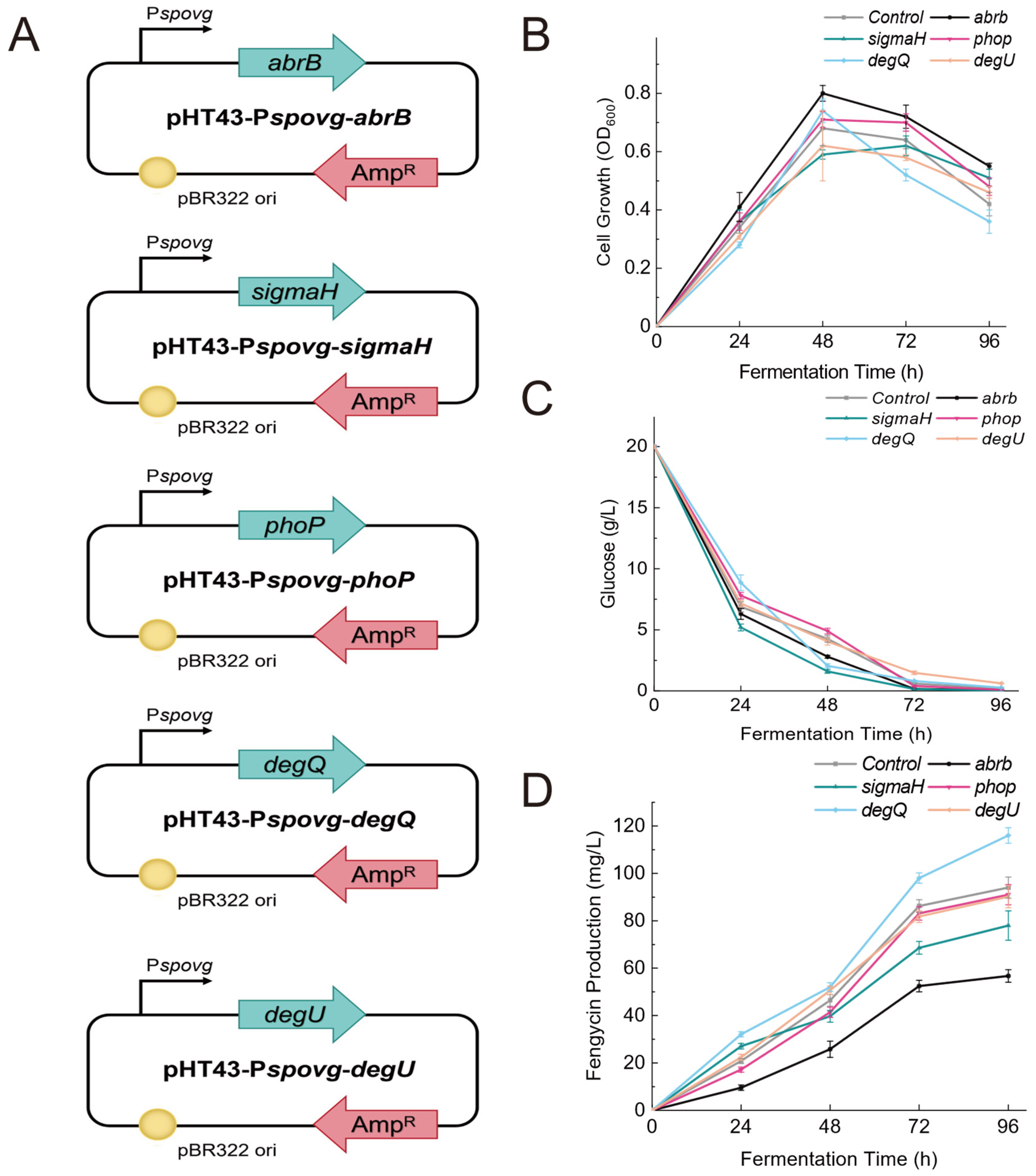
Five key regulators including abrB, sigmaH, phoP, degQ, and degU were overexpressed. Residual glucose, bacterial density (OD600), and fengycin production were monitored over the fermentation period (Figure 4). Glucose consumption rates were similar across strains at 24 and 48 h, with complete depletion occurring around 72 h in all cases, suggesting that overexpression of these regulators did not markedly affect sugar uptake. Notably, enhanced expression of abrB increased the cell density (OD600 = 0.8), whereas overexpressing degU produced the opposite effect (OD600 = 0.59), indicating that overexpression of these regulators differentially influenced cell growth. However, correlating sugar consumption with growth revealed no significant increase in metabolic burden at the whole-cell level due to regulator overexpression.
To determine whether overexpression of global regulatory factors affects fengycin synthesis by B. amyloliquefaciens TF28, the fengycin levels in different fermentation broths at various fermentation stages were detected. In the background of 20 g/L glucose and 10 g/L yeast extract as carbon and nitrogen sources, fengycin yield increased with the extension of fermentation time. The initial strain entered a plateau phase after 72 h, with a final yield of 94 mg/L (calculated based on the yield at 96 h). Overexpression of global regulatory factors had a certain effect on the final yield of fengycin. Among them, overexpression of degQ had the best promoting effect on fengycin synthesis by the strain, increasing the final fengycin yield to 116.0 mg/L, which is consistent with existing research results regarding the positive regulatory role of degQ. However, overexpression of sigmaH, phoP, degU, and abrB all significantly inhibited fengycin production.

3.4. Effect of Overexpression of Global Regulatory Factors on the Expression of Fengycin Synthesis Genes

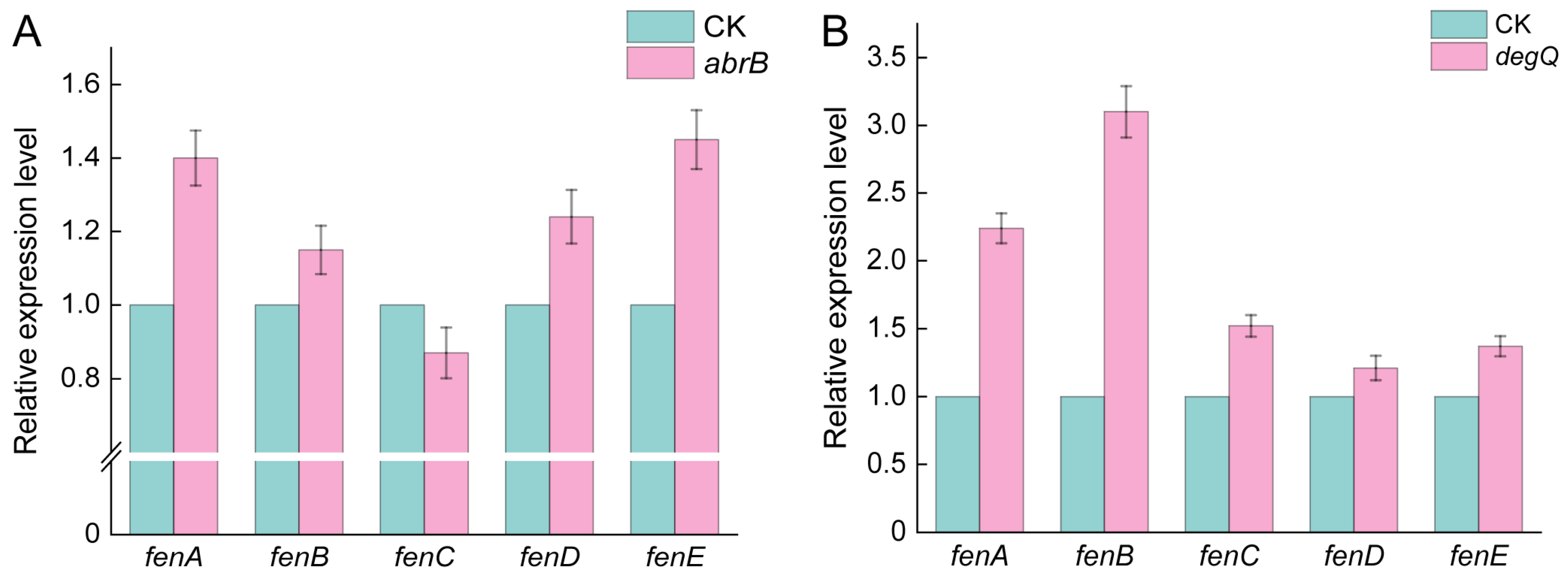
The expression of fengycin synthetase genes (fenA, fenB, fenC, fenD, fenE) is also regulated by global regulators. Changes in the expression of these genes were investigated by overexpressing the positive regulator degQ and the negative regulator abrB. Since B. amyloliquefaciens TF28 was still in the growth phase at 24 h of fermentation and fengycin production decreased by 72 h, cells harvested at 48 h of fermentation were selected for analysis (Figure 5). While overexpression of abrB at 48 h resulted only in a slight up-regulation of most fengycin synthetase genes (with the exception of down-regulated fenC), overexpression of degQ markedly increased the expression of all genes in the cluster. Notably, fenA and fenB exhibited the most pronounced up-regulation. These results suggest that overexpression of degQ activates the fengycin gene cluster, thereby enhancing fengycin production.

4. Discussion

Fengycin is a class of lipopeptide with potent inhibitory activity against phytopathogens. In our previous work, B. amyloliquefaciens TF28, isolated from Heilongjiang Province, China, was found to harbor a fengycin biosynthetic gene cluster and exhibit promising biocontrol potential [27]. In this study, we first confirmed fengycin production by this strain using liquid chromatography–mass spectrometry (LC-MS). Notably, no iturin peak was detected in the fermentation broth, indicating that among the lipopeptides, fengycin is the key antimicrobial substance produced by the strain. Furthermore, the purified fengycin fraction effectively inhibited the growth of F. graminearum, further supporting the feasibility of obtaining bioactive fengycin from B. amyloliquefaciens TF28.
Numerous studies have shown that global regulators influence the lipopeptide synthesis in bacterial strains [28]. Accordingly, a key objective of this work was to identify critical global regulators involved in fengycin production. Since high concentrations of a compound in the environment often feedback inhibit its biosynthesis, exogenous fengycin supplementation was employed as an environmental perturbation to mimic a high-production feedback state, enabling the identification of global regulators responsive to elevated fengycin levels through comparative transcriptomic analysis. In this study, we compared the differential gene expression of cells cultured in media with and without supplemented fengycin. Transcriptomic sequencing analysis identified a total of 424 differentially expressed genes, among which five were annotated as global regulators. These included phoP and sigmaH, both of which were previously implicated in the regulation of lipopeptide synthesis.
We further investigated whether global regulators also modulate fengycin synthesis in B. amyloliquefaciens TF28. Our results showed that after overexpression of all identified global regulators in the strain, bacterial growth and glucose consumption were not significantly affected, whereas fengycin production varied considerably. This indicates that global regulators actively influence fengycin biosynthesis. Notably, the regulatory role of phoP and others appeared contrary to previous reports, which may be attributed to the use of a transient expression system in this study [14]. Uncontrolled protein expression could compete for carbon and nitrogen resources or excessively suppress certain fengycin-related regulatory genes, thereby affecting fengycin yield. Due to the current inability to perform stable gene knock-in or knockout in B. amyloliquefaciens TF28, obtaining genetically stable strains remains challenging. Therefore, our conclusions require further validation in future studies.
The fengycin biosynthetic core genes encode modules that are essential for a specific step in the lipopeptide assembly pathway, and each is transcriptionally governed by its own distinct promoter [29,30]. Our experimental data demonstrate that degQ, a positive transcriptional regulator of fengycin production, significantly upregulates the expression of the entire cluster. The most substantial transcriptional induction was observed for fenA and fenB, highlighting the central role of degQ within this biosynthetic system. Previous studies have shown that degQ expression can be induced under specific environmental conditions, including high cell density, nutrient limitation, and increased demand for extracellular enzyme secretion [31,32]. DegQ primarily functions by modulating the phosphorylation state of degU, thereby influencing multiple physiological processes such as secondary metabolite biosynthesis, protease secretion, and biofilm formation [33,34]. Nevertheless, the results of this study demonstrate that overexpression of degQ has a particularly pronounced effect on enhancing fengycin production. It is therefore reasonable to propose that degQ may also regulate fengycin synthesis through additional direct or indirect pathways.
In both Bacillus amyloliquefaciens and Bacillus subtilis, global regulators including degU, spo0A, codY, and comA have been documented to modulate fengycin production [13,35]. While degQ has been established as a central regulator of fengycin synthesis in Bacillus subtilis and Bacillus velezensis, no prior evidence supported a positive regulatory role for degQ in B. amyloliquefaciens [12,33]. The present study demonstrates that degQ overexpression significantly enhances fengycin yield in B. amyloliquefaciens. This observed positive regulation aligns with its recognized function as an upstream amplifier within the degU-dependent signaling cascade, underscoring the potential of degQ as a strategic target for the metabolic engineering of high-yielding fengycin production strains.
In contrast, the negative regulator abrB did not exert a uniform repressive effect. Notably, abrB overexpression resulted in the significant upregulation of all cluster genes except fenC. This unexpected pattern suggests the involvement of ancillary regulatory networks or additional factors in the precise modulation of fengycin yield. Previous studies have shown that abrB is a key regulator of Bacillus energy metabolism and strongly represses sporulation [36]. Since lipopeptides such as fengycin are typically synthesized during the stationary phase, which follows spore germination, it is reasonable to hypothesize that abrB overexpression inhibits fengycin production by delaying entry into this phase. Supporting this, studies have shown that abrB negatively regulates the lipopeptide surfactin synthesis in Bacillus subtilis 168, and its knockout significantly enhances surfactin production, providing further corroboration for our findings [37]. Therefore, we propose that abrB acts as a negative regulator of fengycin synthesis in B. amyloliquefaciens. However, given that abrB deletion may disrupt energy metabolism, its potential benefits for fengycin production must be carefully weighed against the risk of impairing cellular fitness.
In summary, this study has confirmed that B. amyloliquefaciens TF28 is capable of synthesizing fengycin, which exhibits significant antifungal activity against Fusarium graminearum. Furthermore, based on transcriptomic sequencing analysis, we identified that multiple global transcriptional regulators play key roles in controlling fengycin biosynthesis in B. amyloliquefaciens TF28. Among them, degQ positively regulates fengycin synthesis, whereas abrB exerts a negative regulatory effect. We anticipate that these findings will provide a conceptual framework for the rational design of engineering strains for fengycin production.

Supplementary Materials

The following supporting information can be downloaded at: https://www.mdpi.com/article/10.3390/fermentation12020072/s1, Table S1: Strains and plasmids used in this study; Table S2: Primers used in this study; Table S3: Reads mapped to the reference genome; Table S4: RNA-seq-based screening of differentially expressed genes associated with fengycin synthesis.

Author Contributions

Conceptualization, Y.T. and C.Y.; methodology, G.Y.; validation, L.Z.; resources, Y.X.; data curation, H.X.; writing—original draft preparation, G.Y.; writing—review and editing, Y.T. and C.Y. All authors have read and agreed to the published version of the manuscript.

Funding

This research was funded by Heilongjiang Academy of Sciences Outstanding Youth Innovation Program, grant number 2023QNJJ003.

Institutional Review Board Statement

Not applicable.

Informed Consent Statement

Not applicable.

Data Availability Statement

The data presented in this study are openly available in [NCBI BioProject] at [https://www.ncbi.nlm.nih.gov/bioproject/PRJNA1261693 (accessed on 12 May 2025)], reference number [No. PRJNA1261693].

Acknowledgments

The publication fee for this manuscript was supported by the Institute of Microbiology, Heilongjiang Academy of Sciences, China.

Conflicts of Interest

The authors declare no conflicts of interest.

References

  1. Yin, Y.; Wang, X.; Zhang, P.; Wang, P.; Wen, J. Strategies for improving fengycin production: A review. Microb. Cell Factories 2024, 23, 144. [Google Scholar] [CrossRef]
  2. Valença, C.A.; Barbosa, A.A.; Dolabella, S.S.; Severino, P.; Matos, C.; Krambeck, K.; Souto, E.B.; Jain, S. Antimicrobial bacterial metabolites: Properties, applications and loading in liposomes for site-specific delivery. Curr. Pharm. Des. 2023, 29, 2191–2203. [Google Scholar] [CrossRef]
  3. Malmsten, M. Interactions of antimicrobial peptides with bacterial membranes and membrane components. Curr. Top. Med. Chem. 2016, 16, 16–24. [Google Scholar] [CrossRef]
  4. Hu, L.B.; Shi, Z.Q.; Zhang, T.; Yang, Z.M. Fengycin antibiotics isolated from B-FS01 culture inhibit the growth of Fusarium moniliforme Sheldon ATCC 38932. FEMS Microbiol. Lett. 2007, 272, 91–98. [Google Scholar] [CrossRef] [PubMed]
  5. Yang, X.; Zhang, F.; Wang, J.; Tian, C.; Meng, X. Characterization of Bacillus velezensis YTQ3 as a potential biocontrol agent against Botrytis cinerea. Postharvest Biol. Technol. 2025, 223, 113443. [Google Scholar] [CrossRef]
  6. Guo, Q.; Dong, W.; Li, S.; Lu, X.; Wang, P.; Zhang, X.; Wang, Y.; Ma, P. Fengycin produced by Bacillus subtilis NCD-2 plays a major role in biocontrol of cotton seedling damping-off disease. Microbiol. Res. 2014, 169, 533–540. [Google Scholar] [CrossRef] [PubMed]
  7. Bie, X. Fengycin Production and Its Applications in Plant Growth and Postharvest Quality. In Bio-Based Antimicrobial Agents to Improve Agricultural and Food Safety; Bentham Science Publishers: Sharjah, United Arab Emirates, 2024; pp. 71–119. [Google Scholar]
  8. Villegas-Escobar, V.; Ceballos, I.; Mira, J.J.; Argel, L.E.; Peralta, S.O.; Romero-Tabarez, M. Fengycin C produced by Bacillus subtilis EA-CB0015. J. Nat. Prod. 2013, 76, 503–509. [Google Scholar] [CrossRef] [PubMed]
  9. Hanif, A.; Zhang, F.; Li, P.; Li, C.; Xu, Y.; Zubair, M.; Zhang, M.; Jia, D.; Zhao, X.; Liang, J.; et al. Fengycin produced by Bacillus amyloliquefaciens FZB42 inhibits Fusarium graminearum growth and mycotoxins biosynthesis. Toxins 2019, 11, 295. [Google Scholar] [CrossRef]
  10. Du, Y.; Ma, J.; Yin, Z.; Liu, K.; Yao, G.; Xu, W.; Fan, L.; Du, B.; Ding, Y.; Wang, C. Comparative genomic analysis of Bacillus paralicheniformis MDJK30 with its closely related species reveals an evolutionary relationship between B. paralicheniformis and B. licheniformis. BMC Genom. 2019, 20, 283. [Google Scholar] [CrossRef]
  11. Sun, J.; Qi, X.; Du, C. Biosynthesis and yield improvement strategies of fengycin. Arch. Microbiol. 2025, 207, 90. [Google Scholar] [CrossRef]
  12. Wang, P.; Guo, Q.; Ma, Y.; Li, S.; Lu, X.; Zhang, X.; Ma, P. DegQ regulates the production of fengycins and biofilm formation of the biocontrol agent Bacillus subtilis NCD-2. Microbiol. Res. 2015, 178, 42–50. [Google Scholar] [CrossRef]
  13. Sun, J.; Liu, Y.; Lin, F.; Lu, Z.; Lu, Y. CodY, ComA, DegU and Spo0A controlling lipopeptides biosynthesis in Bacillus amyloliquefaciens fmbJ. J. Appl. Microbiol. 2021, 131, 1289–1304. [Google Scholar] [CrossRef]
  14. Zhang, X.Y.; Ping, M. The PhoR/PhoP two-component system regulates fengycin production in Bacillus subtilis NCD-2 under low-phosphate conditions. J. Integr. Agric. 2018, 17, 149–157. [Google Scholar]
  15. Markelova, N.; Chumak, A. Antimicrobial activity of bacillus cyclic lipopeptides and their role in the host adaptive response to changes in environmental conditions. Int. J. Mol. Sci. 2025, 26, 336. [Google Scholar] [CrossRef] [PubMed]
  16. Liu, N.; Sun, H.; Tang, Z.; Zheng, Y.; Qi, G.; Zhao, X. Transcription factor Spo0A regulates the biosynthesis of difficidin in Bacillus amyloliquefaciens. Microbiol. Spectr. 2023, 11, e01044-23. [Google Scholar] [CrossRef]
  17. Martín, J.F.; Liras, P.; Sánchez, S. Modulation of gene expression in actinobacteria by translational modification of transcriptional factors and secondary metabolite biosynthetic enzymes. Front. Microbiol. 2021, 12, 630694. [Google Scholar] [CrossRef] [PubMed]
  18. Zhang, S.; Jiang, W.; Li, J.; Meng, L.; Cao, X.; Hu, J.; Liu, Y.; Chen, J.; Sha, C. Whole genome shotgun sequence of Bacillus amyloliquefaciens TF28, a biocontrol entophytic bacterium. Stand. Genom. Sci. 2016, 11, 73. [Google Scholar] [CrossRef] [PubMed]
  19. Roy, A.; Mahata, D.; Paul, D.; Korpole, S.; Franco, O.L.; Mandal, S.M. Purification, biochemical characterization and self-assembled structure of a fengycin-like antifungal peptide from Bacillus thuringiensis strain SM1. Front. Microbiol. 2013, 4, 332. [Google Scholar] [CrossRef]
  20. Dhanarajan, G.; Rangarajan, V.; Sridhar, P.R.; Sen, R. Development and scale-up of an efficient and green process for HPLC purification of antimicrobial homologues of commercially important microbial lipopeptides. ACS Sustain. Chem. Eng. 2016, 4, 6638–6646. [Google Scholar] [CrossRef]
  21. Yang, H.; Li, X.; Li, X.; Yu, H.; Shen, Z. Identification of lipopeptide isoforms by MALDI-TOF-MS/MS based on the simultaneous purification of iturin, fengycin, and surfactin by RP-HPLC. Anal. Bioanal. Chem. 2015, 407, 2529–2542. [Google Scholar] [CrossRef]
  22. Bolger, A.M.; Lohse, M.; Usadel, B. Trimmomatic: A flexible trimmer for Illumina sequence data. Bioinformatics 2014, 30, 2114–2120. [Google Scholar] [CrossRef]
  23. Langmead, B.; Salzberg, S.L. Fast gapped-read alignment with Bowtie 2. Nat. Methods 2012, 9, 357–359. [Google Scholar] [CrossRef] [PubMed]
  24. Yu, G.; Wang, L.-G.; Han, Y.; He, Q.-Y. clusterProfiler: An R package for comparing biological themes among gene clusters. OMICS J. Integr. Biol. 2012, 16, 284–287. [Google Scholar] [CrossRef] [PubMed]
  25. Li, B.; Dewey, C.N. RSEM: Accurate transcript quantification from RNA-Seq data with or without a reference genome. BMC Bioinform. 2011, 12, 323. [Google Scholar] [CrossRef]
  26. Love, M.I.; Huber, W.; Anders, S. Moderated estimation of fold change and dispersion for RNA-seq data with DESeq2. Genome Biol. 2014, 15, 550. [Google Scholar] [CrossRef] [PubMed]
  27. Zhang, S.; Ma, Y.; Jiang, W.; Meng, L.; Cao, X.; Hu, J.; Chen, J.; Li, J. Development of a strain-specific quantification method for monitoring Bacillus amyloliquefaciens TF28 in the rhizospheric soil of soybean. Mol. Biotechnol. 2020, 62, 521–533. [Google Scholar] [CrossRef]
  28. Zhou, L.; Höfte, M.; Hennessy, R.C. Does regulation hold the key to optimizing lipopeptide production in Pseudomonas for biotechnology? Front. Bioeng. Biotechnol. 2024, 12, 1363183. [Google Scholar]
  29. Yaseen, Y.; Gancel, F.; Drider, D.; Béchet, M.; Jacques, P. Influence of promoters on the production of fengycin in Bacillus spp. Res. Microbiol. 2016, 167, 272–281. [Google Scholar]
  30. Gao, G.-R.; Hou, Z.-J.; Ding, M.-Z.; Bai, S.; Wei, S.-Y.; Qiao, B.; Xu, Q.-M.; Cheng, J.-S.; Yuan, Y.-J. Improved production of fengycin in Bacillus subtilis by integrated strain engineering strategy. ACS Synth. Biol. 2022, 11, 4065–4076. [Google Scholar] [CrossRef]
  31. Lilge, L.; Vahidinasab, M.; Adiek, I.; Becker, P.; Nesamani, C.K.; Treinen, C.; Hoffmann, M.; Morabbi Heravi, K.; Henkel, M.; Hausmann, R. Expression of degQ gene and its effect on lipopeptide production as well as formation of secretory proteases in Bacillus subtilis strains. MicrobiologyOpen 2021, 10, e1241. [Google Scholar] [CrossRef]
  32. Danevčič, T.; Spacapan, M.; Dragoš, A.; Kovács, Á.T.; Mandic-Mulec, I. DegQ is an important policing link between quorum sensing and regulated adaptative traits in Bacillus subtilis. Microbiol. Spectr. 2023, 11, e00908-23. [Google Scholar] [CrossRef]
  33. Yu, C.; Qiao, J.; Ali, Q.; Jiang, Q.; Song, Y.; Zhu, L.; Gu, Q.; Borriss, R.; Dong, S.; Gao, X.; et al. degQ associated with the degS/degU two-component system regulates biofilm formation, antimicrobial metabolite production, and biocontrol activity in Bacillus velezensis DMW1. Mol. Plant Pathol. 2023, 24, 1510–1521. [Google Scholar] [CrossRef] [PubMed]
  34. Xu, Z.; Xie, J.; Zhang, H.; Wang, D.; Shen, Q.; Zhang, R. Enhanced control of plant wilt disease by a xylose-inducible degQ gene engineered into Bacillus velezensis strain SQR9XYQ. Phytopathology 2019, 109, 36–43. [Google Scholar] [CrossRef] [PubMed]
  35. Verhamme, D.T.; Murray, E.J.; Stanley-Wall, N.R. DegU and Spo0A jointly control transcription of two loci required for complex colony development by Bacillus subtilis. J. Bacteriol. 2009, 191, 100–108. [Google Scholar] [CrossRef] [PubMed]
  36. Zhang, Q.; Zhu, W.; He, S.; Lei, J.; Xu, L.; Hu, S.; Zhang, Z.; Cai, D.; Chen, S. Understanding energy fluctuation during the transition state: The role of AbrB in Bacillus licheniformis. Microb. Cell Factories 2024, 23, 296. [Google Scholar] [CrossRef]
  37. Klausmann, P.; Lilge, L.; Aschern, M.; Hennemann, K.; Henkel, M.; Hausmann, R.; Morabbi Heravi, K. Influence of B. subtilis 3NA mutations in spo0A and abrB on surfactin production in B. subtilis 168. Microb. Cell Factories 2021, 20, 188. [Google Scholar] [CrossRef]
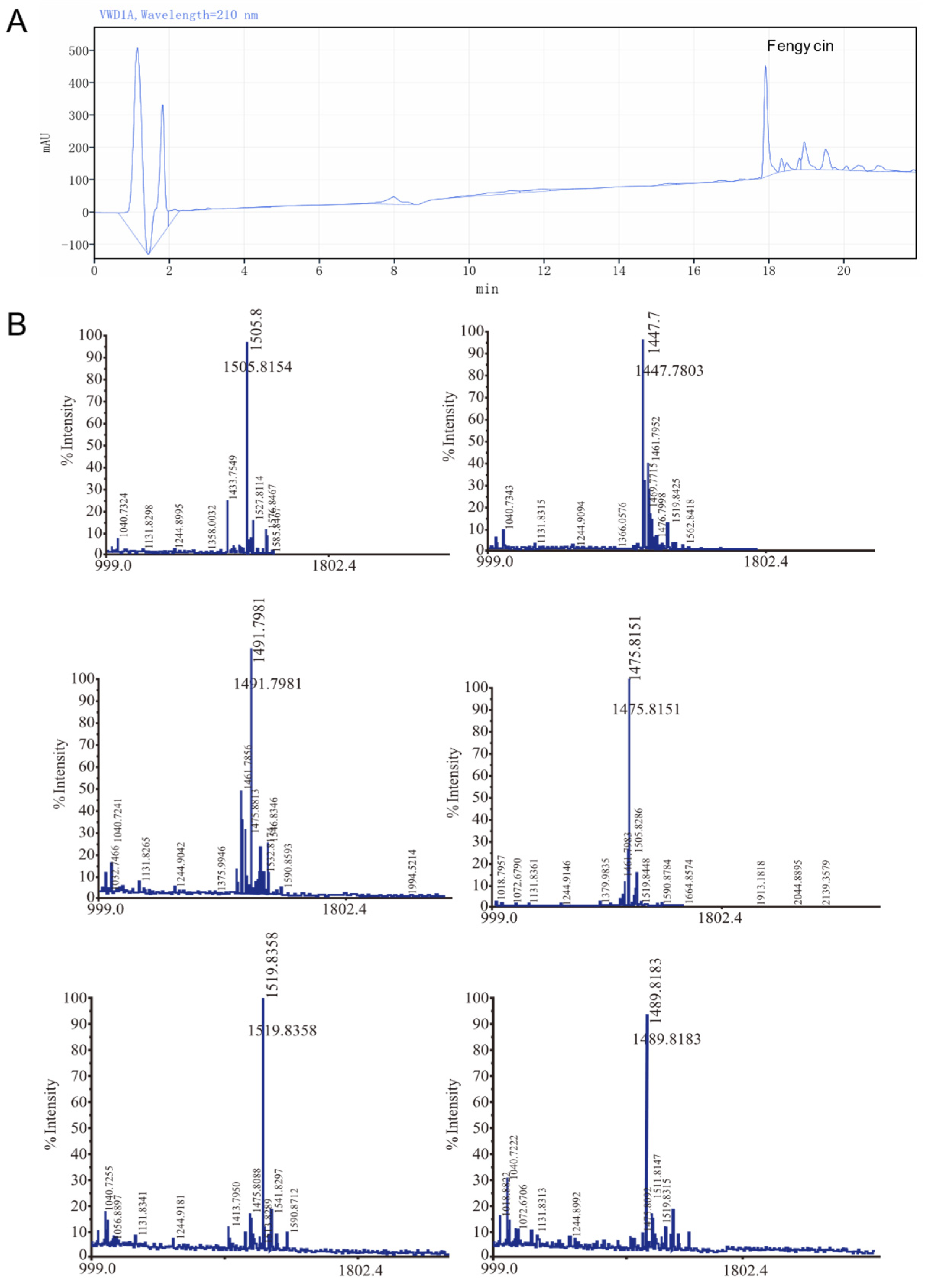
Figure 1. HPLC-MS detection results of fengycin samples: (A) Results of the HPLC analysis, (B) Results of the MALDI-TOF-MS analysis.
Fermentation 12 00072 g001
Figure 2. Inhibitory effect of different concentrations of fengycin extract on the growth of F. graminearum 1, 5: Control (water); 2: 10 μg/mL; 3: 20 μg/mL; 4, 6: 30 μg/mL; 7: 60 μg/mL; 8: 90 μg/mL.
Fermentation 12 00072 g002
Figure 3. Results of differential gene screening and gene expression level detection based on RNA-seq. (A) Volcano plot of differentially expressed genes (DEGs). (B) Expression levels of key DEGs validated by RT-qPCR. ***: p < 0.001; n.s.: not significant.
Fermentation 12 00072 g003
Figure 4. Effect of overexpression of global regulatory factors on residual sugar content, OD600, and fengycin yield in fermentation broth. (A) Plasmids for overexpression of Global Regulatory Factors; (B) bacterial growth; (C) residual glucose; (D) fengycin production.
Fermentation 12 00072 g004
Figure 5. Effect of overexpression of different global regulatory factors on fengycin synthesis gene expression levels at 48 h fermentation state: (A) overexpression of abrB; (B) overexpression of degQ.
Fermentation 12 00072 g005
Table 1. Fengycin HPLC elution conditions.
TimeMobile Phase ConditionsFlow Rate (mL/min)
0–4 minSolvent B: increased from 40% to 45%2 mL/min
4–11 minSolvent B: increased from 45% to 60%0.8 mL/min
11–17 minSolvent B: increased from 65% to 70%0.4 mL/min
17–22 minSolvent B: increased from 70% to 85%1.5 mL/min
Disclaimer/Publisher’s Note: The statements, opinions and data contained in all publications are solely those of the individual author(s) and contributor(s) and not of MDPI and/or the editor(s). MDPI and/or the editor(s) disclaim responsibility for any injury to people or property resulting from any ideas, methods, instructions or products referred to in the content.