Review

Fermenting the Unused: Microbial Biotransformation of Food Industry By-Products for Circular Bioeconomy Valorisation


by
Elsa M. Gonçalves
1,2,*,
José M. Pestana
3,4,5 and
Nuno Alvarenga
1,2
1
UEISTSA—Unidade Estratégica de Investigação e Serviços de Tecnologia e Segurança Alimentar, Instituto Nacional de Investigação Veterinária e Agrária, Av. da República, Quinta do Marquês, 2780-157 Oeiras, Portugal
2
GeoBiotec—GeoBioTec Research Institute, Faculdade de Ciências e Tecnologia, Universidade Nova de Lisboa, Campus da Caparica, 2829-516 Caparica, Portugal
3
LEAF—Linking Landscape, Environment, Agriculture and Food Research Center, Instituto Superior de Agronomia, Universidade de Lisboa, Tapada da Ajuda, 1349-017 Lisboa, Portugal
4
Associate Laboratory TERRA, Instituto Superior de Agronomia, Universidade de Lisboa, Tapada da Ajuda, 1349-017 Lisboa, Portugal
5
CiTUR—Centro de Investigação, Desenvolvimento e Inovação em Turismo—Polo Estoril, Escola Superior de Hotelaria e Turismo do Estoril, Av. Condes de Barnecola N. 808, 2769-510 Estoril, Portugal
*
Author to whom correspondence should be addressed.
Fermentation 2026, 12(2), 73; https://doi.org/10.3390/fermentation12020073
Submission received: 22 December 2025 / Revised: 12 January 2026 / Accepted: 19 January 2026 / Published: 28 January 2026

Abstract

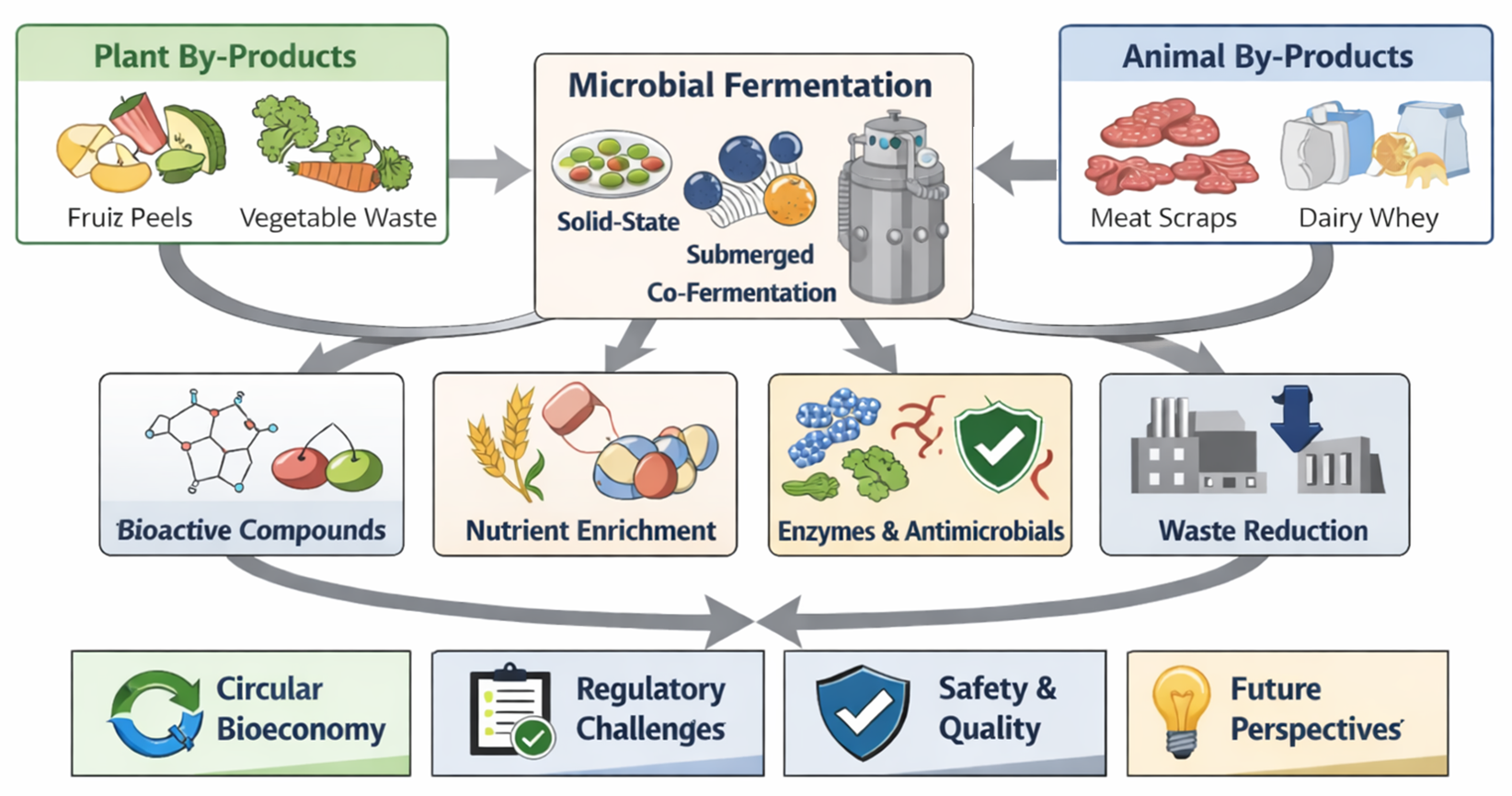
The food industry generates large volumes of nutrient-rich by-products that remain underutilised despite their considerable biochemical potential. These materials originate predominantly from the fruit and vegetable, dairy, meat, and fish and seafood sectors and represent a substantial opportunity for sustainable valorisation. Fermentation has emerged as a powerful platform for converting such by-products into high-value ingredients, including bioactive compounds, functional metabolites, enzymes, antimicrobials, and nutritionally enriched fractions. This review synthesises recent advances in microbial fermentation strategies—spanning lactic acid bacteria, filamentous fungi, yeasts, and mixed microbial consortia—and highlights their capacity to enhance the bioavailability, stability, and functionality of recovered compounds across diverse substrate streams. Key technological enablers, including substrate pre-treatments, precision fermentation, omics-guided strain selection and improvement, and bioprocess optimisation, are examined within the broader framework of circular bioeconomy integration. Despite significant scientific progress, major challenges remain, particularly related to substrate heterogeneity, process scalability, regulatory alignment, safety assessment, and consumer acceptance. The review identifies critical research gaps and future directions, emphasising the need for standardised analytical frameworks, harmonised compositional databases, AI-driven fermentation control, integrated biorefinery concepts, and pilot-scale validation. Overall, the evidence indicates that integrated fermentation-based approaches—especially those combining complementary by-product streams, tailored microbial consortia, and system-level process integration—represent the most promising pathway toward the scalable, sustainable, and economically viable valorisation of food industry by-products.

Graphical Abstract

1. Introduction

The global food processing sector generates vast quantities of secondary materials throughout all stages of transformation, ranging from the primary handling of raw commodities to advanced industrial refinement. Although these materials are frequently classified as waste, a considerable proportion consists of nutritionally dense and biochemically valuable fractions that remain critically underexploited. Current estimates suggest that approximately 1.3 billion tonnes of food-derived biomass are discarded globally each year; however, the reported values vary depending on definitions, data sources, and assessment methodologies, reflecting a substantial uncertainty in global quantification. The growing emphasis on sustainable resource management, circular bioeconomy strategies, and clean-label functional ingredient development has therefore intensified interest in the valorisation of food industry by-products as renewable inputs for high-value bioprocessing [1,2,3].
The terminology applied to these materials is not always used consistently, yet it strongly influences regulatory classification, valorisation potential, and eligibility for food, feed, or biotechnological uses [4,5]. The term by-product typically refers to secondary materials generated alongside the primary product that retain inherent technological or nutritional value, such as fruit pomace, whey, or fish trimmings. In contrast, sub-products generally denote an intentionally co-produced stream with recognised functionality, including buttermilk or collagen-rich bone fractions. The term residue is applied to the remaining material after a specific processing step and often requires stabilisation prior to reuse, as observed for vegetable trimmings or blood-derived liquid fractions. Distinguishing among these categories is essential in circular processing systems, since regulatory frameworks determine whether a material may re-enter food, feed, biochemical, or industrial bioprocessing chains [4].
Microbial fermentation is one of the most flexible and sustainable technological platforms for upgrading by-products into higher-value ingredients and bioproducts [6,7,8]. Through microbial biotransformation, fermentation can enhance the bioavailability of polyphenols, release bioactive peptides, increase antioxidant and antimicrobial activities, improve digestibility, generate organic acids and vitamins, and reduce anti-nutritional compounds [9,10,11]. Numerous studies have shown that fermentation not only stabilises nutrient-rich by-products but often generates novel functional, sensory, or biochemical properties that exceed those of the unprocessed material [7,12]. As such, fermentative valorisation offers a direct route to producing natural, clean-label compounds that meet evolving consumer preferences for sustainable, minimally processed products [13,14].
Food industry by-products can be valorised through diverse technological routes, including physical fractionation, chemical extraction, enzymatic processing, thermochemical conversion, and biological treatments [15]. While each approach presents distinct advantages and limitations, the present review specifically focuses on microbial fermentation as a biotransformation-based valorisation strategy, due to its capacity to simultaneously enhance stability, functionality, and sustainability within circular bioeconomy frameworks [2].
The integration of fermentative processes into circular bioeconomy models provides significant environmental and economic advantages. Fermentation reduces chemical oxygen demand (COD) and biochemical oxygen demand (BOD) loads, mitigates greenhouse gas emissions associated with disposal, stabilises perishable materials, and enables decentralised, small-scale, or regional valorisation strategies [16,17]. Technologically, these bioprocesses support the development of functional beverages, nutraceutical extracts, protein- and peptide-rich ingredients, microbial biopolymers, and precursor molecules for biochemicals and packaging materials [3,5]. The versatility of fermentation therefore positions it as a cornerstone technology for enabling food industry circularity and minimising resource loss.
This review examines the fermentative valorisation potential of by-products generated across four major food industry sectors: fruits and vegetables, dairy, meat, and fish/seafood. It synthesises information on their biochemical composition, microbial fermentation strategies, and technological processing routes and evaluates the functional and biochemical outputs obtained. Moreover, the review considers sustainability and regulatory aspects and identifies research needs for developing scalable, integrated biorefineries capable of converting heterogeneous by-product streams into high-value functional and industrial bioproducts. The review is based on a critical synthesis of recent peer-reviewed literature and regulatory sources, with an emphasis on the cross-sectoral comparison of substrates, fermentation strategies, and valorisation outcomes. Table 1 provides an overview of the main by-product categories addressed in this review, together with their typical compositional attributes and major valorisation challenges. The comparison underscores how sector-specific differences in moisture content, nutrient composition, perishability, and regulatory constraints directly condition the selection and performance of fermentation-based valorisation strategies.

2. Overview of Major Food Industry By-Products

Food industry by-products originate from diverse raw materials and processing operations, and their physicochemical characteristics directly influence their suitability for fermentative valorisation [8,15]. Although often considered heterogeneous and difficult to manage, these materials are frequently rich in carbohydrates, proteins, lipids, minerals, dietary fibres, and bioactive compounds that can serve as substrates for microbial growth or as precursors for value-added biochemical transformations [18,19]. The following subsections provide an integrated overview of the major by-products generated across four focal sectors—fruits and vegetables, dairy, meat, and fish and seafood—and highlight their compositional features, challenges, and fermentative potential. Additional high-volume by-product streams that commonly act as co-substrates in integrated fermentation systems are discussed where relevant, but do not constitute an expansion of the primary sectoral scope of this review.

2.1. Fruits and Vegetable Industry By-Products

The fruits and vegetable sector generates substantial amounts of peels, pomace, seeds, pulp residues, and trimming fractions, often representing 20–50% of the processed raw material, depending on species and processing intensity [20,21]. In the European Union (EU), fresh vegetable production reached 59.8 million tonnes in 2022, with tomatoes alone accounting for approximately 15.4 million tonnes, while fruit production represented a similarly large volume, estimated at 24.3 million tonnes in 2024. These values reflect the magnitude of raw materials entering processing facilities and the significant volumes of associated by-products.
Typical European processing ratios indicate that apples yield approximately 0.25 kg of pomace per kilogram of fruit, grapes generate roughly 0.22 kg/kg of marc, and oranges may produce between 0.37 and 0.60 kg/kg of citrus pomace [22]. Extrapolated to continental production, these values correspond to several million tons of plant-based by-products available annually [3,23].
Fruit and vegetable by-products are characterised by high concentrations of carbohydrates, dietary fibre (cellulose, hemicellulose, and pectin), sugars, carotenoids, vitamins, and polyphenols [18,24,25]. These materials exhibit a strong potential for fermentative biotransformation, with microbial cultures capable of releasing bound phenolics, enhancing antioxidant potential and increasing the bioavailability of structurally complex phytochemicals [9,26]. Lactic acid bacteria, yeasts, and filamentous fungi have been widely applied to these substrates to generate functional beverages, organic acids, enriched phenolic extracts, and enzyme-enhanced products [27,28]. Nonetheless, perishability, high moisture content, and seasonal availability pose practical challenges that often necessitate prompt stabilisation [4].

2.2. Dairy Industry By-Products

The dairy sector produces a diverse range of by-products, with whey being the largest by volume. The EU raw milk output reached approximately 160 million tonnes in 2022, and whey production was estimated at around 15 million tonnes in 2024 [29,30]. Whey comprises lactose, whey proteins, peptides, minerals, and vitamins, making it a valuable substrate for fermentative valorisation [31,32]. Additional dairy by-products include buttermilk, skim milk fractions, and spent starter cultures, all of which exhibit a high nutritional density [30,33].
Despite its value, untreated whey poses environmental concerns due to its high chemical oxygen demand (COD) and biochemical oxygen demand (BOD) [34,35]. Fermentation provides an efficient pathway for converting whey into lactic acid, ethanol, single-cell protein, bioactive peptides, and microbial exopolysaccharides [36,37]. The technological potential of dairy by-products has been demonstrated in numerous systems using lactic acid bacteria, Kluyveromyces yeasts, and engineered microbial strains for lactose hydrolysis and functional ingredient production [34,35]. Major constraints include storage instability, microbial spoilage, and lactose crystallisation, which can be mitigated through controlled fermentation and appropriate pre-treatment strategies [38].

2.3. Meat Industry By-Products

Meat processing in Europe yields significant volumes of blood, bones, offal, and collagen-rich tissues. Across the EU, more than 20 million tonnes of animal by-products are generated annually from slaughterhouses, dairies, and related processing facilities [39,40]. These streams contain high levels of proteins, lipids, and bioavailable minerals such as iron and zinc, making them attractive substrates for the fermentative production of bioactive peptides, enzyme extracts, and flavour compounds [41,42]. Blood typically contains 17–19% protein, while collagen-rich tissues and bones represent valuable substrates for hydrolysate production [40,43].
The fermentation of meat-derived materials can generate antioxidant, antihypertensive, and antimicrobial peptides through targeted proteolysis [11,44]. However, stringent safety regulations, high microbial loads, and sensory challenges related to odour or flavour pose barriers to direct valorisation [4,39]. As a result, fermentation is often preceded by enzymatic hydrolysis or thermal treatment to enhance substrate accessibility, reduce pathogen risks, and improve process performance [43].

2.4. Fish and Seafood Industry By-Products

The EU seafood industry provides another substantial source of nutrient-rich by-products. In 2022, fish and seafood consumption reached approximately 10.6 million tonnes (live weight equivalent), with species-specific processing by-products often accounting for 50–70% of total biomass [45,46]. These by-products include fish heads, skins, bones, viscera, and scales. Many of these materials are currently directed to fishmeal and fish oil production, with the EU generating approximately 370,000–520,000 tonnes of fishmeal and 120,000–190,000 tonnes of fish oil annually [47,48].
Fish and seafood by-products contain high-quality proteins, collagen, gelatin, and long-chain omega-3 fatty acids [49,50]. Fermentation offers a sustainable route for producing fish silage, fermented sauces, peptide-rich hydrolysates, and antioxidant extracts [51,52]. Lactic acid fermentation can inhibit spoilage microorganisms and accelerate proteolysis, while mixed-culture fermentation can modulate aroma compounds and improve sensory characteristics [53,54]. Key challenges include lipid oxidation, strong marine odours, and rapid autolysis driven by endogenous enzymes, which necessitate prompt processing or stabilisation [55].
Beyond sector-specific estimates, global assessments consistently indicate that food processing and manufacturing generate hundreds of millions of tonnes of secondary biomass streams annually. These include by-products, side streams, and processing residues that remain underutilised despite their biochemical potential. At the global level, fruit and vegetable processing, cereal and oilseed refining, and animal-derived streams account for particularly large shares, while Europe represents a significant fraction due to its highly industrialised food sector. The rapid expansion of food processing capacity in Asia further contributes to the global magnitude of these streams. A direct comparison across regions remains challenging because of heterogeneous definitions and reporting practices, and therefore the figures discussed in this review should be interpreted as indicative orders of magnitude rather than precise inventories [56,57].

2.5. Comparative Overview of Compositional Attributes

Although the direct quantification of by-product tonnages remains limited, the available production statistics and typical processing ratios allow for an estimation of the magnitude of valorisation opportunities in Europe [3,19]. Table 2 provides an overview of the approximate scale of major by-product streams across the four focal sectors (fruit and vegetable, dairy, meat, and fish and seafood), together with selected high-volume cross-cutting streams—such as cereal and oilseed residues—that are frequently used as co-substrates in fermentation and integrated biorefinery configurations.
Across all four sectors, the biochemical richness and large volumes of by-products generated in Europe clearly demonstrate the feasibility of developing robust fermentative valorisation pathways. Although compositional variability, perishability, and regulatory constraints remain significant challenges, the scale of available substrates combined with advances in microbial processing technologies creates compelling opportunities for integrated circular biorefinery models [15,58]. These sector-specific characteristics form the basis for the more detailed examination of fermentation technologies presented in Section 3.
Cereal- and oilseed-derived residues and other composite streams are included in this overview only insofar as they function as high-volume co-substrates in fermentation and integrated biorefinery systems and are not considered primary sectoral categories within the scope of this review.

3. Fermentation Technologies and Strategies for By-Product Valorisation

Fermentation is one of the most adaptable and resource-efficient bioprocessing platforms for converting food industry by-products into functional, nutritional, and industrially relevant compounds [2,8]. Its compatibility with a wide variety of substrates, ranging from solid fibrous residues to liquid effluents rich in carbohydrates or proteins, makes fermentation central to the development of circular biorefinery models [59]. Different fermentation technologies have been developed and optimised according to substrate characteristics, microbial requirements, and targeted bioproducts [8,15,23]. Among these, solid-state fermentation, submerged fermentation, co-fermentation strategies using combined substrates, pre-treatment-assisted fermentation, and advanced process intensification approaches have gained particular relevance [19,23]. Each of these modalities presents specific advantages and technical constraints, and their effective implementation depends on a detailed understanding of biochemical composition, microbial ecology, and system-level process engineering [15].

3.1. Solid-State Fermentation (SSF)

Solid-state fermentation involves the growth of microorganisms on moist solid substrates containing little or no free-flowing water, an environment that closely resembles the natural ecological niche of many filamentous fungi [60,61]. SSF is particularly advantageous for processing solid by-products derived from fruit and vegetable processing, cereal milling, oilseed pressing, or partially dehydrated animal-derived materials such as bones, collagen-rich tissues, or dried fish residues [20,23]. In these systems, the solid substrate simultaneously provides physical support and nutrients, minimising the need for external media components and substantially reducing water consumption [19]. The technological appeal of SSF arises from its high product concentrations, minimal wastewater generation, reduced sterility requirements, and strong induction of hydrolytic enzymes. Fungal genera such as Aspergillus, Rhizopus, Penicillium, Neurospora, and Mucor are widely applied due to their extensive enzymatic repertoires, including cellulases, hemicellulases, amylases, pectinases, and proteases [62,63,64]. These enzymes promote the in situ depolymerisation of complex carbohydrates, fibres, and proteins, enabling the release and transformation of valuable compounds during fermentation.
Fruit pomace is among the most extensively studied SSF substrates. The fermentation of grape pomace using Aspergillus niger or Rhizopus oryzae has been shown to significantly increase total phenolic content, antioxidant activity, and the release of phenolic aglycones, thereby enhancing extract functionality [9,65]. Similarly, citrus peels rich in hesperidin and polymethoxylated flavones undergo enhanced biotransformation during SSF due to fungal β-glucosidase activity, which improves the bioavailability of flavonoid derivatives [26,66]. Vegetable by-products such as carrot pomace, tomato skins, and cabbage outer leaves also respond favourably to SSF. The application of Neurospora intermedia to carrot residues yields pigments and protein-rich fungal biomass suitable for natural colourant production or feed supplementation [21]. SSF has additionally been explored for aroma compound development from tomato skins and for producing enzyme cocktails that facilitate downstream extraction processes [27].
Although less common, SSF can be applied to animal-derived substrates following pre-drying or partial hydrolysis. Collagen-rich matrices such as fish scales or bones support fungal growth, leading to bioactive peptide formation and functional hydrolysates [42,43]. Poultry feathers and meat meals have also undergone SSF after pre-treatment to produce keratinases, proteases, and nitrogen-rich microbial biomass suitable for feed applications [40].
Despite these advantages, SSF faces engineering challenges related to heat accumulation, limited mass transfer, aeration constraints, and difficulty maintaining uniform moisture levels [23]. These issues have driven the development of specialised bioreactor designs, including tray systems, rotating drums, forced-aeration packed beds, and column fermenters. Nevertheless, SSF scale-up remains technically complex and requires precise environmental control to prevent localised overheating and uneven microbial colonisation.

3.2. Submerged Fermentation (SmF)

Submerged fermentation involves microbial growth in aqueous environments in which substrates are dissolved or suspended. This configuration is highly compatible with liquid or slurry-like by-products such as cheese whey, meat-processing effluents, enzymatically hydrolysed fish residues, and soluble fractions derived from fruit and vegetable processing [34,35]. The principal advantages of SmF include the ease of process control, scalability, efficient mixing and mass transfer, and compatibility with conventional industrial fermenters [8].
Whey remains the most extensively studied SmF substrate. In the European Union, whey generation reaches approximately 15 million tons annually, representing both an environmental burden and a significant valorisation opportunity [3,30]. Lactic acid bacteria (LAB) (Lactobacillus, Lacticaseibacillus, Lactiplantibacillus spp.) and yeasts such as Kluyveromyces marxianus and Saccharomyces cerevisiae are widely used to convert lactose into lactic acid, ethanol, microbial biomass, bioactive peptides, and exopolysaccharides [36,67,68,69,70,71]. Fermentation efficiency improves when whey undergoes β-galactosidase pre-treatment or membrane concentration to increase fermentable solids [38]. SmF is also widely applied to animal-derived liquid streams. Fish silage, produced by the controlled fermentation of fish viscera or trimmings, provides a microbiologically stable substrate for protein hydrolysate and feed ingredient production [46,51]. Lactic acid fermentation rapidly reduces pH, inhibiting spoilage microorganisms and promoting endogenous proteolysis [53]. Meat-derived liquids such as blood plasma or deboned meat slurries can similarly be fermented using LAB or Bacillus spp. to generate peptides with antioxidant, antimicrobial, or antihypertensive activities [11,44].
Plant-based liquid residues from juice extraction, vegetable blanching, or soluble fibre isolation contain fermentable sugars, pectins, and soluble phenolics, enabling the SmF production of organic acids, short-chain fatty acids, natural aromas, and bioactive metabolites [19,23,72]. Mixed LAB–yeast cultures are particularly effective in enhancing flavour development and phenolic transformation [26]. Compared with SSF, SmF offers a higher reproducibility and easier scale-up. However, it often generates dilute product streams that require costly downstream concentration. Foaming, contamination risks, and large wastewater volumes remain common industrial challenges [8].

3.3. Co-Fermentation and Mixed Microbial Cultures

Co-fermentation, involving the combined utilisation of two or more substrates, has emerged as an effective strategy to overcome the nutritional imbalances inherent to many single by-products [19,59]. Most food by-products exhibit asymmetric nutrient profiles; for example, fruit pomace is rich in carbohydrates and polyphenols but deficient in nitrogen, whereas whey supplies high-quality proteins and lactose but limited fibre and micronutrients. Combining such substrates often improves the microbial performance, metabolite yields, and functional properties of the final products [2].
Plant–plant co-fermentation typically involves combining carbohydrate-rich residues, such as fruit pomace, with protein- or nitrogen-enriched plant co-substrates (e.g., legume or oilseed press cakes) to improve nitrogen availability and support a more efficient microbial metabolism. This strategy enhances enzymatic activity, promotes microbial growth, and facilitates the release and biotransformation of bound phenolics and peptide fractions. As summarised in Table S1 (Supplementary Materials), the available studies and mechanistically related examples demonstrate that nutrient balancing through mixed plant substrates can intensify microbial activity and broaden the spectrum of functional metabolites compared with single-substrate fermentations. Although much of the literature still focuses on individual pomace fermentations, analogous systems—such as citrus pomace co-fermentation and mixed pomace substrates—provide robust indirect evidence supporting this approach and highlight clear opportunities for the targeted investigation of plant–plant co-fermentation systems.
Plant–animal co-fermentation exploits the intrinsic compositional complementarity between animal- and plant-derived by-products to overcome the limitations associated with their independent processing. Animal-derived streams typically supply concentrated proteins, peptides, and minerals but may present sensory challenges or rapid spoilage, whereas plant matrices contribute fermentable carbohydrates, dietary fibre, and buffering capacity. Their combination creates fermentation systems that favour balanced microbial metabolism, improved process robustness, and diversified biochemical outputs. The representative examples compiled in Table S2 (Supplementary Materials) illustrate how plant–animal substrate combinations and closely related mixed-matrix fermentation strategies can enhance fermentation efficiency, modulate aroma development, and generate peptide- and phenolic-enriched products. Although direct plant–animal co-fermentation studies remain comparatively limited, converging evidence from whey-based fermentations, fish hydrolysate–vegetable blends, and protein–fibre systems consistently demonstrates benefits such as accelerated acidification, the mitigation of marine- or blood-derived off-odours, and intensified proteolysis leading to bioactive peptide formation. Collectively, these mechanistically aligned approaches substantiate the broader applicability of plant–animal co-fermentation and identify it as a promising route for the future development of integrated, multi-stream biorefinery platforms.
Mixed microbial cultures further enhance these systems. Mutualistic LAB–yeast interactions, in which yeasts consume oxygen and release growth-promoting metabolites while LAB acidify the medium, are widely exploited in fermented beverages and complex flavour development systems [14,44,51,73,74]. However, co-fermentation increases process complexity and requires the careful control of microbial dynamics, pH, and substrate utilisation to maintain process stability [15].

3.4. Pre-Treatments and Bioprocess Intensification

Pre-treatments play a pivotal role in enhancing by-product fermentability by modifying structural and compositional characteristics [19]. Mechanical treatments such as milling, grinding, and extrusion increase surface area and facilitate microbial colonisation. Sonication disrupts cell walls and improves the accessibility of phenolics and fibres, while thermal treatments are frequently applied to animal-derived materials to reduce microbial loads and improve protein solubility [43].
Enzymatic hydrolysis is among the most effective preparation strategies for protein-rich substrates. Proteases generate peptides and free amino acids that stimulate microbial metabolism and promote bioactive peptide formation. Enzymatically hydrolysed fish residues, for example, exhibit an enhanced antioxidant potential and improved microbial growth during subsequent fermentation [42,44]. Chemical pre-treatments, although limited by regulatory constraints, may also aid hydrolysis. Mild alkaline conditions improve collagen solubilisation, while acidification stabilises fish silage and prevents spoilage [46].
Bioprocess intensification strategies further improve efficiency. Membrane bioreactors enable cell recycling and higher product concentrations, immobilised-cell systems enhance stability and allow repeated cycles, and two-phase solid–liquid systems are effective for mixed substrates [8]. Precision fermentation using metabolically engineered strains represents an emerging frontier aligned with high-value by-product valorisation [59].

3.5. Microbial Selection and Process Optimisation

Microbial selection is critical for fermentation-based valorisation. Suitable strains must efficiently metabolise available substrates, tolerate inhibitors such as phenolics, salts, or lipids, and meet safety criteria including GRAS or QPS status [4]. Lactic acid bacteria remain the most widely applied microorganisms due to their metabolic versatility, acidification capacity, and compatibility with diverse by-products [6]. Both indigenous microbiota and exogenous strains may be employed. Indigenous microbes contribute authenticity and unique sensory profiles but increase variability, whereas engineered strains enable targeted metabolism and improved yields at the cost of greater regulatory scrutiny [73,75,76,77].
Process optimisation requires a precise control of pH, aeration or anaerobiosis, temperature, agitation, and inoculum density [78,79,80]. In SSF, the moisture content is particularly critical, while in SmF agitation and oxygen transfer must be balanced to avoid shear stress and ensure efficient metabolism.

3.6. Comparative Evaluation of Fermentation Strategies

A comparative analysis of SSF, SmF, and co-fermentation reveals complementary strengths and limitations. SSF is resource-efficient and yields concentrated products but requires advanced heat and aeration control. SmF offers industrial scalability and monitoring ease but generates dilute streams requiring intensive downstream processing. Co-fermentation exploits nutrient complementarity yet demands a careful microbial balance to maintain consistency [63,81,82,83]. These features are summarised in Table 3.
The lower scalability of SSF is primarily associated with challenges in heat dissipation, moisture control, and oxygen transfer within dense solid matrices, which become increasingly difficult to manage uniformly at larger scales. These constraints can lead to spatial heterogeneity, reduced process reproducibility, and higher engineering complexity, ultimately increasing capital and operational costs. In contrast, SmF systems benefit from established industrial infrastructure and precise process control but frequently result in dilute product streams due to high water content, particularly when processing low-solid by-products. This dilution increases downstream processing requirements for concentration and purification, which can substantially impact overall process economics. Consequently, the selection between SSF and SmF involves trade-offs between process controllability, scalability, and downstream cost intensity [84,85].
Despite their demonstrated potential, fermentation-based valorisation strategies present important limitations and trade-offs that influence their practical applicability. Solid-state fermentation (SSF), while often offering higher product concentrations and reduced water use, faces scale-up challenges related to heat and mass transfer, aeration control, and process heterogeneity. In contrast, submerged fermentation (SmF) benefits from established industrial infrastructure and precise process control but frequently generates dilute product streams, increasing downstream concentration and purification costs. Co-fermentation strategies can mitigate nutritional imbalances and improve microbial performance; however, they also introduce additional complexity in substrate sourcing, process standardisation, and quality control, particularly when heterogeneous by-product streams are combined.

3.7. Non-Conventional Microbial Platforms: Microalgae and Thraustochytrids

In addition to conventional bacterial and fungal fermentation systems, non-conventional microbial platforms such as microalgae and thraustochytrids are increasingly investigated for the valorisation of food industry by-products. These organisms are considered within the scope of this review when they function as microbial factories capable of converting food-derived residual streams into biomass or high-value metabolites, thereby complementing lactic acid bacteria, yeasts, filamentous fungi, and Bacillus-based processes.
Microalgae have been explored primarily in the context of nutrient-rich liquid by-products and food processing effluents, including dairy wastewaters and vegetable processing streams, where they can support biomass production while contributing to nutrient removal and wastewater valorisation [86,87]. Their application is particularly relevant in integrated circular bioeconomy concepts that combine fermentation-derived side streams with resource recovery. However, practical deployment remains constrained by cultivation mode requirements, light availability in phototrophic systems, and scale-up complexity, which limit their direct comparability with conventional heterotrophic fermentation platforms [86,88,89].
Thraustochytrids, including genera such as Aurantiochytrium and Schizochytrium, represent a distinct and rapidly developing class of heterotrophic, lipid-accumulating microorganisms with a strong potential for food industry by-product valorisation. These organisms can efficiently convert sugar-, glycerol-, or hydrolysate-rich residual streams into lipid-rich biomass, particularly long-chain polyunsaturated fatty acids such as docosahexaenoic acid (DHA), using conventional fermentation infrastructure [90,91,92]. Recent studies demonstrate the feasibility of cultivating thraustochytrids on industrial and food-derived by-products; however, techno-economic analyses indicate that oxygen demand, sterility requirements, substrate consistency, and downstream lipid extraction remain critical cost drivers influencing industrial viability [93].
Within the context of fermentation-based valorisation, microalgae and thraustochytrids are therefore positioned as application-specific, complementary platforms rather than universal solutions. Their inclusion broadens the microbial landscape of food-by-product valorisation while reinforcing the importance of aligning substrate characteristics, microbial physiology, process configuration, and target product value when designing integrated and economically realistic biorefinery systems [94].
To support practical implementation, a concise decision-oriented framework linking substrate class, inhibitory constraints, microbial selection, process configuration, and downstream implications is provided in Supplementary Table S3.

4. Bioproducts and Functional Outputs of Fermentative Valorisation

The fermentation of food industry by-products generates a broad portfolio of outputs, ranging from functional food ingredients and nutraceutical-oriented fractions to feed materials and industrial bioproducts. Product profiles depend strongly on substrate composition (e.g., carbohydrate-rich plant residues versus protein-rich dairy and animal side streams), microbial physiology, fermentation configuration (SSF/SmF; single or mixed cultures), and the use of pre-treatments that increase substrate accessibility and fermentability, as illustrated by the representative examples compiled in the Supplementary Materials (Tables S1 and S2). Fermentative processing also stabilises perishable matrices and promotes biochemical transformations—particularly controlled proteolysis, the depolymerisation of fibres, and the conversion of soluble sugars into organic acids—thereby improving nutritional value, safety, sensory attributes, and techno-functional performance [15,95]. In this review, “in-scope” bioproducts are defined as outputs for which fermentation constitutes the primary transformation step applied to food industry by-products, with a direct relevance to food and feed value chains. Industrial chemicals and material-related outputs are discussed selectively where they arise from fermentation-derived intermediates or microbial polymers produced from food by-products and where they support circular bioeconomy integration.

4.1. Functional Molecules and Ingredient Fractions

Across sectors, fermentation supports the formation or enrichment of functional compounds including peptides and amino-acid-rich fractions, phenolic derivatives, organic acids, vitamins, and microbial polysaccharides, frequently linked to antioxidant, antimicrobial, antihypertensive, and gut-modulating potential in the broader functional-food literature [96,97].
Protein-derived ingredients and peptides: Dairy, meat, and seafood side streams are particularly suitable for fermentation-driven proteolysis, producing peptide-rich hydrolysates and bioactive fractions. Recent peptide-focused reviews and sectoral by-product reviews emphasise that fermentation (often coupled with enzymatic hydrolysis) can improve the solubility, palatability, and functional potential of recovered protein fractions, supporting applications in foods and feeds [11,39,40,52].
Plant phenolics and fibre functionality: Plant by-products (pomaces, peels, and trimmings) contain polyphenols and fibre fractions that can be transformed through microbial enzymatic activities, supporting the increased extractability of phenolic compounds and improved functional behaviour of fibre-rich ingredients. Circular bioeconomy reviews and food waste valorisation syntheses consistently identify fermentation as a key route for upgrading these plant fractions into higher-value ingredients and additives [6,18,24,25,27,28,66,97,98,99].
Organic acids, vitamins, and microbial metabolites: Fermentation commonly yields organic acids (particularly lactic and acetic acids) that contribute preservation, sensory modulation, and downstream upgrading options as biochemical intermediates within circular economy frameworks [100]. Whey and dairy side streams are frequently highlighted as high-potential substrates for microbial bioprocessing due to lactose and whey proteins, enabling the production of acids, biomass, and other microbial metabolites [31,34,35,37,38].
Microbial polysaccharides and texture-active fractions: In fermented matrices, microbial growth can generate polysaccharide-rich fractions that improve viscosity, water-holding, and stability (especially relevant for beverages and dairy-analogue applications), and this is repeatedly identified as part of the functional ingredient opportunity space in broad fermentation and waste valorisation reviews [67,70,101,102,103,104,105].

4.2. Food and Beverage Applications

Fermented by-product ingredients can be used directly (as stabilised powders, pastes, or concentrates) or as functional components in formulations. In beverages, fermentation can reduce harsh sensory notes, increase microbiological stability, and support the development of “naturally functional” drinks using fruit/vegetable residues and dairy side streams [6,79,106,107]. In cereal and bakery systems, SSF-derived ingredients from bran, pomace, and oilseed cakes can enhance fibre functionality and flavour while contributing to valorisation goals; these application directions are consistently emphasised within food waste biorefinery and circular bioeconomy analyses [105,108]. Protein/peptide-rich fermented hydrolysates from dairy and animal by-products can also act as flavour-enhancing or functionality-boosting ingredients (e.g., savoury bases, fortification matrices), aligning with documented valorisation pathways for whey and meat/seafood processing streams [34,52,109].

4.3. Feed Applications

Fermentation is already a practical route for producing safer, more digestible feed ingredients from by-products. For seafood, controlled fermentation into fish silage is a well-established stabilisation and upgrading pathway, producing peptide-rich materials that can partially substitute conventional fishmeal inputs in feeding systems [55,110,111,112,113] or livestock and monogastrics; dairy side streams such as whey can be converted through microbial bioprocessing into biomass and value-added feed fractions, reducing environmental burdens while enhancing utilisation efficiency [31,64,113,114,115,116,117,118,119]. Plant residues (pomace, brans, press cakes) can also benefit from fermentation through improved digestibility and reduced anti-nutritional constraints, a theme repeatedly highlighted in waste valorisation and food waste biorefinery reviews [15,95].

4.4. Biochemicals, Biomaterials, and Packaging-Oriented Outputs

Beyond food and feed, fermentation contributes to the production of platform chemicals and materials within circular economy models. The perspective and review literature focused on bio-based chemicals identifies fermentation as a central enabling technology for circular chemical production, including organic acids and other intermediates that support downstream polymer and material value chains [100]. Fermentation-linked processing is also relevant for biomaterials from food by-products, including collagen/gelatin-derived applications from seafood streams. For instance, fish skin-derived gelatin and peptide fractions are increasingly discussed as functional ingredients and as material candidates in food-related applications [120]. These directions fit within wider “agro-industrial waste to bioproducts” biorefinery strategies, where microbial processing enables integrated, multi-output utilisation rather than single-product recovery [121,122,123].

4.5. Comparative Overview of Bioproducts from Fermented By-Products

The diversity of food industry by-products and fermentation strategies discussed in the preceding sections results in a wide spectrum of bioproducts with distinct functional, nutritional, and industrial relevance. While individual substrates and microbial systems yield specific outputs, comparative analysis is essential to identify recurring transformation pathways, common value-creation mechanisms, and shared constraints across sectors. Such a cross-sector perspective supports the rational selection of fermentation routes and facilitates the design of integrated biorefinery concepts rather than isolated, single-product processes.
In this context, Table 4 provides a consolidated comparison of the major classes of bioproducts obtained from the fermentation of food industry by-products, explicitly linking substrate origin with dominant transformation mechanisms, application domains, and key technical and regulatory constraints. By synthesising information across plant-, dairy-, meat-, and fish and seafood-derived streams, the table highlights both convergent fermentation outcomes—such as stabilisation, depolymerisation, controlled proteolysis, and metabolite enrichment—and sector-specific opportunities and bottlenecks. This comparative overview underscores the strategic role of fermentation in enabling multi-output valorisation pathways and provides a foundation for the sustainability, regulatory, and market considerations discussed in the following section.
Overall, Table 4 illustrates how similar fermentation-driven transformation mechanisms—such as stabilisation, controlled proteolysis, depolymerisation, and metabolite enrichment—can generate distinct product portfolios depending on substrate origin, while also revealing shared constraints related to safety assessment, sensory performance, and downstream processing.

4.6. Concluding Remarks on Functional Outputs

Fermentative valorisation offers a versatile route for upgrading diverse food industry by-products into stabilised ingredients, feed materials, and higher-value bioproducts. Its effectiveness depends on matching substrate characteristics with suitable fermentation strategies and realistic downstream integration, ensuring both functional enhancement and process feasibility. Beyond food applications, fermentation enables the generation of industrial chemicals and microbial polymers, reinforcing its role as a key technology within circular bioeconomy frameworks. Continued innovation in fermentation systems and integrated biorefineries will further strengthen the contribution of by-product valorisation to sustainable and resource-efficient food systems.
While fermentation enables the generation of a diverse portfolio of functional ingredients and bioproducts from food industry by-products, their practical implementation, scalability, and societal impact are ultimately determined by broader sustainability performance, economic feasibility, and regulatory and governance frameworks, which are examined in the following section.

5. Circular Economy, Sustainability, and Regulatory Dimensions of Fermentative By-Product Valorisation

The fermentative valorisation of food industry by-products constitutes a central technological pillar in the transition towards circular and sustainable food systems. Beyond biochemical efficiency, the practical deployment of fermentation-based biorefineries is shaped by environmental performance, regulatory compliance, economic feasibility, and consumer acceptance. By-products originating from plant, dairy, meat, and seafood processing chains differ markedly in composition, perishability, and legal classification; therefore, their sustainable conversion requires integrated strategies combining process engineering, environmental assessment, policy frameworks, and market-oriented innovation [2,19,59,124,125,126].

5.1. Fermentation and the Circular Bioeconomy

In this review, the circular bioeconomy refers to an integrated system in which renewable biological resources and secondary biomass streams from food processing are sustainably valorised through biological and biotechnological processes, with the aim of minimising by-product generation, retaining functional and economic value, and reintegrating recovered compounds into food, feed, material, or biochemical value chains. Fermentation plays a pivotal role in this framework by enabling the targeted microbial biotransformation of heterogeneous by-products into higher-value ingredients and intermediates, thereby supporting resource efficiency, economic circularity, and environmental sustainability.
Circular bioeconomy models emphasise the retention of biological, chemical, and energetic value from secondary biomass streams that would otherwise be downgraded through disposal or low-value use. Food industry residues rich in carbohydrates, proteins, and micronutrients can be reintroduced into productive loops as organic acids, bioactive peptides, microbial biomass, fermented feed ingredients, antioxidants, or biopolymers [15,58,95,,127,128,129]. Compared with landfilling, incineration, or conventional composting, fermentation allows for a targeted biotransformation that preserves functional value and limits nutrient losses. The life cycle-based evaluations reported in recent reviews consistently indicate that the fermentation-based valorisation of whey, fruit pomace, cereal bran, and fish by-products results in a lower global warming potential, eutrophication impact, and toxicity indicators relative to disposal pathways [27,51,130,131,132]. An additional advantage is the stabilisation of highly perishable biomass at or near the point of generation, which reduces transport requirements and favours decentralised or modular biorefinery configurations, increasingly advocated for in circular bioeconomy strategies [15,130].

5.2. Environmental Sustainability and Resource Efficiency

Environmental sustainability assessments of fermentative valorisation focus primarily on reductions in chemical oxygen demand (COD), biochemical oxygen demand (BOD), greenhouse gas emissions, and energy and water consumption. High-strength liquid by-products such as whey, slaughterhouse effluents, and fish processing waters may exhibit extremely high COD levels, posing substantial ecological risks if discharged untreated. Controlled fermentation—particularly lactic acid fermentation—has been shown to substantially reduce organic load while stabilising effluents and suppressing spoilage microbiota [50,53,133].
Greenhouse gas mitigation represents another key benefit. Fermentation diverts protein- and carbohydrate-rich residues away from uncontrolled anaerobic degradation, thereby limiting methane and nitrous oxide emissions. Furthermore, substituting petrochemical-derived organic acids, polymers, or amino acid ingredients with bio-based equivalents produced from food by-products reduces fossil carbon dependency and supports climate-neutral material cycles [43,100,134].
Solid-state fermentation (SSF) can offer additional efficiency advantages, particularly in terms of the reduced water and energy demand compared with submerged systems, owing to minimal mixing requirements and a lower thermal mass. These features make SSF attractive for low-moisture plant residues and partially dried animal-derived materials within resource-efficient processing schemes [23].
Fermented residues may also contribute to nutrient circularity when applied in agriculture. Stabilised plant-based fermentates and spent microbial substrates can enhance soil microbial activity and nutrient availability, supporting regenerative agriculture approaches and closing nutrient loops between food processing and primary production [3,15,58,95,100,135,136].

5.3. Economic Feasibility and Industrial Symbiosis

Economic viability is a prerequisite for the large-scale adoption of fermentation-based valorisation. Many by-products incur disposal costs and regulatory burdens, resulting in a low or negative economic value. Fermentation converts these liabilities into ingredients and intermediates suitable for food, feed, cosmetic, agricultural, and material applications, improving the overall process economics [1,34,124].
The co-location of fermentation units with food processing facilities reduces transport costs, minimises storage losses, and improves substrate consistency—particularly relevant for highly perishable animal-derived residues [39,137]. Industrial symbiosis further strengthens economic performance by enabling cross-sector exchanges, such as combining plant and dairy residues for co-fermentation or utilising brewery and vegetable by-products as microbial growth substrates.
European bioeconomy initiatives increasingly promote regional clusters linking agriculture, food processing, and biorefineries, demonstrating that integrated fermentation systems can achieve improved techno-economic performance when embedded within local value chains [15,59,127,129].

5.4. Regulatory Context and Safety Governance

The regulatory landscape governing by-product valorisation is complex and strongly influences implementation pathways. Within the European Union, plant-derived ingredients intended for food use must comply with the General Food Law and, where novel characteristics arise, the Novel Foods Regulation. Fermented plant by-products used in animal feed are subject to feed safety legislation requiring a demonstrated microbiological stability and control of anti-nutritional factors [4].
Animal by-products are regulated under specific EU legislation that classifies materials according to risk. Only low-risk Category 3 materials—such as dairy whey, edible offal, and certain fish by-products—are eligible for fermentation into feed or selected food applications, often following mandatory hygienic treatments [39]. The microorganisms employed in fermentation must possess appropriate safety status (QPS in the EU or GRAS in the US), while engineered strains may trigger additional regulatory scrutiny.
Safety considerations extend beyond legal classifications. Fermentation generally enhances microbial safety through acidification and competitive exclusion, yet an inadequate process control may lead to the formation of biogenic amines or the persistence of chemical hazards. Consequently, a robust hazard analysis, validated analytical methods, and clear labelling remain essential components of governance frameworks for fermented by-product ingredients [4,101,138,139].

5.5. Market Acceptance and Societal Integration

Consumer perception plays a decisive role in determining the market uptake of fermented by-product-derived ingredients. Studies cited in the existing literature indicate that acceptance improves when environmental benefits, safety assurances, and sensory improvements are clearly communicated [13,14]. Fermentation can enhance sensory quality by reducing bitterness, masking off-odours—particularly in fish-derived materials—and generating desirable flavour complexity, supporting positive consumer responses [7,51,54,140,141]. Clean-label positioning, sustainability narratives, and clearly articulated functional benefits contribute to trust and willingness to adopt products containing upcycled fermented ingredients. Nevertheless, inconsistent terminology and the absence of harmonised regulatory definitions for “upcycled” foods in the EU remain barriers to broader societal integration [3,14,135,140].

5.6. Outlook: Opportunities and Remaining Barriers

Despite clear environmental and economic advantages, several challenges continue to limit widespread industrial deployment. These include the variability in by-product supply, regulatory complexity—particularly for animal-derived streams—sensory constraints in some fermentates, and a limited consumer familiarity with upcycled ingredients [2]. Policy momentum arising from European bioeconomy and sustainability strategies is expected to accelerate innovation, while advances in precision fermentation, mixed-culture design, and integrated life cycle assessments are likely to improve the robustness and scalability.
From a sustainability and scale-up perspective, the feasibility of fermentation-based valorisation is strongly influenced by economic and environmental trade-offs beyond bioconversion efficiency alone. Pre-treatment requirements, water and energy inputs, dilution-related downstream processing demands, and wastewater generation can substantially affect both operating costs and environmental performance. Consequently, the integration of techno-economic assessment (TEA) and life cycle assessment (LCA) is critical for identifying viable process configurations, comparing alternative fermentation routes, and avoiding burden shifting across the value chain. While such quantitative analyses are beyond the scope of this review, their systematic application is essential for translating laboratory-scale successes into robust and scalable industrial solutions.
Overall, fermentative valorisation operates at the intersection of sustainability, regulation, and market innovation. Its long-term success depends on aligning scientific and technological advances with regulatory compliance, economic feasibility, and consumer trust. Under these conditions, fermentation can function as a cornerstone technology within resilient circular food system models.

5.7. Pilot- and Demonstration-Scale Examples of Fermentation-Based Valorisation

While a substantial portion of the literature on the fermentation-based valorisation of food industry by-products remains at a laboratory or early pilot scale, a limited number of processes have progressed to pilot- and demonstration-level implementation (TRL 7–8), indicating a growing industrial interest and partial technical maturation. However, such examples remain relatively scarce and fragmented, and few have advanced beyond site-specific or sector-specific implementations. As a result, the available case studies provide valuable insight into scale-up feasibility and process integration, but should not yet be interpreted as evidence of broadly deployable industrial solutions.
In the dairy sector, pilot-scale fermentations of whey and whey permeate have been implemented to produce lactic acid, bioactive peptides, and microbial biomass, often integrated within existing dairy processing infrastructure. These systems benefit from a continuous feedstock availability and well-established hygienic standards, facilitating scale-up. Nevertheless, most reported implementations remain confined to pilot or demonstration settings, with economic viability strongly dependent on downstream concentration efficiency, energy demand, and the ability to valorise residual streams in integrated process chains. Demonstration studies consistently identify downstream purification and energy intensity as dominant cost drivers, limiting transferability across facilities with different scales or infrastructure [142,143].
Fruit and vegetable processing by-products have likewise advanced to pilot-scale applications, particularly through solid-state and mixed-substrate fermentation approaches. Pilot plants processing fruit pomace, peels, and trimmings have demonstrated the technical feasibility of producing enzyme-rich fractions, antioxidant-containing ingredients, and stabilised feed materials. However, these initiatives frequently rely on tightly controlled feedstock streams and seasonal processing campaigns, and few studies report long-term continuous operation or economic performance under a variable raw material supply. Scale-dependent challenges related to moisture control, microbial heterogeneity, and process standardisation therefore remain significant barriers to wider replication [144,145,146].
In the seafood sector, pilot- and near-industrial-scale fermentation and the enzymatic–fermentative stabilisation of fish by-products, including viscera, frames, and skins, have been used to generate protein hydrolysates and fermented feed ingredients for aquaculture. These systems demonstrate the capacity of fermentation to mitigate rapid spoilage, reduce odour formation, and improve nutrient recovery from highly perishable substrates. At the same time, the strong sensitivity of lipid-rich fish streams to oxidation, coupled with the stringent regulatory requirements for feed approval and quality consistency, has constrained broader industrial rollout beyond niche or regionally embedded applications [147,148].
Collectively, these pilot- and demonstration-scale examples indicate that fermentation-based valorisation can be technically feasible under industrially relevant conditions when aligned with suitable feedstock streams, microbial platforms, and downstream applications. However, their limited number and context-specific nature underscore that fermentation-based valorisation is still transitioning from technological feasibility to industrial robustness. Progress toward widespread deployment will depend on improved process standardisation, the transparent reporting of economic and environmental performance, and replication across diverse processing environments rather than isolated success cases.

6. Research Gaps and Future Directions

Despite substantial scientific advances and growing industrial interest, the fermentative valorisation of food industry by-products has not yet achieved its full technological or economic potential. The existing studies clearly show benefits in terms of bioactive compound production, environmental impact mitigation and integration into circular bioeconomy models. Nevertheless, several critical bottlenecks still limit full-scale implementation and long-term commercialisation. These constraints arise not only from microbiological and bioprocess challenges, but also from the marked heterogeneity of substrates, fragmented regulatory landscapes, uncertain consumer acceptance, incomplete techno-economic evidence, and limited cross-sector coordination. Overcoming these limitations will require sophisticated analytical and modelling tools and, equally importantly, coordinated strategies that connect molecular-level understanding with industrial-scale system design.

6.1. Need for Standardised Substrate Characterisation and Harmonised Databases

One of the most persistent obstacles to scaling fermentation-based valorisation is the absence of standardised frameworks for characterising the biochemical and microbiological properties of by-products. Their composition can vary widely as a function of cultivar, seasonal and climatic conditions, processing technologies, geographic origin, and storage history. In the literature, compositional data are often reported using divergent extraction protocols, moisture bases, and analytical techniques, which makes cross-study comparisons difficult and hinders the predictive modelling of fermentability.
There is, therefore, a clear need for harmonised compositional databases that catalogue macronutrients, micronutrients, fibre fractions, phenolics, lipid classes, contaminants, and baseline microbiota for major categories of food industry by-products. Advances in high-throughput metabolomics and proteomics offer promising tools to generate comprehensive biochemical fingerprints and to build digital libraries that capture the complexity of these materials. The standardisation of sample preparation, moisture correction, and reporting formats would considerably improve reproducibility, facilitate meta-analyses, and provide robust input for machine learning-based process optimisation.

6.2. Limited Scale-Up Studies and Industrial Pilot Demonstrations

Most fermentative valorisation work to date has been conducted at a laboratory scale, with only a small number of pilot or industrial demonstrations. Solid-state fermentation, which is particularly suited to many plant and collagen-rich residues, faces scale-up challenges related to heat and mass transfer, aeration uniformity, and even distribution of inoculum. Although packed-bed, tray, and rotating-drum reactors have been tested, operational data from long-term continuous or semicontinuous operations are still scarce. The submerged fermentation of complex feedstocks also encounters practical limitations; extensive pre-treatment, dilution, or conditioning can undermine the economic advantages of using low-cost by-products.
Techno-economic analyses and life cycle assessments that realistically incorporate collection logistics, storage, transportation, inoculum preparation, utilities, downstream processing, and wastewater management are relatively rare. As a result, it remains difficult to quantitatively benchmark fermentative valorisation routes against conventional waste management or against alternative uses of the same streams. Future research should therefore prioritise pilot- and demonstration-scale fermentations using heterogeneous, real-world feedstocks, ideally within public–private consortia that can share operational data and jointly refine models.

6.3. Integration with Biorefinery Concepts and Multi-Product Recovery

A large portion of the current scientific literature focuses on single target outputs—bioactive peptides, lactic acid, antioxidant-rich extracts, or microbial polysaccharides—produced from a given by-product. In industrial practice, however, economic viability will depend on biorefineries that recover multiple products from the same substrate, thereby using both soluble and insoluble fractions and distributing processing costs across several value streams.
In this context, integrated schemes that combine mechanical and enzymatic pre-treatment, fermentation, extraction, and purification steps are particularly promising. Multi-stage processes may, for example, separate fibrous fractions for use in food or feed formulations, extract oils or pigments, ferment soluble carbohydrates to organic acids or ethanol, and use residual solids as sources of microbial protein or soil amendments. Yet systematic research on multi-product recovery from fermented matrices is still limited. Downstream technologies such as membrane separation, chromatographic fractionation, aqueous two-phase systems, or integrated adsorption–desorption processes have rarely been optimised with fermented by-product streams in mind, even though fermentation substantially alters solubility, viscosity, emulsification behaviour, and colloidal stability.
Future work should thus focus on designing modular and flexible biorefinery platforms capable of handling the compositional variability of different by-products, supported by real-time analytics, dynamic process control, and adaptive microbial consortia.

6.4. Challenges in Co-Fermentation and Mixed Culture Stability

The co-fermentation of complementary substrates and the use of mixed microbial cultures can markedly improve nutrient balance, metabolite yields, and sensory profiles. However, these strategies also introduce a considerable complexity. Microbial populations in mixed cultures are dynamic; their structure and function are shaped by pH evolution, nutrient gradients, redox conditions, and the accumulation of metabolites or inhibitory compounds. While mutualistic interactions may enhance productivity and flavour complexity, competition and shifts in dominance can lead to process variability or failure.
At present, co-fermentation studies are largely empirical, and predictive models of microbial interactions are rare. The limited integration of metagenomics, metatranscriptomics, metabolomics, and metabolic flux analysis constrains our understanding of how consortia function under realistic process conditions. Future research should therefore embrace systems biology approaches and constraint-based modelling to elucidate metabolic cross-feeding, niche differentiation, and robustness within co-fermentations. The knowledge gained from such approaches could inform the rational design of synthetic microbial consortia, combining engineered strains that perform specific biochemical transformations with autochthonous microbes that contribute to desirable sensory or functional traits.

6.5. Incomplete Understanding of Safety, Allergenicity, and Chemical Risks

Although controlled fermentation generally improves microbiological safety by reducing pathogen loads and generating antimicrobial metabolites, the broader safety profile of fermented by-product ingredients remains insufficiently characterised. Plant by-products can contain pesticide residues, mycotoxins, or heavy metals; fish residues may carry mercury, dioxins, or products of lipid oxidation; and meat-derived streams may contain biogenic amines, lipid peroxides, or residues from thermal processing. Fermentation may reduce some of these hazards, but it can also generate new risk factors, such as the accumulation of biogenic amines in protein-rich substrates when decarboxylase-positive microorganisms are present.
Emerging contaminants, including endocrine disruptors, antibiotic residues, microplastics, and PFAS, have received relatively little attention in the context of by-product fermentation. Their behaviour under fermentative conditions, including potential transformation or partitioning into different product fractions, is not well documented. Similarly, although partial hydrolysis during fermentation can reduce the allergenic potential of proteins such as caseins or fish collagen, it does not remove the requirement for allergen labelling and does not guarantee safety for all allergic individuals. The application of advanced proteomic tools combined with in vitro and in vivo immunological assays could characterise peptide patterns and help estimate changes in allergenicity.
There is a clear need for safety frameworks tailored specifically to fermented by-product ingredients, integrating microbiological, chemical, and allergenic dimensions and providing guidance for both food and feed applications.

6.6. Limited Research on Fermentation of Animal-Origin By-Products for Human Food

Research on fermented plant by-products aimed at human food applications is extensive, but animal-derived by-products remain relatively underexplored in this context. Regulatory constraints, sensory issues, and cultural perceptions all play a role. Dairy whey is a notable exception due to its long history of consumption and well-established safety status, yet edible offal, collagen-rich tissues, blood fractions, and fish frames still tend to be channelled towards feed, pet food, or technical applications rather than human food.
Expanding research into the fermentative valorisation of these animal-origin materials for human consumption represents a substantial opportunity. These streams are rich in high-quality proteins, essential minerals, and unique bioactive precursors. Appropriately designed fermentations could attenuate undesirable flavours and aromas, reduce oxidative off-notes, and generate peptide-rich extracts suitable for nutraceuticals, functional foods, or flavour-enhancing ingredients.
To realise this potential, sensory science and consumer research must be integrated more systematically into process development. Work is needed on flavour-masking strategies, the selection of mild fermentative regimes, and the use of carefully chosen starter cultures to create products that meet both safety and sensory expectations for mainstream markets.

6.7. Regulatory Uncertainty and Need for Harmonisation

Regulatory frameworks for by-products differ substantially across regions and often lack specific provisions for fermented, upcycled ingredients. In the European Union, animal by-products are governed by a well-defined categorisation system, but the classification of plant-derived streams as by-products or co-products is not always clear, influencing whether they can re-enter the food chain. Fermented ingredients that substantially differ from traditionally consumed foods may fall under the Novel Foods Regulation, a process that can be time-consuming and financially demanding.
This regulatory complexity can discourage investment and innovation in fermentation-based valorisation. There is a pressing need for clearer and more harmonised guidance concerning the definition of valorised or upcycled food ingredients, acceptable microbial species and processing conditions, hygienic requirements for collection and storage, tolerance limits for contaminants and heavy metals, and labelling rules for fermented by-product-derived components. A regulatory framework explicitly designed for circular food ingredients would help reduce uncertainty, facilitate risk assessment and streamline market authorisation.

6.8. Insufficient Life Cycle and Techno-Economic Analyses

While the environmental advantages of valorising by-products through fermentation are frequently highlighted, robust and comprehensive life cycle and techno-economic analyses are still relatively scarce. Many LCAs focus on a single product within a specific context and do not capture the complexity of integrated biorefineries. Likewise, TEAs often neglect critical variables such as fluctuations in feedstock availability, seasonality, local energy prices, water usage, labour costs, and the impact of regulatory compliance on cost structures.
Future studies should aim to combine LCA and TEA into integrated sustainability assessments that reflect realistic operating scenarios and uncertainty ranges. Sensitivity analyses will be crucial to exploring how changes in feedstock supply, pre-treatment intensity, energy mix, enzyme or inoculum costs, and product market prices influence environmental and economic performance. Process simulation, including digital twins of fermentation systems, could further support decision-making by revealing trade-offs between productivity, resource use, and environmental impacts.

6.9. Consumer Acceptance and Market Positioning Research

The ultimate success of fermentative valorisation in food markets depends on consumer perception and acceptance. Although there is growing interest in sustainability, upcycling, and circularity, consumers may still express reservations about ingredients explicitly described as being derived from “waste”. Perception is influenced by language, cultural background, sensory experience, and trust in regulatory and quality assurance systems. Evidence suggests that acceptance improves when communication emphasises environmental benefits, resource efficiency, and quality enhancement rather than waste reduction alone, and when neutral or positive terms such as “by-products”, “co-product”, or “recovered nutrients” are used instead of “waste”.
More empirical research is needed to understand consumer attitudes toward different categories of by-products, levels of processing, and types of fermentation. Key questions include how much consumers are willing to pay for upcycled functional ingredients, the extent to which labelling transparency influences trust, and how sensory attributes interact with sustainability messaging. Such insights are essential for designing products, brands, and communication strategies that can effectively position fermented by-product ingredients in the marketplace.

6.10. Digitalisation, Artificial Intelligence, and Machine Learning for Process Optimisation

The digitalisation of fermentation processes, including the application of artificial intelligence (AI) and machine learning (ML), remains at an early stage in the valorisation of food industry by-products. Nevertheless, the high compositional variability of by-product substrates and the complexity of microbial ecosystems make data-driven approaches particularly attractive for improving process predictability, robustness, and adaptability. AI- and ML-based tools offer opportunities to predict substrate fermentability, optimise operating conditions, and support the selection and control of suitable microbial cultures or consortia under variable feedstock conditions.
High-resolution process data, combined with metabolomic, metagenomic, and physicochemical information, can be used to develop predictive models that anticipate metabolite formation, detect deviations from optimal process trajectories, and suggest corrective actions in near real time. The development of open, curated fermentation datasets and interoperable modelling frameworks is expected to accelerate innovation, improve reproducibility across research groups, and lower barriers to the industrial adoption of digital tools in fermentation-based valorisation.

6.11. Advanced Monitoring, Modelling, and Digital Control in Fermentation-Based Valorisation

Recent advances in sensor technologies, data analytics, and digital process control are increasingly enabling a more predictable and robust fermentation-based valorisation of food industry by-products. In-line and at-line sensors for conventional parameters such as pH, dissolved oxygen (DO), redox potential, and gas composition are now routinely complemented by spectroscopic techniques, including near-infrared (NIR) and Raman spectroscopy, which allow the non-destructive, real-time monitoring of substrate consumption, metabolite formation, and biomass development during fermentation processes [149]. In parallel, the use of soft sensors—data-driven estimators that infer difficult-to-measure variables from readily available process signals—has gained traction in food and bioprocess fermentations, particularly for estimating biomass concentration, product yields, and metabolic states in complex media [150].
Building on these analytical capabilities, advanced control and modelling approaches are increasingly applied to improve fermentation performance and reproducibility. Model predictive control (MPC) frameworks enable the dynamic adjustment of operating parameters based on mechanistic or hybrid process models, allowing for the anticipation of process disturbances and improved handling of substrate variability. Hybrid modelling strategies that combine first-principles biokinetic models with machine learning algorithms have proven particularly effective in capturing nonlinear behaviour in heterogeneous fermentation systems while retaining interpretability [151,152]. More recently, the concept of digital twins—virtual representations of fermentation processes continuously updated with real-time data—has emerged as a promising tool for process optimisation, scale-up support, and scenario testing in bioprocess engineering [153,154].
Although many of these tools have been developed and validated in food fermentations (e.g., dairy, brewing, and plant-based fermentations) and established industrial bioprocesses, their principles are directly transferable to the valorisation of food industry by-products. In this context, advanced monitoring and control systems can support adaptive process operation, mitigate the effects of feedstock heterogeneity, and reduce the reliance on conservative operating margins. While widespread industrial implementation in by-product valorisation remains limited, the convergence of affordable sensors, data-driven modelling, and digital control platforms represents a key enabling pathway toward scalable, economically viable, and resilient fermentation-based circular bioeconomy systems.

6.12. Opportunities for Precision Fermentation and Metabolic Engineering

Precision fermentation, based on the use of metabolically engineered microorganisms, offers substantial opportunities to upgrade by-products into high-value, targeted molecules such as specific bioactive peptides, rare sugars, vitamins, aromas, or organic acids. Strains of Lactococcus lactis, Pichia pastoris, Bacillus subtilis, and Yarrowia lipolytica have already been engineered for various industrial purposes and could be adapted to utilise complex by-product substrates.
However, most metabolic engineering work to date has been conducted on defined media or simple substrates, not on the heterogeneous matrices typical of food industry by-products. Research is needed to engineer robustness traits such as tolerance to phenolics, high salt, lipids, or recalcitrant proteins, and to design modular chassis strains capable of operating in multi-stage or co-fermentative processes. Combining precision fermentation with upstream fractionation and targeted enrichment could enable the production of high-value compounds from by-products in a cost-effective and scalable manner, provided the regulatory hurdles associated with genetically modified organisms are addressed.

6.13. Future Directions for Fermentation-Based Valorisation

Looking ahead, the advancement of the fermentation-based valorisation of food industry by-products will depend on coordinated, multidisciplinary research efforts. Several strategic areas are expected to shape the next phase of innovation. First, the development of standardised analytical protocols and comprehensive compositional libraries will be essential for enabling a reliable comparison across studies and supporting predictive process design. Equally important is the transition from laboratory-scale demonstrations to pilot- and industrial-scale validation, which will determine the technological robustness and economic viability of the proposed approaches.
Future progress will also rely on the design of integrated multi-product biorefineries capable of maximising resource efficiency and economic return. The continued development of computational tools for modelling mixed microbial systems will enhance the understanding of community interactions and process optimisation. Strengthening safety assessment frameworks and establishing harmonised regulatory pathways will be crucial for supporting market approval and consumer trust. Expanded research on sensory attributes and consumer acceptance will further facilitate commercialisation. Finally, increased digitalisation—combined with AI-enabled fermentation monitoring and control—and the growth of precision fermentation applications will open new avenues for tailoring processes and producing high-value, functionally targeted compounds.

6.14. Concluding Remarks

In summary, while considerable advances have been made in demonstrating the potential of fermentation for the valorisation of food industry by-products, the field is still transitioning from proof-of-concept studies to fully integrated, industrially relevant solutions. Addressing the remaining research and implementation gaps will require interdisciplinary collaboration among food scientists, microbiologists, engineers, economists, regulators, and social scientists. Fermentation is poised to act as a cornerstone technology for more sustainable and circular food systems; the extent of its contribution will ultimately depend on how effectively future research links fundamental understanding with practical, scalable, and socially acceptable applications.

7. Conclusions

The fermentation-based valorisation of food industry by-products represents a promising avenue for creating sustainable, high-value bioproducts while reducing environmental impact and supporting circular bioeconomy objectives. Over the past decade, scientific advances have clearly demonstrated the capacity of microbial systems to unlock bioactive and functional compounds from a wide range of substrates. Emerging tools—such as precision fermentation, multi-omics characterisation, metabolic modelling, and digital process control—are expanding the boundaries of fermentative biotransformation and enabling more predictable, tailored outcomes.
Despite these advances, significant barriers still constrain large-scale industrial deployment. Key challenges include the intrinsic variability of by-product streams, the absence of harmonised analytical and characterisation frameworks, limited pilot- and demonstration-scale validation, and regulatory pathways that remain fragmented across regions and product categories. In parallel, consumer perception, safety assessment, and quality assurance frameworks require further development to support the market acceptance of fermented by-product-derived ingredients.
Looking forward, progress toward industrial adoption will depend on a small number of critical research priorities. First, the development of standardised compositional databases and substrate characterisation protocols is essential to reduce uncertainty and enable predictive process design. Second, an increased emphasis on pilot-scale and pre-commercial demonstrations is required to validate scalability, techno-economic performance, and environmental sustainability under realistic operating conditions. Third, the advancement of integrated biorefinery concepts—combining co-fermentation strategies, targeted downstream processing, and AI-assisted monitoring and control—will be crucial for maximising resource efficiency and economic viability.
Achieving these objectives will require interdisciplinary collaboration translated into concrete deliverables, including shared analytical standards, scalable fermentation and bioreactor designs, integrated life cycle and techno-economic assessment tools, and regulatory-ready safety and quality evaluation frameworks. Through such coordinated efforts, fermentation can fully realise its role as a cornerstone technology for valorising food industry by-products and supporting the transition toward more resilient, resource-efficient, and environmentally aligned food systems.

Supplementary Materials

The following supporting information can be downloaded at https://www.mdpi.com/article/10.3390/fermentation12020073/s1. Table S1: Plant-based co-fermentation and mixed-substrate fermentation strategies relevant to nutrient balancing and functional enhancement; Table S2: Plant–animal co-fermentation and mixed-substrate fermentation strategies reported in the literature; Table S3: Decision-oriented framework linking substrate class, inhibitory constraints, microbial selection, fermentation configuration, and downstream implications in fermentation-based valorization of food-industry by-products. References [155,156,157,158,159,160,161,162,163,164,165,166,109,167,168] are cited in the Supplementary Materials.

Author Contributions

E.M.G. contributed to conceptualisation, supervision, and writing—original draft preparation and review. J.M.P. contributed to methodology, investigation, and writing—review and editing. N.A. contributed to investigation, data curation, and visualisation. All authors have read and agreed to the published version of the manuscript.

Funding

The authors acknowledge financial support from FCT, through the strategic project UIDB/04035/2025 (https://doi.org/10.54499/UID/04035/2025) granted to the GeoBioTec Research Institute and IDfoods project: Food System of The Future—Research and Development in Sustainable Agrifood Systems and Healthy Nutrition, with the reference POCI-01-0247FEDER-039364 supported and financed by the Competitiveness and Internationalization Operational Program (POCI), within the scope of COMPETE2020.

Institutional Review Board Statement

Not applicable.

Informed Consent Statement

Not applicable.

Data Availability Statement

No new data were created or analyzed in this study. Data sharing is not applicable to this article.

Acknowledgments

The authors acknowledge the use of ChatGPT 5.2 for conceptual assistance in the development of the graphical abstract. The graphical abstract was finalised by the authors using Microsoft PowerPoint.

Conflicts of Interest

The authors declare no conflicts of interest.

References

  1. Girotto, F.; Alibardi, L.; Cossu, R. Food Waste Generation and Industrial Uses: A Review. Waste Manag. 2015, 45, 32–41. [Google Scholar] [CrossRef] [Scilit]
  2. Roy, P.; Mohanty, A.K.; Dick, P.; Misra, M. A Review on the Challenges and Choices for Food Waste Valorization: Environmental and Economic Impacts. ACS Environ. Au 2023, 3, 58–75. [Google Scholar] [CrossRef] [Scilit]
  3. Pal, P.; Singh, A.K.; Srivastava, R.K.; Rathore, S.S.; Sahoo, U.K.; Subudhi, S.; Sarangi, P.K.; Prus, P. Circular Bioeconomy in Action: Transforming Food Wastes into Renewable Food Resources. Foods 2024, 13, 3007. [Google Scholar] [CrossRef] [Scilit]
  4. Socas-Rodríguez, B.; Álvarez-Rivera, G.; Valdés, A.; Ibáñez, E.; Cifuentes, A. Food By-Products and Food Wastes: Are They Safe Enough for Their Valorization? Trends Food Sci. Technol. 2021, 114, 133–147. [Google Scholar] [CrossRef] [Scilit]
  5. Caponio, F.; Piga, A.; Poiana, M. Valorization of Food Processing By-Products. Foods 2022, 11, 3246. [Google Scholar] [CrossRef] [Scilit] [PubMed]
  6. Faria, D.J.; de Carvalho, A.P.A.; Conte-Junior, C.A. Valorization of Fermented Food Wastes and Byproducts: Bioactive and Valuable Compounds, Bioproduct Synthesis, and Applications. Fermentation 2023, 9, 920. [Google Scholar] [CrossRef] [Scilit]
  7. Sawant, S.S.; Park, H.-Y.; Sim, E.-Y.; Kim, H.-S.; Choi, H.-S. Microbial Fermentation in Food: Impact on Functional Properties and Nutritional Enhancement—A Review of Recent Developments. Fermentation 2025, 11, 15. [Google Scholar] [CrossRef] [Scilit]
  8. Siddiqui, S.A.; Erol, Z.; Rugji, J.; Taşçı, F.; Kahraman, H.A.; Toppi, V.; Musa, L.; Di Giacinto, G.; Bahmid, N.A.; Mehdizadeh, M.; et al. An Overview of Fermentation in the Food Industry-Looking Back from a New Perspective. Bioresour. Bioprocess. 2023, 10, 85. [Google Scholar] [CrossRef] [Scilit]
  9. Yang, F.; Chen, C.; Ni, D.; Yang, Y.; Tian, J.; Li, Y.; Chen, S.; Ye, X.; Wang, L. Effects of Fermentation on Bioactivity and the Composition of Polyphenols Contained in Polyphenol-Rich Foods: A Review. Foods 2023, 12, 3315. [Google Scholar] [CrossRef] [Scilit]
  10. Guo, Q.; Chen, P.; Chen, X. Bioactive Peptides Derived from Fermented Foods: Preparation and Biological Activities. J. Funct. Foods 2023, 101, 105422. [Google Scholar] [CrossRef] [Scilit]
  11. Jiang, Y.; Sun, J.; Chandrapala, J.; Majzoobi, M.; Brennan, C.; Zeng, X.; Sun, B. Recent Progress of Food-derived Bioactive Peptides: Extraction, Purification, Function, and Encapsulation. Food Front. 2024, 5, 1240–1264. [Google Scholar] [CrossRef] [Scilit]
  12. Foti, P.; Caggia, C.; Romeo, F.V. New Insight into Microbial Exploitation to Produce Bioactive Molecules from Agrifood and By-Products’ Fermentation. Foods 2025, 14, 1439. [Google Scholar] [CrossRef] [Scilit]
  13. Guiné, R.P.F.; Florença, S.G.; Barroca, M.J.; Anjos, O. The Link between the Consumer and the Innovations in Food Product Development. Foods 2020, 9, 1317. [Google Scholar] [CrossRef] [Scilit]
  14. Banovic, M.; Grunert, K.G. Consumer Acceptance of Precision Fermentation Technology: A Cross-Cultural Study. Innov. Food Sci. Emerg. Technol. 2023, 88, 103435. [Google Scholar] [CrossRef] [Scilit]
  15. Tsegaye, B.; Jaiswal, S.; Jaiswal, A.K. Food Waste Biorefinery: Pathway towards Circular Bioeconomy. Foods 2021, 10, 1174. [Google Scholar] [CrossRef] [Scilit]
  16. Costa, S.; Summa, D.; Semeraro, B.; Zappaterra, F.; Rugiero, I.; Tamburini, E. Fermentation as a Strategy for Bio-Transforming Waste into Resources: Lactic Acid Production from Agri-Food Residues. Fermentation 2020, 7, 3. [Google Scholar] [CrossRef] [Scilit]
  17. Estévez, S.; Rebolledo-Leiva, R.; Hernández, D.; González-García, S.; Feijoo, G.; Moreira, M.T. Benchmarking Composting, Anaerobic Digestion and Dark Fermentation for Apple Vinasse Management as a Strategy for Sustainable Energy Production. Energy 2023, 274, 127319. [Google Scholar] [CrossRef] [Scilit]
  18. Tlais, A.Z.A.; Fiorino, G.M.; Polo, A.; Filannino, P.; Di Cagno, R. High-Value Compounds in Fruit, Vegetable and Cereal Byproducts: An Overview of Potential Sustainable Reuse and Exploitation. Molecules 2020, 25, 2987. [Google Scholar] [CrossRef] [Scilit] [PubMed]
  19. Rashwan, A.K.; Bai, H.; Osman, A.I.; Eltohamy, K.M.; Chen, Z.; Younis, H.A.; Al-Fatesh, A.; Rooney, D.W.; Yap, P.-S. Recycling Food and Agriculture By-Products to Mitigate Climate Change: A Review. Environ. Chem. Lett. 2023, 21, 3351–3375. [Google Scholar] [CrossRef] [Scilit]
  20. Sagar, N.A.; Pareek, S.; Sharma, S.; Yahia, E.M.; Lobo, M.G. Fruit and Vegetable Waste: Bioactive Compounds, Their Extraction, and Possible Utilization. Compr. Rev. Food Sci. Food Saf. 2018, 17, 512–531. [Google Scholar] [CrossRef] [Scilit] [PubMed]
  21. Nawirska-Olszańska, A.; Oziembłowski, M. Fruit and Vegetable Processing Waste as Potential Raw Material for Food Enrichment With Dietary Fiber. Food Sci. Nutr. 2025, 13, e70766. [Google Scholar] [CrossRef] [Scilit]
  22. Kandemir, K.; Piskin, E.; Xiao, J.; Tomas, M.; Capanoglu, E. Fruit Juice Industry Wastes as a Source of Bioactives. J. Agric. Food Chem. 2022, 70, 6805–6832. [Google Scholar] [CrossRef] [Scilit]
  23. Mitrea, L.; Calinoiu, L.F.; Teleky, B.E.; Szabo, K.; Martău, A.G.; Nemes, S.A.; Plamada, D.; Pascuta, M.S.; Barta, G.; Varvara, R.A.; et al. Fruit and Vegetable Wastes for Biobased Chemicals. In Fruit and Vegetable Waste Utilization and Sustainability; Elsevier: Amsterdam, The Netherlands, 2023; pp. 43–76. [Google Scholar]
  24. Garcia-Amezquita, L.E.; Tejada-Ortigoza, V.; Serna-Saldivar, S.O.; Welti-Chanes, J. Dietary Fiber Concentrates from Fruit and Vegetable By-Products: Processing, Modification, and Application as Functional Ingredients. Food Bioprocess Technol. 2018, 11, 1439–1463. [Google Scholar] [CrossRef] [Scilit]
  25. Fernandes, A.; Mateus, N.; de Freitas, V. Polyphenol-Dietary Fiber Conjugates from Fruits and Vegetables: Nature and Biological Fate in a Food and Nutrition Perspective. Foods 2023, 12, 1052. [Google Scholar] [CrossRef] [Scilit] [PubMed]
  26. Erskine, E.; Ozkan, G.; Lu, B.; Capanoglu, E. Effects of Fermentation Process on the Antioxidant Capacity of Fruit Byproducts. ACS Omega 2023, 8, 4543–4553. [Google Scholar] [CrossRef] [Scilit]
  27. Salas-Millán, J.Á.; Aguayo, E. Fermentation for Revalorisation of Fruit and Vegetable By-Products: A Sustainable Approach Towards Minimising Food Loss and Waste. Foods 2024, 13, 3680. [Google Scholar] [CrossRef] [Scilit]
  28. Samad, N.; Okonkwo, C.E.; Ayyash, M.; Al-Marzouqi, A.H.; Yuliarti, O.; Kamal-Eldin, A. Valorization of Fruit Pomace by Enzymatic Treatment and Microbial Fermentation. Fermentation 2025, 11, 376. [Google Scholar] [CrossRef] [Scilit]
  29. EUROSTAT Milk Production Growth Comes to a Standstill in 2022. 2023. Available online: https://ec.europa.eu/eurostat/web/products-eurostat-news/w/ddn-20231120-3 (accessed on 28 November 2025).
  30. Pires, A.F.; Marnotes, N.G.; Rubio, O.D.; Garcia, A.C.; Pereira, C.D. Dairy By-Products: A Review on the Valorization of Whey and Second Cheese Whey. Foods 2021, 10, 1067. [Google Scholar] [CrossRef] [Scilit] [PubMed]
  31. Poonia, A.; Rao, V.; Mann, B. Whey Production Status, Types, Characterization and Functional Properties. In Whey Valorization; Springer Nature: Singapore, 2023; pp. 1–27. [Google Scholar]
  32. Sukmana, H.; Rizwana, I.; Dobozi, R.; Al-Tayawi, A.N.; Szabó, B.P.; Özer, B.; Kertész, S. A Review of Various Protein Separation Techniques and Valorization of Cheese Whey and Buttermilk. Eur. Food Res. Technol. 2025, 251, 4263–4279. [Google Scholar] [CrossRef] [Scilit]
  33. Sciuto, G.; Russo, N.; Randazzo, C.L.; Caggia, C. Valorization of Second Cheese Whey Through Microalgae-Based Treatments: Advantages, Limits, and Opportunities. BioTech 2025, 14, 79. [Google Scholar] [CrossRef] [Scilit]
  34. Usmani, Z.; Sharma, M.; Gaffey, J.; Sharma, M.; Dewhurst, R.J.; Moreau, B.; Newbold, J.; Clark, W.; Thakur, V.K.; Gupta, V.K. Valorization of Dairy Waste and By-Products through Microbial Bioprocesses. Bioresour. Technol. 2022, 346, 126444. [Google Scholar] [CrossRef] [Scilit]
  35. Sar, T.; Harirchi, S.; Ramezani, M.; Bulkan, G.; Akbas, M.Y.; Pandey, A.; Taherzadeh, M.J. Potential Utilization of Dairy Industries By-Products and Wastes through Microbial Processes: A Critical Review. Sci. Total Environ. 2022, 810, 152253. [Google Scholar] [CrossRef] [Scilit] [PubMed]
  36. Tunick, M.H.; Renye, J.A.; Garcia, R.A. Conversion of Whey and Other Dairy Waste into Antimicrobial and Immunoregulatory Compounds by Fermentation. Front. Food Sci. Technol. 2025, 5, 1542284. [Google Scholar] [CrossRef] [Scilit]
  37. Delgado-Macuil, R.J.; Perez-Armendariz, B.; Cardoso-Ugarte, G.A.; Tolibia, S.E.M.; Benítez-Rojas, A.C. Recent Biotechnological Applications of Whey: Review and Perspectives. Fermentation 2025, 11, 217. [Google Scholar] [CrossRef] [Scilit]
  38. Giulianetti de Almeida, M.P.; Mockaitis, G.; Weissbrodt, D.G. Got Whey? Sustainability Endpoints for the Dairy Industry through Resource Biorecovery. Fermentation 2023, 9, 897. [Google Scholar] [CrossRef] [Scilit]
  39. Toldrá, F.; Reig, M.; Mora, L. Management of Meat By- and Co-Products for an Improved Meat Processing Sustainability. Meat Sci. 2021, 181, 108608. [Google Scholar] [CrossRef] [Scilit] [PubMed]
  40. Limeneh, D.Y.; Tesfaye, T.; Ayele, M.; Husien, N.M.; Ferede, E.; Haile, A.; Mengie, W.; Abuhay, A.; Gelebo, G.G.; Gibril, M.; et al. A Comprehensive Review on Utilization of Slaughterhouse By-Product: Current Status and Prospect. Sustainability 2022, 14, 6469. [Google Scholar] [CrossRef] [Scilit]
  41. Stadnik, J.; Kęska, P. Meat and Fermented Meat Products as a Source of Bioactive Peptides. Acta Sci. Pol. Technol. Aliment. 2015, 14, 181–190. [Google Scholar] [CrossRef] [Scilit]
  42. Bou, R.; Pinotti, L.; Zeugolis, D.; Watigny, A.; Álvarez, C. Advancing the Valorisation of Meat Co-Products in Food, Pet Food, and Biomedicine Applications. Waste Manag. 2025, 204, 114948. [Google Scholar] [CrossRef] [Scilit]
  43. Gagaoua, M.; Das, A.K.; Fu, Y.; Dib, A.L.; Nanda, P.K. Meat By-Products as a Source of Bioactive Peptides and Functional Ingredients: Regulatory and Safety Barriers to Valorization. Curr. Opin. Green Sustain. Chem. 2024, 47, 100910. [Google Scholar] [CrossRef] [Scilit]
  44. Lafarga, T.; Hayes, M. Bioactive Peptides from Meat Muscle and By-Products: Generation, Functionality and Application as Functional Ingredients. Meat Sci. 2014, 98, 227–239. [Google Scholar] [CrossRef] [Scilit]
  45. EUROSTAT EU Fisheries Remained Ahead of Aquaculture in 2022. 2024. Available online: https://ec.europa.eu/eurostat/de/web/products-eurostat-news/w/ddn-20240731-1 (accessed on 15 November 2025).
  46. Välimaa, A.-L.; Mäkinen, S.; Mattila, P.; Marnila, P.; Pihlanto, A.; Mäki, M.; Hiidenhovi, J. Fish and Fish Side Streams Are Valuable Sources of High-Value Components. Food Qual. Saf. 2019, 3, 209–226. [Google Scholar] [CrossRef] [Scilit]
  47. Maritime Affairs and Fisheries EUMOFA-European Market Observatory for Fisheries and Aquaculture Products. Highlights the EU in the World Market Supply Consumption Import-Export Landings in the EU Aquaculture; EUMOFA: Luxembourg, 2023. [Google Scholar] [CrossRef]
  48. EUMOFA-European Market Observatory for Fisheries and Aquaculture Products. The EU Fish Market-Highights; EUMOFA: Brussels, Belgium, 2025. [Google Scholar]
  49. Shahidi, F.; Varatharajan, V.; Peng, H.; Senadheera, R. Utilization of Marine By-Products for the Recovery of Value-Added Products. J. Food Bioact. 2019, 6, 10–61. [Google Scholar] [CrossRef] [Scilit]
  50. Venugopal, V. Green Processing of Seafood Waste Biomass towards Blue Economy. Curr. Res. Environ. Sustain. 2022, 4, 100164. [Google Scholar] [CrossRef] [Scilit]
  51. Marti-Quijal, F.J.; Remize, F.; Meca, G.; Ferrer, E.; Ruiz, M.-J.; Barba, F.J. Fermentation in Fish and By-Products Processing: An Overview of Current Research and Future Prospects. Curr. Opin. Food Sci. 2020, 31, 9–16. [Google Scholar] [CrossRef] [Scilit]
  52. Jimenez-Champi, D.; Romero-Orejon, F.L.; Muñoz, A.M.; Ramos-Escudero, F. The Revalorization of Fishery By-Products: Types, Bioactive Compounds, and Food Applications. Int. J. Food Sci. 2024, 2024, 6624083. [Google Scholar] [CrossRef] [Scilit]
  53. Kuley, E.; Özyurt, G.; Özogul, I.; Boga, M.; Akyol, I.; Rocha, J.M.; Özogul, F. The Role of Selected Lactic Acid Bacteria on Organic Acid Accumulation during Wet and Spray-Dried Fish-Based Silages. Contributions to the Winning Combination of Microbial Food Safety and Environmental Sustainability. Microorganisms 2020, 8, 172. [Google Scholar] [CrossRef] [Scilit]
  54. Li, H.; Li, G.; Bi, Y.; Liu, S. Fermented Fish Products: Balancing Tradition and Innovation for Improved Quality. Foods 2024, 13, 2565. [Google Scholar] [CrossRef] [Scilit]
  55. Olsen, R.L.; Toppe, J. Fish Silage Hydrolysates: Not Only a Feed Nutrient, but Also a Useful Feed Additive. Trends Food Sci. Technol. 2017, 66, 93–97. [Google Scholar] [CrossRef] [Scilit]
  56. FAO. Global Food Losses and Food Waste–Extent. In Causes and Prevention; FAO: Rome, Italy, 2011. [Google Scholar]
  57. United Nations Environment Programme. Food Waste Index Report 2021; UN Environment Programme: Nairobi, Kenya, 2021; Available online: https://wedocs.unep.org/handle/20.500.11822/35280 (accessed on 18 November 2025).
  58. Nguyen, T.H.; Wang, X.; Utomo, D.; Gage, E.; Xu, B. Circular Bioeconomy and Sustainable Food Systems: What Are the Possible Mechanisms? Clean. Circ. Bioecon. 2025, 11, 100145. [Google Scholar] [CrossRef] [Scilit]
  59. Naresh Kumar, A.; Sarkar, O.; Chandrasekhar, K.; Raj, T.; Narisetty, V.; Mohan, S.V.; Pandey, A.; Varjani, S.; Kumar, S.; Sharma, P.; et al. Upgrading the Value of Anaerobic Fermentation via Renewable Chemicals Production: A Sustainable Integration for Circular Bioeconomy. Sci. Total Environ. 2022, 806, 150312. [Google Scholar] [CrossRef] [Scilit] [PubMed]
  60. Pandey, V.K.; Shafi, Z.; Tripathi, A.; Singh, G.; Singh, R.; Rustagi, S. Production of Biodegradable Food Packaging from Mango Peel via Enzymatic Hydrolysis and Polyhydroxyalkanoates Synthesis: A Review on Microbial Intervention. Curr. Res. Microb. Sci. 2024, 7, 100292. [Google Scholar] [CrossRef] [Scilit]
  61. Ajanaku, P.O.; Olojede, A.O.; Ajanaku, C.O.; Egharevba, G.O.; Agaja, F.O.; Joseph, C.B.; Thomas, R.M. Novel Fermentation Techniques for Improving Food Functionality: An Overview. Fermentation 2025, 11, 509. [Google Scholar] [CrossRef] [Scilit]
  62. Shahryari, Z.; Niknezhad, S.V. Production of Industrial Enzymes by Filamentous Fungi. In Current Developments in Biotechnology and Bioengineering; Elsevier: Amsterdam, The Netherlands, 2023; pp. 293–323. [Google Scholar]
  63. Holker, U.; Hofer, M.; Lenz, J. Biotechnological Advantages of Laboratory-Scale Solid-State Fermentation with Fungi. Appl. Microbiol. Biotechnol. 2004, 64, 175–186. [Google Scholar] [CrossRef] [Scilit] [PubMed]
  64. Karimi, S.; Mahboobi Soofiani, N.; Mahboubi, A.; Taherzadeh, M.J. Use of Organic Wastes and Industrial By-Products to Produce Filamentous Fungi with Potential as Aqua-Feed Ingredients. Sustainability 2018, 10, 3296. [Google Scholar] [CrossRef] [Scilit]
  65. Wang, Z.; Svyantek, A.; Miller, Z. Apple and Grape Waste Pomace Fermentation and Co-Ferment Product Chemistry. Fermentation 2025, 11, 126. [Google Scholar] [CrossRef] [Scilit]
  66. de Oliveira, R.M.d.S.F.; dos Santos, H.M.L.; Fernandes, S.S.; Egea, M.B. Exploring Plant Agro-Industrial By-Products as a Source of Fibrous Food Ingredients: A Review of Extraction Methods and Technological Properties. J. Food Sci. 2025, 90, e70408. [Google Scholar] [CrossRef] [Scilit]
  67. Nicolescu, C.M.; Bumbac, M.; Buruleanu, C.L.; Popescu, E.C.; Stanescu, S.G.; Georgescu, A.A.; Toma, S.M. Biopolymers Produced by Lactic Acid Bacteria: Characterization and Food Application. Polymers 2023, 15, 1539. [Google Scholar] [CrossRef] [Scilit]
  68. Murata, R.; Shim, Y.Y.; Kim, Y.J.; Reaney, M.J.T.; Tse, T.J. Exploring Lactic Acid Bacteria in Food, Human Health, and Agriculture. Crit. Rev. Food Sci. Nutr. 2025, 65, 8122–8148. [Google Scholar] [CrossRef] [Scilit]
  69. Obinwanne Okoye, C.; Chidi Ezenwanne, B.; Olasoji, O. Mechanisms of Preservation by Lactic Acid Bacteria in Food Fermentation. In Fermentation in the Food Industry; IntechOpen: London, UK, 2025. [Google Scholar]
  70. Jurášková, D.; Ribeiro, S.C.; Silva, C.C.G. Exopolysaccharides Produced by Lactic Acid Bacteria: From Biosynthesis to Health-Promoting Properties. Foods 2022, 11, 156. [Google Scholar] [CrossRef] [Scilit] [PubMed]
  71. Drężek, K.; Sobczyk, M.K.; Kállai, Z.; Detman, A.; Bardadyn, P.; Mierzejewska, J. Valorisation of Whey Permeate in Sequential Bioprocesses towards Value-Added Products–Optimisation of Biphasic and Classical Batch Cultures of Kluyveromyces Marxianus. Int. J. Mol. Sci. 2023, 24, 7560. [Google Scholar] [CrossRef] [Scilit] [PubMed]
  72. Silva, M.; Vida, M.; Ramos, A.C.; Roseiro, L.C.; Alvarenga, N.; Gomes, S.; Lidon, F.C.; Reboredo, F.H.; Gonçalves, E.M. Biopreservation of Hericium Erinaceus By-Products via Lactic Acid Fermentation: Effects on Functional and Technological Properties. Foods 2025, 14, 3721. [Google Scholar] [CrossRef] [Scilit] [PubMed]
  73. Narvhus, J. The Role of Interaction between Yeasts and Lactic Acid Bacteria in African Fermented Milks: A Review. Int. J. Food Microbiol. 2003, 86, 51–60. [Google Scholar] [CrossRef] [Scilit]
  74. Canon, F.; Nidelet, T.; Guédon, E.; Thierry, A.; Gagnaire, V. Understanding the Mechanisms of Positive Microbial Interactions That Benefit Lactic Acid Bacteria Co-Cultures. Front. Microbiol. 2020, 11, 2088. [Google Scholar] [CrossRef] [Scilit]
  75. Chessa, L.; Paba, A.; Dupré, I.; Addis, M.; Piga, C.; Pes, M.; Comunian, R. From Raw Milk Microbiome to Cheese: The Challenge of Indigenous Natural Starter Culture Exploitation. Fermentation 2025, 11, 660. [Google Scholar] [CrossRef] [Scilit]
  76. Liu, Y.; Tang, Y.; Mei, H.; Liu, Z.; Li, Z.; Ma, X.; Luo, Z.; Huang, W.; Li, Y.; Yu, M. Feeding Citrus Pomace Fermented with Combined Probiotics Improves Growth Performance, Meat Quality, Fatty Acid Profile, and Antioxidant Capacity in Yellow-Feathered Broilers. Front. Vet. Sci. 2024, 11, 1469947. [Google Scholar] [CrossRef] [Scilit]
  77. Palavecino Prpich, N.Z.; Camprubí, G.E.; Cayré, M.E.; Castro, M.P. Indigenous Microbiota to Leverage Traditional Dry Sausage Production. Int. J. Food Sci. 2021, 2021, 6696856. [Google Scholar] [CrossRef] [Scilit]
  78. Singh, A.; Kumar, S. Exploring the Functionality of Microbes in Fermented Foods: Technological Advancements and Future Directions. Fermentation 2025, 11, 300. [Google Scholar] [CrossRef] [Scilit]
  79. Praveen, M.; Brogi, S. Microbial Fermentation in Food and Beverage Industries: Innovations, Challenges, and Opportunities. Foods 2025, 14, 114. [Google Scholar] [CrossRef] [Scilit]
  80. Mitra, S.; Murthy, G.S. Bioreactor Control Systems in the Biopharmaceutical Industry: A Critical Perspective. Syst. Microbiol. Biomanuf. 2022, 2, 91–112. [Google Scholar] [CrossRef] [Scilit]
  81. Durand, A. Bioreactor Designs for Solid State Fermentation. Biochem. Eng. J. 2003, 13, 113–125. [Google Scholar] [CrossRef] [Scilit]
  82. Kalaiselvan, P.; Devi, N.C.; Deepti, M.; Devi, A.A.; Akamad, K.; Dheeran, P.; Debbarma, S.; Vadivel, D.; Rajesh, D. Solid-State Fermentation—A Sustainable Future Technology in Aquafeeds? Front. Mar. Sci. 2025, 12, 1669719. [Google Scholar] [CrossRef] [Scilit]
  83. Bamidele, M.O.; Bamikale, M.B.; Cárdenas-Hernández, E.; Bamidele, M.A.; Castillo-Olvera, G.; Sandoval-Cortes, J.; Aguilar, C.N. Bioengineering in Solid-State Fermentation for next Sustainable Food Bioprocessing. Next Sustain. 2025, 6, 100105. [Google Scholar] [CrossRef] [Scilit]
  84. Oiza, N.; Moral-Vico, J.; Sánchez, A.; Oviedo, E.R.; Gea, T. Solid-State Fermentation from Organic Wastes: A New Generation of Bioproducts. Processes 2022, 10, 2675. [Google Scholar] [CrossRef] [Scilit]
  85. Mehra, M.K.; VS, B.S.; B, S.; Avanthi, A. Scale-up Strategies for Solid-State Fermentation. In Biotechnology Engineering; Elsevier: Amsterdam, The Netherlands, 2025; pp. 345–374. [Google Scholar]
  86. Amaro, H.M.; Salgado, E.M.; Nunes, O.C.; Pires, J.C.M.; Esteves, A.F. Microalgae Systems-Environmental Agents for Wastewater Treatment and Further Potential Biomass Valorisation. J. Environ. Manag. 2023, 337, 117678. [Google Scholar] [CrossRef] [Scilit]
  87. Alavianghavanini, A.; Shayesteh, H.; Bahri, P.A.; Vadiveloo, A.; Moheimani, N.R. Microalgae Cultivation for Treating Agricultural Effluent and Producing Value-Added Products. Sci. Total Environ. 2024, 912, 169369. [Google Scholar] [CrossRef] [Scilit] [PubMed]
  88. López-Hortas, L.; Flórez-Fernández, N.; Torres, M.D.; Ferreira-Anta, T.; Casas, M.P.; Balboa, E.M.; Falqué, E.; Domínguez, H. Applying Seaweed Compounds in Cosmetics, Cosmeceuticals and Nutricosmetics. Mar. Drugs 2021, 19, 552. [Google Scholar] [CrossRef] [Scilit] [PubMed]
  89. Zieliński, M.; Dębowski, M.; Kazimierowicz, J. Outflow from a Biogas Plant as a Medium for Microalgae Biomass Cultivation—Pilot Scale Study and Technical Concept of a Large-Scale Installation. Energies 2022, 15, 2912. [Google Scholar] [CrossRef] [Scilit]
  90. Zhao, J.; Xu, Y.; Wang, W.; Griffin, J.; Wang, D. Conversion of Liquid Hot Water, Acid and Alkali Pretreated Industrial Hemp Biomasses to Bioethanol. Bioresour. Technol. 2020, 309, 123383. [Google Scholar] [CrossRef] [Scilit]
  91. Gupta, A.; Barrow, C.J.; Puri, M. Omega-3 Biotechnology: Thraustochytrids as a Novel Source of Omega-3 Oils. Biotechnol. Adv. 2012, 30, 1733–1745. [Google Scholar] [CrossRef] [Scilit]
  92. Yang, Y.; Jalalah, M.; Alsareii, S.A.; Harraz, F.A.; Thakur, N.; Zheng, Y.; Alalawy, A.I.; Koutb, M.; Salama, E.-S. Potential of Oleaginous Microbes for Lipid Accumulation and Renewable Energy Generation. World J. Microbiol. Biotechnol. 2024, 40, 337. [Google Scholar] [CrossRef] [Scilit] [PubMed]
  93. Russo, G.L.; Langellotti, A.L.; Sacchi, R.; Masi, P. Techno-Economic Assessment of DHA-Rich Aurantiochytrium Sp. Production Using Food Industry by-Products and Waste Streams as Alternative Growth Media. Bioresour. Technol. Rep. 2022, 18, 100997. [Google Scholar] [CrossRef] [Scilit]
  94. Liu, Y.; Cheng, J.J. Utilization of Microalgae and Thraustochytrids for the Production of Biofuel and Nutraceutical Products. In Sustainable Resource Management; Wiley: Hoboken, NJ, USA, 2021; Volume I, pp. 167–197. [Google Scholar]
  95. Wagh, M.S.; S, S.; Nath, P.C.; Chakraborty, A.; Amrit, R.; Mishra, B.; Mishra, A.K.; Mohanta, Y.K. Valorisation of Agro-Industrial Wastes: Circular Bioeconomy and Biorefinery Process–A Sustainable Symphony. Process Saf. Environ. Prot. 2024, 183, 708–725. [Google Scholar] [CrossRef] [Scilit]
  96. Kowalski, Z.; Kulczycka, J.; Makara, A.; Mondello, G.; Salomone, R. Industrial Symbiosis for Sustainable Management of Meat Waste: The Case of Śmiłowo Eco-Industrial Park, Poland. Int. J. Environ. Res. Public Health 2023, 20, 5162. [Google Scholar] [CrossRef] [Scilit]
  97. Kowalski, S.; Gumul, D. The Use of Waste Products from the Food Industry to Obtain High Value-Added Products. Foods 2024, 13, 847. [Google Scholar] [CrossRef] [Scilit]
  98. Zhao, Y.; Liu, D.; Zhang, J.; Shen, J.; Cao, J.; Gu, H.; Cui, M.; He, L.; Chen, G.; Liu, S.; et al. Improving Soluble Phenolic Profile and Antioxidant Activity of Grape Pomace Seeds through Fungal Solid-State Fermentation. Foods 2024, 13, 1158. [Google Scholar] [CrossRef] [Scilit] [PubMed]
  99. Plakantonaki, S.; Roussis, I.; Bilalis, D.; Priniotakis, G. Dietary Fiber from Plant-Based Food Wastes: A Comprehensive Approach to Cereal, Fruit, and Vegetable Waste Valorization. Processes 2023, 11, 1580. [Google Scholar] [CrossRef] [Scilit]
  100. Ewing, T.A.; Nouse, N.; van Lint, M.; van Haveren, J.; Hugenholtz, J.; van Es, D.S. Fermentation for the Production of Biobased Chemicals in a Circular Economy: A Perspective for the Period 2022–2050. Green Chem. 2022, 24, 6373–6405. [Google Scholar] [CrossRef] [Scilit]
  101. Anumudu, C.K.; Miri, T.; Onyeaka, H. Multifunctional Applications of Lactic Acid Bacteria: Enhancing Safety, Quality, and Nutritional Value in Foods and Fermented Beverages. Foods 2024, 13, 3714. [Google Scholar] [CrossRef] [Scilit]
  102. Liang, S.; Wang, X.; Li, C.; Liu, L. Biological Activity of Lactic Acid Bacteria Exopolysaccharides and Their Applications in the Food and Pharmaceutical Industries. Foods 2024, 13, 1621. [Google Scholar] [CrossRef] [Scilit]
  103. Gao, Y.; Liu, Y.; Ma, T.; Liang, Q.; Sun, J.; Wu, X.; Song, Y.; Nie, H.; Huang, J.; Mu, G. Fermented Dairy Products as Precision Modulators of Gut Microbiota and Host Health: Mechanistic Insights, Clinical Evidence, and Future Directions. Foods 2025, 14, 1946. [Google Scholar] [CrossRef] [Scilit]
  104. Wang, X.; Wang, L.; Wei, X.; Xu, C.; Cavender, G.; Lin, W.; Sun, S. Invited Review: Advances in Yogurt Development—Microbiological Safety, Quality, Functionality, Sensory Evaluation, and Consumer Perceptions across Different Dairy and Plant-Based Alternative Sources. J. Dairy Sci. 2025, 108, 33–58. [Google Scholar] [CrossRef] [Scilit] [PubMed]
  105. Spaccasassi, A.; Ye, L.; Rincón, C.; Börner, R.A.; Bogicevic, B.; Glabasnia, A.; Hofmann, T.; Dawid, C. Sensoproteomic Characterization of Lactobacillus Johnsonii-Fermented Pea Protein-Based Beverage: A Promising Strategy for Enhancing Umami and Kokumi Sensations While Mitigating Bitterness. J. Agric. Food Chem. 2024, 72, 15875–15889. [Google Scholar] [CrossRef] [Scilit]
  106. Barakat, N.; Bouajila, J.; Beaufort, S.; Rizk, Z.; Taillandier, P.; El Rayess, Y. Development of a New Kombucha from Grape Pomace: The Impact of Fermentation Conditions on Composition and Biological Activities. Beverages 2024, 10, 29. [Google Scholar] [CrossRef] [Scilit]
  107. Al-Kharousi, Z.S. Highlighting Lactic Acid Bacteria in Beverages: Diversity, Fermentation, Challenges, and Future Perspectives. Foods 2025, 14, 2043. [Google Scholar] [CrossRef] [Scilit]
  108. Mishra, S.; Singh, R.; Upadhyay, A.; Mishra, S.; Shukla, S. Emerging Trends in Processing for Cereal and Legume-Based Beverages: A Review. Future Foods 2023, 8, 100257. [Google Scholar] [CrossRef] [Scilit]
  109. Kuo, C.-C.; Chen, D.; Jiménez-Flores, R.; Wick, M.; Campanella, O. Sustainable Valorization of Fish Byproducts and Acid Whey through Lactic Acid Bacteria Fermentation into Bioactive Hydrolysates. Sustain. Food Technol. 2025, 3, 1766–1780. [Google Scholar] [CrossRef] [Scilit]
  110. Toppe, J.; Olsen, R.L. Fish Silage Production by Fermentation; FAO: Rome, Italy, 2024. [Google Scholar]
  111. Schingoethe, D.J. Whey Utilization in Animal Feeding: A Summary and Evaluation. J. Dairy Sci. 1976, 59, 556–570. [Google Scholar] [CrossRef] [Scilit]
  112. Santos, J.E.P.; Huber, J.T. Feed Proteins. In Encyclopedia of Dairy Sciences; Elsevier: Amsterdam, The Netherlands, 2002; pp. 494–502. [Google Scholar]
  113. Dai, Z.; Cui, L.; Li, J.; Wang, B.; Guo, L.; Wu, Z.; Zhu, W.; Wu, G. Fermentation Techniques in Feed Production. In Animal Agriculture; Elsevier: Amsterdam, The Netherlands, 2020; pp. 407–429. [Google Scholar]
  114. He, D.; Cui, C. Fermentation of Organic Wastes for Feed Protein Production: Focus on Agricultural Residues and Industrial By-Products Tied to Agriculture. Fermentation 2025, 11, 528. [Google Scholar] [CrossRef] [Scilit]
  115. Nguyen, Q.; Nguyen, L. Nutritive and Therapeutic Value of Fermented Rice Bran as a Feed Additive for Enhancing Performance and Health in Chickens: A Review. Open Vet. J. 2025, 15, 3439. [Google Scholar] [CrossRef] [Scilit]
  116. Álvarez, A.; Rodríguez, A.; Chaparro, S.; Borrás, L.M.; Rache, L.Y.; Brijaldo, M.H.; Martínez, J.J. Solid-State Fermentation as a Biotechnological Tool to Reduce Antinutrients and Increase Nutritional Content in Legumes and Cereals for Animal Feed. Fermentation 2025, 11, 359. [Google Scholar] [CrossRef] [Scilit]
  117. Kwan, T.H.; Pleissner, D.; Lau, K.Y.; Venus, J.; Pommeret, A.; Lin, C.S.K. Techno-Economic Analysis of a Food Waste Valorization Process via Microalgae Cultivation and Co-Production of Plasticizer, Lactic Acid and Animal Feed from Algal Biomass and Food Waste. Bioresour. Technol. 2015, 198, 292–299. [Google Scholar] [CrossRef] [Scilit]
  118. Reddy, C.A.; Henderson, H.E.; Erdman, M.D. Bacterial Fermentation of Cheese Whey for Production of a Ruminant Feed Supplement Rich in Curde Protein. Appl. Environ. Microbiol. 1976, 32, 769–776. [Google Scholar] [CrossRef] [Scilit]
  119. Missotten, J.A.; Michiels, J.; Degroote, J.; De Smet, S. Fermented Liquid Feed for Pigs: An Ancient Technique for the Future. J. Anim. Sci. Biotechnol. 2015, 6, 4. [Google Scholar] [CrossRef] [Scilit] [PubMed]
  120. Joy, J.M.; Padmaprakashan, A.; Pradeep, A.; Paul, P.T.; Mannuthy, R.J.; Mathew, S. A Review on Fish Skin-Derived Gelatin: Elucidating the Gelatin Peptides—Preparation, Bioactivity, Mechanistic Insights, and Strategies for Stability Improvement. Foods 2024, 13, 2793. [Google Scholar] [CrossRef] [Scilit]
  121. Mohd Basri, M.S.; Abdul Karim Shah, N.N.; Sulaiman, A.; Mohamed Amin Tawakkal, I.S.; Mohd Nor, M.Z.; Ariffin, S.H.; Abdul Ghani, N.H.; Mohd Salleh, F.S. Progress in the Valorization of Fruit and Vegetable Wastes: Active Packaging, Biocomposites, By-Products, and Innovative Technologies Used for Bioactive Compound Extraction. Polymers 2021, 13, 3503. [Google Scholar] [CrossRef] [Scilit] [PubMed]
  122. Chen, H.; Wang, J.; Cheng, Y.; Wang, C.; Liu, H.; Bian, H.; Pan, Y.; Sun, J.; Han, W. Application of Protein-Based Films and Coatings for Food Packaging: A Review. Polymers 2019, 11, 2039. [Google Scholar] [CrossRef] [Scilit] [PubMed]
  123. Anbesaw, M.S. Bioconversion of Keratin Wastes Using Keratinolytic Microorganisms to Generate Value-Added Products. Int. J. Biomater. 2022, 2022, 2048031. [Google Scholar] [CrossRef] [Scilit]
  124. Bastidas-Oyanedel, J.-R.; Schmidt, J. Increasing Profits in Food Waste Biorefinery—A Techno-Economic Analysis. Energies 2018, 11, 1551. [Google Scholar] [CrossRef] [Scilit]
  125. Makepa, D.C.; Chihobo, C.H. Barriers to Commercial Deployment of Biorefineries: A Multi-Faceted Review of Obstacles across the Innovation Chain. Heliyon 2024, 10, e32649. [Google Scholar] [CrossRef] [Scilit]
  126. Aït-Kaddour, A.; Hassoun, A.; Tarchi, I.; Loudiyi, M.; Boukria, O.; Cahyana, Y.; Ozogul, F.; Khwaldia, K. Transforming Plant-Based Waste and by-Products into Valuable Products Using Various “Food Industry 4.0” Enabling Technologies: A Literature Review. Sci. Total Environ. 2024, 955, 176872. [Google Scholar] [CrossRef] [Scilit]
  127. Dhar, P.; Deka, S.C.; Panigrahi, R.; Roopashree, R.; Chennakesavulu, K.; Sharma, R.; Sinha, A.; Abate, L. Circular Bioeconomy of Fruits and Vegetable Waste Into Biosolvents and Bioresources: Advancement in Sustainable Bioremediation Technologies. Eng. Rep. 2025, 7, e70396. [Google Scholar] [CrossRef] [Scilit]
  128. Sánchez, A. The Role of Chemical Engineering in the Organic Waste-Based Circular Bioeconomy: What Has Been Done and What Still Needs to Be Done. A Perspective. Front. Chem. Eng. 2025, 7, 1730182. [Google Scholar] [CrossRef] [Scilit]
  129. Ahn, S. Bioplastics from Food By-Products. In Bioplastics within the Circular Bioeconomy; IntechOpen: London, UK, 2025. [Google Scholar]
  130. Jones, R.E.; Speight, R.E.; Blinco, J.L.; O’Hara, I.M. Biorefining within Food Loss and Waste Frameworks: A Review. Renew. Sustain. Energy Rev. 2022, 154, 111781. [Google Scholar] [CrossRef] [Scilit]
  131. Abinandan, S.; Praveen, K.; Venkateswarlu, K.; Megharaj, M. Eco-Innovation Minimizes the Carbon Footprint of Wine Production. Commun. Earth Environ. 2024, 5, 618. [Google Scholar] [CrossRef] [Scilit]
  132. Lee, S.; Ahn, S.; Zong, J.H.; Oh, C.; Suh, S.; Hwang, D.S. Sustainable Valorization of Fish Head Wastes into Nitrogen-Based Nutrients: A Comparative Life Cycle Assessment. J. Biol. Eng. 2025, 19, 87, Correction in J. Biol. Eng. 2025, 19, 110. https://doi.org/10.1186/s13036-025-00589-7. [Google Scholar] [CrossRef] [Scilit] [PubMed]
  133. Kaya Akça, M.; Gündoğan, M.; Budak, G. An Integrated Symbiotic Production System Design of Agro-Based Industries with Profit and Environmental Objectives. Sustainability 2025, 17, 6396. [Google Scholar] [CrossRef] [Scilit]
  134. Nasser, M.; Sharma, M.; Kaur, G. Advances in the Production of Biosurfactants as Green Ingredients in Home and Personal Care Products. Front. Chem. 2024, 12, 1382547. [Google Scholar] [CrossRef] [Scilit]
  135. Venkatesh, G. Circular Bio-Economy—Paradigm for the Future: Systematic Review of Scientific Journal Publications from 2015 to 2021. Circ. Econ. Sustain. 2022, 2, 231–279. [Google Scholar] [CrossRef] [Scilit]
  136. Fidelis, M.; de Moura, C.; Kabbas Junior, T.; Pap, N.; Mattila, P.; Mäkinen, S.; Putnik, P.; Bursać Kovačević, D.; Tian, Y.; Yang, B.; et al. Fruit Seeds as Sources of Bioactive Compounds: Sustainable Production of High Value-Added Ingredients from By-Products within Circular Economy. Molecules 2019, 24, 3854. [Google Scholar] [CrossRef] [Scilit]
  137. Kossalbayev, B.D.; Belkozhayev, A.M.; Abaildayev, A.; Kadirshe, D.K.; Tastambek, K.T.; Kurmanbek, A.; Toleutay, G. Biodegradable Packaging from Agricultural Wastes: A Comprehensive Review of Processing Techniques, Material Properties, and Future Prospects. Polymers 2025, 17, 2224. [Google Scholar] [CrossRef] [Scilit] [PubMed]
  138. Saha Turna, N.; Chung, R.; McIntyre, L. A Review of Biogenic Amines in Fermented Foods: Occurrence and Health Effects. Heliyon 2024, 10, e24501. [Google Scholar] [CrossRef] [Scilit] [PubMed]
  139. Gombas, D.E. Biological Competition as a Preserving Mechanism. J. Food Saf. 1989, 10, 107–117. [Google Scholar] [CrossRef] [Scilit]
  140. Xiang, H.; Sun-Waterhouse, D.; Waterhouse, G.I.N.; Cui, C.; Ruan, Z. Fermentation-Enabled Wellness Foods: A Fresh Perspective. Food Sci. Hum. Wellness 2019, 8, 203–243. [Google Scholar] [CrossRef] [Scilit]
  141. Fan, Y.; Gan, R.; Zhang, Z.; Xu, J.; Liu, S.; Bu, Y.; Cao, C.; Liu, Q.; Xia, X.; Kong, B.; et al. Flavor Effect, Application Status, and Research Trend of Umami Peptides Based on Microbial Fermentation in Food. Food Microbiol. 2025, 130, 104769. [Google Scholar] [CrossRef] [Scilit]
  142. Uribe-Velázquez, T.; Najar-Almanzor, C.E.; Osuna-Orozco, F.R.; Arto-Paz, F.; Valdés, C.; Garcia-Amezquita, L.E.; Carrillo-Nieves, D.; García-Cayuela, T. Cheese Whey Valorization via Microbial Fermentation (Lactic Acid Bacteria, Yeasts/Fungi, and Microalgae), Postbiotic Production, and Whey-Based Encapsulation Strategies. Fermentation 2026, 12, 42. [Google Scholar] [CrossRef] [Scilit]
  143. Alexandri, M.; Schneider, R.; Venus, J. Membrane Technologies for Lactic Acid Separation from Fermentation Broths Derived from Renewable Resources. Membranes 2018, 8, 94. [Google Scholar] [CrossRef] [Scilit]
  144. Kaushik, R.; Morya, S.; Bashir, O.; Bhadha, J.H.; Kasankala, L.M. Valorization of Fruit Waste Through Reutilization Approach: A Comprehensive Review. eFood 2025, 6, e70073. [Google Scholar] [CrossRef] [Scilit]
  145. Macaluso, M.; Mercanti, N.; Pieracci, Y.; Marianelli, A.; Scappaticci, G.; Fratacci, A.; Nicolella, C.; Zinnai, A. Development of a Process for Polyphenol Extraction and the Production of a Functional Powder for Food Fortification. Appl. Sci. 2024, 14, 10712. [Google Scholar] [CrossRef] [Scilit]
  146. Błaszczyk, A.; Sady, S.; Pachołek, B.; Jakubowska, D.; Grzybowska-Brzezińska, M.; Krzywonos, M.; Popek, S. Sustainable Management Strategies for Fruit Processing Byproducts for Biorefineries: A Review. Sustainability 2024, 16, 1717. [Google Scholar] [CrossRef] [Scilit]
  147. Nikoo, M.; Regenstein, J.M.; Yasemi, M. Protein Hydrolysates from Fishery Processing By-Products: Production, Characteristics, Food Applications, and Challenges. Foods 2023, 12, 4470. [Google Scholar] [CrossRef] [Scilit]
  148. Waqar, M.; Sajjad, N.; Ullah, Q.; Vasanthkumar, S.S.; Ahmed, F.; Panpipat, W.; Aluko, R.E.; Kaur, L.; Chaijan, M.; Ageru, T.A. Fish By-Products Utilization in Food and Health: Extraction Technologies, Bioactive, and Sustainability Challenges. Food Sci. Nutr. 2025, 13, e71184. [Google Scholar] [CrossRef] [Scilit]
  149. Svendsen, C.; Skov, T.; van den Berg, F.W.J. Monitoring Fermentation Processes Using In-process Measurements of Different Orders. J. Chem. Technol. Biotechnol. 2015, 90, 244–254. [Google Scholar] [CrossRef] [Scilit]
  150. Yee, C.S.; Zahia-Azizan, N.A.; Abd Rahim, M.H.; Mohd Zaini, N.A.; Raja-Razali, R.B.; Ushidee-Radzi, M.A.; Ilham, Z.; Wan-Mohtar, W.A.A.Q.I. Smart Fermentation Technologies: Microbial Process Control in Traditional Fermented Foods. Fermentation 2025, 11, 323. [Google Scholar] [CrossRef] [Scilit]
  151. Luo, Y.; Kurian, V.; Ogunnaike, B.A. Bioprocess Systems Analysis, Modeling, Estimation, and Control. Curr. Opin. Chem. Eng. 2021, 33, 100705. [Google Scholar] [CrossRef] [Scilit]
  152. Espinel-Ríos, S.; Bettenbrock, K.; Klamt, S.; Findeisen, R. Maximizing Batch Fermentation Efficiency by Constrained Model-based Optimization and Predictive Control of Adenosine Triphosphate Turnover. AIChE J. 2022, 68, e17555. [Google Scholar] [CrossRef] [Scilit]
  153. Shariatifar, M.; Rizi, M.S.; Sotudeh-Gharebagh, R.; Zarghami, R.; Mostoufi, N. On Digital Twins in Bioprocessing: Opportunities and Limitations. Process Biochem. 2025, 156, 274–299. [Google Scholar] [CrossRef] [Scilit]
  154. Appl, C.; Moser, A.; Baganz, F.; Hass, V.C. Digital Twins for Bioprocess Control Strategy Development and Realisation. In Digital Twins; Springer: Cham, Switzerland, 2020; pp. 63–94. [Google Scholar]
  155. Šelo, G.; Planinić, M.; Tišma, M.; Grgić, J.; Perković, G.; Koceva Komlenić, D.; Bucić-Kojić, A. A Comparative Study of the Influence of Various Fungal-Based Pretreatments of Grape Pomace on Phenolic Compounds Recovery. Foods 2022, 11, 1665. [Google Scholar] [CrossRef] [Scilit]
  156. Wang, M.; Yin, Y. Fermented Foods: Raw Materials, Microorganisms, Emerging Technologies, and Novel Products. Foods 2025, 14, 3775. [Google Scholar] [CrossRef] [Scilit]
  157. Ghasemi, A.; Karboune, S.; Groleau, D.; Fliss, I. Fermentation-Assisted Valorization: A Sustainable Strategy for Turning Fruit By-Products Into Value-Added Food Supplements. Food Front. 2026, 7, e70099. [Google Scholar] [CrossRef] [Scilit]
  158. Sheng, F.; Hu, X.; Zeng, J.; Tian, X.; Wu, Z. Citrus Pomace Co-Fermentation Improved Its Protein and Amino Acids by Bacillus Amyloliquefaciens and Candida Utilis. Process Biochem. 2023, 130, 545–554. [Google Scholar] [CrossRef] [Scilit]
  159. Mia, M.S.; Ahmed, M.M.; Zzaman, W. Valorization of Food Waste into Functional Ingredients Supports a Sustainable Strategy for the Food Industry. Discov. Food 2025, 5, 275. [Google Scholar] [CrossRef] [Scilit]
  160. Vidal, N.P.; Roman, L.; Swaraj, V.J.S.; Ragavan, K.V.; Simsek, S.; Rahimi, J.; Kroetsch, B.; Martinez, M.M. Enhancing the Nutritional Value of Cold-Pressed Oilseed Cakes through Extrusion Cooking. Innov. Food Sci. Emerg. Technol. 2022, 77, 102956. [Google Scholar] [CrossRef] [Scilit]
  161. García-Depraect, O.; Vargas-Estrada, L.; Muñoz, R.; Castro-Muñoz, R. Membrane-Assisted Dark Fermentation for Integrated Biohydrogen Production and Purification: A Comprehensive Review. Fermentation 2025, 11, 19. [Google Scholar] [CrossRef] [Scilit]
  162. Rodríguez-Pérez, M.; García-Béjar, B.; Burgos-Ramos, E.; Silva, P. Valorization of Olive Oil and Wine Industry Byproducts: Challenges and Opportunities in Sustainable Food Applications. Foods 2025, 14, 2475. [Google Scholar] [CrossRef] [Scilit]
  163. Buljeta, I.; Šubarić, D.; Babić, J.; Pichler, A.; Šimunović, J.; Kopjar, M. Extraction of Dietary Fibers from Plant-Based Industry Waste: A Comprehensive Review. Appl. Sci. 2023, 13, 9309. [Google Scholar] [CrossRef] [Scilit]
  164. Kotsaki, P.; Aspri, M.; Papademas, P. Novel Whey Fermented Beverage Enriched with a Mixture of Juice Concentrates: Evaluation of Antimicrobial, Antioxidant, and Angiotensin I Converting Enzyme Inhibitory (ACE) Activities Before and After Simulated Gastrointestinal Digestion. Microorganisms 2025, 13, 1490. [Google Scholar] [CrossRef] [Scilit]
  165. de Mello, D.L.L.; Sumera, L.C.; Sampaio, A.R.; Barros, B.C.B. Effect of Whey and Grape Pomace Addition on the Physicochemical and Sensory Characteristics of Fermented Dairy Beverages. Food Humanit. 2025, 4, 100628. [Google Scholar] [CrossRef] [Scilit]
  166. Maksimenko, A.; Belyi, L.; Podvolotskaya, A.; Son, O.; Tekutyeva, L. Exploring Sustainable Aquafeed Alternatives with a Specific Focus on the Ensilaging Technology of Fish Waste. Fermentation 2024, 10, 258. [Google Scholar] [CrossRef] [Scilit]
  167. Shabani, A.; Boldaji, F.; Dastar, B.; Ghoorchi, T.; Zerehdaran, S. Preparation of Fish Waste Silage and Its Effect on the Growth Performance and Meat Quality of Broiler Chickens. J. Sci. Food Agric. 2018, 98, 4097–4103. [Google Scholar] [CrossRef] [Scilit]
  168. Santana, T.M.; Dantas, F.d.M.; Monteiro Dos Santos, D.K.; Kojima, J.T.; Pastrana, Y.M.; De Jesus, R.S.; Gonçalves, L.U. Fish Viscera Silage: Production, Characterization, and Digestibility of Nutrients and Energy for Tambaqui Juveniles. Fishes 2023, 8, 111. [Google Scholar] [CrossRef] [Scilit]

Table 1. Main food industry by-product categories, typical compositional attributes, and major valorisation challenges.
Food SectorRepresentative By-ProductsTypical Compositional AttributesMajor Valorisation Challenges
Fruits and vegetables Peels, pomace, seeds, skins, trimming residues, pulp fractionsHigh moisture content; rich in carbohydrates, dietary fibre (cellulose, hemicellulose, pectin), soluble sugars, polyphenols, carotenoids, vitamins, and organic acidsHigh perishability and seasonal availability; microbial spoilage due to high water activity; heterogeneity of composition; presence of bound phenolics requiring enzymatic or microbial release; need for rapid stabilisation
DairyWhey, whey permeate, buttermilk, skim milk fractions, spent starter culturesHigh lactose content; whey proteins and peptides; minerals (Ca, P); water-soluble vitamins; low fat (in most streams)Very high COD/BOD; rapid microbial spoilage; storage and transport constraints; lactose crystallisation; regulatory requirements for feed/food reuse
MeatBlood, offal, bones, collagen-rich tissues, trimming residues, meat slurriesHigh protein and lipid content; collagen and gelatin precursors; bioavailable iron and zinc; peptides and amino acidsStringent hygiene and animal by-product regulations; odour and sensory issues; pathogen risks; high fat oxidation potential; need for pre-treatment (thermal or enzymatic)
Fish and seafoodHeads, skins, frames, viscera, scales, shellsHigh-quality proteins; collagen and gelatin; omega-3 fatty acids; minerals (Ca, P); endogenous proteasesRapid autolysis; lipid oxidation; strong marine odours; microbial instability; cold-chain dependency; regulatory constraints for feed and food applications
Cereals and oilseedsBran, husks, press cakes, spent grainsDietary fibre (arabinoxylans, β-glucans); residual proteins; starch fractions; phenolic acidsHigh fibre recalcitrance; anti-nutritional factors (phytates, tannins); low solubility; variable moisture depending on processing
Mixed/composite streamsCo-processed plant–animal residues, blended side streamsComplementary nutrient profiles (carbohydrates + nitrogen); improved C/N balanceProcess control complexity; microbial competition; regulatory classification across sectors
Table 2. Approximate scale of major food industry by-product streams in Europe across the four focal sectors, with selected cross-cutting co-substrate streams commonly used in fermentation-based valorisation and integrated biorefinery systems.
Food SectorPrimary Production Context (EU)Typical By-Product Generation RateEstimated Annual By-Product Availability (EU)Valorisation Relevance for Fermentation
Fruits and vegetablesFresh and processed fruits and vegetables (~80–90 million tonnes·year−1 combined)~20–50% of raw material, depending on species and processing intensitySeveral million tonnes·year−1 of pomace, peels, seeds, and trimmingsAbundant carbohydrate- and fibre-rich substrates; strong potential for SSF and SmF to produce organic acids, phenolic-rich ingredients, enzymes, and fermented foods
DairyRaw milk production (~160 million tonnes·year−1)Whey accounts for ~85–90% of milk volume used for cheesemaking~15 million tonnes·year−1 of whey and permeatesHigh-strength liquid stream; ideal for SmF to produce lactic acid, microbial biomass, peptides, EPS, and feed ingredients
Meat Slaughtering and meat processing (>20 million tonnes·year−1 of animal by-products)~30–40% of carcass weight as by-products (blood, bones, offal, trimmings)>20 million tonnes·year−1 (all categories combined)Protein- and collagen-rich substrates suitable for fermentation-assisted hydrolysis, peptide production, and feed applications, subject to regulatory constraints
Fish and seafood Capture fisheries and aquaculture (~10–11 million tonnes·year−1 consumption equivalent)~50–70% of biomass as heads, frames, skins, and visceraSeveral million tonnes·year−1 of seafood by-productsHigh-quality proteins and lipids; suitable for silage fermentation, peptide-rich hydrolysates, and feed ingredients
Cereals and oilseeds Milling, brewing, and oil extraction~10–30% of processed material as bran, husks, press cakes, or spent grainsMillions of tonnes·year−1Fibre- and protein-rich residues; well suited for SSF and co-fermentation to improve digestibility and functional properties
Mixed/composite streams Regional food processing clustersVariable; dependent on co-location and symbiosisSite-specific but significant at regional scaleEnable nutrient-balanced co-fermentation systems and decentralised biorefineries
Table 3. Comparative evaluation of fermentation strategies for food industry by-product valorisation.
CriterionSolid-State Fermentation (SSF)Submerged Fermentation (SmF)Co-Fermentation/Mixed-Substrate Systems
Typical substrates Solid or semi-solid residues (pomace, bran, press cakes, dried animal by-products)Liquid or slurry streams (whey, hydrolysates, effluents)Blends of plant and/or animal by-products
Water and energy demand Low water use; generally lower energy inputHigh water use; higher energy for mixing, aeration, and temperature controlIntermediate; depends on dominant phase
Product concentration High (concentrated enzymes, peptides, metabolites)Low to moderate; often dilute brothsVariable; often improved relative to single substrates
Process control and monitoring Limited; indirect monitoringHigh; precise control of pH, aeration, and temperatureModerate to complex; requires multi-parameter monitoring
Scalability and industrial maturity Moderate; scale-up technically challengingHigh; widely established at industrial scaleEmerging; increasing interest but limited standardisation
Microbial diversity Primarily filamentous fungi; some bacteriaBacteria and yeasts dominateMixed consortia (LAB, yeasts, fungi)
Downstream processing needs Minimal; reduced wastewaterHigh; concentration and purification requiredModerate; depends on product profile
Major advantages Resource efficiency; high yields; strong enzyme inductionProcess robustness; reproducibility; industrial familiarityNutrient complementarity; enhanced yields and functionality
Key limitations Heat build-up; aeration and moisture gradientsDilution effects; foaming; wastewater generationMicrobial competition; stability and reproducibility challenges
Typical applications Enzymes, bioactive peptides, phenolic-rich extracts, feed ingredientsOrganic acids, microbial biomass, EPS, beveragesFunctional ingredients, flavour development, balanced feed products
Table 4. Comparative overview of major bioproducts obtained from fermentation of food industry by-products.
Bioproduct CategoryMain By-Product SourcesFermentation Role/Transformation MechanismRepresentative ApplicationsKey Challenges and Constraints
Bioactive peptides and protein hydrolysatesWhey, buttermilk, blood, collagen-rich tissues, fish skins and framesMicrobial and/or endogenous proteolysis releases peptides and free amino acidsFunctional foods, nutraceuticals, feed ingredients, flavour enhancersControl of peptide profile; bitterness; regulatory approval for health claims; allergen labelling
Phenolic-rich extracts and antioxidant fractionsFruit pomace (grape, apple, citrus), vegetable peels and trimmingsEnzymatic deglycosylation and depolymerisation increase phenolic bioaccessibilityNatural antioxidants, functional ingredients, food stabilisersVariability in phenolic composition; oxidation sensitivity; extraction efficiency
Organic acids (e.g., lactic, acetic, succinic)Whey, fruit and vegetable residues, carbohydrate-rich effluentsMicrobial conversion of sugars into organic acidsFood acidulants, preservatives, bioplastic precursors (PLA), chemical intermediatesProduct dilution in SmF; downstream purification costs; market price competition
Microbial biomass and single-cell proteinWhey, plant hydrolysates, mixed substratesMicrobial growth converts nutrients into protein-rich biomassFeed ingredients, protein supplementationDigestibility and safety validation; regulatory approval for feed use
Exopolysaccharides and texture-active polymersWhey, fruit-derived substratesMicrobial synthesis of EPS during fermentationFood thickening, stabilisation, mouthfeel enhancementStrain specificity; yield variability; process optimisation
Fermented feed ingredients and silageFish viscera, plant pomace, mixed agricultural residuesAcidification and partial hydrolysis stabilise biomass and improve digestibilityAquaculture and livestock feedsOdour management; lipid oxidation (fish); regulatory constraints
Flavour and aroma compoundsMeat, fish and dairy by-products; plant residuesAmino acid metabolism and secondary fermentation pathwaysSavoury bases, seasonings, fermented foodsSensory consistency; consumer acceptance
Platform biochemicalsSugar- and protein-rich by-productsFermentation produces intermediates for downstream processingBio-based chemicals, solvents, resinsEconomic competitiveness with petrochemicals
Biopolymers (PHA, bacterial cellulose)Whey permeates, fruit by-product hydrolysates, sugar-rich plant streamsMicrobial synthesis of intracellular or extracellular polymersBiodegradable packaging, biomedical materialsFeedstock pre-treatment; scale-up complexity; production cost
Functional packaging and biofilmsWhey proteins, fish gelatin, plant polysaccharidesFermentation-assisted modification improves film-forming propertiesEdible films, biodegradable packagingMechanical strength; moisture sensitivity; industrial scalability
Disclaimer/Publisher’s Note: The statements, opinions and data contained in all publications are solely those of the individual author(s) and contributor(s) and not of MDPI and/or the editor(s). MDPI and/or the editor(s) disclaim responsibility for any injury to people or property resulting from any ideas, methods, instructions or products referred to in the content.