
Insights into IAA Production by the Halotolerant Bacterium Vreelandella titanicae




Abstract
1. Introduction
2. Materials and Methods
2.1. Growth Conditions
2.2. Nutrients and Environmental Factors
2.3. UHPLC-PDA-ESI/MS Setup for IAA Determination
2.4. Bacterial Growth and IAA Production Estimation
2.5. Economic Assessment
2.6. Data Analysis and Statistics
3. Results
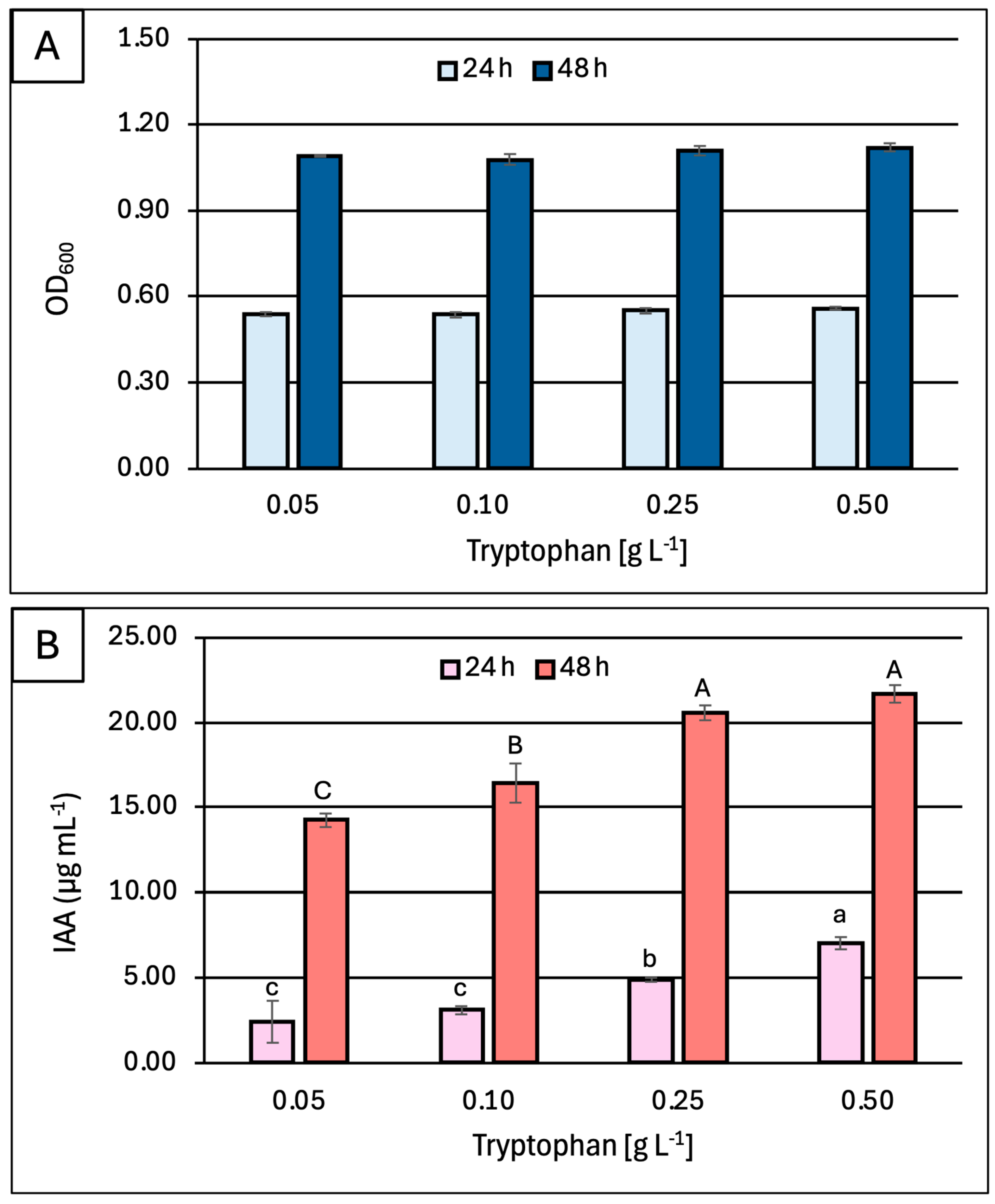
3.1. Optimal Tryptophan Concentration
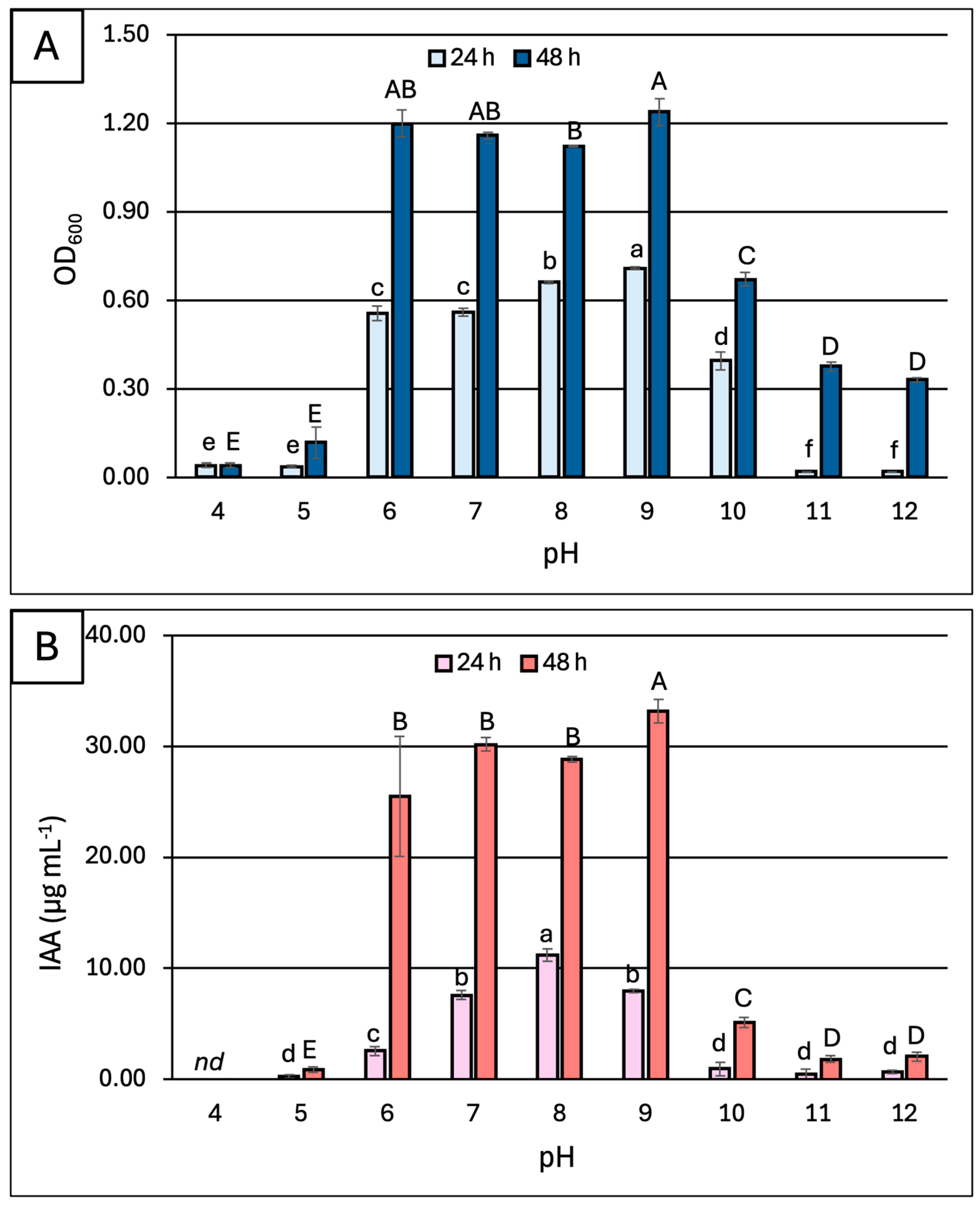
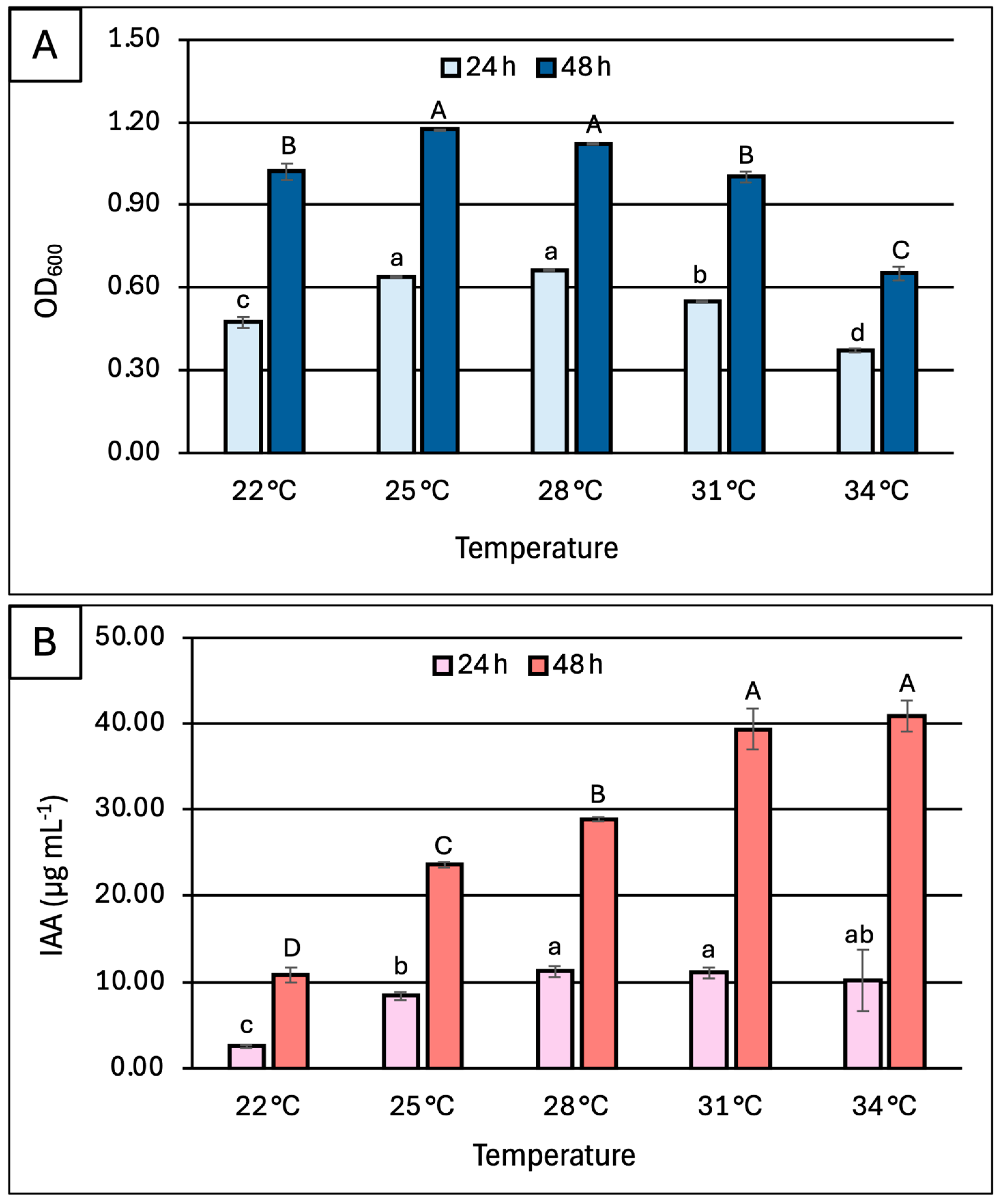
3.2. Effect of Temperature and pH
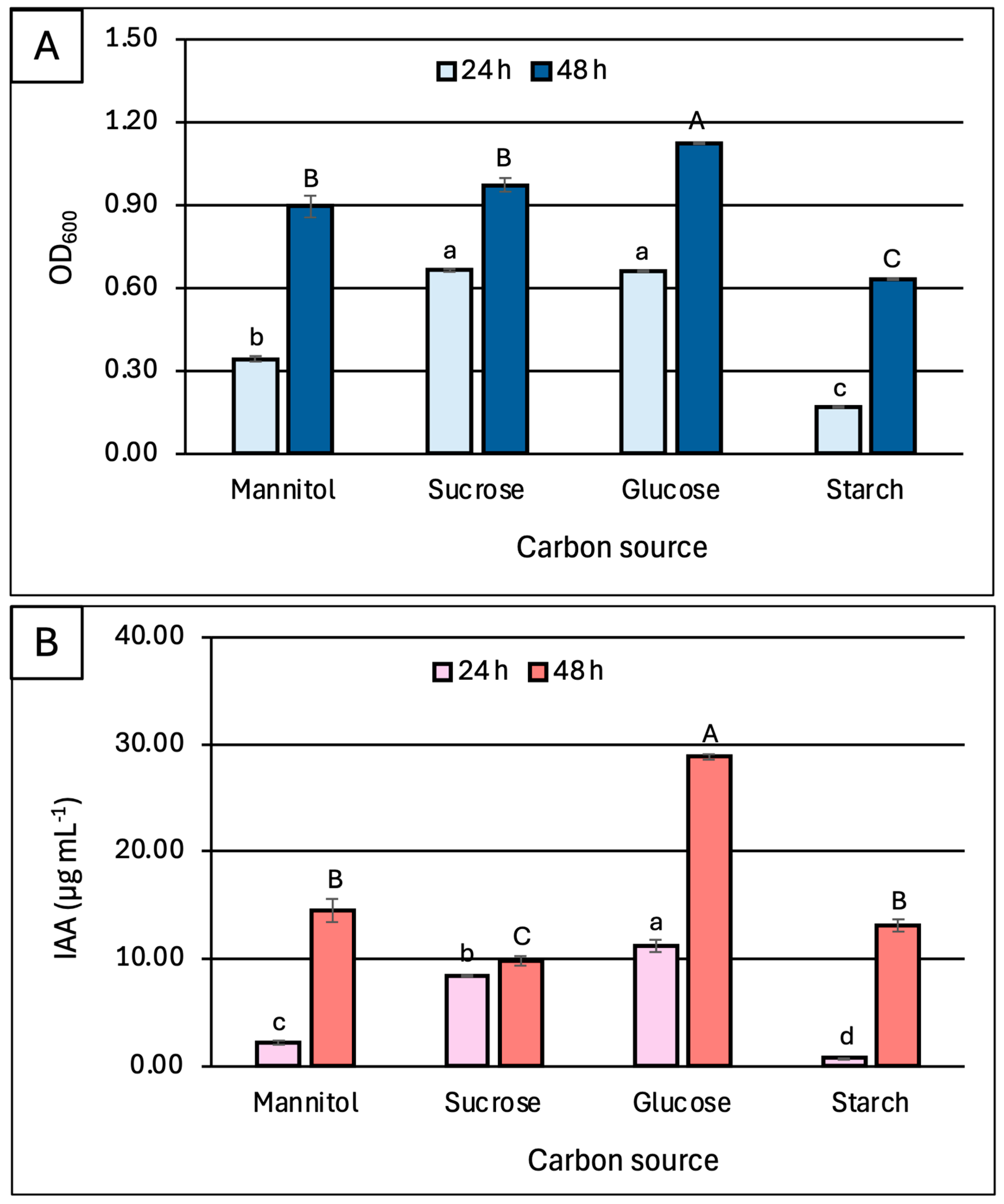
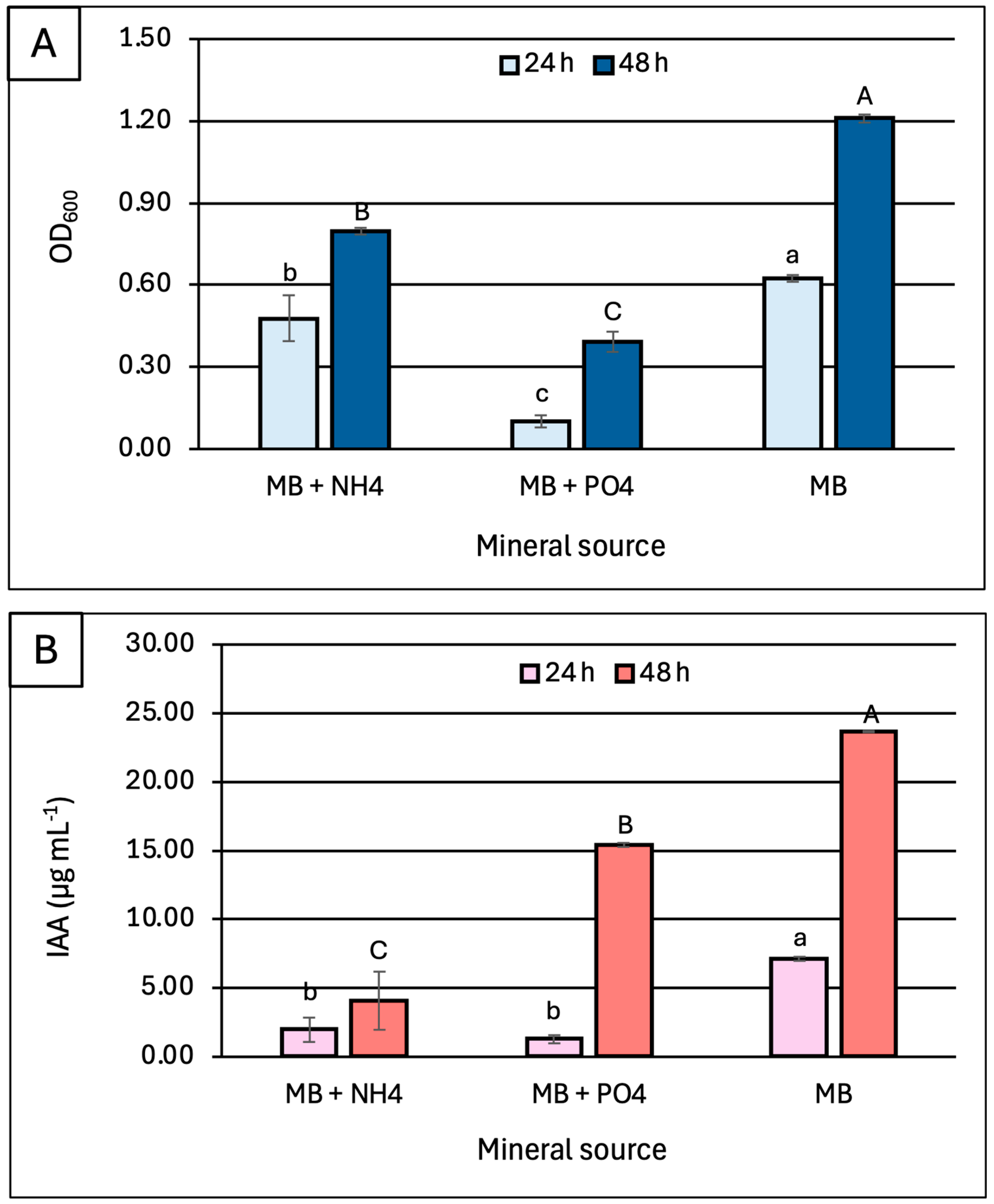
3.3. Effect of Carbon and Inorganic Nitrogen and Phosphorus Sources
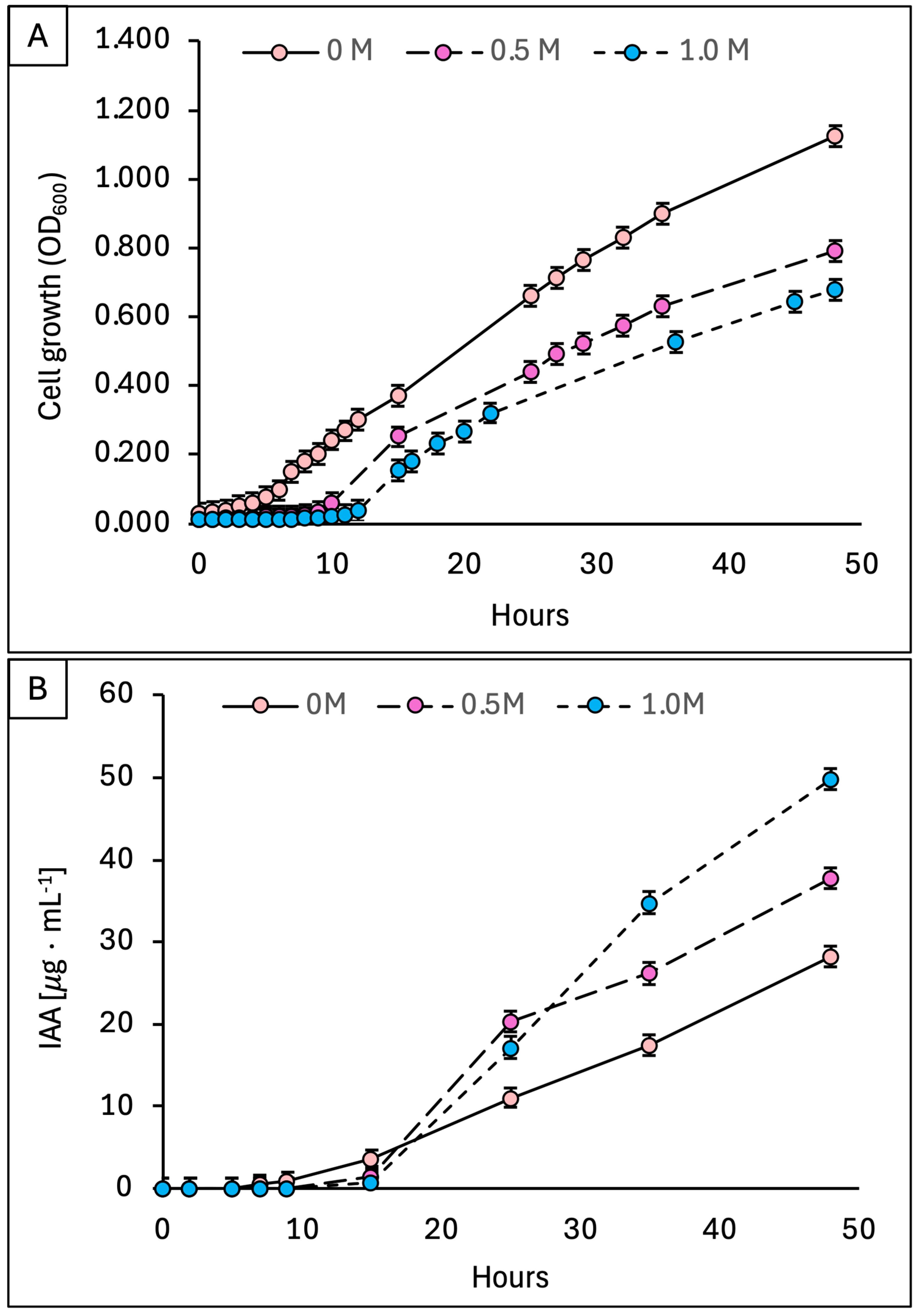
3.4. Effect of NaCl Concentration
3.5. Alternative Growth Media
3.6. Economic Assessment
4. Discussion
5. Conclusions
Supplementary Materials
Author Contributions
Funding
Institutional Review Board Statement
Informed Consent Statement
Data Availability Statement
Acknowledgments
Conflicts of Interest
References
- Pahalvi, H.N.; Rafiya, L.; Rashid, S.; Nisar, B.; Kamili, A.N. Chemical Fertilizers and Their Impact on Soil Health. In Microbiota and Biofertilizers, Vol 2: Ecofriendly Tools for Reclamation of Degraded Soil Environs; Springer: Berlin/Heidelberg, Germany, 2021; pp. 1–20. [Google Scholar]
- Larramendy, M.L.; Soloneski, S. Soil Contamination: Threats and Sustainable Solutions; BoD—Books on Demand: Norderstedt, Germany, 2021. [Google Scholar]
- Shahwar, D.; Mushtaq, Z.; Mushtaq, H.; Alqarawi, A.A.; Park, Y.; Alshahrani, T.S.; Faizan, S. Role of Microbial Inoculants as Bio Fertilizers for Improving Crop Productivity: A Review. Heliyon 2023, 9, e16134. [Google Scholar] [CrossRef]
- Santoyo, G.; Urtis-Flores, C.A.; Loeza-Lara, P.D.; Orozco-Mosqueda, M.D.C.; Glick, B.R. Rhizosphere Colonization Determinants by Plant Growth-Promoting Rhizobacteria (PGPR). Biology 2021, 10, 475. [Google Scholar] [CrossRef]
- Takatsuka, H.; Umeda, M. Hormonal Control of Cell Division and Elongation along Differentiation Trajectories in Roots. J. Exp. Bot. 2014, 65, 2633–2643. [Google Scholar] [CrossRef]
- Spaepen, S.; Vanderleyden, J.; Remans, R. Indole-3-Acetic Acid in Microbial and Microorganism-Plant Signaling. FEMS Microbiol. Rev. 2007, 31, 425–448. [Google Scholar] [CrossRef]
- Duca, D.; Lorv, J.; Patten, C.L.; Rose, D.; Glick, B.R. Indole-3-Acetic Acid in Plant–Microbe Interactions. Antonie Van Leeuwenhoek 2014, 106, 85–125. [Google Scholar] [CrossRef] [PubMed]
- Khalid, A.; Tahir, S.; Arshad, M.; Zahir, Z.A. Relative Efficiency of Rhizobacteria for Auxin Biosynthesis in Rhizosphere and Non-Rhizosphere Soils. Aust. J. Soil Res. 2004, 42, 921–926. [Google Scholar] [CrossRef]
- Duca, D.R.; Glick, B.R. Indole-3-Acetic Acid Biosynthesis and Its Regulation in Plant-Associated Bacteria. Appl. Microbiol. Biotechnol. 2020, 104, 8607–8619. [Google Scholar] [CrossRef]
- Naveed, M.; Qureshi, M.A.; Zahir, Z.A.; Hussain, M.B.; Sessitsch, A.; Mitter, B. L-Tryptophan-Dependent Biosynthesis of Indole-3-Acetic Acid (IAA) Improves Plant Growth and Colonization of Maize by Burkholderia phytofirmans PsJN. Ann. Microbiol. 2015, 65, 1381–1389. [Google Scholar] [CrossRef]
- Vaghela, N.R.; Jotaniya, V.B.; Gohel, S.D. A Review on Enhancing Crop Resilience in Adverse Environmental Conditions: Unveiling the Action Between Plant Growth-Promoting Rhizobacteria and Crops. Microbe 2025, 10, 100651. [Google Scholar] [CrossRef]
- Kaya, C. Microbial Modulation of Hormone Signaling, Proteomic Dynamics, and Metabolomics in Plant Drought Adaptation. Food Energy Secur. 2024, 13, e513. [Google Scholar] [CrossRef]
- Melini, F.; Luziatelli, F.; Bonini, P.; Ficca, A.G.; Melini, V.; Ruzzi, M. Optimization of the Growth Conditions through Response Surface Methodology and Metabolomics for Maximizing the Auxin Production by Pantoea agglomerans C1. Front. Microbiol. 2023, 14, 1022248. [Google Scholar] [CrossRef] [PubMed]
- Zhang, B.-X.; Li, P.-S.; Wang, Y.-Y.; Wang, J.-J.; Liu, X.-L.; Wang, X.-Y.; Hu, X.-M. Characterization and Synthesis of Indole-3-Acetic Acid in Plant Growth Promoting Enterobacter sp. RSC Adv. 2021, 11, 31601–31607. [Google Scholar] [CrossRef] [PubMed]
- Margesin, R.; Schinner, F. Potential of Halotolerant and Halophilic Microorganisms for Biotechnology. Extremophiles 2001, 5, 73–83. [Google Scholar] [CrossRef] [PubMed]
- Oliva, G.; Di Stasio, L.; Vigliotta, G.; Guarino, F.; Cicatelli, A.; Castiglione, S. Exploring the Potential of Four Novel Halotolerant Bacterial Strains as Plant-Growth-Promoting Rhizobacteria (PGPR) under Saline Conditions. Appl. Sci. 2023, 13, 4320. [Google Scholar] [CrossRef]
- Sánchez-Porro, C.; Kaur, B.; Mann, H.; Ventosa, A. Halomonas titanicae sp. nov., a Halophilic Bacterium Isolated from the RMS Titanic. Int. J. Syst. Evol. Microbiol. 2010, 60, 2768–2774. [Google Scholar] [CrossRef]
- Castiglione, S.; Oliva, G.; Vigliotta, G.; Novello, G.; Gamalero, E.; Lingua, G.; Cicatelli, A.; Guarino, F. Effects of Compost Amendment on Glycophyte and Halophyte Crops Grown on Saline Soils: Isolation and Characterization of Rhizobacteria with Plant Growth Promoting Features and High Salt Resistance. Appl. Sci. 2021, 11, 2125. [Google Scholar] [CrossRef]
- Jahanian, A.; Ramirez, J.; O’Hara, I. Advancing Precision Fermentation: Minimizing Power Demand of Industrial Scale Bioreactors through Mechanistic Modelling. Comput. Chem. Eng. 2024, 188, 108755. [Google Scholar] [CrossRef]
- Dhankhar, N.; Kumar, J. Impact of Increasing Pesticides and Fertilizers on Human Health: A Review. Mater. Today Proc. 2023, in press. [Google Scholar] [CrossRef]
- Suárez Pérez, P. Bacterial Gene Diversity Related to Tryptophan Metabolism and Indole-3-Acetic Acid (IAA) Production in the Rhizosphere. Ph.D. Thesis, University of Granada, Granada, Spain, 2020. [Google Scholar]
- Zhang, M.; Gao, C.; Xu, L.; Niu, H.; Liu, Q.; Huang, Y.; Lv, G.; Yang, H.; Li, M. Melatonin and Indole-3-Acetic Acid Synergistically Regulate Plant Growth and Stress Resistance. Cells 2022, 11, 3250. [Google Scholar] [CrossRef]
- Gomes, G.L.B.; Scortecci, K.C. Auxin and Its Role in Plant Development: Structure, Signalling, Regulation and Response Mechanisms. Plant Biol. 2021, 23, 894–904. [Google Scholar] [CrossRef]
- Sasirekha, B.; Shivakumar, S. Statistical Optimization for Improved Indole-3-Acetic Acid (Iaa) Production by Pseudomonas Aeruginosa and Demonstration of Enhanced Plant Growth Promotion. J. Soil Sci. Plant Nutr. 2012, 12, 863–873. [Google Scholar] [CrossRef]
- Bharucha, U.; Patel, K.; Trivedi, U.B. Optimization of Indole Acetic Acid Production by Pseudomonas Putida UB1 and Its Effect as Plant Growth-Promoting Rhizobacteria on Mustard (Brassica nigra). Agric. Res. 2013, 2, 215–221. [Google Scholar] [CrossRef]
- Ham, S.; Yoon, H.; Park, J.-M.; Park, Y.G. Optimization of Fermentation Medium for Indole Acetic Acid Production by Pseudarthrobacter sp. NIBRBAC000502770. Appl. Biochem. Biotechnol. 2021, 193, 2567–2579. [Google Scholar] [CrossRef]
- Sun, P.-F.; Fang, W.-T.; Shin, L.-Y.; Wei, J.-Y.; Fu, S.-F.; Chou, J.-Y. Indole-3-Acetic Acid-Producing Yeasts in the Phyllosphere of the Carnivorous Plant Drosera indica L. PLoS ONE 2014, 9, e114196. [Google Scholar] [CrossRef]
- Scarcella, A.S.D.A.; Bizarria, R.; Bastos, R.G.; Magri, M.M.R. Temperature, pH and Carbon Source Affect Drastically Indole Acetic Acid Production of Plant Growth Promoting Yeasts. Braz. J. Chem. Eng. 2017, 34, 429–438. [Google Scholar] [CrossRef]
- Baliyan, N.; Dhiman, S.; Dheeman, S.; Kumar, S.; Maheshwari, D.K. Optimization of Indole-3-Acetic Acid Using Response Surface Methodology and Its Effect on Vegetative Growth of Chickpea. Rhizosphere 2021, 17, 100321. [Google Scholar] [CrossRef]
- Veerasamy, P.L.; Zakry, F.A.A.; King, W.S.; Kasim, S.; Malahubban, M. Indole-3-Acetic Acid Production by Rhizobacteria bacillus spp. to Various Abiotic Stress Factors. J. Phytol. 2021, 13, 85–90. [Google Scholar] [CrossRef]
- Ait Bessai, S.; Bensidhoum, L.; Nabti, E. Optimization of IAA Production by Telluric Bacteria Isolated from Northern Algeria. Biocatal. Agric. Biotechnol. 2022, 41, 102319. [Google Scholar] [CrossRef]
- Wandira, T.A.; Aisyah, S.N.; Oktavioni, M.; Fatiah, R.; Jamsari, J. Different pH Levels Medium Effects in IAA Production of Phylloplane Bacterium Serratia Plymuthica Strain UBCF_13. IOP Conf. Ser. Earth Environ. Sci. 2021, 741, 012003. [Google Scholar] [CrossRef]
- Cheng, B.; Meng, Y.; Cui, Y.; Li, C.; Tao, F.; Yin, H.; Yang, C.; Xu, P. Alkaline Response of a Halotolerant Alkaliphilic Halomonas Strain and Functional Diversity of Its Na+(K+)/H+ Antiporters. J. Biol. Chem. 2016, 291, 26056–26065. [Google Scholar] [CrossRef]
- Bhutani, N.; Maheshwari, R.; Negi, M.; Suneja, P. Optimization of IAA Production by Endophytic bacillus spp. from Vigna Radiata for Their Potential Use as Plant Growth Promoters. Isr. J. Plant Sci. 2018, 65, 83–96. [Google Scholar] [CrossRef]
- Mohite, B. Isolation and Characterization of Indole Acetic Acid (IAA) Producing Bacteria from Rhizospheric Soil and Its Effect on Plant Growth. J. Soil Sci. Plant Nutr. 2013, 13, 638–649. [Google Scholar] [CrossRef]
- Chandra, S.; Askari, K.; Kumari, M. Optimization of Indole Acetic Acid Production by Isolated Bacteria from Stevia rebaudiana Rhizosphere and Its Effects on Plant Growth. J. Genet. Eng. Biotechnol. 2018, 16, 581–586. [Google Scholar] [CrossRef]
- Bianco, C.; Defez, R. Improvement of Phosphate Solubilization and Medicago Plant Yield by an Indole-3-Acetic Acid-Overproducing Strain of Sinorhizobium meliloti. Appl. Environ. Microbiol. 2010, 76, 4626–4632. [Google Scholar] [CrossRef]
- Alemneh, A.A.; Cawthray, G.R.; Zhou, Y.; Ryder, M.H.; Denton, M.D. Ability to Produce Indole Acetic Acid Is Associated with Improved Phosphate Solubilising Activity of Rhizobacteria. Arch. Microbiol. 2021, 203, 3825–3837. [Google Scholar] [CrossRef] [PubMed]
- Castaldi, S.; Valkov, V.T.; Ricca, E.; Chiurazzi, M.; Isticato, R. Use of Halotolerant Bacillus amyloliquefaciens RHF6 as a Bio-Based Strategy for Alleviating Salinity Stress in Lotus japonicus cv Gifu. Microbiol. Res. 2023, 268, 127274. [Google Scholar] [CrossRef]
- Lebrazi, S.; Niehaus, K.; Bednarz, H.; Fadil, M.; Chraibi, M.; Fikri-Benbrahim, K. Screening and Optimization of Indole-3-Acetic Acid Production and Phosphate Solubilization by Rhizobacterial Strains Isolated from Acacia Cyanophylla Root Nodules and Their Effects on Its Plant Growth. J. Genet. Eng. Biotechnol. 2020, 18, 71. [Google Scholar] [CrossRef]
- Sharma, S.; Kumar, A.; Oberoi, D.; Ghosh, S.; Majhi, J.; Priya, K.; Bandyopadhyay, A. A Review on Diverse Applications of Electrochemically Active Functional Metallopolymers. React. Funct. Polym. 2023, 193, 105742. [Google Scholar] [CrossRef]
- Yousef, N.M.H. Capability of Plant Growth-Promoting Rhizobacteria (Pgpr) For Producing Indole Acetic Acid (Iaa) Under Extreme Conditions. Eur. J. Biol. Res. 2018, 8, 174–182. [Google Scholar] [CrossRef]
- Cai, G.; Li, J.; Zhou, M.; Zhu, G.; Li, Y.; Lv, N.; Wang, R.; Li, C.; Pan, X. Compost-Derived Indole-3-Acetic-Acid-Producing Bacteria and Their Effects on Enhancing the Secondary Fermentation of a Swine Manure-Corn Stalk Composting. Chemosphere 2022, 291, 132750. [Google Scholar] [CrossRef]
- Liu, J.; Zhao, X.; Niu, Y.; Ren, Y.; Wang, M.; Han, B.; Wang, C.; Ma, H. Plant Growth-Promoting Rhizobacteria Halomonas Alkaliantarcticae M23 Promotes the Salt Tolerance of Maize by Increasing the K+/Na+ Ratio, Antioxidant Levels, and ABA Levels and Changing the Rhizosphere Bacterial Community. BMC Plant Biol. 2025, 25, 727. [Google Scholar] [CrossRef] [PubMed]
- Mousa, A.A.A.; Mahmoud, W.H.; Elsaied, H.E.; Elbeltagy, A.E. Halomonas sp for Sustainable Agriculture a Potential Halo Bio Fertilizer for Tomato Plants with Biocontrol Activity against Fusarium Wilt under Saline Environments. Sci. Rep. 2025, 15, 30748. [Google Scholar] [CrossRef]
- Liang, Z.-P.; Wang, Y.; Chen, X.-Y.; Wang, R.; Xu, Y.; Dai, J.-P.; Singh, D.; Zhang, X.-X. Halomonas kashgarensis sp. nov., a Novel Species Isolated from the Rhizosphere Soil of Phragmites australis (Cav.) Trin. Ex Steud in Kashgar County, Xinjiang, China. Diversity 2025, 17, 98. [Google Scholar] [CrossRef]
- Desale, P.; Patel, B.; Singh, S.; Malhotra, A.; Nawani, N. Plant Growth Promoting Properties of Halobacillus sp. and Halomonas sp. in Presence of Salinity and Heavy Metals. J. Basic Microbiol. 2014, 54, 781–791. [Google Scholar] [CrossRef]
- Bessai, S.A.; Cruz, J.; Carril, P.; Melo, J.; Santana, M.M.; Mouazen, A.M.; Cruz, C.; Yadav, A.N.; Dias, T.; Nabti, E.; et al. The Plant Growth-Promoting Potential of Halotolerant Bacteria Is Not Phylogenetically Determined: Evidence from Two Bacillus Megaterium Strains Isolated from Saline Soils Used to Grow Wheat. Microorganisms 2023, 11, 1687. [Google Scholar] [CrossRef]
- Sharma, S.; Kulkarni, J.; Jha, B. Halotolerant Rhizobacteria Promote Growth and Enhance Salinity Tolerance in Peanut. Front. Microbiol. 2016, 7, 1600. [Google Scholar] [CrossRef] [PubMed]
- Azeem, M.A.; Shah, F.H.; Ullah, A.; Ali, K.; Jones, D.A.; Khan, M.E.H.; Ashraf, A. Biochemical Characterization of Halotolerant Bacillus Safensis PM22 and Its Potential to Enhance Growth of Maize under Salinity Stress. Plants 2022, 11, 1721. [Google Scholar] [CrossRef] [PubMed]




| UHPLC system: Nexera XR | |
| Column | Shim-pack GIST-HP C18 (100 × 2.1 mm I.D., 2 μm) |
| Detection | PDA, 190–800 nm |
| Column temperature | 40 °C |
| Injection volume | 5 μL |
| Mobile phases | A (0.1% formic acid in water): B (methanol)=30:70 |
| Flow rate | 0.30 mL/min |
| Elution mode | Isocratic |
| Mass spectrometer: LCMS-2050 (ESI positive-ion mode) | |
| Acquisition mode | SIM (selected-ion monitoring) |
| Interface voltage | 2.0 kV |
| Nebulizing gas | 3 L/min |
| Drying gas | 7 L/min |
| Heating gas | 5 L/min |
| Desolvation line temperature | 200 °C |
| Desolvation temperature | 450 °C |
| Medium | pH | E.C. (uS⋅cm−2) | OD600 | IAA (μg⋅mL−1) |
|---|---|---|---|---|
| LB (Lennox) * | 7.2 | 9000 | 1.71 ± 0.01 | 3.26 ± 0.92 |
| Dairy whey | 4.94 | 10,870 | 0.05 ± 0.01 | 11.30 ± 4.26 |
| Dairy whey * | 4.94 | 10,870 | 0.10 ± 0.04 | 15.68 ± 2.42 |
| Seawater ** | 7.2 | 68,000 | 0.13 ± 0.01 | 24.57 ± 11.28 |
| Medium | IAA Yield (mg L−1) | Incubation Time (h) | Medium Requirement (L) for 1.0 g IAA | Medium Cost (EUR g−1) | Trp Cost (EUR g−1) | Glucose Cost (EUR g−1) | Energy Cost (EUR g−1) | Total Cost (EUR g−1 IAA) |
|---|---|---|---|---|---|---|---|---|
| Marine Broth (MB) | 49.88 | 48 | 20.05 | 135.32 | 0.07 | 0.01 | 0.10 | 135.50 |
| Dairy whey | 11.30 | 48 | 88.50 | 0 | 0 | 0 | 0.43 | 0.43 |
| Dairy whey * | 15.68 | 48 | 63.78 | 0 | 0.23 | 0 | 0.31 | 0.54 |
| Seawater ** | 24.57 | 144 | 40.70 | 0 | 0.15 | 0.03 | 0.59 | 0.78 |
| Bacterial Strain | Culture Medium | L-trp [g L−1] | NaCl | Incubation Time | IAA Quantification Method | IAA [μg mL−1] | Reference |
|---|---|---|---|---|---|---|---|
| V. titanicae QH24 | MB | 0.5 | 1.0 M | 48 h | Salkowsky | 49.9 ± 0.5 | This study * |
| H. acquamarina | na | na | na | na | Salkowsky | 9.0 | [43] |
| H. alkaliantarcticae | Nutrient broth | 0.1 | 1% | 48 h | Salkowsky | 30.0 ± 1.5 | [44] |
| Halomonas sp. QSLA2 | Nutrient agar | 10.0 | 0% | 7 days | Salkowsky | 15.45 ± 0.91 | [45] |
| H. kashgarensis | LB | na | 7.5% | 11 days | Salkowsky | 57.15 | [46] |
| Halomonas sp. MAN5 | Basal medium | 2.5 | 9.0% | 7 days | Gordon & Weber | 144.5 | [47] |
| B. megaterium S3 | LB | 0.5 | 0.3 M | 4 days | Gordon & Weber | 70.0 | [48] |
| P. fluorescens S1 | LB | 0.5 | 0.3 M | 4 days | Gordon & Weber | 37.0 | [48] |
| A. tumefaciens | N-free NFb | 0.5 | 4.0% | 48 h | Salkowsky | 16.9 ± 0.1 | [49] |
| B. safensis | LB | 1.0 | 0% | 7 days | Salkowsky | 116.5 ± 0.1 | [50] |
| Cultivation Medium | Resource Input | Advantages | Main Limitations |
|---|---|---|---|
| Marine Broth (MB) | Synthetic medium, tryptophan, freshwater | Greater IAA yield (laboratory benchmark) | High medium cost |
| Dairy whey | Agro-industrial by-product only | Minimal inputs, resource efficiency, minimal costs | Limited IAA yield |
| Dairy whey * | Agro-industrial by-product, tryptophan | By-product valorization, reduced medium cost | Limited IAA yield |
| Seawater ** | Seawater, glucose, tryptophan | Freshwater saving, no synthetic salt addition | Long cultivation time, lower IAA production |
Disclaimer/Publisher’s Note: The statements, opinions and data contained in all publications are solely those of the individual author(s) and contributor(s) and not of MDPI and/or the editor(s). MDPI and/or the editor(s) disclaim responsibility for any injury to people or property resulting from any ideas, methods, instructions or products referred to in the content. |
© 2026 by the authors. Licensee MDPI, Basel, Switzerland. This article is an open access article distributed under the terms and conditions of the Creative Commons Attribution (CC BY) license.
Share and Cite
Oliva, G.; Iannece, P.; Castiglione, S.; Vigliotta, G. Insights into IAA Production by the Halotolerant Bacterium Vreelandella titanicae. Fermentation 2026, 12, 68. https://doi.org/10.3390/fermentation12020068
Oliva G, Iannece P, Castiglione S, Vigliotta G. Insights into IAA Production by the Halotolerant Bacterium Vreelandella titanicae. Fermentation. 2026; 12(2):68. https://doi.org/10.3390/fermentation12020068
Chicago/Turabian StyleOliva, Gianmaria, Patrizia Iannece, Stefano Castiglione, and Giovanni Vigliotta. 2026. "Insights into IAA Production by the Halotolerant Bacterium Vreelandella titanicae" Fermentation 12, no. 2: 68. https://doi.org/10.3390/fermentation12020068
APA StyleOliva, G., Iannece, P., Castiglione, S., & Vigliotta, G. (2026). Insights into IAA Production by the Halotolerant Bacterium Vreelandella titanicae. Fermentation, 12(2), 68. https://doi.org/10.3390/fermentation12020068