Article

Insights into the Influence of Workshop Spatial Heterogeneity on the Quality and Flavor of Strong-Flavor Daqu from a Microbial Community Perspective


1
College of Biological Engineering, Sichuan University of Science and Engineering, 188 University Town, Yibin 644005, China
2
Wuliangye Yibin Co., Ltd., Yibin 644000, China
3
Key Laboratory for Biorheological Science and Technology, Ministry of Education, College of Bioengineering, Chongqing University, Chongqing 400044, China
*
Authors to whom correspondence should be addressed.
Fermentation 2026, 12(2), 67; https://doi.org/10.3390/fermentation12020067
Submission received: 18 December 2025 / Revised: 15 January 2026 / Accepted: 21 January 2026 / Published: 23 January 2026
(This article belongs to the Special Issue Advances in Fermented Foods and Beverages)

Abstract

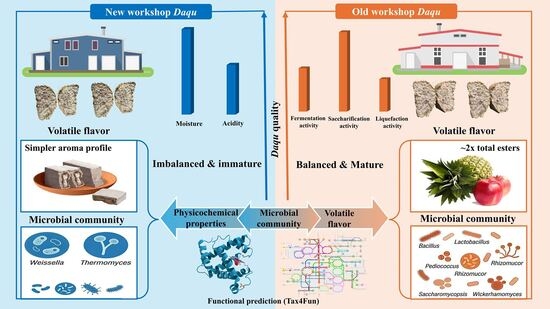
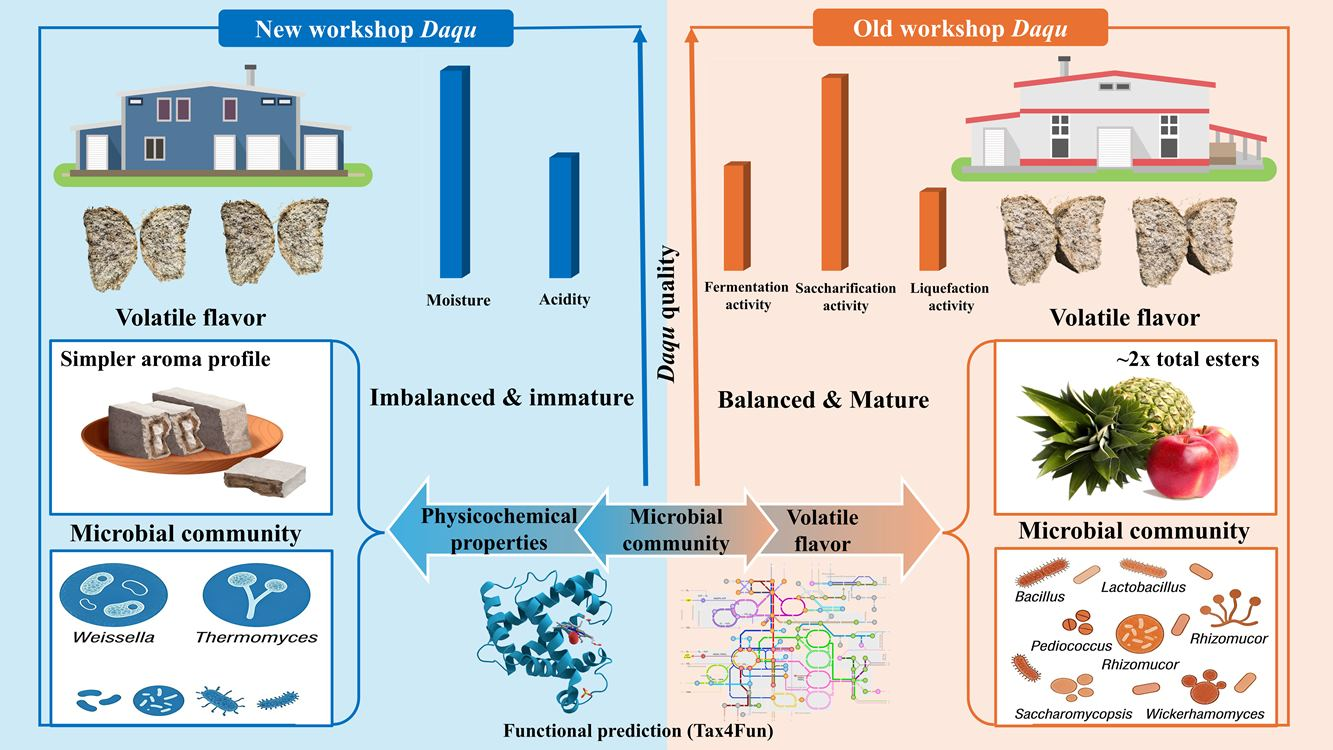
Daqu is the core saccharifying and fermenting starter for strong-flavor Baijiu, and its quality is strongly shaped by the workshop microenvironment. Here, mature Daqu from a newly built workshop and a long-established workshop within the same distillery were compared under identical raw materials and process conditions. Physicochemical properties, volatile flavor compounds (HS-SPME-GC–MS), bacterial and fungal communities (16S/ITS sequencing), and Tax4Fun-predicted functions were jointly analyzed. The quality indicators of the Daqu in the new workshop are qualified, but the acidity (and moisture) is higher, and the fermentation, saccharification and liquefaction abilities are lower. The Daqu in the old workshop is rich in esters, the aroma is more mature, and the total ester content is about twice that of the new workshop. Both Daqu types shared similar core taxa, but the new workshop was dominated by a simpler Weissella–Thermomyces consortium, while the old workshop was enriched in Bacillus, lactic acid bacteria, Rhizomucor, Saccharomycopsis, and Wickerhamomyces. Correlation and network analyses linked these old-workshop core genera to key ethyl esters, higher alcohols and pyrazines, and Tax4Fun indicated a stronger bias toward amino acid/carbohydrate metabolism and membrane transport in the old workshop. These results show that workshop age reshapes Daqu quality by co-modulating physicochemical traits, microbial consortia and functional potential, and suggest microbial and functional targets for accelerating the “maturation” of new workshops.

Graphical Abstract

1. Introduction

Chinese Baijiu is one of the oldest and most consumed distilled spirits in the world, and strong-flavor Baijiu accounts for the largest proportion of production and market share in China [1,2]. Strong-flavor Baijiu is usually made from sorghum alone or from a blend of grains, such as sorghum, rice, glutinous rice, wheat, and corn [3]. Daqu, produced by spontaneous solid-state fermentation of steamed grains, is the core saccharifying, fermenting and aroma-generating starter for Baijiu [4]. It provides complex enzyme systems, diverse microbial consortia and key flavor precursors that jointly determine ethanol yield and sensory quality [5]. The quality of Daqu is traditionally assessed by physicochemical indices such as moisture, acidity and saccharification, liquefaction and fermentation activities, together with sensory evaluation, but accumulating evidence shows that these indices essentially reflect the activity and structure of the underlying microbial community [1,6].
The advancement of high-throughput sequencing and chromatography–mass spectrometry has enabled integrated characterization of Daqu microbiota and volatile profiles across different temperature types, regions and production modes. Bacterial and fungal succession, physicochemical properties and volatile flavor formation have been described for different temperature types and regional strong-flavor Daqu, revealing that genera such as Bacillus, Lactobacillus, Rhizomucor, Wickerhamomyces, and Thermomyces are closely associated with enzyme production and key aroma compounds [7,8]. For example, Mu et al. compared artificial and mechanical Daqu and reported that production mode significantly affected Daqu acidity, enzyme activities, volatile compounds, and microbial structure, underscoring the tight coupling between processing conditions, microbiota and functionality [9]. Comparative studies among Daqu from different regions or grades further indicate that esters are usually the dominant volatiles and that regional or process “signatures” in flavor can be linked to specific microbial assemblages and physicochemical profiles [10,11].
At the same time, the Baijiu workshop has been recognized as an important ecological niche that seeds and shapes the fermentation microbiota [12]. Environmental microbiota in air, tools, floors, and cellar walls contribute substantially to the microbial communities of Daqu, fermented grains and pit mud, and workshop-level differences in temperature, humidity and ventilation can significantly affect microbial succession and flavor formation [10]. Li et al. collected environmental samples from three strong-flavor Baijiu workshops with different usage times (70-year, 30-year, and new) and showed that workshops of different ages harbor distinct airborne and surface communities that are transmitted to Daqu and fermented grains [13]. Xu et al. further demonstrated that environmental microbiota across three distinct-age workshops strongly influenced microbial succession and metabolic profiles of fermented grains, providing quantitative support for the empirical view that “high-quality Baijiu comes from old workshops” [14]. However, most available evidence has focused on environmental reservoirs and fermented grains, and a systematic, workshop-level comparison of mature Daqu integrating physicochemical quality, volatile profiles, bacterial and fungal communities, and inferred functional potential remains limited [15,16].
Therefore, an important knowledge gap remains: how workshop age-associated micro-environments are reflected in the integrated “physicochemical–volatile–microbiota” characteristics of mature Daqu, and whether workshop-specific community structures are associated (correlatively) with key quality indices and representative aroma compound patterns. Although tools such as Tax4Fun can infer KEGG-based functional profiles from 16S rRNA gene data and have been widely used to estimate functional potential in microbial ecology [17,18], they have rarely been jointly interpreted with Daqu quality indices and microbe–flavor association analyses in a controlled, within-distillery comparison.
In this work, we investigated mature strong-flavor Daqu produced in a newly built workshop and in a long-established workshop within the same distillery, under identical raw materials and process specifications. Based on an integrated analysis of physicochemical properties, volatile flavor compounds, bacterial and fungal community structures and Tax4Fun-predicted functions, this study aimed to (1) clarify how workshop age and its associated micro-environment are reflected in the physicochemical and aroma characteristics of mature Daqu; (2) identify core bacterial and fungal genera and their correlation patterns with key quality indices and flavor categories; and (3) infer functional tendencies and metabolic modules that may underpin these differences. By coupling “physicochemical–flavor–microbiota–function” across two workshops with distinct operation histories, our work provides new insight into how workshop heterogeneity shapes Daqu quality and suggests concrete microbial consortia and functional targets that could be leveraged to accelerate the “maturation” of new workshops and to guide ecological regulation in traditional solid-state Baijiu fermentation.

2. Materials and Methods

2.1. Sample Collection

Strong-flavor Daqu used in this study was collected from a strong-flavor Baijiu distillery in Yibin, Sichuan Province, China (28.79° N, 104.59° E). Within the same Daqu production base, a newly built workshop that had been in operation for approximately 2 months was defined as the new workshop (N), and a long-established workshop that had been continuously operated for about 20 years was defined as the old workshop (O). According to the distillery’s standardized production requirements, both workshops used the same raw material (wheat) from the same supplier, and all pretreatment steps and processing parameters were identical between workshops. Ineach workshop, mature Daqu bricks at the end of the standard fermentation and maturation period were sampled from five independent fermentation batches using a five-point sampling method. Bricks collected from each batch were crushed, thoroughly homogenized and combined to obtain one composite sample, yielding five composite samples per workshop (A1–A5 for N, B1–B5 for O, total n = 10). Each composite sample was immediately divided into two portions: one was stored at −80 °C for DNA extraction and subsequent high-throughput sequencing and functional prediction, and the other was stored at −20 °C for determinations of physicochemical indices and volatile flavor compounds.

2.2. Detection of Physicochemical Indexes

Daqu powders were prepared by crushing finished bricks, sieving (20-mesh) and homogenizing. Moisture was determined gravimetrically by drying to constant mass at 105 °C, and total titratable acidity was measured by direct titration of aqueous extracts with 0.1 mol/L NaOH to an endpoint of pH 8.2 (QB/T 4257-2011 “General Analysis Method of Liquor-making Daqu” [19]. QB/T 4257-2011 is a Chinese light-industry standard that specifies general analytical methods for Daqu quality evaluation, including moisture, acidity and enzymatic activities). Fermentation power, saccharification power and liquefaction power were determined following QB/T 4257-2011 as previously described. Specifically, fermentation power was expressed as the mass of CO2 released from fermentable sugars by 0.5 g Daqu incubated at 30 °C for 72 h; saccharification power was defined as the amount of glucose produced from soluble starch by 1 g Daqu at 35 °C and pH 4.6 within 1 h; and liquefaction power was defined as the amount of starch liquefied by 1 g absolute-dry Daqu within 1 h. All determinations were performed in triplicate.

2.3. High Throughput Sequencing

Total microbial DNA was extracted from homogenized Daqu samples using the FastDNA Spin Kit (MP Biomedicals, Irvine, CA, USA) according to the manufacturer’s instructions. DNA integrity was checked by 1.0% agarose gel electrophoresis, and DNA concentration was quantified using a Qubit 2.0 fluorometer (Thermo Fisher Scientific, Waltham, MA, USA). All DNA samples were diluted to approximately 1 ng/µL with sterile nuclease-free water prior to PCR amplification.
Bacterial communities were characterized by amplifying the V3–V4 region of the 16S rRNA gene with primers 338F (5′-ACTCCTACGGGAGGCAGCAG-3′) and 806R (5′-GGACTACHVGGGTWTCTAAT-3′). Fungal communities were analyzed by amplifying the ITS1 region using primers ITS1F (5′-CTTGGTCATTTAGAGGAAGTAA-3′) and ITS2R (5′-GCTGCGTTCTTCATCGATGC-3′). Each PCR reaction (25 µL) contained 1× high-fidelity PCR buffer, 2.5 mM MgCl2, 0.2 mM dNTPs, 0.2 µM of each primer, 1 U of TransStart FastPfu DNA Polymerase (TransGen Biotech, Beijing, China), and 1 µL of template DNA. The amplification program consisted of an initial denaturation at 95 °C for 3 min; 35 cycles of 95 °C for 30 s, 55 °C for 30 s and 72 °C for 45 s; and a final extension at 72 °C for 10 min, followed by holding at 10 °C.
PCR products were verified on 2.0% agarose gels, and amplicons of the expected size were excised and purified using a PCR Clean-Up Kit (Yuhua, Zhengzhou, China) following the manufacturer’s protocol. Equimolar amounts of purified amplicons from different samples were pooled to construct sequencing libraries. Paired-end sequencing (2 × 300 bp) was performed on an Illumina MiSeq platform (Illumina, San Diego, CA, USA) by Majorbio Bio-Pharm Technology Co., Ltd. (Shanghai, China).

2.4. Analysis of Flavor Compounds

Volatile flavor compounds in Daqu were determined by headspace solid-phase microextraction coupled with gas chromatography–mass spectrometry (HS-SPME-GC–MS) for Daqu aroma analysis [3]. Briefly, 1.00 g of finely ground Daqu was weighed into a 20 mL headspace vial, and 2.0 mL saturated NaCl solution and 50 µL of 4-octanol internal standard solution were added. After sealing, the vial was equilibrated and extracted using a pre-conditioned SPME fiber at 60 °C, then thermally desorbed in the GC injector. Volatiles were separated on a DB-WAX UI capillary column using high-purity helium as carrier gas and analyzed on an EI-MS detector in full-scan mode. Compound identification was based on comparison of mass spectra with the NIST 20 library, calculation of retention indices relative to C7–C30 n-alkanes [20], and, when available, confirmation with authentic standards, as commonly applied in Daqu flavor studies. Semi-quantitative data were obtained by normalizing peak areas to the internal standard without response-factor correction.

2.5. Bioinformatics Analysis

Raw paired-end reads were first subjected to quality control using fastp (v0.19.6) to remove adaptor sequences, trim low-quality bases and discard reads containing ambiguous bases or shorter than the length threshold [21]. High-quality reads were then merged according to overlapping regions, and only successfully merged, non-chimeric sequences were retained for downstream analyses [22].
For bacterial communities, effective sequences were clustered into operational taxonomic units (OTUs) at 97% sequence similarity using a de novo clustering algorithm. Representative sequences of each OTU were taxonomically assigned using an RDP-like naïve Bayesian classifier against the SILVA SSU rRNA reference database. For fungal communities, sequences were clustered at the same similarity cutoff and annotated against the UNITE ITS reference database. Rarefaction to the minimum sequencing depth was applied to normalize the OTU tables across samples, and sequencing coverage for all samples exceeded 99%, indicating that the sequencing depth was sufficient to capture the majority of bacterial and fungal diversity.
Alpha-diversity indices and beta-diversity based on Bray–Curtis distances were calculated on the normalized OTU tables, and principal coordinate analysis (PCoA) were performed to visualize differences in community structure between the new and old workshops. Taxonomic composition at different levels (phylum, genus) and differential taxa were obtained using the pipelines provided by the commercial analysis platform and cross-checked in R.
To infer the functional potential of bacterial communities, Tax4Fun (v0.3.1) was applied to the 16S rRNA data to predict Kyoto Encyclopedia of Genes and Genomes (KEGG) orthologs (KOs) and pathway-level functional profiles, following the original description of Tax4Fun [17]. The resulting KO and pathway abundance tables were used for subsequent pathway enrichment and correlation analyses.

2.6. Statistical Analysis

Unless otherwise stated, all statistical analyses were performed using Origin 2025 (OriginLab, Northampton, MA, USA), SPSS 26.0 (IBM, Armonk, NY, USA), R 4.3.1 (R Foundation for Statistical Computing, Vienna, Austria) and the Majorbio Cloud Platform (Majorbio Bio-Pharm Technology Co., Ltd., Shanghai, China). Physicochemical indices and representative volatile compounds are expressed as mean ± standard deviation (n = 5). Differences between Daqu from the new (N) and old (O) workshops were evaluated using Student’s t-test after checking for normality and homogeneity of variance; p < 0.05 was considered statistically significant.

3. Results and Discussion

3.1. Analysis of Physicochemical Properties

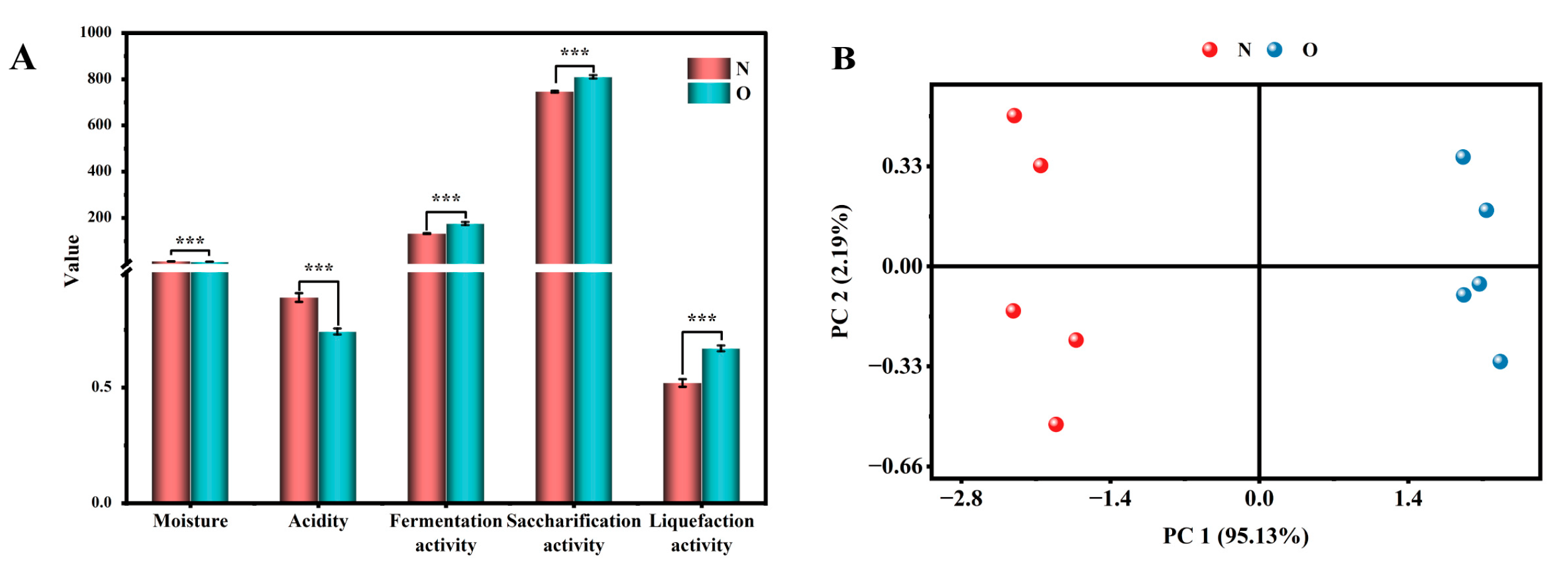
Five key physicochemical indices of Daqu were determined, including moisture, acidity, fermentation activity, saccharification activity, and liquefaction activity. As shown in Figure 1A, clear differences were observed between N-Daqu (A1–A5, new workshop) and O-Daqu (B1–B5, old workshop. On average, O-Daqu had lower moisture and acidity, but higher fermentation activity, saccharification activity and liquefaction activity than N-Daqu (all p < 0.001). Overall, O-Daqu displayed a typical pattern of lower moisture and acidity combined with higher enzymatic activities.
Moisture and acidity are key quality indicators for Daqu, because they shape the internal ecological niche by affecting microbial growth, enzyme stability and storage safety [23]. High-quality or mature Daqu is usually characterized by moisture ≤ 13% and moderate acidity, which help suppress spoilage microorganisms while favoring the enrichment of functional bacteria and fungi involved in saccharification and aroma formation [24,25]. Consistent with this, the lower moisture and acidity observed in O-Daqu suggest that the old-workshop products may have experienced a more complete maturation process and formed a physicochemical environment distinct from N-Daqu [15,26,27].
Fermentation, saccharification and liquefaction activities reflect the integrated capacity of Daqu to hydrolyze starch and support subsequent alcoholic fermentation, and are widely used as core indices in the quality control of strong-flavor Daqu [28]. In this study, the three activities were all markedly higher in O-Daqu than in N-Daqu, indicating a stronger starch-degradation potential in the old workshop samples. Previous work has shown that Daqu with higher enzymatic activities tends to harbor richer communities of amylolytic molds, ethanol-producing yeasts and flavor-producing bacteria, and is positively associated with Baijiu yield and flavor quality [29,30,31]. This supports the view that O-Daqu exhibits a higher functional potential than N-Daqu.
The multivariate relationships among these indices were further evaluated by PCA. As shown in Figure 1B, PC1 explained 95.13% of the total variance, and N- and O-Daqu were clearly separated along PC1. Samples located on the negative side of PC1 were associated with higher moisture and acidity but lower fermentation, saccharification and liquefaction activities, whereas samples on the positive side showed the opposite pattern. All O-Daqu samples clustered on the PC1 positive side, while all N-Daqu samples clustered on the negative side. All O-Daqu samples clustered on the PC1 positive side, while all N-Daqu samples clustered on the negative side, confirming a consistent workshop-associated divergence in physicochemical profiles that provides context for subsequent comparisons of volatile compounds and microbial communities.

3.2. Analysis of Volatile Flavor Substances

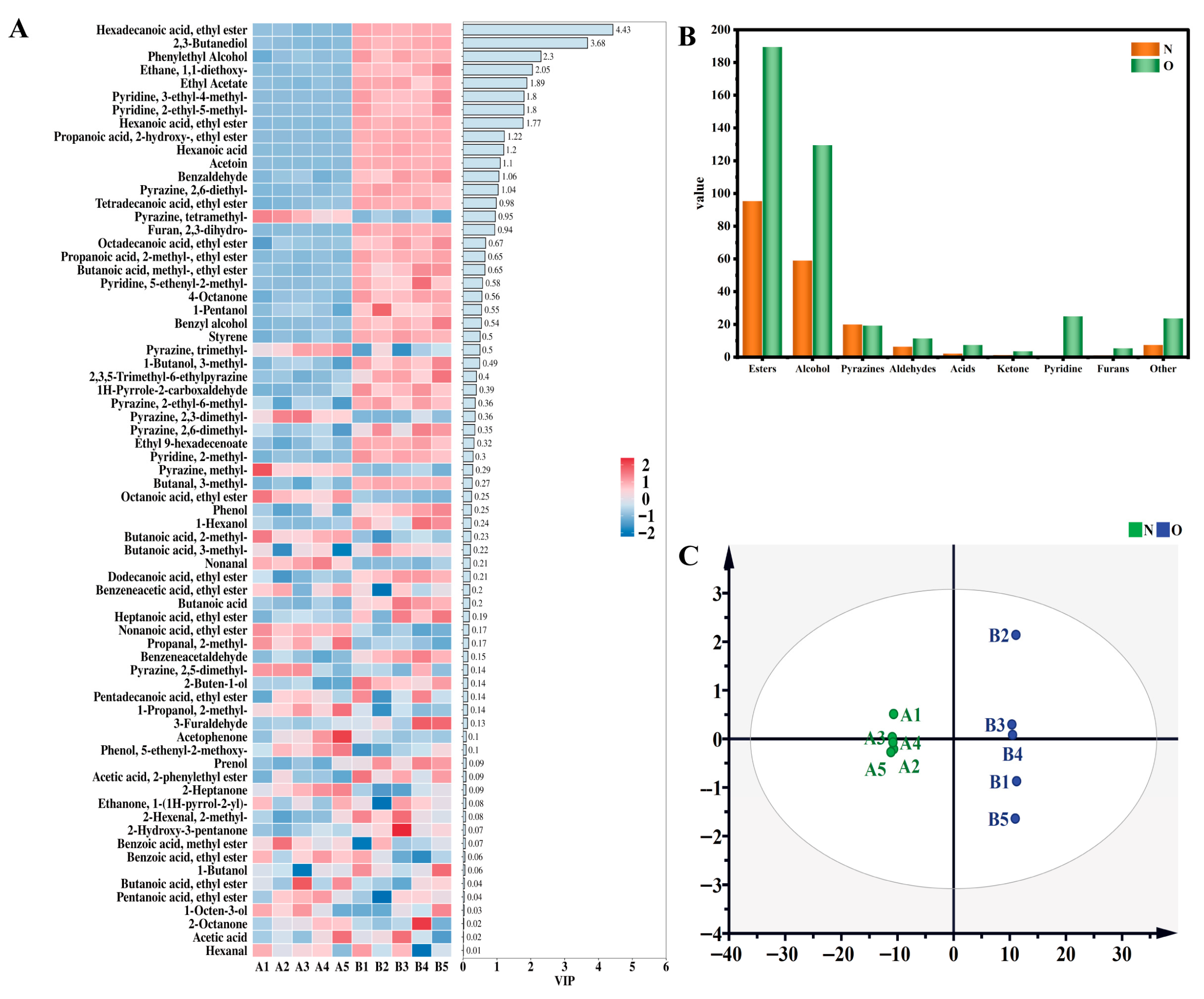
Headspace SPME–GC–MS revealed a complex volatile profile in both N- and O-Daqu. As shown in Figure 2A, about 70 volatile compounds were identified in total, including 20 esters, 11 alcohols, 9 aldehydes, 6 ketones, 9 pyrazines, 5 acids, 4 pyridines, and 6 other compounds. This overall composition, dominated by esters, alcohols, carbonyl compounds, and nitrogen-containing heterocycles, was consistent with previous reports for strong-flavor and medium-temperature Daqu.
To identify the key compounds responsible for discriminating between the two workshops, multivariate OPLS-DA was conducted. The score plot in Figure 2C shows a clear separation between N- and O-Daqu along the first predictive component, indicating systematic differences in the overall volatile profile. Combined with the VIP values shown on the right side of Figure 2A, the discriminating compounds with VIP > 1 were mainly enriched in O-Daqu, including four representative esters (ethyl hexanoate, ethyl hexadecanoate, ethyl acetate, and ethyl 2-hydroxypropanoate), together with multiple higher alcohols and pyrazines. These esters are widely recognized as principal aroma-active compounds in strong-flavor Baijiu and are frequently used as indicators of high-quality base liquor and Daqu, whereas pyrazines contribute roasted, nutty, and baked notes and are often associated with higher-temperature processing and/or more mature Daqu [32,33]. In addition, several aromatic aldehydes and some short-chain acids and low-level esters that contributed to group discrimination were also present at higher levels in O-Daqu (Figure 2A,B), suggesting an overall shift toward higher abundances of multiple volatile classes in the old workshop, rather than an apparent trade-off among major compound categories [34].
Collectively, O-Daqu showed higher relative abundances for most discriminating volatiles, including key esters, higher alcohols and pyrazines, compared with N-Daqu. This workshop-associated enrichment pattern provides a chemical basis for the subsequent microbiome analyses and correlation exploration, while the mechanisms underlying these differences are further discussed in the context of community structure and predicted functional potential.

3.3. Analysis Microbial Community

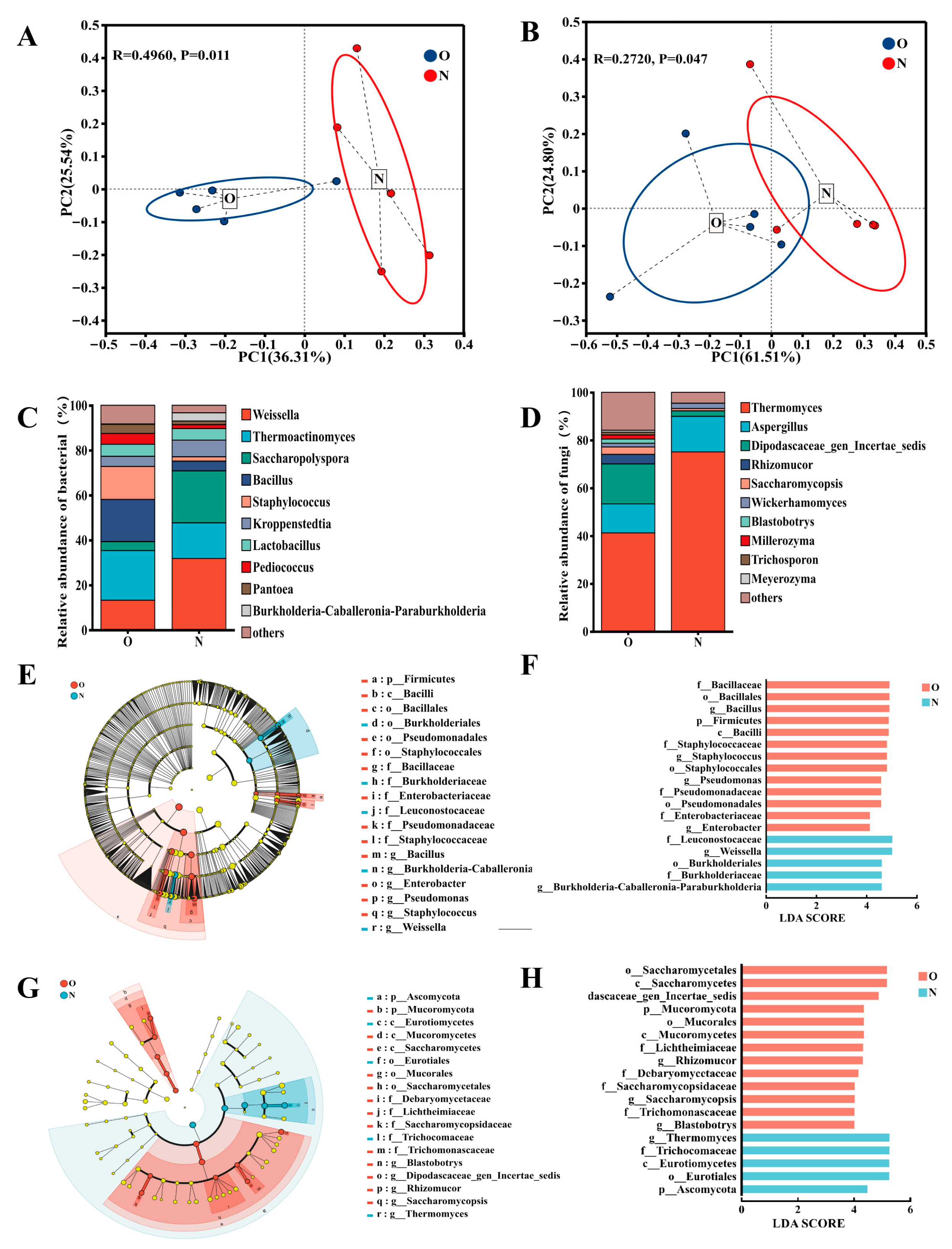
Based on 16S rRNA and ITS high-throughput sequencing, the bacterial and fungal communities of new workshop Daqu and old workshop Daqu were compared and analyzed. The PCoA based on Bray–Curtis distance showed a clear separation between new-workshop and old-workshop Daqu. For bacteria, PC1 and PC2 explained 36.31% and 25.54% of the variation, respectively, and samples from the two workshops clustered into non-overlapping groups, with PERMANOVA R = 0.4960, p = 0.011, as shown in Figure 3A. A similar pattern was observed for fungi: PC1 and PC2 explained 61.51% and 24.80% of the variation, and N and O again formed distinct clusters, as shown in Figure 3B. These ordinations indicate a strong workshop-associated divergence in both bacterial and fungal community structures in mature Daqu. Similar spatial differentiation has been reported among Daqu produced in different regions or production lines and is considered an important driver of quality heterogeneity in Baijiu starters [25,35].
At the genus level, the overall dominant genera were largely shared between the two workshops, and the common major taxa included Weissella, Thermoactinomyces, Saccharopolyspora, Bacillus, Staphylococcus, Kroppenstedtia, Lactobacillus, Pediococcus and Pantoea (Figure 3C). Notably, Burkholderia–Caballeronia–Paraburkholderia was detected as a dominant genus only in N-Daqu, with a mean relative abundance of 3.69%, indicating a workshop-associated enrichment in the new environment.
Despite the broadly similar “core genus set”, their relative contributions differed markedly. In O-Daqu, Thermoactinomyces (22.12%) and Bacillus (18.76%) were the two main dominant genera, whereas in N-Daqu, Weissella (31.82%) was the most abundant genus. In addition, Saccharopolyspora showed a pronounced workshop bias, with a mean relative abundance of 23.11% in N-Daqu versus 3.98% in O-Daqu, while Staphylococcus displayed the opposite pattern (14.65% in O-Daqu versus 1.94% in N-Daqu). Therefore, Saccharopolyspora and Staphylococcus can be regarded as signature genera driving bacterial community differentiation between the two workshops in this study.
Many of these genera have been recognized as core functional bacteria in high- and medium-temperature Daqu. Thermotolerant taxa such as Bacillus, Saccharopolyspora and Kroppenstedtia have been reported to secrete hydrolytic enzymes (e.g., amylases and proteases) and to contribute to starch degradation and proteolysis during Daqu fermentation [36,37,38]. Lactic acid bacteria such as Lactobacillus, Weissella and Pediococcus are closely associated with acid production and flavor balance during Daqu fermentation. In this context, the dominance of Weissella in N-Daqu is consistent with the higher acidity observed in Section 3.1. Meanwhile, the enrichment of Thermoactinomyces and Bacillus in O-Daqu suggests a stronger representation of thermotolerant, enzyme-associated populations in the old-workshop samples [39,40].
LEfSe further identified Bacillus, Staphylococcus, Pseudomonas, Enterobacter, and their affiliated families as biomarkers for O-Daqu, whereas Weissella and Burkholderia-Caballeronia-Paraburkholderia were significantly enriched in N-Daqu, as shown in Figure 3E,F. These LEfSe results were consistent with the genus-level abundance patterns and further highlight workshop-associated taxa differences.
The fungal community also showed obvious shifts between the two workshops. In N-Daqu, Thermomyces and Aspergillus were overwhelmingly dominant, with minor contributions from Dipodascaceae_gen_Incertae_sedis, Rhizomucor, Saccharomycopsis and Wickerhamomyces, as shown in Figure 3D. O-Daqu displayed a more even fungal composition: the relative abundance of Thermomyces decreased, while Aspergillus, Dipodascaceae_gen_Incertae_sedis, Rhizomucor, Saccharomycopsis, Wickerhamomyces Millerozyma, Trichosporon, and Blastobotrys increased markedly.
Thermophilic molds such as Thermomyces and Aspergillus are considered key saccharifying and flavor-forming fungi in high-temperature Daqu [41]. They produce amylases, glucoamylases and esterases and adapt well to the hot core of the bricks [12]. Mucoromycota members such as Rhizomucor, as well as Saccharomycopsis and Wickerhamomyces, can produce both hydrolytic enzymes and aroma precursors, and their enrichment has been associated with improved ester and higher-alcohol formation in Baijiu fermentations [42,43]. Thus, the higher fungal evenness and the increased contributions of Rhizomucor, Saccharomycopsis and Wickerhamomyces in O-Daqu may be related to the broader enrichment of esters and other volatiles described in Section 3.2, although this linkage remains correlative.
LEfSe analysis confirmed that multiple taxa within Ascomycota and Mucoromycota (e.g., orders Saccharomycetales and Mucorales, genera Rhizomucor, Saccharomycopsis and Blastobotrys) were significantly enriched in O-Daqu, whereas Thermomyces and several Eurotiomycetes lineages were characteristic of N-Daqu, as shown in Figure 3G,H. Similar workshop-associated shifts in fungal biomarkers have been reported in comparisons of Daqu differing in temperature types or quality.
In summary, N-Daqu was characterized by a community dominated by Weissella and Thermomyces, whereas O-Daqu showed higher relative abundances of Bacillus, Thermoactinomyces, Staphylococcus and several molds. Rather than attributing quality differences to single “core strains”, these patterns support the view that workshop environments may be associated with distinct multi-kingdom consortia in Daqu. In the following sections, we integrate correlation analyses and functional prediction to further explore how these community differences co-vary with physicochemical indices and volatile profiles.

3.4. Correlation Analysis of Microbial Community with Physicochemical and Flavor

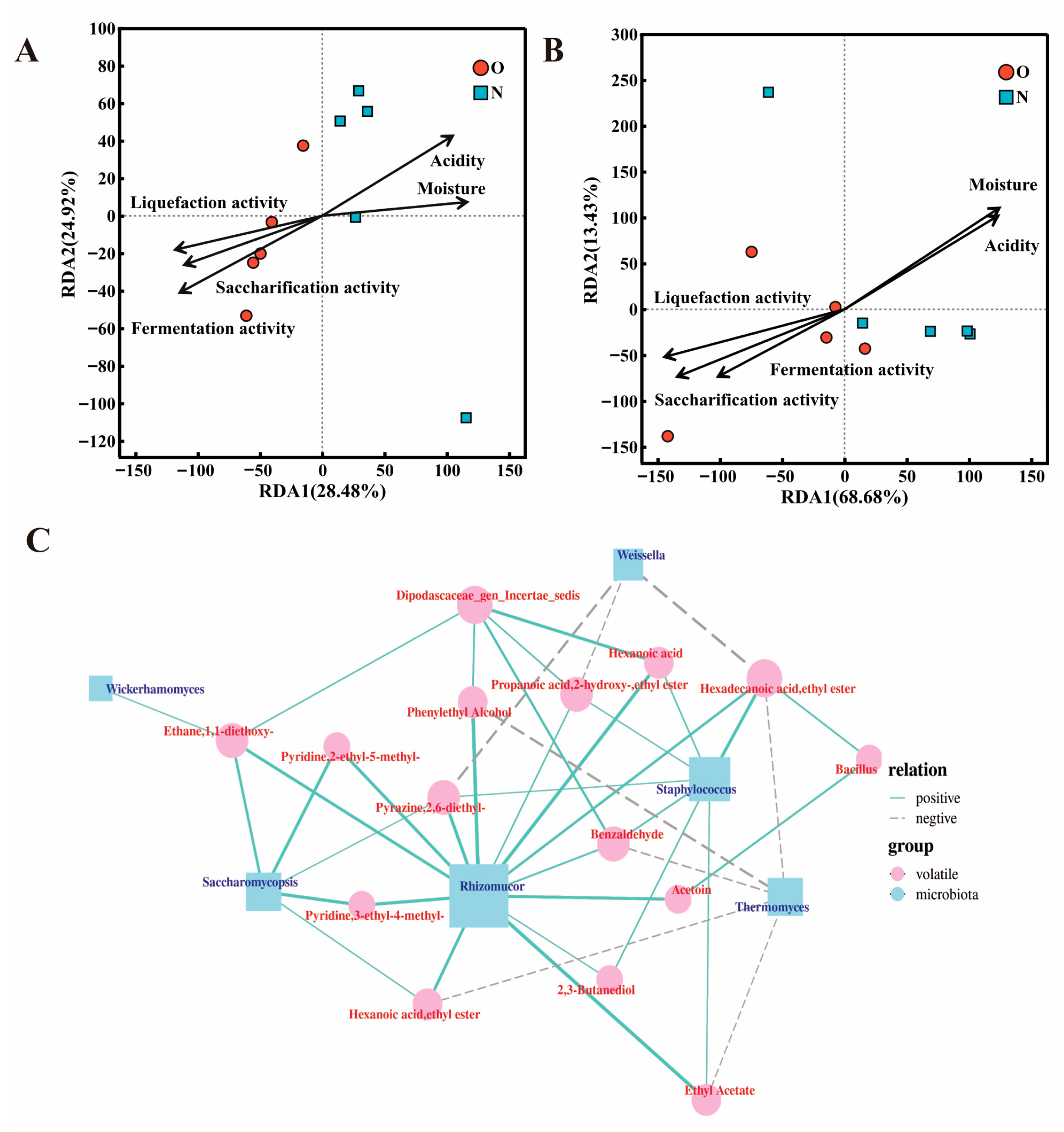
Redundancy analysis and correlation heatmaps were used to link the core microbiota with physicochemical properties and key aroma compounds. For bacteria, moisture, acidity and liquefaction activity loaded strongly on the first RDA axis and clearly separated N and O samples, indicating that these indices are strongly associated with the major variation in bacterial community composition across samples (Figure 4A,B). Genera enriched in the old workshop, such as Bacillus, Staphylococcus and Pediococcus, tended to co-vary positively with higher acidity and liquefaction activity, whereas Weissella and Burkholderia-Caballeronia-Paraburkholderia showed the opposite trend. Similar patterns were observed for fungi (Figures S1 and S2): Thermomycetes molds (Thermomyces, Rhizomucor) and ester-producing yeasts (Saccharomycopsis, Wickerhamomyces) were more frequently observed under the physicochemical conditions characteristic of the old workshop, while Thermomyces and other Ascomycota members dominated under the more homogeneous conditions of the new workshop. Overall, the ordinations suggest that moisture, acidity and amylolytic activities are key environmental correlates of community structure in Daqu, consistent with previous reports.
The correlation network between dominant genera and discriminant volatiles further clarified how workshop-specific microbiota drive flavor differentiation, as shown in Figure 4C. Rhizomucor formed the central hub and displayed strong positive correlations (|r| > 0.7, p < 0.05) with several esters (e.g., ethyl acetate, hexanoic acid ethyl ester, hexadecanoic acid ethyl ester), higher alcohols (2,3-butanediol, phenylethyl alcohol) and pyrazine derivatives. This agrees with recent work showing that molds such as Rhizomucor cooperate with Bacillus to provide amino acids and carbonyl precursors for pyrazine and ester formation in Daqu [44]. Bacillus itself was positively linked to branched-chain alcohols (2,3-butanediol), acetoin and several pyrazines, supporting its recognized role as a major producer of Maillard-derived nutty notes [7].
Yeast genera were mainly correlated with fruity–floral markers [45]. Saccharomycopsis and Wickerhamomyces were positively correlated with ethyl acetate, hexanoic acid ethyl ester and phenylethyl alcohol (Figure 4C), in line with reports that these genera possess strong ester-synthesis and higher-alcohol-producing capacities in Baijiu and other traditional ferments. In contrast, lactic acid bacteria such as Weissella showed negative associations with long-chain ethyl esters but positive links with organic acids, suggesting a potential trade-off pattern between acidification and ester accumulation under certain conditions. Thermophilic fungi exhibited mixed correlations, being positively related to some esters yet negatively related to aldehydes such as benzaldehyde, which may reflect indirect relationships mediated by shared substrates, environmental gradients, or microbial interactions.
The network in Figure 4C highlights a cooperative consortium in the old workshop where Rhizomucor, Bacillus, Staphylococcus, and ester-producing yeasts jointly promote the formation of esters, higher alcohols and pyrazines, while LAB fine-tune acidity and redox conditions. Over all, Figure 4C provides an exploratory overview of co-occurrence and co-variation patterns among dominant bacteria/fungi and representative volatile compounds.

3.5. Analysis of Metabolic Pathway

To further move from “who is there” to “what they may potentially encode”, the bacterial 16S rRNA data were subjected to functional prediction with Tax4Fun, which infers KEGG ortholog (KO) profiles and metabolic pathways from taxonomic composition. This approach has been widely used to link community succession with functional shifts in fermentation systems.
Limitations of Tax4Fun-based functional prediction. Tax4Fun infers community-level functional potential by linking 16S rRNA-based taxonomic profiles to reference genomes and KEGG annotations [17]. Therefore, these results rep-resent predicted functional potential rather than experimentally validated metabolic activity. Predictions can be biased by the completeness and representativeness of available reference genomes, cannot resolve strain-level gene-content variation, and do not capture regulation or fun-gal functional contributions. In complex solid-state fermentations, functional shifts may also be driven by rare taxa, genomic plasticity and horizontal gene transfer, which are not fully reflected by 16S-based inference. Accordingly, predicted pathway enrichments should be interpreted as hypotheses and ideally validated by shotgun meta-genomics and metatranscriptomics, targeted gene quantification and enzyme activity assays [18].
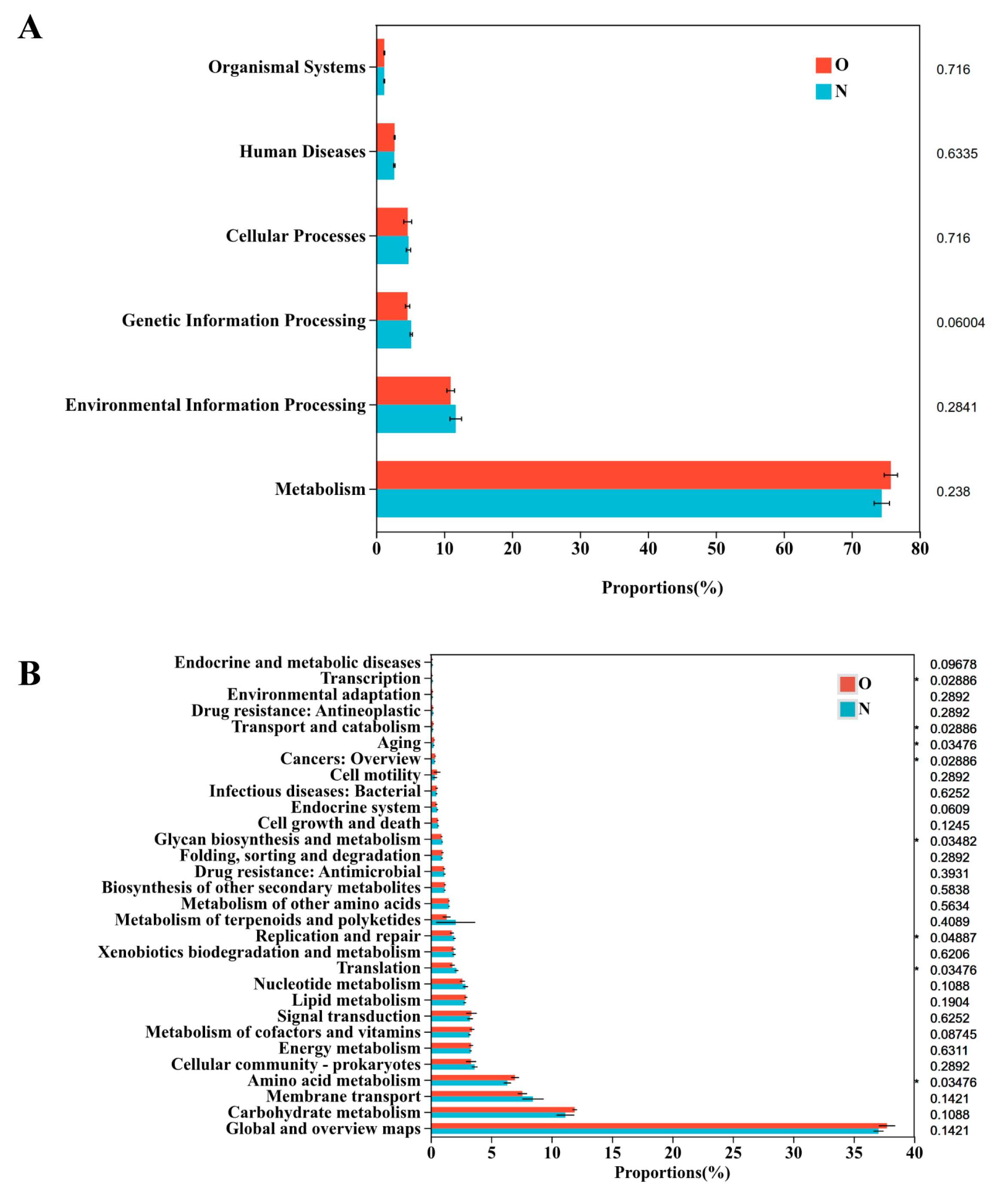
At KEGG level 1, both N- and O-group Daqu were dominated by metabolism-related functions, which accounted for almost three-quarters of the predicted functional potential in each group, whereas cellular processes, environmental information processing, genetic information processing, human diseases and organismal systems contributed much smaller proportions (all <15%). As shown in Figure 5A, there was no significant difference in the overall contribution of the “Metabolism” category between the two workshops (Student’s t-test, p = 0.238), indicating that the core metabolic capacity of the bacterial communities was largely conserved despite the pronounced differences in community structure and physicochemical properties.
At KEGG level 2, more subtle differences in predicted functional composition were observed (Figure 5B). Pathways related to global and overview metabolism, carbohydrate metabolism and amino-acid metabolism showed the highest relative abundances in both groups, in line with the crucial role of sugar and amino-acid turnover in Baijiu starter fermentation. Compared with the N group, the O group tended to have slightly higher proportions of “carbohydrate metabolism” and “amino acid metabolism”, whereas the N group showed modest enrichment of information-processing pathways such as “transcription” and “replication and repair”. Several level-2 pathways differed significantly between groups, including transcription, transport and catabolism, aging and cancer-related pathways (all p < 0.05; Figure 5B), which may reflect distinct stress-response and redox states of the microbiota under the heterogeneous workshop environments rather than true disease processes, as also suggested in other fermentation studies using Tax4Fun [46].
To visualize workshop-discriminatory predicted functional features, enzymes and KOs showing the largest inter-group differences were displayed as heatmaps (Figures S3 and S4). Old-workshop samples were characterized by higher predicted abundances of several enzymes involved in fatty-acid and energy metabolism, such as 3-oxoacyl-[acyl-carrier-protein] reductase/β-ketoacyl-ACP reductase and aldehyde dehydrogenase (NAD+). In contrast, new-workshop samples showed stronger signals for succinate-semialdehyde dehydrogenase and a series of dehydrogenases and oxidoreductases associated with amino-acid degradation and organic-acid formation (Figure S3). These differences are consistent with the physicochemical data, where O-group Daqu exhibited higher fermentation and saccharification activities, while N-group Daqu showed slightly higher acidity (Figure 1), suggesting that the O group may channel more carbon through fatty-acid and energy pathways, whereas the N group favors acid-producing amino-acid routes.
A similar pattern was observed at the KO level. As shown in Figure S4, bacterial communities from the old workshop were enriched in multiple ABC-type transport systems for peptides, nickel and other solutes, as well as two-component regulatory systems. Such transporters and signal-transduction proteins are important for nutrient scavenging and stress adaptation in solid-state fermentation and have been linked to efficient growth of Bacillus and Staphylococcus species in Daqu-like environments [44]. In contrast, the new-workshop samples showed higher predicted abundances of phosphotransferase system (PTS) components and 6-phospho-β-glucosidase, which are key elements of sugar uptake and utilization [47]. Enhanced PTS activity could facilitate rapid import and phosphorylation of glucose and other carbohydrates, providing substrates for lactic-acid production and for the formation of higher alcohols and esters observed in the N groups [48].
Taken together, the Tax4Fun-based functional prediction suggested that, although N- and O-workshop Daqu shared broadly similar core metabolic categories, their bacterial communities may differ in specific predicted transport and central metabolic modules. In particular, O-workshop Daqu showed higher predicted abundances of KOs pathways related to amino acid metabolism, carbohydrate metabolism, and ABC-type transport, whereas N-workshop Daqu showed relatively higher predicted abundances of phosphotransferase system components and certain sugar-utilization enzymes. These patterns provide a link between workshop microenvironment, community assembly, and the observed differences in physicochemical indices and volatile profiles. But direct mechanistic verification will require multi-omics and targeted biochemical assays.

4. Conclusions

In this study, we compared mature Daqu from a newly built and a long-established workshop within the same strong-aroma Baijiu distillery. The new workshop produced Daqu with higher acidity but lower fermentation, saccharification and liquefaction activities, whereas the old workshop yielded Daqu with an ester-rich, more mature flavor profile, with roughly double the total ester content and more pronounced fruity–floral notes. Both types shared similar core bacterial and fungal groups, but the new workshop was dominated by a relatively simple Weissella–Thermomyces consortium, while the old workshop harbored a more diverse community enriched in Bacillus, lactic acid bacteria, Rhizomucor and Saccharomycopsis, which was closely associated with the accumulation of key ethyl esters, higher alcohols and pyrazines. Functional prediction indicated that, although overall metabolic repertoires were similar, the old workshop was biased toward amino acid and carbohydrate metabolism and membrane transport functions that favor flavor formation. These findings collectively suggest that the workshop age and microenvironment can reshape the quality of Daqu by co-regulating the physicochemical properties, microbial community and its metabolic potential. This study provides a mechanistic basis and specific microbial targets for accelerating the “maturation” of new workshops.
New Daqu workshops can be considered as the early stages of the fermentation ecosystem, while old workshops represent ecologically mature environments. After repeated production cycles, long-term environmental inoculation (through air transmission, workers and tools) and the accumulation of resident microbiota on surfaces (such as floors, walls, molds and turning equipment) can gradually establish a stable local microbial pool, thereby repeatedly seeding Daqu. At the same time, the continuous selection pressure (high temperature, low water activity, acidity and substrate competition) during the solid-state Daqu fermentation process may favor the functional professional groups that adapt to the pressure over time, thereby possibly enhancing community stability and multi-boundary interactions. Therefore, our future work will combine longitudinal sampling with production cycles, building environment source tracking, on-site environmental monitoring and multi-omics to more comprehensively analyze the ecological formation of Daqu fermentation workshops.

Supplementary Materials

The following supporting information can be downloaded at: https://www.mdpi.com/article/10.3390/fermentation12020067/s1, Scheme S1. Flowchart of Daqu production process. Figure S1. Spearman correlation heatmap between dominant bacterial and fungal genera and physicochemical indices. * and ** indicate p < 0.05 and p < 0.01, respectively. Figure S2. (D) Spearman correlation heatmap between dominant genera and key volatile components or volatile groups. Figure S3. Heat map of enzyme. Figure S4. Heat map of KO.

Author Contributions

Conceptualization, W.T. and D.Z.; Methodology, M.Z., X.L. and J.Z. (Jie Zhou); Software, M.Z. and J.Z. (Jia Zheng); Validation, Y.L. and W.T.; Formal analysis, M.Z. and J.Z. (Jia Zheng); Investigation, M.Z., X.L. and J.Z. (Jie Zhou); Resources, D.Z. and W.T.; Data curation, M.Z. and Y.L.; Writing—original draft preparation, M.Z.; Writing—review and editing, J.Z. (Jia Zheng), W.T. and D.Z.; Visualization, M.Z. and J.Z. (Jia Zheng); Supervision, W.T. and D.Z.; Project administration, W.T. and D.Z.; Funding acquisition, W.T. and D.Z. All authors have read and agreed to the published version of the manuscript.

Funding

This work was funded by the Wuliangye Group research project (2024ZHYS0030).

Institutional Review Board Statement

Not applicable.

Informed Consent Statement

Not applicable.

Data Availability Statement

The original contributions presented in this study are included in the article. Further inquiries can be directed to the corresponding authors.

Acknowledgments

The authors thank the Wuliangye Group for support and the assistance of the production base staff during sample collection.

Conflicts of Interest

Mingyao Zou, Jia Zheng, Xiaohu Liang, Jie Zhou and Dong Zhao were employed by the company Wuliangye Yibin Co., Ltd. The remaining authors declare that the research was conducted in the absence of any commercial or financial relationships that could be construed as a potential conflict of interest. The authors declare that this study received funding from Wuliangye Group research project (2024ZHYS0030). The funder was not involved in the study design, collection, analysis, interpretation of data, the writing of this article or the decision to submit it for publication.

References

  1. Tu, W.; Cao, X.; Cheng, J.; Li, L.; Zhang, T.; Wu, Q.; Xiang, P.; Shen, C.; Li, Q. Chinese Baijiu: The perfect works of microorganisms. Front. Microbiol. 2022, 13, 919044. [Google Scholar] [CrossRef]
  2. Huang, X.; Liu, J.; Luo, H.; Zou, W. Research progress on the diversity, physiological and functional characteristics of lactic acid bacteria in the Nongxiangxing baijiu microbiome. J. Food Sci. 2025, 90, e70082. [Google Scholar] [CrossRef]
  3. Wang, Z.; Wang, S.; Liao, P.; Chen, L.; Sun, J.; Sun, B.; Zhao, D.; Wang, B.; Li, H. HS-SPME combined with GC-MS/O to analyze the flavor of strong aroma baijiu Daqu. Foods 2022, 11, 116. [Google Scholar]
  4. Liu, H.; Sun, B. Effect of fermentation processing on the flavor of Baijiu. J. Agric. Food Chem. 2018, 66, 5425–5432. [Google Scholar] [CrossRef] [PubMed]
  5. Sun, Y.; Zhang, H.; Zhang, H.; Huang, J.; Du, L.; Wang, J. Comprehensive Investigation of Grade-Specific Aroma Signatures in Nongxiangxing Baijiu Using Flavoromics Approaches. Foods 2025, 14, 3781. [Google Scholar] [CrossRef]
  6. Tian, L.; Xu, P.; Qin, J.; Hou, G.; Huang, Q.; Liu, Y.; Li, Y.; Guan, T. Insights into the Flavor Profiles and Key Aroma-Active Compounds of Sichuan Xiaoqu Qingxiangxing Baijiu Across Distilling Stages. Foods 2025, 14, 2814. [Google Scholar] [CrossRef]
  7. He, M.; Jin, Y.; Zhou, R.; Zhao, D.; Zheng, J.; Wu, C. Dynamic succession of microbial community in Nongxiangxing daqu and microbial roles involved in flavor formation. Food Res. Int. 2022, 159, 111559. [Google Scholar] [CrossRef]
  8. Nie, X.; Jia, X.; Zhu, K.; Ling, Z.; Chen, H.; Xie, J.; Ao, Z.; Song, C.; Shen, C.; Zhu, C. Dynamic Changes and Potential Correlations between Microbial Diversity and Volatile Flavor Compounds in Chinese Medium-Temperature Daqu during Manufacturing. Molecules 2024, 29, 4851. [Google Scholar] [CrossRef] [PubMed]
  9. Mu, Y.; Huang, Y.; Li, D.; Zhu, Z.; Yu, S.; Xie, F. Revealing the comprehensive effect of mechanization on sauce-flavor Daqu through high-throughput sequencing and multi-dimensional metabolite profiling. Food Res. Int. 2024, 191, 114645. [Google Scholar] [CrossRef] [PubMed]
  10. Zhang, Y.; Xu, J.; Jiang, Y.; Niu, J.; Chen, X.; Han, B.-Z. Microbial characteristics and metabolite profiles of high-temperature Daqu in different maturation stages. World J. Microbiol. Biotechnol. 2022, 38, 234. [Google Scholar] [CrossRef]
  11. Ying, H.; Yang, J.; Yu, L.; Wei, J.; Sheng, Q.; Yuan, Y.; Yue, T. Metagenomics and GC-IMSanalyses reveal microbial community differences and flavor characteristics among three types of Feng flavor Daqu. Food Res. Int. 2025, 221, 117551. [Google Scholar] [CrossRef]
  12. Wu, X.; Zhao, X.; Wang, L.; Chen, B.; Li, F.; Tang, Z.; Wu, F. Unraveling the regional environmental ecology dominated baijiu fermentation microbial community succession and associated unique flavor. Front. Microbiol. 2024, 15, 1487359. [Google Scholar] [CrossRef]
  13. Li, Y.; Liu, S.; Zhang, S.; Liu, T.; Qin, H.; Shen, C.; Liu, H.; Yang, F.; Yang, C.; Yin, Q. Spatiotemporal distribution of environmental microbiota in spontaneous fermentation workshop: The case of Chinese Baijiu. Food Res. Int. 2022, 156, 111126. [Google Scholar] [CrossRef]
  14. Xu, S.; Zhou, H.; Xu, B.; Liu, W.; Hu, W.; Xu, Q.; Hong, J.; Liu, Y.; Li, X. Environmental microbiota and its influence on microbial succession and metabolic profiles in baijiu fermentation across three distinct-age workshops. LWT 2024, 201, 116262. [Google Scholar] [CrossRef]
  15. Wang, C.; Li, C.; Bin, Z.; Zhu, G.; Tang, S.; Zhang, J.; Chen, Y.; Xiao, D.; Guo, X. Workshop environment heterogeneity shaped the microbiome and metabolome profiles during Xiasha round of Jiangxiangxing Baijiu. Food Chem. X 2024, 22, 101264. [Google Scholar] [CrossRef]
  16. Yuan, S.; Liu, X.; Tu, R.; Ren, D.; Yuan, L.; Han, X.; Liu, S.; Mao, J. Unveiling the Terroir of Chinese Baijiu: How Altitude Shapes the Brewing Microbiome and Flavor Chemistry in the Chishui River Basin. Food Biosci. 2025, 74, 107824. [Google Scholar] [CrossRef]
  17. Aßhauer, K.P.; Wemheuer, B.; Daniel, R.; Meinicke, P. Tax4Fun: Predicting functional profiles from metagenomic 16S rRNA data. Bioinformatics 2015, 31, 2882–2884. [Google Scholar] [CrossRef] [PubMed]
  18. Wemheuer, F.; Taylor, J.A.; Daniel, R.; Johnston, E.; Meinicke, P.; Thomas, T.; Wemheuer, B. Tax4Fun2: Prediction of habitat-specific functional profiles and functional redundancy based on 16S rRNA gene sequences. Environ. Microbiome 2020, 15, 11. [Google Scholar] [CrossRef] [PubMed]
  19. QB/T 4257-2011; General Methods of Analysis for Daqu. Ministry of Industry and Information Technology: Beijing, China, 2011.
  20. Van Den Dool, H.; Kratz, P.D. A generalization of the retention index system including linear temperature programmed gas-liquid partition chromatography. J. Chromatogr. 1963, 11, 463–471. [Google Scholar] [CrossRef]
  21. Chen, S.; Zhou, Y.; Chen, Y.; Gu, J. Fastp: An ultra-fast all-in-one FASTQ preprocessor. Bioinformatics 2018, 34, i884–i890. [Google Scholar] [CrossRef]
  22. Magoč, T.; Salzberg, S.L. FLASH: Fast length adjustment of short reads to improve genome assemblies. Bioinformatics 2011, 27, 2957–2963. [Google Scholar] [CrossRef]
  23. Liu, S.; Zhou, Y.; Ma, D.; Zhang, S.; Dong, Y.; Zhang, X.; Mao, J. Environment microorganism and mature daqu powder shaped microbial community formation in mechanically strong-flavor daqu. Food Biosci. 2023, 52, 102467. [Google Scholar] [CrossRef]
  24. Deng, J.; Zheng, J.; Huang, D.; Huang, Z.; Ye, G.; Luo, H. Characterization of physicochemical properties, volatile compounds and microbial community structure in four types of Daqu. LWT 2023, 184, 115064. [Google Scholar] [CrossRef]
  25. Han, P.-J.; Luo, L.-J.; Han, Y.; Song, L.; Zhen, P.; Han, D.-Y.; Wei, Y.-H.; Zhou, X.; Wen, Z.; Qiu, J.-Z. Microbial community affects Daqu quality and the production of ethanol and flavor compounds in Baijiu fermentation. Foods 2023, 12, 2936. [Google Scholar] [CrossRef] [PubMed]
  26. Niu, J.; Yan, Y.; Zhang, G.; Shen, Y.; Cheng, W.; Li, H.; Duan, Z.; Sun, J.; Wang, B.; Wu, J. Temporal and Workshop Heterogeneity of Microbial Communities with Physicochemical Properties and Flavor Substances During Stacked Fermentation of Sauce-Flavor Baijiu. Foods 2025, 14, 924. [Google Scholar] [CrossRef] [PubMed]
  27. Deng, L.; Mao, X.; Liu, D.; Ning, X.-Q.; Shen, Y.; Chen, B.; Nie, H.-F.; Huang, D.; Luo, H.-B. Comparative analysis of physicochemical properties and microbial composition in high-temperature Daqu with different colors. Front. Microbiol. 2020, 11, 588117. [Google Scholar] [CrossRef] [PubMed]
  28. Jiang, X.; Peng, Z.; Zhu, Q.; Zheng, T.; Liu, X.; Yang, J.; Zhang, J.; Li, J. Exploration of seasonal fermentation differences and the possibility of flavor substances as regulatory factors in Daqu. Food Res. Int. 2023, 168, 112686. [Google Scholar] [CrossRef]
  29. Lu, Y.; Yan, Q.; Zhang, K.; Zhang, J.; Zou, W.; Yang, J.; Li, H. Generation of a synthetic autochthonous microbiota responsible for the essential flavors and brewing properties of Daqu. Food Res. Int. 2024, 197, 115180. [Google Scholar] [CrossRef]
  30. Xia, Y.; Luo, H.; Wu, Z.; Zhang, W. Microbial diversity in jiuqu and its fermentation features: Saccharification, alcohol fermentation and flavors generation. Appl. Microbiol. Biotechnol. 2023, 107, 25–41. [Google Scholar] [CrossRef]
  31. Yu, Q.; Mou, F.; Xiao, J.; Zhan, C.; Li, L.; Chang, X.; Dong, X.; Chen, M.; Wang, X.; Chen, M. Correlational analysis of physicochemical indexes, microbial communities, and volatile components in light-flavor Daqu from north and south regions of China. World J. Microbiol. Biotechnol. 2024, 40, 54. [Google Scholar] [CrossRef]
  32. Li, D.; Wu, X.; Li, Y.; Duan, C.; Ma, F.; Li, X. Comparative analysis of organic acids and volatile organic compounds of ginseng vinegars fermented by Acetobacter ghanensis and Acetobacter pasteurianus. Eur. Food Res. Technol. 2025, 251, 2793–2809. [Google Scholar] [CrossRef]
  33. Xian, S.; Li, H.; Wang, X.; He, X.; Li, Y.; Liu, X.; Shen, G.; Chen, A. Analysis of Physicochemical Characteristics, Flavor, and Microbial Community of Sichuan Industrial Paocai Fermented by Traditional Technology. Foods 2025, 14, 3232. [Google Scholar] [CrossRef]
  34. Zhang, Q.; Wu, W.J.; Cheung, Y.M.; Lin, Y.; Deng, X.; Li, M.; He, C.; Guo, D.; Li, C.; Lam, H.-M. Deciphering the Flavor Chemistry of Traditional and Novel Nattos: A Multidisciplinary Approach Integrating Amino Acid Profiling, Volatile Compound Analysis, and Molecular Docking. Volatile Compd. Anal. Mol. Docking 2025. [Google Scholar] [CrossRef]
  35. Yuan, H.; Zhang, Z.; Ding, L.; Jiang, Q.; Li, Q.; Huang, J.; Wang, S.; Li, L.; Nan, G.; Lou, K. Artificial vs. Mechanical Daqu: Comparative Analysis of Physicochemical, Flavor, and Microbial Profiles in Chinese Baijiu Starter Cultures. Fermentation 2025, 11, 135. [Google Scholar] [CrossRef]
  36. Wen, Z.; Wei, Y.-H.; Han, D.-Y.; Song, L.; Zhu, H.-Y.; Guo, L.-C.; Chen, S.-X.; Lin, B.; He, C.-J.; Guo, Z.-X. Deciphering the role of traditional flipping crafts in medium-temperature Daqu fermentation: Microbial succession and metabolic phenotypes. Curr. Res. Food Sci. 2025, 10, 101063. [Google Scholar] [CrossRef] [PubMed]
  37. Cui, M.; Cai, W.; Yu, P.; Chen, W.; Shan, C.; Zhuang, G.; Wang, Y. Characterization and Correlation Analysis of Bacterial Composition and Physicochemical Quality in High-and Medium-Temperature Daqu from China’s Binzhou Region. Curr. Microbiol. 2025, 82, 72. [Google Scholar] [CrossRef] [PubMed]
  38. Song, D.; Zhong, X.; Wu, Y.; Guo, J.; Song, L.; Yang, L. From Artisan Experience to Scientific Elucidation: Preparation Processes, Microbial Diversity, and Food Applications of Chinese Traditional Fermentation Starters (Qu). Foods 2025, 14, 3814. [Google Scholar] [CrossRef] [PubMed]
  39. Wu, W.; Wang, Z.; Xu, B.; Cai, J.; Cheng, J.; Mu, D.; Wu, X.; Li, X. Exploring core microbiota based on characteristic flavor compounds in different fermentation phases of Sufu. Molecules 2022, 27, 4933. [Google Scholar] [CrossRef]
  40. Zhang, Q.; Yang, S.; Yang, Z.; Zheng, T.; Li, P.; Zhou, Q.; Cai, W.; Wang, Y.; Zhang, J.; Ji, X. Effects of a novel microbial fermentation medium produced by Tremella aurantialba SCT-F3 on cigar filler leaf. Front. Microbiol. 2023, 14, 1267916. [Google Scholar] [CrossRef]
  41. Wu, Y.; Duan, Z.; Niu, J.; Zhu, H.; Zhang, C.; Li, W.; Li, X.; Sun, B. Spatial heterogeneity of microbiota and flavor across different rounds of sauce-flavor baijiu in Northern China. Food Chem. X 2023, 20, 100970. [Google Scholar] [CrossRef]
  42. Yi, X.; Xia, H.; Huang, P.; Ma, S.; Wu, C. Exploring community succession, assembly patterns, and metabolic functions of ester-producing-related microbiota during the production of Nongxiangxing baijiu. Foods 2024, 13, 3169. [Google Scholar] [CrossRef]
  43. Jin, C.; Jin, G.; Jin, J.; Lv, Y.; Dang, Z.; Feng, Y.; Xu, Y. The Impact of Mechanized and Traditional Processes on Microbial Diversity and Volatile Flavor Compound Formation During Xifeng Baijiu Fermentation. Foods 2024, 13, 3710. [Google Scholar] [CrossRef] [PubMed]
  44. Zhong, Z.; Liu, T.; He, K.; Zhong, M.; Chen, X.; Xue, Y.; Han, B.; Wang, D.; Liu, J. Microbial enzymes: The bridge between Daqu flavor and microbial communities. Food Innov. Adv. 2024, 3, 426–437. [Google Scholar] [CrossRef]
  45. Duan, Z.F.; Han, M.Y.; Niu, J.L.; Zhao, J.R.; Li, W.W.; Zhu, L.N.; Ma, H.F.; Wu, Y.F.; Li, X.T.; Sun, B.G. Evolution of fermented grain yeast communities in strong-flavored baijiu and functional validation of yeasts that produce superior-flavored substances. J. Sci. Food Agric. 2024, 104, 5973–5981. [Google Scholar] [CrossRef]
  46. Han, D.; Yang, Y.; Guo, Z.; Chen, K.; Dai, S.; Zhu, Y.; Wang, Y.; Yu, Z.; Wang, K.; Liu, P. Metagenomics profiling of the microbial community and functional differences in solid-state fermentation vinegar starter (seed Pei) from different Chinese regions. Front. Microbiol. 2024, 15, 1389737. [Google Scholar] [CrossRef]
  47. Liu, Y.; Li, H.; Liu, W.; Ren, K.; Li, X.; Zhang, Z.; Huang, R.; Han, S.; Hou, J.; Pan, C. Bioturbation analysis of microbial communities and flavor metabolism in a high-yielding cellulase Bacillus subtilis biofortified Daqu. Food Chem. X 2024, 22, 101382. [Google Scholar] [CrossRef] [PubMed]
  48. Liu, X.; Quan, W. Progress on the synthesis pathways and pharmacological effects of naturally occurring pyrazines. Molecules 2024, 29, 3597. [Google Scholar] [CrossRef] [PubMed]
Figure 1. (A) Moisture, acidity, fermentation, saccharification and liquefaction activities (*** p < 0.001). (B) PCA score plot based on the five indices.
Fermentation 12 00067 g001
Figure 2. (A) Heatmap of the content of volatile compounds. (B) Total relative abundance of major classes of volatile compounds. (C) Orthogonal partial least squares-discrimination analysis (OPLS-DA) plots of volatile compounds in the two types of Daqu.
Fermentation 12 00067 g002
Figure 3. (A) PCA of bacterial communities at the genus level. (B) PCA of fungal communities at the genus level. (C) Relative abundance of dominant bacterial genera. (D) Relative abundance of dominant fungal genera. (E,F) LEfSe cladogram and LDA scores of differential bacterial taxa. (G,H) LEfSe cladogram and LDA scores of differential fungal taxa.
Fermentation 12 00067 g003
Figure 4. (A) RDA ordination of bacterial communities constrained by physicochemical indices. (B) RDA ordination of fungal communities constrained by physicochemical indices. (C) Microbe–metabolite correlation network showing significant associations (|ρ| > threshold, p < 0.05) between dominant genera and volatile compounds.
Fermentation 12 00067 g004
Figure 5. (A) T-test histogram of KEGG Level 1 (B) T-test histogram of KEGG Level 2.
Fermentation 12 00067 g005
Disclaimer/Publisher’s Note: The statements, opinions and data contained in all publications are solely those of the individual author(s) and contributor(s) and not of MDPI and/or the editor(s). MDPI and/or the editor(s) disclaim responsibility for any injury to people or property resulting from any ideas, methods, instructions or products referred to in the content.