Article

Sugar and Ethanol Conversion of Recovered Whole and Degermed Corn Kernel Fibers Pretreated with Sodium Carbonate


by
Valerie García-Negrón
* and
David B. Johnston
Sustainable Biofuels and Co-Products Research Unit, Eastern Regional Research Center, Agricultural Research Service, U.S. Department of Agriculture, 600 E. Mermaid Lane, Wyndmoor, PA 19038, USA
*
Author to whom correspondence should be addressed.
Fermentation 2026, 12(1), 61; https://doi.org/10.3390/fermentation12010061
Submission received: 5 December 2025 / Revised: 12 January 2026 / Accepted: 14 January 2026 / Published: 21 January 2026

Abstract

Corn fermentation in biorefineries produces residual biomass and by-products, particularly corn kernel fiber and outgassed carbon dioxide (CO2), that have value-added potential for improving sugar and bioethanol conversions. Recovered corn kernel fiber contains lignocellulosic components which can be made accessible by pretreating the biomass with an alkaline sodium carbonate solution made with captured CO2 and then used as supplemental biomass in corn ethanol production. In this work, different ratios of whole and degermed corn kernel fibers are pretreated and mixed with corn to be evaluated as beneficial ingredients in bioethanol co-fermentation. Sugar yields from enzymatic hydrolysis demonstrate the pretreatment promotes saccharification reaching over 70% total sugar conversion for the whole corn fibers. During co-fermentation, 10 and 20% corn solid loadings significantly increased ethanol yields while additional corn fiber loadings increased sugar yields. Conversion rates and yields were similar between the whole and degermed corn fibers supporting how a single recovery design can benefit multiple corn streams.

1. Introduction

As of today, bioethanol is the best alternative to non-renewable energy sources due to its significant potential for decreasing emissions and climate effects [1,2,3]. Evaluation of renewable energy sources requires characterizing lifecycle processes such as energy generation, energy efficiency (low emissions), feedstock dependence, and land use. Commercial ethanol production consists of converting starch from corn to fermentable sugars, yeast fermenting the sugars to ethanol, and distillation recovery of the ethanol. Second-generation ethanol technologies utilize cellulosic biomass in which raw materials from agricultural and forestry wastes are commonly used. Cellulosic ethanol feedstocks include dedicated energy crops and industrial wastes containing hemicellulose, cellulose, and lignin [4]. Ethanol is produced primarily from whole corn with over 50% of the world production made in the United States [5].
Corn is an agricultural non-woody plant and a rich source of starch and fiber. It is among the dominant crops grown for ethanol production, although it is also used for food, animal feed, industrial products, sweeteners, and oils [6,7]. Moreover, corn kernel fiber (CF), an undervalued by-product from corn processing, is one of the most abundant raw materials. CF is the outer layer of the corn kernel which contains lignocellulosic material as part of the pericarp and the cell wall of the endosperm [8,9]. Thus, CF has the potential to be utilized for additional starch-based ethanol and cellulosic ethanol via wet- and dry-mill methods [10]. Additionally, CF and residual starch can be converted simultaneously during ethanol conversion without requiring additional corn grind [9]. Recent work presents a comprehensive review of the chemical composition of corn fiber and methods used for ethanol production which include pretreatment, enzyme optimization, hydrolysis, and fermentation [11,12].
Lignocellulosic biomass is commonly pretreated to alter its complex cellulose structure and allow enzymes to more easily convert carbohydrate polymers into fermentable sugars. Over the years, various pretreatments (alkali, acids, hot steam, and ammonia) have been used for cellulose degradation in CF and other lignocellulosic biomass [13,14,15,16]. Different alkaline pretreatments on CF have been shown to be effective in breaking ester bonds between hemicellulose, cellulose, and lignin [17]. Also, corn stover pretreated with sodium carbonate (Na2CO3) promoted lignin degradation and increased cellulose content, resulting in higher sugar conversion during ethanol production [18]. The recovery and reutilization of carbon dioxide (CO2), another by-product from fermentation, has been demonstrated to be useful in subsequent feedstock pretreatments [18,19]. Specifically, the capture of CO2 has been carried out from an actual fermenter setup and absorbed in a sodium hydroxide (NaOH) solution to make Na2CO3 for biomass pretreatments. Common challenges in similar biomass pretreatments relate to application-specific affinity, fraction separations, high-yield production, and processing costs [20,21]. Effective biomass pretreatment methods contribute to the overall biorefinery process and sustainable energy systems by improving sugar conversion to biofuels and by-products [22].
This work evaluates the reutilization and feasibility of corn ethanol fermentation by-products, particularly, corn fibers and CO2 gas. The processing configuration recovers post-fermentation CF and pretreats them with an alkaline Na2CO3 solution to enhance the CF as a supplemental cellulosic source for other ethanol conversion processes. To effectively design a sustainable second-generation bioethanol production, it is necessary to understand the treatments’ effects on the biomass and their impact on biofuel conversion. CF obtained from two kinds of biorefinery corn streams, whole and degermed, are studied to understand their differences in cellulosic content when pretreated and their effects on ethanol and sugar yields in corn ethanol co-fermentation. Moreover, co-fermentations using different mixtures of corn and CF are investigated to assess limits of CF supplementation. Reutilization of CF can benefit large-scale ethanol production by reusing by-products while potentially increasing yields.

2. Materials and Methods

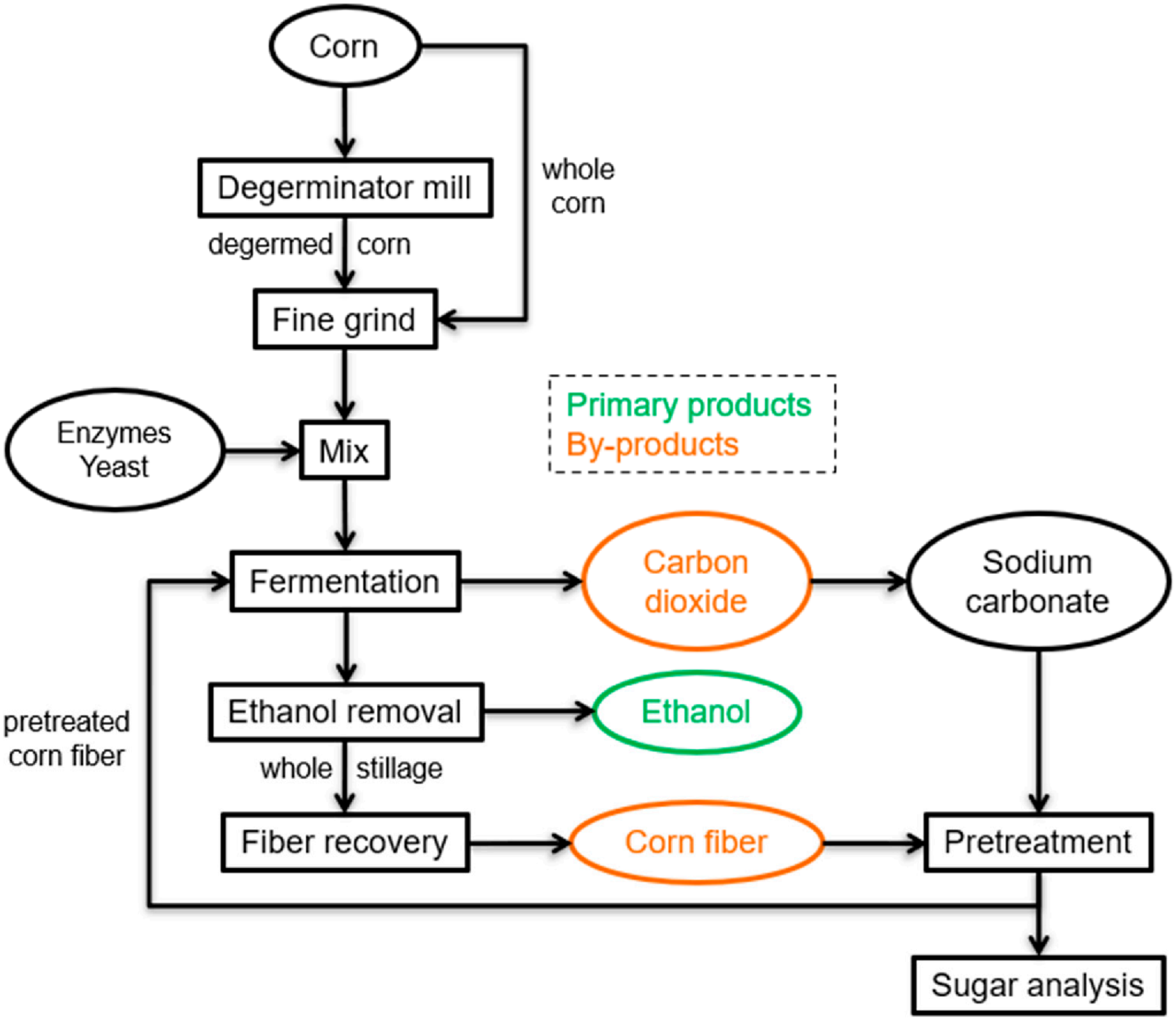
Figure 1 presents the flow diagram of corn-to-ethanol production reusing by-products. Post-fermentation CF was evaluated in two chemical processes: sugar analysis and co-fermentation. Comparisons were made between four CF conditions: untreated whole (UWF), untreated degermed (UDF), pretreated whole (PWF), and pretreated degermed (PDF) corn kernel fibers. Fiber pretreatment was performed with Na2CO3, a mild alkaline treatment that can be prepared using captured CO2 gas from fermentation.

2.1. Fiber Recovery

Fiber recovery for the post-fermentation whole corn fiber (WF) was produced by screening corn whole stillage with a 325-mesh screen from a corn ethanol fermentation that used whole corn kernel fibers. The post-fermentation degermed fibers (DF) were recovered by screening whole stillage from a corn ethanol fermentation that had used a wet-fractionation process to remove the germ prior to fermentation. The fibers were rinsed with distilled water, dried in a convection forced air oven at 55 °C, and stored in a sealed bag until ready for pretreatment.

2.2. Composition Analysis

The composition analysis was carried out using the NREL-TP-510-42618 protocol to determine structural carbohydrates and lignin in biomass, using an Aminex® HPX-87P column from Bio-Rad (Hercules, CA, USA) with a chromatography grade filtered water solvent flowing at 0.6 mL min−1 at 80 °C [23]. The analysis was used to measure moisture and lignocellulosic content found in the post-fermentation CF. High-performance liquid chromatography (HPLC) analysis measured sugar release during hydrolysis and fermentation at varied intervals up to 72 h. Samples were stored frozen until ready to be used and filtered prior to analysis using 0.2 µm syringe filters. The analysis was conducted as described in [24] with additional standards for xylose and arabinose included in the calibration. Dry weights were determined for corn and biomass samples [25]. An Aminex® HPX-87H column from Bio-Rad (Hercules, CA, USA) was used at 65 °C with 5 mM sulfuric acid solvent flowing at 0.6 mL-min−1 and equipped with the 1260 Infinity HPLC from Agilent (Santa Clara, CA, USA)  diode array detector (DAD) and a refractive index detector (RID). Experiments were triplicated for each CF condition and duplicates of 5 µL HPLC injections were collected for each sample. For the ash content, solids recovered during composition analysis procedure and after drying step were set at 575 °C overnight in a Lindberg/Blue M™ box furnace from Thermo Scientific™ (Waltham, MA, USA), then transferred to a desiccator until reaching room temperature to determine the weights. HPLC results were analyzed using Agilent ChemStation software edition version 5.0.0.352.

2.3. Fourier Transform Infrared Spectroscopy (FTIR)

The CF samples, prior to being used, were dried overnight in an oven at 55 °C and tested at room temperature using an attenuated total reflectance (ATR) Spectrum 3 model from Perkin Elmer Inc (Waltham, MA, USA). set to a frequency range from 600 to 4000 cm−1, for 32 scans, and with a resolution of 32 cm−1. ATR-FTIR experiments were performed in triplicate.

2.4. Fiber Pretreatment

The recovered CF was treated with a 2 M Na2CO3 solution from Sigma-Aldrich (Burlington, MA, USA). The dried solids’ loading was 5% (w/v) and were added to a stainless steel 2.5 L reactor which was mixed with the solution, sealed, and allowed to sit for 5 min. A convection oven was used to incubate the reactor at 150 °C for 1.5 h, then it was removed and cooled to close to room temperature. A Büchner funnel and Whatman filter paper (grade #2) were used to separate the solids from the liquid under vacuum. The process was continued by washing the solids until the pH was close to neutral. The recovered solids were dried at 55 °C overnight and stored in a sealed bag.

2.5. Enzymatic Hydrolysis

A 5.1 g dried biomass was hydrolyzed at 10% (w/v) solid loading in 50 mM citric acid buffer with a pH of 4.8. The biomass hydrolyzing enzymes utilized in this evaluation were Cellic® cellulase (CTec2) and hemicellulase (HTec2) from Novonesis (Franklinton, NC, USA) and they were added at 0.255 mL g−1 and 0.1275 mL g−1, respectively. The hydrolysis was incubated for 72 h in a shaker incubator at 50 °C at 160 rpm. The flasks were closed and sealed with a stopper and a parafilm to prevent water loss. Samples were collected at specific intervals (0.5, 1, 2, 4, 6, 24, 48, 72 h) for HPLC analysis of glucose, xylose, and arabinose. For the HPLC experiments, an Aminex® HPX-87P column from Bio-Rad (Hercules, CA, USA) was used at 80 °C with chromatography grade filtered water solvent flowing at 0.6 mL min−1. Duplicates of 5 µL HPLC injections were collected for each sample and standard.

2.6. Fermentation

The corn used in this work was commercially available as “yellow dent #2 corn” which is mainly used for food grade, beverages, and animal feed. The corn was cleaned to remove any broken kernels and debris, then, finely grounded using a Bunn G2 burr mill (Springfield, IL, USA) in the Turkish setting and kept in a refrigerator stored at 4 °C until used for experiments. The degermed corn was wet milled to remove the germ before grounding. All fermentations were performed in duplicate following a previously established procedure and adjusting moisture content based on the AOAC Official Method 930.15 [25,26]. The co-fermentation experiments used corn solid loadings of 10 and 20 wt.% in a 1400 g corn mash with water. The pH of the mash was initially adjusted to 5.8 using HCl with a mechanical mixer, then SPEZYME® RSL (α-amylase, 750 µL) was mixed and heated to 90 °C for 1 h. After cooling down to 30 °C, 1.68 g of urea (1.2 g urea per 1000 g mash) was added to supplement nitrogen and pH was adjusted to 4.5 to enhance the fermentation conditions. The mash preparation was completed by adding 1.54 g of Ethanol Red® yeast (Saccharomyces cerevisiae) from Lesaffre (Milwaukee, WI, USA) and OPTIDEX® L-400 (glucoamylase, 700 µL) and FERMGEN® (protease, 700 µL), both from DuPont Industrial Biosciences (Palo Alto, CA, USA). The mash was partitioned into loads of 100 g and placed with 1–5 g of CF in 250 mL flasks. Then, the hydrolyzing enzymes CTec2 and HTec2 were added to the flasks in quantities of 500 µL and 200 µL, respectively. The control CF-only fermentation consisted of a similarly prepared 100 g mash (without the amylase-based enzymes and heating step) partitioned into loads of 1–5 g and placed in flasks. Shaken flasks were incubated at 30 °C at 200 rpm for 72 h in a shaking incubator and the fermentation progress was measured periodically, weighing the flasks throughout the incubation period to determine weight loss, indicative of CO2 production and ethanol fermentation.
Percentage theoretical yields for sugar conversions and ethanol production were calculated using the ratio of actual and theoretical yields. The actual yields were based on the average mass fractions obtained from HPLC replicates, scaled by the corresponding solid loading of CF. Theoretical yields were calculated using the sugar compositions reported in Table 1. The polymeric sugar concentrations were converted to their corresponding monomeric form, using a correction factor of 0.9 for C-6 sugars (glucose) and 0.88 for C-5 sugars (xylose and arabinose). The theoretical yield of ethanol also considered the theoretical conversion of glucose to ethanol based on the reaction’s stoichiometry (0.511 g of ethanol per g of glucose).

2.7. Statistical Analysis

Statistical analyses were applied to determine the significant factors for the different CF conditions during two chemical processes: sugar analysis and co-fermentation. For composition and sugar analysis, the independent variables consisted of the CF source variant (whole or degermed) and if pretreatment was applied or not. The evaluations of CF composition considered three response variables: glucan, xylan, and arabinan content. The evaluations of CF sugar yields also considered three response variables: glucose, xylose, and arabinose concentrations. For co-fermentation yields, the independent variables consisted of the CF source variant (whole or degermed), corn loading (10 or 20%), and fiber loading (1–5%).
Visual (e.g., histogram, boxplot, Q-Q plot) and statistical (e.g., Shapiro–Wilk) normality tests were confirmed for biomass composition, sugar concentrations, and fermentation yields. Student’s t-test, one-way ANOVA, and Tukey’s HSD tests were used to establish factors of significance using a confidence level of 95%. Spearman rank correlation tests were used to establish linear relationships between independent and dependent variables. Statistical analyses were carried out using R 4.4.1 via RStudio (2024.09.0 Build 375) and with support from library functions found in the Comprehensive R Archive Network, specifically car (v3.1.3), ggplot2 (v3.5.2), and corrplot (v0.95).

3. Results and Discussion

3.1. Recovered Corn Fiber Characterization

The composition analysis shown in Table 1 includes the lignocellulosic content for the different variants of CF evaluated. The remaining composition fractions correspond to starch, oil, protein, and extractives. For the total lignin content, which includes the acid soluble and acid insoluble lignin, the WF exhibited a slightly higher content (19.96%) than the DF (17.95%), likely due to a slight lignin loss in the fiber during the wet-fractionation process for degerming the corn. Lignin contents for the pretreated fibers (PF) were inconsistent across sample replicates and not measured successfully due to measurement interference from additional corn fiber residues, mainly gum found in the acid insoluble lignin, thus these results were omitted. To mitigate these effects, we propose to perform an extraction step after pretreatment but prior to the composition analysis to allow reliable measurements of the acid insoluble lignin [27]. Cellulose content (glucan) increased significantly after pretreatment, more than doubling for the degermed samples (p << 0.001). The presence of the pretreatment explains most of the variability of glucan (p << 0.001). For the untreated fiber (UF), the content of glucan, xylan, and arabinan were similar, although the WF contained slightly higher glucan and arabinan contents. In contrast, PDF had higher content of cellulose and hemicellulose components compared to PWF because of the degerming step. Sugar conversions were highly linearly correlated (0.83 or higher). The ash content also increased with pretreatment indicating there are more accessible organic materials, attributed to effective pretreatment.
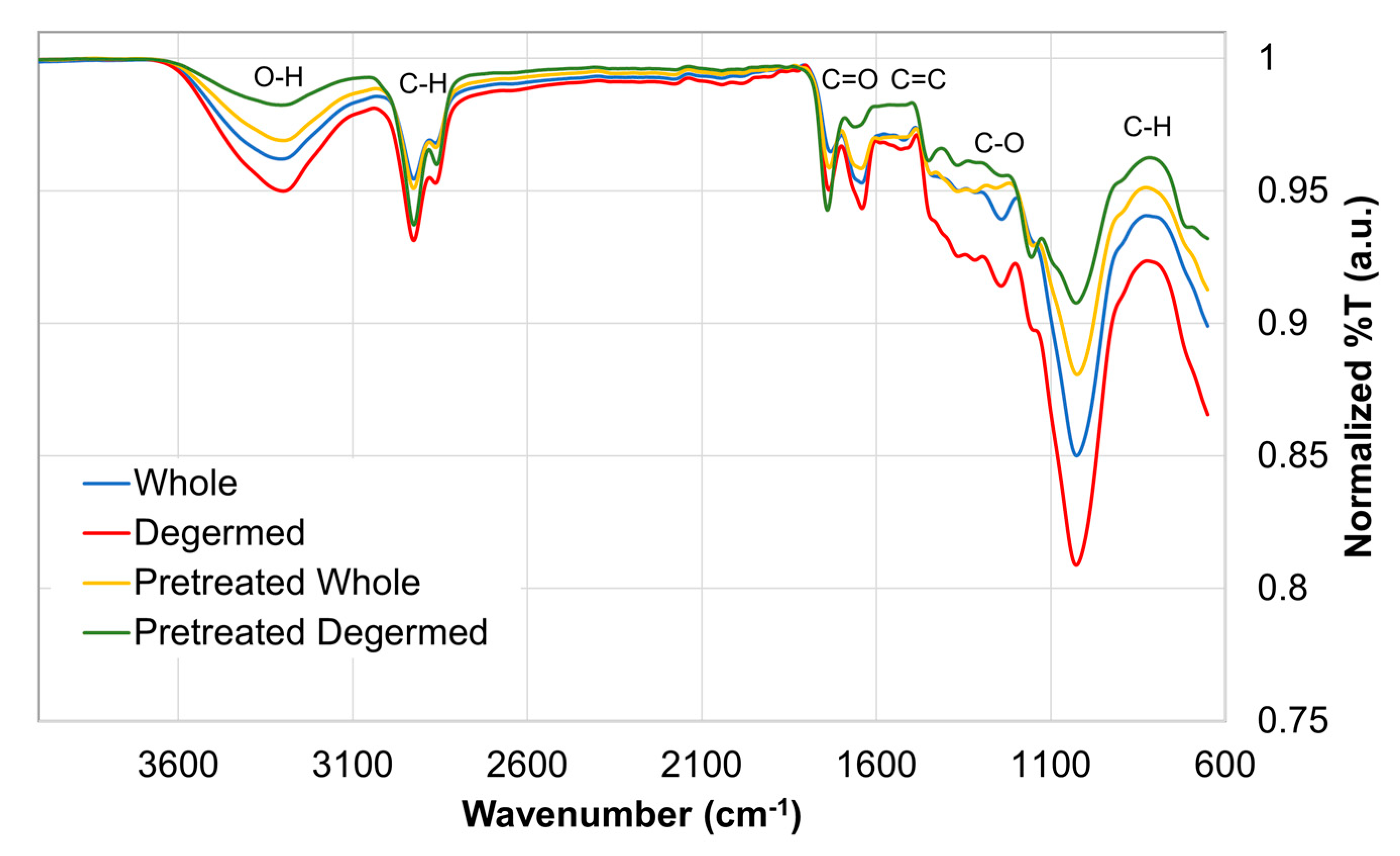
The ATR-FTIR spectra in Figure 2 shows notable similarities and differences in functional groups between the CF. The spectra are compared independently between the untreated and pretreated experiments due to biomass heterogeneity. The spectra have peaks corresponding to O-H stretching at wavenumbers 3300 and 1640 cm−1. A double absorbance band associated with C-H located between 2800 and 2900 cm−1 also indicates the presence of OH stretching, CH bond deformation, and CH2 and CH3 groups. The 1730 cm−1 signal corresponds to C=O from corn residue and acetyl groups and uronic esters of cellulose. The peak of C=C group at ~1513 cm−1 corresponds to the stretching group vibration in carbonyl of hemicellulose, where PF had no peaks due to delignification, contrary to UF. Moreover, PF had smoother signals in the region around 1230 cm−1 which corresponds to corn residue related to C-O aromatic group present in lignin structure. The band close to 1050 cm−1 corresponds to cellulose linkages, though it can also correspond to xylopyranosyl (d-xylose) and contributions of arabinosyl substituents (univalent radical derived from arabinose). These are considered as arabinoxylan structures based on previous studies [28,29]. Variations around the 1300 cm−1 band indicated differences in lignin aromatic structures, particularly between UF and PF, with the pretreated samples having no peaks. In the cellulose bands (~1100 cm−1), the PWF exhibited a higher peak compared to the PDF in agreement with the composition data where the PWF had a higher solid yield after pretreatment and consequently a higher cellulose content. PDF compared to PWF had a more pronounced spectra in the 1700–1800 cm−1 bands associated with C=O in corn. The main differences between the FTIR spectra are related to the phenolic hydroxyl groups present in lignin that can cause inhibitor effects during the enzymatic hydrolysis of cellulose. The removal of these units can clearly benefit the enzymatic hydrolysis due to a reduction in phenolic groups or delignification during pretreatment providing more accessibility to the cell wall structure of the material [30].

3.2. Sugar Conversion—Enzymatic Hydrolysis

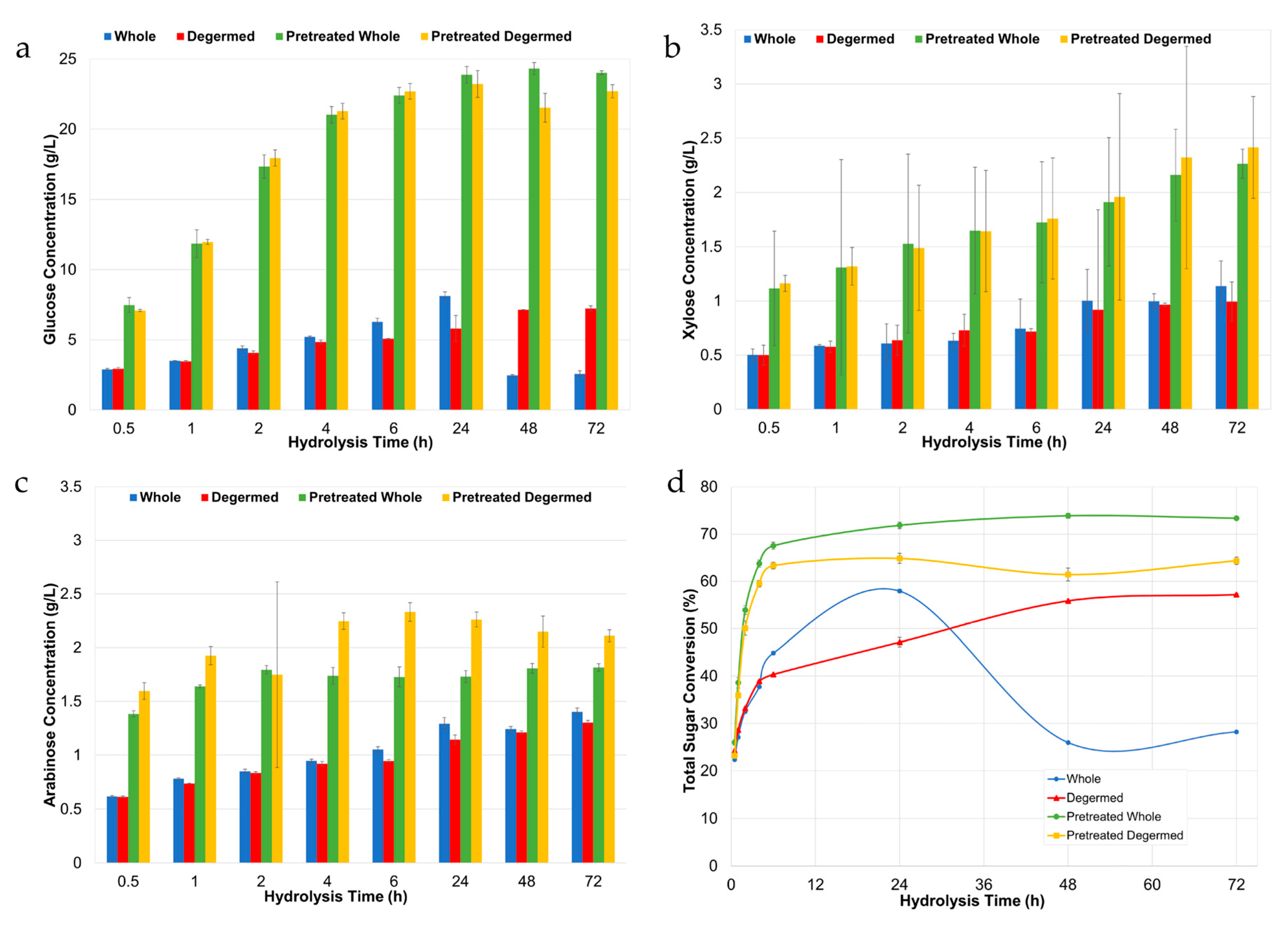
The post-fermentation CF were hydrolyzed to evaluate sugar conversion as a response to the effects of fiber characteristics, kernel degerming, chemical pretreatment, and hydrolysis duration. Figure 3a–c results show pretreatment significantly improved saccharification of the principal polysaccharides, mainly glucose. PF reached glucose concentrations of over three times those of the UF after only one hour of hydrolysis and with a greater difference as time passed. The PF had a similar glucose release until the 24 h mark (~23 g L−1), whereas the PWF continued to release additional glucose. On the other hand, concentrations for xylose and arabinose remained under 2.5 g L−1 throughout the 72 h period. For xylose, the untreated and pretreated concentrations were relatively similar between their respective whole and degermed fiber samples. For the pretreated arabinose fibers, the degermed variant reached a higher concentration than the whole fiber. Overall, after 24 h cellulosic concentrations attained over 95% its maximum concentration at 72 h. Figure 3d presents the total sugar conversions for corn fibers where the pretreated samples were more effective than their untreated counterparts, and PWF had the highest yields (over 70%). Glucose concentration accounted for more than 50% and 60% of the total sugar yield for PDF and PWF, respectively, while xylose and arabinose represented only 10%. High availability of hydrolysable substrate when reaction begins results in a rapid increase in sugar conversion. Note that after 6 h hydrolysis over 90% of the sugar conversion for the PF had already taken place, while the UDF required up to 48 h. The total sugar conversion for the UWF exhibited a rate drop after 24 h. Although decrease in substrate reactivity could be considered as a cause for its rate drop of continual hydrolysis of cellulose in long residence time, the low cellulose concentrations do not support sugar accumulation, but additional investigation is required to understand the root cause [31].

3.3. Fermentation

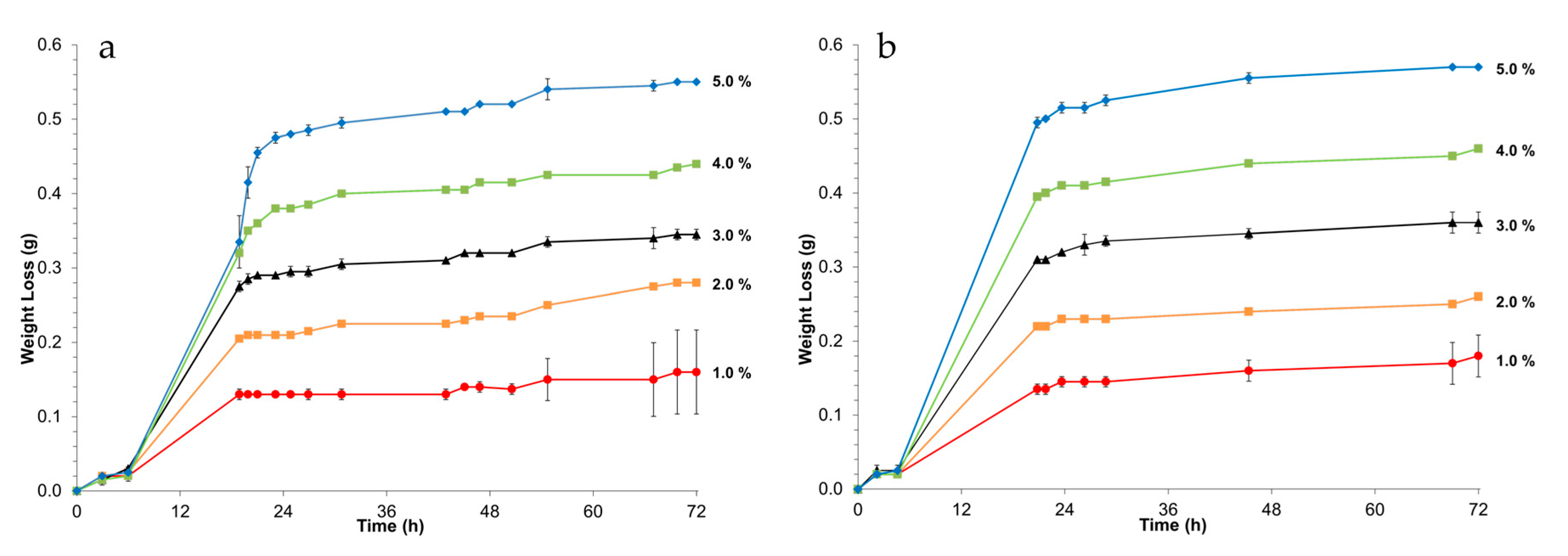
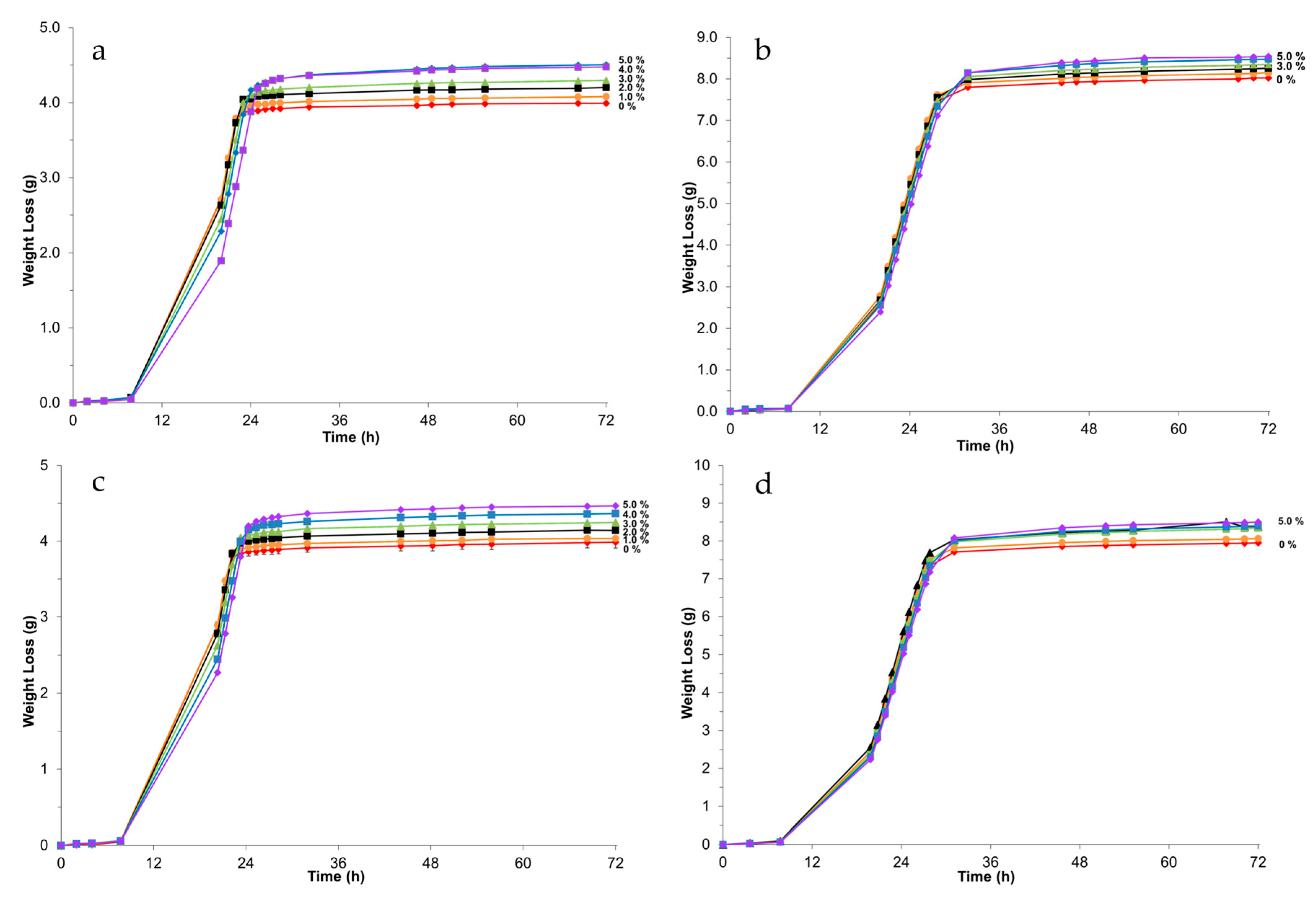
Fermentation studies were performed with solid loadings of 1–5% dry basis of PF. In addition to control fermentations using only PWF and PDF, co-fermentations with 10 or 20% solid corn added in the mixture were included in the analysis. Figure 4 compares the weight loss profiles during incubation for the control PF-only experiments and Figure 5 for the PF–corn mixtures. A longer lag phase of 8–12 h was observed for the co-fermentations, attributed to the high pH of the neutralized pretreated fiber that could have impacted the pH of the mixture and caused the lag. It is possible that the pH impacted the overall performance of the yeast; nevertheless, the fermentations proceeded quickly after the lag phase so there is no direct evidence to support a highly stressed yeast. The control fermentations did not show this added lag because pH adjustments were made prior to fermentation, ending with a pH of ~4.7. This is contrary to the PF–corn cases where the pH increased slightly as more fibers were added, changing from 4.5 to ~5.3. The abrupt change in weight loss that occurs in the log phase (6–24 h) indicates the critical conversion time for the PF. Interestingly, the main difference between PWF and PDF was the amount of weight loss experienced during the first 24 h, where PDF exhibited a larger weight loss followed by a steady weight loss during acidification slowdown. The slight weight loss changes in the linear phase corresponded to PF still being hydrolyzed and fermentation occurring quickly after.
Control fermentations exhibited weight loss profiles of the same form for all the fiber ratios and with an increasing loss rate of 0.1 g per 1 g of PF, indicating a linear relationship between fiber wt.% and weight loss after the log phase. On the other hand, co-fermentations exhibited differences between corn and fiber loadings. Due to the higher concentration of starch material in corn, an increase in weight loss was observed which was about 10 times more compared to the PF-only cases. The 20% mixtures resulted in almost twice the weight loss compared to the 10% mixtures, with this effect being reduced for fiber loadings of 4–5%. The co-fermentations lost most of the weight in about 6 h, comparable to the losses in the control fermentations, but the weight losses were more stable. Also, note there were two intervals where significant weight loss took place. In the 10% corn mixtures weight loss rates stabilized after 24 h, while in the 20% mixtures they took longer (~30 h). Particularly, the loss rates in the 20% mixtures had less variability among each other compared to the 10% mixtures. These observations were independent of whether using PWF or PDF and there was no significant statistical difference between them (p << 0.01). Generally, higher fiber loading resulted in additional weight loss, although there were minor differences between the 4 and 5% fiber loadings. The co-fermentation effects were less pronounced when mixed with more corn. These observations indicated a potential limit of CF supplementation for corn ethanol co-fermentation. After 72 h of fermentation, both the PWF and PDF reached similar weight losses.
Table 2 and Table 3 show the HPLC data after 72 h of incubation. For the PF-only experiments, the ethanol concentrations agreed closely with the weight losses shown in Figure 4, reaching over 50% of the theoretical yield based on the available glucose composition. The final concentrations of xylose and arabinose for both PWF and PDF indicated relatively poor release, reaching only about 10 and 15% of the theoretical yields for xylose and arabinose, respectively. Figure 3b,c showed the arabinose yields stabilized while the xylose yields almost tripled. The pentose levels were relatively low compared to the glucose available, but the conversion of the xylose and arabinose to ethanol could possibly be improved by adjusting the pH after mixing the corn mash and fibers and using a mixture of yeasts (e.g., pentose-fermenting or specialized Saccharomyces cerevisiae strain). Corn fiber is typically a difficult substrate to hydrolyze with enzymes even with extensive pretreatment.
Similar ethanol and sugar conversions were obtained between WF and DF, indicating the corn germ is low in cellulosic content. Ethanol yields remained consistent when supplementing corn mixtures with 1–5% PF while xylose and arabinose slightly increased; however, the ethanol concentration was lower than the control case, indicating glucose conversion was limited and additional pentose sugars were not fermented. In Figure 4, the weight loss differences between fiber loadings decreased resulting in very similar profiles for 4 and 5%. Comparing the ethanol yields with the weight loss profiles, the measured ethanol values do not agree with the observed weight loss data which clearly showed that additional CO2 was released with the fiber supplements. This discrepancy is attributed to yeast-inhibiting sugar-degrading products limiting ethanol conversion efficiency, possibly due to non-optimal pH conditions. Table 2 and Table 3 only include data for xylose and arabinose, but additional products, particularly maltotriose and dextrin, were formed and moderately increased with the addition of corn fibers. Doubling the corn loading to 20% in the co-fermentation produced more than twice the ethanol yields and only slightly more aldopentose sugars.
Anomalous behaviors observed in the fermentation data remain unresolved, though attributed to suboptimal pH or fermentation inhibitors, such as organic acids, phenolic compounds, or furfurals. Several process optimization strategies can be employed to mitigate these but were not included in this work. For example, dynamic pH control and quantifying fermentation inhibitors via HPLC or gas chromatography–mass spectrometry (GC-MS). Statistical differences (p < 0.05, df = 23, n = 96) between ethanol and sugar groups, with respect to fiber, corn wt.%, and fiber wt.%, were evaluated. The corn loading accounted for basically all the variability in ethanol yields (p << 0.001); while for the sugar yields (p << 0.001), it was mainly attributed to the fiber loadings followed by corn loading. Only the sugar yields exhibited a linear relationship with a factor of 0.87 when increasing the fiber loadings in the co-fermentations.

4. Conclusions

Maximizing biomass utilization in biorefinery processes is key to improving energy efficiency, reducing operating costs, and limiting environmental factors. CF recovered from fermentation as a by-product of bioethanol production has potential value as it contains cellulosic material suitable as a sugar supplement in subsequent corn fermentation. Biomass pretreatment with Na2CO3 increased the sugar yields during co-fermentation. Moreover, Na2CO3 pretreatment has the upside that it can be produced by reutilizing CO2 outgassed from fermentation. This approach is applicable to processing streams of either whole or degermed corn kernel fibers. Composition analysis confirmed that the alkaline pretreatment was effective at promoting enzymatic conversion, tripling the glucan concentration. The WF released more glucan and attained a higher total sugar conversion compared to DF due to loss of lignocellulosic material during the degerm step. Sugar analysis indicated that a greater release of sugars for co-fermentation could be attained by adjusting operating conditions or using a mixture of yeasts to improve simultaneous conversion of glucose, xylose, and arabinose to ethanol. Adding different mixtures of corn and recovered CF during co-fermentation resulted in higher product yields with additional corn and increasing sugar conversions with additional corn fibers. Future work includes dynamic pH control and quantifying fermentation inhibitors to improve characterization of the chemical reactions that take place. This work demonstrates how fermentation by-products can be converted into value-added products to enhance sustainable second-generation bioethanol processes.

Author Contributions

V.G.-N.: Writing—original manuscript, validation, methodology, investigation, formal analysis, project administration, conceptualization, supervision, and revision and editing of final version of manuscript. D.B.J.: validation, investigation, formal analysis, conceptualization, and revision and editing of manuscript. All authors have read and agreed to the published version of the manuscript.

Funding

This research was supported by U.S. Department of Agriculture, Agricultural Research Service, Project Number: 8072-41000-111.

Institutional Review Board Statement

Not applicable.

Informed Consent Statement

Not applicable.

Data Availability Statement

The original contributions presented in this study are inlcuded in the article. Further inquiries can be directed to the corresponding author.

Acknowledgments

The authors would like to specially thank Jennifer L. Thomas for her assistance in conducting fermentations and HPLC analysis, and Matthew J. Toht for his assistance on the pretreatments of CF and HPLC analysis. Authors thank Novonesis for donating enzymes used in this research.

Conflicts of Interest

The authors declare no conflict of interest. Mention of trade names or commercial products in this article is solely for the purpose of providing scientific information and does not imply recommendation or endorsement by the United States Department of Agriculture (USDA). USDA is an equal employment provider and employer.

Abbreviations

The following abbreviations are used in this manuscript:
ATR-FTIRAttenuated total reflectance–Fourier Transform Infrared Spectroscopy
CFCorn fiber
CO2Carbon dioxide
DFDegermed corn fibers (untreated and pretreated)
HPLCHigh-performance liquid chromatography
Na2CO3Sodium carbonate
PDFPretreated degermed corn fiber
PFPretreated corn fibers (whole and degermed)
PWFPretreated whole corn fiber
UDFUntreated degermed corn fiber
UFUntreated corn fibers (whole and degermed)
UWFUntreated whole corn fiber
WFWhole corn fibers (untreated and pretreated)

References

  1. Ćetković, J.; Lakić, S.; Živković, A.; Žarković, M.; Vujadinović, R. Economic analysis of measures for GHG emission reduction. Sustainability 2021, 13, 1712. [Google Scholar] [CrossRef]
  2. Mankar, A.R.; Pandey, A.; Modak, A.; Pant, K. Pretreatment of lignocellulosic biomass: A review on recent advances. Bioresour. Technol. 2021, 334, 125235. [Google Scholar] [CrossRef]
  3. Rosales-Calderon, O.; Arantes, V. A review on commercial-scale high-value products that can be produced alongside cellulosic ethanol. Biotechnol. Biofuels 2019, 12, 240. [Google Scholar] [CrossRef]
  4. Olatunji, K.O.; Ahmed, N.A.; Ogunkunle, O. Optimization of biogas yield from lignocellulosic materials with different pretreatment methods: A review. Biotechnol. Biofuels 2021, 14, 159. [Google Scholar] [CrossRef]
  5. U.S. Fuel Ethanol Plant Production Capacity. 2023. Available online: https://www.eia.gov/petroleum/ethanolcapacity/ (accessed on 9 October 2023).
  6. Dijkstra, A.J. Vegetable Oils: Types and Properties. In Encyclopedia of Food and Health; Elsevier: Amsterdam, The Netherlands, 2016. [Google Scholar] [CrossRef]
  7. García-Lara, S.; Serna-Saldivar, S.O. Corn history and culture. In Corn; Elsevier: Amsterdam, The Netherlands, 2019; pp. 1–18. [Google Scholar] [CrossRef]
  8. Norvell, K.L.; Nghiem, N.P. Soaking in Aqueous Ammonia (SAA) Pretreatment of Whole Corn Kernels for Cellulosic Ethanol Production from the Fiber Fractions. Fermentation 2018, 4, 87. [Google Scholar] [CrossRef]
  9. Wang, M.; Qiao, J.; Sheng, Y.; Wei, J.; Cui, H.; Li, X.; Yue, G. Bioconversion of corn fiber to bioethanol: Status and perspectives. Waste Manag. 2023, 157, 256–268. [Google Scholar] [CrossRef]
  10. Wang, Y.; Wang, S.; Li, R.; Wang, Y.; Xiang, Q.; Qiu, S.; Xu, W.; Bai, Y. Synergistic effect of corn fiber gum and chitosan in stabilization of oil in water emulsion. LWT 2022, 154, 112592. [Google Scholar] [CrossRef]
  11. Guo, Y.; Liu, G.; Ning, Y.; Li, X.; Hu, S.; Zhao, J.; Qu, Y. Production of cellulosic ethanol and value-added products from corn fiber. Bioresour. Bioprocess. 2022, 9, 81. [Google Scholar] [CrossRef] [PubMed]
  12. Van Eylen, D.; Van Dongen, F.; Kabel, M.; De Bont, J. Corn fiber, cobs and stover: Enzyme-aided saccharification and co-fermentation after dilute acid pretreatment. Bioresour. Technol. 2011, 102, 5995–6004. [Google Scholar] [CrossRef] [PubMed]
  13. Brillard, A.; Brilhac, J.-F. Improved relationships between kinetic parameters associated with biomass pyrolysis or combustion. Bioresour. Technol. 2021, 342, 126053. [Google Scholar] [CrossRef] [PubMed]
  14. Meenakshisundaram, S.; Fayeulle, A.; Leonard, E.; Ceballos, C.; Pauss, A. Fiber degradation and carbohydrate production by combined biological and chemical/physicochemical pretreatment methods of lignocellulosic biomass–A review. Bioresour. Technol. 2021, 331, 125053. [Google Scholar] [CrossRef] [PubMed]
  15. Reshmy, R.; Balakumaran, P.A.; Divakar, K.; Philip, E.; Madhavan, A.; Pugazhendhi, A.; Sirohi, R.; Binod, P.; Awasthi, M.K.; Sindhu, R. Microbial valorization of lignin: Prospects and challenges. Bioresour. Technol. 2022, 344, 126240. [Google Scholar] [CrossRef] [PubMed]
  16. Zhao, L.; Guo, S.; Ci, Y.; An, Y.; Huang, A.; Li, Z.; Qin, Y.; Xu, Q.; Lu, F.; Liu, F. Efficient saccharification of cellulose by a photo-assisted biocatalysis system. Ind. Crops Prod. 2021, 174, 114191. [Google Scholar] [CrossRef]
  17. Gáspár, M.; Kálmán, G.; Réczey, K. Corn fiber as a raw material for hemicellulose and ethanol production. Process Biochem. 2007, 42, 1135–1139. [Google Scholar] [CrossRef]
  18. García-Negrón, V.; Toht, M.J. Corn Stover Pretreatment with Na2CO3 Solution from Absorption of Recovered CO2. Fermentation 2022, 8, 600. [Google Scholar] [CrossRef]
  19. Nghiem, N.P.; Toht, M.J. Pretreatment of Sweet Sorghum Bagasse for Ethanol Production Using Na2CO3 Obtained by NaOH Absorption of CO2 Generated in Sweet Sorghum Juice Ethanol Fermentation. Fermentation 2019, 5, 91. [Google Scholar] [CrossRef]
  20. da Costa Lopes, A.M. Biomass delignification with green solvents towards lignin valorisation: Ionic liquids vs deep eutectic solvents. Acta Innov. 2021, 40, 64–78. [Google Scholar] [CrossRef]
  21. Silveira, M.H.L.; Morais, A.R.C.; da Costa Lopes, A.M.; Olekszyszen, D.N.; Bogel-Łukasik, R.; Andreaus, J.; Pereira Ramos, L. Current pretreatment technologies for the development of cellulosic ethanol and biorefineries. ChemSusChem 2015, 8, 3366–3390. [Google Scholar] [CrossRef]
  22. Roy, S.; Chakraborty, S. Emerging technologies for waste biomass pretreatment: Pros and cons. In Processing of Biomass Waste; Elsevier: Amsterdam, The Netherlands, 2024; pp. 41–54. [Google Scholar] [CrossRef]
  23. Sluiter, A.; Hames, B.; Ruiz, R.; Scarlata, C.; Sluiter, J.; Templeton, D.; Crocker, D. Determination of structural carbohydrates and lignin in biomass. Lab. Anal. Proced. 2008, 1617, 1–16. [Google Scholar]
  24. Johnston, D.B.; McAloon, A.J. Protease increases fermentation rate and ethanol yield in dry-grind ethanol production. Bioresour. Technol. 2014, 154, 18–25. [Google Scholar] [CrossRef]
  25. AOAC International; Latimer, G.W. Official Methods of Analysis of AOAC International, 19th ed.; AOAC International Gaithersburg: Gaithersburg, MD, USA, 2012. [Google Scholar]
  26. Johnston, D.B.; Nghiem, N.P. Mixed fermentation of corn and pretreated corn stover for fuel ethanol production. Cereal Chem. 2021, 98, 926–934. [Google Scholar] [CrossRef]
  27. Yadav, M.P.; Moreau, R.A.; Hotchkiss, A.T.; Hicks, K.B. A new corn fiber gum polysaccharide isolation process that preserves functional components. Carbohydr. Polym. 2012, 87, 1169–1175. [Google Scholar] [CrossRef]
  28. Barbosa, B.M.; Vaz, S., Jr.; Colodette, J.L.; de Aguiar, A.R.; Cabral, C.P.T.; de Freitas Homem de Faria, B. Structural and chemical characterization of lignin and hemicellulose isolated from corn fibers toward agroindustrial residue valorization. Cellulose 2022, 29, 8117–8132. [Google Scholar] [CrossRef]
  29. Devi, S.; Poonia, P.K.; Kumar, V.; Tiwari, A.; Meena, R.K.; Kumar, U.; Gulnaz, A.; Al-Sadoon, M.K. Characterization of Natural Fiber Extracted from Corn (Zea mays L.) Stalk Waste for Sustainable Development. Sustainability 2022, 14, 16605. [Google Scholar] [CrossRef]
  30. Mou, H.; Li, B.; Fardim, P. Pretreatment of corn stover with the modified hydrotropic method to enhance enzymatic hydrolysis. Energy Fuels 2014, 28, 4288–4293. [Google Scholar] [CrossRef]
  31. Zhang, S.; Wolfgang, D.E.; Wilson, D.B. Substrate heterogeneity causes the nonlinear kinetics of insoluble cellulose hydrolysis. Biotechnol. Bioeng. 1999, 66, 35–41. [Google Scholar] [CrossRef]
Figure 1. Process flow diagram for conversion of whole and degermed corn to ethanol and post-fermentation recovery of CF for sugar and co-fermentation utilization. Pretreated corn fibers (PF) were treated with sodium carbonate (Na2CO3) formed with carbon dioxide (CO2) outgassed from fermentation. Green color represents the “primary products” and orange color represents the “By-products”.
Fermentation 12 00061 g001
Figure 2. FTIR profiles of post-fermentation corn kernel fibers. The legend labels correspond to corn fiber samples: whole (UWF), degermed (UDF), pretreated whole (PWF), and pretreated degermed (PDF).
Fermentation 12 00061 g002
Figure 3. Average sugar concentrations of post-fermentation corn kernel fibers: (a) glucose, (b) xylose, and (c) arabinose. (d) Total sugar yields of post-fermentation corn kernel fibers. The legend labels correspond to corn fiber samples: whole (UWF), degermed (UDF), pretreated whole (PWF), and pretreated degermed (PDF).
Fermentation 12 00061 g003
Figure 4. (a) Control fermentations of pretreated whole corn kernel fiber (PWF) and (b) pretreated degermed corn kernel fiber (PDF) showing weight loss progression over 72 h. Error bars represent ± one standard deviation from the average value from duplicate flasks and are shown for 1%, 3%, and 5% for improved clarity.
Fermentation 12 00061 g004
Figure 5. Mixed fermentations of 10% (a) and 20% (b) corn and pretreated whole corn kernel fiber (PWF) and 10% (c) and 20% (d) corn and pretreated degermed corn kernel fiber (PDF), all showing weight loss progression over 72 h. Error bars representing ± one standard deviation from average were smaller than data points so were omitted for clarity. (bd) are color coded with respect to (a). solid loadings: 5.0% (blue), 4.0% (purple), 3.0% (green), 2.0% (black), 1.0% (orange), and 0% (red).
Fermentation 12 00061 g005
Table 1. Composition analysis of corn fibers on a dry weight basis for untreated and pretreated samples. For each lignocellulosic component, statistical differences (p < 0.05, df = 3, n = 12) between groups, with respect to fiber and treatment, are represented with superscript letters. N/A: data not reported.
Corn Fiber SampleMoisture Content
(%)
Total Lignin
(%)
Glucan
(%)
Xylan
(%)
Arabinan
(%)
Ash
(%)
Solid Yield After Pretreatment
(%)
Whole
(UWF)
2.39 ± 0.1619.96 ± 3.93 a13.01 ± 0.01 a10.27 ± 0.85 a5.53 ± 0.49 a0.63 ± 0.20N/A
Degermed (UDF)2.97 ± 0.0617.95 ± 0.59 a11.17 ± 0.00 a10.34 ± 0.29 a5.00 ± 0.09 a3.01 ± 0.68N/A
Pretreated Whole
(PWF)
1.73 ± 0.02-32.25 ± 1.91 b14.52 ± 0.21 b9.14 ± 0.58 b7.99 ± 1.2947.15
Pretreated
Degermed (PDF)
1.57± 0.09-33.51 ± 6.20 b20.76 ± 3.35 c11.80 ± 0.76 c10.32 ± 2.2439.51
Table 2. Ethanol and sugar yields after 72 h fermentations using pretreated degermed corn kernel fibers (PDF).
PDF
(% Dry Basis)
Ethanol Xylose Arabinose
(g L−1)%Theor a(g L−1)%Theor b(g L−1)%Theor b
11.80 ± 0.3386.90.26 ± 0.0512.40.19 ± 0.0914.4
22.37 ± 0.1757.20.37 ± 0.028.80.31 ± 0.0612.2
33.67 ± 0.7859.10.67 ± 0.1210.60.67 ± 0.1317.9
44.50 ± 0.9554.30.85 ± 0.1410.10.87 ± 0.1116.9
55.94 ± 0.8257.41.09 ± 0.1710.31.14 ± 0.1817.7
10% Corn + PDF      
043.39 ± 1.50 0.26 ± 0.01 0.31 ± 0.02 
141.53 ± 0.93-0.49 ± 0.0323.20.54 ± 0.0242.2
241.34 ± 0.59-0.64 ± 0.0315.00.73 ± 0.1028.2
339.25 ± 0.77-0.76 ± 0.0112.00.95 ± 0.0324.6
442.16 ± 0.40-0.88 ± 0.1110.41.20 ± 0.0323.3
542.40 ± 0.70-1.03 ± 0.109.81.27 ± 0.1319.8
20% Corn + PDF      
086.83 ± 1.50 0.40 ± 0.01 0.58 ± 0.01 
186.98 ± 0.93-0.72 ± 0.1633.90.79 ± 0.1161.6
284.26 ± 0.59-0.72 ± 0.1617.01.05 ± 0.0940.8
386.44 ± 0.77-0.92 ± 0.0314.61.27 ± 0.0432.9
483.01 ± 0.40-1.00 ± 0.0511.81.38 ± 0.0526.9
586.09 ± 0.70-1.08 ± 0.0810.21.54 ± 0.2023.9
a Theoretical ethanol yield is based on glucan conversion from pretreated corn kernel fiber. b Theoretical sugar yields were calculated after reduction in corn-only control.
Table 3. Ethanol and sugar yields after 72 h fermentations using pretreated whole corn kernel fibers (PWF).
PWF
(% Dry Basis)
Ethanol Xylose Arabinose
(g L−1)%Theor a(g L−1)%Theor b(g L−1)%Theor b
10.59 ± 0.8328.50.20 ± 0.019.50.17 ± 0.0113.4
22.03 ± 0.0848.90.35 ± 0.058.40.33 ± 0.0612.8
33.61 ± 0.7358.20.71 ± 0.1911.20.68 ± 0.1717.6
44.04 ± 0.6348.80.81 ± 0.029.60.80 ± 0.1715.5
55.10 ± 0.1449.31.01 ± 0.049.61.00 ± 0.0315.4
10% Corn + PWF      
042.12 ± 0.10 0.12 ± 0.16 0.29 ± 0.02 
142.12 ± 0.24-0.53 ± 0.0124.90.58 ± 0.0244.6
242.44 ± 0.29-0.69 ± 0.0216.30.76 ± 0.0129.5
342.41 ± 0.53-0.84 ± 0.0513.20.89 ± 0.1223.1
441.67 ± 1.10-0.88 ± 0.2110.41.04 ± 0.1920.2
541.39 ± 0.64-0.93 ± 0.288.80.92 ± 0.0214.3
20% Corn + PWF      
086.96 ± 0.40 0.44 ± 0.04 0.58 ± 0.01 
186.31 ± 0.59-0.63 ± 0.0129.70.75 ± 0.0658.5
287.72 ± 1.17-0.81 ± 0.0519.11.03 ± 0.0340.0
385.44 ± 0.09-0.91 ± 0.0214.41.12 ± 0.0430.9
484.32 ± 0.55-1.00 ± 0.0111.81.36 ± 0.0126.3
586.89 ± 3.20-1.11 ± 0.1610.51.51 ± 0.2223.5
a Theoretical ethanol yield is based on glucan conversion from pretreated corn kernel fiber. b Theoretical sugar yields were calculated after reduction of corn-only control.
Disclaimer/Publisher’s Note: The statements, opinions and data contained in all publications are solely those of the individual author(s) and contributor(s) and not of MDPI and/or the editor(s). MDPI and/or the editor(s) disclaim responsibility for any injury to people or property resulting from any ideas, methods, instructions or products referred to in the content.