
GHG Emissions and Carbon Sequestration in Coastal Bambusa edulis Shelterbelts with Biochar and Organic Fertilizer

 , ,
, ,  , , and
Abstract
1. Introduction
2. Materials and Methods
2.1. Study Site and Experimental Design
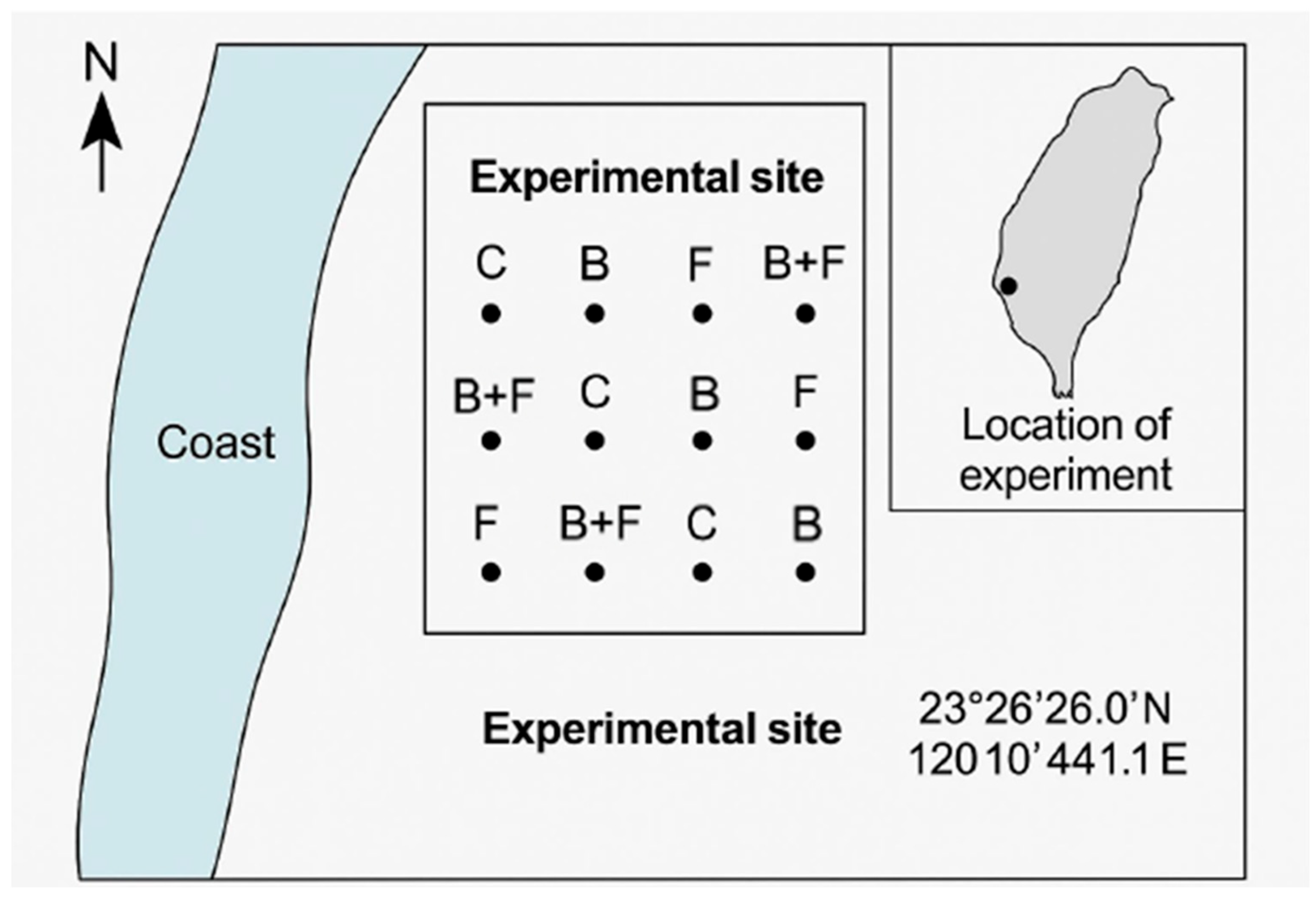
2.1.1. Location
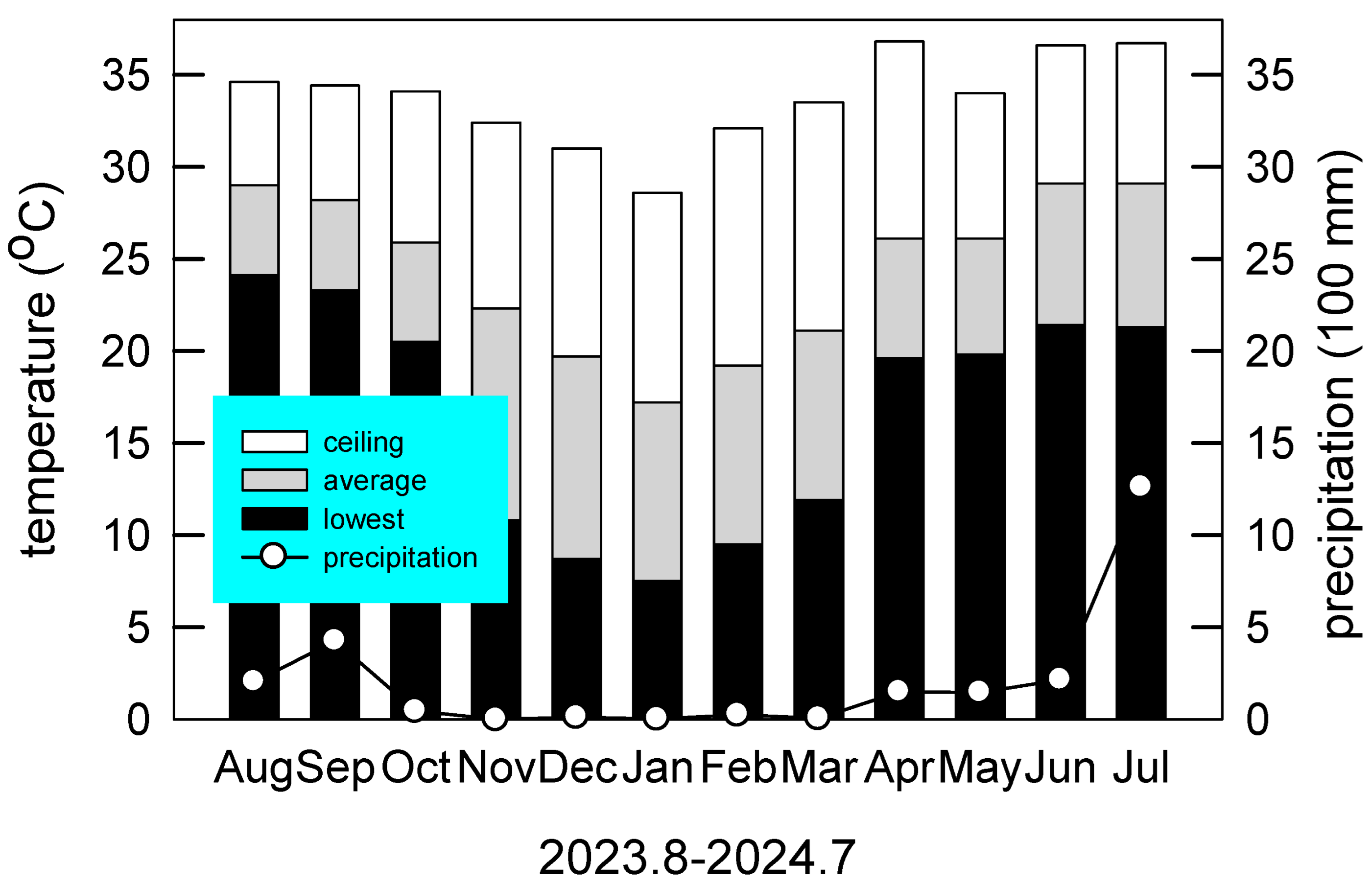
2.1.2. Climatic Data
2.1.3. Soil Characterization
2.1.4. Crop and Its Management
2.1.5. Measurement
2.2. Soil Greenhouse Gas Flux Measurement
- F: Gas flux (mg m−2 h−1)
- S: Slope of gas concentration increase over time (ppm s−1) (CH4: 20 s; N2O: 20 s; CO2: 30 s)
- V: Volume of the chamber (L)
- tc: Time conversion constant, N2O: 20 s: 180 = (1 h × (60 min/h) × ((60 s/min)/20 s)); CO2: 120 = (1 h × (60 min/h) × ((60 s/min)/30 s))
- M: Molecular weight of the gas (g mol−1)
- R: Ideal gas constant (0.082 L atm mol−1 K−1)
- T: Absolute temperature (K)
- 1000: Unit conversion factor (1 mg = 1000 µg)
- A: Area of the chamber base (m2)
2.3. Photosynthetic Carbon Assimilation Measurement
2.4. Statistical Analysis
3. Results
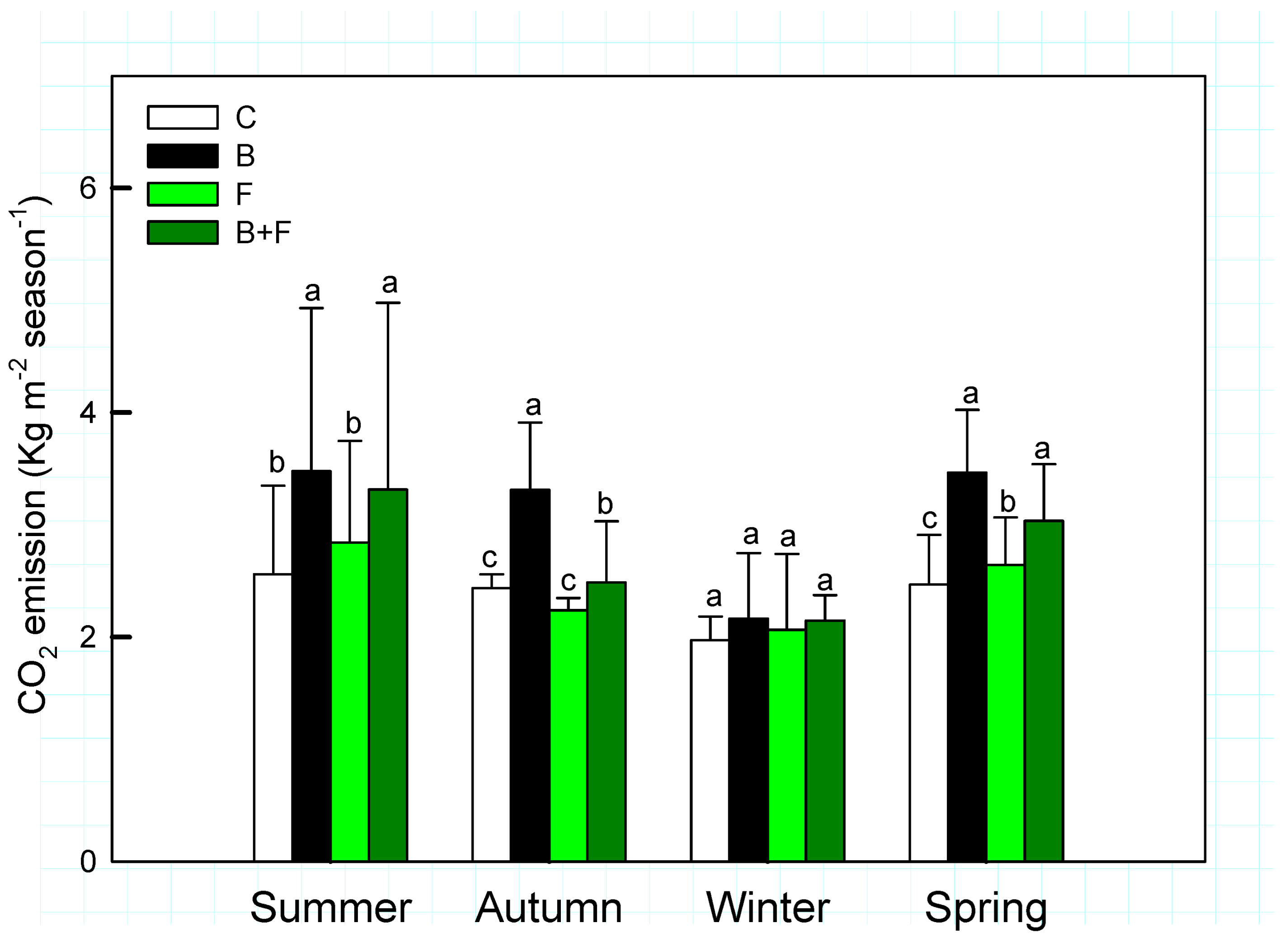
3.1. Seasonal Variation in CO2 Emissions
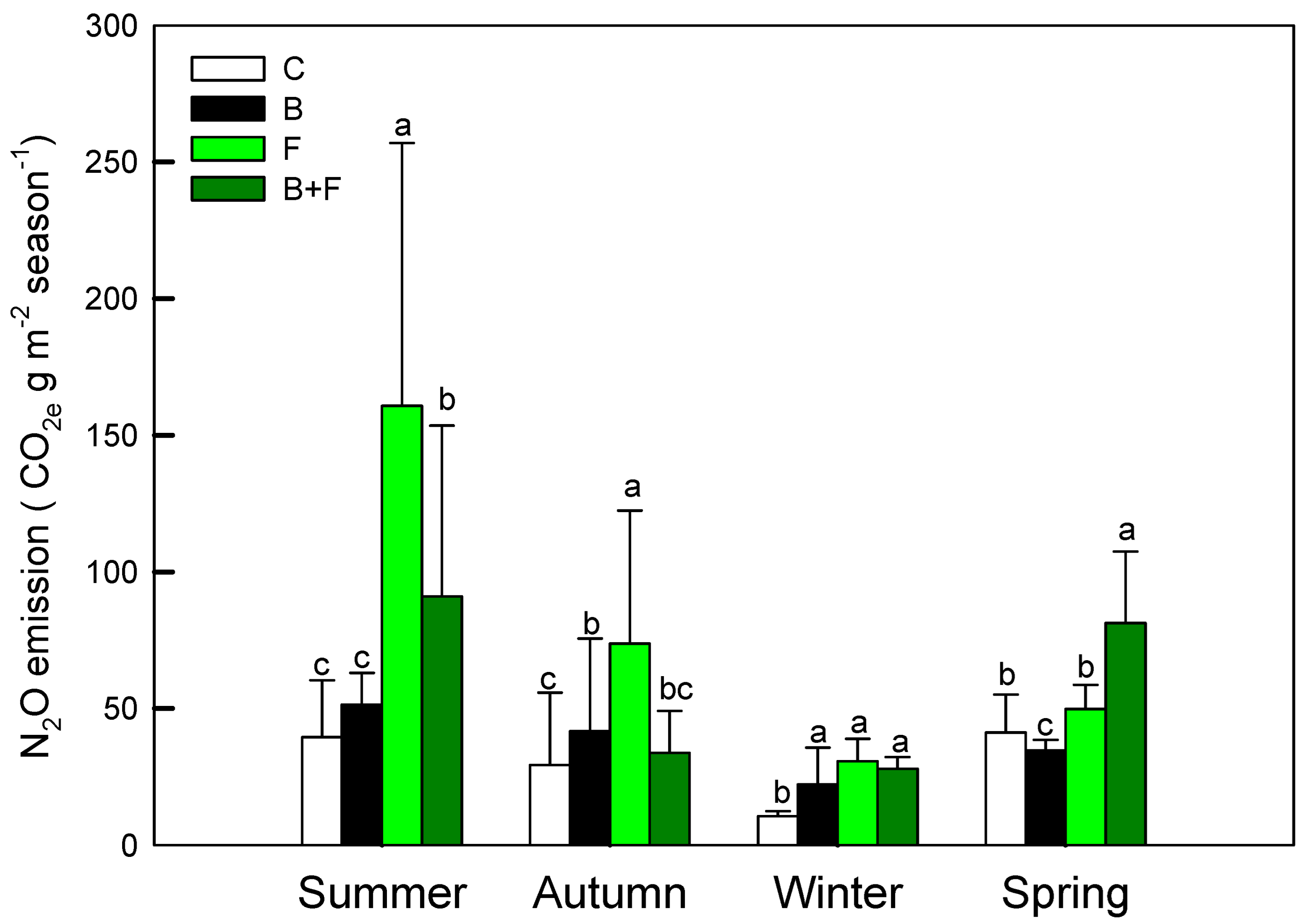
3.2. N2O Emissions and Fertilizer Response
3.3. Carbon Assimilation Performance
4. Discussion
4.1. CO2 Emissions
4.2. N2O Emissions and Nitrogen Transformation Pathways
4.3. Carbon Assimilation and Photosynthetic Response
4.4. Management Implications for Bamboo Agroecosystems
5. Conclusions
Author Contributions
Funding
Data Availability Statement
Conflicts of Interest
References
- IPCC. Climate Change 2023: Synthesis Report. Intergovernmental Panel on Climate Change, 2023. Available online: https://www.ipcc.ch/report/ar6/syr/ (accessed on 25 June 2025).
- Seddon, N.; Chausson, A.; Berry, P.; Girardin, C.A.J.; Smith, A.; Turner, B. Understanding the value and limits of nature-based solutions to climate change and other global challenges. Philos. Trans. R. Soc. B 2020, 375, 20190120. [Google Scholar] [CrossRef] [PubMed]
- Science Based Targets Initiative (SBTi). Foundations for Science-Based Net-Zero Target Setting in the Corporate Sector; SBTi: London, UK, 2021; Available online: https://sciencebasedtargets.org (accessed on 25 June 2025).
- Taskforce on Nature-Related Financial Disclosures (TNFD). Guidance on the Identification and Assessment of Nature-Related Issues. In The LEAP Approach; TNFD: London, UK, 2023; Available online: https://tnfd.global (accessed on 25 June 2025).
- Wang, Y.C. Estimates of biomass and carbon sequestration in Dendrocalamus latiflorus culms. For. Prod. Ind. 2004, 23, 13–22. [Google Scholar]
- Song, X.; Zhou, G.; Jiang, H.; Yu, S.; Fu, J.; Li, W.; Wang, W.; Ma, Z.; Peng, C. Carbon sequestration by Chinese bamboo forests and their ecological benefits: Assessment of potential, problems, and future challenges. Environ. Rev. 2011, 19, 418–428. [Google Scholar] [CrossRef]
- Adekiya, A.O.; Alori, E.T.; Ogunbode, T.O.; Sangoyomi, T.; Oriade, O.A. Enhancing organic carbon content in rropical soils: Strategies for sustainable agriculture and climate change mitigation. Open Agric. J. 2023, 17, e18743315282476. [Google Scholar] [CrossRef]
- Liu, Y.H.; Yen, T.M. Assessing aboveground carbon storage capacity in bamboo plantations with various species related to its affecting factors across Taiwan. For. Ecol. Manag. 2021, 481, 118745. [Google Scholar] [CrossRef]
- Lin, M.Y.; Hsieh, I.F.; Lin, P.H.; Laplace, S.; Ohashi, M.; Chen, T.H.; Kume, T. Moso bamboo (Phyllostachys pubescens) forests as a significant carbon sink? A case study based on 4-year measurements in central Taiwan. Ecol. Res. 2017, 32, 845–857. [Google Scholar] [CrossRef]
- Antal, M.J.; Grønli, M. The art, science, and technology of charcoal production. Ind. Eng. Chem. Res. 2003, 42, 1619–1640. [Google Scholar] [CrossRef]
- Jeffery, S.; Bezemer, T.M.; Cornelissen, G.; Kuyper, T.W.; Lehmann, J.; Mommer, L.; Sohi, S.P.; van de Voorde, T.F.; Wardle, D.A.; van Groenigen, J.W. The way forward in biochar research: Targeting trade-offs between the potential wins. Glob. Change Biol. Bioenergy 2015, 7, 1–13. [Google Scholar] [CrossRef]
- Gul-Lalay; Ullah, S.; Shah, S.; Jamal, A.; Saeed, M.F.; Mihoub, A.; Zia, A.; Ahmed, I.; Seleiman, M.F.; Mancinelli, R.; et al. Combined effect of biochar and plant growth-promoting rhizobacteria on physiological responses of canola (Brassica napus L.) subjected to drought stress. J. Plant Growth Regul. 2024, 43, 1814–1832. [Google Scholar] [CrossRef]
- Ahmad, I.; Ghaffar, A.; Zakir, A.; Khan, Z.U.H.; Saeed, M.F.; Rasool, A.; Jamal, A.; Mihoub, A.; Marzeddu, S.; Boni, M.R. Activated biochar is an effective technique for arsenic removal from contaminated drinking water in Pakistan. Sustainability 2022, 14, 14523. [Google Scholar] [CrossRef]
- Wang, X.; Song, D.; Liang, G.; Liang, G.; Zhang, Q.; Ai, C.; Zhou, W. Maize biochar addition rate influences soil enzyme activity and microbial community composition in a fluvo-aquic soil. Appl. Soil Ecol. 2015, 96, 265–272. [Google Scholar] [CrossRef]
- Song, X.; Razavi, B.; Ludwig, B.; Zamanian, K.; Zang, H.; Kuzyakov, Y.; Dippold, M.A.; Gunina, A. Combined biochar and nitrogen application stimulates enzyme activity and root plasticity. Sci. Total Environ. 2020, 735, 139393. [Google Scholar] [CrossRef]
- Lehmann, J.; Joseph, S. Biochar for Environmental Management: An Introduction. In Biochar for Environmental Management; Joannes, L., Stephen Joseph, S., Eds.; Earthscan: London, UK, 2009; pp. 1–12. [Google Scholar]
- Song, X.; Pan, G.; Zhang, C.; Zhang, L.; Wang, H. Effects of biochar application on fluxes of three biogenic greenhouse gases: A meta-analysis. Ecosyst. Health Sustain. 2016, 2, e01202. [Google Scholar] [CrossRef]
- Li, Y.; Hu, S.; Chen, J.; Müller, K.; Li, Y.; Fu, W.; Lin, Z.; Wang, H. Effects of biochar application in forest ecosystems on soil properties and greenhouse gas emissions: A review. J. Soils Sediments 2018, 18, 546–563. [Google Scholar] [CrossRef]
- Ma, R.; Wu, X.; Liu, Z.; Yi, Q.; Xu, M.; Zheng, J.; Bian, R.; Zhang, X.; Pan, G. Biochar improves soil organic carbon stability by shaping the microbial community structures at different soil depths four years after an incorporation in a farmland soil. Curr. Res. Environ. Sustain. 2023, 5, 100214. [Google Scholar] [CrossRef]
- Yang, X.C.; Huang, M.Y.; Chen, C.I.; Lin, C.H.; Huang, W.H.; Lee, L.H.; Wang, C.W. Assessing the benefits of alternating wet and dry (AWD) irrigation of rice fields on greenhouse gas emissions in central Taiwan. Taiwania 2025, 70, 530–539. [Google Scholar]
- Wang, C.W.; Lin, K.H.; Feng, Y.Z.; Lin, Y.W.; Yang, Z.W.; Chen, C.I.; Huang, M.-Y. Effects of crop rotation and tillage on CO2 and CH4 fluxes in paddy fields. Taiwania 2025, 70, 512–520. [Google Scholar]
- Woolf, D.; Amonette, J.E.; Street-Perrott, F.A.; Lehmann, J.; Joseph, S. Sustainable biochar to mitigate global climate change. Nat. Commun. 2010, 1, 56. [Google Scholar] [CrossRef]
- Biederman, L.A.; Harpole, W.S. Biochar and its effects on plant productivity and nutrient cycling: A meta-analysis. GCB Bioenergy 2013, 5, 202–214. [Google Scholar] [CrossRef]
- Novak, J.M.; Lima, I.; Xing, B.; Gaskin, J.W.; Steiner, C.; Das, K.C.; Ahmedna, M.; Rehrah, D.; Watts, D.W.; Busscher, W.J.; et al. Characterization of designer biochar produced at different temperatures and their effects on a loamy sand. Ann. Environ. Sci. 2009, 3, 195–206. [Google Scholar]
- Gao, J.; Li, Q.; Zhang, J.; Cui, K.; Wu, Z.; Shi, M.; Song, X. Biochar amendment alters the nutrient-use strategy of Moso bamboo under N additions. Front. Plant Sci. 2021, 12, 667964. [Google Scholar] [CrossRef]
- United States Salinity Laboratory Staff. Diagnosis and Improvement of Saline and Alkali Soils. In Agriculture Handbook 60; Richards, L.A., Ed.; U.S. Department of Agriculture: Washington, DC, USA, 1954. [Google Scholar]
- Liu, C.C.; Huang, L.C.; Chang, C.T.; Sung, H.Y. Purification and characterization of soluble invertases from suspension-cultured bamboo (Bambusa edulis) cells. Food Chem. 2006, 96, 621–631. [Google Scholar] [CrossRef]
- Pao, S.H.; Wu, H.; Hsieh, H.L.; Chen, C.P.; Lin, H.J. Effects of modulating probiotics on greenhouse gas emissions and yield in rice paddies. Plant Soil Environ. 2025, 71, 21–35. [Google Scholar] [CrossRef]
- Chen, C.-I.; Wang, Y.-N.; Lin, H.-H.; Wang, C.-W.; Yu, J.-C.; Chen, Y.-C. Seasonal photosynthesis and carbon assimilation dynamics in a Zelkova serrata (Thunb.) Makino Plantation. Forests 2021, 12, 467. [Google Scholar] [CrossRef]
- Raich, J.W.; Tufekciogul, A. Vegetation and soil respiration: Correlations and controls. Biogeochemistry 2000, 48, 71–90. [Google Scholar] [CrossRef]
- Subke, J.A.; Inglima, I.; Cotrufo, M.F. Trends and methodological impacts in soil CO2 efflux partitioning: A meta-analytical review. Glob. Change Biol. 2006, 12, 921–943. [Google Scholar] [CrossRef]
- Liu, Q.; Wang, R.; Li, R.; Hu, Y.; Guo, S. Temperature sensitivity of soil respiration to nitrogen fertilization: Varying effects between growing and non-growing seasons. PLoS ONE 2016, 11, e0168599. [Google Scholar] [CrossRef]
- Davidson, E.A.; Janssens, I.A.; Luo, Y. On the variability of respiration in terrestrial ecosystems: Moving beyond Q10. Glob. Change Biol. 2006, 12, 154–164. [Google Scholar]
- Singh, B.P.; Hatton, B.J.; Singh, B.; Cowie, A.L.; Kathuria, A. Influence of biochars on nitrous oxide emission and nitrogen leaching from two contrasting soils. J. Environ. Qual. 2010, 39, 1224–1235. [Google Scholar] [CrossRef]
- Oertel, C.; Matschullat, J.; Zurba, K.; Zimmermann, F.; Erasmi, S. Greenhouse gas emissions from soils—A review. Geochemistry 2016, 76, 327–352. [Google Scholar] [CrossRef]
- Wang, X.; Gao, X.; Chen, X. Meta-analysis data quantifying nitrous oxides emissions from Chinese vegetable production. Data Brief 2018, 19, 114–116. [Google Scholar] [CrossRef] [PubMed]
- Zimmerman, A.R.; Gao, B.; Ahn, M.Y. Positive and negative carbon mineralization priming effects among a variety of biochar-amended soils. Soil Biol. Biochem. 2011, 43, 1169–1179. [Google Scholar] [CrossRef]
- Ventura, M.; Sorrenti, G.; Panzacchi, P.; George, E.; Tonon, G. Biochar reduces short-term nitrate leaching from a horizon in an apple orchard. J. Environ. Qual. 2013, 42, 76–82. [Google Scholar] [CrossRef]
- Bovsun, M.A.; Castaldi, S.; Nesterova, O.V.; Semal, V.A.; Sakara, N.A.; Brikmans, A.V.; Khokhlova, A.I.; Karpenko, T.Y. Effect of Biochar on Soil CO2 Fluxes from Agricultural Field Experiments in Russian Far East. Agronomy 2021, 11, 1559. [Google Scholar] [CrossRef]
- Abalos, D.; Jeffery, S.; Sanz-Cobena, A.; Guardia, G.; Vallejo, A. Meta-analysis of the effect of urease and nitrification inhibitors on crop productivity and nitrogen use efficiency. Agric. Ecosyst. Environ. 2014, 189, 136–144. [Google Scholar] [CrossRef]
- Shcherbak, I.; Millar, N.; Robertson, G.P. Global meta-analysis of the nonlinear response of soil nitrous oxide (N2O) emissions to fertilizer nitrogen. Proc. Natl. Acad. Sci. USA 2014, 111, 9199–9204. [Google Scholar] [CrossRef] [PubMed]
- Baggs, E.M. Soil microbial sources of nitrous oxide: Recent advances in knowledge, emerging challenges and future direction. Curr. Opin. Environ. Sustain. 2011, 3, 321–327. [Google Scholar] [CrossRef]
- Akiyama, H.; Yan, X.; Yagi, K. Evaluation of effectiveness of enhanced-efficiency fertilizers as mitigation options for N2O and NO emissions from agricultural soils: Meta-analysis. Glob. Change Biol. 2010, 16, 1837–1846. [Google Scholar] [CrossRef]
- Amirahmadi, E.; Ghorbani, M.; Adani, F. Biochar contribution in greenhouse gas mitigation and crop yield considering pyrolysis conditions, utilization strategies and plant type—A meta-analysis. Field Crops Res. 2025, 333, 110040. [Google Scholar] [CrossRef]
- Charles, A.; Rochette, P.; Whalen, J.K.; Angers, D.A.; Chantigny, M.H.; Bertrand, N. Global nitrous oxide emission factors from agricultural soils after addition of organic amendments: A meta-analysis. Agric. Ecosyst. Environ. 2017, 236, 88–98. [Google Scholar] [CrossRef]
- Liu, X.; Zhang, A.; Ji, C.; Joseph, S.; Bian, R.; Li, L.; Pan, G.; Paz-Ferreiro, J. Biochar’s effect on crop productivity and the dependence on experimental conditions—A meta-analysis of literature data. Plant Soil 2013, 373, 583–594. [Google Scholar] [CrossRef]
- Xia, F.; Mei, K.; Xu, Y.; Zhang, C.; Dahlgren, R.A.; Zhang, M. Response of N2O emission to manure application in field trials of agricultural soils across the globe. Sci. Total Environ. 2020, 733, 139390. [Google Scholar] [CrossRef] [PubMed]
- Loaiza, S.; Verchot, L.; Valencia, D.; Guzmán, P.; Amezquita, N.; Garcés, G.; Puentes, O.; Trujillo, C.; Chirinda, N.; Pittelkow, C.M. Evaluating greenhouse gas mitigation through alternate wetting and drying irrigation in Colombian rice production. Agric. Ecosyst. Environ. 2024, 360, 108787. [Google Scholar] [CrossRef]
- Balaine, N.; Carrijo, D.R.; Adviento-Borbe, M.A.; Linquist, B. Greenhouse gases from irrigated rice systems under varying severity of alternate-wetting and drying irrigation. Soil Sci. Soc. Am. J. 2019, 83, 1533–1541. [Google Scholar] [CrossRef]
- Arunrat, N.; Sereenonchai, S.; Uttarotai, T. Effects of soil texture on microbial community composition and abundance under alternate wetting and drying in paddy soils of central Thailand. Sci. Rep. 2025, 15, 24155. [Google Scholar] [CrossRef]
- Taghizadeh-Toosi, A.; Clough, T.J.; Condron, L.M.; Sherlock, R.R.; Anderson, C.R.; Craigie, R.A. Biochar incorporation into pasture soil suppresses in situ nitrous oxide emissions from ruminant urine patches. J. Environ. Qual. 2011, 40, 468–476. [Google Scholar] [CrossRef]
- Ali, M.A.; Oh, J.H.; Kim, P.J. Evaluation of silicate iron slag amendment on reducing methane emission from flood water rice farming. Agric. Ecosyst. Environ. 2008, 128, 21–26. [Google Scholar] [CrossRef]
- Ali, M.A.; Lee, C.H.; Lee, Y.B.; Kim, P.J. Silicate fertilization in no-tillage rice farming for mitigation of methane emission and increasing rice productivity. Agric. Ecosyst. Environ. 2009, 132, 16–22. [Google Scholar] [CrossRef]
- Kreye, C.; Dittert, K.; Zheng, X.; Zhang, X.; Lin, S.; Tao, H.; Sattelmacher, B. Fluxes of methane and nitrous oxide in water-saving rice production in North China. Nutr. Cycl. Agroecosyst. 2007, 77, 293–304. [Google Scholar] [CrossRef]
- Evans, J.R. Photosynthesis and nitrogen relationships in leaves of C3 plants. Oecologia 1989, 78, 9–19. [Google Scholar] [CrossRef]
- Makino, A.; Sakuma, H.; Sudo, E.; Mae, T. Differences between maize and rice in N-use efficiency for photosynthesis and protein allocation. Plant Cell Physiol. 2003, 44, 952–956. [Google Scholar] [CrossRef]
- Phillips, N.G.; Attard, R.D.; Ghannoum, O.; Lewis, J.D.; Logan, B.A.; Tissue, D.T. Impact of variable [CO2] and temperature on water transport structure–function relationships in Eucalyptus. Tree Physiol. 2011, 31, 945–952. [Google Scholar] [CrossRef] [PubMed][Green Version]
- Smith, P.; Martino, D.; Cai, Z.; Gwary, D.; Janzen, H.; Kumar, P.; McCarl, B.; Ogle, S.; O’Mara, F.; Rice, C.; et al. Greenhouse gas mitigation in agriculture. Philos. Trans. R. Soc. B Biol. Sci. 2008, 363, 789–813. [Google Scholar] [CrossRef] [PubMed]
- Agegnehu, G.; Bass, A.M.; Nelson, P.N.; Bird, M.I. Benefits of biochar, compost and biochar–compost for soil quality, maize yield and greenhouse gas emissions in tropical agricultural soil. Sci. Total Environ. 2016, 543, 295–306. [Google Scholar] [CrossRef] [PubMed]
- Lehmann, J.; Joseph, S. (Eds.) Biochar for Environmental Management: Science, Technology and Implementation, 2nd ed.; Routledge: London, UK, 2015. [Google Scholar] [CrossRef]
- Taiwan EPA. Taiwan’s Net-Zero Emissions Pathway; Environmental Protection Administration, Executive Yuan: Taipei, Taiwan, 2022. Available online: https://www.ndc.gov.tw/en/Content_List.aspx?n=B666BCFA2C722230 (accessed on 25 June 2025).
- Griscom, B.W.; Adams, J.; Ellis, P.W.; Houghton, R.A.; Lomax, G.; Miteva, D.A.; Schlesinger, W.H.; Shoch, D.; Siikamäki, J.V.; Smith, P.; et al. Natural climate solutions. Proc. Natl. Acad. Sci. USA 2017, 114, 11645–11650. [Google Scholar] [CrossRef]



| Temperature | Rainfall | CO2 | N2O | |
|---|---|---|---|---|
| temperature | 1 | 0.768 ** | 0.867 ** | 0.763 ** |
| rainfall | - | 1 | 0.854 ** | 0.857 ** |
| CO2 | - | - | 1 | 0.714 * |
| N2O | - | - | - | 1 |
Disclaimer/Publisher’s Note: The statements, opinions and data contained in all publications are solely those of the individual author(s) and contributor(s) and not of MDPI and/or the editor(s). MDPI and/or the editor(s) disclaim responsibility for any injury to people or property resulting from any ideas, methods, instructions or products referred to in the content. |
© 2025 by the authors. Licensee MDPI, Basel, Switzerland. This article is an open access article distributed under the terms and conditions of the Creative Commons Attribution (CC BY) license (https://creativecommons.org/licenses/by/4.0/).
Share and Cite
Huang, Y.-P.; Chen, C.-I.; Shen, C.-P.; Shen, J.-Y.; Chen, W.-C.; Liou, Y.-H.; Lee, S.-C.; Chien, C.-C.; Yang, X.-C.; Huang, W.-H.; et al. GHG Emissions and Carbon Sequestration in Coastal Bambusa edulis Shelterbelts with Biochar and Organic Fertilizer. C 2025, 11, 93. https://doi.org/10.3390/c11040093
Huang Y-P, Chen C-I, Shen C-P, Shen J-Y, Chen W-C, Liou Y-H, Lee S-C, Chien C-C, Yang X-C, Huang W-H, et al. GHG Emissions and Carbon Sequestration in Coastal Bambusa edulis Shelterbelts with Biochar and Organic Fertilizer. C. 2025; 11(4):93. https://doi.org/10.3390/c11040093
Chicago/Turabian StyleHuang, Ying-Pin, Chung-I Chen, Chih-Pei Shen, Jia-Yi Shen, Wei-Chih Chen, Yue-Hua Liou, Shih-Chi Lee, Chuan-Chi Chien, Xu-Chen Yang, Wen-Hung Huang, and et al. 2025. "GHG Emissions and Carbon Sequestration in Coastal Bambusa edulis Shelterbelts with Biochar and Organic Fertilizer" C 11, no. 4: 93. https://doi.org/10.3390/c11040093
APA StyleHuang, Y.-P., Chen, C.-I., Shen, C.-P., Shen, J.-Y., Chen, W.-C., Liou, Y.-H., Lee, S.-C., Chien, C.-C., Yang, X.-C., Huang, W.-H., & Wang, C.-W. (2025). GHG Emissions and Carbon Sequestration in Coastal Bambusa edulis Shelterbelts with Biochar and Organic Fertilizer. C, 11(4), 93. https://doi.org/10.3390/c11040093