Abstract
The Cox and Merz rules are empirical correlations between the apparent viscosity of polymers with the effect of shear rate and the complex dynamic viscosity with the effect of frequency. In this study, the rheological properties of mayonnaise-type emulsions enriched with Averrhoa carambola extracts were investigated using small-amplitude oscillatory shear (SAOS) and steady shear flow. The results showed that the shear-thinning behavior of the samples was non-Newtonian with yield stress and had time-dependent characteristics, as evidenced by curves from non-oscillatory measurements. It was observed that the experimental data on the complex and apparent viscosity of the samples obeyed the Cox–Merz rule.
1. Introduction
The viscoelastic properties of complex fluids can be determined by oscillatory deformation; therefore, the fluid deforms by applying shear strain or shear stress induced by the harmonic periodic oscillation of frequency to obtain the transfer function , where and are the storage modulus (i.e., elastic) and are the loss modulus (i.e., viscous modulus). For these, Cox and Merz [1] suggested an empirical correlation between the apparent viscosity of the polymers to the effect of the shear rate and the complex dynamic viscosity to the effect of frequency; additionally, they reported that the steady-state viscosity and the complex viscosity are similar in the sense that .
The onset of the Cox–Merz rule of uniform apparent viscosity and complex viscosity and its applicability range is still lacking a detailed explanation, i.e., Bistany and Kokini [2] were pioneers in the application of the Cox–Merz rule to food and found that dynamic viscosity was much higher than steady viscosity in many cases, indicating the nonlinear nature of biological reactions; then, the Cox–Merz superposition rule was applied to some starch pastes [3,4], salep glucomannan milk drinks [5], tomato juice [6], and sage seed gum [7]. However, there are many examples of materials that do not comply with the Cox–Merz rule, such as worm-like, inulin–waxy maize starch mixtures [8], micellar systems [9], salad dressing-type emulsions [10], polymer-like liquid [11], ice cream mixes [12], and Eruca sativa starch mixtures [13], among many other systems.
Mayonnaise is an oil-in-water emulsion in which oil is the dispersed phase and water is the dispersion medium obtained by emulsifying edible vegetable oil in vinegar (aqueous phase) [14]. The rheological characteristics of mayonnaise have been extensively studied; it presents a non-Newtonian-type shear thinning behavior with yield stress and time-dependent characteristics [15].
Several articles have been published on the flow properties and oscillatory shear measurement of mayonnaise [16,17,18]. For steady shear measurement, the models of the power law [19], Carreau [20], Herschel–Bulkley [21], and Casson [19] have been widely used to describe the flow properties of mayonnaise-type emulsions.
Oscillatory shear measurement has exhibited a pronounced plateau with a storage modulus () higher than the loss modulus () as a solid-like gel [22,23]. Various studies investigated the rheological properties of mayonnaise-type emulsion, including the flow and viscoelastic properties of the products. Ma and Barbosa-Canovas [24] stated that the viscoelastic properties (elastic modulus and complex viscosity) of mayonnaise increased with increasing oil and xanthan gum concentration. Manciani et al. [25] demonstrated that alginate concentration and molecular weight influence functional mayonnaise properties. Dolz et al. [26] reported that modified starch with xanthan gum increased emulsion thixotropy. Flamminii et al. report that the addition of olive leaf phenolic extract, free form and encapsulated in Alginate/Pectin microcapsule, decreased friction factors obtained by tribological measurements. Roshandel et al. [27] determined the effect of oleaster as a fat replacer led to obtaining samples with homogeneous structures and good stability, high antioxidants, and suitable viscoelastic properties; but there is little literature on the rheological properties of phenol-rich mayonnaise-type emulsions. However, if the emulsion is not properly formulated and processed, it is highly susceptible to physical instability due to its chemical, physical, and structural properties [28] and phase inversion, creaming, and flocculation, and Ostwald maturation can cause emulsion instability [29,30,31]. The addition of phenol compounds affects the degree of instability [32], which is significantly different from the surface activity of mayonnaise. The stability of the system determines the appreciation of the consumer for emulsified food products by contributing to quality and sensory properties, such as creaminess, aroma taste perception, and rheological parameters that define stability [33,34].
Because the physical and structural properties of the emulsion are related to food components, which can affect the physical properties of the water phase, different physical, structural, and sensory properties may result. In the mayonnaise industry, the empirical textural index depends on the viscosity of the final product and is used to measure the viscoelasticity. The empirical textural index related to the viscoelasticity of the final products, which depends on the colloid mill gap, is used in the mayonnaise industry. As the colloid mill gap increases, the size of the oil droplets increases, and the thickness of the product decreases. The viscosity characteristics of mayonnaises are closely related to the close packaging of droplets, which interact with each other in the matrix; then, the addition of polyphenol compounds induces some surface activity and affects the emulsification process [35,36] in the case of complex real formulations [32]. This is one of the main characteristics of the rheological properties of oil–water emulsions, such as the viscosity value [37]; that is, the use of phenol-rich olive oil or artificially enriched olive oil in the production of mayonnaise significantly affected the dispersion of the corresponding mayonnaises, such as emulsions [38] and mayonnaise based on extra-virgin olive oil. The gel network of mayonnaise samples prepared with extra-virgin olive oil presents a smaller number of links with weaker interactions [35].
In particular, no attempt has been made to study the rheological properties of microstructural food products enriched with phenolic compounds in the aging process, especially in dynamic modules using small dynamic oscillatory deformation.
To design unit operations, process standardization, and develop a quality product from conventional ingredients, it is necessary to characterize raw materials and products in terms of rheological properties [6]. Flow behavior curves or rheograms are the most useful representations to describe the rheology of samples. However, several phenomena in a viscoelastic sample may not be described in terms of viscosity functions, and thus the elastic behavior needs to be considered and measured. Understanding the viscoelastic properties is, therefore, valuable in the design of processing conditions, the selection of appropriate machinery for material handling, and the quality control of product stability.
Dynamic oscillating rheometers help monitor the development of the structure over time without breaking the structural elements that form in the sample over time. In mayonnaise enriched with the Averrhoa extraction system, it is also important to understand the interaction of components to improve the rheological properties and storage stability of mayonnaise products [39]. Samples that obey the Cox–Merz rule can be correlated with the structure, and then a simple ambient pressure technique will become available to provide the essential shear-thinning properties of lubricants [40]. Furthermore, this may provide additional information on the differences between the dynamics of a food system, particularly when modeling these systems is sought [9]. The comparison between the steady-state flow curve and complex viscosity provides a quantification of shear-induced structural breakdown in food systems [2,41]. Samples that obey the Cox–Merz rule are typical of solid-like gels, which are not associated with any structure alteration [18]. Moreover, the evolution of other rheological parameters related to shear-induced structural breakdown, such as the critical strain for the onset of nonlinear viscoelastic behavior and the relative deviation of the Cox–Merz rule, indicates a more developed and resistant structural network [10]. Then, the applicability of the Cox–Merz rule is used for mayonnaises [22] and salad dressing-type emulsions [10,26]. Therefore, the present work investigated the applicability of the modified Cox–Merz rule to mayonnaise enriched with A. carambola extract. This rheological study involves small-amplitude oscillatory shear (SAOS) and steady shear flow.
2. Materials and Methods
2.1. Materials
Xanthan gum, citric acid, and lecithin were purchased from Tecnas SA (Medellín, Colombia). Ethanol (99.5%). Hexane and glacial acetic acid (99.5%) were obtained from Panreac (Barcelona, Spain). Sodium hydroxide (NaOH) was obtained from EMSURE. Acetic acid, Tween 80, phenolphthalein, gallic acid standard (>98%), anhydrous sodium carbonate (99.5%), phenylmethyl siloxane (5%), diammonium salt of 2,2′-azino-bis (3-ethylbenzothiazoline-6-sulfonic acid) (ABTS, ≥95%), and Folin–Ciocalteu reagent were purchased from Sigma–Aldrich (St. Louis, MO, USA). Extracts of A. carambola were used with 4661.14 ± 15.51 mg Acid Gallic Equivalent (GAE)/g of extract and 81.67 ± 0.95 μMol Trolox/g of extract.
2.2. Formulation of Mayonnaise
Mayonnaise with different percentages of A. carambola extract (0, 0.1, 0.2, 0.3, and 0.4 wt%) was made following the procedures described by Quintana et al. [42] and Guo et al. [43] with some modifications. Initially, a continuous phase was carried out by dispersion of xanthan gum (0.5 wt%) in distilled water (18 wt%) with Tween 80 (1.5 wt%) until being constantly stirred for 10 min at 25 ° C to achieve a homogeneous solution. Then, whole eggs (10 wt%), salt (3% wt), vinegar (3 wt%), sodium citrate (1 wt%), and extract (0, 0.1, 0.2, 0.3, or 0.4 wt%) were mixed and stirred for 15 min. Subsequently, olive oil (64 wt%) was added in a continuous phase by homogenization at 10000 rpm for 5 min using an Ultra Turrax homogenizer. The samples were packaged and refrigerated (5 °C) until analysis.
2.3. Emulsion Stability
The mayonnaises obtained containing extracts of A. carambola were placed in glass containers and then kept at 20–25 °C for 28 days. Emulsion stability (ES) was calculated by Equation (1):
where and are the emulsified volume and the total volume of the emulsion, respectively.
2.4. Rheological Analysis
The stationary and dynamic assays were performed following the methodology described by Mieles-Gómez et al. [44] using a controlled stress rheometer (Haake Mars 60, Thermo-Scientific, Bremen, Germany) with a rough plate geometry of 35 mm in diameter and 1 mm in the gap. The samples were equilibrated 10 min before the rheological assay to ensure the same mechanical and thermal history.
2.4.1. Steady Shear Flow Rheology
The viscous flow test was carried out at a temperature of 25 °C with a shear rate range of 10−3 to 103 s−1 for 20 min.
2.4.2. Dynamic Oscillatory Rheology
Stress sweep: Stress sweeps were performed at 0.01, 0.1, and 1 Hz, applying an ascending stress value from 0.001 to 1000 Pa, to determine the linear viscoelasticity range (LVR).
Frequency sweep: The frequency sweeps were then performed to obtain the mechanical spectrum applying a stress value, within the LVR in a frequency range of 10−2 to 102 rad/s, obtaining different viscoelastic properties, such as , , and .
′ and were modeled as a power function of (Equations (2) and (3)) and are commonly used for describing the viscoelastic behavior of food and dispersions [45]:
Complex viscosity () was described by the following equation:
where , , and are constants, and are referred to as the frequency exponents, and is the frequency. The correlations between the values of the dynamic and steady-state shear parameters were evaluated using the Cox–Merz rule, which states that the steady-state viscosity () at a specific shear rate () is equal to the complex viscosity () at a specific angular velocity (), when (Equation (5)) [45]:
when this rule is valid, the rheological properties of the mayonnaise-type emulsion enriched with A. carambola phenolic extract can be determined by oscillatory or steady-state shear experiments, which are useful due to the limitations in each type of experiment [46]. The parameters of each model were obtained using the nonlinear Excel Solver-GRG algorithm [47].
2.5. Statistical Analysis
All analyses were performed in triplicate. The results obtained were statistically analyzed using ANOVA with Statgraphics Centurion version 16.1 to determine statistically significant differences (p < 0.05) between samples.
3. Results
3.1. Steady-State Behavior
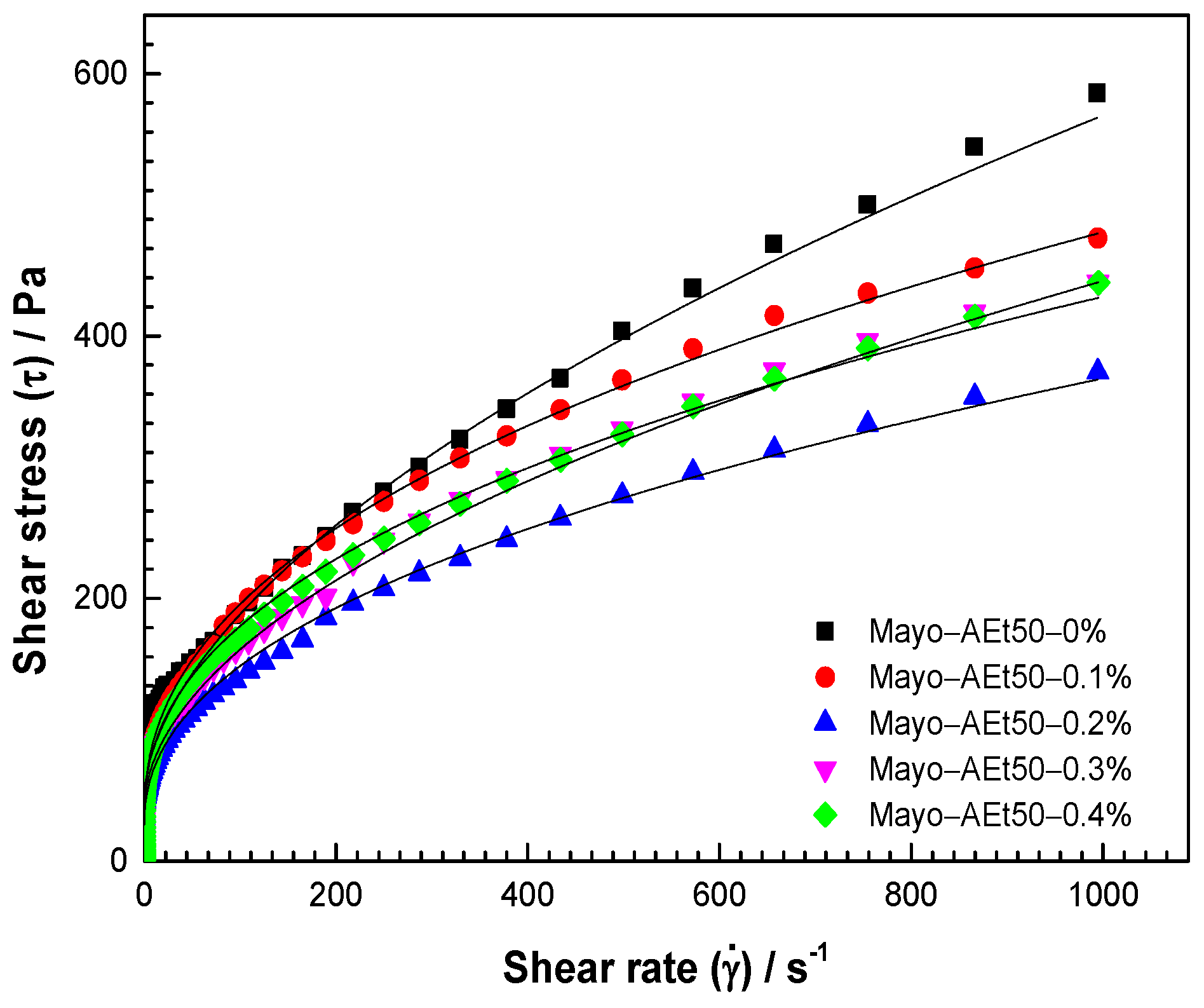
The flow behavior of mayonnaise enriched with A. carambola extract is shown in Figure 1. The samples present an increase in shear stress with the shear rate, a typical behavior of non-Newtonian flow behavior type shear thinning. Similar results for mayonnaise-type emulsions were obtained in previous studies [15,16,18,48,49,50,51,52,53] where rheological properties can be used to understand the structure and interaction of components in emulsions. The changes observed in shear stress are a consequence of the addition of A. carambola extracts, which are associated with the interaction of phytochemicals and complexation. Then, different rheological models were employed for the characterization of flow curves of mayonnaises [24,54,55]; in this case, all mayonnaise was adjusted to the Herschel–Bulkley model (Equation (6)):
where (Pa) is the shear stress, (Pa) is the yield stress, the consistency index (), (s−1) is the shear rate, and n is the flux index.
Figure 1.
Flow behavior of mayonnaise enriched with A. carambola extracts adjusted to the Herschel–Bulkley model.
The model parameters with a high fitting degree (R2 > 0.96) are given in Table 1. The (yield stress) ranged from 27.22 to 39.72 Pa of samples with extracts of A. carambola, presenting lower values than samples without extracts (MayoAEt500% = 48.87) that could be attributed to polysaccharide–phenolic complexation. k (consistency index) presents values of 10.00 ± 1.79, 21.38 ± 1.37, 15.39 ± 1.19, 11.05 ± 1.11 and 19.20 ± 1.48 for MayoAEt500%, MayoAEt500.1%, MayoAEt500.2%, MayoAEt500.3%, and MayoAEt500.4%, respectively, showing an increase with the addition of extracts. In all cases, n values were lower than 1, with values between 0.44 and 0.57 indicating shear thinning fluids [56]. Then, mayonnaises present a shear thinning behavior as a result of the alignment of molecules in the direction of flow and a decrease in viscosity with an increase in the shear rate. Similar results demonstrate the use of the Herschel Bulkley model for the characterization of mayonnaises, i.e., Ma and Barbosa-Cánovas [24] for mayonnaises with different concentrations of oil and xanthan gum; Izidoro et al. [57] for commercial mayonnaise (traditional and light); Yüccer et al. [58] for low cholesterol mayonnaises; and Park et al. [59] for low-fat mayonnaises.
Table 1.
Adjustment parameters of the flow behavior of mayonnaise enriched with A. carambola extracts adjusted with the Herschel–Bulkley model.
Furthermore, the addition of phenolic compounds in food matrices modified the rheological properties; that is, Tudorache and Bordenave [60] report that the addition of phenolic compounds can lead to the aggregation of polysaccharides in a solution and the modification of the rheological properties of the solution toward lower viscosity and less pseudoplastic behavior (more Newtonian). Quintana et al. [61] report that the pure chitosan solution presented shear thinning behavior, where the addition of licorice extracts decreased the shear stress value and presented a shear thickening behavior, probably due to the hydroclustering of particles and an order-to-disorder transition.
3.2. Viscoelastic Properties
A dynamic rheological test was carried out in order to determine the viscoelastic properties of the samples. In the dynamic test, sinusoidal oscillation stress is applied as a function of frequency () to measure the phase difference between the stresses and the amplitude ratio. The strain produces two stress components from the strain: the storage () and loss () components [62]. Initially, a stress sweep was performed to determine the linear viscoelastic range (LVR); then, mayonnaise samples present LVR between 1 and 150 Pa, choosing 10 Pa to develop a frequency sweep to evaluate the viscoelastic properties.
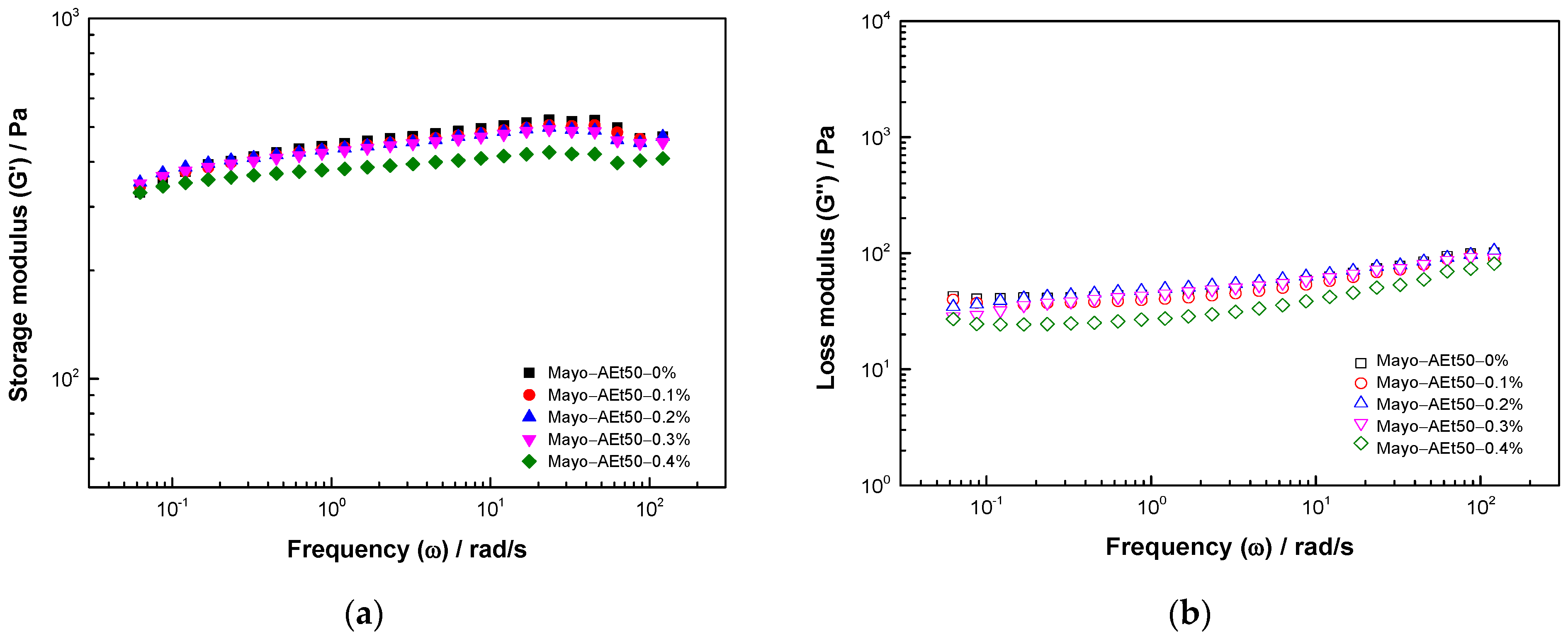
The viscoelasticity properties of the mayonnaise samples enriched with A. carambola extract are shown in Figure 2.
Figure 2.
(a) Storage modulus () and (b) loss modulus () in function of frequency () of mayonnaise enriched with A. carambola extract.
An elastic material is termed to behave more like a solid if the elastic or storage modulus is much greater than the loss modulus ( > ); however, if < , the material exhibits liquid-like behavior [63]. Overall, all samples exhibited frequency-dependent behavior, where and increase with frequency [64], and this shows the dominant contribution of the elastic component to mayonnaise, which is attributed to a format among lipoproteins adsorbed all over oil droplets [65]. The values were higher than in all samples within the frequency range, implying that mayonnaise has a gel-like structure of a flocculated and entangled network and tends to behave more like an elastic solid [66]. Similar behavior has been reported for food systems such as traditional full-fat mayonnaises [24], inulin–water gels [67], jam and yogurt [68], mayonnaise incorporated with Himalayan walnut oil [69], mayonnaises [25], and olive oil-based mayonnaise [32].
The well-known power-law model was selected to uncover the frequency dependence of the and values (Equations (1) and (2)). The viscoelastic adjustment parameters are shown in Table 2. The adjustment correlation coefficient (R2) shows good fitness (R2 > 0.812) for (Equation (1)), except for at a lower concentration of extracts (<0.3%), and a good correlation (R2 > 0.909), indicating the sensitivity of elastic properties to the incorporation of phenolic extracts. In all cases, k’ was higher than k″, indicating a typical weak gel behavior [70]. n′ values close to 0 and 1 reflected elastic and viscous behavior, respectively [71]. The obtained values were similar to those reported by Sun et al. [72] for low-fat mayonnaises (n′ = 0.059–0.124, n″ = 0.022–0.086, k′ = 334–888.9 Pa·sn′, k″ = 100.9–129.3 Pa·sn′) and are lower than those obtained by Peressini et al. [73] for light mayonnaises (n′ = 0.08–0.15, k′ =2.37–2.90 KPa·sn′). Then, the parameters confirmed the viscoelastic properties of mayonnaises. k′, k″, and n′ decrease with A. carambola extract concentration, while the n″ increase confirmed the stronger network formed by the higher concentration.
Table 2.
Viscoelastic parameters of mayonnaise enriched with extracts of A. carambola adjusted to Equations (1) and (2).
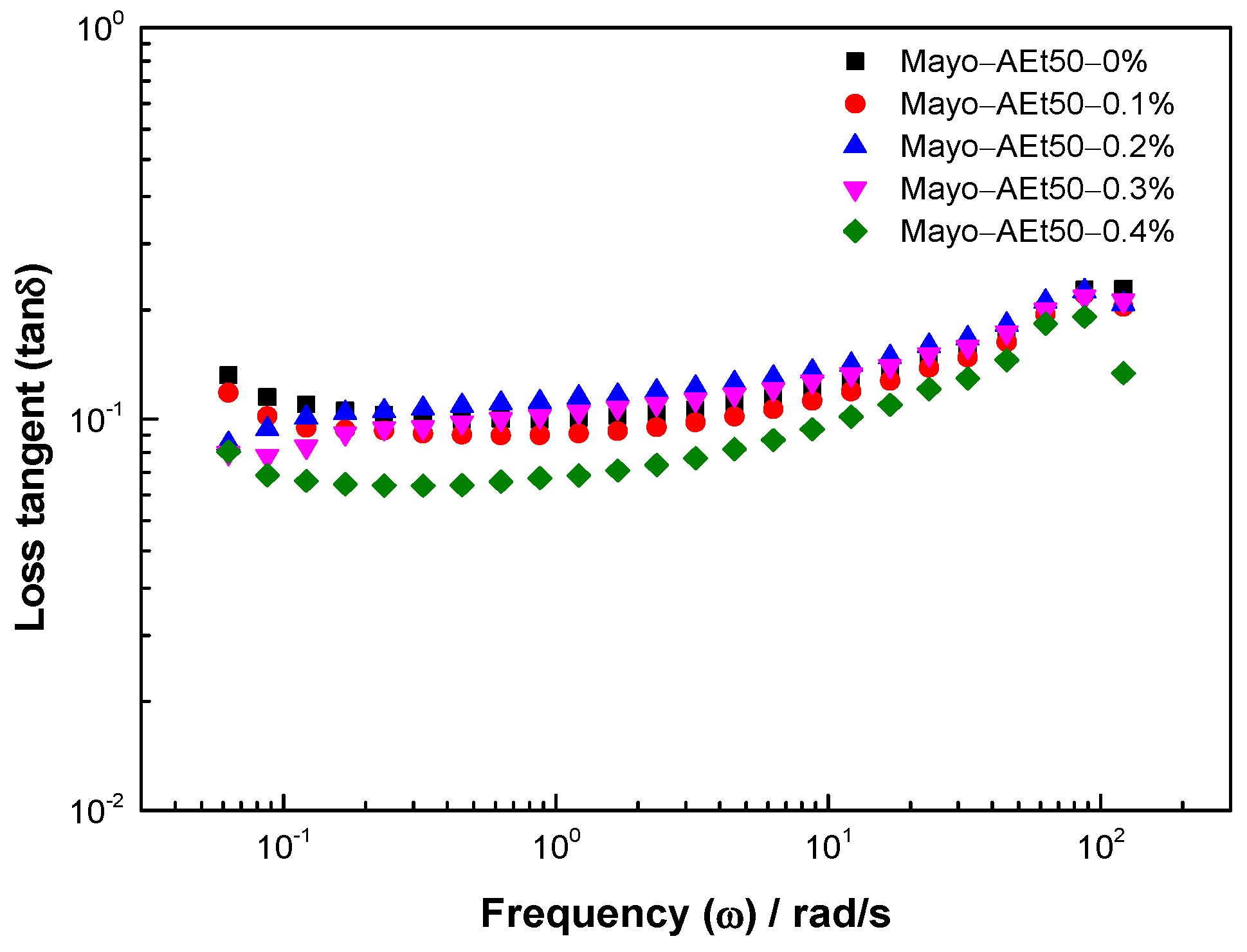
Loss tangent (tan δ) (the ratio between loss and storage modulus) is a direct measure of viscous and elastic effects in the sample, indicating gel-like behavior (tan δ < 1) [74]. The loss of the tangent of mayonnaise enriched with A. carambola extract is shown in Figure 3. Tan δ present values of 0.099, 0.090, 0.109, 0.099, and 0.069 at 1 rad/s for MayoAEt500%, MayoAEt500.1%, MayoAEt500.2%, MayoAEt500.3%, and MayoAEt500.4%, respectively, denoting the development of a solid elastic character with gelation. Therefore, it can be inferred that tan δ established a gel-like character development with gelation but could not discriminate the relative elastic/viscous nature of mayonnaises using 0.1 to 0.4% of A. carambola extracts.
Figure 3.
Loss tangent of mayonnaise enriched with A. carambola extract.
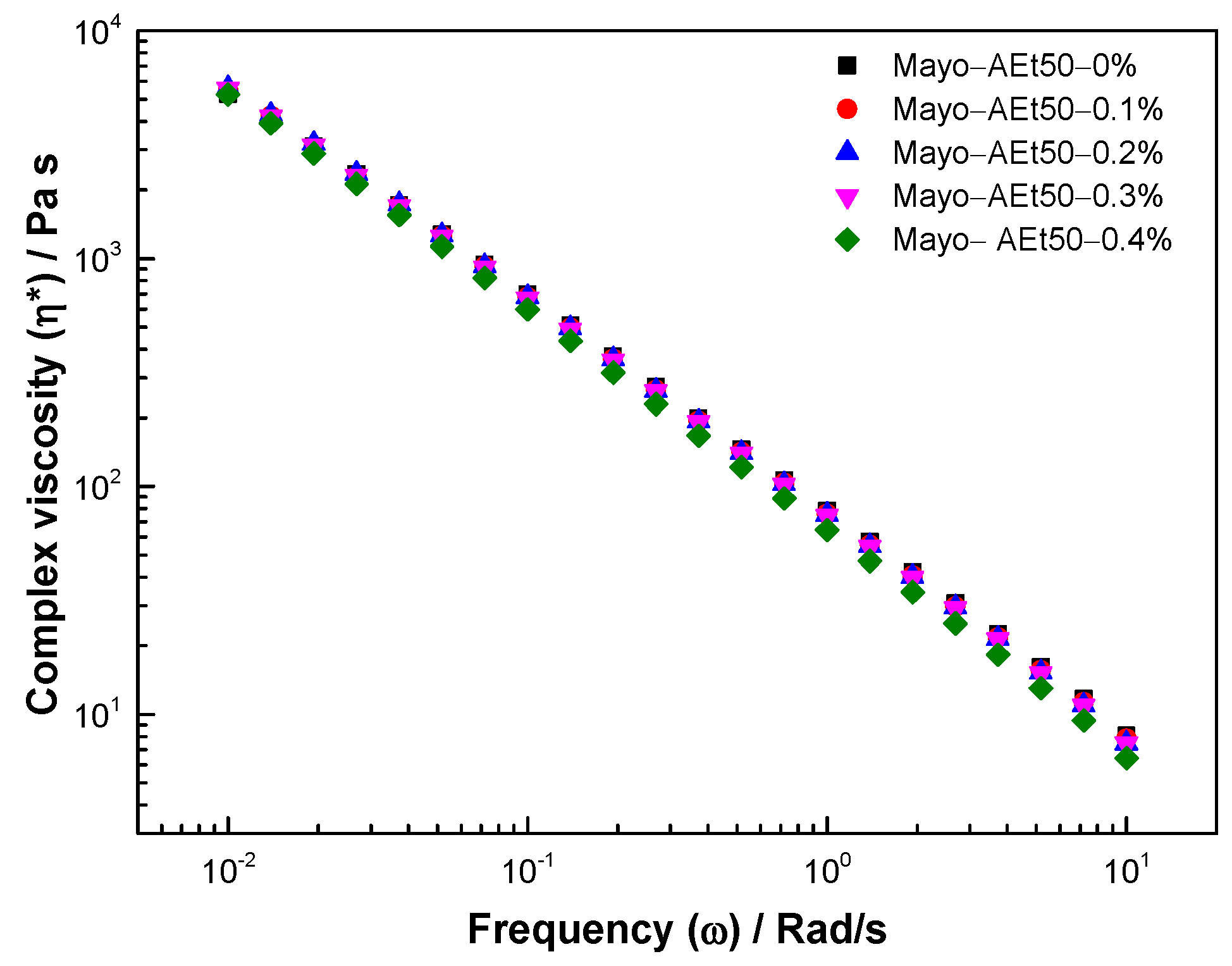
The complex viscosity () of mayonnaise enriched with A. carambola extract with the change in frequency () is shown in Figure 4. The oscillatory dynamic test shows that mayonnaises exhibit a shear-thinning behavior, decreasing and increasing () due to the network breakup, as shown by the η curves of non-oscillatory measurements. The reduction in complex viscosity is the outcome of network breakup between mayonnaise enriched with A. carambola extract and among polymer chains, where the molecules of the polymer matrix are aligned with the flow.
Figure 4.
Complex viscosity of mayonnaise-type emulsion enriched with phenolic extract from A. carambola.
3.3. Applicability of the Cox–Merz Rule
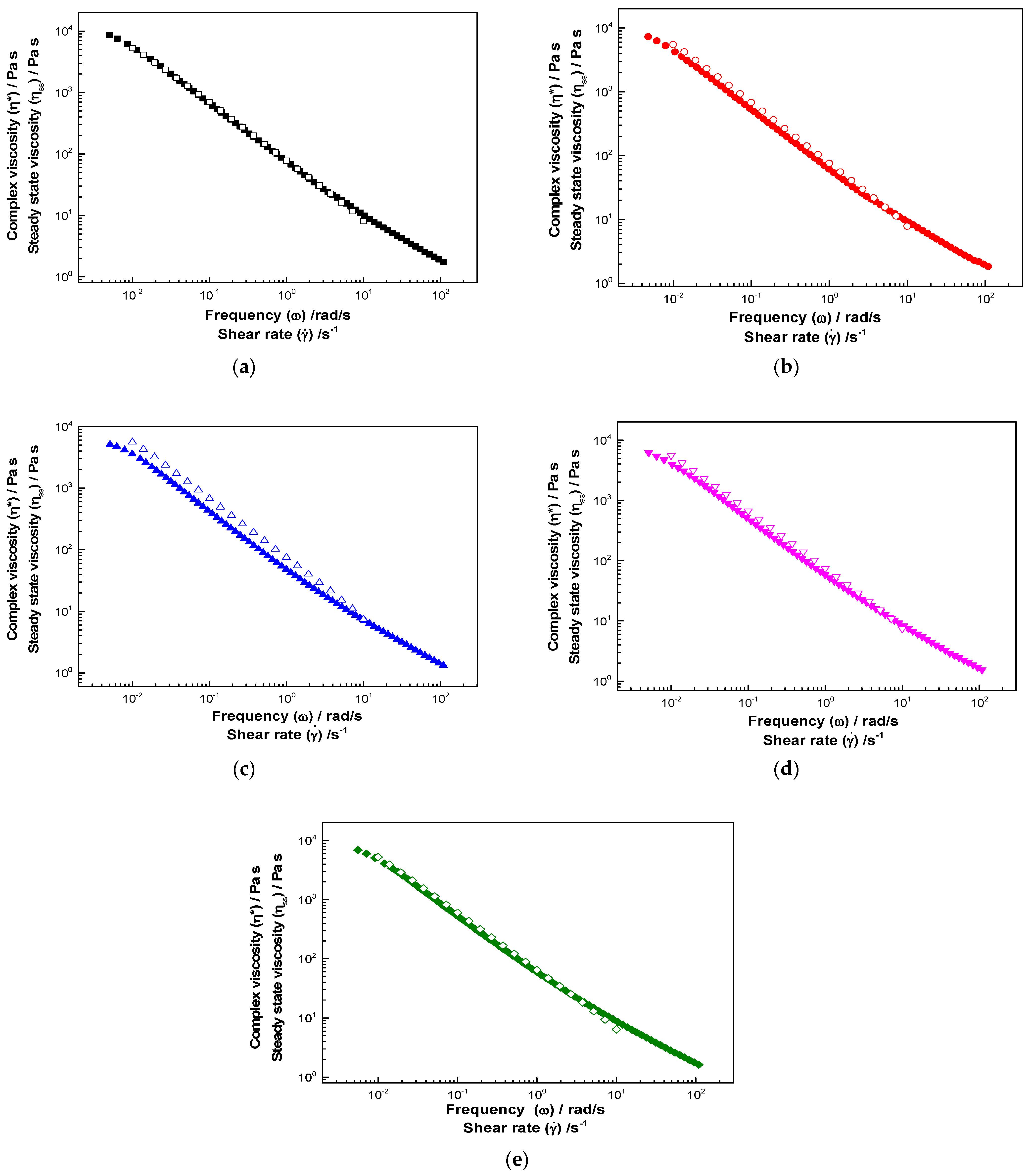
The steady shear properties were correlated with the dynamic properties, verifying the applicability of the Cox–Merz rule [1,75]. In order to evaluate the applicability of the Cox–Merz rule, the steady state viscosity and complex viscosity of mayonnaise enriched with A. carambola as a function of frequency and shear rate are shown in Figure 5.
Figure 5.
Complex (empty symbols) and apparent (filled symbol) of mayonnaise enriched with A. carambola extracts. (a) MayoAEt500%, (b) MayoAEt500.1%, (c) MayoAEt500.2%, (d) MayoAEt500.3%, and (e) MayoAEt500.4%.
It was observed that the experimental data of steady-state viscosity and complex viscosity for the samples obeyed the modified Cox–Merz rule. This indicates that similar molecular rearrangements may occur in the two flow patterns over the applied shear rate or frequency range [47,76]. In addition, a linear (Equation (7)) and power-modified (Equation (8)) Cox–Merz rule was used:
where is related to the magnitude difference between steady-state viscosity and complex viscosity ; similarly, is related to the differences in behavior between steady-state viscosity and complex viscosity in relation to the shear rate () and frequency (), and the parameter, which is related to both magnitude and behavior differences, showed values close to 1, indicating that the data obeyed the Cox–Merz rule [6].
The values of the parameters , , and are shown in Table 3. In both cases (linear and power-modified Cox–Merz rule), the adjustment coefficient (R2) was 0.99. Then, were higher than 1 in all cases, with values of 1.013, 1.257, 1.606, 1.371, and 1.083 for MayoAEt500%, MayoAEt500.1%, MayoAEt500.2%, MayoAEt500.3%, and MayoAEt500.4%, respectively, which can be attributed to the fact that shear forces have a destructive effect on intermolecular interactions of the constituents compared with the oscillatory deformations. However, no correlation with the percentage of the extract was identified, where the samples with the highest value present 0.3% of the extract. For , the values were between 0.824 and 1.927, and the lowest value was from MayoAEt500% (0.824), followed by MayoAEt500.4% (0.850), MayoAEt500.3% (0.928), MayoAEt500.1% (1.263), and MayoAEt500.2% (1.263), and for , the samples present values closer to 1.
Table 3.
Modified Cox–Merz rule parameters of mayonnaise enriched with A. carambola extracts.
The parameters (Equation (7)) and and (Equation (8)) showed a similar behavior in relation to the addition of A. carambola extract. The parameters and first increase until the addition of 0.3% of extract and then decrease (MayoAEt500.3%, MayoAEt500.4%), while parameter followed the opposite trend. Then, the and are related to the differences in behavior between and in relation to the shear rate () and oscillatory frequency (), while is related to the magnitude of the difference between the apparent ( and complex viscosities () [6]. The results obtained were similar to potato puree ( = 0.90–1.35 and = 2.15–39.83) [77], baby apricot food ( = 1.16–1.44 and = 0.41–1.26), and ketchup ( = 0.94 and = 0.41–13.97) [2], and lower than tomato juice ( = 3.73–4.76) and sweet potato baby food ( = 7.14) [78].
The parameters of the linear regression (Equation (9)) of the data could be used to evaluate the description of the experimental values by the models:
Table 4 shows the parameters of Equations (7) and (8). The adjustment coefficient (R2) was 0.99. The results show that parameter A is very close to 1 and parameter B is 0 for both models, which indicates that the complex viscosity values are very close to the steady viscosity values [6], confirming that the data obeyed the Cox–Merz rule. Similar behavior has been reported by different authors, i.e., Ishi and Nakamura [79] reported that concentrated suspension obeys the modified Cox–Merz rule, and Augusto et al. [6] correlated two modified Cox–Merz rules for tomato juice consistency processed by high-pressure homogenization.
Table 4.
Parameters of linear regression (Equation (9)) of modified Cox–Merz rule parameters of mayonnaise enriched with A. carambola extracts.
The results obtained indicate that the rheological properties of mayonnaise-type emulsion enriched with the phenolic extract of A. carambola can be determined by oscillatory or steady-state shear experiments, indicating that the noted solidity of the gels could be related to limited dynamic viscosity alterations rather than extensive loss of shear viscosity. Furthermore, the addition of extracts modified the consistency of mayonnaise more than it modified its internal structure and highlighted the possible applications of phenolic extract as a valuable ingredient for the development of healthy products.
4. Conclusions
The steady-state assays show that the flow properties of mayonnaise determine non-Newtonian behavior. Mayonnaise has a shear thinning behavior and was adjusted to the Herschel–Bulkley model (R2 > 0.96). The addition of A. carambola extracts decreases the yield stress and flux index and increases the consistency index, which could be attributed to polysaccharide–phenolic complexation.
The viscoelasticity properties of mayonnaise exhibited frequency-dependent behavior and could be considered a weak gel, as both and increase with the frequency, dominating the elastic component, which is characteristic of typical weak gel, confirming the Tan δ values.
The steady shear properties were correlated with the dynamic properties, checking the applicability of the Cox–Merz rule (R2 = 0.99) when the complex viscosity values are very close to the steady viscosity values, suggesting that the solidity of the gel is related to limited dynamic viscosity changes rather than large losses of deformation viscosity.
Author Contributions
Conceptualization, S.E.Q., M.Z.-N. and L.A.G.-Z.; methodology, S.E.Q. and M.Z.-N.; software, M.Z.-N., D.R.-B. and S.E.Q.; validation, S.E.Q. and L.A.G.-Z.; formal analysis, M.Z.-N., D.R.-B., S.E.Q. and L.A.G.-Z.; investigation, M.Z.-N., S.E.Q. and L.A.G.-Z.; resources, M.Z.-N. and L.A.G.-Z.; data curation, S.E.Q., M.Z.-N., D.R.-B. and L.A.G.-Z.; writing—original draft preparation, S.E.Q. and L.A.G.-Z.; writing—review and editing, S.E.Q., M.Z.-N., D.R.-B. and L.A.G.-Z.; visualization, S.E.Q., M.Z.-N., D.R.-B. and L.A.G.-Z.; supervision, S.E.Q. and L.A.G.-Z.; project administration, L.A.G.-Z.; funding acquisition, L.A.G.-Z. All authors have read and agreed to the published version of the manuscript.
Funding
This research was funded by MINCIENCIAS, project 368-2019, code 110780864755.
Data Availability Statement
Not applicable.
Acknowledgments
This work is part of a research program called “Programa Nacional de Ciencia, Tecnologa y Innovación en Ciencias Agropecuarias; Project 368-2019 code 110780864755” sponsored by MinCiencias (Colombia). The authors are grateful for their financial support.
Conflicts of Interest
The authors declare no conflict of interest.
References
- Cox, W.P.; Merz, E.H. Correlation of Dynamic and Steady Flow Viscosities. J. Polym. Sci. 1958, 28, 619–622. [Google Scholar] [CrossRef]
- Bistany, K.L.; Kokini, J.L. Dynamic Viscoelastic Properties of Foods in Texture Control. J. Rheol. 1983, 27, 605–620. [Google Scholar] [CrossRef]
- Chamberlain, E.K.; Rao, M.A. Rheological Properties of Acid Converted Waxy Maize Starches in Water and 90% DMSO/10% Water. Carbohydr. Polym. 1999, 40, 251–260. [Google Scholar] [CrossRef]
- Park, S.; Chung, M.G.; Yoo, B. Effect of Octenylsuccinylation on Rheological Properties of Corn Starch Pastes. Starch—Stärke 2004, 56, 399–406. [Google Scholar] [CrossRef]
- Yaşar, K.; Kahyaoglu, T.; Şahan, N. Dynamic Rheological Characterization of Salep Glucomannan/Galactomannan-Based Milk Beverages. Food Hydrocoll 2009, 23, 1305–1311. [Google Scholar] [CrossRef]
- Augusto, P.E.D.; Ibarz, A.; Cristianini, M. Effect of High Pressure Homogenization (HPH) on the Rheological Properties of Tomato Juice: Viscoelastic Properties and the Cox–Merz Rule. J. Food Eng. 2013, 114, 57–63. [Google Scholar] [CrossRef]
- Razavi, S.M.A.; Cui, S.W.; Guo, Q.; Ding, H. Some Physicochemical Properties of Sage (Salvia Macrosiphon) Seedgum. Food Hydrocoll. 2014, 35, 453–462. [Google Scholar] [CrossRef]
- Zimeri, J.E.; Kokini, J.L. Rheological Properties of Inulin–Waxy Maize Starch Systems. Carbohydr. Polym. 2003, 52, 67–85. [Google Scholar] [CrossRef]
- Manero, O.; Bautista, F.; Soltero, J.F.A.; Puig, J.E. Dynamics of Worm-like Micelles: The Cox–Merz Rule. J. Nonnewton. Fluid Mech. 2002, 106, 1–15. [Google Scholar] [CrossRef]
- Riscardo, M.A.; Moros, J.E.; Franco, J.M.; Gallegos, C. Rheological Characterisation of Salad-Dressing-Type Emulsions Stabilised by Egg Yolk/Sucrose Distearate Blends. Eur. Food Res. Technol. 2005, 220, 380–388. [Google Scholar] [CrossRef]
- Davis, V.A.; Ericson, L.M.; Parra-Vasquez, A.N.G.; Fan, H.; Wang, Y.; Prieto, V.; Longoria, J.A.; Ramesh, S.; Saini, R.K.; Kittrell, C.; et al. Phase Behavior and Rheology of SWNTs in Superacids. Macromolecules 2004, 37, 154–160. [Google Scholar] [CrossRef]
- Dogan, M.; Kayacier, A.; Toker, Ö.S.; Yilmaz, M.T.; Karaman, S. Steady, Dynamic, Creep, and Recovery Analysis of Ice Cream Mixes Added with Different Concentrations of Xanthan Gum. Food Bioprocess Technol. 2013, 6, 1420–1433. [Google Scholar] [CrossRef]
- Karaman, S.; Yilmaz, M.T.; Kayacier, A. Mathematical Approach for Two Component Modeling of Salep-Starch Mixtures Using Central Composite Rotatable Design: Part II. Dynamic Oscillatory Shear Properties and Applicability of Cox-Merz Rule. Food Hydrocoll. 2013, 31, 277–288. [Google Scholar] [CrossRef]
- Mirzanajafi-Zanjani, M.; Yousefi, M.; Ehsani, A. Challenges and Approaches for Production of a Healthy and Functional Mayonnaise Sauce. Food Sci. Nutr. 2019, 7, 2471–2484. [Google Scholar] [CrossRef] [PubMed]
- Ma, L.; Barbosa-Cánovas, G.V. Rheological Characterization of Mayonnaise. Part I: Slippage at Different Oil and Xanthan Gum Concentrations. J. Food Eng. 1995, 25, 397–408. [Google Scholar] [CrossRef]
- Figoni, P.I.; Shoemaker, C.F. Characterization of Time Dependent Flow Properties of Mayonnaise under Steady Shear. J. Texture Stud. 1983, 14, 431–442. [Google Scholar] [CrossRef]
- Kiosseoglou, V.D.; Sherman, P. Influence of Egg Yolk Lipoproteins on the Rheology and Stability of O/W Emulsions and Mayonnaise 1. Viscoelasticity of Groundnut Oil-In-Water Emulsions and Mayonnaise. J. Texture Stud. 1983, 14, 397–417. [Google Scholar] [CrossRef]
- Elliott, J.H.; Ganz, A.J. Salad Dressings—Preliminary Rheological Characterization. J. Texture Stud. 1977, 8, 359–371. [Google Scholar] [CrossRef]
- Chivero, P.; Gohtani, S.; Yoshii, H.; Nakamura, A. Assessment of Soy Soluble Polysaccharide, Gum Arabic and OSA-Starch as Emulsifiers for Mayonnaise-like Emulsions. LWT Food Sci. Technol. 2016, 69, 59–66. [Google Scholar] [CrossRef]
- Batista, A.P.; Raymundo, A.; Sousa, I.; Empis, J. Rheological Characterization of Coloured Oil-in-Water Food Emulsions with Lutein and Phycocyanin Added to the Oil and Aqueous Phases. Food Hydrocoll. 2006, 20, 44–52. [Google Scholar] [CrossRef]
- Guilmineau, F.; Kulozik, U. Influence of a Thermal Treatment on the Functionality of Hen’s Egg Yolk in Mayonnaise. J. Food Eng. 2007, 78, 648–654. [Google Scholar] [CrossRef]
- Katsaros, G.; Tsoukala, M.; Giannoglou, M.; Taoukis, P. Effect of Storage on the Rheological and Viscoelastic Properties of Mayonnaise Emulsions of Different Oil Droplet Size. Heliyon 2020, 6, e05788. [Google Scholar] [CrossRef] [PubMed]
- Zhao, Q.; Fan, L.; Liu, Y.; Li, J. Mayonnaise-like High Internal Phase Pickering Emulsions Stabilized by Co-Assembled Phosphorylated Perilla Protein Isolate and Chitosan for Extrusion 3D Printing Application. Food Hydrocoll. 2023, 135, 108133. [Google Scholar] [CrossRef]
- Ma, L.; Barbosa-Cánovas, G.V. Rheological Characterization of Mayonnaise. Part II: Flow and Viscoelastic Properties at Different Oil and Xanthan Gum Concentrations. J. Food Eng. 1995, 25, 409–425. [Google Scholar] [CrossRef]
- Mancini, F.; Montanari, L.; Peressini, D.; Fantozzi, P. Influence of Alginate Concentration and Molecular Weight on Functional Properties of Mayonnaise. LWT 2002, 35, 517–525. [Google Scholar] [CrossRef]
- Dolz, M.; Hernández, M.J.; Delegido, J. Oscillatory Measurements for Salad Dressings Stabilized with Modified Starch, Xanthan Gum, and Locust Bean Gum. J. Appl. Polym. Sci. 2006, 102, 897–903. [Google Scholar] [CrossRef]
- Roshandel, Z.; Zibaei, R.; Abdolmaleki, K. Characteristics of Reduced-Fat Mayonnaise Prepared by Oleaster as a Fat Replacer and Natural Antioxidant. Food Sci. Nutr. 2023, 11, 3329–3338. [Google Scholar] [CrossRef]
- McClements, D.J. Food Emulsions: Principles, Practices, and Techniques, 3rd ed.; CRC Press: Boca Raton, FL, USA, 2005. [Google Scholar]
- Niknam, R.; Ghanbarzadeh, B.; Ayaseh, A.; Adun, P. Comprehensive Study of Intrinsic Viscosity, Steady and Oscillatory Shear Rheology of Barhang Seed Hydrocolloid in Aqueous Dispersions. J. Food Process Eng. 2019, 42, e13047. [Google Scholar] [CrossRef]
- Niknam, R.; Ghanbarzadeh, B.; Ayaseh, A.; Hamishehkar, H. Plantago Major Seed Gum Based Biodegradable Films: Effects of Various Plant Oils on Microstructure and Physicochemical Properties of Emulsified Films. Polym. Test 2019, 77, 105868. [Google Scholar] [CrossRef]
- Niknam, R.; Ghanbarzadeh, B.; Ayaseh, A.; Rezagholi, F. The Hydrocolloid Extracted from Plantago Major Seed: Effects on Emulsifying and Foaming Properties. J. Dispers. Sci. Technol. 2019, 41, 667–673. [Google Scholar] [CrossRef]
- di Mattia, C.; Balestra, F.; Sacchetti, G.; Neri, L.; Mastrocola, D.; Pittia, P. Physical and Structural Properties of Extra-Virgin Olive Oil Based Mayonnaise. LWT Food Sci. Technol. 2015, 62, 764–770. [Google Scholar] [CrossRef]
- Wu, Y.; Cui, W.; Eskin, N.A.M.; Goff, H.D. An Investigation of Four Commercial Galactomannans on Their Emulsion and Rheological Properties. Food Res. Int. 2009, 42, 1141–1146. [Google Scholar] [CrossRef]
- Niknam, R.; Ghanbarzadeh, B.; Ayaseh, A.; Rezagholi, F. The Effects of Plantago Major Seed Gum on Steady and Dynamic Oscillatory Shear Rheology of Sunflower Oil-in-Water Emulsions. J. Texture Stud. 2018, 49, 536–547. [Google Scholar] [CrossRef] [PubMed]
- Di Mattia, C.; Paradiso, V.M.; Andrich, L.; Giarnetti, M.; Caponio, F.; Pittia, P. Effect of Olive Oil Phenolic Compounds and Maltodextrins on the Physical Properties and Oxidative Stability of Olive Oil O/W Emulsions. Food Biophys. 2014, 9, 396–405. [Google Scholar] [CrossRef]
- Souilem, S.; Kobayashi, I.; Neves, M.A.; Sayadi, S.; Ichikawa, S.; Nakajima, M. Preparation of Monodisperse Food-Grade Oleuropein-Loaded W/O/W Emulsions Using Microchannel Emulsification and Evaluation of Their Storage Stability. Food Bioprocess Technol. 2014, 7, 2014–2027. [Google Scholar] [CrossRef]
- Depree, J.A.; Savage, G.P. Physical and Flavour Stability of Mayonnaise. Trends Food Sci. Technol. 2001, 12, 157–163. [Google Scholar] [CrossRef]
- Giacintucci, V.; Di Mattia, C.; Sacchetti, G.; Neri, L.; Pittia, P. Role of Olive Oil Phenolics in Physical Properties and Stability of Mayonnaise-like Emulsions. Food Chem. 2016, 213, 369–377. [Google Scholar] [CrossRef]
- Yoo, D.; Yoo, B. Rheology of Rice Starch-Sucrose Composites. Starch—Staerke 2005, 57, 254–261. [Google Scholar] [CrossRef]
- Bair, S.; Yamaguchi, T.; Brouwer, L.; Schwarze, H.; Vergne, P.; Poll, G. Oscillatory and Steady Shear Viscosity: The Cox-Merz Rule, Superposition, and Application to EHL Friction. Tribol. Int. 2014, 79, 126–131. [Google Scholar] [CrossRef]
- Franco, J.M.; Berjano, M.; Guerrero, A.; Muñoz, J.; Gallegos, C. Flow Behaviour and Stability of Light Mayonnaise Containing a Mixture of Egg Yolk and Sucrose Stearate as Emulsifiers. Food Hydrocoll. 1995, 9, 111–121. [Google Scholar] [CrossRef]
- Quintana, S.E.; Franco, J.M.; Garcia-Zapateiro, L. Physico-Chemical and Bromatological Characteristics of Arenca and Rheological Properties of Oil-in-Water Emulsions Containing Isolated Protein. Cienc. E Agrotecnologia 2015, 39, 634–641. [Google Scholar] [CrossRef]
- Guo, Q.; Zhu, X.; Zhen, W.; Li, Z.; Kang, J.; Sun, X.; Wang, S.; Cui, S.W. Rheological Properties and Stabilizing Effects of High-Temperature Extracted Flaxseed Gum on Oil/Water Emulsion Systems. Food Hydrocoll. 2021, 112, 106289. [Google Scholar] [CrossRef]
- Mieles-Gómez, L.; Lastra-Ripoll, S.E.; Torregroza-Fuentes, E.; Quintana, S.E.; García-Zapateiro, L.A. Rheological and Microstructural Properties of Oil-in-Water Emulsion Gels Containing Natural Plant Extracts Stabilized with Carboxymethyl Cellulose/Mango (Mangifera indica) Starch. Fluids 2021, 6, 312. [Google Scholar] [CrossRef]
- Rao, M.A.; Tattiyakul, J. Granule Size and Rheological Behavior of Heated Tapioca Starch Dispersions. Carbohydr. Polym. 1999, 38, 123–132. [Google Scholar] [CrossRef]
- Gunasekaran, S.; Ak, M.M. Dynamic Oscillatory Shear Testing of Foods—Selected Applications. Trends Food Sci. Technol. 2000, 11, 115–127. [Google Scholar] [CrossRef]
- Shende, T.; Niasar, V.J.; Babaei, M. An Empirical Equation for Shear Viscosity of Shear Thickening Fluids. J. Mol. Liq. 2021, 325, 115220. [Google Scholar] [CrossRef]
- Bengoechea, C.; López, M.L.; Cordobés, F.; Guerrero, A. Influence of Semicontinuous Processing on the Rheology and Droplet Size Distribution of Mayonnaise-like Emulsions. Food Sci. Technol. Int. 2009, 15, 367–373. [Google Scholar] [CrossRef]
- Håkansson, A.; Chaudhry, Z.; Innings, F. Model Emulsions to Study the Mechanism of Industrial Mayonnaise Emulsification. Food Bioprod. Process. 2016, 98, 189–195. [Google Scholar] [CrossRef]
- Juszczak, L.; Fortuna, T.; Kośla, A. Sensory and Rheological Properties of Polish Commercial Mayonnaise. Nahrung—Food 2003, 47, 232–235. [Google Scholar] [CrossRef]
- Laverse, J.; Mastromatteo, M.; Frisullo, P.; Del Nobile, M.A. X-ray Microtomography to Study the Microstructure of Mayonnaise. J. Food Eng. 2012, 108, 225–231. [Google Scholar] [CrossRef]
- Paredes, M.D.C.; Rao, M.A.; Bourne, M.C. Rheological Characterization of Salad Dressings 2: Effect of Storage. J. Texture Stud. 1989, 20, 235–250. [Google Scholar] [CrossRef]
- Yilmazer, G.; Carrillo, A.R.; Kokini, J.L. Effect of Propylene Glycol Alginate and Xanthan Gum on Stability of O/W Emulsions. J. Food Sci. 1991, 56, 513–517. [Google Scholar] [CrossRef]
- Kumar, Y.; Roy, S.; Devra, A.; Dhiman, A.; Prabhakar, P.K. Ultrasonication of Mayonnaise Formulated with Xanthan and Guar Gums: Rheological Modeling, Effects on Optical Properties and Emulsion Stability. LWT 2021, 149, 111632. [Google Scholar] [CrossRef]
- Worrasinchai, S.; Suphantharika, M.; Pinjai, S.; Jamnong, P. β-Glucan Prepared from Spent Brewer’s Yeast as a Fat Replacer in Mayonnaise. Food Hydrocoll. 2006, 20, 68–78. [Google Scholar] [CrossRef]
- Haddarah, A.; Bassal, A.; Ismail, A.; Gaiani, C.; Ioannou, I.; Charbonnel, C.; Hamieh, T.; Ghoul, M. The Structural Characteristics and Rheological Properties of Lebanese Locust Bean Gum. J. Food Eng. 2014, 120, 204–214. [Google Scholar] [CrossRef]
- Izidoro, D.; Sierakowski, M.R.; Waszczynskyj, N.; Haminiuk, C.W.I.; Scheer, A.D.P. Sensory Evaluation and Rheological Behavior of Commercial Mayonnaise. Int. J. Food Eng. 2007, 3, 1–15. [Google Scholar] [CrossRef]
- Yüceer, M.; Ilyasoǧlu, H.; Özçelik, B. Comparison of Flow Behavior and Physicochemical Characteristics of Low-Cholesterol Mayonnaises Produced with Cholesterol-Reduced Egg Yolk. J. Appl. Poult. Res. 2016, 25, 518–527. [Google Scholar] [CrossRef]
- Park, J.J.; Olawuyi, I.F.; Lee, W.Y. Characteristics of Low-Fat Mayonnaise Using Different Modified Arrowroot Starches as Fat Replacer. Int. J. Biol. Macromol. 2020, 153, 215–223. [Google Scholar] [CrossRef]
- Tudorache, M.; Bordenave, N. Phenolic Compounds Mediate Aggregation of Water-Soluble Polysaccharides and Change Their Rheological Properties: Effect of Different Phenolic Compounds. Food Hydrocoll. 2019, 97, 105193. [Google Scholar] [CrossRef]
- Quintana, S.E.; Llalla, O.; García-Zapateiro, L.A.; García-Risco, M.R.; Fornari, T. Preparation and Characterization of Licorice-Chitosan Coatings for Postharvest Treatment of Fresh Strawberries. Appl. Sci. 2020, 10, 8431. [Google Scholar] [CrossRef]
- Rao, A.M. Measurement of Flow and Viscoelastic Properties. In Rheology of Fluid, Semisolid, and Solid Foods—Food Engineering Series; Springer: Boston, MA, USA, 2014; pp. 63–159. ISBN 978-1-4614-9230-6. [Google Scholar]
- Mun, S.; Kim, Y.L.; Kang, C.G.; Park, K.H.; Shim, J.Y.; Kim, Y.R. Development of Reduced-Fat Mayonnaise Using 4αGTase-Modified Rice Starch and Xanthan Gum. Int. J. Biol. Macromol. 2009, 44, 400–407. [Google Scholar] [CrossRef] [PubMed]
- Ahmed, J.; Ramaswamy, H.S. Effect of Temperature on Dynamic Rheology and Colour Degradation Kinetics of Date Paste. Food Bioprod. Process. 2005, 83, 198–202. [Google Scholar] [CrossRef]
- Muñtoz, J.; Sherman, P. Dynamic Viscoelastic Properties of Some Commercial Salad Dressings. J. Texture Stud. 1990, 21, 411–426. [Google Scholar] [CrossRef]
- Ma, Z.; Boye, J.I. Advances in the Design and Production of Reduced-Fat and Reduced-Cholesterol Salad Dressing and Mayonnaise: A Review. Food Bioprocess Technol. 2013, 6, 648–670. [Google Scholar] [CrossRef]
- Alvarez-Sabatel, S.; De Marañón, I.M.; Arboleya, J.C. Impact of High Pressure Homogenisation (HPH) on Inulin Gelling Properties, Stability and Development during Storage. Food Hydrocoll. 2015, 44, 333–344. [Google Scholar] [CrossRef]
- Gabriele, D.; De Cindio, B.; D’Antona, P. A Weak Gel Model for Foods. Rheol. Acta 2001, 40, 120–127. [Google Scholar] [CrossRef]
- Akhtar, G.; Masoodi, F.A. Structuring Functional Mayonnaise Incorporated with Himalayan Walnut Oil Pickering Emulsions by Ultrasound Assisted Emulsification. Ultrason. Sonochem. 2022, 86, 106022. [Google Scholar] [CrossRef]
- Bhardwaj, M.; Sandhu, K.S.; Saxena, D.C. Experimental and Modeling Studies of the Flow, Dynamic and Creep Recovery Properties of Pearl Millet Starch as Affected by Concentration and Cultivar Type. Int. J. Biol. Macromol. 2019, 135, 544–552. [Google Scholar] [CrossRef]
- Yousefi, A.R.; Razavi, S.M.A. Dynamic Rheological Properties of Wheat Starch Gels as Affected by Chemical Modification and Concentration. Starch—Staerke 2015, 67, 567–576. [Google Scholar] [CrossRef]
- Sun, C.; Liu, R.; Liang, B.; Wu, T.; Sui, W.; Zhang, M. Microparticulated Whey Protein-Pectin Complex: A Texture-Controllable Gel for Low-Fat Mayonnaise. Food Res. Int. 2018, 108, 151–160. [Google Scholar] [CrossRef]
- Peressini, D.; Sensidoni, A.; De Cindio, B. Rheological Characterization of Traditional and Light Mayonnaises. J. Food Eng. 1998, 35, 409–417. [Google Scholar] [CrossRef]
- Mounsey, J.S.; O’Riordan, E.D. Characteristics of Imitation Cheese Containing Native Starches. J. Food Sci. 2001, 66, 586–591. [Google Scholar] [CrossRef]
- Rincón, F.; Muñoz, J.; Ramírez, P.; Galán, H.; Alfaro, M.C. Physicochemical and Rheological Characterization of Prosopis Juliflora Seed Gum Aqueous Dispersions. Food Hydrocoll. 2014, 35, 348–357. [Google Scholar] [CrossRef]
- García-Cruz, E.E.; Rodríguez-Ramírez, J.; Méndez Lagunas, L.L.; Medina-Torres, L. Rheological and Physical Properties of Spray-Dried Mucilage Obtained from Hylocereus Undatus Cladodes. Carbohydr. Polym. 2013, 91, 394–402. [Google Scholar] [CrossRef] [PubMed]
- Alvarez, M.D.; Fernández, C.; Canet, W. Rheological Behaviour of Fresh and Frozen Potato Puree in Steady and Dynamic Shear at Different Temperatures. Eur. Food Res. Technol. 2004, 218, 544–553. [Google Scholar] [CrossRef][Green Version]
- Ahmed, J.; Ramaswamy, H.S. Viscoelastic and Thermal Characteristics of Vegetable Puree-Based Baby Foods. J. Food Process Eng. 2006, 29, 219–233. [Google Scholar] [CrossRef]
- Ishii, M.; Nakamura, H. Applicability of Modified Cox-Merz Rule to Concentrated Suspensions. J. Nonnewton. Fluid Mech. 2020, 282, 104322. [Google Scholar] [CrossRef]
Disclaimer/Publisher’s Note: The statements, opinions and data contained in all publications are solely those of the individual author(s) and contributor(s) and not of MDPI and/or the editor(s). MDPI and/or the editor(s) disclaim responsibility for any injury to people or property resulting from any ideas, methods, instructions or products referred to in the content. |
© 2023 by the authors. Licensee MDPI, Basel, Switzerland. This article is an open access article distributed under the terms and conditions of the Creative Commons Attribution (CC BY) license (https://creativecommons.org/licenses/by/4.0/).