
Article

Explicit Velocity Fields in Bubbly Taylor–Couette Flow with Buoyancy on Gas Bubbles

Department of Mechanical Engineering, University of Alberta, Edmonton, AB T6G 2G8, Canada
Fluids 2026, 11(7), 167; https://doi.org/10.3390/fluids11070167
Submission received: 18 May 2026 / Revised: 18 June 2026 / Accepted: 30 June 2026 / Published: 2 July 2026
(This article belongs to the Collection Advances in Flow of Multiphase Fluids and Granular Materials)

Abstract

Explicit expressions for bubbly Taylor–Couette flow fields are rarely available in the literature. The present work aims to derive explicit expressions for bubble velocity fields in laminar gas–liquid Taylor–Couette flow between two rotating coaxial cylinders with the buoyancy effect on gas bubbles. It is assumed that the angular velocity of the rotating cylinder(s) is moderately low and the bubble radius is relatively small so that the Stokes number of bubbles is small enough and, consequently, the radial bubble migration is ignorable and the bubble volume fraction can be treated as being constant in a limited period of time. Explicit leading-order solutions are derived for the spiral rising bubble velocity field in the dilute limit. Unlike the heavy particles dominated by the Stokes drag, the added mass and lift forces are shown to be relevant for the bubbly flows. The radial bubble velocity field is discussed in detail for several cases of major interest under the condition that the added mass coefficient is equal to the lift force coefficient, as assumed by some authors in the literature. Our results show that the radial-to-azimuthal velocity ratio of bubbles is linearly proportional to the Stokes number of bubbles and can be controlled by the angular velocity of the rotating cylinder(s) and the bubble radius so that the assumption of ignorable radial bubble migration can be reasonably justified within a limited period of time (for example, in the first few tens of revolutions of the rotating cylinder(s)).

1. Introduction

Recently, bubbly Taylor–Couette (TC) flow of a gas–liquid two-phase suspension between two coaxial rotating cylinders has been an active research topic [1,2,3,4,5,6,7,8,9,10,11], and specific research interest has largely focused on the bubble-induced friction reduction on the rotating cylinder(s). To mention a few studies, for example, Murai et al. [2] studied the radial bubble distribution in a vertical bubbly TC flow where uniformly distributed bubbles were observed at low rotational speed, Climent et al. [3] studied the preferential accumulation of bubbles in bubbly TC flow between a rotating inner cylinder and a fixed outer cylinder, Murai et al. [4] studied frictional drag reduction in bubbly TC flow, van Gils et al. [5] studied the importance of bubble deformability for strong drag reduction in turbulent bubbly Taylor–Couette flow, Gao et al. [6] conducted a CFD investigation of bubble effects on TC flow patterns, Raeiszadeh et al. [7,8] studied the effect of pipe rotation on downward co-current air–water flow in a vertical cylinder, and Du et al. [11] performed a visualization investigation on spiral rising bubbles in turbulent bubbly TC flow.
The analysis and simulation of bubbly flow fields commonly require extensive numerical computations of turbulent bubbly flow based on the theories of gas–liquid two-phase flow [12,13,14,15,16,17,18], and explicit expressions for the velocity fields of bubbly TC flow are rarely reported in the literature. On the other hand, explicit expressions for the bubble velocity fields of TC flow are of interest or even highly desirable, particularly when they are helpful for the study of bubbly TC flow-related subjects such as flow stability. To the best of our knowledge, the velocity fields of bubbly TC flow are usually given as numerical solutions, while explicit expressions for bubbly flow fields seem rarely available in the literature.
The present paper aims to derive explicit expressions for the laminar velocity fields of bubbly TC flow with specific interest in the radial velocity field of gas bubbles. For this purpose, we shall confine ourselves to the case when the radial bubble migration is slow enough that the volume fraction of bubbles can be treated as being constant within a limited period of time (for example, during the first few tens of revolutions of the rotating cylinders). The equations of the present model are formulated in Section 2, and their specific forms for bubbly TC flow are given in Section 3. The model is applied to study laminar bubbly TC flow in Section 4. In Section 5, the explicit solutions obtained in Section 4 are applied to study the radial velocity field of bubbles in bubbly TC flow. The main conclusions are summarized in Section 6.

2. Equations for Two-Phase Bubbly Flow

For low-velocity laminar TC flow of a gas bubble–liquid two-phase flow (such as micro-/nanobubble–liquid suspensions [19,20,21]), the Stokes number of bubbles is usually a few orders of magnitude smaller than unity, and, therefore, the radial bubble migration of a bubble–liquid suspension of uniformly distributed bubbles can be ignored and the bubbly volume fraction can be assumed to be constant in a limited period of time. The present work is based on this assumption and limitation.
With the present two-fluid model detailed in Appendix A, for small spherical gas bubbles (of mass density ρS and radius rS) in a viscous liquid (of mass density ρf), because ρ f / ρ S 10 3 , it follows from Equation (A3) that the hydrodynamics of an incompressible gas–liquid suspension with uniformly distributed small spherical bubbles are governed by the modified form of the Navier–Stokes equations:
ρ d v m d t = ρ v m t + v m · v m = p + · μ v + v T + ρ f 1 δ g
d i v v = 0 ,
where x and t are the spatial coordinates and time; p(x, t) is the pressure field of the suspension; v(x, t) is the velocity field of the suspension (defined by (A2) as the velocity field of the geometrical center of the representative unit cell of suspension); vm(x, t) is the velocity field of the mass center of the representative unit cell defined by (A4) in Appendix A; the effective density ρ (per unit volume) of the suspension is given by ρ = ρ S δ + ρ f ( 1 δ ) ; δ is the volume fraction of the particles; μ is the effective viscosity of the suspension, which can be estimated by the formula μ = μ f 1 + α δ with constant α and the viscosity μf of the fluid; and 2 are the gradient and Laplacian operators; and g is the gravity force per unit mass.
As explained in Appendix A, Newton’s second and third laws imply that the resultant external force acting on the representative unit cell, given by the terms on right-hand side of (1), equates to the mass of the unit cell multiplied by the acceleration dvm/dt of its mass center (rather than the acceleration field dv/dt of its geometrical center), which leads to the above modified form of Navier–Stokes Equation (1). Clearly, for a homogenous clear fluid (δ = 0), vm(x, t) = v(x, t) and Equation (1) reduces to the classical form of the Navier–Stokes equations.
For a gas–liquid two-phase suspension with ρ f / ρ S 10 3 , we have vm(x, t) ≠ v(x, t). It is readily seen that relation (A9) reduces to (3):
v m + a d v m d t + C L 2 ρ r S 2 9 μ v m × × v = v + b d v d t + C L 2 ρ r S 2 9 μ v × × v + 2 δ ρ f r S 2 9 μ g ,
Here, for bubbles in a liquid with ρ f / ρ S 10 3 , it follows from (A10) that
a = C a 2 ρ r S 2 9 μ ,   b = a 1 δ C a ( 1 δ ) .
Here, Ca and CL are the added mass coefficient and the lift force coefficient, respectively; d/dt denotes the material derivative of the associated velocity field along its own streamlines; and coefficients a and b are derived by considering the Stokes drag, the forces due to added mass and flow acceleration, the lift force and the buoyancy, as summarized in several review articles (see, e.g., Equation (11) in Magnaudet & Eames [13] or Equations (92)–(95) in Legendre & Zenit [17], which do not include the wall lubrication force). In particular, unlike for heavy particles (such as in dusty gases with ρSf ≈ 103) for which the Stokes drag dominates over the lift force, it is noted from (3) and (4) that the lift force term can be of the same order of the coefficient a-related term and could play an equally relevant role in the bubbly TC flow.

3. Equations for Steady Bubbly Taylor–Couette Flow

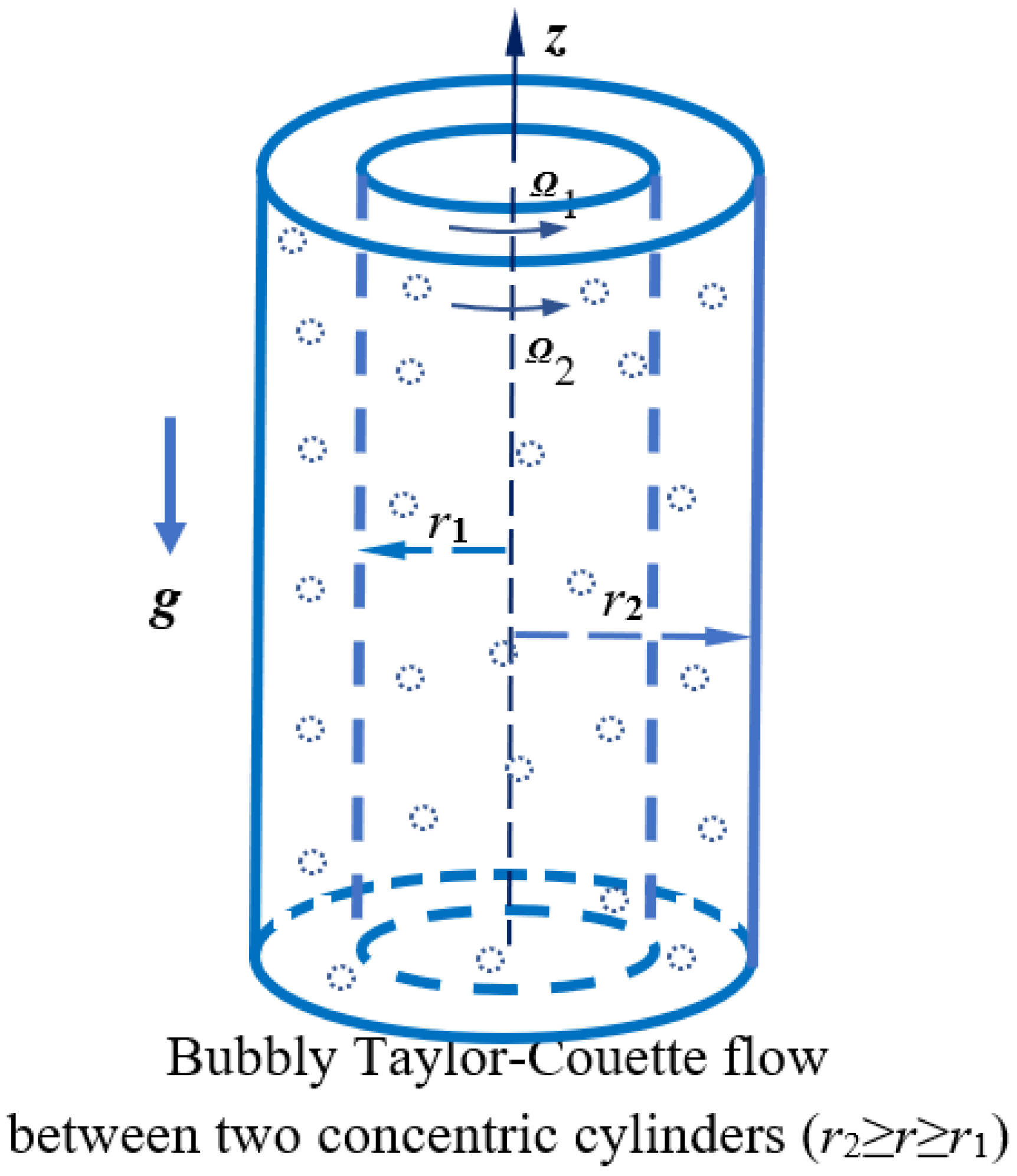
As stated by Murai et al. [2], uniformly distributed bubbles can be observed in TC flow at low rotational speed. Let us consider axisymmetric TC flow of an incompressible viscous fluid with uniformly dispersed spherical bubbles of radius rS, between two coaxial rotating cylinders, as shown in Figure 1.
Here, under the assumption that the radial bubble migration of uniformly distributed bubbles is slow enough, the time rate of change of bubbly flow fields can be ignored so that the bubbly flow fields can be treated as being approximately steady within a limited period of time.
With cylindrical coordinates (r, θ, z), the bubble–liquid suspension occupies the space (r1rr2, −∞ ≤ z ≤ +∞); the inner and outer cylinders, of radii r1 and r2, rotate at two counter-clockwise angular velocities Ω1 and Ω2, respectively, with a buoyancy effect on the gas bubbles, as shown in Figure 1. Assuming that the walls of the cylinders are impermeable, the steady axisymmetric z-independent velocity fields v = (0, v, w) and vm = (um, vm, wm) in the cylindrical coordinates (r, θ, z) shown in Figure 1 give
v = 0 v ( r ) w ( r ) , v m = u m r v m ( r ) w m ( r ) , p z , r = p 0 ρ f g z + p ( r ) ,
where p0 is the reference pressure at z = 0. Note that
· v + v T = 0 v , r r + v , r r v r 2 1 r d d r r w , r ,
where subscript “,” denotes the partial derivative with respect to r or z. In addition, we have
× v = 0 w , r 1 r d d r r v , v × × v = v r d d r r v + w w , r 0 0 ,   v m × × v = v m r d d r r v + w m w , r u m r d d r r v u m w , r .
Equation (1) for the steady axisymmetric velocity fields shown by (5) gives the following nonlinear equations for (um, v, vm, w, wm, p):
ρ u m u m r v m 2 r = p r ,
u m v m r + v m r = μ ρ v , r r + v , r r v r 2 ,
ρ u m w m r = p z + μ 1 r r r w , r ρ g .
Equation (2) is met automatically by the velocity fields (5), and the vm-v relations (3) give
u m + a u m u m r v m 2 r + C L 2 ρ r S 2 9 μ v m r d d r r v + w m w , r = b v 2 r + C L 2 ρ r S 2 9 μ v r d d r r v + w w , r ,
v m + a u m v m r + v m r C L 2 ρ r S 2 9 μ u m r d d r r v = v ,
w m + a u m w m r C L 2 ρ r S 2 9 μ u m w , r = w 2 δ ρ f r S 2 9 μ g .
It can be verified from the lift force expression in (A7) that the radial lift force in particulate circular Poiseuille pipe flow pushes the suspended particles that move axially slower (or faster) than the carrier fluid toward the centerline (or the wall) of the pipe. For particulate TC flow, however, it is seen from Equation (7) that the sign of radial lift force acting on the buoyant bubbles has a nonlinear dependence on the axial velocities of the bubbles and the carrier fluid and is rather dominated by their azimuthal velocities in the present linearized analysis in the dilute limit.

4. Leading-Order Bubble Velocity Fields in the Dilute Limit

For the present steady problem within bounded space (r1rr2), a physically reasonable small parameter for dilute bubbly fluids is the volume fraction of particles (δ << 1). Therefore, let us consider the solutions expanded as the power series of the dimensionless small parameter δ. Clearly, the zeroth-order solutions for a clear fluid (δ = 0) without dispersed bubbles are given by
δ = 0 :   u m = 0 , v m r = v ( r ) = v 0 r = A r + B r ,   w = w m = 0 , p z , r = p 0 ρ f g z + p 0 r ,
where p0(r) is determined by (8a) with um = 0 and vm = v0(r), and
A = r 1 2 Ω 1 r 2 2 Ω 2 r 1 2 r 2 2 ,   B = r 1 2 r 2 2 Ω 2 Ω 1 r 1 2 r 2 2 .
It is well-known that the TC velocity field v0(r), depending on different combinations of (r1, r2) and (Ω1, Ω2), exhibits rich and complicated physical phenomena. In what follows, to demonstrate the effects of dispersed bubbles on the TC velocity field, the derived general formulas will be discussed in detail for specific cases of major interest.
The present paper focuses on the initial TC flow with uniformly distributed bubbles (δ = constant). Let us now consider the power series expansions
u m r = 0 + δ u 1 m r +
v r = v 0 r + δ v 1 r + ,   v m r = v 0 r + δ v 1 m r +
w r = 0 + δ w 1 r + ,   w m r = 0 + δ w 1 m r +
p r ,   z = p 0 ρ f g z + p 0 r + δ p 1 ( r ) .
With the Einstein formula μ = μ f 1 + α δ , up to the first power of the small parameter δ, it is verified from (4) that
ρ = ρ f 1 δ ,   μ μ f = 1 + α δ ,
a =   a 0 + O ( δ ) ,   a b = a 0 δ C a + O δ 2 ,     a 0 = C a 2 ρ f r S 2 9 μ f .
Since the present work focuses on the lowest-order analysis of the bubbly flow field, the expansion coefficients that are not involved in the present lowest-order analysis are not listed in (13). Here a 0 = C a 2 ρ f r S 2 9 μ f is the dimensional modified relaxation time of gas bubbles due to the added mass [17], and the Stokes number of the bubbles can be defined by ( a 0 Ω ) with the angular velocity Ω of the inner and/or outer cylinder.
Our goal here is to derive the lowest first-order bubble-modified velocity fields (u1m, v1, v1m, w1, w1m) of particulate flow due to dispersed bubbles. Once u1m and v1m are known, the bubble-induced additional pressure field p1(r) can be determined by (8a).
From substitution of (12) and (13) into (8b), (9a) and (9b), we have three coupled linearized equations for (u1m, v1, v1m) as follows:
u 1 m v 0 r + v 0 r = μ f ρ f v 1 r 2 + 1 r r r v 1 r ,
u 1 m + C L 2 ρ f r S 2 9 μ f ( v 1 m v 1 ) r d d r r v 0 = a 0 C a v 0 2 r + 2 a 0 v 0 r v 1 m v 1 ,
v 1 m + a 0 C L 2 ρ f r S 2 9 μ f u 1 m v 0 r + v 0 r = v 1 .
With the no-slip boundary conditions w 1 r = r 1 ,   r 2 = 0 and (A5) and (12), up to the leading order, the decoupled linearized equations of (8c) and (9c) for w1(r) and w1m(r) give
w 1 = 0 ,
w 1 m = 2 ρ f r S 2 9 μ f g ,   w S = w 1 m = v ,   v 2 ρ f r S 2 9 μ f g .
Thus, the volume-averaged axial velocity of the gas–liquid suspension in the z-direction is zero, while the massless bubbles move upward with terminal velocity v determined by the balance between the buoyancy and the Stokes drag, as expected.
Now, by using (14b) and (14c) to eliminate (v1m-v1), we have the decoupled first-order equation for u1m(r) as follows:
1 + 4 A 2 ρ f r S 2 9 μ f 2 C a C L C a v 0 r A C L u 1 m = a 0 C a v 0 2 r .
Once u1m is known from (17), v1(r) can be determined from (14a) with the no-slip boundary conditions v 1 r = r 1 ,   r 2 = 0 , and then v1m(r) can be determined by (14c). In general, v1m(r) and v1(r) are not equal. However, it is seen from (14c) that v1m(r) = v1(r) when Ca = CL, which implies that the gas bubbles and the liquid have the same leading-order azimuthal velocity field when Ca = CL.
In particular, if Ca = CL = 0.5 as apparently assumed by some authors in the recent bubbly flow literature [12,13,14], the second term inside the brackets on the left-hand side of (17) vanishes, and up to the leading-order terms, it follows from (A5) that
u 1 m r = 2 a 0 v 0 2 r r 0 ,   u S r = ρ u 1 m r ρ f u 1 m r 0 .
Here it is stated that the second term inside the brackets on the left-hand side of (17) vanishing when Ca = CL is an exceptional case which happens only for massless gas bubbles (for which the coefficient a defined by (A10) reduces to a given by (13)). For instance, for heavy particles in a dusty gas ((ρSf) ≈ 103), the coefficient a 2 ρ S r S 2 9 μ is about three orders of magnitude larger than the lift force coefficient C L 2 ρ r S 2 9 μ in the relation (3), which explains why the lift force is ignorable for heavy particles in a dusty gas.
Thus, with Ca = CL = 0.5 [12,13,14,15,16,17,18], it is seen from (12), (16), (18) and v1m(r) = v1(r) that the leading-order steady velocity field of bubbles in cylindrical coordinates (r, θ, z) is given by
v S r = u S r v S r w S r = 2 a 0 v 0 2 r r v 0 ( r ) + δ v 1 ( r ) v = 2 ρ f r S 2 9 μ f g
Therefore, up to the leading order in the dilute limit, bubbles move with the gas–liquid suspension at the same azimuthal velocity and rise up at the terminal velocity given in (16) due to buoyancy. The predicted spiral rising of bubbles based on the laminar TC flow is qualitatively similar to some known results for turbulent bubbly TC flow; for example, see the visualization investigation by Du et al. [11] on turbulent bubbly TC flow driven by a rotating inner cylinder with a fixed outer cylinder, where the spiral rising bubbles were observed experimentally and simulated numerically.
In what follows, let us focus on the steady radial velocity field uS(r) of bubbles. It is seen from (19) that the steady bubble radial velocity uS(r) depends on the two radii (r1. r2) and angular velocities (Ω1, Ω2) through the azimuthal velocity v0(r).

5. Discussion with Comparison to Known Data

Let us focus on the implications of the explicit radial velocity field of bubbles given by (19) for several cases of TC flow of major interest. Here, we shall assume that Ca = CL = 0.5, as specifically assumed by some authors in the recent bubbly flow literature [12,13,14].
Case 1. If the two coaxial cylinders are co-rotating (Ω1 = Ω2) or the inner cylinder is absent (r1 = 0), we have B = 0 and A = Ω2. It follows from (A5) and (18) that, up to the leading order, we have
v 0 r = Ω 2 r ,   u S r = 2 a 0 Ω 2 2 r .
The radial velocity of buoyant bubbles is negative toward the inner cylinder or the central axis, which is consistent with some known results available in the literature. For instance, in the downward air–water two-phase flow in a vertical pipe studied by Raeiszadeh et al. [7,8], as mentioned previously, the lift force acting on the buoyant bubbles that move upward with respect to the water phase pushes the bubbles toward the central axis of the pipe. As shown in [7,8] and also predicted by the above Formula (20), additional rotation of the pipe (as a special TC flow with r1 = 0) further enhances the bubble motion toward the central axis and leads to even stronger bubble accumulation around the central axis of the rotating pipe.
It is seen from (20) that the bubble radial velocity is proportional to the radial coordinate r, and the radial-to-azimuthal velocity ratio (uS/v0) of the bubbles is linearly proportional to the Stokes number (a0Ω2) of the bubbles. Since the coefficient a0 given in (13) is proportional to the square of the bubble radius, the Stokes number of the bubbles is largely controlled by the bubble radius and the angular velocity Ω2; therefore, the radial-to-azimuthal velocity ratio (uS/v0) of the bubbles can be a few orders of magnitude smaller than unity when the bubble radius is sufficiently small with moderately low angular velocity Ω2.
Case 2. Similarly, if the bubbly TC flow is driven by a rotating inner cylinder while the outer cylinder is fixed (Ω2 = 0)—an important case addressed by numerous previous studies (see, e.g., [1,2,3,4,5,6])—we have
A = r 1 2 r 1 2 r 2 2 Ω 1 , B = A r 2 2 , v 0 r = r A r 2 2 r 2 1 ,
u S r = 2 a 0 A r 2 2 r 2 1 v 0 ( r ) = 2 a 0 A 2 r r 2 2 r 2 1 2 .
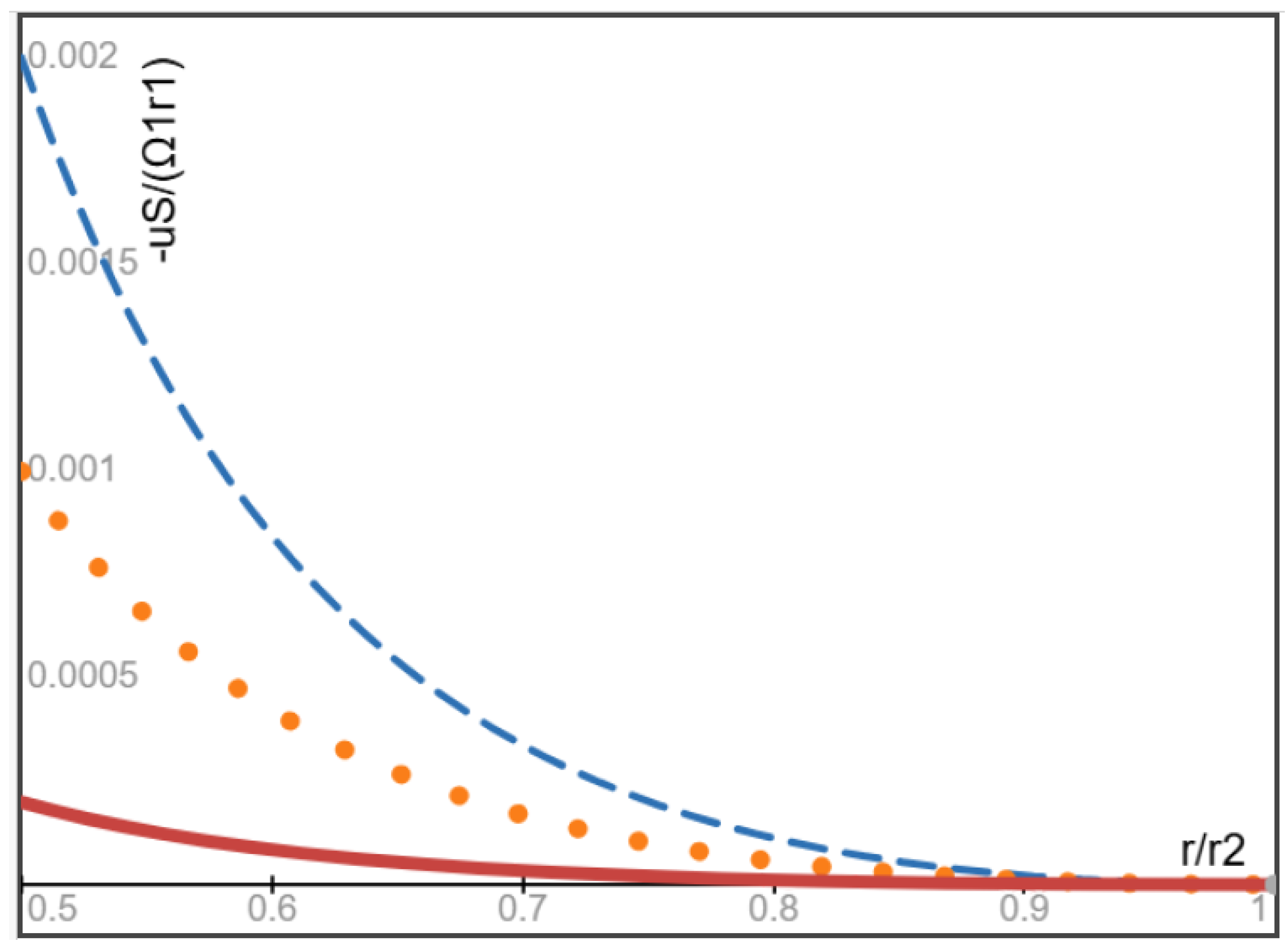
As shown in (19), up to the leading order, the azimuthal velocity of bubbles predicted by the present model is equal to the volume-averaged azimuthal velocity of the suspension, and the axial velocity of the bubbles is the terminal rising velocity while the volume-averaged axial velocity of the suspension given by (15) is zero. On the other hand, the radial velocity of bubbles is always negative toward the inner cylinder and proportional to the square of the angular speed of the inner cylinder. For example, the magnitude of the bubble radial velocity (−uS) normalized by the azimuthal speed (Ω1r2) of the rotating inner cylinder is shown in Figure 2 for several values of the bubble Stokes number ( a 0 Ω 1 ) in the case r1 = 0.5r2. It is seen from Figure 2 that the bubble radial velocity is a few orders of magnitude lower than the azimuthal velocity of the bubbles and the suspension; it decreases monotonically with increasing radial coordinate and vanishes on the fixed outer cylinder.
All of these predictions are qualitatively consistent with some known results. For example, see Figure 12a of Gao et al. [6] on weakly turbulent bubbly TC flow driven by a rotating inner cylinder with a fixed outer cylinder, where it is shown that the azimuthal velocity components of the bubbles (of mean radius 0.3 mm) and the liquid are nearly equal, the radial velocities of the bubbles and the liquid are vanishingly small, and the axial velocity of buoyant bubbles is clearly greater than the vanishingly small axial velocity of the liquid phase.
In particular, the predicted negative radial velocity (22) of bubbles toward the inner rotating cylinder is in qualitative agreement with known results reported in the literature for laminar and turbulent bubbly TC flow driven by a rotating inner cylinder; for example, see Figure 9 of [2] (with bubble mean radius 0.25–0.3 mm), Figure 12 of [4] (with bubble mean radius 0.25–0.3 mm), and Figure 4 of [6] (with bubble mean radius 0.3 mm), where the bubble volume fraction is vanishingly small between the two cylinders except for in the narrow region near the rotating inner cylinder where a high peak in the bubble volume fraction appears as a result of the slow but long-term radial bubble migration toward the inner cylinder. Murai et al. [2] explained bubble accumulation at the rotating inner cylinder in terms of the centripetal force acting on the bubbles. Consistently with this explanation, it is seen from Figure 2 that the bubble radial velocity given by (22) attains its maximum at the rotating inner cylinder (r = r1) and vanishes at the fixed outer cylinder (r = r2).
To the best of our knowledge, the velocity fields of bubbly TC flow studied in the existing literature are usually given by numerical solutions; the explicit expression (22) derived here for the bubble radial velocity in laminar TC flow does not have similar counterparts in the existing literature and may provide useful results about the bubble velocity fields of bubbly TC flow.
Case 3. If the outer cylinder rotates (Ω2 > 0) while the inner cylinder is fixed (Ω1 = 0), a case rarely studied in the literature, we have
A = r 2 2 Ω 2 r 1 2 r 2 2 ,   B = A r 1 2 ,
u S r = 2 a 0 A 1 r 1 2 r 2 v 0 ( r ) = 2 a 0 A 2 r 1 r 1 2 r 2 2 .
It is seen from (24) that the magnitude of the bubble radial velocity in Case 3 increases monotonically with the radial coordinate and vanishes on the fixed inner cylinder.
Case 4. If the two cylinders are counter-rotating (Ω1 = −Ω2 > 0), we have
A = r 1 2 + r 2 2 r 1 2 r 2 2 Ω 1 ,   B = 2 r 1 2 r 2 2 r 1 2 + r 2 2 A ,   v 0 r = r A 1 2 r 1 2 r 12 2 ,   r 12 r r 1 2 + r 2 2 r 2 2 > r 1 ,
u S r = 2 a 0 A 1 2 r 1 2 r 12 2 v 0 r = 2 a 0 A 2 r 1 2 r 1 2 r 12 2 2 .
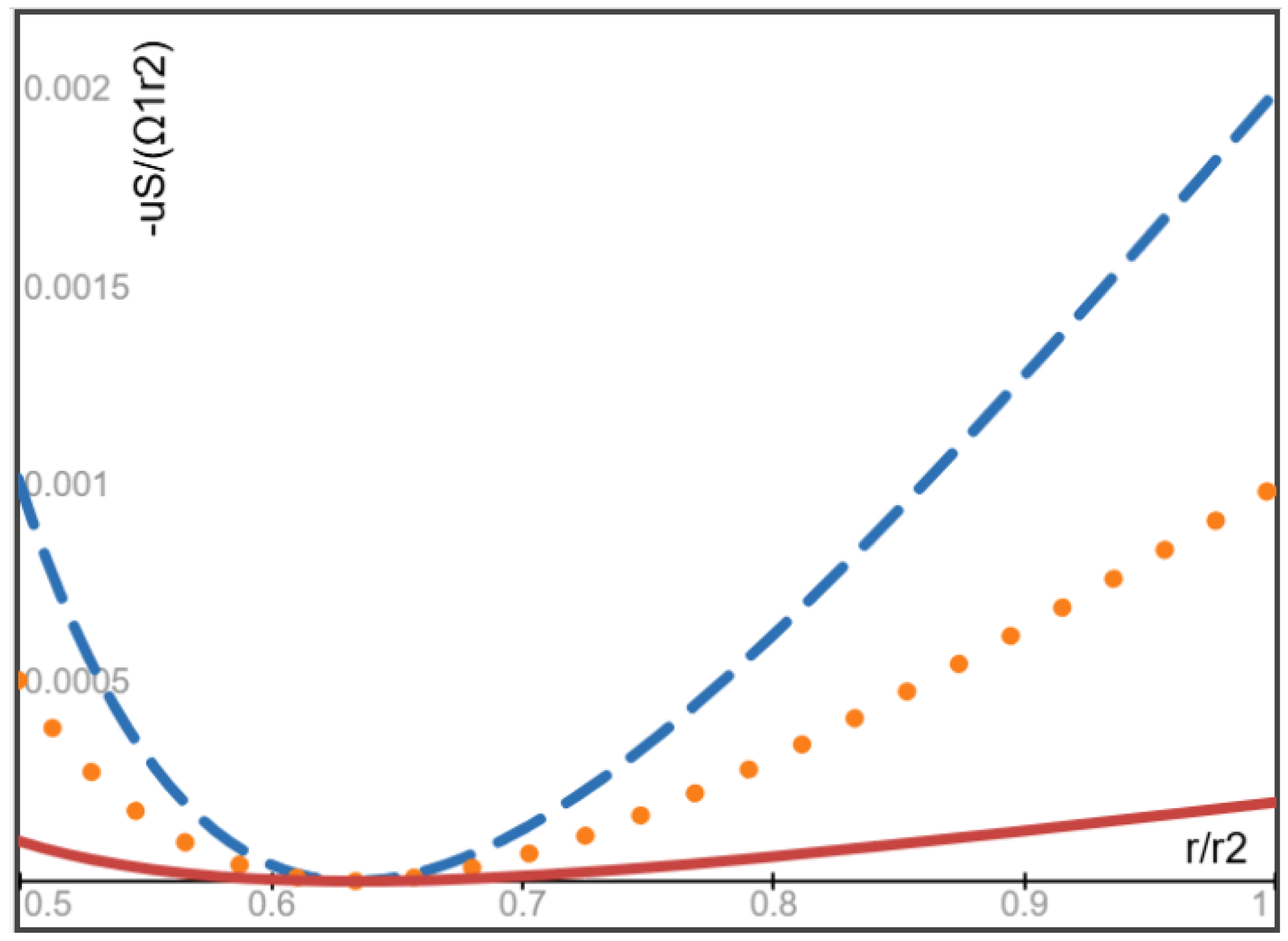
For example, the magnitude of the bubble radial velocity (−uS) normalized by the azimuthal speed (Ω1r2) of the outer cylinder is shown in Figure 3 for several values of the bubble Stokes number ( a 0 Ω 1 ) in the case r1 = 0.5r2. It is noted that the radial velocity uS(r) of bubbles given by (26) vanishes at the location between the two cylinders (which is r/r2 = √0.4 when r1 = 0.5r2 as shown in Figure 3) determined by
u S = 0   a t   r = 2 r 1 2 r 2 2 r 1 2 + r 2 2 .
Thus, as a result of the zero radial velocity of bubbles at the location given by (27), it is expected that a local maximum of the bubble volume fraction could develop at this location in the early stage of bubbly TC flow with uniformly distributed bubbles. Although it is known that counter-rotating TC flow exhibits some complex and unique flow phenomena [9], to the best of our current knowledge, few data are available in the existing literature on the bubble radial distribution in counter-rotating bubbly TC flow; therefore, this theoretical prediction cannot be verified here due to the lack of available known data.
It is seen from (19)–(26) that for all four cases, the radial-to-azimuthal velocity ratio (uS/v0) of the bubbles is linearly proportional to the Stokes number of the bubbles and, therefore, can be largely controlled by the bubble size and the angular velocity of the rotating cylinder(s). For example, for gas bubbles in water with bubble diameter 0.1 mm, we have a 0 4 × 10 4 s [17]. Thus, the Stokes number of the bubbles is of the order 10−3 if the rotation of the cylinders is slow with angular velocity of the order 2π/s. In such cases, radial bubble migration can be reasonably ignored in the first few tens of revolutions of TC flow. In particular, the radial migration of bubbles in bubbly TC flow can be ignored even for much faster angular rotation of the cylinder(s) when gas bubbles on much smaller micro-/nano-scales are considered [19,20,21].

6. Conclusions

Explicit leading-order expressions for the steady bubble velocity fields of bubbly Taylor–Couette (TC) flow were derived under the condition that the angular velocity of the rotating cylinder(s) is moderately low and the bubble size is relatively small so that the Stokes number is small and the radial bubble migration is ignorable within a limited period of time. The predicted spiral rising velocity field of bubbles under the buoyancy effect was qualitatively consistent with some known simulations of laminar and turbulent bubbly TC flow. Since the velocity fields of bubbly TC flow available in the literature are usually given as numerical solutions, to the best of our current knowledge, the explicit expression derived here for the radial velocity field of bubbles has no similar counterparts in the existing literature.
Specifically, our results derived for several cases of major interest showed that the radial-to-azimuthal velocity ratio of bubbles is linearly proportional to the Stokes number of bubbles and can be a few orders of magnitude smaller than unity when the angular velocity of the rotating cylinder(s) is moderately low and the bubble size is relatively small. Therefore, radial bubble migration can be suppressed by a moderately low angular velocity of the rotating cylinder(s) and a relatively small bubble radius. These conditions justify the adopted assumption that the radial bubble migration can be assumed to be slow and the volume fraction of bubbles can be treated as being constant during a limited period of time (for example, in the first few tens of revolutions of the rotating cylinder(s)).

Funding

No external funding applied to this research.

Data Availability Statement

The data that support the findings of this study are available within the article.

Acknowledgments

During the preparation of this manuscript, the author used the free online version of “Desmos” graphing calculator for the purposes of making the Figure 2 and Figure 3. The author have reviewed and edited the output and take full responsibility for the content of this publication.

Conflicts of Interest

The author has no known competing financial interests or personal relationships that could have appeared to influence the work reported in this paper.

Appendix A. General Equations of the Present Model

The single-phase models [22,23,24] treat an incompressible Newtonian fluid with uniformly suspended spherical particles as a homogeneous incompressible viscous fluid with constant effective viscosity μ and mass density ρ, governed by the classical Navier–Stokes equations
ρ d v d t = ρ v t + v · v = p + μ 2 v + ρ f g + δ ρ S ρ f g ,   d i v v = 0 ,
where x and t are the spatial coordinates and time, v(x, t) is the volume-averaged velocity field of the particle–fluid suspension defined by
v = δ v S + v f 1 δ ,
p(x, t) is the pressure field of the suspension, and and 2 are the gradient and Laplacian operators. The mass density ρ (per unit volume) of the suspension is given by ρ = ρ S δ + ρ f ( 1 δ ) , where ρS and ρf are the mass densities of the particles and the fluid, respectively; δ is the volume fraction of the particles; μ is the effective viscosity of the suspension, which can be estimated by the Einstein formula μ = μ f 1 + α δ with the coefficient α and the viscosity μf of the fluid; and g is the gravity force per unit mass. Single-phase models based on the single velocity field v(x, t) enjoy simple mathematical formulations but cannot explain some multiphase flow phenomena of particle-laden fluids, such as particle migration.
Unlike the single-phase models, the present model addresses the role of relative shift between the velocity field vS(x, t) of the dispersed particles and the velocity field vf(x, t) of the carrier fluid when the particles are not neutrally buoyant (ρSρf). It follows from Newton’s second and third laws that the resultant external force acting on the representative unit cell, given by the terms on the right-hand side of Equation (A1), equates to the mass of the unit cell multiplied by the acceleration dvm/dt of its mass center (rather than the acceleration field dv/dt of its geometrical center); therefore, instead of Equation (A1), dv/dt on the left-hand side of (A1) should be replaced by dvm/dt, and the suspension is governed by the modified form of the Navier–Stokes equations:
ρ d v m d t = ρ v m t + v m · v m = p + · μ v + v T + ρ f g + δ ρ S ρ f g
where vm(x, t) is the mass-averaged velocity field of the suspension (defined by the velocity field of the mass center of the representative unit cell defined by the mass-averaged velocity field)
ρ v m = δ ρ S v S + ρ f 1 δ v f .
In general, vm(x, t) ≠ v(x, t). To derive a relationship between vm(x, t) and v(x, t), we note that it follows from (A2) and (A4) that
ρ v m = δ ρ S ρ f v S + ρ f v .
Thus, the mass-averaged acceleration field relation gives
ρ d v m d t = ρ S ρ f δ d v S d t + ρ f d v d t ,
where d/dt denotes the material derivative of the associated velocity field along its own streamlines, and vS(x, t) can be given in terms of v(x, t) and vm(x, t) from (A5).
For a spherical particle (of radius rS) moving at velocity vS(x, t) with respect to a suspension of effective viscosity μ, effective mass density ρ and velocity field v(x, t), the forces acting on the particle due to the Stokes drag, acceleration field and added mass [25,26], buoyancy, and lift force [27,28,29] are given by
6 π r S μ v v S + ρ V S d v d t + C a ρ V S d v d t d v S d t + V S ρ S ρ g + C L ρ V S v v S × × v ,
where V S = 4 π r S 3 3 , and Ca and CL are the added mass coefficient and the lift force coefficient, respectively. Thus, the dynamics of the spherical particle are governed by
ρ S V S d v S d t = 6 π r S μ v v S + ρ V S d v d t + C a ρ V S d v d t d v S d t + V S ρ S ρ g + C L ρ V S v v S × × v .
By dividing both sides of (A8) by 6 π r S μ , multiplying both sides of the obtained equation by ( δ ρ S ρ f ρ ), and using (A5) and (A6) to eliminate the velocity field vS and its material derivative dvS/dt, we have
v m + a d v m d t + C L 2 ρ r S 2 9 μ v m × × v = v + b d v d t + 2 δ ρ S ρ f ρ S ρ r S 2 9 ρ μ g + C L 2 ρ r S 2 9 μ v × × v ,
with
a = 1 + C a ρ ρ S 2 ρ S r S 2 9 μ ,   b = a ρ f ρ + 1 + C a ρ S ρ f δ C a ρ + ρ S .
Finally, the conservation of mass for the carrier fluid and spherical particles gives
t δ x , t + d i v δ x ,   t v S = 0 ,
t 1 δ x , t + d i v 1 δ x ,   t v f = 0 ,
respectively. In view of (A2) and (A4), (A12) and (A13) give Equation (2) and
t ρ + d i v ρ v m = 0 .
In summary, we have eight Equations (A3), (2), (A9) and (A13) for δ(x, t), two velocity fields v(x, t) and vm(x, t), and the pressure field p(x, t), with the coefficients (a, b) given by (A10).
For gas bubble–liquid two-phase suspensions, the physical concepts and mathematical equations formulated in the two-fluid model for spherical particles can be largely applied to fluids with dispersed spherical gas bubbles (for example, compare (A7) with Equation (11) in Magnaudet & Eames [13] or Equations (92)–(95) in Legendre & Zenit [17]). For gas bubbles in a liquid, the bubble density ρS is ignored compared to the liquid density ρf. Thus, when slow radial bubble migration and the associated Equation (A13) are ignored as assumed in the present work, (A3) for bubbly flow reduces to (1), (A9) reduces to (3), and a and b given by (A10) reduce to (4).
Here, it should be stated that, for the special case of heavy particles with (ρS/ρf) >> 1 and Stokes drag dominating over other forces, we have a = 2 ρ S r S 2 9 μ ,   b = ρ f ρ a . The present model based on Stokes drag alone has been used to study the linear stability of plane parallel flow [30] and the Kelvin–Helmholtz instability of fluid interfaces [31], and it has been shown that the results derived by the present model for heavy particles are identical to Saffman’s classical results [32] and the results from Michael [33] derived by the classical Saffman model. This offers supporting evidence for the efficiency and accuracy of the present model.

References

  1. Shiomi, Y.; Kutsuna, H.; Akagawa, K.; Ozawa, M. Two-phase flow in an annulus with rotating inner cylinder (flow pattern in bubbly flow region). Nucl. Eng. Des. 1993, 141, 27–34. [Google Scholar] [CrossRef]
  2. Murai, Y.; Oiwa, H.; Takeda, Y. Bubble behavior in a vertical Couette-Taylor flow. J. Phys. Conf. Ser. 2005, 14, 143–156. [Google Scholar]
  3. Climent, E.; Simonnet, M.; Magnaudet, J. Preferential accumulation of bubbles in Couette-Taylor flow patterns. Phys. Fluids 2007, 19, 083301. [Google Scholar] [CrossRef]
  4. Murai, Y.; Oiwa, H.; Takeda, Y. Frictional drag reduction in bubbly Couette-Taylor flow. Phys. Fluids 2008, 20, 034101. [Google Scholar]
  5. van Gils, D.P.M.; Narezo Guzman, D.; Sun, C.; Lohse, D. The importance of bubble deformability for strong drag reduction in bubbly turbulent Taylor-Couette flow. J. Fluid Mech. 2013, 722, 317–347. [Google Scholar]
  6. Gao, X.; Kong, B.; Vigil, R.D. CFD investigation of bubble effects on Taylor-Couette flow patterns in the weakly turbulent vortex regime. Chem. Eng. J. 2015, 270, 508–518. [Google Scholar]
  7. Raeiszadeh, F.; Hajidavalloo, E.; Behbahaninejad, M.; Hanafizadeh, P. Effect of pipe rotation on downward co-current air-water flow in a vertical pipe. Int. J. Multiph. Flow 2016, 81, 1–14. [Google Scholar]
  8. Raeiszadeh, F.; Hajidavalloo, E.; Behbahaninejad, M.; Hanafizadeh, P. Modeling and simulation of downward vertical two-phase flow with pipe rotation. Chem. Eng. Res. Des. 2018, 137, 10–19. [Google Scholar] [CrossRef]
  9. Bullee, P.A.; Bakhuis, D.; Ezeta, R.; Huisman, S.G.; Sun, C.; Lammertink, R.G.; Lohse, D. Effect of axially varying sandpaper roughness on bubbly drag reduction in Taylor-Vouette turbulence. Int. J. Multiph. Flow 2020, 132, 103434. [Google Scholar]
  10. Abdelili, A.; Oualli, H.; Hanchi, S.; Bouabdallah, A. Bubble injection effect on Taylor-Couette flow controlled by deformation of inner cylinder cross-section. J. Braz. Soc. Mech. Sci. Eng. 2021, 43, 214. [Google Scholar]
  11. Du, S.; Yang, X.; Zhu, Y.; Yan, S.; Bai, Z. Visualization investigation of bubble dynamic characteristics for different motion mode in a Taylor-Couette reactor. Chem. Eng. J. 2025, 506, 160099. [Google Scholar] [CrossRef]
  12. Climent, E.; Magnaudet, J. Large-scale simulations of bubble-induced convection in a liquid layer. Phys. Rev. Lett. 1999, 82, 4827–4830. [Google Scholar]
  13. Magnaudet, J.; Eames, I. The motion of high-Reynolds-Number bubbles. Annu. Rev. Fluid Mech. 2000, 32, 659–708. [Google Scholar]
  14. Nakamura, K.; Yoshikawa, H.N.; Tasaka, Y.; Murai, Y. Linear stability analysis of bubble-induced convection in a horizontal liquid layer. Phys. Rev. E 2020, 102, 053102. [Google Scholar] [CrossRef] [PubMed]
  15. Colombo, M.; Rzehak, R.; Fairweather, M.; Liao, Y.; Lucas, D. Benchmarking of computational fluid dynamic models for bubbly flow. Nucl. Eng. Des. 2021, 375, 111075. [Google Scholar] [CrossRef]
  16. Basagni, G.; Varallo, N.; Mereu, R. Computational fluid dynamics modeling of two-phase bubble column: A comprehensive review. Fluids 2023, 8, 91. [Google Scholar] [CrossRef]
  17. Legendre, D.; Zenit, R. Gas bubble dynamics. Rev. Mod. Phys. 2025, 97, 025001. [Google Scholar] [CrossRef]
  18. Zhao, T.; Shin, B. An application of upwind difference scheme with preconditioned numerical fluxes to gas-liquid two-phase flows. Fluids 2025, 10, 38. [Google Scholar]
  19. Ren, F.; Noda, N.A.; Ueda, T.; Sano, Y.; Takase, Y.; Umekage, T.; Yonezawa, Y.; Tanaka, H. CFD-PBM approach for the gas-liquid flow in a nanobubble generator with honeycomb structure. J. Dispers. Sci. Technol. 2019, 40, 306–317. [Google Scholar]
  20. Xu, W.; Li, W.; Wang, J.; Song, Y.; Wu, B.; Wen, J.; Li, K.; Li, B. Numerical simulation of gas-liquid two-phase flow CFD-PBM model in a micro-nanobubble generator. Minerals 2022, 12, 1270. [Google Scholar]
  21. García-Magariño, A.; Lopez-Gavilan, P.; Sor, S.; Terroba, F. Micro/bubble drag reduction focused on new applications. J. Mar. Sci. Eng. 2023, 11, 1315. [Google Scholar] [CrossRef]
  22. Park, H.M. Comparison of the pseudo-single-phase continuum model and the homogeneous single-phase model of nanofluids. Int. J. Heat Mass Transf. 2018, 120, 106–116. [Google Scholar]
  23. Saha, G.; Paul, M.C. Investigation of the characteristics of nanofluids flow and heat transfer in a pipe using a single phase model. Int. Commun. Heat Mass Transf. 2018, 93, 48–59. [Google Scholar] [CrossRef]
  24. Turkyilmazoglu, M. Single phase nanofluids in fluid mechanics and their hydrodynamic linear stability analysis. Comput. Methods Programs Biomed. 2020, 187, 105171. [Google Scholar] [CrossRef] [PubMed]
  25. Klinkenberg, J.; de Lange, H.C.; Brandt, L. Linear stability of particle laden flows: The influence of added mass, fluid acceleration and Basset history force. Meccanica 2014, 49, 811–827. [Google Scholar]
  26. Ru, C.Q. On particle-modified velocity fields of particulate Taylor-Couette flow. Phys. Fluids 2024, 36, 093340. [Google Scholar]
  27. Rubinow, S.I.; Keller, J.B. The transverse force on a spinning sphere moving in a viscous fluid. J. Fluid Mech. 1961, 11, 447–459. [Google Scholar] [CrossRef]
  28. Saffman, P.G. The lift on a small sphere in a slow shear flow. J. Fluid Mech. 1965, 22, 385–400. [Google Scholar] [CrossRef]
  29. Ru, C.Q. Steady radial diverging flow of a particle-laden fluid with particle migration. Fluids 2025, 10, 200. [Google Scholar] [CrossRef]
  30. Ru, C.Q. Stability of plane parallel flow revisited for particle-fluid suspensions. J. Appl. Mech. 2024, 91, 111005. [Google Scholar]
  31. Ru, C.Q. On Kelvin-Helmholtz instability of particulate two-fluid flow. Acta Mech. Sin. 2025, 41, 324143. [Google Scholar]
  32. Saffman, P.G. On the stability of laminar flow of a dusty gas. J. Fluid Mech. 1962, 13, 120–128. [Google Scholar] [CrossRef]
  33. Michael, D.H. Kelvin-Helmholtz instability of a dusty gas. Math. Proc. Camb. Philos. Soc. 1965, 61, 569–571. [Google Scholar] [CrossRef]
Figure 1. Steady bubbly Taylor–Couette flow between two long coaxial rotating cylinders of radii r1 and r2 and angular velocities Ω1 and Ω2, respectively, with downward gravity.
Fluids 11 00167 g001
Figure 2. The bubble radial velocity (−uS) normalized by the azimuthal speed (Ω1r1) of the rotating inner cylinder for Case 2 of a fixed outer cylinder (Ω2 = 0) with r1 = 0.5r2 for three values of the bubble Stokes number ( a 0 Ω 1 ): 0.001 (dashed blue), 0.0005 (dotted orange), and 0.0001 (solid red).
Fluids 11 00167 g002
Figure 3. The bubble radial velocity (−uS) normalized by the azimuthal speed (Ω1r2) of the outer cylinder for Case 4 of counter-rotating cylinders (Ω1 = −Ω2 > 0) with r1 = 0.5r2 for three values of the bubble Stokes number ( a 0 Ω 1 ): 0.001 (dashed blue), 0.0005 (dotted orange), and 0.0001 (solid red).
Fluids 11 00167 g003
Disclaimer/Publisher’s Note: The statements, opinions and data contained in all publications are solely those of the individual author(s) and contributor(s) and not of MDPI and/or the editor(s). MDPI and/or the editor(s) disclaim responsibility for any injury to people or property resulting from any ideas, methods, instructions or products referred to in the content.