1. Introduction
The energy efficiency of thermal conditioning systems in electric vehicles (EVs) is one of the main factors affecting overall vehicle performance and user acceptance [
1,
2]. Unlike conventional vehicles with internal combustion engines that exploit waste heat for cabin conditioning, EVs rely entirely on battery energy for both traction and auxiliary loads. Consequently, thermal management has a direct impact on vehicle range, operating cost, and passenger comfort [
3]. Among these auxiliary loads, the heating, ventilation, and air conditioning (HVAC) system is a major contributor to energy consumption, especially under extreme ambient conditions.
A key challenge in simulating EV thermal performance is the lack of fast, system-compatible models that provide detailed cabin airflow information [
4,
5]. Passenger thermal comfort depends strongly on local air velocities and temperatures within the cabin. However, resolving these quantities with high fidelity typically requires computational fluid dynamics (CFD) simulations. While CFD delivers accurate flow and temperature fields, its computational cost makes it impractical for vehicle-level simulations, optimization loops, or control-oriented frameworks where repeated or real-time evaluations are needed.
This limitation motivates the development of surrogate models that reproduce CFD-level cabin airflow predictions at a fraction of the computational cost. Such models are particularly valuable when integrated into system-level EV simulations, where cabin airflow information supports HVAC control strategies, passenger comfort assessment, energy management decisions, and overall vehicle energy optimization.
In this work, a data-driven surrogate model that employs scientific machine learning methods is presented to predict cabin airflow in EVs. High-fidelity CFD solutions are used as training data for learning velocity and temperature fields inside the passenger compartment. The CFD simulations are performed with the widely used open-source library suite
OpenFOAM [
6], and the obtained data are used to train a convolutional neural network in
Python [
7]. The
PyTorch library [
8] is used for implementing a mirror-symmetric network inspired by the U-Net architecture [
9]. Specifically, the U-Net structure was first introduced for biomedical image segmentation, as particularly suitable for learning spatially resolved fields owing to its multiscale feature extraction and skip-connection design. In the present context, the adopted design aims to reproduce dominant cabin flow structures and temperature distributions while maintaining low inference times and modest computational requirements. The present work does not aim to introduce fundamentally new machine learning methodologies. Instead, its contribution lies in the integration of established approaches into a coherent framework tailored for system-level EV simulations. In particular, the following aspects constitute the main contributions of this study: (i) development of a graph-based surrogate model operating directly on unstructured CFD meshes, (ii) implementation of a predictor–corrector training strategy for improved convergence behavior, and (iii) establishment of a complete workflow from CFD data generation to surrogate deployment, including the integration of the surrogate model into a system-level simulation environment.
Previous studies have demonstrated that artificial neural networks (ANN) can efficiently approximate flow fields under domain-specific constraints, particularly for steady-state and laminar regimes on structured grids. In that view, [
10] employs convolutional neural networks to predict steady laminar flows with high efficiency, highlighting the potential of data-driven models for accelerating CFD tasks. Similarly, [
11] extends surrogate modeling approaches to both steady and unsteady flows, showing that machine-learned models can capture dominant flow dynamics while significantly reducing computational cost. A broader overview is provided by [
12] that reviews recent advances in machine learning-based CFD surrogates, emphasizing their applicability in the built environment and identifying limitations related to generalization, data requirements, and physical consistency. In parallel, developments in geometric deep learning have enabled the extension of such approaches beyond structured grids toward unstructured and mesh-based representations. Provided by [
13] is a comprehensive framework for learning on non-Euclidean domains, establishing the theoretical foundation for graph-based representations of physical systems. Furthermore, [
14] demonstrates that graph networks can learn to simulate complex physical dynamics governed by partial differential equations, accurately capturing interactions across discretized domains. Finally, [
15] extends this concept to mesh-based simulations, showing that message-passing architectures can directly operate on computational meshes and generalize across varying geometries and resolutions. These approaches highlight the capability of graph-based models to preserve spatial connectivity and numerical structure, making them very suitable for CFD-derived datasets.
Building on these foundations, the present work investigates surrogate modeling for complex three-dimensional cabin geometries defined on unstructured meshes, where flow features such as jet development, recirculation, and buoyancy-driven stratification must be captured simultaneously. Complementing existing approaches, the proposed framework focuses on a problem-specific yet practically relevant setting, developing a surrogate model tailored to a defined cabin geometry and operating range. The primary objective is to bridge the gap between high-fidelity CFD-based airflow modeling and system-level EV simulations, where computational efficiency and real-time capability are essential (e.g., energy optimization, design-phase studies, control-oriented applications).
To concentrate on the essential aspects of surrogate model development and assessment, a simplified electric truck cabin geometry is employed as the reference test case (
Figure 1). This simplification allows systematic exploration of model accuracy and robustness without excessive focus on geometrical complexity, while maintaining all relevant flow features and required surrogate model complexity. Nevertheless, the proposed methodology remains extensible to passenger cabins of other EV configurations, including electric minibuses, trucks, or passenger cars.
An important aspect of the presented approach is the integration of the developed surrogate model into a system-level EV simulation environment. The respective EV model is implemented in
Modelica/
Dymola [
16,
17], which provides a physics-based, equation-oriented environment for modeling vehicle subsystems such as the HVAC, battery, and vehicle dynamics. In such environments, HVAC operation is typically governed by control strategies (e.g., PID controllers) coupled with multiple subsystems, including heat exchangers and ventilation units. Executing CFD simulations within this loop is computationally infeasible, making reduced-order or surrogate representations essential for practical implementation. By embedding the surrogate model within this system-level simulation, cabin airflow information becomes available on demand during energy management and thermal comfort analyses. This capability enables evaluation and optimization of HVAC control strategies while explicitly accounting for passenger comfort, without the burden of repeated CFD calculations. Therefore, this surrogate model is trained for a specific cabin configuration and operating range: the intention is not to construct a universally generalizable model, but rather to establish a reproducible workflow that can be applied to other configurations by retraining on corresponding CFD datasets.
The remainder of this paper is organized as follows:
Section 2 describes the CFD dataset generation with
OpenFOAM (geometry definition, numerical setup, data preparation, characteristic cabin flow patterns);
Section 3 presents the surrogate model development (neural network architecture, input–output formulation, training procedure);
Section 4 evaluates the surrogate predictions (main airflow outputs and quantitative accuracy assessment);
Section 5 describes the coupling of the Python-based surrogate with the
Modelica/
Dymola EV system model (communication protocol and performance considerations);
Section 6 summarizes the main conclusions and directions for future work.
2. Cabin Airflow Dataset
The dataset used for training and validating the presented data-driven surrogate model was generated from high-fidelity numerical simulations of airflow and heat transfer inside an EV passenger cabin. The primary objective of the CFD campaign is to provide physically consistent, spatially resolved velocity and temperature fields representative of typical cabin conditioning scenarios. These fields serve as reference ground-truth data for subsequent data-driven modeling.
2.1. Governing Equations
The cabin airflow is simulated as a steady-state, incompressible, turbulent flow of a Newtonian fluid with heat transfer. This flow is governed by the conservation equations for mass, momentum, and energy, which in the present case take the form [
18]:
where
u, p, and T denote the velocity vector field, and pressure and temperature scalar fields, respectively; ρ is the air density; c
p is the specific heat capacity; μ and μ
t are the molecular and turbulent dynamic viscosities, while Pr and Pr
t are the corresponding Prandtl numbers.
To model the effects of turbulent fluctuations on the mean flow, the Reynolds-averaged Navier–Stokes (RANS) approach is employed, where turbulent viscosity μ
t is defined based on the additional turbulence scalars [
19]. Here, the k–ε turbulence closure framework is used [
20], which requires two turbulence scalar transport equations to be solved: for the turbulent kinetic energy k, and for its dissipation rate ε. The final set of turbulence equations in steady-state form reads
where C
μ is the turbulent viscosity constant, P
k is the production of turbulent kinetic energy, σ
k and σ
ε are turbulent Prandtl numbers. Owing to its robustness, accuracy, and computational efficiency, for this work, the realizable k–ε model variant is selected [
21], in which the model constants C
1 and C
2 are sensitized for wall-bounded shear and jet-dominated flows.
For the air properties, cp = 1005 J/(kg·K) and μ = 1.8 × 10⁻⁵ Pa·s were assumed constant. The density variation was evaluated using the ideal gas law, while the Prandtl analogy was used for the thermal conductivity with Pr = 0.71 and Prt = 0.85. These assumptions are standard for indoor airflow simulations and ensure consistency across the dataset.
2.2. CFD Setup
The simulations were performed using open-source CFD code
OpenFOAM, where steady-state solutions were obtained with the solver
buoyantSimpleFoam, which accounts for buoyancy effects and employs the SIMPLE algorithm for pressure–velocity coupling [
22].
The computational mesh was generated starting from a structured background grid created with
blockMesh. The cabin geometry, including dashboard and seats, was introduced using
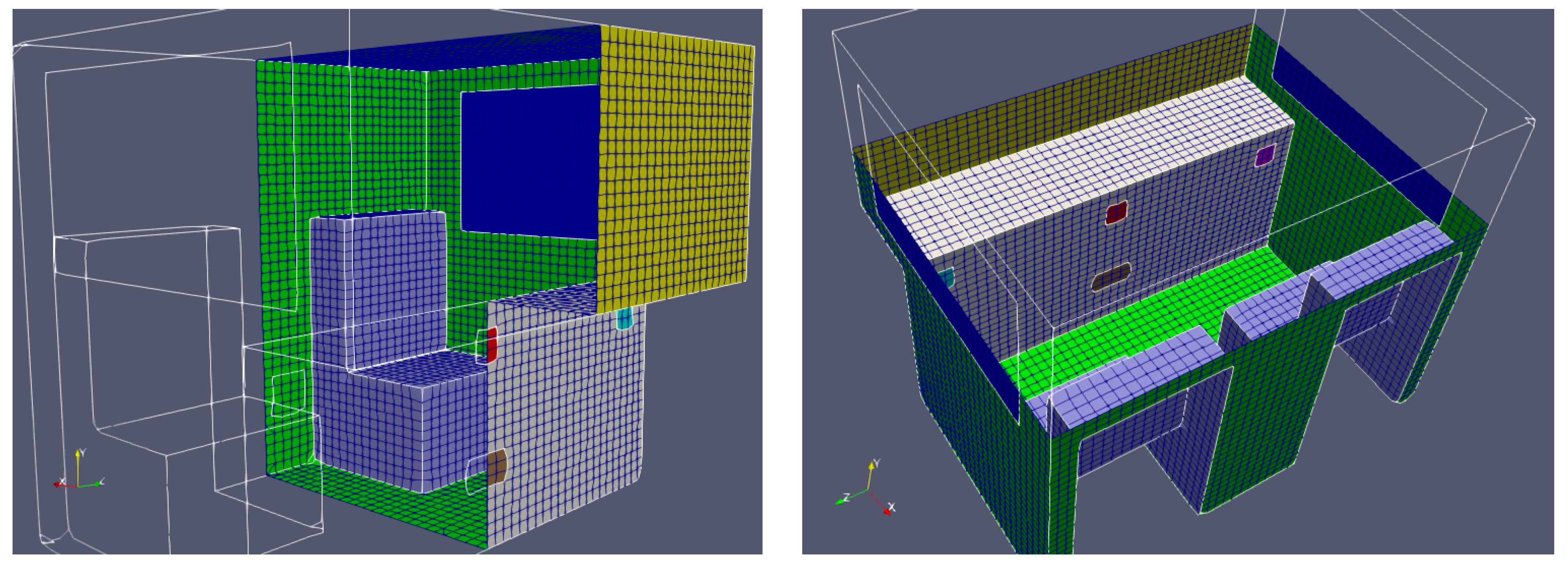
snappyHexMesh. The final mesh (
Figure 1) comprises 61,947 cells, intentionally kept compact to enable a large parametric study while still capturing the dominant cabin flow structures relevant for passenger comfort.
The entire CFD setup was intentionally maintained within the OpenFOAM environment in order to simplify and accelerate dataset generation. In this context, the boundary surfaces were defined using topoSet and createPatch utilities, extracting patches for the cabin construction (in addition to the seats and dashboard), windows, and windshield to be treated as walls, as well as one centrally located air outlet patch, and three air inlet patches (left, center, and right). In addition to mesh resolution, standard quality metrics such as non-orthogonality and skewness were monitored to ensure numerical stability, with values remaining within recommended limits for reliable simulations (from the checkMesh utility: aspect ratio 3.09, skewness 2.06, non-orthogonality 7.42).
2.3. CFD Verification
The CFD results are treated as ground-truth data for the surrogate model, meaning that the learned mapping directly reflects the numerical solution of the governing equations under the chosen modeling assumptions. However, before using the CFD results as ground-truth for surrogate model training, the numerical setup underwent a dedicated verification step to assess the reliability and consistency of the simulations. This verification comprised two complementary analyses: a grid independence study and turbulence model sensitivity testing.
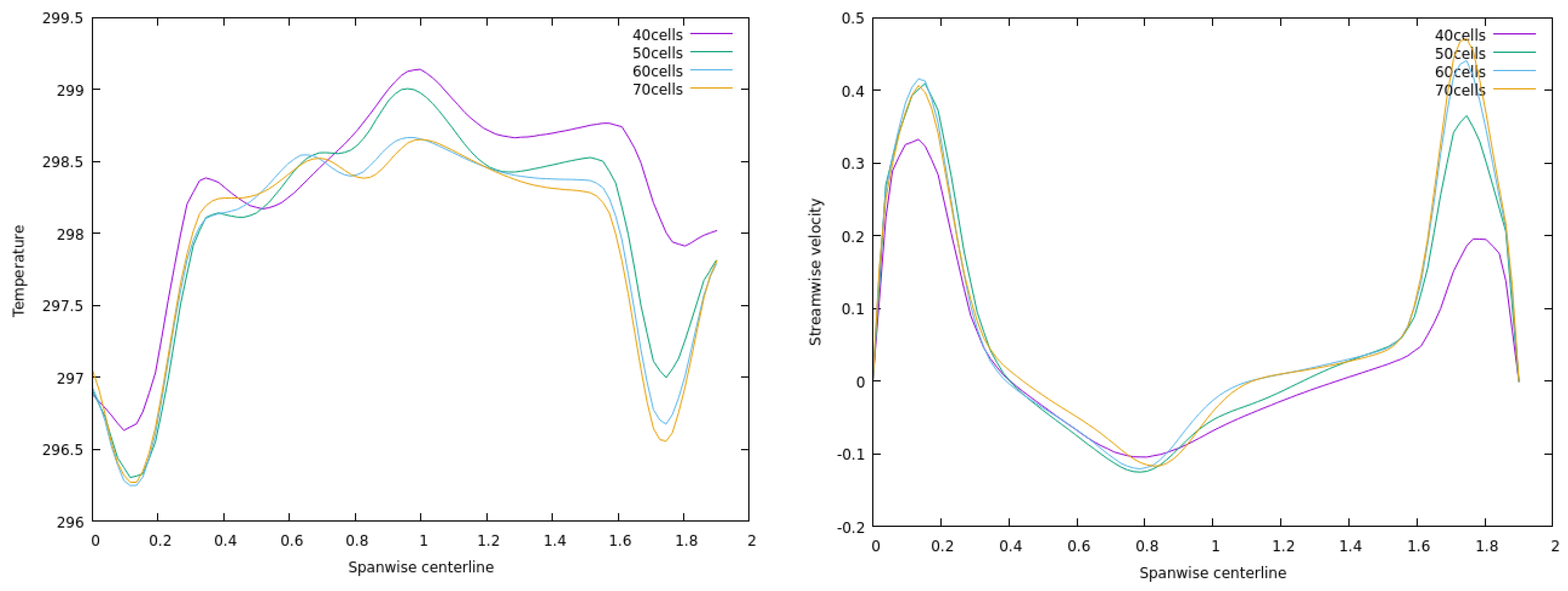
Mesh sensitivity was assessed by uniformly refining the computational grid in all three spatial directions. For each refinement level, velocity and temperature profiles were evaluated along the spanwise centerline of the cabin domain (
Figure 2). With increasing mesh resolution, the profiles converged consistently. Beyond 60 background mesh divisions per characteristic direction in blockMesh, changes in both velocity and temperature became negligible, with profiles tending toward a single curve. Consequently, the mesh resolution corresponding to approximately 60 background mesh divisions was considered sufficient to ensure grid-independent results, and this resolution was adopted for the entire simulation campaign.
To evaluate the impact of turbulence modeling on predicted cabin airflow, the realizable k–ε simulations were compared with the k–ω SST model [
23], since both are widely used for indoor and wall-bounded turbulent flows.
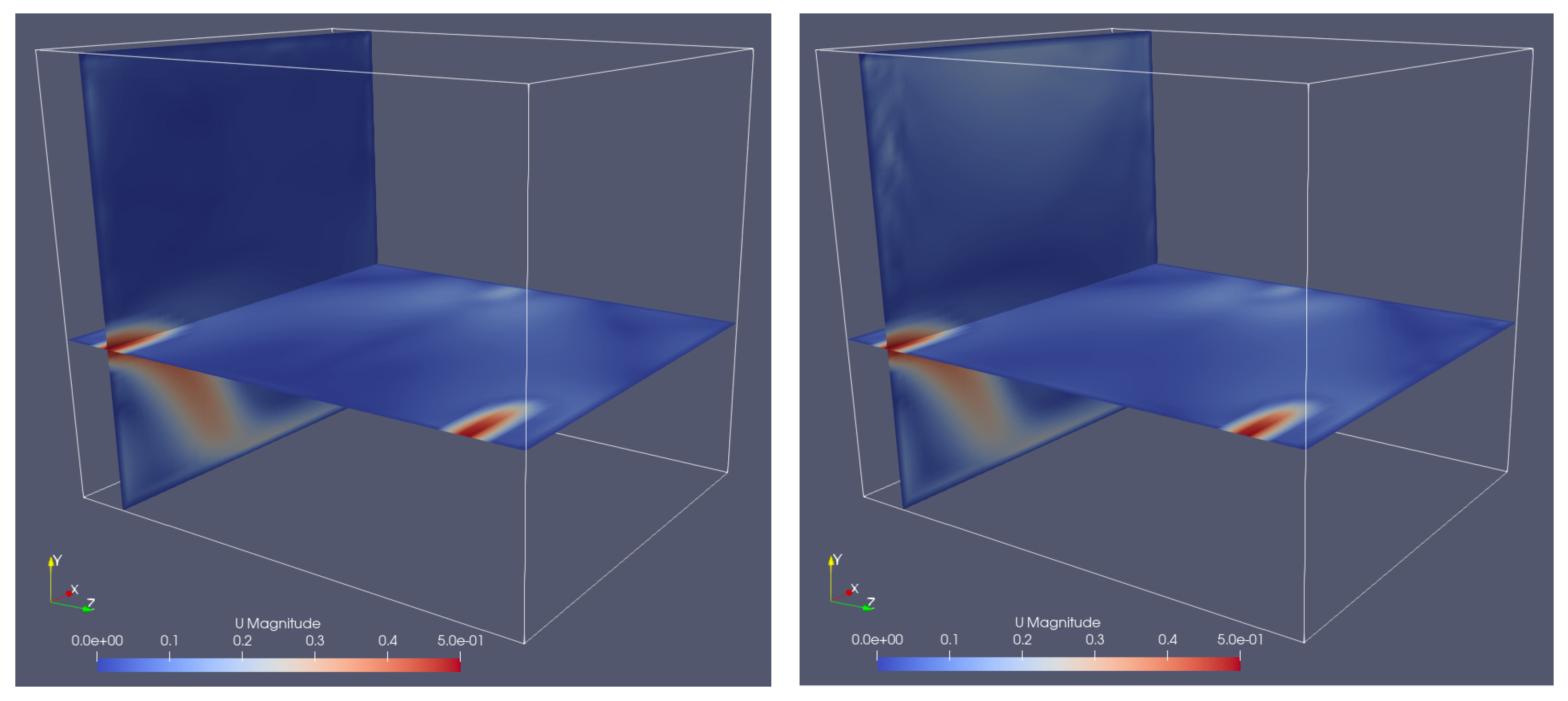
Figure 3 illustrates the qualitative and quantitative comparison, showing that the spatial distributions of velocity and temperature obtained with the two models exhibit only minor quantitative differences, and that the overall flow topology and thermal stratification remain consistent. The agreement between grid-refined solutions and across turbulence models establishes a satisfactory level of numerical fidelity: differences between the realizable k–ε and k–ω SST models remained within a few percent over representative cutplanes (<5%), confirming consistency of the dataset. The CFD results are therefore regarded as a reliable reference dataset for training and evaluating the surrogate model.
2.4. Boundary Conditions
At the air inlets, the fixed value (Dirichlet) boundary condition was imposed for the velocity, temperature, and turbulence quantities, while for the pressure, the zero-gradient (Neumann) boundary condition was applied. Conversely, at the outlet, the pressure was prescribed as Dirichlet and Neumann for all other variables. All solid surfaces were treated as no-slip walls with adiabatic thermal boundary conditions.
Only the left inlet acted as the main control for the operating regime, while the values at the right and center inlets were kept constant. To represent typical cabin conditioning scenarios, the values of velocity and temperature at the left inlet (U_in and T_in, respectively) were systematically varied over a specified range, and
Table 1 summarizes the applied values. The goal was to analyze parameter combinations defining two characteristic operating regimes: one with low blowing intensity and heating level (referred to as the L-case), and one with high blowing intensity and heating level (referred to as the H-case).
The parameter space defined by
Table 1 represents the intended operating envelope for the surrogate model. The dataset is therefore designed to ensure sufficient coverage within this range rather than to span all possible HVAC operating conditions. The imposed boundary condition values formed the input parameter set for the main simulation campaign, executed through an automated script generating a dataset comprising 132 simulations. Running in the decomposed mode, the total simulation time amounted to 18.2 h.
2.5. Cabin Flow Characteristics
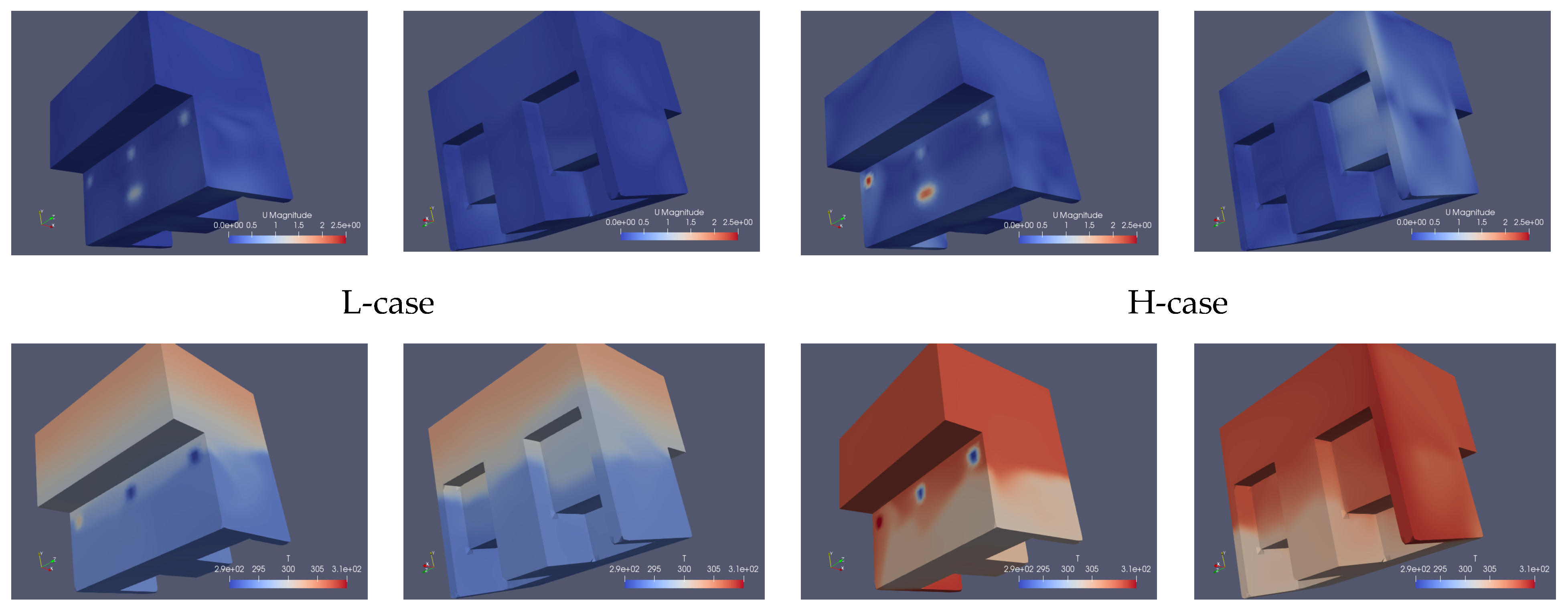
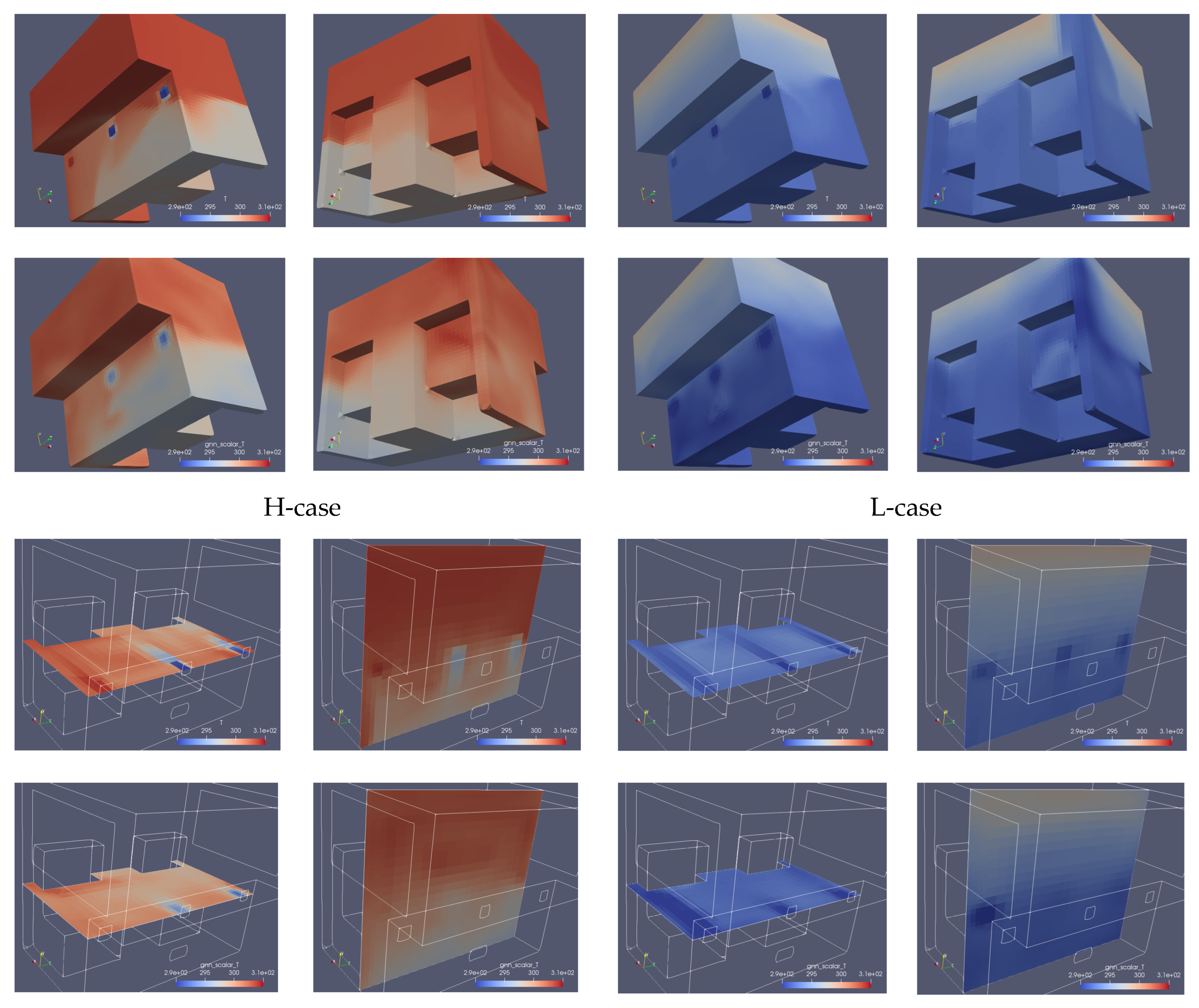
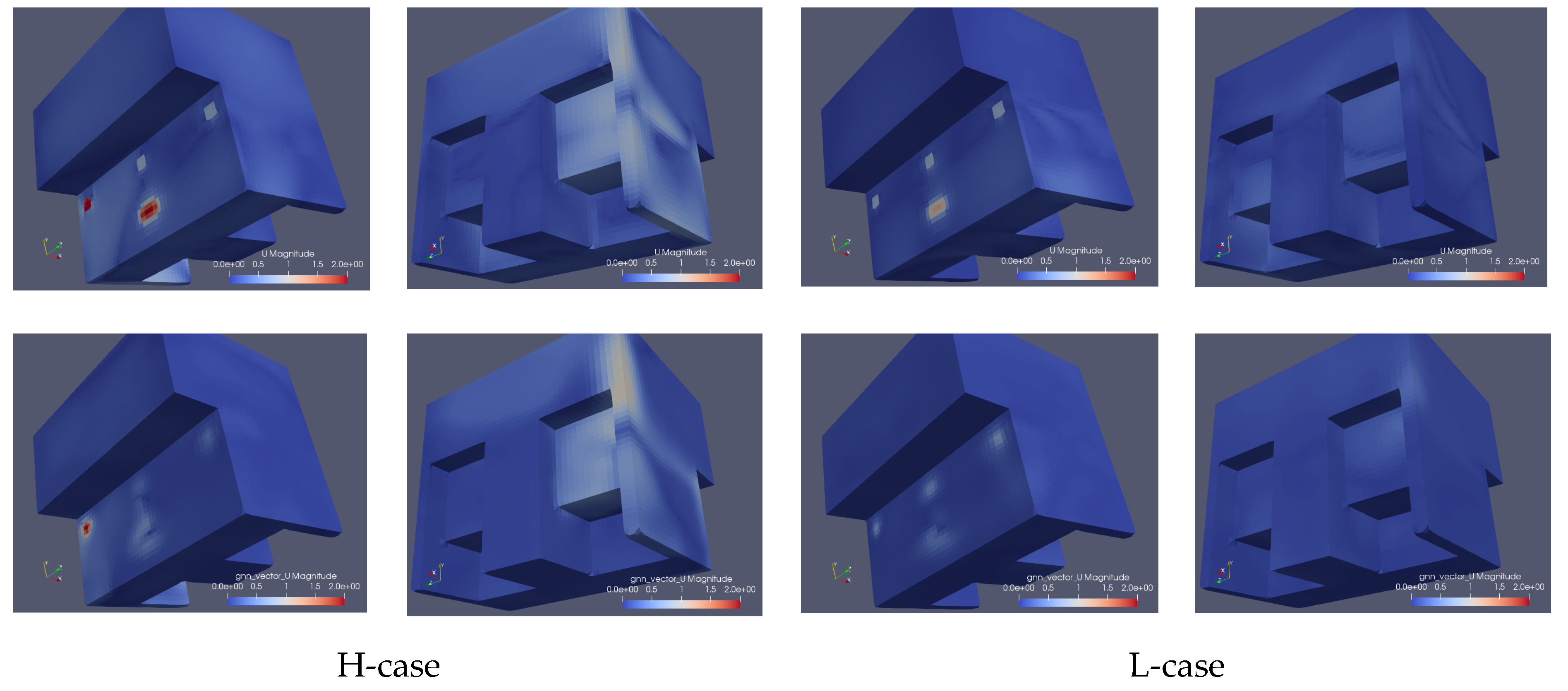
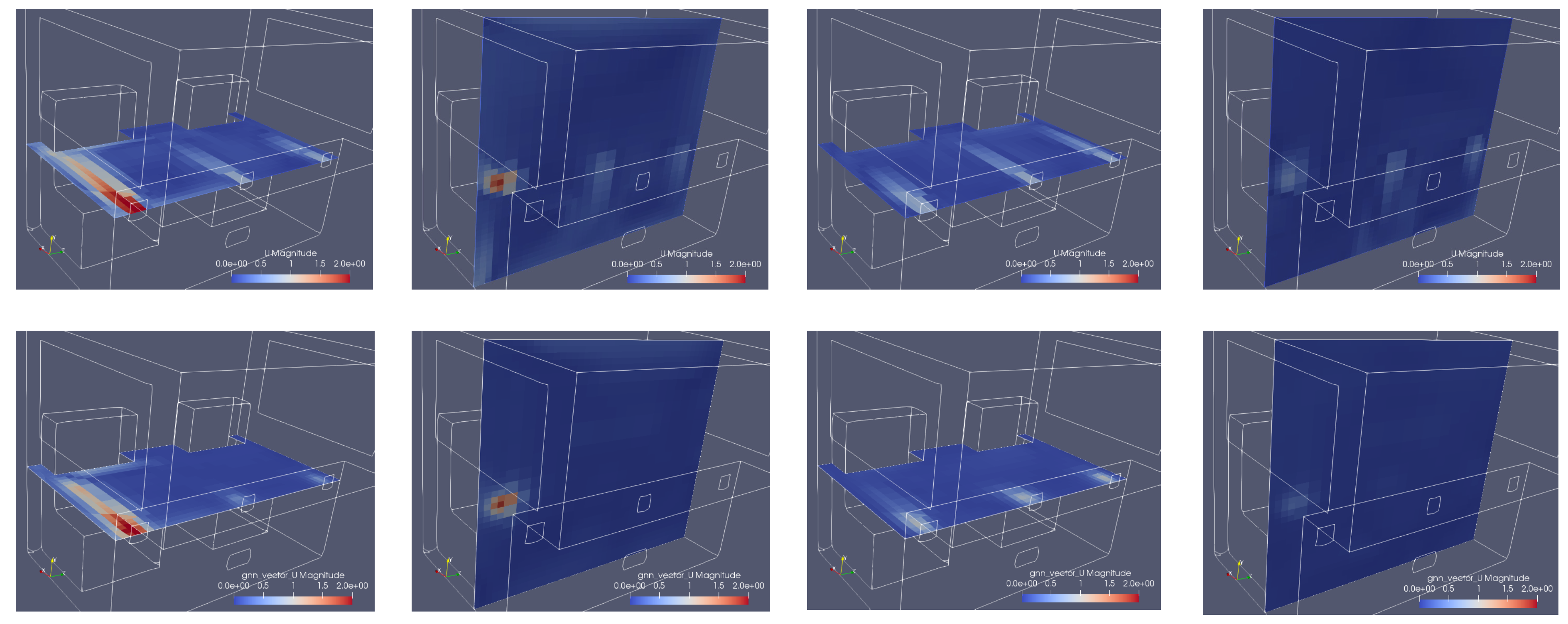
Representative results for the L-case and H-case are shown in
Figure 4. The velocity fields (
Figure 4, top) reveal jet-dominated flows issuing from the inlets, traversing the seating region, and recirculating toward the outlet after impingement on the rear cabin wall.
The temperature fields (
Figure 4, bottom) exhibit a clear stratification characterized by a supply-air-dominated zone around the seats and an accumulation of warmer air near the cabin roof due to buoyancy effects. Capturing both airflow structure and temperature stratification is essential for assessing passenger thermal comfort and forms the basis of the surrogate model outputs.
3. Surrogate Model Architecture
The surrogate model is implemented in Python (v3.10.11) using PyTorch (v2.5.1). It is designed to provide spatially resolved predictions of cabin airflow at low computational cost, thereby enabling its deployment within system-level EV simulations. Because the CFD solution data are defined on an unstructured mesh, the surrogate adopts a graph-based domain representation. In this formulation, message passing between nodes is established through edges that reflect the cell connectivity of the CFD mesh. On this basis, a graph-based neural network composed of convolutional layers is constructed, organized as a mirror-symmetric feed-forward architecture with skip connections.
This model design preserves geometric adjacencies and supports multiscale feature extraction directly on the CFD mesh, avoiding the memory overhead and geometric distortion associated with voxelization. The approach is consistent with developments in geometric deep learning and learned mesh-based simulators, leveraging message-passing networks on graphs which approximate PDE operators and generalize across different geometries and resolutions [
16,
17,
18]. The implementation further benefits from the research-oriented programming paradigm of
PyTorch and mature optimization tools.
3.1. Model Structure and Implementation
The surrogate-modeling workflow consists of four stages: (i) dataset preparation, (ii) ANN definition, (iii) training and validation, and (iv) model storage and post-processing. For the dataset preparation, the OpenFOAM case is read directly from its file structure: mesh connectivity from constant/polyMesh is used to construct the computational graph; input fields are taken from the initial directory (0/); target fields from the converged time directories (1/, 2/, etc.). As a standard practice for stabilizing ANN training, per-channel statistics are computed to normalize input and target quantities (min–max scaling).
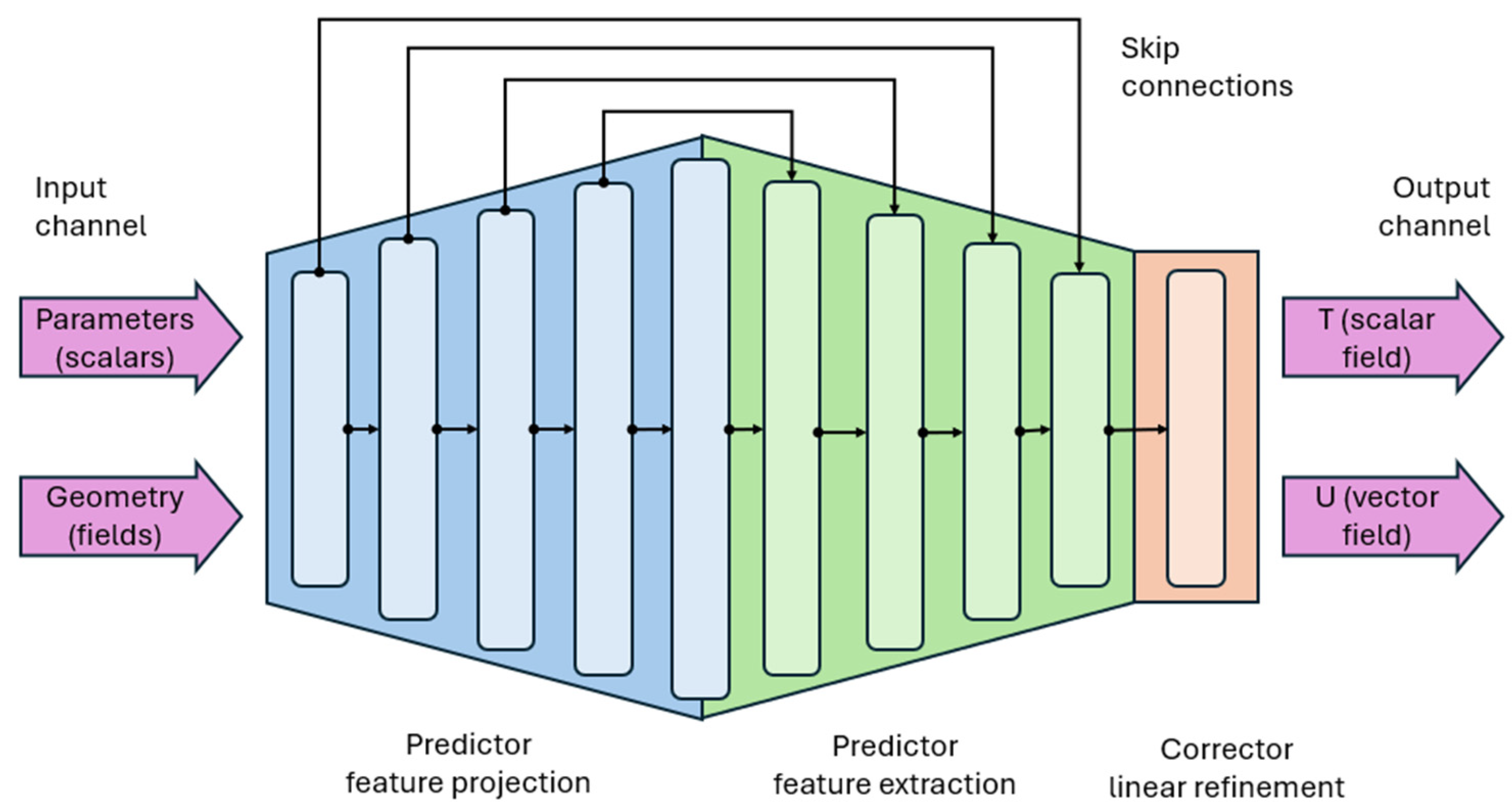
The model leverages a graph neural network (GNN) data representation [
24] and is organized into skip-connected modules that incorporate hierarchical feature projection, as illustrated in
Figure 5. The first two sections (predictor) progressively aggregate multiscale features through stacked graph convolutional network (GCN) blocks [
25] and then reconstruct them at the original graph resolution, while lateral skip connections preserve high-frequency spatial detail. The final section (corrector) applies a linear projection to refine the four supervised targets (three velocity components and temperature). The training objective combines an MSE term applied to a hidden representation of the predictor, either with an L1 penalty on the final outputs or their cast into a physics constraint form. The resulting λ-weighted loss balance promotes a smooth latent space output and ensures sensitivity near convergence, while providing robustness to localized outliers and projecting physics-defined conditions, as applicable for CFD fields [
26,
27,
28].
In the training loop, the Adam optimizer is used, whose adaptive step-size mechanism is well-suited to the heterogeneous operating conditions encountered in the dataset [
29]. An efficient
PyTorch implementation of data-loading utilities and the model-serialization framework facilitates fast and streamlined experimentation and reproducibility. For the present configuration, the total training time was 8.1 h, which is modest relative to the computational cost of additional CFD simulations.
3.2. Input and Output Channels
Two categories of inputs are used for training the surrogate: boundary-condition parameters, which define the operating point (both L-case and H-case inlet velocities and temperatures, as listed in
Table 1), and user-defined volume fields encoding the geometry and topology required to reconstruct spatial flow structures.
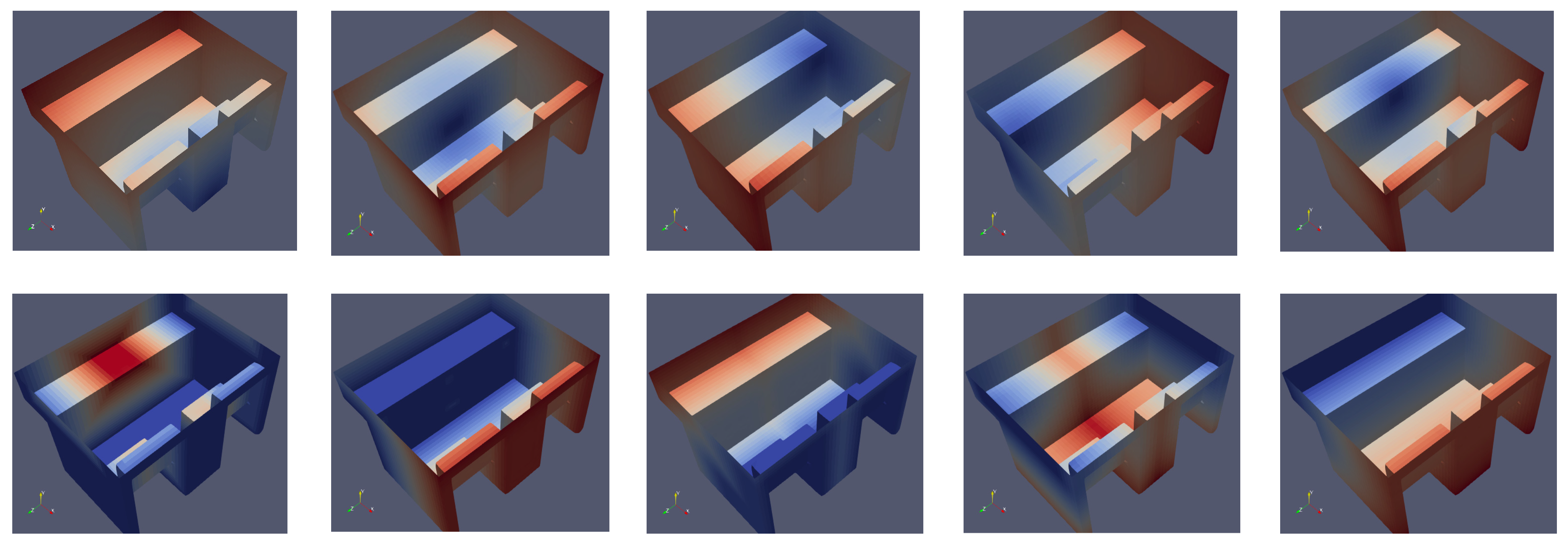
The operating point values T_in, U_in are embedded as global parameters, broadcast to all nodes, and concatenated with the first layer node features for learning the flow mapping across the L-case and H-case regimes. The geometric descriptors include cell-center coordinates and signed distance functions (SDFs) to selected boundaries (inlets, outlet, windows/windshield, and cabin construction with dashboard and seats), as shown in
Figure 6. Coordinates are generated on-the-fly using the
postProcess utility, whereas the
checkMesh –writeFields "(wallDistance)" utility option is used to obtain the SDFs (it requires the
wallDist subdictionary in
fvSchemes to define the method for wall distance calculation). Together, these geometric features provide a compact, mesh-aware description consistent with graph-based learning approaches used in physical simulation.
Targets consist of the steady-state CFD solution fields: three components of the air-flow velocity vector field U and the temperature scalar field T, stored in the respective time directories. As a part of the dataset preparation, the targets from the training set are normalized (min–max scaler), and the training is performed using the normalized target values. During inference, the predicted values are renormalized (using the per-channel scaler defined at the training dataset preparation), and the physical units are recovered.
3.3. Model Architecture Rationale
The adopted predictor–correction design separates representation learning from output calibration, which improves optimization stability through residual-style refinement. This is known to improve the training in deep architectures, since regularization is applied at two complementary levels: an MSE term on the predictor’s hidden representation encourages a smooth, structured latent space, while an L1 penalty or physics-based loss on the final outputs enhances robustness to localized deviations without diminishing sensitivity to physically relevant gradients.
The choice of a palindromic feed-forward GNN with skip connections is motivated by two distinct considerations: mesh awareness and multiscale fidelity. For the first, graph message passing naturally leverages the CFD mesh connectivity, preserving geometric adjacency and local numerical stencils, which is an essential property when learning operators on unstructured discretizations. For the second, cabin flows simultaneously exhibit jet cores, recirculation zones, and buoyancy-driven stratification: the encoder–decoder architecture with skip connections maintains fine-scale detail while aggregating broader spatial context, a strength inherited from U-Net-inspired designs.
Compared with pure convolutional networks on voxelized grids, the graph-based approach retains geometric fidelity without rasterization artifacts and delivers more reliable predictions across different flow regimes. However, there is a trade-off relative to image-based workflow: computational cost grows with the number of graph edges, the processing pipeline is more complex, and the GNN architecture requires somewhat greater computational resources and longer training times (approximately 25% in this case). This is acceptable, though, given the application’s need for accuracy and geometry fidelity.
The surrogate provides mesh-aware predictions tailored to the underlying CFD geometry and reasonably reconstructs the multiscale flow features essential for comfort-relevant metrics. At the same time, its fast inference capability makes it suitable for seamless server–client coupling with Modelica/Dymola, thereby enabling efficient integration within system-level EV simulations. While the present framework does not enforce strict physical conservation laws in the predictor stage, auxiliary physics-based requirements can be promoted in the corrector step through a λ-weighted loss term. In the present case, these are defined from the discretized weak form of the Navier–Stokes equations (Equation (1)) calculated as the filter applied to the CFD ground-truth and ANN-predicted fields.
3.4. Training Strategy
The dataset used for training was systematically partitioned into training and validation subsets in order to ensure robust model development and evaluation. Out of the total 132 CFD samples, 120 cases were used for training and 12 for validation, selected to ensure representative coverage of the operating parameter space defined by inlet velocity and temperature ranges. It is noted that the available dataset is limited in size and, therefore, cannot support the broad generalization of the trained surrogate model. Nevertheless, presented below is a dedicated quantification study, conducted using the available samples to assess the influence of dataset size on the resulting predictive accuracy.
The training process follows a predictor–corrector strategy, in which the initial network (predictor) learns a coarse representation of the flow field, while a subsequent corrector stage refines the prediction. The loss formulation combines statistical weighting and physics-informed components. First, a weighted loss is applied to emphasize shear-layer regions, as they exhibit steep gradients typically underrepresented during standard training. This improves the ability of the predictor to resolve localized flow features. In the corrector step, an additional physics-based loss component is introduced by recasting the predicted fields into residuals of the Navier–Stokes equations and comparing them to residuals computed from the CFD data. The quantification of this supervised learning strategy, aimed at improving consistency with the governing equations, is given below.
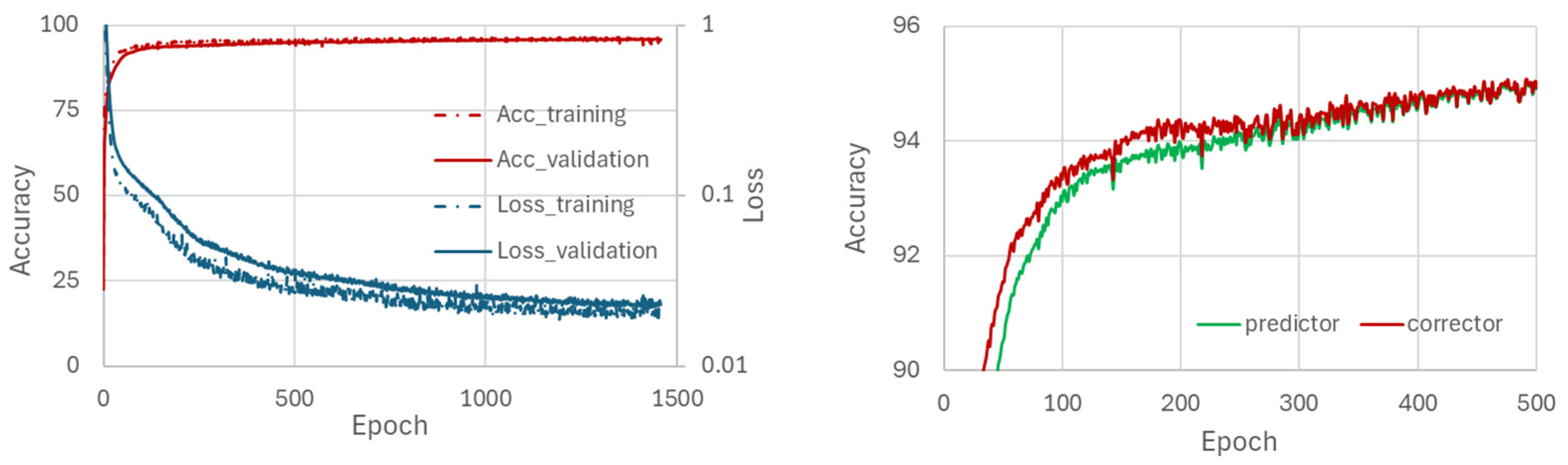
The training history is shown in
Figure 7, illustrating stable convergence of both loss and accuracy for training and validation datasets (
Figure 7, left). A zoom-in of the early training phase (
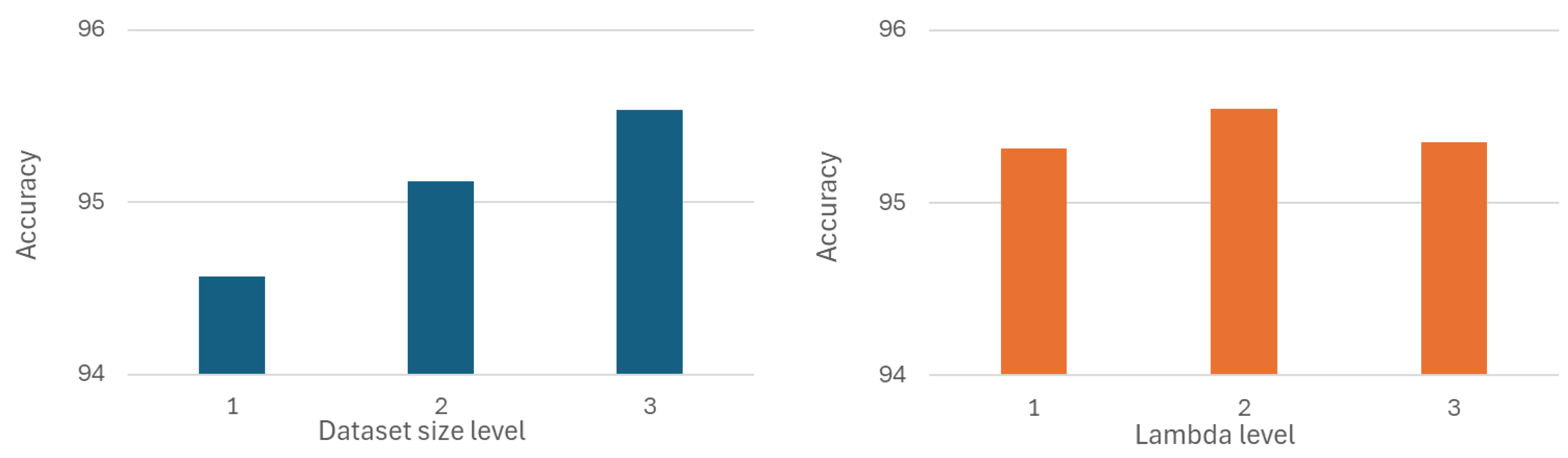
Figure 7, right) highlights the contribution of the corrector stage, which accelerates convergence during approximately the first third of the training process. As training progresses, the predictor and corrector outputs become increasingly aligned. The influence of dataset size was assessed by inferring the trained model on a reduced number of training samples. Three dataset levels were considered (
Figure 8 left): full dataset (3), reduced by one sixth (2), and reduced by one third (1). The results show a consistent increase in predictive accuracy with increasing training set size, indicating that the increase in data availability would yield measurable improvements in model performance. In addition, the effect of including the physics-based loss term was investigated by progressively increasing its λ-weighting relative to the direct supervised prediction, taking 10% (1), 20% (2), and 40% (3) for the weighting factor (
Figure 8, right). The inclusion of the Navier–Stokes residuals was found to improve predictive accuracy (particularly for reduced dataset sizes). However, the improvement depends on an appropriate weighting level that balances data-driven fitting and physics-based regularization.
4. Surrogate Model Predictions
The developed surrogate model is intended to enable rapid prediction of cabin airflow velocity and temperature with an accuracy level suitable for energy-efficiency and thermal-management studies with system-level EV simulations. For a qualitative and quantitative comparison against high-fidelity CFD reference solutions,
Figure 9 summarizes the temperature predictions, and
Figure 10 shows velocity fields, both for representative high-intensity blowing and heating (H-case) and low blowing and heating (L-case) operating conditions. The achieved inference time of approximately 2.1 s per case confirms that the surrogate approaches near-real-time performance, making it suitable for on-the-fly use within coupled system simulations or optimization loops.
As illustrated in
Figure 9, the surrogate model reproduces the principal characteristics of the steady-state temperature distribution with good qualitative agreement across both operating regimes. In both the H-case and L-case, a distinctly warmer air region forms near the cabin ceiling, driven by buoyancy effects, while the lower part of the cabin (particularly the seating area) remains dominated by the supply-air temperature. This vertical stratification, which is a key feature for passenger thermal comfort assessment, is consistently captured by the model. Differences between the CFD and surrogate predictions are limited primarily to the immediate vicinity of the air inlets, where strong temperature gradients exist.
The predicted velocity fields shown in
Figure 10 demonstrate similar qualitative agreement with CFD in capturing the dominant flow topology. The surrogate successfully reproduces the acceleration of the inlet jets through the seating region and the subsequent redirection toward the outlet, as well as the presence of a relatively stagnant zone in the upper cabin region. These features are evident in both blowing regimes, although they are more pronounced in the H-case due to the higher inlet momentum. However, compared to temperature, localized deviations in velocity magnitude and jet spreading can be observed, particularly in regions of strong shear.
4.1. Interpretation of Prediction Errors
The overall discrepancies observed are acceptable from an application perspective, as system-level simulations rely primarily on spatially averaged quantities in passenger-relevant zones, where prediction accuracy exceeds 95%. Looking at the temperature distribution, the surrogate demonstrates high predictive accuracy, with volumetric mean temperature deviations remaining below 4% relative to CFD across the evaluated cases. This level of agreement is sufficient for most system-level and comfort-oriented analyses. However, the velocity magnitude displays comparatively larger discrepancies, with a mean relative error of approximately 17%. This behavior is reflected quantitatively by the higher relative error in velocity predictions. Notably, this error represents a cumulative measure over all three velocity components, further amplifying the discrepancy when compared to scalar temperature predictions. A practical consequence of the difference in predictive performance between temperature and velocity is the distinct physical role of these quantities: temperature behaves primarily as a passively transported scalar, governed by advection and diffusion, whereas velocity is the flow carrier and is far more sensitive to local flow structures and turbulence-induced mixing.
The qualitative differences between CFD and surrogate predictions become more apparent when examining local flow features. It can be observed in
Figure 9 and
Figure 10 that the surrogate exhibits reduced accuracy in resolving jet shear layers, flow separation zones, and regions where turbulent mixing strongly influences jet spreading and entrainment. In CFD simulations, these phenomena are explicitly resolved through the solution of turbulence transport equations, which recover the relevant turbulent length and velocity scales. In contrast, the surrogate model recovers these effects phenomenologically from the training data. While the adopted graph-based architecture effectively approximates large-scale flow patterns and stratification, it lacks an explicit representation of turbulence physics. Consequently, fine-scale structures (particularly those associated with sharp velocity gradients) tend to be smoothed, leading to underprediction or overprediction of local velocity magnitudes.
4.2. Field-Based Accuracy
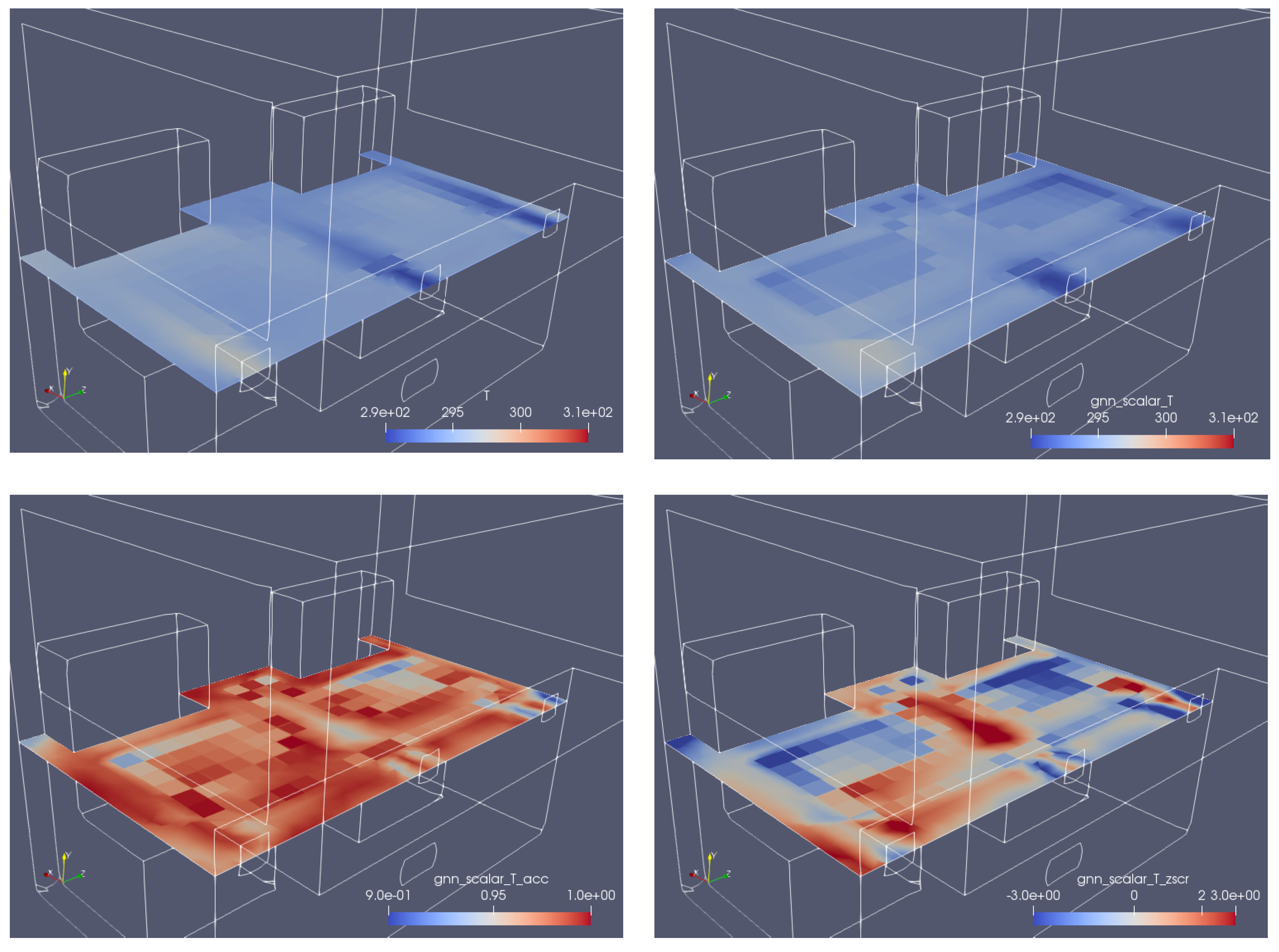
To analyze the prediction accuracy at the field level, a normalized accuracy measure is defined as follows:
where ϕ denotes a generic flow variable (e.g., T or U). This metric evaluates the local deviation relative to the dynamic range of the CFD reference field.
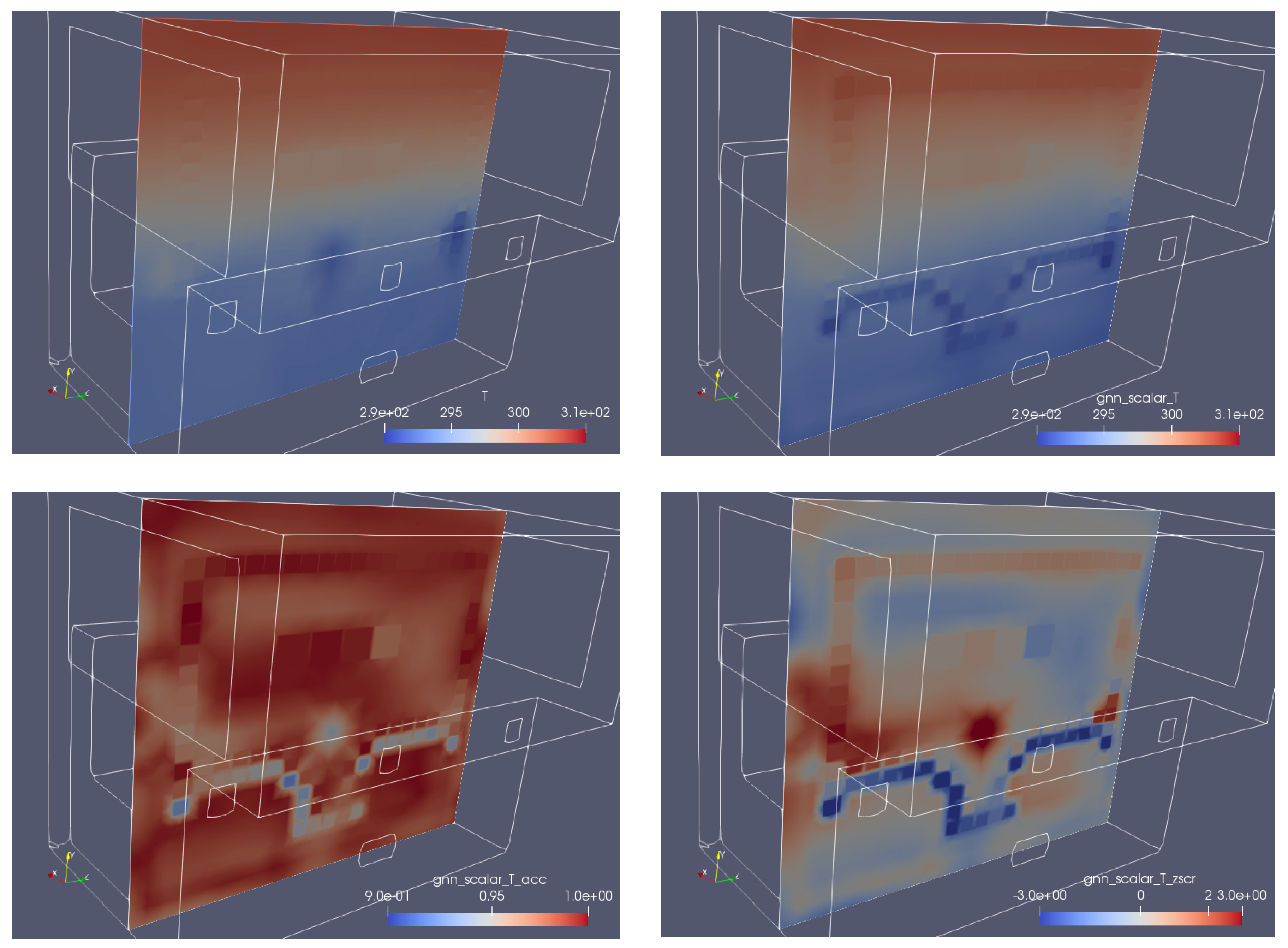
Figure 11 presents the resulting accuracy distribution for temperature on both the horizontal and vertical midplanes. Across most of the cabin domain, the surrogate achieves local accuracies exceeding 95%, indicating that the dominant flow and thermal structures are well represented. Regions with significantly reduced accuracy (often falling below 90%) are confined to jet cores, shear layers, and near-inlet zones, where gradients are steepest, and the flow exhibits strong directional changes.
These regions coincide with elevated Z-score values (absolute Z-score greater than 3), identifying them as statistical outliers within the dataset. Such outliers predominantly arise in localized, turbulence-dominated regions rather than in passenger-occupied zones, which are the primary interest for vehicle energy-management applications. As these regions correspond to strong shear layers and high-gradient zones, which act as statistical outliers within the dataset, they are inherently more difficult to approximate with purely data-driven models.
The presence of localized inaccuracies highlights a fundamental limitation of purely data-driven surrogates: without explicit knowledge of the governing Navier–Stokes equations or turbulence closure models, the neural network’s extrapolation capability in high-gradient regions is limited. In the present framework, this limitation is partially mitigated through the predictor–correction architecture and the use of robust loss functions, which suppress the influence of extreme outliers and bias the model toward a physically consistent solution during training.
5. System-Level Integration
Rather than packaging the surrogate as a functional mock-up unit (FMU), which might cause version or license-related constraints, the present study employs a direct server–client communication architecture. This approach offers high flexibility and minimal overhead, enabling rapid experimentation with surrogate-model variants and input–output definitions. While the coupling via FMU remains a tool-independent alternative for surrogate-model integration, the server–client implementation used here emphasizes simplicity and transparency when embedding data-driven models into established system-simulation workflows. Notably, Python natively supports such communication through its built-in socket library, which is part of the standard Python distribution and facilitates straightforward and robust implementation of this coupling mechanism.
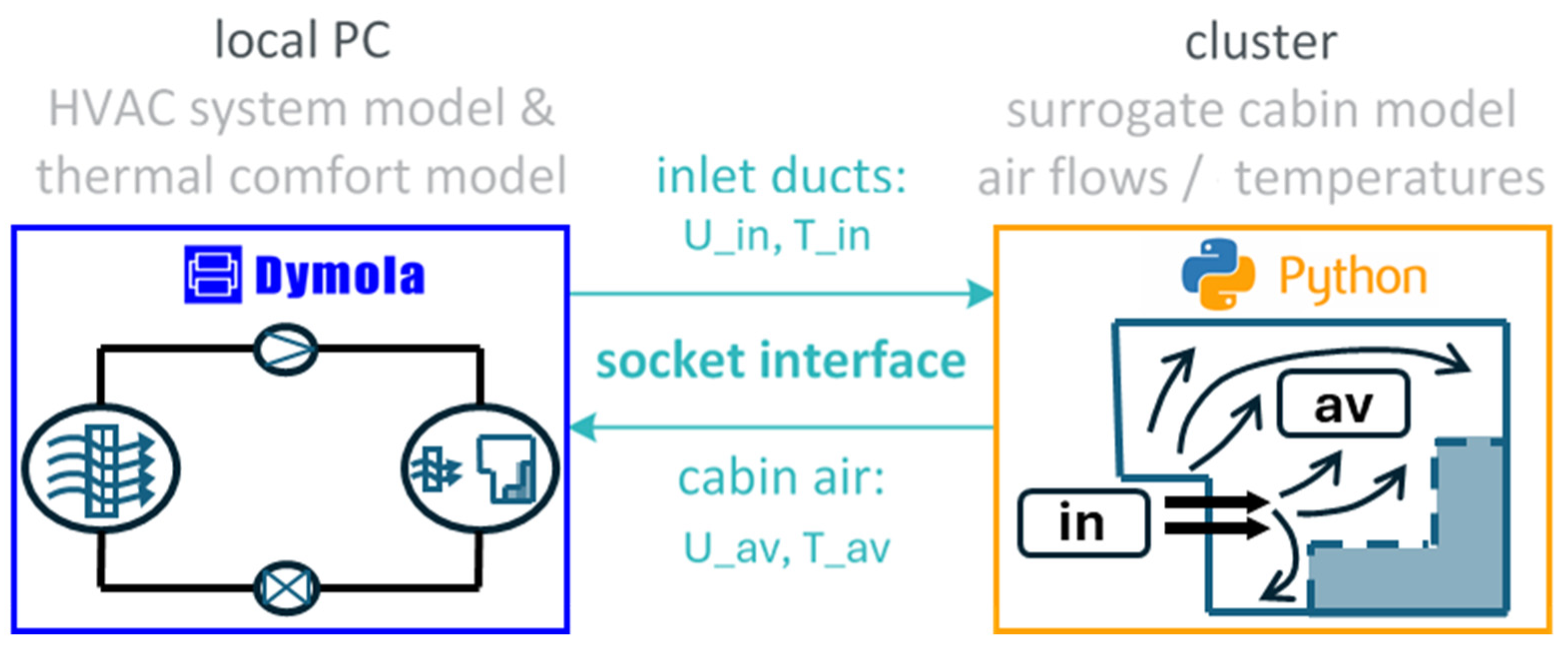
In the exemplary workflow illustrated in
Figure 12, the surrogate model operates as an independent
Python server process, for example, deployed on a remote compute cluster, where it hosts the trained neural network and processes incoming inference requests. The
Modelica/
Dymola simulation functions as a client potentially running on a separate local workstation, and communicates with the
Python server through a predefined protocol during runtime. At prescribed simulation steps,
Dymola transmits the current operating conditions to the
Python server (U_in, T_in). The surrogate evaluates the request and returns the spatially averaged temperature and airflow velocity within the predefined passenger-occupied regions required for comfort-relevant metrics (U_av, T_av). The communication latency remains sufficiently low to permit the EV system-level simulation to progress without disrupting numerical stability or degrading overall simulation performance. This demonstrates that surrogate-based airflow prediction enables system-level simulations that would otherwise be infeasible using CFD due to computational constraints.
6. Discussion and Conclusions
This work presents the development, verification, and application of a data-driven surrogate model for predicting cabin airflow in electric vehicles, with the explicit objective of bridging high-fidelity CFD simulations and system-level thermal-management studies. The study is intentionally focused on a defined cabin geometry and operating range, reflecting a practical engineering application rather than a universally generalizable modeling framework. The surrogate deploys a graph neural network structured into a mirror-symmetric architecture with skip connections, enabling direct learning from CFD data defined on unstructured meshes while preserving multiscale spatial information. The model was trained on a systematically generated CFD dataset covering a representative range of inlet velocities and temperatures, corresponding to low and high blowing/heating operating regimes.
The conducted analysis demonstrates that the surrogate model is capable of reproducing the dominant airflow topology and thermal stratification observed in CFD simulations with high fidelity. Across different operating flow regimes, the model reliably captures the formation of buoyancy-driven warm air layers near the cabin ceiling, the supply-air-dominated region around the seating area, and the principal jet structures linking inlets and outlets. Quantitative evaluation shows scenario-dependent accuracy, with local temperature deviations remaining below 4% in passenger-occupied zones, while local velocity magnitude predictions exhibit larger discrepancies, reaching a mean relative error of approximately 17%. These results are consistent with the physical roles of temperature as a passively transported scalar and velocity as the turbulence-carrying field, which is more sensitive to local shear layers and high-gradient regions.
A detailed field-based accuracy analysis further revealed that prediction errors are spatially localized, primarily in jet cores, shear layers, and near-inlet regions, where turbulent mixing and momentum exchange dominate the flow physics. In contrast, the majority of the cabin volume (particularly the regions most relevant for passenger comfort) exhibits prediction accuracy exceeding 95%. This distinction is an important finding of the study, as it confirms that the surrogate’s limitations are largely confined to localized, turbulence-dominated features rather than global comfort-relevant indicators.
From a practical standpoint, one of the most significant outcomes of this work is the achieved near-real-time inference capability. With prediction times on the order of a few seconds per case, the surrogate enables rapid access to cabin airflow characteristics without executing full CFD simulations. This performance makes the model suitable for iterative design studies, parametric analyses, and embedded use within vehicle-level simulations. In particular, the direct server–client coupling between the Python-based surrogate and Modelica/Dymola system models allows system-level simulations to request airflow information on demand and proceed with energy-management calculations without sacrificing computational efficiency.
In an application context, the presented framework represents a pragmatic compromise between accuracy and computational efficiency. For EV thermal-management optimization and control, where airflow predictions are primarily used to assess passenger comfort and energy consumption trends rather than to resolve fine-scale turbulence, the demonstrated accuracy is sufficient and operationally valuable. The methodology therefore supports the broader goal of improving energy efficiency and driving range in electric vehicles by enabling tighter coupling between cabin comfort models and vehicle energy-management systems.
At the same time, the results highlight inherent limitations of purely data-driven surrogates. The reduced accuracy in highly turbulent regions underscores the absence of explicit physical constraints, such as conservation laws or turbulence closures, within the current learning framework. Although the adopted predictor–correction head and robust loss formulation mitigate the influence of outliers, the model fundamentally operates as an interpolator within the space covered by the training data. A preliminary investigation of physics-based loss formulations indicates that incorporating governing-equation residuals can improve prediction robustness, particularly in data-scarce scenarios.
The gained observations motivate the future work aimed at enhancing predictive fidelity through physics-defined constraints, hybrid modeling strategies, and domain decomposition approaches that treat jet and shear-layer regions with specialized subnetworks. The focus is to be on extending the present framework through systematic incorporation and improved treatment of physics-based considerations, and evaluation of alternative architectures. In addition, further studies are to investigate generalization across different geometries and expanded operating conditions, building upon the workflow established in this study.