
Article

Spatial and Energetic Organization of Coherent Structures in Couette–Poiseuille Turbulent Channels

by
Sergio Gandía-Barberá
and
Sergio Hoyas
*
Instituto Universitario de Matemática Pura y Aplicada, Universitat Politècnica de València, 46022 València, Spain
*
Author to whom correspondence should be addressed.
Fluids 2026, 11(1), 18; https://doi.org/10.3390/fluids11010018
Submission received: 2 November 2025 / Revised: 3 January 2026 / Accepted: 5 January 2026 / Published: 8 January 2026
(This article belongs to the Special Issue Modelling Flows in Pipes and Channels)

Abstract

Coherent structures play a pivotal role in wall-bounded turbulence, serving as primary carriers of momentum, energy, and scalar quantities across the flow. This study examines coherent structures, specifically streamwise streaks and intense Reynolds stress regions (Q structures), within a novel DNS dataset capturing a stepped transition from pure Poiseuille flow to pure Couette flow at R e τ 250 , based on the stationary wall. Structures are identified using a percolation algorithm to ensure well-defined boundaries, followed by three-dimensional clustering in Cartesian coordinates. They are further classified as wall-attached or wall-detached based on their proximity to the domain walls. Intense Reynolds stress structures are categorized into quadrants according to the signs of their averaged velocity components. The statistical properties of these structures—encompassing geometric characteristics, energy content, and spatial distribution—are thoroughly analyzed. Particular emphasis is placed on how these properties evolve across the transition from Poiseuille to Couette flow. The results reveal that increasing mean shear in Couette-like cases significantly influences the energy content and spatial distribution of the structures while their geometric characteristics remain relatively consistent across the dataset. This spatial distribution is closely linked to the large-scale structures of the streamwise velocity component in Couette flow, confirming that these structures are genuine physical features rather than artificial artifacts of the flow.

1. Introduction

Understanding the momentum transfer mechanism in wall turbulence is crucial to predicting drag in wall-bounded turbulent flows [1]. This mechanism is often explained by analyzing artifacts that carry most of the wall-normal momentum flux from the buffer to the logarithmic and outer layers. These artifacts, also known as coherent structures, were first described experimentally as streamwise streaks [2] and Reynolds-stress events [3].
The study of the geometry and interaction among coherent structures is extensive in boundary layers and turbulent channel flows [4,5,6,7,8,9,10,11]. In this study, we focus on the latter. Turbulent channel flows are defined by two parallel walls separated vertically by a distance of 2 h . Within the domain, the flow progresses in x-direction, generally being the longest dimension of the domain. Periodic boundary conditions are established in the streamwise and spanwise direction, while the no-slip condition is used in the wall-normal direction. The main control parameter is the friction Reynolds number, R e τ = u τ h / ν , where u τ is the friction velocity and ν is the kinematic viscosity [12]. We will use a superindex + to indicate any quantity adimensionalized with u τ and ν , as the wall-normal distance, y + = y u τ / ν .
There are two large groups of channel flows: pressure-driven or Poiseuille [13,14,15] and wall-driven or Couette [16,17,18]. A combination of both is also possible [19,20,21], with surprising applications [22]. Even if the geometry is the same, and the mean flow and intensities are similar, Couette flows have a different particularity. They present long and wide structures that appear as streamwise rolls. Such structures are coherent regions of either positive or negative streamwise velocity fluctuations. They have been observed both experimentally [23,24] and numerically [16,17,19,25,26,27,28,29], persisting even if the flow is influenced by a cross-flow [30] or a streamwise pressure gradient [20]. Lee and Moser [17] obtained structures at least as long as 310 h for R e τ = 500 . On the other hand, Gandía-Barbera et al. [11] have shown that stratification processes in thermoconvective flows can effectively remove them. Hoyas & Oberlack [18] found that these rolls greatly affect flow statistics and may be finite for large Reynolds numbers. One question we aim to address in this paper is how these rolls impact the characteristics of the different structures within the flow.
This line of inquiry is connected with previous studies on the dynamics of coherent structures in turbulent flows. Hamilton et al. [31] studied the dynamics of the coherent structures present in the near-wall region of turbulent flows using a minimal Couette channel flow. The authors related the origin and disappearance of structures to a temporary quasi-cyclic process of regeneration consisting of three sequential subprocesses: streak formation, streak breakdown, and vortex regeneration. This process was proven to be conditioned to the spanwise dimension of the domain. By reducing the spanwise dimension, a mismatch in the subprocess’s timing interrupts the regeneration cycle, which cancels both streaks and rolls. By merging the insights from these two areas, we aim to examine how streamwise rolls influence the overall behavior of coherent structures in wall-bounded turbulent flows. Later, Álcantara-Ávila et al. [32] showed that the flow statistics for domains shorter than approximately 2 π h in the spanwise direction are unreliable.
However, these are not the only structures studied. Del Álamo et al. [4] studied the organization of vortex clusters defined by the discriminant of the velocity gradient tensor [33]. The authors observed that two classes of clusters populate the logarithmic region. One consists of small vortex packets detached from the wall, roughly homogeneous and isotropic. The other is formed by tall clusters rooted in the near-wall region below y + 20 , being self-similar in their Cartesian dimensions. The tall attached clusters are linked to intense velocity structures, which consist of a wall-normal ejection (i.e., burst event) surrounded by two inclined counter-rotating vortexes (i.e., rolls).
Lózano-Duran et al. [5] examined momentum transfer in turbulent channel flows through intense burst events. The authors found that these events can be separated into attached and detached families using the same threshold on y + as in [4]. Although the attached structures contain around 60% of the total Reynolds stress at various R e τ values, the detached structures are dissipative objects of the order of a few local Kolmogorov scales. In fact, along the channel height, detached events with positive Reynolds stress contribution (Q+) tend to be canceled by detached events with negative contribution (Q). The authors concluded that most of the Reynolds stress is carried by attached negative events extending up to the logarithmic layer and are spatially self-similar.
In a perspective paper, Jiménez [1] extensively studied eddies and coherent structures in wall-bounded turbulent flows. Eddies are statistical artifacts defined mainly through two-point correlations, while coherent structures include dynamics and are generally defined by filtering a given flow parameter, such as, for example, velocity fluctuations or Reynolds stress. The author describes two kinds of correlations for eddies: short ones for the transverse velocities (i.e., of the order of the distance from the wall) and a long one for the streamwise velocity (i.e., at least ten times longer than those of the transverse velocities). Coherent structures can generally be related to eddies. In particular, the transverse-velocity eddies correspond to structures defined by strong wall-normal or spanwise velocities or by the Reynolds stress. However, streamwise eddies do not correspond to particularly intense structures but to a concatenation of smaller coherent structures. Interestingly, the conditional flow field around structures of intense Reynolds stress is an inclined roll located between a high- and a low-speed streak of the streamwise velocity for either channels or turbulent homogeneous shear flows. Note that in the former, the impermeability condition of the wall deforms the structures, acting against their symmetry and alignment with the direction of the shear at 45 degrees.
Using a new paradigm, Cremades et al. [34] investigate coherent structures through an explainable deep-learning approach. The instantaneous velocity field derived from a turbulent channel flow simulation is utilized to forecast the velocity field over time using a U-net architecture [35]. The game-theoretic SHapley Additive exPlanations (SHAP) [36] algorithm is employed to evaluate the significance of each structure in the prediction process based on the predicted flow. The findings corroborate previous observations in the literature and extend them by revealing that the essential structures for flow reconstruction do not necessarily contribute the most to the Reynolds shear stress. Continuing this work, the authors state that the classic structures only paint a partial picture of wall-bounded turbulence. A new background to define coherent regions of great importance [37] is introduced using SHAP, obtaining that the most important structures do not coincide with the classical ones.
As noted in previous studies, the coherent structures involved in momentum transfer are sustained through a complex process involving not only linear transient mechanisms (i.e., Orr [38] and lift-up mechanisms) but also non-linearity [1]. Another approach to investigate the self-sustaining mechanism was to use scale decomposition and filtering by Motoori & Goto [39]. The authors examined two sustaining mechanisms: vortex stretching and real-space energy transfer. They characterized the contribution from mean shear to a given scale and among scales. The authors observed that the mean flow transfers energy to the largest scale at each height. For smaller scales, kinetic energy production from the mean flow becomes less important, and the energy transport term between scales plays a major role. Indeed, the threshold defining which mechanism (either production from mean shear or interscale transport) inserts energy on a given scale is the Corrsin scale, where the mean shearing and cascade time scales (i.e., the eddy turnover time, ETT) are balanced. Thus, structures larger than the Corrsin scale extract energy from the mean shear; conversely, the main energy source for structures smaller than the Corrsin scale is the energy cascade, being the donor scale, generally twice the size of the recipient scale.
Furthermore, the increase in computational power in the last decade has allowed the examination of momentum transfer through the spectral analysis of interscale transport ([40,41,42,43,44,45]). Kawata and Alfredsson [40] decomposed the Reynolds stress equation into a large- and a small-scale part by spatial filtering based on a spanwise cutoff wave number k z . Filtering based on Fourier modes allows proper orthogonal decomposition, in which terms involving both scales are nullified ( u i S u j L = u i L u j S = 0 ), where u i L and u i S are the large- and small-scale part of the perturbation velocity u i as u i = u i L + u i S . In this way, the decomposition of the full-scale equation becomes less complex. For diverse Couette experiments with Reynolds numbers up to R e τ = 108 , both the energy spectra E k t and the cospectra E u v have their peaks around λ z / h = 3 . Similar spanwise wavelengths were associated with streaks in the center of Couette flows through one-point correlations of fluctuating streamwise velocity u [20]. Turbulent energy transport t r k t is shown to bring energy from the large-scale energy-containing range to smaller scales; however, shear stress transport t r u v indicates the opposite tendency; that is, an inverse energy cascade.
Kawata and Tsukahara [43] further investigated the mechanism of interscale transport in streamwise and spanwise reduced Couette channel flows. The influence of simulation domain size on very large-scale structures was examined, focusing on why streamwise length reduction is less critical than spanwise length reduction. While the streamwise length reduction affects the Reynolds stresses by suppressing energy redistribution among them, the spanwise length reduction tends to suppress the intensity of all velocity components. Also, in streamwise-minimal channels, the x independent mode ( k x = 0 ) undertakes most of the streamwise turbulent energy ( k u u ), production ( P u u ) and interscale transport ( T u u ) from the longest wavelengths in the reference case. This fact may explain why streamwise length reduction does not eliminate the very large-scale structures, as the x independent mode assumes its role. On the other hand, the authors observed that the spanwise-minimal channels could reproduce the same tendency on Reynolds shear stress as the reference case despite the obvious differences in the instantaneous flow fields of each case. This suggests that the interscale transfers observed through spanwise Fourier mode analysis may not represent the effect of the interaction between the near-wall and very-large-scale structures. It is very interesting how Kawata and Tsukahara [43] could link the Reynolds stresses’ closed-loop transport to the subprocesses of the self-sustaining cycle that likely correspond. Such linkage may help explain how external influences (e.g., stratification) can affect specific production or transference terms and consequently break the self-sustaining cycle. For instance, Gandía-Barberá et al. [11] observed that stable stratification at R i τ 3 can suppress the outer streamwise streaks and large-scale counter-rotating rolls, which are common in neutral turbulent Couette channel flows.
The use of coherent structures to study turbulence organization is more frequent in turbulent Poiseuille flows than in Couette ones. First, the inversion of tangential Reynolds stress in Poiseuille flows produces a natural barrier for the growth of coherent structures that extract energy from u v [43]. This fact facilitates the identification of points and the clustering of structures. Second, while turbulent Couette flows are currently limited to friction Reynolds numbers around R e τ = 10 3 [18], turbulent Poiseuille flows are simulated at much greater values, being the limit currently at R e τ = 10 4 [15,46]. Considering that the friction Reynolds number defines the range of scales between the large shear-driven structures and the small structures affected by dissipation, one could argue that Poiseuille flows are preferred as they can provide greater separation between scales and a clear logarithmic region [15]. However, to observe large-scale streamwise elongated modes in Poiseuille flows, the friction Reynolds number must be above R e τ = 2 · 10 3 [41]. This fact introduces obvious restrictions on computational cost and domain size.
On the other hand, turbulent plane Couette flows are well known to involve very large-scale streamwise elongated structures (i.e., streaks) in the channel center region, filling the entire channel wall-normal and streamwise directions, even at low R e τ [17,29,31]. Ref. [20] measured the streamwise and spanwise wavelength of these structures at R e τ = 125 obtaining λ x , λ z = 50 h , 2.5 h . Thus, a clear scale separation between outer and smaller-scale structures near the wall can be achieved at relatively low Reynolds numbers compared to other wall turbulence configurations, such as turbulent Poiseuille flows in channels, pipes, and boundary layers.
Large-scale phenomena in channel flows can be described from two different perspectives: either dimensional- and time-averaged or conditionally-averaged. In the former, the phenomena are depicted in two-dimensional fields of velocity fluctuations and streamwise vorticity ω x , showing alternating patterns along the streamwise and spanwise dimensions [17,20]. In the latter, large-scale structures are depicted in a three-dimensional space showing interaction among them [1,43]. Here, the conditional average presents a sweep-ejection pair, in which the ejection sits in a low-velocity streak and the sweep in a high-velocity one [1]. The interaction reveals an approximately streamwise roll, rising out of the ejection and sinking into the sweep.
Based on the interaction mentioned above, our study analyzes two types of coherent structures: streamwise streaks and bursts. The streamwise streaks are defined as regions of slowly moving fluid elongated in the direction of the mean flow. Since the seminal paper of Kline [2], low-speed streaks in wall-bounded flows play an important role in turbulence production near the wall and transport to the outer region of the flow. Streamwise vortices form low-speed streaks through a linear advection mechanism, in which low-speed fluid is lifted away from the wall by the vortex into a region of higher-speed fluid, producing a low-speed streak. On the other side of the vortex, high-speed fluid is pushed toward the wall, creating a high-speed streak [31]. This is the only mechanism by which energy from the mean flow can be transferred directly to the streaks. Conversely, streamwise streaks break in a wavy pattern transporting turbulent energy from u 2 to the velocity components v 2 and w 2 through pressure-strain correlation [43]. Bae and Lee [10] found that streaks tend to detach from the wall with a strong wall-normal velocity during the breakdown process. These detached streaks resemble ejections (i.e., Q2-events) when observed through conditional averages.
Bursting, in the form of ejections and sweeps (i.e., Q4-events), comprises structures of intense Reynolds stress. They play important roles in most structural models that explain how turbulent kinetic energy and momentum are redistributed in wall-bounded turbulence. The study of bursting in the form of coherent structures is limited to the past decade. In two separate works, Lozano-Durán [5,47] studied the characteristics of bursts from two different perspectives: first statistically in individual flow realizations and later time-resolved. Osawa and Jimenez [6] studied the statistical attributes of intense Reynolds stress structures and compared them to structures of a minimal norm on the stress tensor. Finally, Gandía-Barberá et al. [11] analyzed the effect of stable stratification on the statistical characteristics and intensity of bursts.
In the present article, the topology (e.g., length, width, height, volume), the intensity of the above-mentioned coherent structures, and the spatial interaction among them are studied in turbulent channel flows with diverse Couette–Poiseuille configurations at R e τ = 250 . The simulation dataset goes from a pure Poiseuille flow to a pure Couette flow, covering intermediate configurations, which are achieved by controlling the velocity of the moving wall. As it will be observed later, introducing an additional degree of freedom in the study of channel flows allows the control of the Reynolds number on the moving wall. This feature makes C-P flows a good candidate for studying the interaction of the large-scale structures in the channel core with the near-wall turbulence [19] or to elucidate the minimum shear ratio necessary to develop very large-scale structures in the channel center. In particular, we are interested in the long and wide structures of the streamwise velocity present in Couette flows and absent in Poiseuille ones. These structures strongly affect the topology and distribution of coherent structures, creating a new self-sustaining cycle away from the viscous region and thus confirming that they are genuine physical features rather than artificial artifacts of the flow.
While previous studies have independently examined coherent structures in Poiseuille and Couette flows, as well as the mechanisms sustaining turbulence in each configuration, a unified understanding of how these structures change across a continuous transition between both flow types is still missing. The present work addresses this gap by analyzing coherent structures, namely streaks and Reynolds-stress–carrying Q events, across a controlled Couette–Poiseuille family at fixed Reynolds number. This approach allows us to isolate the effect of mean shear and, in particular, to investigate how the emergence of large streamwise rolls in Couette-like flows reorganizes the geometry, topology, and energetic contribution of coherent structures throughout the channel. By systematically quantifying how streaks and Q events evolve with shear ratio, our study reveals structural changes that are not captured in classical descriptions of wall turbulence and provides new evidence of the interplay between streamwise rolls and the spatial organization of momentum-carrying structures. In this way, the paper extends existing results and offers a new framework to interpret coherent-structure dynamics in mixed Couette–Poiseuille configurations.
The paper is organized as follows. The numerical methodology, the Couette–Poiseuille dataset, and the identification of coherent structures are explained in Section 2. The organization and characteristics of streaks and bursts on each C-P case are described in Section 3 and Section 4, respectively. Finally, the conclusions, in Section 5, summarize the findings of this work. This work aligns with the United Nations Sustainable Development Goals 7 and 9, as a better understanding of turbulence can positively influence better energy use and boost innovation [48].

2. Methodology and Numerical Simulations

2.1. Couette–Poiseuille Simulation Dataset

In this study, a new dataset of direct numerical simulations of Couette–Poiseuille turbulent channel flows (C-P) at R e τ 250 is calculated. The dataset comprises six C-P cases from pure Couette flow (i.e., C10P00) to pure Poiseuille flow (i.e., C00P10). Viscosity and bulk velocity were kept constant for all cases. See Table 1. The controlling parameter (e.g., degree of freedom) of the C-P dataset is the ratio of the shear stress between the two walls (i.e., moving and static wall) γ = τ M / τ S , which is restricted by definition to 1 γ 1 [19]. Based on the shape of the mean streamwise velocity profile, C-P cases with γ > 0 are considered Couette-like, while cases with γ < 0 are considered Poiseuille-like. Following this description, pure Couette and pure Poiseuille flows are ruled by γ = 1 and γ = 1 , respectively. Special mention must be made of case C06P04 where γ 0 . This case exhibits nearly zero mean shear at the moving wall and can thus be used as a model for understanding turbulent flows near separation [19]. Under such conditions, the wall affects the core flow only through the impermeability condition; that is, wall-parallel velocity components are unaffected by the upper wall.
The simulations were performed in a computational box of sizes L x = 8 π h , L y = 2 h and L z = 6 π h . The streamwise, wall-normal, and spanwise coordinates are denoted by x, y, and z, and the corresponding velocity components are U, V, and W. Statistically averaged quantities are denoted by an overbar, whereas fluctuating quantities are denoted by lowercase letters, i.e., U = U ¯ + u . Primes are reserved for intensities, u = ( u u ¯ ) 1 / 2 . Quantities averaged in time or along any particular direction are denoted using angle brackects; that is, U x z t is the streamwise velocity averaged in the homogeneous directions and time.
The C-P flows can be described through the mass balance and momentum equations:
j U j = 0 ,
t U i + U j j U i = i P + 1 Re τ j j U i ,
where repeated subscripts indicate summation over 1, 2, and 3. The pressure term includes the constant density ρ . The previous equations are transformed into an equation for the wall-normal vorticity ω y and for the Laplacian of the wall-normal velocity ϕ = 2 v . The spatial discretization uses dealiased Fourier expansions in x and z, and seven-point compact finite differences in y, with fourth-order consistency and extended spectral-like resolution [49]. The temporal discretization is a third-order semi-implicit Runge-Kutta scheme [50]. The algorithm is described in [51]. This code exhibits significant parallelizability, encompassing I/O operations, facilitating computations demanding substantial computational power [18]. Results from this code have been used largely by the community [52,53,54,55], so we consider the code and its results validated.
The mesh has a size of ( 768 , 251 , 1152 ) points, which gives a resolution of 8.2 and 4.1 wall units in x and z, respectively. The wall-normal grid spacing is adjusted to keep the resolution at Δ y = 1.5 η , i.e., approximately constant in terms of the local isotropic Kolmogorov scale η = ( ν 3 / ε ) 1 / 4 . In wall units, Δ y + varies from 0.37 at the wall to Δ y + 2.68 at the centreline. This grid size is similar to the one typically used in channel flows for Poiseuille and Couette flows [15,18]. The simulations ran for at least 25 ETT to obtain accurate statistical information [56].

2.2. The Identification of Coherent Structures

This study defines coherent structures as three-dimensional regions of the flow in which given conditions are fulfilled. The streamwise streaks are identified using the method used in [10]. In a streak, the streamwise velocity fluctuation shall be negative, and the wall-parallel velocity shall surpass a set threshold,
u x , y , z , t < 0 ,
u 2 x , y , z , t + w 2 x , y , z , t > α u τ s ,
where u τ s is the friction velocity measured on the static wall, and the parameter α is the percolation index for streak identification. It is also possible to define high-velocity streaks where u > 0 . However, as low-velocity streaks are thought to be more important close to the wall [10], we will only focus on this second, using only streaks to denote them.
The structures of intense Reynolds stress (i.e., bursts) are identified through the same approach as in [5]. Intense Reynolds stress structures are defined by
| τ x , y , z , t | > β   u y v y
where τ x , y , z , t = u x , y , z , t v x , y , z , t is the instantaneous point-wise tangential Reynolds stress and β is the percolation index for u v -structure identification.
Both coherent structures are defined by connecting identified points in the six orthogonal directions of the direct numerical simulation Cartesian mesh. This algorithm is detailed in [57]. Once the clusters satisfying the threshold are identified, coherent structures with a volume less than 30 3 wall units are discarded to reduce noise in identifying structure interactions. A coherent structure’s volume is measured here as the sum of the volume of individual structure voxels, defined as in [58].
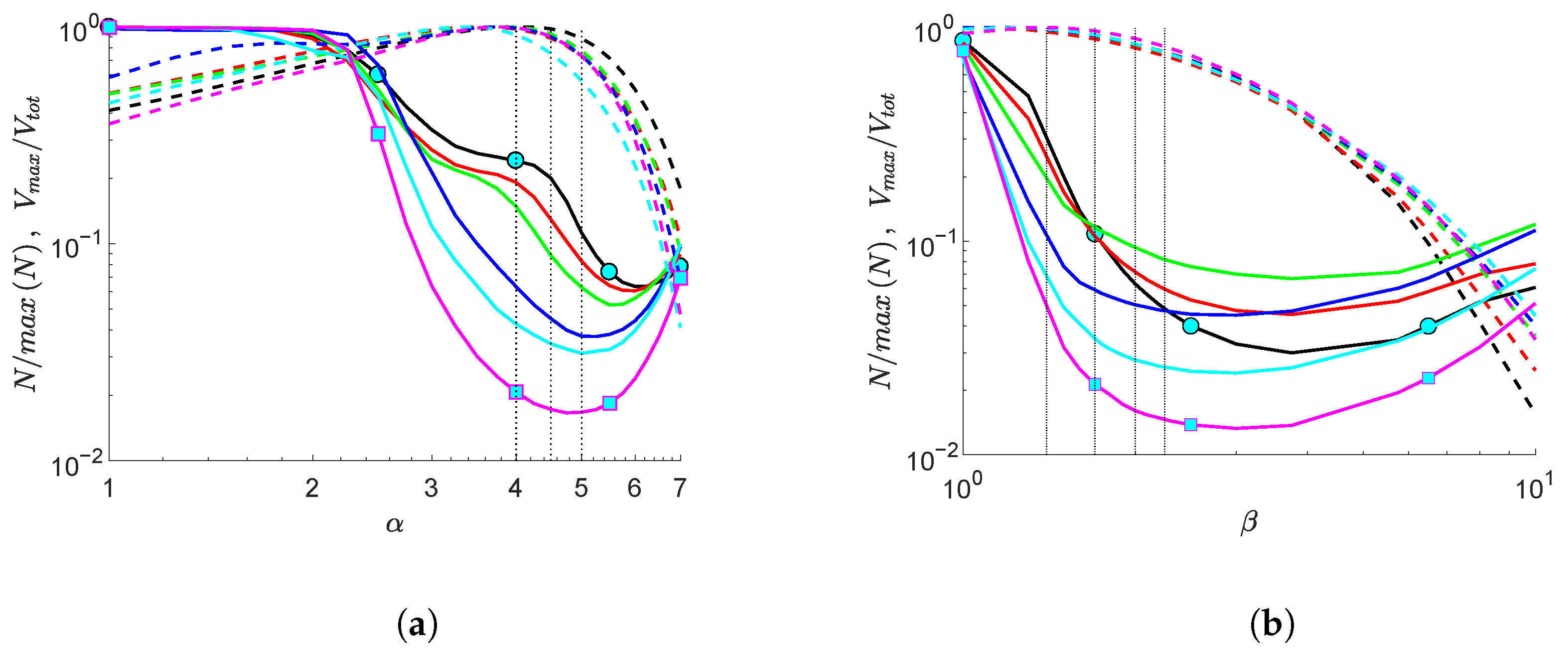
The percolation indexes for streaks (4) and u v -structures (5) are estimated through percolation analysis [4,5]. Figure 1a,b show the results of the percolation analysis for streaks and u v -structures, respectively. In both figures, the volume ratio V max / V tot , composed by the maximum volume of a single structure ( V max ) and the sum of the volume of all identified structures ( V tot ), tends to unity at low percolation values. Here, the scenario comprises a very large coherent structure that merges most identified points and several small structures without a relevant volume proportion. On the other hand, at high percolation ratios, both the volume ratio and the ratio of identified objects N / max N become small, resulting in very few but very intense structures.
In Figure 1a, the evolution of the volume ratio has two different trends. The ratio decreases steadily in cases from C00P10 to C04P06, whilst in cases from C06P04 to C10P00, the ratio shows a saddle at α 3.75 . This fact provides the first evidence that the intensity of streamwise streaks is organized differently in the cases with a predominant Couette proportion. Pirozzoli et al. [19] showed that in a case with shear stress ratio γ 0 (similar to our C06P04), the streamwise streaks can grow up to the channel center as in pure Couette flows. Similarly, Gandía-Barberá et al. [20] determined that the presence of alternating very-large streamwise streaks in the channel center starts in case C06P04.
In Figure 1b, the volume ratio decreases faster at 1 β 2 when comparing cases C00P10-C04P06 against C06P04-C10P00. However, it is worth noting how the volume ratio of cases C04P06, C06P04, and C08P02 reach their minimum in greater values than C10P00. This can be explained by the fact that in cases C04P06 to C08P02, the shear Reynolds number at the moving wall (Table 1) is too low to generate relevant structures in the upper region of the domain. Therefore, the overall identified volume V t o t in these cases is less than in case C10P00 due to the missing contribution of the upper area, increasing the volume ratio.
The requirements for selecting a percolation index are to reach a volume ratio below 10 % while keeping the ratio of identified objects near unity [4]. In this way, it is ensured that a representative population structure is identified and structures are separated enough to provide valid statistical results. The selected percolation indexes are gathered in Table 1. Similar percolation indexes were selected by Bae et al. [10] for streaks ( α ) in C00P10. Furthermore, the percolation indexes for u v -structures are similar to the selected values in [5] and [11] for C00P10 and C10P00 cases, respectively. Small variations in the indices do not alter the qualitative or quantitative results of the analysis. In our case, all reported ratios remain essentially unchanged under reasonable perturbations of α and β . Moreover, this same methodology has been used consistently in our previous works ([34,37]) with comparable robustness.

3. Streaks

3.1. The Geometry and Shape of Individual Streaks

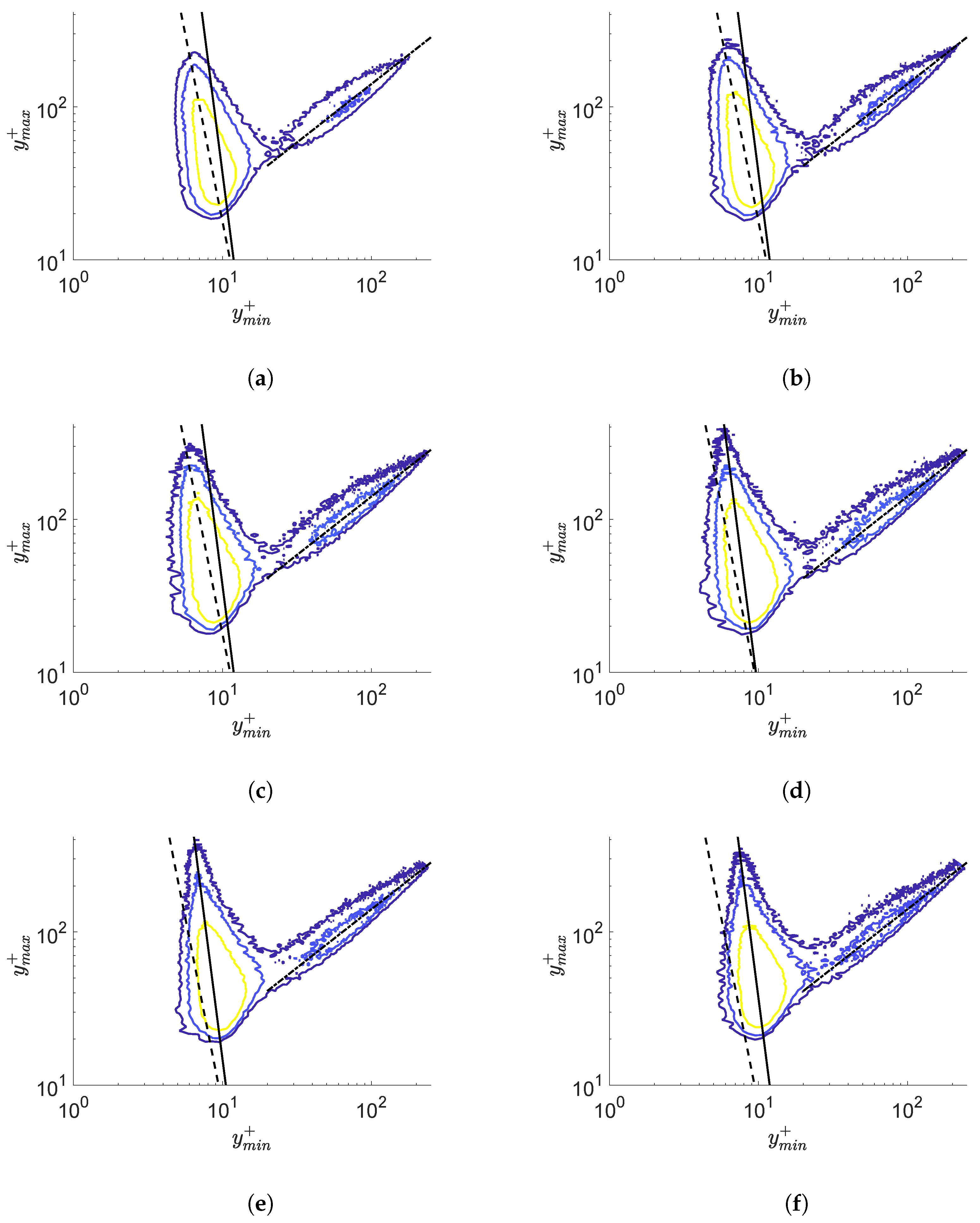
Streaks and other coherent structures are generally classified first based on their distance to the nearest domain wall [5]. Figure 2 shows the joint probability density function (PDF) of the wall-normal distance to the closest wall from streak bottom y m i n + and top y m a x + on the cases listed in Table 1. Two areas gather at least 50% of the plotted data in all cases. These areas are separated by a transition zone with less data density at y m i n + = 20 . Thus, this value defines two kinds of streaks: wall-attached and wall-detached [5]. The former, from now on referred to simply as attached, are defined by y m i n + 20 while the latter, detached, are defined by y m i n + > 20 . A similar streak classification is employed in [10]. Both attached and detached regions in Figure 2 exhibit a power-law relation between y m i n + and y m a x + . The attached region presents y m a x + y m i n + 4.9 for cases C00P10, C02P08 and C04P06. On the contrary, cases C06P04, C08P02 and C10P00 have a distribution y m a x + y m i n + 7.6 . This fact denotes that the vertical growth of the attached streaks behaves differently depending on the sign of the shear stress ratio, γ . Moreover, the change in the proportionality is not gradual with the shear stress ratio, as inclination only changes once the shear ratio reaches positive values. That is, Couette-like cases (i.e., from C06P04 to C10P00) follow the same distribution independently of the value of the shear stress ratio. The same occurs in Poiseuille-like cases. Therefore, Figure 2 indicates that the mechanism of streak generation changes after case C04P06. This fact is aligned with the observations in [20], in which the presence of alternating very-large streamwise streaks in the channel center starts in case C06P04.
On the other hand, the distribution of detached streaks follows y m a x + y m i n + 0.76 . This distribution does not change among the different cases, suggesting that the height of these streaks is less affected by the underlying mechanism in each case.
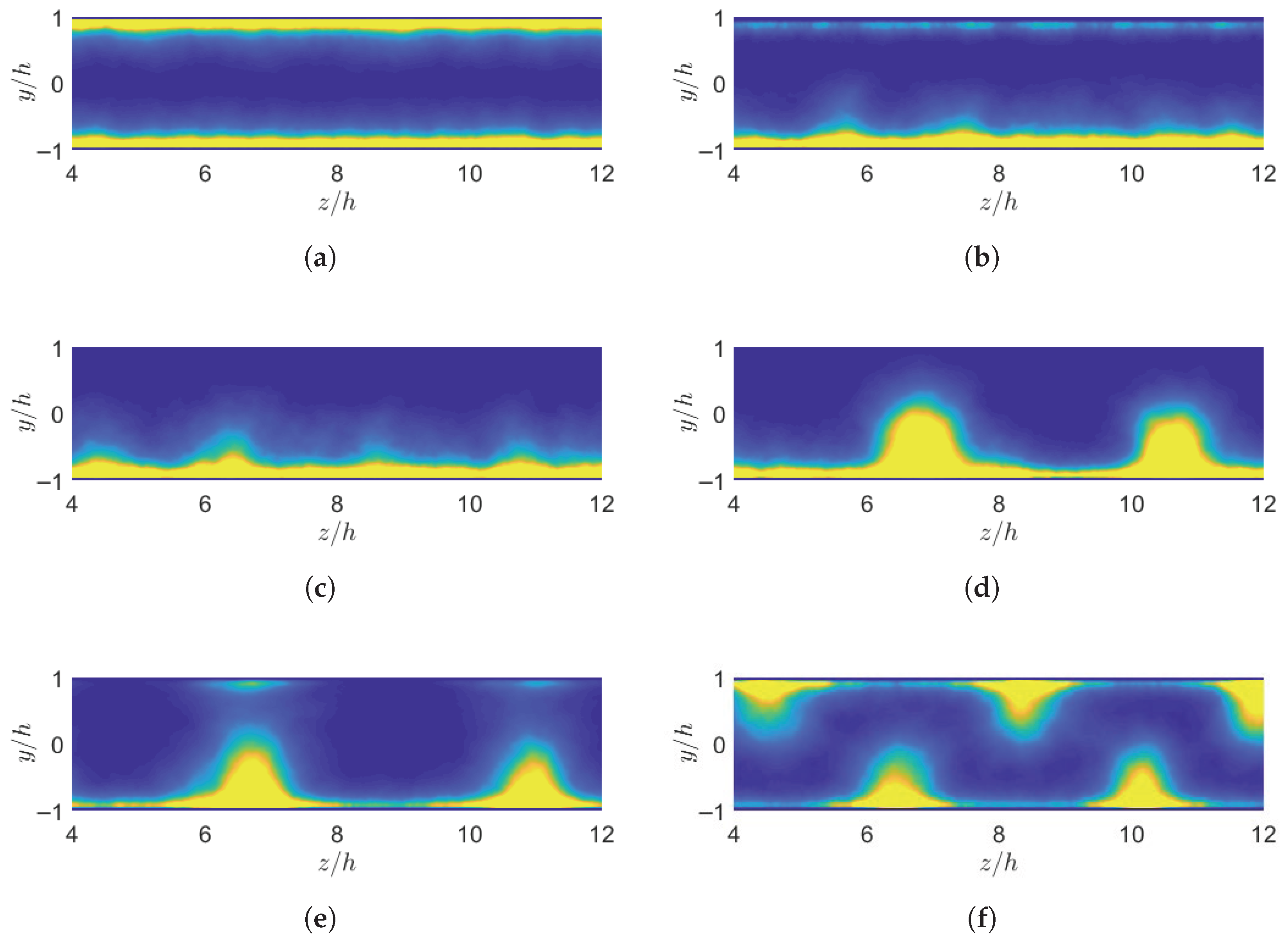
The organisation of streaks in streamwise- and time-averaged planes is shown in Figure 3. In cases with a negative shear ratio γ , no spanwise pattern in the arrangement of streaks is observed. However, an alternating pattern appears for positive shear ratios, with a spacing of approximately 3.75 h between streak regions. The alternating spanwise arrangement of streaks emerges first at the bottom static wall, as the friction Reynolds number in this region is always in the turbulent regime. See Table 1. The lack of streaks in the upper moving wall in cases C04P06 to C08P02, independently of the shear ratio, is due to the insufficient friction Reynolds number in this region to sustain turbulence.
Furthermore, this organization remains consistent when the shear ratio becomes positive, regardless of the Couette proportion in each case. This behavior aligns with the results for the attached streaks seen in Figure 2.
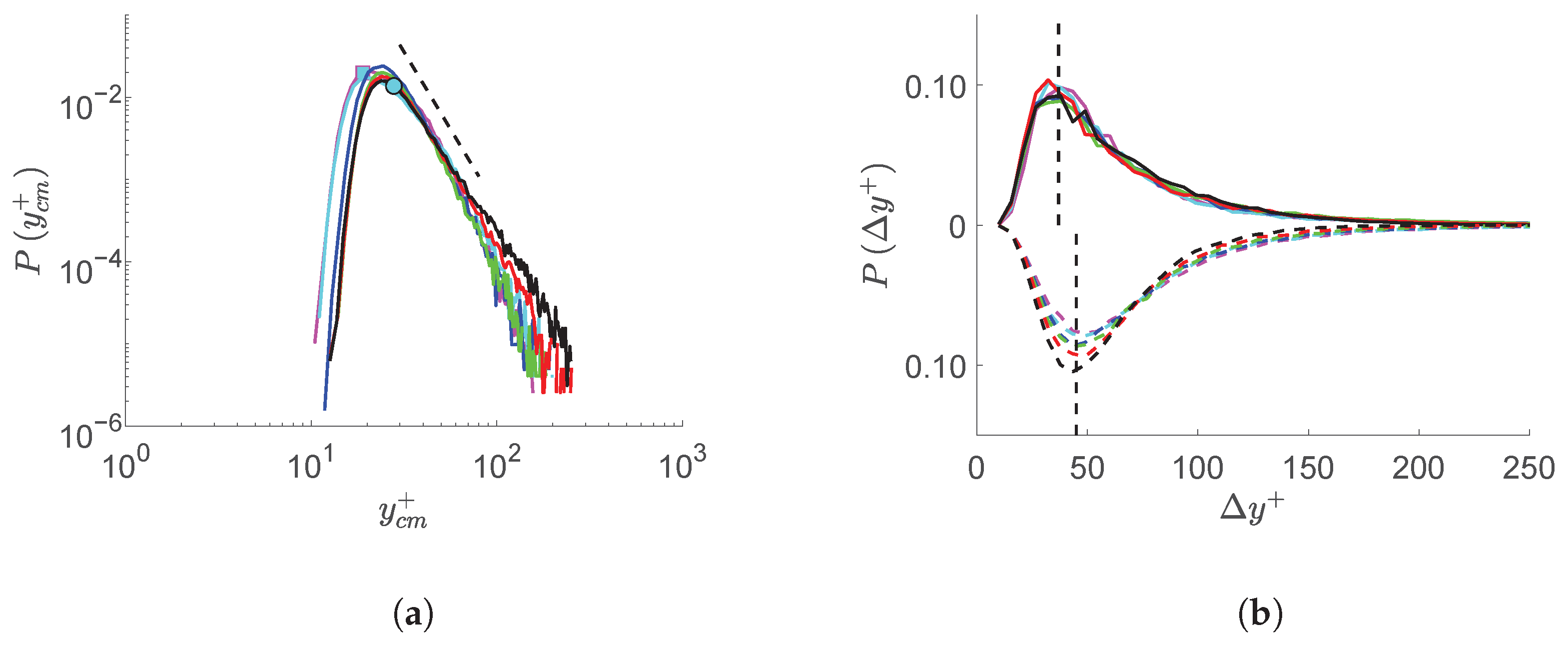
Following the streak classification in [10], the authors explored the potential identification of tall attached structures in the simulations. These structures would not only extend down to y m i n 20 , but would also be taller in y m a x or y c m (i.e., the height of the structure’s center of mass) than the rest of the attached structures. Figure 4 shows the PDF of the y c m associated only with attached streaks. The figure does not present any distinction among attached streaks. Nevertheless, after defining structures with y c m + > 50 as potential tall-attached streaks and studying their characteristics, these structures were found to be conglomerates of attached streaks. The reason is that potential tall-attached structures exhibited dimensional ratios different from those of attached streaks in our study, which deviates from the self-similarity observed in all types of attached structures, whether tall-attached or just attached [10]. Thus, the streaks are classified in this study as either attached y m i n 20 or detached y m i n > 20 .
The average ratio of attached and detached streaks and their volume is listed in Table 2. Attached streaks are predominant among them in all cases, making up, on average, 70% of all streaks. These results indicate that the use of different percolation indexes, α , across cases (See Table 1) influences neither the number of streaks of each type nor their overall volume. Indeed, the results highlight a similar scenario in all cases despite the clear reallocation observed in Figure 3.
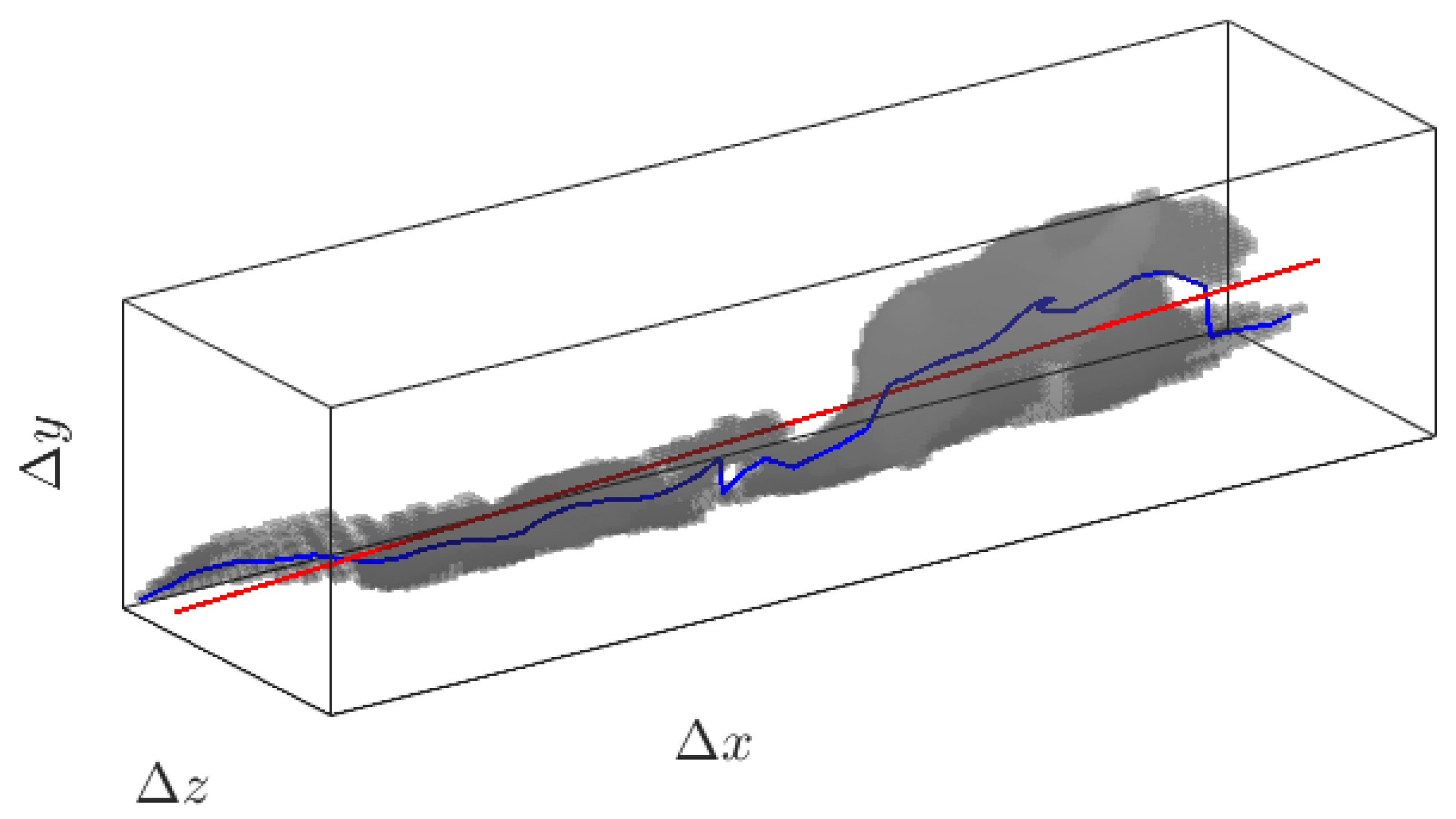
As streaks are typically meandering structures, obtaining a simpler geometric configuration is necessary to study their spatial orientation [59]. Each identified streak is contained within a Cartesian box aligned with the domain axes to achieve this. The box’s length, width, and height are defined by the parameters Δ x , Δ z , and Δ y , respectively (see Figure 5). A spline is defined for each identified streak by calculating the streak’s center of mass at each Δ y Δ z plane. The spline points ( x s , y s , z s ) are then used to generate a linear approximation ( x s , A 2 x s + B 2 , A 3 x s + B 3 ) based on least squares fitting, where:
A k = N i = 1 N x s i x k i i = 1 N x s i i = 1 N x k i N i = 1 N x s i 2 i = 1 N x s i 2 , B k = i = 1 N x k i i = 1 N x s i 2 i = 1 N x s i i = 1 N x s i x k i N i = 1 N x s i 2 i = 1 N x s i 2 ,
being N the amount of spline points and k = { 2 ,   3 } , where x 2 = y s and x 3 = z s .
The streak elevation, heading angles, and meandering are calculated from the linear approximation in reference to the Cartesian box. The elevation angle ( θ ) and heading angle ( ψ ) in radians are defined as follows:
θ = arctan A 2 , ψ = arctan A 3 .
The streak meandering, ϵ is the root mean square of the distance between the linear approximation and the spline at each x s location, as in [59].
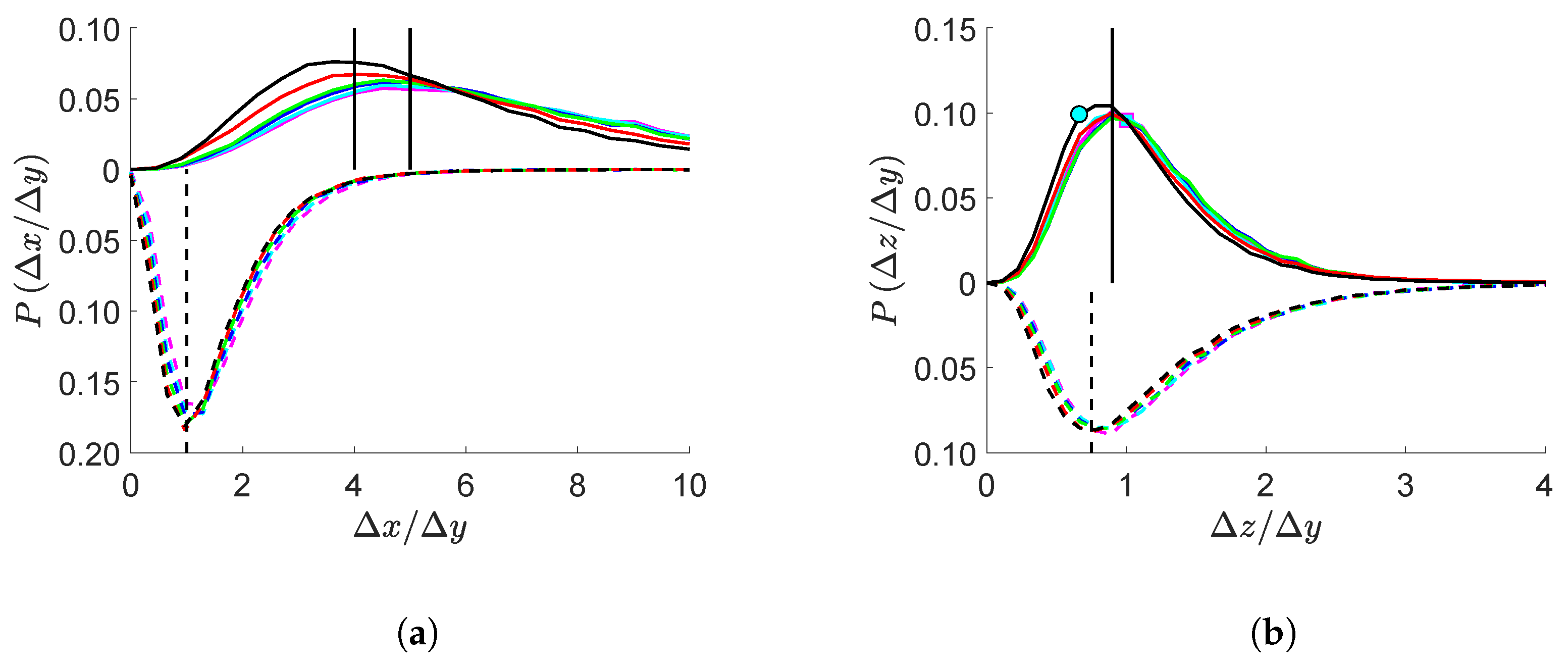
The study of the sizes of the circumscribing boxes for the attached Q structures shows how the structures tend to grow in each Cartesian direction. Self-similarity, as well as growth patterns, can be extracted from probabilistic plots of the box dimensions and ratios. The PDFs of streak dimensional ratios are depicted in Figure 6 based on box dimensions (Figure 5). A good collapse of the dimensional ratios is observed independent of the case, except for Δ x / Δ y on attached streaks. Poiseuille-like attached streaks have a longitudinal ratio Δ x / Δ y = 5.0 greater than Couette-like streaks with Δ x / Δ y = 4.0 . This fact can be traced to the different percolation ratios selected for Poiseuille- and Couette-like streaks. A 2-point correlation of u along the streamwise direction in Couette flows shows a very large correlation, generally exceeding the domain length [17,20,27]. Hence, a greater percolation index is needed to break the streaks (i.e., u structures) into coherent structures. See Figure 1. Bae et al. [10] reported Δ x / Δ y = 7.0 for attached streaks on a Poiseuille flow using α = 3.4 . Thus, the ratio Δ x / Δ y on the attached streaks is sensitive to the percolation index selected. Conversely, detached streaks show a perfect agreement independent of the case, collapsing at Δ x / Δ y = 1.0 . The ratio Δ z / Δ y shows a good agreement for all streaks independent of the case, collapsing for attached streaks at Δ z / Δ y = 0.9 and for detached streaks at Δ z / Δ y = 0.75 . These values match the findings in [10].
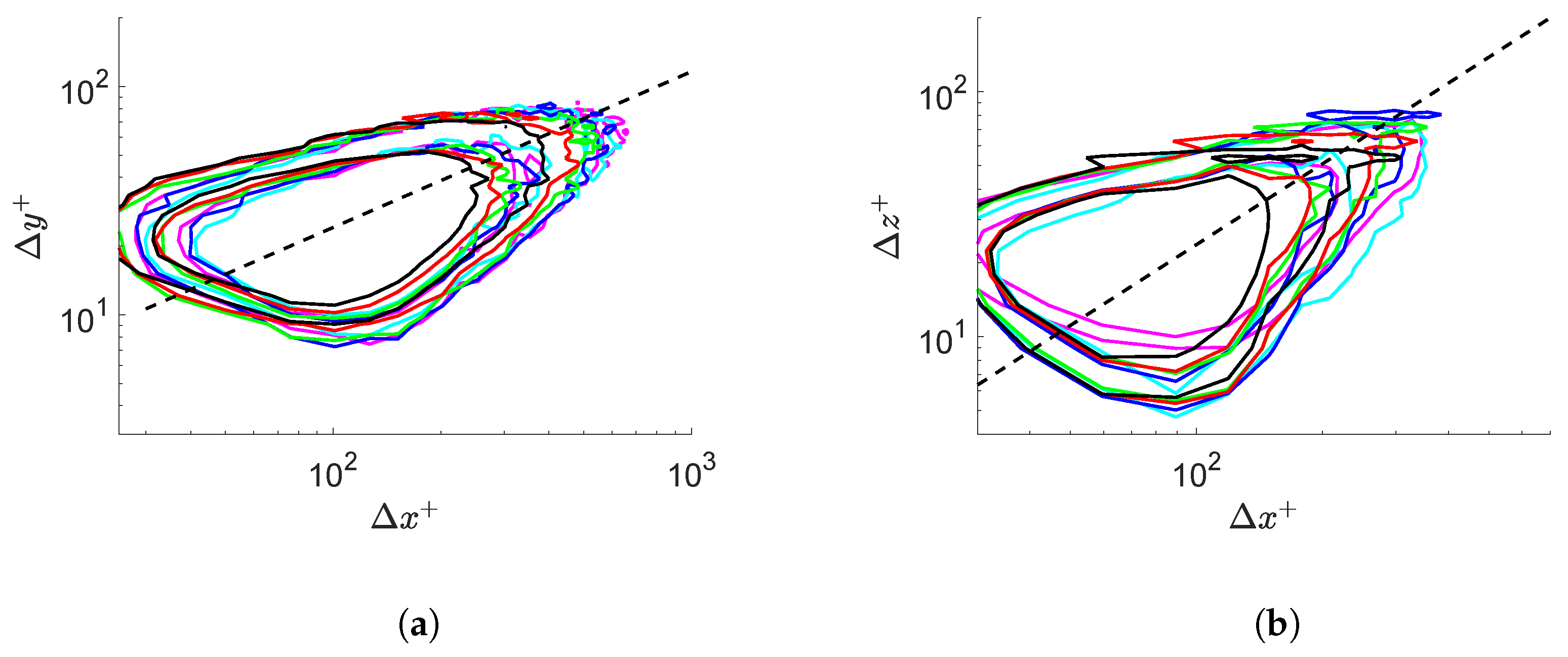
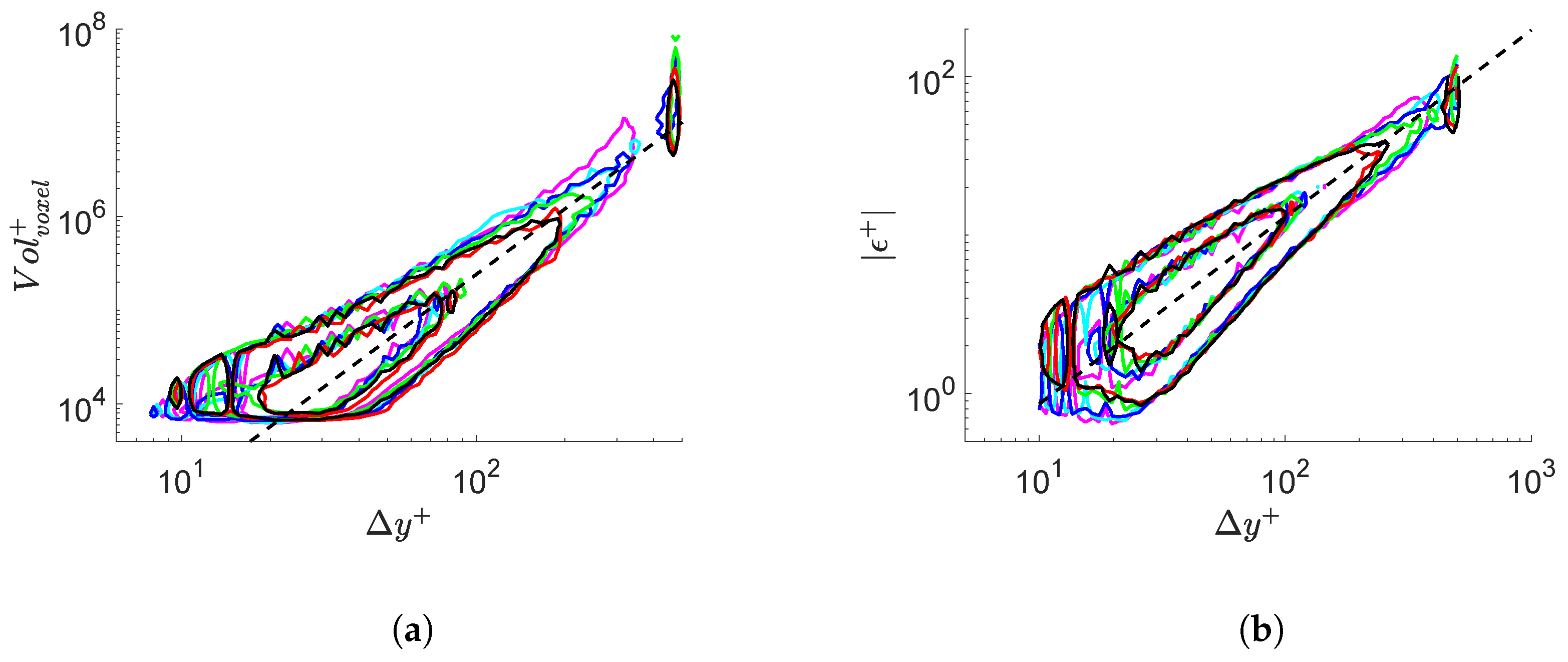
The streak dimensions are analyzed through 2-dimensional PDFs of the streak length, Δ x + , against the streak height, Δ y + (Figure 7a), and the streak width, Δ z + (Figure 7b), in wall units. Both figures reveal a strong collapse across cases within the region Δ x + 400 and Δ y + 70 . The data are observed to follow the trend Δ x Δ y 2 in the former and Δ x Δ z in the latter. These trends are consistent with those reported by [10] for streaks in Poiseuille channel flows. However, the analysis presented here demonstrates that the trends are also applicable to streaks identified in pure Couette flows as well as in Couette–Poiseuille combinations. Furthermore, Poiseuille-like cases are found to exhibit longer streaks, extending up to Δ x + = 600 . The deviation of streaks with Δ x + > 400 from the observed data trends may suggest that such streaks are conglomerates of smaller ones.
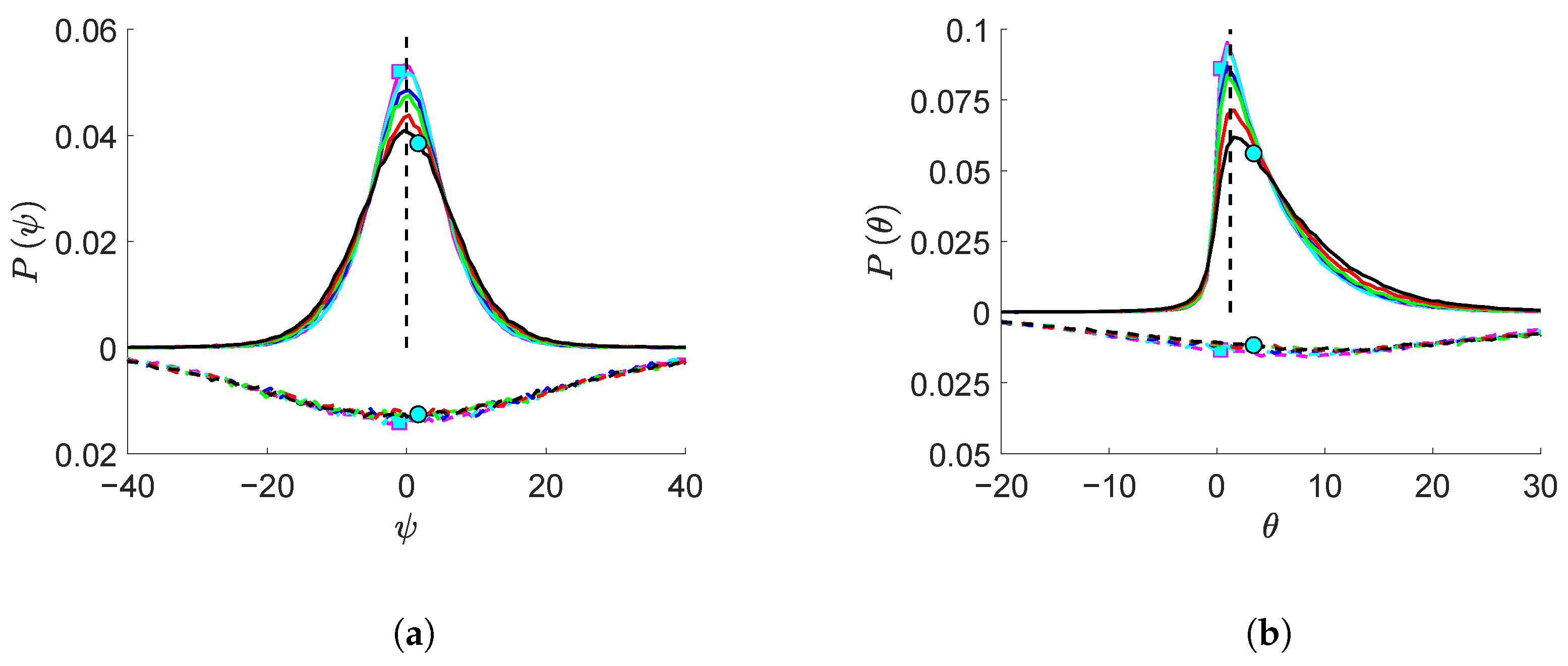
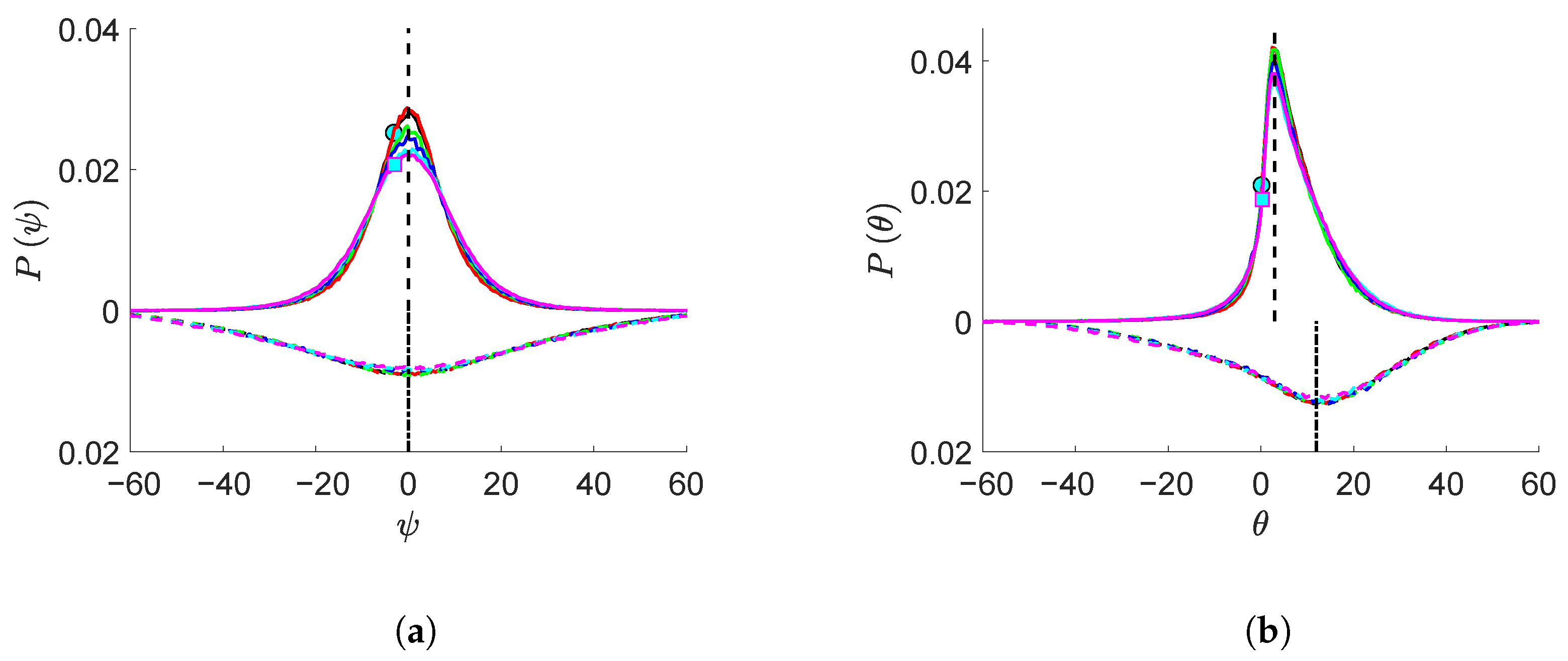
Streaks are further evaluated based on their elevation and heading angles as described in Equation (7). The PDF of heading and elevation angles is depicted in Figure 8a and Figure 8b, respectively. The PDF of the streaks’ heading angle is centered at ψ = 0 degrees and symmetric along this axis for either attached or detached streaks. The predominant heading angle aligned with the streamwise direction is also observable in the stream-spanwise plane representation of streaks in the literature [60,61]. Symmetry may be a consequence of the periodic boundary conditions in the X-Z plane of the simulation domain. While the heading angle range for attached streaks is mainly within ± 10 degrees, detached streaks have a broader range up to ± 40 degrees. On the other hand, the PDF for streaks elevation angle is centered at θ = 1.25 degrees for attached streaks and is not symmetric. The non-uniformity of the mean shear caused by the impermeability of the wall reduces the inclination of attached structures with respect to the free stream [1]. Detached structures in Figure 8b have a greater average elevation angle as they are located further from the domain walls. Curiously enough, Figure 8a,b show similar average values for attached and detached streaks independently of the Couette–Poiseuille case.
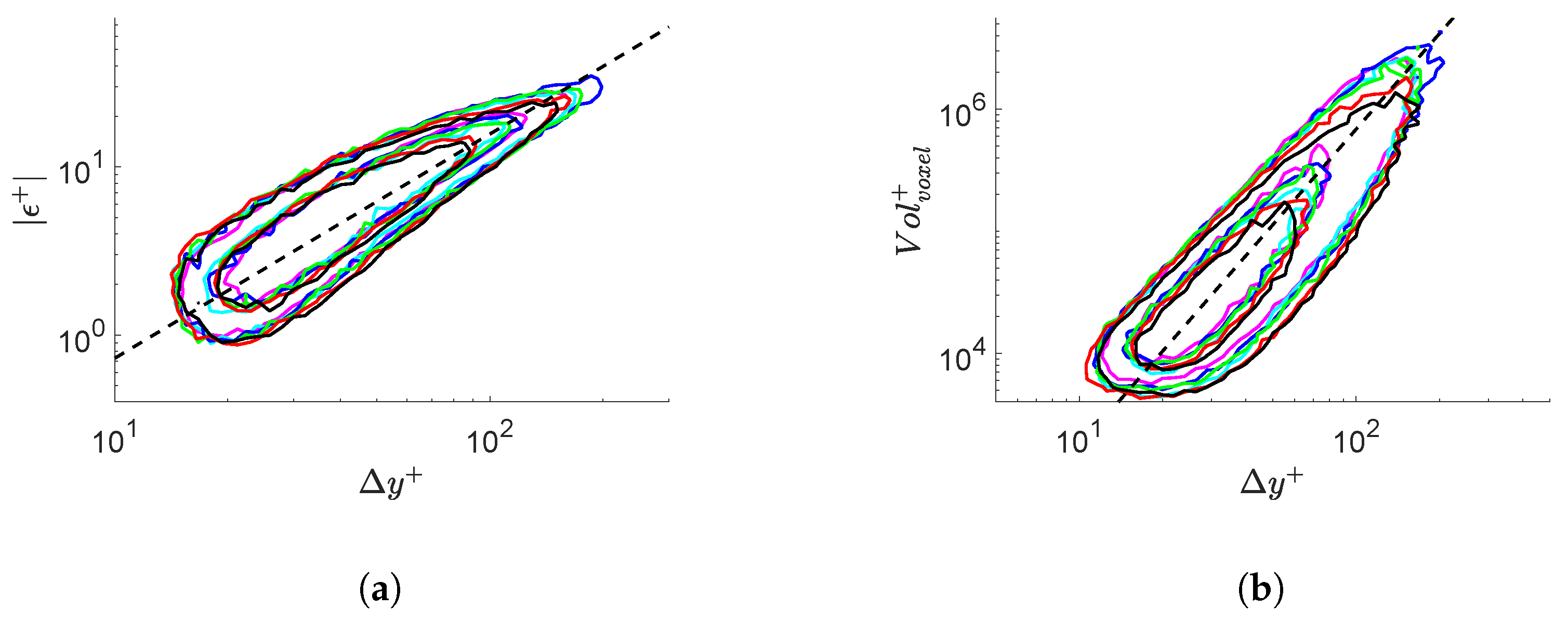
Figure 9a shows the relation between the streak meandering and streak height, both in wall units. In all cases, the meandering behaviour increases with distance from the wall. Such a trend is also observed in canonical smooth-wall boundary layers [59]. The meandering scales exponentially with the streak height with exponent 1.33 , showing an almost linear increase of meandering with streak height. Finally, the collapse among cases in Figure 9a shows that streaks have similar meandering behaviour independently of the shear ratio (i.e., Couette–Poiseuille contributions).
Figure 9b depicts the relation between the streak volume and streak height, both in wall units. The streak volume is the sum of the volume of all the voxels defining the streak. The streak volume increases with streak height and scales exponentially as per Δ y + 2.60 . This exponent is considered a crude fractal dimension of the object provided that the object is self-similar [4], being characteristic of full shell- or flake-like objects when its value is around 2.5 [6]. Here, the collapse among cases in Figure 9b shows that streaks have a similar increase in volume independently of the shear ratio, and in all cases, streaks can be portrayed as full shell- or flake-like objects.

3.2. Relative Position and Absolute Distance Between Streaks

Figure 3 shows a global redistribution of the streaks along the domain spanwise dimension. Therefore, it is interesting to see how this redistribution may affect the distances between streak pairs. The relative position between the structures i and j is defined by the vector:
δ i , j = x m c j x m c i Δ y ¯ i , j
where x m c i is the position vector of the structure i mass center in Cartesian coordinates. Following the work of [5,6], the relative position δ i , j is normalized with the mean wall-normal height of the selected structures, Δ y ¯ i , j = Δ y i + Δ y j / 2 .
The relative position is measured against structures of similar size [5,62,63]. The filter to define if two structures can be considered as a pair is:
1 / 2 < Δ y j / Δ y i < 2 .
Consecutive to the definition of relative distance in Equation (8), the absolute distance between structure i and structure j is defined as
R i , j = x m c j x m c i = x m c j x m c i 2 + y m c j y m c i 2 + z m c j z m c i 2
In this work, the figures related to structure distances are compiled using only the closest structure j to the reference one i as in [6].
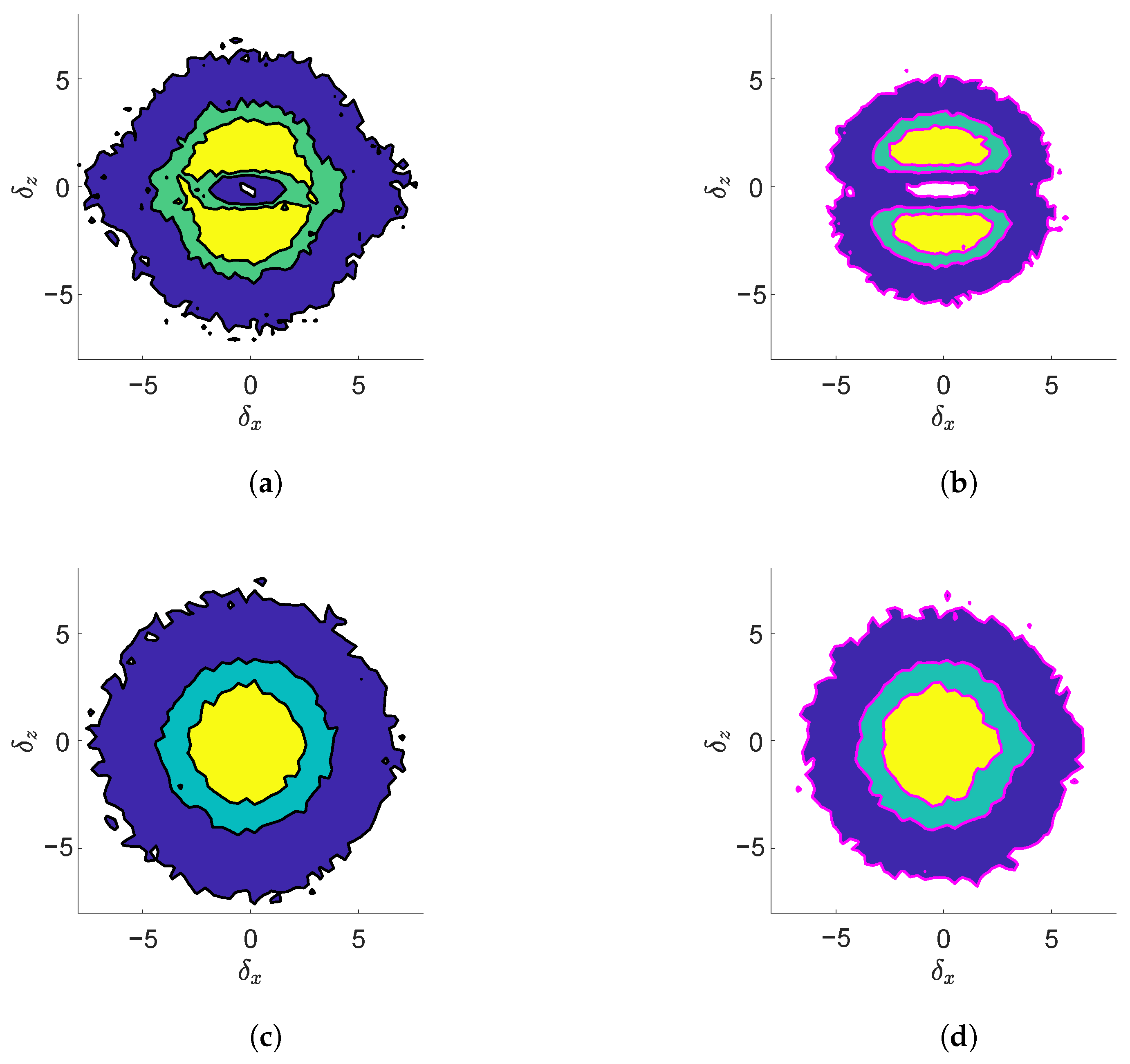
Figure 10 shows the two-dimensional PDF of the relative position between two streaks of diverse types along the streamwise δ x and spanwise δ z directions. Figure 10a,b show the spatial distribution between two attached streaks in pure Couette and pure Poiseuille cases, respectively. In both cases, attached streaks tend to form pairs aligned spanwise with a relative spanwise distance δ z between 0.8 and 3 units. However, in the pure Couette case, attached streaks can be paired streamwise, too, with an average relative distance δ x of 2.8 units.
Figure 10c,d define the pair formed by an attached and detached streak. The spatial distribution of the pair is isotropic along the streamwise and spanwise directions, with 50% of the structures at a distance below 4 units. This distribution applies to either pure Poiseuille or pure Couette flow. Generally, detached streaks tend to be located at a positive streamwise position regarding their original attached streak after detaching [64]. However, in our study, the closest distance between structures is calculated without considering the origin of each structure.
The spatial distribution formed by a pair of detached streaks is depicted in Figure 10. Detached streaks tend to form pairs aligned in the streamwise direction with an average relative distance δ x below 2.8 units. Bae et al. [64] show that detached streaks have a greater averaged wall-normal velocity than attached streaks in the buffer layer. The authors consider the generation of detached streaks through a streak breakup as a strong ejection or bursting effect, which is conditioned on the presence of a Q2 structure. Curiously enough, ref. [5] observed that Q2 structures tend to form pairs aligned in the streamwise direction. This fact agrees with our observation on the organization of detached streaks.
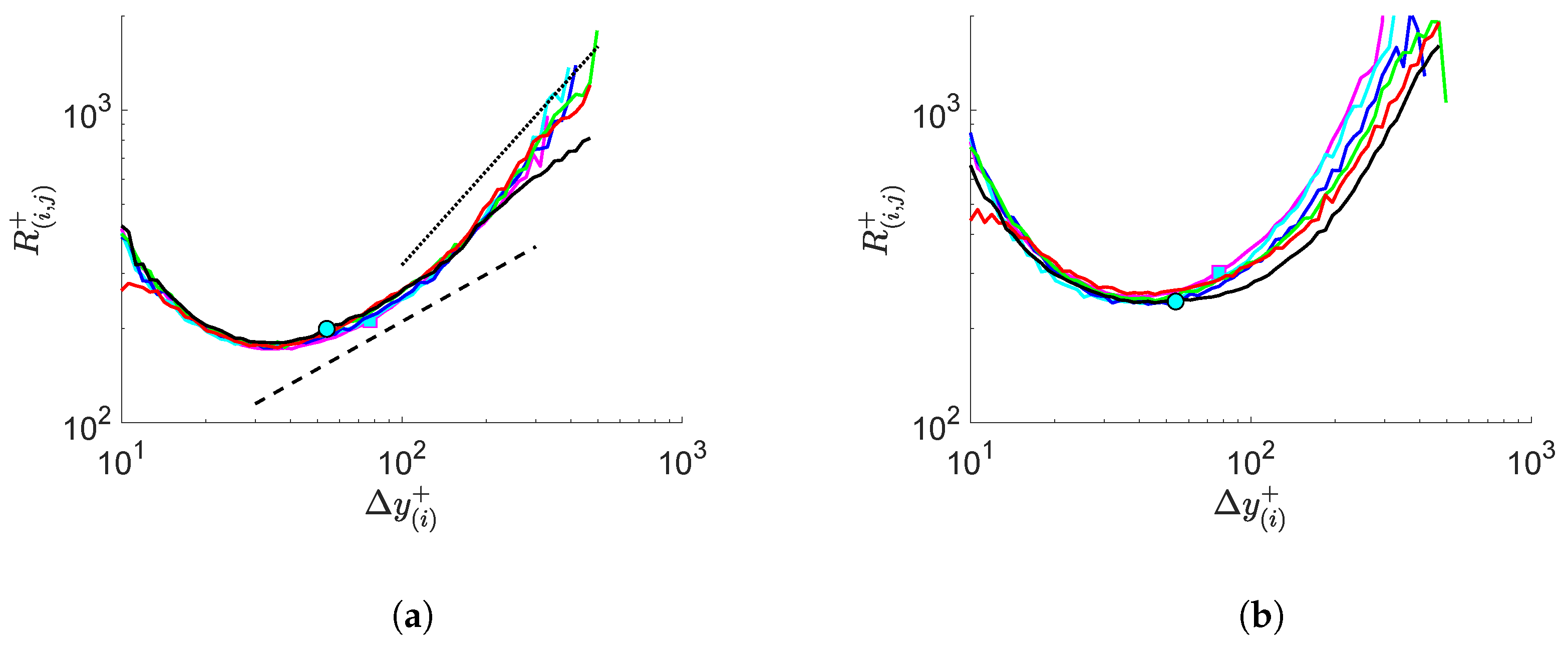
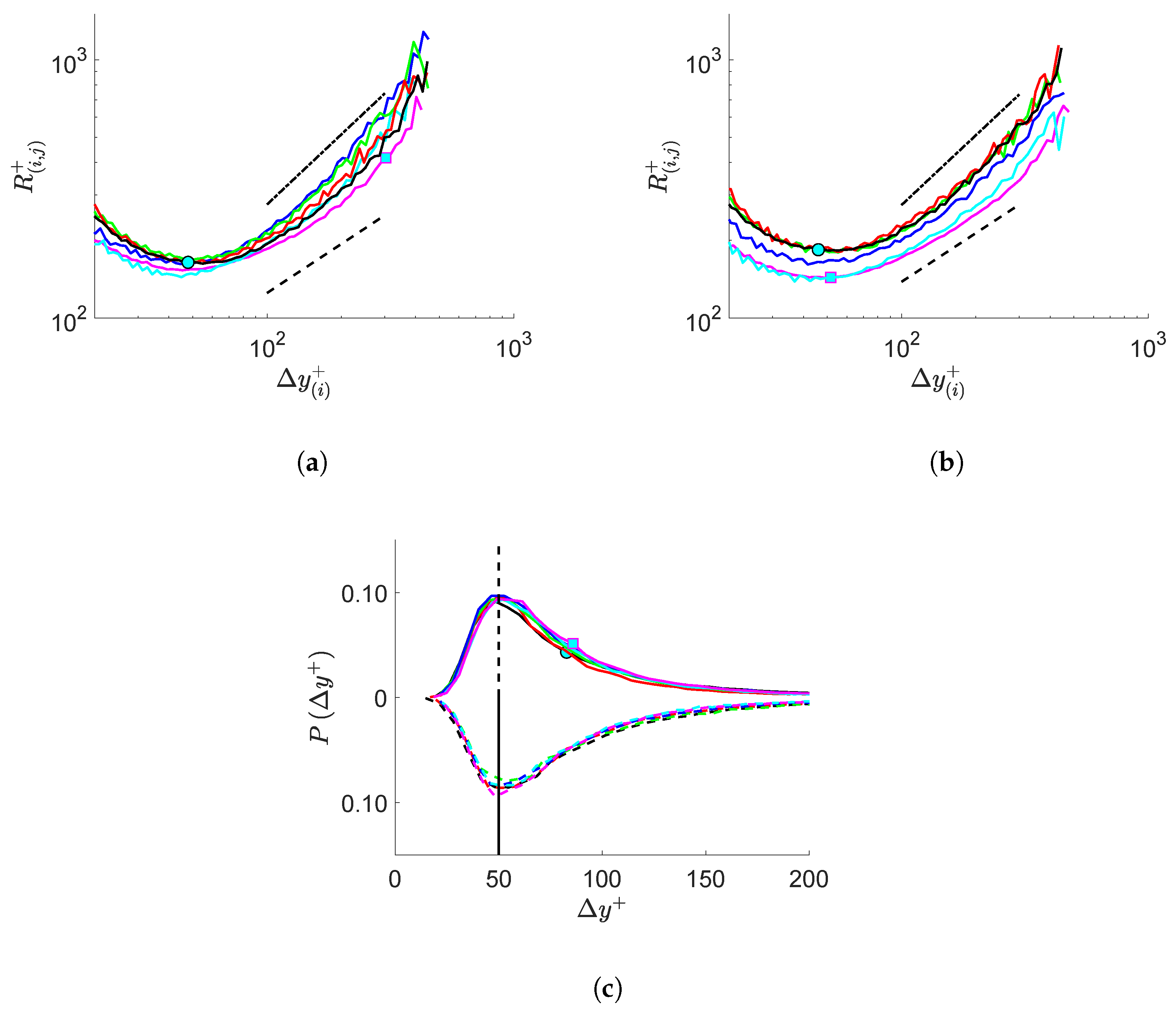
The closest absolute distance on average is depicted in Figure 11 for pairs of attached streaks (a) and pairs of attached and detached streaks (b). Attached streak pairs decrease their absolute distance in all cases, reaching a minimum at Δ y i + = 40 , which coincides with the most frequent streak height in wall-units, as depicted in Figure 4b. Thus, the absolute distance between attached streaks reduces as more streaks of a given height are present. Note that only streaks of similar height are compared against each other by using the filter in Equation (9). After reaching the minimum, the absolute distance increases proportionally to Δ y + 0.5 for streaks reaching Δ y i + 150 in all cases. After this threshold, the absolute distance tends to increase even further, becoming proportional to Δ y i + . However, the latter must be considered with precaution as the number of streaks employed for the data in this range is much smaller.
Similar behavior is observed in pairs of attached and detached streaks in Figure 11b. The closest absolute distance is observed in streaks with a height of around 40 wall units, as the number of detached streaks with this height also peaks in Figure 4b. After the minimum distance, the distributions no longer collapse among cases. For a given Δ i + , the absolute distance is greater in Poiseuille-like cases (i.e., negative shear ratio) than in Couette-like cases (i.e., positive shear ratio). Since attached-attached pairs show a good collapse in Figure 11b, the lack of agreement among attached-detached streaks must stem from changes in the distribution of detached streaks. Indeed, the number of detached streaks and their volume increase in Couette-like cases, with a maximum in case C10P00. See Table 2. Therefore, as the number and volume of detached streaks are highest at C10P00, the closest distance between attached and detached streaks reduces.

4. Intense Reynolds Stress Structures

The points belonging to intense Reynolds stress structures are identified using the threshold defined in Equation (5). Each structure is engulfed in a 3-dimensional box aligned with the Cartesian coordinate system following the same procedure as for streaks, see Figure 5. The ratio of Q structures belonging to a given quadrant and their volume ratio is listed in Table 3. Here, the data is presented for either all structures or attached structures. Data relative to detached structures can be extracted by subtracting the attached data from the overall data.

4.1. The Geometry and Shape of Individual Structures

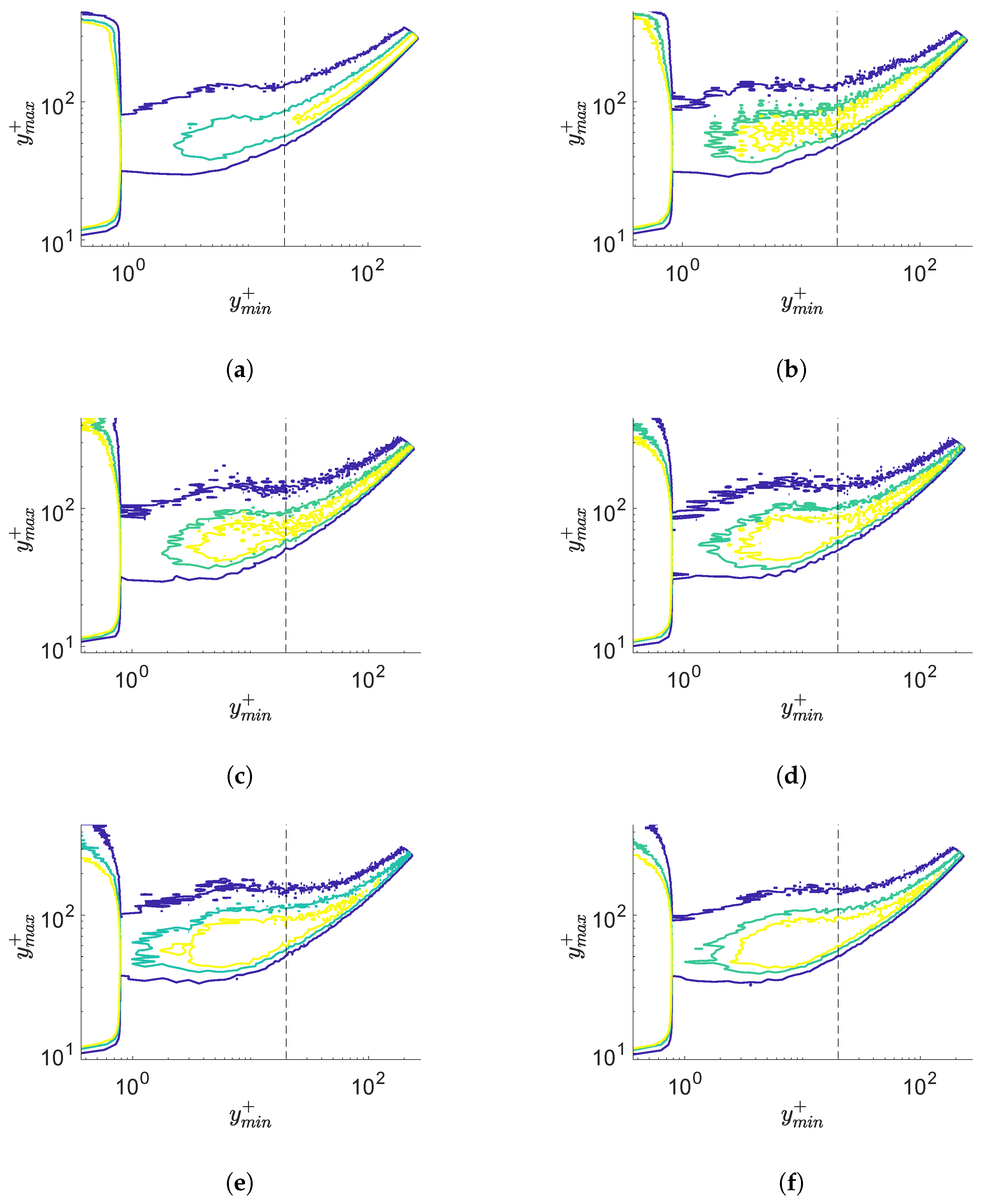
Figure 12 depicts the joint PDF of the structure’s minimum distance to the nearest wall y m i n + against its maximum distance y m a x + . A vertical line at y m i n + = 20 separates between attached and detached structures following the literature definition [5]. Among the attached structures, we can differentiate two zones: the first zone with y m i n + < 1 , and the second zone with 1 y m i n + 20 . While the quadrant contributions to the first zone remain similar among cases, the second zone differs from case to case, being therefore affected by the shear ratio, γ . The first zone has a constant averaged contribution of 43% Q2 structures and 53% Q4 structures, among cases. It is obvious that Q4 structures will be more present in this zone as they tend to grow with negative wall-normal velocity, reaching closer positions to the wall. Conversely, the contribution of Q2 and Q4 to the second zone is not constant. The Poiseuille-like cases show a 50–41% contribution of Q2 and Q4, respectively, while Couette-like cases show a 75–20% contribution.
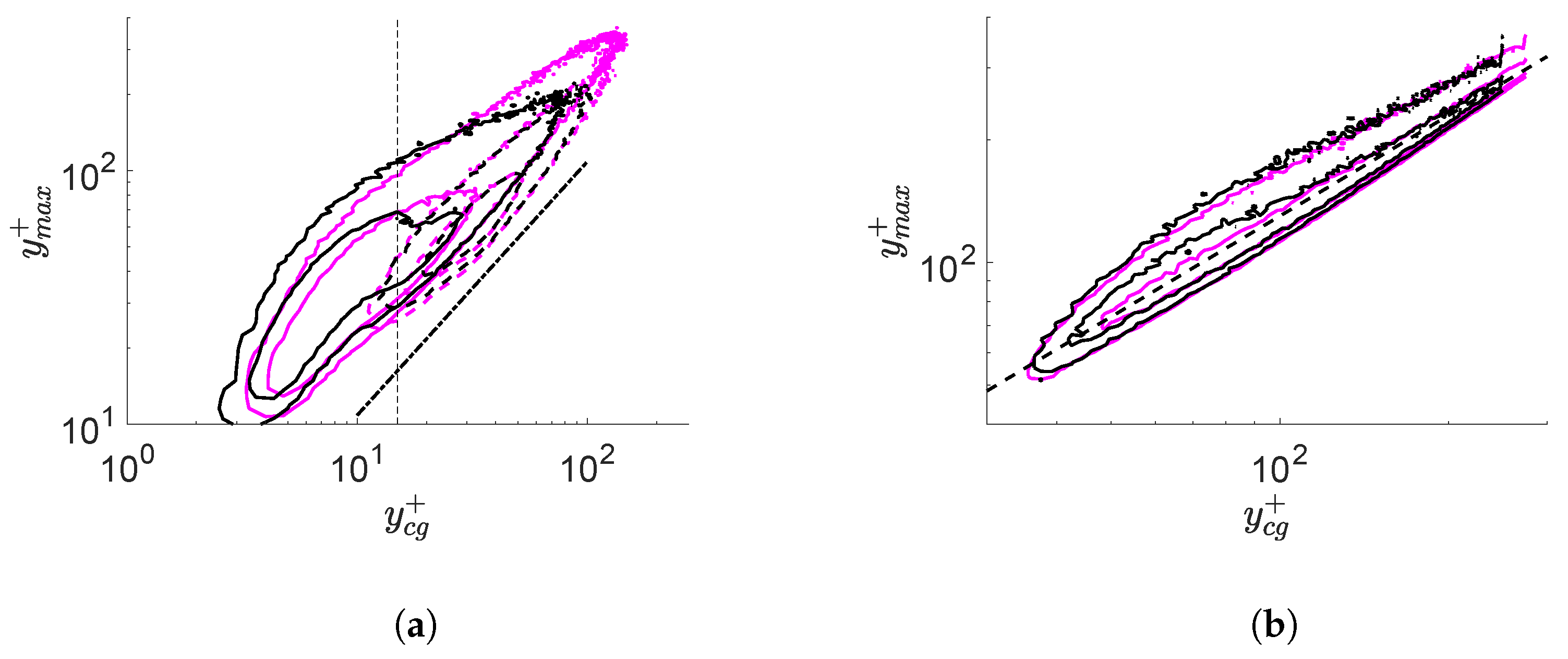
To examine whether attached structures exhibit different geometric characteristics based on their zone, we analyze their center-of-mass height relative to the nearest wall y c g + and their maximum height y m a x + , as shown in Figure 13a. The joint probability density function (PDF) reveals a consistent linear trend, y m a x + y c g + , across all attached structures, regardless of their zone or quadrant (e.g., Q2 or Q4). However, this linear relationship is modified for structures with y c g + 15 due to the influence of the wall. This region is predominantly occupied by Q4 structures, whose negative wall-normal velocity flattens them against the wall, as previously reported by [11].
To compare these characteristics with detached structures, Figure 13b presents the same parameters for detached structures. The results show excellent agreement between pure Couette and pure Poiseuille cases, following a trend of y m a x + y c g + 0.82 , which differs from the trend observed in attached structures. Based on these findings, we classify all structures with y m i n 20 as attached and those with y m i n > 20 as detached.
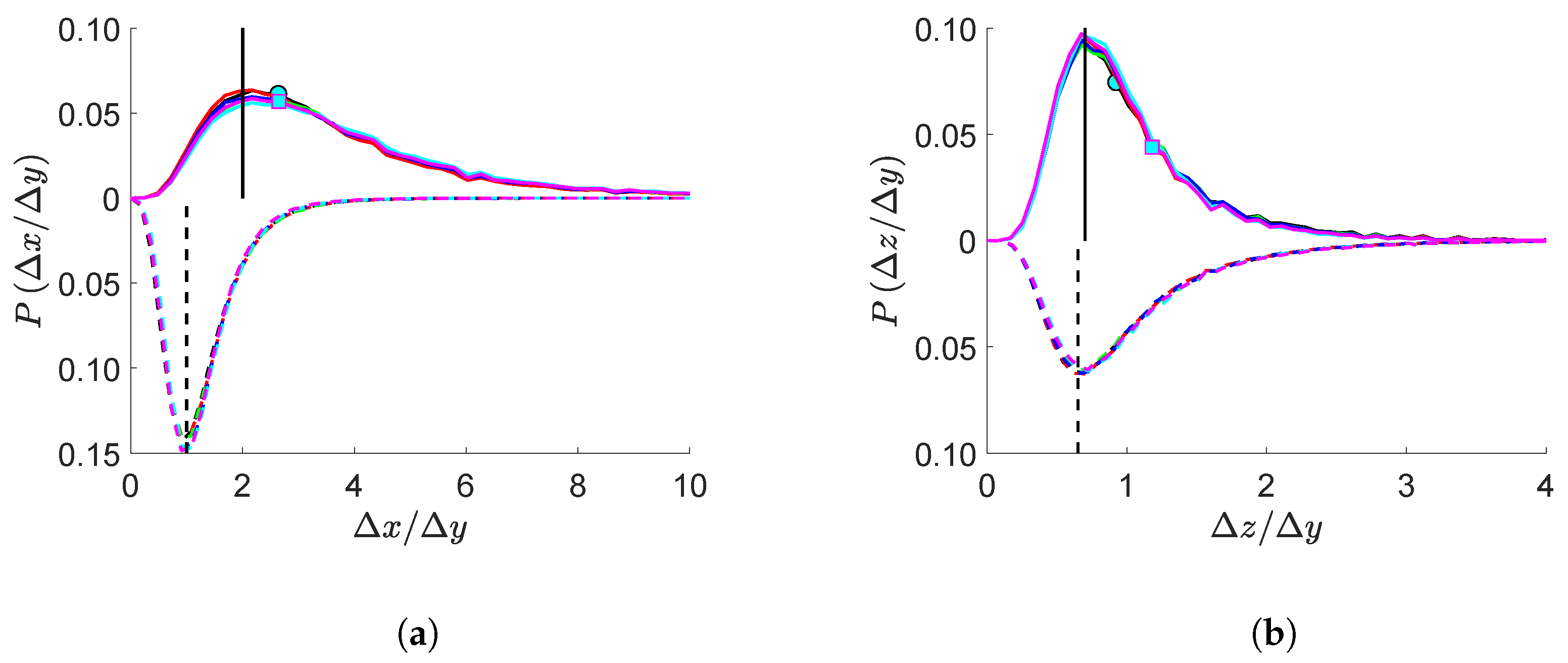
Figure 14 shows the self-similar behavior of the attached and detached Q events in all simulation cases. The ratio Δ x / Δ y has the highest probability at 2.0 and 1.0 for attached and detached structures, respectively. On the other hand, the ratio Δ z / Δ y has the highest probability at 0.7 and 0.65 for attached and detached structures, respectively.
Further developing the above-mentioned ratios, the attached structures in all cases (Table 1) follow
Δ x 2 Δ y 2.86 Δ z ,
whilst detached structures in all cases follow
Δ x Δ y 1.54 Δ z .
A similar ratio as described in Equation (11) is reported by [6] in turbulent Poiseuille flow. The authors demonstrated the self-similarity for Q (i.e., both Q2 and Q4 together) objects at R e τ = 934 and R e τ = 2003 , with Δ x 2 Δ y 2.5 Δ z . Although we include all types of attached Q structures in this analysis, the majority are Q structures (see Table 3), allowing for a meaningful comparison. This indicates that the self-similarity trend of attached Q structures is independent of the shear ratio and Reynolds number, at least within the range R e τ 2003 .
As a result of this self-similarity, the volume of the bounding boxes containing Q structures (Figure 5) can be expressed as V box + = Δ x + × Δ y + × Δ z + Δ y + 3 [11]. However, coherent structures often exhibit elongated shapes resembling filaments or ribbons [65], which do not entirely fill the bounding box. To better characterize the intrinsic shape of these structures, we employ parameters such as volume in voxels and meandering. Other studies use different methodologies, such as a box-counting algorithm [65], the structure’s genus [58], or shape definitions based on Minkowski functionals [66].
Figure 15a shows that the volume of attached structures scales with Δ y + D , where D = 2.32 . This scaling aligns with results from similar studies [5,11]. In these studies, the authors interpreted the scaling of object volume with height as an estimate of fractal dimension. They concluded that an exponent D between 2.25 and 2.45 corresponds to structures resembling spongelike objects composed of flakes. Notably, in Figure 15a, attached structures with Δ y + 20 deviate from this trend. These structures are typically Q4 structures flattened against the wall due to their negative wall-normal velocity component.
The meandering of the structures is evaluated using the same definition as for streaks in Section 3. Figure 15b compares the meandering of attached Q structures against their height. The results show good agreement across simulation cases, indicating that the meandering scales as Δ y + 1.2 . This scaling is similar to that observed for streaks in Figure 9. We conclude that coherent structures tend to become increasingly wavy with wall distance, leading to higher meandering [59]. Interestingly, attached structures with Δ y + 20 , previously associated with wall flattening, still follow the same meandering trend as other structures. This observation suggests that meandering is governed primarily by the growth of the structure in the streamwise and spanwise directions.
Figure 16 presents the PDFs of these angles as defined in Equation (7). A perfect agreement is observed between cases in either attached or detached structures. Like streaks, the Q structures tend to be aligned on average with the streamwise direction. Structures whose characteristic length is greater than the Corrsin length [67] interact with the mean shear; thus, they grow in the direction of the mean shear, ψ = 0 . Attached Q structures comply with this condition since the Corrsin scale ( L c ) in channel flows is L c y and all attached structures are larger than L c [1]. For this reason, the maximum of the heading angle PDF is located at 0 degrees in all cases for attached structures. Finally, detached Q in channel flows are shorter than the attached ones, but not wider [1]. This results in several detached structures being smaller than the Corrsin scale and, therefore, a greater dispersion on their heading angle. Nevertheless, detached structures also have a predominant alignment with the streamwise direction. This agreement between both structures may stem from the fact that detached structures can be linked to attached structures during their lifetime. Attached Q2 structures tend to grow steadily away from the wall and end up detaching from it. Conversely, detached Q4 structures can be born away from the wall and move down relatively quickly, attaching to the wall and staying attached thereafter [47].
On the other hand, the elevation angle for attached structures peaks at θ = 3 and covers a wide range until θ = 20 . The range in attached structures is narrow in comparison to detached structures. The latter peaks at θ = 12 and covers a range of 20 θ 40 . This trend matches the observations of Jiménez [1]. The author reports that the elevation angle of the flow field conditioned to a Q2–Q4 pair is truncated by the presence of the domain wall. Consequently, the flow field conditioned to the presence of attached Q structures is less symmetric and less inclined in the streamwise direction than a case without walls (i.e., stationary homogeneous shear turbulence) [62]. When conditioning the flow field to the presence of detached Q structures, the elevation angle is still truncated by the wall, but to a lesser magnitude. Thus, the elevation angle is higher than for attached structures.

4.2. The Intensity of Individual Structures

The intensity of individual structures is analyzed in terms of Reynolds stress and turbulent kinetic energy, with a focus on their contributions to the averaged quantities u v and k . For attached structures, we only take into account the ones of type Q2 ( u m < 0 , v m > 0 ) and Q4 ( u m > 0 , v m < 0 ), while for detached structures we group them into Q ( u m v m < 0 ) and Q + ( u m v m > 0 ). Both the neglect of attached Q + structures and the grouping of detached structures are based on the results presented in Table 3. The structure-averaged streamwise and wall-normal fluctuation velocities, u m and v m , are defined as:
u m = Ω u   d V Ω d V , v m = Ω v   d V Ω d V
where the domain Ω is determined by the connected points that define the structure.
Here, we observe that the numerical fraction and volume ratio of Q + events are significantly lower than those of Q events. As described by [1], an explanation for this imbalance of structure types is that Q events extract energy from the shear, while Q + events lose it. Consequently, the former tend to grow, with some individuals reaching the domain walls and developing attached structures, while the latter tend to vanish before reaching a domain wall.
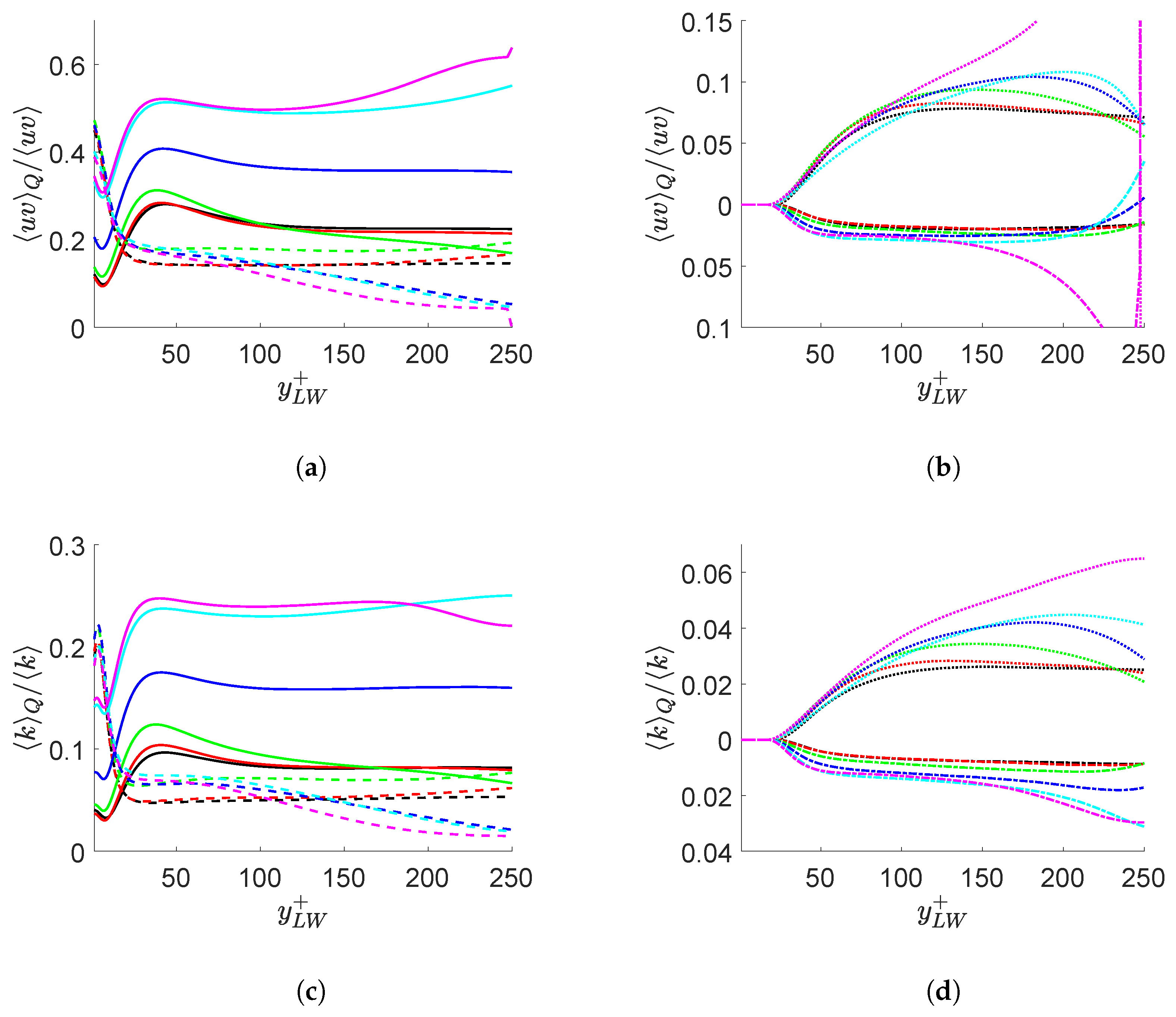
The contribution of the attached and detached Q structures to the overall Reynolds stress along the wall-normal direction is depicted in Figure 17a,b. Note that only the lower part of the simulation domain is depicted as in this region, the friction Reynolds number (Table 1) is similar among cases. In Figure 17a, attached structures reach, in most cases, constant quadrant contributions to the momentum flux at y + > 50 . This fact stems from using an identification threshold dependent on the wall distance as reported in [11].
Independent from the simulation case, the attached Q4 events are less energetic than the attached Q2 events at y + > 20 , approximately ([5,11]). This characteristic is related to the fact that attached Q4 structures tend to come nearer to the wall due to their negative v m component. Thus, the Reynolds stress near the wall ( y + 20 ) is mainly dominated by attached Q4 structures, covering up to 50% of the averaged Reynolds stress. Curiously enough, in this region, the contribution of the attached Q4 structures collapses perfectly among cases, and even along the wall-normal direction, their contribution is just slightly affected by the simulation case. Conversely, the contribution of attached Q2 structures near the wall is small and dependent on the simulation case. The former is due to the reduced presence of this kind of structure. See the discussion related to Figure 13a.
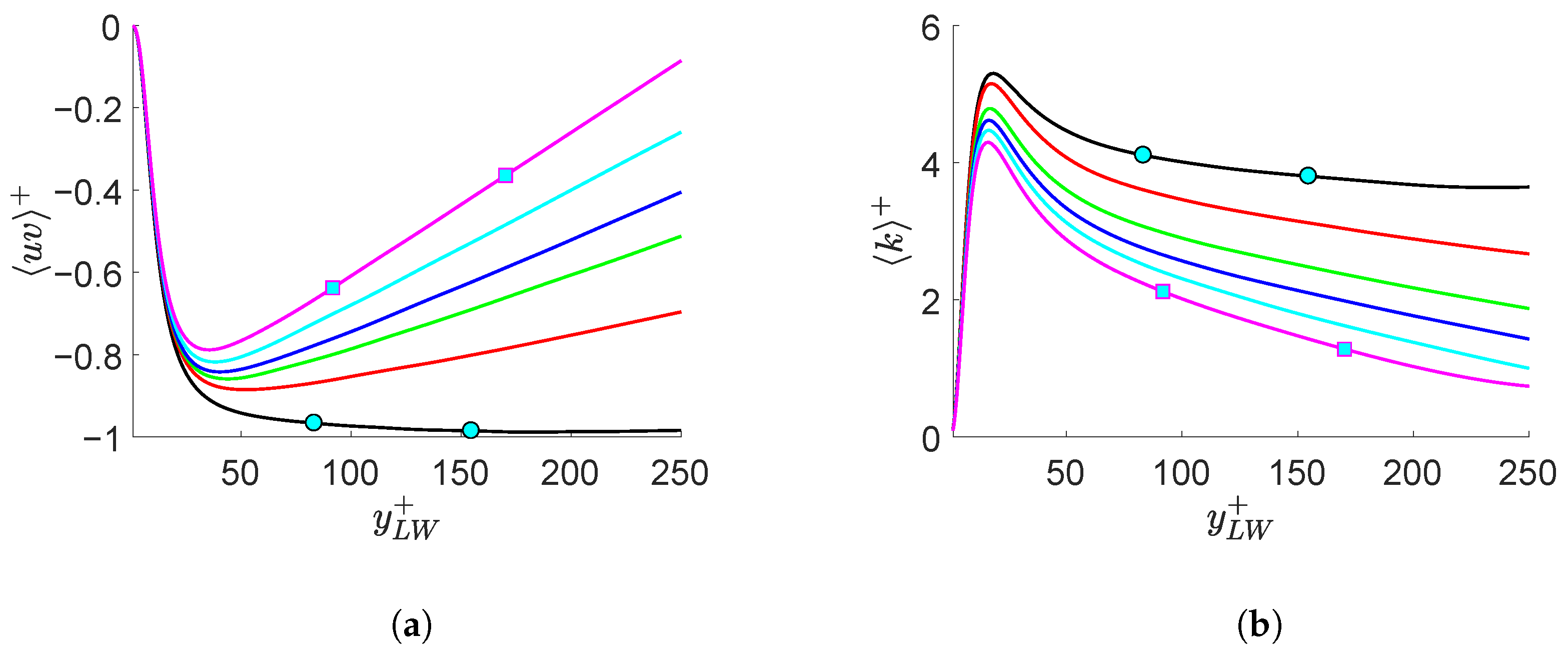
Figure 17b illustrates the contribution of detached structures to the momentum flux. Due to their definition, detached structures cannot exist at y + 20 , leading to a 0% contribution in this region. In the range 20 < y + < 100 , detached Q structures show an increasing Reynolds stress contribution, reaching up to 8%, regardless of the case. Beyond this range, most cases maintain a constant contribution below 10% in the wall-normal direction. An exception occurs in the pure Poiseuille case, where the contribution rises toward the channel center, as previously observed in [11]. This trend in the pure Poiseuille and other Poiseuille-like cases may be attributed to the reduction of momentum flux near the channel center, as shown in Figure 18a, while the kinetic energy remains similar Figure 18b. The decreasing averaged Reynolds stress limits the growth of structures originating above the buffer layer, resulting in predominantly detached and less energetic structures. In contrast, Couette-like cases sustain a nearly constant averaged Reynolds stress in the channel center, producing stable quadrant contributions from both attached and detached structures. Detached Q + structures, however, consistently contribute approximately 3% to Reynolds stress across all cases. Overall, detached structures are only weakly influenced by the mean shear and exhibit a nearly constant Reynolds stress contribution along the wall-normal direction.
The contributions of attached and detached Q structures to the averaged turbulent kinetic energy are depicted in Figure 17c,d. Although the contributions of attached structures resemble their trends in Reynolds stress, their impact on turbulent kinetic energy is considerably smaller across all wall-normal regions. This difference arises because Q structures are identified for their intense Reynolds stress (via Equation (5)), not their turbulent kinetic energy. Attached Q 2 structures contribute between 25% and 10% to the averaged turbulent kinetic energy, while attached Q 4 structures remain below 10% throughout.
Detached Q structures also contribute less to turbulent kinetic energy than to Reynolds stress, particularly in the region y + < 100 . Detached Q structures contribute less than 4%, with the pure Poiseuille case being the only exception. Contributions from detached Q + structures remain below 2%.
Therefore, attached Q 2 structures are consistently more energetic than attached Q 4 structures in the region y + > 20 across all C-P cases. In the viscous and buffer layers, attached Q 4 structures dominate and account for a significant share of u v . Detached structures are generally less energetic than attached ones. However, in Poiseuille-like cases, detached Q structures in the outer region ( y + > 100 ) show similar proportions of u v and k as attached Q 4 structures.
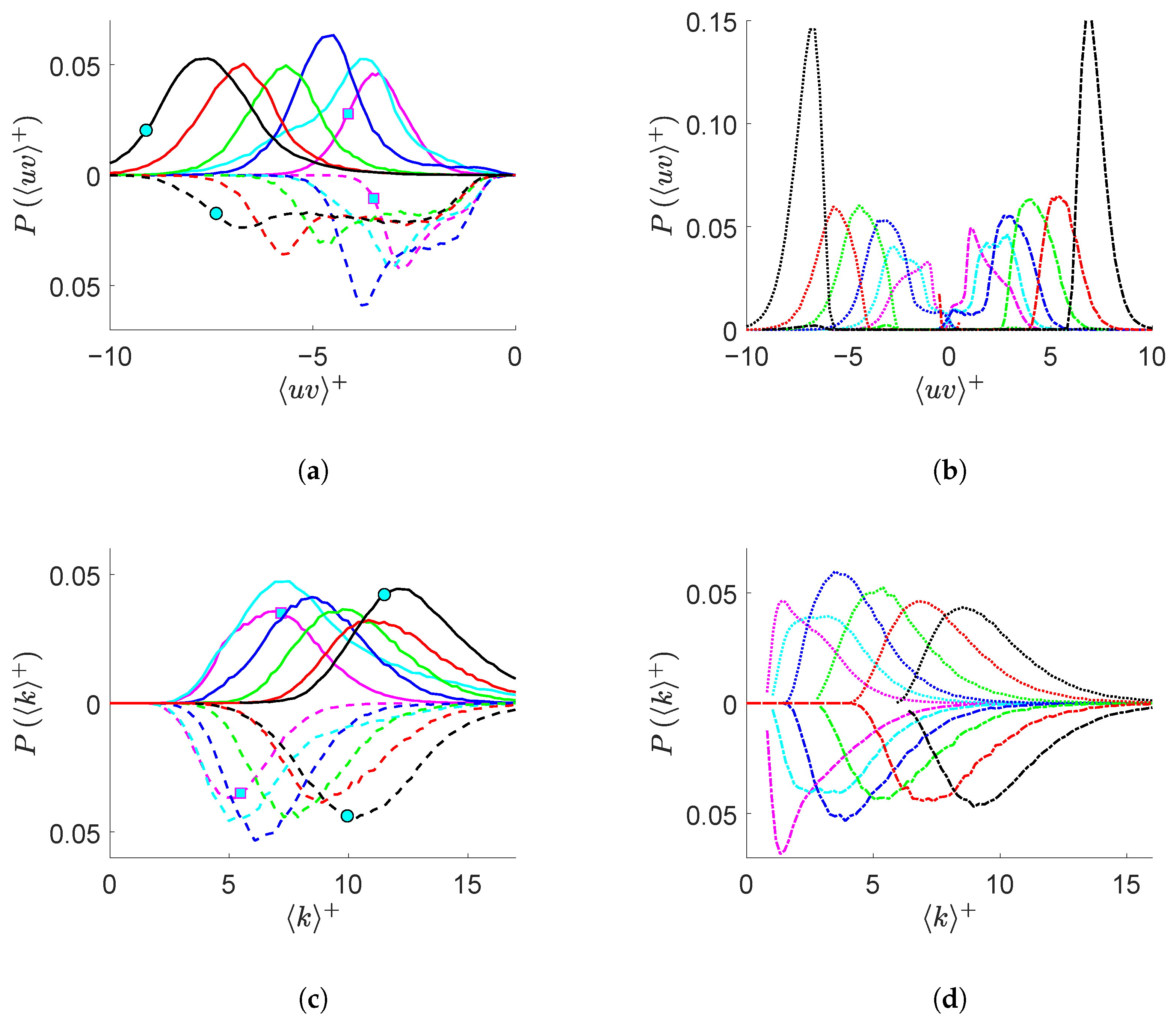
The Reynolds stress and turbulent kinetic energy averaged within the structure domain, Ω , are evaluated using the velocity components defined in Equation (13). To facilitate comparison across simulation cases, their one-dimensional probability density functions (PDFs) are shown in Figure 19, distinguishing between attached and detached structures. For attached structures, Q2 consistently exhibits higher values of u v Ω and k Ω compared to Q4 across all cases. Furthermore, Q2 structures occupy a larger domain volume than Q4 structures, as detailed in Table 3.
This combination of higher intensity and larger domain volume explains the dominant contribution of attached Q2 structures to the streamwise and spanwise-averaged Reynolds stress and turbulent kinetic energy (TKE), as illustrated in Figure 17a. These characteristics establish Q2 structures as the primary contributors to the spatially averaged values of these quantities.
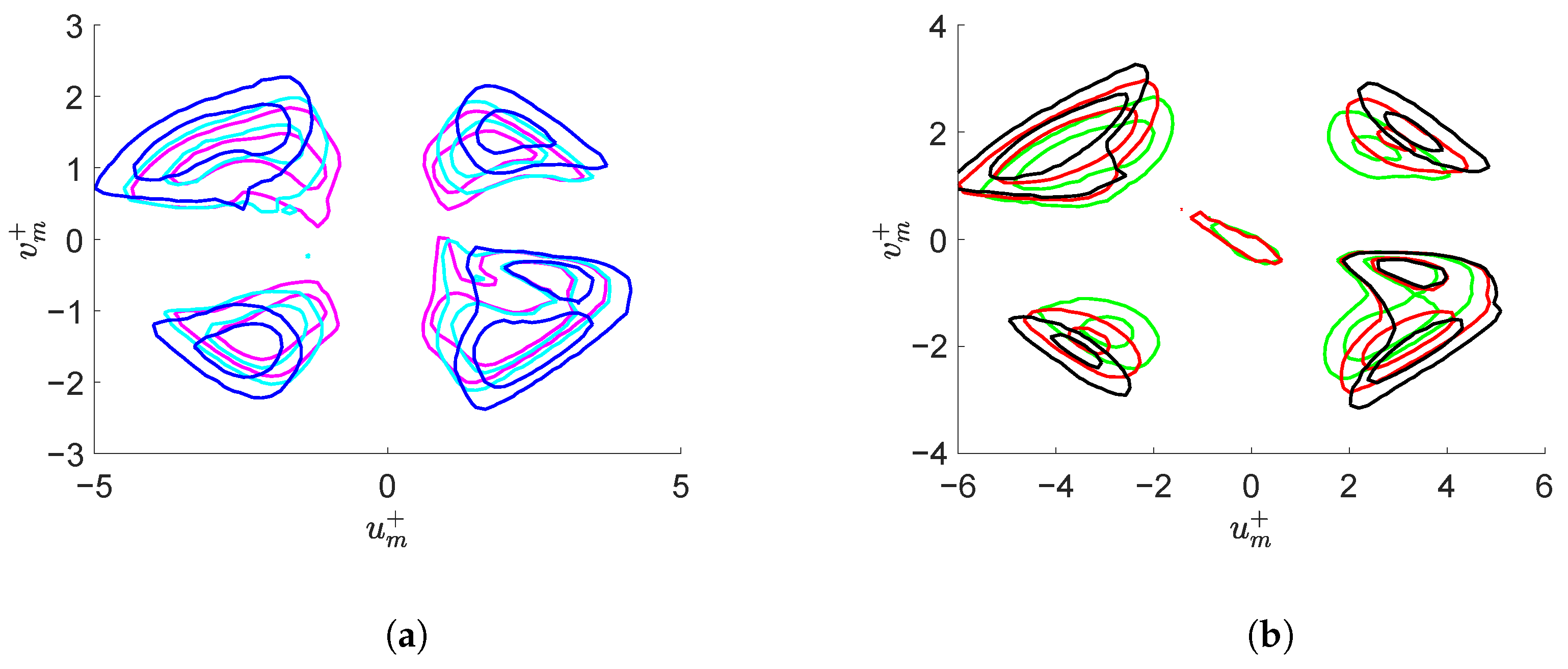
An increase in the shear ratio further enhances the energy content of both attached structures. Consequently, attached structures in Couette-like cases contain more momentum flux and turbulent kinetic energy than those in Poiseuille-like cases [11]. This trend is also visible in Figure 20, where the contours of u m + and v m + display higher absolute values as the case transitions from C00P10 to C10P00. Interestingly, the attached Q4 structures exhibit two distinct regions of intense momentum flux ( τ m + = u m + · v m + ). These regions persist across simulation cases, with the less intense region being largely independent of the simulation case and, therefore, the shear ratio. In fact, a nearly perfect collapse is observed in the less intense region of Q4 among Couette-like cases, as shown in Figure 20b. This region has an averaged value of τ m + 2 , a pattern also evident in Figure 19a. In these PDFs, attached Q4 structures exhibit a prominent peak at higher values, which vary with the case, and a secondary, weaker peak around u v Ω + 2.0 across cases. Notably, this duality of intense regions is observed in UV graphs but not in TKE figures.
The analysis of detached structures in Figure 19 (right) shows that detached structures increase their intensity components following the same trend as attached structures. As observed by [47], structures are controlled by the shear, mainly generated by the wall, and can be born at any height, being attached or detached at the beginning of their lifetime. The author observed that Q2s are generally born in the buffer layer and rise, while Q4s are born away from the wall and tend to approach it. For this reason, a structure can evolve during its lifetime from detached to attached or vice versa.
Moreover, the increasing intensity of detached structures is somehow surprising, as we showed in Figure 17 that their contribution to the total Reynolds stress and TKE is never large [5]. The reason for their limited contribution is that generally detached structures represent a small volume fraction among all structures identified as observed in Table 3. We generally consider that detached structures may be either at the beginning of their lifetime or near their end, as a product of a split from a bigger attached structure. Finally, Q+ structures also increase their intensity with the shear ratio of our simulations. We can then conclude that the shear increases the intensity, both TKE and UV, of Q structures independently of their height from the nearest wall and for all cases.

4.3. Relative Position and Absolute Distance Between Structures

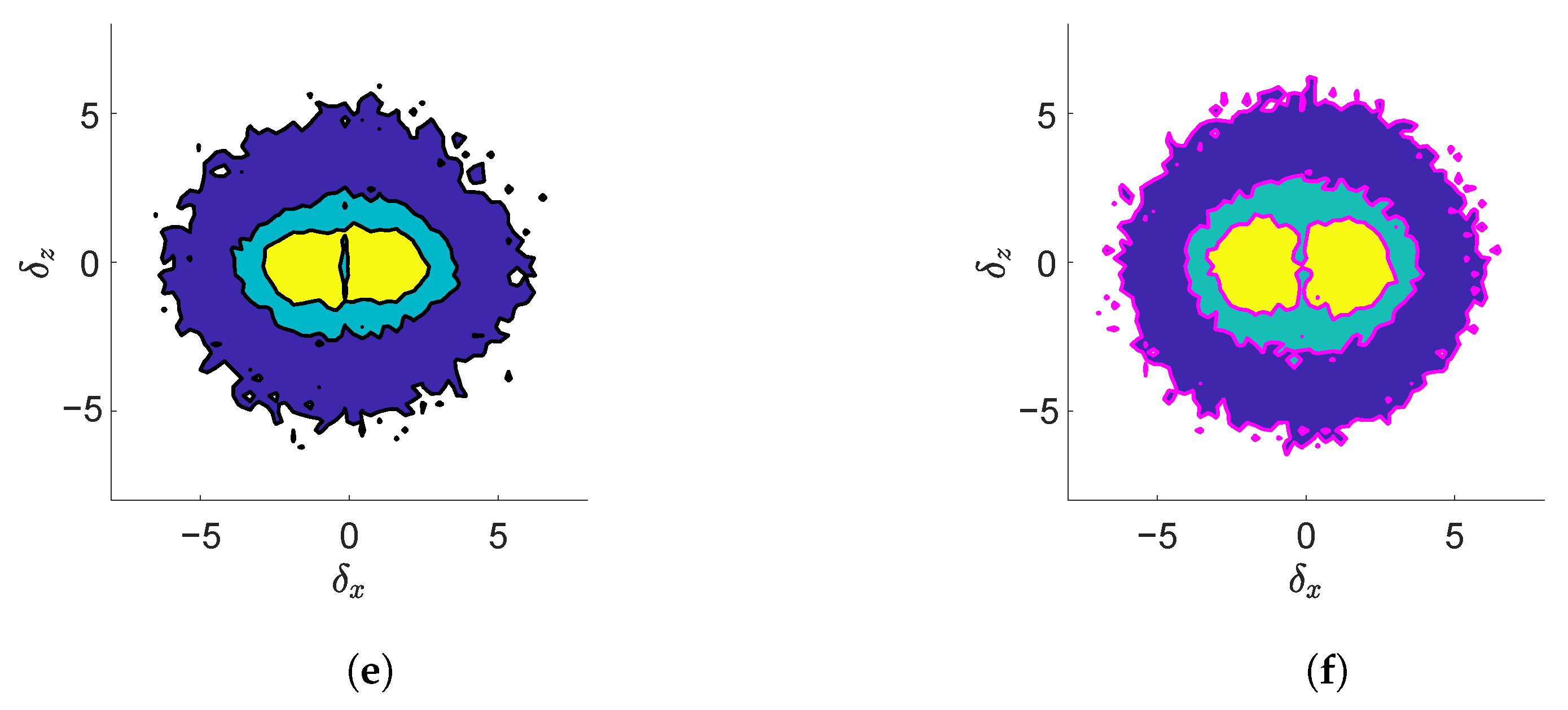
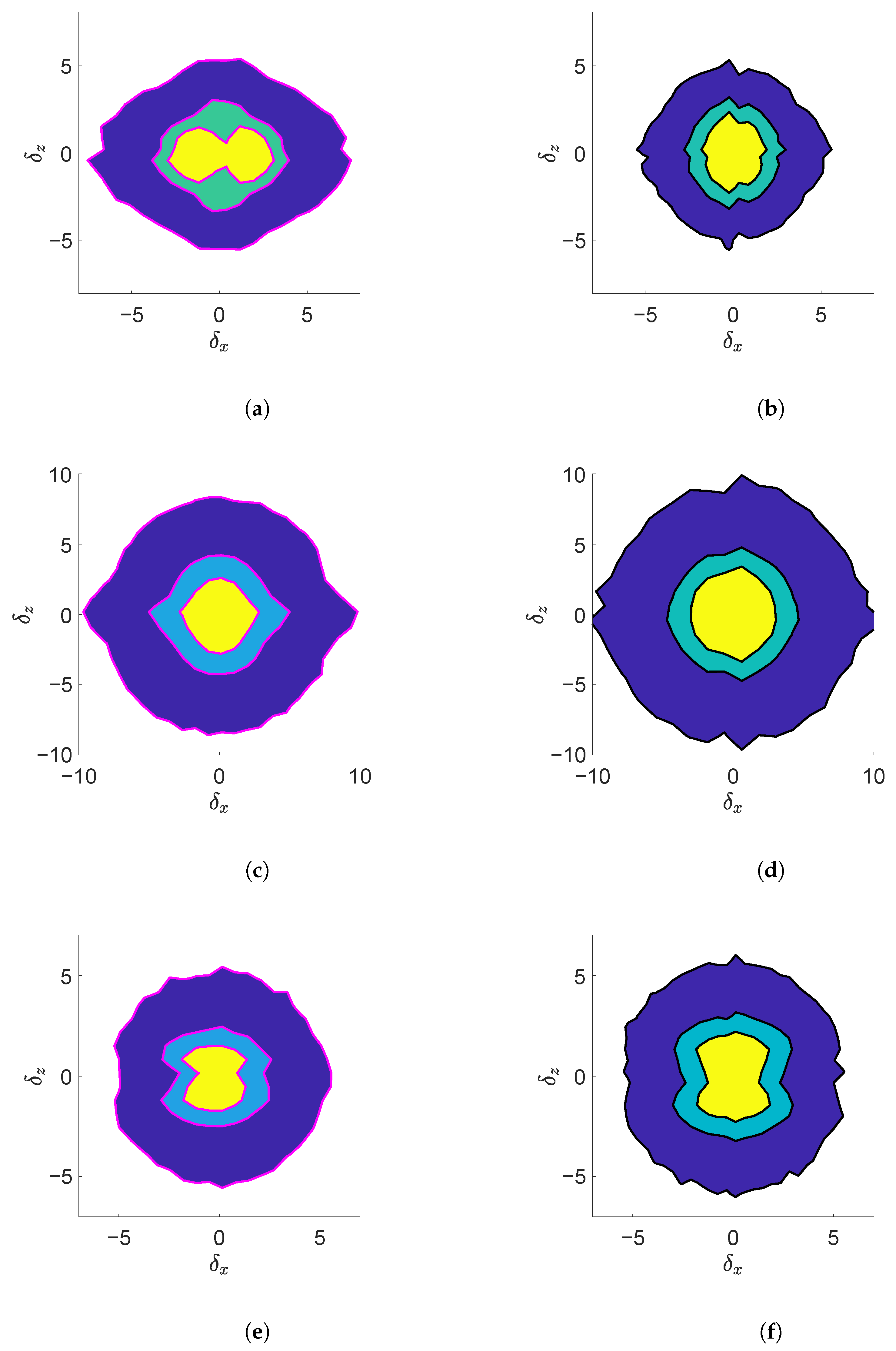
The relative distances between attached pairs in the streamwise and spanwise directions are shown in Figure 21. Attached pairs of the same type (i.e., Q2–Q2 or Q4–Q4) predominantly align in the streamwise direction, as illustrated in Figure 21a,b. This alignment was previously observed by [5] in pure Poiseuille channel flows, where it was noted that structures sufficiently tall to be influenced by the mean shear tend to exhibit organized patterns. In the present study, the pure Poiseuille case (C00P10) displays an average streamwise distance between attached Q2 structures of δ x 1.8 , which reduces to δ x 1.08 in the pure Couette case. Notably, this reduction in distance is specific to Q2 pairs and does not appear in the other configurations presented in Figure 21.
Attached Q4 pairs also exhibit streamwise alignment with similar streamwise distances to Q2 pairs, though the alignment is less pronounced. In the pure Couette case, the organization of attached pairs of the same type becomes more isotropic, with the probability density function (PDF) tending toward a circular distribution. This trend is consistent with the behavior of attached streaks, as shown in Figure 10, when comparing pure Poiseuille and pure Couette flows.
Finally, the attached Q2–Q4 pairs exhibit a preferred alignment in the spanwise direction, consistent with findings from previous studies [5] and as shown in Figure 21e,f. These pairs are typically separated by δ z 0.8 , regardless of the simulation case. Figure 21 highlights that increasing the shear ratio (from Poiseuille to Couette) primarily affects the distance and organization of attached Q2 pairs.
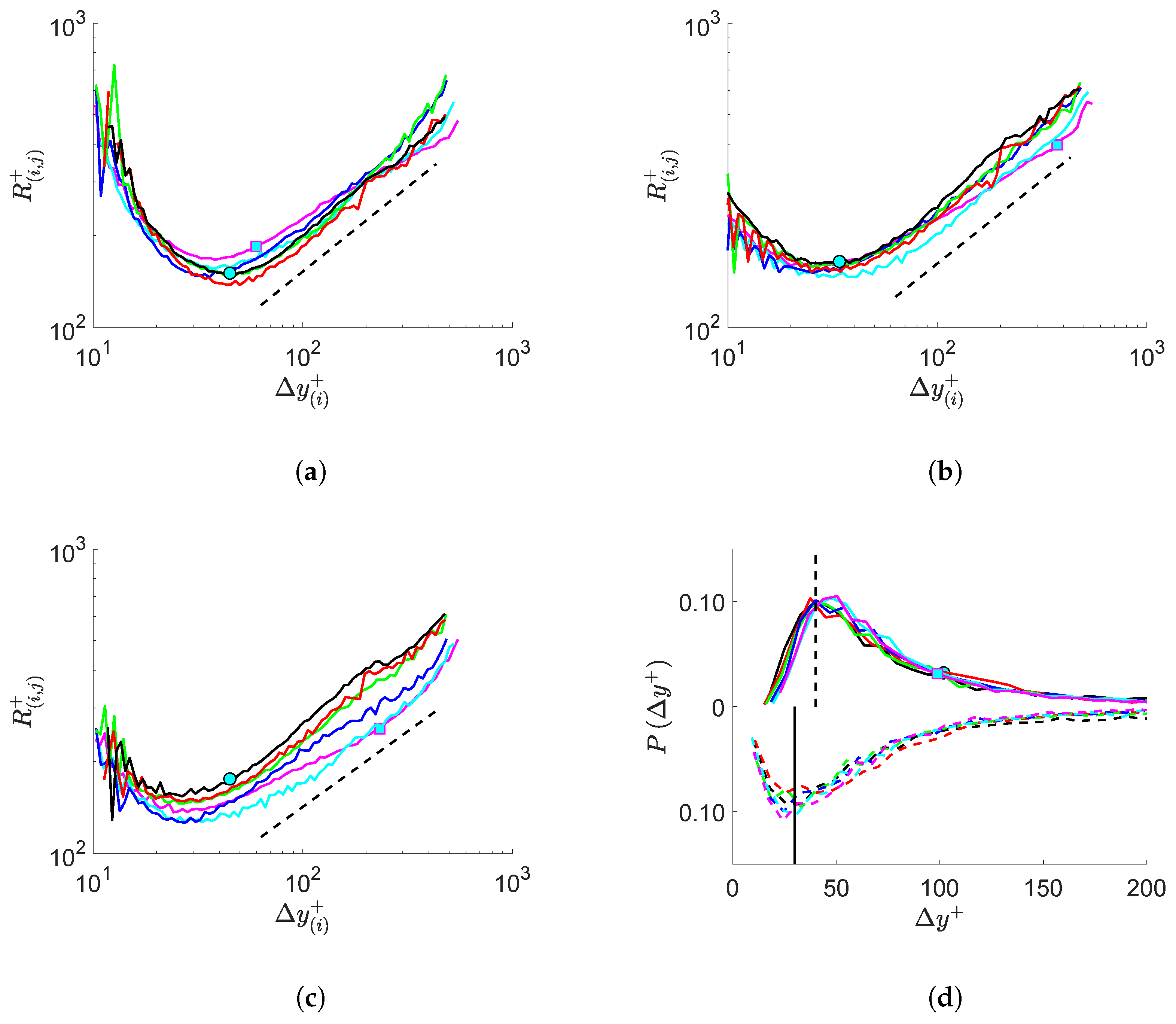
The analysis of distances between structure pairs is extended by focusing on the minimum absolute distance between attached structures of similar height, as shown in Figure 22. The absolute distance is calculated using Equation (10). Unlike the approach in Figure 21, this analysis incorporates the wall-normal distance between pairs. Results presented in Figure 22a,b indicate that the minimum absolute distance in wall units scales consistently across simulation cases for attached Q2 and Q4 structure pairs. In both cases, the scaling follows Δ y + 0.55 .
However, the minimum distance between attached Q2 and Q4 pairs does not collapse as neatly as it does for pairs of the same type. A gradual increase in distance is observed when transitioning from pure Poiseuille to pure Couette flow. This trend is attributed to the alignment of Q2–Q4 pairs in the spanwise direction, where Q2 structures typically align with low-speed streaks and Q4 structures with high-speed streaks. The spanwise size of streaks above the buffer layer increases with mean shear, reaching up to 2.5 times the channel’s semi-height in pure Couette flows [20]. Consequently, the gradual increase in the absolute distance between Q2–Q4 pairs, as shown in Figure 22c, is likely related to the enhanced spanwise separation between streaks driven by the moving wall.
Distances between structures exhibit a minimum value, a pattern similar to the behavior observed for streaks in Figure 11, particularly for structure heights below 100 wall units. This minimum corresponds to the peak probability of Δ y + , as illustrated in Figure 22d, where Δ y + = 40 for attached Q2 structures and Δ y + = 30 for attached Q4 structures. These specific Δ y + values increase the likelihood of matching structures, thereby reducing their absolute distance and creating a minimum in the distribution. Matching of structures is based on similar height criteria, as defined by the filter in Equation (9).
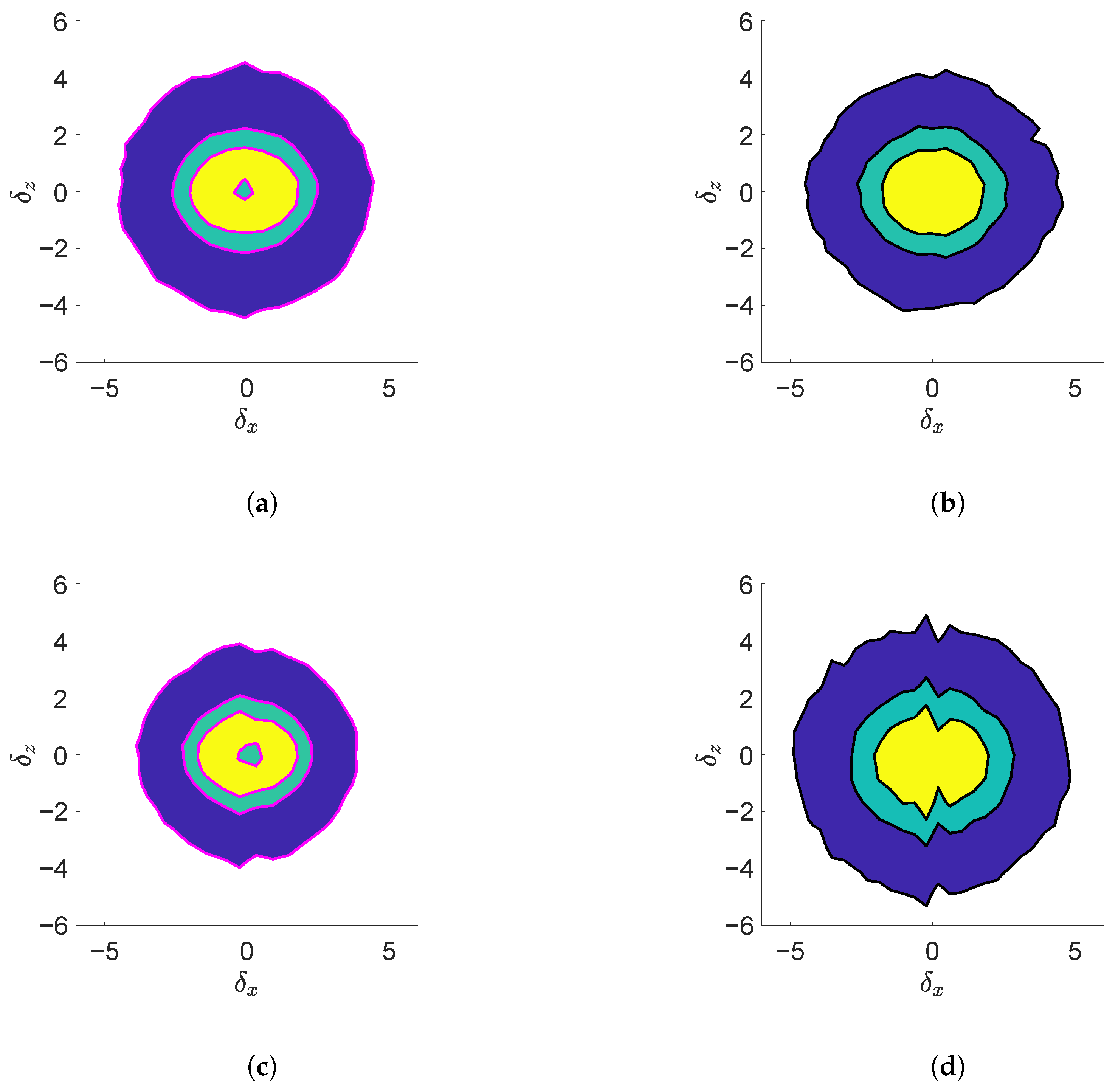
The analysis is extended to detached structures, focusing on detached Q2 and Q4 structures, while excluding detached Q1 and Q3 structures due to their limited energetic contribution, as shown in Figure 17. Detached Q2–Q2 and Q4–Q4 pairs exhibit isotropic organization in the streamwise-spanwise plane, as evidenced by the circular probability contours in Figure 23, which indicate no preferential alignment. Regardless of the simulation case, 50% of the structure pairs are confined within the region defined by δ x < 2 and δ z < 2 .
A more detailed understanding of structure distances is provided by incorporating Figure 24. Detached structures show a minimum distance at the peak probability of Δ y + , which occurs at Δ y + = 50 for both detached Q2 and Q4 structures. Unlike attached structures, detached structures are far enough from the wall to avoid geometric constraints, allowing them to grow taller. In contrast, attached Q4 structures in Figure 22 display smaller Δ y + values due to their tendency to flatten against the wall.
Once the minimum distance is exceeded, the scaling of absolute distance among detached structures diverges from that of attached structures. Depending on the simulation case, the absolute distance scales between Δ y + 0.63 and Δ y + 0.90 , demonstrating variability across different conditions.

5. Conclusions

This study contributes to the understanding of the characteristics of coherent structures in various channel flows. The analyzed flows span a stepped transition from pure Poiseuille to pure Couette configurations, providing a range of cases between these two extremes. The friction Reynolds number was chosen in all cases to sustain turbulence and ensure sufficient scale separation in the pure Couette case, allowing for the distinction between near-wall and large-scale structures. This dataset is thus well-suited for investigating coherent structures based on their momentum source, whether pressure-driven or shear-driven, despite the relatively low-friction Reynolds number.
The structures analyzed include low-speed streaks and intense Reynolds stress structures (Q structures), due to their significance in wall-bounded turbulence dynamics and energy transfer. Low-speed streaks, formed by the lift-up effect, redistribute momentum in the near-wall region and play a central role in turbulence production and maintenance through interaction with the mean shear. Conversely, Q events, such as bursts (Q2) and sweeps (Q4), are critical for driving Reynolds stresses and transferring energy from the mean flow to turbulent fluctuations.
The spanwise organization of streaks is heavily influenced by the shear ratio. In Couette-like cases (positive shear ratio), attached streaks reach the channel center and are separated spanwise by approximately 3.75 h . Remarkably, this organization emerges even in the first dataset case with a positive shear ratio. Additionally, the wall-normal growth of streaks varies across cases: attached streaks in Couette-like flows grow taller than those in Poiseuille-like flows, as shown by the probability distributions of their minimum and maximum distances from the wall. Detached streaks, however, exhibit consistent growth tendencies across all cases, as they are unaffected by the mean shear.
Relative distances between streaks reveal that the shear ratio primarily affects attached pairs. Couette-like cases exhibit higher streamwise organization of attached streak pairs compared to Poiseuille-like cases, though attached pairs in both flows are predominantly organized spanwise. Despite these spatial differences, streaks exhibit similar characteristics across cases, including angular inclination, meandering, volume, and dimensional ratios. This consistency suggests that while shear significantly impacts the spatial location and growth of streaks, their dimensional characteristics remain unaffected.
Q structures, particularly bursts (Q2) and sweeps (Q4), play a crucial role in the redistribution of momentum and energy within turbulent flows. These structures sustain turbulence by driving Reynolds stresses and facilitating energy transfer.
The spatial distribution and intensity of Q structures vary with the shear configuration. In Poiseuille-like cases, Q2 structures are significantly more volumetric than Q4 structures, but this disparity decreases in Couette-like configurations. In the latter, Q2 structures reduce in volume while Q4 structures expand. Furthermore, Couette-like configurations favour attached Q structures, whereas Poiseuille-like cases exhibit a more balanced distribution of attached and detached structures.
The shear ratio has limited influence on other Q structure properties, such as dimensional ratios ( Δ x / Δ y , Δ z / Δ y ) , angular inclination, volume, and meandering. These properties show strong agreement across shear cases, indicating robust structural similarities.
The intensity of Q structures was also studied along the wall-normal direction. In the near-wall region ( y + < 20 ), Q4 structures dominate the intensity contribution, which remains consistent across shear cases. At wall distances y + 20 , Q2 structures dominate, peaking at y + 40 . Beyond y + > 50 , the intensity contribution of all Q structures stabilizes, reflecting the wall-normal percolation method used. Individual Q structures increase in intensity with shear, with the most intense structures observed in pure Couette flows. Interestingly, a common region of attached Q4 structures with τ m + 2 is observed across all cases, driven by Q4 structures located in the near-wall region ( y + < 20 ).
The study also examined the relative and absolute distances between Q structures. Pairs of attached Q structures of the same type (Q2–Q2 and Q4–Q4) predominantly align streamwise, whereas Q2–Q4 pairs align spanwise. Shear ratio primarily affects the streamwise distance between Q2–Q2 pairs, reducing it from δ x 1.8 in Poiseuille-like cases to δ x 1 in Couette-like cases. The absolute distance between attached pairs of the same type scales proportionally to ( Δ y + ) 0.55 , showing good agreement across all shear cases. However, this agreement is not observed for attached pairs of different types, where Q2–Q4 pairs exhibit progressively larger distances with increasing shear. This spatial relocation of Q2 and Q4 structures is attributed to the influence of very large streamwise rolls.
To sum up, the changes in the mean shear due to the domain moving wall modify the characteristics of the coherent structures, such as streaks and Q structures. The geometry, topology, energetic intensity, and spatial organisation of these structures are affected by the gradual increase in shear ratio, although in different ways. While the geometry and topology are less influenced by the changes in shear, often showing a perfect collapse among simulation cases, the energetic intensity increases incrementally with the shear ratio. In contrast, the spatial organisation of coherent structures changes with the sign of the shear ratio, presenting a distinct scenario for Poiseuille-like, that is, negative shear ratio, or Couette-like, that is, positive shear ratio, configurations. This observation agrees with the fact that very large streamwise rolls, which remain fixed in the spanwise direction, are present in Couette-like configurations. Thus, a point remains open regarding the causality between the presence of streamwise rolls and the changes in coherent structure characteristics. Despite the comprehensive comparison carried out in this study, several limitations should be acknowledged. The simulations were performed at a relatively low-friction Reynolds number, which restricts the scale separation and may affect the generality of the results at higher Reynolds numbers where outer and inner interactions are stronger. Moreover, the identification of streaks relies on a global threshold that does not account for the wall-normal variation of turbulent intensity, and the detection of Q structures uses a percolation methodology that introduces an arbitrary parameter. These limitations suggest several promising directions for further research, including extending the analysis to higher Reynolds numbers, refining the detection criteria for coherent structures, and using complementary tools such as spectral energy budget analysis or causal inference to better resolve the link between the emergence of large streamwise rolls and the spatial organisation of momentum-carrying structures.

Author Contributions

Methodology, S.H.; Software, S.G.-B.; Validation, S.G.-B.; Formal analysis, S.G.-B. and S.H.; Investigation, S.G.-B.; Resources, S.H.; Writing—original draft, S.G.-B.; Writing—review & editing, S.H.; Supervision, S.H.; Project administration, S.H. All authors have read and agreed to the published version of the manuscript.

Funding

The authors acknowledge support by CIN/AEI/10.13039/501100011033 and by ERDF, “A way of making Europe”, under project PID2024-162480OB-I00.

Data Availability Statement

Data of this study is available by contacting the corresponding author.

Acknowledgments

The computations of new simulations were made possible by a generous grant of computing time from the supercomputing centre of the Universitat Politècnica de València.

Conflicts of Interest

The authors declare no conflicts of interest.

Abbreviations

The following abbreviations are used in this manuscript:
DNSDirect Numerical Simulation
C-PCouette–Poiseuille
PDFProbability Density Function
ETTEddy Turnover Time
TKETurbulent Kinetic Energy
SHAPSHapley Additive exPlanations
ReReynolds number
CFDComputational Fluid Dynamics

References

  1. Jiménez, J. Coherent structures in wall-bounded turbulence. J. Fluid Mech. 2018, 842, P1. [Google Scholar] [CrossRef]
  2. Kline, S.J.; Reynolds, W.C.; Schraub, F.A.; Runstadler, P.W. The structure of turbulent boundary layers. J. Fluid Mech. 1967, 30, 741–773. [Google Scholar] [CrossRef]
  3. Lu, S.S.; Willmarth, W.W. Measurements of the structure of the Reynolds stress in a turbulent boundary layer. J. Fluid Mech. 1973, 60, 481–511. [Google Scholar] [CrossRef]
  4. del Álamo, J.C.; Jiménez, J.; Zandonade, P.; Moser, R. Self-similar vortex clusters in the turbulent logarythmic region. J. Fluid Mech. 2006, 561, 329–358. [Google Scholar] [CrossRef]
  5. Lozano-Durán, A.; Flores, O.; Jiménez, J. The three-dimensional structure of momentum transfer in turbulent channels. J. Fluid Mech. 2012, 694, 100–130. [Google Scholar] [CrossRef]
  6. Osawa, K.; Jiménez, J. Intense structures of different momentum fluxes in turbulent channels. Phys. Rev. Fluids 2018, 3, 084603. [Google Scholar] [CrossRef]
  7. Hwang, J.; Sung, H.J. Wall-attached structures of velocity fluctuations in a turbulent boundary layer. J. Fluid Mech. 2018, 856, 958–983. [Google Scholar] [CrossRef]
  8. Cheng, C.; Li, W.; Lozano-Durán, A.; Liu, H. Uncovering Townsend’s wall-attached eddies in low-Reynolds-number wall turbulence. J. Fluid Mech. 2020, 889, A29. [Google Scholar] [CrossRef]
  9. Yoon, M.; Hwang, J.; Yang, J.; Sung, H.J. Wall-attached structures of streamwise velocity fluctuations in an adverse-pressure-gradient turbulent boundary layer. J. Fluid Mech. 2020, 885, A12. [Google Scholar] [CrossRef]
  10. Bae, H.J.; Lee, M. Life cycle of streaks in the buffer layer of wall-bounded turbulence. Phys. Rev. Fluids 2021, 6, 064603. [Google Scholar] [CrossRef]
  11. Gandía-Barberá, S.; Alcántara-Ávila, F.; Hoyas, S.; Avsarkisov, V. Stratification effect on extreme-scale rolls in plane Couette flows. Phys. Rev. E 2021, 6, 034605. [Google Scholar] [CrossRef]
  12. Pope, S.B. Turbulent Flows; Cambridge University Press: Cambridge, UK, 2000. [Google Scholar]
  13. Hoyas, S.; Jiménez, J. Scaling of the velocity fluctuations in turbulent channels up to Reτ=2003. Phys. Fluids 2006, 18, 011702. [Google Scholar] [CrossRef]
  14. Lee, M.; Moser, R. Direct numerical simulation of turbulent channel flow up to Reτ≈5200. J. Fluid Mech. 2015, 774, 395–415. [Google Scholar] [CrossRef]
  15. Hoyas, S.; Oberlack, M.; Alcántara-Ávila, F.; Kraheberger, S.V.; Laux, J. Wall turbulence at high friction Reynolds numbers. Phys. Rev. Fluids 2022, 7, 014602. [Google Scholar] [CrossRef]
  16. Avsarkisov, V.; Hoyas, S.; Oberlack, M.; García-Galache, J. Turbulent plane Couette flow at moderately high Reynolds number. J. Fluid Mech. 2014, 751, R1. [Google Scholar] [CrossRef]
  17. Lee, M.; Moser, R. Extreme-scale motions in turbulent plane Couette flows. J. Fluid Mech. 2018, 842, 128–145. [Google Scholar] [CrossRef]
  18. Hoyas, S.; Oberlack, M. Turbulent Couette flow up to Reτ=2000. J. Fluid Mech. 2024, 987, R9. [Google Scholar] [CrossRef]
  19. Pirozzoli, S.; Bernardini, M.; Orlandi, P. Large-scale motions and inner/outer layer interactions in turbulent Couette–-Poiseuille flows. J. Fluid Mech. 2011, 680, 534–563. [Google Scholar] [CrossRef]
  20. Gandía-Barberá, S.; Hoyas, S.; Oberlack, M.; Kraheberger, S. The link between the Reynolds shear stress and the large structures of turbulent Couette-Poiseuille flow. Phys. Fluids 2018, 30, 041702. [Google Scholar] [CrossRef]
  21. Cheng, W.; Pullin, D.; Samtaney, R.; Luo, X. Numerical simulation of turbulent, plane parallel Couette–Poiseuille flow. J. Fluid Mech. 2023, 955, A4. [Google Scholar] [CrossRef]
  22. Lluesma-Rodríguez, F.; Hoyas, S. Approximation of the Couette-Poiseuille flow on an annular domain in compressible regime for a hyperloop pod. Results Eng. 2024, 21, 101680. [Google Scholar] [CrossRef]
  23. Tillmark, N. Experiments on Transition and Turbulence in Plane Couette Flow. Ph.D. Thesis, KTH, Royal Institute of Technology, Stockholm, Sweden, 1995. [Google Scholar]
  24. Kitoh, O.; Nakabyashi, K.; Nishimura, F. Experimental study on mean velocity and turbulence characteristics of plane Couette flow: Low-Reynolds-number effects and large longitudinal vortical structure. J. Fluid Mech. 2005, 539, 199–227. [Google Scholar] [CrossRef]
  25. Bech, K.; Tillmark, N.; Alfredsson, P.; Andersson, H. An investigation of turbulent plane Couette flow at low Reynolds numbers. J. Fluid Mech. 1995, 286, 291–325. [Google Scholar] [CrossRef]
  26. Komminaho, J.; Lundbladh, A.; Johansson, A. Very large structures in plane turbulent Couette flow. J. Fluid Mech. 1996, 320, 259–285. [Google Scholar] [CrossRef]
  27. Tsukahara, T.; Kawamura, H.; Shingai, K. DNS of turbulent Couette flow with emphasis on the large-scale structure in the core region. J. Turbul. 2006, 7, N19. [Google Scholar] [CrossRef]
  28. Bernardini, M.; Pirozzoli, S.; Orlandi, P. The effect of large-scale turbulent structures on particle dispersion in wall-bounded flows. Int. J. Multiph. Flow 2013, 51, 55–64. [Google Scholar] [CrossRef]
  29. Pirozzoli, S.; Bernardini, M.; Orlandi, P. Turbulence statistics in Couette flow at high Reynolds number. J. Fluid Mech. 2014, 758, 323–343. [Google Scholar] [CrossRef]
  30. Kraheberger, S.; Hoyas, S.; Oberlack, M. DNS of a turbulent Couette flow at constant wall transpiration up to Reτ=1000. J. Fluid Mech. 2018, 835, 421–443. [Google Scholar] [CrossRef]
  31. Hamilton, J.; Kim, J.; Waleffe, F. Regeneration mechanisms of near-wall turbulence structures. J. Fluid Mech. 1995, 287, 317–348. [Google Scholar] [CrossRef]
  32. Alcántara-Ávila, F.; Gandía-Barberá, S.; Hoyas, S. Evidences of persisting thermal structures in Couette flows. Int. J. Heat Fluid Flow 2019, 76, 287–295. [Google Scholar] [CrossRef]
  33. Chong, M.; Perry, A.; Cantwell, B. A general classification of three-dimensional flow fields. J. Phys. A 1990, 2, 765–777. [Google Scholar] [CrossRef]
  34. Cremades, A.; Hoyas, S.; Deshpande, R.; Quintero, P.; Lellep, M.; Lee, W.J.; Monty, J.P.; Hutchins, N.; Linkmann, M.; Marusic, I.; et al. Identifying regions of importance in wall-bounded turbulence through explainable deep learning. Nat. Commun. 2024, 15, 3864. [Google Scholar] [CrossRef] [PubMed]
  35. Schmekel, D.; Alcántara-Ávila, F.; Hoyas, S.; Vinuesa, R. Predicting coherent turbulent structures via deep learning. Front. Phys. 2022, 10, 888832. [Google Scholar] [CrossRef]
  36. Lellep, M.; Prexl, J.; Eckhardt, B.; Linkmann, M. Interpreted machine learning in fluid dynamics: Explaining relaminarisation events in wall-bounded shear flows. J. Fluid Mech. 2022, 942, A2. [Google Scholar] [CrossRef]
  37. Cremades, A.; Hoyas, S.; Vinuesa, R. Classically studied coherent structures only paint a partial picture of wall-bounded turbulence. Nat. Commun. 2025, 16, 10189. [Google Scholar] [CrossRef]
  38. Orr, W.M. The Stability or Instability of the Steady Motions of a Perfect Liquid and of a Viscous Liquid. Part II: A Viscous Liquid. Proc. R. Ir. Acad. Sect. A Math. Phys. Sci. 1907, 27, 69–138. [Google Scholar]
  39. Motoori, Y.; Goto, S. Hierarchy of coherent structures and real-space energy transfer in turbulent channel flow. J. Fluid Mech. 2021, 911, A27. [Google Scholar] [CrossRef]
  40. Kawata, T.; Alfredsson, P.H. Inverse interscale transport of the Reynolds shear stress in plane Couette turbulence. Phys. Rev. Lett. 2018, 120, 244501. [Google Scholar] [CrossRef]
  41. Lee, M.; Moser, R.D. Spectral analysis of the budget equation in turbulent channel flows at high Reynolds number. J. Fluid Mech. 2019, 860, 886–938. [Google Scholar] [CrossRef]
  42. Bauer, C.; von Kameke, A.; Wagner, C. Kinetic energy budget of the largest scales in turbulent pipe flow. Phys. Rev. Fluids 2019, 4, 064607. [Google Scholar] [CrossRef]
  43. Kawata, T.; Tsukahara, T. Scale interactions in turbulent plane Couette flows in minimal domains. J. Fluid Mech. 2021, 911, A55. [Google Scholar] [CrossRef]
  44. Wang, H.; Yang, Z.; Wu, T.; Wang, S. Coherent structures associated with interscale energy transfer in turbulent channel flows. Phys. Rev. Fluids 2021, 6, 104601. [Google Scholar] [CrossRef]
  45. Kawata, T.; Tsukahara, T. Spectral analysis on dissimilarity between turbulent momentum and heat transfers in plane Couette turbulence. Phys. Fluids 2022, 34, 075135. [Google Scholar] [CrossRef]
  46. Oberlack, M.; Hoyas, S.; Kraheberger, S.V.; Alcántara-Ávila, F.; Laux, J. Turbulence Statistics of Arbitrary Moments of Wall-Bounded Shear Flows: A Symmetry Approach. Phys. Rev. Lett. 2022, 128, 024502. [Google Scholar] [CrossRef]
  47. Lozano-Durán, A.; Jiménez, J. Effect of the computational domain on direct simulations of turbulent channels up to Reτ=4200. Phys. Fluids 2014, 26, 011702. [Google Scholar] [CrossRef]
  48. Sánchez-Roncero, A.; Garibo-i Orts, Ò.; Conejero, J.A.; Eivazi, H.; Mallor, F.; Rosenberg, E.; Fuso-Nerini, F.; García-Martínez, J.; Vinuesa, R.; Hoyas, S. The sustainable development goals and aerospace engineering: A critical note through artificial intelligence. Results Eng. 2023, 17, 100940. [Google Scholar] [CrossRef]
  49. Lele, S.K. Compact finite difference schemes with spectral-like resolution. J. Comput. Phys. 1992, 103, 16–42. [Google Scholar] [CrossRef]
  50. Spalart, P.R.; Moser, R.D.; Rogers, M.M. Spectral methods for the Navier-Stokes equations with one infinite and two periodic directions. J. Comput. Phys. 1991, 96, 297–324. [Google Scholar] [CrossRef]
  51. Lluesma-Rodríguez, F.; Álcantara Ávila, F.; Pérez-Quiles, M.; Hoyas, S. A code for simulating heat transfer in turbulent channel flow. Mathematics 2021, 9, 756. [Google Scholar] [CrossRef]
  52. Tang, S.; Antonia, R. Similarity for dissipation-scaled wall turbulence. J. Fluid Mech. 2023, 960, A18. [Google Scholar] [CrossRef]
  53. Spalart, P. The Conjecture of a General Law of the Wall for Classical Turbulence Models, Implying a Structural Limitation. Flow Turbul. Combust. 2023, 112, 443–457. [Google Scholar] [CrossRef]
  54. Yu, L.; Chen, Y.; Yousif, M.Z.; Lim, H.C. Three-dimensional super-resolution reconstruction of turbulent flow using 3D-ESRGAN with random sampling strategy. Comput. Fluids 2025, 305, 106890. [Google Scholar] [CrossRef]
  55. Palasis, A.; Liakopoulos, A.; Sofiadis, G. From Direct Numerical Simulations to Data-Driven Models: Insights into Mean Velocity Profiles and Turbulent Stresses in Channel Flows. Modelling 2025, 6, 18. [Google Scholar] [CrossRef]
  56. Hoyas, S.; Vinuesa, R.; Schmid, P.; Nagib, H. Sensitivity study of resolution and convergence requirements for the extended overlap region in wall-bounded turbulence. Phys. Rev. Fluids 2024, 9, L082601. [Google Scholar] [CrossRef]
  57. Gandía-Barberá, S.; Cremades, A.; Vinuesa, R.; Hoyas, S.; Pérez-Quiles, M.J. Sequential and Parallel Algorithms to Compute Turbulent Coherent Structures. Mathematics 2024, 12, 3325. [Google Scholar] [CrossRef]
  58. Lozano-Durán, A.; Borrel, G. Algorithm 964: An Efficient Algorithm to Compute the Genus of Discrete Surfaces and Applications to Turbulent Flows. Assoc. Comput. Mach. 2016, 42, 34. [Google Scholar] [CrossRef]
  59. Kevin, K.; Monty, J.; Hutchins, N. The meandering behaviour of large-scale structures in turbulent boundary layers. J. Fluid Mech. 2019, 865, R1. [Google Scholar] [CrossRef]
  60. Rawat, S.; Cossu, C.; Hwang, Y.; Rincon, F. On the self-sustained nature of large-scale motions in turbulent Couette flow. J. Fluid Mech. 2015, 782, 515–540. [Google Scholar] [CrossRef]
  61. Jiménez, J. The streaks of wall-bounded turbulence need not be long. J. Fluid Mech. 2022, 945, R3. [Google Scholar] [CrossRef]
  62. Dong, S.; Lozano-Durán, A.; Sekimoto, A.; Jiménez, J. Coherent structures in statistically stationary homogeneous shear turbulence. J. Fluid Mech. 2017, 816, 167–208. [Google Scholar] [CrossRef]
  63. Cheng, C.; Li, W.; Lozano-Durán, A.; Liu, H. On the structure of streamwise wall-shear stress fluctuations in turbulent channel flows. J. Fluid Mech. 2020, 903, A29. [Google Scholar] [CrossRef]
  64. Bae, H.; Encinar, M.; Lozano-Durán, A. Causal analysis of self-sustaining processes in the logarithmic layer of wall-bounded turbulence. J. Phys. Conf. Ser. 2018, 1001, 012013. [Google Scholar] [CrossRef]
  65. Moisy, F.; Jiménez, J. Geometry and clustering of intense structures in isotropic turbulence. J. Fluid Mech. 2004, 513, 111–133. [Google Scholar] [CrossRef]
  66. Leung, T.; Swaminathan, N.; Davidson, P.A. Geometry and interaction of structures in homogeneous isotropic turbulence. J. Fluid Mech. 2012, 710, 453–481. [Google Scholar] [CrossRef]
  67. Corrsin, S. Progress report on some turbulent diffusion research. Adv. Geophys. 1959, 6, 441–451. [Google Scholar] [CrossRef]
Figure 1. Lines as in Table 1. Percolation study for identifying streaks (a) and u v -structures (b). At each percolation index, the curves depict the ratio of the volume of the largest identified object against the volume of all identified objects V max / V tot (solid lines) and the ratio of the number of identified objects against the maximum number of objects N / max ( N ) (dashed lines). To avoid many tiny structures, those with a volume less than V + = 30 3 have been removed before the study. The vertical dotted lines denote the selected percolation indexes according to Table 1.
Fluids 11 00018 g001
Figure 2. Joint PDF of the wall-normal distance to the closest domain wall from streak bottom y min + and top y max + . Top row: cases C00P10 (a) and C02P08 (b). Middle row: cases C04P06 (c) and C06P04 (d). Bottom row: cases C08P02 (e) and C10P00 (f). Contours contain 50%, 70%, and 90% of the total data (Dark blue to yellow). The dashed line represents y max + y min + 4.9 , the solid line y max + y min + 7.6 for attached streaks in Poiseuille and Couette cases, respectively, and the dash-dotted line y max + y min + 0.76 for detached streaks.
Fluids 11 00018 g002
Figure 3. Streak points position averaged in time and x, normalized by the local maximum. Blue indicates a lack of streak points, while yellow marks the regions of highest density. Top row: cases C00P10 (a) and C02P08 (b). Middle row: cases C04P06 (c) and C06P04 (d). Bottom row: cases C08P02 (e) and C10P00 (f). To improve visibility, the values of z / h are limited to the two central rolls.
Fluids 11 00018 g003
Figure 4. Lines as in Table 1. (a) PDF of the center of mass y c m + of attached streaks. The dashed line represents a decay proportional to y c m + 3.75 . (b) PDF of the height of attached (solid lines) and detached (dashed lines) streaks. Vertical dashed lines are placed at Δ y + = 37 and Δ y + = 45 for reference.
Fluids 11 00018 g004
Figure 5. A single identified attached streak (gray) is contained in a Cartesian box. The blue line is the streak spline defined by the streak center of mass at each Δ y Δ z plane. The red line is the linear approximation of the spline following the least squares fitting (Equation (6)). The flow goes from bottom left to top right along the x-axis.
Fluids 11 00018 g005
Figure 6. Lines as in Table 1. Solid lines correspond to attached streaks, dashed lines to detached streaks. (a) PDF of the aspect ratio Δ x / Δ y of identified streaks. (b) PDF of the aspect ratio Δ z / Δ y of identified streaks. Vertical lines in (a) mark Δ x / Δ y = { 1.0 ,   4.0 ,   5.0 } ; vertical lines in (b) mark Δ z / Δ y = { 0.75 ,   0.90 } .
Fluids 11 00018 g006
Figure 7. Lines as in Table 1. (a) Two-dimensional PDF of attached streaks’ length in wall units Δ x + vs. height Δ y + , with dashed line Δ x Δ y 2 . (b) Two-dimensional PDF of attached streaks’ width Δ z + vs. length Δ x + , with dashed line Δ x Δ z . Contours represent 50% and 80% of the data.
Fluids 11 00018 g007
Figure 8. Lines as in Table 1. Solid lines correspond to attached streaks and dashed lines to detached streaks. (a) PDF of the heading angle ψ (in degrees) of the identified streaks. The vertical dashed line is located at ψ = 0 . (b) PDF of the elevation angle θ (in degrees) of the identified streaks. The vertical dashed line is located at θ = 1.25 .
Fluids 11 00018 g008
Figure 9. Lines as in Table 1. (a) Two-dimensional PDF of the meandering | ϵ + | (in wall units) versus streak height Δ y + (in wall units). The black dashed line indicates | ϵ + | ( Δ y + ) 1.33 . (b) Two-dimensional PDF of the streak volume in voxels V voxel + versus streak height Δ y + . The black dashed line indicates V voxel + ( Δ y + ) 2.60 . In both cases, only attached streaks are used. Contours represent 50% and 99% of the total data.
Fluids 11 00018 g009
Figure 10. Two-dimensional PDFs of the closest relative position of (a,b) two attached streaks, (c,d) one attached and one detached streak, and (e,f) two detached streaks. The left column corresponds to case C10P00 and the right column to case C00P10. Contours contain 30%, 50%, and 80% of the total data.
Fluids 11 00018 g010aFluids 11 00018 g010b
Figure 11. Lines as in Table 1. Closest absolute distance, on average, between streaks of types i and j ( R i , j + ) versus the height of streak i, Δ y i + , both in wall units. (a) Streaks i and j are attached and attached, respectively. The black dashed line indicates R i , j + ( Δ y + ) 0.5 , and the dotted line R i , j + Δ y + . (b) Streaks i and j are attached and detached, respectively.
Fluids 11 00018 g011
Figure 12. Joint PDF of the wall-normal distance to the closest domain wall from the structure bottom y m i n + and top y m a x + . Cases are C00P10 (a), C02P08 (b), C04P06 (c), C06P04 (d), C08P02 (e) and C10P00 (f). For each case, the plotted contours contain 50%, 70%, and 90% of the total data. The dashed line represents y m i n + = 20 .
Fluids 11 00018 g012
Figure 13. (a) Two-dimensional PDF of the Q-structure center-of-mass height y c g + versus the structure maximum height y m a x + in wall units for attached Q structures. Solid and dashed lines correspond to attached Q structures with y m i n + 1 and 1 < y m i n + 20 , respectively. The vertical dashed line is at y c g + = 15 . The dash-dotted line indicates y m a x + y c g + . (b) Two-dimensional PDF for detached Q structures. The dashed line indicates y m a x + ( y c g + ) 0.82 . Contours represent 50% and 90% of the total data.
Fluids 11 00018 g013
Figure 14. Lines as in Table 1. Solid lines are for attached Q-structures, and dashed lines are for detached Q-structures. (a) PDF of the structure aspect ratio Δ x / Δ y . Vertical lines are located at Δ x / Δ y = { 1.0 ,   2.0 } . (b) PDF of the structure aspect ratio Δ z / Δ y . Vertical lines are located at Δ z / Δ y = { 0.65 ,   0.70 } .
Fluids 11 00018 g014
Figure 15. Lines as in Table 1. (a) Joint PDF of the Q structure height against structure volume measured in voxels. (b) Joint PDF of the Q structure height against structure meandering. All quantities are expressed in wall units. In both panels, only attached structures are considered. Contours contain 50% and 90% of total data. The lines are Δ y + 2.32 .
Fluids 11 00018 g015
Figure 16. Lines as in Table 1. Solid lines are for attached Qs, and dashed lines are for detached Qs. (a) PDF of the heading angle ψ in degrees. The vertical lines are defined at ψ = 0 deg. (b) PDF of the elevation angle θ in degrees. The vertical dashed line is defined at θ = 3 deg. The vertical dash-dotted line is defined at θ = 12 deg.
Fluids 11 00018 g016
Figure 17. Lines as in Table 1. Contribution of Q structures to the overall Reynolds stress (attached structures in (a), detached structures in (b)) and turbulent kinetic energy (attached structures in (c), detached structures in (d)) along the wall-normal direction near the lower domain wall, y L W + . Lines: (a,c) , attached Q2; – – –, attached Q4; (b,d) · · ·, detached Q; – · –, detached Q+.
Fluids 11 00018 g017
Figure 18. Lines as in Table 1. (a) Non-dimensional averaged Reynolds stress u v + along the wall-normal direction. (b) Non-dimensional averaged turbulent kinetic energy k + along the wall-normal direction. Both magnitudes are represented along the domain’s lower wall y L W + and averaged in time, streamwise and spanwise directions.
Fluids 11 00018 g018
Figure 19. Lines as in Table 1. One-dimensional PDF of Reynolds stress (a,b) and turbulent kinetic energy (c,d) contained in attached (a,c) and detached (b,d) Q structures. Lines: (a,c) , attached Q2; – – –, attached Q4; (b,d) · · ·, detached Q; – · –, detached Q+.
Fluids 11 00018 g019
Figure 20. Lines as in Table 1. Two-dimensional PDF of the average fluctuating streamwise velocity against the average fluctuating wall-normal velocity of all identified Qs. Both quantities are expressed in wall units. (a) Poiseuille-like cases. (b) Couette-like cases. Contours contain 50% and 85% of total data.
Fluids 11 00018 g020
Figure 21. Two-dimensional PDF of the closest relative position in streamwise δ x and spanwise δ z directions of (a,b) two attached Q2 structures, (c,d) two attached Q4 structures, and (e,f) an attached Q2–Q4 pair. The left column is for case C00P10. The right column is for case C10P00. Contours contain 20%, 50%, and 90% of the total data.
Fluids 11 00018 g021
Figure 22. Lines as in Table 1. Closest absolute distance in average between Reynolds stress structures of types i and j R i , j + against the height of structure i, Δ y i + . Both quantities are in wall units. (a) Structure types i and j are Q2-attached and Q2-attached, respectively. The black dashed line indicates R i , j + Δ y + 0.55 . (b) Structure types i and j are Q4-attached and Q4-attached, respectively. The black dashed line indicates R i , j + Δ y + 0.55 . (c) Structure types i and j are Q2-attached and Q4-attached, respectively. The black dashed line indicates R i , j + Δ y + 0.50 . (d) PDF of structure height in wall-normal units Δ y + . Solid lines and dashed lines are related to the attached Q2 and Q4 structures, respectively. Vertical lines are located at Δ y + = 30 and Δ y + = 40 .
Fluids 11 00018 g022
Figure 23. Two-dimensional PDF of the closest relative position in streamwise δ x and spanwise δ z directions of (a,b) two detached Q2 structures, (c,d) two detached Q4 structures. The left column is for case C00P10. The right column is for case C10P00. Contours contain 20%, 50%, and 90% of the total data.
Fluids 11 00018 g023
Figure 24. Lines as in Table 1. Closest absolute distance in average between Reynolds stress structures of types i and j R i , j + against the height of structure i, Δ y i + . Both quantities are in wall units. (a) Structure types i and j are Q2-detached and Q2-detached, respectively. (b) Structure types i and j are Q4-detached and Q4-detached, respectively. The black dash-dotted line indicates R i , j + Δ y + 0.63 . The black dashed line indicates R i , j + Δ y + 0.90 . (c) PDF of structure height in wall-normal units Δ y + . Solid lines and dashed lines are related to detached Q2 and detached Q4 structures, respectively. Both vertical lines are located at Δ y + = 50 .
Fluids 11 00018 g024
Table 1. Description of the C-P dataset. Two different Reynolds numbers are given depending on the local R e τ at the moving (fourth column) over the stationary (third) wall. γ = τ M / τ S is the ratio of shear stress at the two walls [19]. The next two columns denote the computational time span while statistics were taken in wash-outs ( U b / L x ) and eddy turn-overs ( u τ / h ). T is the computational time spanned by those fields. The last two columns list the percolation indexes used for streaks and Q-events identification acc. to Equations (4) and (5). Line shapes given in the second column are used to identify the cases throughout all the figures of the present paper.
CaseLine Re τ s Re τ m γ TU b / L x Tu τ / h α β
C10P00Fluids 11 00018 i0012502501.0028.238.65.002.25
C08P02Fluids 11 00018 i002252970.3832.144.34.502.25
C06P04Fluids 11 00018 i00325460.0224.033.44.002.00
C04P06Fluids 11 00018 i00425654−0.2120.428.74.001.70
C02P08Fluids 11 00018 i005263139−0.5325.937.34.001.40
C00P10Fluids 11 00018 i006275275−1.0036.454.94.001.40
Table 2. Cases as in Table 1. The ratio of attached ( N a t t ) and detached ( N d e t ) streaks per case, normalized with the total amount of identified streaks ( N a l l ). The ratio of attached ( V a t t ) and detached ( V d e t ) streak volumes per case normalized with the simulation domain volume ( V d o m ).
Case N att / N all N det / N all V att / V dom V det / V dom
C00P100.740.260.01450.0011
C02P080.720.280.00970.0009
C04P060.660.340.01010.0012
C06P040.650.350.01420.0012
C08P020.670.330.01130.0014
C10P000.660.340.01310.0021
Table 3. Cases as in Table 1. Time-averaged data of the identified Q events. N i is the numerical fraction of structures classified in each u v quadrant among all identified structures. V i is the volume fraction of structures classified in each u v quadrant among the overall identified volume. Ratios are classified in a given structure class, being all of them or attached. The attached structures have y m i n + < 20 .
Case N Q 1 N Q 2 N Q 3 N Q 4 V Q 1 V Q 2 V Q 3 V Q 4
C00P100.1810.2660.2040.3490.0390.6710.0350.254
C00P10 (att)0.0170.1300.0210.1650.0100.6040.0050.177
C02P080.1730.2730.2030.3510.0420.6640.0490.245
C02P08 (att)0.0200.1500.0260.1920.0120.6180.0110.185
C04P060.1450.3260.1790.3500.0540.5550.1500.241
C04P06 (att)0.0220.1880.0230.1980.0370.5160.1230.188
C06P040.1180.3950.1310.3560.0480.4050.0510.496
C06P04 (att)0.0170.2310.0130.2160.0330.3510.0320.441
C08P020.1050.4470.0950.3530.0390.5000.0460.415
C08P02 (att)0.0220.2760.0100.2320.0210.4400.0300.365
C10P000.1190.4440.0920.3460.0420.5250.0490.384
C10P00 (att)0.0220.2600.0100.2210.0180.4430.0300.323
Disclaimer/Publisher’s Note: The statements, opinions and data contained in all publications are solely those of the individual author(s) and contributor(s) and not of MDPI and/or the editor(s). MDPI and/or the editor(s) disclaim responsibility for any injury to people or property resulting from any ideas, methods, instructions or products referred to in the content.