1. Introduction
With the rapid development of science and technology in recent years, the increasingly serious air pollution has widely attracted people’s concern and attention. Respiratory diseases caused by air pollution are increasing and pose a serious threat to human health. As we all know, suspended particulate matter in the atmosphere is an important factor leading to air pollution that cannot be ignored, and some of this particulate matter will be inhaled by the human body along with the air flow, and deposition will occur in the respiratory system, which may trigger respiratory inflammation, tracheitis, bronchitis, chronic asthma, and other respiratory diseases [
1]. Accompanied by the use and development of micro- and nanotechnology in the field of drug delivery, nebulized inhalation therapy and targeted drug delivery technology have become important means of treating respiratory diseases in today’s world. The study of the transport mechanism of micro- and nanoscale drug particles inside the human respiratory system is becoming a hot spot [
2,
3,
4]. In order to achieve effective treatment, drug particles need to accurately reach specific regions of the human body; therefore, a detailed understanding of the movement and deposition phenomena of particles inside the bifurcation tubes of the human respiratory system is of great significance in the study of the effects on human health [
5]. It has been found that most of the particles found in the natural environment, such as soot, respirable particles produced during industrial production, automobile exhaust, or aerosolized particles dispersed from man-made devices, are electrically charged [
6]. The electrostatic charge on the particles can also lead to a significantly different transport behavior from that of the uncharged particles, so the electrostatic effect on the transportation of inertial particles in the bifurcation ducts of the human respiratory system exists as an extremely important influence.
In recent years, a large number of researchers have investigated the computational fluid dynamics related to the air flow and particle motion in bifurcated tubes. Zhao et al. [
7] conducted the first detailed experiments to study the primary and secondary flow fields in a single bifurcated tube with smooth bifurcation angles and precisely defined geometric parameters. Afterwards, Zhao et al. [
8] performed a numerical simulation study using the same geometric model as in the above experiments and verified the good agreement between calculations and experiments. Fresconi et al. [
9] developed a “Y” bifurcated tube model to study the secondary flow characteristics in the tube during human exhalation. The results show that there is a relationship between the vortex and the asymmetry of the flow. Kang et al. [
10] studied the characteristics of pressure loss in human lung airways using a realistic model bifurcation. Pradhan et al. [
11] analyzed the bifurcated tube flow field in detail through five aspects: the curvature of the tube, the diverting effect of the bifurcation ridge, the change in the flow domain from the parent tube to the daughter tube, the complex shape change of the bifurcation ridge, and the fluid inertia. In addition, the change characteristics of the primary and secondary flow fields of the uniform velocity distribution inlet and parabolic velocity distribution inlet are also investigated, and it is proved that the calculation is more accurate by using the parabolic velocity distribution inlet, which attenuates the influence of the inlet end of the tube section on the fluid flow. Liu et al. [
12,
13] used the control volume method to solve the laminar N-S equations to investigate the fluid flow characteristics in a bifurcated tube with symmetric and asymmetric structures during human inspiration. The relationship between the Reynolds number and the overall flow characteristics, including the flow pattern and pressure drop, was mainly analyzed, and the study proved that normal human respiration is not affected by the airway size. Tadjfar et al. [
14] investigated the flow field characteristics inside a single bifurcated tube with different Reynolds numbers, as well as bifurcation angles, by using a direct numerical simulation (DNS) method. The results show that, for a constant Reynolds number, as the bifurcation angle increases, the phenomenon of reflux in the tube becomes more significant, and the motion of longitudinal vortices is also enhanced. Stylianou et al. [
15] performed direct numerical simulations (DNS) of inspiratory and expiratory flows in a bifurcated tube model of the human respiratory airway to characterize the fluid flow structures in the human bifurcated airway when fully developed turbulence passes through it. The results show that there are significant differences in the vortex structure generated by the human body during inspiration and expiration, and the phenomenon of “carinal vortices” is identified. In addition, Large Eddy Simulation (LES) and Reynolds-Averaged Navier-Stokes (RANS) simulations are performed, and the results are compared with DNS calculations. It is found that the LES and RANS simulations can capture the key features of the flow field, whereas the DNS and RANS simulations are more suitable for the mean flow field, which is mainly affected by the curvature effects of the tube. Pilou et al. [
16] investigated the structural characteristics of the flow field of a person at rest (Q = 1.83 L/min), during light exercise (Q = 4.46 L/min), and during heavy exercise (Q = 7.06 L/min) by means of different flow rates of inhaled air. The gas–solid two-phase flow inside the bifurcated tube is based on the addition of particles to the single-phase flow field, and the effect of the flow field characteristics on the motion behavior of the particles is investigated. Numerical simulation studies of gas–solid two-phase flow in bifurcated tubes initially focused more on square cross-section bifurcated tubes. Lee et al. [
17] simulated the effects of geometry, fluid flow characteristics, and particle size on the inertial deposition of particles in square cross-section bifurcated tubes. The results showed that the shape of the bifurcation ridge (round or sharp), the Reynolds number of the flow field, and the magnitude of the bifurcation angle affect both the flow field and particle deposition. In addition, in a similar study, Asgharian et al. [
18] investigated particle deposition in a square cross-section single bifurcation tube based on the geometrical characteristics of the third and fourth generation lungs and calculated particle collision and deposition phenomena under different Reynolds number conditions (Re = 100~1000), with inlet fluids of uniform and parabolic velocity distributions. The results show that the Reynolds number of the flow field and the inlet velocity distribution have some effects on the collision and deposition of particles, and the gravity-induced deposition phenomenon is significant for particles with sizes larger than 10 μm. Chen et al. [
19] simulated the transport and deposition phenomena of particles with different particle sizes (
dp = 1~7 μm) in a bifurcated airway, mainly focusing on particle deposition under gravity and inertial collision, and proposed a correlation function for predicting the efficiency of particle deposition with the variation of Stokes number and deposition parameters. Luo et al. [
20] firstly used the large eddy simulation (LES) method to study the asymmetric single bifurcation tube model of the human upper respiratory tract, calculated the effects of transitional or turbulent flow conditions on particle deposition during inspiration, and analyzed the effects of nonlaminar flow on the trajectory of particles, which were compared with the laminar flow model and RANS k-ε model under the same geometric structure and flow conditions, respectively. The results show that LES can capture instantaneous variable values and generate more detailed flow patterns.
The collision between particles and particles, as well as particles and tube wall in gas–solid two-phase flow, is a very common phenomenon. The electrostatic phenomenon of particles in gas–solid two-phase flow has been a matter of wide concern among scholars, and the electrostatic effect will have a non-negligible impact on the transport mechanism of particles, destroying the local aggregation phenomenon of particles, and changing the flow behavior of particles, as well as the concentration distribution, and so on. Yao et al. [
21] used the large eddy simulation (LES) method to study the effect of electrostatic force on the dispersion and deposition of particles of different scales in a horizontal circular tube flow with an additional electric field. It was concluded that the electrostatic force destroys the binding effect of small-scale eddies on charged particles, and the electrostatic effect alters the effect of turbulence on particle dispersion, in addition to which the electrostatic force tends to reduce the particle concentration, which is more pronounced with the increase of particle size. In addition, in similar studies, Lim et al. [
22,
23] also used large eddy simulation (LES) coupled with DEM to investigate the diffusion motion and distribution characteristics of particles in a circular tube under the case of a charged tube wall. The results show that particle adsorption occurs on the tube wall under electrostatic force, and the particle concentration near the wall is higher than that in the center of the tube. Yan et al. [
24] used one-way coupled large eddy simulation (LES) and the Lagrangian method to investigate the transport of particles in turbulent flow in a 90° bend tube under the electrostatic effect. The results show that the electrostatic force changes the concentration distribution of particles in the elbow tube. In the elbow region, particles at the center of the tube have a lower concentration dominated by the trailing force effect, while near the wall the electrostatic force dominates, leading to aggregation of particles and thus an increase in concentration. Grosshans et al. [
25,
26] used LES as well as DNS methods to study the change the flow behavior of particles in a two-phase flow in a square tube in the presence of an additional charge. It was shown that particles with large charges are more uniformly distributed in the tube by electrostatic repulsive forces, and that electrostatic forces affect the transport mechanism of particles by the secondary flow in the flow field, weakening the effect of vortex structures on particle motion. However, little literature has been found on the electrostatic effects on particle flow in bifurcated tubes.
In general, the electrostatic effect on particles behavior has little been studied in the bifurcated tubes and the working mechanisms have never been found. In this work, one-way coupling method combined LES with Lagrangian was used to track charged particle flows, where three different particle sizes (dp = 10 μm, 20 μm, 50 μm) were considered in a bifurcated tube flow with Re = 1036. The electrostatic field of charged particles at different cross-sections of the daughter tube was studied and particle concentrations under electrostatic and non-electrostatic effect were compared. In the end, the working mechanism of electrostatic effect on particle behavior in bifurcated tubes is found.
3. Validation
Before analyzing the behavior of particles in a bifurcated tube, it is crucial to obtain an accurate flow field, which is initially characterized and described in this section.
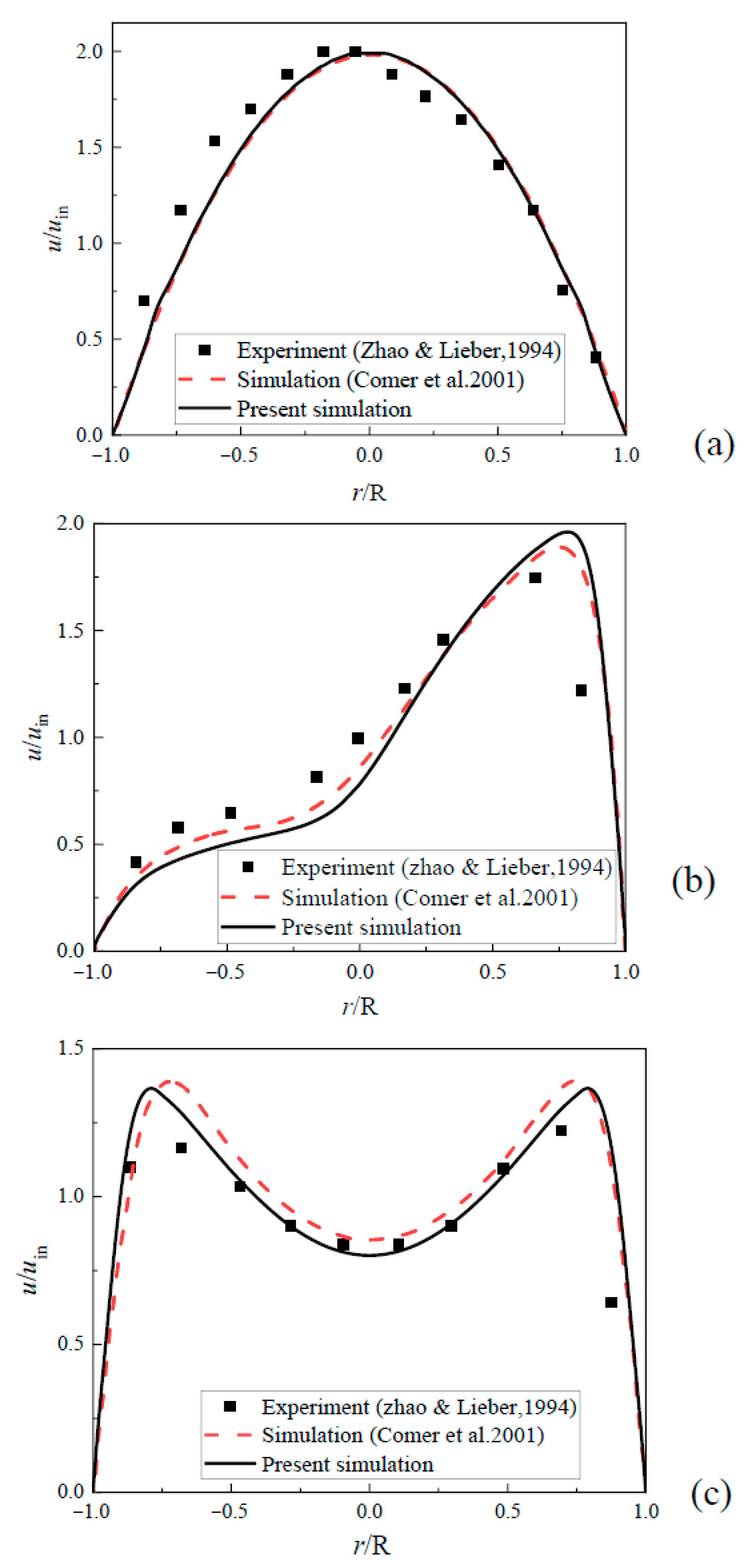
The fully developed flow field data in the bifurcated tube obtained by simulation with the present work are compared with the experimental data of a symmetric single bifurcated tube in Zhao and Lieber [
7] and the simulated data of Comer et al. [
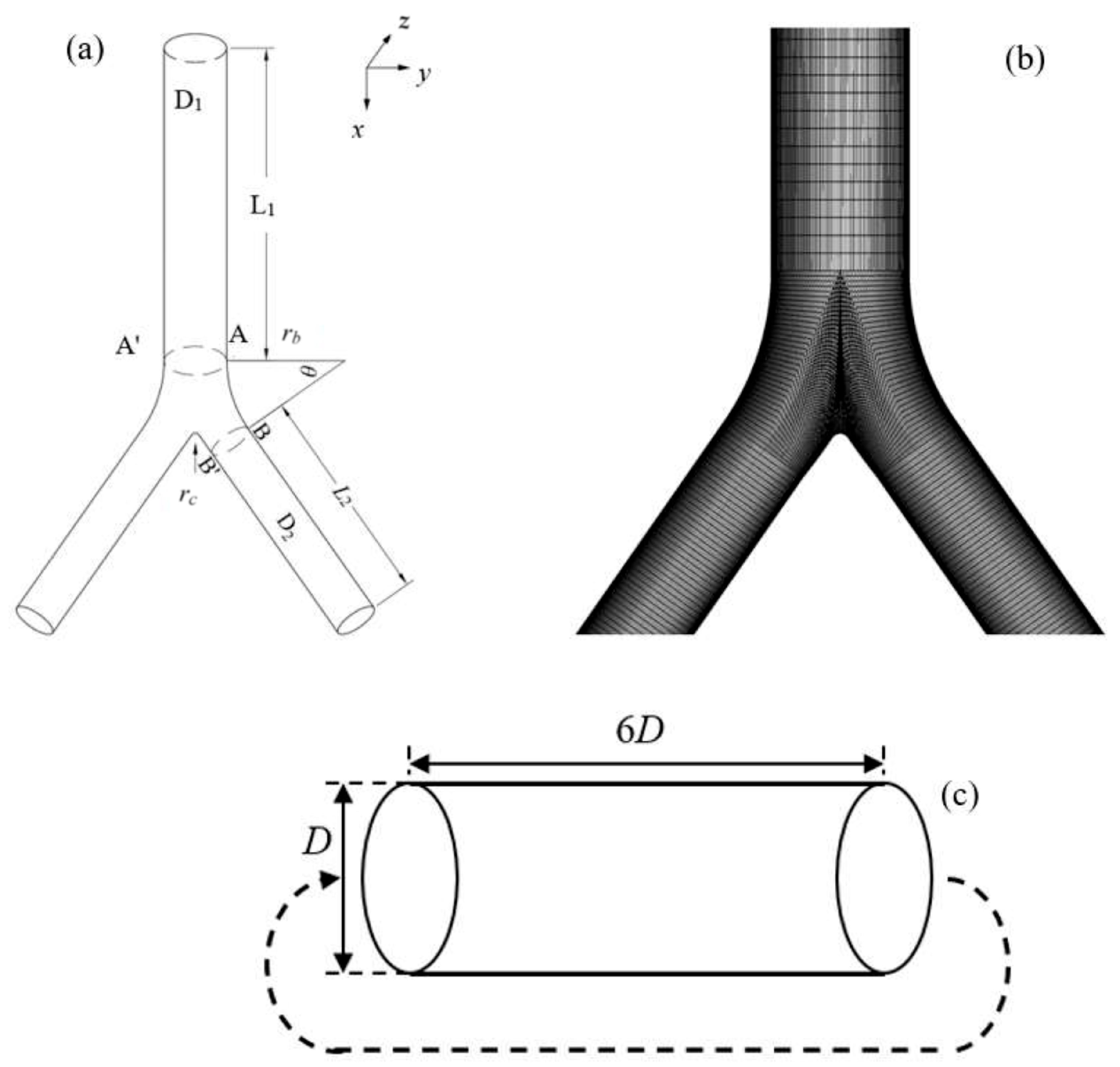
42], who performed numerical simulation of the flow field at Reynolds number Re = 1036, modeled as a symmetric bifurcated airway. The comparative axial velocity distributions on the bifurcated tube A-A’ and B-B’ cross sections (the locations of the bifurcated tube A-A’ and B-B’ cross sections are shown in
Figure 1a) are shown in
Figure 2. From the axial velocity distribution on the cross-section A-A’ of the parent tube in
Figure 2a, it can be seen that the axial velocities in this cross-section have a symmetric distribution of approximately parabolic type, which corresponds exactly to the simulation data of Comer et al. [
42]. The experimental data points of Zhao and Lieber [
7] are different from the simulation, indicating that there is a certain asymmetry in the flow inside the tube, which may be due to the clogging effect of the fluid flow in one of the daughter tubes in the experiment.
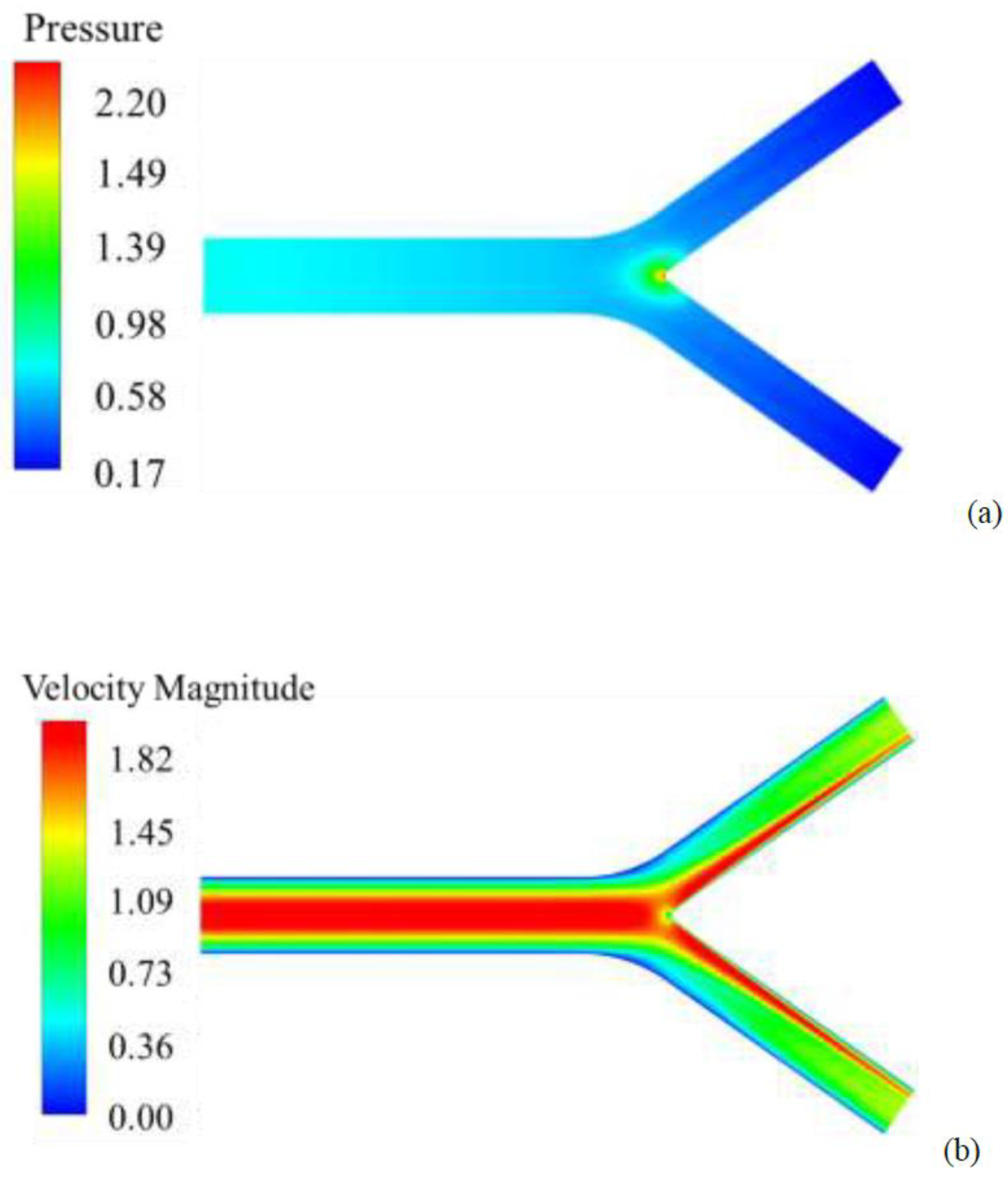
Figure 2b shows the axial velocity distribution of the daughter tube cross-section B-B’ parallel to the bifurcation plane. At this time, the distribution value of the axial velocity increases sequentially from the outer wall of the tube to the inner wall of the tube, which is owing to the centrifugal force of the fluid inside the tube. Therefore, the maximum velocity is inclined towards the inner wall of the tube, which can also be shown that the axial velocity exists in a region of high velocity near the inner wall of the daughter tube (
Figure 3b).
Figure 2c shows the comparative axial velocity distribution of the daughter tube cross-section B-B’ perpendicular to the bifurcation plane. It can be found that the axial velocity distribution shows an “M” structure distribution, which is mainly due to the influence of the secondary flow of the fluid. Therefore, this work simulates the flow field method, and the existing experiments and simulations of the three groups tend to agree; it can be considered that the simulation method used in this work is reasonable.
The radius of curvature of the bifurcation module in a bifurcated tube largely determines the flow characteristics of the fluid. The fluid in a bifurcated tube generates a pressure gradient in the secondary direction in the vertical flow direction under the interaction of the diverging flow and curvature effect (
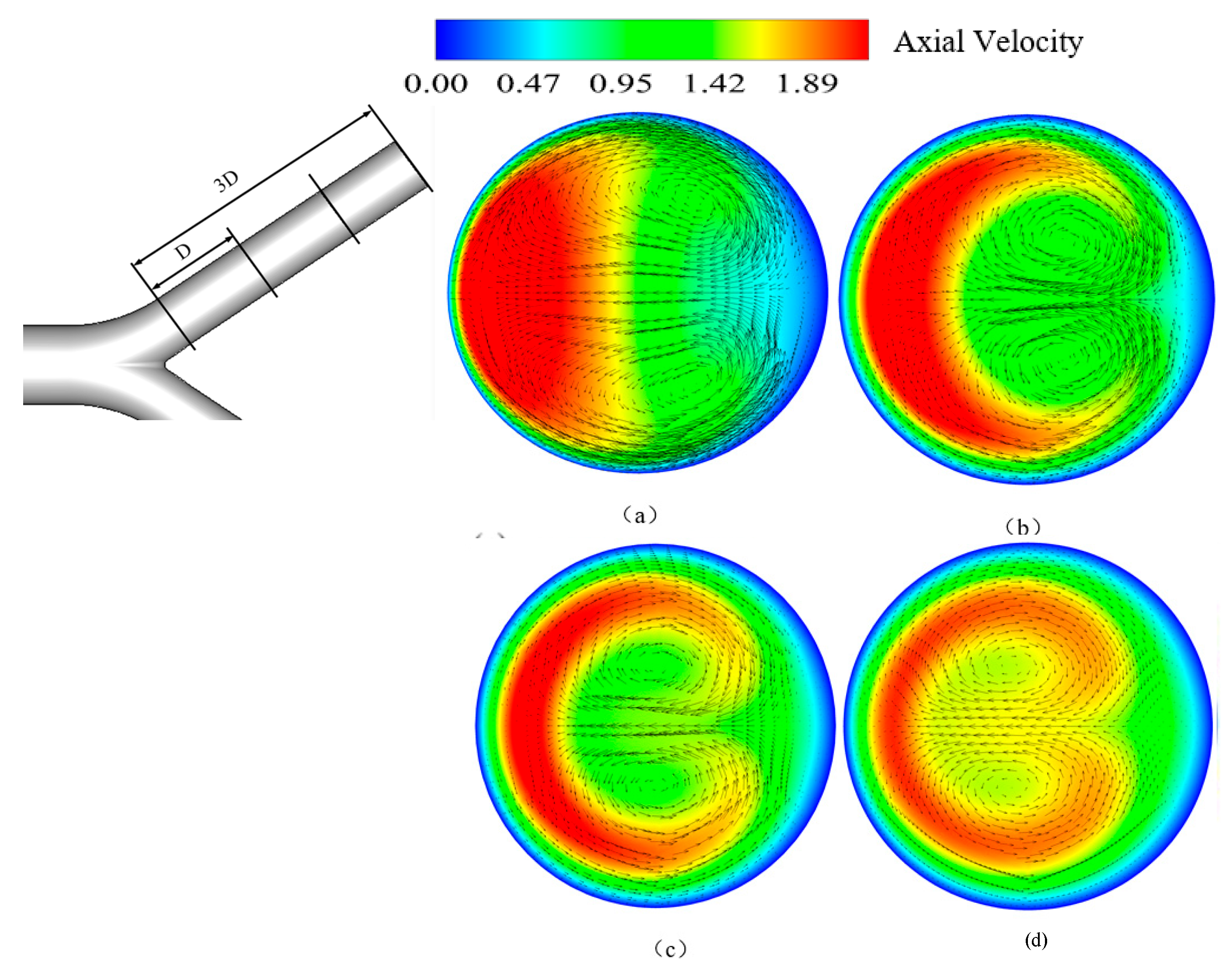
Figure 3a), which in turn forms the secondary flow. The distribution characteristics of the fluid secondary flow phenomenon at different cross sections of the tube are obviously different. In order to more comprehensively observe the rule of change of the secondary flow in different locations of the tube section, different tube sections will be taken to analyze one by one, as shown in
Figure 4. Starting from the entrance of the daughter tube, with the interval distance as D to intercept four different circular cross-sections, respectively named: 0D, 1D, 2D, and 3D circular cross-sections.
Figure 4 shows the superposition of the cloud map distribution of axial velocity and the secondary flow vector map on the 0D-3D circular sections of the daughter tube section. From the cloud map distribution of axial velocities, it can be seen that there exists a high-speed region near the inner wall of the bifurcated tube, and the high-speed region decreases and develops into a crescent-shaped region along the circular cross-section sequentially. From the secondary flow vector diagram, it can be seen that the secondary flow moves from the inner wall to the outer wall of the tube, forming a pair of symmetric and counter-rotating secondary vortices along the centerline of the cross-section, which are known as Dean Vortices. This phenomenon is primarily caused by the interplay between curvature and divergence effects within the bifurcated tube, which generates a centrifugal force on the fluid flow in the curved section, leading to the formation of a Dean vortex. Furthermore, in the 0D section, the Dean vortex can be observed near the outer wall of the tube and close to the tip. As one progresses downstream, the position of the Dean vortex gradually shifts. In the 3D section, the Dean vortex is found near the horizontal centerline of the cross-section, remaining parallel to that centerline.
4. Results and Discussion
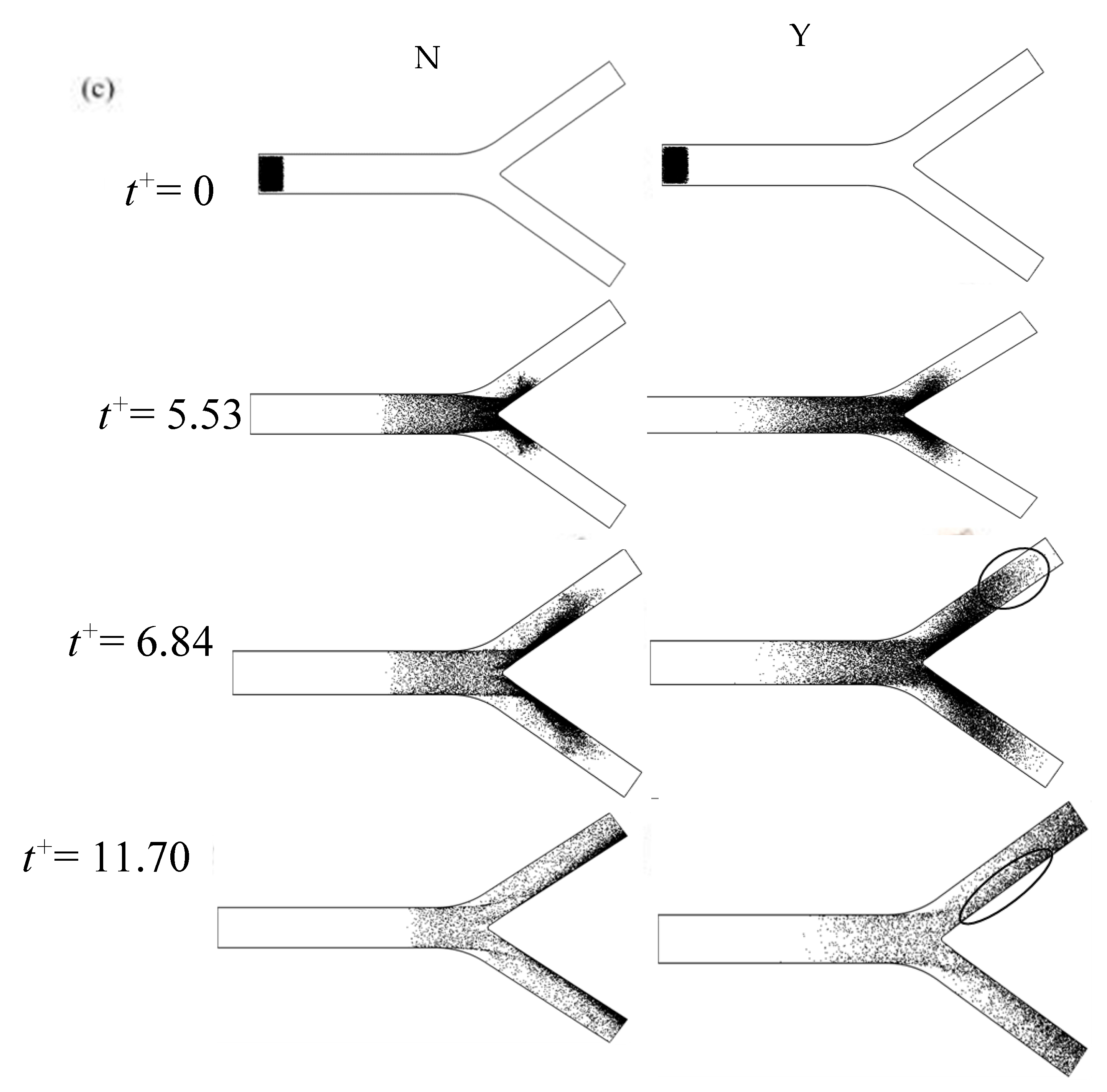
To understand the characteristics of the particle motion inside the bifurcation tube at different moments, four typical dimensionless moments
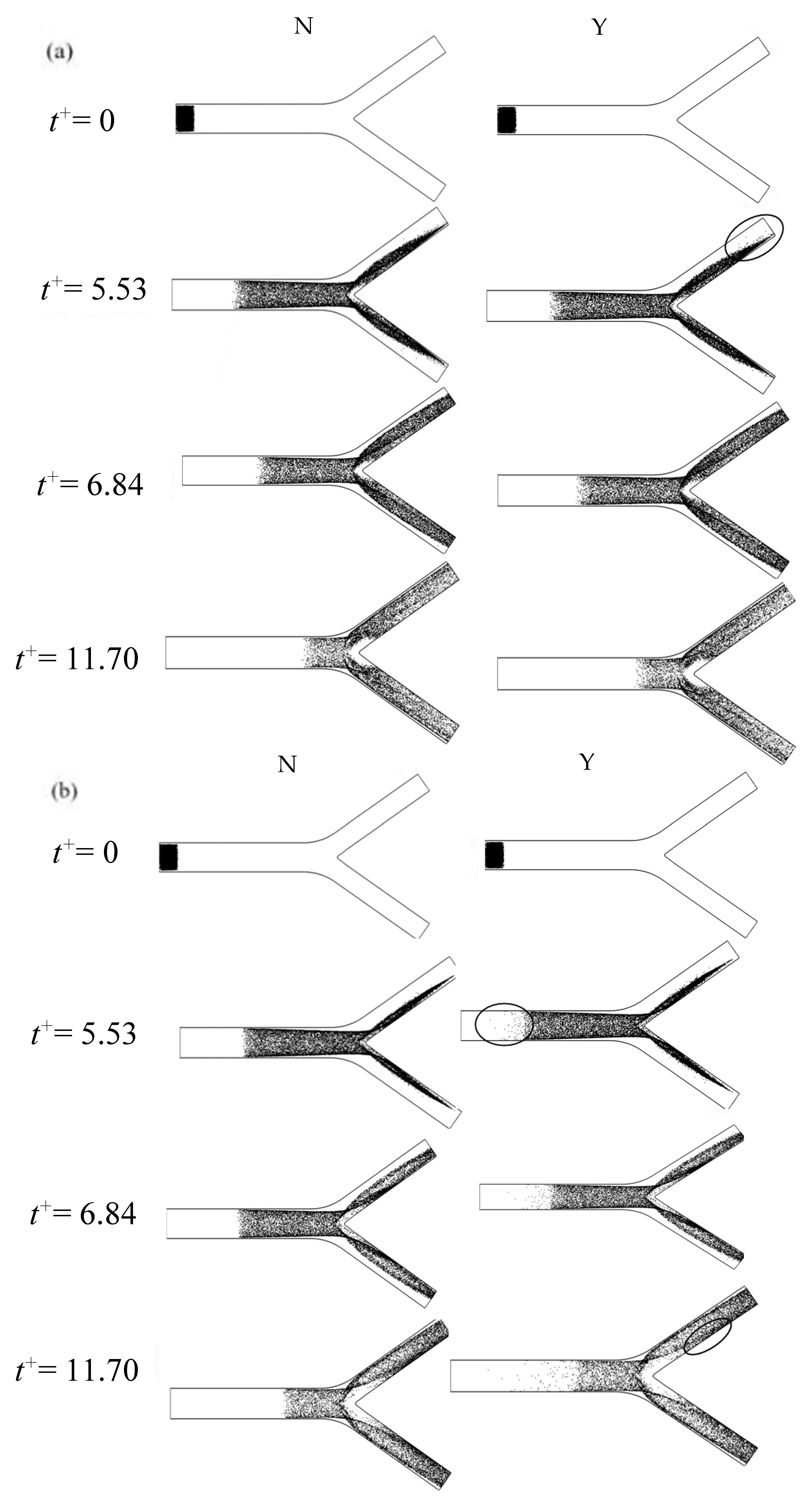
t+ = 0, 5.53, 6.84, 11.70 were selected to analyze the motion distribution of particles of three different sizes inside the bifurcation tube. Initially, the initialized particles move in a parabolic trajectory due to the flow field’s influence, passing through the parent tube and the bifurcation module. Upon impacting the bifurcation ridge, particles split into the two daughter tubes, moving forward along the inner walls and eventually rolling up to fill the entire tube due to the secondary flow. Finally, the particles flow out of the bifurcated tube from the exit end of the daughter tube. As observed in the flow field (
Figure 3b), there are regions of high velocity at the center of the parent pipe and the inner walls of the daughter tubes. Thus, particles in the center preferentially move toward the bifurcation ridge, impacting it and continuing along the inner walls of the daughter tubes. Subsequently, under the influence of the secondary flow, particles are rolled up, gradually filling the pipe and flowing out from the exit of the daughter pipe. Throughout the calculations, particles adhere to the flow field dynamics. Smaller particles exhibit better flowability and enhanced diffusion capabilities [
43]. Consequently, those near the bifurcation ridge migrate from the inner wall to the outer wall of the pipe due to secondary fluid flow, progressively forming a “V” shaped low concentration zone around the bifurcation ridge. For particles of the same size in the same section, this “V” shaped low concentration zone expands over time (
Figure 5a,b). Comparing
Figure 5a,b, it is evident that the “V” shaped low concentration zones created by particles with diameters
dp = 10 µm and
dp = 20 µm in the absence of electrostatic forces reveal that larger particles are less densely distributed. The reduced flowability of larger particles limits their interaction with the secondary flow, causing them to primarily follow the axial fluid movement rather than participate in the roll-up movement. Additionally, the flow field velocity distribution at the inner wall of the daughter tube shows a high-speed region (
Figure 3b), leading to faster migration of particles at the inner wall compared to those at other locations. This results in a more pronounced low concentration area in the “V” shape formed by larger particles. Furthermore, the effects of gravity on the particles play a significant role; as the size increases, gravitational forces diminish the vortex’s constraint on the particles, further contributing to the observed distribution phenomena. For uncharged particles with a diameter of
dp = 50 µm (
Figure 5c), the absence of a “V”-shaped low concentration zone around the bifurcation ridge is notable. This change is primarily due to the weak flow-following characteristics of these larger particles. The influence of gravity on the larger particles disrupts the vortex structure that typically constrains their movement. Consequently, many particles aggregate at the inner wall of the tube, eliminating the ridge effect. Under the influence of secondary flow, particles are transported from the inner wall to the outer wall of the tube, resulting in the disappearance of the low concentration zone. When comparing charged particles to uncharged particles in
Figure 5, it is clear that the distribution changes significantly due to electrostatic forces, with the effect becoming more pronounced as particle size increases. For instance, charged particles with
dp = 10 µm at
t+ = 5.53 (
Figure 5a) exhibit weak diffusion due to the repulsive forces among similarly charged particles, contrasting with the uncharged particles that cluster at the inner wall. In
Figure 5b, during the time interval
t+ = 5.53 to
t+ = 11.70, some charged particles of
dp = 20 µm exhibit lower velocities in the parent tube section, indicating that they are not following the majority flow and are more sparsely distributed, particularly evident in the circled area at
t+ = 5.53. Additionally, the distribution of charged particles at
t+ = 11.70 shows a significant decrease in concentration at the inner wall of the daughter tube compared to uncharged particles at the same time. This phenomenon can be attributed to the electrostatic repulsion, which causes particles in the parent tube to detach from the majority and disperse, further reducing the concentration at the wall. For
dp = 50 µm particles, the influence of electrostatic forces is significant. In the parent tube section, repulsive forces cause some lower-velocity particles to detach and exit the tube, as shown in
Figure 5c at moments
t+ = 5.53 and
t+ = 6.84. By
t+ = 6.84, the charged particles experience considerable diffusion due to electrostatic forces, allowing them to fill the entire tube, even as uncharged particles, originally aggregated by gravity, are pushed outward by electrostatic repulsion. At
t+ = 11.70, a notable decrease in the concentration of charged particles at the inner wall is observed. In summary, as particle size increases, the electrostatic forces between particles become stronger, significantly affecting their motion behavior. The electrostatic repulsive force among charged particles enhances their diffusion, enabling faster filling of the tube while also markedly reducing the concentration of particles accumulated at the tube walls.
To further analyze the impact of electrostatic force on particle distribution within the daughter tube section, the interception method depicted in
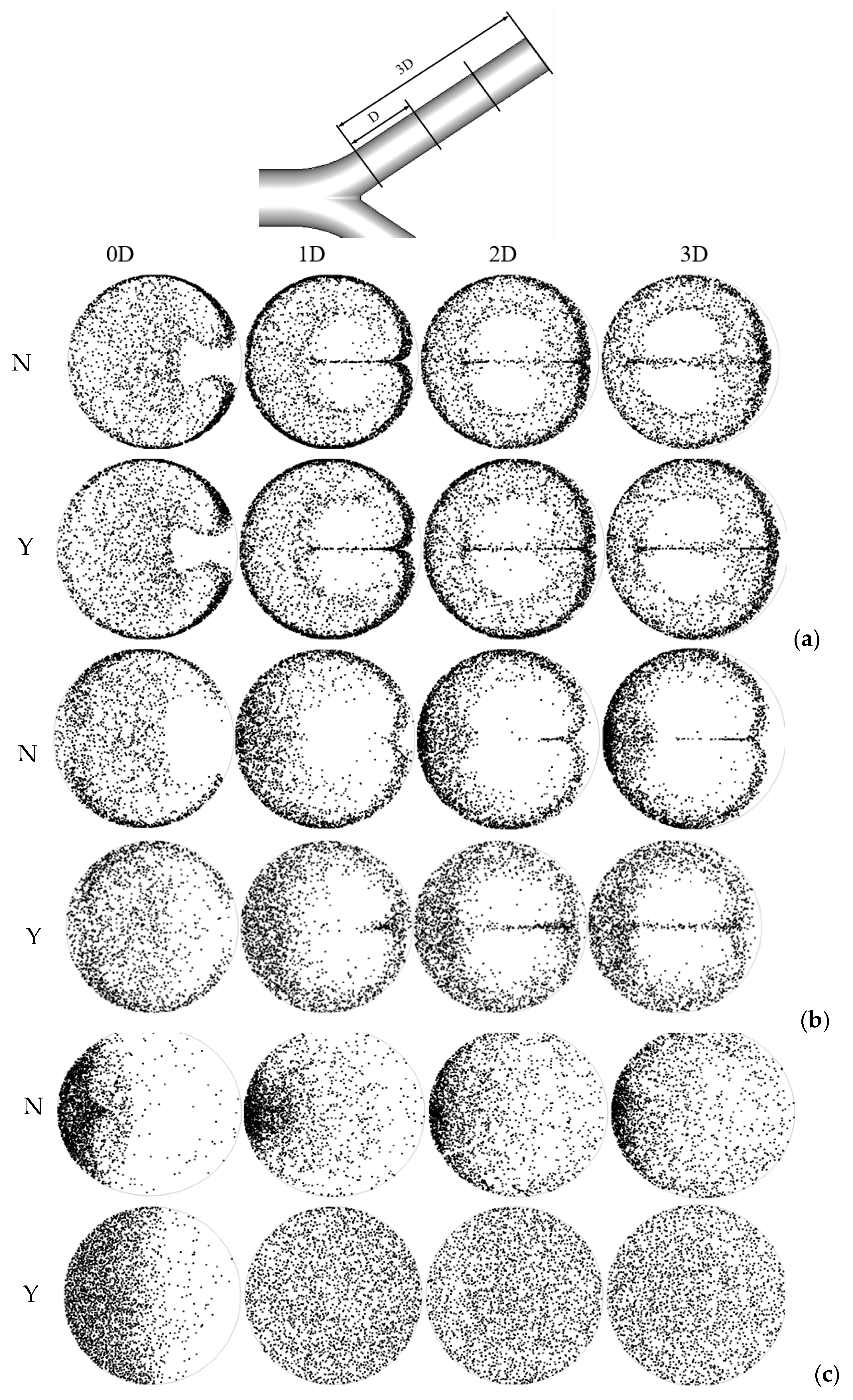
Figure 4 is utilized. This method facilitates the simulation and calculation of the instantaneous distribution of charged particles across a circular cross-section, allowing for a comparison with the distribution of uncharged particles on the 0D–3D cross-section at the same moment. The objective is to elucidate the effects of electrostatic forces on particle movement and distribution. The instantaneous distributions of particles of three different sizes (
dp = 10 μm, 20 μm, 50 μm) are examined at the moment
t+ = 31.92. The results are illustrated in
Figure 6, where “N” denotes the distribution of uncharged particles and “Y” represents the distribution of charged particles.
The instantaneous distribution of uncharged particles with a size of
dp = 10 μm at different cross-sections is represented as “N” in
Figure 6a. It is observed that, at the 0D cross-section, the concentration of particles is lower near the inner wall of the tube, while a higher concentration is noted near the outer wall. This variation is attributed to the ridge effect, which causes the gas flow to move away from the bifurcation ridge (inner wall) and towards the outer wall, while the particles are carried along with the fluid. Consequently, the concentration of particles in the outer wall region is higher than the concentration of particles in the inner wall region. As the cross-section moves backward, the particles are primarily influenced by the secondary flow of the flow field. They engage in a symmetric, reverse rotation around the vortex, moving away from the vortex center and aggregating preferentially at the periphery of the vortex, thus forming a “particle void region” within the cross-section. The position of this “particle void region” shifts in accordance with changes in vortex position, initially located near the top of the tube wall and moving toward the horizontal centerline. Furthermore, the analysis of the 0D-3D circular cross-section reveals a gradual increase in the “particle void region.” This increase can be attributed to the relatively weak vortex effect at the 0D cross-section, despite the large vorticity. As the cross-section is shifted backward, although the vorticity decreases, the vortex effect accumulates, leading to a more pronounced “particle void region.” In comparison with the instantaneous distribution of particles influenced by electrostatic force at
t+ = 31.92 in
Figure 6a, the particle void region at the outer wall of the tube on the 0D cross-section shows a slight reduction. This suggests that the electrostatic force enhances the movement of charged particles in alignment with the secondary flow of the flow field, thereby decreasing the cavity area for particles. Given the small particle size, the electrostatic effect remains relatively weak, resulting in less pronounced changes in particle distribution. Nevertheless, the influence of the electrostatic force on particle motion distribution is evident and should not be overlooked.
In
Figure 6b, the instantaneous distribution of particles with a size of
dp = 20 μm without the effect of electrostatic force is represented as “N.” When compared to the particles of size
dp = 10 μm shown in
Figure 6a, it is evident that while the smaller particles have formed a complete “particle void region” in the 1D cross-section, the larger particles with
dp = 20 μm have only developed a complete “particle void region” in the 3D cross-section after a gradual development process. This indicates that the phenomenon of particles aligning with the secondary flow of the fluid is diminished for larger particles. The primary reason for this attenuation is the increase in particle size, which enhances the effect of gravity and weakens the particles’ ability to follow the fluid motion. This results in a reduced influence of the vortex on the movement of the particles. Consequently, the established motion pattern, where particles typically move away from the vortex center and preferentially aggregate around the vortex due to fluid dynamics, becomes partially disrupted. With the circular cross-section sequentially backward, it becomes apparent that particle movement is a gradual developmental process. The particles adapt to the evolution of the secondary flow within the fluid, and the cumulative vortex effects from the 0D to 3D cross-sections become more pronounced. Therefore, the aggregation of particles around the vortex region results from this gradual evolution of motion. As the circular cross-section moves sequentially backward, the particles respond to the evolving secondary flow of the fluid. Transitioning from a 0D to a 3D cross-section, the vortex effect accumulates gradually, leading to a more pronounced response from the particles to the vortices. As a result, the aggregation of particles around the vortices develops progressively. When comparing the instantaneous distribution of particles with and without electrostatic force at
dp = 20 μm in
Figure 6b, some phenomena can be observed. To begin with, there is a noticeable reduction in the concentration of charged particles near the tube wall across all cross-sections, particularly in areas where uncharged particles were previously densely distributed. The electrostatic force facilitates the diffusion of charged particles, and the repulsion between these charged particles significantly lowers their concentration at the tube wall. Additionally, the electrostatic force enhances the impact of fluid structure on particle movement. In the 0D section, there is a distinct cavity zone for uncharged particles at the outer wall of the tube, whereas this cavity zone disappears for charged particles, which are present in the previously unoccupied area. The dissolution of this empty zone under the effect of electrostatic force indicates that the electrostatic force helps accelerate the movement of charged particles in alignment with the fluid flow. Furthermore, the electrostatic repulsion among particles promotes their diffusion, leading to a more uniform distribution within the flow field.
The instantaneous distribution of 50 µm particles under uncharged conditions, as shown in “
Figure 6c ‘N’,” indicates a significant aggregation of particles at the inner wall of the pipe. This phenomenon primarily results from the strong gravity acting on the particles, which causes them to cluster at the tube’s inner surface. As moving backward along the cross-section, the particles begin to diffuse and gradually fill the entire tube. Moreover, it is noteworthy that the “particle cavity zone” under secondary flow no longer exists. This is mainly attributed to the fact that gravity plays a dominant role in the movement of large particles. At this stage, gravity effectively destroys the particles’ tendency to cluster within the vortex, eliminating the aggregation phenomenon that was previously observed. As a result, the particles are liberated from the constraints of the vortex structure, leading to a more uniform distribution as they move through the tube outside the inner wall. In comparison, when examining the instantaneous distribution of 50 µm particles across different cross-sections (0D-3D) under the influence of electrostatic force, it is evident that particles, which initially aggregated at the inner wall due to gravity, have diffused and become more evenly distributed within the pipe. The primary reason for this redistribution is that the electrostatic force accelerates particle diffusion and induces repulsion among the particles, resulting in lower particle concentration at the inner wall. The electrostatic force facilitates the movement of the particles in accordance with the fluid flow, which further contributes to a more uniform distribution of charged particles throughout the tube.
When comparing the distribution of instantaneous different particle motion in the absence of electrostatic forces across 0D cross-sections, a noticeable particle cavity zone is observed at the outer wall of the daughter tube for particles with sizes of
dp = 10 μm and
dp = 20 μm. The formation of this cavity zone can be attributed to several factors. Firstly, as the fluid enters the daughter tube after diverting through the parent tube, the large volume of the vortex at the inlet end of the daughter tube section (0D cross-section) does not exert a significant vortex effect. Consequently, the phenomenon of particles following the fluid secondary flow around the vortex is not pronounced in this section. Secondly, the influence of gravity is also a main factor. As particle size increases, the gravitational effect on larger particles becomes more pronounced, playing a crucial role in their movement. Under the action of gravity, the particles are not completely swept up at the outer wall of the tube as they follow the movement of the secondary flow of the fluid, thus leading to the creation of cavity areas of particles at the outer wall of the tube. As particle size increases, the cavity zone at the outer wall becomes progressively larger. This is due to the enhanced gravitational effects on larger particles, which weaken their ability to follow the fluid’s motion, thus disrupting particle aggregation around the vortex. In the size of particles with
dp = 50 μm, the majority accumulate near the inner wall of the tube, with only a small number undergoing diffusive movement and dispersing throughout the tube. This occurrence is primarily due to the dominance of gravity in the movement process of large particles. Under the influence of gravity, the ridge effect is completely negated, preventing particles from curling up in response to secondary flow, resulting instead in substantial aggregation at the inner wall of the tube. Comparing the distribution of the instantaneous motion of particles in a 3D cross-section for different particle sizes in the absence of electrostatic forces. For particle sizes of
dp = 10 μm and
dp = 20 μm, an increase in particle size leads to an expansion of the “particle void region”, resulting in a more pronounced aggregation of particles at the tube wall and a significant increase in particle concentration. This effect occurs because, as particle size increases, the centrifugal force acting on particles with greater inertia also increases. Consequently, these larger particles move away from the center of the vortex due to the influence of centrifugal force, which further expands the “particle void region” and enhances particle concentration at the tube wall. In contrast, for uncharged transient distributions of particles with a size of
dp = 50 μm in a 3D cross-section, the “particle void region” is no longer present. Instead, larger particles, influenced by gravity, tend to aggregate heavily along the inner wall of the tube. Some particles, however, remain distributed more uniformly throughout the tube, apart from the inner wall, due to diffusion in the flow field. The presence of gravity disrupts the preferential aggregation of larger particles around the vortex; the particles follow the flow field, and the secondary flow movement distribution characteristics. Comparison of the instantaneous distribution of different particles under the electrostatic effect. For particles with a size of
dp = 10 μm, the electrostatic effect is relatively weak, resulting in only a minor reduction in the “particle void region” (0D cross-section). In contrast, for particles with sizes of
dp = 20 μm and
dp = 50 μm, the electrostatic repulsive forces between particles promote their diffusion, causing previously aggregated particles to disperse.
Table 2 presents the average absolute values of the various forces acting on the charged particles in the x, y, and z directions at time
t+ = 31.92. As particle size increases, the electrostatic force acting on the particles also increases, indicating that the influence of electrostatic forces on particle motion becomes more significant. From
Table 2, it can be observed that the electrostatic force on the particles is several orders of magnitude greater than any other forces acting on them. This phenomenon is attributed to localized aggregation of particles occurring in specific regions of the tube. The electrostatic force experienced by each particle results from the cumulative effect of the electrostatic forces exerted by nearby particles; thus, dense aggregations lead to a significantly larger electrostatic force on the particles.
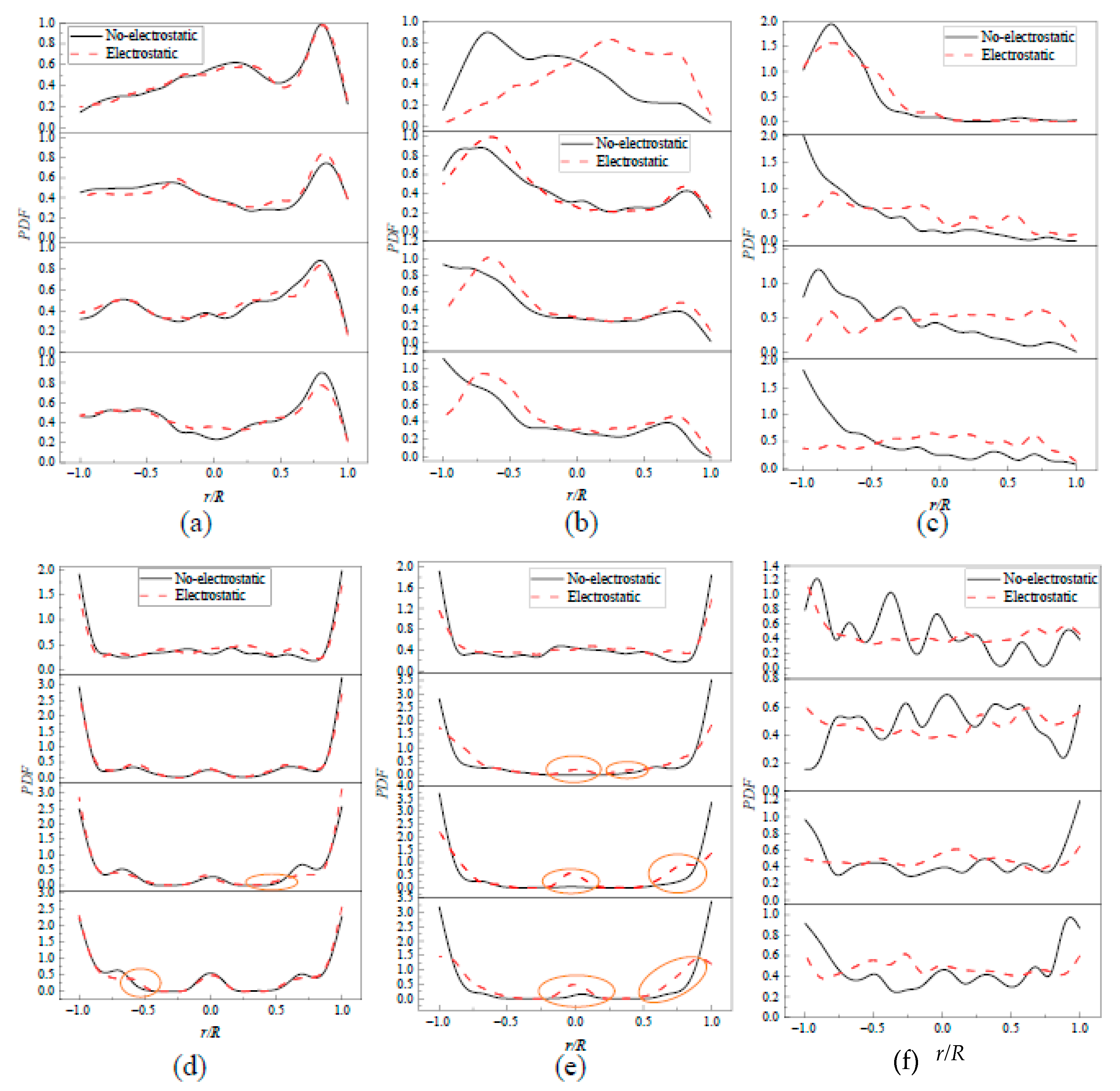
In order to quantitatively characterize the distribution of particles on the 0D-3D circular cross-section and further analyze the law of electrostatic force on the motion behavior of particles, the transverse and longitudinal probability distribution functions (PDF) of particles are introduced in this work to specifically represent the distribution of particles’ concentration at different locations on the cross-section. The moment is taken as
t+ = 31.92. As shown in
Figure 7a, the trends of the PDF distribution curves of charged and uncharged particles with a particle size of
dp = 10 μm are the same, but there exists a significant difference in the size of the concentration of charged and uncharged particles at the same location. This is because the particle size is small, the electrostatic force generated between the particles is small, and produces a weak change in the way the particles move. Therefore, the electrostatic effect changes the local distribution of small particles, and the electrostatic effect is not negligible. As shown in
Figure 7d, the particle distribution extends from the center of the tube to the sides of the tube wall, forming a progressively more distinct “W” shape in the 0D–3D cross-section. The particles are influenced by the vortex structure as they follow the flow field, causing them to move away from the vortex center and preferentially accumulate around the vortex. This results in a lower concentration of particles at the vortex center and a higher concentration around it. Combined with
Figure 4, we see that the flow field’s cross-sectional distribution features a pair of up-and-down symmetric, counter-rotating vortices. Particles tend to follow the flow field away from the center of the vortex, leading to aggregation near the vortex periphery, which is reflected in the “W” shape of the longitudinal particle probability distribution function (PDF). In the 0D cross-section, the longitudinal PDF of the particles does not exhibit a complete “W” distribution. This particular cross-section corresponds to the inlet of the daughter tube. Although the vorticity is large, its constraining effect on the particles is weak, resulting in a less pronounced “W” shape distribution. As illustrated in the circles on the 1D, 2D, and 3D sections, the concentration of charged particles exceeds that of uncharged particles at the edges of the “particle cavity zone.” This indicates that the “particle cavity zone” formed by charged particles is smaller than that formed by uncharged particles. The electrostatic force enhances the diffusive motion of the particles, leading to a slight reduction in the size of the “particle cavity zone.” The PDF curves for charged and uncharged particles with a particle size of
dp = 20 µm are presented in
Figure 7b,e. Notably, there is a significant deflection in the concentration distribution of charged particles in the 0D cross-section, characterized by a sudden increase in particle concentration at the outer wall of the tube (
Figure 7b). The enhancement of diffusive motion and the acceleration of particle movement due to the electrostatic effect contribute to the elimination of the particle-cavity zone at the outer wall, resulting in this abrupt concentration increase. From 0D to 3D sections, it is observed that the concentration of charged particles at the inner wall of the tube is lower than that of uncharged particles, while the concentration at the outer wall is higher. The electrostatic forces acting between the charged particles facilitate their diffusive motion, which helps disperse the particles that would otherwise accumulate heavily at the inner wall due to gravitational effects. Combining this insight with the analysis in
Figure 6b, it can be concluded that the electrostatic forces promote the movement of charged particles in alignment with the secondary flow dynamics. This, along with the particles’ response to the vortex structures, results in the particles at the inner wall of the tube moving toward the outer wall more rapidly over the same time period. Consequently, this alters the concentration distribution characteristics of particles: the concentration of particles at the inner wall decreases, while that at the outer wall increases when comparing charged particles to uncharged ones.
The comparative longitudinal PDF distributions for particles with a size of
dp = 20 µm in the 0D-3D cross-section, both with and without electrostatic force, are illustrated in
Figure 7e. It is evident that the concentration of charged particles is significantly lower than that of uncharged particles at the tube wall. This phenomenon can be attributed to the mutual repulsion among charged particles of the same type. The repulsive forces result in the dispersal of many particles that would otherwise be concentrated at the tube wall, leading to a notable decrease in particle concentration in that area. As highlighted in the circled portion of the tube’s central section, the “W” distribution pattern of charged particles is more pronounced in the 1D-3D sections compared to that of uncharged particles. The electrostatic forces enhance the motion of charged particles as they follow the secondary flow of the fluid, which in turn increases their responsiveness to the vortex structures. This results in a more distinct clustering of particles around the vortex. Charged particles gather more rapidly around the vortex within a short time frame, forming a complete “particle cavity zone”. Consequently, the “W” distribution of charged particles becomes more prominent. Additionally, from the 1D-3D cross-section indicated near the outer wall of the tube, it can be observed that the “particle cavity zone” decreases under the influence of electrostatic force. This reduction is more pronounced as the particle size increases. For particles of size
dp = 50 µm, the concentration of charged particles at the inner wall of the tube is significantly lower than that of uncharged particles, further indicating that the electrostatic force promotes the diffusive motion of the particles (
Figure 7c). The concentration distribution of charged particles with
dp = 50 µm is much smoother compared to the concentration distribution of uncharged particles (
Figure 7f). The electrostatic force not only promotes the diffusion of the particles, but also accelerates the motion of the particles following the flow field, resulting in a more uniform distribution of the particles in the tube.
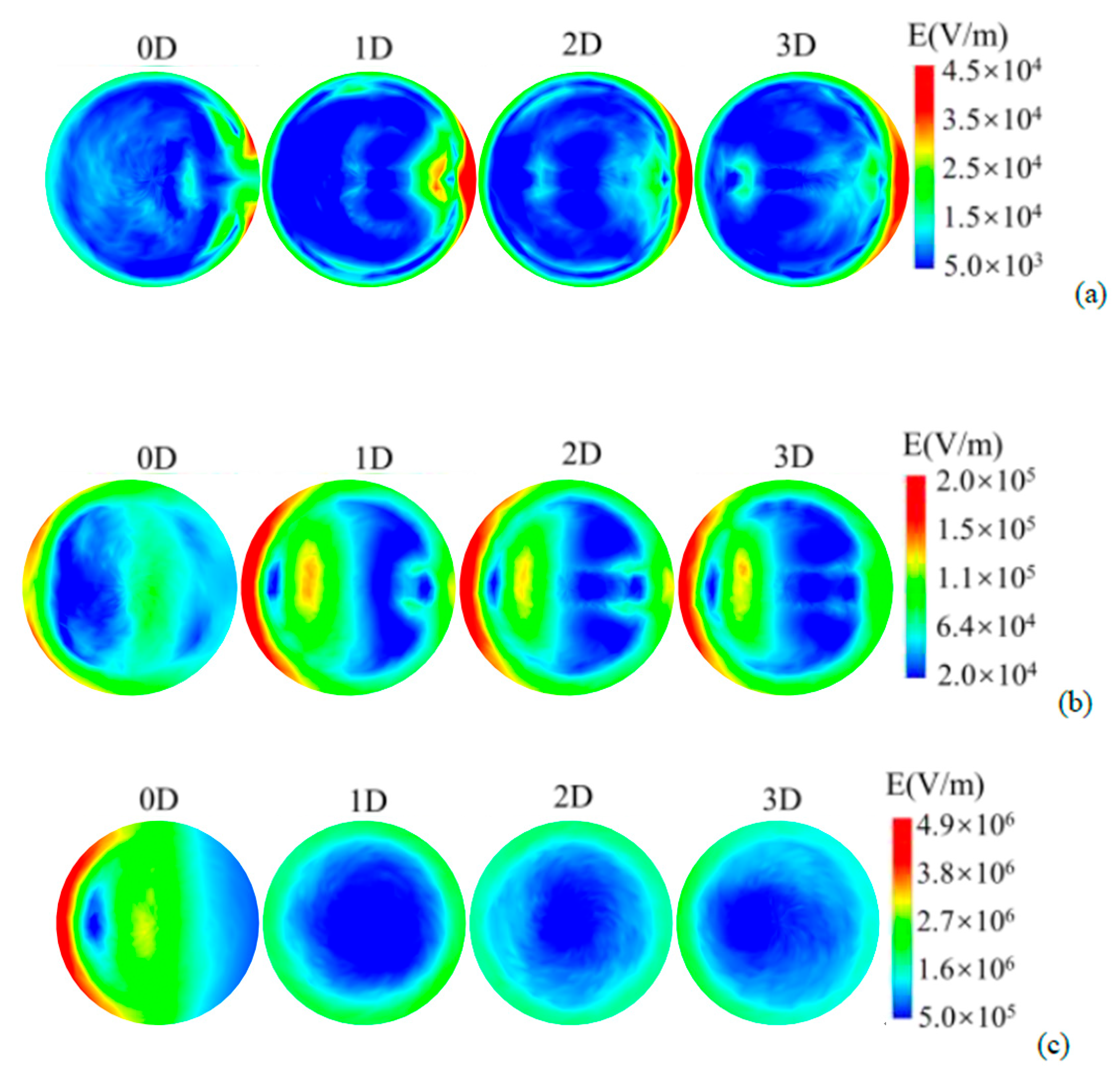
In this work, we calculated the electrostatic field distributions of three different particle sizes on the 0D-3D circular cross-section at the moment
t+ = 31.92, as illustrated in
Figure 8. By comparing the distribution of charged particles in
Figure 6 with the electrostatic field distribution in
Figure 8, it becomes evident that the electrostatic field distribution changes in accordance with the motion of the particles. Notably, the strength of the electric field significantly increases in areas where a large number of particles are concentrated. For instance, near the tube wall, the electric field intensity is lower in regions with fewer particles, while regions with more uniform particle distribution also exhibit a reduced electric field intensity. This phenomenon occurs because the field strengths in different directions tend to cancel each other out, resulting in a lower combined field strength. Furthermore, comparing the electrostatic fields of the three particle sizes in
Figure 8 reveals that the electric field strength increases by an order of magnitude as the particle size increases. This increase is primarily attributed to the larger charge carried by individual particles as their size grows, which enhances the strength of the electric field generated between the particles. Therefore, it can be concluded that as particle size increases, the electric field strength correspondingly increases.
5. Conclusions
In this work, the effect of the presence or absence of electrostatic forces on the behavior of three different particle sizes (dp = 10 μm, 20 μm, 50 μm) in a symmetric bifurcated tube under normal human working conditions (Re = 1036) is investigated by the LES-Lagrangian method. Results obtained for the single-phase flow are in good agreement with other experiments and simulations, which confirms the reliability of the single-phase flow simulated. The effect of electrostatic action on the behavior of particles in a laminar flow bifurcation tube is analyzed, and the field strength distribution of the electrostatic field in the daughter tube section of the bifurcation tube is further analyzed. The impact of electrostatic forces on particle behavior in a laminar flow bifurcated tube is examined, alongside an analysis of the electrostatic field strength distribution within the daughter tube sections of the bifurcation.
The electrostatic force among particles influences their distribution, with larger particle sizes exhibiting more pronounced effects. For particles sized dp = 10 µm, the electrostatic force has a minimal impact on their motion due to their small size, resulting in only weak diffusion under the influence of electrostatic forces. In contrast, for particles with sizes of dp = 20 µm and dp = 50 µm, there is a significant reduction in particle concentration at the inner wall of the daughter tube. The electrostatic repulsion among these larger particles effectively disperses those that were initially clustered, leading to a substantial decrease in overall particle concentration.
The electrostatic forces between particles enhance their movement along the secondary flow and amplify their interactions with vortices, thereby facilitating the rapid formation of a complete “particle cavity zone” in the daughter tube section compared to uncharged particles. Additionally, the electrostatic repulsion among particles alters their positions, causing previously aggregated particles to disperse. This dispersion leads to a notable reduction in the size of the “particle cavity zone.”
The distribution of the electrostatic field is influenced by the movement of the particles, exhibiting significant changes based on particle concentration. In areas with large aggregations of particles, the strength of the electric field increases substantially, while it diminishes in regions where particle concentration is low. In zones where particles are more uniformly distributed, the combined electric field strength is reduced due to the cancellation effects of the field strengths in different directions. Moreover, as particle size increases, the electric field strength correspondingly rises, exhibiting an increase by an order of magnitude for all three particle sizes considered.
In summary, the electrostatic effects between particles positively influence inhalation therapy in practical applications. Charged drug particles are able to reach specific areas of the body more quickly. Additionally, the electrostatic forces facilitate the diffusion and even distribution of particles within the human trachea, preventing localized aggregation. This dynamic not only shortens treatment time but also enhances the overall efficiency of the therapy.
In this work, a one-way coupling method was used to study gas–solid flows that exclusively consider airflow effects on particles, excluding particle–fluid interactions (two-way coupling) and particle-particle interactions (four-way coupling). It is revealed that electrostatic force decreases particle aggregation compared to static-free conditions, meaning that electrostatics reduces the clustering tendency of particles. Given the sparse particle distribution in the study area with minimal aggregated regions, this methodology proves particularly suitable for most scenarios. In the future, two-way coupling and four-way coupling methods will be further developed to discover the working mechanism of the electrostatic effect on dense particles.




 Experiment (Zhao & Lieber, 1994 [7]),
  Simulation (Comer et al., 2001 [42]),
  Present simulation.