
Recent Advances in Carbon Quantum Dot-Enhanced Stimuli-Sensitive Hydrogels: Synthesis, Properties, and Applications

 ,
,  and
and
Abstract
1. Introduction
2. Synthesis of Carbon Quantum Dot-Enhanced Stimuli-Sensitive Hydrogels
2.1. Synthesis and Characteristics of CQDs
2.1.1. Top-Down Synthesis Methods
2.1.2. Bottom-Up Synthesis Methods
2.1.3. Physicochemical Properties and Applications
2.2. Types and Mechanisms of Stimuli-Responsive Hydrogels
2.2.1. Types of Stimuli-Responsive Hydrogels
2.2.2. Mechanisms and Enhanced Functionality
2.3. Preparation Methods of CQD-Enhanced Stimuli-Sensitive Hydrogels
2.3.1. Fabrication Techniques for Stimuli-Sensitive Hydrogels
2.3.2. Integration Strategies for CQDs
2.3.3. Advanced Manufacturing Approaches
3. Roles of CQDs in Stimuli-Sensitive Hydrogels
3.1. Optical Properties
3.1.1. Enhanced Optical Characteristics
3.1.2. Applications in Bioimaging
3.1.3. Smart Sensors
3.2. Mechanical Properties
3.3. Electrical Conductivity and Related Applications
3.3.1. Electrical Conductivity Enhancement
3.3.2. Applications in Wearable Electronics and Actuators
3.4. Stimuli-Responsive Behavior
3.4.1. Stimuli-Responsive Mechanisms
3.4.2. Controlled Release and Material Adaptation
3.4.3. Adaptive System Applications
4. Biomedical Applications
4.1. Stimuli-Responsive Drug Delivery Systems
4.1.1. Mechanisms and Design
4.1.2. Multi-Stimuli Responsiveness
4.1.3. Multifunctional Systems
4.2. Tissue Engineering and Regenerative Medicine
4.2.1. Stimuli-Responsive Scaffold Design
4.2.2. Tissue Regeneration Applications
4.2.3. Bioactive Integration and Safety
4.3. Bioimaging and Biosensing
4.3.1. Fluorescent Bioimaging Platforms
4.3.2. Stimuli-Responsive Biosensing Systems
4.4. Antimicrobial and Responsive Biomaterials
5. Environmental Applications
5.1. Responsive Water Treatment Systems
5.2. Photocatalysis for Environmental Remediation
5.2.1. Photocatalytic Mechanisms
5.2.2. Pollutant Degradation Applications
5.3. Environmental Monitoring and Sensing
5.3.1. pH- and Light-Responsive Sensors
5.3.2. Pollutant and Composite Sensors
5.3.3. Practical Applications and Challenges
6. Energy Applications
6.1. Energy Storage and Conversion Devices
6.2. Solar Cells and Light-Responsive Materials
7. Smart Material Applications
7.1. Wearable and Flexible Electronics
7.2. Responsive and Sustainable Materials
7.2.1. Adaptive Material Innovations
7.2.2. Sustainable Synthesis Approaches
7.3. Information Storage and Anti-Counterfeiting
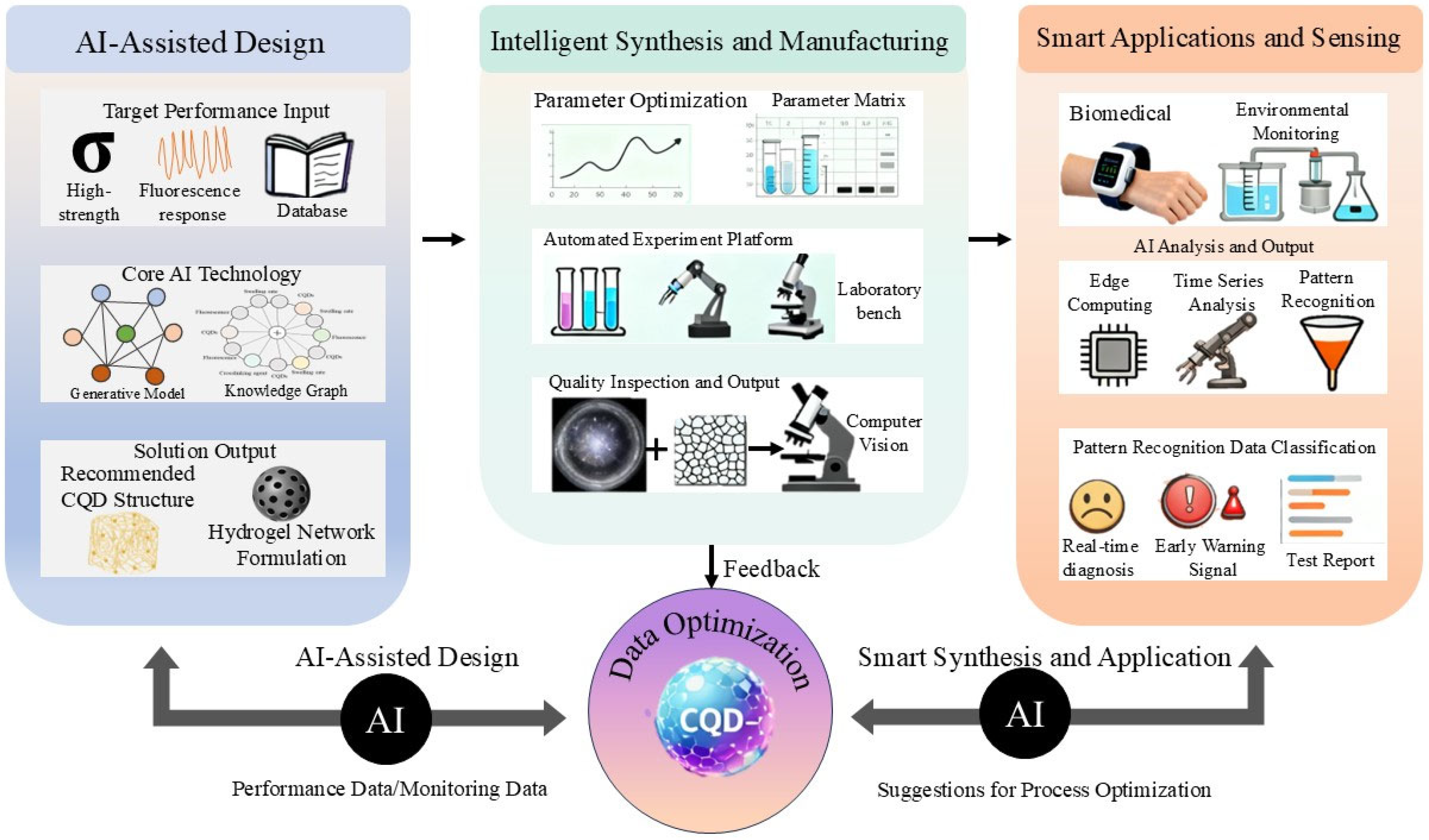
8. The Role of Artificial Intelligence in Advancing CQD–Hydrogels
8.1. AI in Material Design and Performance Prediction
8.2. AI in Intelligent Sensing and Adaptive Systems
8.3. Integration of AI in Intelligent Sensing and Adaptive Systems
8.4. Future Perspectives and Interdisciplinary Synergy
9. Challenges and Future Perspectives
9.1. Current Limitations
9.2. Future Research Directions
9.2.1. Sustainable Synthesis and Scalability Solutions
9.2.2. Real-World Application-Oriented Design
9.2.3. Advanced Characterization and Regulatory Collaboration
9.2.4. Targeted Improvements for Key Applications
10. Conclusions
Author Contributions
Funding
Institutional Review Board Statement
Informed Consent Statement
Data Availability Statement
Acknowledgments
Conflicts of Interest
References
- Bustamante-Torres, M.; Romero-Fierro, D.; Arcentales-Vera, B.; Palomino, K.; Magaña, H.; Bucio, E. Hydrogels classification according to the physical or chemical interactions and as stimuli-sensitive materials. Gels 2021, 7, 182. [Google Scholar] [CrossRef] [PubMed]
- Roy, A.; Manna, K.; Pal, S. Recent advances in various stimuli-responsive hydrogels: From synthetic designs to emerging healthcare applications. Mater. Chem. Front. 2022, 6, 2338–2385. [Google Scholar] [CrossRef]
- Zhao, F.; Li, X.; Zuo, M.; Liang, Y.; Qin, P.; Wang, H.; Wu, Z.; Luo, L.; Liu, C.; Leng, L. Preparation of photocatalysts decorated by carbon quantum dots (CQDs) and their applications: A review. J. Environ. Chem. Eng. 2023, 11, 109487. [Google Scholar] [CrossRef]
- Hu, F.; Lu, H.; Xu, G.; Lv, L.; Chen, L.; Shao, Z. Carbon quantum dots improve the mechanical behavior of polyvinyl alcohol/polyethylene glycol hydrogel. J. Appl. Polym. Sci. 2022, 139, e52805. [Google Scholar] [CrossRef]
- Bai, B.; Qi, S.; Yang, K.; Yu, X.; Jian, R.; Zhang, T.; Wang, D.; Meng, H.; Zhao, Y.; Xia, Y.; et al. Self-Assembly of Selenium-Doped Carbon Quantum Dots as Antioxidants for Hepatic Ischemia-Reperfusion Injury Management. Small 2023, 19, 2300217. [Google Scholar] [CrossRef] [PubMed]
- Yadav, P.K.; Chandra, S.; Kumar, V.; Kumar, D.; Hasan, S.H. Carbon quantum dots: Synthesis, structure, properties, and catalytic applications for organic synthesis. Catalysts 2023, 13, 422. [Google Scholar] [CrossRef]
- Omidian, H.; Wilson, R.L. Enhancing hydrogels with quantum dots. J. Compos. Sci. 2024, 8, 203. [Google Scholar] [CrossRef]
- Kanungo, S.; Gupta, N.; Rawat, R.; Jain, B.; Solanki, A.; Panday, A.; Das, P.; Ganguly, S. Doped Carbon Quantum Dots Reinforced Hydrogels for Sustained Delivery of Molecular Cargo. J. Funct. Biomater. 2023, 14, 166. [Google Scholar] [CrossRef]
- Ganguly, S.; Margel, S. Fluorescent quantum dots-based hydrogels: Synthesis, Fabrication and multimodal biosensing. Talanta Open 2023, 8, 100243. [Google Scholar] [CrossRef]
- Zou, Y.; Shi, Y.; Wang, T.; Ji, S.; Zhang, X.; Shen, T.; Huang, X.; Xiao, J.; Farag, M.A.; Shi, J.; et al. Quantum dots as advanced nanomaterials for food quality and safety applications: A comprehensive review and future perspectives. Compr. Rev. Food Sci. Food Saf. 2024, 23, e13339. [Google Scholar] [CrossRef] [PubMed]
- Sharma, A.S.; Ali, S.; Sabarinathan, D.; Murugavelu, M.; Li, H.; Chen, Q. Recent progress on graphene quantum dots-based fluorescence sensors for food safety and quality assessment applications. Compr. Rev. Food Sci. Food Saf. 2021, 20, 5765–5801. [Google Scholar] [CrossRef]
- Sun, X.; Li, G.; Yin, Y.; Zhang, Y.; Li, H. Carbon quantum dot-based fluorescent vesicles and chiral hydrogels with biosurfactant and biocompatible small molecule. Soft Matter 2018, 14, 6983–6993. [Google Scholar] [CrossRef]
- Wu, Y.; Li, W.; Feng, Y.; Shi, J. Carbon Dots as Multifunctional Nanofillers in Sustainable Food Packaging: A Comprehensive Review. Foods 2025, 14, 3082. [Google Scholar] [CrossRef]
- Hu, X.; Li, Y.; Xu, Y.; Gan, Z.; Zou, X.; Shi, J.; Huang, X.; Li, Z.; Li, Y. Green one-step synthesis of carbon quantum dots from orange peel for fluorescent detection of Escherichia coli in milk. Food Chem. 2021, 339, 127775. [Google Scholar] [CrossRef]
- Sun, Y.P.; Zhou, B.; Lin, Y.; Wang, W.; Fernando, K.S.; Pathak, P.; Meziani, M.; Harruff, B.A.; Wang, X.; Wang, H.; et al. Quantum-sized carbon dots for bright and colorful photoluminescence. J. Am. Chem. Soc. 2006, 128, 7756–7757. [Google Scholar] [CrossRef]
- Liang, N.; Hu, X.; Li, W.; Mwakosya, A.W.; Guo, Z.; Xu, Y.; Huang, X.; Li, Z.; Zhang, X.; Zou, X.; et al. Fluorescence and colorimetric dual-mode sensor for visual detection of malathion in cabbage based on carbon quantum dots and gold nanoparticles. Food Chem. 2021, 343, 128494. [Google Scholar] [CrossRef]
- Liang, N.; Hu, X.; Li, W.; Wang, Y.; Guo, Z.; Huang, X.; Li, Z.; Zhang, X.; Zhang, J.; Xiao, J.; et al. A dual-signal fluorescent sensor based on MoS2 and CdTe quantum dots for tetracycline detection in milk. Food Chem. 2022, 378, 132076. [Google Scholar] [CrossRef] [PubMed]
- Wu, M.; Wang, Y.; Wu, W.; Hu, C.; Wang, X.; Zheng, J.; Li, Z.; Jiang, B.; Qiu, J. Preparation of functionalized water-soluble photoluminescent carbon quantum dots from petroleum coke. Carbon 2014, 78, 480–489. [Google Scholar] [CrossRef]
- Song, S.H.; Jang, M.-H.; Chung, J.; Jin, S.H.; Kim, B.H.; Hur, S.-H.; Yoo, S.; Cho, Y.-H.; Jeon, S. Highly Efficient Light-Emitting Diode of Graphene Quantum Dots Fabricated from Graphite Intercalation Compounds. Adv. Opt. Mater. 2014, 2, 1016–1023. [Google Scholar] [CrossRef]
- Ren, X.; Zhang, F.; Guo, B.; Gao, N.; Zhang, X. Synthesis of N-doped micropore carbon quantum dots with high quantum yield and dual-wavelength photoluminescence emission from biomass for cellular imaging. Nanomaterials 2019, 9, 495. [Google Scholar] [CrossRef] [PubMed]
- Wang, W.; Jayan, H.; Majeed, U.; Zou, X.; Hu, Q.; Guo, Z. Visual detection of Auramine O using dual-signal ratiometric fluorescent nanopaper sensor combined portable smartphone. Food Biosci. 2025, 65, 106135. [Google Scholar] [CrossRef]
- Li, Y.; Mi, Y.; Liu, Z.; Liu, Y.; Zhang, W.; Qiu, S.; Ramos, M.A.; Hu, T.S.; Xu, Q. MoO3-x quantum dots-based hydrogel with excellent light-triggered self-healing efficiency and pressure sensitive photoluminescence for accurate remote force measurement. Mater. Today Phys. 2022, 27, 100807. [Google Scholar] [CrossRef]
- Hu, X.; Zhang, X.; Li, Y.; Shi, J.; Huang, X.; Li, Z.; Zhang, J.; Li, W.; Xu, Y.; Zou, X. Easy-to-Use Visual Sensing System for Milk Freshness, Sensitized with Acidity-Responsive N-Doped Carbon Quantum Dots. Foods 2022, 11, 1855. [Google Scholar] [CrossRef] [PubMed]
- Zhang, J.; Zhang, J.; Huang, X.; Zhai, X.; Li, Z.; Shi, J.; Sobhy, R.; Khalifa, I.; Zou, X. Lemon-derived carbon quantum dots incorporated guar gum/sodium alginate films with enhanced the preservability for blanched asparagus active packaging. Food Res. Int. 2025, 202, 115736. [Google Scholar] [CrossRef] [PubMed]
- Wu, Y.; Zhang, J.; Hu, X.; Huang, X.; Zhang, X.; Zou, X.; Shi, J. Preparation of edible antibacterial films based on corn starch/carbon nanodots for bioactive food packaging. Food Chem. 2024, 444, 138467. [Google Scholar] [CrossRef]
- Zhang, L.; Liu, D.; Jiang, Q.; Sun, Q. Edible coating of Chrysanthemum morifolium by-products derived carbon quantum dots alleviated postharvest quality deterioration of Gastrodia elata through regulating phenylpropanoid pathway. Food Packag. Shelf Life 2025, 52, 101602. [Google Scholar] [CrossRef]
- Shi, Y.; Li, W.; Hu, X.; Zhang, X.; Huang, X.; Li, Z.; Zhai, X.; Shen, T.; Shi, J.; He, Y.; et al. A novel sustainable biomass-based fluorescent probe for sensitive detection of salicylic acid in rice. Food Chem. 2024, 434, 137260. [Google Scholar] [CrossRef]
- Gu, Z.G.; Li, D.J.; Zheng, C.; Kang, Y.; Wöll, C.; Zhang, J. MOF-templated synthesis of ultrasmall photoluminescent carbon-nanodot arrays for optical applications. Angew. Chem. 2017, 129, 6957–6962. [Google Scholar] [CrossRef]
- Li, W.; Hu, X.; Li, Q.; Shi, Y.; Zhai, X.; Xu, Y.; Li, Z.; Huang, X.; Wang, X.; Shi, J.; et al. Copper nanoclusters@ nitrogen-doped carbon quantum dots-based ratiometric fluorescence probe for lead (II) ions detection in porphyra. Food Chem. 2020, 320, 126623. [Google Scholar] [CrossRef]
- LeCroy, G.E.; Sonkar, S.K.; Yang, F.; Veca, L.M.; Wang, P.; Tackett, K.N.; Yu, J.J.; Vasile, E.; Qian, H.; Liu, Y.; et al. Toward structurally defined carbon dots as ultracompact fluorescent probes. ACS Nano 2014, 8, 4522–4529. [Google Scholar] [CrossRef] [PubMed]
- Yang, H.L.; Bai, L.F.; Geng, Z.R.; Chen, H.; Xu, L.T.; Xie, Y.C.; Wang, D.J.; Gu, H.W.; Wang, X.M. Carbon quantum dots: Preparation, optical properties, and biomedical applications. Mater. Today Adv. 2023, 18, 100376. [Google Scholar] [CrossRef]
- Bi, X.; Li, L.; Luo, L.; Liu, X.; Li, J.; You, T. A ratiometric fluorescence aptasensor based on photoinduced electron transfer from CdTe QDs to WS2 NTs for the sensitive detection of zearalenone in cereal crops. Food Chem. 2022, 385, 132657. [Google Scholar] [CrossRef] [PubMed]
- Ding, H.; Yu, S.B.; Wei, J.S.; Xiong, H.M. Full-color light-emitting carbon dots with a surface-state-controlled luminescence mechanism. ACS Nano 2016, 10, 484–491. [Google Scholar] [CrossRef]
- Sun, Y.; Zhai, X.; Zou, X.; Shi, J.; Huang, X.; Li, Z. A ratiometric fluorescent sensor based on silicon quantum dots and silver nanoclusters for beef freshness monitoring. Foods 2023, 12, 1464. [Google Scholar] [CrossRef]
- Yosri, N.; Gao, S.; Zhou, R.; Wang, C.; Zou, X.; El-Seedi, H.R.; Guo, Z. Innovative quantum dots-based SERS for ultrasensitive reporting of contaminants in food: Fundamental concepts and practical implementations. Food Chem. 2025, 467, 142395. [Google Scholar] [CrossRef]
- Hua, X.W.; Bao, Y.W.; Wu, F.G. Fluorescent carbon quantum dots with intrinsic nucleolus-targeting capability for nucleolus imaging and enhanced cytosolic and nuclear drug delivery. ACS Appl. Mater. Interfaces 2018, 10, 10664–10677. [Google Scholar] [CrossRef]
- Chen, X.; Song, Z.; Yuan, B.; Li, X.; Li, S.; Nguyen, T.T.; Guo, M.; Guo, Z. Fluorescent carbon dots crosslinked cellulose Nanofibril/Chitosan interpenetrating hydrogel system for sensitive detection and efficient adsorption of Cu (II) and Cr (VI). Chem. Eng. J. 2022, 430, 133154. [Google Scholar] [CrossRef]
- Yan, X.; Rahman, S.; Rostami, M.; Tabasi, Z.A.; Khan, F.; Alodhayb, A.; Zhang, Y. Carbon quantum dot-incorporated chitosan hydrogel for selective sensing of Hg2+ ions: Synthesis, characterization, and density functional theory calculation. ACS Omega 2021, 6, 23504–23514. [Google Scholar] [CrossRef] [PubMed]
- Geng, H.; Zhang, P.; Peng, Q.; Cui, J.; Hao, J.; Zeng, H. Principles of cation− π interactions for engineering mussel-inspired functional materials. Acc. Chem. Res. 2022, 55, 1171–1182. [Google Scholar] [CrossRef]
- Wei, D.; Yang, J.; Zhu, L.; Chen, F.; Tang, Z.; Qin, G.; Chen, Q. Semicrystalline hydrophobically associated hydrogels with integrated high performances. ACS Appl. Mater. Interfaces 2018, 10, 2946–2956. [Google Scholar] [CrossRef]
- Lin, S.; Liu, X.; Liu, J.; Yuk, H.; Loh, H.C.; Parada, G.A.; Song, C.S.; Masic, A.; Zhao, X. Anti-fatigue-fracture hydrogels. Sci. Adv. 2019, 5, eaau8528. [Google Scholar] [CrossRef]
- Zhao, Y.; Song, S.; Ren, X.; Zhang, J.; Lin, Q.; Zhao, Y. Supramolecular adhesive hydrogels for tissue engineering applications. Chem. Rev. 2022, 122, 5604–5640. [Google Scholar] [CrossRef] [PubMed]
- Nazir, M.J.; Li, G.; Nazir, M.M.; Zulfiqar, F.; Siddique, K.H.; Iqbal, B.; Du, D. Harnessing soil carbon sequestration to address climate change challenges in agriculture. Soil Tillage Res. 2024, 237, 105959. [Google Scholar] [CrossRef]
- Wang, Y.; Chen, Q.; Chen, M.; Guan, Y.; Zhang, Y. PHEMA hydrogel films crosslinked with dynamic disulfide bonds: Synthesis, swelling-induced mechanical instability and self-healing. Polym. Chem. 2019, 10, 4844–4851. [Google Scholar] [CrossRef]
- Maqbool, Z.; Farooq, M.S.; Rafiq, A.; Uzair, M.; Hussain, Q. Utilisation of Climate-Smart Conservation Agriculture Practices for Improved Soil Carbon Sequestration, Greenhouse Gas Mitigation and Sustainable Crop Productivity. Soil Use Manag. 2025, 41, e70103. [Google Scholar] [CrossRef]
- Zhou, Q.; Cheng, K.W.; Xiao, J.; Wang, M. The multifunctional roles of flavonoids against the formation of advanced glycation end products (AGEs) and AGEs-induced harmful effects. Trends Food Sci. Technol. 2020, 103, 333–347. [Google Scholar] [CrossRef]
- Bao, Y.; Gou, H.; Sánchez-Terrón, G.; Zhang, L.; Zamora, R.; Hidalgo, F.J.; Estévez, M. Reactions between dicarbonyls and food proteins: When lipid oxidation and the maillard reaction meet protein oxidation. Food Chem. 2025, 495, 146446. [Google Scholar] [CrossRef]
- Su, C.Y.; Li, D.; Sun, W.; Wang, L.J.; Wang, Y. Green, tough, and heat-resistant: A GDL-induced strategy for starch-alginate hydrogels. Food Chem. 2024, 449, 139188. [Google Scholar] [CrossRef] [PubMed]
- Mahmood, F.; Ali, M.; Khan, M.; Mbeugang, C.F.M.; Isa, Y.M.; Kozlov, A.; Penzik, M.; Xie, X.; Yang, H.; Zhang, S.; et al. A review of biochar production and its employment in synthesizing carbon-based materials for supercapacitors. Ind. Crops Prod. 2025, 227, 120830. [Google Scholar] [CrossRef]
- Wu, Q.; Zhong, Y.; Chen, R.; Ling, G.; Wang, X.; Shen, Y.; Hao, C. Cu-Ag-C@ Ni3S4 with core shell structure and rose derived carbon electrode materials: An environmentally friendly supercapacitor with high energy and power density. Ind. Crops Prod. 2024, 222, 119676. [Google Scholar] [CrossRef]
- Zhao, X.; Wu, H.; Guo, B.; Dong, R.; Qiu, Y.; Ma, P.X. Antibacterial anti-oxidant electroactive injectable hydrogel as self-healing wound dressing with hemostasis and adhesiveness for cutaneous wound healing. Biomaterials 2017, 122, 34–47. [Google Scholar] [CrossRef]
- Gamboa, J.; Paulo-Mirasol, S.; Espona-Noguera, A.; Enshaei, H.; Ortiz, S.; Estrany, F.; Ginebra, M.P.; Torras, J. Biodegradable Conducting PVA-Hydrogel Based on Carbon Quantum Dots: Study of the Synergistic Effect of Additives. J. Polym. Environ. 2024, 32, 3609–3626. [Google Scholar] [CrossRef]
- Shahriari, M.H.; Hadjizadeh, A.; Abdouss, M. Advances in self-healing hydrogels to repair tissue defects. Polym. Bull. 2023, 80, 1155–1177. [Google Scholar] [CrossRef]
- Yu, X.; Ma, X.; Pan, Z.; Ma, X.; Ji, X.; Lv, Y.; Wei, Y. Preparation of 3D Cellulose-Carbon Quantum Dots Hydrogels for Adsorption of Mercury from Aqueous Solution. J. Polym. Environ. 2024, 32, 3516–3529. [Google Scholar] [CrossRef]
- Taghiloo, B.; Shahnazi, A.; Nabid, M.R. Construction of nanocomposite hydrogel by TiO2-carbon quantum dots encapsulated in alginate with a highly efficient adsorption and photodegradation of dye pollutants. J. Alloys Compd. 2024, 1005, 175859. [Google Scholar] [CrossRef]
- Liu, S.; Ge, C.; Li, Z.; Shan, J.; Chen, K.; Li, X.; Liu, Y.; Zhang, X. Visible-Light-Induced Silk Fibroin Hydrogels with Carbon Quantum Dots as Initiators for 3D Bioprinting Applications. ACS Biomater. Sci. Eng. 2024, 10, 5822–5831. [Google Scholar] [CrossRef] [PubMed]
- Yang, Q.; Gao, D.; Miao, R.; Qin, C.; Song, F.; Zhao, W.; Zhao, N.; Lin, H. Carbon quantum dots and cucurbituril joining hands to achieve luminescence and self-healing performance in a hydrogel. J. Mater. Sci. 2023, 58, 1739–1751. [Google Scholar] [CrossRef]
- Ruiz-Palomero, C.; Benítez-Martínez, S.; Soriano, M.L.; Valcárcel, M. Fluorescent nanocellulosic hydrogels based on graphene quantum dots for sensing laccase. Anal. Chim. Acta 2017, 974, 93–99. [Google Scholar] [CrossRef]
- Wang, S.; Liang, N.; Hu, X.; Li, W.; Guo, Z.; Zhang, X.; Huang, X.; Li, Z.; Zou, X.; Shi, J. Carbon dots and covalent organic frameworks-based FRET immunosensor for sensitive detection of Escherichia coli O157:H7. Food Chem. 2024, 447, 138663. [Google Scholar] [CrossRef]
- Song, W.; Zhai, X.; Shi, J.; Zou, X.; Xue, Y.; Sun, Y.; Sun, W.; Zhang, J.; Huang, X.; Li, Z.; et al. A ratiometric fluorescence amine sensor based on carbon quantum dot-loaded electrospun polyvinylidene fluoride film for visual monitoring of food freshness. Food Chem. 2024, 434, 137423. [Google Scholar] [CrossRef]
- Latif, Z.; Shahid, K.; Anwer, H.; Shahid, R.; Ali, M.; Lee, K.H.; Alshareef, M. Carbon quantum dots (CQDs)-modified polymers: A review of non-optical applications. Nanoscale 2024, 16, 2265–2288. [Google Scholar] [CrossRef]
- Wang, Y.; Hu, A. Carbon quantum dots: Synthesis, properties and applications. J. Mater. Chem. C 2014, 2, 6921–6939. [Google Scholar] [CrossRef]
- Madhi, A.; Shirkavand Hadavand, B.; Madhi, A.H. Bio-friendly fluorescent polyvinyl alcohol/gelatin/chitosan hydrogel membranes strengthened by g-C3N4/CQDs nanocomposite: Preparation, investigation of UV-absorption, mechanical and rheological properties. Fuller. Nanotub. Carbon Nanostructures 2024, 32, 611–620. [Google Scholar] [CrossRef]
- Hu, M.; Gu, X.; Hu, Y.; Wang, T.; Huang, J.; Wang, C. Low chemically cross-linked PAM/C-dot hydrogel with robustness and superstretchability in both as-prepared and swelling equilibrium states. Macromolecules 2016, 49, 3174–3183. [Google Scholar] [CrossRef]
- Lan, M.; Zhang, J.; Zhou, J.; Gu, H. CQDs-cross-linked conductive collagen/PAA-based nanocomposite organohydrogel coupling flexibility with multifunctionality for dual-modal sensing of human motions. ACS Appl. Mater. Interfaces 2024, 16, 23838–23854. [Google Scholar] [CrossRef]
- Elugoke, S.E.; Uwaya, G.E.; Quadri, T.W.; Ebenso, E.E. Carbon quantum dots: Basics, properties, and fundamentals. In Carbon Dots: Recent Developments and Future Perspectives. Am. Chem. Soc. 2024, 1465, 3–42. [Google Scholar] [CrossRef]
- Moniruzzaman, M.; Dutta, S.D.; Hexiu, J.; Ganguly, K.; Lim, K.T.; Kim, J. Polyphenol derived bioactive carbon quantum dot-incorporated multifunctional hydrogels as an oxidative stress attenuator for antiaging and in vivo wound-healing applications. Biomater. Sci. 2022, 10, 3527–3539. [Google Scholar] [CrossRef]
- Jiang, D.; Zhu, H.; Yang, W.; Cui, L.; Liu, J. One-side non-covalent modification of CVD graphene sheet using pyrene-terminated PNIPAAm generated via RAFT polymerization for the fabrication of thermo-responsive actuators. Sens. Actuators B Chem. 2017, 239, 193–202. [Google Scholar] [CrossRef]
- Wu, S.; Shi, H.; Lu, W.; Wei, S.; Shang, H.; Liu, H.; Si, M.; Le, X.; Yin, G.; Theato, P.; et al. Aggregation-induced emissive carbon dots gels for octopus-inspired shape/color synergistically adjus table actuators. Angew. Chem. Int. Ed. 2021, 60, 21890–21898. [Google Scholar] [CrossRef] [PubMed]
- Ida, S.; Okuno, T.; Morimura, M.; Suzuki, K.; Takeshita, H.; Oyama, M.; Nakajima, M.; Kanaoka, S. Structure–property correlation of crosslinked domain hydrogels exhibiting thermoresponsive mechanical toughening and hybridization with photoluminescent carbon dots. Polym. Chem. 2022, 13, 3479–3488. [Google Scholar] [CrossRef]
- Kirubanithy, K.; Santhanam, A. A pH-responsive nanocarrier of peanut shell carbon quantum dots as a promising delivery of doxorubicin for cancer therapy. Sci. Rep. 2025, 15, 33885. [Google Scholar] [CrossRef]
- Xu, Y.; Hassan, M.M.; Sharma, A.S.; Li, H.; Chen, Q. Recent advancement in nano-optical strategies for detection of pathogenic bacteria and their metabolites in food safety. Crit. Rev. Food Sci. Nutr. 2023, 63, 486–504. [Google Scholar] [CrossRef]
- Zheng, M.; Ruan, S.; Liu, S.; Sun, T.; Qu, D.; Zhao, H.; Xie, Z.; Gao, H.; Jing, X.; Sun, Z. Self-targeting fluorescent carbon dots for diagnosis of brain cancer cells. ACS Nano 2015, 9, 11455–11461. [Google Scholar] [CrossRef]
- Sahu, K.M.; Biswal, A.; Manisha, U.; Swain, S.K. Synthesis and drug release kinetics of ciprofloxacin from polyacrylamide/dextran/carbon quantum dots (PAM/Dex/CQD) hydrogels. Int. J. Biol. Macromol. 2024, 269, 132132. [Google Scholar] [CrossRef] [PubMed]
- Kazeminava, F.; Javanbakht, S.; Nouri, M.; Gholizadeh, P.; Nezhad-Mokhtari, P.; Ganbarov, K.; Tanomand, A.; Kafil, H.S. Gentamicin-loaded chitosan/folic acid-based carbon quantum dots nanocomposite hydrogel films as potential antimicrobial wound dressing. J. Biol. Eng. 2022, 16, 36. [Google Scholar] [CrossRef] [PubMed]
- Türk, S.; Özacar, M. Nitrogen-Doped Carbon Quantum Dots-Gellan Gum As An Innovative Self-Healable Hydrogel Composite. Int. J. Life Sci. Biotechnol. 2022, 5, 581–590. [Google Scholar] [CrossRef]
- Zoghi, M.; Pourmadadi, M.; Yazdian, F.; Nigjeh, M.N.; Rashedi, H.; Sahraeian, R. Synthesis and characterization of chitosan/carbon quantum dots/Fe2O3 nanocomposite comprising curcumin for targeted drug delivery in breast cancer therapy. Int. J. Biol. Macromol. 2023, 249, 125788. [Google Scholar] [CrossRef]
- Pourmadadi, M.; Tajiki, A.; Abdouss, M.; Mohammadi, A.B.; Kharaba, Z.; Rahdar, A.; Díez-Pascual, A.M. Novel carbon quantum dots incorporated polyacrylic acid/polyethylene glycol pH-sensitive nanoplatform for drug delivery. Inorg. Chem. Commun. 2024, 159, 111814. [Google Scholar] [CrossRef]
- Karami, M.H.; Pourmadadi, M.; Abdouss, M.; Kalaee, M.R.; Moradi, O.; Rahdar, A.; Díez-Pascual, A.M. Novel chitosan/γ-alumina/carbon quantum dot hydrogel nanocarrier for targeted drug delivery. Int. J. Biol. Macromol. 2023, 251, 126280. [Google Scholar] [CrossRef]
- Sarkar, N.; Sahoo, G.; Das, R.; Prusty, G.; Swain, S.K. Carbon quantum dot tailored calcium alginate hydrogel for pH responsive controlled delivery of vancomycin. Eur. J. Pharm. Sci. 2017, 109, 359–371. [Google Scholar] [CrossRef]
- Feng, T.; Ai, X.; An, G.; Yang, P.; Zhao, Y. Charge-convertible carbon dots for imaging-guided drug delivery with enhanced in vivo cancer therapeutic efficiency. ACS Nano 2016, 10, 4410–4420. [Google Scholar] [CrossRef] [PubMed]
- Bhattacharyya, S.K.; Dule, M.; Paul, R.; Dash, J.; Anas, M.; Mandal, T.K.; Das, P.; Das, N.C.; Banerjee, S. Carbon dot cross-linked gelatin nanocomposite hydrogel for pH-sensing and pH-responsive drug delivery. ACS Biomater. Sci. Eng. 2020, 6, 5662–5674. [Google Scholar] [CrossRef]
- Gao, N.; Yang, W.; Nie, H.; Gong, Y.; Jing, J.; Gao, L.; Zhang, X. Turn-on theranostic fluorescent nanoprobe by electrostatic self-assembly of carbon dots with doxorubicin for targeted cancer cell imaging, in vivo hyaluronidase analysis, and targeted drug delivery. Biosens. Bioelectron. 2017, 96, 300–307. [Google Scholar] [CrossRef]
- Chen, T.; Yao, T.; Peng, H.; Whittaker, A.K.; Li, Y.; Zhu, S.; Wang, Z. An injectable hydrogel for simultaneous photothermal therapy and photodynamic therapy with ultrahigh efficiency based on carbon dots and modified cellulose nanocrystals. Adv. Funct. Mater. 2021, 31, 2106079. [Google Scholar] [CrossRef]
- Roy, A.; Samanta, S.; Singha, K.; Maity, P.; Kumari, N.; Ghosh, A.; Dhara, S.; Pal, S. Development of a thermoresponsive polymeric composite film using cross-linked β-cyclodextrin embedded with carbon quantum dots as a transdermal drug carrier. ACS Appl. Bio Mater. 2020, 3, 3285–3293. [Google Scholar] [CrossRef]
- He, H.; Fei, Z.; Guo, T.; Hou, Y.; Li, D.; Wang, K.; Ren, F.; Fan, K.; Zhou, D.; Xie, C.; et al. Bioadhesive injectable hydrogel with phenolic carbon quantum dot supported Pd single atom nanozymes as a localized immunomodulation niche for cancer catalytic immunotherapy. Biomaterials 2022, 280, 121272. [Google Scholar] [CrossRef]
- Majood, M.; Agrawal, O.; Garg, P.; Selvam, A.; Yadav, S.K.; Singh, S.; Kalyansundaram, D.; Verma, Y.K.; Nayak, R.; Mohanty, S.; et al. Carbon quantum dot-nanocomposite hydrogel as Denovo Nexus in rapid chondrogenesis. Biomater. Adv. 2024, 157, 213730. [Google Scholar] [CrossRef] [PubMed]
- Zhou, W.; Hu, Z.; Wei, J.; Dai, H.; Chen, Y.; Liu, S.; Duan, Z.; Xie, F.; Zhang, W.; Guo, R. Quantum dots-hydrogel composites for biomedical applications. Chin. Chem. Lett. 2022, 33, 1245–1253. [Google Scholar] [CrossRef]
- Zheng, K.; Tong, Y.; Zhang, S.; He, R.; Xiao, L.; Iqbal, Z.; Zhang, Y.; Gao, J.; Zhang, L.; Jiang, L.; et al. Flexible bicolorimetric polyacrylamide/chitosan hydrogels for smart real-time monitoring and promotion of wound healing. Adv. Funct. Mater. 2021, 31, 2102599. [Google Scholar] [CrossRef]
- Lee, C.; Pant, B.; Kim, B.S.; Jang, R.S.; Park, S.; Park, M.; Park, S.; Kim, H.Y. Carbon quantum dots incorporated keratin/polyvinyl alcohol hydrogels: Preparation and photoluminescent assessment. Mater. Lett. 2017, 207, 57–61. [Google Scholar] [CrossRef]
- Baraz, Z.H.; Arsalani, N.; Naghash-Hamed, S. Fluorescent biopolymer hydrogels crosslinked with carbon quantum dots for selective detection of heavy iron (III) ions. J. Ind. Eng. Chem. 2024, 139, 281–294. [Google Scholar] [CrossRef]
- Wang, C.; Gu, C.; Zhao, X.; Yu, S.; Zhang, X.; Xu, F.; Ding, L.; Huang, X.; Qian, J. Self-designed portable dual-mode fluorescence device with custom python-based analysis software for rapid detection via dual-color FRET aptasensor with IoT capabilities. Food Chem. 2024, 457, 140190. [Google Scholar] [CrossRef]
- Xiang, Y.; Mao, C.; Liu, X.; Cui, Z.; Jing, D.; Yang, X.; Liang, Y.; Li, Z.; Zhu, S.; Zheng, Y.; et al. Rapid and superior bacteria killing of carbon quantum dots/ZnO decorated injectable folic acid-conjugated PDA hydrogel through dual-light triggered ROS and membrane permeability. Small 2019, 15, 1900322. [Google Scholar] [CrossRef]
- Lu, S.; Chen, Z.; Tu, H.; Liu, H.; Liu, Y.; Chen, S.; Cai, D.; Liu, C.; Zhang, X.; Zou, G.; et al. Multifunctional carbon quantum dots decorated self-healing hydrogel for highly effective treatment of superbug infected wounds. Chem. Eng. J. 2024, 480, 148218. [Google Scholar] [CrossRef]
- Li, P.; Liu, S.; Yang, X.; Du, S.; Tang, W.; Cao, W.; Zhou, J.; Gong, X.; Xing, X. Low-drug resistance carbon quantum dots decorated injectable self-healing hydrogel with potent antibiofilm property and cutaneous wound healing. Chem. Eng. J. 2021, 403, 126387. [Google Scholar] [CrossRef]
- Geng, B.; Li, P.; Fang, F.; Shi, W.; Glowacki, J.; Pan, D.; Shen, L. Antibacterial and osteogenic carbon quantum dots for regeneration of bone defects infected with multidrug-resistant bacteria. Carbon 2021, 184, 375–385. [Google Scholar] [CrossRef]
- Li, Q.; You, Y.; Hu, X.; Lu, D.; Wen, Q.; Yu, G.; Wang, W.; Xu, T. Preparation of amino-modified carbon quantum dots-ZnO/cellulose nanofiber multifunctional hydrogel: Enhanced adsorption synergistic photoreduction and reversible fluorescence response visual recognition of Cr (VI). Int. J. Biol. Macromol. 2024, 254, 128068. [Google Scholar] [CrossRef]
- Li, Y.; Xu, Y.; Zhu, J.; Meng, X.; Ai, S.; Zhang, M.; Yang, F.; Yin, H.; Cheng, K. Immobilization nitrogen-doped sodium alginate-derived carbon quantum dots on sodium alginate hydrogel for enhanced Pb (II) removal. Diam. Relat. Mater. 2024, 149, 111576. [Google Scholar] [CrossRef]
- Amoozadeh, P.; Sarrafi, A.M.; Hadavand, B.S.; Niazi, A.; Konoz, E. Determination of Optimal Conditions for Dye Adsorption Using Hydrogel Containing Zinc Oxide and Carbon Quantum Dots by Experimental Design. Prog. Color Color. Coat. 2024, 17, 297–306. [Google Scholar] [CrossRef]
- Perumal, S.; Atchudan, R.; Thirukumaran, P.; Yoon, D.H.; Lee, Y.R.; Cheong, I.W. Simultaneous removal of heavy metal ions using carbon dots-doped hydrogel particles. Chemosphere 2022, 286, 131760. [Google Scholar] [CrossRef] [PubMed]
- Li, B.; Wu, A.; Zhou, M.; Wang, Y.; Hu, Z.; Su, L. Mechanical, adsorption and detection properties of functionalized N-CQDs/P (AM-U-ChCl) composite hydrogels. New J. Chem. 2024, 48, 14486–14495. [Google Scholar] [CrossRef]
- Makama, A.B.; Umar, M.; Saidu, S.A. CQD-based composites as visible-light active photocatalysts for purification of water. In Visible-Light Photocatalysis of Carbon-Based Materials; Intechopen: London, UK, 2018; Chapter 1. [Google Scholar]
- Ibarbia, A.; Sánchez-Abella, L.; Lezama, L.; Grande, H.J.; Ruiz, V. Graphene quantum dot-based hydrogels for photocatalytic degradation of organic dyes. Appl. Surf. Sci. 2020, 527, 146937. [Google Scholar] [CrossRef]
- Nayak, S.; Prasad, S.R.; Mandal, D.; Das, P. Carbon dot cross-linked polyvinylpyrrolidone hybrid hydrogel for simultaneous dye adsorption, photodegradation and bacterial elimination from waste water. J. Hazard. Mater. 2020, 392, 122287. [Google Scholar] [CrossRef]
- Huang, J.; Liu, X.; Li, L.; Chen, S.; Yang, J.; Yan, J.; Xu, F.; Zhang, X. Nitrogen-doped carbon quantum dot-anchored hydrogels for visual recognition of dual metal ions through reversible fluorescence response. ACS Sustain. Chem. Eng. 2021, 9, 15190–15201. [Google Scholar] [CrossRef]
- Tao, X.; Liao, M.; Wu, F.; Jiang, Y.; Sun, J.; Shi, S. Designing of biomass-derived carbon quantum dots@ polyvinyl alcohol film with excellent fluorescent performance and pH-responsiveness for intelligent detection. Chem. Eng. J. 2022, 443, 136442. [Google Scholar] [CrossRef]
- Cayuela, A.; Soriano, M.L.; Kennedy, S.R.; Steed, J.W.; Valcárcel, M. Fluorescent carbon quantum dot hydrogels for direct determination of silver ions. Talanta 2016, 151, 100–105. [Google Scholar] [CrossRef] [PubMed]
- Wu, S.; Zhou, C.; Ma, C.; Yin, Y.; Sun, C. Carbon quantum dots-based fluorescent hydrogel hybrid platform for sensitive detection of iron ions. J. Chem. 2022, 2022, 3737646. [Google Scholar] [CrossRef]
- Borodina, A.; Kostromin, S.; Pankin, D.; Povolotskiy, A.; Ushakova, E.; Bronnikov, S. Carbon quantum dots-loaded fluorescent hydrogel for Fe3+ ions detection. Int. J. Environ. Anal. Chem. 2024, 105, 5451–5466. [Google Scholar] [CrossRef]
- Truskewycz, A.; Beker, S.A.; Ball, A.S.; Murdoch, B.; Cole, I. Incorporation of quantum carbon dots into a PVP/ZnO hydrogel for use as an effective hexavalent chromium sensing platform. Anal. Chim. Acta 2020, 1099, 126–135. [Google Scholar] [CrossRef]
- Yin, Y.; Lu, H.; Song, W.; Hu, X.; Sun, C. Carbon quantum dot (CQD)-based composite fluorescent hydrogel for the isolation and determination of iron (III). Anal. Lett. 2024, 57, 1595–1610. [Google Scholar] [CrossRef]
- Zhou, Z.; Wang, Z.; Tang, Y.; Zheng, Y.; Wang, Q. Optical detection of anthrax biomarkers in an aqueous medium: The combination of carbon quantum dots and europium ions within alginate hydrogels. J. Mater. Sci. 2019, 54, 2526–2534. [Google Scholar] [CrossRef]
- Jiao, Z.; Li, J.; Mo, L.; Liang, J.; Fan, H. A molecularly imprinted chitosan doped with carbon quantum dots for fluorometric determination of perfluorooctane sulfonate. Microchim. Acta 2018, 185, 473. [Google Scholar] [CrossRef]
- Seifikar, F.; Azizian, S. Super-stable carbon quantum dots nanofluid for efficient solar-thermal conversion. Energy Convers. Manag. 2021, 228, 113675. [Google Scholar] [CrossRef]
- Jin, S.; Allam, O.; Lee, K.; Lim, J.; Lee, M.J.; Loh, S.H.; Jang, S.S.; Lee, S.W. Carbon quantum dot modified reduced graphene oxide framework for improved alkali metal ion storage performance. Small 2022, 18, 2202898. [Google Scholar] [CrossRef]
- Liu, D.; Van Tam, T.; Choi, W.M. Facile synthesis of g-C3N4 quantum dots/graphene hydrogel nanocomposites for high-performance supercapacitor. RSC Adv. 2022, 12, 3561–3568. [Google Scholar] [CrossRef] [PubMed]
- Wei, J.S.; Ding, C.; Zhang, P.; Ding, H.; Niu, X.Q.; Ma, Y.Y.; Li, C.; Wang, Y.G.; Xiong, H.M. Robust negative electrode materials derived from carbon dots and porous hydrogels for high-performance hybrid supercapacitors. Adv. Mater. 2019, 31, 1806197. [Google Scholar] [CrossRef] [PubMed]
- Wang, M.; Li, Y.; Fang, J.; Villa, C.J.; Xu, Y.; Hao, S.; Li, J.; Liu, Y.; Wolverton, C.; Chen, X.; et al. Superior oxygen reduction reaction on phosphorus-doped carbon dot/graphene aerogel for all-solid-state flexible Al–air batteries. Adv. Energy Mater. 2020, 10, 1902736. [Google Scholar] [CrossRef]
- Huang, J.J.; Zhong, Z.F.; Rong, M.Z.; Zhou, X.; Chen, X.D.; Zhang, M.Q. An easy approach of preparing strongly luminescent carbon dots and their polymer based composites for enhancing solar cell efficiency. Carbon 2014, 70, 190–198. [Google Scholar] [CrossRef]
- Zhang, H.; Ji, X.; Liu, N.; Zhao, Q. Synergy effect of carbon nanotube and graphene hydrogel on highly efficient quantum dot sensitized solar cells. Electrochim. Acta 2019, 327, 134937. [Google Scholar] [CrossRef]
- Allahbakhsh, A. Nitrogen-doped graphene quantum dots hydrogels for highly efficient solar steam generation. Desalination 2021, 517, 115264. [Google Scholar] [CrossRef]
- Tam, T.V.; Kang, S.G.; Kim, M.H.; Lee, S.G.; Hur, S.H.; Chung, J.S.; Choi, W.M. Novel graphene hydrogel/B-doped graphene quantum dots composites as trifunctional electrocatalysts for Zn–air batteries and overall water splitting. Adv. Energy Mater. 2019, 9, 1900945. [Google Scholar] [CrossRef]
- Zhang, H.; Yang, C.; Du, Z.; Pan, D.; Zhong, X. Graphene hydrogel-based counter electrode for high efficiency quantum dot-sensitized solar cells. J. Mater. Chem. A 2017, 5, 1614–1622. [Google Scholar] [CrossRef]
- Wei, X.; Li, J.; Hu, Z.; Wang, C.; Gao, Z.; Cao, Y.; Han, J.; Li, Y. Carbon Quantum Dot/Chitosan-Derived Hydrogels with Photo-stress-pH Multiresponsiveness for Wearable Sensors. Macromol. Rapid Commun. 2023, 44, 2200928. [Google Scholar] [CrossRef]
- Yu, Y.; Feng, Y.; Liu, F.; Wang, H.; Yu, H.; Dai, K.; Zheng, G.; Feng, W. Carbon Dots-Based Ultrastretchable and Conductive Hydrogels for High-Performance Tactile Sensors and Self-Powered Electronic Skin. Small 2023, 19, 2204365. [Google Scholar] [CrossRef]
- Alkabes, H.A.; Elksass, S.; El-Kelany, K.E.; El-Kemary, M. A wirelessly multi stimuli-responsive ultra-sensitive and self-healable wearable strain sensor based on silver quantum dots of 3D organo-hydrogel nanocomposites. J. Mater. Chem. C 2021, 9, 17291–17306. [Google Scholar] [CrossRef]
- Shen, J.; Yang, Y.; Zhang, J.; Lin, W.; Gu, H. Carbon quantum dot-functionalized dermis-derived transparent electronic skin for multimodal human motion signal monitoring and construction of self-powered triboelectric nanogenerator. ACS Appl. Mater. Interfaces 2024, 16, 46771–46788. [Google Scholar] [CrossRef]
- Tohamy, H.A.S. Cellulosic nitrogen doped carbon quantum dots hydrogels with fluorescence/visco-elastic properties for pH-and temperature-sensitivity. Diam. Relat. Mater. 2023, 136, 110027. [Google Scholar] [CrossRef]
- Omidi, M.; Yadegari, A.; Tayebi, L. Wound dressing application of pH-sensitive carbon dots/chitosan hydrogel. RSC Adv. 2017, 7, 10638–10649. [Google Scholar] [CrossRef]
- Najafi, M.; Pourmadadi, M.; Abdous, M.; Rahdar, A.; Pandey, S. Formulation of double nanoemulsions based on pH-sensitive carboxymethyl cellulose/Starch copper doped carbon quantum dots for quercetin controlled release. J. Mol. Liq. 2024, 400, 124543. [Google Scholar] [CrossRef]
- Li, M.; Li, W.; Cai, W.; Zhang, X.; Wang, Z.; Street, J.; Ong, W.J.; Xia, Z.; Xu, Q. A self-healing hydrogel with pressure sensitive photoluminescence for remote force measurement and healing assessment. Mater. Horiz. 2019, 6, 703–710. [Google Scholar] [CrossRef]
- Zhai, Z.; Dong, X.; Qi, H.; Tao, R.; Zhang, P. Carbon quantum dots with high photothermal conversion efficiency and their application in photothermal modulated reversible deformation of poly (n-isopropylacrylamide) hydrogel. ACS Appl. Bio Mater. 2023, 6, 3395–3405. [Google Scholar] [CrossRef]
- Shen, J.; He, Z.; Zhang, J.; Guo, H.; Lin, W.; Gu, H. Green and sustainable preparation of functionalized carbon quantum dots and fluorescent hydrogel from exopolysaccharides for multiple fluorescence applications. Polymer 2023, 288, 126471. [Google Scholar] [CrossRef]
- Amoozadeh, P.; Mohsen Sarrafi, A.H.; Shirkavand Hadavand, B.; Niazi, A.; Konoz, E. UV-curable hybrid hydrogels of carbon quantum dots: Synthesis, characterizations and investigation of properties and rheological behavior. Polym.-Plast. Technol. Mater. 2022, 61, 2063–2072. [Google Scholar] [CrossRef]
- Truskewycz, A.; Beker, S.; Ball, A.S.; Cole, I. Photoluminescence measurements of carbon quantum dots within three-dimensional hydrogel matrices using a high throughput 96 well plate method. MethodsX 2019, 6, 437. [Google Scholar] [CrossRef]
- Lv, H.; Wang, S.; Wang, Z.; Meng, W.; Han, X.; Pu, J. Fluorescent cellulose-based hydrogel with carboxymethyl cellulose and carbon quantum dots for information storage and fluorescent anti-counterfeiting. Cellulose 2022, 29, 6193–6204. [Google Scholar] [CrossRef]
- Luo, Q.; Liu, H.; Li, D.; Dai, J.; Xia, L.; Jiang, J.; Xu, Y.; Zeng, B.; Luo, W.; Dai, L. Carboxymethylcellulose hydrogels with stable carbon quantum dots: Enabling dynamic fluorescence modulation, automatic erasure, and secure information encryption. Carbohydr. Polym. 2024, 326, 121610. [Google Scholar] [CrossRef] [PubMed]
- Wu, Y.; Ren, Y.; Guo, J.; Liu, Z.; Liu, L.; Yan, F. Imidazolium-type ionic liquid-based carbon quantum dot doped gels for information encryption. Nanoscale 2020, 12, 20965–20972. [Google Scholar] [CrossRef] [PubMed]
- Li, H.; Xu, T.; Zhang, Z.; Chen, J.; She, M.; Ji, Y.; Zheng, B.; Yang, Z.; Zhang, S.; Li, J. Photostable and printable fluorescence carbon quantum dots for advanced message encryption and specific reversible multiple sensing of Cu2+ and cysteine. Chem. Eng. J. 2023, 453, 139722. [Google Scholar] [CrossRef]
- Martín-Pacheco, A.; Del Río Castillo, A.E.; Martín, C.; Herrero, M.A.; Merino, S.; Garcia Fierro, J.L.; Díez-Barra, E.; Vazquez, E. Graphene quantum dot–aerogel: From nanoscopic to macroscopic fluorescent materials. sensing polyaromatic compounds in water. ACS Appl. Mater. Interfaces 2018, 10, 18192–18201. [Google Scholar] [CrossRef]
- Zhang, Y.; Jing, X.; Zou, J.; Feng, P.; Wang, G.; Zeng, J.; Lin, L.; Liu, Y.; Mi, H.Y.; Nie, S. Mechanically robust and anti-swelling anisotropic conductive hydrogel with fluorescence for multifunctional sensing. Adv. Funct. Mater. 2024, 34, 2410698. [Google Scholar] [CrossRef]
- Rakhshaei, R.; Namazi, H.; Hamishehkar, H.; Rahimi, M. Graphene quantum dot cross-linked carboxymethyl cellulose nanocomposite hydrogel for pH-sensitive oral anticancer drug delivery with potential bioimaging properties. Int. J. Biol. Macromol. 2020, 150, 1121–1129. [Google Scholar] [CrossRef]
- Guo, Y.; Liu, Y.; Yang, J.; Wu, Y.; Lian, H.; Tang, X.; Li, C.; Cui, W.; Guo, Z. Carbon Dots Meet Artificial Intelligence: Applications in Biomedical Engineering. J. Mater. Chem. B 2025, 13, 13905–13927. [Google Scholar] [CrossRef]
- Zhong, S.; Xue, Y.; Wang, K.; Li, H.; Lu, Y.; Pang, Z.; Jiang, T.; Tan, G. pH-sensitive tunable thermochromic hydrogel with carbon quantum dots for smart windows. Natl. Sci. Open 2024, 3, 20230071. [Google Scholar] [CrossRef]
- Hou, X.; Mu, L.; Chen, F.; Hu, X. Emerging investigator series: Design of hydrogel nanocomposites for the detection and removal of pollutants: From nanosheets, network structures, and biocompatibility to machine-learning-assisted design. Environ. Sci. Nano 2018, 5, 2216–2240. [Google Scholar] [CrossRef]
- Kang, C.H.; Guo, J.X.; Zhang, Z.H.; Kiyingi, W.; Xue, P.C. An intelligent micro-nano capsule green hydrogel decorated with carbon quantum dots with delayed crosslinking characteristics for enhanced oil recovery in harsh reservoir. Pet. Sci. 2025, 22, 4809–4822. [Google Scholar] [CrossRef]
- Ruan, H.; Yu, Y.; Xie, J.; Zhou, L.; Li, Y. Fluorescent Sulfur Quantum Dot Reinforced PVA Hydrogel with Integrated Self-Powered Sensing and Triboelectric Energy Harvesting for Wireless Motion Monitoring. ACS Appl. Nano Mater. 2025, 8, 16008–16016. [Google Scholar] [CrossRef]
- Yang, S.Q.; Jia, B.Z.; Liu, J.; Gong, F.X.; Wang, H.; Lei, H.T.; Xu, Z.L.; Luo, L. Machine learning-assisted dual-mode hydrogel sensor for the detection of nitrite. Chem. Eng. J. 2025, 522, 167093. [Google Scholar] [CrossRef]
- Jiang, M.; Han, C.; Cao, Z.; Zhao, Y.; Zhao, X.; Zhou, K.; Zhai, W.; Zheng, G.; Zhu, X.; Wan, P.; et al. Microcrack-Structured Visualizable Hydrogel Sensor for Machine Learning-Assisted Handwriting Recognition. Adv. Funct. Mater. 2025, 36, e12316. [Google Scholar] [CrossRef]
- Wang, Y.N.; Qin, L.; Yuan, Z.; Li, J.; Meng, F. Development of a novel humidity sensor for breath pattern recognition using large dislocation hollow core fiber infused with nano-carbon quantum water gel microfiber. Sens. Actuators B Chem. 2025, 422, 136644. [Google Scholar] [CrossRef]
- Qi, W.; Liu, Y.; Dong, N.; Li, M.; Zhou, J.; Xie, Y.; Chang, Q.; Luo, B.; Celia, C.; Wang, J.; et al. Multifunctional Carbon Quantum Dots for Monitoring and Therapy of Bacterial Infected Wounds. Adv. Healthc. Mater. 2025, 14, 2403670. [Google Scholar] [CrossRef] [PubMed]
- Ding, H.; Liu, R.; Ruan, H.; Li, J.; Yan, C.; Xu, F.; Yang, T.; Xia, Q.; Feng, N.; Zhang, Y. Rapidly Gelling Sprayable Hydrogels Integrating Carbon Quantum Dots and Plant Extracellular Vesicles Enable Multifunctional Wound Care via Photothermal Management, Immunomodulation, and Ferroptosis. Small 2025, 21, 2503202. [Google Scholar] [CrossRef] [PubMed]
- Ratre, P.; Nazeer, N.; Soni, N.; Kaur, P.; Tiwari, R.; Mishra, P.K. Smart carbon-based sensors for the detection of non-coding RNAs associated with exposure to micro (nano) plastics: An artificial intelligence perspective. Environ. Sci. Pollut. Res. 2024, 31, 8429–8452. [Google Scholar] [CrossRef] [PubMed]




| Hydrogel System | CQD Type/Modification | Key Mechanical Properties | Sensing Target | Sensing Performance | Reference |
|---|---|---|---|---|---|
| Collagen/PAA | Unmodified CQDs | Good flexibility, high tensile strength | Human motion (pressure) | High sensitivity, accurate monitoring | [65] |
| Cellulose/CQDs | Unmodified CQDs | Excellent compression modulus | Hg2+ | Low detection limit, high adsorption | [54] |
| PVA/MoO3−x | Unspecified CQDs | High elongation, photo-self-healing | Temperature (25–45 °C) | Pressure-sensitive photoluminescence | [22] |
| Chitosan/Alginate | Unmodified CQDs | Tensile strength 0.8 MPa, swelling 450% | Cu2+ | Detection limit 1 μM, high selectivity | [54] |
| Gelatin/g-C3N4 QDs | g-C3N4 Quantum Dots | Good biocompatibility, degradable | pH (4.0–8.0) | Fluorescence change 40% | [73] |
| Polyacrylamide/Dextran | Unspecified CQDs | Excellent fatigue resistance, stable | Ciprofloxacin | Response time <30 min | [74] |
| Chitosan/Folic Acid-CQDs | Folic Acid-Modified CQDs | Tensile strength 1.1 MPa | CEA (tumor marker) | Detection limit 0.03 ng/mL | [75] |
| Alginate/TiO2-CQDs | Unmodified CQDs | Compressive strength 1.5 MPa, self-healing | Methylene Blue (dye) | Detection limit 0.5 μM | [55] |
| Polyacrylic Acid/Fe-CQDs | Fe-Doped CQDs | Elongation 280%, stable mechanics | H2O2 | Detection limit 0.1 μM, wide range | [72] |
| Gellan Gum/N-Doped CQDs | N-Doped CQDs | Tensile strength 0.9 MPa, self-healing | Humidity (30–90% RH) | Resistance sensitivity 0.05 kΩ/% RH | [76] |
| Cellulose/Carboxylated CQDs | Carboxylated CQDs | Compression modulus 1.3 MPa | Cr6+ | Reduction rate 88%, low detection limit | [37] |
| PNIPAM/Alkyl-CQDs | Alkyl-Functionalized CQDs | LCST = 30 °C, stable phase transition | Temperature (20–40 °C) | Fluorescence change 55% | [48] |
| Hyaluronic Acid/CQDs | Unmodified CQDs | Good biocompatibility, swelling 520% | Glucose | Detection limit 1 mM | [46] |
| Chitosan/Fe3O4-CQDs | Magnetic Fe3O4@CQDs | Tensile strength 1.2 MPa, magnetic | Pb2+/Cd2+ (heavy metals) | Low detection limits for both | [77] |
| PVA/Gelatin/Chitosan | g-C3N4/CQDs Nanocomposite | Good UV absorption, balanced mechanics | No specific target (UV protection) | Excellent UV absorption performance | [63] |
| Resources | Synthesis | Properties | Gelators | Roles | Application | Results | Ref | |||
|---|---|---|---|---|---|---|---|---|---|---|
| Ammonium citrate dibasic | Hydrothermal | / | 0.01–100 Hz 300% | 3 h | pH | glycol and carbox- ymethyl chitosan | Schiff base | Wound healing | CQDAG antibacterial hydrogel dressing was synthesized | [95] |
| Chitosan | Hydrothermal | / | 500–700% | 2 h | / | polyvinyl alcohol, polyethylene glycol (-OH) | Electrostatic interaction, in situ polymerized | Polymer lubricant | Liquid lubricants | [4] |
| Aloe vera leaves | Carbonization 2 h | Λex: 360 nm | / | / | pH, temperature | Sodium alginate | Electrostatic interaction | Wound healing, drug delivery | Potential alternative dosing strategies for vancomycin | [80] |
| Carbon nanotubes | Electrochemical method | Λex: 350 nm | / | / | Hg2+, Pb2+, etc. | LMWG | Hydrophobic interaction, electrostatic interaction | Environmental monitoring | Silver ion fluorescence detection method | [107] |
| Ball-milled graphite | Electrochemical oxidation method | / | / | / | pH, aromatic molecules | N, N′-methylenebisacrylamide (MBA) | Physical bonds and covalent bonds | Sensing | The preparation of in situ water sensors | [140] |
| Citric acid | Hydrothermal | 6000 a.u | 1.46 Mpa, 2.56 Mpa, 8.50 MJ/m3 | 60 s | Zr4+, 2.15 S/m | N, N′-methylenebis-acrylamide | Physical bonds and covalent bonds | Sensing | Advancing underwater soft electronic devices and visual information interaction | [141] |
| Sugarcane bagasse/Beech pine sawdust | Microwave method | Λex: 350 nm, λem: 429–498 nm | 0.49 Pa, 568.81 Pa | / | pH, temperature | N,N′-methylenebisacrylamide, 2-acrylamido-2-methyl-1-propane-sulfonic acid | Electrostatic interaction | Biomedicine | Skin, skeletal muscle, and blood vessels, as well as actuators for drug delivery | [128] |
| Herbal powder | Solventothermal method | / | / | 90.1% | pH | 2,2′-azino-bis (3-ethylbenzothiazoline-6-sulfonic acid) diammonium salt | Schiff base | Biomedicine | Promote the formation of new blood vessels and wound healing | [94] |
| Citric acid | Solventothermal method | Λex: 340 nm, λem: 460 nm | 316 kpa | / | pH, temperature | N,N′-methylenebisacrylamide | Physical bonds and covalent bonds | Intelligent application | Information storage and fluorescent anti-counterfeiting materials | [136] |
| Citric acid | Hydrothermal | Λex: 345–350 nm, λem: 450 nm | / | / | PH, Hg2+, Pb2+ | Glutaraldehyde | Electrostatic interaction | Detection | Optical sensor to detect trace heavy metal ions in aqueous solution | [38] |
| Citric acid | Hydrothermal | Λex: 363 nm, λem: 437 nm | / | / | pH, Cr (VI) | N,N′-Methylenebis | Physical bonds and covalent bonds | Intelligent application | Used for information encryption | [137] |
| Saponin powder | Hydrothermal | Λex: 370 nm, λem: 435 nm | 1.65 Mpa | / | Fe3+ | N,N′-methylenebisacrylamide | Electrostatic interaction | Adsorption, detection | Dual-functional sensing platform for adsorption method determination of Fe3+ | [111] |
| Spermidine hydrochloride | Microwave-assisted molecular fusion method | Λex: 380 nm, λem: 480 nm | / | 97.0 ± 1.6% | / | Methacrylic anhydride | Electrostatic interaction | Biomedicine | Multifunctional biomaterials, promoting bone growth | [96] |
| Citric acid | Hydrothermal | / | 300 Mpa, 39.15 Mpa | / | Hg (II), PH, temperature | N,N′-methylenebisacrylamide | Physical bonds and covalent bonds | Wastewater treatment | Good adsorption capacity and regeneration potential, removal of Hg(II) from aqueous solution | [54] |
| Citric acid | Microwave method | Λem: 600 nm | / | / | Ultraviolet light | Trimethylolpropane triacrylate | Electrostatic interaction | Wastewater treatment | Synthetic UV cured hydrogels, hybrid hydrogels for decolorization | [134] |
| Wood | Hydrothermal | Λex: 350–420 nm, λem: 502 nm | 37.9 Mpa, 453% | / | pH | Cellulose nanofibers | Carboxyamine condensation reaction | Intelligent sensing and detection | Accurate sensing and detection of wearable smart devices | [106] |
| Citric acid monohydrate | Hydrothermal | Λex: 340 nm, λem: 450 nm | / | / | Fe3+ | N,N′-methylenebis(acrylamide) | Physical bonds and covalent bonds | Sensing | Environmental sensors to detect the ionic concentration in low Fe3+ aqueous media | [109] |
| Citric acid | Hydrothermal | Λex: 367 nm, λem: 461.5 nm | 65.52 Mpa | / | pH | Polystyrene | In situ polymerized | Biomedicine | pH-sensitive targeted drug delivery system. | [142] |
| Coal tar powder | One-step hydrogen peroxide etching | Λex: 365 nm, λem: 434 nm | 0.37 Mpa 0.41 Mpa | 19.08% | / | Cucurbituril | Electrostatic interaction | Biomedicine | Drug delivery; tissue engineering; bioimaging; biosensors | [57] |
| Application Field | Hydrogel System | CQD Type/Modification | Core Performance Indicators | Key Advantages | Reference |
|---|---|---|---|---|---|
| Biomedicine | Chitosan/γ-Alumina/CQDs | Amino-Functionalized CQDs | pH-responsive, drug loading 25 wt% | Low cytotoxicity, high targeting | [79] |
| Polyacrylic Acid/PEG | Unspecified CQDs | pH-sensitive, controllable release | Good biocompatibility, precise release | [78] | |
| Chitosan/Folic Acid-CQDs | Folic Acid-Modified CQDs | Folate targeting, release rate 80% | Tumor-targeted, low side effects | [75] | |
| Carboxymethylcellulose/Starch | Cu-Doped CQDs | pH-sensitive, sustained release 72 h | Biodegradable, low cytotoxicity | [130] | |
| Alginate/Gelatin/g-C3N4 QDs | g-C3N4 Quantum Dots | Cell viability 92%, wound closure 80% | Injectable, in situ solidification | [78] | |
| Silk Fibroin | Unspecified CQDs | Good biocompatibility, 3D printable | Visible light-curable, tissue-adaptable | [56] | |
| CQDs Nanocomposite Hydrogel | Unmodified CQDs | Promote chondrogenesis, high efficiency | Good biocompatibility, no immune response | [87] | |
| Chitosan/ZnO-CQDs | Zn-Doped CQDs | Cell viability 88%, bone repair | Antibacterial, accelerate bone regeneration | [96] | |
| Gelatin/Carbon Quantum Dots | Unmodified CQDs | High pH responsiveness, good adhesion | Biodegradable, matching regeneration rate | [82] | |
| Environment | TiO2/CQDs/Alginate | Unmodified CQDs | MB degradation 85%, cycle 10 times | Visible light-responsive, recyclable | [55] |
| PVP/CQDs Hybrid Hydrogel | Unspecified CQDs | Dye adsorption + photodegradation | Stable, suitable for complex wastewater | [104] | |
| ZnO/CQDs Composite Hydrogel | Unspecified CQDs | High dye adsorption capacity, fast rate | Simple preparation, low cost | [99] | |
| Graphene Quantum Dot Hydrogel | Graphene Quantum Dots | High dye degradation, wide light response | Stable, suitable for large-scale purification | [103] | |
| Carboxymethylcellulose/CQDs | Unspecified CQDs | Stable fluorescence, synchronous detection | Biodegradable, no secondary pollution | [136] | |
| Amino-CQDs-ZnO/Cellulose | N-Doped CQDs | Cr(VI) reduction 90%, adsorption 156 mg/g | High selectivity, anti-interference | [97] | |
| CNF/Chitosan IPN Hydrogel | Fluorescent CQDs | Simultaneous Cu(II)/Cr(VI) detection | High sensitivity, fast adsorption | [37] | |
| Alginate/CQD Hydrogel | N-Doped CQDs (alginate-derived) | High Pb(II) removal rate, good capacity | Green, biodegradable, no pollution | [98] | |
| CQD-Doped Hydrogel Particles | Unspecified CQDs | Multi-heavy metal removal, stable | Uniform particles, easy recovery | [100] | |
| N-CQDs/P(AM-U-ChCl) | N-Doped CQDs | High adsorption, stable mechanics | Green preparation, high selectivity | [101] | |
| Energy | g-C3N4 QDs/Graphene | g-C3N4 Quantum Dots | Specific capacitance 286 F/g, stable cycle | High conductivity, long service life | [116] |
| CQDs/Porous Hydrogel | Unspecified CQDs | Excellent anode performance, high capacitance | Porous, fast ion transport | [117] | |
| Graphene Hydrogel/B-GQDs | B-Doped Graphene Quantum Dots | Trifunctional electrocatalysis, stable | High efficiency, long cycle life | [122] | |
| CQDs-Modified rGO Framework | Unspecified CQDs | Excellent alkali metal storage | Stable, high energy density | [115] | |
| P-Doped CQDs/Graphene Aerogel | P-Doped CQDs | Excellent ORR, suitable for Al-air battery | Flexible, high conductivity | [118] | |
| Smart Materials | N-Doped CQDs/Gellan Gum | N-Doped CQDs | Conductivity 0.5 S/cm, stable bending | Self-healing (80% in 10 min), wearable | [76] |
| CQDs-Based Ultrastretchable Hydrogel | Unspecified CQDs | High stretchability, high tactile sensitivity | Self-powered, motion monitoring | [125] | |
| CQDs-Functionalized Dermal E-Skin | Unspecified CQDs | Multimodal motion signal monitoring | Transparent, skin-adaptable, self-powered | [127] | |
| Chitosan/CQD Hydrogel | Unmodified CQDs | Photo–pressure–pH multi-response | Good biocompatibility, complex environment | [124] | |
| Ag QDs 3D Organohydrogel Nanocomposite | Silver Quantum Dots | Ultrasensitive, wireless response | Self-healing, precise motion capture | [126] |
Disclaimer/Publisher’s Note: The statements, opinions and data contained in all publications are solely those of the individual author(s) and contributor(s) and not of MDPI and/or the editor(s). MDPI and/or the editor(s) disclaim responsibility for any injury to people or property resulting from any ideas, methods, instructions or products referred to in the content. |
© 2026 by the authors. Licensee MDPI, Basel, Switzerland. This article is an open access article distributed under the terms and conditions of the Creative Commons Attribution (CC BY) license.
Share and Cite
Li, M.; Du, Y.; He, Y.; He, J.; Ji, D.; Sun, Q.; Ma, Y.; Zhou, L.; Jiang, Y.; Yi, J. Recent Advances in Carbon Quantum Dot-Enhanced Stimuli-Sensitive Hydrogels: Synthesis, Properties, and Applications. Gels 2026, 12, 332. https://doi.org/10.3390/gels12040332
Li M, Du Y, He Y, He J, Ji D, Sun Q, Ma Y, Zhou L, Jiang Y, Yi J. Recent Advances in Carbon Quantum Dot-Enhanced Stimuli-Sensitive Hydrogels: Synthesis, Properties, and Applications. Gels. 2026; 12(4):332. https://doi.org/10.3390/gels12040332
Chicago/Turabian StyleLi, Mingna, Yanlin Du, Yunfeng He, Jiahua He, Du Ji, Qing Sun, Yongshuai Ma, Linyan Zhou, Yongli Jiang, and Junjie Yi. 2026. "Recent Advances in Carbon Quantum Dot-Enhanced Stimuli-Sensitive Hydrogels: Synthesis, Properties, and Applications" Gels 12, no. 4: 332. https://doi.org/10.3390/gels12040332
APA StyleLi, M., Du, Y., He, Y., He, J., Ji, D., Sun, Q., Ma, Y., Zhou, L., Jiang, Y., & Yi, J. (2026). Recent Advances in Carbon Quantum Dot-Enhanced Stimuli-Sensitive Hydrogels: Synthesis, Properties, and Applications. Gels, 12(4), 332. https://doi.org/10.3390/gels12040332