Hydrogel Development, Processing and Applications in Agriculture: A Review

 ,
,  ,
, 
Abstract
1. Introduction
2. Raw Materials for Hydrogels Applied in Agriculture
2.1. Synthetic Polymers
2.2. Natural Polymers
2.2.1. Polysaccharides
Chitin

| Biopolymers | Characteristics | References | |
|---|---|---|---|
| Polysaccharides | Chitin |
| [121,122,125,126,127] |
| Chitosan |
| [121,123,124,128,129,130,131,132,133,134,135,136,137,138,139,140,141,142,143,144,145] | |
| Sodium alginate |
| [76,109,146,147,148,149,150,151,152,153,154,155,156,157,158,159,160,161,162,163] | |
| Agar |
| [112,164,165,166,167,168,169,170] | |
| K-carrageenan |
| [171,172,173,174,175] | |
| Starch |
| [76,137,176,177,178,179,180,181,182,183,184] | |
| Cellulose |
| [54,76,171,173,185,186,187,188,189,190,191,192,193,194,195,196] | |
| Lignin |
| [82,151,197,198] | |
| Xanthan gum |
| [199,200,201,202,203,204,205] | |
| Guar gum |
| [206,207,208,209] | |
| Proteins | Collagen |
| [118,210,211,212] |
| Gelatin |
| [140,146,213,214,215] | |
| Keratin |
| [216,217,218] | |
| Soy protein |
| [219,220,221] |
| Biopolymers | Application | References | |
|---|---|---|---|
| Polysaccharides | Chitin |
| [121,122,125,126,127] |
| Chitosan |
| [121,123,124,128,129,130,131,132,133,134,135,136,137,138,139,140,141,142,143,144,145] | |
| Sodium alginate |
| [76,109,146,147,148,149,150,151,152,153,154,155,156,157,158,159,160,161,162,163] | |
| Agar |
| [112,164,165,166,167,168,169,170] | |
| K-carrageenan |
| [171,172,173,174,175] | |
| Starch |
| [76,137,176,177,178,179,180,181,182,183,184] | |
| Cellulose |
| [54,76,171,173,185,186,187,188,189,190,191,192,193,194,195,196] | |
| Lignin |
| [82,151,197,198] | |
| Xanthan gum |
| [199,200,201,202,203,204,205] | |
| Guar gum |
| [206,207,208,209] | |
| Proteins | Collagen |
| [118,210,211,212] |
| Gelatin |
| [140,146,213,214,215] | |
| Keratin |
| [216,217,218] | |
| Soy protein |
| [219,220,221] |
Chitosan
Sodium Alginate
Agar
K-Carrageenan
Starch
Cellulose and Its Derivatives
Lignin
Xanthan Gum
Guar Gum
2.2.2. Proteins
Collagen (Gelatin)
Keratin
Soy Protein
2.3. Additives
2.3.1. Organic Additives
2.3.2. Inorganic Additives
2.3.3. Nanomaterials
2.3.4. Biological Additives
3. Gelation Process of Hydrogels: Mechanisms and Stimuli for Gelation
4. Applications of Hydrogels in Agriculture
4.1. Controlled Release of Agrochemical Compounds
4.2. Soil Conditioner and Water Retainer
| Main Polymer | Effect on Plant Growth | Reference |
|---|---|---|
| Cellulose and polylactic acid | Enhanced the growth and survival rate of Raphanus sativus and Phaseolus vulgaris by 20% | [300] |
| Starch, polyacrylic acid, polyvinyl alcohol | Improvement in chili plant growth | [110] |
| Carboxymethyl cellulose | More significant cucumber seed germination | [186] |
| Carboxymethyl cellulose, hydroxyethyl cellulose | Hydrogels tripled the time during which the soil remained humid | [312] |
| Gum arabic, acrylic acid | A 20% increase in the diameter and volume of roots in maize plants | [279] |
| Carboxymethyl cellulose, acrylic acid | Hydrogels promoted plant growth and germination in 28 days | [88] |
| Gelatin, methacrylamide, agar | Enhancement of the retention of water in chickpea plants | [165] |
| Agar, activated carbon | Plants with hydrogels showed better and more uniform growth than those without hydrogels | [164] |
| Chitosan, polyvinyl alcohol | The implementation of hydrogels increased the stem length and diameter by approximately 20% in watermelon | [313] |
| Sodium alginate, lignosulfonate, konjac | Under extreme conditions, hydrogels were able to extend the growth cycle of the plant by 9–14 days | [151] |
| Chitin | Seeds germinated very quickly when using soilless culture media | [125] |
| Sodium alginate | Hydrogels promoted the growth of maize seedlings by continuously providing water and nutrients that the plant needs | [157] |
4.3. Enhancers of the Soil Biological Activity
| Main Polymer | Conditions | WSC (g/g) | Reference |
|---|---|---|---|
| Sodium carboxymethyl cellulose, hydroxyethyl cellulose, polyvinyl alcohol | Distilled water at a media temperature between 10 and 40 °C | 5.00–18.40 | [321] |
| Xanthan gum, gelatin | Distilled water at 25 °C | 9.80–25.00 | [202] |
| Gelatin, chitosan, polyvinyl alcohol | Distilled water | 10.80–12.00 | [215] |
| Lignin | Distilled water | 34.00 | [197] |
| Alginate | Deionized water | 3.09 | [322] |
| Cellulose, carboxymethyl cellulose | Distilled water at 26 °C | 14.50–20.55 | [194] |
| Chitosan | Distilled water | 2.49–3.25 | [323] |
| Starch, poly(vinyl alcohol) | pH 7 and 25 °C | 5.0–12.00 | [324] |
| Carboxymethyl cellulose, polyvinylpyrrolidone | Distilled water at room temperature | 130.00–144.00 | [325] |
| Carboxymethyl cellulose, hydroxyethyl cellulose | Distilled water | 30.00–80.00 | [312] |
| Chitosan | pH 1 at room temperature | 0.80–0.90 | [136] |
| Chitosan, gelatin, polylactic acid | Deionized water at 25 °C | 44.48 | [140] |
5. Challenges
- Their water absorption capacity is much higher than that of other organic mulches, charcoal or other conventional plastic mulches [51].
- Intelligent systems capable of responding to stimuli highlight their ability to modulate the delivery of such nutrients compared to conventional fertilizers or those with controlled release [295].
- Soil properties and microbial activity improve, since they are environmentally friendly, provide a fixed content of organic matter and lack of pathogens compared to organic amendments or the carbon trapping caused by charcoal [74].
- Firstly, it is necessary to optimize the appropriate amount of polymer, aiming to achieve an adequate degree of crosslinking while avoiding negative effects. This concentration will vary depending on the type of biopolymer as well as its chemical properties (e.g., molecular weight, viscosity, among others). Nonetheless, the combination of different formulations must be considered to enhance the synergistic effects of the compounds, such as the combination of polysaccharides with proteins as a source of nitrogen. Likewise, the incorporation of different crosslinkers for the development of chemically and enzymatically crosslinked hydrogels must be considered to avoid toxicity and potential harm to soils [326].
- Moreover, the key properties of hydrogels that enable them to act as water reservoirs are their ability to retain water and saline solutions. Therefore, it is necessary to measure these properties and their release into soils, particularly given the ability of cryogels (which are a special type of hydrogel) to undergo multiple swelling–shrinking cycles under different external stimuli. Another alternative is their utilization as matrices for the controlled release of agrochemical compounds, whose incorporation must be characterized to ensure a proper response, allowing their release in soil and being directly linked to the characteristics of the hydrogel. Importantly, release profiles should align with peak plant nutrient demands to prevent leaching or depletion [327,328,329].
- With respect to their incorporation into soils, it is necessary to evaluate the properties of soils before and after the incorporation of the matrices, aiming to avoid pollution due to various possible causes (acidification or alkalinization of soils, which can alter the availability of macronutrients and micronutrients; formation of carbonates; and a decrease in organic matter content, which worsens due to the overuse of chemical fertilizers and which needs to be maintained in equilibrium to support soil development, etc.). Nonetheless, biodegradability into non-toxic products must be achieved to prevent environmental contamination, as well as characterization of the effects of microorganisms present in soils [36,43,330].
- It is also essential to evaluate the effects of hydrogels on plants. Although the incorporation of a porous gelled matrix into soils will not be detrimental to plant growth, several factors must be considered to ensure agricultural production. Thus, the germination rate, number of leaves, total biomass, presence of different nutrients in the fruits and overall crop yield must be evaluated. Additionally, toxicity tests are required to prevent potential risks to human health [331,332].
- Industrially, a cost–benefit balance is essential. Hydrogels can be produced from treated residues and by-products from agricultural, industrial and marine sources, which can be treated to obtain different biopolymers [335,336,337]. However, their cost is often prohibitive for smallholder farmers in comparison with other traditional methods, such as mulching or composting [62], highlighting the need for scalable methods for their manufacture [338].
- It is necessary to take into consideration the existence of laws that ensure safe use of biopolymers and nanomaterials; particularly in Europe, the main regulating laws are Regulation (EU) 2019/1009 and REACH for chemical substances, while EFSA develops specific guidelines for assessing the risks of nanomaterials in the food chain. Hence, these regulations limit the use of hydrogels by evaluating their toxicity, biodegradability, ecotoxicity, as well as persistence in soils [339].
6. Conclusions and Future Perspectives
- Hydrogel composition and performance. The composition of biopolymer-based hydrogels must be carefully evaluated to avoid negative impacts. Therefore, because of their ability to be modified by external factors (pH, temperature or ion concentration), it is necessary to assess the changes in their efficiency under unfavorable conditions (high temperatures, soil compaction or salinization). This includes in-depth studies of the mechanical properties of the hydrogels to optimize their water retention capacity while maintaining ease of handling and application.
- Soil compatibility. The survival of soil microorganisms must be ensured, requiring a thorough evaluation of hydrogel–soil interactions by studying multiple characteristics such as soil texture, soil composition, biodegradation rates and changes in microbial populations to ensure compatibility and environmental safety.
- Nutrient release. Nutrient release has been widely studied for macronutrients (such as nitrogen and phosphorus), but it must be expanded to include micronutrients (like zinc, copper, etc.), particularly those that are deficient in the population, to encourage crop biofortification strategies.
- Plant response optimization. The effectiveness of hydrogels must be assessed through parameters such as germination rate, root and shoot length, biomass, crop yield or seed composition. The need for hydrogels depends on the specific requirements of each plant species.
- Industrial considerations. Scaling up hydrogel production is necessary to optimize production processes, reduce costs and improve scalability, thereby enabling practical and economically viable field applications.
Author Contributions
Funding
Institutional Review Board Statement
Informed Consent Statement
Data Availability Statement
Acknowledgments
Conflicts of Interest
References
- FAO/Marco Longari. Better Land, Soil and Water Management Key to Feeding 10 Billion People, FAO Warns. Available online: https://www.fao.org/newsroom/detail/better-land--soil-and-water-management-key-to-feeding-10-billion-people--fao-warns/en (accessed on 7 March 2026).
- Relf, D. Human Issues in Horticulture. Horttechnology 1992, 2, 159–171. [Google Scholar] [CrossRef]
- Food and Agriculture Organization of the United Nations (FAO). The Future of Food and Agriculture—Alternative Pathways to 2050. Available online: https://www.fao.org/global-perspectives-studies/food-agriculture-projections-to-2050/en/ (accessed on 13 March 2026).
- Maroto Borrego, J.V. Elementos de Horticultural General, 3rd ed.; Ediciones Mundi-Prensa: Madrid, Spain, 2008; ISBN 978-84-8476-3413. [Google Scholar]
- Ghobashy, M.M. The Application of Natural Polymer-Based Hydrogels for Agriculture. In Hydrogels Based on Natural Polymers; Elsevier: Amsterdam, The Netherlands, 2020; pp. 329–356. [Google Scholar] [CrossRef]
- Grabowska-Polanowska, B.; Garbowski, T.; Bar-Michalczyk, D.; Kowalczyk, A. The Benefits of Synthetic or Natural Hydrogels Application in Agriculture: An Overview Article. J. Water Land Dev. 2021, 51, 139032. [Google Scholar] [CrossRef]
- Chaudhry, S.; Sidhu, G.P.S. Climate Change Regulated Abiotic Stress Mechanisms in Plants: A Comprehensive Review. Plant Cell Rep. 2022, 41, 1–31. [Google Scholar] [CrossRef] [PubMed]
- Agrimonti, C.; Lauro, M.; Visioli, G. Smart Agriculture for Food Quality: Facing Climate Change in the 21st Century. Crit. Rev. Food Sci. Nutr. 2021, 61, 971–981. [Google Scholar] [CrossRef] [PubMed]
- Skendžić, S.; Zovko, M.; Pajač Živković, I.; Lešić, V.; Lemić, D. Effect of Climate Change on Introduced and Native Agricultural Invasive Insect Pests in Europe. Insects 2021, 12, 985. [Google Scholar] [CrossRef]
- Subedi, B.; Poudel, A.; Aryal, S. The Impact of Climate Change on Insect Pest Biology and Ecology: Implications for Pest Management Strategies, Crop Production, and Food Security. J. Agric. Food Res. 2023, 14, 100733. [Google Scholar] [CrossRef]
- Penuelas, J.; Coello, F.; Sardans, J. A Better Use of Fertilizers Is Needed for Global Food Security and Environmental Sustainability. Agric. Food Secur. 2023, 12, 5. [Google Scholar] [CrossRef]
- Mahmud, A.A.; Upadhyay, S.K.; Srivastava, A.K.; Bhojiya, A.A. Biofertilizers: A Nexus between Soil Fertility and Crop Productivity under Abiotic Stress. Curr. Res. Environ. Sustain. 2021, 3, 100063. [Google Scholar] [CrossRef]
- López Dávila, E.; Martínez Castro, Y.; Romero Romero, O. Características y Consecuencias Adversas a La Salud Humana de Agroquímicos Usados En La Agricultura Cubana. Rev. Cub. Salud Publica 2022, 48, 1–2. [Google Scholar]
- Meena, R.; Kumar, S.; Datta, R.; Lal, R.; Vijayakumar, V.; Brtnicky, M.; Sharma, M.; Yadav, G.; Jhariya, M.; Jangir, C.; et al. Impact of Agrochemicals on Soil Microbiota and Management: A Review. Land 2020, 9, 34. [Google Scholar] [CrossRef]
- Skrzypczak, D.; Mikula, K.; Izydorczyk, G.; Dawiec-Liśniewska, A.; Moustakas, K.; Chojnacka, K.; Witek-Krowiak, A. New Directions for Agricultural Wastes Valorization as Hydrogel Biocomposite Fertilizers. J. Environ. Manag. 2021, 299, 113480. [Google Scholar] [CrossRef] [PubMed]
- Vejan, P.; Khadiran, T.; Abdullah, R.; Ahmad, N. Controlled Release Fertilizer: A Review on Developments, Applications and Potential in Agriculture. J. Control. Release 2021, 339, 321–334. [Google Scholar] [CrossRef] [PubMed]
- Yang, T.; Mei, Y.; Xu, L.; Yu, H.; Chen, Y. Application of Question Answering Systems for Intelligent Agriculture Production and Sustainable Management: A Review. Resour. Conserv. Recycl. 2024, 204, 107497. [Google Scholar] [CrossRef]
- Ashitha, A.; Rakhimol, K.R.; Jyothis, M. Fate of the Conventional Fertilizers in Environment. In Controlled Release Fertilizers for Sustainable Agriculture; Elsevier: Amsterdam, The Netherlands, 2021; pp. 25–39. [Google Scholar]
- Sardarmehni, M.; Levis, J.W.; Barlaz, M.A. What Is the Best End Use for Compost Derived from the Organic Fraction of Municipal Solid Waste? Environ. Sci. Technol. 2021, 55, 73–81. [Google Scholar] [CrossRef] [PubMed]
- Choudhury, D.; Kumar, P.; Zhimo, V.Y.; Sahoo, J. Crop Rotation Patterns and Soil Health Management. In Bioremediation of Emerging Contaminants from Soils; Elsevier: Amsterdam, The Netherlands, 2024; pp. 565–589. [Google Scholar]
- Shaji, H.; Chandran, V.; Mathew, L. Organic Fertilizers as a Route to Controlled Release of Nutrients. In Controlled Release Fertilizers for Sustainable Agriculture; Elsevier: Amsterdam, The Netherlands, 2021; pp. 231–245. [Google Scholar]
- Bergstrand, K.-J. Organic Fertilizers in Greenhouse Production Systems—A Review. Sci. Hortic. 2022, 295, 110855. [Google Scholar] [CrossRef]
- Baddeley, J.A.; Pappa, V.A.; Pristeri, A.; Bergkvist, G.; Monti, M.; Reckling, M.; Schläfke, N.; Watson, C.A. Legume-Based Green Manure Crops. In Legumes in Cropping Systems; CABI: Wallingford, UK, 2017; pp. 125–138. [Google Scholar]
- Ali, S.S.; Kornaros, M.; Manni, A.; Al-Tohamy, R.; El-Shanshoury, A.E.-R.R.; Matter, I.M.; Elsamahy, T.; Sobhy, M.; Sun, J. Advances in Microorganisms-Based Biofertilizers: Major Mechanisms and Applications. In Biofertilizers; Elsevier: Amsterdam, The Netherlands, 2021; pp. 371–385. [Google Scholar]
- Ibáñez, A.; Garrido-Chamorro, S.; Vasco-Cárdenas, M.; Barreiro, C. From Lab to Field: Biofertilizers in the 21st Century. Horticulturae 2023, 9, 1306. [Google Scholar] [CrossRef]
- Jiménez-Rosado, M.; Perez-Puyana, V.; Guerrero, A.; Romero, A. Bioplastic Matrices for Sustainable Agricultural and Horticultural Applications. In Bioplastics for Sustainable Development; Springer: Singapore, 2021; pp. 399–429. [Google Scholar]
- Jiménez-Rosado, M.; Castro-Criado, D.; Rubio-Valle, J.F.; Perez-Puyana, V.M.; Romero, A. Biodegradable Soy Protein-Based Tablets for the Controlled Release of Zinc. Ind. Crops Prod. 2024, 211, 118261. [Google Scholar] [CrossRef]
- Cárceles Rodríguez, B.; Durán-Zuazo, V.H.; Soriano Rodríguez, M.; García-Tejero, I.F.; Gálvez Ruiz, B.; Cuadros Tavira, S. Conservation Agriculture as a Sustainable System for Soil Health: A Review. Soil Syst. 2022, 6, 87. [Google Scholar] [CrossRef]
- Jiménez-Rosado, M.; Zarate-Ramírez, L.S.; Romero, A.; Bengoechea, C.; Partal, P.; Guerrero, A. Bioplastics Based on Wheat Gluten Processed by Extrusion. J. Clean. Prod. 2019, 239, 117994. [Google Scholar] [CrossRef]
- Agrahar-Murugkar, D. Food to Food Fortification of Breads and Biscuits with Herbs, Spices, Millets and Oilseeds on Bio-Accessibility of Calcium, Iron and Zinc and Impact of Proteins, Fat and Phenolics. LWT 2020, 130, 109703. [Google Scholar] [CrossRef]
- Jiménez-Rosado, M.; Di Foggia, M.; Rosignoli, S.; Guerrero, A.; Rombolà, A.D.; Romero, A. Effect of Zinc and Protein Content in Different Barley Cultivars: Use of Controlled Release Matrices. Renew. Agric. Food Syst. 2023, 38, e34. [Google Scholar] [CrossRef]
- Felix, M.; Perez-Puyana, V.; Romero, A.; Guerrero, A. Development of Protein-based Bioplastics Modified with Different Additives. J. Appl. Polym. Sci. 2017, 134, 45430. [Google Scholar] [CrossRef]
- Alonso-González, M.; Felix, M.; Romero, A.; Sergi, C.; Bavasso, I.; Sarasini, F. Lab-Scale Biocomposite Manufacturing: Exploring Rice Bran-Based Bioplastics Reinforced with Natural Fillers through Extrusion and Injection Molding. Resour. Conserv. Recycl. 2025, 212, 107990. [Google Scholar] [CrossRef]
- Jiménez-Rosado, M.; Perez-Puyana, V.; Rubio-Valle, J.F.; Guerrero, A.; Romero, A. Evaluation of Superabsorbent Capacity of Soy Protein-Based Bioplastic Matrices with Incorporated Fertilizer for Crops. J. Polym. Environ. 2020, 28, 2661–2668. [Google Scholar] [CrossRef]
- Alonso-González, M.; Ramos, M.; Bengoechea, C.; Romero, A.; Guerrero, A. Evaluation of Composition on Processability and Water Absorption of Wheat Gluten-Based Bioplastics. J. Polym. Environ. 2021, 29, 1434–1443. [Google Scholar] [CrossRef]
- Kaur, P.; Agrawal, R.; Pfeffer, F.M.; Williams, R.; Bohidar, H.B. Hydrogels in Agriculture: Prospects and Challenges. J. Polym. Environ. 2023, 31, 3701–3718. [Google Scholar] [CrossRef]
- Aswathy, S.H.; Narendrakumar, U.; Manjubala, I. Commercial Hydrogels for Biomedical Applications. Heliyon 2020, 6, e03719. [Google Scholar] [CrossRef]
- Varaprasad, K.; Raghavendra, G.M.; Jayaramudu, T.; Yallapu, M.M.; Sadiku, R. A Mini Review on Hydrogels Classification and Recent Developments in Miscellaneous Applications. Mater. Sci. Eng. C 2017, 79, 958–971. [Google Scholar] [CrossRef]
- Ho, T.C.; Chang, C.C.; Chan, H.P.; Chung, T.W.; Shu, C.W.; Chuang, K.P.; Duh, T.H.; Yang, M.H.; Tyan, Y.C. Hydrogels: Properties and Applications in Biomedicine. Molecules 2022, 27, 2902. [Google Scholar] [CrossRef]
- Li, X.; Gong, J.P. Design Principles for Strong and Tough Hydrogels. Nat. Rev. Mater. 2024, 9, 380–398. [Google Scholar] [CrossRef]
- Guo, Y.; Bae, J.; Fang, Z.; Li, P.; Zhao, F.; Yu, G. Hydrogels and Hydrogel-Derived Materials for Energy and Water Sustainability. Chem. Rev. 2020, 120, 7642–7707. [Google Scholar] [CrossRef]
- Han, S.S.; Ji, S.M.; Park, M.J.; Suneetha, M.; Uthappa, U.T. Pectin Based Hydrogels for Drug Delivery Applications: A Mini Review. Gels 2022, 8, 834. [Google Scholar] [CrossRef] [PubMed]
- Qin, C.; Wang, H.; Zhao, Y.; Qi, Y.; Wu, N.; Zhang, S.; Xu, W. Recent Advances of Hydrogel in Agriculture: Synthesis, Mechanism, Properties and Applications. Eur. Polym. J. 2024, 219, 113376. [Google Scholar] [CrossRef]
- Sahranavard, M.; Zamanian, A.; Ghorbani, F.; Shahrezaee, M.H. A Critical Review on Three Dimensional-Printed Chitosan Hydrogels for Development of Tissue Engineering. Bioprinting 2020, 17, e00063. [Google Scholar] [CrossRef]
- Zhu, J.; Zhang, X.; Qin, Z.; Zhang, L.; Ye, Y.; Cao, M.; Gao, L.; Jiao, T. Preparation of PdNPs Doped Chitosan-Based Composite Hydrogels as Highly Efficient Catalysts for Reduction of 4-Nitrophenol. Colloids Surf. A Physicochem. Eng. Asp. 2021, 611, 125889. [Google Scholar] [CrossRef]
- Das, S.K.; Ghosh, G.K. Hydrogel-Biochar Composite for Agricultural Applications and Controlled Release Fertilizer: A Step towards Pollution Free Environment. Energy 2022, 242, 122977. [Google Scholar] [CrossRef]
- Zhang, Z.; Rahman, F.; Rumi, S.S.; Turner, C.; Abidi, N. Repurposing Cottonseed Meal as Dye Biosorbent. Resour. Conserv. Recycl. 2024, 208, 107711. [Google Scholar] [CrossRef]
- Kratochvílová, R.; Kráčalík, M.; Smilková, M.; Sedláček, P.; Pekař, M.; Bradt, E.; Smilek, J.; Závodská, P.; Klučáková, M. Functional Hydrogels for Agricultural Application. Gels 2023, 9, 590. [Google Scholar] [CrossRef]
- Ding, C.; Zhang, S.; Fu, X.; Liu, T.; Shao, L.; Fei, M.; Hao, C.; Liu, Y.; Zhong, W.H. Robust Supramolecular Composite Hydrogels for Sustainable and “Visible” Agriculture Irrigation. J. Mater. Chem. A Mater. 2021, 9, 24613–24621. [Google Scholar] [CrossRef]
- Singh, N.; Agarwal, S.; Jain, A.; Khan, S. 3-Dimensional Cross Linked Hydrophilic Polymeric Network “Hydrogels”: An Agriculture Boom. Agric. Water Manag. 2021, 253, 106939. [Google Scholar] [CrossRef]
- Wu, Y.; Li, S.; Chen, G. Hydrogels as Water and Nutrient Reservoirs in Agricultural Soil: A Comprehensive Review of Classification, Performance, and Economic Advantages. Environ. Dev. Sustain. 2023, 26, 24653–24685. [Google Scholar] [CrossRef]
- Palanivelu, S.D.; Armir, N.A.Z.; Zulkifli, A.; Hair, A.H.A.; Salleh, K.M.; Lindsey, K.; Che-Othman, M.H.; Zakaria, S. Hydrogel Application in Urban Farming: Potentials and Limitations—A Review. Polymers 2022, 14, 2590. [Google Scholar] [CrossRef] [PubMed]
- Cai, J.; Zhang, D.; Xu, W.; Ding, W.P.; Zhu, Z.Z.; He, J.R.; Cheng, S.Y. Polysaccharide-Based Hydrogels Derived from Cellulose: The Architecture Change from Nanofibers to Hydrogels for a Putative Dual Function in Dye Wastewater Treatment. J. Agric. Food Chem. 2020, 68, 9725–9732. [Google Scholar] [CrossRef]
- Das, D.; Bhattacharjee, S.; Bhaladhare, S. Preparation of Cellulose Hydrogels and Hydrogel Nanocomposites Reinforced by Crystalline Cellulose Nanofibers (CNFs) as a Water Reservoir for Agriculture Use. ACS Appl. Polym. Mater. 2023, 5, 2895–2904. [Google Scholar] [CrossRef]
- Badgar, K.; Abdalla, N.; El-Ramady, H.; Prokisch, J. Sustainable Applications of Nanofibers in Agriculture and Water Treatment: A Review. Sustainability 2022, 14, 464. [Google Scholar] [CrossRef]
- Yousef, S.; Hamdy, M.; Tatariants, M.; Tuckute, S.; El-Abden, S.Z.; Kliucininkas, L.; Baltusnikas, A. Sustainable Industrial Technology for Recovery of Cellulose from Banknote Production Waste and Reprocessing into Cellulose Nanocrystals. Resour. Conserv. Recycl. 2019, 149, 510–520. [Google Scholar] [CrossRef]
- Krasnopeeva, E.L.; Panova, G.G.; Yakimansky, A.V. Agricultural Applications of Superabsorbent Polymer Hydrogels. Int. J. Mol. Sci. 2022, 23, 15134. [Google Scholar] [CrossRef]
- GrowMania HidroGel Retenedor de Agua Control Garden. Available online: https://www.growmania.es/sustrato-para-plantas/hidrogel-retenedor-de-agua-1kg-control-garden.html (accessed on 13 March 2026).
- Plara Hidrogel Para Plantas 1KG de Retención de Agua|Control de Humedad Para Sustrato Para Plantas|Gel de Riego No Tóxicas de Liberación Lenta|Agua En Gel Ecológicos. Available online: https://www.amazon.es/dp/B0DF7SG7KK/ref=sspa_mw_detail_0?ie=UTF8&sp_csd=d2lkZ2V0TmFtZT1zcF9waG9uZV9kZXRhaWwp13NParams&th=1 (accessed on 13 March 2026).
- Ali, K.; Asad, Z.; Agbna, G.H.D.; Saud, A.; Khan, A.; Zaidi, S.J. Progress and Innovations in Hydrogels for Sustainable Agriculture. Agronomy 2024, 14, 2815. [Google Scholar] [CrossRef]
- Okeke, E.S.; Okoye, C.O.; Atakpa, E.O.; Ita, R.E.; Nyaruaba, R.; Mgbechidinma, C.L.; Akan, O.D. Microplastics in Agroecosystems-Impacts on Ecosystem Functions and Food Chain. Resour. Conserv. Recycl. 2022, 177, 105961. [Google Scholar] [CrossRef]
- Agbna, G.H.D.; Zaidi, S.J. Hydrogel Performance in Boosting Plant Resilience to Water Stress—A Review. Gels 2025, 11, 276. [Google Scholar] [CrossRef]
- Alquera Ciencia SL Hidrogel Para Plantas. Available online: https://www.alquera.com/hidrogel/?attribute_pa_cantidad=5kg (accessed on 13 March 2026).
- Qingdao SOCO New Material Co., Ltd. Potassium Polyacrylate—SOCO. Available online: https://www.socopolymer.com/potassium-polyacrylate.html (accessed on 13 March 2026).
- Chemtex Speciality Ltd. Alsta Hydrogel—Super Absorbent Polymer for Agriculture. Available online: https://hydrogelagriculture.wordpress.com/ (accessed on 13 March 2026).
- Novingrecons SLU Cubo 05 Kg Retenedor Agua Gel. Grano Micro 660. Available online: https://novingrecons.com/shop/8437017064190-cubo-05-kg-retenedor-agua-gel-grano-micro-660-1754#attr= (accessed on 13 March 2026).
- ILSA The Green Evolution. AGROGEL—Gelatine for Agricultural Use. Available online: https://www.agrogel.it/en/agrogel-gelatine-for-agricultural-use/ (accessed on 13 March 2026).
- Ahmad Bhat, S.; Nazir, B.; Nissar, N.; Salam, S.; Mehraj Ud Din, S.; Ahmed Bahar, F.; Ahmad Raja, W. The Critical Necessity of the Future: Pusa Hydrogel, A Novel Approach to Convert Desert into Farmland. Int. J. Innov. Sci. Res. Technol. 2022, 7, 1075–1079. [Google Scholar]
- Acuro Organics Limited Super Absorbent Polymer for Agriculture, Packaging Type: Bag, Packaging Size: 25 Kg. Available online: https://www.indiamart.com/proddetail/super-absorbent-polymer-for-agriculture-6266691512.html?srsltid=AfmBOoqsvv6Dj07HvnOaDHinwSToosr8R9OCUG7vz_lJp2EaRxPtB-0s (accessed on 13 March 2026).
- Zhu, J.; Zhang, Z.; Wen, Y.; Song, X.; Tan, W.K.; Ong, C.N.; Li, J. Recent Advances in Superabsorbent Hydrogels Derived from Agro Waste Materials for Sustainable Agriculture: A Review. J. Agric. Food Chem. 2024, 72, 22399–22419. [Google Scholar] [CrossRef]
- Gong, L.; Passari, A.K.; Yin, C.; Kumar Thakur, V.; Newbold, J.; Clark, W.; Jiang, Y.; Kumar, S.; Gupta, V.K. Sustainable Utilization of Fruit and Vegetable Waste Bioresources for Bioplastics Production. Crit. Rev. Biotechnol. 2024, 44, 236–254. [Google Scholar] [CrossRef]
- Morone, P.; Koutinas, A.; Gathergood, N.; Arshadi, M.; Matharu, A. Food Waste: Challenges and Opportunities for Enhancing the Emerging Bio-Economy. J. Clean. Prod. 2019, 221, 10–16. [Google Scholar] [CrossRef]
- Devre, P.V.; Gore, A.H. Agro-Waste Valorization into Carbonaceous Eco-Hydrogel: A Circular Economy and Zero Waste Tactic for Doxorubicin Removal in Water/Wastewater. Langmuir 2024, 40, 141–158. [Google Scholar] [CrossRef]
- Adjuik, T.A.; Nokes, S.E.; Montross, M.D. Biodegradability of Bio-based and Synthetic Hydrogels as Sustainable Soil Amendments: A Review. J. Appl. Polym. Sci. 2023, 140, e53655. [Google Scholar] [CrossRef]
- Gupta, S.K.; Panwar, P.; Banyal, R.; Ramanan, S.S. Forest Soils. In Textbook of Forest Science; Springer Nature: Singapore, 2025; pp. 165–189. [Google Scholar]
- Tariq, Z.; Iqbal, D.N.; Rizwan, M.; Ahmad, M.; Faheem, M.; Ahmed, M. Significance of Biopolymer-Based Hydrogels and Their Applications in Agriculture: A Review in Perspective of Synthesis and Their Degree of Swelling for Water Holding. RSC Adv. 2023, 13, 24731–24754. [Google Scholar] [CrossRef]
- Pettinelli, N. Desarrollo de Nuevos Hidrogeles Para Aplicaciones Biomédicas. Ph.D Thesis, Universidade da Coruña, Coruña, Spain, 2020. [Google Scholar]
- Behera, S.; Mahanwar, P.A. Superabsorbent Polymers in Agriculture and Other Applications: A Review. Polym. Plast. Technol. Mater. 2020, 59, 341–356. [Google Scholar] [CrossRef]
- Ahmed, E.M. Hydrogel: Preparation, Characterization, and Applications: A Review. J. Adv. Res. 2015, 6, 105–121. [Google Scholar] [CrossRef]
- Dhiman, A.; Sharma, A.K.; Agrawal, G. Polymer Based Engineered Materials for Sustainable Agriculture. ACS Agric. Sci. Technol. 2022, 2, 693–711. [Google Scholar] [CrossRef]
- Satchanska, G.; Davidova, S.; Petrov, P.D. Natural and Synthetic Polymers for Biomedical and Environmental Applications. Polymers 2024, 16, 1159. [Google Scholar] [CrossRef] [PubMed]
- Kaur, R.; Sharma, R.; Chahal, G.K. Synthesis of Lignin-Based Hydrogels and Their Applications in Agriculture: A Review. Chem. Pap. 2021, 75, 4465–4478. [Google Scholar] [CrossRef]
- Zhong, M.; Liu, Y.-T.; Liu, X.-Y.; Shi, F.-K.; Zhang, L.-Q.; Zhu, M.-F.; Xie, X.-M. Dually Cross-Linked Single Network Poly(Acrylic Acid) Hydrogels with Superior Mechanical Properties and Water Absorbency. Soft Matter 2016, 12, 5420–5428. [Google Scholar] [CrossRef]
- Cheng, D.; Liu, Y.; Yang, G.; Zhang, A. Water- and Fertilizer-Integrated Hydrogel Derived from the Polymerization of Acrylic Acid and Urea as a Slow-Release N Fertilizer and Water Retention in Agriculture. J. Agric. Food Chem. 2018, 66, 5762–5769. [Google Scholar] [CrossRef] [PubMed]
- Sennakesavan, G.; Mostakhdemin, M.; Dkhar, L.K.; Seyfoddin, A.; Fatihhi, S.J. Acrylic Acid/Acrylamide Based Hydrogels and Its Properties—A Review. Polym. Degrad. Stab. 2020, 180, 109308. [Google Scholar] [CrossRef]
- Ghobashy, M.M.; El-Damhougy, B.K.; El-Wahab, H.A.; Madani, M.; Amin, M.A.; Naser, A.E.M.; Abdelhai, F.; Nady, N.; Meganid, A.S.; Alkhursani, S.A.; et al. Controlling Radiation Degradation of a CMC Solution to Optimize the Swelling of Acrylic Acid Hydrogel as Water and Fertilizer Carriers. Polym. Adv. Technol. 2021, 32, 514–524. [Google Scholar] [CrossRef]
- Bhuyan, M.M.; Chandra Dafader, N.; Hara, K.; Okabe, H.; Hidaka, Y.; Rahman, M.M.; Mizanur Rahman Khan, M.; Rahman, N. Synthesis of Potato Starch-Acrylic-Acid Hydrogels by Gamma Radiation and Their Application in Dye Adsorption. Int. J. Polym. Sci. 2016, 2016, 9867859. [Google Scholar] [CrossRef]
- Zhang, Y.; Tian, X.; Zhang, Q.; Xie, H.; Wang, B.; Feng, Y. Hydrochar-Embedded Carboxymethyl Cellulose-g-Poly(Acrylic Acid) Hydrogel as Stable Soil Water Retention and Nutrient Release Agent for Plant Growth. J. Bioresour. Bioprod. 2022, 7, 116–127. [Google Scholar] [CrossRef]
- Jabbari, E.; Nozari, S. Swelling Behavior of Acrylic Acid Hydrogels Prepared by γ-Radiation Crosslinking of Polyacrylic Acid in Aqueous Solution. Eur. Polym. J. 2000, 36, 2685–2692. [Google Scholar] [CrossRef]
- Choudhary, S.; Sharma, K.; Bhatti, M.S.; Sharma, V.; Kumar, V. DOE-Based Synthesis of Gellan Gum-Acrylic Acid-Based Biodegradable Hydrogels: Screening of Significant Process Variables and in Situ Field Studies. RSC Adv. 2022, 12, 4780–4794. [Google Scholar] [CrossRef]
- Chaudhuri, S.D.; Dey, A.; Upganlawar, S.; Chakrabarty, D. Influence of Clay Concentration on the Absorption and Rheological Attributes of Modified Cellulose /Acrylic Acid Based Hydrogel and the Application of Such Hydrogel. Mater. Chem. Phys. 2022, 282, 125942. [Google Scholar] [CrossRef]
- Chen, M.; Ni, Z.; Shen, Y.; Xiang, G.; Xu, L. Reinforced Swelling and Water-Retention Properties of Super-Absorbent Hydrogel Fabricated by a Dual Stretchable Single Network Tactic. Colloids Surf. A Physicochem. Eng. Asp. 2020, 602, 125133. [Google Scholar] [CrossRef]
- Saraydın, D.; Karadağ, E.; Işıkver, Y.; Şahiner, N.; Güven, O. The Influence of Preparation Methods on the Swelling and Network Properties of Acrylamide Hydrogels with Crosslinkers. J. Macromol. Sci. Part A 2004, 41, 419–431. [Google Scholar] [CrossRef]
- Nascimento, C.D.V.; Simmons, R.W.; de Andrade Feitosa, J.P.; Dias, C.T.D.S.; Costa, M.C.G. Potential of Superabsorbent Hydrogels to Improve Agriculture under Abiotic Stresses. J. Arid Environ. 2021, 189, 104496. [Google Scholar] [CrossRef]
- Kernosenko, L.; Samchenko, K.; Goncharuk, O.; Pasmurtseva, N.; Poltoratska, T.; Siryk, O.; Dziuba, O.; Mironov, O.; Szewczuk-Karpisz, K. Polyacrylamide Hydrogel Enriched with Amber for In Vitro Plant Rooting. Plants 2023, 12, 1196. [Google Scholar] [CrossRef]
- Dhanapal, V.; Subhapriya, P.; Nithyanandam, K.P.; Kiruthika, M.V.; Keerthana, T.; Dineshkumar, G. Design, Synthesis and Evaluation of N,N1-Methylenebisacrylamide Crosslinked Smart Polymer Hydrogel for the Controlled Release of Water and Plant Nutrients in Agriculture Field. Mater. Today Proc. 2021, 45, 2491–2497. [Google Scholar] [CrossRef]
- El Idrissi, A.; El Gharrak, A.; Achagri, G.; Essamlali, Y.; Amadine, O.; Akil, A.; Sair, S.; Zahouily, M. Synthesis of Urea-Containing Sodium Alginate-g-Poly(Acrylic Acid-Co-Acrylamide) Superabsorbent-Fertilizer Hydrogel Reinforced with Carboxylated Cellulose Nanocrystals for Efficient Water and Nitrogen Utilization. J. Environ. Chem. Eng. 2022, 10, 108282. [Google Scholar] [CrossRef]
- Ersen Dudu, T.; Alpaslan, D.; Aktas, N. Superabsorbent Hydrogels Based on N,N-Dimethylacrylamide and Maleic Acid for Applications in Agriculture as Water Purifier and Nitrogen Carrier. Polym. Bull. 2022, 79, 8551–8573. [Google Scholar] [CrossRef]
- Sani Mamman, I.; Teo, Y.Y.; Misran, M. Synthesis, Characterization and Rheological Study of Arabic Gum-Grafted-Poly (Methacrylic Acid) Hydrogels. Polym. Bull. 2021, 78, 3399–3423. [Google Scholar] [CrossRef]
- Ninciuleanu, C.M.; Ianchiş, R.; Alexandrescu, E.; Mihăescu, C.I.; Scomoroşcenco, C.; Nistor, C.L.; Preda, S.; Petcu, C.; Teodorescu, M. The Effects of Monomer, Crosslinking Agent, and Filler Concentrations on the Viscoelastic and Swelling Properties of Poly(Methacrylic Acid) Hydrogels: A Comparison. Materials 2021, 14, 2305. [Google Scholar] [CrossRef]
- Ninciuleanu, C.M.; Ianchiș, R.; Alexandrescu, E.; Mihăescu, C.I.; Burlacu, S.; Trică, B.; Nistor, C.L.; Preda, S.; Scomoroscenco, C.; Gîfu, C.; et al. Adjusting Some Properties of Poly(Methacrylic Acid) (Nano)Composite Hydrogels by Means of Silicon-Containing Inorganic Fillers. Int. J. Mol. Sci. 2022, 23, 10320. [Google Scholar] [CrossRef] [PubMed]
- Dhanapal, V.; Subhapriya, P.; Sennappan, M.; Govindaraju, K.M. Controlled Release Characteristics of Methylenebisacrylamide Crosslinked Superabsorbent Polymer for Water and Fertilizer Conservation in Agriculture Sector. J. Polym. Res. 2022, 29, 298. [Google Scholar] [CrossRef]
- Kaur, K.; Jindal, R.; Saini, D. Synthesis, Optimization and Characterization of PVA-Co-Poly(Methacrylic Acid) Green Adsorbents and Applications in Environmental Remediation. Polym. Bull. 2020, 77, 3079–3100. [Google Scholar] [CrossRef]
- Junior, C.R.; Fernandes, R.D.; de Moura, M.R.; Aouada, F.A. On the Preparation and Physicochemical Properties of PH-Responsive Hydrogel Nanocomposite Based on Poly(Acid Methacrylic)/Laponite RDS. Mater. Today Commun. 2020, 23, 100936. [Google Scholar] [CrossRef]
- Malka, E.; Margel, S. Engineering of PVA/PVP Hydrogels for Agricultural Applications. Gels 2023, 9, 895. [Google Scholar] [CrossRef]
- Malka, E.; Dombrovsky, A.; Margel, S. Preparation and Characterization of a Novel PVA/PVP Hydrogel Containing Entrapped Hydrogen Peroxide for Agricultural Applications. ACS Agric. Sci. Technol. 2022, 2, 430–436. [Google Scholar] [CrossRef]
- Jungsinyatam, P.; Suwanakood, P.; Saengsuwan, S. Multicomponent Biodegradable Hydrogels Based on Natural Biopolymers as Environmentally Coating Membrane for Slow-Release Fertilizers: Effect of Crosslinker Type. Sci. Total Environ. 2022, 843, 157050. [Google Scholar] [CrossRef]
- Kareem, S.A.; Dere, I.; Gungula, D.T.; Andrew, F.P.; Saddiq, A.M.; Adebayo, E.F.; Tame, V.T.; Kefas, H.M.; Joseph, J.; Patrick, D.O. Synthesis and Characterization of Slow-Release Fertilizer Hydrogel Based on Hydroxy Propyl Methyl Cellulose, Polyvinyl Alcohol, Glycerol and Blended Paper. Gels 2021, 7, 262. [Google Scholar] [CrossRef]
- Liu, S.; Wu, Q.; Sun, X.; Yue, Y.; Tubana, B.; Yang, R.; Cheng, H.N. Novel Alginate-Cellulose Nanofiber-Poly(Vinyl Alcohol) Hydrogels for Carrying and Delivering Nitrogen, Phosphorus and Potassium Chemicals. Int. J. Biol. Macromol. 2021, 172, 330–340. [Google Scholar] [CrossRef]
- Tanan, W.; Panichpakdee, J.; Suwanakood, P.; Saengsuwan, S. Biodegradable Hydrogels of Cassava Starch-g-Polyacrylic Acid/Natural Rubber/Polyvinyl Alcohol as Environmentally Friendly and Highly Efficient Coating Material for Slow-Release Urea Fertilizers. J. Ind. Eng. Chem. 2021, 101, 237–252. [Google Scholar] [CrossRef]
- Torres-Figueroa, A.V.; de los Santos-Villalobos, S.; Rodríguez-Félix, D.E.; Moreno-Salazar, S.F.; Pérez-Martínez, C.J.; Chan-Chan, L.H.; Ochoa-Meza, A.; del Castillo-Castro, T. Physically and Chemically Cross-Linked Poly(Vinyl Alcohol)/Humic Acid Hydrogels for Agricultural Applications. ACS Omega 2023, 8, 44784–44795. [Google Scholar] [CrossRef] [PubMed]
- Chaudhary, J.; Thakur, S.; Sharma, M.; Gupta, V.K.; Thakur, V.K. Development of Biodegradable Agar-Agar/Gelatin-Based Superabsorbent Hydrogel as an Efficient Moisture-Retaining Agent. Biomolecules 2020, 10, 939. [Google Scholar] [CrossRef] [PubMed]
- Tanasić, J.; Erceg, T.; Tanasić, L.; Baloš, S.; Klisurić, O.; Ristić, I. The Influence of Reaction Conditions on Structural Properties and Swelling Kinetics of Polyurethane Hydrogels Intended for Agricultural Purposes. React. Funct. Polym. 2021, 169, 105085. [Google Scholar] [CrossRef]
- Azeem, M.K.; Islam, A.; Khan, R.U.; Rasool, A.; Anees Ur Rehman Qureshi, M.; Rizwan, M.; Shuib, R.K.; Rehman, A.; Sadiqa, A. Guar Gum/Poly Ethylene Glycol/Graphene Oxide Environmentally Friendly Hybrid Hydrogels for Controlled Release of Boron Micronutrient. R. Soc. Open Sci. 2023, 10, 231157. [Google Scholar] [CrossRef]
- Ghosh, A.; Chowdhury, S.R.; Dutta, R.; Babu, R.; Rumbo, C.; Dasgupta, N.; Mukherjee, P.; Das, N.C.; Ranjan, S. Polyurethane Chemistry for the Agricultural Applications—Recent Advancement and Future Prospects; Cheng, H.N., Gross, R.A., Eds.; American Chemical Society: Washington, DC, USA, 2023; pp. 1–36. [Google Scholar]
- Klein, M.; Poverenov, E. Natural Biopolymer-based Hydrogels for Use in Food and Agriculture. J. Sci. Food Agric. 2020, 100, 2337–2347. [Google Scholar] [CrossRef]
- Maksimova, Y.G.; Shchetko, V.A.; Malsimov, A.Y. Polymer Hydrogels in Agriculture (Review). Sel’skokhozyaistvennaya Biol. 2023, 58, 23–42. [Google Scholar] [CrossRef]
- Manzoor, A.; Dar, A.H.; Pandey, V.K.; Shams, R.; Khan, S.; Panesar, P.S.; Kennedy, J.F.; Fayaz, U.; Khan, S.A. Recent Insights into Polysaccharide-Based Hydrogels and Their Potential Applications in Food Sector: A Review. Int. J. Biol. Macromol. 2022, 213, 987–1006. [Google Scholar] [CrossRef]
- Qureshi, M.A.; Nishat, N.; Jadoun, S.; Ansari, M.Z. Polysaccharide Based Superabsorbent Hydrogels and Their Methods of Synthesis: A Review. Carbohydr. Polym. Technol. Appl. 2020, 1, 100014. [Google Scholar] [CrossRef]
- Tomadoni, B.; Casalongué, C.; Alvarez, V.A. Biopolymer-Based Hydrogels for Agriculture Applications: Swelling Behavior and Slow Release of Agrochemicals. In Polymers for Agri-Food Applications; Springer International Publishing: Cham, Switzerland, 2019; pp. 99–125. [Google Scholar]
- Jia, X.; Ma, P.; Wei, C.-I.; Wang, Q. Chitin and Chitosan: Pioneering Sustainable Substrates for next-Generation Soilless Vertical Farming. Trends Food Sci. Technol. 2024, 150, 104599. [Google Scholar] [CrossRef]
- Sun, H.; Liu, L.; Liu, W.; Liu, Q.; Zheng, Z.; Fan, Y.; Ouyang, J. Removal of Inhibitory Furan Aldehydes in Lignocellulosic Hydrolysates via Chitosan-Chitin Nanofiber Hybrid Hydrogel Beads. Bioresour. Technol. 2022, 346, 126563. [Google Scholar] [CrossRef]
- Michalik, R.; Wandzik, I. A Mini-Review on Chitosan-Based Hydrogels with Potential for Sustainable Agricultural Applications. Polymers 2020, 12, 2425. [Google Scholar] [CrossRef] [PubMed]
- Maddaloni, M.; Vassalini, I.; Alessandri, I. Green Routes for the Development of Chitin/Chitosan Sustainable Hydrogels. Sustain. Chem. 2020, 1, 325–344. [Google Scholar] [CrossRef]
- Tang, H.; Zhang, L.; Hu, L.; Zhang, L. Application of Chitin Hydrogels for Seed Germination, Seedling Growth of Rapeseed. J. Plant Growth Regul. 2014, 33, 195–201. [Google Scholar] [CrossRef]
- Truong, T.T.C.; Le, B.T.; Duong, N.T.T.; Le Thi, A.P.; Nguyen, K.D. Preparation and Properties of Chitin Hydrogel Applied as Moisture-Supporter for Seed Germination. Cellul. Chem. Technol. 2024, 58, 283–292. [Google Scholar] [CrossRef]
- Jiang, J.; Yu, J.; Liu, L.; Wang, Z.; Fan, Y.; Satio, T.; Isogai, A. Preparation and Hydrogel Properties of PH-Sensitive Amphoteric Chitin Nanocrystals. J. Agric. Food Chem. 2018, 66, 11372–11379. [Google Scholar] [CrossRef]
- Jamnongkan, T.; Kaewpirom, S. Potassium Release Kinetics and Water Retention of Controlled-Release Fertilizers Based on Chitosan Hydrogels. J. Polym. Environ. 2010, 18, 413–421. [Google Scholar] [CrossRef]
- Dou, Z.; Bini Farias, M.V.; Chen, W.; He, D.; Hu, Y.; Xie, X. Highly Degradable Chitosan-Montmorillonite (MMT) Nano-Composite Hydrogel for Controlled Fertilizer Release. Front. Environ. Sci. Eng. 2023, 17, 53. [Google Scholar] [CrossRef]
- Ritonga, H.; Basri, M.; Rembon, F.; Ramadhan, L.O.A.; Nurdin, M. High Performance of Chitosan-Co-Polyacrylamide-TiO2 Crosslinked Glutaraldehyde Hydrogel as Soil Conditioner for Soybean Plant (Glycine Max). Soil Sci. Annu. 2020, 71, 194–204. [Google Scholar] [CrossRef]
- Said, M.; Atassi, Y.; Tally, M.; Khatib, H. Environmentally Friendly Chitosan-g-Poly(Acrylic Acid-Co-Acrylamide)/Ground Basalt Superabsorbent Composite for Agricultural Applications. J. Polym. Environ. 2018, 26, 3937–3948. [Google Scholar] [CrossRef]
- Wu, L.; Liu, M. Preparation and Properties of Chitosan-Coated NPK Compound Fertilizer with Controlled-Release and Water-Retention. Carbohydr. Polym. 2008, 72, 240–247. [Google Scholar] [CrossRef]
- Zhatkanbayev, Y.; Zhatkanbayeva, Z.; Iskakova, Z.; Kolpek, A.; Serikov, A.; Moldagulova, N.; Danlybayeva, G.; Sarsenova, A.; Anuarbekova, S. Application of Chitosan-Based Hydrogel Obtained from Insects in Pine Planting. Int. J. Biomater. 2023, 2023, 8175405. [Google Scholar] [CrossRef] [PubMed]
- Dhiman, A.; Bhardwaj, D.; Goswami, K.; Deepika; Agrawal, G. Biodegradable Redox Sensitive Chitosan Based Microgels for Potential Agriculture Application. Carbohydr. Polym. 2023, 313, 120893. [Google Scholar] [CrossRef] [PubMed]
- Liu, H.; Huang, Z.; Shi, Y.; Cai, T.; Miao, Q.; Gao, Z.; Cui, Z. Lightweight PH-Responsive Chitosan Hydrogel Iron Fertilizer: Efficient Performance, Controlled-Release, and Tomato Application. J. Environ. Chem. Eng. 2024, 12, 113428. [Google Scholar] [CrossRef]
- Suratman, A.; Purwaningsih, D.R.; Kunarti, E.S.; Kuncaka, A. Controlled Release Fertilizer Encapsulated by Glutaraldehyde-Crosslinked Chitosan Using Freeze-Drying Method. Indones. J. Chem. 2020, 20, 1414. [Google Scholar] [CrossRef]
- Supare, K.; Mahanwar, P. Starch-Chitosan Hydrogels for the Controlled-Release of Herbicide in Agricultural Applications: A Study on the Effect of the Concentration of Raw Materials and Crosslinkers. J. Polym. Environ. 2022, 30, 2448–2461. [Google Scholar] [CrossRef]
- Ladeira, N.M.B.; Donnici, C.L.; de Mesquita, J.P.; Pereira, F.V. Preparation and Characterization of Hydrogels Obtained from Chitosan and Carboxymethyl Chitosan. J. Polym. Res. 2021, 28, 335. [Google Scholar] [CrossRef]
- Arafa, E.G.; Sabaa, M.W.; Mohamed, R.R.; Elzanaty, A.M.; Abdel-Gawad, O.F. Preparation of Biodegradable Sodium Alginate/Carboxymethylchitosan Hydrogels for the Slow-Release of Urea Fertilizer and Their Antimicrobial Activity. React. Funct. Polym. 2022, 174, 105243. [Google Scholar] [CrossRef]
- Yuan, W.; Li, S.; Guan, H.; Zhang, S.; Zhang, Y.; Zhang, M.; Yu, Y.; Chen, X. Preparation and Properties of a Novel Biodegradable Composite Hydrogel Derived from Gelatin/Chitosan and Polylactic Acid as Slow-Release N Fertilizer. Polymers 2023, 15, 997. [Google Scholar] [CrossRef]
- Arafa, E.G.; Sabaa, M.W.; Mohamed, R.R.; Kamel, E.M.; Elzanaty, A.M.; Mahmoud, A.M.; Abdel-Gawad, O.F. Eco-Friendly and Biodegradable Sodium Alginate/Quaternized Chitosan Hydrogel for Controlled Release of Urea and Its Antimicrobial Activity. Carbohydr. Polym. 2022, 291, 119555. [Google Scholar] [CrossRef]
- Li, H.; Wang, J.; Luo, Y.; Bai, B.; Cao, F. PH-Responsive Eco-Friendly Chitosan–Chlorella Hydrogel Beads for Water Retention and Controlled Release of Humic Acid. Water 2022, 14, 1190. [Google Scholar] [CrossRef]
- Sarhan, N.; Arafa, E.G.; Elgiddawy, N.; Elsayed, K.N.M.; Mohamed, F. Urea Intercalated Encapsulated Microalgae Composite Hydrogels for Slow-Release Fertilizers. Sci. Rep. 2024, 14, 15032. [Google Scholar] [CrossRef] [PubMed]
- Wu, X.; Sun, L.; Qin, B.; Wang, T.; Wang, Y.; Zhao, J.; Fu, Y. Novel Antimicrobial Polysaccharide Hydrogel with Fertilizer Slow-Release Function for Promoting Sesamum Indicum L. Seeds Germination. Polymer 2024, 311, 127491. [Google Scholar] [CrossRef]
- Jabrail, F.H.; Mutlaq, M.S. Controlled Delivery System for NPK Agrochemical Release from Chitosan Copolymer Hydrogels. Am. J. Appl. Sci. 2022, 19, 84–92. [Google Scholar] [CrossRef]
- Yetilmezsoy, K.; Kıyan, E.; Ilhan, F. Synthesis of Agro-Industrial Wastes/Sodium Alginate/Bovine Gelatin-Based Polysaccharide Hydrogel Beads: Characterization and Application as Controlled-Release Microencapsulated Fertilizers. Int. J. Biol. Macromol. 2024, 279, 135382. [Google Scholar] [CrossRef]
- Barrientos-Sanhueza, C.; Cargnino-Cisternas, D.; Díaz-Barrera, A.; Cuneo, I.F. Bacterial Alginate-Based Hydrogel Reduces Hydro-Mechanical Soil-Related Problems in Agriculture Facing Climate Change. Polymers 2022, 14, 922. [Google Scholar] [CrossRef]
- Shen, Y.; Wang, H.; Li, W.; Liu, Z.; Liu, Y.; Wei, H.; Li, J. Synthesis and Characterization of Double-Network Hydrogels Based on Sodium Alginate and Halloysite for Slow Release Fertilizers. Int. J. Biol. Macromol. 2020, 164, 557–565. [Google Scholar] [CrossRef]
- Feng, D.; Bai, B.; Wang, H.; Suo, Y. Novel Fabrication of Biodegradable Superabsorbent Microspheres with Diffusion Barrier through Thermo-Chemical Modification and Their Potential Agriculture Applications for Water Holding and Sustained Release of Fertilizer. J. Agric. Food Chem. 2017, 65, 5896–5907. [Google Scholar] [CrossRef]
- El Bouchtaoui, F.-Z.; Ablouh, E.-H.; Kassem, I.; Kassab, Z.; Sehaqui, H.; El Achaby, M. Slow-Release Fertilizers Based on Lignin–Sodium Alginate Biopolymeric Blend for Sustained N–P Nutrients Release. J. Coat. Technol. Res. 2022, 19, 1551–1565. [Google Scholar] [CrossRef]
- Song, B.; Liang, H.; Sun, R.; Peng, P.; Jiang, Y.; She, D. Hydrogel Synthesis Based on Lignin/Sodium Alginate and Application in Agriculture. Int. J. Biol. Macromol. 2020, 144, 219–230. [Google Scholar] [CrossRef]
- Singh, J.; Singh, B. Vishavnath Designing Starch–Alginate Hydrogels for Controlled Delivery of Fungicide for the Alleviation of Environmental Pollution. ACS Agric. Sci. Technol. 2022, 2, 1239–1250. [Google Scholar] [CrossRef]
- Di Martino, A.; Khan, Y.A.; Durpekova, S.; Sedlarik, V.; Elich, O.; Cechmankova, J. Ecofriendly Renewable Hydrogels Based on Whey Protein and for Slow Release of Fertilizers and Soil Conditioning. J. Clean. Prod. 2021, 285, 124848. [Google Scholar] [CrossRef]
- Skrzypczak, D.; Jarzembowski, Ł.; Izydorczyk, G.; Mikula, K.; Hoppe, V.; Mielko, K.A.; Pudełko-Malik, N.; Młynarz, P.; Chojnacka, K.; Witek-Krowiak, A. Hydrogel Alginate Seed Coating as an Innovative Method for Delivering Nutrients at the Early Stages of Plant Growth. Polymers 2021, 13, 4233. [Google Scholar] [CrossRef] [PubMed]
- Stanley, N.; Mahanty, B. Preparation and Characterization of Biogenic CaCO3-Reinforced Polyvinyl Alcohol–Alginate Hydrogel as Controlled-Release Urea Formulation. Polym. Bull. 2020, 77, 529–540. [Google Scholar] [CrossRef]
- Chen, Y.S.; Phang, S.W.; Shuib, A.S.; Tee, J.L. Release Behavior and Biodegradability of Controlled-release Potassium Fertilizer Encapsulated in Starch–Alginate Matrix. Asia-Pac. J. Chem. Eng. 2023, 18, e2998. [Google Scholar] [CrossRef]
- Lv, Q.; Xiao, T.; Dong, G.; Tan, X.; Zhang, Z.; Zhao, M.; Zhu, M.; Li, J.; Zhang, W. Preparation and Characterization of Starch Carbamate Modified Natural Sodium Alginate Composite Hydrogel Blend Formulation and Its Application for Slow-Release Fertilizer. Int. J. Biol. Macromol. 2024, 278, 134713. [Google Scholar] [CrossRef]
- Tiamwong, S.; Yukhajon, P.; Noisong, P.; Subsadsana, M.; Sansuk, S. Eco-Friendly Starch Composite Supramolecular Alginate–Ca2+ Hydrogel as Controlled-Release P Fertilizer with Low Responsiveness to Multiple Environmental Stimuli. Gels 2023, 9, 204. [Google Scholar] [CrossRef]
- El Idrissi, A.; Tayi, F.; Dardari, O.; Essamlali, Y.; Jioui, I.; Ayouch, I.; Akil, A.; Achagri, G.; Dänoun, K.; Amadine, O.; et al. Urea-Rich Sodium Alginate-Based Hydrogel Fertilizer as a Water Reservoir and Slow-Release N Carrier for Tomato Cultivation under Different Water-Deficit Levels. Int. J. Biol. Macromol. 2024, 272, 132814. [Google Scholar] [CrossRef]
- van der Merwe, R.D.; Goosen, N.J.; Pott, R.W.M. Macroalgal-Derived Alginate Soil Amendments for Water Retention, Nutrient Release Rate Reduction, and Soil PH Control. Gels 2022, 8, 548. [Google Scholar] [CrossRef]
- Martínez-Cano, B.; Mendoza-Meneses, C.J.; García-Trejo, J.F.; Macías-Bobadilla, G.; Aguirre-Becerra, H.; Soto-Zarazúa, G.M.; Feregrino-Pérez, A.A. Review and Perspectives of the Use of Alginate as a Polymer Matrix for Microorganisms Applied in Agro-Industry. Molecules 2022, 27, 4248. [Google Scholar] [CrossRef]
- Hurtado, A.; Aljabali, A.A.A.; Mishra, V.; Tambuwala, M.M.; Serrano-Aroca, Á. Alginate: Enhancement Strategies for Advanced Applications. Int. J. Mol. Sci. 2022, 23, 4486. [Google Scholar] [CrossRef]
- Lee, H.; Shin, S.; Han, H.; Hyun, J. In-Situ Printing of an Oxygen-Generating Tubular Alginate Hydrogel Embedding Chlorella Vulgaris. Bioresour. Technol. 2025, 421, 132146. [Google Scholar] [CrossRef] [PubMed]
- Cao, L.; Li, N. Activated-Carbon-Filled Agarose Hydrogel as a Natural Medium for Seed Germination and Seedling Growth. Int. J. Biol. Macromol. 2021, 177, 383–391. [Google Scholar] [CrossRef] [PubMed]
- Singh, J.; Singh, B. Vishavnath Agar-Gelatin-Derived Hydrogel-Based Controlled Delivery Devices for Linuron Herbicide to Prevent Environmental Hazards. Environ. Chem. Ecotoxicol. 2024, 6, 153–163. [Google Scholar] [CrossRef]
- Dissanayake, W.; Najaf Zadeh, H.; Nazmi, A.; Stevens, C.; Huber, T.; Abhayawardhana, P. Exploring the Potential of 3D-Printable Agar–Urea Hydrogels as an Efficient Method of Delivering Nitrogen in Agricultural Applications. Polysaccharides 2024, 5, 49–66. [Google Scholar] [CrossRef]
- Wang, Y.; Yang, W.; Zhu, J.; Chen, Q.; Li, N. Agarose Hydrogel Doped with Soluble Se-Chitosan for Se-Enriched Cultivation of Sprouts. Adv. Agrochem 2023, 2, 356–363. [Google Scholar] [CrossRef]
- Cao, L.; Zhu, J.; Li, N. Selenium-Agarose Hybrid Hydrogel as a Recyclable Natural Substrate for Selenium-Enriched Cultivation of Mung Bean Sprouts. Int. J. Biol. Macromol. 2022, 194, 17–23. [Google Scholar] [CrossRef]
- Merino, D.; Mansilla, A.Y.; Salcedo, M.F.; Athanassiou, A. Upcycling Orange Peel Agricultural Waste for the Preparation of Green Hydrogels as Active Soil Conditioners. ACS Sustain. Chem. Eng. 2023, 11, 10917–10928. [Google Scholar] [CrossRef]
- Cebrián-Lloret, V.; Martínez-Abad, A.; López-Rubio, A.; Martínez-Sanz, M. Exploring Alternative Red Seaweed Species for the Production of Agar-Based Hydrogels for Food Applications. Food Hydrocoll. 2024, 146, 109177. [Google Scholar] [CrossRef]
- Akalin, G.O.; Pulat, M. Preparation and Characterization of κ-Carrageenan Hydrogel for Controlled Release of Copper and Manganese Micronutrients. Polym. Bull. 2020, 77, 1359–1375. [Google Scholar] [CrossRef]
- Pandya, J.; Mungray, A.A. Novel Biopolymeric Chitosan-Urea-Based Core-Shell Hydrogel for Use in Sustainable Agriculture. Mater. Today Commun. 2024, 41, 110402. [Google Scholar] [CrossRef]
- Akalin, G.O.; Pulat, M. Controlled Release Behavior of Zinc-Loaded Carboxymethyl Cellulose and Carrageenan Hydrogels and Their Effects on Wheatgrass Growth. J. Polym. Res. 2020, 27, 6. [Google Scholar] [CrossRef]
- Jíménez-Arias, D.; Morales-Sierra, S.; Silva, P.; Carrêlo, H.; Gonçalves, A.; Ganança, J.F.T.; Nunes, N.; Gouveia, C.S.S.; Alves, S.; Borges, J.P.; et al. Encapsulation with Natural Polymers to Improve the Properties of Biostimulants in Agriculture. Plants 2022, 12, 55. [Google Scholar] [CrossRef] [PubMed]
- Berton, S.B.R.; de Jesus, G.A.M.; Sabino, R.M.; Monteiro, J.P.; Venter, S.A.S.; Bruschi, M.L.; Popat, K.C.; Matsushita, M.; Martins, A.F.; Bonafé, E.G. Properties of a Commercial κ-Carrageenan Food Ingredient and Its Durable Superabsorbent Hydrogels. Carbohydr. Res. 2020, 487, 107883. [Google Scholar] [CrossRef] [PubMed]
- Bora, A.; Karak, N. Starch and Itaconic Acid-Based Superabsorbent Hydrogels for Agricultural Application. Eur. Polym. J. 2022, 176, 111430. [Google Scholar] [CrossRef]
- Kalendova, P.; Svoboda, L.; Hroch, J.; Honcova, P.; Drobna, H.; Slang, S. Hydrogels Based on Starch from Various Natural Sources: Synthesis and Characterization. Starch-Stärke 2021, 73, 2100051. [Google Scholar] [CrossRef]
- Chamorro, A.F.; Palencia, M.; Arrieta, Á.A. Development of High-Efficiency Fertilizer by Hydrogels Obtained from Cassava Starch and Citric Acid for Slow Release of Ammonium and Potassium. Gels 2024, 10, 434. [Google Scholar] [CrossRef]
- Gungula, D.T.; Andrew, F.P.; Joseph, J.; Kareem, S.A.; Barminas, J.T.; Adebayo, E.F.; Saddiq, A.M.; Tame, V.T.; Dere, I.; Ahinda, W.J.; et al. Formulation and Characterization of Water Retention and Slow-Release Urea Fertilizer Based on Borassus Aethiopum Starch and Maesopsis Eminii Hydrogels. Results Mater. 2021, 12, 100223. [Google Scholar] [CrossRef]
- Dudu, T.E.; Alpaslan, D.; Aktas, N. Synthesis of Controlled Release Hydrogels from Dimethylacrylamide/Maleic Acid/Starch and Its Application in Lettuce Cultivation. J. Polym. Res. 2022, 29, 524. [Google Scholar] [CrossRef]
- Li, J.; Lu, J.; Li, Y. Carboxylmethylcellulose/Bentonite Composite Gels: Water Sorption Behavior and Controlled Release of Herbicide. J. Appl. Polym. Sci. 2009, 112, 261–268. [Google Scholar] [CrossRef]
- Qamruzzaman, M.; Ahmed, F.; Mondal, M.I.H. An Overview on Starch-Based Sustainable Hydrogels: Potential Applications and Aspects. J. Polym. Environ. 2022, 30, 19–50. [Google Scholar] [CrossRef]
- Apostolidis, E.; Kioupis, D.; Kakali, G.; Stoforos, N.G.; Mandala, I. Effect of Starch Concentration and Resistant Starch Filler Addition on the Physical Properties of Starch Hydrogels. J. Food Sci. 2021, 86, 5340–5352. [Google Scholar] [CrossRef] [PubMed]
- Cui, C.; Jia, Y.; Sun, Q.; Yu, M.; Ji, N.; Dai, L.; Wang, Y.; Qin, Y.; Xiong, L.; Sun, Q. Recent Advances in the Preparation, Characterization, and Food Application of Starch-Based Hydrogels. Carbohydr. Polym. 2022, 291, 119624. [Google Scholar] [CrossRef] [PubMed]
- Das, D.; Prakash, P.; Rout, P.K.; Bhaladhare, S. Synthesis and Characterization of Superabsorbent Cellulose-Based Hydrogel for Agriculture Application. Starch-Stärke 2021, 73, 1900284. [Google Scholar] [CrossRef]
- Bauli, C.R.; Lima, G.F.; de Souza, A.G.; Ferreira, R.R.; Rosa, D.S. Eco-Friendly Carboxymethyl Cellulose Hydrogels Filled with Nanocellulose or Nanoclays for Agriculture Applications as Soil Conditioning and Nutrient Carrier and Their Impact on Cucumber Growing. Colloids Surf. A Physicochem. Eng. Asp. 2021, 623, 126771. [Google Scholar] [CrossRef]
- Ghobashy, M.M.; Amin, M.A.; Ismail, M.A.; Nowwar, A.I.; El-diehy, M.A.; Gayed, H.M. Radiation Cross-Linked Ultra-Absorbent Hydrogel to Rationalize Irrigation Water and Fertilizer for Maize Planting in Drought Conditions. Int. J. Biol. Macromol. 2023, 252, 126467. [Google Scholar] [CrossRef]
- Charoenchaitrakool, M.; Tulathon, P.; Meesangnil, W.; Niamnuy, C.; Seubsai, A.; Nunta, S.; Sudsakorn, K. Carboxymethyl Cellulose and Gelatin Composite Hydrogel for Environmentally Friendly Urea Delivery. Colloids Surf. A Physicochem. Eng. Asp. 2024, 690, 133774. [Google Scholar] [CrossRef]
- Shang, H.; Yang, X.; Liu, H. Temperature-Responsive Hydrogel Prepared from Carboxymethyl Cellulose-Stabilized N-Vinylcaprolactam with Potential for Fertilizer Delivery. Carbohydr. Polym. 2023, 313, 120875. [Google Scholar] [CrossRef]
- Durpekova, S.; Di Martino, A.; Dusankova, M.; Drohsler, P.; Sedlarik, V. Biopolymer Hydrogel Based on Acid Whey and Cellulose Derivatives for Enhancement Water Retention Capacity of Soil and Slow Release of Fertilizers. Polymers 2021, 13, 3274. [Google Scholar] [CrossRef]
- Kassem, I.; Ablouh, E.-H.; El Bouchtaoui, F.-Z.; Kassab, Z.; Hannache, H.; Sehaqui, H.; El Achaby, M. Biodegradable All-Cellulose Composite Hydrogel as Eco-Friendly and Efficient Coating Material for Slow-Release MAP Fertilizer. Prog. Org. Coat. 2022, 162, 106575. [Google Scholar] [CrossRef]
- Mohamed, R.R.; Fahim, M.E.; Soliman, S.M.A. Development of Hydrogel Based on Carboxymethyl Cellulose/Poly(4-Vinylpyridine) for Controlled Releasing of Fertilizers. BMC Chem. 2022, 16, 52. [Google Scholar] [CrossRef]
- Priya, E.; Akash, J.; Sudipta, S.; Pradip, K.M. A Urea-Loaded Hydrogel Comprising of Cellulose Nanofibers and Carboxymethyl Cellulose: An Effective Slow-Release Fertilizer. J. Clean. Prod. 2024, 434, 140215. [Google Scholar] [CrossRef]
- Ahmad, D.F.B.A.; Wasli, M.E.; Tan, C.S.Y.; Musa, Z.; Chin, S.-F. Eco-Friendly Cellulose-Based Hydrogels Derived from Wastepapers as a Controlled-Release Fertilizer. Chem. Biol. Technol. Agric. 2023, 10, 36. [Google Scholar] [CrossRef]
- Petre, M.; Zarnea, G.; Adrian, P.; Gheorghiu, E. Biodegradation and Bioconversion of Cellulose Wastes Using Bacterial and Fungal Cells Immobilized in Radiopolymerized Hydrogels. Resour. Conserv. Recycl. 1999, 27, 309–332. [Google Scholar] [CrossRef]
- Akalin, G.O.; Pulat, M. Preparation and Characterization of Nanoporous Sodium Carboxymethyl Cellulose Hydrogel Beads. J. Nanomater. 2018, 2018, 9676949. [Google Scholar] [CrossRef]
- Mazloom, N.; Khorassani, R.; Zohuri, G.H.; Emami, H.; Whalen, J. Development and Characterization of Lignin-Based Hydrogel for Use in Agricultural Soils: Preliminary Evidence. Clean 2019, 47, 1900101. [Google Scholar] [CrossRef]
- Manu; Kumar, D.; Gupta, R.K. Natural Polymers-Humic Acid and Lignin Based Hydrogels: In Agriculture, Environment and Energy Storage. Ind. Crops Prod. 2024, 219, 119029. [Google Scholar] [CrossRef]
- Mahmoud, U.; Aly, A.; Ismail, M. Preparing Expandable Graphite from Biomass Waste and Its Application as Fire-Retardant Agent in Epoxy Resin. Egypt. J. Chem. 2024, 67, 489–495. [Google Scholar] [CrossRef]
- Yadav, R.; Ayush; Manu; Rani, A. Synthesis and Characterization of Xanthan Gum and Carboxymethylcellulose Sodium Salt Based Ionic Crosslinked Hydrogels for Agricultural Application. Bulg. Chem. Commun. 2023, 55, 131–137. [Google Scholar] [CrossRef]
- Sorze, A.; Valentini, F.; Dorigato, A.; Pegoretti, A. Development of a Xanthan Gum Based Superabsorbent and Water Retaining Composites for Agricultural and Forestry Applications. Molecules 2023, 28, 1952. [Google Scholar] [CrossRef]
- Das, S.; Dalei, G. In Situ Forming Dialdehyde Xanthan Gum-Gelatin Schiff-Base Hydrogels as Potent Controlled Release Fertilizers. Sci. Total Environ. 2023, 875, 162660. [Google Scholar] [CrossRef]
- Salachna, P.; Pietrak, A. Evaluation of Carrageenan, Xanthan Gum and Depolymerized Chitosan Based Coatings for Pineapple Lily Plant Production. Horticulturae 2021, 7, 19. [Google Scholar] [CrossRef]
- Sorze, A.; Valentini, F.; Burin Mucignat, M.; Pegoretti, A.; Dorigato, A. Multifunctional Xanthan Gum/Wood Fibers Based Hydrogels as Novel Topsoil Covers for Forestry and Agricultural Applications. Carbohydr. Polym. Technol. Appl. 2024, 7, 100520. [Google Scholar] [CrossRef]
- Patel, J.; Maji, B.; Moorthy, N.S.H.N.; Maiti, S. Xanthan Gum Derivatives: Review of Synthesis, Properties and Diverse Applications. RSC Adv. 2020, 10, 27103–27136. [Google Scholar] [CrossRef] [PubMed]
- Songara, J.C.; Patel, J.N. Synthesis of Guar Gum-Based Hydrogel for Sugarcane Field Solid Conditioning. J. Indian Chem. Soc. 2021, 98, 100220. [Google Scholar] [CrossRef]
- Thombare, N.; Mishra, S.; Siddiqui, M.Z.; Jha, U.; Singh, D.; Mahajan, G.R. Design and Development of Guar Gum Based Novel, Superabsorbent and Moisture Retaining Hydrogels for Agricultural Applications. Carbohydr. Polym. 2018, 185, 169–178. [Google Scholar] [CrossRef]
- Songara, J.C.; Patel, J.N. Impact of Guar Gum-based Hydrogel on Yield and Economics for Sugarcane Crops. Agron. J. 2023, 115, 2533–2543. [Google Scholar] [CrossRef]
- Mandal, S.; Chi, H.; Moss, R.E.; Dhital, P.; Babatunde, E.O.; Gurav, R.; Hwang, S. Seed Gum-Based Polysaccharides Hydrogels for Sustainable Agriculture: A Review. Int. J. Biol. Macromol. 2024, 263, 130339. [Google Scholar] [CrossRef]
- Tzoumani, I.; Lainioti, G.C.; Aletras, A.J.; Zainescu, G.; Stefan, S.; Meghea, A.; Kallitsis, J.K. Modification of Collagen Derivatives with Water-Soluble Polymers for the Development of Cross-Linked Hydrogels for Controlled Release. Materials 2019, 12, 4067. [Google Scholar] [CrossRef]
- Niculescu, M.-D.; Epure, D.-G.; Lasoń-Rydel, M.; Gaidau, C.; Gidea, M.; Enascuta, C. Biocomposites Based on Collagen and Keratin with Properties for Agriculture and Industrie Applications. Eurobiotech J. 2019, 3, 160–166. [Google Scholar] [CrossRef]
- Niculescu, M.D.; Gaidau, C.; Epure, D.G.; Gidea, M. Experimental Observations about Improving the Properties of Collagen Extracts for Applications in Agriculture. Rev. De Chim. 2018, 69, 379–385. [Google Scholar] [CrossRef]
- Manzoor, E.; Majeed, Z.; Nawazish, S.; Akhtar, W.; Baig, S.; Baig, A.; Fatima Bukhari, S.M.; Mahmood, Q.; Mir, Z.; Shaheen, S. Wood Ash Additive for Performance Improvement of Gelatin-Based Slow-Release Urea Fertilizer. Agriculture 2022, 12, 1743. [Google Scholar] [CrossRef]
- El-diehy, M.A.; Farghal, I.I.; Amin, M.A.; Ghobashy, M.M.; Nowwar, A.I.; Gayed, H.M. Radiation Synthesis of Sodium Alginate/Gelatin Based Ultra-Absorbent Hydrogel for Efficient Water and Nitrogen Management in Wheat under Drought Stress. Sci. Rep. 2024, 14, 19463. [Google Scholar] [CrossRef] [PubMed]
- López-Velázquez, J.C.; Rodríguez-Rodríguez, R.; Espinosa-Andrews, H.; Qui-Zapata, J.A.; García-Morales, S.; Navarro-López, D.E.; Luna-Bárcenas, G.; Vassallo-Brigneti, E.C.; García-Carvajal, Z.Y. Gelatin–Chitosan–PVA Hydrogels and Their Application in Agriculture. J. Chem. Technol. Biotechnol. 2019, 94, 3495–3504. [Google Scholar] [CrossRef]
- Arican, F.; Uzuner-Demir, A.; Sancakli, A.; Ismar, E. Synthesis and Characterization of Superabsorbent Hydrogels from Waste Bovine Hair via Keratin Hydrolysate Graft with Acrylic Acid (AA) and Acrylamide (AAm). Chem. Pap. 2021, 75, 6601–6610. [Google Scholar] [CrossRef]
- Zhang, F.; Chen, H.; Yang, H.; Zhao, S.; Zhang, Y.; He, Y.; Song, P.; Wang, R. Waste Feather Keratin Composited Geopolymer Hydrogels for Improving Plant Water Retention and N Nutrients Utilization. Colloids Surf. A Physicochem. Eng. Asp. 2024, 682, 132925. [Google Scholar] [CrossRef]
- Wattie, B.; Dumont, M.-J.; Lefsrud, M. Synthesis and Properties of Feather Keratin-Based Superabsorbent Hydrogels. Waste Biomass Valorization 2018, 9, 391–400. [Google Scholar] [CrossRef]
- Yan, J.; Jia, X.; Yan, W.; Yin, L. Double-Network Hydrogels of Corn Fiber Gum and Soy Protein Isolate: Effect of Biopolymer Constituents and PH Values on Textural Properties and Microstructures. Foods 2021, 10, 356. [Google Scholar] [CrossRef]
- Ardra Ashok, K.P.; Saeed, P.A.; Smitha, M.; Sujith, A. Polyvinyl Alcohol-Soy Protein Isolate Hydrogels: Controlled Release of Fertilizer and Matrix Nutrients for Sustainable Agriculture. J. Clean. Prod. 2024, 451, 141827. [Google Scholar] [CrossRef]
- Wang, L.; Ji, X.; Cheng, Y.; Tao, Y.; Lu, J.; Du, J.; Wang, H. All-Biodegradable Soy Protein Isolate/Lignin Composite Cross-Linked by Oxidized Sucrose as Agricultural Mulch Films for Green Farming. Int. J. Biol. Macromol. 2022, 223, 120–128. [Google Scholar] [CrossRef]
- Moraes Schambeck, C.; Ribeiro da Costa, R.H.; Derlon, N. Phosphate Removal from Municipal Wastewater by Alginate-like Exopolymers Hydrogels Recovered from Aerobic Granular Sludge. Bioresour. Technol. 2021, 333, 125167. [Google Scholar] [CrossRef]
- Kumar, A.; Hart, P.; Thakur, V.K. Seaweed Based Hydrogels: Extraction, Gelling Characteristics, and Applications in the Agriculture Sector. ACS Sustain. Resour. Manag. 2024, 1, 1876–1905. [Google Scholar] [CrossRef]
- El Idrissi, A.; Dardari, O.; Metomo, F.N.N.N.; Essamlali, Y.; Akil, A.; Amadine, O.; Aboulhrouz, S.; Zahouily, M. Effect of Sodium Alginate-Based Superabsorbent Hydrogel on Tomato Growth under Different Water Deficit Conditions. Int. J. Biol. Macromol. 2023, 253, 127229. [Google Scholar] [CrossRef] [PubMed]
- Niu, C.; Lin, Z.; Fu, Q.; Xu, Y.; Chen, Y.; Lu, L. An Eco-Friendly Versatile Superabsorbent Hydrogel Based on Sodium Alginate and Urea for Soil Improvement with a Synchronous Chemical Loading Strategy. Carbohydr. Polym. 2024, 327, 121676. [Google Scholar] [CrossRef] [PubMed]
- Baranovskii, V.Y.; Ganev, V.G.; Petkova, V.B.; Voicheva, K.C.; Dimitrov, M.V. Hydrogels Based on Polycarboxylic Acid-Agar-Agar Complexes. Colloid J. 2012, 74, 645–648. [Google Scholar] [CrossRef]
- Singh, J.; Vishavnath; Sharma, V.; Singh, B. Development of Agar-Alginate Marine Polysaccharides-Based Hydrogels for Agricultural Applications to Reduce Environmental Hazards. Int. J. Biol. Macromol. 2025, 295, 139659. [Google Scholar] [CrossRef]
- Kolya, H.; Kang, C.-W. Synthesis of Starch-Based Smart Hydrogel Derived from Rice-Cooked Wastewater for Agricultural Use. Int. J. Biol. Macromol. 2023, 226, 1477–1489. [Google Scholar] [CrossRef]
- Peng, G.; Xu, S.; Peng, Y.; Wang, J.; Zheng, L. A New Amphoteric Superabsorbent Hydrogel Based on Sodium Starch Sulfate. Bioresour. Technol. 2008, 99, 444–447. [Google Scholar] [CrossRef]
- Moharrami, P.; Motamedi, E. Application of Cellulose Nanocrystals Prepared from Agricultural Wastes for Synthesis of Starch-Based Hydrogel Nanocomposites: Efficient and Selective Nanoadsorbent for Removal of Cationic Dyes from Water. Bioresour. Technol. 2020, 313, 123661. [Google Scholar] [CrossRef]
- Shen, X.; Shamshina, J.L.; Berton, P.; Bandomir, J.; Wang, H.; Gurau, G.; Rogers, R.D. Comparison of Hydrogels Prepared with Ionic-Liquid-Isolated vs Commercial Chitin and Cellulose. ACS Sustain. Chem. Eng. 2016, 4, 471–480. [Google Scholar] [CrossRef]
- Zhang, W.; Liu, Y.; Xuan, Y.; Zhang, S. Synthesis and Applications of Carboxymethyl Cellulose Hydrogels. Gels 2022, 8, 529. [Google Scholar] [CrossRef]
- Chang, C.; Zhang, L. Cellulose-Based Hydrogels: Present Status and Application Prospects. Carbohydr. Polym. 2011, 84, 40–53. [Google Scholar] [CrossRef]
- Capanema, N.S.V.; Mansur, A.A.P.; de Jesus, A.C.; Carvalho, S.M.; de Oliveira, L.C.; Mansur, H.S. Superabsorbent Crosslinked Carboxymethyl Cellulose-PEG Hydrogels for Potential Wound Dressing Applications. Int. J. Biol. Macromol. 2018, 106, 1218–1234. [Google Scholar] [CrossRef] [PubMed]
- Del Valle, L.; Díaz, A.; Puiggalí, J. Hydrogels for Biomedical Applications: Cellulose, Chitosan, and Protein/Peptide Derivatives. Gels 2017, 3, 27. [Google Scholar] [CrossRef]
- Durpekova, S.; Filatova, K.; Cisar, J.; Ronzova, A.; Kutalkova, E.; Sedlarik, V. A Novel Hydrogel Based on Renewable Materials for Agricultural Application. Int. J. Polym. Sci. 2020, 2020, 8363418. [Google Scholar] [CrossRef]
- Rajendran, S.; Al-Samydai, A.; Palani, G.; Trilaksana, H.; Sathish, T.; Giri, J.; Saravanan, R.; Lalvani, J.I.J.; Nasri, F. Replacement of Petroleum Based Products With Plant-Based Materials, Green and Sustainable Energy—A Review. Eng. Rep. 2025, 7, e70108. [Google Scholar] [CrossRef]
- Malik, B.; Chawla, R.; Khatkar, S.K. Protein Hydrogels: A Concise Review of Properties and Applications. Int. J. Pept. Res. Ther. 2023, 29, 94. [Google Scholar] [CrossRef]
- Tan, M.; Nawaz, M.A.; Buckow, R. Functional and Food Application of Plant Proteins—A Review. Food Rev. Int. 2023, 39, 2428–2456. [Google Scholar] [CrossRef]
- Katona, G.; Sipos, B.; Csóka, I. Advancements in the Field of Protein-Based Hydrogels: Main Types, Characteristics, and Their Applications. Gels 2025, 11, 306. [Google Scholar] [CrossRef]
- De Berardinis, L.; Plazzotta, S.; Manzocco, L. Optimising Soy and Pea Protein Gelation to Obtain Hydrogels Intended as Precursors of Food-Grade Dried Porous Materials. Gels 2023, 9, 62. [Google Scholar] [CrossRef]
- Liang, J.; Zhao, Z.; Xing, M.; Wang, X.; Dong, Y.; Yang, Y.; Du, N.; Gu, H.; Meng, L.; Peng, W.; et al. Improving Properties of Soy Protein–Based Hydrogel Composites by Incorporating Bamboo Biochar towards Slow Release and Water Retention of Fertilizers and Enhanced Plant Growth. Adv. Compos. Hybrid Mater. 2025, 8, 53. [Google Scholar] [CrossRef]
- Alhaj Hamoud, Y.; Shaghaleh, H.; Chang, T.; Zhang, K.; Al-Rejaie, S.S. Physio-Biochemical Responses of Rice to Smart Nitrogen Fertilizer Nano-Hydrogel under Drought Stress and Flooding Alternation: An Eco-Friendly Innovative Approach to Enhance the Grain Quality. S. Afr. J. Bot. 2024, 168, 270–285. [Google Scholar] [CrossRef]
- Perez-Puyana, V.; Romero, A.; Guerrero, A. Influence of Collagen Concentration and Glutaraldehyde on Collagen-based Scaffold Properties. J. Biomed. Mater. Res. A 2016, 104, 1462–1468. [Google Scholar] [CrossRef] [PubMed]
- Jiménez-Rosado, M.; Bouroudian, E.; Perez-Puyana, V.; Guerrero, A.; Romero, A. Evaluation of Different Strengthening Methods in the Mechanical and Functional Properties of Soy Protein-Based Bioplastics. J. Clean. Prod. 2020, 262, 121517. [Google Scholar] [CrossRef]
- Jiménez-Rosado, M.; Pérez-Puyana, V.; Cordobés, F.; Romero, A.; Guerrero, A. Development of Soy Protein-Based Matrices Containing Zinc as Micronutrient for Horticulture. Ind. Crops Prod. 2018, 121, 345–351. [Google Scholar] [CrossRef]
- Zhao, J.; Sun, F.; Li, Y.; Liu, Q.; Kong, B. Modification of Gel Properties of Soy Protein Isolate by Freeze-Thaw Cycles Are Associated with Changes of Molecular Force Involved in the Gelation. Process Biochem. 2017, 52, 200–208. [Google Scholar] [CrossRef]
- Wang, X.; Luo, K.; Liu, S.; Adhikari, B.; Chen, J. Improvement of Gelation Properties of Soy Protein Isolate Emulsion Induced by Calcium Cooperated with Magnesium. J. Food Eng. 2019, 244, 32–39. [Google Scholar] [CrossRef]
- Cruz-Barrera, M.; Chaparro, M.; Mendoza, J.; Torres-Cuesta, D.; Gómez, M.; Estrada-Bonilla, G.A. Hydrogel Capsules as Carriers for PGPB Consortia Enhance Compost Efficacy and Nutrient Uptake in Oat (Avena Sativa) Fertilization. Plant Soil 2025. [Google Scholar] [CrossRef]
- Bezuglova, O.; Klimenko, A. Application of Humic Substances in Agricultural Industry. Agronomy 2022, 12, 584. [Google Scholar] [CrossRef]
- Guo, X.; Liu, H.; Wu, S. Humic Substances Developed during Organic Waste Composting: Formation Mechanisms, Structural Properties, and Agronomic Functions. Sci. Total Environ. 2019, 662, 501–510. [Google Scholar] [CrossRef]
- Zeng, L.; Chen, Y.; Wang, S.; Hou, C.; Huang, Q.; Wang, Z.; Yang, L. Modification of Gelatin Hydrogel for Soil Water Retention: Physical Blending or Chemical Combination with Humic Substance Extracted from Compost. Eur. Polym. J. 2025, 230, 113884. [Google Scholar] [CrossRef]
- Hu, X.; Ma, W.; Pasang, L.; Li, J.; Chen, H. Gel-Embedded Biochar and Hydroxyapatite Composite for the Improvement of Saline-Alkali Soil and Plant Growth Promotion. Gels 2024, 10, 222. [Google Scholar] [CrossRef]
- Nooeaid, P.; Cha-aim, K.; Chuysinuan, P.; Pengsuk, C.; Thanyacharoern, T.; Sophonputtanaphoca, S.; Techasakul, S. Nutrient Controlled Release Behaviors and Plant Growth of NPK Encapsulated Hydroxyapatite/Alginate Biocomposite toward Agricultural and Environmental Sustainability. Mater. Res. Express 2024, 11, 035310. [Google Scholar] [CrossRef]
- Singh, J.; Boddula, R.; Digambar Jirimali, H. Utilization of Secondary Agricultural Products for the Preparation of Value Added Silica Materials and Their Important Applications: A Review. J. Solgel Sci. Technol. 2020, 96, 15–33. [Google Scholar] [CrossRef]
- Olad, A.; Zebhi, H.; Salari, D.; Mirmohseni, A.; Reyhani Tabar, A. Slow-Release NPK Fertilizer Encapsulated by Carboxymethyl Cellulose-Based Nanocomposite with the Function of Water Retention in Soil. Mater. Sci. Eng. C 2018, 90, 333–340. [Google Scholar] [CrossRef] [PubMed]
- Ren, L.; Li, W.; Zhang, D.; Fang, W.; Yan, D.; Wang, Q.; Jin, X.; Li, Y.; Cao, A. Silica Modified Copper-Based Alginate/Chitosan Hybrid Hydrogel to Control Soil Fumigant Release, Reduce Emission and Enhance Bioactivity. Int. J. Biol. Macromol. 2023, 244, 125132. [Google Scholar] [CrossRef]
- Hafezi, M.; Khorasani, S.N.; Khalili, S.; Neisiany, R.E. Self-Healing Interpenetrating Network Hydrogel Based on GelMA/Alginate/Nano-Clay. Int. J. Biol. Macromol. 2023, 242, 124962. [Google Scholar] [CrossRef]
- Naik, D.A.; Iyer, D.J. Applications of Hydrogel/Zeolite Composites: A Review. Int. J. Eng. Res. 2018, 7, 56. [Google Scholar] [CrossRef]
- Gholamhoseini, M.; Habibzadeh, F.; Ataei, R.; Hemmati, P.; Ebrahimian, E. Zeolite and Hydrogel Improve Yield of Greenhouse Cucumber in Soil-Less Medium under Water Limitation. Rhizosphere 2018, 6, 7–10. [Google Scholar] [CrossRef]
- Tanaka, F.C.; Yonezawa, U.G.; de Moura, M.R.; Aouada, F.A. Obtention, Characterization, and Herbicide Diquat Carrier/Release Properties by Nanocomposite Hydrogels Based on the Polysaccharides and Zeolite for Future Use in Agriculture. Environ. Nanotechnol. Monit. Manag. 2023, 20, 100880. [Google Scholar] [CrossRef]
- Songara, J.C.; Patel, J.N.; Mungray, A.A. Preparation and Characterization of PAA/ GG-Zeolite Nano-Composite Hydrogel for Agricultural Applications. J. Indian Chem. Soc. 2022, 99, 100686. [Google Scholar] [CrossRef]
- Liu, M.; Liang, R.; Zhan, F.; Liu, Z.; Niu, A. Synthesis of a Slow-Release and Superabsorbent Nitrogen Fertilizer and Its Properties. Polym. Adv. Technol. 2006, 17, 430–438. [Google Scholar] [CrossRef]
- Suddick, E.C.; Whitney, P.; Townsend, A.R.; Davidson, E.A. The Role of Nitrogen in Climate Change and the Impacts of Nitrogen-Climate Interactions in the United States: Foreword to Thematic Issue. Biogeochemistry 2013, 114, 1–10. [Google Scholar] [CrossRef]
- Erisman, J.W.; Galloway, J.; Seitzinger, S.; Bleeker, A.; Butterbach-Bahl, K. Reactive Nitrogen in the Environment and Its Effect on Climate Change. Curr. Opin. Environ. Sustain. 2011, 3, 281–290. [Google Scholar] [CrossRef]
- Johnston, A.E.; Poulton, P.R.; Fixen, P.E.; Curtin, D. Phosphorus. Its Efficient Use in Agriculture. Adv. Agron. 2014, 123, 177–228. [Google Scholar]
- Chen, F.; Miao, C.; Duan, Q.; Jiang, S.; Liu, H.; Ma, L.; Li, Z.; Bao, X.; Lan, B.; Chen, L.; et al. Developing Slow Release Fertilizer through In-Situ Radiation-Synthesis of Urea-Embedded Starch-Based Hydrogels. Ind. Crops Prod. 2023, 191, 115971. [Google Scholar] [CrossRef]
- Fageria, N.K.; Baligar, C.; Clark, R.B. Micronutrients in Crop Production. Advances in Agronomy 2002, 77, 185–268. [Google Scholar]
- Ekanayake, S.A.; Godakumbura, P.I. Synthesis of a Dual-Functional Nanofertilizer by Embedding ZnO and CuO Nanoparticles on an Alginate-Based Hydrogel. ACS Omega 2021, 6, 26262–26272. [Google Scholar] [CrossRef]
- Shang, H.; Ma, C.; Li, C.; Zhao, J.; Elmer, W.; White, J.C.; Xing, B. Copper Oxide Nanoparticle-Embedded Hydrogels Enhance Nutrient Supply and Growth of Lettuce (Lactuca Sativa) Infected with Fusarium Oxysporum f. Sp. Lactucae. Environ. Sci. Technol. 2021, 55, 13432–13442. [Google Scholar] [CrossRef]
- Rani Sarkar, M.; Rashid, M.H.; Rahman, A.; Kafi, M.A.; Hosen, M.I.; Rahman, M.S.; Khan, M.N. Recent Advances in Nanomaterials Based Sustainable Agriculture: An Overview. Environ. Nanotechnol. Monit. Manag. 2022, 18, 100687. [Google Scholar] [CrossRef]
- Guancha-Chalapud, M.A.; Serna-Cock, L.; Tirado, D.F. Hydrogels Are Reinforced with Colombian Fique Nanofibers to Improve Techno-Functional Properties for Agricultural Purposes. Agriculture 2022, 12, 117. [Google Scholar] [CrossRef]
- Liu, Z.; Li, D.; Dai, H.; Huang, H. Enhanced Properties of Tea Residue Cellulose Hydrogels by Addition of Graphene Oxide. J. Mol. Liq. 2017, 244, 110–116. [Google Scholar] [CrossRef]
- Yuan, D.; Huang, X.; Meng, Q.; Ma, J.; Zhao, Y.; Ke, Q.; Kou, X. Recent Advances in the Application of Zein-Based Gels: A Review. Eur. Polym. J. 2022, 179, 111557. [Google Scholar] [CrossRef]
- Vinzant, K.; Rashid, M.; Khodakovskaya, M.V. Advanced Applications of Sustainable and Biological Nano-Polymers in Agricultural Production. Front. Plant Sci. 2023, 13, 1081165. [Google Scholar] [CrossRef] [PubMed]
- de Oliveira, J.L.; Campos, E.V.R.; Camara, M.C.; Della Vechia, J.F.; de Matos, S.T.S.; de Andrade, D.J.; Gonçalves, K.C.; Nascimento, J.; Polanczyk, R.A.; de Araújo, D.R.; et al. Hydrogels Containing Botanical Repellents Encapsulated in Zein Nanoparticles for Crop Protection. ACS Appl. Nano Mater. 2020, 3, 207–217. [Google Scholar] [CrossRef]
- Ali, M.; Cybulska, J.; Frąc, M.; Zdunek, A. Application of Polysaccharides for the Encapsulation of Beneficial Microorganisms for Agricultural Purposes: A Review. Int. J. Biol. Macromol. 2023, 244, 125366. [Google Scholar] [CrossRef]
- Antunes, D.R.; Forini, M.M.L.H.; Biscalchim, É.R.; Lima, P.H.C.; Cavalcante, L.A.F.; Teixeira Filho, M.C.M.; Tripathi, D.K.; Caballero, J.P.; Grillo, R. Polysaccharide-Based Sustainable Hydrogel Spheres for Controlled Release of Agricultural Inputs. Int. J. Biol. Macromol. 2024, 279, 135202. [Google Scholar] [CrossRef]
- Lima-Tenório, M.K.; Karas, L.P.; Furmam-Cherobim, F.; Guerlinguer, E.; Rubira, A.F.; Steffens, M.B.R.; Galvão, C.W.; Tenório-Neto, E.T.; Etto, R.M. Encapsulation of Plant Growth-Promoting Bacteria with Gum Arabic Hydrogels: A Potential System for Sustainable Agriculture. J. Polym. Environ. 2024, 32, 5702–5712. [Google Scholar] [CrossRef]
- Valle, S.F.; Giroto, A.S.; Guimarães, G.G.F.; Ribeiro, C. Encapsulation of Acidithiobacillus Thiooxidans in Sulfur-Loaded Hydrogel Films for Increased Nutrient Uptake by Plants. ACS Agric. Sci. Technol. 2025, 5, 864–873. [Google Scholar] [CrossRef]
- Ahmed, M.S.; Islam, M.; Hasan, M.K.; Nam, K.-W. A Comprehensive Review of Radiation-Induced Hydrogels: Synthesis, Properties, and Multidimensional Applications. Gels 2024, 10, 381. [Google Scholar] [CrossRef]
- Sánchez-Cid, P.; Jiménez-Rosado, M.; Romero, A.; Pérez-Puyana, V. Novel Trends in Hydrogel Development for Biomedical Applications: A Review. Polymers 2022, 14, 3023. [Google Scholar] [CrossRef]
- Gulrez, S.K.H.; Al-Assaf, S.; O Phillips, G. Hydrogels: Methods of Preparation, Characterisation and Applications; Carpi, A., Ed.; Intech: London, UK, 2011; ISBN 9533072687. [Google Scholar]
- Nele, V.; Wojciechowski, J.P.; Armstrong, J.P.K.; Stevens, M.M. Tailoring Gelation Mechanisms for Advanced Hydrogel Applications. Adv. Funct. Mater. 2020, 30, 2002759. [Google Scholar] [CrossRef]
- Yue, Y.; Han, J.; Han, G.; French, A.D.; Qi, Y.; Wu, Q. Cellulose Nanofibers Reinforced Sodium Alginate-Polyvinyl Alcohol Hydrogels: Core-Shell Structure Formation and Property Characterization. Carbohydr. Polym. 2016, 147, 155–164. [Google Scholar] [CrossRef]
- Liu, Y.; Weng, R.; Wang, W.; Wei, X.; Li, J.; Chen, X.; Liu, Y.; Lu, F.; Li, Y. Tunable Physical and Mechanical Properties of Gelatin Hydrogel after Transglutaminase Crosslinking on Two Gelatin Types. Int. J. Biol. Macromol. 2020, 162, 405–413. [Google Scholar] [CrossRef] [PubMed]
- Zhang, Y.; Dong, L.; Liu, L.; Wu, Z.; Pan, D.; Liu, L. Recent Advances of Stimuli-Responsive Polysaccharide Hydrogels in Delivery Systems: A Review. J. Agric. Food Chem. 2022, 70, 6300–6316. [Google Scholar] [CrossRef] [PubMed]
- Mehdi-Sefiani, H.; Granados-Carrera, C.M.; Romero, A.; Chicardi, E.; Domínguez-Robles, J.; Perez-Puyana, V.M. Chitosan–Type-A-Gelatin Hydrogels Used as Potential Platforms in Tissue Engineering for Drug Delivery. Gels 2024, 10, 419. [Google Scholar] [CrossRef] [PubMed]
- Sayed, A.; Mohamed, M.M.; Abdel-Raouf, M.; Adel, G. Radiation Green Synthesis of Guar Gum -Pectin/ Polyacrylamide/ Zinc Oxide Superabsorbent Hydrogel Composites for Sustainable Agriculture. Res. Sq. 2022. [Google Scholar] [CrossRef]
- Singh, S.; Singh, R.; Singh, K.; Katoch, K.; Zaeen, A.A.; Birhan, D.A.; Singh, A.; Sandhu, H.S.; Singh, H.; Sahrma, L.K. Smart Fertilizer Technologies: An Environmental Impact Assessment for Sustainable Agriculture. Smart Agric. Technol. 2024, 8, 100504. [Google Scholar] [CrossRef]
- Abbas, A.; Wang, Z.; Zhang, Y.; Peng, P.; She, D. Lignin-Based Controlled Release Fertilizers: A Review. Int. J. Biol. Macromol. 2022, 222, 1801–1817. [Google Scholar] [CrossRef]
- Lawrencia, D.; Wong, S.K.; Low, D.Y.S.; Goh, B.H.; Goh, J.K.; Ruktanonchai, U.R.; Soottitantawat, A.; Lee, L.H.; Tang, S.Y. Controlled Release Fertilizers: A Review on Coating Materials and Mechanism of Release. Plants 2021, 10, 238. [Google Scholar] [CrossRef]
- Salimi, M.; Channab, B.E.; El Idrissi, A.; Zahouily, M.; Motamedi, E. A Comprehensive Review on Starch: Structure, Modification, and Applications in Slow/Controlled-Release Fertilizers in Agriculture. Carbohydr. Polym. 2023, 322, 121326. [Google Scholar] [CrossRef]
- Chamorro, A.F.; Palencia, M.; Combatt, E.M. Starch Hydrogels for Slow and Controlled-Release Fertilizers: A Review. Polymers 2025, 17, 1117. [Google Scholar] [CrossRef] [PubMed]
- Mansouri, H.; Ait Said, H.; Noukrati, H.; Oukarroum, A.; Ben youcef, H.; Perreault, F. Advances in Controlled Release Fertilizers: Cost-Effective Coating Techniques and Smart Stimuli-Responsive Hydrogels. Adv. Sustain. Syst. 2023, 7, 2300149. [Google Scholar] [CrossRef]
- Ghobashy, M.M.; El-Damhougy, B.K.; Nady, N.; El-Wahab, H.A.; Naser, A.M.; Abdelhai, F. Radiation Crosslinking of Modifying Super Absorbent (Polyacrylamide/Gelatin) Hydrogel as Fertilizers Carrier and Soil Conditioner. J. Polym. Environ. 2018, 26, 3981–3994. [Google Scholar] [CrossRef]
- Singh, B.; Sharma, D.K.; Negi, S.; Dhiman, A. Synthesis and Characterization of Agar-Starch Based Hydrogels for Slow Herbicide Delivery Applications. Int. J. Plast. Technol. 2015, 19, 263–274. [Google Scholar] [CrossRef]
- Phang, S.W.; Sin, L.T.; Bee, S.-T.; Low, J.Y.; Tee, T.-T. Release Behaviour Study on Controlled-Release Phosphorous Fertilizer Encapsulated by Starch-Alginate Superabsorbent Composite. J. Eng. Sci. Technol. 2018, 13, 82–94. [Google Scholar]
- Huang, J.; Chen, L.; Huang, M.; Liu, M. Urea Intercalated Halloysite/Sodium Alginate Composite Hydrogels for Slow-Release Fertilizers. Appl. Clay Sci. 2023, 242, 107041. [Google Scholar] [CrossRef]
- Durpekova, S.; Bergerova, E.D.; Hanusova, D.; Dusankova, M.; Sedlarik, V. Eco-Friendly Whey/Polysaccharide-Based Hydrogel with Poly(Lactic Acid) for Improvement of Agricultural Soil Quality and Plant Growth. Int. J. Biol. Macromol. 2022, 212, 85–96. [Google Scholar] [CrossRef]
- Zanino, A.; Pizzetti, F.; Masi, M.; Rossi, F. Polymers as Controlled Delivery Systems in Agriculture: The Case of Atrazine and Other Pesticides. Eur. Polym. J. 2024, 203, 112665. [Google Scholar] [CrossRef]
- Trenkel, M.E. Slow-and Controlled-Release and Stabilized Fertilizers: An Option for Enhancing Nutrient Efficiency in Agriculture; IFA: Bristol, UK, 2010. [Google Scholar]
- Jariwala, H.; Santos, R.M.; Lauzon, J.D.; Dutta, A.; Wai Chiang, Y. Controlled Release Fertilizers (CRFs) for Climate-Smart Agriculture Practices: A Comprehensive Review on Release Mechanism, Materials, Methods of Preparation, and Effect on Environmental Parameters. Environ. Sci. Pollut. Res. 2022, 29, 53967–53995. [Google Scholar] [CrossRef]
- Davidson, D.; Gu, F.X. Materials for Sustained and Controlled Release of Nutrients and Molecules To Support Plant Growth. J. Agric. Food Chem. 2012, 60, 870–876. [Google Scholar] [CrossRef]
- Firmanda, A.; Fahma, F.; Syamsu, K.; Sari, Y.W.; Suryanegara, L.; Wood, K.; Saito, Y. Factors Influencing the Biodegradability of Agro-Biopolymer Based Slow or Controlled Release Fertilizer. J. Polym. Environ. 2023, 31, 1706–1724. [Google Scholar] [CrossRef]
- Hu, Z.-Y.; Chen, G.; Yi, S.-H.; Wang, Y.; Liu, Q.; Wang, R. Multifunctional Porous Hydrogel with Nutrient Controlled-Release and Excellent Biodegradation. J. Environ. Chem. Eng. 2021, 9, 106146. [Google Scholar] [CrossRef]
- Sayed, A.; Mohamed, M.M.; Abdel-raouf, M.E.-S.; Mahmoud, G.A. Radiation Synthesis of Green Nanoarchitectonics of Guar Gum-Pectin/Polyacrylamide/Zinc Oxide Superabsorbent Hydrogel for Sustainable Agriculture. J. Inorg. Organomet. Polym. Mater. 2022, 32, 4589–4600. [Google Scholar] [CrossRef]
- Oladosu, Y.; Rafii, M.Y.; Arolu, F.; Chukwu, S.C.; Salisu, M.A.; Fagbohun, I.K.; Muftaudeen, T.K.; Swaray, S.; Haliru, B.S. Superabsorbent Polymer Hydrogels for Sustainable Agriculture: A Review. Horticulturae 2022, 8, 605. [Google Scholar] [CrossRef]
- Ilyasov, L.O.; Panova, I.G.; Kushchev, P.O.; Belov, A.A.; Maksimova, I.A.; Smagin, A.V.; Yaroslavov, A.A. Sparsely Cross-Linked Hydrogel with Starch Fragments as a Multifunctional Soil Conditioner. J. Compos. Sci. 2022, 6, 347. [Google Scholar] [CrossRef]
- Costa, M.C.G.; Freire, A.G.; Lourenço, D.V.; Sousa, R.R.; Feitosa, J.P.D.A.; Mota, J.C.A. Hydrogel Composed of Potassium Acrylate, Acrylamide, and Mineral as Soil Conditioner under Saline Conditions. Sci. Agric. 2022, 79, e20200235. [Google Scholar] [CrossRef]
- Qin, C.-C.; Abdalkarim, S.Y.H.; Zhou, Y.; Yu, H.-Y.; He, X. Ultrahigh Water-Retention Cellulose Hydrogels as Soil Amendments for Early Seed Germination under Harsh Conditions. J. Clean. Prod. 2022, 370, 133602. [Google Scholar] [CrossRef]
- Demitri, C.; Scalera, F.; Madaghiele, M.; Sannino, A.; Maffezzoli, A. Potential of Cellulose-Based Superabsorbent Hydrogels as Water Reservoir in Agriculture. Int. J. Polym. Sci. 2013, 2013, 435073. [Google Scholar] [CrossRef]
- González Gómez, H.; Ramírez Godina, F.; Ortega Ortiz, H.; Benavides Mendoza, A.; Robledo Torres, V.; Cabrera De la Fuente, M. Use of Chitosan-PVA Hydrogels with Copper Nanoparticles to Improve the Growth of Grafted Watermelon. Molecules 2017, 22, 1031. [Google Scholar] [CrossRef]
- Hawrylak-Nowak, B.; Hasanuzzaman, M.; Wójcik, M. Biostimulation and Biofortification of Crop Plants—New Challenges for Modern Agriculture. Acta Agrobot. 2019, 72, 1777. [Google Scholar] [CrossRef]
- Jiménez-Rosado, M.; Rodríguez Declet, A.; Negri, P.; Guerrero, A.; Romero, A.; Domenico Rombolà, A. Use of Protein-Based Matrices as Amino Acids Source in in-Vitro Grapevine. J. Hortic. Sci. Biotechnol. 2024, 99, 576–583. [Google Scholar] [CrossRef]
- de Carvalho, F.V.; Junior, F.G.; Filho, S.T.; Alberton, M.D.; Barcellos, I.O.; Gomes, S.F.L. Synthesis And Ecotoxicological Evaluation of Gelatin-Urea Delivery System for Biostimulation Purposes. Macromol. Symp. 2024, 413, 2300118. [Google Scholar] [CrossRef]
- Nuzzo, A.; Mazzei, P.; Savy, D.; Di Meo, V.; Piccolo, A. Bio-Based Hydrogels Composed of Humic Matter and Pectins of Different Degree of Methyl-Esterification. Molecules 2020, 25, 2936. [Google Scholar] [CrossRef] [PubMed]
- Afnan, F.; Kashem, M.N.H.; Joshi, R.; Simpson, C.; Li, W. Growth of Romaine Lettuce in Eggshell Powder Mixed Alginate Hydrogel in an Aeroponic System for Water Conservation and Vitamin C Biofortification. Gels 2024, 10, 322. [Google Scholar] [CrossRef]
- Mikula, K.; Izydorczyk, G.; Skrzypczak, D.; Mironiuk, M.; Moustakas, K.; Witek-Krowiak, A.; Chojnacka, K. Controlled Release Micronutrient Fertilizers for Precision Agriculture—A Review. Sci. Total Environ. 2020, 712, 136365. [Google Scholar] [CrossRef]
- Mikula, K.; Izydorczyk, G.; Mironiuk, M.; Szopa, D.; Chojnacka, K.; Witek-Krowiak, A. Selection of Matrix Material for Hydrogel Carriers of Plant Micronutrients. J. Mater. Sci. 2024, 59, 3031–3048. [Google Scholar] [CrossRef]
- Fabian, D.R.C.; Durpekova, S.; Dusankova, M.; Hanusova, D.; Bergerova, E.D.; Sedlacik, M.; Skoda, D.; Sedlarik, V. Renewable Whey-Based Hydrogel with Polysaccharides and Polyvinyl Alcohol as a Soil Amendment for Sustainable Agricultural Application. Int. J. Biol. Macromol. 2024, 259, 129056. [Google Scholar] [CrossRef]
- Tay, J.; Hoddle, M.S.; Mulchandani, A.; Choe, D. Development of an Alginate Hydrogel to Deliver Aqueous Bait for Pest Ant Management. Pest Manag. Sci. 2017, 73, 2028–2038. [Google Scholar] [CrossRef]
- Ritonga, H.; Nurfadillah, A.; Rembon, F.S.; Ramadhan, L.O.A.N.; Nurdin, M. Preparation of Chitosan-EDTA Hydrogel as Soil Conditioner for Soybean Plant (Glycine Max). Groundw. Sustain. Dev. 2019, 9, 100277. [Google Scholar] [CrossRef]
- Pang, S.C.; Chin, S.F.; Tay, S.H.; Tchong, F.M. Starch–Maleate–Polyvinyl Alcohol Hydrogels with Controllable Swelling Behaviors. Carbohydr. Polym. 2011, 84, 424–429. [Google Scholar] [CrossRef]
- Raafat, A.I.; Eid, M.; El-Arnaouty, M.B. Radiation Synthesis of Superabsorbent CMC Based Hydrogels for Agriculture Applications. Nucl. Instrum. Methods Phys. Res. B 2012, 283, 71–76. [Google Scholar] [CrossRef]
- Djafaripetroudy, S.; Fatehi, P.; El Idrissi, A.; Kang, K.; Abidi, N.; McLaren, B. Advancing Agricultural Efficiency and Sustainability: Bio-Inspired Superabsorbent Hydrogels for Slow and Controlled Release Fertilizers. Sci. Total Environ. 2025, 977, 179366. [Google Scholar] [CrossRef] [PubMed]
- Park, J.; Guan, W.; Yu, G. Smart Hydrogels for Sustainable Agriculture. EcoMat 2025, 7, e70011. [Google Scholar] [CrossRef]
- Ungureanu, E.; Mikhailidi, A.; Tofanica, B.-M.; Fortună, M.E.; Rotaru, R.; Ungureanu, O.C.; Samuil, C.; Popa, V.I. Sustainable Gels from Polysaccharides in Agriculture. Polysaccharides 2025, 6, 37. [Google Scholar] [CrossRef]
- Ma, K.; Uddin, N.; Jin, H.; Ullah, M.W.; Shah, S.W.A.; Sakrabani, R.; Zhu, D. Lignin-Based Cryogels for Advancing Sustainable Crop Production via Enhanced Nutrient Accessibility and Growth Efficiency. Int. J. Biol. Macromol. 2025, 287, 138613. [Google Scholar] [CrossRef]
- Wan Anuar, W.A.N.; Ramli, R.A.; El-Sayed, M.M.; Warkar, S.G. Recent Study on Biodegradable Hydrogels for Agriculture Application: A Review. J. Environ. Chem. Eng. 2025, 13, 115679. [Google Scholar] [CrossRef]
- Lerma, T.A.; Chamorro, A.F.; Palencia, M. Effect of Soil Conditioners Based on Geomimetic Materials on Plant Growth in Degraded Soils: Poly(Acrylic Acid)/Bentonite. J. Environ. Chem. Eng. 2024, 12, 113567. [Google Scholar] [CrossRef]
- Luligo-Montealegre, W.E.; Prado-Alzate, S.; Ayala-Aponte, A.; Tirado, D.F.; Serna-Cock, L. Aloe Vera Cuticle: A Promising Organic Water-Retaining Agent for Agricultural Use. Horticulturae 2024, 10, 797. [Google Scholar] [CrossRef]
- Sethi, G.; Behera, K.K.; Sayyed, R.; Adarsh, V.; Sipra, B.S.; Singh, L.; Alamro, A.A.; Behera, M. Enhancing Soil Health and Crop Productivity: The Role of Zinc-Solubilizing Bacteria in Sustainable Agriculture. Plant Growth Regul. 2025, 105, 601–617. [Google Scholar] [CrossRef]
- Kaur Takkar, M.; Gumber, K. Agro-Nanocarriers: An Emerging Trend for Better Plant Nutrition. J. Plant Nutr. 2024, 47, 332–350. [Google Scholar] [CrossRef]
- Yan, J.; Zhang, Z.; Lai, B.; Wang, C.; Wu, H. Recent Advances in Marine-Derived Protein/Polysaccharide Hydrogels: Classification, Fabrication, Characterization, Mechanism and Food Applications. Trends Food Sci. Technol. 2024, 151, 104637. [Google Scholar] [CrossRef]
- Li, S.; Chen, G. Agricultural Waste-Derived Superabsorbent Hydrogels: Preparation, Performance, and Socioeconomic Impacts. J. Clean. Prod. 2020, 251, 119669. [Google Scholar] [CrossRef]
- Ni, N.; Dumont, M.-J. Protein-Based Hydrogels Derived from Industrial Byproducts Containing Collagen, Keratin, Zein and Soy. Waste Biomass Valorization 2017, 8, 285–300. [Google Scholar] [CrossRef]
- Lee, P.; Lin, X.; Khan, F.; Bennett, A.E.; Winter, J.O. Translating Controlled Release Systems from Biomedicine to Agriculture. Front. Biomater. Sci. 2022, 1, 1011877. [Google Scholar] [CrossRef]
- European Parliament. Council of the European Union Regulation (EU) 2019/1009 of the European Parliament and of the Council of 5 June 2019 Laying down Rules on the Making Available on the Market of EU Fertilising Products and Amending Regulations (EC) No 1069/2009 and (EC) No 1107/2009 and Repealing Regulation (EC) No 2003/2003. 2019. Available online: http://data.europa.eu/eli/reg/2019/1009/oj (accessed on 13 March 2026).
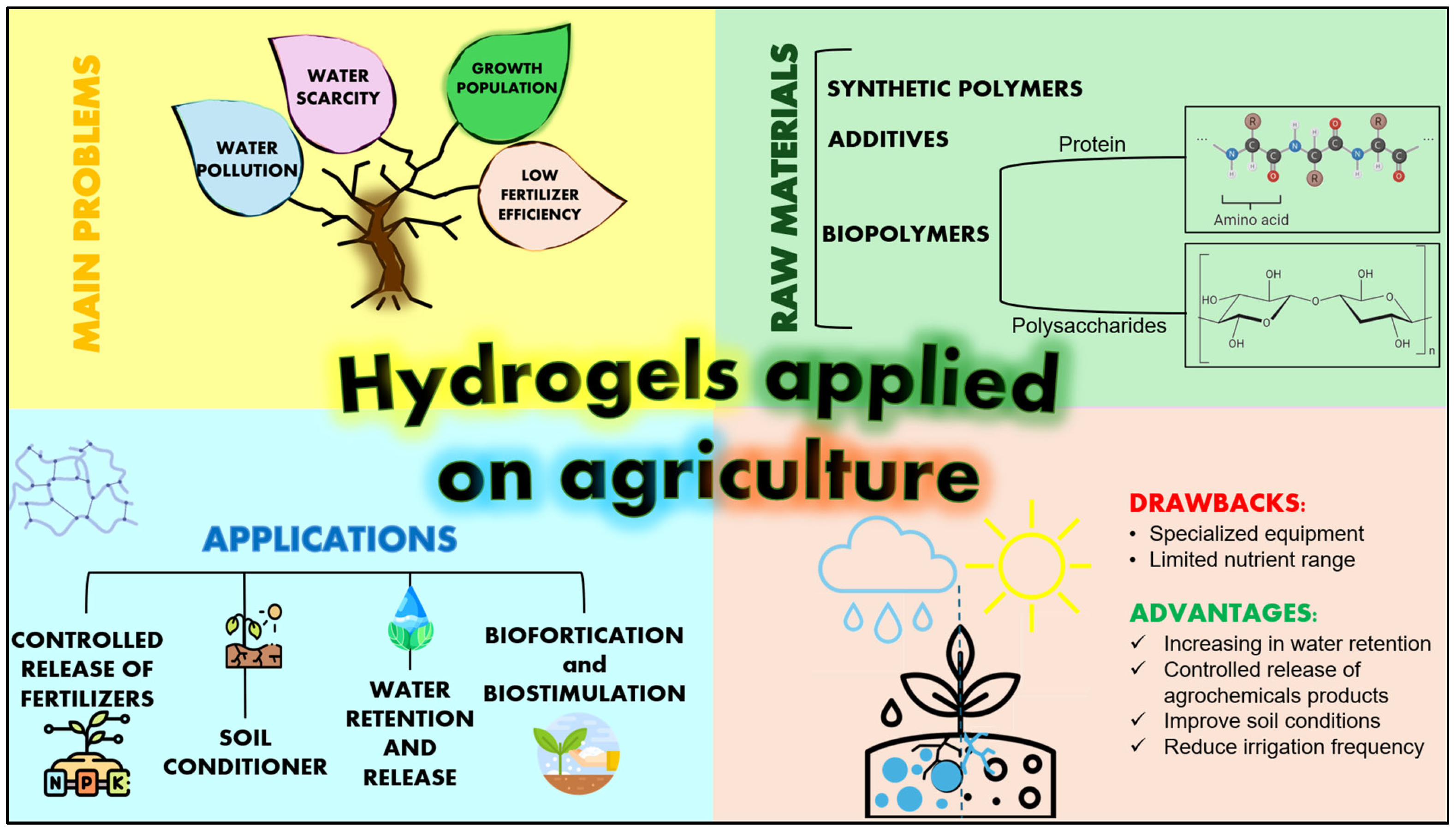


| Raw Materials | Commercial Hydrogel | Properties | Manufacturer | References |
|---|---|---|---|---|
| Potassium polyacrylate (KPA) | Plant Hydrogel; Potassium Polyacrylate | Absorbs 300 times its weight in water Enhances seed germination and root development Increases soil water retention Enhances the utilization of organic matter within the soil Decreases the loss of fertilizers | Alquera Ciencia SL (Spain) | [63] |
| TRPSORBTM | High water absorption capacity and controlled release of nutrients Long life cycle (1–3 years) Significantly increases seedling survival rate | Qingdao SOCO New Material Co., Ltd. | [64] | |
| Control Garden | Optimizes water use Suitable for hot climates Facilitates the growth of roots | GrowMania SL (Spain) | [58] | |
| Plara | Increases plant drought resistance Ensures a stable water supply for plants Improves the quality and size of fruits and vegetables | Plara Sp.z.o.o (Poland) | [59] | |
| ALSTA Hydrogel | Ability to absorb up to 500 times its weight in water Compatible with all soil and plant types | Chemtex SL (India) | [65] | |
| Potassium-based polymer | Agua Gel | Biodegradable Decrease water irrigation cycles Increase soil porosity | Novingrecons SLU (Spain) | [66] |
| Hydrolyzed gelatin | Agrogel | Enables complexation of macronutrients Controlled release of nitrogen via microbial activity Ability to absorb between 150–200% of deionized water | ILSA S.p.A (Italy) | [67] |
| Carboxymethyl cellulose-grafted anionic polyacrylate polymer | Pusa Hydrogel | High fluid absorption in the presence of fertilizers Maintains water absorption capacity at high temperatures Slow release of water Employment for an extended time | IARI, New Delhi | [68] |
| Acrylate/Acrylamide copolymer | Waterlock 93N | Absorbs 100 times the water during multiple cycles Moisture environment Biodegrades into CO2, H2O, nitrogen, etc. Can be used for 2–3 years | Acuro Organics Ltd., New Delhi | [69] |
| RAW MATERIALS FOR HYDROGELS IN AGRICULTURE | SYNTHETIC POLYMERS | Acrylic acid and acrylic derivatives | |
| Vinyl polymers | |||
| Polyethylene glycol and polyurethanes | |||
| NATURAL POLYMERS | Based on polysaccharides | Chitin and chitosan | |
| Sodium alginate | |||
| Agar | |||
| K-carrageenan | |||
| Starch | |||
| Cellulose | |||
| Lignin | |||
| Xanthan gum | |||
| Guar gum | |||
| Based on proteins | Collagen and gelatin | ||
| Keratin | |||
| Soy protein | |||
| Classification of Hydrogels | Advantages | Disadvantages |
|---|---|---|
| Synthetic polymer hydrogels |
|
|
| Natural polymer hydrogels |
|
|
| Main Polymer | Agrochemical (AC) | Release Time | Reference |
|---|---|---|---|
| Sodium alginate, acrylic acid, acrylamide | Urea | 100% within 20 days | [97] |
| Gelatin, polyacrylamide | Urea | 100% within 6 days | [296] |
| P2O5 | |||
| K2SO4 | |||
| Agar, Starch | Atrazine | 100% after 6 days | [297] |
| Gelatin, methacrylamide, agar | Linuron | 100% after 3 days | [165] |
| Sodium alginate, carboxymethyl chitosan | Urea | 75–90% after 26 days | [139] |
| Sodium alginate, starch | Diammonium hydrogen phosphate | 10–12 wt% after 30 days | [298] |
| Halloysite, sodium alginate | Urea | 100% after 36–60 h | [299] |
| Bentonite, sodium carboxymethyl cellulose | Metolachlor | 50% after 158 h | [181] |
| Starch, chitosan | Atrazine | 750 mg/0.5 g hydrogel after 750 h | [137] |
| Starch | Urea | 80–90% after 42 h | [267] |
| Starch | Urea | 80–90% after 30 days | [176] |
| Sodium alginate, starch | Urea | 100% after more than 50 days | [157] |
| Cellulose, polylactic acid | Potassium nitrate | 85% within 96 h | [300] |
| Starch, polyacrylic acid, polyvinyl alcohol | Urea | 35–75% within 30 days | [110] |
| Carboxymethyl cellulose, acrylic acid | Urea | 210–220 mg/dL hydrogel for 144 h | [86] |
| Carboxymethyl cellulose | NPK fertilizer | 72 h | [186] |
| Carboxymethyl cellulose, polyacrylic acid | Phosphorus | 27–32% after 150 min | [88] |
| Main Polymer | Conditions | Range of Days of Biodegradation | Reference |
|---|---|---|---|
| Sodium alginate, carboxymethyl cellulose | Room temperature for 30 days | 21.4–25.5% of degradation after 30 days | [139] |
| Sodium alginate, chitosan | Room temperature for 30 days | 30.2716–33.5697% of degradation after 30 days | [141] |
| Lignin and PEDGE | Room temperature for 40 days | 15–82% of degradation for 40 days | [197] |
| Xanthan gum, gelatin | Room temperature for 40 days | 65–70% mass loss after 60 days | [202] |
| Soy protein isolate, polyvinyl alcohol | Room temperature for 100 days | 65.18% mass loss after 100 days | [220] |
| Gelatin, polyvinyl alcohol | Room temperature for 28 days | 40–47% mass loss after 28 days | [215] |
| Sodium alginate, polyvinyl alcohol | Room temperature for 120 days | 36.9–47.4% weight loss after 120 days | [149] |
| Acrylic acid | 30 °C for 60 days | 63% weight loss after 60 days | [306] |
| Guar gum, pectin, acrylamide | For 30 days | 45% of the mass was degraded after 30 days | [307] |
| Sodium alginate | Room temperature for 60 days | 6% of the mass was in the first 60 days and 14% after the second 60 days | [151] |
Disclaimer/Publisher’s Note: The statements, opinions and data contained in all publications are solely those of the individual author(s) and contributor(s) and not of MDPI and/or the editor(s). MDPI and/or the editor(s) disclaim responsibility for any injury to people or property resulting from any ideas, methods, instructions or products referred to in the content. |
© 2026 by the authors. Licensee MDPI, Basel, Switzerland. This article is an open access article distributed under the terms and conditions of the Creative Commons Attribution (CC BY) license.
Share and Cite
Granados-Carrera, C.M.; Perez-Puyana, V.M.; Jiménez-Rosado, M.; Romero, A. Hydrogel Development, Processing and Applications in Agriculture: A Review. Gels 2026, 12, 259. https://doi.org/10.3390/gels12030259
Granados-Carrera CM, Perez-Puyana VM, Jiménez-Rosado M, Romero A. Hydrogel Development, Processing and Applications in Agriculture: A Review. Gels. 2026; 12(3):259. https://doi.org/10.3390/gels12030259
Chicago/Turabian StyleGranados-Carrera, Carmen Mª., Victor M. Perez-Puyana, Mercedes Jiménez-Rosado, and Alberto Romero. 2026. "Hydrogel Development, Processing and Applications in Agriculture: A Review" Gels 12, no. 3: 259. https://doi.org/10.3390/gels12030259
APA StyleGranados-Carrera, C. M., Perez-Puyana, V. M., Jiménez-Rosado, M., & Romero, A. (2026). Hydrogel Development, Processing and Applications in Agriculture: A Review. Gels, 12(3), 259. https://doi.org/10.3390/gels12030259