Review

Modified Nanocellulose Hydrogels and Applications in Sensing Fields

1
School of Textile Science and Engineering, Tiangong University, Tianjin 300387, China
2
Department of Bioinformatics and Medical Engineering, Asia University, Taichung City 413305, Taiwan
3
Fujian Key Laboratory of Novel Functional Textile Fibers and Materials, Minjiang University, Fuzhou 350108, China
4
Tianjin and Ministry of Education Key Laboratory for Advanced Textile Composite Materials, Tiangong University, Tianjin 300387, China
5
Shaoxing Keqiao Institute, Tiangong University, Shaoxing 312030, China
6
Advanced Medical Care and Protection Technology Research Center, Department of Fiber and Composite Materials, Feng Chia University, Taichung City 407102, Taiwan
7
Advanced Medical Care and Protection Technology Research Center, College of Textile and Clothing, Qingdao University, Qingdao 266071, China
*
Authors to whom correspondence should be addressed.
Gels 2025, 11(2), 140; https://doi.org/10.3390/gels11020140
Submission received: 25 December 2024 / Revised: 20 January 2025 / Accepted: 31 January 2025 / Published: 17 February 2025
(This article belongs to the Special Issue Cellulose- and Nanocellulose-Based Gels: Design and Applications)

Abstract

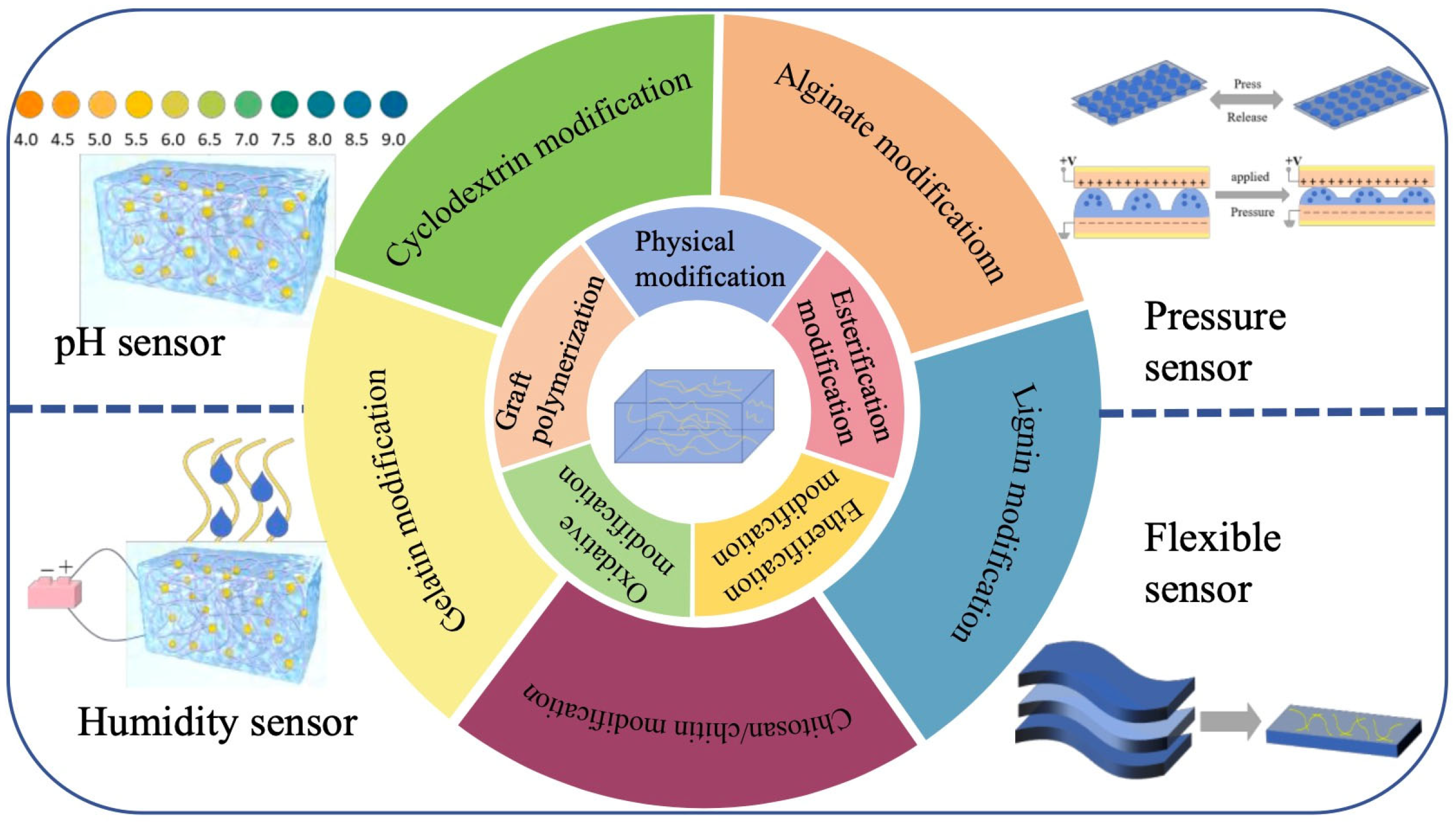
Due to the intensification of global warming and the greenhouse effect, the exploration and research of sustainable sensors have become a research direction of people. Cellulose-based hydrogels, as a new kind of green material with strong plasticity, have become a popular material for sensor development. Due to the limited mechanical properties and poor compatibility of single-cellulose-based hydrogels, researchers have modified them to not only retain the original excellent properties of cellulose hydrogels, but also increase other properties, which has broadened the field of developing cellulose hydrogel sensors. From 2017 to 2020, cellulose-based hydrogel sensors were mainly used for biosensing applications, with a focus on the detection of biomolecules. Since then, researchers have increasingly turned their attention to pressure and strain sensors, especially those that are flexible and suitable for wearable devices. This paper introduces the modification of cellulose and cellulose-based hydrogels in detail, and lists the applications of modified cellulose-based hydrogels in different functional sensor directions, which provides different ideas for the application of modified cellulose-based hydrogels in the field of sensing, and proves that they have great potential in the field of sensing.
Keywords: cellulose-based hydrogel; cellulose modification; cellulose-based hydrogel modification; sensor; pressure sensing cellulose-based hydrogel; cellulose modification; cellulose-based hydrogel modification; sensor; pressure sensing