
Establishment of a Loop-Mediated Isothermal Amplification (LAMP) Method for the Detection of Fusarium oxysporum f. sp. momordicae

Abstract
1. Introduction
2. Methods
2.1. Test Strains
2.2. Fungal Culturing and Nucleic Acid Extraction
2.3. Primer Designing and Synthesis
2.4. In Silico Validation of the Fom-Specific Marker
2.5. LAMP Reaction
2.6. Analysis of LAMP Specificity
2.7. Analysis of LAMP Sensitivity
2.8. Detection of Fom in Different Parts of Infected Bitter Gourd Seedlings by LAMP
3. Results
3.1. In Silico Validation of Marker Specificity
3.2. Screening of LAMP Primers
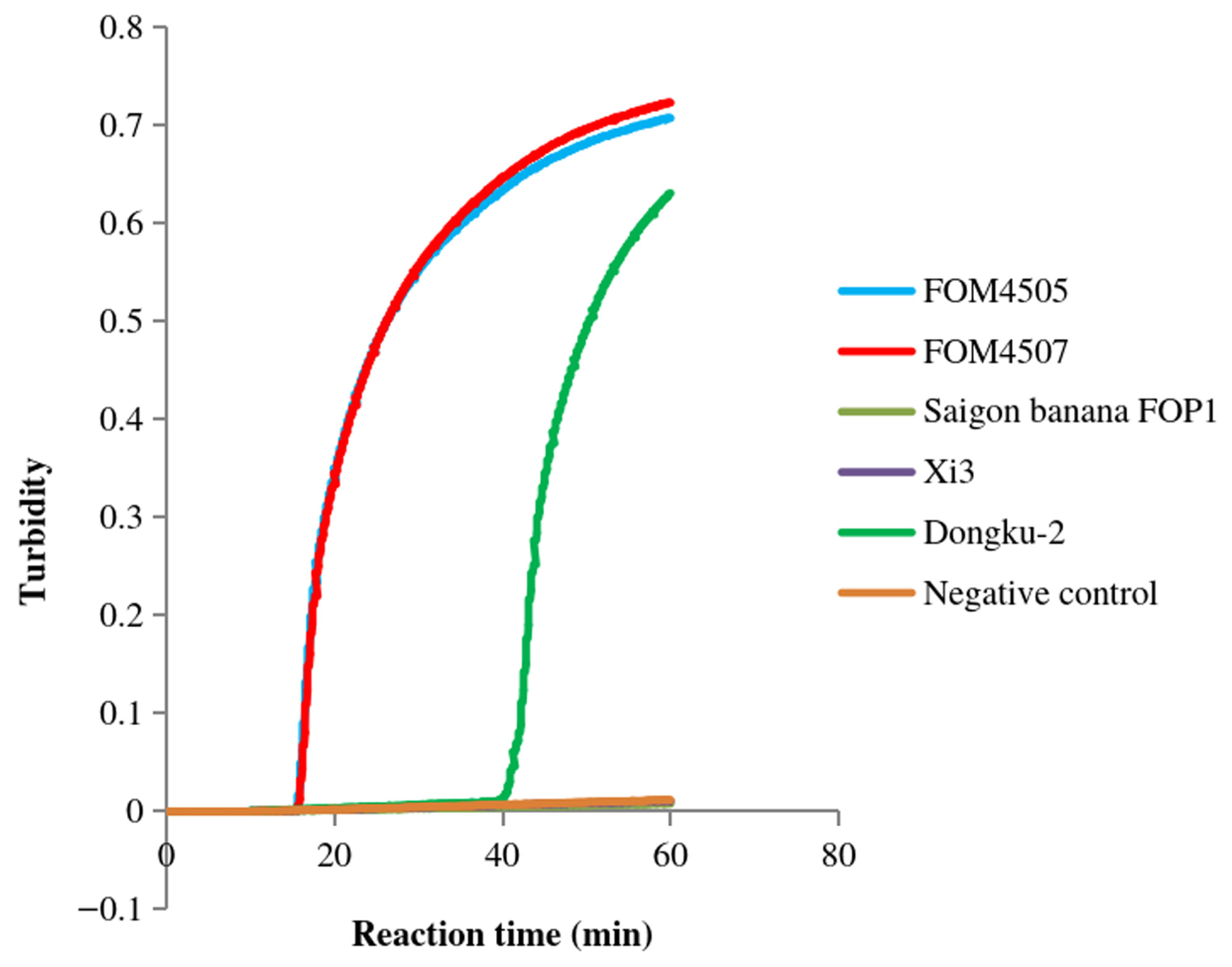
3.3. Verification of FoM-1-1 and FoM-1-2 Primers
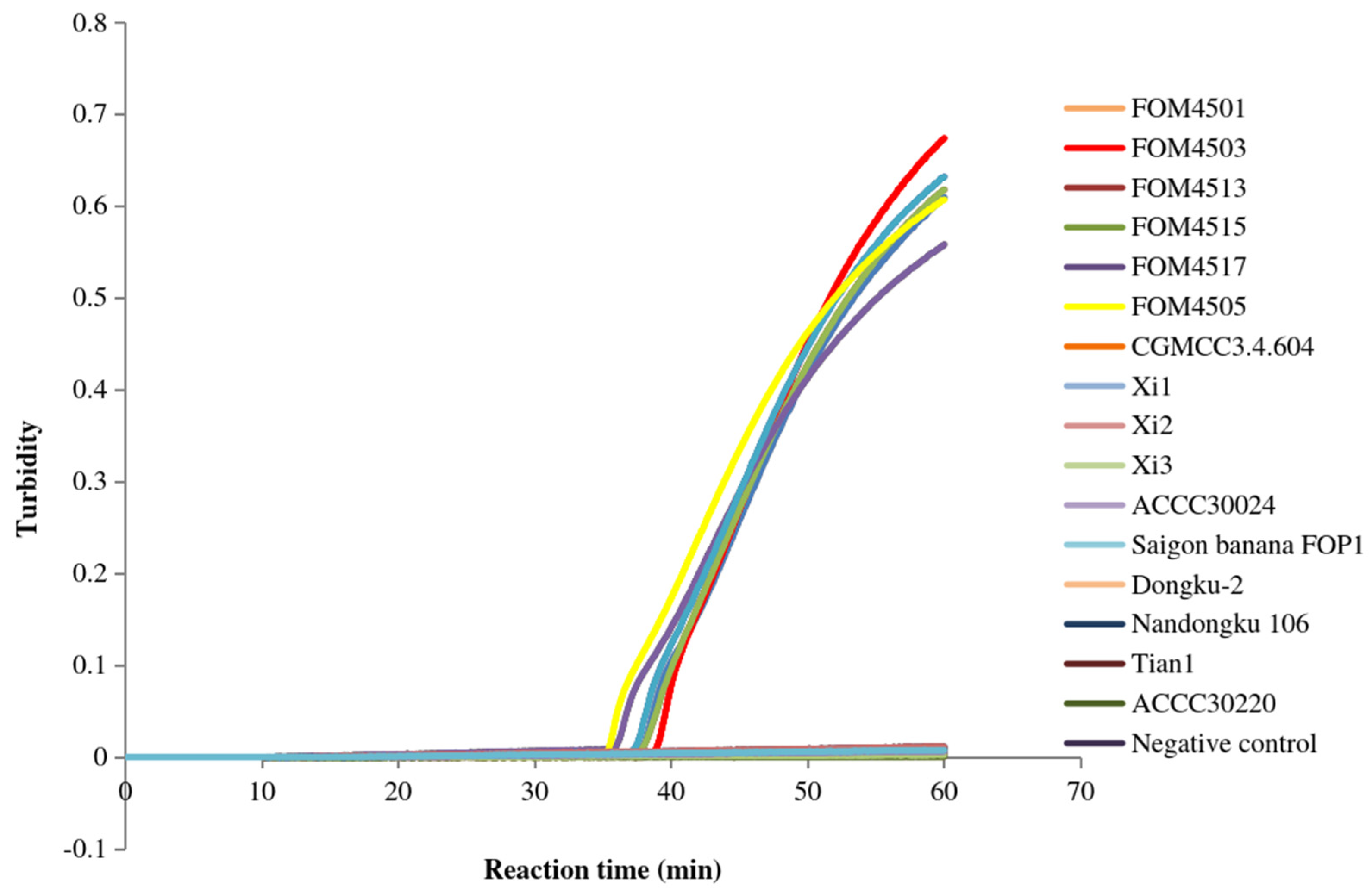
3.4. Verification of FoM-3-1, FoM-3-2, and FoM-3-3 Primers
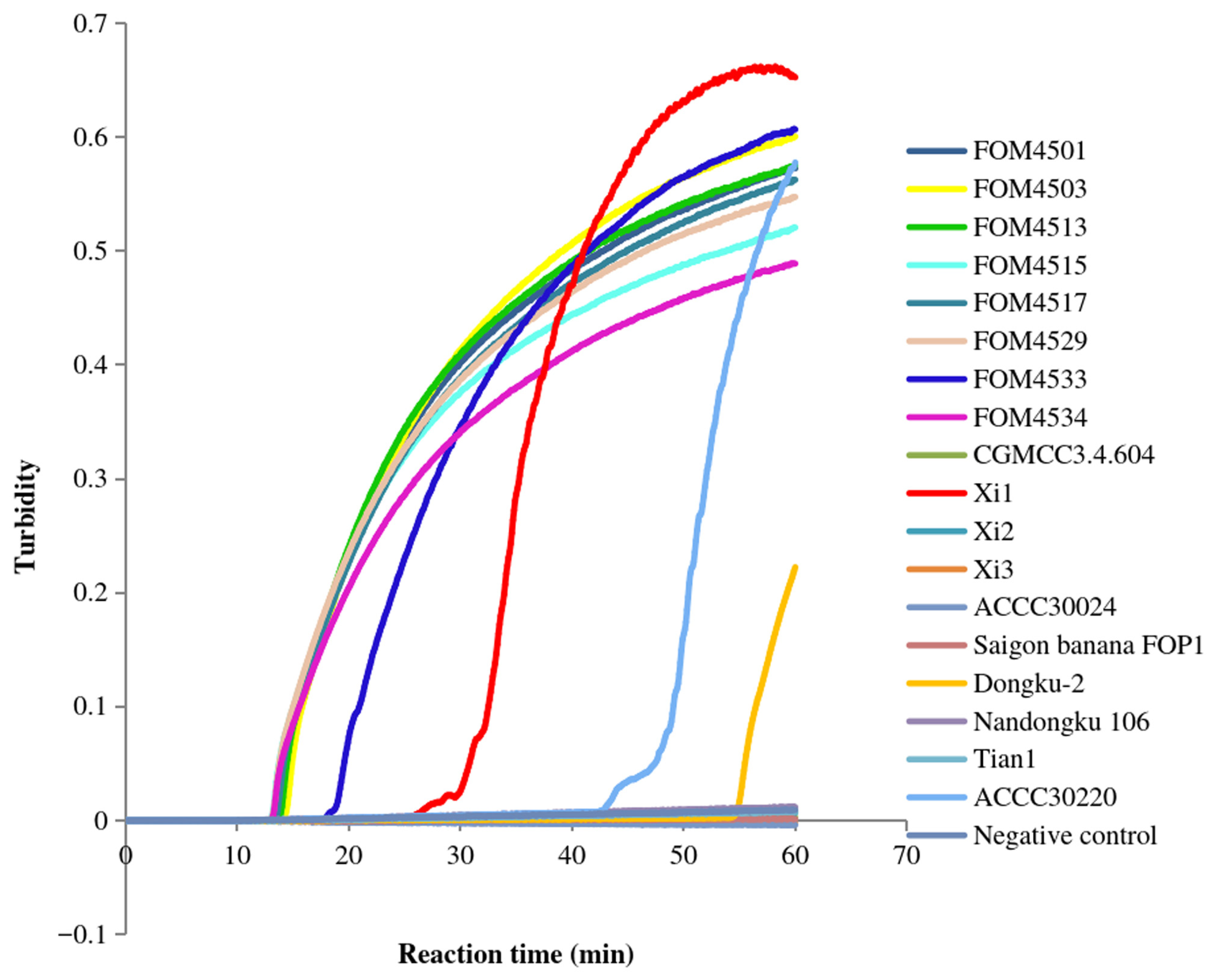
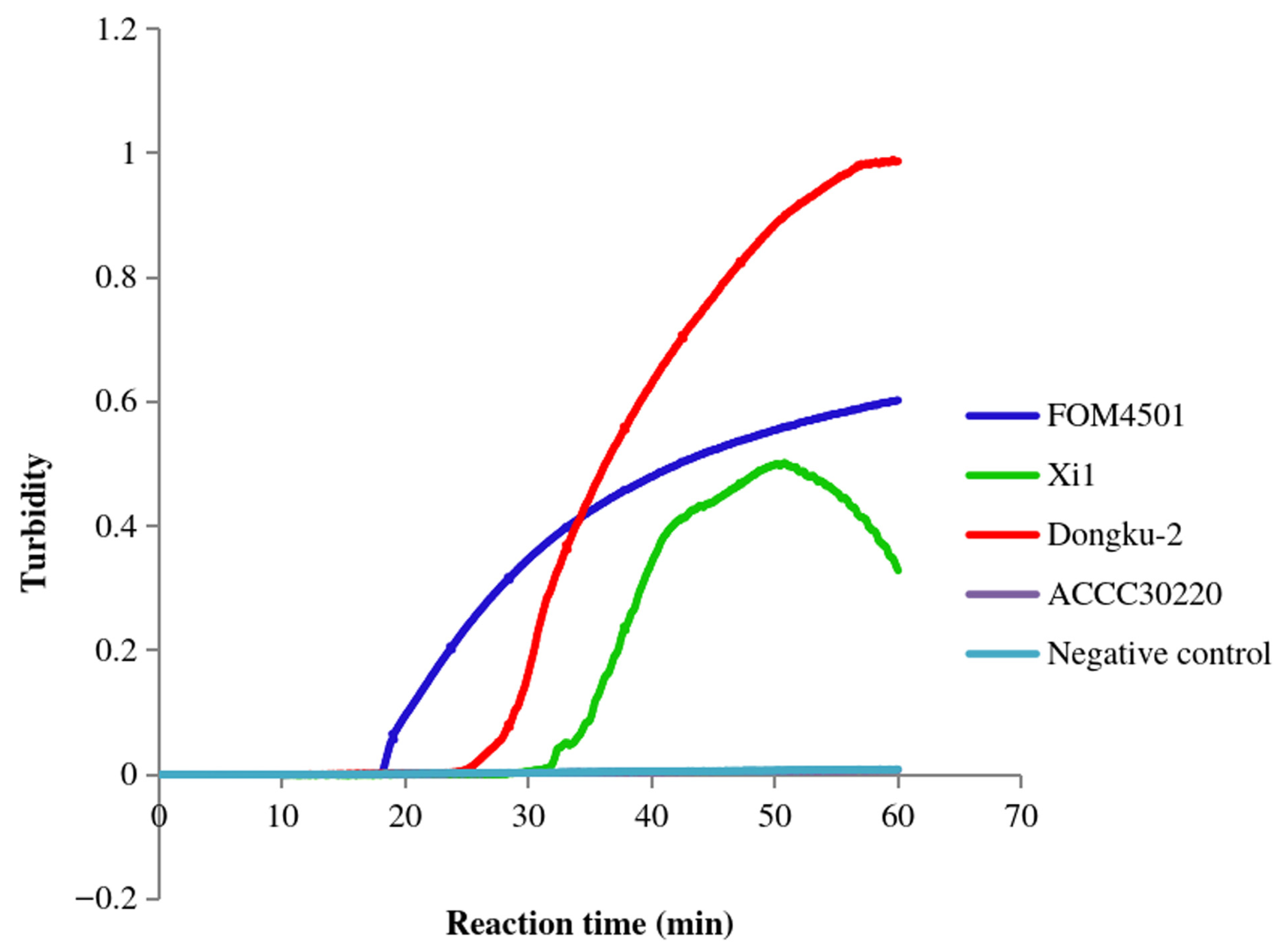
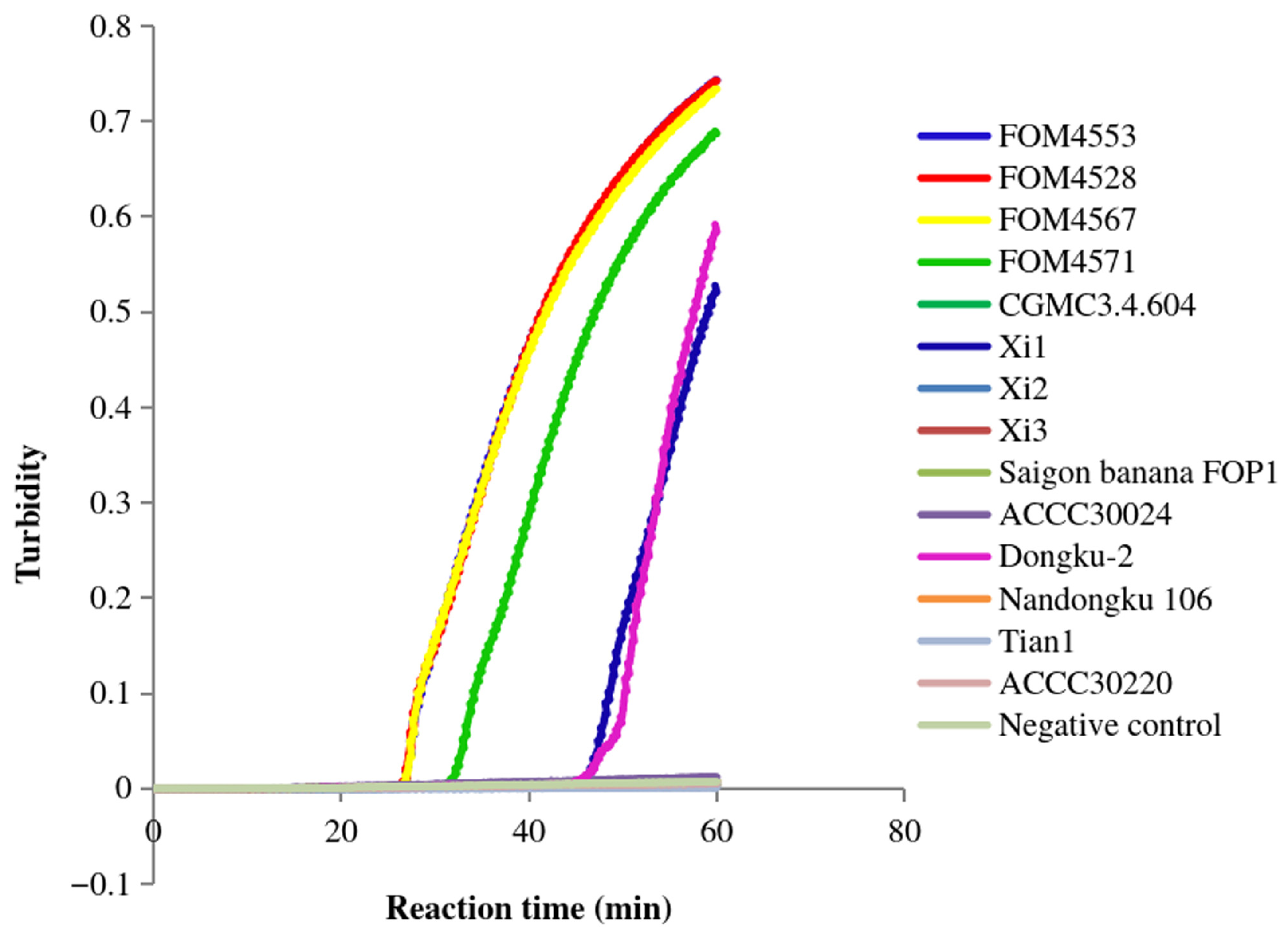
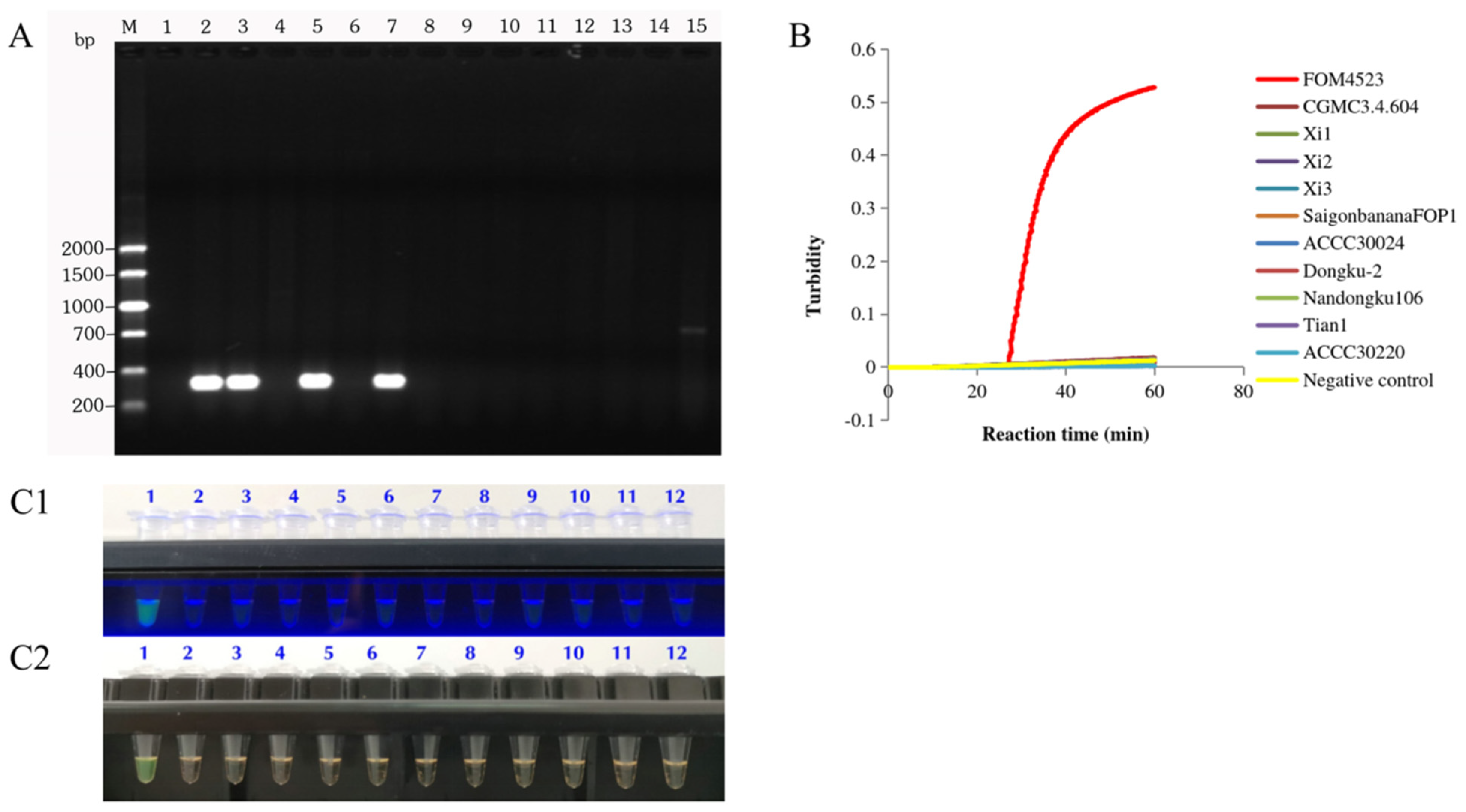
3.5. Specificity of LAMP
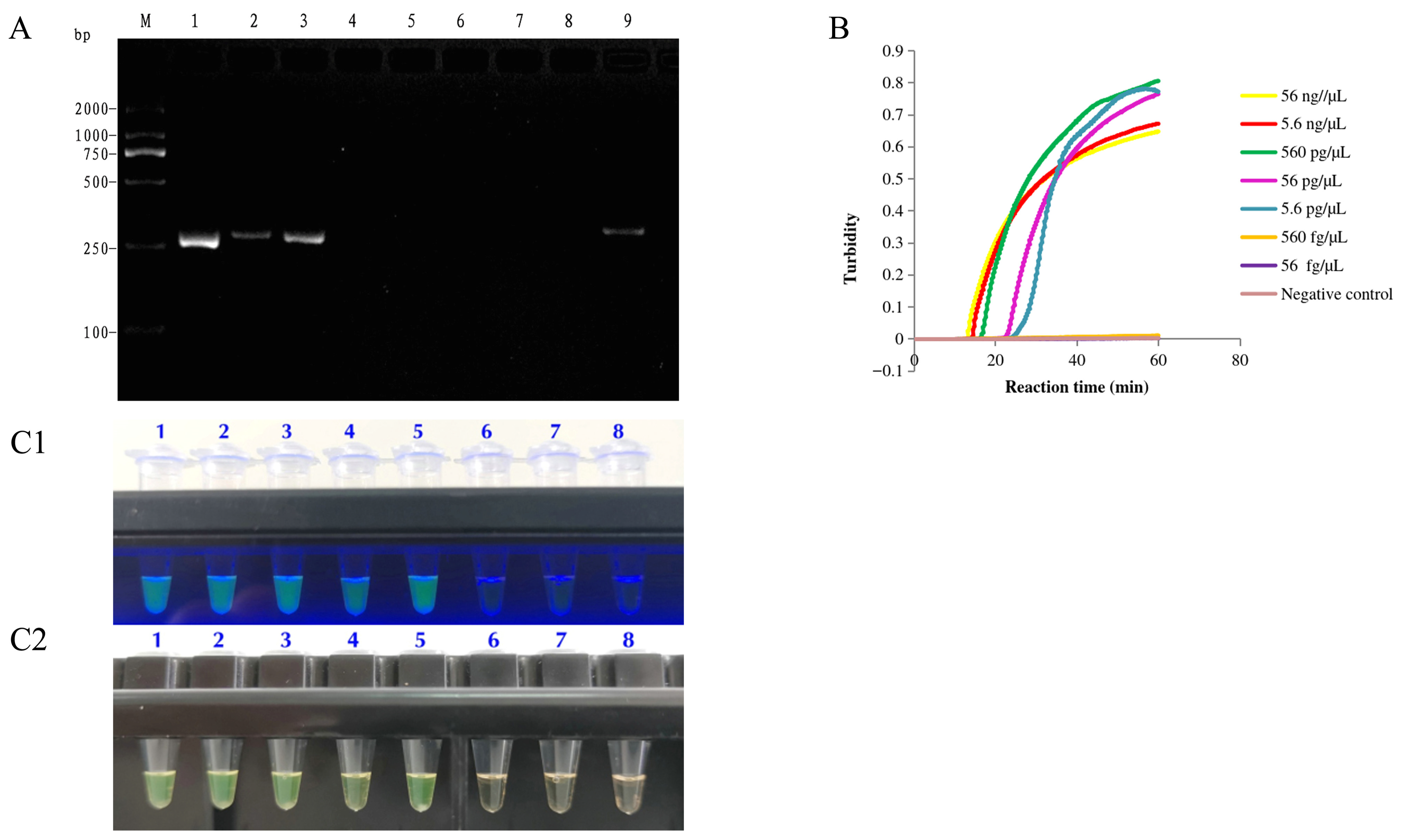
3.6. Sensitivity of LAMP
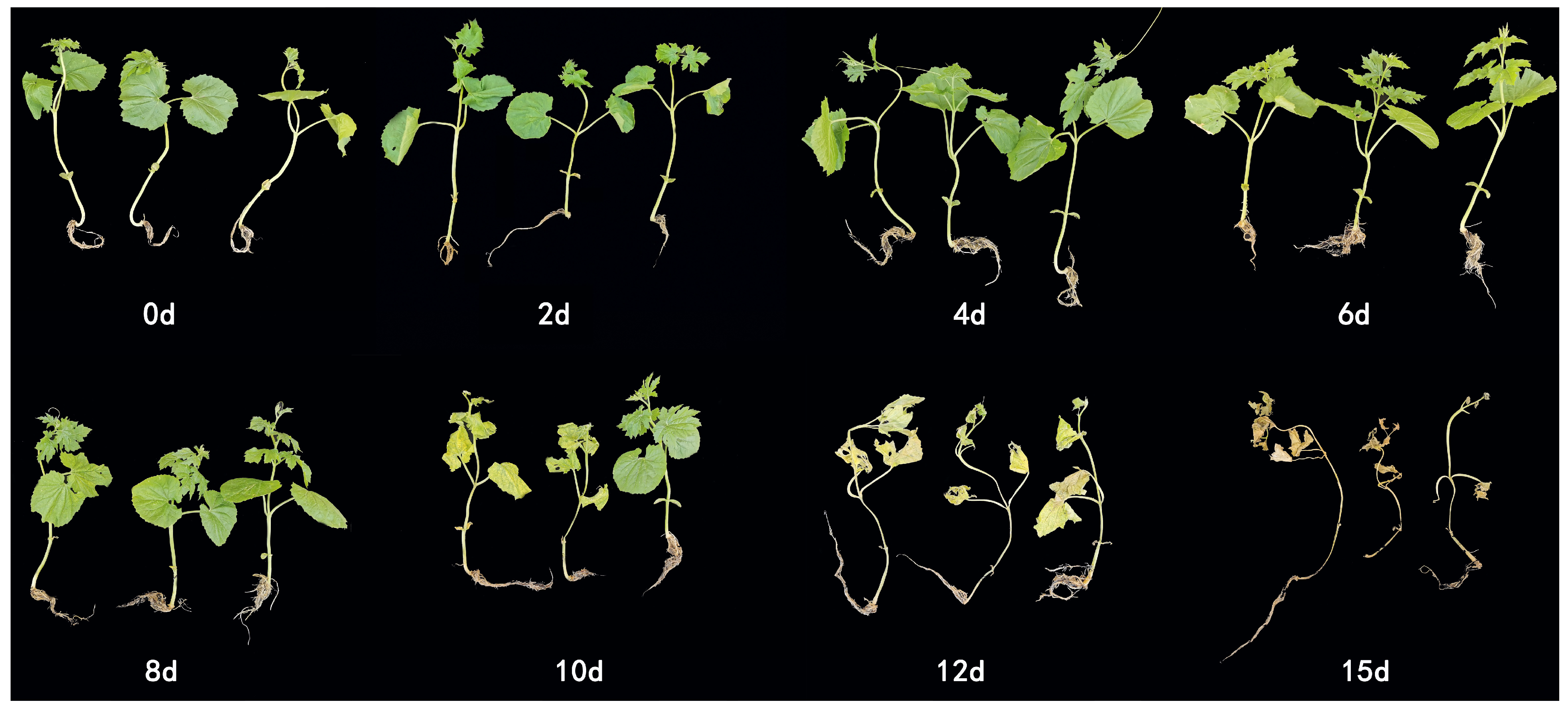
3.7. Detection of Fom in Different Parts of Infected Bitter Gourd Seedlings by the LAMP System
4. Discussion
5. Conclusions
Author Contributions
Funding
Institutional Review Board Statement
Informed Consent Statement
Data Availability Statement
Conflicts of Interest
References
- Rubatzky, V.E.; Yamaguchi, M. World Vegetables: Principles, Production, and Nutritive Values, 2nd ed.; Springer: Boston, MA, USA, 1997. [Google Scholar]
- Martin, M. Nutritional and therapeutic benefits of bitter gourd (Momordica charantia L.). Int. J. Agric. Nutr. 2024, 6, 1–3. [Google Scholar] [CrossRef]
- Fang, E.F.; Ng, T.B. Bitter gourd (Momordica charantia) is a cornucopia of health: A review of its credited antidiabetic, anti-HIV, and antitumor properties. Curr. Mol. Med. 2011, 11, 417–436. [Google Scholar] [CrossRef] [PubMed]
- Behera, T.K.; Behera, S.; Bharathi, L.K.; John, K.J.; Simon, P.W.; Staub, J.E. Bitter Gourd: Botany, Horticulture, Breeding. In Horticultural Reviews; Janick, J., Ed.; Wiley-VCH: Weinheim, Germany, 2010; Volume 37, pp. 101–141. [Google Scholar]
- Cui, J.; Yang, Y.; Luo, S.; Wang, L.; Huang, R.; Wen, Q.; Han, X.; Miao, N.; Cheng, J.; Liu, Z.; et al. Whole-genome sequencing provides insights into the genetic diversity and domestication of bitter gourd (Momordica spp.). Hortic. Res. 2020, 7, 85. [Google Scholar] [CrossRef]
- Guan, F.; Shi, B.; Zhang, J.; Wan, X. Metabolome revealed the potential mechanism of fusarium wilt resistance in bitter gourd (Momordica charantia) based on liquid chromatography with mass spectrometry. Plant Dis. 2024, 108, 920–929. [Google Scholar] [CrossRef]
- Relevante, C.A.; Cumagun, C.J.R. Control of Fusarium wilt in bittergourd and bottlegourd by biofumigation using mustard var. Monteverde. Arch. Phytopathol. Plant Prot. 2013, 46, 747–753. [Google Scholar] [CrossRef]
- Yan, X.; Guo, S.; Gao, K.; Sun, S.; Yin, C.; Tian, Y. The impact of the soil survival of the pathogen of fusarium wilt on soil nutrient cycling mediated by microorganisms. Microorganisms 2023, 11, 2207. [Google Scholar] [CrossRef]
- Arie, T. Fusarium diseases of cultivated plants, control, diagnosis, and molecular and genetic studies. J. Pest. Sci. 2019, 44, 275–281. [Google Scholar] [CrossRef] [PubMed]
- Sun, S.K. A new fusarium wilt of bitter gourd in Taiwan. Plant Dis. 1983, 67, 226–227. [Google Scholar] [CrossRef]
- Jangir, P.; Mehra, N.; Sharma, K.; Singh, N.; Rani, M.; Kapoor, R. Secreted in Xylem Genes: Drivers of Host Adaptation in Fusarium oxysporum. Front. Plant Sci. 2021, 12, 628611. [Google Scholar] [CrossRef]
- Fraser-Smith, S.; Czislowski, E.; Meldrum, R.A.; Zander, M.; O’Neill, W.; Balali, G.R.; Aitken, E.A.B. Sequence variation in the putative effector gene SIX8 facilitates molecular differentiation of Fusarium oxysporum f. sp. cubense. Plant Pathol. 2014, 63, 1044–1052. [Google Scholar] [CrossRef]
- Bates, H.J.; Pike, J.; Price, R.J.; Jenkins, S.; Connell, J.; Legg, A.; Armitage, A.; Harrison, R.J.; Clarkson, J.P. Comparative genomics and transcriptomics reveal differences in effector complement and expression between races of Fusarium oxysporum f. sp. lactucae. Front. Plant Sci. 2024, 15, 1415534. [Google Scholar] [CrossRef] [PubMed]
- Nishmitha, K.; Bashyal, B.M.; Dubey, S.C.; Kamil, D. Molecular characterization of Indian races of Fusarium oxysporum f. sp. lentis (Fol) based on secreted in Xylem (SIX) effector genes and development of a SIX11 gene-based molecular marker for specific detection of Fol. Arch. Microbiol. 2024, 206, 200. [Google Scholar] [CrossRef]
- Notomi, T. Loop-mediated isothermal amplification of DNA. Nucleic Acids Res. 2000, 28, e63. [Google Scholar] [CrossRef] [PubMed]
- Adusei-Fosu, K.; Dickinson, M. Detecting Fusarium oxysporum f. sp. elaeidis by using loop-mediated isothermal amplification. J. Plant Pathol. 2023, 105, 1637–1643. [Google Scholar] [CrossRef]
- Lan, C.Z.; Ruan, H.C.; Yang, X.J. Development of a loop-mediated isothermal amplification assay for sensitive and specific detection of Fusarium oxysporum f. sp. cucumerinum Owen. Phytoparasitica 2018, 46, 283–293. [Google Scholar] [CrossRef]
- Zhang, X.; Zhang, H.; Pu, J.; Qi, Y.; Yu, Q.; Xie, Y.; Peng, J. Development of a real-time fluorescence loop-mediated isothermal amplification assay for rapid and quantitative detection of Fusarium oxysporum f. sp. cubense tropical race 4 in soil. PLoS ONE 2013, 8, e82841. [Google Scholar] [CrossRef]
- Nagamine, K.; Hase, T.; Notomi, T. Accelerated reaction by loop-mediated isothermal amplification using loop primers. Mol. Cell. Probes 2002, 16, 223–229. [Google Scholar] [CrossRef]
- Mori, Y.; Notomi, T. Loop-mediated isothermal amplification (LAMP): A rapid, accurate, and cost-effective diagnostic method for infectious diseases. J. Infect. Chemother. 2009, 15, 62–69. [Google Scholar] [CrossRef] [PubMed]
- Tomita, N.; Mori, Y.; Kanda, H.; Notomi, T. Loop-mediated isothermal amplification (LAMP): Overview and applications. Clin. Chim. Acta 2008, 395, 89–96. [Google Scholar]
- Parida, M.; Sannarangaiah, S.; Dash, P.K.; Rao, P.V.; Morita, K. Loop mediated isothermal amplification (LAMP): A new generation of innovative gene amplification technique; perspectives in clinical diagnosis of infectious diseases. Rev. Med. Virol. 2008, 18, 407–421. [Google Scholar] [CrossRef]
- DB42/T 2346-2024; Technical Regulation for Intercropping of Greenhouse Watermelon and Bitter Gourd. Hubei Provincial Market Supervision Administration: Wuhan, China, 2024.
- Liang, H.; Li, P.; Ke, X.; Jiang, J.; Qiu, W. High-efficiency planting pattern of early spring cucumber-bitter gourd (loofah)-lettuce. J. Chang. Veg. 2018, 23, 36–39. [Google Scholar]
- Liang, T. High-efficiency cultivation technology of early spring open-field muskmelon intercropped with bitter gourd. Anhui Agric. Sci. Bull. 2024, 30, 45–49. [Google Scholar] [CrossRef]
- McKeen, C.D.; Wensley, R.N. Longevity of Fusarium oxysporum in soil tube culture. Science 1961, 134, 1528–1529. [Google Scholar] [CrossRef] [PubMed]
- Magdama, F.; Monserrate-Maggi, L.; Serrano, L.; Sosa, D.; Geiser, D.M.; Jiménez-Gasco, M.D.M. Comparative analysis uncovers the limitations of current molecular detection methods for Fusarium oxysporum f. sp. cubense race 4 strains. PLoS ONE 2019, 14, e0222727. [Google Scholar] [CrossRef]
- Chen, Z.; Huang, R.; Li, Q.; Huang, X.; Yuan, G.; Huang, Y.; Lin, W. Molecular Markers of Fusarium oxysporum f. sp. momordicae and Their Application. CN 103060322B, 23 July 2014. [Google Scholar]
- Kangdi, G.; Ying, Z.; Zhen, L.; Shengli, D.; Wen, C. Development of a specific detection technique for bitter gourd fusarium wilt pathogen based on URP-PCR polymorphic fragments. Acta Phytopathol. Sin. 2019, 49, 306–313. [Google Scholar] [CrossRef]
- Duan, Y.; Yang, Y.; Wang, Y.; Pan, X.; Wu, J.; Cai, Y.; Li, T.; Zhao, D.; Wang, J.; Zhou, M. Loop-Mediated Isothermal Amplification for the Rapid Detection of the F200Y Mutant Genotype of Carbendazim-Resistant Isolates of Sclerotinia sclerotiorum. Plant Dis. 2016, 100, 976–983. [Google Scholar] [CrossRef]
- Dai, X.; Cao, Y.; Yu, M.; Hou, M.; Li, H.; Li, J.; Li, H.; Li, P.; Wang, Z.; Zhang, X. Rapid and quantitative detection of Aspergillus niger Van Tieghem using loop-mediated isothermal amplification assay. J. Plant Pathol. 2024, 106, 1603–1614. [Google Scholar] [CrossRef]
- Ren, L.Y.; Wen, K.; Cheng, B.P.; Jin, J.H.; Srivastava, V.; Chen, X.R. Rapid detection of the phytopathogenic oomycete Phytopythium helicoides with a visualized loop-mediated isothermal amplification assay. Braz. J. Microbiol. 2025, 56, 563–572. [Google Scholar] [CrossRef] [PubMed]
- Siegieda, D.; Panek, J.; Frąc, M. “Shining a LAMP” (loop-mediated isothermal amplification) on the molecular detection of phytopathogens Phytophthora sp. and Phytophthora cactorum in strawberry fields. Pathogens 2021, 10, 1453. [Google Scholar] [CrossRef]
- Deng, S.; Ma, X.; Chen, Y.; Feng, H.; Zhou, D.; Wang, X.; Zhang, Y.; Zhao, M.; Zhang, J.; Daly, P.; et al. LAMP assay for distinguishing Fusarium oxysporum and Fusarium commune in lotus (Nelumbo nucifera) rhizomes. Plant Dis. 2022, 106, 231–246. [Google Scholar] [CrossRef] [PubMed]
- Scarlett, K.; Tesoriero, L.; Daniel, R.; Guest, D. Detection and quantification of Fusarium oxysporum f. sp. cucumerinum in environmental samples using a specific quantitative PCR assay. Eur. J. Plant Pathol. 2013, 137, 315–324. [Google Scholar] [CrossRef]
- Su, M.; Xiao, R.; Zhu, Y.; Huang, S.; Liu, B. Identification of the pathogen causing bitter gourd wilt and determination of fungal biomass in plants. China Veg. 2010, 62–66. [Google Scholar] [CrossRef]
- Lan, J.; Su, M.; Ge, C.; Xiao, R.; Lin, K.; Zhu, Y. Correlation between the distribution of Fusarium oxysporum and the progression of watermelon wilt disease. Chin. Agric. Sci. Bull. 2007, 23, 302–305. [Google Scholar]



| Number | Isolate | Scientific Name | Host | Source |
|---|---|---|---|---|
| 1 | FOM4505 | F. oxysporum momordicae | Bitter gourd | Nanning, Guangxi, China |
| 2 | FOM4507 | F. oxysporum momordicae | Bitter gourd | Nanning, Guangxi, China |
| 3 | FOM4514 | F. oxysporum momordicae | Bitter gourd | Nanning, Guangxi, China |
| 4 | FOM4522 | F. oxysporum momordicae | Bitter gourd | Wuming, Guangxi, China |
| 5 | FOM4530 | F. oxysporum momordicae | Bitter gourd | Beihai, Guangxi, China |
| 6 | FOM4523 | F. oxysporum momordicae | Bitter gourd | Wuming, Guangxi, China |
| 7 | FOM4552 | F. oxysporum momordicae | Bitter gourd | Wutang, Guangxi, China |
| 8 | FOM518 | F. oxysporum momordicae | Bitter gourd | Nanning, Guangxi, China |
| 9 | FOM4535 | F. oxysporum momordicae | Bitter gourd | Nanning, Guangxi, China |
| 10 | FOM4582 | F. oxysporum momordicae | Bitter gourd | Fuzhou, Fujian, China |
| 11 | FOM4598 | F. oxysporum momordicae | Bitter gourd | Nanning, Guangxi, China |
| 12 | FOM4569 | F. oxysporum momordicae | Bitter gourd | Nanning, Guangxi, China |
| 13 | FOM4516 | F. oxysporum momordicae | Bitter gourd | Hengyang, Hunan, China |
| 14 | FOM4519 | F. oxysporum momordicae | Bitter gourd | Wuming, Guangxi, China |
| 15 | FOM4527 | F. oxysporum momordicae | Bitter gourd | Nanning, Guangxi, China |
| 16 | FOM4506 | F. oxysporum momordicae | Bitter gourd | Nanning, Guangxi, China |
| 17 | FOM4520 | F. oxysporum momordicae | Bitter gourd | Wuming, Guangxi, China |
| 18 | FOM4532 | F. oxysporum momordicae | Bitter gourd | Nanning, Guangxi, China |
| 19 | FOM4578 | F. oxysporum momordicae | Bitter gourd | Guangzhou, Guangdong, China |
| 20 | FOM4546 | F. oxysporum momordicae | Bitter gourd | Nanning, Guangxi, China |
| 21 | FOM4577 | F. oxysporum momordicae | Bitter gourd | Nanning, Guangxi, China |
| 22 | FOM4549 | F. oxysporum momordicae | Bitter gourd | Nanning, Guangxi, China |
| 23 | FOM4575 | F. oxysporum momordicae | Bitter gourd | Nanning, Guangxi, China |
| 24 | FOM4563 | F. oxysporum momordicae | Bitter gourd | Lingchuan, Guangxi, China |
| 25 | FOM4521 | F. oxysporum momordicae | Bitter gourd | Wuming, Guangxi, China |
| 26 | FOM4561 | F. oxysporum momordicae | Bitter gourd | Wutang, Guangxi, China |
| 27 | FOM4536 | F. oxysporum momordicae | Bitter gourd | Nanning, Guangxi, China |
| 28 | FOM4525 | F. oxysporum momordicae | Bitter gourd | Nanning, Guangxi, China |
| 29 | FOM4550 | F. oxysporum momordicae | Bitter gourd | Wutang, Guangxi, China |
| 30 | FOM4558 | F. oxysporum momordicae | Bitter gourd | Wutang, Guangxi, China |
| 31 | FOM4553 | F. oxysporum momordicae | Bitter gourd | Wutang, Guangxi, China |
| 32 | FOM4528 | F. oxysporum momordicae | Bitter gourd | Nanning, Guangxi, China |
| 33 | FOM4567 | F. oxysporum momordicae | Bitter gourd | Nanning, Guangxi, China |
| 34 | FOM4571 | F. oxysporum momordicae | Bitter gourd | Nanning, Guangxi, China |
| 35 | FOM4509 | F. oxysporum momordicae | Bitter gourd | Nanning, Guangxi, China |
| 36 | FOM4572 | F. oxysporum momordicae | Bitter gourd | Nanning, Guangxi, China |
| 37 | FOM4501 | F. oxysporum momordicae | Bitter gourd | Nanning, Guangxi, China |
| 38 | FOM4503 | F. oxysporum momordicae | Bitter gourd | Nanning, Guangxi, China |
| 39 | FOM4513 | F. oxysporum momordicae | Bitter gourd | Nanning, Guangxi, China |
| 40 | FOM4529 | F. oxysporum momordicae | Bitter gourd | Nanning, Guangxi, China |
| 41 | FOM4517 | F. oxysporum momordicae | Bitter gourd | Nanning, Guangxi, China |
| 42 | FOM4534 | F. oxysporum momordicae | Bitter gourd | Nanning, Guangxi, China |
| 43 | FOM4515 | F. oxysporum momordicae | Bitter gourd | Nanning, Guangxi, China |
| 44 | FOM4533 | F. oxysporum momordicae | Bitter gourd | Yulin, Guangxi, China |
| 45 | ACCC30024 | F. oxysporum niveum | Watermelon | ACCC |
| 46 | Xi1 | F. oxysporum niveum | Watermelon | Nanning, Guangxi, China |
| 47 | Xi2 | F. oxysporum niveum | Watermelon | Beihai, Guangxi, China |
| 48 | Xi3 | F. oxysporum niveum | Watermelon | Guangzhou, Guangdong, China |
| 49 | Tian1 | F.oxysporum melonis | Melon | Laibing, Guangxi, China |
| 50 | ACCC30220 | F. oxysporum cucumerinum | Cucumber | ACCC |
| 51 | Saigon banana FOP1 | F. oxysporum cubense | Saigon banana | Nanning, Guangxi, China |
| 52 | Dongku-2 | F.oxyspoorum benincasae | Wax gourd | Nanning, Guangxi, China |
| 53 | Nandongku 106 | F.oxyspoorum benincasae | Wax gourd | Nanxiao, Guangxi, China |
| 54 | CGMCC3.4.604 | F. solani | Eggplant | CGMCC |
| Group | Primers | Sequence (5′–3′) |
|---|---|---|
| FoM-1-1 | FoM-F3-1 | CGAGGCTAGCTAGCGTGA |
| FoM-B3-1 | CTCTAGAGGCGAGGGAGAG | |
| FoM-FIP-1 | AGCTGATGGCTCGACGAGCTGAGGATGCTCTTTGCCAACC | |
| FoM-BIP-1 | CCTGTTTTTGTAGCACCACCGCTGCTCGGCAGAGAACATCT | |
| FoM-LB-1 | AGATTGTTGAGGCTCATAAGCGT | |
| FoM-1-2 | FoM-F3-1 | CGAGGCTAGCTAGCGTGA |
| FoM-B3-1 | CTCTAGAGGCGAGGGAGAG | |
| FoM-FIP-1 | AGCTGATGGCTCGACGAGCTGAGGATGCTCTTTGCCAACC | |
| FoM-BIP-1 | CCTGTTTTTGTAGCACCACCGCTGCTCGGCAGAGAACATCT | |
| FoM-3-1 | FoM-F3-3 | TCAGCTCTGCCTCTTCGT |
| FoM-B3-3 | GCGTCAACAATCTTGCGATAG | |
| FoM-FIP-3 | CGGCAGAGAACATCTAGACACGCCCCCTGTTTTTGTAGCACCA | |
| FoM-BIP-3 | ACCCTCTCCCTCGCCTCTAGGCTACAGAACCAGGGGAATT | |
| FoM-LF-3 | TGAGCCTCAACAATCTTGCGG | |
| FoM-LB-3 | CTCGTCGAGCCATCTGCTC | |
| FoM-3-2 | FoM-F3-3 | TCAGCTCTGCCTCTTCGT |
| FoM-B3-3 | GCGTCAACAATCTTGCGATAG | |
| FoM-FIP-3 | CGGCAGAGAACATCTAGACACGCCCCCTGTTTTTGTAGCACCA | |
| FoM-BIP-3 | ACCCTCTCCCTCGCCTCTAGGCTACAGAACCAGGGGAATT | |
| FoM-LF-3 | TGAGCCTCAACAATCTTGCGG | |
| FoM-3-3 | FoM-F3-3 | TCAGCTCTGCCTCTTCGT |
| FoM-B3-3 | GCGTCAACAATCTTGCGATAG | |
| FoM-FIP-3 | CGGCAGAGAACATCTAGACACGCCCCCTGTTTTTGTAGCACCA | |
| FoM-BIP-3 | ACCCTCTCCCTCGCCTCTAGGCTACAGAACCAGGGGAATT | |
| PCR | FOMM—SPF | AAGGATAACGAGGCTAGCT |
| FOMM—SPR | GTATAGAGCATCTAGACACGAATGC |
| Feature | Description |
|---|---|
| Marker sequence (5′→3′) | AAGGATAACGAGGCTAGCTAGCGTGAGAGGATGCTCTTTGCCAACCACCCTTTCATTCCCCTCAAGAGCTCGTCGAGCCATCAGCTCTGCCTCTTCGTGTTTCCCCTGTTTTTGTAGCACCACCGCAAGATTGTTGAGGCTCATAAGCGTGTCTAGATGTTCTCTGCCGAGCACCCTCTCCCTCGCCTCTAGAGCTCGTCGAGCCATCTGCTCGGCTTCCTCAAAATTCCCCTGGTTCTGTAGCACTATCGCAAGATTGTTGACGCTTGCATTCGTGTCTAGATGCTCTATAC |
| Length | 293 bp |
| NCBI GenBank BLAST (E-value ≤ 1 × 10⁻⁵, coverage ≥80%) | No significant homologous matches found |
| Local alignment with other F. oxysporum formae speciales (BLASTn, E-value ≤ 1 × 10⁻⁵) | Coverage consistently <45% with multiple gaps No valid match detected in one forma specialis (similarity <60%) |
Disclaimer/Publisher’s Note: The statements, opinions and data contained in all publications are solely those of the individual author(s) and contributor(s) and not of MDPI and/or the editor(s). MDPI and/or the editor(s) disclaim responsibility for any injury to people or property resulting from any ideas, methods, instructions or products referred to in the content. |
© 2026 by the authors. Licensee MDPI, Basel, Switzerland. This article is an open access article distributed under the terms and conditions of the Creative Commons Attribution (CC BY) license.
Share and Cite
Huang, X.; Feng, C.; Ju, X.; Huang, Y.; Chen, X.; Liang, J.; Liu, X.; Chen, Z.; Huang, R. Establishment of a Loop-Mediated Isothermal Amplification (LAMP) Method for the Detection of Fusarium oxysporum f. sp. momordicae. J. Fungi 2026, 12, 378. https://doi.org/10.3390/jof12050378
Huang X, Feng C, Ju X, Huang Y, Chen X, Liang J, Liu X, Chen Z, Huang R. Establishment of a Loop-Mediated Isothermal Amplification (LAMP) Method for the Detection of Fusarium oxysporum f. sp. momordicae. Journal of Fungi. 2026; 12(5):378. https://doi.org/10.3390/jof12050378
Chicago/Turabian StyleHuang, Xiongjuan, Chengcheng Feng, Xixi Ju, Yuhui Huang, Xiaofeng Chen, Jiazuo Liang, Xinglian Liu, Zhendong Chen, and Rukui Huang. 2026. "Establishment of a Loop-Mediated Isothermal Amplification (LAMP) Method for the Detection of Fusarium oxysporum f. sp. momordicae" Journal of Fungi 12, no. 5: 378. https://doi.org/10.3390/jof12050378
APA StyleHuang, X., Feng, C., Ju, X., Huang, Y., Chen, X., Liang, J., Liu, X., Chen, Z., & Huang, R. (2026). Establishment of a Loop-Mediated Isothermal Amplification (LAMP) Method for the Detection of Fusarium oxysporum f. sp. momordicae. Journal of Fungi, 12(5), 378. https://doi.org/10.3390/jof12050378