
Article

Targeted Suppression of the Tomato Pathogen Alternaria alternata via Exogenous Application of Double-Stranded RNA

by
Andrey R. Suprun
1,*,
Stanislava A. Vinogradova
1,2,
Alina A. Beresh
1,2,
Natalia S. Chopenko
2,
Alina A. Dneprovskaya
1,2,
Evgeniya V. Trubetskaya
1,
Artem Yu. Manyakhin
1 and
Konstantin V. Kiselev
1
1
Federal Scientific Center of the East Asia Terrestrial Biodiversity, Far Eastern Branch of the Russian Academy of Sciences, 690022 Vladivostok, Russia
2
Institute of the World Ocean, Far Eastern Federal University (FEFU), 690922 Vladivostok, Russia
*
Author to whom correspondence should be addressed.
J. Fungi 2026, 12(5), 373; https://doi.org/10.3390/jof12050373
Submission received: 16 April 2026 / Revised: 12 May 2026 / Accepted: 15 May 2026 / Published: 18 May 2026
(This article belongs to the Special Issue Plant–Fungal Interactions: Molecular and Biocontrol Perspectives)

Abstract

Alternaria blight, caused by fungi of the genus Alternaria, is one of the most common and damaging diseases affecting tomatoes, leading to significant yield losses. The intensive use of chemical fungicides faces the problems of pathogen resistance development and negative environmental impacts. This study investigated the possibility of using RNA interference technology based on exogenous double-stranded RNAs (dsRNAs) to protect tomatoes against the causal agent of early blight (EB), Alternaria alternata. Key genes of the pathogen A. alternata were selected as targets: Alt-a1 (a major allergen and virulence factor), TEF1a (translation elongation factor 1-alpha) and β-Tub (β-tubulin). Specific dsRNAs were synthesized in vitro and applied to tomato plants (Solanum lycopersicum L. cv. Micro-Tom) simultaneously with inoculation of A. alternata strain C7.24-T2-L-F1 spores. Visual assessment, measurement of chlorophyll A and B, and real-time quantitative PCR analysis showed that treatment with dsRNAs targeting the Alt-a1, TEF1a and β-Tub genes significantly suppressed infection development, reducing the amount of pathogen DNA in plant tissues by 7 to 27 times depending on the dsRNA type. The most effective was dsRNA to the Alt-a1 gene. Thus, the obtained results demonstrate the promise of spray-induced gene silencing (SIGS) as a strategy for protecting tomato plants against the pathogen A. alternata.

1. Introduction

The tomato (Solanum lycopersicum L.) is one of the most widely cultivated and consumed vegetable crops in the world [1]. Phytopathogenic fungi pose is a serious threat to global food security. Among them, representatives of the genus Alternaria rank as one of the most harmful, causing early blight (EB) in tomato plants, characterized by necrotic lesions on leaves, stems, and fruits, leading to yield losses of up to 80% [2,3]. This pathogen is most dangerous in regions with high humidity and moderately warm climates, where prolonged night-time dew promotes disease development [4]. A high degree of infection leads to defoliation and significant economic losses within a short period.
Fungi of the genus Alternaria exhibit high ecological plasticity, acting as saprotrophs, endophytes, or aggressive pathogens depending on environmental conditions and genotypic characteristics [4,5]. Their ability to colonize a wide range of substrates—from plant tissues and agricultural products to soil—makes them a focus of intense research across various fields, including plant pathology, biotechnology, and ecology [6].
Controlling tomato EB has traditionally been based on the use of chemical fungicides. However, this strategy is associated with the risks of pathogen resistance development, the accumulation of toxic compounds in produce, and negative impacts on agroecosystems [7]. Regular applications at 7–10 day intervals do not always ensure effective control due to the high susceptibility of the crop and the prolonged persistence of conditions favorable for infection [4]. Furthermore, cases of Alternaria spp. resistance to fungicides have been reported, exacerbating the problem [8]. All of this highlights the need to search for alternative, environmentally safe plant protection methods [9].
A promising approach for combating tomato EB is Spray-Induced Gene Silencing (SIGS), based on the application of exogenous double-stranded RNAs (dsRNAs) to the surface of plants, followed by their penetration into plant and fungal tissues [10,11]. Once taken up by the pathogen’s cells, the dsRNA triggers the RNA interference (RNAi) mechanism. The dsRNA binds to the ribonuclease DCL, which cleaves it into small fragments, 20–25 nucleotides in length, each with two unpaired bases at the 5′ and 3′ ends. These fragments interact with the RISC complex, which cleaves one of the complementary RNA strands [12]. The resulting complex moves through the cell in search of homologous messenger RNA. Upon finding it, the AGO protein from the RISC complex cleaves the messenger RNA [10]. The specific degradation of complementary messenger RNAs leads to the suppression of vital gene expression and inhibition of infection development [13]. The high specificity of dsRNA action minimizes impact on the host plant and non-target organisms.
The effectiveness of the SIGS approach has been demonstrated in relation to protecting various crops from phytopathogenic fungi. It has been previously reported that treatment with dsRNAs targeting the CYP51 gene of Fusarium graminearum and Botrytis cinerea suppressed infection on Arabidopsis, barley, and grapevine [14,15,16]. Treatment of tomato, apple, and grape plants with dsRNAs targeting the VPS51, DCTN1, SAC1, and pgxB genes of Aspergillus niger inhibited pathogen growth and symptom development, leading to a significant reduction in lesion size compared to the control [14]. Spraying with dsRNAs against the Hsp90, EF-1α, and SDH genes of Phytophthora infestans reduced growth, sporulation, and disease development in potato [17]. However, to date, there is limited data on the use of SIGS technology on tomato plants.
In this study, we report the successful use of exogenous synthetic dsRNAs complementary to the Alt-a1, EF-1α, and β-Tub genes of the fungus A. alternata. The experiments were conducted by analyzing the expression levels of target genes, assessing the severity of early blight symptoms, and evaluating the level of A. alternata DNA amplification in tomato leaves. It was shown that the application of dsRNA led to a reduction in leaf lesion area and a significant decrease in pathogen load within plant tissues.

2. Materials and Methods

2.1. Fungal Pathogen and Plant Inoculation

Alternaria alternata (Fr.) (strain C7.24-T2-L-F1) was isolated from naturally infected tomato leaves (cv. Dessert) with early blight (EB) symptoms collected from an experimental field in the Far Eastern Federal District of Russia (longitude 43.97641661616043 and latitude 132.4808241135788) in 2024. Isolates were grown on potato dextrose agar (PDA) in 9 cm glass Petri dishes at 25 °C in a climate chamber for 7 days. The resulting pure culture was identified to the species level based on the morphological and molecular genetic markers ITS, RPB2, TEF1, and Alt-a1. The sequences of the primers used are presented in Table S1. The resulting nucleotide sequences showed 100% homology to A. alternata.
Tomato plant (Solanum lycopersicum L.) cultivar Micro-Tom was grown under controlled conditions at 25 °C, with a 16 h photoperiod, and a light intensity of ~120 μmol m−2 s−1 in a chamber (Sanyo MLR-352, Panasonic, Osaka, Japan). The seed material (obtained within the framework of the state assignment of the Ministry of Science and Higher Education of the Russian Federation (subject number 124012200181-4)) was provided by the Laboratory of Biotechnology of the Federal Scientific Center for Terrestrial Biodiversity of East Asia, Vladivostok, Russia.
A. alternata spore suspension was prepared from 7-day-old actively growing cultures by adding 5 mL of 0.01% v/v Tween 20 to a Petri dish, after which the spores were washed off by pipetting. Spore numbers were measured using a Goryaev chamber and diluted to a concentration of 2 × 10⁵ spores mL−1. Leaves of 8-week-old tomato were droplet inoculated with 1 mL of the spore suspension at a concentration of 2 × 10⁵ spores/mL. One hour after inoculation, when the applied droplets with spores had dried, the plants were treated with 100 μg of dsRNA dissolved in 1 mL of water specific for regions of the Alt-a1 (Alt-a1-dsRNA), TEF1a (TEF1a-dsRNA), and β-Tubulin (Tub2-dsRNA) gene transcripts of A. alternata. Spore inoculation without added dsRNA (Sp) served as a negative control, as did treatment with dsRNA complementary to the neomycin phosphotransferase II gene (NPTII-dsRNA), which is absent from the Alternaria and tomato genomes. For each dsRNA treatment, 100 μg of dsRNA was dissolved in 1 mL of nuclease-free water and then applied to tomato leaves. And the positive control was set by using 1 mL of a 0.2% solution of KS-carbendazim 500 g/L (Ferazim, AgroExpertGroup, Moscow, Russia), a well-known agent for controlling fungal plant pathogens that inhibits β-tubulin.
Three plants were used in a separate experiment for each treatment type. A total of three independent experiments were conducted. After inoculation, plants were incubated at 30 °C, 80–90% humidity, and a 16 h light cycle to stimulate EB development. Efficacy was assessed by the degree of suppression of necrotic symptoms caused by the A. alternata fungus on day 7 post-inoculation in Fiji software version 1.54p using the Trainable Weka Segmentation plugin [18]. This tool performs pixel-by-pixel image segmentation, combining image processing methods with machine learning algorithms. This allows for precise segmentation of diseased tissue from healthy tissue. The results are presented as a percentage, representing the ratio of the affected tissue area to the healthy tissue area.

2.2. Construction of Tub2, TEF1a and Alt-a1 Templates and Synthesis of dsRNAs

A large fragment of the targeted genes beta-tubulin (Tub2) (GenBank KY814630.1; 554 bp), translation elongation factor 1-alpha (TEF1a) (GenBank MN258358.1; 424 bp), and major allergen (Alt-a1) (GenBank MW387003.1; 512 bp) were amplified by RT-PCR using RNA samples isolated from A. alternata mycelium (strain C7.24-T2-L-F1). The primers are listed in Table S1. The RT-PCRs were performed in a Bis-M1105 Thermal Cycler (Bis-N, Novosibirsk, Russia). The RT-PCR products were subcloned into pJET1.2/blunt. The T7 promoter sequence was then introduced into the 5′ and 3′ ends of the Tub2, TEF1a, and Alt-a1 genes by PCR, using pJET1.2/blunt plasmids containing the target gene sequences as a template. The PCR program was as follows: a denaturation step for 2 min at 95 °C, then 5 cycles of 10 s at 95 °C, 10 s at 65 °C, 38 s at 72 °C, followed by 35 cycles of 10 s at 95 °C, 48 s at 72 °C, and a final step of 2 min at 72 °C. Tub2-, TEF1a-, and Alt-a1-dsRNA were then synthesized using the in vitro T7 transcription kit (Biolabmix, Novosibirsk, Russia) according to the manufacturer’s protocol and using primers containing the T7 promoter sequence at the 5′ end (Table S1). The resulting dsRNA products were analyzed by gel electrophoresis in 2% w/v agarose gels and spectrophotometrically (NanoPhotometer P330, Implen, Munich, Germany) to assess purity, integrity, and quantity.

2.3. Evaluation of the In Vitro Effect of dsRNAs on the Growth of A. alternata

The effect of dsRNAs targeting the Tub2, TEF1a, and Alt-a1 genes, as well as non-specific dsRNA targeting the NPTII gene, on the growth of A. alternata was tested in vitro using Petri dishes with potato dextrose agar (PDA) (HiMedia Laboratories, Thane, India). Samples (5 mm in diameter) were obtained from an actively growing colony of A. alternata. Each explant was placed in the center of a Petri dish, and then 100 µg (30 µL) of the respective dsRNA was immediately applied directly onto it for each treatment variant. Sterile water (30 µL) was used as a negative control. Additionally, the 0.2% solution of Ferazim (1 µL/mL) was used as a positive control. Growth dynamics were assessed by measuring the colony diameter at 1, 3, and 5 days post-dsRNA application. A total of six treatments were evaluated: (i) water (negative control); (ii) dsRNA targeting the Alt-a1 gene (Alt-a1-dsRNA); (iii) dsRNA targeting the TEF1a gene (EF1-dsRNA); (iv) dsRNA targeting the β-Tub gene (Tub-dsRNA); (v) non-specific dsRNA targeting the NPTII gene (NPTII-dsRNA); (vi) 0.2% solution of KS-carbendazim 500 g/L (positive control).

2.4. DNA/RNA Isolation and Reverse Transcription Reaction

DNA was isolated from 50 mg of tomato leaves according to the method described by Echt et al. in 1992 [19], with some modifications. Briefly, 800 μL of Echta’s buffer was added to a test tube and placed in a thermostat at 60 °C. The tissue was placed in a mortar and ground with a pestle with the addition of 800 μL of the incubated Echta’s buffer; then, the contents were transferred to 1.5 mL test tubes. The tubes were incubated for 1–1.5 h in a thermostat at 60 °C, stirring regularly. After incubation, 300 μL of chloroform were added and mixed for 5 min. Then, the tube was centrifuged for 5 min at 13,000× g and 420 μL of the supernatant was collected in a new tube. 950 μL of ethyl alcohol was added and the tube was incubated at −20 °C for 20 min. Then, it was centrifuged for 7 min at 13,000× g. The alcohol was decanted and the DNA precipitate was dried for 15–20 min. The dried precipitate was dissolved in 100–150 µL of water. DNA concentration was measured using a NanoPhotometer P330 spectrophotometer (Implen, Munich, Germany).
For RNA extraction, diseased tomato leaves were collected seven days after inoculation. Total RNA was extracted as described previously [20]. cDNAs were synthesized using the MMLV RT Kit (Eurogen, Moscow, Russia). Reactions were carried out in a 40 μL reaction mixture that included first-strand buffer, 4 μL dNTP mix (10 mM each), 1.5 μL oligo-(dT)15 primer (100 μM), 4 μL DTT (dithiothreitol, 20 mM), and 3.4 μL MMLV reverse transcriptase (100 U/μL) at 37 °C for 80 min. The resulting products were then PCR-amplified and tested using primers for the tomato Actin gene (NM_001330119.1) and the A. alternata glyceraldehyde-3-phosphate dehydrogenase (AaGAPDH) gene (KJ717959.1) (Table S1).

2.5. Quantitative Real-Time Polymerase Chain Reaction (qRT-PCR)

The expression levels of Alt-a1, TEF1a, and Tub2 were analyzed by qRT-PCR using SYBR Green I dye and a real-time PCR kit (Evrogen, Moscow, Russia) using two internal controls (AaActin and AaGAPDH). The expression was calculated by the 2−∆∆CT method [21]. All gene identification numbers and used primers are listed in Table S1. qRT-PCR data shown were obtained from at least three experiments and are averages of 6 technical replicates for each experiment.
To quantify A. alternata DNA and assess the pathogen’s development in plant tissues, qRT-PCR was performed. Specific primers for A. alternata target genes (Alt-a1, EF-1α, ITS, GAPDH), as well as tomato housekeeping genes (SlUbi, SlAct), were developed specifically for RT-PCR (Table S1). DNA isolated from tomato leaves affected by Alternaria leaf spot was used as internal standards to construct a calibration curve. The resulting amplification levels for A. alternata sequences were divided by the values obtained for the SlUbi and SlAct genes from the corresponding samples. Sixteen technical replicates (eight qRT-PCR reactions normalized to the SlUbi (Solyc07g064130.1) gene region and eight qRT-PCR reactions to SlAct (Solyc04g011500.2)) were used to quantify the amplification of the studied sequences.

2.6. Chlorophyll Extraction and Quantification

Extraction and quantification of chlorophyll in leaves were performed according to a modified protocol [22]. Briefly, leaf samples were lyophilized to eliminate the effect of leaf moisture. Amounts of dried and crushed leaves (0.5 g) were transferred to a test tube and 10 mL of 80% v/v acetone were added. The samples were incubated in the dark at room temperature for 6 h, shaking the tube once an hour during the extraction period, until the crushed leaves became bleached. Absorbance at 646 nm and 663 nm was determined using a Spectrostar nano spectrophotometer (BMG Labtech, Ortenberg, Germany). Three biological replicates were used for each sample. The chlorophyll a and b contents were calculated using the following formulas: CA = (12.25 × A663 − 2.79 × A646) × V/(1000 × W); CB = (21.50 × A646 − 5.10 × A663) × V/(1000 × W), where V is the volume of the extraction solution and W is the weight of the sample in grams.

2.7. Statistical Analysis

The data, presented as mean ± standard error (SE), were subjected to a one-way analysis of variance (ANOVA) followed by Tukey’s pairwise comparison test. The 0.05 level was selected as the point of minimal statistical significance. For each type of analysis, at least three independent experiments were performed, each with several technical replicates.

3. Results

3.1. In Vitro Evaluation of Exogenous dsRNA Efficacy

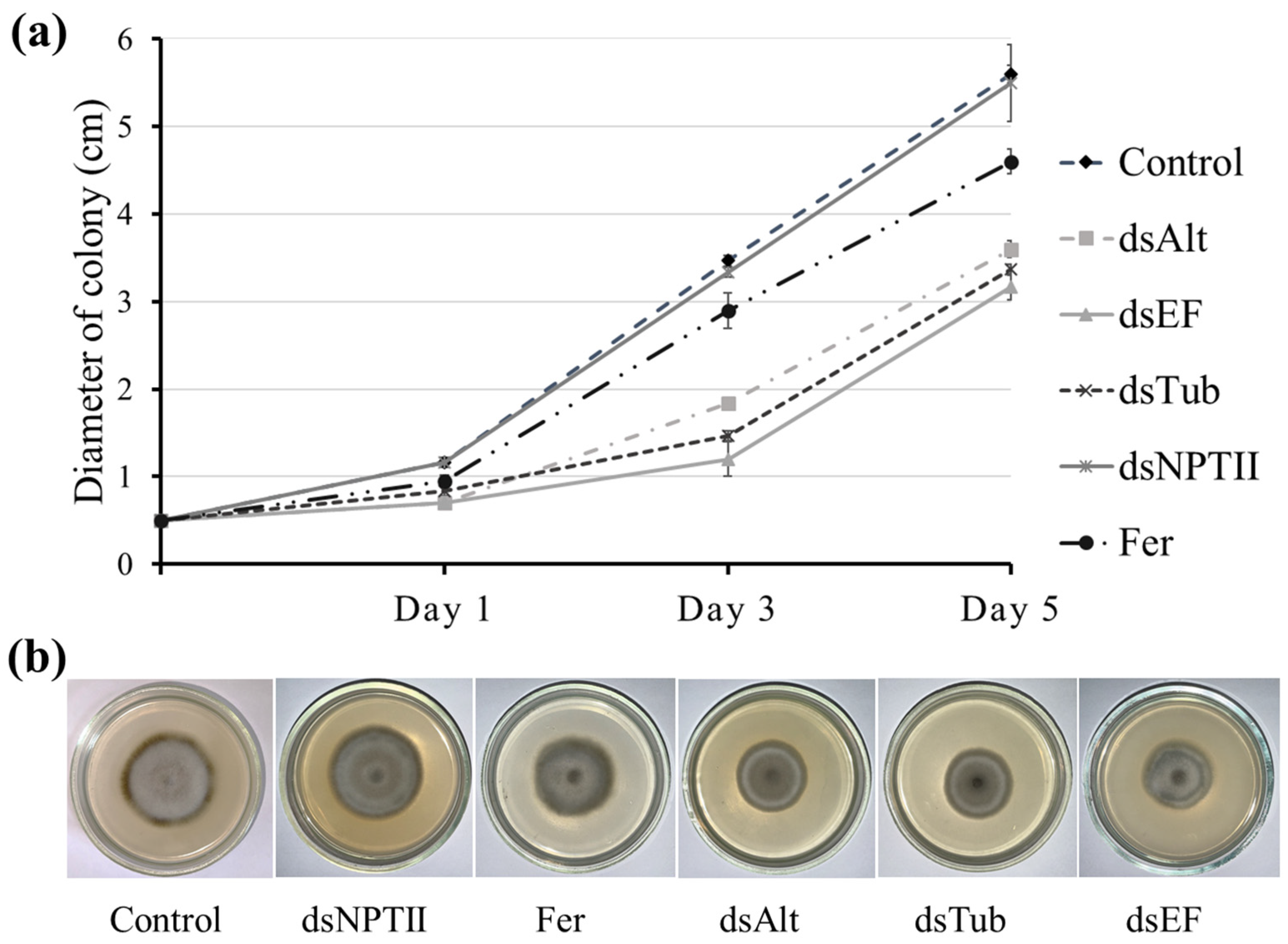
Following the production of specific dsRNAs, their ability to inhibit the growth of A. alternata was assessed under in vitro conditions on Petri dishes. As a negative control, colonies were treated with 1 mL of sterile water. To compare the efficacy of the tested dsRNAs with a traditional plant protection approach, 1 mL of a 0.2% carbendazim fungicide solution was used. Carbendazim is a systemic, broad-spectrum agent from the benzimidazole class, commonly applied to control EB on tomatoes [23]. To confirm the specificity of the RNA interference effect, an additional control was included using 100 μg of dsRNA complementary to the NPTII gene, which is absent from the genomes of both the fungus and the tomato plant. It was shown that A. alternata colonies subjected to a single treatment with 100 μg of Tub2-, TEF1a-, or Alt-a1-dsRNA demonstrated a significant reduction in growth rate over the 5-day experiment compared to colonies treated with water, NPTII-dsRNA, or the fungicide (Figure 1a,b).

3.2. Protective Effect of Exogenous dsRNA Against A. alternata in Tomato Plants

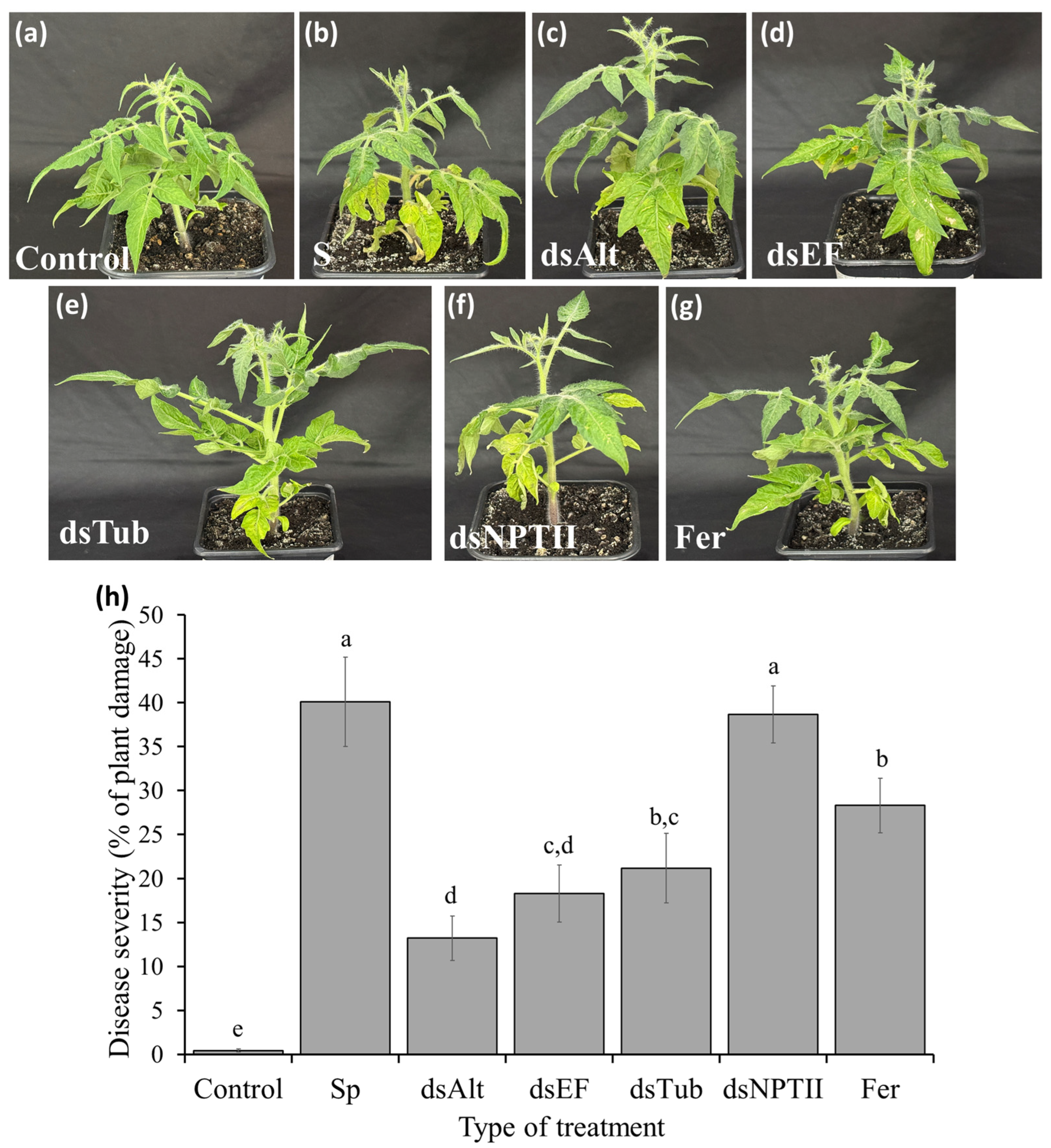
To assess the fungicidal potential of specific Tub2-, TEF1a-, and Alt-a1-dsRNA, a series of experiments was conducted on tomato plants. It was found that co-application of A. alternata spores with the target-specific dsRNAs led to a significant suppression of EB symptoms (Figure 2). The highest efficacy was demonstrated by the Alt-a1-dsRNA treatment, where the affected area of tomato leaves was reduced by 3 times compared to control plants inoculated with pathogen spores only (Figure 2b,h). The application of Tub2- and TEF1a-dsRNA also resulted in a significant reduction in leaf damage, by 1.8 and 2.2 times, respectively, compared to the control (Figure 2c,d,h). The use of NPTII-dsRNA did not have a significant effect on disease development. This indicates the specificity of the dsRNA action on the target gene sequences of the pathogen. Notably, the application of 0.2% solution of KS-carbendazim reduced the affected leaf area by only 1.4 times, which is lower than the efficacy achieved with all three specific dsRNA constructs (Figure 2g,h).

3.3. Chlorophyll Content

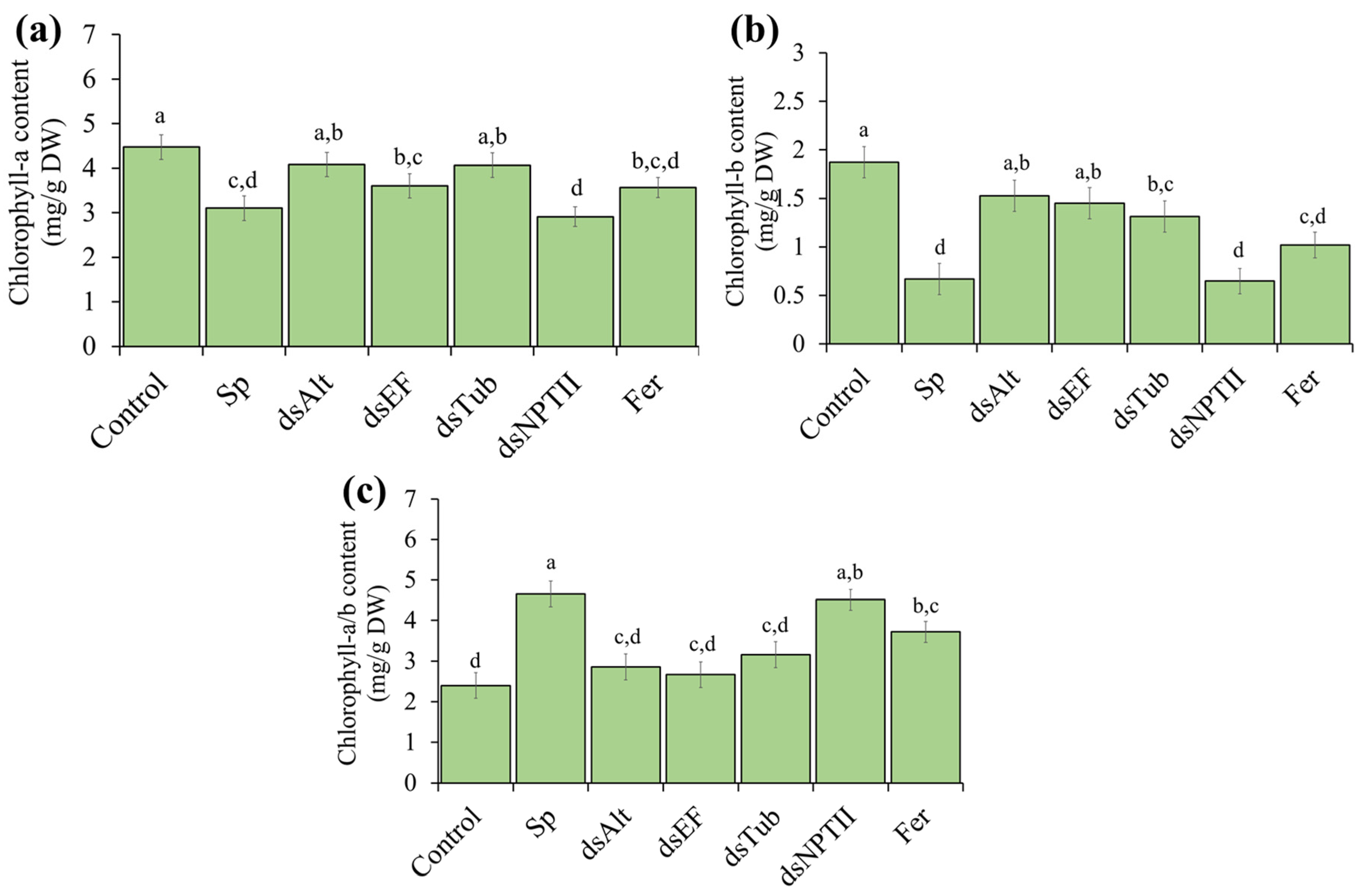
Physiological reactions and the ability of plants to withstand stress significantly affect the chlorophyll content [24]. Therefore, we next assessed the chlorophyll-a and chlorophyll-b content in tomato leaves after inoculation with A. alternata spores both alone and in combination with Tub2-dsRNA, TEF1a-dsRNA, Alt-a1-dsRNA, NPTII-dsRNA and 2% solution of the fungicide Ferazim (carbendazim 500 g/L).
Both chlorophyll-a and chlorophyll-b content were significantly reduced after inoculation with spores and after treatment with NPTII-dsRNA (Figure 3a). However, with the use of specific Tub2-dsRNA, TEF1a-dsRNA and Alt-a1-dsRNA the reduction in chlorophyll content was less pronounced.
The chlorophyll a/b ratio in tomato leaves increased significantly after spore inoculation and NPTII-dsRNA treatment compared to the control (Figure 3c). In contrast, the chlorophyll a/b ratio did not change significantly after Tub2-, TEF1a-, and Alt-a1-dsRNAs treatment (Figure 3c). Alternaria infection is known to cause damage to thylakoid membranes [25]. This destruction may occur unevenly. It can be speculated that chlorophyll b, associated with more vulnerable light-harvesting complexes, is destroyed faster than chlorophyll a in the reaction centers.

3.4. Effect of Double-Stranded RNAs on the Silencing Efficiency of Target Genes in A. alternata

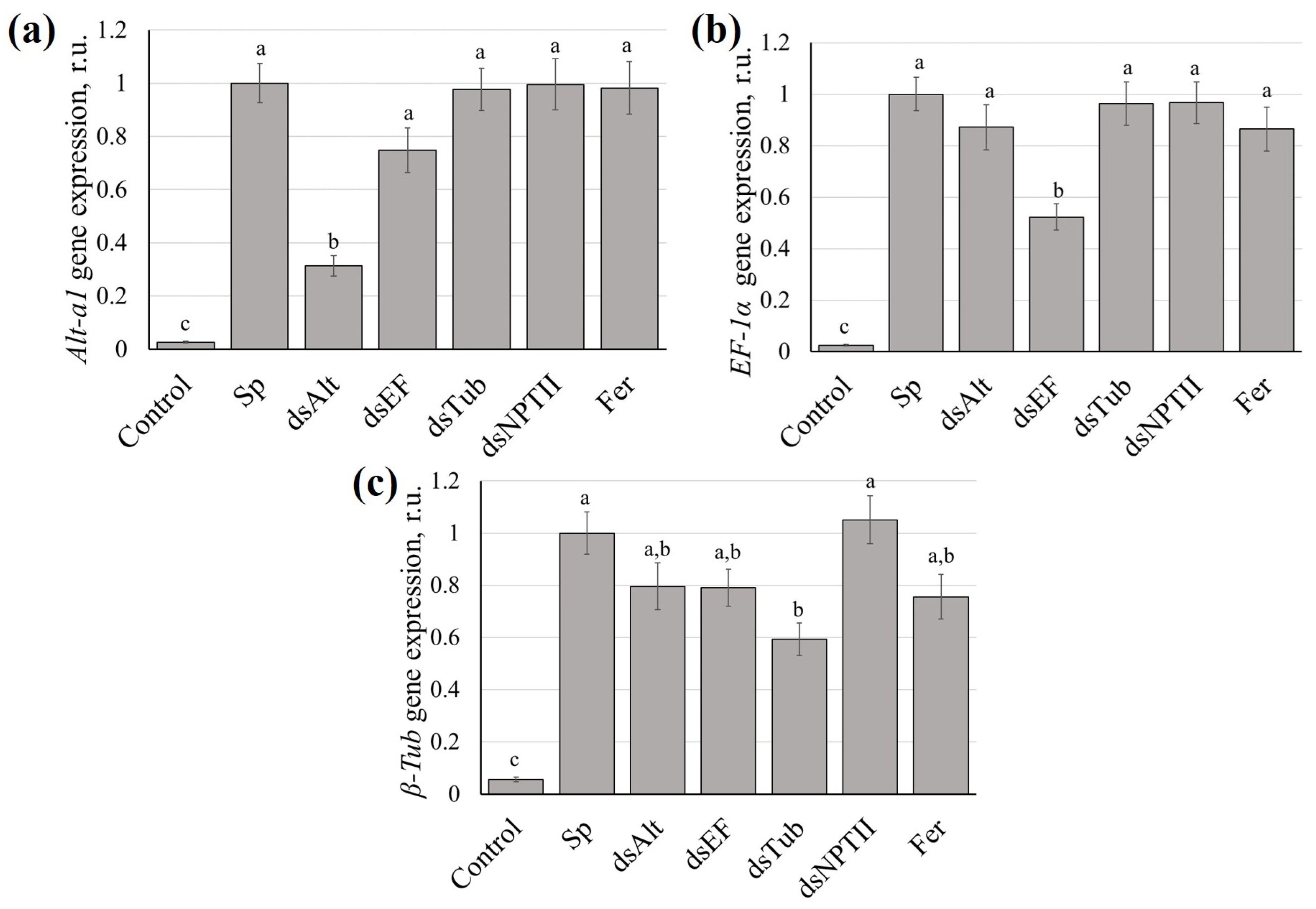
We assessed the effect of exogenous application of synthetic Tub2-dsRNA, TEF1a-dsRNA, Alt-a1-dsRNA, and NPTII-dsRNA onto the surface of 8-week-old tomato plants inoculated with A. alternata on the mRNA levels of the fungal Alt-a1, EF-1α, and β-Tub genes. Transcript levels were measured by RT-qPCR at 7 days post-inoculation (7 dpi). Treatment with Alt-a1-dsRNA resulted in a statistically significant 3.2-fold reduction in Alt-a1 expression compared to the control (Figure 4a). TEF1a-dsRNA treatment led to a 1.9-fold suppression of TEF1a expression (Figure 4b). Tub2-dsRNA treatment caused a 1.7-fold decrease in β-Tub expression (Figure 4c). Treatment with NPTII-dsRNA or 0.2% solution of the fungicide, used as negative controls, did not induce significant changes in target transcript levels, confirming the specificity of dsRNA action (Figure 4).

3.5. Relative Quantitative Determination of A. alternata DNA

Valsesi et al. [21] developed a multiplex real-time polymerase chain reaction (real-time PCR) assay utilizing TaqMan fluorescent probes for the relative quantification of Plasmopara viticola DNA directly from leaf tissue of Vitis vinifera [26]. Subsequently, Pavon and colleagues developed a real-time PCR method for the specific detection of Alternaria spp. in food products. This approach was based on primers targeting the internal transcribed spacers ITS1 and ITS2 of the ribosomal RNA (rRNA) gene [27].
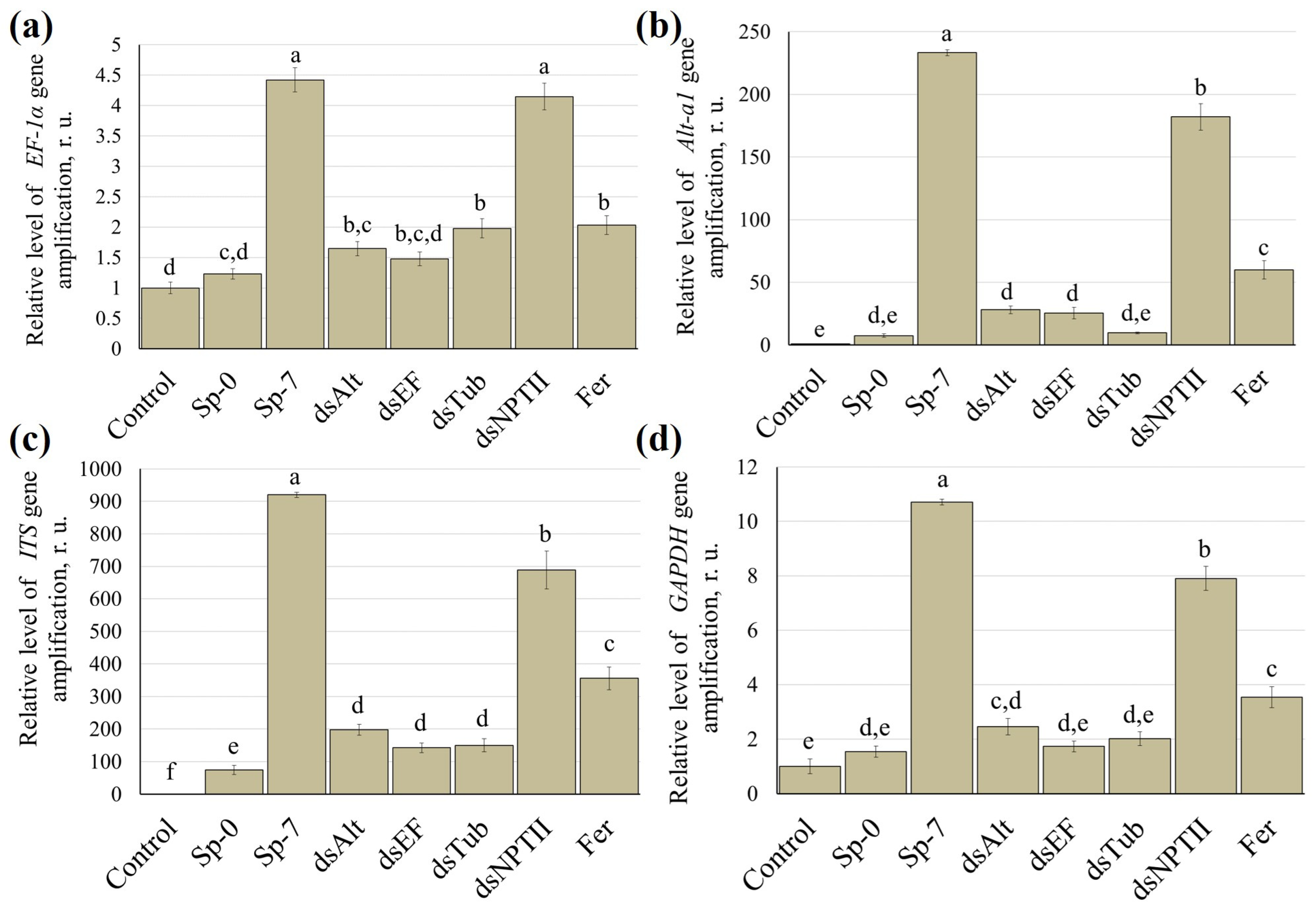
In this study, to assess the efficacy of dsRNA on the development of A. alternata on tomatoes, quantitative DNA analysis was performed using real-time PCR with primers listed in Table S1. The relative amplification level was calculated as the ratio of fungal DNA to plant DNA in each sample. For the detection of A. alternata, the Alt-a1, EF-1α, ITS and GAPDH genes were used as targets. According to the real-time PCR data, the relative amplicon levels of all target genes were significantly higher in spore-treated plants at 7 days post-inoculation with A. alternata spores compared to control plants treated with water (Figure 5). DNA was also extracted from plants 1 h after inoculation with A. alternata spores to assess the baseline amplification level of fungal DNA amplification immediately after spore application, before active growth began. This control allowed us to confirm that the detected signal was indeed due to the introduced A. alternata spores and not to contamination of the samples. It was shown that a statistically significant difference between 1 hpi and the control was only observed when using primers targeting the ITS gene (Figure 5c).
The maximum accumulation level of pathogen DNA was observed for the ITS gene, indicating its higher sensitivity (Figure 5c). In contrast, the lowest relative amplification values were characteristic of the GAPDH and TEF1a genes (Figure 5a,d). The application of Alt-a1-dsRNA, TEF1a-dsRNA, and Tub2-dsRNA together with spore inoculation led to a significant reduction in the amplicon levels of all target genes of the pathogenic fungus, ranging from 9- to 27-fold, compared to plants inoculated with spores only (Figure 5a–d). The use of a fungicide also reduced amplicon levels at 7 days post-inoculation, but to a lesser extent, from 2.1- to 3.8-fold, compared to control plants treated with A. alternata spores only (Figure 5a–d). Interestingly, treatment with NPTII-dsRNA caused a slight reduction in amplicon levels; however, these differences were statistically significant only for the Alt-a1, ITS and GAPDH genes (Figure 5b–d).

4. Discussion

In this study, we demonstrated for the first time the successful use of exogenous dsRNA as a highly specific and effective tool for the suppression of the phytopathogenic fungus A. alternata on tomato plants. Using the SIGS approach, we showed that a single co-application of A. alternata spores with dsRNA targeting the Alt-a1, EF-1α, or β-Tub genes significantly reduced EB symptoms, reduced the amount of fungal DNA in plant tissues, and partially preserved photosynthetic pigment content. These results provide compelling evidence that SIGS may be a viable alternative or complement to traditional chemical fungicides for the control of Alternaria leaf spot.
Among the three tested constructs, Alt-a1-dsRNA consistently demonstrated the highest protective effect. It reduced Alt-a1 transcript levels by 3.2-fold (Figure 4a) and reduced pathogen DNA more effectively than dsRNAs targeting TEF1a or β-Tub (Figure 5). The Alt-a1 gene encodes the major allergen and a well-established virulence factor of A. alternata [4,28]. This gene is directly involved in the ability of the pathogen to colonize host tissues and evade plant defense responses [28]. Silencing a virulence-related gene may impose a greater fitness constraint on the fungus than silencing housekeeping genes such as TEF1a or β-Tub [29]. Housekeeping genes are essential for survival, but fungi may have compensatory mechanisms or duplicated genes that partially counteract the effect of their suppression [30]. At the same time, the loss of a specific virulence factor can directly disrupt the infection process. Our results are consistent with previous reports that inhibition of virulence factors often provides more effective disease control than targeting general metabolic genes [30,31,32]. It was shown that suppression of the ACTT2 or ACTTS2 genes of A. alternata, encoding hydrolase, by transforming the fungus with a plasmid construct expressing hairpin RNAs, resulted in a complete loss of ACTT2 and ACTTS2 transcripts, and as a consequence, the production of ACT toxin and virulence [31,32]. Therefore, we suggest that Alt-a1 represents a promising target for EB treatment by SIGS.
One of the interesting results of our study was the superiority of the use of Alt-a1-dsRNA compared to the fungicide based on carbendazim, which acts by inhibiting β-tubulin [33]. The use of a fungicide resulted in a decrease in the area of affected leaves by only 1.4 times and reduced the amount of pathogen DNA from 2.1 to 3.8 times, treatment with Alt-a1-dsRNA led to a three-fold reduction in the area of damage to tomato plants and up to a 27-fold decrease in the relative level of amplification of the ITS marker of A. alternata (Figure 5). However, interestingly, the results of using Tub2-dsRNA and fungicide were comparable in a number of ways, including a decrease in the area of leaf damage, chlorophyll content and expression of the Tub2 genes of A. alternata (Figure 4c). This similarity may be that, despite different mechanisms of action, both approaches ultimately affect the microtubular function of the pathogen: carbendazim directly disrupts the polymerization of β-tubulin, while Tub2-dsRNA reduces the expression level of the corresponding gene at the post-transcriptional level [34].
The specificity of the observed RNA interference effect was confirmed by the lack of significant disease suppression with NPTII-dsRNA, which targets the neomycin phosphotransferase II gene, the sequence of which is absent from both the A. alternata and tomato genomes. A small but statistically significant decrease in the amplicon levels of some markers, namely Alt-a1, ITS, and GAPDH, was observed with NPTII-dsRNA treatment (Figure 5). This effect could be explained by a nonspecific immune response in the fungus, such as activation of the RNA interference mechanism by any long dsRNA, or by a very low level of sequence-independent off-target effects. However, the magnitude of this effect was incomparably lower than that observed with specific dsRNA.
The efficacy of SIGS observed in this study is consistent with previous studies using exogenous dsRNA to inhibit the development of fungal pathogens. For example, dsRNA targeting the CYP51 and EF2 genes successfully suppressed F. graminearum and B. cinerea in barley, Arabidopsis and grapes [14,15,16]. Similarly, spraying with dsRNA against the TEF1a gene of P. infestans significantly reduced the growth rate, sporulation, disease severity, and decreased the expression of pathogen target genes on potato [17]. In another study, Gu et al. used dsRNA targeting the Faβ2Tub genes of B. cinerea and Colletotrichum truncatum, which led to inhibition of fungal growth and weaker disease symptoms at 4 dpi [35]. However, to our knowledge, our study is one of the first detailed reports demonstrating the effectiveness of SIGS against Alternaria on tomato using multiple independent target genes and a comprehensive set of evaluation criteria. Thus, this study expands the list of phytopathogenic fungi amenable to control by SIGS.
Despite the promising results, we acknowledge several limitations of this study. First, all experiments were conducted under controlled conditions. Field conditions include variable temperatures, humidity, UV radiation, and precipitation, which may degrade dsRNA or reduce its uptake by the pathogen [36,37]. Second, we applied a single dose of dsRNA (100 μg per plant) simultaneously with fungal inoculation. Long-term protection and the need for repeated treatments were not assessed in a longer experiment. Third, the mechanism by which exogenous dsRNA applied to the leaf surface penetrates A. alternata hyphae remains unclear [38]. Possible routes include direct uptake through the fungal cell wall (via endocytosis or specific transporters), uptake from apoplastic fluid, or even uptake through damaged plant tissue [39,40]. Elucidating these mechanisms will be important for optimizing dsRNA delivery and stability.
Thus, our study clearly demonstrates that exogenous dsRNA targeting the Alt-a1, TEF1a and β-Tub genes of the fungus A. alternata effectively suppresses EB development in tomato plants. The Alt-a1 gene emerged as the most promising target. These results support the further development of SIGS as an environmentally friendly, highly specific, and effective strategy for controlling Alternaria blight and, potentially, other fungal diseases in agriculture. With continued research into dsRNA stabilization, delivery, and field effectiveness, SIGS has the potential to become an effective next-generation plant protection technology.

Supplementary Materials

The following supporting information can be downloaded at: https://www.mdpi.com/article/10.3390/jof12050373/s1; Table S1: Primers used in the work.

Author Contributions

Conceptualization, writing—original draft preparation—and writing—review and editing, A.R.S.; methodology, K.V.K.; formal analysis, A.A.D.; investigation, S.A.V. and A.A.B.; visualization, N.S.C.; data curation, E.V.T.; resources, A.Y.M. All authors have read and agreed to the published version of the manuscript.

Funding

The research was supported by a grant from the Russian Science Foundation (grant number 25-26-20013, https://rscf.ru/prjcard_int?25-26-20013) (accessed on 15 April 2026) and the Government of Primorsky Krai (grant number 30-2025-005021).

Data Availability Statement

The data presented in this study are available within the article and Supplementary Materials.

Acknowledgments

We thank Haiping Xin from the State Key Laboratory of Plant Diversity and Specialty Crops, Wuhan Botanical Garden, Chinese Academy of Sciences, for his valuable advice during the writing of this paper. The experiments described in this work were performed using equipment from the Instrumental Centre for Biotechnology and Gene Engineering at the Federal Scientific Centre of East Asia Terrestrial Biodiversity of the Far East Branch of the Russian Academy of Sciences (FSC EATB FEB RAS).

Conflicts of Interest

We declare that we have no conflicts of interest.

References

  1. Lin, T.; Zhu, G.; Zhang, J.; Xu, X.; Yu, Q.; Zheng, Z.; Zhang, Z.; Lun, Y.; Li, S.; Wang, X.; et al. Genomic Analyses Provide Insights into the History of Tomato Breeding. Nat. Genet. 2014, 46, 1220–1226. [Google Scholar] [CrossRef]
  2. Schmey, T.; Tominello-Ramirez, C.S.; Brune, C.; Stam, R. Alternaria Diseases on Potato and Tomato. Mol. Plant Pathol. 2024, 25, e13435. [Google Scholar] [CrossRef] [PubMed]
  3. Martinko, K.; Ivanković, S.; Lazarević, B.; Đermić, E.; Đermić, D. Control of Early Blight Fungus (Alternaria alternata) in Tomato by Boric and Phenylboronic Acid. Antibiotics 2022, 11, 320. [Google Scholar] [CrossRef]
  4. Vinogradova, S.A.; Kiselev, K.V.; Suprun, A.R. An Overview of the Alternaria Genus: Ecology, Pathogenicity and Importance for Agriculture and Human Health. J. Fungi 2026, 12, 64. [Google Scholar] [CrossRef]
  5. Lawrence, D.P.; Rotondo, F.; Gannibal, P.B. Biodiversity and Taxonomy of the Pleomorphic Genus Alternaria. Mycol. Prog. 2015, 15, 3. [Google Scholar] [CrossRef]
  6. Salotti, I.; Giorni, P.; Battilani, P. Biology, Ecology, and Epidemiology of Alternaria Species Affecting Tomato: Ground Information for the Development of a Predictive Model. Front. Plant Sci. 2024, 15, 1430965. [Google Scholar] [CrossRef]
  7. Bessadat, N.; Berruyer, R.; Hamon, B.; Bataille-Simoneau, N.; Benichou, S.; Kihal, M.; Henni, D.E.; Simoneau, P. Alternaria Species Associated with Early Blight Epidemics on Tomato and Other Solanaceae Crops in Northwestern Algeria. Eur. J. Plant Pathol. 2017, 148, 181–197. [Google Scholar] [CrossRef]
  8. Nagrale, D.T.; Sharma, L.; Kumar, S.; Gawande, S.P. Recent Diagnostics and Detection Tools: Implications for Plant Pathogenic Alternaria and Their Disease Management. In Current Trends in Plant Disease Diagnostics and Management Practices; Kumar, P., Gupta, V.K., Tiwari, A.K., KamLe, M., Eds.; Springer International Publishing: Cham, Switzerland, 2016; pp. 111–163. [Google Scholar]
  9. Wang, Y.; Bao, Y.; Shen, D.; Feng, W.; Yu, T.; Zhang, J.; Zheng, X.D. Biocontrol of Alternaria alternata on Cherry Tomato Fruit by Use of Marine Yeast Rhodosporidium paludigenum Fell & Tallman. Int. J. Food Microbiol. 2008, 123, 234–239. [Google Scholar] [CrossRef]
  10. Dubrovina, A.S.; Suprun, A.R.; Kiselev, K.V. Regulation of Plant Genes with Exogenous RNAs. Int. J. Mol. Sci. 2025, 26, 6773. [Google Scholar] [CrossRef]
  11. Suprun, A.R.; Manyakhin, A.Y.; Trubetskaya, E.V.; Kiselev, K.V.; Dubrovina, A.S. Regulation of Anthocyanin Accumulation in Tomato Solanum lycopersicum L. by Exogenous Synthetic dsRNA Targeting Different Regions of SlTRY Gene. Plants 2024, 13, 2489. [Google Scholar] [CrossRef] [PubMed]
  12. Dubrovina, A.; Kiselev, K. Exogenous RNAs for Gene Regulation and Plant Resistance. Int. J. Mol. Sci. 2019, 20, 2282. [Google Scholar] [CrossRef] [PubMed]
  13. Bilir, Ö.; Göl, D.; Hong, Y.; McDowell, J.M.; Tör, M. Small RNA-Based Plant Protection against Diseases. Front. Plant Sci. 2022, 13, 951097. [Google Scholar] [CrossRef]
  14. Qiao, L.; Lan, C.; Capriotti, L.; Ah-Fong, A.; Nino Sanchez, J.; Hamby, R.; Heller, J.; Zhao, H.; Glass, N.L.; Judelson, H.S.; et al. Spray-Induced Gene Silencing for Disease Control Is Dependent on the Efficiency of Pathogen RNA Uptake. Plant Biotechnol. J. 2021, 19, 1756–1768. [Google Scholar] [CrossRef] [PubMed]
  15. Werner, B.T.; Gaffar, F.Y.; Schuemann, J.; Biedenkopf, D.; Koch, A.M. RNA-Spray-Mediated Silencing of Fusarium Graminearum AGO and DCL Genes Improve Barley Disease Resistance. Front. Plant Sci. 2020, 11, 476. [Google Scholar] [CrossRef] [PubMed]
  16. Nerva, L.; Sandrini, M.; Gambino, G.; Chitarra, W. Double-Stranded RNAs (dsRNAs) as a Sustainable Tool against Gray Mold (Botrytis cinerea) in Grapevine: Effectiveness of Different Application Methods in an Open-Air Environment. Biomolecules 2020, 10, 200. [Google Scholar] [CrossRef]
  17. S, S.; Sharma, S.; Bairwa, A.; Tomar, M.; Kumar, R.; Bhardwaj, V.; Jeevalatha, A.; Bakade, R.; Salaria, N.; Thakur, K.; et al. Spraying of dsRNA Molecules Derived from Phytophthora Infestans, along with Nanoclay Carriers as a Proof of Concept for Developing Novel Protection Strategy for Potato Late Blight. Pest. Manag. Sci. 2022, 78, 3183–3192. [Google Scholar] [CrossRef]
  18. Schindelin, J.; Arganda-Carreras, I.; Frise, E.; Kaynig, V.; Longair, M.; Pietzsch, T.; Preibisch, S.; Rueden, C.; Saalfeld, S.; Schmid, B.; et al. Fiji: An Open-Source Platform for Biological-Image Analysis. Nat. Methods 2012, 9, 676–682. [Google Scholar] [CrossRef]
  19. Echt, C.S.; Erdahl, L.A.; McCoy, T.J. Genetic Segregation of Random Amplified Polymorphic DNA in Diploid Cultivated Alfalfa. Genome 1992, 35, 84–87. [Google Scholar] [CrossRef]
  20. Suprun, A.R.; Kiselev, K.V.; Dubrovina, A.S. Exogenously Induced Silencing of Four MYB Transcription Repressor Genes and Activation of Anthocyanin Accumulation in Solanum lycopersicum. Int. J. Mol. Sci. 2023, 24, 9344. [Google Scholar] [CrossRef]
  21. Livak, K.J.; Schmittgen, T.D. Analysis of Relative Gene Expression Data Using Real-Time Quantitative PCR and the 2(-Delta Delta C(T)) Method. Methods 2001, 25, 402–408. [Google Scholar] [CrossRef]
  22. Lichtenthaler, H.; Wellburn, A.R. Determination of Total Carotenoids and Chlorophylls a and b of Leaf in Different Solvents. Biochem. Soc. Trans. 1985, 11, 591–592. [Google Scholar] [CrossRef]
  23. Roy, C.K.; Akter, N.; Sarkar, M.K.I.; Pk, M.U.; Begum, N.; Zenat, E.A.; Jahan, M.A.A. Control of Early Blight of Tomato Caused by Alternaria Solani and Screening of Tomato Varieties against the Pathogen. Open Microbiol. J. 2019, 13, 41–50. [Google Scholar] [CrossRef]
  24. Massimi, M.; Radócz, L.; Kabashi, B. The Response of Chlorophyll Content and Ionic Composition in Tomato and Pepper Seedlings to Foliar Nutrition in Growing Chambers. Agronomy 2023, 13, 2234. [Google Scholar] [CrossRef]
  25. Zhao, C.; Niu, T.; Zhou, J.; Zhu, L.; Gu, S.; Wang, X. Early Detection of Alternaria Alternata Infection in Fresh Pepper Fruit Based on Chlorophyll Fluorescence Properties and Membrane Leakage. Food Anal. Methods 2025, 18, 1089–1100. [Google Scholar] [CrossRef]
  26. Development of a High-Throughput Method for Quantification of Plasmopara viticola DNA in Grapevine Leaves by Means of Quantitative Real-Time Polymerase Chain Reaction. Available online: https://apsjournals.apsnet.org/doi/10.1094/PHYTO-95-0672 (accessed on 6 April 2026).
  27. Pavón, M.Á.; González, I.; Martín, R.; García Lacarra, T. ITS-Based Detection and Quantification of Alternaria Spp. in Raw and Processed Vegetables by Real-Time Quantitative PCR. Food Microbiol. 2012, 32, 165–171. [Google Scholar] [CrossRef]
  28. Zhang, S.; Liu, L.; Li, W.; Yin, M.; Hu, Q.; Chen, S.; Chen, F.; Liu, Y.; Guan, Z.; Jiang, J. Alternaria alternata Effector AaAlta1 Targets CmWD40 and Participates in Regulating Disease Resistance in Chrysanthemum Morifolium. PLoS Pathog. 2025, 21, e1012942. [Google Scholar] [CrossRef]
  29. Siscar-Lewin, S.; Hube, B.; Brunke, S. Antivirulence and Avirulence Genes in Human Pathogenic Fungi. Virulence 2019, 10, 935–947. [Google Scholar] [CrossRef] [PubMed]
  30. Alkemade, J.A.; Hawkins, N.J.; Baraldi, E.; Buddie, A.G.; Cockerton, H.M.; Corkley, I.; Fraaije, B.A.; Gaya, E.; Gifford, D.R.; Hartig, F.; et al. Learning from Fungicide Resistance: Evolutionary Insights to Guide RNAi-Based Control of Fungal Crop Pathogens. Fungal Biol. Rev. 2025, 53, 100443. [Google Scholar] [CrossRef]
  31. Miyamoto, Y.; Masunaka, A.; Tsuge, T.; Yamamoto, M.; Ohtani, K.; Fukumoto, T.; Gomi, K.; Peever, T.L.; Akimitsu, K. Functional Analysis of a Multicopy Host-Selective ACT-Toxin Biosynthesis Gene in the Tangerine Pathotype of Alternaria alternata Using RNA Silencing. Mol. Plant-Microbe Interact. 2008, 21, 1591–1599. [Google Scholar] [CrossRef]
  32. Ajiro, N.; Miyamoto, Y.; Masunaka, A.; Tsuge, T.; Yamamoto, M.; Ohtani, K.; Fukumoto, T.; Gomi, K.; Peever, T.L.; Izumi, Y.; et al. Role of the Host-Selective ACT-Toxin Synthesis Gene ACTTS2 Encoding an Enoyl-Reductase in Pathogenicity of the Tangerine Pathotype of Alternaria alternata. Phytopathology 2010, 100, 120–126. [Google Scholar] [CrossRef]
  33. Bai, S.; Zhang, M.; Tang, S.; Li, M.; Wu, R.; Wan, S.; Chen, L.; Wei, X.; Li, F. Research Progress on Benzimidazole Fungicides: A Review. Molecules 2024, 29, 1218. [Google Scholar] [CrossRef]
  34. Vela-Corcía, D.; Romero, D.; de Vicente, A.; Pérez-García, A. Analysis of β-Tubulin-Carbendazim Interaction Reveals That Binding Site for MBC Fungicides Does Not Include Residues Involved in Fungicide Resistance. Sci. Rep. 2018, 8, 7161. [Google Scholar] [CrossRef] [PubMed]
  35. Gu, K.-X.; Song, X.-S.; Xiao, X.-M.; Duan, X.-X.; Wang, J.-X.; Duan, Y.-B.; Hou, Y.-P.; Zhou, M.-G. A Β2-Tubulin dsRNA Derived from Fusarium Asiaticum Confers Plant Resistance to Multiple Phytopathogens and Reduces Fungicide Resistance. Pestic. Biochem. Physiol. 2019, 153, 36–46. [Google Scholar] [CrossRef] [PubMed]
  36. Zotti, M.; dos Santos, E.A.; Cagliari, D.; Christiaens, O.; Taning, C.N.T.; Smagghe, G. RNA Interference Technology in Crop Protection against Arthropod Pests, Pathogens and Nematodes. Pest Manag. Sci. 2018, 74, 1239–1250. [Google Scholar] [CrossRef] [PubMed]
  37. Smagghe, G. RNA Interference in Fungal Plant Pathogens: What Do We Know from Botrytis Cinerea with Research Hotspots and Gaps, and What Are the Future Directions? J. Fungi 2025, 11, 498. [Google Scholar] [CrossRef]
  38. Mann, C.W.G.; Sawyer, A.; Gardiner, D.M.; Mitter, N.; Carroll, B.J.; Eamens, A.L. RNA-Based Control of Fungal Pathogens in Plants. Int. J. Mol. Sci. 2023, 24, 12391. [Google Scholar] [CrossRef]
  39. Wytinck, N.; Sullivan, D.S.; Biggar, K.T.; Crisostomo, L.; Pelka, P.; Belmonte, M.F.; Whyard, S. Clathrin Mediated Endocytosis Is Involved in the Uptake of Exogenous Double-Stranded RNA in the White Mold Phytopathogen Sclerotinia Sclerotiorum. Sci. Rep. 2020, 10, 12773. [Google Scholar] [CrossRef]
  40. Brosnan, C.A.; Fletcher, S.J.; Sawyer, A.; de Felippes, F.F.; Carroll, B.J.; Waterhouse, P.M.; Mitter, N.; Gardiner, D.M. Foliar-Applied Double-Stranded RNA Is Mobile, Transfers to Plant Pathogens, and Triggers RNAi. Nucleic Acids Res. 2026, 54, gkaf1452. [Google Scholar] [CrossRef]
Figure 1. Alternaria alternata growth over time after application of water (Control); specific Alt-a1, TEF1a, and Tub2 dsRNA (dsAlt, dsEF and dsTub, respectively); nonspecific NPTII-dsRNA (dsNPTII) and the 0.2% solution of KS-carbendazim (Fer). (a) Colony diameter (cm) of fungi growing on potato dextrose agar (PDA) on days 1, 3 and 5 after treatment. (b) Examples of fungal development in Petri dishes on day 5 after treatment. Data are presented as mean ± standard error (SE).
Jof 12 00373 g001
Figure 2. Tomato plant damage after inoculation with (a) water; (b) A. alternata spores; (c) A. alternata spores and Alt-a1-dsRNA; (d) A. alternata spores and TEF1a-dsRNA; (e) A. alternata spores and Tub2-dsRNA; (f) A. alternata spores and NPTII-dsRNA; (g) A. alternata spores and 0.2% solution of KS-carbendazim. (h) Percentage of affected area of tomato plants. Control—plants treated with 1 mL water; Sp—plants inoculated with A. alternata spores; dsAlt—plants inoculated with spores together with Alt-a1-dsRNA (100 μg); dsEF—plants inoculated with spores together with TEF1a-dsRNA (100 μg); dsTub—plants inoculated with spores together with Tub2-dsRNA (100 μg); dsNPTII—plants inoculated with spores together with NPTII-dsRNA (100 μg); Fer—plants inoculated with spores together with 1 mL of a 0.2% solution of the fungicide Ferazim (carbendazim 500 g/L). Quantification of the size of lesions caused by A. alternata was assessed using Fiji software. Data are presented as mean ± standard error (SE). Different letters above the bars indicate significant differences determined using one-way analysis of variance (ANOVA) with Tukey’s pairwise comparisons (p ≤ 0.05).
Jof 12 00373 g002
Figure 3. (a) Chlorophyll-a and (b) Chlorophyll-b content in leaves of tomato leaves; (c) Chlorophyll a/b ratio in tomato leaves. Control—plants treated with 1 mL water; Sp—plants inoculated with A. alternata spores; dsAlt—plants inoculated with spores together with Alt-a1-dsRNA (100 μg); dsEF—plants inoculated with spores together with TEF1a-dsRNA (100 μg); dsTub—plants inoculated with spores together with Tub2-dsRNA (100 μg); dsNPTII—plants inoculated with spores together with NPTII-dsRNA (100 μg); Fer—plants inoculated with spores together with 1 mL of a 0.2% solution of KS-carbendazim. Data are presented as mean ± standard error (SE). The means in each column followed by the same letter did not differ when using one-way analysis of variance (ANOVA) with Tukey’s pairwise comparisons (p ≤ 0.05).
Jof 12 00373 g003
Figure 4. Changes in the expression of the (a) Alt-a1, (b) TEF1a, (c) Tub2 genes of Alternaria alternata. Control—plants treated with 1 mL water; Sp—plants inoculated with A. alternata spores; dsAlt—plants inoculated with spores together with Alt-a1-dsRNA (100 μg); dsEF—plants inoculated with spores together with TEF1a-dsRNA (100 μg); dsTub—plants inoculated with spores together with Tub2-dsRNA (100 μg); dsNPTII—plants inoculated with spores together with NPTII-dsRNA (100 μg); Fer—plants inoculated with spores together with 1 mL of a 0.2% solution of KS-carbendazim. Expression analysis was assessed on day 7 post-inoculation (7 dpi). Data are presented as mean ± standard error (SE). The means in each column followed by the same letter did not differ when using one-way analysis of variance (ANOVA) with Tukey’s pairwise comparisons (p ≤ 0.05).
Jof 12 00373 g004
Figure 5. Relative amplification level of Alternaria alternata DNA of different genetic markers: (a) translation elongation factor 1-α (EF-1α) gene; (b) allergen Alt a 1 (Alt-a1) gene; (c) internal transcribed spacer (ITS); (d) glyceraldehyde-3-phosphate dehydrogenase (GAPDH) gene. Control—plants treated with 1 mL water; Sp-0—plants inoculated with A. alternata spores at 1 hpi; Sp-7—plants inoculated with A. alternata spores at 7 dpi; dsAlt—plants inoculated with spores together with Alt-a1-dsRNA (100 μg); dsEF—plants inoculated with spores together with TEF1a-dsRNA (100 μg); dsTub—plants inoculated with spores together with Tub2-dsRNA (100 μg); dsNPTII—plants inoculated with spores together with NPTII-dsRNA (100 μg); Fer—plants inoculated with spores together with 1 mL of a 0.2% solution of KS-carbendazim. Analysis was assessed on day 7 post-inoculation (7 dpi). Data are presented as mean ± standard error (SE). The means in each column followed by the same letter did not differ when using one-way analysis of variance (ANOVA) with Tukey’s pairwise comparisons (p ≤ 0.05).
Jof 12 00373 g005
Disclaimer/Publisher’s Note: The statements, opinions and data contained in all publications are solely those of the individual author(s) and contributor(s) and not of MDPI and/or the editor(s). MDPI and/or the editor(s) disclaim responsibility for any injury to people or property resulting from any ideas, methods, instructions or products referred to in the content.