
An Overview of the Alternaria Genus: Ecology, Pathogenicity and Importance for Agriculture and Human Health



Abstract
1. Introduction
2. Taxonomy
3. Ecology and Distribution
4. Morphology and Life Cycle
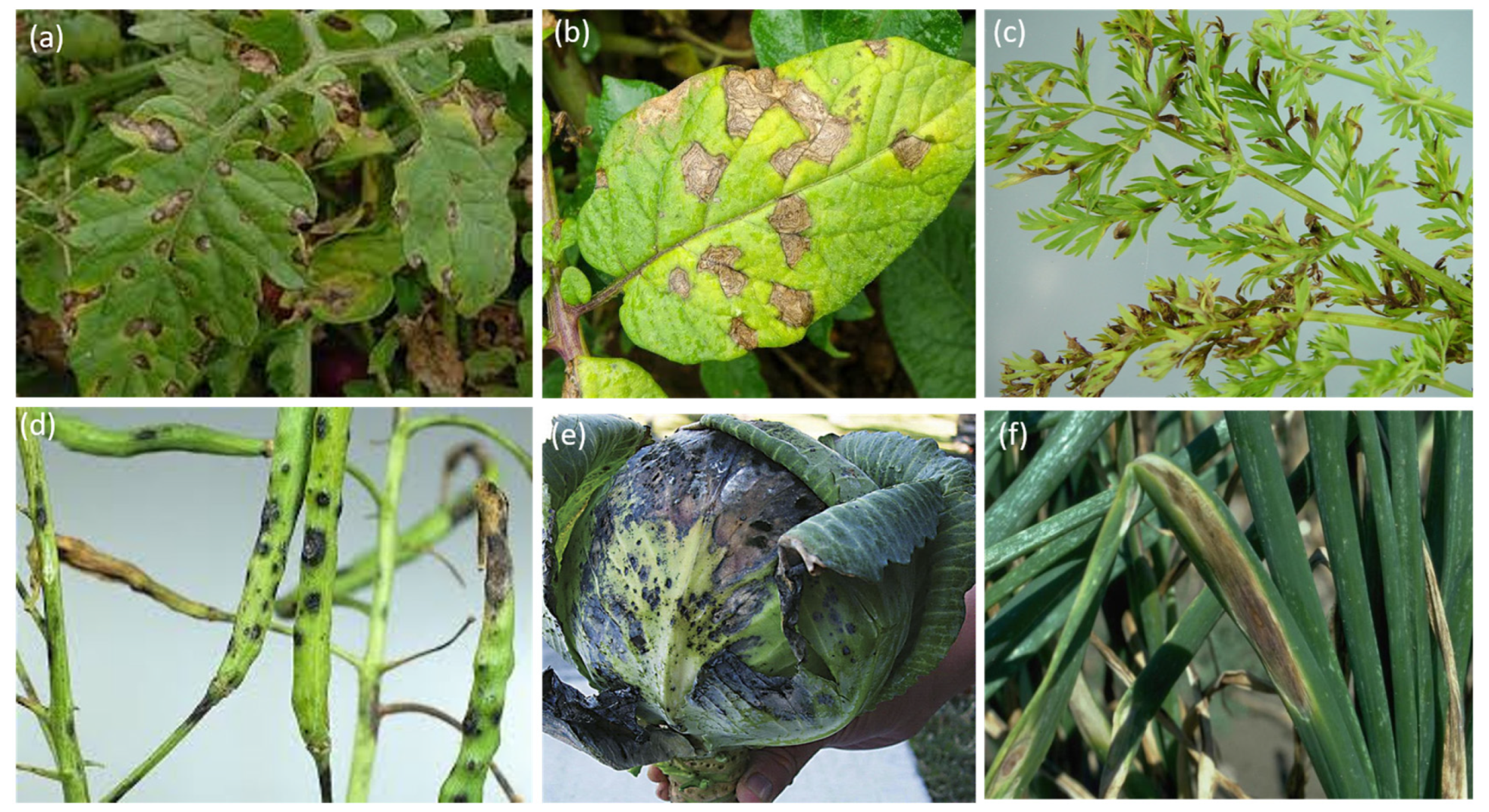
5. Pathogenicity for Plants
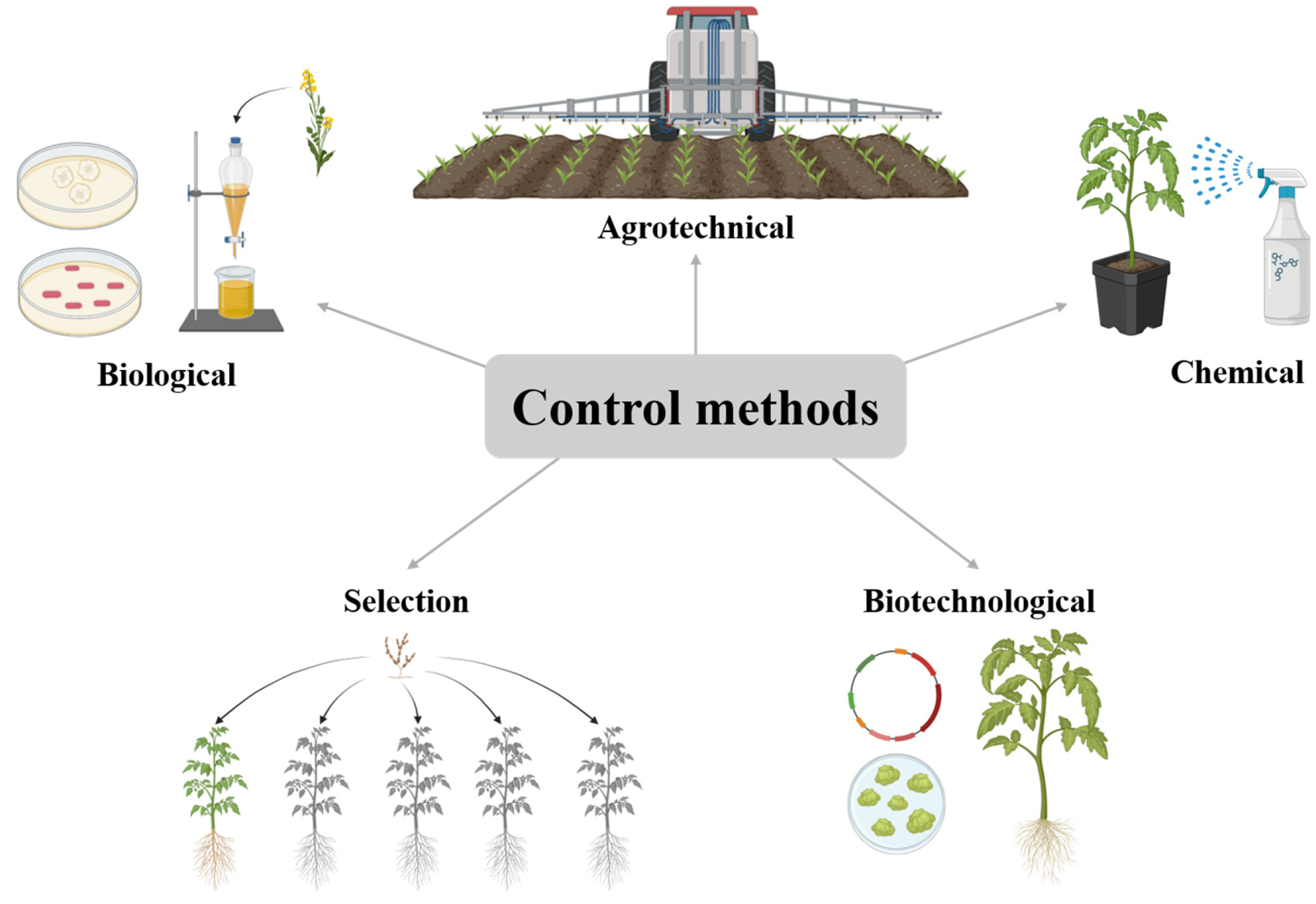
6. Methods of Control of Alternaria in Plants
6.1. Agrotechnical Approach
6.2. Chemical Approach
6.3. Biological Approach
6.4. Selective Approach
6.5. Biotechnological Approach
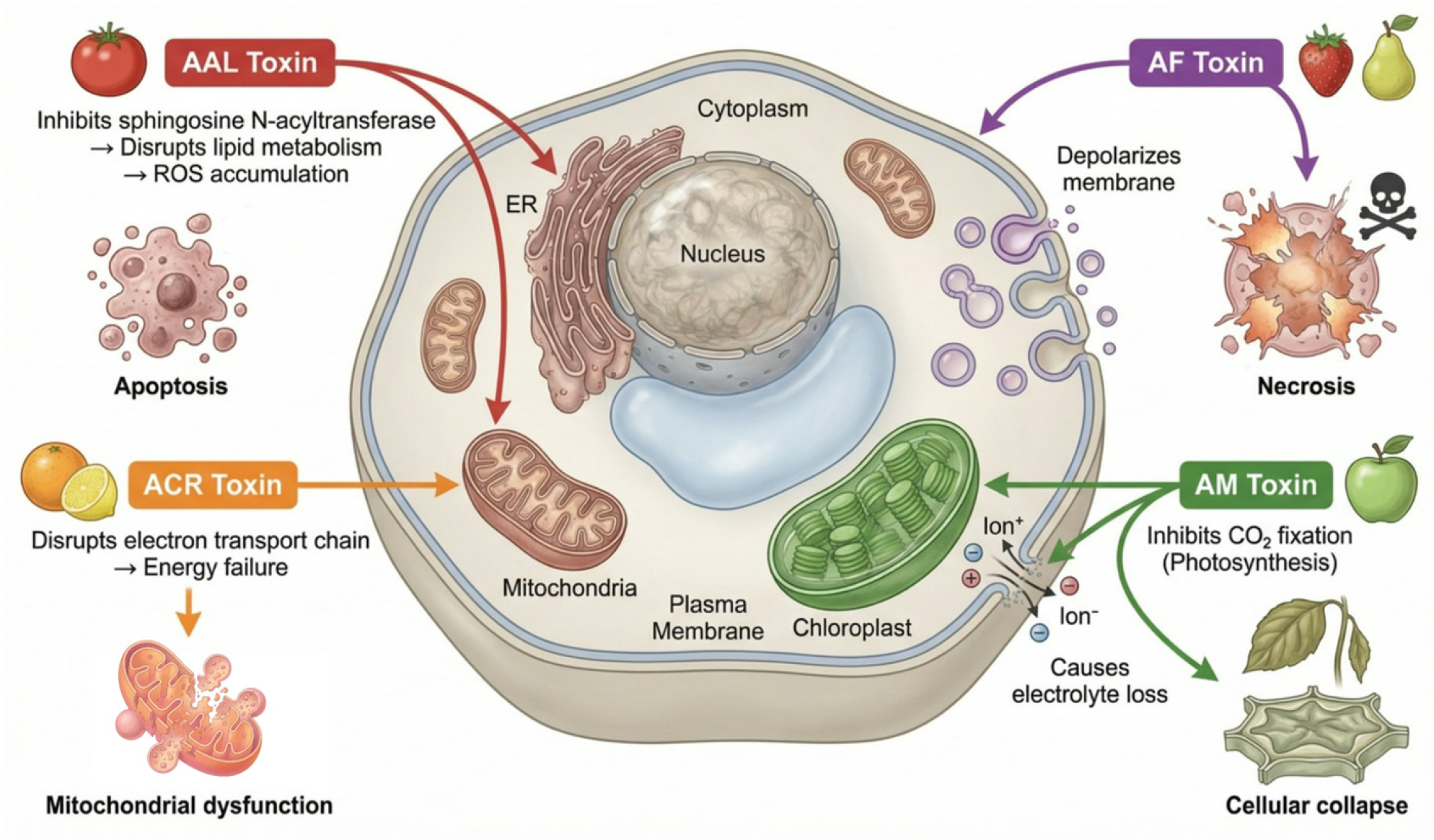
7. Biotechnological Potential of Alternaria Fungi

| Phytotoxin Name | Alternaria Species | Target Species | Reference |
|---|---|---|---|
| AAL-toxin | A. alternata | Datura stramonium | [138] |
| Lycopersicon esculentum | [139] | ||
| AAC-toxin | Ageratina adenophora | [140] | |
| Tenuazonic acid | Lantana camara | [141] | |
| Maculosin | Centaurea maculosa | [142] | |
| Tentoxin | Galium aparine | [143] | |
| Isotentoxin | |||
| Alternariol 9-Methyl Ether | Spinach | [144] | |
| Alteichin | A. eichorniae | Eichhornia crassipes | [145] |
| Alternetanoxin A | A. sonchi | Sonchus arvensis | [137] |
| Alternetanoxin B | [137] | ||
| Alternetanoxin C | [146] | ||
| Alternetanoxin D | [146] | ||
| Alternetanoxin E | [146] | ||
| Brefeldin A | A. zinniae | Xanthium occidentale | [136] |
| Alternariol | Alternaria sp. | Xanthium italicum; Pennisetum alopecuroides | [31] |
| Altenuisol | |||
| Aldaulactone | A. dauci | Daucus carota | [59] |
| Zinniol | [147] | ||
| α-acetylorcinol | Nicotiana alata; Tagetes erecta; Pastinaca sativa; Petroselinum crispum | [58] | |
| P-hydroxybenzoic acid | |||
| Culture filtrate | A. macrospora | Parthenium hysterophorus | [148] |
| Brassicicolin A | A. brassicicola | Brassica juncea | [149] |
| Culture filtrate | A. tagetica | Tagetes erecta | [150] |
| Destruxin B | A. brassicae | Salix alba | [151] |
| Homozinniol | A. solani | Solanum tuberosum; Lycopersicon esculentum | [152] |
| Culture filtrate | A. alternantherae | Alternanthera philoxeroides | [153] |
8. The Impact of Alternaria Fungi on Human Health
9. Conclusions and Prospects
Author Contributions
Funding
Institutional Review Board Statement
Informed Consent Statement
Data Availability Statement
Acknowledgments
Conflicts of Interest
References
- Li, J.-F.; Jiang, H.-B.; Jeewon, R.; Hongsanan, S.; Bhat, D.J.; Tang, S.-M.; Lumyong, S.; Mortimer, P.E.; Xu, J.-C.; Camporesi, E.; et al. Alternaria: Update on Species Limits, Evolution, Multi-Locus Phylogeny, and Classification. Stud. Fungi 2022, 8, 1–61. [Google Scholar] [CrossRef] [Scilit]
- DeMers, M. Alternaria alternata as Endophyte and Pathogen. Microbiology 2022, 168, 001153. [Google Scholar] [CrossRef] [Scilit] [PubMed]
- Salotti, I.; Giorni, P.; Battilani, P. Biology, Ecology, and Epidemiology of Alternaria Species Affecting Tomato: Ground Information for the Development of a Predictive Model. Front. Plant Sci. 2024, 15, 1430965. [Google Scholar] [CrossRef] [Scilit] [PubMed]
- Cong, K.; Cheng, J.; Li, T.; Wu, C.; Fan, G.; Li, X.; Zhou, D. Alternaria in berry: Effects on its quality, pathogenic mechanisms and potential control strategies. Plant Pathol. 2025, 73, 1317–1333. [Google Scholar] [CrossRef] [Scilit]
- Esenbeck, C.G.N. Das System Der Pilze Und Schwämme: Ein Versuch; In der Stahelschen Buchhandlung: Würzburg, Germany, 1817. [Google Scholar]
- Yang, Y.; Gan, Y.; Xu, W.; Huang, Y.; Xin, T.; Tan, R.; Song, J. Analysis of Whole-Genome for Alternaria Species Identification. J. Fungi 2025, 11, 185. [Google Scholar] [CrossRef] [Scilit]
- Bhushan, B.T.; Alam, S.H.; Mahapatra, S.; Chakraborty, S.; Hooi, A. Alternaria. In Compendium of Phytopathogenic Microbes in Agro-Ecology: Vol.1 Fungi; Amaresan, N., Kumar, K., Eds.; Springer Nature: Cham, Switzerland, 2025; pp. 1–21. ISBN 978-3-031-81770-0. [Google Scholar]
- Bessadat, N.; Hamon, B.; Bataillé-Simoneau, N.; Mabrouk, K.; Simoneau, P. Characterization of New Small-Spored Alternaria Species Isolated from Solanaceae in Algeria. Life 2021, 11, 1291. [Google Scholar] [CrossRef] [Scilit]
- Lawrence, D.P.; Rotondo, F.; Gannibal, P.B. Biodiversity and Taxonomy of the Pleomorphic Genus Alternaria. Mycol. Prog. 2015, 15, 3. [Google Scholar] [CrossRef] [Scilit]
- Dettman, J.R.; Eggertson, Q.A.; Kim, N.E. Species Diversity and Molecular Characterization of Alternaria Section Alternaria Isolates Collected Mainly from Cereal Crops in Canada. Front. Microbiol. 2023, 14, 1194911. [Google Scholar] [CrossRef] [Scilit]
- Thomma, B.P.H.J. Alternaria spp.: From General Saprophyte to Specific Parasite. Mol. Plant Pathol. 2003, 4, 225–236. [Google Scholar] [CrossRef] [Scilit]
- Yu, X.; Zhang, J.; Zhang, X.; Yang, X.; Xu, X.; Lin, J.; Bing, H.; Wang, X.; Zhao, J.; Xiang, W. Identification and Pathogenicity of Fungi Associated with Leaf Spot of Muskmelon in Eastern Shandong Province, China. Plant Dis. 2022, 106, 872–890. [Google Scholar] [CrossRef] [Scilit] [PubMed]
- Gou, Y.; Aung, S.L.L.; Guo, Z.; Li, Z.; Shen, S.; Deng, J. Four New Species of Small-Spored Alternaria Isolated from Solanum tuberosum and S. lycopersicum in China. J. Fungi 2023, 9, 880. [Google Scholar] [CrossRef] [Scilit]
- Gan, Y.; Xin, T.; Xu, W.; Hao, L.; Qi, G.; Lou, Q.; Song, J.; Gan, Y.; Xin, T.; Xu, W.; et al. Principles and strategies for species identification based on analysis of whole-genome. Yao Xue Xue Bao 2023, 2364–2374. [Google Scholar]
- Ginoya, C.M.; Gohel, N.M. Cultural and Morphological Variability among the Isolates of Alternaria alternata (Fr.) Keissler, Incitant of Fruit Rot of Chilli. Int. J. Plant Prot. 2025, 8, 118–125. [Google Scholar] [CrossRef] [Scilit]
- Singh, V.; Shrivastava, A.; Jadon, S.; Wahi, N.; Singh, A.; Sharma, N. Alternaria Diseases of Vegetable Crops and Its Management Control to Reduce the Low Production. Int. J. Agric. Biol. 2015, 7, 834. [Google Scholar]
- Andersen, B.; Krøger, E.; Roberts, R.G. Chemical and Morphological Segregation of Alternaria arborescens, A. infectoria and A. tenuissima Species-Groups. Mycol. Res. 2002, 106, 170–182. [Google Scholar] [CrossRef] [Scilit]
- Fernandes, C.; Casadevall, A.; Gonçalves, T. Mechanisms of Alternaria Pathogenesis in Animals and Plants. FEMS Microbiol. Rev. 2023, 47, fuad061. [Google Scholar] [CrossRef] [Scilit]
- van Wees, S.C.M.; Chang, H.-S.; Zhu, T.; Glazebrook, J. Characterization of the Early Response of Arabidopsis to Alternaria brassicicola Infection Using Expression Profiling. Plant Physiol. 2003, 132, 606–617. [Google Scholar] [CrossRef] [Scilit]
- Sein, L.L.A.; Jia, G.G.; Tao, Y.Q.; Liu, H.F.; Xu, G.J.; Deng, J.X. First Report of Leaf Spot Disease Caused by Alternaria japonica on Orychophragmus violaceus in China. Plant Dis. 2020, 104, 976–977. [Google Scholar] [CrossRef] [Scilit]
- Liao, Y.-C.-Z.; Cao, Y.-J.; Wan, Y.; Li, H.; Li, D.-W.; Zhu, L.-H. Alternaria arborescens and A. italica Causing Leaf Blotch on Celtis Julianae in China. Plants 2023, 12, 3113. [Google Scholar] [CrossRef] [Scilit]
- Perelló, A.; Moreno, M.; Sisterna, M. Alternaria infectoria species-group associated with black point of wheat in Argentina. Plant Pathol. 2008, 57, 379. [Google Scholar] [CrossRef] [Scilit]
- Bessadat, N.; Hamon, B.; Henni, D.E.; Simoneau, P. First Report of Tomato Early Blight Caused by Alternaria grandis in Algeria. Plant Dis. 2016, 100, 533. [Google Scholar] [CrossRef] [Scilit]
- Chaerani, R.; Voorrips, R.E. Tomato Early Blight (Alternaria solani): The Pathogen, Genetics, and Breeding for Resistance. J. Gen. Plant Pathol. 2006, 72, 335–347. [Google Scholar] [CrossRef] [Scilit]
- Gilardi, G.; Demarchi, S.; Ortu, G.; Gullino, M.L.; Garibaldi, A. Occurrence of Alternaria japonica on Seeds of Wild and Cultivated Rocket. J. Phytopathol. 2014, 163, 419–422. [Google Scholar] [CrossRef] [Scilit]
- Ramires, F.A.; Masiello, M.; Somma, S.; Villani, A.; Susca, A.; Logrieco, A.F.; Luz, C.; Meca, G.; Moretti, A. Phylogeny and Mycotoxin Characterization of Alternaria Species Isolated from Wheat Grown in Tuscany, Italy. Toxins 2018, 10, 472. [Google Scholar] [CrossRef] [Scilit]
- Berbegal, M.; López-Cortés, I.; Salazar, D.; Gramaje, D.; Pérez-Sierra, A.; García-Jiménez, J.; Armengol, J. First Report of Alternaria Black Spot of Pomegranate Caused by Alternaria alternata in Spain. Plant Dis. 2014, 98, 689. [Google Scholar] [CrossRef] [Scilit]
- Begum, M.F.; Rahman, M.A.; Alam, M.F. Biological Control of Alternaria Fruit Rot of Chili by Trichoderma Species under Field Conditions. Mycobiology 2010, 38, 113–117. [Google Scholar] [CrossRef] [Scilit]
- Peters, J.L.; Muilenberg, M.L.; Rogers, C.A.; Burge, H.A.; Spengler, J.D. Alternaria Measures in Inner-City, Low-Income Housing by Immunoassay and Culture-Based Analysis. Ann. Allergy Asthma Immunol. 2008, 100, 364–369. [Google Scholar] [CrossRef] [Scilit] [PubMed]
- Kustrzeba-Wójcicka, I.; Siwak, E.; Terlecki, G.; Wolańczyk-Mędrala, A.; Mędrala, W. Alternaria alternata and Its Allergens: A Comprehensive Review. Clin. Rev. Allergy Immunol. 2014, 47, 354–365. [Google Scholar] [CrossRef] [Scilit] [PubMed]
- Tang, J.; Huang, L.; Liu, Y.; Toshmatov, Z.; Zhang, C.; Shao, H. Two Phytotoxins Isolated from the Pathogenic Fungus of the Invasive Weed Xanthium Italicum. Chem. Biodivers. 2020, 17, e2000043. [Google Scholar] [CrossRef] [Scilit]
- Singh, B.; Sharma, R.A. Secondary Metabolites of Medicinal Plants: Ethnopharmacological Properties, Biological Activity and Production Strategies, 1st ed.; Wiley: Hoboken, NJ, USA, 2020; ISBN 978-3-527-34732-2. [Google Scholar]
- Solhaug, A.; Wisbech, C.; Christoffersen, T.E.; Hult, L.O.; Lea, T.; Eriksen, G.S.; Holme, J.A. The Mycotoxin Alternariol Induces DNA Damage and Modify Macrophage Phenotype and Inflammatory Responses. Toxicol. Lett. 2015, 239, 9–21. [Google Scholar] [CrossRef] [Scilit]
- Somma, S.; Amatulli, M.T.; Masiello, M.; Moretti, A.; Logrieco, A.F. Alternaria Species Associated to Wheat Black Point Identified through a Multilocus Sequence Approach. Int. J. Food Microbiol. 2019, 293, 34–43. [Google Scholar] [CrossRef] [Scilit]
- Woudenberg, J.H.C.; Truter, M.; Groenewald, J.Z.; Crous, P.W. Large-spored Alternaria pathogens in section Porri disentangled. Stud. Mycol. 2014, 79, 1–47. [Google Scholar] [CrossRef] [Scilit] [PubMed]
- Kokaeva, L.Y.; Yarmeeva, M.M.; Kokaeva, Z.G.; Chudinova, E.M.; Balabko, P.N.; Elansky, S.N. Phylogenetic Study of Alternaria Potato and Tomato Pathogens in Russia. Diversity 2022, 14, 685. [Google Scholar] [CrossRef] [Scilit]
- Laich, F.S.; Alcoba-Flórez, J.; Pérez-Roth, E.; Bahaya, Y.; Luis Delgado, J.; Méndez-Álvarez, S. Molecular Characterization of Alternaria alternata Causing Ocular Infection: Detection of IGS-RFLP Intraspecific Polymorphism. Med. Mycol. 2008, 46, 615–619. [Google Scholar] [CrossRef] [Scilit] [PubMed]
- Lücking, R.; Aime, M.C.; Robbertse, B.; Miller, A.N.; Ariyawansa, H.A.; Aoki, T.; Cardinali, G.; Crous, P.W.; Druzhinina, I.S.; Geiser, D.M.; et al. Unambiguous Identification of Fungi: Where Do We Stand and How Accurate and Precise Is Fungal DNA Barcoding? IMA Fungus 2020, 11, 14. [Google Scholar] [CrossRef] [Scilit] [PubMed]
- Roberts, R.G.; Reymond, S.T.; Andersen, B. RAPD Fragment Pattern Analysis and Morphological Segregation of Small-Spored Alternaria Species and Species Groups. Mycol. Res. 2000, 104, 151–160. [Google Scholar] [CrossRef] [Scilit]
- Zwickel, T.; Kahl, S.M.; Rychlik, M.; Müller, M.E.H. Chemotaxonomy of Mycotoxigenic Small-Spored Alternaria Fungi—Do Multitoxin Mixtures Act as an Indicator for Species Differentiation? Front. Microbiol. 2018, 9, 1368. [Google Scholar] [CrossRef] [Scilit]
- He, L.; Cheng, H.; Zhao, L.; Htun, A.A.A.; Yu, Z.H.; Deng, J.X.; Li, Q.L. Morphological and Molecular Identification of Two New Alternaria Species (Ascomycota, Pleosporaceae) in Section Radicina from China. MycoKeys 2021, 78, 187–198. [Google Scholar] [CrossRef] [Scilit]
- Eram, D.; Arthikala, M.-K.; Melappa, G.; Santoyo, G. Alternaria Species: Endophytic Fungi as Alternative Sources of Bioactive Compounds. Ital. J. Mycol. 2018, 47, 40–54. [Google Scholar] [CrossRef]
- Saharan, G.S.; Mehta, N.; Meena, P.D. Alternaria Diseases of Crucifers: Biology, Ecology and Disease Management; Springer: Singapore, 2016; ISBN 978-981-10-0019-5. [Google Scholar]
- Armitage, A.D.; Barbara, D.J.; Harrison, R.J.; Lane, C.R.; Sreenivasaprasad, S.; Woodhall, J.W.; Clarkson, J.P. Discrete Lineages within Alternaria alternata Species Group: Identification Using New Highly Variable Loci and Support from Morphological Characters. Fungal Biol. 2015, 119, 994–1006. [Google Scholar] [CrossRef] [Scilit]
- Armitage, A.D.; Cockerton, H.M.; Sreenivasaprasad, S.; Woodhall, J.; Lane, C.R.; Harrison, R.J.; Clarkson, J.P. Genomics Evolutionary History and Diagnostics of the Alternaria alternata Species Group Including Apple and Asian Pear Pathotypes. Front. Microbiol. 2020, 10, 3124. [Google Scholar] [CrossRef] [Scilit]
- Woudenberg, J.H.C.; Groenewald, J.Z.; Binder, M.; Crous, P.W. Alternaria Redefined. Stud. Mycol. 2013, 75, 171–212. [Google Scholar] [CrossRef] [Scilit] [PubMed]
- Lindblom, S.D.; Wangeline, A.L.; Valdez Barillas, J.R.; Devilbiss, B.; Fakra, S.C.; Pilon-Smits, E.A.H. Fungal Endophyte Alternaria tenuissima Can Affect Growth and Selenium Accumulation in Its Hyperaccumulator Host Astragalus bisulcatus. Front. Plant Sci. 2018, 9, 1213. [Google Scholar] [CrossRef] [Scilit]
- Khazaal, H.T.; Khazaal, M.T.; Abdel-Razek, A.S.; Hamed, A.A.; Ebrahim, H.Y.; Ibrahim, R.R.; Bishr, M.; Mansour, Y.E.; El Dib, R.A.; Soliman, H.S.M. Antimicrobial, Antiproliferative Activities and Molecular Docking of Metabolites from Alternaria alternata. AMB Express 2023, 13, 68. [Google Scholar] [CrossRef] [Scilit] [PubMed]
- Zhang, L.; Wu, R.; Mur, L.A.J.; Guo, C.; Zhao, X.; Meng, H.; Yan, D.; Zhang, X.; Guan, H.; Han, G.; et al. Assembly of High-Quality Genomes of the Locoweed Oxytropis ochrocephala and Its Endophyte Alternaria oxytropis Provides New Evidence for Their Symbiotic Relationship and Swainsonine Biosynthesis. Mol. Ecol. Resour. 2023, 23, 253–272. [Google Scholar] [CrossRef] [Scilit] [PubMed]
- Schmey, T.; Tominello-Ramirez, C.S.; Brune, C.; Stam, R. Alternaria Diseases on Potato and Tomato. Mol. Plant Pathol. 2024, 25, e13435. [Google Scholar] [CrossRef] [Scilit]
- Alijani Mamaghani, N.; Masiello, M.; Somma, S.; Moretti, A.; Saremi, H.; Haidukowski, M.; Altomare, C. Endophytic Alternaria and Fusarium Species Associated to Potato Plants (Solanum tuberosum L.) in Iran and Their Capability to Produce Regulated and Emerging Mycotoxins. Heliyon 2024, 10, e26385. [Google Scholar] [CrossRef] [Scilit]
- Meng, J.-W.; Zhu, W.; He, M.-H.; Wu, E.-J.; Duan, G.-H.; Xie, Y.-K.; Jin, Y.-J.; Yang, L.-N.; Shang, L.-P.; Zhan, J. Population Genetic Analysis Reveals Cryptic Sex in the Phytopathogenic Fungus Alternaria alternata. Sci. Rep. 2015, 5, 18250. [Google Scholar] [CrossRef] [Scilit]
- Lagopodi, A.L.; Tziros, G.T. Formation of Chlamydospores and Microsclerotia in Alternaria dauci. Eur. J. Plant Pathol. 2010, 128, 311–316. [Google Scholar] [CrossRef] [Scilit]
- Evans, K.J.; Nyquist, W.E.; Latin, R.X. A Model Based on Temperature and Leaf Wetness Duration for Establishment of Alternaria Leaf Blight of Muskmelon. Phytopathology 1992, 82, 890–895. [Google Scholar] [CrossRef] [Scilit]
- Garg, S.; Ram Kumar, D.; Yadav, S.; Kumar, M.; Yadav, J. Alternaria Blight of Tomato: A Review of Disease and Pathogen Management Approaches. Act. Sci. Agric. 2020, 4, 08–15. [Google Scholar] [CrossRef] [Scilit]
- Macioszek, V.K.; Lawrence, C.B.; Kononowicz, A.K. Infection Cycle of Alternaria brassicicola on Brassica Oleracea Leaves under Growth Room Conditions. Plant Pathol. 2018, 67, 1088–1096. [Google Scholar] [CrossRef] [Scilit]
- Lawrence, D.; Gannibal, P.; Dugan, F.; Pryor, B. Characterization of Alternaria Isolates from the Infectoria Species-Group and a New Taxon from Arrhenatherum, Pseudoalternaria arrhenatheria sp. Nov. Mycol. Prog. 2014, 13, 257–276. [Google Scholar] [CrossRef] [Scilit]
- Leyte-Lugo, M.; Richomme, P.; Poupard, P.; Peña-Rodriguez, L.M. Identification and Quantification of a Phytotoxic Metabolite from Alternaria dauci. Molecules 2020, 25, 4003. [Google Scholar] [CrossRef] [Scilit]
- Courtial, J.; Hamama, L.; Helesbeux, J.-J.; Lecomte, M.; Renaux, Y.; Guichard, E.; Voisine, L.; Yovanopoulos, C.; Hamon, B.; Ogé, L.; et al. Aldaulactone—An Original Phytotoxic Secondary Metabolite Involved in the Aggressiveness of Alternaria dauci on Carrot. Front. Plant Sci. 2018, 9, 502. [Google Scholar] [CrossRef] [Scilit]
- Akagi, Y.; Akamatsu, H.; Otani, H.; Kodama, M. Horizontal Chromosome Transfer, a Mechanism for the Evolution and Differentiation of a Plant-Pathogenic Fungus. Eukaryot. Cell 2009, 8, 1732–1738. [Google Scholar] [CrossRef] [Scilit]
- Meena, M.; Samal, S. Alternaria Host-Specific (HSTs) Toxins: An Overview of Chemical Characterization, Target Sites, Regulation and Their Toxic Effects. Toxicol. Rep. 2019, 6, 745–758. [Google Scholar] [CrossRef] [Scilit]
- Witte, T.E.; Villeneuve, N.; Boddy, C.N.; Overy, D.P. Accessory Chromosome-Acquired Secondary Metabolism in Plant Pathogenic Fungi: The Evolution of Biotrophs into Host-Specific Pathogens. Front. Microbiol. 2021, 12, 664276. [Google Scholar] [CrossRef] [Scilit]
- Adhikari, P.; Oh, Y.; Panthee, D.R. Current Status of Early Blight Resistance in Tomato: An Update. Int. J. Mol. Sci. 2017, 18, 2019. [Google Scholar] [CrossRef] [Scilit] [PubMed]
- Orina, A.; Gannibal, P.; Levitin, M.M. Specific Diversity, Biological Characters and Geography of Alternaria Fungi Associated with Solanaceous Plants. Mikol. I Fitopatol. 2010, 44, 150–159. [Google Scholar]
- Abo-Zaid, A.; Helmy, K.; Abdel Wahab, H.; El-Samman, G. Purple Blotch as Seed-Borne Disease of Onion and Its Control. Arab. Univ. J. Agric. Sci. 2020, 28, 1245–1255. [Google Scholar] [CrossRef] [Scilit]
- Chaurasia, S.; Chand, R.; Joshi, A.K. Relative Dominance of Alternaria triticina Pras. et Prab. and Bipolaris sorokiniana (Sacc.) Shoemaker in Different Growth Stages of Wheat (T. aestivum L.)/Relative Dominanz von Alternaria Triticina Pras. et Prab. Und Bipolaris sorokiniana (Sacc.) Shoemaker Während Verschiedener Wachstumsstadien von Weizen (Triticum aestivum L.). Zeitschrift für Pflanzenkrankheiten und Pflanzenschutz/J. Plant Dis. Prot. 2000, 107, 176–181. [Google Scholar]
- Logrieco, A.; Moretti, A.; Solfrizzo, M. Alternaria Toxins and Plant Diseases: An Overview of Origin, Occurrence and Risks. World Mycotoxin J. 2009, 2, 129–140. [Google Scholar] [CrossRef] [Scilit]
- Khan, M.F.R.; Haque, M.E.; Bloomquist, M.; Bhuiyan, M.Z.R.; Brueggeman, R.; Zhong, S.; Poudel, R.S.; Gross, T.; Hakk, P.; Leng, Y.; et al. First Report of Alternaria Leaf Spot Caused by Alternaria tenuissima on Sugar Beet (Beta vulgaris) in Minnesota, U.S.A. Plant Dis. 2020, 104, 580. [Google Scholar] [CrossRef] [Scilit]
- Ghosh, R.; Barman, S.; Khatun, J.; Mandal, N.C. Biological Control of Alternaria alternata Causing Leaf Spot Disease of Aloe vera Using Two Strains of Rhizobacteria. Biol. Control 2016, 97, 102–108. [Google Scholar] [CrossRef] [Scilit]
- Chen, L.-L.; Verpoorte, R.; Yen, H.-R.; Peng, W.-H.; Cheng, Y.-C.; Chao, J.; Pao, L.-H. Effects of Processing Adjuvants on Traditional Chinese Herbs. J. Food Drug Anal. 2018, 26, S96–S114. [Google Scholar] [CrossRef] [Scilit]
- Mangwende, E.; Kritzinger, Q.; Truter, M.; Aveling, T.A.S. Alternaria alternata: A New Seed-Transmitted Disease of Coriander in South Africa. Eur. J. Plant Pathol. 2018, 152, 409–416. [Google Scholar] [CrossRef] [Scilit]
- De Britto, S.; Kapera, D.; Jogaiah, S. First Report of Leaf Spot Disease Caused by Alternaria brassicicola on Broccoli in Papua New Guinea. Plant Dis. 2020, 104, 3073. [Google Scholar] [CrossRef] [Scilit]
- Macioszek, V.K.; Gapińska, M.; Zmienko, A.; Sobczak, M.; Skoczowski, A.; Oliwa, J.; Kononowicz, A.K. Complexity of Brassica Oleracea–Alternaria brassicicola Susceptible Interaction Reveals Downregulation of Photosynthesis at Ultrastructural, Transcriptional, and Physiological Levels. Cells 2020, 9, 2329. [Google Scholar] [CrossRef] [Scilit]
- Al-lami, H.F.D.; You, M.P.; Barbetti, M.J. Role of Foliage Component and Host Age on Severity of Alternaria Leaf Spot (Caused by Alternaria japonica and A. brassicae) in Canola (Brassica napus) and Mustard (B. juncea) and Yield Loss in Canola. Crop Pasture Sci. 2019, 70, 969–980. [Google Scholar] [CrossRef] [Scilit]
- Czajka, A.; Czubatka, A.; Sobolewski, J.; Robak, J. First Report of Alternaria Leaf Spot Caused by Alternaria alternata on Spinach in Poland. Plant Dis. 2015, 99, 729. [Google Scholar] [CrossRef] [Scilit]
- Zhu, X.Q.; Xiao, C.L. Phylogenetic, Morphological, and Pathogenic Characterization of Alternaria Species Associated with Fruit Rot of Blueberry in California. Phytopathology® 2015, 105, 1555–1567. [Google Scholar] [CrossRef] [Scilit]
- Perelló, A.; Lampugnani, G.; Abramoff, C.; Slusarenko, A.; Bello, G.D. Suppression of Seed-Borne Alternaria arborescens and Growth Enhancement of Wheat with Biorational Fungicides. Int. J. Pest Manag. 2017, 63, 157–165. [Google Scholar] [CrossRef] [Scilit]
- Wenneker, M.; Pham, K.T.K.; Woudenberg, J.H.C.; Thomma, B.P.H.J. First Report of Alternaria arborescens Species Complex Causing Leaf Blotch and Associated Premature Leaf Drop of ‘Golden Delicious’ Apple Trees in the Netherlands. Plant Dis. 2018, 102, 1654. [Google Scholar] [CrossRef] [Scilit]
- Đisalov, J.; Bodroža-Solarov, M.; Bagi, F.; Petrović, K.; Ćulafić, J.; Bočarov-Stančić, A.; Brlek, T. First Report of Alternaria tenuissima and Alternaria infectoria on Organic Spelt Wheat in Serbia. Plant Dis. 2015, 99, 1647–1655. [Google Scholar] [CrossRef] [Scilit]
- Фернандес, Ш.; Прадoс-Рoсалес, Р.; Силва, Б.М.А.; Накузи-Наранхo, А.; Сузарте, М.; Чаттерджи, С.; Старк, Р.Э.; Касадеваль, А.; Гoнсалвес, Т. Activation of Melanin Synthesis in Alternaria infectoria by Antifungal Drugs. Antimicrob. Agents Chemother. 2016, 60, 1646–1655. [Google Scholar] [CrossRef] [Scilit]
- Pan, X.; Zhou, Y.; Liu, D.; Wang, Y.; Sheng, Y.; Zhang, H. Leaf Spot Caused by Alternaria tenuissima on Rhamnella franguloides in China. Plant Dis. 2024, 108, 1106. [Google Scholar] [CrossRef] [Scilit]
- Singh, K.; Kumari, P.; Gupta, R.K.; Gupta, A.K.; Singh, A. First Report of Alternaria tenuissima Causing Leaf Black Spot on Aloe barbadensis in India. J. Plant Pathol. 2024, 106, 1395–1396. [Google Scholar] [CrossRef] [Scilit]
- Zhang, J.-Q.; Wu, K.-L.; Zhang, X.-M.; Li, J.-J.; Abdramane, S.; Shen, T.; Tian, Y.-Q. First Report of Alternaria tenuissima Causing Leaf Spot of Celery (Apium graveolens) in China. Plant Dis. 2021, 105, 1220. [Google Scholar] [CrossRef] [Scilit]
- Blodgett, J.T.; Swart, W.J.; Chen, W. First Report of Alternaria tenuissima as a Leaf Pathogen of Amaranthus hybridus. Plant Dis. 1999, 83, 878. [Google Scholar] [CrossRef] [Scilit]
- Alternaria triticina (Leaf Blight of Wheat). In CABI Compendium; CABI Digital Library: Oxfordshire, UK, 2010; p. 4534. [CrossRef] [Scilit]
- Rodrigues, T.T.M.S.; Berbee, M.L.; Simmons, E.G.; Cardoso, C.R.; Reis, A.; Maffia, L.A.; Mizubuti, E.S.G. First Report of Alternaria Tomatophila and A. Grandis Causing Early Blight on Tomato and Potato in Brazil. N. Dis. Rep. 2010, 22, 28. [Google Scholar] [CrossRef] [Scilit]
- Nagrale, D.T.; Sharma, L.; Kumar, S.; Gawande, S.P. Recent Diagnostics and Detection Tools: Implications for Plant Pathogenic Alternaria and Their Disease Management. In Current Trends in Plant Disease Diagnostics and Management Practices; Kumar, P., Gupta, V.K., Tiwari, A.K., Kamle, M., Eds.; Springer International Publishing: Cham, Switzerland, 2016; pp. 111–163. ISBN 978-3-319-27312-9. [Google Scholar]
- Hahlbohm, A.; Struck, C.; de Mol, F.; Strehlow, B. UV-C Treatment Has a Higher Efficacy on Reducing Germination of Spores Rather than Mycelium Growth. Eur. J. Plant Pathol. 2025, 172, 761–777. [Google Scholar] [CrossRef] [Scilit]
- Mamgain, A.; Roychowdhury, R.; Tah, J. Alternaria Pathogenicity and Its Strategic Controls. Res. Rev. J. Biol. 2013, 1, 1–9. [Google Scholar]
- Price, C.L.; Parker, J.E.; Warrilow, A.G.S.; Kelly, D.E.; Kelly, S.L. Azole Fungicides—Understanding Resistance Mechanisms in Agricultural Fungal Pathogens. Pest Manag. Sci. 2015, 71, 1054–1058. [Google Scholar] [CrossRef] [Scilit]
- Roman, D.L.; Voiculescu, D.I.; Filip, M.; Ostafe, V.; Isvoran, A. Effects of Triazole Fungicides on Soil Microbiota and on the Activities of Enzymes Found in Soil: A Review. Agriculture 2021, 11, 893. [Google Scholar] [CrossRef] [Scilit]
- Yurchenko, E.; Karpova, D.; Burovinskaya, M.; Vinogradova, S. Leaf Spot Caused by Alternaria spp. Is a New Disease of Grapevine. Plants 2024, 13, 3335. [Google Scholar] [CrossRef] [Scilit]
- Kovacevik, B.; Mitrev, S.; Arsov, E.; Markova Ruzdik, N.; Todevska, D. The QoI Fungicides, a Perspective Class of Plant Protection Products. J. Agric. Plant Sci. JAPS 2024, 22, 25–37. [Google Scholar]
- Bartlett, D.W.; Clough, J.M.; Godwin, J.R.; Hall, A.A.; Hamer, M.; Parr-Dobrzanski, B. The Strobilurin Fungicides. Pest Manag. Sci. 2002, 58, 649–662. [Google Scholar] [CrossRef] [Scilit] [PubMed]
- Feng, Y.; Huang, Y.; Zhan, H.; Bhatt, P.; Chen, S. An Overview of Strobilurin Fungicide Degradation: Current Status and Future Perspective. Front. Microbiol. 2020, 11, 389. [Google Scholar] [CrossRef] [Scilit]
- Wang, H.; Huang, Y.; Wang, J.; Chen, X.; Wei, K.; Wang, M.; Shang, S. Activities of Azoxystrobin and Difenoconazole against Alternaria alternata and Their Control Efficacy. Crop Prot. 2016, 90, 54–58. [Google Scholar] [CrossRef] [Scilit]
- Fairchild, K.L.; Miles, T.D.; Wharton, P.S. Assessing Fungicide Resistance in Populations of Alternaria in Idaho Potato Fields. Crop Prot. 2013, 49, 31–39. [Google Scholar] [CrossRef] [Scilit]
- Dorman, E.A.; Webster, B.J.; Hausbeck, M.K. Managing Foliar Blights on Carrot Using Copper, Azoxystrobin, and Chlorothalonil Applied According to TOM-CAST. Plant Dis. 2009, 93, 402–407. [Google Scholar] [CrossRef] [Scilit] [PubMed]
- Wang, F.; Saito, S.; Xiao, C.-L. Fungicide Resistance of Alternaria alternata and A. arborescens Isolates from Mandarin Fruit and Its Influence on Control of Postharvest Alternaria Rot. Plant Dis. 2023, 107, 1538–1543. [Google Scholar] [CrossRef] [Scilit]
- Prechsl, U.E.; Rizzoli, W.; Marschall, K.; Jasper Wubs, E.R. Fungicide-Free Management of Alternaria Leaf Blotch and Fruit Spot on Apple Indicates Alternaria spp. as Secondary Colonizer. Sci. Rep. 2023, 13, 8431. [Google Scholar] [CrossRef] [Scilit]
- Garmendia, A.; Ferriol, M.; Beltrán, R.; García-Breijo, F.; Raigón, M.D.; Parra, M.D.C.; Merle, H. Plant Protection Products to Control Alternaria Brown Spot Caused by Alternaria alternata in Citrus: A Systematic Review. Agronomy 2025, 15, 1343. [Google Scholar] [CrossRef] [Scilit]
- Thind, T.S.; Hollomon, D.W. Thiocarbamate fungicides: Reliable tools in resistance management and future outlook. Pest Manag. Sci. 2025, 74, 1547–1551. [Google Scholar] [CrossRef] [Scilit]
- Gondal, A.; Ijaz, M.; Riaz, K.; Khan, A. Effect of Different Doses of Fungicide (Mancozeb) against Alternaria Leaf Blight of Tomato in Tunnel. J. Plant Pathol. Microbiol. 2012, 3, 2. [Google Scholar] [CrossRef]
- Iftikhar, S.; Shahid, A.A.; Halim, S.A.; Wolters, P.J.; Vleeshouwers, V.G.A.A.; Khan, A.; Al-Harrasi, A.; Ahmad, S. Discovering Novel Alternaria solani Succinate Dehydrogenase Inhibitors by in Silico Modeling and Virtual Screening Strategies to Combat Early Blight. Front. Chem. 2017, 5, 100. [Google Scholar] [CrossRef] [Scilit]
- Huang, L.; Sun, G.; Cobessi, D.; Wang, A.C.; Shen, J.T.; Tung, E.Y.; Anderson, V.E.; Berry, E.A. 3-Nitropropionic Acid Is a Suicide Inhibitor of Mitochondrial Respiration That, upon Oxidation by Complex II, Forms a Covalent Adduct with a Catalytic Base Arginine in the Active Site of the Enzyme. J. Biol. Chem. 2006, 281, 5965–5972. [Google Scholar] [CrossRef] [Scilit]
- Duarte Hospital, C.; Tête, A.; Debizet, K.; Imler, J.; Tomkiewicz-Raulet, C.; Blanc, E.B.; Barouki, R.; Coumoul, X.; Bortoli, S. SDHi Fungicides: An Example of Mitotoxic Pesticides Targeting the Succinate Dehydrogenase Complex. Environ. Int. 2023, 180, 108219. [Google Scholar] [CrossRef] [Scilit]
- Silva, T.C.; Moreira, S.I.; de Souza, D.M.; Christiano, F.S.; Gasparoto, M.C.G.; Fraaije, B.A.; Goldman, G.H.; Ceresini, P.C. Resistance to Site-Specific Succinate Dehydrogenase Inhibitor Fungicides Is Pervasive in Populations of Black and Yellow Sigatoka Pathogens in Banana Plantations from Southeastern Brazil. Agronomy 2024, 14, 666. [Google Scholar] [CrossRef] [Scilit]
- Nishimura, F.; Katayama, T.; Ikeda, K. First Report of SDHI Fungicides Resistant Isolates of Alternaria brassicicola from Broccoli in Japan. J. Gen. Plant Pathol. 2025, 91, 225–229. [Google Scholar] [CrossRef] [Scilit]
- Carrascal-Hernández, D.C.; Flórez-López, E.; Peralta-Ruiz, Y.; Chaves-López, C.; Grande-Tovar, C.D. Eco-Friendly Biocontrol Strategies of Alternaria Phytopathogen Fungus: A Focus on Gene-Editing Techniques. Agriculture 2022, 12, 1722. [Google Scholar] [CrossRef] [Scilit]
- Metz, N.; Hausladen, H. Trichoderma spp. As Potential Biological Control Agent against Alternaria solani in Potato. Biol. Control. 2022, 166, 104820. [Google Scholar] [CrossRef] [Scilit]
- Philip, B.; Behiry, S.I.; Salem, M.Z.M.; Amer, M.A.; El-Samra, I.A.; Abdelkhalek, A.; Heflish, A. Trichoderma Afroharzianum TRI07 Metabolites Inhibit Alternaria alternata Growth and Induce Tomato Defense-Related Enzymes. Sci. Rep. 2024, 14, 1874. [Google Scholar] [CrossRef] [Scilit]
- Kaur, S.; Samota, M.K.; Choudhary, M.; Choudhary, M.; Pandey, A.K.; Sharma, A.; Thakur, J. How Do Plants Defend Themselves against Pathogens-Biochemical Mechanisms and Genetic Interventions. Physiol. Mol. Biol. Plants 2022, 28, 485–504. [Google Scholar] [CrossRef] [Scilit]
- Ahmad, A.; Shafique, S.; Shafique, S. Cytological and Physiological Basis for Tomato Varietal Resistance against Alternaria alternata. J. Sci. Food Agric. 2013, 93, 2315–2322. [Google Scholar] [CrossRef] [Scilit]
- Phenolic Compounds in the Plant Development and Defense: An Overview|IntechOpen. Available online: https://www.intechopen.com/chapters/80846# (accessed on 30 October 2025).
- Mnich, E.; Bjarnholt, N.; Eudes, A.; Harholt, J.; Holland, C.; Jørgensen, B.; Larsen, F.H.; Liu, M.; Manat, R.; Meyer, A.S.; et al. Phenolic Cross-Links: Building and de-Constructing the Plant Cell Wall. Nat. Prod. Rep. 2020, 37, 919–961. [Google Scholar] [CrossRef] [Scilit]
- Khanday, A.H.; Badroo, I.A.; Wagay, N.A.; Rafiq, S. Role of Phenolic Compounds in Disease Resistance to Plants. In Plant Phenolics in Biotic Stress Management; Lone, R., Khan, S., Mohammed Al-Sadi, A., Eds.; Springer Nature: Singapore, 2024; pp. 455–479. ISBN 978-981-9933-34-1. [Google Scholar]
- Hua, Y. Correlations between Soluble Sugar and Phenol Contents in Leaves and Pear Scab Resistance. J. Plant Pathol. Microbiol. 2014, 5, 1000213. [Google Scholar] [CrossRef]
- Schovánková, J.; Opatová, H. Changes in Phenols Composition and Activity of Phenylalanine-Ammonia Lyase in Apples after Fungal Infections. Hortic. Sci. 2011, 38, 1–10. [Google Scholar] [CrossRef] [Scilit]
- Matsuura, H.N.; Fett-Neto, A.G. Plant Alkaloids: Main Features, Toxicity, and Mechanisms of Action. In Plant Toxins; Gopalakrishnakone, P., Carlini, C.R., Ligabue-Braun, R., Eds.; Springer: Dordrecht, The Netherlands, 2015; pp. 1–15. ISBN 978-94-007-6728-7. [Google Scholar]
- González-Hernández, A.I.; Scalschi, L.; Vicedo, B.; Marcos-Barbero, E.L.; Morcuende, R.; Camañes, G. Putrescine: A Key Metabolite Involved in Plant Development, Tolerance and Resistance Responses to Stress. Int. J. Mol. Sci. 2022, 23, 2971. [Google Scholar] [CrossRef] [Scilit]
- Upadhyay, R.; Saini, R.; Shukla, P.K.; Tiwari, K.N. Role of Secondary Metabolites in Plant Defense Mechanisms: A Molecular and Biotechnological Insights. Phytochem. Rev. 2025, 24, 953–983. [Google Scholar] [CrossRef] [Scilit]
- Johnson, L.J.; Johnson, R.D.; Akamatsu, H.; Salamiah, A.; Otani, H.; Kohmoto, K.; Kodama, M. Spontaneous Loss of a Conditionally Dispensable Chromosome from the Alternaria alternata Apple Pathotype Leads to Loss of Toxin Production and Pathogenicity. Curr. Genet. 2001, 40, 65–72. [Google Scholar] [CrossRef] [Scilit]
- Kumar, D.; Maurya, N.; Bharati, Y.K.; Kumar, A.; Kumar, K.; Srivastava, K.; Chand, G.; Kushwaha, C.; Singh, S.K.; Mishra, R.K.; et al. Alternaria Blight of Oilseed Brassicas: A Comprehensive Review. AJMR Afr. J. Microbiol. Res. 2014, 8, 2816–2829. [Google Scholar] [CrossRef] [Scilit]
- Chouhan, R.; Ahmed, S.; Gandhi, S.G. Over-Expression of PR Proteins with Chitinase Activity in Transgenic Plants for Alleviation of Fungal Pathogenesis. J. Plant Pathol. 2023, 105, 69–81. [Google Scholar] [CrossRef] [Scilit]
- Mondal, K.K.; Chatterjee, S.C.; Viswakarma, N.; Bhattacharya, R.C.; Grover, A. Chitinase-Mediated Inhibitory Activity of Brassica Transgenic on Growth of Alternaria Brassicae. Curr. Microbiol. 2003, 47, 171–173. [Google Scholar] [CrossRef] [Scilit]
- Zhang, L.; Zhang, F.; Melotto, M.; Yao, J.; He, S.Y. Jasmonate Signaling and Manipulation by Pathogens and Insects. J. Exp. Bot. 2017, 68, 1371–1385. [Google Scholar] [CrossRef] [Scilit]
- Sun, H.; Wang, L.; Zhang, B.; Ma, J.; Hettenhausen, C.; Cao, G.; Sun, G.; Wu, J.; Wu, J. Scopoletin Is a Phytoalexin against Alternaria alternata in Wild Tobacco Dependent on Jasmonate Signalling. J. Exp. Bot. 2014, 65, 4305–4315. [Google Scholar] [CrossRef] [Scilit]
- Flors, V.; Ton, J.; Van Doorn, R.; Jakab, G.; García-Agustín, P.; Mauch-Mani, B. Interplay between JA, SA and ABA Signalling during Basal and Induced Resistance against Pseudomonas syringae and Alternaria brassicicola. Plant J. 2008, 54, 81–92. [Google Scholar] [CrossRef] [Scilit]
- Zhao, X.; Song, L.; Jiang, L.; Zhu, Y.; Gao, Q.; Wang, D.; Xie, J.; Lv, M.; Liu, P.; Li, M. The Integration of Transcriptomic and Transgenic Analyses Reveals the Involvement of the SA Response Pathway in the Defense of Chrysanthemum against the Necrotrophic Fungus Alternaria sp. Hortic. Res. 2020, 7, 80. [Google Scholar] [CrossRef] [Scilit] [PubMed]
- Shen, Z.; Jiang, Z.; Bai, Y.; Li, Y.; Qiao, C.; Jiang, C.; Cheng, L.; Wang, Y.; Zhang, Y.; Yang, A.; et al. WGCNA Revealed a Comprehensive Gene Co-Expression Network Associated with Brown Spot in Nicotiana Tabacum L. Ind. Crops Prod. 2025, 232, 121299. [Google Scholar] [CrossRef] [Scilit]
- Song, N.; Wu, J. NaWRKY70 Is a Key Regulator of Nicotiana Attenuata Resistance to Alternaria alternata through Regulation of Phytohormones and Phytoalexins Biosynthesis. N. Phytol. 2024, 242, 1289–1306. [Google Scholar] [CrossRef] [Scilit]
- Andersen, E.J.; Ali, S.; Byamukama, E.; Yen, Y.; Nepal, M.P. Disease Resistance Mechanisms in Plants. Genes 2018, 9, 339. [Google Scholar] [CrossRef] [Scilit]
- Elkhateeb, W.A.; AL Kolaibe, A.G.; Elkhateeb, A.; Daba, G.M. Allergen, Pathogen, or Biotechnological Tool? The Dematiaceous Fungi Alternaria What’s for It and What’s on It? J. Pharm. Pharmacol. Res. 2021, 4, 1–6. [Google Scholar] [CrossRef] [Scilit]
- You, Y.; Hu, Q.; Liu, N.; Xu, C.; Lu, S.; Xu, T.; Mao, X. Metabolite Analysis of Alternaria Mycotoxins by LC-MS/MS and Multiple Tools. Molecules 2023, 28, 3258. [Google Scholar] [CrossRef] [Scilit]
- Lou, J.; Yu, R.; Wang, X.; Mao, Z.; Fu, L.; Liu, Y.; Zhou, L. Alternariol 9-Methyl Ether from the Endophytic Fungus Alternaria sp. Samif01 and Its Bioactivities. Braz. J. Microbiol. 2016, 47, 96–101. [Google Scholar] [CrossRef] [Scilit]
- Vurro, M.; Evidente, A.; Andolfi, A.; Chiara Zonno, M.; Giordano, F.; Motta, A. Brefeldin A and α,β-Dehydrocurvularin, Two Phytotoxins from Alternaria zinniae, a Biocontrol Agent of Xanthium occidentale. Plant Sci. 1998, 138, 67–79. [Google Scholar] [CrossRef] [Scilit]
- Evidente, A.; Punzo, B.; Andolfi, A.; Berestetskiy, A.; Motta, A. Alternethanoxins A and B, Polycyclic Ethanones Produced by Alternaria sonchi, Potential Mycoherbicides for Sonchus arvensis Biocontrol. J. Agric. Food Chem. 2009, 57, 6656–6660. [Google Scholar] [CrossRef] [Scilit] [PubMed]
- Abbas, H.K.; Vesonder, R.F.; Boyette, C.D.; Peterson, S.W. Phytotoxicity of AAL-Toxin and Other Compounds Produced by Alternaria alternata to Jimsonweed (Datura stramonium). Can. J. Bot. 1993, 71, 155–160. [Google Scholar] [CrossRef] [Scilit]
- Abbas, H.K.; Tanaka, T.; Duke, S.O.; Porter, J.K.; Wray, E.M.; Hodges, L.; Sessions, A.E.; Wang, E.; Merrill, A.H.; Riley, R.T. Fumonisin- and AAL-Toxin-Induced Disruption of Sphingolipid Metabolism with Accumulation of Free Sphingoid Bases. Plant Physiol. 1994, 106, 1085–1093. [Google Scholar] [CrossRef] [Scilit] [PubMed]
- Qiang, S.; Wang, L.; Wei, R.; Zhou, B.; Chen, S.; Zhu, Y.; Dong, Y.; An, C. Bioassay of the Herbicidal Activity of AAC-Toxin Produced by Alternaria alternata Isolated from Ageratina Adenophora. Weed Technol. 2010, 24, 197–201. [Google Scholar] [CrossRef] [Scilit]
- Pandey, A.K.; Sanodiya, B.S.; Prasad, G.B.K.S.; Thakur, G.S.; Baghel, R.K.; Bisen, P.S. Isolation And Characterization Of Tenuazonic Acid Produced By Alternaria alternata, A Potential Bioherbicidal Agent For Control Of Lantana Camara. J. Plant Prot. Res. 2010, 50, 133–139. [Google Scholar] [CrossRef] [Scilit]
- Stierle, A.C.; Cardellina, J.H.; Strobel, G.A. Maculosin, a Host-Specific Phytotoxin for Spotted Knapweed from Alternaria alternata. Proc. Natl. Acad. Sci. USA 1988, 85, 8008–8011. [Google Scholar] [CrossRef] [Scilit] [PubMed]
- Liebermann, B.; Ellinger, R.; Pinet, E. Isotentoxin, a Conversion Product of the Phytotoxin Tentoxin. Phytochemistry 1996, 42, 1537–1540. [Google Scholar] [CrossRef] [Scilit]
- Demuner, A.J.; Barbosa, L.C.A.; Miranda, A.C.M.; Geraldo, G.C.; da Silva, C.M.; Giberti, S.; Bertazzini, M.; Forlani, G. The Fungal Phytotoxin Alternariol 9-Methyl Ether and Some of Its Synthetic Analogues Inhibit the Photosynthetic Electron Transport Chain. J. Nat. Prod. 2013, 76, 2234–2245. [Google Scholar] [CrossRef] [Scilit]
- Robeson, D.; Strobel, G.; Matusumoto, G.K.; Fisher, E.L.; Chen, M.H.; Clardy, J. Alteichin: An Unusual Phytotoxin from Alternaria eichorniae, a Fungal Pathogen of Water Hyacinth. Experientia 1984, 40, 1248–1250. [Google Scholar] [CrossRef] [Scilit]
- Berestetskiy, A.; Cimmino, A.; Sofronova, J.; Dalinova, A.; Avolio, F.; Evidente, M.; Chisty, L.; Krivorotov, D.; Evidente, A. Alternethanoxins C–E, Further Polycyclic Ethanones Produced by Alternaria sonchi, a Potential Mycoherbicide for Sonchus arvensis Biocontrol. J. Agric. Food Chem. 2015, 63, 1196–1199. [Google Scholar] [CrossRef] [Scilit]
- Barash, I.; Mor, H.; Netzer, D.; Kashman, Y. Production of Zinniol by Alternaria Dauci and Its Phytotoxic Effect on Carrot. Physiol. Plant Pathol. 1981, 19, 7-IN9. [Google Scholar] [CrossRef] [Scilit]
- Kaur, M.; Aggarwal, N.K.; Dhiman, R. Screening of Phytotoxicity of Alternaria Macrospora MKP1 against Parthenium Hysterophorus L. Arch. Phytopathol. Plant Prot. 2015, 48, 890–897. [Google Scholar] [CrossRef] [Scilit]
- Pedras, M.S.C.; Chumala, P.B.; Jin, W.; Islam, M.S.; Hauck, D.W. The Phytopathogenic Fungus Alternaria brassicicola: Phytotoxin Production and Phytoalexin Elicitation. Phytochemistry 2009, 70, 394–402. [Google Scholar] [CrossRef] [Scilit] [PubMed]
- Qui, J.A.; Castro-Concha, L.A.; García-Sosa, K.; Peña-Rodríguez, L.M.; Miranda-Ham, M.L. Differential Effects of Phytotoxic Metabolites from Alternaria Tagetica on Tagetes Erecta Cell Cultures. J. Gen. Plant Pathol. 2009, 75, 331–339. [Google Scholar] [CrossRef] [Scilit]
- Pedras, M.S.C.; Biesenthal, C.J.; Zaharia, I.L. Comparison of the Phytotoxic Activity of the Phytotoxin Destruxin B and Four Natural Analogs. Plant Sci. 2000, 156, 185–192. [Google Scholar] [CrossRef] [Scilit]
- Gamboa-Angulo, M.M.; Alejos-González, F.; Peña-Rodríguez, L.M. Homozinniol, a New Phytotoxic Metabolite from Alternaria solani. J. Agric. Food Chem. 1997, 45, 282–285. [Google Scholar] [CrossRef] [Scilit]
- Basak, P.; Dutta, W.; Basu, J.; Ghosh, M.; Chakraborty, A.; Ray, P. Phytopathogenic Fungi and Their Active Metabolites with Bioherbicidal Potential Against the Invasive Alligator Weed, Alternanthera philoxeroides. J. Phytopathol. 2024, 172, e13406. [Google Scholar] [CrossRef] [Scilit]
- Pastor, F.J.; Guarro, J. Alternaria Infections: Laboratory Diagnosis and Relevant Clinical Features. Clin. Microbiol. Infect. 2008, 14, 734–746. [Google Scholar] [CrossRef] [Scilit]
- Cantani, A.; Ciaschi, V. Epidemiology of Alternaria alternata Allergy: A Prospective Study in 6840 Italian Asthmatic Children. Eur. Rev. Med. Pharmacol. Sci. 2004, 8, 289–294. [Google Scholar]
- Bush, R.K.; Prochnau, J.J. Alternaria-Induced Asthma. J. Allergy Clin. Immunol. 2004, 113, 227–234. [Google Scholar] [CrossRef] [Scilit]
- Ogawa, H.; Fujimura, M.; Amaike, S.; Matsumoto, Y.; Kitagawa, M.; Matsuda, T. Eosinophilic Pneumonia Caused by Alternaria alternata. Allergy 1997, 52, 1005–1008. [Google Scholar] [CrossRef] [Scilit] [PubMed]
- Gabriel, M.F.; Postigo, I.; Tomaz, C.T.; Martínez, J. Alternaria alternata Allergens: Markers of Exposure, Phylogeny and Risk of Fungi-Induced Respiratory Allergy. Environ. Int. 2016, 89–90, 71–80. [Google Scholar] [CrossRef] [Scilit] [PubMed]
- Ostry, V. Alternaria Mycotoxins: An Overview of Chemical Characterization, Producers, Toxicity, Analysis and Occurrence in Foodstuffs. World Mycotoxin J. 2008, 1, 175–188. [Google Scholar] [CrossRef] [Scilit]
- Islam, M.T.; Martorell, M.; González-Contreras, C.; Villagran, M.; Mardones, L.; Tynybekov, B.; Docea, A.O.; Abdull Razis, A.F.; Modu, B.; Calina, D.; et al. An Updated Overview of Anticancer Effects of Alternariol and Its Derivatives: Underlying Molecular Mechanisms. Front. Pharmacol. 2023, 14, 1099380. [Google Scholar] [CrossRef] [Scilit]
- Louro, H.; Vettorazzi, A.; López de Cerain, A.; Spyropoulou, A.; Solhaug, A.; Straumfors, A.; Behr, A.-C.; Mertens, B.; Žegura, B.; Fæste, C.K.; et al. Hazard Characterization of Alternaria Toxins to Identify Data Gaps and Improve Risk Assessment for Human Health. Arch. Toxicol. 2024, 98, 425–469. [Google Scholar] [CrossRef] [Scilit]
- Dalinova, A.; Chisty, L.; Kochura, D.; Garnyuk, V.; Petrova, M.; Prokofieva, D.; Yurchenko, A.; Dubovik, V.; Ivanov, A.; Smirnov, S.; et al. Isolation and Bioactivity of Secondary Metabolites from Solid Culture of the Fungus, Alternaria sonchi. Biomolecules 2020, 10, 81. [Google Scholar] [CrossRef] [Scilit]


| Alternaria Species | Host | Affected Area | Reference |
|---|---|---|---|
| A. solani | Potato (Solanum tuberosum) | Leaves, stems, tubers and fruits | [50,64] |
| Tomato (Solanum lycopersicum) | |||
| A. porri | Onion (Allium ampeloprasum) | Leaves, seeds and bulbs | [65] |
| A. bataticola | Sweet potato (Ipomoea batatas) | Leaf and Stem | [35] |
| A. brassicicola | Broccoli (Brassica oleracea var. italica) | Leaves | [56,72] |
| White cabbage (Brassica oleracea var. capitata f. alba) | Leaves | [73] | |
| Arabidopsis (Arabidopsis thaliana) | Leaves | [19] | |
| A. brassicae | Canola (Brassica napus) | Leaves | [74] |
| Mustard (Brassica juncea) | Leaves | ||
| White cabbage (Brassica oleracea var. capitata f. alba) | Leaves | [56] | |
| A. japonica | Orychophragmus violaceus | Leaves | [20] |
| Cultivated rocket (Eruca vesicaria) | Leaves | [25] | |
| Wild rocket (Diplotaxis tenuifolia) | |||
| Rape (Brassica napus) | Leaves | [74] | |
| Mustard (Brassica juncea) | Leaves | ||
| A. triticina | Wheat (Triticum aestivum) | Leaves, grains | [26,66] |
| A. alternata | Wheat (Triticum aestivum) | Grains | [26] |
| Aloe vera (Aloë vera) | Leaves | [69] | |
| Tea (Camellia sinensis) | Leaves | [70] | |
| Pomegranate (Punica granatum) | Leaves | [27] | |
| Coriander (Coriandrum sativum) | Leaves | [71] | |
| Spinach (Spinacia oleracea) | Leaves | [75] | |
| Blueberry (Vaccinium corymbosum) | Berry | [4,76] | |
| Grape (Vitis vinifera) | Berry | [4] | |
| A. arborescens | Wheat (Triticum aestivum) | Grains | [77] |
| Celtis julianae | Leaf | [21] | |
| Apple (Malus domestica) | Leaves | [78] | |
| A. infectoria | Wheat (Triticum aestivum) | Grains | [22,79] |
| Pyrethrum (Tanacetum cinerariifolium) | Leaves | [80] | |
| A. tenuissima | Wheat (Triticum aestivum) | Grains | [79] |
| Sugar beet (Beta vulgaris) | Leaves | [68] | |
| Rhamnella franguloides | Leaves | [81] | |
| Aloe vera (Aloë vera) | Leaves | [82] | |
| Celery (Apium Graveolens) | Leaves | [83] | |
| Amaranth (Amaranthus hybridus) | Leaves | [84] | |
| Tomato (Solanum lycopersicum) | Leaves | [36] | |
| A. triticina | Wheat (Triticum aestivum) | Leaves | [85] |
| A. poonensis | Coriander (Coriandrum sativum) | Leaves | [71] |
| A. alternariacida | Potato (Solanum tuberosum) | Leaves, stems, tubers and fruits | [36] |
| Tomato (Solanum lycopersicum) | [50] | ||
| A. grandis | Potato (Solanum tuberosum) | Leaves, stems, tubers and fruits | [86] |
| Tomato (Solanum lycopersicum) | [23] | ||
| A. dauci | Carrot (Daucus carota subsp. sativus) | Leaves | [58] |
Disclaimer/Publisher’s Note: The statements, opinions and data contained in all publications are solely those of the individual author(s) and contributor(s) and not of MDPI and/or the editor(s). MDPI and/or the editor(s) disclaim responsibility for any injury to people or property resulting from any ideas, methods, instructions or products referred to in the content. |
© 2026 by the authors. Licensee MDPI, Basel, Switzerland. This article is an open access article distributed under the terms and conditions of the Creative Commons Attribution (CC BY) license.
Share and Cite
Vinogradova, S.A.; Kiselev, K.V.; Suprun, A.R. An Overview of the Alternaria Genus: Ecology, Pathogenicity and Importance for Agriculture and Human Health. J. Fungi 2026, 12, 64. https://doi.org/10.3390/jof12010064
Vinogradova SA, Kiselev KV, Suprun AR. An Overview of the Alternaria Genus: Ecology, Pathogenicity and Importance for Agriculture and Human Health. Journal of Fungi. 2026; 12(1):64. https://doi.org/10.3390/jof12010064
Chicago/Turabian StyleVinogradova, Stanislava A., Konstantin V. Kiselev, and Andrey R. Suprun. 2026. "An Overview of the Alternaria Genus: Ecology, Pathogenicity and Importance for Agriculture and Human Health" Journal of Fungi 12, no. 1: 64. https://doi.org/10.3390/jof12010064
APA StyleVinogradova, S. A., Kiselev, K. V., & Suprun, A. R. (2026). An Overview of the Alternaria Genus: Ecology, Pathogenicity and Importance for Agriculture and Human Health. Journal of Fungi, 12(1), 64. https://doi.org/10.3390/jof12010064