Article

Three New Fungi from China: A Potentially Psychoactive Psilocybe and Two Deconica Species

1
State Key Laboratory of Microbial Diversity and Innovative Utilization, Chinese Academy of Sciences, Beijing 100101, China
2
College of Life Sciences, University of Chinese Academy of Sciences, Beijing 100049, China
3
Xizang Key Laboratory of Plateau Fungi, Institute of Plateau Biology of Xizang Autonomous Region, Lhasa 850000, China
4
Department of Biology, Faculty of Science, Chiang Mai University, Chiang Mai 50200, Thailand
*
Author to whom correspondence should be addressed.
These authors contributed equally to this work.
J. Fungi 2025, 11(12), 887; https://doi.org/10.3390/jof11120887
Submission received: 22 October 2025 / Revised: 1 December 2025 / Accepted: 12 December 2025 / Published: 16 December 2025
(This article belongs to the Collection Fungal Biodiversity and Ecology)

Abstract

The saprotrophic genera Deconica and Psilocybe exhibit broad geographic distributions across temperate and subtropical biomes globally. Despite China’s rich fungal diversity, taxonomic studies of these genera remain limited, with few species previously documented. In this study, 64 specimens of Deconica and Psilocybe from China were examined using an integrative taxonomic approach combining detailed morphological characterization with multilocus phylogenetic analyses (ITS, nrLSU, rpb2, and tef1-α). We identified six known Psilocybe species, three known Deconica species, and three species new to science, i.e., Deconica lignicola, D. shannanensis, and Psilocybe striata. In addition, at least six not yet described taxa were identified as members of the two genera. Psilocybe striata is distinguished by a white pileus covered with distinctive striate veils and exhibits a bluing reaction, which was discovered in Chongqing, representing the expansion of the known geographic range of Psilocybe in China. Deconica lignicola is characterized by pleurocystidia of the chrysocystidia type and narrowly lageniform cheilocystidia with short necks, and it is a typical lignicolous fungus, which grows on decaying wood. Deconica shannanensis produces small, reddish-brown to dark brown basidiomata, with abundant narrowly lageniform to lageniform cheilocystidia and does not have pleurocystidia; it is a coprophilous species inhabiting high-altitude meadows. These findings not only enrich the recorded species diversity of Deconica and Psilocybe in China but also deepen the understanding of their ecological adaptations and geographical distribution.

1. Introduction

The Psilocybe (Fr.) P. Kumm., typified by P. semilanceata (L.) P. Kumm., belongs to Hymenogastraceae, Agaricales, and is notable for its psychoactive properties [1,2]. All currently known species of Psilocybe are saprotrophic, exhibiting a cosmopolitan distribution across tropical, subtropical, and temperate biomes [3,4]. They preferentially colonize nutrient-rich substrates, such as decaying wood, leaf litter, and herbivore dung, playing a crucial role in ecosystem nutrient cycling through the enzymatic degradation of recalcitrant biopolymers like cellulose and lignin [5,6,7,8]. Morphologically, the key diagnostic feature of Psilocybe species is the rapid bluing reaction of the basidiomata upon mechanical injury, caused by the oxidation of psilocybin [9,10,11]. Microscopically, their basidiospores are smooth-walled, with a distinct germ pore, and clamp connections are commonly present at septa [12,13]. Species within Psilocybe biosynthesize neuroactive indole alkaloids, notably psilocybin and psilocin, rendering them significant subjects in ethnomycology and neuropharmacology [6,7,14,15,16]. Some species engage in dynamic interactions with soil microbial consortia. For instance, the mycelial networks of P. cubensis can selectively enrich specific bacterial taxa (e.g., Ochrobactrum and Stenotrophomonas) via exudate-mediated metabolic cross-talk, thereby promoting phytohormone biosynthesis and facilitating plant growth [17].
Although phylogenetically distinct, Deconica (W.G. Sm.) P. Karst. closely resembles Psilocybe in basidiome structure and spore morphology [6,18]. However, Deconica species are consistently distinguished by the absence of psychoactive indole alkaloids and the consequent lack of a bluing reaction upon injury. Additionally, some Deconica species possess chrysocystidia (cystidia with refractive golden-yellow contents), in contrast to their absence in Psilocybe. Deconica exhibits a broad distribution across temperate and subtropical regions, occupying diverse niches from primary forests to human-disturbed habitats, commonly fruiting on decaying wood, mosses, dung, and soil [18,19,20].
The taxonomic history of Psilocybe and Deconica has been a persistent point of contention. Historically circumscribed based on morphological characteristics, they were previously classified under Psilocybe (Fr.) P. Kumm. based on traditional taxonomic frameworks [21]. However, molecular phylogenetic studies later revealed this broad concept to be polyphyletic. This evidence necessitated a revision, leading to the use of the genus Deconica by Redhead et al. (2007) to accommodate the non-bluing, non-psychoactive taxa, while retaining the psychoactive, bluing species within Psilocybe [2]. This reclassification was formalized by Noordeloos (2009) and subsequently corroborated by multilocus phylogenetic analyses [6,22], resolving long-standing historical misidentifications and taxonomic ambiguities.
Despite global advances in the taxonomy and phylogeny of Psilocybe and Deconica, research on the two genera in China remains limited. Knowledge concerning their species diversity, distribution patterns, and phylogenetic relationships within the region is particularly scarce. The Flora Fungorum Sinicorum (2014) listed only 11 Psilocybe species and provides a systematic description of these taxa [12]. Although these species were clearly distinguished based on morphological differences, the study was limited primarily to species descriptions and lacked extensive molecular or ecological analyses. A subsequent update by Tolgor et al. (2024) expanded the list to 15 species and supplemented it with information on their ecological roles and distributions, but molecular data are still limited [13]. In the past five years, only two new species, P. zhushanensis (R.L. Zhao and B. Cao) and P. ningshanensis (X.L. He, W.Y. Huo, L.G. Zhang, Y. Liu, and J.Z. Li), have been described in China [23,24]. For Deconica, the genus is estimated to comprise approximately 133 taxa [3]. Although extensive phylogenetic studies have been conducted worldwide on Deconica, such as those by Ramírez-Cruz et al. (2013) and Silva et al. (2013) that provided additional molecular data and phylogenetic insights, taxonomic research on this genus in China has remained relatively limited [6,25]. This long-standing gap was not addressed until the recent work of Yan et al. (2024) and Shen et al. (2024), who described a total of five new species, marking a pivotal step in exploring Deconica diversity in China [18,26].
Research on these genera has mainly focused on taxonomy and distribution, with growing interest in their psychoactive compounds. A revised checklist of poisonous mushrooms in China lists 24 Psilocybe species, 15 of which contain psychoactive compounds like psilocybin, responsible for neuropsychiatric syndrome poisoning [27,28]. Psilocybe is the primary group of hallucinogenic mushrooms, with approximately 144 species documented [3]. Psilocybin has shown significant clinical efficacy in treating depression and post-traumatic stress disorder [29,30].
The aim of this study was to conduct an integrative taxonomic study combining detailed morphological characterization with multilocus phylogenetic analyses. Targeted loci included the Internal Transcribed Spacer (ITS), the nuclear large ribosomal subunit (nrLSU), the second largest subunit of RNA polymerase II (rpb2), and the translation elongation factor 1-α (tef1-α). Based on 64 specimens of the genera Deconica and Psilocybe collected from China, we identified nine known species and described three new species: Deconica lignicola, D. shannanensis, and Psilocybe striata. The generic names Psilocybe and Deconica are abbreviated as P. and D., respectively.

2. Materials and Methods

2.1. Specimen Collection and Morphological Study

Fresh basidiomata of Psilocybe and Deconica were collected from natural habitats. Macro-morphological characteristics, including color changes upon handling or bruising, odor, and substrate, were documented in situ with photographic records. Specimens were carefully wrapped in aluminum foil to prevent damage or mixing during transport. Upon return to the lab, specimens were desiccated to constant mass using a food drier at 50 °C, subsequently stored in sealed plastic bags and deposited in the Mycological Herbarium of the Chinese Academy of Sciences, Beijing (HMAS).
Micro-morphological analyses followed Largent et al. (1986) [31]. Dried specimens of mature basidiomata were rehydrated in 5% KOH, stained with 1% Congo red, and observed for microstructures such as basidiospores, basidia, cheilocystidia, and pleurocystidia. The abbreviation [n/m/p] denotes measurements of n basidiospores derived from m basidiomata across p distinct specimens. Basidiospore dimensions are expressed as (a) b–c (d), where the range b–c encompasses 90% of measured values, with a and d representing minimum and maximum extremes, respectively. In addition, x denotes the mean aspect ratio ± standard deviation (SD). Q is the aspect ratio of basidiospores observed from the side, and Qm denotes the mean of all basidiospores ± is the standard deviation of the sample [31,32,33].

2.2. DNA Extraction, PCR Amplification, and Sequencing

Genomic DNA was extracted from dried specimens using a Broad-spectrum plant Rapid Genomic DNA Kit (Biomed, Tokyo, Japan) according to the manufacturer’s protocol. The extracted DNA was used as a template for PCR amplification of four gene regions (ITS, nrLSU, rpb2, and tef1-α). Primers ITS1-F and ITS4 were used for sequencing internal transcribed spacer (ITS) [34,35], while LROR and LR5 were used for large ribosomal subunit (nrLSU) [36]. The rpb2 gene was sequenced with primers brpb2-6F/brpb2-7.1R, and the tef1-α gene was targeted with EF1-983F/EF1-1567R [37,38]. The PCR programs followed Li et al. (2025) [33]. The PCR products were purified and sequenced by Beijing Tianyi Huiyuan Biotechnology Co., Ltd. (Beijing, China).

2.3. Molecular Phylogenetic Study

Sequence checking and assembly were performed using Geneious Prime v2025.0.3 [39]. Raw sequences were aligned using AliView v1.28 with the MAFFT algorithm [40], followed by manual curation to trim ambiguous positions and gaps. These sequences were then concatenated in PhyloSuite v1.2.3 [41], with missing data and ambiguous regions coded as “N”. Phylogenetic analysis was conducted using both Maximum Likelihood (ML) and Bayesian Inference (BI) methods. The ML tree was constructed by RAxML v7.2.6 using the GTR+G+I site substitution model, which includes a General Time Reversible (GTR) substitution matrix, Gamma-distributed rate heterogeneity among sites, and a proportion of invariant sites, and branch support was evaluated with 1000 bootstrap (BS) replicates [42]. BI analyses were performed with MrBayes v3.2.7a, utilizing a general time reversible (GTR) model of DNA substitution and a gamma distribution rate variation across sites [33,43,44]. Four chains were processed with 10 million generations for each gene. All phylograms were visualized with iTOL v5 and graphically refined in Adobe Illustrator 2024 (Adobe Inc., San Jose, CA, USA) [45]. All newly generated nucleotide sequences from this study (ITS, nrLSU, rpb2, and tef1-α) have been deposited in the GenBank database.

3. Results

3.1. Molecular Phylogenetic Analysis

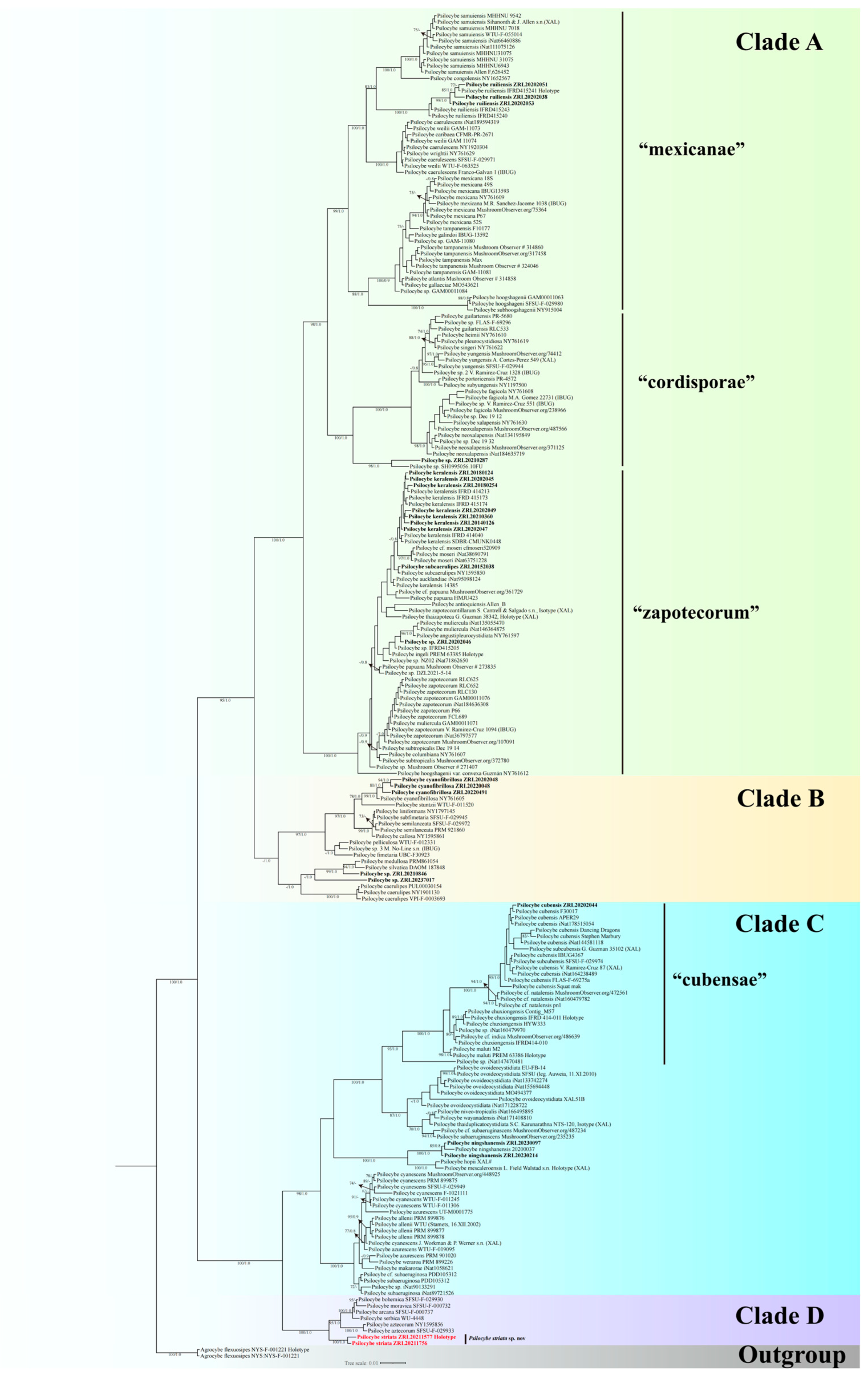
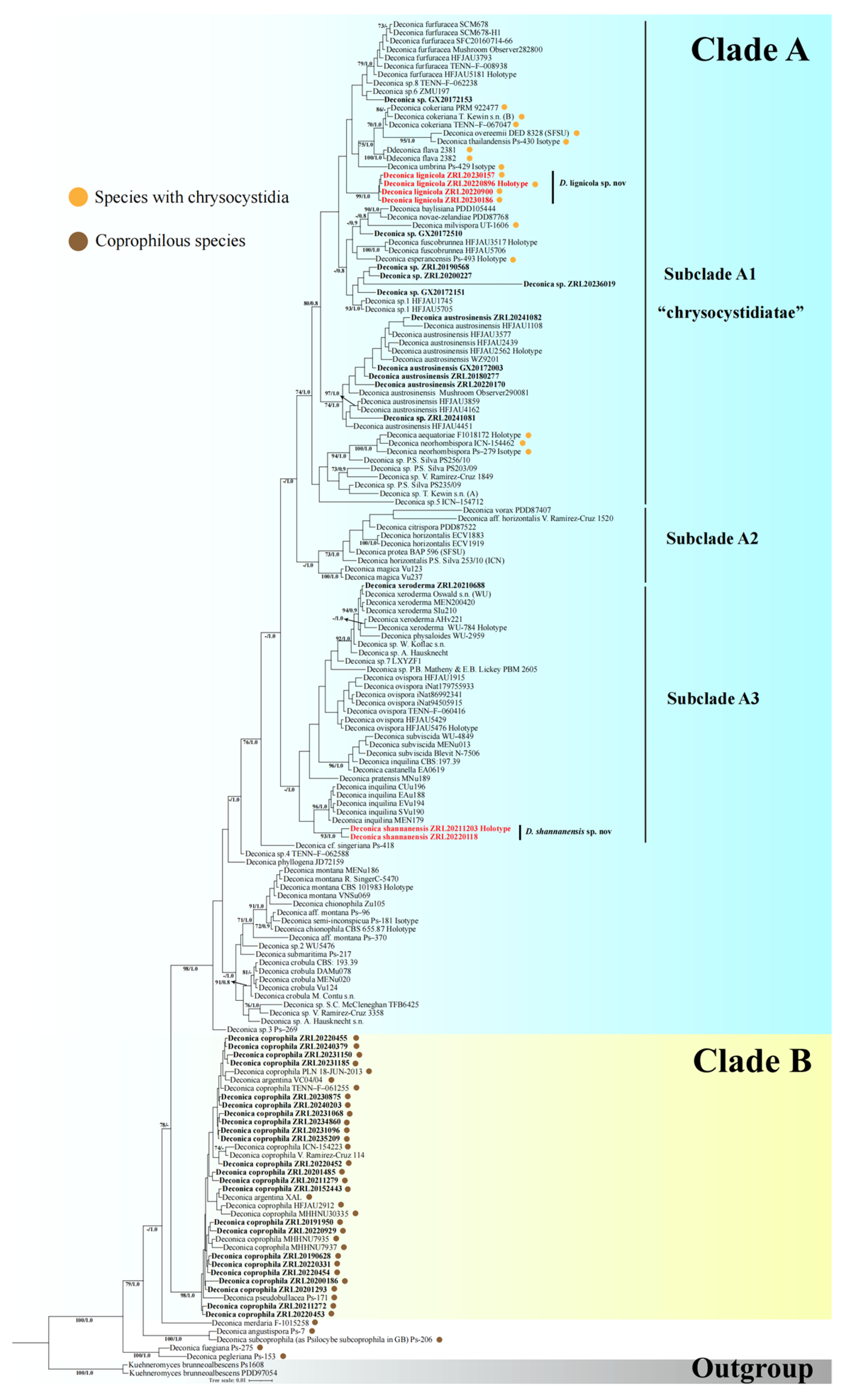
Two separate combined datasets were used for multigene phylogenetic analysis of Psilocybe and Deconica. The first Psilocybe dataset comprised 364 sequences (191 ITS, 71 nrLSU, 49 rpb2, and 53 tef1-α) retrieved from previous studies [6,14,46,47,48,49,50], along with 89 newly generated sequences (23 ITS, 23 nrLSU, 20 rpb2, and 23 tef1-α), while Agrocybe was selected as the outgroup. The Maximum Likelihood (ML) and Bayesian Inference (BI) analyses exhibited similar topologies. The ML tree is presented in Figure 1. The second Deconica dataset, with Kuehneromyces selected as the outgroup, comprised 142 sequences (121 ITS and 21 nrLSU) obtained from previous studies [6,18,20,26], and 128 newly generated sequences (41 ITS, 33 nrLSU, 24 rpb2, and 30 tef1-α). The Maximum Likelihood (ML) and Bayesian Inference (BI) analyses produced congruent topologies. The ML tree is presented in Figure 2. All sequences of Psilocybe and their GenBank accession numbers are shown in Table S1, while those of Deconica are listed in Table S2; sequences newly generated in this study are shown in boldface.
In the phylogenetic tree (Figure 1), the results robustly support Psilocybe as a monophyletic clade with strong statistical support (BS = 100%; PP = 1.00), which is divided into four major clades (A–D). These four clades are resolved into two major sister lineages: one comprising Clades A and B, and the other comprising the sister Clades C and D. This topology is consistent with prior studies [6,14,48,49,50,51]. Clade A (BS = 100%; PP = 1.00) comprises subclades mexicanae, cordisporae, and zapotecorum. Clade B (PP = 1.0) exhibited conflicting positions between the Maximum Likelihood (ML) and Bayesian Inference (BI) analyses. In the BI tree, it formed a distinct, strongly supported cluster; in contrast, it failed to resolve as a monophyletic group in the ML tree (Figure S1). Clade C (BS = 98%; PP = 1.00) is characterized by a group of widely distributed species, including the well-known P. cubensis, P. cyanescens, and their close relatives. Clade D (BS = 100%; PP = 1.00) was clustered as an independent lineage comprising the P. serbica species complex alongside the newly described P. striata. This placement of the P. serbica complex into a distinct Clade D contrasts with Ramírez-Cruz et al. (2013) but is strongly supported by more recent studies [14,24,48]. In our analysis, the P. cyanescens group remains within Clade C, reinforcing the separation of these two lineages.
As shown in Figure 2 and Figure S2, Deconica is strongly supported as a monophyletic group (BS = 100%; PP = 1.0), consistent with previous studies [6,18,20,26]. Within Deconica, Clade A (BS = 98%; PP = 1.0) consists of three subclades (A1–A3). Subclade A1 (BS = 74%; PP = 1.0) corresponds to the “chrysocystidiatae” clade, whose members are predominantly characterized by the presence of chrysocystidia. Subclade A2 (PP = 1.0), which lacks strong support in the ML analysis, groups taxa exhibiting reduced or absent stipes and small basidiospores. Subclade A3 (PP = 1.0) comprises species that display small to moderately sized basidiomes, basidiospores with thin to slightly thickened walls, cheilocystidia, and no pleurocystidia. Similar to A2, this subclade lacks significant support in the ML tree but is strongly supported in the BI analysis; its monophyly is also corroborated by shared morphological traits. Outside Clade A, the phylogeny includes a group of coprophilous taxa. Among these, Clade B (BS = 98%; PP = 1.0) constitutes a well-supported phylogenetic complex comprising D. coprophila, D. argentina, and D. pseudobullacea. However, resolving the relationships within this complex and among the other coprophilous species requires integration of additional molecular data and morphological characterization.
Based on these well-supported phylogenetic placements and morphological evidence, one new species of Psilocybe and two of Deconica are proposed herein. All novel taxa form monophyletic groups with full statistical support (Figure 1 and Figure 2). Detailed morphological descriptions, photographs, and diagnostic comparisons are presented in the Section 3.2.

3.2. Taxonomy

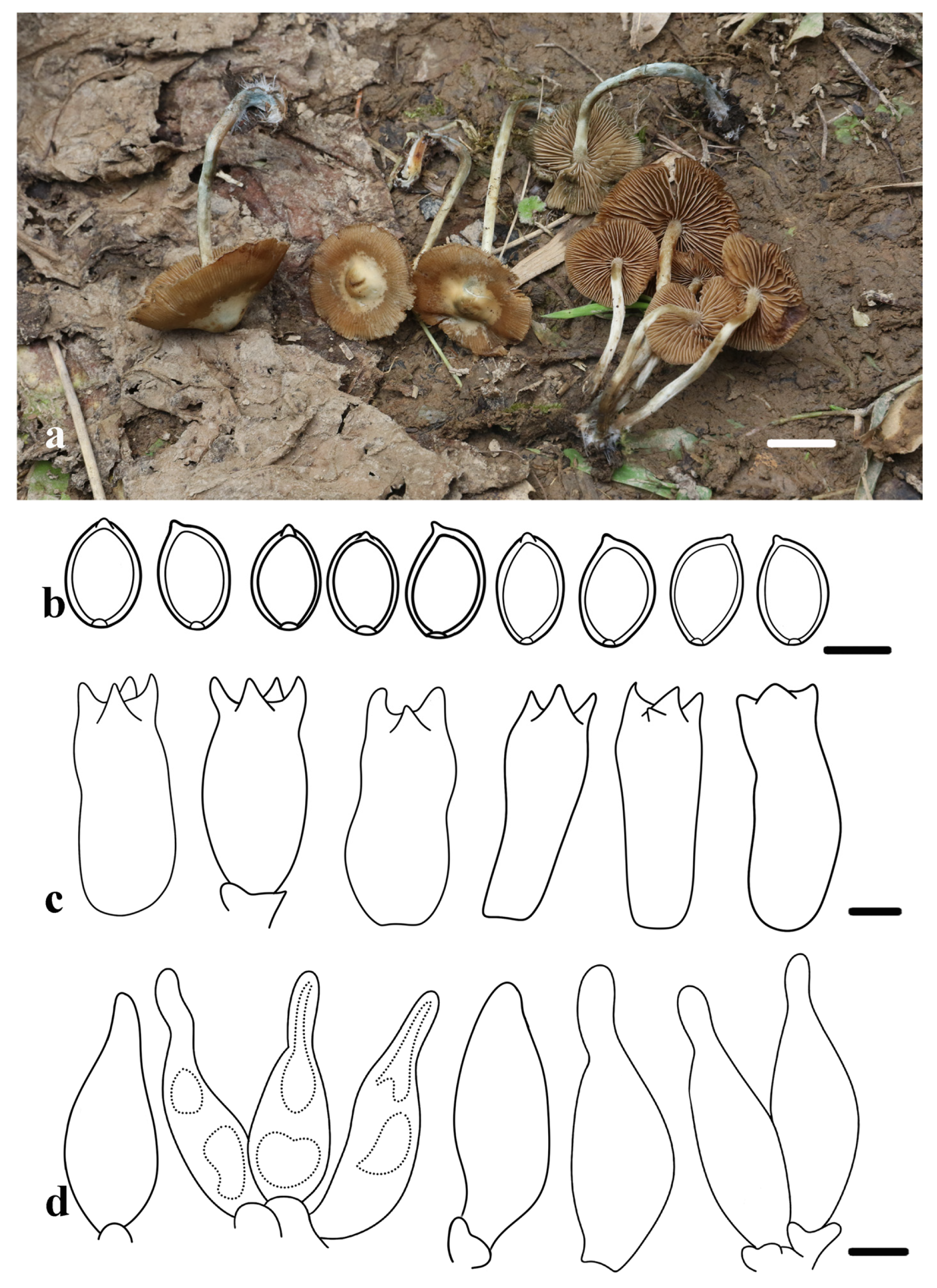
Psilocybe striata R.L. Zhao, H.Y. Feng, J.X. Li, and B. Cao, sp. nov. Figure 3.
Fungal Names: FN 572999
Etymology: striata (Latin) meaning “striped”, referring to the conspicuously striate pileus surface of the species.
Type: China, Chongqing, Kaiju County, Xuebaoshan National Nature Reserve, Xiaoyuan village, 31°35′17″ N, 108°41′18″ E, 1350 m a.s.l., 11 September 2021, X.Y. Zhu, ZRL20211577 (holotype HMAS 282652), Genbank accession: PV940825 (ITS), PV940896 (LSU), PX394216 (rpb2), PX401805 (tef1-α).
Diagnosis: Psilocybe striata is characterized by a pileus with a whitish background overlaid with striate, detachable yellowish-brown veils, an irregular margin with overhanging veil remnants, and a stipe base with dense white rhizomorphs. Microscopically, it produces ellipsoid, slightly thick-walled basidiospores and conical or lageniform cheilocystidia. Basidiomata turn blue upon mechanical damage.
Macroscopic description: Pileus 16–33 mm, initially campanulate, becoming plano-convex to applanate with age, developing a beige broad central papilla or umbo; surface whitish with detachable yellowish-brown to sepia veils, radially striate from margin to papilla and with white spots; margin irregular, often with overhanging veils remnants, bluing when mechanical injury. Context thin, yellowish centrally. Lamellae adnexed to adnate, with numerous lamellulae of varying lengths, situated between lamellae; color congruent with pileus or slightly darker, edges undulate, sometimes with scattered hyaline crystalline deposits. Stipe 25–38 × 1.5–2.5 mm, central, cylindrical, base slightly swollen, surface beige with some brownish, and squamulose fibers at the apex, base with dense white rhizomorphs and a distinct bluing reaction upon injury. Odor not recorded.
Microscopic description: Basidiospores [60/3/2], (7.4) 8.3–9.5 (10.8) × (5.1) 5.6–6.4 (7.6) µm, X = 8.9 ± 0.6 × 6.0 ± 0.4 µm, Q = 1.4–1.6, Qm = 1.5 ± 0.1, ovoid or ellipsoid in frontal view, ellipsoid to subcitriform in lateral view, with germ pore, slightly thick-walled, smooth, yellowish brown or dark yellow in KOH. Basidia 21.1–241 × 9.2–10.3 µm, clavate, cylindrical to subcylindrical, thin-walled, hyaline, four-spored. Cheilocystidia 22.7–25.9 × 7.5–9.1 µm, abundant, few conical, often lageniform with a short neck, apex rounded or sometimes slightly capitate, occasionally with inclusions, thin-walled, hyaline. No pleurocystidia. Clamp connections are present at the base of basidia and cheilocystidia.
Habitat and Habit: Saprotrophic, scattered or gregarious on humus-containing plant debris or mosses in mixed coniferous-broadleaved forest. Currently known only from Chongqing, China.
Additional specimens examined: China, Chongqing, Wushi county, Yintiaolin National Nature Reserve, 31°23′52″ N, 109°41′19″ E, 2796.8 m a.s.l., 16 September 2021, X.Y. Zhu, ZRL20211756 (HMAS 282653).
Notes: Phylogenetically, P. striata is deeply nested within Clade D, where it forms a distinct, strongly supported lineage. It is resolved as the sister group to a subclade containing P. serbica, P. moravica, P. arcana, P. bohemica, and P. aztecorum (Figure 1). Morphologically, P. striata shares several features with this group, but can be distinguished by a unique combination of characteristics. Macroscopically, all these species exhibit a bluing reaction. Additionally, P. striata shares the presence of conspicuous white rhizomorphs at the stipe base with P. bohemica, P. moravica, and P. arcana, which are absent in both P. serbica and P. aztecorum [52,53,54,55,56]. While all related species have ochraceous brown, thick-walled basidiospores with a germ pore, the basidiospores of P. striata are notably smaller (8.3–9.5 μm long) than those of its relatives, which typically exceed 10 μm in length [53,54,56]. Cystidial morphology provides the most definitive diagnostic characteristics. Psilocybe striata is characterized by the presence of conical or lageniform cheilocystidia (often with short necks) and does not have pleurocystidia, while P. arcana, which also lacks pleurocystidia, has lageniform cheilocystidia with more elongated necks [53]. In contrast, all other species in the complex possess pleurocystidia: P. serbica has lageniform pleurocystidia and cheilocystidia with elongated necks [53,56], P. aztecorum has pleurocystidia with long or rostrate necks [54,55,56], and both P. moravica and P. bohemica develop pleurocystidia, though in P. bohemica, these are often scarce [52,53,57]. Therefore, the unique combination of significantly smaller basidiospores, the presence of lageniform cheilocystidia, and no pleurocystidia provides a robust and clear morphological diagnosis for P. striata against all its closely related species.
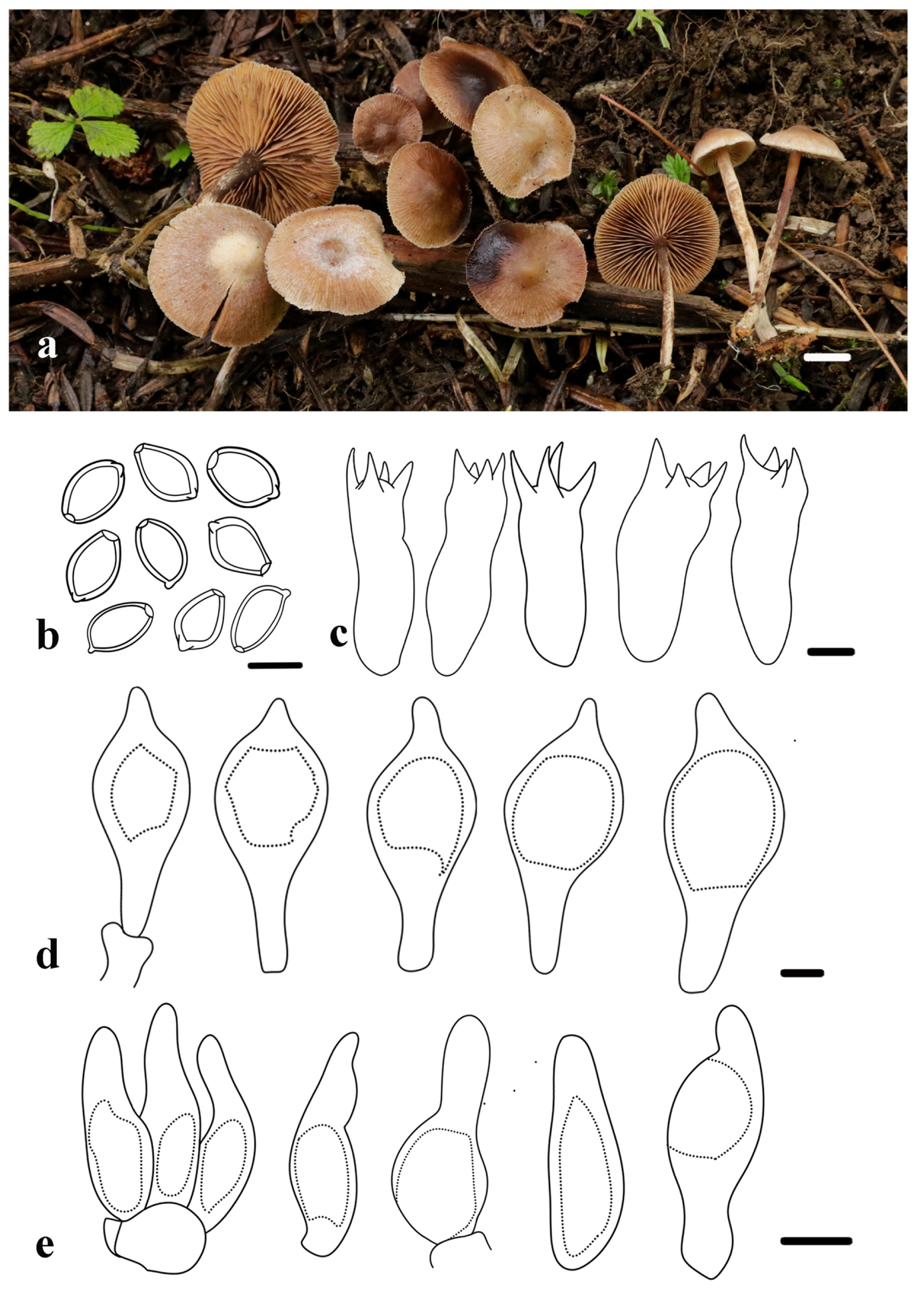
Deconica lignicola R.L. Zhao, H.Y. Feng, J.X. Li and B. Cao, sp. nov. Figure 4.
Fungal Names: FN 573000
Etymology: lignicola (Latin), meaning “wood-inhabiting”, referring mostly to its habit of growing on decaying wood.
Type: China, Hubei province, Shennongjia Forestry District, Shennong Peak Watchtower, 31°27′30″ N, 110°16′13″ E, 2886 m a.s.l., 26 Aug. 2022, X.Y. Zhu, ZRL20220896 (holotype HMAS 282620), Genbank accession: PV940853 (ITS), PV940905 (LSU), PX376975 (rpb2), PX401783 (tef1-α).
Diagnosis: Deconica lignicola is characterized by its pileus with a pointed to broadly rounded beige papilla and radiating striations towards margins; Basidiospores ellipsoid or oblong-ellipsoid, slightly thick-walled with a germ pore; Pleurocystidia type chrysocystidia, fusiform, clavate to broadly lageniform; and narrowly lageniform cheilocystidia with a short neck.
Macroscopic description: Pileus 10–25 mm, juvenile pileus often campanulate, typically expanding to plano-convex at maturity, usually with a pointy to broadly rounded beige papilla; surface smooth, light brown to yellowish brown or sepia, sometimes with reddish brown tones; margin straight, crenate, with distinct striations from margin to papilla. Context thin, fleshy, and brown. Lamellae adnate, subdistant, with lamellulae and narrow interlamellar gaps, edges smooth without decurrent tooth, tawny. Stipe 22–35 × 1.5–2.7 mm, central, cylindrical, equal in width from apex to base, surface brown, sometimes fading to white.
Microscopic description: Basidiospores [60/5/4], (6.4) 6.7–7.4 (7.8) × (3.9) 4.4–4.9 (5.4) µm, X = 7.0 ± 0.3 × 4.6 ± 0.3 µm, Q = 1.4–1.6, Qm = 1.5 ± 0.1, subrhomboid or ellipsoid in frontal view, oblong-ellipsoid in lateral view, thick-walled, smooth, with germ pore, yellowish brown in KOH. Basidia 19.5–23.3 × 6.4–7.5 µm, clavate to cylindrical, narrow at the base, thin-walled, hyaline, four-spored. Pleurocystidia type chrysocystidia, 33–40.3 × 13.4–17.7 µm, abundant, scattered, shape variable, often fusiform, clavate to broadly lageniform, with a short or long stalk base and a short neck, contents sometimes present in Congo red, thin-walled, hyaline. Cheilocystidia 14.7–19.9 × 5.3–7.1 µm, abundant, typically narrowly lageniform, subfusiform or subutriform, usually with a short neck, thin-walled, hyaline. No clamp connections.
Habitat and Habit: Saprotrophic, scattered on decaying wood and dead branches in mixed coniferous-broadleaved forest. Currently found only in the Shennongjia area of Hubei province, China.
Additional specimens examined: China, Hubei province, Shennongjia Forestry District, Shennong Peak Watchtower, 31°27′30″ N, 110°16′13″ E, 2886 m a.s.l., 26 August 2022, X.Y. Zhu, ZRL20220900 (HMAS 282621); China, Hubei province, Shennongjia Forestry District, Shennong Peak Watchtower, 31°27′30″ N, 110°16′13″ E, 2886 m a.s.l., 20 June 2023, J.X. Li, ZRL20230157 (HMAS 282622); China, Hubei province, Shennongjia Forestry District, Shennong Peak Watchtower, 31°27′30″ N, 110°16′13″ E, 2886 m a.s.l., 20 June 2023, J.X. Li, ZRL20230186 (HMAS 282623).
Notes: Phylogenetic analyses place D. lignicola in a well-supported clade and close to D. cokeriana (A.H.Sm. and Hesler) (Ram.-Cruz and A. Cortés-Pérez), D. thailandensis (E. Horak, Guzmán, and Desjardin) (Ram.-Cruz and Guzmán), D. overeemii (E. Horak and Desjardin) (Desjardin and B.A. Perry), and D. flava (Y.Y. Shen and Y.B. Song) (Figure 2). However, D. lignicola can be clearly differentiated from each of these related taxa based on distinct macroscopic and microscopic features. Deconica cokeriana exhibits an inflexed to involute pileus margin and juvenile basidiomata displaying a completely flocculose surface or white fibrillose veil remnants on half of the pileus [58], whereas D. lignicola has a campanulate to plane-convex pileus with a straight margin and a smooth surface in its immature state. Deconica thailandensis has a smaller pileus, with a diameter of only 6–15 mm, which sets it apart from the other species in the clade. Although similar in structure to D. lignicola, D. thailandensis bears persistent white veil remnants on the pileus margin, with distinctive, persistent fibrils of the veil near the margin, rendering the margin appendiculate due to persistent fibrillose squamules [59]. Deconica overeemii shares a similar pileus shape to D. lignicola, but lacks true chrysocystidia, a fundamental microscopic difference. Furthermore, its pileus is not striate, unlike the typically striate pileus of D. lignicola [60]. Deconica flava can be separated by its floccose pileus surface, often with white fibrillose patches [26]. Both D. flava and D. lignicola possess chrysocystidia that are broadly lageniform with a mucro, but the chrysocystidia of D. lignicola (33–40.3 × 13.4–17.7 µm) are significantly larger than those of D. flava (15.2–26.8 × 5.6–13.0 µm) [26,59,60].
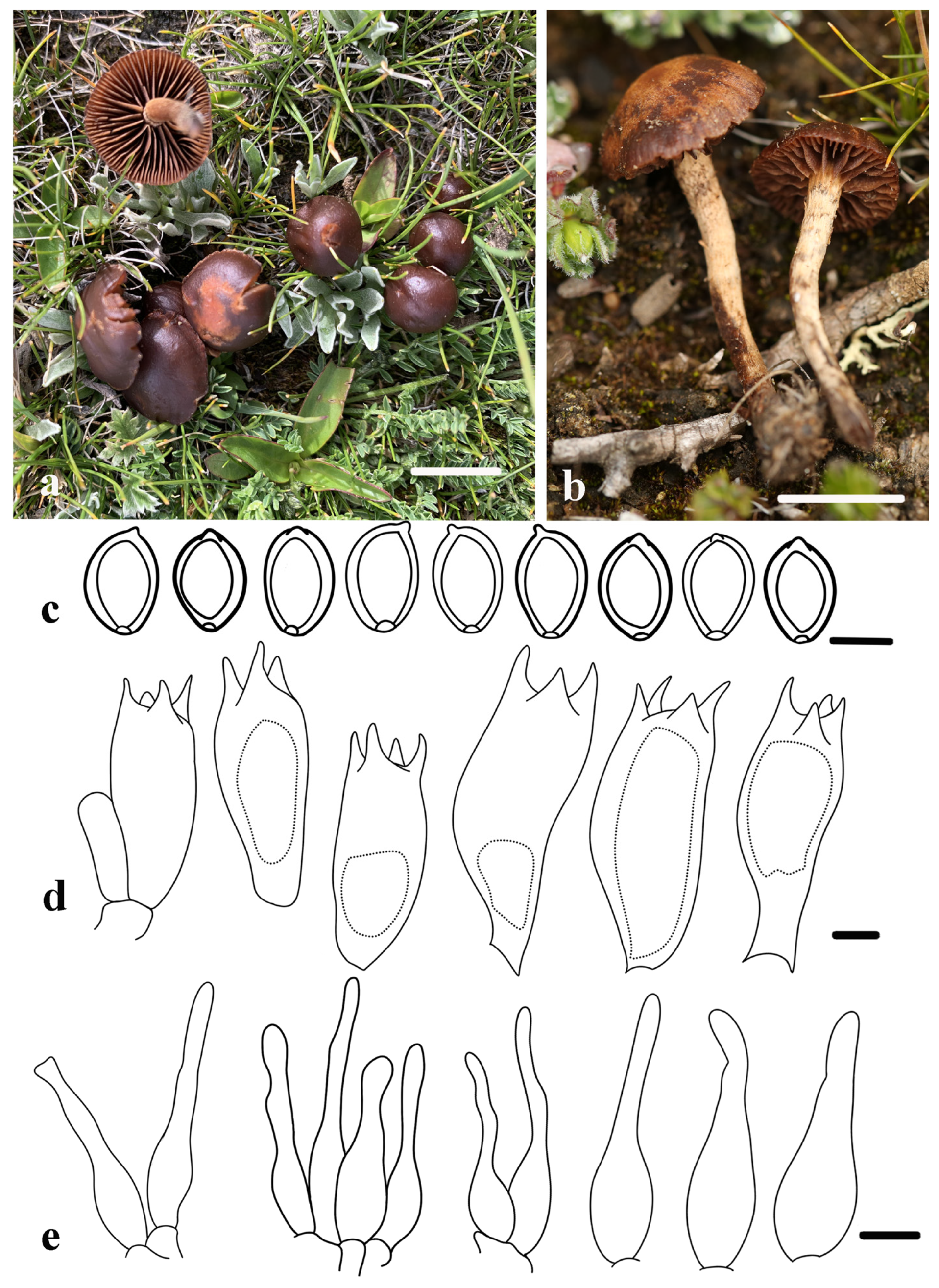
Deconica shannanensis R.L. Zhao, H.Y. Feng, J.X. Li, and B. Cao, sp. nov. Figure 5.
Fungal Names: FN573017
Etymology: shannanensis (Latin) referring to Shannan City, Xizang, China, where the holotype was collected.
Type: China, Xizang, Shannan City, Yamdrok Yumtso, 29°11′38″ N, 90°37′19″ E, 4770 m a.s.l., 30 July 2021, M.Q. He, ZRL20211203 (holotype HMAS 282624), Genbank accession: PV940843 (ITS), PV940893 (LSU), PX376973 (rpb2), PX401774 (tef1-α).
Diagnosis: Deconica shannanensis is characterized by its reddish-brown to dark brown, non-papillate basidiomata and brown lamellae with white squamulose veil remnants; Microscopically, it possesses ellipsoid or ovoid basidiospores with a distinct germ pore, abundant narrowly lageniform to lageniform cheilocystidia with a long neck, and no pleurocystidia.
Macroscopic description: Pileus 5–18 mm, initially hemispherical, expanding to convex at maturity, without papilla, dark brown or reddish-brown; smooth pileus of juvenile basidiomata, frequently developing areolate, ochraceous maculae at maturity; margin slightly inrolled, irregular. Context thin, light brown. Lamellae adnate, rugose, with lamellulae of unequal length situated inbetween, with large intervals, finely serrated edges, brown. Stipe 8–22 × 2.3–3.2 mm, central, cylindrical, equal in width, surface beige, rough, with white and brown fibrillose squamules at the apex.
Microscopic description: Basidiospores [60/3/2], (7.0) 7.6–8.8 (9.9) × (4.5) 5.0–6.0 (6.5) µm, X = 8.2 ± 0.6 × 5.5 ± 0.5 µm, Q = (1.3)1.4–1.6 (1.8), Qm = 1.5 ± 0.1, amygdaliform or ellipsoid in frontal view, ellipsoid to ovoid in lateral view, wall slightly thickened, smooth, with germ pore, color from dark yellow to yellowish-brown in KOH. Basidia 21.1–23.7 × 8.1–9.4 µm, cylindrical to clavate, thin-walled, hyaline, four-spored. Cheilocystidia abundant, 21.2–30.8 × 6.1–7.8 µm, narrowly lageniform to lageniform, typically with a long neck, thin-walled, hyaline. No pleurocystidia. No clamp connections.
Habitat and Habit: Saprotrophic, scattered or gregarious on cattle dung in alpine meadows. Currently found only in Xizang, China.
Additional specimens examined: China, Xizang, Rikaze area, Yadong County, Pari Town Plateau Meadow, 27°45′23″ N, 89°6′18″ E, 4330 m a.s.l., 28 July 2022, M.Q. He, ZRL20220118 (HMAS 282625).
Notes: Phylogenetic analyses place D. shannanensis as the sister taxon to D. inquilina in Subclade A3, although this relationship lacks statistical support (Figure 2). Despite this phylogenetic proximity, the two species are distinctly separated by both morphological and ecological traits. Macroscopically, D. shannanensis exhibits a non-striate pileus that lacks a separable pellicle, contrasting with the translucent-striate pileus and separable pellicle of D. inquilina. Furthermore, D. shannanensis possesses a typically larger pileus (5–18 mm) but a shorter and thicker stipe, whereas D. inquilina has a smaller pileus (4–10.5 mm) and a more slender, elongated stipe (15–35 × 1–2 mm) [25]; From an ecological perspective, their ecological niches are distinctly different: D. shannanensis is a coprophilous species inhabiting high-altitude meadows, while D. inquilina grows on leaf litter and moss [6]. When compared to other members of Subclade A3, including D. xeroderma, D. ovispora, D. subviscida, and D. castanella, D. shannanensis remains morphologically distinguishable. Its hemispherical to convex brown pileus, which develops rough patches on the surface upon maturity, whereas D. xeroderma has a smooth pileus surface, often covered by a pale yellow, silky veil [61]. Additionally, while species such as D. ovispora, D. subviscida, and D. castanella may share a brown pileus coloration, they consistently exhibit distinct striations and a central, low convexity. Furthermore, the pileus margin of both D. subviscida and D. castanella is frequently adorned with an appendiculate veil, and D. castanella is characterized by a dense covering of small white patches on the pileus surface [18,19,62,63]. These consistent morphological differences effectively delineate D. shannanensis from its phylogenetic relatives within the subclade.

4. Discussion

Despite significant advances in the study of Psilocybe and Deconica, much of their diversity remains undiscovered. Current taxonomic efforts have formally described only a fraction of the species within these genera, with many more awaiting discovery and description. This is especially true for Deconica, although early estimates suggested the genus could comprise over 100 species, the number of currently recognized species is far lower [64,65]. Similarly, the species diversity, distribution, and phylogenetic relationships of both genera within China remain largely unexplored. For instance, recent editions of the Flora Fungorum Sinicorum list only a handful of Psilocybe species, and while several new taxa have been recently described (P. zhushanensis, P. ningshanensis), the total count remains limited [23,24,48]. The situation is even more critical for Deconica, with only five species reported from China to date. This significant gap between regional records and global diversity estimates, compounded by a lack of comprehensive molecular data, underscores the urgent need for further taxonomic investigation in the region, which this study begins to address.
In this study, based on an integrative taxonomic examination of 64 specimens, we identified nine known species across the two genera under investigation, as well as three new species to science. The known species include P. cubensis, P. cyanofibrillosa, P. keralensis, P. ningshanensis, P. ruiliensis, P. subcaerulipes, D. austrosinensis, D. coprophila, and D. xeroderma. Additionally, several collections were provisionally identified as Psilocybe sp. and Deconica sp., which may represent new taxonomic entities, though these findings require further investigation. Notably, their morphoanatomic features and phylogenetic affinities to known species were not discussed in detail. The discovery of P. striata in Chongqing is particularly noteworthy, as it represents a new locality record for Psilocybe in China, expanding its known distribution beyond previously documented areas like Yunnan and Xizang [27,28,48]. Meanwhile, the discoveries of D. lignicola and D. shannanensis enrich the known diversity of their respective lineages within China. Notably, D. shannanensis is one of the Deconica species recorded in high-altitude meadows, further contributing to our understanding of the genus’ ecological diversity. These novel taxa raise critical questions about the historical biogeography and ecological plasticity of these fungi, suggesting their adaptive capacities may be broader than previously recognized.
The concept of Psilocybe s.str., as defined by Redhead et al. (2007), restricts the genus to species that exhibit a bluing reaction upon mechanical damage, a trait associated with psychoactive compounds [2]. Phylogenetically, P. striata is robustly placed within Psilocybe Clade D, a group where all confirmed members are known to be psychoactive [6,8,14]. Given its phylogenetic placement within this clade and its strong bluing reaction—a widely recognized macroscopic indicator for psilocybin—we hypothesize that P. striata may also produce these compounds and could therefore be considered potentially toxic. This morphological and phylogenetic evidence reinforces the utility of the bluing reaction as a reliable macroscopic indicator of potential toxicity within Psilocybe, particularly when interpreted in a phylogenetic context. Within Deconica, Subclade A1 (subclade “chrysocystidiatae”) is primarily defined by the presence of chrysocystidia, specialized cystidia with golden-yellow contents. However, the absence of chrysocystidia in some phylogenetically nested species, such as D. fuscobrunnea, D. furfuracea, and D. austrosinensis, demonstrates that the presence of chrysocystidia is not a stable diagnostic character for this entire lineage and should not be solely relied upon for classification [6,18].
In conclusion, this study advances the taxonomy of Psilocybe and Deconica in China by describing three new species and confirming nine known species through integrated morphological and phylogenetic analyses. Our work reveals the rich, yet largely undiscovered, diversity of these genera in the montane and alpine ecosystems of Chongqing and Xizang, emphasizing the need for continued exploration. The findings provide a crucial foundation for future research into the ecology, biogeography, and evolution of these fungi.

Supplementary Materials

The following supporting information can be downloaded at: https://zenodo.org/records/17667185, Figure S1: Maximum likelihood (ML) tree of Psilocybe inferred from ITS, nrLSU, rpb2 and tef1-α sequences; Figure S2: Bayesian Inference (BI) tree of Deconica inferred from ITS, nrLSU, rpb2 and tef1-α sequences; Table S1: Taxa, vouchers and GenBank accession numbers of Psilocybe taxa used in this study; Table S2: Taxa, vouchers and GenBank accession numbers of Deconica taxa used in this study. Additionally, the phylogenetic trees and sequence alignments have been deposited in the National Microbiology Data Center, NMDC. The official number is NMDCX0002180.

Author Contributions

Conceptualization, H.-Y.F.; methodology, H.-Y.F.; validation, H.-Y.F. and J.-X.L.; formal analysis, H.-Y.F. and J.-X.L.; resources, J.-X.L., B.C. and W.-Q.Y.; data curation, H.-Y.F. and J.-X.L.; writing—original draft preparation, H.-Y.F.; writing—review and editing, R.-L.Z. and J.-X.L.; supervision, R.-L.Z.; project administration, R.-L.Z.; funding acquisition, R.-L.Z. All authors have read and agreed to the published version of the manuscript.

Funding

We would like to thank the National Natural Science Foundation of China (32500009), the Science and Technology Projects of Xizang Autonomous Region, China (XZ202501ZY0019), the Science and Technology Fundamental Resources Investigation Program, Ministry of Science and Technology of China (2023FY101303), the Background Resources Survey in Shennongjia National Park (SNJNP2022004), and the Open Project Fund of Hubei Provincial Key Laboratory for Conservation Biology of Shennongjia Snub-nosed Monkeys (SNJGKL2022004).

Institutional Review Board Statement

Not applicable.

Informed Consent Statement

Not applicable.

Data Availability Statement

All sequence data are available in NCBI GenBank following the accession numbers in the Supplementary Materials.

Acknowledgments

We thank Xin-Yu Zhu and Mao-Qiang He for their assistance with the field collection of specimens used in this study, and Xi-Xi Han for her important assistance in our phylogenetic analyses. We thank the Mycological Herbarium, Institute of Microbiology, CAS, Beijing, China (HMAS).

Conflicts of Interest

The authors declare no conflicts of interest.

References

  1. Norvell, L.L. Report of the nomenclature committee for fungi: 15. Taxon 2010, 59, 291–293. [Google Scholar] [CrossRef]
  2. Redhead, S.A.; Moncalvo, J.-M.; Vilgalys, R.; Matheny, P.B.; Guzmán-Dávalos, L.; Guzmán, G. (1757) Proposal to conserve the name Psilocybe (Basidiomycota) with a conserved type. Taxon 2007, 56, 255–257. [Google Scholar]
  3. Guzmán, G. Species diversity in the genus Psilocybe (Basidiomycotina, Agaricales, Strophariaceae) of world mycobiota, with special attention to hallucinogenic properties. Int. J. Med. Mushrooms 2005, 7, 305. [Google Scholar] [CrossRef]
  4. Van Court, R.C.; Wiseman, M.S.; Meyer, K.W.; Ballhorn, D.J.; Amses, K.R.; Slot, J.C.; Dentinger, B.T.M.; Garibay-Orijel, R.; Uehling, J.K. Diversity, biology, and history of psilocybin-containing fungi: Suggestions for research and technological development. Fungal Biol. 2022, 126, 308–319. [Google Scholar] [CrossRef] [PubMed]
  5. Bradshaw, A.J.; Autumn, K.C.; Rickart, E.A.; Dentinger, B.T. On the origin of feces: Fungal diversity, distribution, and conservation implications from feces of small mammals. Environ. DNA 2022, 4, 608–626. [Google Scholar] [CrossRef]
  6. Ramírez-Cruz, V.; Guzmán, G.; Villalobos-Arámbula, A.R.; Rodríguez, A.; Matheny, P.B.; Sánchez-García, M.; Guzmán-Dávalos, L. Phylogenetic inference and trait evolution of the psychedelic mushroom genus Psilocybe sensu lato (Agaricales). Botany 2013, 91, 573–591. [Google Scholar] [CrossRef]
  7. Stamets, P. Psilocybin Mushrooms of the World: An Identification Guide; Ten Speed Press: Berkeley, CA, USA, 1996. [Google Scholar]
  8. Strauss, D.; Ghosh, S.; Murray, Z.; Gryzenhout, M. An overview on the taxonomy, phylogenetics and ecology of the psychedelic genera Psilocybe, Panaeolus, Pluteus and Gymnopilus. Front. For. Glob. Change 2022, 5, 813–998. [Google Scholar] [CrossRef]
  9. Guzmán, G. New taxonomical and ethnomycological observations on Psilocybe s.s. (Fungi, Basidiomycota, Agaricomycetidae, Agaricales, Strophariaceae) from Mexico, Africa and Spain. Acta Botánica Mex. 2012, 79–106. [Google Scholar] [CrossRef][Green Version]
  10. Moncalvo, J.-M.; Vilgalys, R.; Redhead, S.A.; Johnson, J.E.; James, T.Y.; Aime, M.C.; Hofstetter, V.; Verduin, S.J.; Larsson, E.; Baroni, T.J. One hundred and seventeen clades of euagarics. Mol. Phylogenetics Evol. 2002, 23, 357–400. [Google Scholar] [CrossRef]
  11. Nashikkar, R.; Mane, K.; Patil, R. Psilocybin Fungi Unveiled: Morphological Characteristics and Pharmacological Potentials. Int. J. Res. Appl. Sci. Eng. 2024, 23, 357–400. [Google Scholar] [CrossRef]
  12. Tolgor, B. Flora Fungorum Sinicorum; Vol. 49: Strophariaceae; Science Press: Beijing, China, 2014; pp. 1–211. [Google Scholar]
  13. Tolgor, B. Flora Fungorum Sinicorum; Vol. 72: Strophariaceae; Science Press: Beijing, China, 2024; pp. 1–224. [Google Scholar]
  14. Bradshaw, A.J.; Ramírez-Cruz, V.; Awan, A.R.; Furci, G.; Guzmán-Dávalos, L.; Dentinger, B.T. Phylogenomics of the psychoactive mushroom genus Psilocybe and evolution of the psilocybin biosynthetic gene cluster. Proc. Natl. Acad. Sci. USA 2024, 121, e2311245121. [Google Scholar] [CrossRef] [PubMed]
  15. Guzmán, G. Traditional uses and abuses of hallucinogenic fungi: Problems and solutions. Int. J. Med. Mushrooms 2003, 5, 57–59. [Google Scholar] [CrossRef]
  16. Wasson, R.G. Seeking the magic mushroom. Life 1957, 42, 100–120. [Google Scholar]
  17. Balakrishnan, K.; Krishnaa, D.; Balakrishnan, G.; Manickam, M.; Abdulkader, A.M.; Dharumadurai, D. Association of bacterial communities with psychedelic mushroom and soil as revealed in 16S rRNA gene sequencing. Appl. Biochem. Biotechnol. 2024, 196, 2566–2590. [Google Scholar] [CrossRef]
  18. Yan, J.-Q.; Wang, S.-N.; Hu, Y.-P.; Nie, C.-F.; Ke, B.-R.; Zeng, Z.-H.; Zeng, H. Four New Species of Deconica (Strophariaceae, Agaricales) from Subtropical Regions of China. J. Fungi 2024, 10, 745. [Google Scholar] [CrossRef]
  19. Noordeloos, M. Strophariaceae sl Fungi Europaei 13; Edizioni Candusso: Alassio, Italy, 2011. [Google Scholar]
  20. Ramírez-Cruz, V.; da Silva, P.S.; Villalobos-Arámbula, A.R.; Matheny, P.B.; Noordeloos, M.; Morgado, L.; da Silveria, R.M.B.; Guzmán-Dávalos, L. Two new species of Deconica (Agaricales, Basidiomycota) from Australia and Mexico. Mycol. Prog. 2020, 19, 1317–1328. [Google Scholar] [CrossRef]
  21. Guzmán, G. The Genus Psilocybe: Revision of the Known Species (Hallucinogenic Species); Nova Hedwigia Beihefte; Lubrecht and Cramer, Limited: Port Jervis, NY, USA, 1983; Volume 74. [Google Scholar]
  22. Noordeloos, M.E. The genus Deconica (WG SM.) P. KARST. in Europe–new combinations. Osterr. Z. Für Pilzkd 2009, 18, 197–199. [Google Scholar]
  23. Cao, B.; Phurbu, D.; Ralaiveloarisoa, A.; Liimatainen, K.; Niskanen, T.; Ramírez-Cruz, V.; Bradshaw, A.J.; Dentinger, B.T.M.; Ramírez-Guillén, F.; Cortés-Pérez, A.; et al. Fungal diversity notes 1919–2016: Taxonomic and phylogenetic contributions to fungal taxa. Fungal Divers. 2025, 132, 425–651. [Google Scholar] [CrossRef]
  24. He, X.-L.; Huo, W.-Y.; Zhang, L.-G.; Liu, Y.; Qi, P.; Dai, L.; Qiao, T.; Lu, P.; Li, J.-Z. Psilocybe ningshanensis (Hymenogastraceae, Agaricales), a new species from China. Phytotaxa 2022, 545, 175–185. [Google Scholar] [CrossRef]
  25. Silva, P.S.d. Os gêneros Deconica (WG Sm.) P. Karst. e Psilocybe (Fr.) P. Kumm. (Agaricales) na Região Sul do Brasil: Contribuíção á sua Filogenia com Bases Morfológicas, Moleculares e Químicas. Ph.D. Thesis, Universidade Federal do Rio Grande do Sul, Porto Alegre, Brazil, 2013. [Google Scholar]
  26. Shen, Y.-Y.; Zhang, Z.-W.; Li, W.-Q.; Liu, X.-N.; Tian, F.-Y.; Pang, C.-M.; Dai, W.-H.; Song, Y.-B.; Dong, M. Morpho-molecular analysis of two new species Deconica and Entocybe in Agaricales from Mount Tianmu, China. MycoKeys 2024, 109, 319. [Google Scholar] [CrossRef]
  27. Tolgor, B.; Bao, H.-Y.; Li, Y. A revised checklist of poisonous mushrooms in China. Mycosystema 2014, 33, 517–548. [Google Scholar] [CrossRef]
  28. Tolgor, B.; Li, H.-J.; Bao, H.-Y.; Li, Y. A revised checklist of poisonous mushrooms in China. J. Fungal Res. 2024, 22, 301–321. [Google Scholar] [CrossRef]
  29. Carhart-Harris, R.; Giribaldi, B.; Watts, R.; Baker-Jones, M.; Murphy-Beiner, A.; Murphy, R.; Martell, J.; Blemings, A.; Erritzoe, D.; Nutt, D.J. Trial of psilocybin versus escitalopram for depression. N. Engl. J. Med. 2021, 384, 1402–1411. [Google Scholar] [CrossRef] [PubMed]
  30. Griffiths, R.R.; Johnson, M.W.; Carducci, M.A.; Umbricht, A.; Richards, W.A.; Richards, B.D.; Cosimano, M.P.; Klinedinst, M.A. Psilocybin produces substantial and sustained decreases in depression and anxiety in patients with life-threatening cancer: A randomized double-blind trial. J. Psychopharmacol. 2016, 30, 1181–1197. [Google Scholar] [CrossRef]
  31. Largent, D.L.; Johnson, D.; Watling, R.; Stuntz, D.E.; Baroni, T.J.; Thiers, H.D. How to Identify Mushrooms to Genus; Mad River Press: Eureka, CA, USA, 1986. [Google Scholar]
  32. Bas, C. Morphology and Subdivision of Amanita and a Monograph of Its Section Lepidella. Persoonia 1969, 5, 285–573. [Google Scholar]
  33. Li, J.-X.; Cao, B.; He, M.-Q.; Zhu, X.-Y.; Liu, D.-M.; Zhao, R.-L. Ten new species of Leucoagaricus and Leucocoprinus from Beijing: Revealing rich diversity in temperate regions. Mycology 2025, 16, 1558–1588. [Google Scholar] [CrossRef]
  34. Gardes, M.; Bruns, T.D. ITS primers with enhanced specificity for basidiomycetes-application to the identification of mycorrhizae and rusts. Mol. Ecol. 1993, 2, 113–118. [Google Scholar] [CrossRef]
  35. White, T.J.; Bruns, T.; Lee, S.; Taylor, J. Amplification and direct sequencing of fungal ribosomal RNA genes for phylogenetics. PCR Protoc. A Guide Methods Appl. 1990, 18, 315–322. [Google Scholar]
  36. Vilgalys, R.; Hester, M. Rapid genetic identification and mapping of enzymatically amplified ribosomal DNA from several Cryptococcus species. J. Bacteriol. 1990, 172, 4238–4246. [Google Scholar] [CrossRef]
  37. Matheny, P.B. Improving phylogenetic inference of mushrooms with RPB1 and RPB2 nucleotide sequences (Inocybe; Agaricales). Mol. Phylogenetics Evol. 2005, 35, 1–20. [Google Scholar] [CrossRef]
  38. Rehner, S.A.; Buckley, E. A Beauveria phylogeny inferred from nuclear ITS and EF1-α sequences: Evidence for cryptic diversification and links to Cordyceps teleomorphs. Mycologia 2005, 97, 84–98. [Google Scholar] [CrossRef]
  39. Liu, X.; Chen, Q.; Xiang, Q.; Gu, Y.; Han, X.-X.; Xing, R.; Zhao, R.-L.; He, M.-Q. Additions to the Entoloma (Agaricales, Entolomataceae) from China: Description of five species with one new to science. MycoKeys 2025, 123, 89–103. [Google Scholar] [CrossRef]
  40. Katoh, K.; Standley, D.M. MAFFT Multiple Sequence Alignment Software Version 7: Improvements in Performance and Usability. Mol. Biol. Evol. 2013, 30, 772–780. [Google Scholar] [CrossRef] [PubMed]
  41. Zhang, D.; Gao, F.; Jakovlić, I.; Zou, H.; Zhang, J.; Li, W.X.; Wang, G.T. PhyloSuite: An integrated and scalable desktop platform for streamlined molecular sequence data management and evolutionary phylogenetics studies. Mol. Ecol. Resour. 2020, 20, 348–355. [Google Scholar] [CrossRef] [PubMed]
  42. Stamatakis, A. RAxML-VI-HPC: Maximum likelihood-based phylogenetic analyses with thousands of taxa and mixed models. Bioinformatics 2006, 22, 2688–2690. [Google Scholar] [CrossRef] [PubMed]
  43. Ronquist, F.; Huelsenbeck, J.P. MrBayes 3: Bayesian phylogenetic inference under mixed models. Bioinformatics 2003, 19, 1572–1574. [Google Scholar] [CrossRef]
  44. Ronquist, F.; Teslenko, M.; Van Der Mark, P.; Ayres, D.L.; Darling, A.; Höhna, S.; Larget, B.; Liu, L.; Suchard, M.A.; Huelsenbeck, J.P. MrBayes 3.2: Efficient Bayesian phylogenetic inference and model choice across a large model space. Syst. Biol. 2012, 61, 539–542. [Google Scholar] [CrossRef]
  45. Letunic, I.; Peer, B. Interactive Tree Of Life (iTOL) v5: An online tool for phylogenetic tree display and annotation. Nucleic Acids Res. 2021, 49, W293–W296. [Google Scholar] [CrossRef]
  46. Borovička, J.; Oborník, M.; Stříbrný, J.; Noordeloos, M.E.; Sánchez, L.; Gryndler, M. Phylogenetic and chemical studies in the potential psychotropic species complex of Psilocybe atrobrunnea with taxonomic and nomenclatural notes. Persoonia-Mol. Phylogeny Evol. Fungi 2015, 34, 1–9. [Google Scholar] [CrossRef]
  47. Borovička, J.; Rockefeller, A.; Werner, P.G. Psilocybe allenii–a new bluing species from the Pacific Coast, USA. Czech Mycol. 2012, 64, 181–195. [Google Scholar] [CrossRef]
  48. Ma, T.; Ling, X.-F.; Hyde, K.D. Species of Psilocybe (Hymenogastraceae) from Yunnan, southwest China. Phytotaxa 2016, 284, 181–193. [Google Scholar] [CrossRef]
  49. Ma, T.; Feng, Y.; Lin, X.-F.; Karunarathna, S.C.; Ding, W.-F.; Hyde, K.D. Psilocybe chuxiongensis, a new bluing species from subtropical China. Phytotaxa 2014, 156, 211–220. [Google Scholar] [CrossRef][Green Version]
  50. Van Der Merwe, B.; Rockefeller, A.; Kilian, A.; Clark, C.; Sethathi, M.; Moult, T.; Jacobs, K. A description of two novel Psilocybe species from southern Africa and some notes on African traditional hallucinogenic mushroom use. Mycologia 2024, 116, 821–834. [Google Scholar] [CrossRef] [PubMed]
  51. Borovička, J.; Noordeloos, M.E.; Gryndler, M.; Oborník, M. Molecular phylogeny of Psilocybe cyanescens complex in Europe, with reference to the position of the secotioid Weraroa novae-zelandiae. Mycol. Prog. 2011, 10, 149–155. [Google Scholar] [CrossRef]
  52. Borovička, J. New variety of Psilocybe moravica and notes on Psilocybe bohemica. Czech Mycol. 2006, 58, 75–80. [Google Scholar] [CrossRef]
  53. Borovička, J. The wood-rotting bluing Psilocybe species in Central Europe–an identification key. Czech Mycol. 2008, 60, 173–192. [Google Scholar] [CrossRef]
  54. Cortés-Pérez, A.; Ramírez-Guillén, F.; Guzmán, G.; Guzmán-Dávalos, L.; Rockefeller, A.; Ramírez-Cruz, V. Type studies in five species of Psilocybe (Agaricales, Basidiomycota). Nova Hedwig 2021, 112, 197–221. [Google Scholar] [CrossRef]
  55. Heim, R. Notes préliminaires sur les agarics hallucinogènes du Mexique. Rev. Mycol. 1957, 22, 58–79. [Google Scholar]
  56. Ramírez-Crnz, V.; Guzmán, G.; Guzmán-Dávalos, L. Type studies of Psilocybe sensu lato (Strophariaceae, Agaricales). Sydowia 2013, 65, 11. [Google Scholar]
  57. Krisai-Greilhuber, I.; Kresitschnig, P.; Pötz, H.; Evelin, D.; Barfuss, M.H. Psilocybe serbica var. bohemica–ein österreichischer Nachweis. Osterr. Z. Für Pilzkd 2016, 25, 201–208. [Google Scholar]
  58. Ramírez-Cruz, V.; Cortes-Perez, A.; Borovička, J.; Villalobos-Arambula, A.R.; Matheny, P.B.; Guzmán-Dávalos, L. Deconica cokeriana (Agaricales, Strophariaceae), a new combination. Mycoscience 2020, 61, 95–100. [Google Scholar] [CrossRef]
  59. Horak, E.; Guzmán, G.; Desjardin, D. Four new species of Psilocybe from Malaysia and Thailand, with a key to the species of sect. Neocaledonicae and discussion on the distribution of the tropical and temperate species. Sydowia 2009, 61, 25–37. [Google Scholar]
  60. Retnowati, A.; Sufaati, S. A New Distribution Record of Deconica overeemi (Agaricales, Strophariaceae). Floribunda 2024, 7, 182–191. [Google Scholar] [CrossRef]
  61. Ma, T. Taxonomy of Psilocybe sl and Panaeolus in Yunnan, Southwest China, with Notes on Related Genus Protostropharia. Ph.D. Thesis, Chinese Academy of Forestry, Beijing, China, 2014. [Google Scholar]
  62. Knudsen, H.; Vesterholt, J. Funga Nordica: Agaricoid, Boletoid and Cyphelloid Genera; Nordsvamp: Copenhagen, Denmark, 2008. [Google Scholar]
  63. Peck, C.H. Report of the State Botanist 1887. Annu. Rep. N. Y. State Mus. Nat. Hist. 1888, 41, 51–122. [Google Scholar]
  64. He, M.-Q.; Zhao, R.-L.; Hyde, K.D.; Begerow, D.; Kemler, M.; Yurkov, A.; McKenzie, E.H.; Raspé, O.; Kakishima, M.; Sánchez-Ramírez, S. Notes, outline and divergence times of Basidiomycota. Fungal Divers. 2019, 99, 105–367. [Google Scholar] [CrossRef]
  65. Kalichman, J.; Kirk, P.M.; Matheny, P.B. A compendium of generic names of agarics and Agaricales. Taxon 2020, 69, 425–447. [Google Scholar] [CrossRef]
Figure 1. Bayesian Inference (BI) tree of Psilocybe inferred from ITS, nrLSU, rpb2, and tef1-α sequences. BS > 70% and PP > 0.80 are indicated on nodes. Examined specimens in this study are shown in boldface, and new species are highlighted in bold red.
Jof 11 00887 g001
Figure 2. Maximum likelihood (ML) tree of Deconica inferred from ITS, nrLSU, rpb2, and tef1-α sequences. BS > 70% and PP > 0.80 are indicated on nodes. Examined specimens in this study are shown in boldface, new species are highlighted in bold red, and species with chrysocystidia are marked with orange dots, while coprophilous species are marked with brown dots.
Jof 11 00887 g002
Figure 3. Morphology of Psilocybe striata. (a) Basidiomata (holotype, HMAS 282652). (b) Basidiospores. (c) Basidia. (d) Cheilocystidia. Scale bars: (a) = 1 cm, (bd) = 5 µm.
Jof 11 00887 g003
Figure 4. Morphology of Deconica lignicola. (a) Basidiomata (holotype, HMAS 282620). (b) Basidiospores. (c) Basidia. (d) Pleurocystidia. (e) Cheilocystidia. Scale bars: (a) = 1 cm, (be) = 5 µm.
Jof 11 00887 g004
Figure 5. Morphology of Deconica shannanensis. (a) Basidiomata (holotype, HMAS 282624). (b) Basidiomata (HMAS 282625). (c) Basidiospores. (d) Basidia. (e) Cheilocystidia. Scale bars: (a,b) = 1 cm, (ce) = 5 µm.
Jof 11 00887 g005
Disclaimer/Publisher’s Note: The statements, opinions and data contained in all publications are solely those of the individual author(s) and contributor(s) and not of MDPI and/or the editor(s). MDPI and/or the editor(s) disclaim responsibility for any injury to people or property resulting from any ideas, methods, instructions or products referred to in the content.