You are currently viewing a new version of our website. To view the old version click .

Journal of Cardiovascular Development and Disease, Volume 11, Issue 7

July 2024 - 46 articles

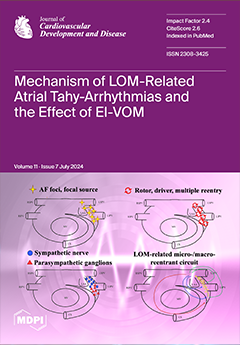
Cover Story: The LOM can act as a trigger as well as a substrate of AF and AT. Additionally, the LOM can be a source of arrhythmogenic autonomic nerves, contributing to the development of these tachyarrhythmias. The LOM is often involved in complex ATs, especially after endocardial ablation at the mitral isthmus. The LOM is an epicardial structure containing sympathetic nerves, veins, and muscular bundles that connect to the LA, which is insulated from the LA by fatty tissue, resulting in the difficulty in ablating this structure from the endocardial surface. EI-VOM provides a safe and effective way to eliminate this arrhythmogenic structure. View this paper
  • Issues are regarded as officially published after their release is announced to the table of contents alert mailing list .
  • You may sign up for email alerts to receive table of contents of newly released issues.
  • PDF is the official format for papers published in both, html and pdf forms. To view the papers in pdf format, click on the "PDF Full-text" link, and use the free Adobe Reader to open them.

Articles (46)

  • Article
  • Open Access
1 Citations
1,614 Views
9 Pages

Clinical Outcome Using Different Catheter Interventional Treatment Modalities in High-Risk Pulmonary Artery Embolism

  • Luise Antonia Mentzel,
  • Parham Shahidi,
  • Stephan Blazek,
  • Dmitry Sulimov,
  • Holger Thiele and
  • Karl Fengler

Background: For patients with high-risk pulmonary artery embolism (PE), catheter-directed therapies pose a viable alternative treatment option to systemic thrombolysis or anticoagulation. Right now, there are multiple devices available which have bee...

  • Article
  • Open Access
1 Citations
3,338 Views
15 Pages

Age-Specific Outcomes of Bioprosthetic vs. Mechanical Aortic Valve Replacement: Balancing Reoperation Risk with Anticoagulation Burden

  • Fatimah A. Alhijab,
  • Latifa A. Alfayez,
  • Essam Hassan,
  • Monirah A. Albabtain,
  • Ismail M. Elnaggar,
  • Khaled A. Alotaibi,
  • Adam I. Adam,
  • Claudio Pragliola,
  • Huda H. Ismail and
  • Amr A. Arafat

Background: The choice of prosthesis for aortic valve replacement (AVR) remains challenging. The risk of anticoagulation complications vs. the risk of aortic valve reintervention should be weighed. This study compared the outcomes of bioprosthetic vs...

  • Article
  • Open Access
4 Citations
2,183 Views
14 Pages

The Role of NOTCH Pathway Genes in the Inherited Susceptibility to Aortic Stenosis

  • Olga Irtyuga,
  • Rostislav Skitchenko,
  • Mary Babakekhyan,
  • Dmitrii Usoltsev,
  • Svetlana Tarnovskaya,
  • Anna Malashicheva,
  • Yulya Fomicheva,
  • Oksana Rotar,
  • Olga Moiseeva and
  • Ulyana Shadrina
  • + 3 authors

The NOTCH-signaling pathway is responsible for intercellular interactions and cell fate commitment. Recently, NOTCH pathway genes were demonstrated to play an important role in aortic valve development, leading to an increased calcified aortic valve...

  • Review
  • Open Access
9 Citations
7,241 Views
10 Pages

Although heart failure with preserved ejection fraction (HFpEF) has become the predominant heart failure subtype, it remains clinically under-recognized. This has been attributed to the complex pathophysiological mechanisms that accompany individuals...

  • Review
  • Open Access
1 Citations
2,576 Views
14 Pages

Coronary Artery Calcium and Aging: Physiological Basis, Assessment, and Treatment Options in Percutaneous Coronary Intervention

  • Mohamed Abdirashid,
  • Umberto Barbero,
  • Chiara Cavallino,
  • Ludovica Maltese,
  • Elodi Bacci,
  • Danilo Reale,
  • Giorgio Marengo,
  • Michele De Benedictis,
  • Francesco Rametta and
  • Fabrizio Ugo

Coronary artery calcification is a complex anatomical and histological pathology with different pathways that contribute to calcium deposit and calcification progression. As part of the atherosclerotic process, extensive calcifications are becoming m...

  • Brief Report
  • Open Access
2 Citations
2,023 Views
11 Pages

Intricate MIB1-NOTCH-GATA6 Interactions in Cardiac Valvular and Septal Development

  • Rebeca Piñeiro-Sabarís,
  • Donal MacGrogan and
  • José Luis de la Pompa

Genome-wide association studies and experimental mouse models implicate the MIB1 and GATA6 genes in congenital heart disease (CHD). Their close physical proximity and conserved synteny suggest that these two genes might be involved in analogous cardi...

  • Review
  • Open Access
3,861 Views
19 Pages

Arrhythmic Risk Stratification in Cardiac Amyloidosis: A Review of the Current Literature

  • Eleonora Bonvicini,
  • Alberto Preda,
  • Chiara Tognola,
  • Raffaele Falco,
  • Roberto Gidiucci,
  • Giulio Leo,
  • Sara Vargiu,
  • Marisa Varrenti,
  • Lorenzo Gigli and
  • Matteo Baroni
  • + 6 authors

Cardiac amyloidosis is the most frequent infiltrative disease caused by the deposition of misfolded proteins in the cardiac tissue, leading to heart failure, brady- and tachyarrhythmia and death. Conduction disorders, atrial fibrillation (AF) and ven...

  • Article
  • Open Access
1 Citations
1,454 Views
15 Pages

Objective: To study possible determinants of longevity in a cohort of middle-aged men followed for 61 years until extinction using measurements taken at baseline and at years 31 or 61 of follow-up. Material and Methods: In 1960, two rural cohorts inc...

  • Article
  • Open Access
1 Citations
2,240 Views
10 Pages

Background: Long-term prognosis of dilated cardiomyopathy (DCM) in the Chinese population is lacking, and the left ventricular (LV) hypertrabeculation phenotype usually overlaps with DCM. Objectives: The study aims to investigate whether the presence...

  • Case Report
  • Open Access
1,940 Views
7 Pages

Advanced Echocardiography Assessment in the Management of Alcapa Syndrome: Case Report

  • Asmaa Carla Hagău,
  • Horațiu Suciu,
  • Anca Voichița Popoiu and
  • Iolanda Muntean

Anomalous origin of the left coronary artery from the pulmonary artery (ALCAPA) is a rare and potentially life-threatening condition affecting infants that requires immediate corrective surgery to restore blood flow to the myocardium. We present a ca...

of 5

Get Alerted

Add your email address to receive forthcoming issues of this journal.

XFacebookLinkedIn
J. Cardiovasc. Dev. Dis. - ISSN 2308-3425