

Identification of Clinically Relevant Yeasts from Avian Isolates Using API ID32C, MALDI-TOF MS, and ITS Sequencing: Potential Relevance from a One Health Perspective

 ,
,  , , , ,
Simple Summary
Abstract
1. Introduction
2. Materials and Methods
2.1. Study Design and Setting
2.2. Microbiological Procedures
2.3. Strain Processing
2.4. Identification Methods
2.5. Statistical Analysis
3. Results
3.1. Isolates and Initial Identifications
3.2. Sequencing Resolves Discordance
3.3. Host-Associated Patterns
3.4. Concordance Analysis
4. Discussion
5. Conclusions
Author Contributions
Funding
Institutional Review Board Statement
Informed Consent Statement
Data Availability Statement
Acknowledgments
Conflicts of Interest
References
- Costa, E.O.; Gandra, C.R.; Pires, M.F.; Coutinho, S.D.; Castilho, W.; Teixeira, C.M. Survey of bovine mycotic mastitis in dairy herds in the State of São Paulo, Brazil. Mycopathologia 1993, 124, 13–17. [Google Scholar] [CrossRef] [PubMed]
- Arzeni, D.; Del Poeta, M.; Simonetti, O.; Offidani, A.M.; Lamura, L.; Balducci, M.; Cester, N.; Giacometti, A.; Scalise, G. Prevalence and antifungal susceptibility of vaginal yeasts in outpatients attending a gynecological center in Ancona, Italy. Eur. J. Epidemiol. 1997, 13, 447–450. [Google Scholar] [CrossRef] [PubMed]
- De Crecy, E.; Jaronski, S.; Lyons, B.; Lyons, T.J.; Keyhani, N.O. Directed evolution of a filamentous fungus for thermotolerance. BMC Biotechnol. 2009, 9, 74. [Google Scholar] [CrossRef] [PubMed]
- Brunet, K.; Minoza, A.; Rammaert, B.; Portet-Sulla, V.; Hubert, F.; Lorenzo, J.C.; Rodier, M.H.; Cateau, E. Invasive Candida bovina infection, France. Emerg. Infect. Dis. 2020, 26, 626–627. [Google Scholar] [CrossRef] [PubMed]
- Briscoe, A.G.; Nichols, S.; Hartikainen, H.; Knipe, H.; Foster, R.; Green, A.J.; Okamura, B.; Bass, D. High-throughput sequencing of faeces provides evidence for dispersal of parasites and pathogens by migratory waterbirds. Mol. Ecol. Resour. 2021, 22, 1303–1318. [Google Scholar] [CrossRef] [PubMed]
- Corzo-Leon, D.E.; Peacock, M.; Rodriguez-Zulueta, P.; Salazar-Tamayo, G.J.; MacCallum, D.M. General hospital outbreak of invasive candidiasis due to azole-resistant Candida parapsilosis associated with an Erg11 Y132F mutation. Med. Mycol. 2021, 59, 664–671. [Google Scholar] [CrossRef] [PubMed]
- Aruo, S.K. Necrotizing cutaneous rhodotorulosis in chickens in Uganda. Avian Dis. 1980, 24, 1038–1043. [Google Scholar] [CrossRef]
- Álvarez-Pérez, S.; Mateos, A.; Domínguez, L.; Martínez-Nevado, E.; Rodríguez-Bertos, A.; Blanco, J.L.; García, M.E. First isolation of the anamorph of Kazachstania heterogenica from a fatal infection in a primate host. Med. Mycol. 2012, 50, 193–196. [Google Scholar] [CrossRef] [PubMed]
- Araujo, P.S.; Medeiros, Z.; Melo, F.L.; Maciel, M.A.; Melo, H.R. Candida famata-induced fulminating cholecystitis. Rev. Soc. Bras. Med. Trop. 2013, 46, 795–796. [Google Scholar] [CrossRef] [PubMed]
- Diba, K.; Makhdoomi, K.; Nasri, E.; Vaezi, A.; Javidnia, J.; Gharabagh, D.J.; Jazani, N.H.; Reza Chavshin, A.; Badiee, P.; Badali, H.; et al. Emerging Candida species isolated from renal transplant recipients: Species distribution and susceptibility profiles. Microb. Pathog. 2018, 125, 240–245. [Google Scholar] [CrossRef] [PubMed]
- Díaz-García, J.; Mesquida, A.; Sánchez-Carrillo, C.; Reigadas, E.; Muñoz, P.; Escribano, P.; Guinea, J. Monitoring the epidemiology and antifungal resistance of yeasts causing fungemia in a tertiary care hospital in Madrid, Spain: Any relevant changes in the last 13 years? Antimicrob. Agents Chemother. 2021, 65, e01827-20. [Google Scholar] [CrossRef] [PubMed]
- Dornelles, G.; Araújo, G.R.; Rodrigues, M.; Alves, V.; Costa, R.C.; Abreu, J.; Figueiredo-Carvalho, M.H.; Almeida-Paes, R.; Frases, S. Harris’ hawk (Parabuteo unicinctus) as a source of pathogenic human yeasts: A potential risk to human health. Future Microbiol. 2022, 17, 169–175. [Google Scholar] [CrossRef] [PubMed]
- Armas Carballo, O. Partridges and Wild Doves as Carriers in Feces of Salmonella and Other Gram-Negative Bacilli After the Application of the ISO Standard 6579-1:2017. Bachelor’s Thesis, Universidad de Las Palmas de Gran Canaria, Facultad de Veterinaria, Las Palmas de Gran Canaria, Spain, 2023. Available online: https://accedacris.ulpgc.es/?utm_source=chatgpt.com (accessed on 1 May 2026).
- Elad, D.; Shpigel, N.Y.; Winkler, M.; Klinger, I.; Fuchs, V.; Saran, A.; Faingold, D. Feed contamination with Candida krusei as a probable source of mycotic mastitis in dairy cows. J. Am. Vet. Med. Assoc. 1995, 207, 620–622. [Google Scholar] [CrossRef] [PubMed]
- Dromer, F.; Mathoulin-Pélissier, S.; Fontanet, A.; Ronin, O.; Dupont, B.; Lortholary, O.; French Cryptococcosis Study Group. Epidemiology of HIV-associated cryptococcosis in France (1985–2001): Comparison of the pre- and post-HAART eras. AIDS 2004, 18, 555–562. [Google Scholar] [CrossRef] [PubMed]
- Rosario, I.; Acosta, B.; Colom, M.F. La paloma y otras aves como reservorio de Cryptococcus spp. Rev. Iberoam. Micol. 2008, 25, S13–S18. [Google Scholar] [CrossRef] [PubMed]
- Du, J.; Wang, X.; Luo, H.; Wang, Y.; Liu, X.; Zhou, X. Epidemiological investigation of non-albicans Candida species recovered from mycotic mastitis of cows in Yinchuan, Ningxia of China. BMC Vet. Res. 2018, 14, 251. [Google Scholar] [CrossRef] [PubMed]
- Ebani, V.V.; Guardone, L.; Bertelloni, F.; Perrucci, S.; Poli, A.; Mancianti, F. Survey on the presence of bacterial and parasitic zoonotic agents in the feces of wild birds. Vet. Sci. 2021, 8, 171. [Google Scholar] [CrossRef] [PubMed]
- Foley, G.L.; Schlafer, D.H. Candida abortion in cattle. Vet. Pathol. 1987, 24, 532–536. [Google Scholar] [CrossRef] [PubMed]
- Chee, H.Y.; Lee, K.B. Isolation of Cryptococcus neoformans var. grubii (serotype A) from pigeon droppings in Seoul, Korea. J. Microbiol. 2005, 43, 469–472. [Google Scholar] [PubMed]
- Cafarchia, C.; Romito, D.; Iatta, R.; Camarda, A.; Montagna, M.T.; Otranto, D. Role of birds of prey as carriers and spreaders of Cryptococcus neoformans and other zoonotic yeasts. Med. Mycol. 2006, 44, 485–492. [Google Scholar] [CrossRef] [PubMed]
- Borman, A.M.; Petch, R.; Linton, C.J.; Palmer, M.D.; Bridge, P.D.; Johnson, E.M. Phenotypic and molecular identification of rare yeast isolates: A comparison of traditional methods with MALDI-TOF mass spectrometry. J. Clin. Microbiol. 2015, 53, 934–940. [Google Scholar]
- Forastiero, A.; Garcia-Gil, V.; Rivero-Menendez, O.; Garcia-Rubio, R.; Monteiro, M.C.; Alastruey-Izquierdo, A.; Jordan, R.; Agorio, I.; Mellado, E. Rapid development of Candida krusei echinocandin resistance during caspofungin therapy. Antimicrob. Agents Chemother. 2015, 59, 6975–6982. [Google Scholar] [CrossRef] [PubMed]
- Eliakim-Raz, N.; Babaoff, R.; Yahav, D.; Yanai, S.; Shaked, H.; Bishara, J. Epidemiology, microbiology, clinical characteristics, and outcomes of candidemia in internal medicine wards: A retrospective study. Int. J. Infect. Dis. 2016, 52, 49–54. [Google Scholar] [CrossRef] [PubMed]
- Fisher, M.C.; Hawkins, N.J.; Sanglard, D.; Gurr, S.J. Worldwide emergence of resistance to antifungal drugs challenges human health and food security. Science 2018, 360, 739–742. [Google Scholar] [CrossRef] [PubMed]
- Casadevall, A. Global catastrophic threats from the fungal kingdom. Curr. Top. Microbiol. Immunol. 2019, 424, 21–32. [Google Scholar] [CrossRef] [PubMed]
- Friedman, D.Z.P.; Schwartz, I.S. Emerging fungal infections: New patients, new patterns, and new pathogens. J. Fungi 2019, 5, 67. [Google Scholar] [CrossRef] [PubMed]
- Chen, S.C.A.; Perfect, J.; Colombo, A.L.; Cornely, O.A.; Groll, A.H.; Seidel, D.; Albus, K.; de Almeida, J.N., Jr.; Garcia-Effron, G.; Gilroy, N.; et al. Global guideline for the diagnosis and management of rare yeast infections: An initiative of the ECMM in cooperation with ISHAM and ASM. Lancet Infect. Dis. 2021, 21, e375–e386. [Google Scholar] [CrossRef] [PubMed]
- Caria, J.; Leal, E.; Dias, A.; Pinheiro, H.; Póvoas, D.; Maltez, F. A case of central nervous system infection by Candida famata in an immunosuppressed patient with HIV-1 infection. Med. Mycol. Case Rep. 2022, 38, 21–24. [Google Scholar] [CrossRef] [PubMed]
- Fisher, M.C.; Alastruey-Izquierdo, A.; Berman, J.; Bicanic, T.; Bignell, E.M.; Bowyer, P.; Bromley, M.; Brüggemann, R.; Garber, G.; Cornely, O.A.; et al. Tackling the emerging threat of antifungal resistance to human health. Nat. Rev. Microbiol. 2022, 20, 557–571. [Google Scholar] [CrossRef] [PubMed]
- Branco, J.; Miranda, I.M.; Rodrigues, A.G. Candida parapsilosis virulence and antifungal resistance mechanisms: A comprehensive review of key determinants. J. Fungi 2023, 9, 80. [Google Scholar] [CrossRef] [PubMed]
- Gallotti, A.C.; Lombera, M.; Pinto, K.; Pinilla, I.; Zaragoza, O.; Cuétara, M.S. Kazachstania slooffiae, an emerging pathogen to watch for in humans? Med. Mycol. Case Rep. 2023, 42, 100604. [Google Scholar] [CrossRef] [PubMed]
- Haag-Wackernagel, D.; Moch, H. Health hazards posed by feral pigeons. J. Infect. 2004, 48, 307–313. [Google Scholar] [CrossRef] [PubMed]
- Groenewald, M.; Daniel, H.M.; Robert, V.; Poot, G.A.; Smith, M.T. Polyphasic re-examination of Debaryomyces hansenii strains and reinstatement of D. hansenii, D. fabryi and D. subglobosus. Persoonia 2008, 21, 17–27. [Google Scholar] [CrossRef] [PubMed]
- Kadota, K.; Uchida, K.; Nagatomo, T.; Goto, Y.; Shinjo, T.; Hasegawa, T.; Ogawa, H.; Yamaguchi, R.; Tateyama, S. Granulomatous epididymitis related to Rhodotorula glutinis infection in a dog. Vet. Pathol. 1995, 32, 716–718. [Google Scholar] [CrossRef] [PubMed]
- Harrigan, W.F. Laboratory Methods in Food Microbiology; Gulf Professional Publishing: San Diego, CA, USA, 1998. [Google Scholar]
- James, S.A.; Stratford, M. Spoilage yeasts with emphasis on the genus Zygosaccharomyces. In Yeasts in Food: Beneficial and Detrimental Aspects; Boekhout, T., Robert, V., Eds.; Behr’s Verlag: Hamburg, Germany, 2003; pp. 171–186. [Google Scholar]
- Hermann, E. Health-Hazardous Fungi in Feces from Feral Pigeons. Bachelor’s Thesis, Uppsala University, Uppsala, Sweden, 2023. [Google Scholar]
- Relloso, M.S.; Nievas, J.; Taie, S.F.; Farquharson, V.; Mujica, M.T.; Romano, V.; Zarate, M.S.; Smayevsky, J. Evaluación de la espectrometría de masas MALDI-TOF MS para la identificación rápida y confiable de levaduras. Rev. Argent. Microbiol. 2015, 47, 103–107. [Google Scholar] [CrossRef] [PubMed]
- Maldonado, L.B.; Sosa, B.A.; Mizrachi, R. Aislamiento de levaduras del género Cryptococcus de excretas de palomas. Rev. Soc. Venez. Microbiol. 2001, 21, 29–30. [Google Scholar]
- Rosario Medina, I.; Román Fuentes, L.; Batista Arteaga, M.; Real Valcárcel, F.; Acosta Arbelo, F.; Padilla Del Castillo, D.; Déniz Suárez, S.; Ferrer Quintana, O.; Vega Gutiérrez, B.; Silva Sergent, F.; et al. Pigeons and their droppings as reservoirs of Candida and other zoonotic yeasts. Rev. Iberoam. Micol. 2017, 34, 211–214. [Google Scholar] [CrossRef] [PubMed]
- Pakshir, K.; Zareshahrabadi, Z.; Zomorodian, K.; Ansari, S.; Nouraei, H.; Gharavi, A. Molecular identification of non-Cryptococcus yeasts associated with pigeon droppings in Shiraz, Southern Iran. Iran. J. Vet. Res. 2019, 20, 204–208. [Google Scholar] [CrossRef]
- Muñoz, P.; Sánchez-Somolinos, M.; Alcalá, L.; Rodríguez-Créixems, M.; Peláez, T.; Bouza, E. Candida krusei fungaemia: Antifungal susceptibility and clinical presentation of an uncommon entity during 15 years in a single general hospital. J. Antimicrob. Chemother. 2005, 55, 188–193. [Google Scholar] [CrossRef] [PubMed]
- Kronen, R.; Lin, C.; Hsueh, K.; Powderly, W.; Spec, A. Risk factors and mortality associated with Candida krusei bloodstream infections. Open Forum Infect. Dis. 2017, 4, S74–S75. [Google Scholar] [CrossRef]
- Ricardo, E.; Miranda, I.M.; Faria-Ramos, I.; Silva, R.M.; Rodrigues, A.G.; Pina-Vaz, C. In vivo and in vitro acquisition of resistance to voriconazole by Candida krusei. Antimicrob. Agents Chemother. 2014, 58, 4604–4611. [Google Scholar] [CrossRef] [PubMed]
- Pfaller, M.A.; Diekema, D.J.; Messer, S.A.; Boyken, L.; Hollis, R.J.; Jones, R.N.; International Fungal Surveillance Participant Group. In vitro activities of voriconazole, posaconazole, and four licensed systemic antifungal agents against Candida species infrequently isolated from blood. J. Clin. Microbiol. 2003, 41, 78–83. [Google Scholar] [PubMed]
- Scorzoni, L.; de Lucas, M.P.; Mesa-Arango, A.C.; Fusco-Almeida, A.M.; Lozano, E.; Cuenca-Estrella, M.; Mendes-Giannini, M.J.; Zaragoza, O. Antifungal efficacy during Candida krusei infection in non-conventional models correlates with the yeast in vitro susceptibility profile. PLoS ONE 2013, 8, e60047. [Google Scholar] [CrossRef] [PubMed]
- Seker, E. Identification of Candida species isolated from bovine mastitic milk and their in vitro hemolytic activity in Western Turkey. Mycopathologia 2010, 169, 303–308. [Google Scholar] [CrossRef] [PubMed]
- Wawron, W.; Bochniarz, M.; Szczubiał, M. Enzymatic activity of yeasts isolated from the inflamed mammary secretion in dairy cows. Pol. J. Vet. Sci. 2011, 14, 65–68. [Google Scholar] [CrossRef] [PubMed]
- Ksouri, S.; Djebir, S.; Hadef, Y.; Benakhla, A. Survey of bovine mycotic mastitis in different mammary gland statuses in two north-eastern regions of Algeria. Mycopathologia 2015, 179, 327–331. [Google Scholar] [CrossRef] [PubMed]
- Posteraro, B.; De Carolis, E.; Vella, A.; Sanguinetti, M.; Tortorano, A.M. Identification of uncommon pathogenic yeast species by MALDI-TOF MS. J. Clin. Microbiol. 2010, 48, 3419–3422. [Google Scholar]
- Posteraro, B.; Efremov, L.; Leoncini, E.; Amore, R.; Posteraro, P.; Ricciardi, W.; Sanguinetti, M. Are the conventional commercial yeast identification methods still helpful in the era of new clinical microbiology diagnostics? A meta-analysis of their accuracy. J. Clin. Microbiol. 2015, 53, 2439–2450. [Google Scholar] [CrossRef] [PubMed]
- Marenzoni, M.L.; Morganti, G.; Moretta, I.; Crotti, S.; Agnetti, F.; Moretti, A.; Pitzurra, L.; Casagrande Proietti, P.; Sechi, P.; Cenci-Goga, B.; et al. Microbiological and parasitological survey of zoonotic agents in apparently healthy feral pigeons. Pol. J. Vet. Sci. 2016, 19, 309–315. [Google Scholar] [CrossRef] [PubMed]
- Suhr, M.J.; Gomes-Neto, J.C.; Banjara, N.; Florescu, D.F.; Mercer, D.F.; Iwen, P.C.; Hallen-Adams, H.E. Epidemiological investigation of Candida species causing bloodstream infection in paediatric small bowel transplant recipients. Mycoses 2017, 60, 366–374. [Google Scholar] [CrossRef] [PubMed]
- Lovero, G.; Borghi, E.; Balbino, S.; Cirasola, D.; De Giglio, O.; Perdoni, F.; Caggiano, G.; Morace, G.; Montagna, M.T. Molecular identification and echinocandin susceptibility of Candida parapsilosis complex bloodstream isolates in Italy, 2007–2014. PLoS ONE 2016, 11, e0150218. [Google Scholar] [CrossRef] [PubMed]
- Tadec, L.; Talarmin, J.P.; Gastinne, T.; Bretonnière, C.; Miegeville, M.; Le Pape, P.; Morio, F. Epidemiology, risk factors, species distribution, antifungal resistance and outcome of candidemia at a single French hospital: A 7-year study. Mycoses 2016, 59, 296–303. [Google Scholar] [CrossRef] [PubMed]
- Lockhart, S.R.; Messer, S.A.; Pfaller, M.A.; Diekema, D.J. Geographic distribution and antifungal susceptibility of the newly described species Candida orthopsilosis and Candida metapsilosis in comparison to the closely related species Candida parapsilosis. J. Clin. Microbiol. 2008, 46, 2659–2664. [Google Scholar] [CrossRef] [PubMed]
- Motoa, G.; Muñoz, J.S.; Oñate, J.; Pallares, C.J.; Hernández, C.; Villegas, M.V. Epidemiology of Candida isolates from intensive care units in Colombia from 2010 to 2013. Rev. Iberoam. Micol. 2017, 34, 17–22. [Google Scholar] [CrossRef] [PubMed]
- Colombo, A.L.; Guimarães, T.; Camargo, L.F.; Richtmann, R.; Queiroz-Telles, F.; Salles, M.J.; Cunha, C.A.; Yasuda, M.A.; Moretti, M.L.; Nucci, M. Brazilian guidelines for the management of candidiasis: A joint meeting report of three medical societies. Braz. J. Infect. Dis. 2013, 17, 283–312. [Google Scholar] [CrossRef] [PubMed]
- Trofa, D.; Gácser, A.; Nosanchuk, J.D. Candida parapsilosis, an emerging fungal pathogen. Clin. Microbiol. Rev. 2008, 21, 606–625. [Google Scholar] [CrossRef] [PubMed]
- Skeldon, N.; Dobromylskyj, M.; Fews, D.; Hayden, W. Candida parapsilosis complex infection in a cutaneous lesion from a dog: Spotlight on an opportunistic pathogen of potential increasing importance. Vet. Clin. Pathol. 2020, 49, 655–659. [Google Scholar] [CrossRef] [PubMed]
- Shimada, K.; Tachibana, M.; Watamura, T.; Kobayashi, H.; Matsumoto, A.; Iwanaga, M.; Hanafusa, Y.; Shibahara, T. Swine abortion caused by Candida parapsilosis. J. Vet. Med. Sci. 2021, 83, 1666–1669. [Google Scholar] [CrossRef] [PubMed]
- Thomas, D.; Davenport, R. Zygosaccharomyces bailii: A profile of characteristics and spoilage activities. Food Microbiol. 1985, 2, 157–169. [Google Scholar] [CrossRef]
- Magobo, R.E.; Lockhart, S.R.; Govender, N.P. Fluconazole-resistant Candida parapsilosis strains with a Y132F substitution in the ERG11 gene causing invasive infections in a neonatal unit, South Africa. Mycoses 2020, 63, 471–477. [Google Scholar] [CrossRef] [PubMed]
- World Health Organization (WHO). Fungal Priority Pathogens List to Guide Research, Development and Public Health Action; WHO: Geneva, Switzerland, 2022; Available online: https://www.who.int/publications/i/item/9789240060241 (accessed on 7 April 2026).
- Soldini, S.; Posteraro, B.; Vella, A.; De Carolis, E.; Borghi, E.; Falleni, M.; Losito, A.R.; Maiuro, G.; Trecarichi, E.M.; Sanguinetti, M.; et al. Microbiologic and clinical characteristics of biofilm-forming Candida parapsilosis isolates associated with fungaemia and their impact on mortality. Clin. Microbiol. Infect. 2018, 24, 771–777. [Google Scholar] [CrossRef] [PubMed]
- Samonis, G.; Anatoliotaki, M.; Apostolakou, H.; Maraki, S.; Mavroudis, D.; Georgoulias, V. Transient fungemia due to Rhodotorula rubra in a cancer patient: Case report and review of the literature. Infection 2001, 29, 173–176. [Google Scholar] [CrossRef] [PubMed]
- Tuon, F.F.; de Almeida, G.M.; Costa, S.F. Central venous catheter-associated fungemia due to Rhodotorula spp.: A systematic review. Med. Mycol. 2007, 45, 441–447. [Google Scholar] [CrossRef] [PubMed]
- Mahendra, P.; Rodrigues Paula, C.; da Silva Ruiz, L.; Paulos Gutama, K. Rhodotoruliosis: An emerging opportunistic mycosis of humans and animals. J. Mycol. Mycol. Sci. 2021, 4, 1–6. [Google Scholar] [CrossRef]
- Monga, D.P.; Garg, D.N. Ovine pulmonary infection caused by Rhodotorula rubra. Mykosen 1980, 23, 208–211. [Google Scholar] [CrossRef] [PubMed]
- Spanamberg, A.; Wünder, E.A., Jr.; Brayer Pereira, D.I.; Argenta, J.; Cavallini Sanches, E.M.; Valente, P.; Ferreiro, L. Diversity of yeasts from bovine mastitis in Southern Brazil. Rev. Iberoam. Micol. 2008, 25, 154–156. [Google Scholar] [CrossRef] [PubMed]
- Muñoz, P.; Bouza, E.; Cuenca-Estrella, M.; Eiros, J.M.; Pérez, M.J.; Sánchez-Somolinos, M.; Rincón, C.; Hortal, J.; Peláez, T. Saccharomyces cerevisiae fungemia: An emerging infectious disease. Clin. Infect. Dis. 2005, 40, 1625–1634. [Google Scholar] [CrossRef] [PubMed]
- Souza Goebel, C.; de Mattos Oliveira, F.; Severo, L.C. Saccharomyces cerevisiae infections. Rev. Iberoam. Micol. 2013, 30, 205–208. [Google Scholar] [CrossRef] [PubMed]
- Ramani, R.; Gromadzki, S.; Pincus, D.H.; Salkin, I.F.; Chaturvedi, V. Efficacy of API 20C and ID32C systems for identification of common and rare clinical yeast isolates. J. Clin. Microbiol. 1998, 36, 3396–3398. [Google Scholar] [CrossRef] [PubMed]
- Rosario, I.; de Mendoza, M.H.; Déniz, S.; Soro, G.; Álamo, I.; Acosta, B. Isolation of Cryptococcus species including C. neoformans from cloaca of pigeons. Mycoses 2005, 48, 421–424. [Google Scholar] [CrossRef] [PubMed]
- Rosario, I.; Déniz, S.; Ferrer, O.; Acosta, F.; Padilla, D.; Acosta, B.; Soro, G. Presence of C. albidus, C. laurentii and C. uniguttulatus in crop and droppings of pigeon lofts (Columba livia). Mycopathologia 2010, 169, 315–319. [Google Scholar] [CrossRef] [PubMed]
- Thomaz, D.Y.; de Almeida, J.N., Jr.; Sejas, O.N.E.; Del Negro, G.M.B.; Carvalho, G.O.M.H.; Gimenes, V.M.F.; de Souza, M.E.B.; Arastehfar, A.; Camargo, C.H.; Motta, A.L.; et al. Environmental clonal spread of azole-resistant Candida parapsilosis with Erg11-Y132F mutation causing a large candidemia outbreak in a Brazilian cancer referral center. J. Fungi 2021, 7, 259. [Google Scholar] [CrossRef] [PubMed]
- Martorell, P. Desarrollo y Aplicación de Sistemas Rápidos para la Detección, Identificación y Caracterización de Levaduras Alterantes de Alimentos. Ph.D. Thesis, Universidad de Valencia, Valencia, Spain, 2006. Available online: http://hdl.handle.net/10803/9761 (accessed on 7 April 2026).
- Meletiadis, J.; Arabatzis, M.; Bompola, M.; Tsiveriotis, K.; Hini, S.; Petinaki, E.; Velegraki, A.; Zerva, L. Comparative evaluation of three commercial identification systems using common and rare bloodstream yeast isolates. J. Clin. Microbiol. 2011, 49, 2722–2727. [Google Scholar] [CrossRef] [PubMed]
- Taverna, C.G.; Vivot, M.E.; Arias, B.A.; Canteros, C.E. Manual de Interpretación de Resultados para la Identificación de Levaduras de Interés Médico por MALDI-TOF (MALDI Biotyper–Bruker Daltonics); ANLIS-INEI “Dr. Carlos G. Malbrán”: Buenos Aires, Argentina, 2021; Available online: http://sgc.anlis.gob.ar/handle/123456789/2417 (accessed on 1 May 2026).
- Kaeuffer, C.; Baldacini, M.; Ruge, T.; Ruch, Y.; Zhu, Y.J.; De Cian, M.; Philouze, G.; Bachellier, P.; Denis, J.; Lefebvre, N.; et al. Fungal infections caused by Kazachstania spp., Strasbourg, France, 2007–2020. Emerg. Infect. Dis. 2022, 28, 29–34. [Google Scholar] [CrossRef] [PubMed]
- Morales-López, S.E.; Garcia-Effron, G. Infections due to rare Cryptococcus species: A literature review. J. Fungi 2021, 7, 279. [Google Scholar] [CrossRef] [PubMed]
- Rogowska-Szadkowska, D.; Wiercińska-Drapało, A.; Borzuchowska, A.; Prokopowicz, D. Infekcja Candida humicola ośrodkowego układu nerwowego u pacjenta zakażonego ludzkim wirusem upośledzenia odporności (HIV): Opis przypadku. Przegl. Epidemiol. 1997, 51, 465–469. [Google Scholar] [PubMed]
- Ramli, S.R.; Leong, M.C.; Khaithir, T.M.; Aziz, M.N.; Loons, L.C.; Rafia, M.H. Cryptococcus humicolus meningitis: First case report in Malaysia. Southeast Asian J. Trop. Med. Public Health 2012, 43, 1212–1217. [Google Scholar] [PubMed]
- Shinde, S.M.; Vanarse, K.S.; Pandit, A.N. Systemic humicolus cryptococcosis. Indian Pediatr. 2004, 41, 1162–1164. [Google Scholar] [PubMed]
- Bernal-Martínez, L.; Gómez-López, A.; Castelli, M.V.; Mesa-Arango, A.C.; Zaragoza, O.; Rodríguez-Tudela, J.L.; Cuenca-Estrella, M. Susceptibility profile of clinical isolates of non-Cryptococcus neoformans/non-Cryptococcus gattii Cryptococcus species and literature review. Med. Mycol. 2010, 48, 90–96. [Google Scholar] [CrossRef] [PubMed]
- Jacques, N.; Mallet, S.; Casaregola, S. Delimitation of the species of the Debaryomyces hansenii complex by intron sequence analysis. Int. J. Syst. Evol. Microbiol. 2009, 59, 1242–1251. [Google Scholar] [CrossRef] [PubMed]
- Nguyen, H.-V.; Gaillardin, C.; Neuvéglise, C. Differentiation of Debaryomyces hansenii and Candida famata by rRNA gene intergenic spacer fingerprinting and reassessment of phylogenetic relationships among D. hansenii, C. famata, D. fabryi, C. flareri (=D. subglobosus) and D. prosopidis: Description of D. vietnamensis sp. nov. closely related to D. nepalensis. FEMS Yeast Res. 2009, 9, 641–662. [Google Scholar] [CrossRef] [PubMed]
- Michán, C.; Martínez, J.L.; Alvarez, M.C.; Turk, M.; Sychrová, H.; Ramos, J. Salt and oxidative stress tolerance in Debaryomyces hansenii and Debaryomyces fabryi. FEMS Yeast Res. 2013, 13, 180–188. [Google Scholar] [CrossRef] [PubMed]
- Quintilla, R.; Kolecka, A.; Casaregola, S.; Daniel, H.M.; Houbraken, J.; Kostrzewa, M.; Boekhout, T.; Groenewald, M. MALDI-TOF MS as a tool to identify foodborne yeasts and yeast-like fungi. Int. J. Food Microbiol. 2018, 266, 109–118. [Google Scholar] [CrossRef] [PubMed]



| Strain | Bird Sample Type) | API ID32C Identification/% ID | API Profile | MALDI-TOF MS Identification | Score | Sequencing Result |
|---|---|---|---|---|---|---|
| 1 | Wild pigeon (crop) | S. cerevisiae/99.8% | 4 0 6 0 0 0 0 0 0 1 | S. cerevisiae | 1.86 | No |
| 2 | Wild pigeon (cloaca) | Cr. humicola (V. humicola)/91.8% | 5 7 7 7 7 7 7 7 1 7 | D. hansenii (C. famata) | 1.31 | D. hansenii species complex |
| 3 | Wild pigeon (cloaca) | C. globosa/99.8% | 4 1 0 6 0 0 0 0 1 1 | D. hansenii (C. famata) | 1.56 | D. hansenii |
| 4 | Partridge (cloaca) | R. mucilaginosa/65% | 4 0 2 1 7 0 0 0 0 1 | R. mucilaginosa | 2.22 | No |
| 5 | Partridge (cloaca) | R. mucilaginosa/65% | 4 0 2 1 7 0 0 0 0 1 | R. mucilaginosa | 2.20 | No |
| 6 | Partridge (cloaca) | C. parapsilosis/80.4% | 5 5 4 6 3 4 0 3 1 7 | C. parapsilosis | 2.00 | No |
| 7 | Partridge (cloaca) | C. krusei (P. kudriavzevii)/98.3% | 0 3 0 0 0 0 0 0 0 3 | P. kudriavzevii | 2.04 | No |
| 8 | Partridge (crop) | R. mucilaginosa/65% | 4 0 2 1 7 0 0 0 0 1 | R. mucilaginosa | 2.32 | No |
| 9 | Partridge (crop) | R. mucilaginosa/65% | 4 0 2 1 7 0 0 0 0 1 | R. mucilaginosa | 2.28 | No |
| 10 | Urban pigeon (cloaca) | Zygosaccharomyces spp./56.5% | 0 0 0 0 0 0 0 0 0 1 | K. telluris | 1.93 | K. bovina |
| 11 | Urban pigeon (cloaca) | Zygosaccharomyces spp. /56.5% | 0 0 0 0 0 0 0 0 0 1 | N. diffluens (Cr. diffluens) | 1.99 | D. hansenii species complex |
| 12 | Urban pigeon (cloaca) | Cr. humicola (V. humicola) | 5 7 7 7 7 7 7 7 1 7 | N. liquefaciens (Cr. liquefaciens) | 1.23 | D. hansenii species complex |
| 13 | Urban pigeon (cloaca) | Zygosaccharomyces spp. /56.5% | 0 0 0 0 0 0 0 0 0 1 | K. telluris complex | 1.76 | K. bovina |
| 14 | Urban pigeon (cloaca) | Zygosaccharomyces spp. /56.5% | 0 0 0 0 0 0 0 0 0 1 | K. telluris complex | 2.09 | K. bovina |
| 15 | Urban pigeon (cloaca) | Zygosaccharomyces spp. /56.5% | 0 0 0 0 0 0 0 0 0 1 | K. telluris complex | 2.01 | K. bovina |
| 16 | Urban pigeon (cloaca) | Zygosaccharomyces spp. /56.5% | 0 0 0 0 0 0 0 0 0 1 | K. telluris complex | 2.07 | K. bovina |
| 17 | Urban pigeon (cloaca) | Cr. humicola (V. humicola)/91.8% | 5 7 7 7 7 7 7 7 1 7 | K. telluris complex | 2.03 | K. bovina |
| 18 | Urban pigeon (cloaca) | Zygosaccharomyces spp. /56.5% | 0 0 0 0 0 0 0 0 0 1 | K. telluris complex | 1.98 | K. bovina |
| 19 | Urban pigeon (cloaca) | Cr. humicola (V. humicola)/91.8% | 5 7 7 7 7 7 7 7 1 7 | K. telluris complex | 1.88 | K. bovina |
| 20 | Urban pigeon (cloaca) | R. glutinis/98.2% | 4 0 6 3 5 5 0 3 0 1 | Rhodotorula spp. | 1.27 | No |
| 21 | Urban pigeon (cloaca) | Zygosaccharomyces spp. /56.5% | 0 0 0 0 1 0 0 0 0 0 | D. hansenii (C. famata) | 1.64 | D. hansenii species complex i |
| 22 | Urban pigeon (cloaca) | Zygosaccharomyces spp. /56.5% | 0 0 0 0 0 0 0 0 0 1 | K. telluris complex | 1.86 | K. bovina |
| 23 | Urban pigeon (cloaca) | Zygosaccharomyces spp. /56.5% | 0 0 0 4 0 0 0 0 0 1 | K. telluris complex | 2.07 | K. bovina |
| 24 | Urban pigeon (cloaca) | Zygosaccharomyces spp. /56.5% | 0 0 0 0 0 0 0 0 0 1 | K. telluris complex | 1.92 | K. bovina |
| Isolate | MALDI-TOF ID | ITS Identification | % Identity | Query Coverage (%) | Accession |
|---|---|---|---|---|---|
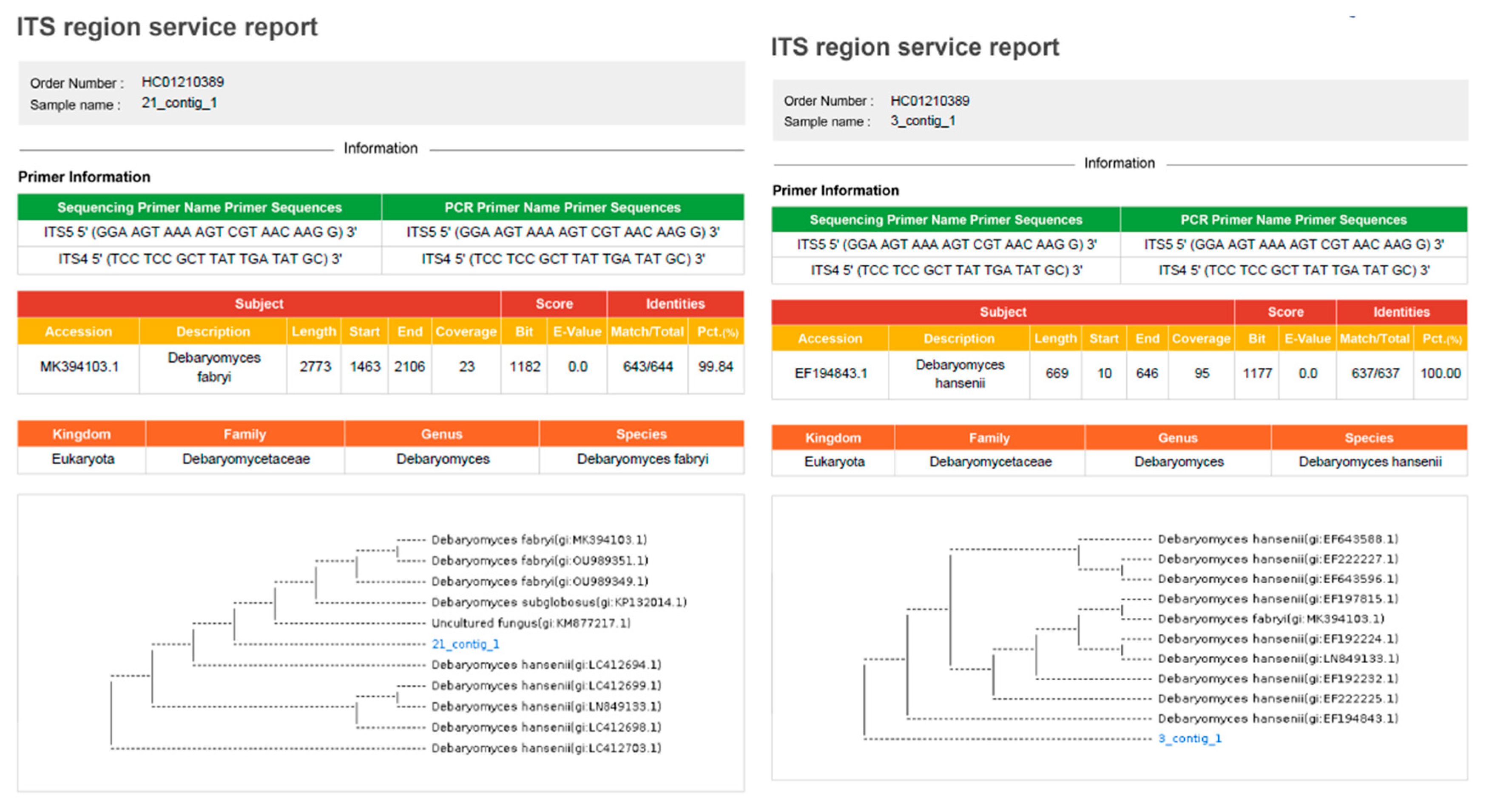
| 2 | Debaryomyces spp. | D. hansenii species complex | 99.8 | 23 | MK394103.1 |
| 3 | D. hansenii | D. hansenii | 100.0 | 95 | EF194843.1 |
| 10 | K. telluris complex | K. bovina | 100.0 | 99 | KY103626.1 |
| 11 | Debaryomyces spp. | D. hansenii species complex | 100.0 | 22 | MK394103.1 |
| 12 | Debaryomyces spp. | D. hansenii species complex | 99.8 | 22 | MK394103.1 |
| 13 | K. telluris complex | K. bovina | 100.0 | 99 | KY103626.1 |
| 14 | K. telluris complex | K. bovina | 100.0 | 99 | KY103626.1 |
| 15 | K. telluris complex | K. bovina | 100.0 | 99 | KY103626.1 |
| 16 | K. telluris complex | K. bovina | 100.0 | 99 | KY103626.1 |
| 17 | K. telluris complex | K. bovina | 100.0 | 99 | KY103626.1 |
| 18 | K. telluris complex | K. bovina | 100.0 | 99 | KY103626.1 |
| 19 | K. telluris complex | K. bovina | 100.0 | 99 | KY103626.1 |
| 21 | Debaryomyces spp. | D. hansenii species complex | 99.8 | 23 | MK394103.1 |
| 23 | K. telluris complex | K. bovina | 100.0 | 99 | KY103626.1 |
| 24 | K. telluris complex | K. bovina | 100.0 | 99 | KY103626.1 |
Disclaimer/Publisher’s Note: The statements, opinions and data contained in all publications are solely those of the individual author(s) and contributor(s) and not of MDPI and/or the editor(s). MDPI and/or the editor(s) disclaim responsibility for any injury to people or property resulting from any ideas, methods, instructions or products referred to in the content. |
© 2026 by the authors. Licensee MDPI, Basel, Switzerland. This article is an open access article distributed under the terms and conditions of the Creative Commons Attribution (CC BY) license.
Share and Cite
Acosta-Hernández, B.; Cabrera Guerle, N.; García, P.L.; Armas Carballo, O.; Ojeda-Vargas, M.d.M.; Garcia-Bustos, V.; Real Valcárcel, F.; Déniz Suárez, S.; Díaz Rodríguez, E.L.; Rosario Medina, I. Identification of Clinically Relevant Yeasts from Avian Isolates Using API ID32C, MALDI-TOF MS, and ITS Sequencing: Potential Relevance from a One Health Perspective. Vet. Sci. 2026, 13, 615. https://doi.org/10.3390/vetsci13070615
Acosta-Hernández B, Cabrera Guerle N, García PL, Armas Carballo O, Ojeda-Vargas MdM, Garcia-Bustos V, Real Valcárcel F, Déniz Suárez S, Díaz Rodríguez EL, Rosario Medina I. Identification of Clinically Relevant Yeasts from Avian Isolates Using API ID32C, MALDI-TOF MS, and ITS Sequencing: Potential Relevance from a One Health Perspective. Veterinary Sciences. 2026; 13(7):615. https://doi.org/10.3390/vetsci13070615
Chicago/Turabian StyleAcosta-Hernández, Begoña, Nicolás Cabrera Guerle, Pablo Lorenzo García, Olga Armas Carballo, María del Mar Ojeda-Vargas, Victor Garcia-Bustos, Fernando Real Valcárcel, Soraya Déniz Suárez, Esther Licia Díaz Rodríguez, and Inmaculada Rosario Medina. 2026. "Identification of Clinically Relevant Yeasts from Avian Isolates Using API ID32C, MALDI-TOF MS, and ITS Sequencing: Potential Relevance from a One Health Perspective" Veterinary Sciences 13, no. 7: 615. https://doi.org/10.3390/vetsci13070615
APA StyleAcosta-Hernández, B., Cabrera Guerle, N., García, P. L., Armas Carballo, O., Ojeda-Vargas, M. d. M., Garcia-Bustos, V., Real Valcárcel, F., Déniz Suárez, S., Díaz Rodríguez, E. L., & Rosario Medina, I. (2026). Identification of Clinically Relevant Yeasts from Avian Isolates Using API ID32C, MALDI-TOF MS, and ITS Sequencing: Potential Relevance from a One Health Perspective. Veterinary Sciences, 13(7), 615. https://doi.org/10.3390/vetsci13070615