

Dietary Tartary Buckwheat Flavonoids Enhance Antioxidant Capacity and Regulate Lipid Metabolism via the AMPK Pathway in Liangshan Yanying Chickens
by

Dongdong Li
, 
Yi Zhang
,
Anqiang Lai
,
Binlong Chen
,
Silu Wang
,
Caiyun Sun
,
Zhiqiu Huang
and
Zengwen Huang
* College of Animal Science, Xichang University, Xichang 615000, China
*
Author to whom correspondence should be addressed.
Vet. Sci. 2026, 13(4), 375; https://doi.org/10.3390/vetsci13040375
Submission received: 18 March 2026
/
Revised: 9 April 2026
/
Accepted: 10 April 2026
/
Published: 13 April 2026
(This article belongs to the Special Issue Natural Products in Veterinary Therapy: Evidence, Applications, and Integrative Approaches to Improve Animal Health and Welfare)
Simple Summary
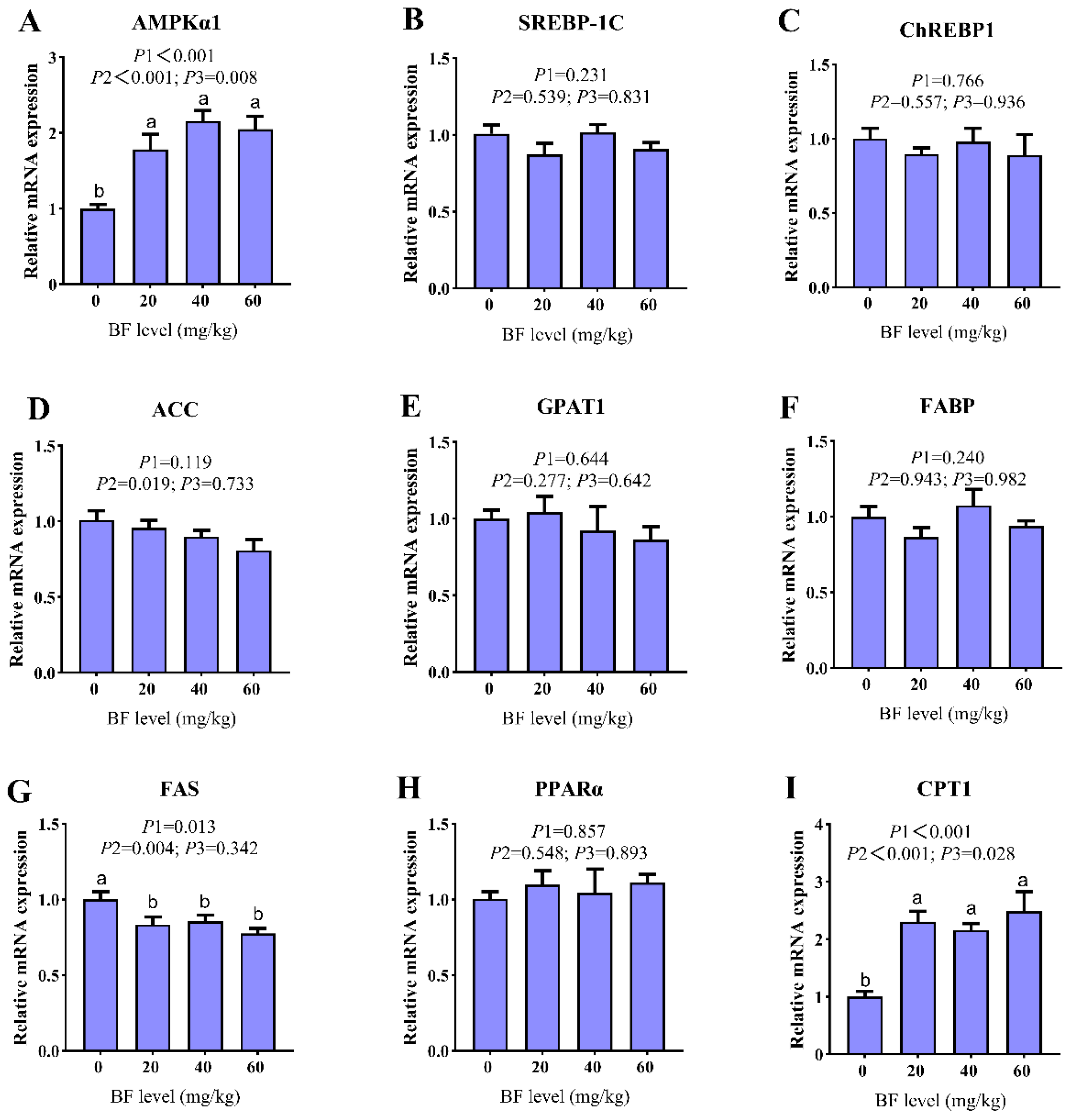
With antibiotic restrictions in livestock production, plant-derived bioactive additives are a research priority. Flavonoids are plant-derived bioactive components with well-documented antioxidative, anti-inflammatory, and lipid-regulatory properties. Tartary buckwheat flavonoids (TBF) are hypothesized to enhance the production efficiency and improve the health status of Liangshan Yanying chickens. In the present work, we evaluated the impacts of dietary TBF inclusion in Liangshan Yanying chickens, and our results revealed that TBF exerted no adverse impacts on growth performance, but it significantly enhanced serum antioxidant capacity, promoted tibial calcium and phosphorus deposition, increased lean meat deposition, and regulated hepatic fatty acid oxidation and synthesis via AMPK-related genes. This work supplies theoretical backing and data evidence for the application of tartary buckwheat flavonoids in Liangshan Yanying chicken production.
Abstract
The present work was designed to investigate the impacts of tartary buckwheat flavonoids (TBF) on the growth performance and physiological metabolism of Liangshan Yanying chickens. A total of 144 healthy 4-week-old Liangshan Yanying chickens of uniform body weight were randomly divided into four groups. Each group consisted of six replicates with six chickens per replicate. The control group was fed a basal diet, whereas the treatment groups received the same basal formulation supplemented with TBF at concentrations of 20, 40, and 60 mg/kg, respectively. The entire feeding trial lasted for 10 consecutive weeks. Growth performance, serum parameters, bone quality, slaughter traits, and hepatic lipid metabolism were determined and statistically analyzed. Results showed that dietary TBF supplementation had no significant impact on the overall growth performance (p > 0.05); however, final body weight and average daily weight gain displayed a positive linear trend in response to increasing TBF levels (0.05 < p < 0.1). For serum parameters, TBF supplementation significantly increased total antioxidant capacity (p < 0.05) and decreased malondialdehyde content (p < 0.05) in a linear manner. Specifically, compared with the control group, the 60 mg/kg TBF group increased T-AOC by approximately 64.6% and reduced MDA by approximately 67.9%, demonstrating a robust antioxidant effect. A linear increase in high-density lipoprotein cholesterol levels approaching significance (p = 0.055) was also observed. A significant quadratic regulatory effect of TBF was observed on serum glucose concentrations (p < 0.05), whereby the 60 mg/kg TBF dose reduced serum glucose by 15.6% relative to the control (p < 0.05), reflecting a robust hypoglycemic effect. Regarding bone quality, supplementation with 20 and 60 mg/kg TBF significantly elevated tibial phosphorus content relative to the 0 mg/kg TBF group (p < 0.05). Regression analysis showed that increasing dietary TBF levels linearly elevated tibial calcium content (p < 0.05) and resulted in linear increasing trends in tibial ash content, tibial phosphorus content, femur ash content, and femur calcium content (0.05 < p < 0.1). Concerning slaughter performance, dietary TBF inclusion resulted in a significant linear rise in breast muscle percentage (p < 0.05). At the molecular level, TBF upregulated the mRNA expression of hepatic AMPKα1 and CPT1, while concurrently downregulating the expression of FAS and ACC (p < 0.05). Collectively, dietary TBF supplementation in Liangshan Yanying chickens effectively improved antioxidant capacity, promoted tibial calcium and phosphorus deposition, regulated hepatic fatty acid oxidation and synthesis via AMPK-related genes, and enhanced lean meat deposition, with no adverse effects on growth performance under the experimental conditions.