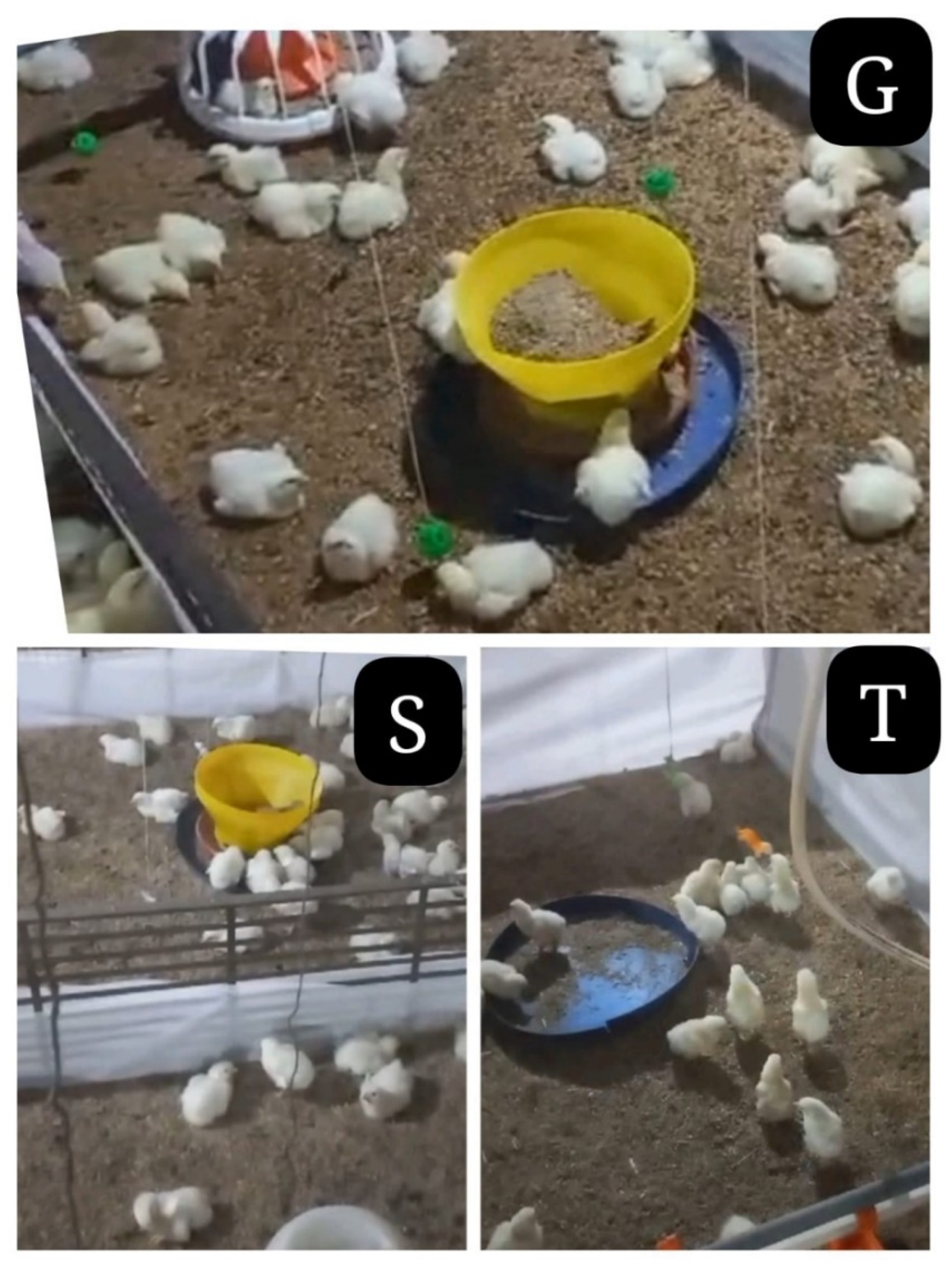
1. Introduction
Over the past several decades, broiler production has emerged as the fastest-growing sector of global animal agriculture, surpassing 100 million tons of meat produced in 2020. This expansion has been driven by global population growth, shifts in dietary patterns, and increasing demand for animal-derived protein sources [
1]. Compared with other livestock species, such as pigs and cattle, broiler chickens exhibit superior feed conversion efficiency and rapid growth rates, rendering broiler production highly economically competitive [
2]. Despite these advantages, increasing consumer concern, particularly in industrialized countries, has focused on the animal welfare implications of intensive broiler production systems. In such systems, birds are commonly housed in large, high-density flocks that may exceed 20,000 individuals [
3]. These environments typically lack structural enrichment and consist of flat flooring, often concrete, covered with litter materials such as peat, wood shavings, chopped straw, or similar substrates [
4]. Feed and water are provided through automated delivery systems, and indoor environmental conditions, including temperature and ventilation, are carefully regulated to maximize growth performance [
5]. Nevertheless, intensive broiler production is frequently associated with significant welfare and health challenges. Production-related disorders, including lameness, footpad dermatitis, and sudden cardiac death, commonly peak during the final week of the production cycle and are particularly prevalent under high stocking densities [
6]. These conditions adversely affect productivity by increasing mortality rates, reducing growth performance, and compromising meat quality [
7]. Rapid growth rates combined with low levels of physical activity further exacerbate the risk of lameness and footpad dermatitis, particularly in environments characterized by poor litter quality or excessive moisture [
8]. Consequently, affected birds may experience pain and discomfort, leading to diminished welfare outcomes and substantial economic losses for producers.
Environmental enrichment, defined as modifications to the housing environment that enhance the biological functioning of captive animals, has been proposed as a practical strategy for improving animal welfare and production performance [
9]. The primary objectives of environmental enrichment include promoting more effective use of the environment, encouraging species-specific behaviors, reducing or preventing the development of abnormal behaviors, and enhancing cognitive engagement and problem-solving capacity [
10]. When applied within farm animal production systems, environmental enrichment requires additional considerations beyond those typical of laboratory or zoological settings. Enrichment strategies must not only support mental and physical health and facilitate the expression of natural behaviors, but also be feasible for implementation at a commercial scale and economically sustainable for producers [
11,
12]. In broiler chickens, environmental enrichment primarily targets low activity levels, as birds may spend up to 80% of their time inactive. By stimulating locomotion and promoting variation in resting postures, enrichment interventions can increase muscle use and may contribute to a reduction in leg-related disorders, including lameness and footpad dermatitis [
13,
14,
15].
Increasing environmental complexity has been shown to elevate broiler activity levels, at least temporarily [
16]. The higher activity attained under normal, stable housing settings following the introduction of enrichment materials is likely attributable to improved fulfillment of broilers’ behavioral needs. Additional benefits include improved health outcomes, reduced fear responses, and increased expression of positive, species-typical behaviors, such as wing flapping [
17,
18]. Consequently, substantial evidence indicates that environmental enrichment enhances physical health, improves affective states, and enables the expression of natural behaviors, thereby contributing to overall broiler welfare [
19,
20,
21]. Against this background, the present study investigates the effects of novel hanging enrichment tools on broiler chickens. Specifically, the study aims to evaluate growth performance, behavior, foot condition, serum biochemical parameters, carcass characteristics, and meat quality traits in broilers reared with and without the provision of enrichment.
3. Results
3.1. Growth Performance
During the first growth phase (days 1–21), FI was not significantly influenced by treatment (p = 0.247), with values ranging from 1162.71 g in T3 to 1179.27 g in T5. In contrast, BW, WG, FCR, and EPEF differed significantly among treatments (p < 0.0001). Broilers in T2 (hanging toys) and T4 (rotational enrichment) consistently exhibited superior performance compared with the other groups. These treatments yielded the highest BW and WG values, with BW of 812.2 g and WG of 772.4 g in T2, and BW of 806.6 g and WG of 766.4 g in T4. Correspondingly, EPEF values were significantly greater (p ≤ 0.05) in T2 (152.2) and T4 (151.3). Feed efficiency was also improved in these groups, as indicated by lower FCR values of 1.53 (T2) and 1.52 (T4). Conversely, the control group (T5; no environmental enrichment) demonstrated the poorest overall performance (p < 0.05), characterized by lower BW (690.7 g), WG (650.7 g), and EPEF (108.9), and the highest FCR (1.81). Treatments T1 (green balls) and T3 (hanging strings) showed intermediate performance, with BW and WG values significantly higher than those of T5 but lower than those observed in T2 and T4.
During the second growth phase (days 22–35), FI remained unaffected by treatment (
p = 0.645), ranging from 1851.9 g (T4) to 1861.0 g (T3). However, significant differences persisted in BW, WG, FCR, and EPEF (
p < 0.0001). The highest performance was again recorded in T2, which achieved a BW of 1933.9 g, WG of 1121.8 g, FCR of 1.66, and EPEF of 333.7. T4 ranked second, exhibiting slightly lower values than T2 but still significantly outperforming the remaining treatments. The control group continued to show the poorest performance, with the lightest BW (1750.8 g), WG (1060.06 g), EPEF (285.7), and the least efficient FCR (1.75). Across the entire 35-day experimental period, FI did not differ significantly among treatments (
p = 0.437), ranging from 3019.8 g in T4 to 3035.2 g in T2. Nevertheless, WG, FCR, and EPEF differed markedly among treatments (
p < 0.0001). T2 consistently demonstrated superior performance, recording the heaviest WG (1894.14 g), the highest EPEF (344.8), and the most efficient FCR (1.60). T4 ranked second and significantly outperformed T1, T3, and T5. As expected, the control group (T5) showed the lowest overall performance, with the lightest WG (1710.8 g), lowest EPEF (281.96), and poorest feed efficiency (FCR = 1.77). Treatments T1 and T3 exhibited intermediate performance levels (
Table 3).
3.2. Behavioral Assessment
During the early growth phase (days 1–21), active behavior differed markedly among treatments, although differences among enriched groups were not always statistically significant. Birds in T4 (rotational enrichment) exhibited the highest proportion of active behavior (24.7%), followed by T1 (green balls; 24.1%) and T2 (hanging toys; 23.8%), while T3 (strings) showed slightly lower activity (22.7%). In contrast, the control group (T5) displayed the lowest activity level (6.9%). Correspondingly, inactivity was greatest in T5 (41.1%), significantly exceeding that of all enriched treatments, which showed comparable inactivity levels of approximately 26%. Eating behavior was most pronounced in T5 (25.0%), significantly higher than in all enriched groups, among which no significant differences were observed (e.g., T1 = 20.2%; T4 = 21.1%). Drinking behavior followed a similar pattern, with T5 recording the highest proportion of time spent drinking (21.8%), while enriched treatments did not differ significantly from one another, ranging from 19.5% (T1) to 20.2% (T4). Maintenance behavior varied among enrichment types, being highest in T3 (10.7%) and T2 (10.00%), whereas T4 (8.1%) and T5 (5.3%) showed significantly lower values, indicating differential effects of enrichment type on self-maintenance activities.
During the later growth phase (days 22–35), active behavior did not differ significantly among enriched treatments, with values of 23.8% in T1 and 23.3% in T2. However, T5 again exhibited significantly lower activity levels (6.4%) than all enriched groups. Inactivity was highest in T5 (42.2%), whereas enriched treatments showed lower and comparable inactivity levels, ranging from 21.5% (T2) to 22.30% (T3). Eating behavior remained most prominent in T5, while among enriched treatments, T4 recorded the highest eating activity, significantly exceeding that of T1, T2, and T3. Drinking behavior followed a similar trend, with T5 showing the highest proportion (23.8%), and enriched groups remaining statistically similar (19.27% in T4 to 19.88% in T3). Maintenance behavior was highest in T2 (14.5%) and T1 (14.1%), and lowest in T5 (5.1%). Across the entire experimental period (days 1–35), birds in T4 exhibited the highest overall activity level (24.18%), followed closely by T1 (24.00%), T2 (23.6%), and T3 (23.2%). The control group consistently showed the lowest activity (6.7%) and the highest inactivity (41.7%), significantly exceeding that observed in enriched treatments (23.8% to 24.2%). Eating behavior was most frequent in T5 (23.7%), whereas among enriched treatments, T4 recorded the highest proportion (21.5%), followed by T3 (20.8%), T2 (20.9%), and T1 (20.50%). Drinking behavior followed the same pattern, with T5 ranking highest (22.8%) and enriched treatments showing no significant differences (19.5% to 19.7%). Maintenance activities were highest in T2 (12.2%) and T3 (12.1%), intermediate in T4 (10.6%), and lowest in T5 (5.2%) (
Table 4).
3.3. Foot Condition of Commercial Broiler
Toe damage scores differed significantly among treatments (
p = 0.004). The highest mean score was observed in T4 (rotational enrichment using green balls, toys, and strings across growth phases; 1.89), followed by T2 (hanging toys for 21 days; 1.82). Intermediate scores were recorded in T3 (hanging strings for 21 days) and the control group, T5 (no enrichment), with values ranging from 1.69 to 1.75. The lowest toe damage score was observed in T1 (hanging green balls for 21 days; 1.64). In contrast, footpad dermatitis scores did not differ significantly among treatments (
p = 0.051). Likewise, hock burn scores showed no significant treatment effects (
p = 0.168), with mean values ranging from 1.76 to 1.90 (
Table 5).
3.4. Blood Biochemical Profile
Broilers provided with environmental enrichment (T1: hanging green balls; T2: hanging toys; T3: hanging strings; T4: combined enrichment tools) exhibited significantly lower heterophil counts compared with the control group (T5; p < 0.0001). Heterophil values in enriched treatments ranged from 18.5 to 19.8, whereas the control group showed a markedly higher value (47.2). In contrast, lymphocyte counts were significantly greater in the control group (86.8) than in enriched treatments (p < 0.0001), which ranged from 70.1 (T4) to 76.2 (T1). Consistent with these results, the H/L ratio was significantly elevated in the control group (0.55) compared with all enriched treatments (p < 0.0001), which exhibited lower and comparable ratios (0.25–0.28).
Serum glucose concentrations followed a similar pattern, with significantly higher levels observed in T5 (204.6 mg/dL) compared with enriched treatments (
p < 0.0001), which ranged from 183.9 mg/dL (T3) to 185.4 mg/dL (T2). Cholesterol concentrations were also highest in the control group (123.7 mg/dL) and significantly lower in enriched groups (
p < 0.0001), with values ranging from 109.3 mg/dL (T4) to 111.3 mg/dL (T1). Furthermore, total serum protein levels were significantly greater (
p < 0.0001) in the control group (5.95 g/dL) than in enriched treatments, which ranged from 4.68 g/dL (T2) to 4.73 g/dL (T3). Similarly, albumin and globulin concentrations, key indicators of protein metabolism and immune status, were significantly elevated in T5 (
p < 0.0001). Albumin levels in the control group reached 3.14 g/dL, compared with 2.30 g/dL (T1) to 2.37 g/dL (T4) in enriched groups. Globulin concentrations were also highest in T5 (2.81 g/dL) and were reduced in enriched treatments, ranging from 2.32 g/dL (T2) to 2.38 g/dL (T1) (
Table 6).
3.5. Carcass Traits
Pre-slaughter weight, dressed weight, carcass yield, liver weight, and heart weight of commercial broilers reared under different environmental enrichment treatments differed significantly among treatments, whereas gizzard weight was not affected. Pre-slaughter weight was significantly influenced by enrichment (p < 0.0001), with the greatest value observed in T2 (hanging toys; 1934.2 g), followed by T4 (rotational enrichment; 1896.2 g), T1 (green balls; 1853.68 g), and T3 (strings; 1833.4 g). The control group (T5) recorded the lightest pre-slaughter weight (1750.8 g), which was significantly lower than all enriched treatments. Dressed weight also differed significantly among treatments (p < 0.0001). Birds in T4 achieved the heaviest dressed weight (1268.2 g), followed by T2 (1240.0 g), T1 (1224.2 g), and T3 (1208.7 g). In contrast, the control group exhibited the lightest dressed weight (1090.1 g), significantly lower than all enriched groups. Carcass yield percentage was significantly higher in enriched treatments compared with the control (p = 0.028). The lowest yield was observed in the control group (62.3), whereas enriched treatments achieved higher values, with the highest carcass yield recorded in T4 (66.03%), followed by T1 (65.9%), T3 (65.6%), and T2 (64.1%). Differences among enriched treatments were not statistically significant (p > 0.05).
Liver weight was significantly affected by treatment (
p < 0.0001), with the greatest value observed in T2 (46.2 g), followed by T4 (43.7 g), T1 (43.3 g), and T3 (38.9 g). The control group exhibited the lightest liver weight (35.0 g). A similar pattern was observed for heart weight, which was significantly greater in enriched treatments (
p = 0.002). The heaviest heart weight was recorded in T2 (8.7 g), followed by T4 (8.0 g), T3 (7.9 g), and T1 (7.9 g), whereas the control group had the lowest value (6.8 g). In contrast, gizzard weight was not significantly influenced by environmental enrichment (
p = 0.471), with values ranging from 21.1 g in T3 to 26.0 g in T1 (
Table 7).
3.6. Meat Quality Traits
Commercial broilers reared under different environmental enrichment treatments exhibited significant differences in several meat quality attributes, including L*, initial pH, and ultimate pH, whereas a* and b* were not significantly affected. Lightness (L*) values differed significantly among treatments (p < 0.0001). All enriched groups showed significantly higher L* values compared with the control group. The control group (T5) exhibited the lowest L* value (50.8), whereas the highest L* value was observed in T3 (hanging strings; 55.5). Significant differences in L* were also detected among enriched treatments, particularly between T1 and T5. In contrast, a* and b* values did not differ significantly among treatments (p > 0.05). Redness values ranged from 13.1 in T3 to 14.3 in T4, whereas yellowness values varied from 16.02 in T3 to 18.5 in T2.
Initial pH was significantly higher in enriched groups compared with the control (
p < 0.0001). Enriched treatments (T1–T4) exhibited similar initial pH values, ranging from 6.41 to 6.43, whereas the control group (T5) had a significantly lower initial pH (6.25). These results suggest improved pre-slaughter physiological stability in birds exposed to enrichment. Treatments also significantly influenced ultimate pH (
p < 0.0001). The control group recorded the highest ultimate pH (5.72), potentially reflecting stress-related alterations in postmortem muscle metabolism. Among enriched treatments, T2 exhibited the highest ultimate pH (5.63), followed by T3 (5.60), T4 (5.59), and T1 (5.56), all of which were significantly lower than the control group (
Table 8).
4. Discussion
Growth performance, as reflected by body weight and feed efficiency, was significantly enhanced in broilers provided with string enrichment compared with the control and other treatment groups. Body weight (BW) increased steadily throughout the production cycle, with string-enriched birds consistently exhibiting greater weight gains. In parallel, FCR was improved, indicating more efficient utilization of feed resources. These improvements may be attributed to increased physical activity and behavioral engagement stimulated by string enrichment, which may enhance metabolic efficiency and gastrointestinal function. Strings appear to serve as effective environmental enrichments by reducing boredom, encouraging natural pecking behavior, and mitigating stress. Reduced stress is closely associated with improved growth performance, as elevated corticosterone levels are known to suppress feed intake and impair nutrient absorption. Moreover, environmental enrichment has been linked to enhanced digestive enzyme activity, potentially further improving nutrient assimilation. Enrichment-induced sensory stimulation may also support neurocognitive development and reduce the occurrence of maladaptive behaviors such as feather pecking and cannibalism, both of which negatively affect feed intake and growth. In the absence of enrichment, control birds may allocate more time to non-productive activities or engage in feed-wasting behaviors; however, direct measurement of feed wastage was beyond the scope of the present study. The present findings are consistent with previous reports. Yenilmez et al. [
23] demonstrated that hanging enrichment objects increased broiler activity and growth performance, while Riber et al. [
24] reported improvements in feed efficiency and final body weight following enrichment provision. Similarly, Brantsæter et al. [
25] showed that pecking-related enrichments enhanced growth rate and feed utilization. In contrast, Kemper and Tetens [
26] observed no significant growth benefits, potentially due to differences in enrichment type, bird genotype, or management conditions. Tahamtani et al. [
27] further emphasized that enrichment effectiveness depends on its complexity and novelty, indicating that not all enrichment strategies uniformly enhance performance. Overall, these results support the conclusion that appropriately designed and implemented environmental enrichment can improve broiler growth performance, highlighting its potential value as a practical management strategy in commercial production systems.
Broilers provided with string enrichment exhibited significantly higher levels of exploratory and foraging-related behaviors, including pecking, scratching, and perching, compared with birds in the control group. In addition, enriched birds displayed reduced aggression and fewer abnormal repetitive behaviors, whereas control birds showed higher frequencies of feather pecking and pacing. Time devoted to active behaviors was consistently greater in enriched birds, while sedentary behaviors, such as prolonged sitting, were more prevalent among non-enriched birds. The provision of string enrichment appeared to effectively satisfy the birds’ intrinsic motivation to explore and peck by redirecting these behaviors toward an appropriate substrate. Chickens possess a strong innate drive for exploratory and pecking activities; in environments lacking sufficient stimulation, this motivation may be redirected toward conspecifics, leading to aggressive interactions and feather damage. The availability of string enrichment likely provided a suitable outlet for pecking behavior, thereby reducing frustration, stress, and the expression of maladaptive behaviors. Increased interaction with enrichment materials may also have enhanced cognitive stimulation, contributing to improved welfare outcomes. Moreover, higher levels of activity are widely recognized as indicators of good health and environmental comfort, suggesting that birds in enriched conditions experienced a more favorable living environment. These findings are consistent with previous research. Nicol et al. [
28] reported that environmental enrichment reduces the incidence of abnormal behaviors and improves poultry welfare. Tahamtani et al. [
27] demonstrated that increased environmental complexity promotes species-specific behaviors while reducing fearfulness and aggression in broilers. Similarly, Lambton et al. [
29] observed lower rates of injurious pecking in enriched flocks. In contrast, Kristensen et al. [
30] found that enrichment does not always result in sustained behavioral changes, potentially due to habituation or loss of novelty over time. This limitation may be addressed by periodically modifying the type or placement of enrichment materials to maintain birds’ interest and behavioral engagement.
Assessment of broiler foot condition revealed significant differences in toe damage among the enrichment treatments. Birds exposed to rotational enrichment involving green balls, toys, and strings (T4) exhibited the highest toe damage scores, whereas broilers provided with a single, consistent enrichment (green balls for 21 days; T1) showed the lowest scores. In contrast, footpad dermatitis and hock burn scores did not differ significantly among treatments, indicating that these conditions were largely unaffected by the type of enrichment applied. The increased toe damage observed in the T4 group may be associated with the frequent alteration of enrichment materials. One possible explanation is that the periodic introduction of novel objects could have temporarily disrupted behavioral patterns, potentially leading to more vigorous or inappropriate interactions with enrichment items during initial exposure periods. This interpretation remains hypothetical, as the present study did not directly measure behavioral responses immediately following enrichment changes. However, previous research has shown that sudden changes in environmental complexity can temporarily increase activity levels and exploratory behavior [
31], which might elevate the risk of minor injuries if interactions become overly vigorous. Alternatively, birds in the rotational treatment may have directed pecking behavior toward novel enrichment objects with greater intensity compared with birds habituated to a single enrichment type. These findings highlight that not all enrichment strategies produce uniformly positive welfare outcomes and that the timing and frequency of enrichment presentation may influence specific aspects of broiler welfare. Further research examining behavioral responses immediately following enrichment changes would help clarify the mechanisms underlying the observed toe damage differences. Conversely, the continuous provision of a single enrichment object, as implemented in T1, may have created a more predictable and stable environment, reducing stress-related behaviors and subsequent toe damage. These findings highlight that not all enrichment strategies produce uniformly positive welfare outcomes and that poorly designed or excessively complex enrichment programs may inadvertently compromise specific aspects of broiler welfare. The present findings are consistent with previous studies reporting variable effects of environmental enrichment on broiler welfare. Riber et al. [
24] demonstrated that while enrichment can generally enhance welfare, rapidly changing or overly complex stimuli may induce stress and increase undesirable behaviors. Likewise, Yang et al. [
32] reported no significant effect of enrichment on hock burn prevalence, supporting the present observation that hock burn may be relatively unresponsive to enrichment interventions. On the contrary, Schrader and Malchow [
33] found that consistent enrichment provisions, such as perches or platforms, effectively reduced footpad dermatitis, whereas other types of enrichment showed limited efficacy. Collectively, these studies emphasize the importance of carefully designing and implementing enrichment strategies to optimize welfare outcomes in broiler production systems.
Significant differences were observed among treatments, particularly between enriched environments and the control group, indicating that environmental enrichment plays an important role in alleviating stress and improving the physiological status of broiler chickens. Birds provided with string-based enrichment (T3) exhibited the lowest concentrations of blood glucose, cholesterol, total protein, albumin, and globulin compared with all other treatments, including the non-enriched control group (T5). In addition, the H/L ratio, widely recognized as a reliable indicator of physiological stress, was markedly lower in the string-enriched group, further indicating reduced stress levels. It should be acknowledged, however, that blood biochemical parameters are influenced by multiple interacting factors, including nutritional status, metabolic rate, immune function, and circadian rhythms, in addition to stress responses [
34]. Elevated blood glucose concentrations are commonly associated with stress-induced activation of glucocorticoids, which stimulate gluconeogenesis and glucose mobilization. The reduced biochemical values observed in string-enriched birds may therefore reflect a calmer physiological state, likely facilitated by continuous and appropriate environmental stimulation. Hanging strings may have promoted the expression of natural behaviors, such as pecking and exploration, thereby diverting attention from environmental stressors and attenuating activation of the hypothalamic–pituitary–adrenal axis, which plays a central role in regulating glucose and lipid metabolism. Lower albumin and globulin concentrations in enriched birds may indicate reduced metabolic demand and a more balanced immune status, free from chronic stress or inflammatory challenge. When considered alongside the reduced H/L ratio, these findings collectively suggest improved overall welfare in birds exposed to string enrichment. The present results are consistent with previous reports. Riber et al. [
24] demonstrated that environmental enrichment in broiler systems improves welfare and reduces physiological stress, as reflected by favorable blood profiles. Similarly, Tahamtani et al. [
35] reported that increased environmental complexity enhanced coping capacity and reduced stress indicators in broilers. Kang et al. [
18] also observed improvements in metabolic and stress-related parameters when broilers had access to stimulating features such as pecking devices and platforms. However, not all studies have reported consistent benefits; Ventura et al. [
36] found that certain enrichment strategies had minimal or no impact on stress responses or blood chemistry, suggesting that enrichment effectiveness depends on both enrichment type and sustained novelty. Collectively, these findings emphasize the importance of carefully selecting and managing enrichment strategies to ensure sustained engagement and optimal welfare outcomes in broiler production systems.
Environmental enrichment had a significant effect on pre-slaughter body weight, with the greatest value recorded in T2 (hanging toys for 21 days) and the lowest in the non-enriched control group (T5). These findings indicate that environmental enrichment plays a crucial role in promoting improved growth performance, likely through stress reduction and enhanced feeding motivation, which together support more efficient feed utilization. Among the enrichment strategies evaluated, hanging toys (T2) produced the most pronounced increase in pre-slaughter weight, suggesting that this form of enrichment was particularly effective in stimulating growth-related responses. Environmental enrichment also positively influenced dressing percentage and carcass yield. The greatest carcass yield was observed in T4, which received a combination of enrichment items, whereas the lowest yield occurred in the control group. Improved carcass yield in enriched birds may reflect enhanced nutrient absorption and metabolic efficiency associated with reduced physiological stress. Lower stress levels are known to improve endocrine balance, favor protein accretion, and limit catabolic processes, thereby supporting muscle development. Liver and heart weights were significantly greater in enriched treatments, with T2 exhibiting the greatest value, while the control group consistently recorded the lightest organ weights. Increased liver weight in enriched birds may be associated with reduced stress and increased feeding activity, resulting in greater metabolic engagement. Similarly, higher heart weights may indicate improved cardiovascular development, which can support enhanced growth and overall physiological resilience. In contrast, gizzard weight did not differ significantly among treatments, suggesting that environmental enrichment has a limited influence on gizzard development, which is more strongly determined by genetic background and dietary structure. Collectively, T2 (hanging toys for 21 days) and T4 (combined enrichment strategy for up to 21 days) produced the most favorable outcomes in terms of growth performance, carcass characteristics, and organ development, highlighting their potential applicability in commercial broiler production systems. These findings are consistent with previous reports. Ventura et al. [
36] demonstrated that enriched environments improve carcass characteristics through enhanced muscle growth, while Bizeray et al. [
37] reported increased breast muscle yield and reduced fat deposition in broilers reared in enriched pens. In contrast, Kells et al. [
38] observed minimal differences in carcass traits between enriched and non-enriched systems, suggesting that the effectiveness of enrichment may depend on factors such as enrichment type, duration of exposure, and genetic line.
The present study demonstrated that environmental enrichment significantly influenced several meat quality traits in commercial broilers. Lightness (L*) values were highest in birds provided with hanging strings, whereas a* and b* did not differ significantly among treatments. The increased L* values observed in enriched groups suggest reduced pre-slaughter stress, which may have favorably influenced muscle pigmentation and water-holding capacity. Reduced stress is known to promote physiological stability, thereby positively affecting postmortem muscle characteristics. In contrast, the absence of significant differences in redness and yellowness indicates that these color parameters are likely more strongly influenced by genetic background, dietary composition, and processing conditions than by environmental enrichment. Initial muscle pH values were significantly higher in all enriched treatments, while ultimate pH values were lower in enriched groups compared with the control group. Higher initial pH values in enriched birds suggest improved preservation of muscle glycogen reserves as a result of reduced pre-slaughter stress, thereby limiting excessive lactic acid accumulation immediately following slaughter. The relationship between stress and ultimate pH is complex and depends on the timing and nature of stress exposure. Acute stress immediately before slaughter can deplete muscle glycogen reserves, resulting in reduced lactic acid production postmortem and consequently higher ultimate pH (dark, firm, dry meat) [
39]. Conversely, chronic stress may lead to heightened glycogenolysis and greater lactic acid accumulation, producing lower ultimate pH [
40]. The lower ultimate pH values observed in enriched treatments in the present study (5.56–5.63) compared with the control (5.72) may reflect more regulated postmortem metabolism and reduced chronic stress exposure throughout the rearing period, contributing to improved meat tenderness, enhanced water-holding capacity, and a reduced risk of pale, soft, exudative meat [
41]. These findings are consistent with previous reports demonstrating that stress reduction through environmental enrichment positively influences muscle pH dynamics [
24]. Chen et al. [
42] observed higher initial pH values in broilers housed in enriched environments, indicating improved muscle energy preservation before slaughter. Conversely, the lack of changes in redness and yellowness is consistent with the findings of Simsek et al. [
43], who emphasized that these traits are predominantly influenced by genetic and dietary factors rather than environmental conditions. Collectively, these results support the conclusion that environmental enrichment enhances broiler meat quality primarily by reducing stress and improving physiological status, although not all color parameters are equally affected.




 ,
,