The Effect of Artificial Insemination and Multiple Ovulation Embryo Transfer on Production, Health Status, and Survival of Holstein–Friesian Cows


 , ,
, , 
Simple Summary
Abstract
1. Introduction
2. Materials and Methods
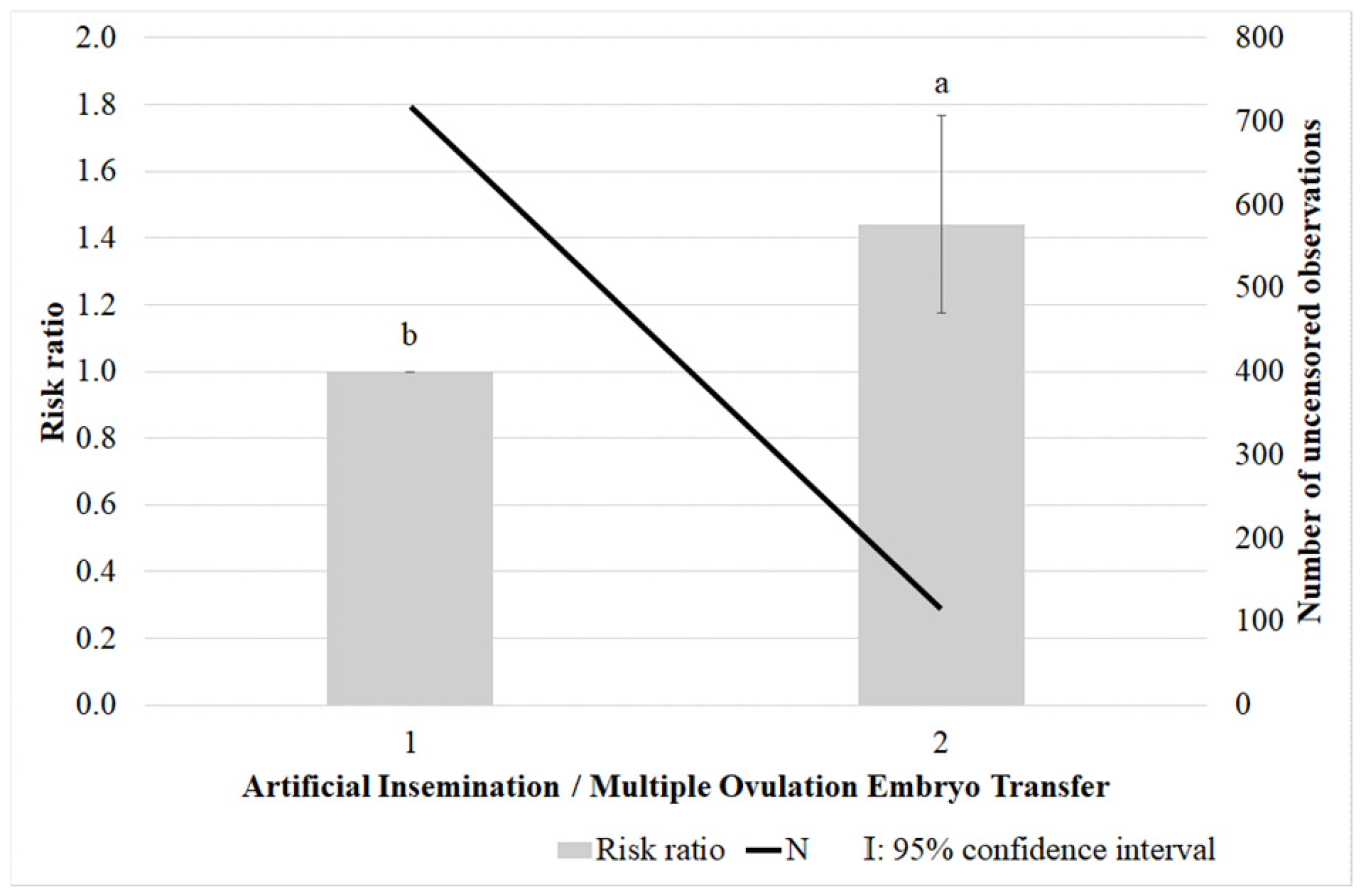
- Method of conception: MOET or AI;
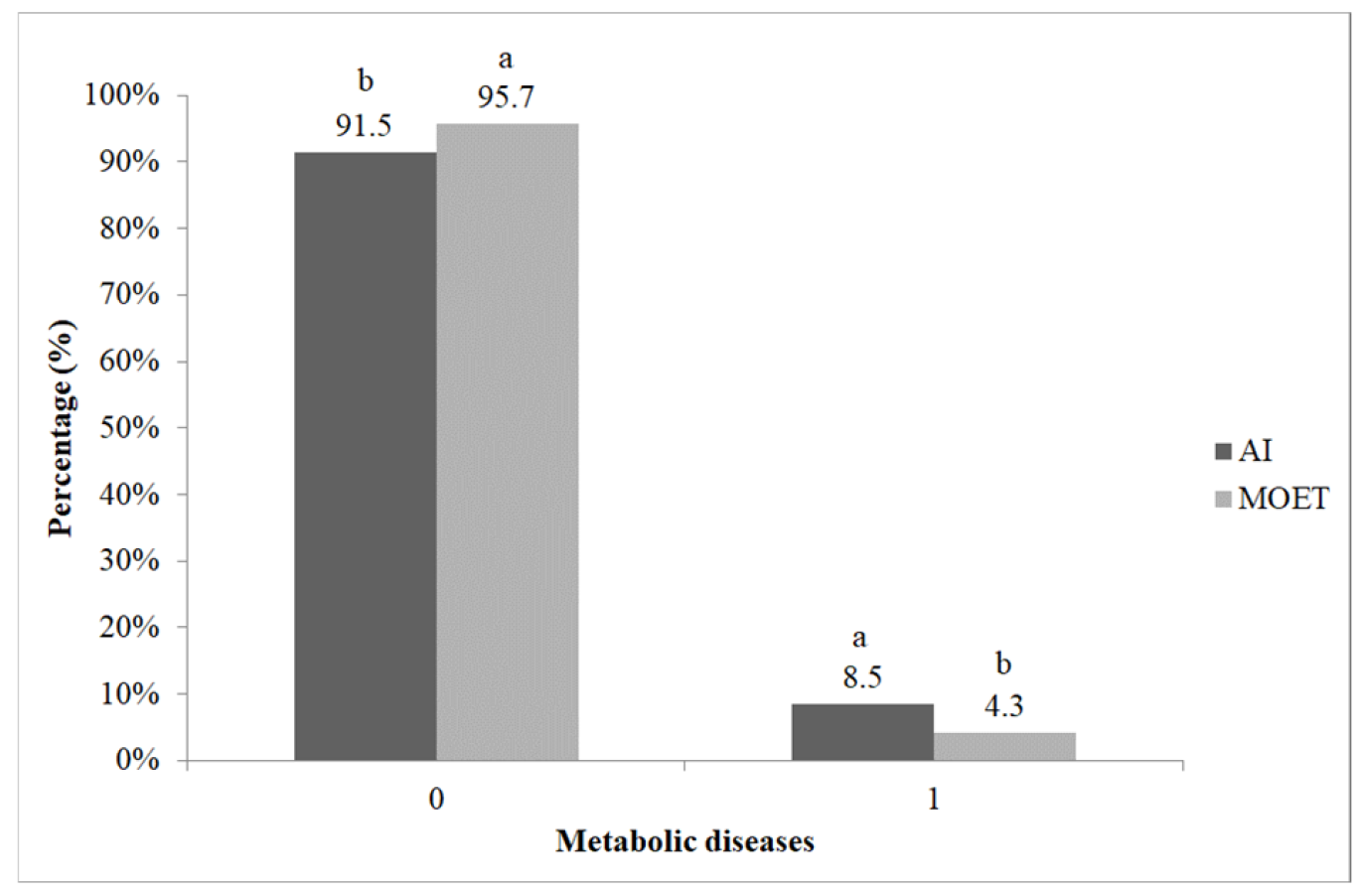
- Metabolic disease (ketosis, hypocalcemia, fatty liver, and subacute ruminal acidosis) records: two levels (0 = no problem; 1 = at least one problem occurred during lifetime);
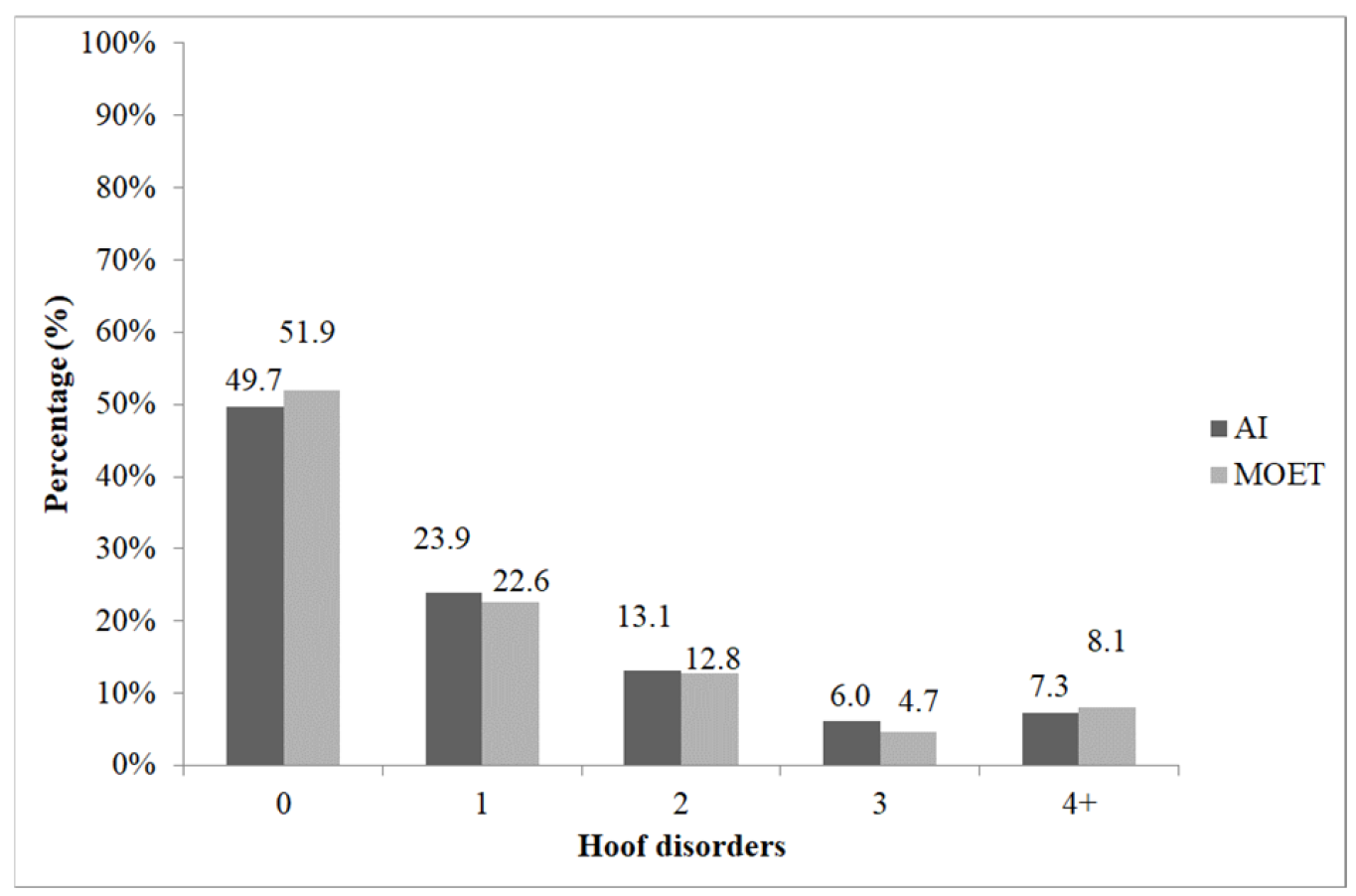
- Hoof disorder (digital dermatitis, interdigital phlegmon, sole ulcers, and laminitis) records: five levels (0 = no problem; 1–4 = number of problems during lifetime, with 4 indicating four or more);
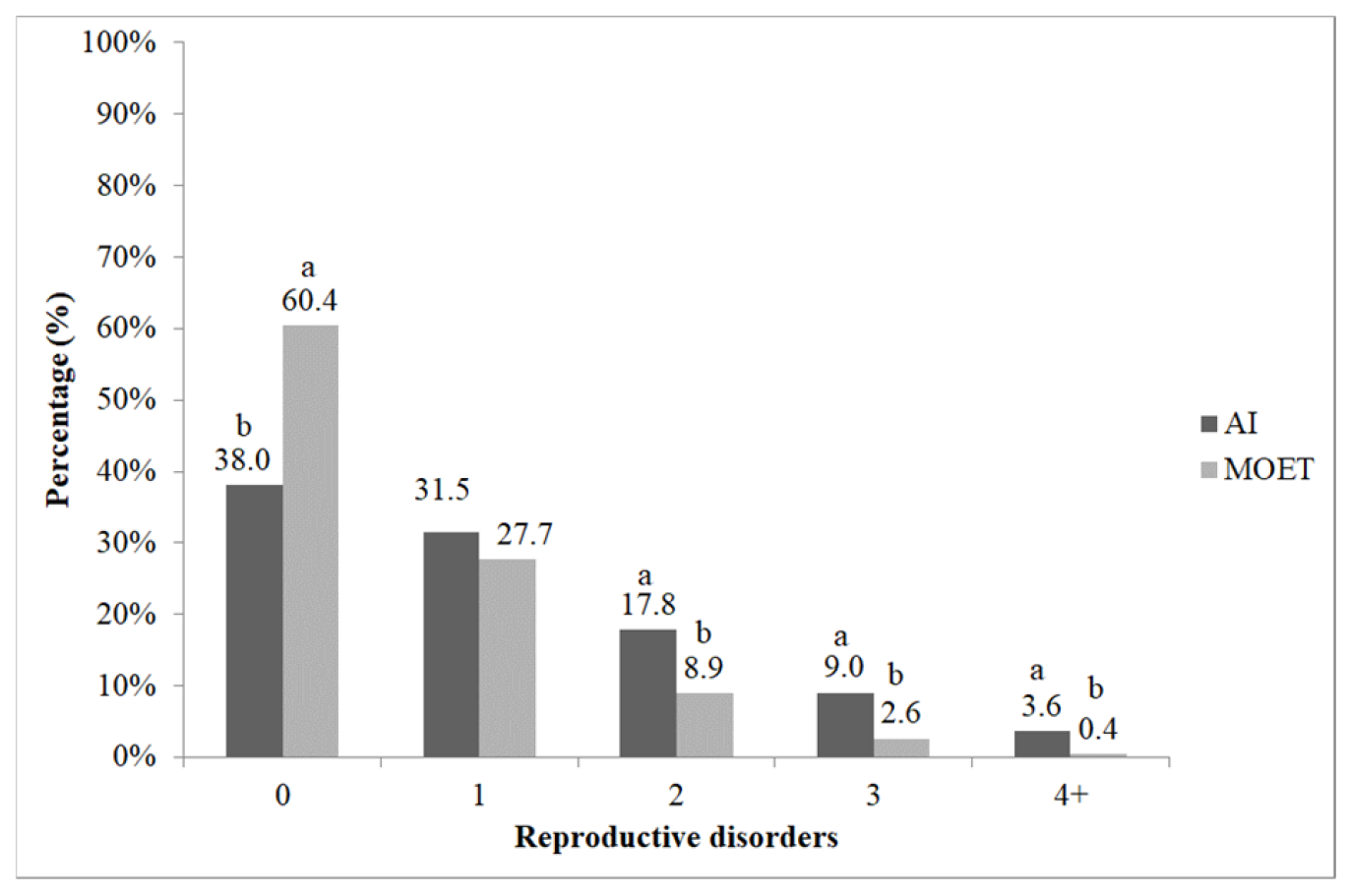
- Uterine and reproductive disorder (metritis, clinical endometritis, retained fetal membranes, pyometra, cystic ovarian disease, anestrus, and uterine prolapse) records: five levels (0 = no problem; 1–4 = number of problems during lifetime, with 4 indicating four or more);
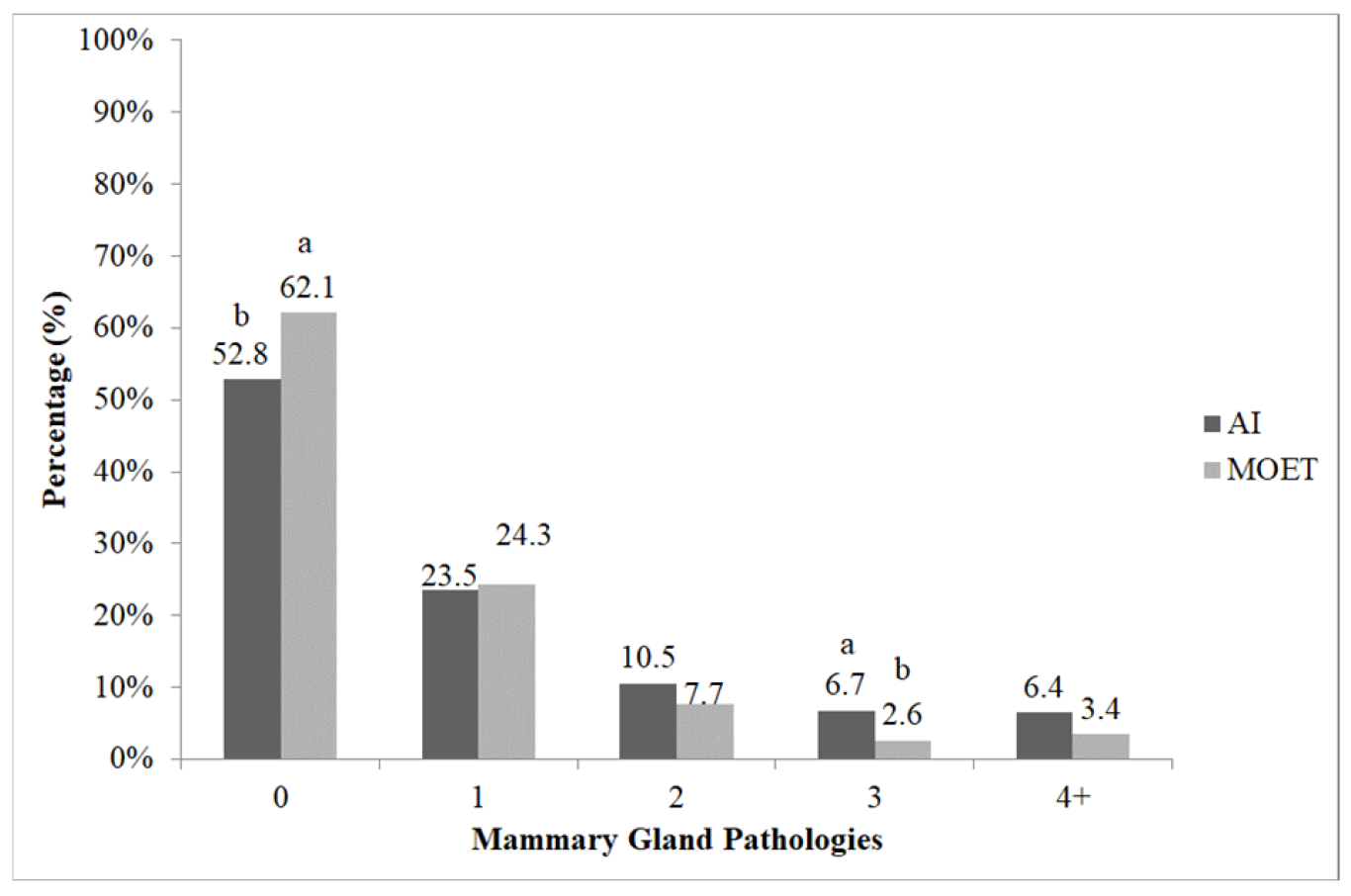
- Udder-related disorder (mastitis, udder edema, udder cleft dermatitis, and structural disorders) records: five levels (0 = no problem; 1–4 = number of problems during lifetime, with 4 indicating four or more).
3. Results
4. Discussion
5. Conclusions
Author Contributions
Funding
Institutional Review Board Statement
Informed Consent Statement
Data Availability Statement
Conflicts of Interest
Abbreviations
| AI | Artificial insemination |
| MOET | Multiple ovulation embryo transfer |
| ET | Embryo transfer |
| ART | Assisted-reproduction technologies |
| GS | Genomic selection |
References
- Fetrow, J.; Nordlund, K.V.; Norman, H.D. Invited Review: Culling: Nomenclature, definitions, and recommendations. J. Dairy Sci. 2006, 89, 1896–1905. [Google Scholar] [CrossRef]
- Najafabadi, H.A.; Mahyari, S.A.; Edriss, M.A.; Strapáková, E. Genetic analysis of productive life length in Holstein dairy cows using Weibull proportional risk model. Arch. Anim. Breed. 2016, 59, 387–393. [Google Scholar] [CrossRef]
- Vacek, M.; Štípková, M.; Němcová, E.; Bouška, J. Relationships between conformation traits and longevity of Holstein cows in the Czech Republic. Czech J. Anim. Sci. 2018, 51, 327–333. [Google Scholar] [CrossRef]
- Polupan, Y.; Stavetska, R.; Siriak, V. The influence of genotypic factors on longevity and lifetime production of dairy cows. Anim. Breed. Genet. 2021, 61, 90–106. [Google Scholar] [CrossRef]
- Alrhmoun, M. Exploring critical animal-based traits as potential predictors of production diseases in dairy cattle: A systematic review and meta-analysis. Anim. Open Space 2024, 3, 100066. [Google Scholar] [CrossRef]
- Smith, G.; Friggens, N.C.; Ashworth, C.M.; Chagunda, M.G. Association between body energy content in the dry period and post-calving production disease status in dairy cattle. Animals 2017, 11, 1590–1598. [Google Scholar] [CrossRef]
- Grzesiak, W.; Adamczyk, K.; Zaborski, D.; Wójcik, J. Estimation of Dairy Cow Survival in the First Three Lactations for Different Culling Reasons Using the Kaplan–Meier Method. Animals 2022, 12, 1942. [Google Scholar] [CrossRef]
- Askel, E.J.; Frigotto, T.A.; Navarro, R.B.; Filho, I.R.B.; Ollhoff, R.D.; de Almeida, R. Relationship between metabolic profile, diseases, productive and reproductive performance in high- producing Holstein cows in the postpartum period. Semin. Ciências Agrárias 2021, 42, 3449–3462. [Google Scholar] [CrossRef]
- Belaid, M.A.; Rodriguez-Prado, M.; López-Suárez, M.; Rodríguez-Prado, D.V.; Calsamiglia, S. Prepartum behavior changes in dry Holstein cows at risk of postpartum diseases. J. Dairy Sci. 2021, 104, 4575–4583. [Google Scholar] [CrossRef] [PubMed]
- Mahmoud, M.; Yin, T.; Brügemann, K.; König, S. Phenotypic, genetic, and single nucleotide polymorphism marker associations between calf diseases and subsequent performance and disease occurrences of first-lactation German Holstein cows. J. Dairy Sci. 2017, 100, 2017–2031. [Google Scholar] [CrossRef] [PubMed]
- Lonergan, P.; Sánchez, J.M. Multiple Ovulation and Embryo Transfer. Encycl. Dairy Sci. 2020, 3, 881–889. [Google Scholar] [CrossRef]
- Abdel Aziz, R.L.; Hussein, M.M.; El-Said, H.; Kamel, S.; Ibrahim, M.A.; Abdel-Wahab, A. Monitoring of health status, performance and transcript abundance of some genes in dairy heifers produced by embryo transfer or artificial insemination. Reprod. Domest. Anim. Zuchthyg. 2023, 58, 1146–1155. [Google Scholar] [CrossRef]
- Weldegebriel, D.G. A Review of Embryo Transfer Technology in Cattle. Glob. J. Anim. Sci. Res. 2015, 3, 562–575. [Google Scholar]
- Schnuelle, G.J. Emerging diseases in international trade in embryos. Reprod. Fertil. Dev. 2021, 33, 55–65. [Google Scholar] [CrossRef] [PubMed]
- Koltes, J.E.; Cole, J.B.; Clemmens, R.; Dilger, R.N.; Kramer, L.M.; Lunney, J.K.; McCue, M.E.; McKay, S.D.; Mateescu, R.G.; Murdoch, B.M.; et al. A Vision for Development and Utilization of High-Throughput Phenotyping and Big Data Analytics in Livestock. Front. Genet. 2019, 10, 1664–8021. [Google Scholar] [CrossRef] [PubMed]
- Cole, J.B.; Eaglen, S.A.E.; Maltecca, C.; Mulder, H.A.; Pryce, J.E. The future of phenomics in dairy cattle breeding. Anim. Front. Rev. Mag. Anim. Agric. 2020, 10, 37–44. [Google Scholar] [CrossRef] [PubMed]
- Amann, R.P.; De Jarnette, J.M. Impact of genomic selection of AI dairy sires on their likely utilization and methods to estimate fertility: A paradigm shift. Theriogenology 2012, 77, 795–817. [Google Scholar] [CrossRef] [PubMed]
- VanRaden, P.M. Efficient methods to compute genomic predictions. J. Dairy Sci. 2008, 91, 4414–4423. [Google Scholar] [CrossRef] [PubMed]
- Cenariu, M.; Pall, E.; Cernea, C.; Groza, I. Evaluation of bovine embryo biopsy techniques according to their ability to preserve embryo viability. BioMed Res. Int. 2012, 1, 541384. [Google Scholar] [CrossRef]
- Rodríguez, L.; Velez, M.G.; Maldonado, J.G. Recuperación y transferencia de embriones de vacas Holstein de elite con infecciones uterinas recurrentes. Rev. Colomb. Cienc. 1998, 11, 61–71. [Google Scholar] [CrossRef]
- Lafontaine, S.; Labrecque, R.; Blondin, P.; Cue, R.I.; Sirard, M.A. Comparison of cattle derived from in vitro fertilization, multiple ovulation embryo transfer, and artificial insemination for milk production and fertility traits. J. Dairy Sci. 2023, 106, 4380–4396. [Google Scholar] [CrossRef]
- Mészáros, G.; Sölkner, J.; Ducrocq, V. The Survival Kit: Software to analyze survival data including possibly correlated random effects. Comput. Methods Programs Biomed. 2013, 110, 503–510. [Google Scholar] [CrossRef] [PubMed]
- Chiumia, D.; Chagunda, M.G.G.; Macrae, A.I.; Roberts, D.J. Predisposing factors for involuntary culling in Holstein–Friesian dairy cows. J. Dairy Res. 2013, 80, 45–50. [Google Scholar] [CrossRef] [PubMed]
- Esslemont, R.J.; Kossaibati, M.A. Culling in 50 dairy herds in England. Vet. Rec. 1997, 140, 36–39. [Google Scholar] [CrossRef] [PubMed]
- Randall, L.V.; Green, M.J.; Green, L.E.; Chagunda, M.G.G.; Mason, C.; Archer, S.C.; Huxley, J.N. The contribution of previous lameness events and body condition score to the occurrence of lameness in dairy herds: A study of 2 herds. J. Dairy Sci. 2018, 101, 1311–1324. [Google Scholar] [CrossRef] [PubMed]
- Ingvartsen, K.L. Feeding- and management-related diseases in the transition cow: Physiological adaptations around calving and strategies to reduce feeding-related diseases. Anim. Feed Sci. Technol. 2006, 126, 175–213. [Google Scholar] [CrossRef]
- Probo, M.; Pascottini, O.B.; LeBlanc, S.; Opsomer, G.; Hostens, M. Association between metabolic diseases and the culling risk of high-yielding dairy cows in a transition management facility using survival and decision tree analysis. J. Dairy Sci. 2018, 101, 9419–9429. [Google Scholar] [CrossRef] [PubMed]
- Rilanto, T.; Reimus, K.; Orro, T.; Emanuelson, U.; Viltrop, A.; Mõtus, K. Dairy Cow Culling—Reasons and Risk Factors. BMC Vet. Res. 2020, 16, 173. [Google Scholar] [CrossRef] [PubMed]
- Relić, R.; Vuković, D. Reproductive problems and welfare of dairy cows. Vet. Med. 2013, 70, 1843–5378. [Google Scholar]
- Rupp, R.; Boichard, D. Genetics of resistance to mastitis in dairy cattle. Vet. Res. 2003, 34, 671–688. [Google Scholar] [CrossRef] [PubMed]
- van Pelt, M.L.; Meuwissen, T.H.E.; de Jong, G.; Veerkamp, R.F. Genetic analysis of longevity in Dutch dairy cattle using random regression. J. Dairy Sci. 2015, 98, 4117–4130. [Google Scholar] [CrossRef] [PubMed]
- Martínez, J.F.; Galina, C.S.; Rojas, J.; Vargas, B.; Romero-Zúniga, J.J. Comparative productive performance of cows born through embryo transfer, artificial insemination and natural mating in dairy and dual-purpose herds raised in tropical conditions. Reprod. Domest. Anim. 2023, 58, 1104–1113. [Google Scholar] [CrossRef]
- Hossein-Zadeh, N.G. Evaluation of the genetic trend of milk yield in the multiple ovulation and embryo transfer populations of dairy cows, using stochastic simulation. Comptes Rendus Biol. 2010, 333, 710–715. [Google Scholar] [CrossRef] [PubMed]
- Bonilla, L.; Block, J.; Denicol, A.C.; Hansen, P.J. Consequences of transfer of an in vitro-produced embryo for the dam and resultant calf. J. Dairy Sci. 2014, 97, 229–239. [Google Scholar] [CrossRef]
- Fouéré, C.; Sanchez, M.P.; Boussaha, M.; Fritz, S.; Vinet, A.; Kiefer, H.; Boichard, D.; Hozé, C. A large population study to assess the magnitude of prenatal programming in dairy cattle. J. Dairy Sci. 2024, 107, 5913–5923. [Google Scholar] [CrossRef] [PubMed]



| Reproduction Techniques | Culling Reason | Total Number of Culled Cows | Total Number of Cows | ||||||
|---|---|---|---|---|---|---|---|---|---|
| 1 | 2 | 3 | 4 | 5 | 6 | 7 | |||
| AI | 54 a (3.5%) | 86 (5.6%) | 151 (9.8%) | 288 (18.7%) | 68 (4.4%) | 68 (4.4%) | 2 (0.1%) | 717 (46.4%) | 1544 (100%) |
| MOET | 18 b (7.5%) | 21 (8.8%) | 21 (8.8%) | 43 (18.0%) | 3 (1.3%) | 10 (4.2%) | 0 (0.0%) | 116 (48.5%) | 239 (100%) |
| Reproduction Techniques | Number of Cows | Milk Production (100 Days) (kg) |
|---|---|---|
| AI | 1544 | 3400.2 ± 14.42 b |
| MOET | 239 | 3555.5 ± 38.87 a |
Disclaimer/Publisher’s Note: The statements, opinions and data contained in all publications are solely those of the individual author(s) and contributor(s) and not of MDPI and/or the editor(s). MDPI and/or the editor(s) disclaim responsibility for any injury to people or property resulting from any ideas, methods, instructions or products referred to in the content. |
© 2026 by the authors. Licensee MDPI, Basel, Switzerland. This article is an open access article distributed under the terms and conditions of the Creative Commons Attribution (CC BY) license.
Share and Cite
Tóth, E.; Posta, J.; Komlósi, I.; Szelényi, Z.; Gonda, M.; Rátky, J.; Knop, R. The Effect of Artificial Insemination and Multiple Ovulation Embryo Transfer on Production, Health Status, and Survival of Holstein–Friesian Cows. Vet. Sci. 2026, 13, 320. https://doi.org/10.3390/vetsci13040320
Tóth E, Posta J, Komlósi I, Szelényi Z, Gonda M, Rátky J, Knop R. The Effect of Artificial Insemination and Multiple Ovulation Embryo Transfer on Production, Health Status, and Survival of Holstein–Friesian Cows. Veterinary Sciences. 2026; 13(4):320. https://doi.org/10.3390/vetsci13040320
Chicago/Turabian StyleTóth, Eszter, János Posta, István Komlósi, Zoltán Szelényi, Michael Gonda, József Rátky, and Renáta Knop. 2026. "The Effect of Artificial Insemination and Multiple Ovulation Embryo Transfer on Production, Health Status, and Survival of Holstein–Friesian Cows" Veterinary Sciences 13, no. 4: 320. https://doi.org/10.3390/vetsci13040320
APA StyleTóth, E., Posta, J., Komlósi, I., Szelényi, Z., Gonda, M., Rátky, J., & Knop, R. (2026). The Effect of Artificial Insemination and Multiple Ovulation Embryo Transfer on Production, Health Status, and Survival of Holstein–Friesian Cows. Veterinary Sciences, 13(4), 320. https://doi.org/10.3390/vetsci13040320