
Completion of the Genome Sequence of a Historic CDV Vaccine Strain, Rockborn: Evolutionary and Epidemiologic Implications
by
 , , , , , and
Zsófia Lanszki
1,2,†,
Krisztián Bányai
3,4,5,†, 
Ágnes Bogdán
3,
Gábor Kemenesi
1,2,
Georgia Diakoudi
6,
Gianvito Lanave
6,
Francesco Pellegrini
6,
Nicola Decaro
6 and
Vito Martella
4,6,*
1
National Laboratory of Virology, Szentágothai Research Centre, University of Pécs, 7624 Pécs, Hungary
2
Faculty of Sciences, Institute of Biology, University of Pécs, 7624 Pécs, Hungary
3
Department of Medical Biology, Medical School, University of Pécs, 7624 Pécs, Hungary
4
Department of Pharmacology and Toxicology, University of Veterinary Medicine, 1078 Budapest, Hungary
5
National Laboratory for Infectious Animal Diseases, Antimicrobial Resistance, Veterinary Public Health and Food Chain Safety, HUN-REN Veterinary Medical Research Institute, Hungária krt. 21., 1077 Budapest, Hungary
6
Department of Veterinary Medicine, University of Bari Aldo Moro, 70010 Valenzano, Italy
*
Author to whom correspondence should be addressed.
†
These authors contributed equally to this work.
Vet. Sci. 2026, 13(1), 81; https://doi.org/10.3390/vetsci13010081
Submission received: 31 October 2025
/
Revised: 8 January 2026
/
Accepted: 11 January 2026
/
Published: 14 January 2026
(This article belongs to the Section Veterinary Microbiology, Parasitology and Immunology)
Simple Summary
Canine distemper is a serious, contagious disease in dogs and other animals, and vaccines are crucial for its control. An old vaccine strain, called Rockborn, was widely used but later withdrawn from many markets due to safety concerns, although vaccines with Rockborn-like viruses are still on the market. We sequenced the entire genome of a Rockborn virus cell passage available in our laboratory to understand its evolution and improve future diagnostic tools. Our analyses revealed that viruses similar to the Rockborn strain are still circulating in wildlife and domestic dogs. More importantly, it was discovered that the Rockborn strain has been exchanging genetic material with other canine distemper viruses, creating new, recombinant viruses.
Abstract
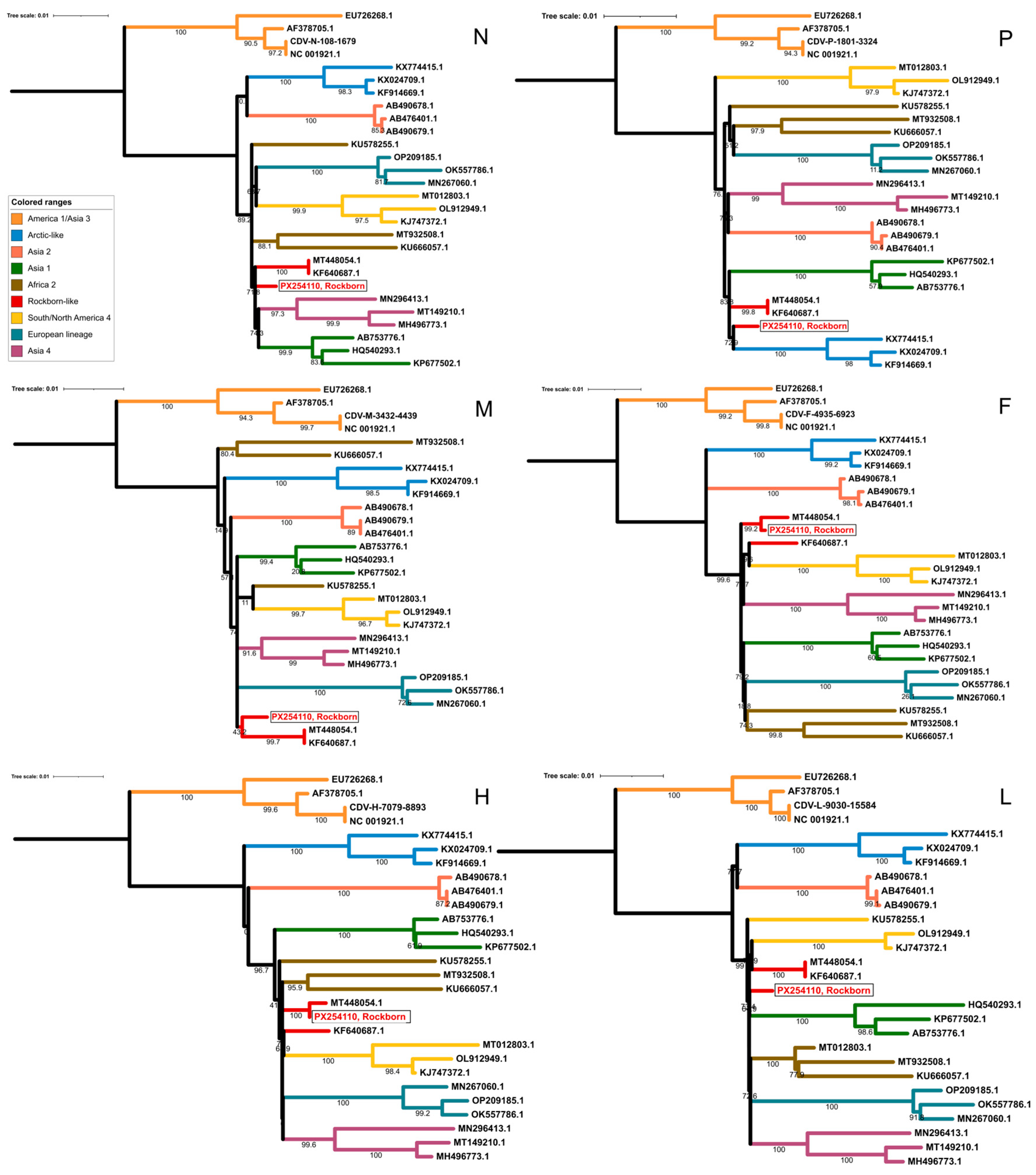
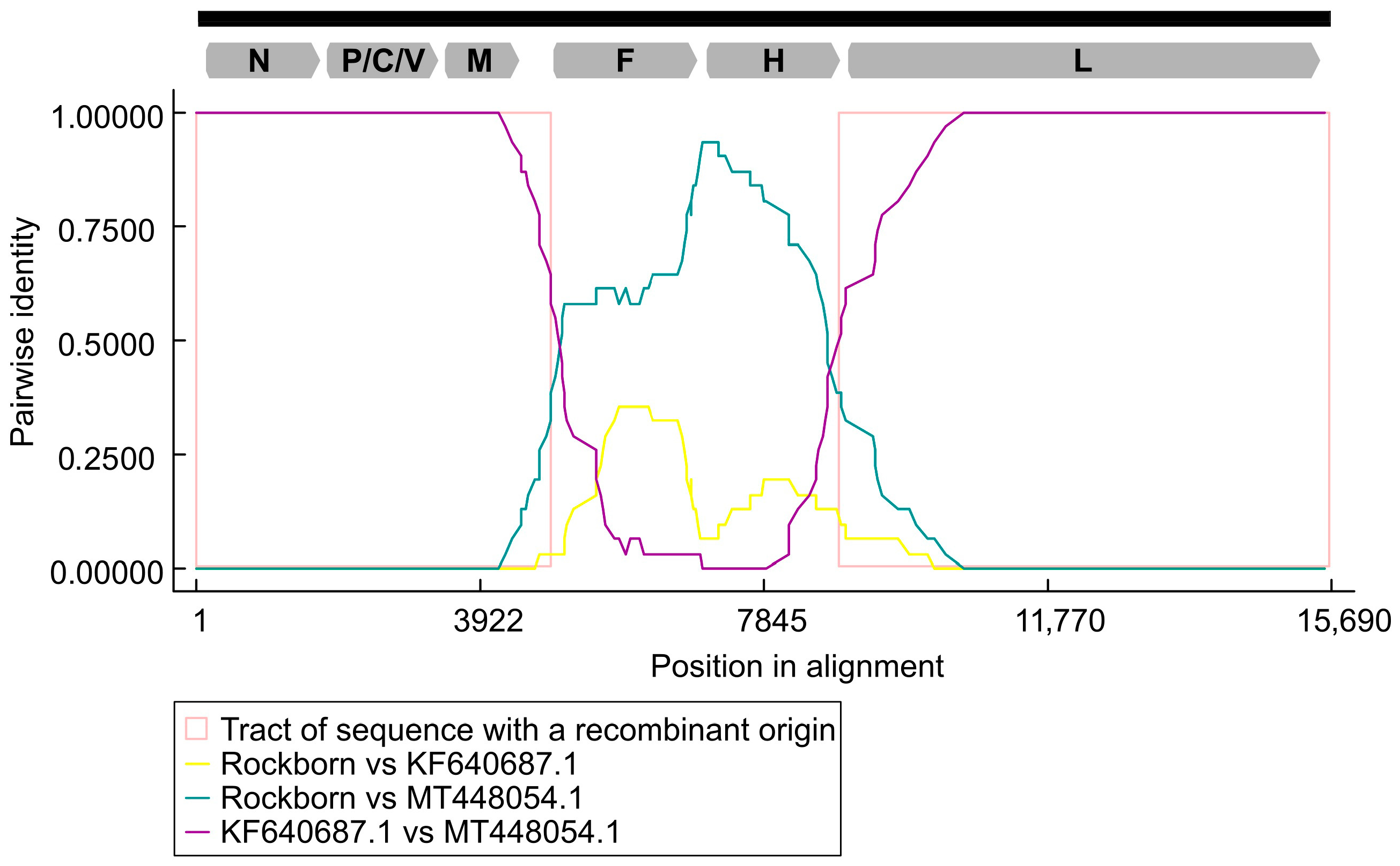
The historic Rockborn strain of the canine distemper virus was widely used as a vaccine, but its use was discontinued due to safety concerns. Yet, Rockborn-like canine distemper virus strains are still used in some vaccine formulations. Genetic analysis of this strain was previously limited to the H gene, leaving its full evolutionary and pathogenic potential unclear. This study aimed to determine the complete genome sequence of the Rockborn strain to reconstruct its origin, understand its evolution, and provide a reference for improving diagnostics and future research on virulence markers. An amplicon-based sequencing protocol using MinION nanopore technology was employed to determine the complete genome of the Rockborn-46th laboratory strain. The genome was assembled, annotated, and analyzed in comparison with 223 genomes. The complete genome of the Rockborn strain was 15,690 nucleotides in length. Phylogenetic analysis revealed that Rockborn forms a unique lineage with field isolates from a masked civet in China and a dog in the United States. Crucially, a significant recombination event was identified, showing that the Rockborn strain acted as a parental strain, contributing its F and H genes to create mosaic viruses. The full-genome characterization of the Rockborn strain confirms that Rockborn-like viruses persist and actively contribute to the evolution of canine distemper virus through recombination. This finding highlights the inadequacy of single-gene analysis for diagnostics and surveillance, and underscores the necessity of whole-genome sequencing to accurately track the virus epidemiology and evolution.