
Article

The Relative Age Effect Beyond Geography: Evidence of a Shared Pattern in Senior International Football

by
Diego Hernán Villarejo-García
1,
Carlos Navarro-Martínez
2,*,
José Francisco López-Gil
3,4 and
José Pino-Ortega
1
1
Faculty of Sport Science, University of Murcia, 30100 Murcia, Spain
2
Education, Diversity and Quality Research Group, Faculty of Education, University of Murcia, Campus de Espinardo, 30100 Murcia, Spain
3
School of Medicine, Universidad Espíritu Santo, Samborondón 092301, Ecuador
4
Vicerrectoría de Investigación y Postgrado, Universidad de Los Lagos, Osorno 5290000, Chile
*
Author to whom correspondence should be addressed.
Data 2026, 11(9), 245; https://doi.org/10.3390/data11090245 (registering DOI)
Submission received: 8 August 2026 / Revised: 10 September 2026 / Accepted: 16 September 2026 / Published: 19 September 2026

Abstract

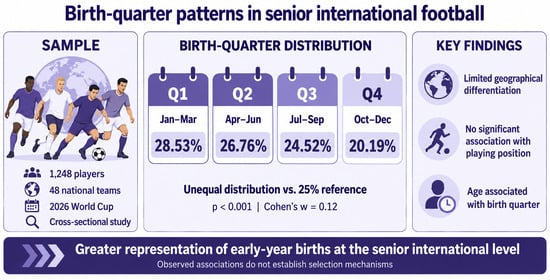
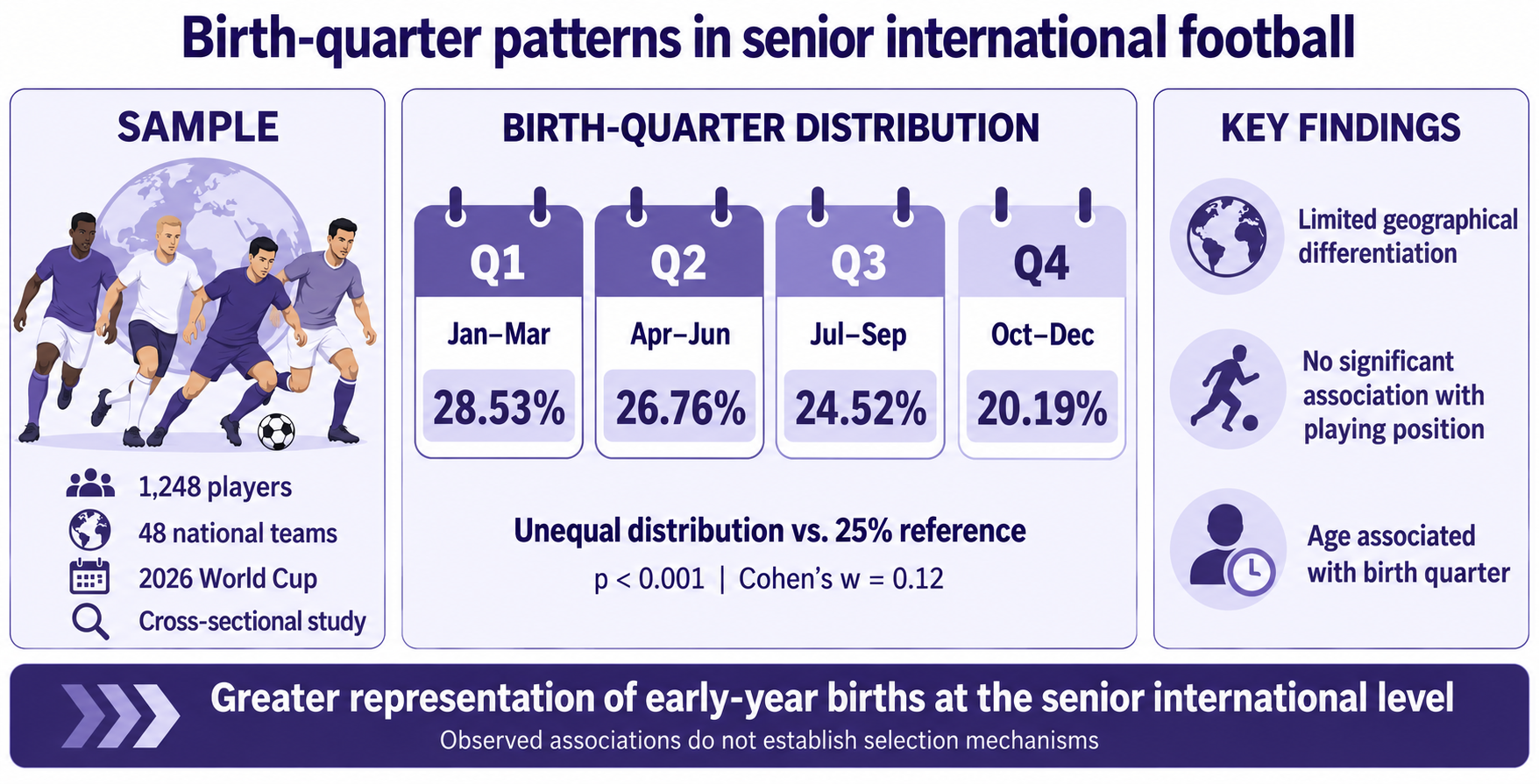
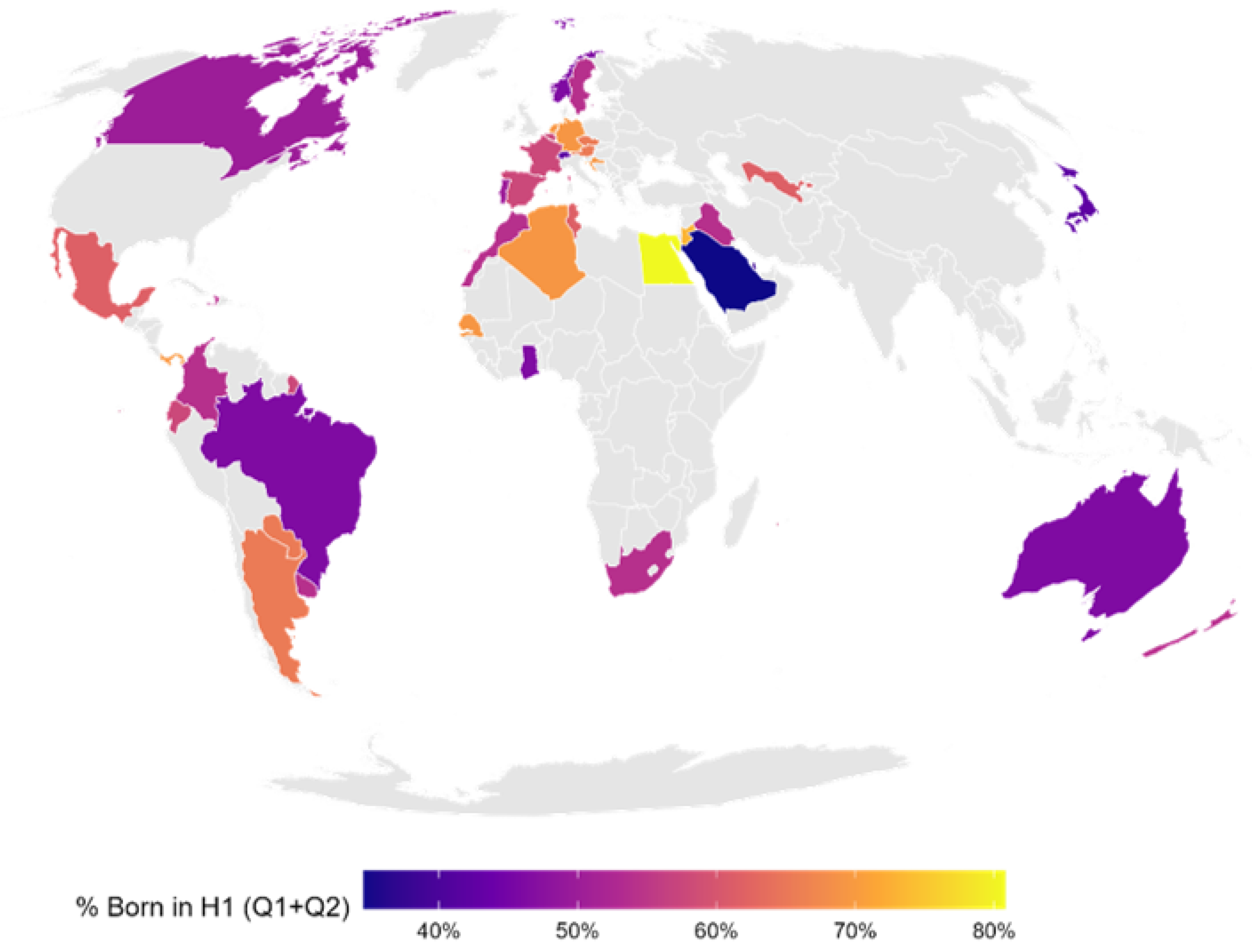
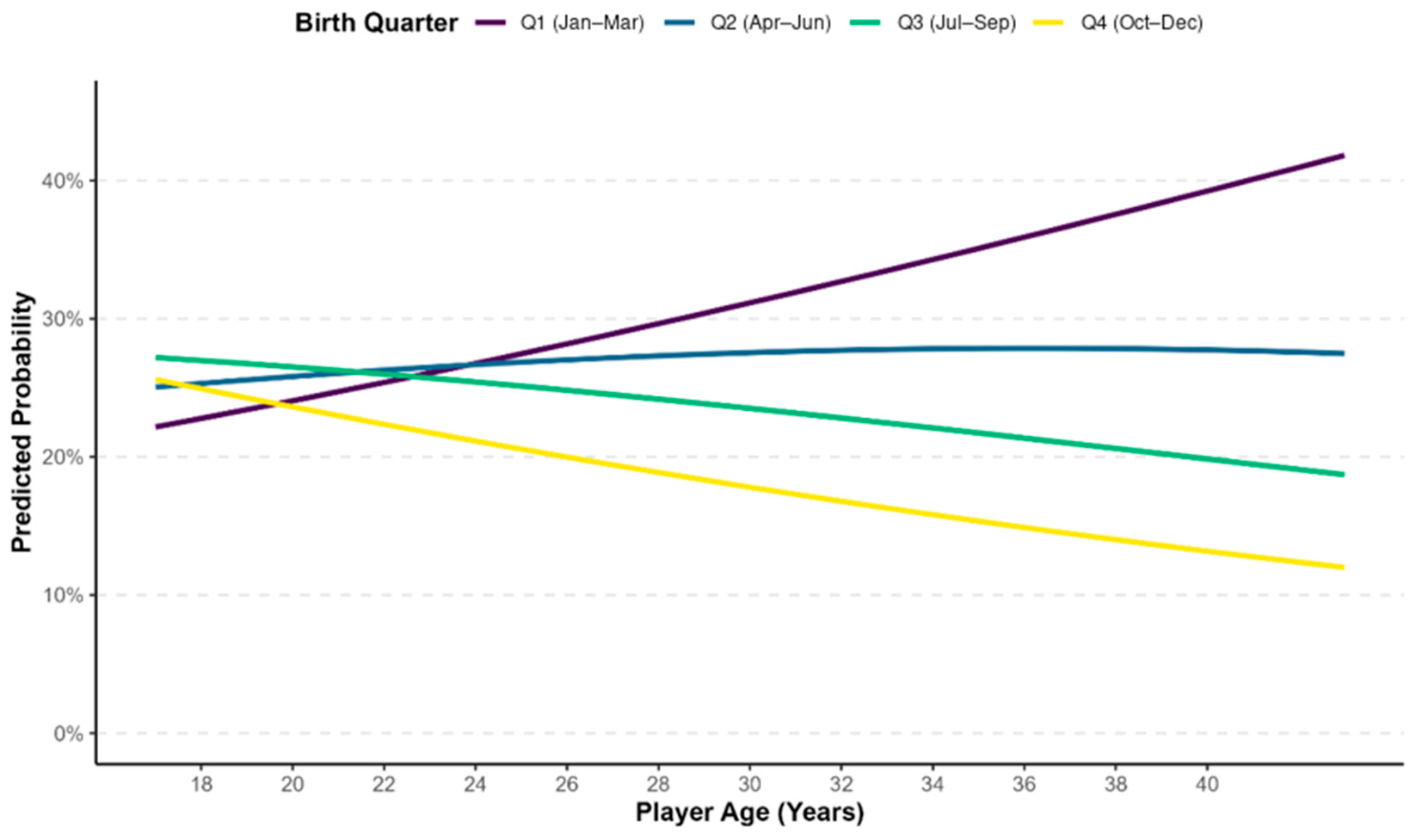
The Relative Age Effect (RAE) describes systematic differences in athlete representation according to birth date, but it remains unclear whether the associated birth-quarter asymmetries vary across geographical contexts or reflect a broadly shared international pattern. This study examined birth-quarter distributions associated with the RAE in senior international football using a cross-sectional sample of 1248 players from the 48 national teams participating in the 2026 Fédération Internationale de Football Association (FIFA) World Cup. Birth-quarter distributions were assessed using χ2 goodness-of-fit and independence tests, and a cumulative link mixed model evaluated the effects of age, height, playing position, and continental confederation, with national team included as a random effect. Marginal probabilities by age, spatial mapping of first-half-year births, and exploratory unsupervised cluster analysis were also performed. Birth-quarter distribution differed significantly from an equal reference distribution, with greater representation of players born in the first birth quarter (Q1: January–March) and second birth quarter (Q2: April–June) and lower representation in the fourth birth quarter (Q4: October–December). Playing position and confederation were not significantly associated with birth quarter, whereas player age was the only covariate that remained statistically significant in the mixed-effects model. Older age groups showed a lower representation of players born in Q4. Low between-team variance and weak cluster separation indicated limited differentiation in birth-quarter distributions among the national rosters analysed, although descriptive variation in first-half-year (H1: Q1 + Q2) representation was evident. These findings are consistent with an asymmetric birth-quarter distribution at the senior international level; however, because talent identification and development systems were not directly evaluated, these observations cannot establish specific organizational mechanisms or a uniform structural bias.
Keywords: birth quarter; cluster analysis; international football; multilevel modelling; national teams; relative age effect; talent identification birth quarter; cluster analysis; international football; multilevel modelling; national teams; relative age effect; talent identification
Graphical Abstract