1. Introduction
Talent identification and development are central processes in high-performance football, where players are assessed and selected from an early age to gain access to academies, national programmes, and elite competitive structures. However, these decisions are made during dynamic and non-linear stages of development, meaning that temporary advantages associated with growth, maturation, or experience may be mistaken for long-term sporting potential [
1,
2]. This limitation is particularly relevant because early selection influences subsequent access to specialized training, competitive experience, and sustained opportunities for progression [
3]. Among the biases that may affect these processes, the Relative Age Effect (RAE) is one of the most widely documented phenomena in sport.
The RAE refers to the disproportionate distribution of athletes according to their date of birth within the same annual cohort, typically characterized by an over-representation of those born close to the beginning of the selection cut-off period and an under-representation of those born toward the end. Since the pioneering work of Barnsley et al. [
4], numerous studies have shown that relatively older athletes are more likely to be identified, selected, and promoted within talent development programmes. The foundational review by Musch and Grondin [
5] emphasized that, although the RAE has been documented internationally, it is neither inevitable nor uniform across sporting contexts. Its occurrence and magnitude may depend on the interaction between age-grouping policies, competition for selection, sport popularity, maturational differences, and physical and psychological mechanisms that amplify initial age-related advantages. Consequently, chronological differences of almost twelve months during childhood and adolescence may translate into inequalities in growth, biological maturation, physical capacities, sporting experience, and perceived competence by coaches and selectors [
5,
6,
7]. These initial differences may subsequently accumulate through repeated selection, access to higher-quality training, competitive participation, and differential opportunities for progression.
Football represents one of the main contexts in which to study the RAE because of the early entry of players into academies, the intense competition for limited places, and the organization of age categories through annual cohorts. Research in youth football has consistently documented a greater representation of players born during the first months of the year in professional academies, national talent identification programmes, and international tournaments [
8,
9]. This imbalance does not appear to be confined to a specific league or development system, as it has been identified across different European countries and in youth competitions organized by the Fédération Internationale de Football Association (FIFA) and the continental confederations. Likewise, a recent review integrating 563 independent samples from 90 articles concluded that the magnitude of the RAE in football varies according to age and competitive level, generally being more pronounced in highly selective contexts [
10].
The interpretation of this phenomenon, however, requires a distinction between representation, performance, and sporting progression. The over-representation of relatively older players does not necessarily imply that they perform better once selected. Some studies have shown that the RAE persists even when anthropometric or performance differences between birth quarters are small, suggesting that part of the bias may have emerged during earlier stages of the selection process [
11]. In addition, recent evidence indicates that initial advantages in representation do not always translate linearly into higher transition rates or better professional outcomes, and that relatively younger players who successfully progress through selection processes may follow different career trajectories. These observations call into question the ability of talent identification systems to distinguish between temporary developmental advantages and long-term sporting potential.
Although the RAE tends to be more pronounced during developmental stages, evidence indicates that birth-quarter asymmetries may persist in professional football and senior international competitions. Helsen et al. [
12] identified its presence in European professional football, while direct analyses of the 2014 FIFA World Cup provided evidence of its persistence at the highest international level. Costa et al. [
13] observed a significantly non-uniform birth-quarter distribution among 733 players and reported significant asymmetries within specific playing positions and geographical regions, particularly Europe and Asia. Similarly, Steingröver et al. [
14] identified a significant overall RAE among the 736 players participating in the same tournament, with significant effects in the Union of European Football Associations (UEFA) and the Asian Football Confederation (AFC) and a descriptive inverse pattern among Confederation of African Football (CAF) players. Pedersen et al. [
15], after analysing 20,401 players from 47 youth and senior international tournaments, subsequently showed that the expression of the RAE varied according to age, sex, and competitive period. More recently, Martínez-Benítez et al. [
16] examined 9064 male players from 15 FIFA World Cups held between 1962 and 2022, together with 3580 players from women’s World Cups, and reported variation across tournament editions, sporting outcomes, and confederations. Collectively, these findings indicate that birth-quarter asymmetries may persist in senior World Cups, while their magnitude and geographical expression may vary across tournaments and analytical contexts. In this context, the scientific question should no longer be limited to confirming the existence of the RAE, but should move toward examining its structure, moderators, and the mechanisms that may contribute to its persistence. In particular, it is necessary to determine whether the differences observed across competitions and countries reflect genuinely distinct selection systems or local variations around a common international pattern. This distinction is relevant from both theoretical and applied perspectives: a context-dependent phenomenon would require interventions tailored to each national system, whereas a shared structural bias would call for a review of common organizational principles, such as cut-off dates, early selection, and the differential allocation of opportunities.
Previous studies have therefore established both the persistence of the RAE in senior international football and the possibility of variation across competitions and confederations. However, most available approaches have examined pooled tournament distributions, conducted separate goodness-of-fit analyses within geographical groups, or compared broad continental categories [
13,
14,
15,
16]. These strategies do not directly determine whether the variation observed between national teams represents structured heterogeneity across national development systems or fluctuations around a shared international pattern. In particular, previous research has not simultaneously quantified national-team-level variability while adjusting for individual covariates and complemented this estimation with spatial analysis and unsupervised classification of national birth-quarter profiles. This distinction is important because the presence of significant asymmetry within one or more confederations does not necessarily demonstrate that birth-quarter distributions differ significantly between confederations. Addressing this question requires simultaneous consideration of both the hierarchical structure of the data and the international distribution of the phenomenon. In particular, it is important to model the dependence among players belonging to the same national team, quantify the variability attributable to the national level, and complement this estimation with spatial analyses and unsupervised classification techniques to determine whether clearly differentiated national profiles exist. This integration of multilevel modelling, geographical analysis, and clustering has received limited attention in previous research on the RAE in international football. Consequently, the remaining knowledge gap concerns not so much the international existence of the RAE, which is already well documented, but rather its architecture across national systems and the extent to which the observed differences represent distinct patterns or variations along a common international continuum.
Accordingly, the present study provides an integrated evaluation of the RAE in senior international football by combining distributional tests, multilevel modelling, marginal probabilities, spatial analysis, and unsupervised learning to determine whether the phenomenon reflects differentiated contexts or a shared pattern across national teams.
Therefore, the aim of this study was to determine whether the Relative Age Effect observed in senior international football represents a phenomenon dependent on geographical and competitive context or, conversely, manifests as a shared pattern across international talent identification and development systems. To this end, the overall distribution of birth quarters, their associations with playing position and continental confederation, the independent effects of age and height, the variability between national teams, and the existence of differentiated geographical patterns or international groupings were evaluated. It was hypothesized that the RAE would be present among the national teams participating in the 2026 FIFA World Cup, with limited variability across playing positions, confederations, and countries.
2. Materials and Methods
2.1. Study Design
An observational, analytical, cross-sectional study was conducted to evaluate birth-quarter distributions and their variability across national teams as evidence relevant to the RAE in senior international football. The study was conducted in accordance with the Strengthening the Reporting of Observational Studies in Epidemiology (STROBE) guidelines for reporting observational studies [
17].
Unlike previous research focused on national leagues, developmental age categories, or specific competitions, the present study included all players registered by the 48 national teams participating in the 2026 FIFA World Cup. This complete inclusion of the tournament rosters allowed the RAE to be examined at the highest level of international competition using a multilevel analytical strategy that integrated descriptive analyses, hypothesis testing, mixed-effects models, spatial analyses, and unsupervised learning techniques.
2.2. Participants
The study population comprised all players officially registered by the 48 national teams participating in the 2026 FIFA World Cup.
The final sample consisted of 1248 players, distributed across the six continental confederations recognized by FIFA (UEFA, Confederación Sudamericana de Fútbol (CONMEBOL), Confederation of North, Central America and Caribbean Association Football (CONCACAF), CAF, AFC, and Oceania Football Confederation (OFC)). Each national team contributed 26 players, ensuring a uniform roster size across teams. However, the number of national teams represented differed across confederations, resulting in unequal sample sizes at this level. This should be taken into account when interpreting the precision of comparisons between confederations.
The inclusion of all official tournament rosters reduces the risk of incomplete roster sampling within the competition and provides complete representation of the players selected for this edition of the FIFA World Cup.
2.3. Data Sources
Information on players’ dates of birth and official squad lists was obtained directly from documentation published by FIFA for the 2026 FIFA World Cup.
The database was subsequently enriched with information obtained from Transfermarkt, including chronological age, specific playing position, height, number of international appearances, international goals, current market value, and peak historical market value. The combined use of both sources enabled the construction of an integrated database containing demographic, sporting, and competitive information for each player.
Prior to the statistical analyses, automated quality-control procedures were conducted to identify duplicate records, inconsistencies across variables, and identification errors. No duplicate player–team records were detected, and Transfermarkt identifier coverage reached 95.9%, allowing adequate linkage of records across the data sources used.
2.4. Variables
The dependent variable was birth quarter, determined from each player’s date of birth. This variable was categorized into four consecutive periods of the year: Q1, corresponding to players born between January and March; Q2, between April and June; Q3, between July and September; and Q4, between October and December.
The independent variables recorded were age (years), height (cm), specific playing position, obtained from Transfermarkt-linked roster codes and collapsed into four mutually exclusive categories (goalkeeper, defender, midfielder, and forward), national team, and continental confederation. Variables related to sporting performance (international appearances and goals) and players’ economic valuation (current market value and peak historical market value) were also included and were used solely for descriptive purposes in the present study.
Economic variables had a coverage of 66.3%; therefore, their results should be interpreted only for cases with available data.
For terminological consistency, “birth-quarter distribution” refers to the observed distribution of players across Q1–Q4, whereas “birth-quarter asymmetry” indicates a departure from the expected reference distribution. The term “H1 representation” refers exclusively to the proportion of players born in the first half of the year (Q1 + Q2) and is used as a descriptive spatial indicator rather than as a direct measure of the RAE. The term “RAE” is reserved for the broader phenomenon inferred from systematic birth-date-related differences in representation. Finally, “selection bias” refers to a potential underlying mechanism and not to a process directly measured in the present study.
2.5. Data Quality Control
The database underwent a systematic data-cleaning process prior to the statistical analyses.
This procedure included checking for duplicate records, validating unique identifiers, reviewing inconsistencies across variables, assessing missing values, and detecting potential outliers using automated statistical procedures. For the cumulative link mixed model (CLMM) predictors (birth quarter, age, height, playing position, confederation and national team), there were no missing values (N = 1248 players nested in K = 48 teams); analyses were therefore complete-case and no imputation was used.
The distribution of continuous variables was assessed using the Shapiro–Wilk and Anderson–Darling tests, complemented by analyses of skewness and kurtosis and visual inspection of histograms and normal probability plots. Because several variables did not follow a normal distribution, subsequent analyses combined parametric and non-parametric procedures, with effect sizes and confidence intervals systematically reported in accordance with current recommendations for biomedical and sports science research.
2.6. Statistical Analysis
All statistical analyses and computational workflows were executed in R (version 4.3.2) using the ordinal, emmeans, cluster, sf, and ggplot2 packages. Significance for all inferential tests was established a priori at α = 0.05.
To evaluate deviations and associations in birth-quarter distributions across categorical predictors, non-parametric Chi-square (χ2) goodness-of-fit and independence tests were conducted. First, a Chi-square goodness-of-fit test evaluated whether the overall distribution of birth quarters (Q1 to Q4) significantly departed from the equal distribution of 25% per quarter used as the analytical reference. Second, two-way Chi-square tests of independence were performed to test for potential associations between birth quarter distribution and (a) playing position (Goalkeepers, Defenders, Midfielders, Forwards) and (b) continental confederation (UEFA, CONMEBOL, CAF, AFC, CONCACAF, OFC). Effect sizes were reported as Cohen’s w for the goodness-of-fit test and Cramér’s V for independence tests. Because three primary χ2 tests were performed, p-values for this family were also adjusted using the Holm procedure. As a sensitivity analysis for the goodness-of-fit test, the equal 25% reference was compared with alternative non-uniform expected quarterly distributions representing mild seasonal birth schedules.
To adjust for continuous covariates (player age and physical stature) while accounting for the hierarchical nesting of players (
N = 1248) within national team federations (K = 48), a CLMM was fitted with a logit link function
where Yi represents the ordered birth quarter (Q1 < Q2 < Q3 < Q4), γk denotes the flexible threshold cut-points (k ∈ {1,2,3}), and u
j accounts for national team random intercepts. Reference categories were fixed a priori to Goalkeepers for tactical position and UEFA for continental confederation. Fixed effects are reported as unstandardized regression coefficients (β), standard errors (SE), Wald z-values, odds ratios (OR = eβ), and corresponding 95% confidence intervals (95% CI). Random effects were evaluated via the intercept variance (σ
Country2), with a 95% confidence interval obtained by cluster bootstrap resampling of national teams (B = 200). The model was estimated by adaptive Gauss–Hermite quadrature (nAGQ = 5) in the ordinal package. The proportional-odds assumption for the fixed-effects cumulative logit specification was assessed with likelihood-ratio tests of nominal effects (
ordinal::
nominal_test) and a partial proportional-odds model allowing age to vary by threshold.
To visualize age-related patterns, marginal predicted probabilities for each birth quarter across player age (18–40 years) were derived from the fixed-effects Cumulative Link specification using clm probability extraction. To examine geographical variation in H1 representation, national-level proportions of players born in the first half of the selection year (%H1 = Q1 + Q2) were mapped onto a global choropleth projection. National H1 and quarter-specific proportions (n = 26 players per team) were accompanied by Wilson 95% confidence intervals to reflect sampling uncertainty at the roster level.
Finally, an exploratory unsupervised k-means cluster analysis (Euclidean distance; multiple random starts) was performed on the country-level quarterly proportion matrix (N = 48) to examine whether the national birth-quarter distributions showed evidence of distinct grouping patterns. Cluster separation was evaluated using average silhouette coefficients (Sk) across solutions ranging from K = 2 to K = 5, and a silhouette plot is available in the public project repository listed in the Data Availability Statement. Silhouette values were interpreted descriptively, with values above 0.50 considered indicative of relatively clear cluster separation. Given the compositional nature of the quarterly proportions and the limited number of national teams, this analysis was considered exploratory and was not used as standalone evidence of discrete national typologies.
2.7. Ethical Considerations
All information analysed in this study was obtained from publicly accessible secondary sources, including official FIFA documentation and Transfermarkt. The study involved no participant recruitment, intervention, direct interaction, or access to private records, and no health-related or other special-category personal data were processed. Therefore, ethics committee approval and individual informed consent were not required.
3. Results
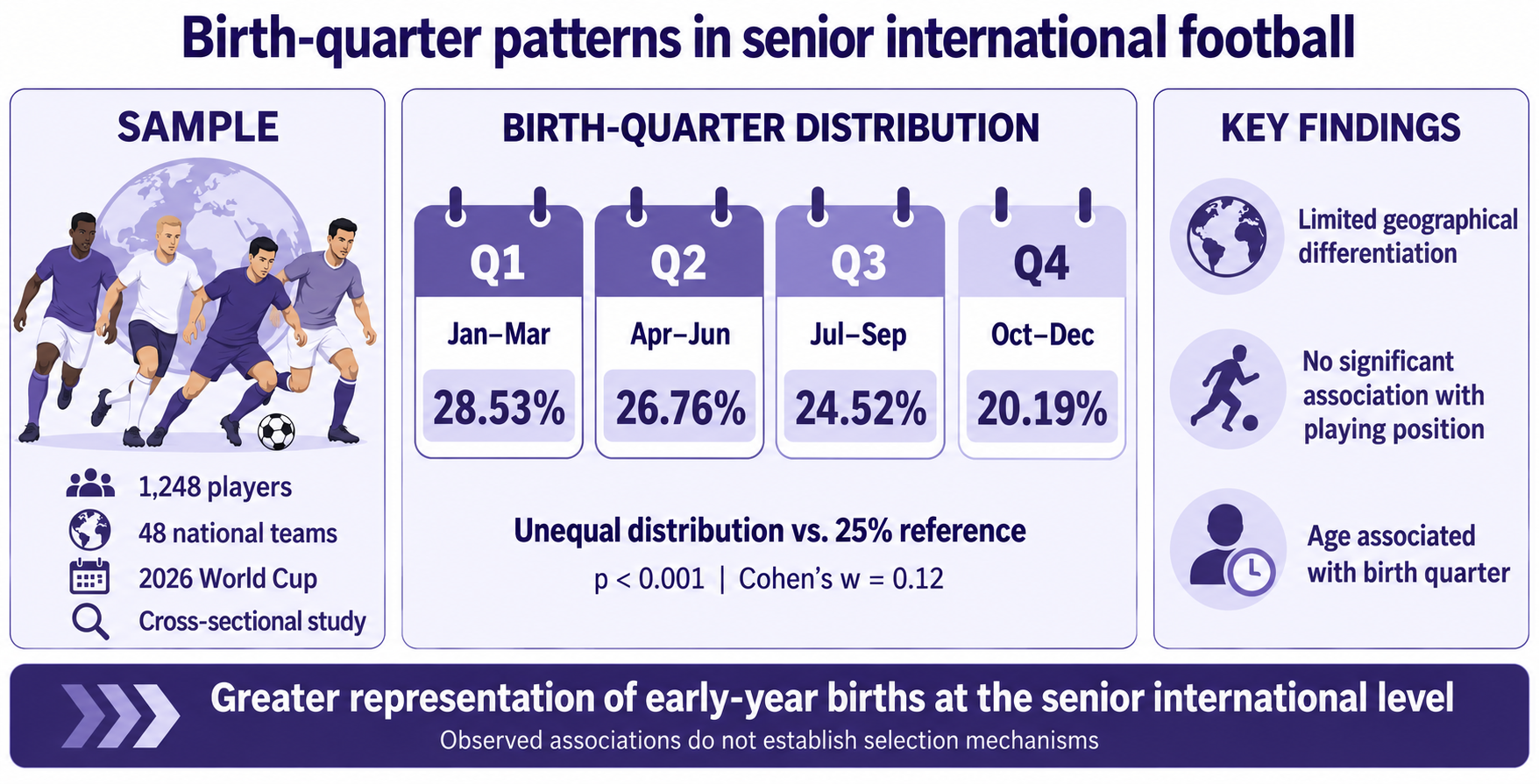
Preliminary bivariate analyses confirmed a non-uniform overall distribution of birth quarters across the global sample (χ
2 = 18.80, df = 3,
p < 0.001; Holm-adjusted
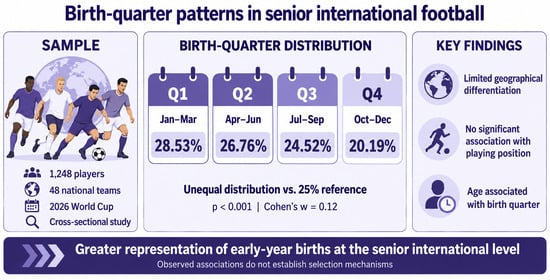
p < 0.001; Cohen’s w = 0.12), with 28.53% of players born in Q1 and 20.19% born in Q4. However, chi-square tests of independence revealed no significant associations between birth-quarter distribution and playing position (χ
2 = 5.22, df = 9,
p = 0.815; Holm-adjusted
p = 0.815) or continental confederation (χ
2 = 16.83, df = 15,
p = 0.329; Holm-adjusted
p = 0.658). Subsequently, to adjust for continuous covariates and account for the hierarchical nesting of players within national teams, the CLMM was applied (
Table 1). Sensitivity analyses replacing the uniform 25% reference with mild seasonal expected distributions showed that the goodness-of-fit conclusion was not uniformly robust across all alternative schedules (sensitivity results are available in the public project repository listed in the Data Availability Statement).
The CLMM revealed that individual player age was the only predictor with a statistically significant effect on birth quarter distribution (p = 0.004). Specifically, each additional year of player age was associated with a 3.5% decrease in the odds of being born in a later quarter (OR = 0.965, 95% CI 0.942–0.989). Conversely, player height showed no statistically significant relationship with birth quarter (p = 0.216), indicating that no adjusted association between birth quarter and adult height was supported in this sample.
Regarding tactical positions, comparisons relative to Goalkeepers revealed no significant differences across Defenders (p = 0.571), Midfielders (p = 0.685), or Forwards (p = 0.314). Similarly, continental confederations showed no significant deviation when contrasted against UEFA (AFC: p = 0.101; CAF: p = 0.893; CONCACAF: p = 0.753; CONMEBOL: p = 0.998; OFC: p = 0.803). Crucially, the random-effect variance between national teams was negligible (σCountry2 = 0.013, 95% CI [0.000, 0.058]), demonstrating that less than 1% of the total latent variance in birth quarter is attributable to the player’s national origin.
Likelihood-ratio tests of nominal effects for the fixed-effects cumulative logit model did not indicate material violation of the proportional-odds assumption (Age: likelihood ratio (LR) = 1.03, df = 2, p = 0.596; playing position: p = 0.520; confederation: p = 0.260).
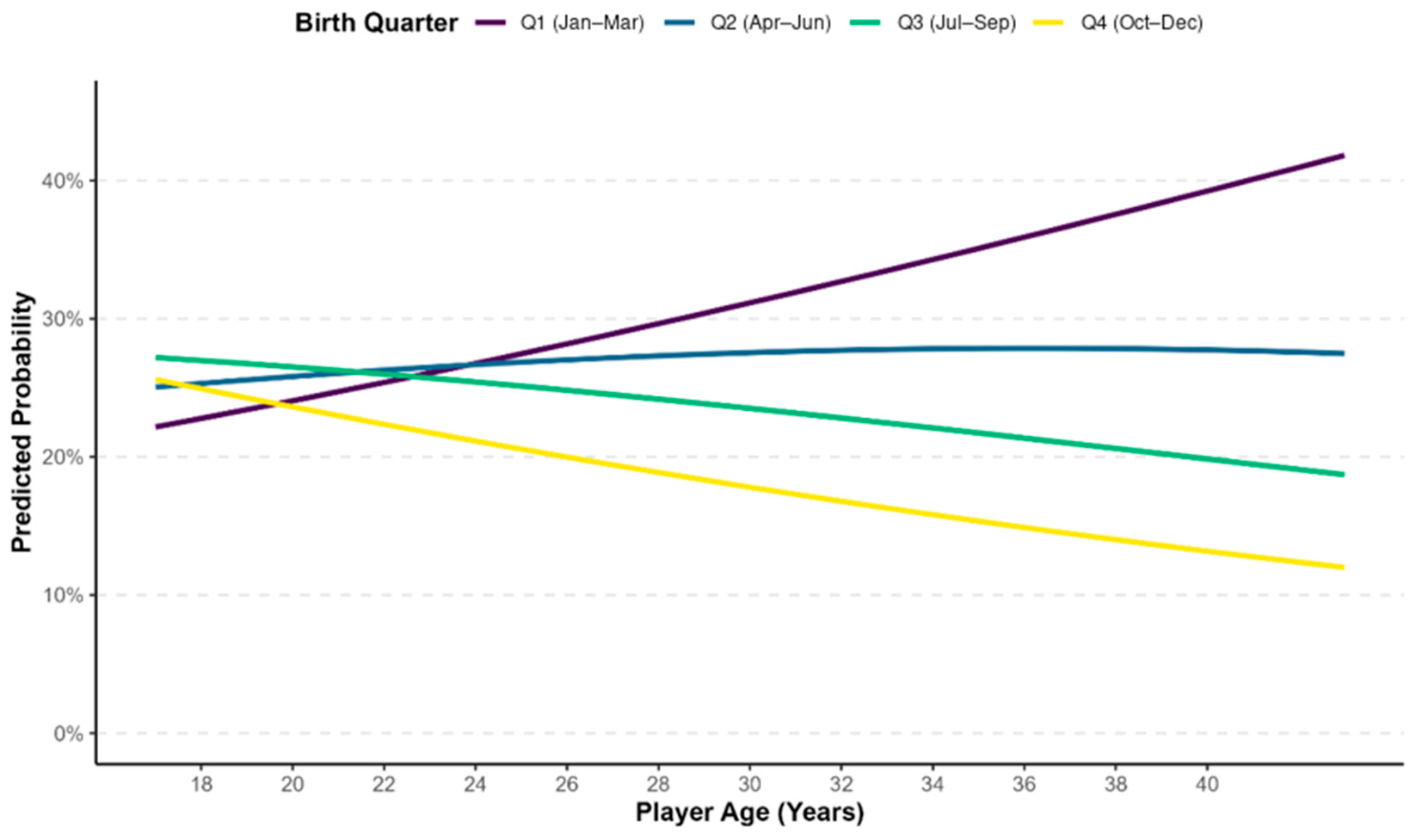
To model age-related differences in birth-quarter representation within this cross-sectional sample, marginal predicted probabilities for each birth quarter were derived from the fitted CLMM as a function of player age.
Figure 1 illustrates the dynamic change in quarterly selection likelihood across the age continuum.
As displayed in
Figure 1, chronological age was significantly associated with birth-quarter distribution. The predicted probabilities differed across player age within this cross-sectional sample. Younger players (~18–22 years) showed a different quarterly distribution compared with older players, while players aged >30 years displayed a lower predicted probability of being born in Q4 and a higher predicted representation of Q1. These findings indicate age-related differences in birth-quarter representation within the sample. However, given the cross-sectional design, they should not be interpreted as evidence of changes over time, differential dropout, or greater career longevity.
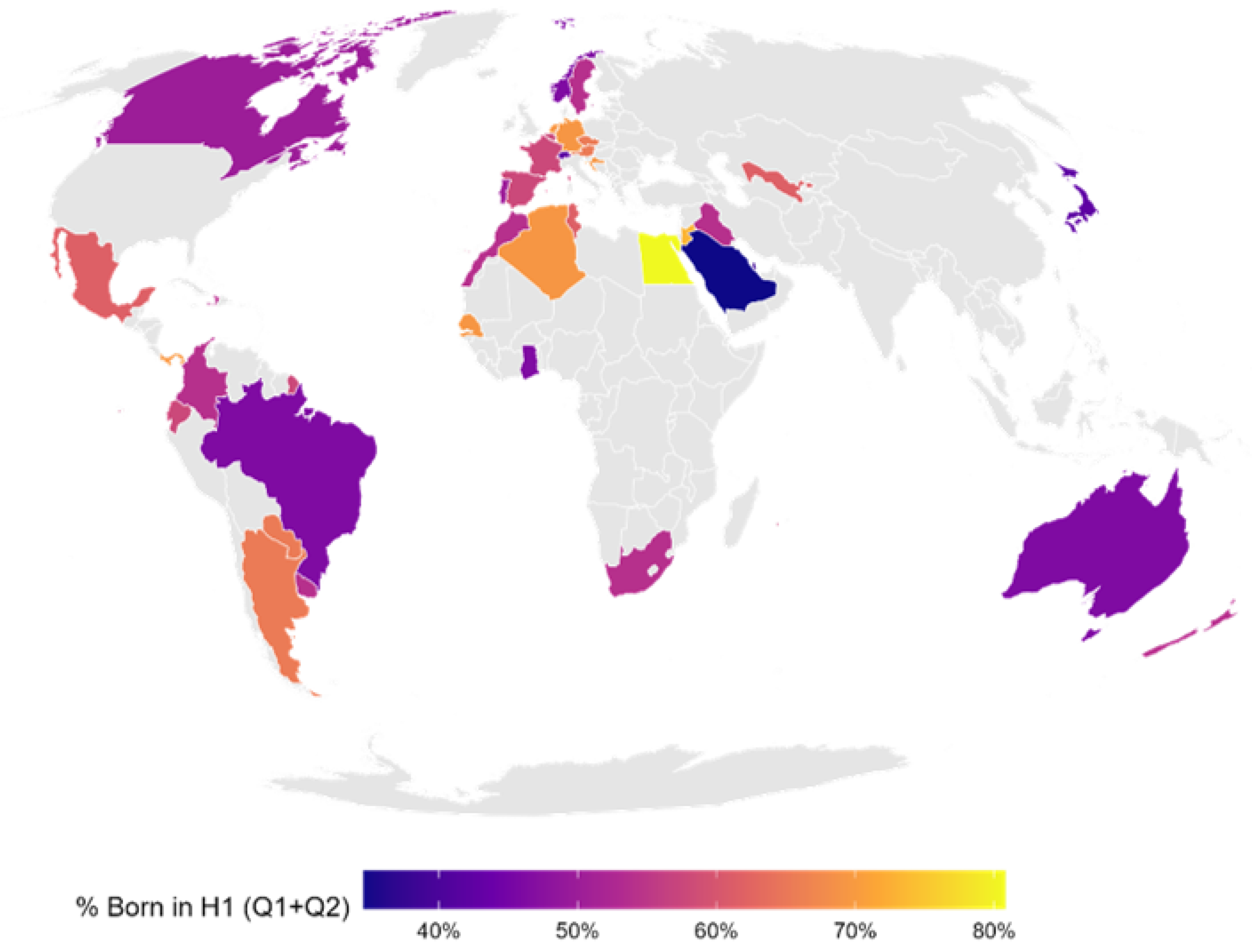
To evaluate the spatial representation and geographical stability of the Relative Age Effect across international talent pools, the national proportion of players born in H1 was mapped globally.
Figure 2 provides a choropleth visualization of the percentage of senior national team players born during the first half of the selection year (H1: Q1 + Q2) across all analysed national federations (N = 48).
As depicted in
Figure 2, the over-representation of early-born players (H1) was observed across a wide range of national federations and continental regions. In most of the analysed federations, H1 values exceeded the 50% reference threshold derived from an equal birth distribution, with proportions above 70% in several national teams across Europe, South America, Asia, and Africa. Only a small proportion of federations showed H1 values below 50%. This geographical representation is descriptive and illustrates the broad spatial distribution of early-born players across the study sample, consistent with the absence of a significant association between birth-quarter distribution and continental confederation (χ
2 = 16.83,
p = 0.329). However, the H1 indicator combines Q1 and Q2 and therefore provides a simplified representation of the RAE that may obscure differences in the full quarterly distribution, particularly contrasts between Q1 and Q4. Because each federation contributed only 26 players, national percentages are sensitive to single-player changes (3.85 percentage points per player), and Wilson 95% confidence intervals for H1 were wide (approximately 30–36 percentage points).
To examine whether national federations naturally group into distinct profiles based on their birth quarter distribution, a k-means cluster analysis was performed on the country-level proportion matrix (N = 48). Across all evaluated partition solutions (K = 2 to K = 5), average silhouette coefficients remained low (S2 = 0.238; S3 = 0.281; S4 = 0.295; S5 = 0.317), well below the established threshold (0.50) required to indicate substantial cluster structure. Although a two-cluster solution partitioning the sample into a “High-RAE Bias” profile (n = 20, mean H1 = 65.58%; Q4 = 15.96%) and a “Moderate/Balanced” profile (n = 28, mean H1 = 47.94%; Q4 = 23.21%) was computationally identified, the low silhouette values indicated weak separation between clusters. Thus, the national birth-quarter distributions did not show a clearly defined discrete cluster structure.
4. Discussion
The aim of this study was to determine whether birth-quarter asymmetries consistent with the RAE observed in senior international football depend on geographical and competitive context or manifest as a shared pattern among the national teams participating in the 2026 FIFA World Cup. The main finding was the presence of a non-uniform birth distribution, characterized by an over-representation of players born during the first months of the year. In addition, birth quarter was not associated with playing position or continental confederation, the variability attributable to national team was low, and no clearly differentiated national groupings were identified. Overall, these findings indicate an asymmetric birth-quarter distribution characterized by greater representation of players born in Q1 and Q2, together with lower representation in Q4, across the rosters evaluated. While the low between-team variance and absence of confederation-level differences suggest limited macro-geographical differentiation within this sample, this distribution should not be assumed to represent an identical selection trajectory across distinct national federations. The over-representation of relatively older players is consistent with the body of evidence accumulated since the earliest studies on annual age grouping and athlete selection. The meta-analysis by Cobley et al. [
6] showed that the RAE occurs consistently across different sports and tends to be more pronounced in male, highly competitive contexts characterized by intensive selection processes. In football, Helsen et al. [
9] documented a marked asymmetry in European youth categories, while subsequent reviews confirmed that age, competitive level, and selection pressure moderate the magnitude of the phenomenon [
10,
18]. The persistence observed in the present study is particularly relevant because the sample does not consist of players in developmental stages, where maturational differences are more evident, but of players who have reached the highest level of international competition. This finding is consistent with recent studies that continue to identify an over-representation of players born early in the year in adult professional football, although generally with a smaller magnitude than that observed in youth categories [
15,
19]. The overall birth-quarter distribution observed in the present study closely resembles that previously reported for the 2014 FIFA World Cup. Steingröver et al. [
14] found that 29.8% of players were born in Q1 and 21.1% in Q4, with an overall effect size of w = 0.14. In the present 2026 sample, the corresponding proportions were 28.53% and 20.19%, with w = 0.12. Costa et al. [
13] likewise reported a significant overall birth-quarter asymmetry in the 2014 tournament. Therefore, despite the expansion of the competition from 32 to 48 national teams, the magnitude and direction of the overall RAE observed in 2026 were comparable to those reported twelve years earlier. This similarity supports the persistence of birth-quarter asymmetries at the senior international level. Nevertheless, comparisons between cross-sectional tournament editions cannot demonstrate temporal stability, individual carry-over effects, or a common developmental pathway.
The geographical findings, however, differ from some previous analyses of the 2014 FIFA World Cup. Costa et al. [
13] reported significant birth-quarter asymmetries within the European and Asian groups, while Steingröver et al. [
14] identified significant effects in UEFA and AFC and a descriptive inverse distribution among CAF players. In contrast, the present study found no significant association between birth quarter and continental confederation, and confederation remained non-significant after adjustment for age, height, playing position, and national-team clustering. These results should not be interpreted as directly contradictory. Testing whether the birth-quarter distribution within a particular confederation differs from an equal reference distribution is not equivalent to testing whether distributions differ between confederations. An overall RAE may therefore be present within several geographical groups even when the differences between those groups are small.
The broader historical findings of Martínez-Benítez et al. [
16] also indicate that the expression of the RAE varies across World Cup editions, sporting outcomes, and confederations. Likewise, Williams [
8] identified a typical RAE across most FIFA regions in youth World Cups but observed an inverse distribution among African players, while Andrew et al. [
20] reported an RAE among male U-17 CONCACAF players but not at the U-20 or senior levels. Differences between these studies and the present findings may reflect player age, tournament composition, roster size, selection-year operationalization, competitive period, or the statistical hypotheses evaluated. Accordingly, the absence of confederation-level differences and the low between-team variance observed in 2026 indicate limited macro-geographical differentiation within this specific tournament sample, rather than demonstrating that all national development systems produce identical selection patterns.
The absence of differences across playing positions further supports this interpretation. Some studies have proposed that the RAE may vary according to the physical and anthropometric demands of each playing position, particularly during youth development. Romann and Fuchslocher [
21], for example, observed that nationality, playing position, and height could influence the distribution of relative age among young football players. However, in the present adult sample, neither playing position nor height showed independent effects. Nevertheless, height measured in adulthood is only an imperfect indicator of the maturational processes experienced during developmental stages and, therefore, the absence of a current association does not rule out a possible historical influence of biological maturation on selection processes. Physical advantages associated with being relatively older may be particularly relevant during adolescence but may lose explanatory value once growth and maturation are complete. Therefore, the persistence of the RAE at the senior elite level may reflect less a current anthropometric advantage than the accumulated influence of selection decisions made during earlier developmental stages. This interpretation is consistent with the cumulative selection mechanisms originally outlined by Musch and Grondin [
5] and with the developmental systems model proposed by Wattie et al. [
7], according to which the RAE emerges from the prolonged interaction of individual, social, organizational, and environmental constraints rather than from a single physical characteristic.
Chronological age was the only independent predictor associated with birth quarter. The adjusted probabilities showed a lower representation of players born during the final months of the year among older age groups. This pattern is compatible with a cumulative persistence of the bias but should be interpreted with caution. Because of the cross-sectional design, the study does not demonstrate that relatively younger players leave the elite level earlier or that relatively older players have longer careers; it only identifies differences between age groups represented within the same competition. Lupo et al. [
22] observed that the RAE persisted during the early stages of senior careers and, in football, also among older players, unlike in other sports. However, recent longitudinal studies suggest a more complex picture. Brustio et al. [
23] showed that the over-representation of relatively older players at youth international level did not necessarily translate into higher transition rates to the senior national team, whereas Biermann et al. [
24] found that relatively younger players who successfully progressed through the development pathway accumulated more professional playing minutes. Similarly, Nisbet et al. [
25] reported that male footballers born in the first quarter had the lowest transition rate from youth to senior national teams. Therefore, the present findings should be interpreted as evidence of differential representation at the elite level rather than as evidence of superiority, better performance, or greater career longevity among players born earlier in the year.
This distinction between representation and performance is essential. Previous research has shown that a higher representation of footballers born early in the year does not necessarily translate into better subsequent outcomes. For example, Doyle and Bottomley [
26] and Bezuglov et al. [
27] reported an over-representation of relatively older players without finding a corresponding advantage in market value. These findings, which derive from previous studies rather than from the analyses conducted in the present work, reinforce the need to avoid interpreting greater representation as direct evidence of sporting superiority. Accordingly, the findings of the present study should be restricted to differences in representation according to birth quarter, without drawing inferences about performance or market value.
The spatial analysis and the absence of a robust cluster structure represent one of the main contributions of the study. The weak separation observed between clusters suggests that national birth-quarter distributions are better interpreted as variations along a continuum rather than as clearly differentiated profiles. This interpretation is consistent with the low variability between national teams observed in the mixed-effects model and with the absence of a significant association between birth quarter and continental confederation. Taken together, the low between-team variance, lack of confederation-level associations, and weak cluster boundaries indicate that the observed quarterly asymmetry was not confined to specific geographical regions within this cohort. Nevertheless, caution is warranted before generalizing these findings to a universal international pattern. Because developmental pathways, academy curricula, and talent identification policies were not directly evaluated in this study, the observed roster distributions cannot be taken as direct empirical evidence of shared institutional practices across national systems.
This approach extends previous research, which has generally focused on comparing proportions across countries, leagues, competitions, or confederations, by simultaneously evaluating the variability attributable to national team and the possible existence of groupings across countries. However, the term “structural” should not be interpreted as synonymous with universal or immutable. The RAE depends on the interaction between cut-off dates, competitive depth, age, sex, and characteristics of selection processes; therefore, the presence of a shared pattern among the national teams examined may coexist with local variation in magnitude and with contexts in which the phenomenon is attenuated or absent [
6,
7,
10].
From an applied perspective, the findings support the need to review talent identification processes before players reach the senior level. When birth-quarter asymmetry remains observable among the highest-level international players, it is likely that accumulated inequalities originated much earlier in the selection pathway. Interventions should therefore not be limited to modifying the composition of professional squads, but should instead target the mechanisms that generate differential opportunities during development. Proposed strategies include contextualizing evaluations according to relative age and maturation, delaying definitive exclusion decisions, maintaining flexible entry and re-entry pathways, and periodically monitoring birth-date distributions within academies and national teams. The available evidence does not yet support the superiority of any single strategy; therefore, these approaches should be evaluated through prospective designs rather than assumed to be effective in themselves.
Limitations and Future Perspectives
This study has several limitations. First, its cross-sectional design precludes reconstruction of individual trajectories from developmental stages to senior national-team selection and prevents determination of whether the age-related pattern reflects differences in access, transition, dropout, or persistence. Second, the findings are restricted to men’s football and to a single edition of the competition; therefore, they may be influenced by specific squad-selection decisions, injuries, or generational changes and should not be directly generalized to other editions, age categories, or women’s football. Third, the analysis used a uniform 25% distribution per birth quarter as the analytical reference. This assumption does not account for possible seasonal variation in births or demographic differences between countries. Sensitivity analyses using alternative non-uniform expected quarterly distributions indicated that the goodness-of-fit result can be attenuated under some seasonal schedules; therefore, future studies should incorporate national reference birth distributions when available. Fourth, potential differences in cut-off dates or in school and federation calendars across countries were not specifically modelled, although these factors may influence the expression of the RAE. Fifth, the analysis was based on the squads selected for the tournament, meaning that potential bias arising from competition-specific selection decisions cannot be ruled out. It should also be noted that part of the supplementary information was obtained from Transfermarkt, a secondary source, and that variables related to biological maturation, progression through youth national teams, age of academy entry, playing time, or characteristics of national development systems were not included. Finally, the cluster analysis should be considered exploratory given the limited number of national teams and the compositional nature of the quarterly proportions used.
Future studies should longitudinally link youth and senior national teams, examine multiple editions of the FIFA World Cup, and include women’s competitions. It would also be relevant to investigate whether date of birth is associated with the likelihood of selection, number of international appearances, playing minutes, and career duration, while clearly distinguishing between representation, transition, and performance. Finally, multilevel models could be extended by incorporating national- and organizational-level variables to identify which policies may attenuate or intensify the RAE. This approach would allow research to move beyond describing the persistence of the phenomenon toward identifying modifiable mechanisms and evaluating interventions aimed at reducing the potential loss of talent.



 ,
,