Data Descriptor

Dataset on the Biodiversity and Seasonal Dynamics of Horseflies (Tabanidae, Diptera) in Some Regions of European Russia


by
Irina A. Budaeva
1,
Sergei V. Pestov
2,
Alexander B. Ruchin
3,*,
Sergei V. Lukiyanov
3,
Evgeniy A. Lobachev
3,
Mikhail N. Esin
3 and
Irina G. Esina
3
1
Department of Zoology and Parasitology, Voronezh State University, 1 Universitetskaya pl., Voronezh 394018, Russia
2
Institute of Chemistry and Ecology, Vyatka State University, Moskovskaya St., 36, Kirov 610000, Russia
3
Joint Directorate of the Mordovia State Nature Reserve and National Park Smolny, Saransk 430005, Russia
*
Author to whom correspondence should be addressed.
Data 2026, 11(8), 210; https://doi.org/10.3390/data11080210
Submission received: 29 July 2026 / Revised: 10 August 2026 / Accepted: 16 August 2026 / Published: 20 August 2026
(This article belongs to the Section Spatial Data Science for Environment and Earth)

Abstract

The regional fauna of many Diptera groups is insufficiently studied. Tabanidae are the largest representatives of blood-sucking Diptera. A description of a dataset on the biodiversity of horseflies (Tabanidae) is presented, which includes information obtained by the authors and their colleagues in 2001, 2007–2009, and 2012–2025. The information was received from 14 regions of European Russia. A total of 5740 specimens were processed. In total, samples were obtained from 159 localities. Each record includes information about the species, time and place of collection, the collectors and determiners, as well as the administrative affiliation of the locality, making the dataset suitable for faunistic, biogeographical, and ecological studies. In total, 35 species were reliably identified. The most studied was the Republic of Mordovia, from which 33 species of Tabanidae became known. In turn, 12 species are included in the dataset from the Vladimir Region, and 10 species are included in the dataset from the Ryazan Region. Five species (Chrysops caecutiens, Chrysops viduatus, Haematopota pluvialis, Hybomitra bimaculata, Hybomitra muehlfeldi) were represented in the dataset in the largest number, and they accounted for 61.5% of the total specimens. The dataset also includes one specimen each of five species: Atylotus plebeius, Chrysops nigripes, Chrysops sepulcralis, Hybomitra borealis, and Hybomitra kaurii. Tabanidae activity begins in the first ten days of May and ends in the second ten-day period of September. The maximum species richness was observed in the third ten-day period of June and the first ten days of July, with 24 species recorded in each of these periods. Meanwhile, the maximum value of the Shannon index (2.52) and the minimum value of the Berger–Parker index (0.16) are observed in the first ten days of July. The dataset can be used as a basis for further study of the diversity and distribution of Tabanidae in European Russia.
Dataset License: Creative Commons Attribution (CC-BY) 4.0 License

1. Summary

Diptera is one of the largest insect orders in terms of species diversity and number in ecosystems. Species from this order are widespread in terrestrial ecosystems. Larvae of some species from large families are part of the benthos of river and lake ecosystems [1,2,3]. Diptera species are pests of crops, parasites of humans and animals, and they also contribute to the destruction of organic matter in ecosystems, act as plant pollinators, and perform other ecological functions [4,5,6,7]. Therefore, Diptera are of great economic importance to humans [8,9]. Tabanidae are the largest representatives of blood-sucking Diptera. Female Tabanidae often disturb the peace and comfort of people in agroecosystems, bathing sites, parks, forests, and anywhere where these insects can breed [10,11]. However, not only humans suffer from bites and the nuisance of tabanids, but many domestic and wild animals are also subjected to aggressive and incessant attacks by certain species.
Tabanidae are important as pests of animal husbandry and have a significant impact on the health status of wild ungulates in the natural biogeocenoses of European Russia [12,13]. With the participation of tabanids, the circulation of pathogens of dangerous human diseases and the animals used by them is possible: tularemia, leukemia, anaplasmosis and other diseases [14,15]. At the same time, some species of tabanids are not hematophagous, but they visit flowers and feed on flower nectar, although their role in pollination is still poorly studied [16,17].
The family of horseflies is widespread throughout the world, with the exception of Antarctica. This is a very large family that includes more than 4700 species and 200 genera worldwide [18]. About 180 species are known in Russia [19]. However, the exact assessment of species biodiversity in individual regions is still unknown, due to difficulties in identifying species. The purpose of our research is to describe the biodiversity of Tabanidae species in some regions of European Russia using recently obtained data.

2. Data Description

Data from the dataset can be uploaded as a single XLSX file to GBIF (https://www.gbif.org/dataset/863d2007-99e5-4436-b706-9abd06f344a2, accessed on 10 August 2026) [20]. It contains 1891 rows, and each row represents a set of data. The columns contained in it are as shown in Table 1.
The presented dataset can be used to map the distribution of Tabanidae species in European Russia, clarify and update regional faunal lists; analyze the seasonal occurrence of horseflies; and identify rare, local and peripheral finds, as well as for subsequent biogeographic studies using GBIF data. A total of 5740 specimens of 35 Tabanidae species from 14 regions were reliably identified (Table 2). The Republic of Mordovia turned out to be the most studied, from which 33 Tabanidae species became known. In total, 12 species are included in the dataset from the Vladimir Region, and 10 species are included in the dataset from the Ryazan Region. Less than 10 species from other regions are included in the dataset. Therefore, direct comparisons of the species richness and number of Tabanidae between regions should be carried out with caution, taking into account differences in the intensity of material collection.
Five common species (Chrysops caecutiens (Linnaeus, 1758), Chrysops viduatus (Fabricius, 1794), Haematopota pluvialis (Linnaeus, 1758), Hybomitra bimaculata (Macquart, 1826), Hybomitra muehlfeldi (Brauer, 1880)) accounted for 3528 specimens (61.5%). There are five known species per specimen in the dataset: Atylotus plebeius (Fallén, 1817), Chrysops nigripes Zetterstedt, 1838, Chrysops sepulcralis Fabricius, 1794, Hybomitra borealis (Fabricius, 1779), Hybomitra kaurii Chvála & Lyneborg, 1970.
New information on the composition of the Tabanidae fauna was obtained for a number of studied regions. For the first time, five species are listed for the fauna of the Republic of Mordovia: Chrysops concavus Loew, 1858, Chrysops sepulcralis Fabricius, 1794, Haematopota scutellata (Olsufiev, Moucha & Chvála, 1964), Haematopota subcylindrica Pandellé, 1883 and Hybomitra arpadi (Szilády, 1923). For the Ryazan Region, two species were first noted: Atylotus plebeius (Fallén, 1817) and Chrysops concavus Loew, 1858. A new species for the Ulyanovsk Region is Chrysops concavus Loew, 1858, and for the Penza Region is Chrysops relictus Meigen, 1820 and Tabanus sudeticus Zeller, 1842. Since the last two species belong to the common and widespread ones, their first record in the Penza Region only reflects the insufficient study of the local horsefly fauna.
There are several interesting species to note. For example, Silvius alpinus (Scopoli, 1763). This species was found in large number only in the Republic of Mordovia. In various regions within its range, it is a rather rare species that occurs in single specimens [21,22]. Haematopota italica Meigen, 1804 and Tabanus miki Brauer, 1880, which are rare throughout their range, were also recorded there [23,24].
Atylotus fulvus (Meigen, 1804) is a Palearctic species with a wide distribution range in Europe and northern Africa, reaching Russia [25,26]. This species is found in waterlogged swamp habitats and black alder forests [27]. In the northern part of its range, it occurs regularly, but to the south, the range may become fragmented and the species becomes rare. The find of the species in the Republic of Mordovia supplements the information on the distribution of A. fulvus in the central part of European Russia.
Atylotus plebeius (Fallén, 1817) is a rare marsh species of horsefly with a disjointed Palearctic distribution. In northeastern Russia, the species is considered very rare and local [27]. The species is mainly associated with forest and partially taiga zones. They are found along the edges of marshes; larvae are known from lowland marshes and heavily swampy lowlands near sphagnum marshes [28]. The finding of Atylotus plebeius in the Ryazan Region should be considered an important record of a rare marsh species in the southern part of the European area of its range.
Chrysops nigripes Zetterstedt, 1838 is a northern Holarctic species of horsefly associated primarily with the boreal and subarctic zones of Eurasia and North America [29,30]. In European Russia, the southern border of the species range is approximately located near Moscow and Nizhny Novgorod [28,31]. In the northeast of European Russia, the species is widespread from the southern taiga to the tundra zone [27]. The species is confined to moist and swampy habitats: swamps, peatlands, lake shores, drainage ditches, and other moist freshwater biotopes [28,30]. The finding of this species in the Republic of Mordovia supplements information on the distribution of Chrysops nigripes on the southern outskirts of the European part of the range.
Haematopota scutellata (Olsufiev, Moucha et Chvála, 1964) is a West Palearctic species of horsefly with a discontinuous range. Most of the finds relate to Central, Western and partly Southern Europe, where the species is known mainly from mountainous and foothill areas, moist forest biotopes, swamps, slope swamps, spring areas and other moist habitats [32,33,34]. In most of its range, the species is rare and occurs locally. The finding of Haematopota scutellata in the Republic of Mordovia confirms the habitat of the species in the lowland part of Eastern Europe. Based on the available data, it can be considered a find within the southern or southeastern periphery of a lowland isolate of the species located in the Volga basin.
Heptatoma pellucens (Fabricius, 1777) is a widespread Palearctic forest species. In the European part of Russia, the southern border of its distribution runs through the forest-steppe regions, including areas close to the latitudes of the Voronezh and Saratov regions [28]. Despite its wide range, the species is rare or scarce in many parts of its distribution [35,36]. Larvae develop in small stagnant water bodies rich in decomposing organic matter and are highly sensitive to the hydrochemical conditions of their habitats; their low number may be associated with narrow ecological confinement and cannibalism of older larval ages [37]. The find of H. pellucens in the Republic of Mordovia is of faunal interest, as it confirms the presence of this rare, sporadically occurring species in the central part of European Russia.
Hybomitra arpadi (Szilády, 1923) is a Holarctic taiga species of horsefly that is widespread in the northern part of the Palearctic and North America. In the Palearctic, the range covers Scandinavia, Estonia, northern Belarus, the northern and middle regions of the European part of Russia; to the east, the range extends to Primorye, Korea, Japan, Kamchatka, and Chukotka. Some isolated finds are also known in Central and Western Europe [28,35,38]. In northeastern Russia, Hybomitra arpadi is a widespread species found from the southern taiga to the tundra zone [27]. The species is mainly found in moist forest and forest-swamp habitats. Larvae develop in swampy forests, along the banks of water bodies, in pits and roadside ditches with muddy soil, in moss, among plant roots, and in grassy tussocks in swampy meadows [39]. The find of the species in the Republic of Mordovia is of significant faunal and zoogeographic interest, since the region is located south of the main taiga distribution zone of the species.
Hybomitra borealis (Fabricius, 1779) is a Holarctic taiga species of horseflies that is widespread in the northern part of the Palearctic and North America. In the Palearctic, the range covers northern Eurasia from Northern and Central Europe to the Far East, including Kamchatka, Sakhalin, Northeastern China, and northern Japan. In European Russia, the southern border of the range passes through the central regions, including the territory of modern Nizhny Novgorod Region [28]. The species is most numerous in the northern and middle taiga and in the forests of Primorsky Krai; it is rare in other parts of its range. The flight of adults is observed from June to August [28]. In the presented dataset, Hybomitra borealis is known from a single specimen from the Nizhny Novgorod Region, which corresponds to the rare nature of species records on the southern periphery of its main taiga distribution. The find is of faunal interest as a modern confirmation of the presence of a rare boreal–taiga species in the central part of European Russia.
Hybomitra kaurii Chvála et Lyneborg, 1970 is a forest Euro-Baikal boreo-montane species. The range covers Central Europe, Scandinavia, the northern and central regions of European Russia, the south of Western and Central Siberia, and the Baikal Region [27,28,35]. Hybomitra kaurii is not common and usually scarce in the forest zone. Larvae develop in moist forest and swamp habitats: in moss near swampy forests, among the roots of trees, shrubs and sedges, along the banks of small stagnant water bodies and in floodplain meadows [27,28]. The finding of Hybomitra kaurii in the Republic of Mordovia supplements the information on the distribution of the species in the central part of European Russia and refers to the southern periphery of its forest boreo-montane range in Eastern Europe.
The active flight of horseflies in the temperate zone of Europe begins in the first ten days of May and ends in the second ten-day period of September [40,41]. Our research revealed a similar type of activity. The maximum species richness was observed in the third ten-day period of June and the first ten days of July, with 24 species recorded in each of these periods, accounting for 68.6% of the total identified species diversity of horseflies. Meanwhile, the maximum value of the Shannon index (2.52) and the minimum value of the Berger–Parker index (0.16) are observed in the first ten days of July (Table 3). Throughout the summer season, the dominant structure of the taxonomic complex of horseflies undergoes restructuring. During May, Hybomitra nitidifrons is the absolute dominant, and by the end of the month, Hybomitra bimaculata begins to predominate. From the third ten-day period of June to the beginning of August, there is no clearly predominant species. The most numerous species during this period is Haematopota pluvialis (16–28%). It is accompanied by several codominant species: Chrysops viduatus (22%) in late June, Chrysops caecutiens (15%) in the first ten days of of July, Tabanus sudeticus (16%) in mid-July, and Chrysops relictus (13–19%) in late July and early August. In the second ten-day period of August, the predominant species are Atylotus rusticus (25%) and Tabanus glaucopis (18%).
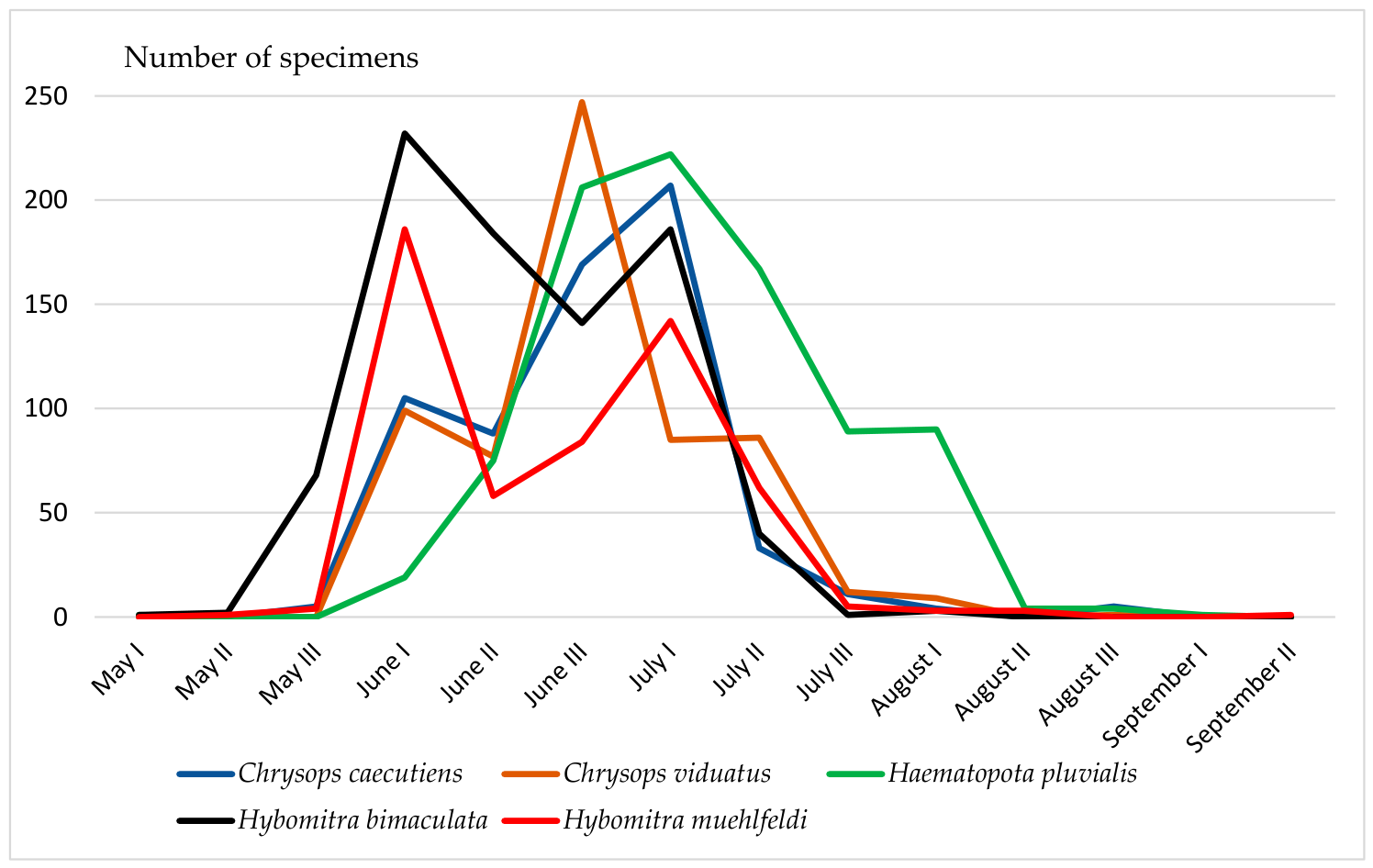
During the entire summer period, five species have the highest absolute number in the collections: Chrysops caecutiens, Chrysops viduatus, Haematopota pluvialis, Hybomitra bimaculata, Hybomitra muehlfeldi. The relative abundance of Chrysops caecutiens in the taiga zone varies from 1 to 13% [27]. According to the literature, this species is an early summer species [13]. In the northern taiga zone, the total duration of summer decreases and active flight shifts to mid-July [27]. In the center of the Russian Plain, this species accounts for 10.9% of collections (Figure 1). It flies from the third ten-day period of May to the end of August. There are two peaks of increasing relative abundance—in the first ten days of June and the first ten days of July—and this species becomes a codominant. In the first case, this is due to an increase in the abundance of this species, and in the second case, it is due to a significant decrease in the activity of other species.
In the taiga zone, the abundance of Chrysops viduatus is no more than 1%. Flight activity varies significantly from year to year [13,27]. In our collections in the broad-leaved forest zone and the forest–steppe zone, this species accounts for 10.7% (Figure 1). The flight period coincides with the previous species, but active flight ends a little later, by mid-July. This species becomes dominant in the third ten-day period of June.
Haematopota pluvialis is one of the most abundant species. Activity varies significantly depending on weather conditions, increasing mainly in cloudy weather. During the mass flight period in the taiga zone, its relative abundance reaches up to 40%. To the north, the abundance decreases to 10%. It flies from late June to mid-August. In the middle and southern taiga, it can be found in early September during warm years. The peak number in the taiga zone occurs at the end of July [27]. In our collections from broad-leaved forests and forest-steppe, its share is 15.3% (Figure 1). This species is dominant or codominant from late July to early August. Unlike the taiga zone, the flight in broad-leaved forests is more extended. The first individuals fly out in early May, and the flight season ends in early September. Intensive flight occurs from late June to mid-July.
In the taiga zone, the relative abundance of Hybomitra bimaculata can reach 20–40%. It is usually about 10% [13,27]. In the zone of broad-leaved forests and forest–steppe, it flies from early May to early August. Mass flight of this species is observed from the last ten-day period of May to mid-July (Figure 1). Until mid-June, it is the dominant species in the community of horseflies. A similar pattern is observed in the southern taiga [13], while in more northern regions, mass flight shifts to a later date in late July/August [27].
The abundance of Hybomitra muehlfeldi varies from 2 to 5%. It flies from mid-June to the end of July [13,27]. In the broad-leaved forest and forest-steppe zones, the average abundance is 9.5%. This species has the longest flight duration compared to other species, flying from mid-May to mid-September, but the most intense flight activity occurs in June, with some years maintaining high activity until the first ten days of July. The maximum relative abundance was observed in early June (23%) (Figure 1), when it was slightly less numerous than Hybomitra bimaculata.

3. Methods

3.1. Study Area

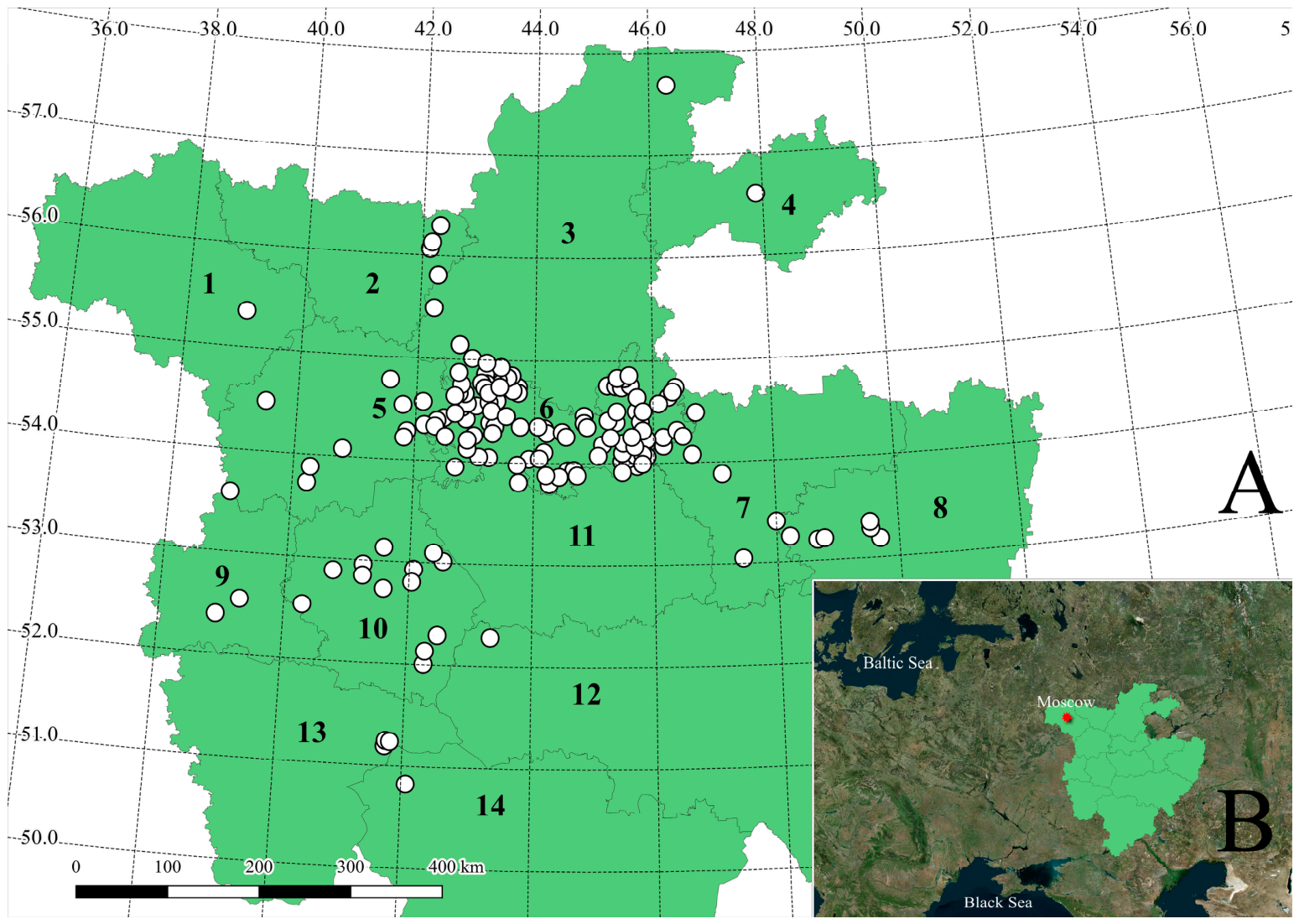
The study area covers 14 regions of European Russia (Moscow Region, Vladimir Region, Nizhny Novgorod Region, Republic of Mari El, Ryazan Region, Republic of Mordovia, Ulyanovsk Region, Samara Region, Lipetsk Region, Tambov Region, Penza Region, Saratov Region, Voronezh Region, and Volgograd Region). The total area of the study area was more than 400,000 km2 (Figure 2).
Most of the samples were collected within two plains that are part of the Russian Plain: the Volga Upland and the Oka-Don Lowland. The terrain in these regions is predominantly flat and hilly. The altitude does not exceed 300 m (for example, in the Volga Upland). At the same time, the Oka-Don Lowland has more flat terrain and relatively lower elevations. The climate in these areas is temperate continental. At the same time, the climate becomes more continental in the eastern and southern directions. During the summer months, subtropical air from the south also has an impact and leads to droughts. The two largest rivers with their numerous tributaries, the Volga and the Don, flow through the studied area. These areas are characterized by high population density, urbanization, and numerous agricultural landscapes. The research was conducted mainly within the forest, forest–steppe, and steppe zones [42].

3.2. Data Collection

The data for the dataset was collected in 2001, 2007–2009, and 2012–2025. Methods adhered to conventional practices, employing sweepnets, beer traps, pan traps, and malaise traps [43]. We used all the methods of collecting Tabanidae during the most active flight season in European Russia (from May to September). During the collection of flying specimens, dates and coordinates were recorded in various ways. This information was added to the dataset [20]. The seasonal activity of the species was studied mainly via the example of five species with significant numbers of specimens in the dataset. We also calculated the Margalef index, Berger–Parker index, Shannon index, and Simpson index to understand the species diversity, dominance, and evenness as fauna [44,45]. Statistical processing was performed using standard Microsoft Excel software packages.

3.3. Taxonomic Analysis

All the samples that we caught using different types of traps were washed and placed in 90% alcohol. The only exceptions were samples caught by sweepnets. These samples were mounted on entomological needles. All samples were identified in the laboratory. Sample identification was conducted in laboratory conditions using a MBS-10 stereomicroscope and a Mikromed 1 microscope (var. 1–20) (Russia). Species identification was determined by external morphological features using taxonomic keys by Chvála et al. [35] and Olsufjev [28]. If necessary, genitalia were dissected, clarified in alkali solution and enclosed in euparal to confirm the determination. The species identity of some of the samples was further verified by comparing them with the materials of the comparative collection stored in the collection fund of the Department of Zoology and Parasitology at Voronezh State University. Only 5740 specimens were processed [20]. Some samples could not be identified before the species and they were not counted in the database. In total, samples were obtained from 159 localities. The names of species new to the regions are marked with an asterisk “*”.
Most of the studied material is stored in the collection fund of the Department of Zoology and Parasitology at Voronezh State University; some of the material was transferred to the collection fund of the Mordovia State Nature Reserve.

4. Conclusions

The formed dataset systematizes long-term information on the species composition, distribution, and seasonal occurrence of Tabanidae in European Russia and supplements the faunal lists of individual territories. New finds were obtained for the Republic of Mordovia, Ryazan, Ulyanovsk and Penza regions. Records of rare forest and marsh species, including taxa with a predominantly boreal distribution, expand information about their presence in the central part of the study area and on the periphery of the ranges of individual species. The predominance of widespread species in materials allows us to trace the timing and seasonal dynamics of Tabanidae activity in the temperate zone, while isolated finds of rare and ecologically specialized taxa emphasize the value of long-term collections and unification of materials from different years and regions. The standardized representation of records ensures that the dataset is used to update faunal lists and map finds, analyze the spatial and seasonal distribution of species, clarify range boundaries, and model potential distribution. The availability of data on collection dates, numbers, localities, and geographical coordinates makes it possible to compare records between territories and combine them with other open sources of biodiversity data. The materials can be used in planning further faunal research, selecting areas and timing of field work, as well as to identify areas where information remains incomplete. The dataset structure allows for the inclusion of new finds and the expansion of its geographical and temporal coverage. Such replenishment will make it possible to accumulate comparable information on the composition of regional fauna, the distribution of individual species and the timing of their seasonal activity.

Author Contributions

Conceptualization, A.B.R.; methodology, A.B.R., I.A.B. and S.V.P.; software, M.N.E.; validation, A.B.R. and M.N.E.; formal analysis, A.B.R. and M.N.E.; investigation, A.B.R., M.N.E., E.A.L. and S.V.L.; resources, A.B.R., M.N.E. and I.G.E.; data curation, A.B.R. and M.N.E.; writing—original draft preparation, A.B.R., I.A.B. and S.V.P.; writing—review and editing, A.B.R., I.A.B. and S.V.P.; visualization, A.B.R.; supervision, A.B.R.; project administration, A.B.R.; funding acquisition, A.B.R. and M.N.E. All authors have read and agreed to the published version of the manuscript.

Funding

This research was funded by the Russian Science Foundation, grant number 22-14-00026-Π.

Institutional Review Board Statement

Not applicable.

Informed Consent Statement

Not applicable.

Data Availability Statement

The original contributions presented in this study are included in the article. Further inquiries can be directed to the corresponding author(s).

Acknowledgments

The authors thank K.P. Tomkovich and G.B. Semishin for assistance with specimen collection.

Conflicts of Interest

The authors declare no conflicts of interest.

References

  1. Courtney, G.W.; Pape, T.; Skevington, J.H.; Sinclair, B.J. Biodiversity of Diptera. In Insect Biodiversity: Science and Society; John Wiley & Sons: Hoboken, NJ, USA, 2017; Volume I, pp. 229–278. [Google Scholar]
  2. Afonina, E.Y.; Tashlykova, N.A. Diversity of aquatic organisms in the lowland watercourses: A case study in transboundary rivers, Transbaikalia, Russia. Nat. Conserv. Res. 2025, 10, 1–19. [Google Scholar] [CrossRef] [Scilit]
  3. Vdovina, O.N.; Tropina, E.F.; Makarycheva, A.Y.; Yerunova, M.G. Patterns of macroinvertebrate distribution in watercourses of the Krasnoyarsk Stolby National Park (East Siberia). Nat. Conserv. Res. 2025, 10, 50–65. [Google Scholar] [CrossRef] [Scilit]
  4. Boyle, M.J.W.; Bonebrake, T.C.; da Silva, K.D.; Dongmo, M.A.K.; França, F.M.; Gregory, N.; Kitching, R.L.; Ledger, M.J.; Lewis, O.T.; Sharp, A.C.; et al. Causes and consequences of insect decline in tropical forests. Nat. Rev. Biodivers. 2025, 1, 315–331. [Google Scholar] [CrossRef] [Scilit]
  5. Malyavina, M.S.; Smirnov, D.G. Structure of ectoparasite communities of Nyctalus species (Chiroptera: Vespertilionidae) in the Zhiguli State Nature Reserve and Samarskaya Luka National Park (European Russia). Nat. Conserv. Res. 2024, 9, 1–23. [Google Scholar] [CrossRef] [Scilit]
  6. Esin, M.N.; Ruchin, A.B.; Gavryushin, D.I.; Xi, Y.Q.; Dvořák, L.; Dvořáková, K. Diptera species, new for the Republic of Mordovia, Russia. Nat. Conserv. Res. 2023, 8, 98–105. [Google Scholar] [CrossRef] [Scilit]
  7. Oliveira, L.R.D.; Frazão, L.A.; Silva, S.C.O.; Araújo, W.S.; Nunes, Y.R.F.; Fernandes, V.M.; Veloso, M.D.M. Nutrient cycling and soil quality in threatened veredas in two Protected Areas of the Brazilian cerrado. Nat. Conserv. Res. 2024, 9, 34–46. [Google Scholar] [CrossRef] [Scilit]
  8. Chowdary, L.R.; Harish, G.N.; Karedla, A.K.; Chandrashekara, K.M. Flies of Medical, Veterinary, and Forensic Importance. In Flies; CRC Press: Boca Raton, FL, USA, 2025; pp. 163–302. [Google Scholar]
  9. Ruchin, A.B.; Egorov, L.V. Results of long-term research of threatened insect species in selected regions of European Russia. Nat. Conserv. Res. 2025, 10, 66–91. [Google Scholar] [CrossRef] [Scilit]
  10. Krolow, T.K.; González, C.R.; Martínez, M.; Menchaca, A.; Saravia, A.; Mihok, S.; Parodi, P.; Krüger, R.F. An Overview of the Tabanidae (Diptera) of Uruguay. Taxonomy 2026, 6, 36. [Google Scholar] [CrossRef] [Scilit]
  11. Al-Talafha, H.A.; Amr, Z. Tabanidae Fauna (Order: Diptera) of the Arab Countries in the Middle East. Ecol. Montenegrina 2024, 71, 53–85. [Google Scholar] [CrossRef] [Scilit]
  12. Pestov, S.V.; Panjukova, E.V. Landscape and zonal distribution of bloodsucking mosquitoes and horseflies (Diptera: Culicidae, Tabanidae) in the Northeastern Russian Plain. Èntomol. Rev. 2013, 93, 1129–1137. [Google Scholar] [CrossRef] [Scilit]
  13. Agasoi, V.V.; Prokofiev, V.V.; Medvedev, S.G. Seasonal dynamics of activity of horseflies (Diptera, Tabanidae) in Pskov Province. Parazitologiya 2020, 54, 267–284. [Google Scholar] [CrossRef] [Scilit]
  14. Nevill, E.M.; Stuckenberg, B.R.; Phelps, R.J. Vectors: Tabanidae. In Infectious Diseases of Livestock; Oxford University Press Southern Africa: Kaapstad, South Africa, 2004; pp. 87–92. [Google Scholar]
  15. Baldacchino, F.; Desquesnes, M.; Mihok, S.; Foil, L.D.; Duvallet, G.; Jittapalapong, S. Tabanids: Neglected subjects of research, but important vectors of disease agents! Infect. Genet. Evol. 2014, 28, 596–615. [Google Scholar] [CrossRef] [Scilit] [PubMed]
  16. Johnson, S.D. Long-proboscid horseflies (Philoliche: Tabanidae) as pollinators of co-adapted plants in Africa and Asia. J. Appl. Èntomol. 2025, 149, 466–477. [Google Scholar] [CrossRef] [Scilit]
  17. Krolow, T.K.; Carmo, D.D.D.D.; Oliveira, L.P.; Henriques, A.L. The Tabanidae (Diptera) in Brazil: Historical aspects, diversity and distribution. Zoologia 2024, 41, e23074. [Google Scholar] [CrossRef] [Scilit]
  18. Evenhuis, N.L.; Pape, T. (Eds.) Systema Dipterorum (Version 3.1, May 2021). In Species 2000 & ITIS Catalogue of Life; Naturalis: Leiden, The Netherlands, 2026. [Google Scholar]
  19. Nartshuk, E.P. Key to families of Diptera (Insecta) of the fauna of Russian and adjacent countries. In Proceedings of the Zoological Institute, Saint Petersburg, Russia, 18–20 August 2003; Volume 294, pp. 1–252. [Google Scholar]
  20. Budaeva, I.; Pestov, S.; Ruchin, A.; Lukiyanov, S.; Lobachev, E.; Esin, M.; Esina, I. Biodiversity of Horseflies (Tabanidae, Diptera) in Some Regions of European Russia; Joint Directorate of the Mordovia State Nature Reserve and National Park “Smolny”: Saransk, Russia, 2026. [Google Scholar] [CrossRef]
  21. Farkas, S.; Berta, B. First data on horseflies (Tabanidae) feeding on red deer (Cervus elaphus) in Hungary. Nat. Somogyiensis 2024, 44, 67–72. [Google Scholar] [CrossRef] [Scilit]
  22. Krčmar, S.; Pezzi, M. Diversity of horseflies (Diptera: Tabanidae) of highly protected nature areas in Croatia: An overview. J. Insect Biodivers. 2024, 46, 32–60. [Google Scholar] [CrossRef] [Scilit]
  23. Farkas, S.; Otártics, M. New distribution records for the Hungarian Tabanidae (Diptera) fauna of South-Transdanubia. Nat. Somogyiensis 2022, 39, 139–144. [Google Scholar] [CrossRef] [Scilit]
  24. Krčmar, S.; Kovačić, M. Diversity of horsefly fauna (Diptera: Tabanidae) of Bansko Hill. Nat. Croat. Period. Musei Hist. Nat. Croat. 2023, 32, 523–534. [Google Scholar] [CrossRef] [Scilit]
  25. Prisniy, Y.A. Fauna of Horseflies (Diptera, Tabanidae) of the South of the Middle Russian Forest-Steppe and Adjoining Steppe Territories. Entomol. Rev. 2020, 100, 83–90. [Google Scholar] [CrossRef] [Scilit]
  26. Zeghouma, D.; Bouslama, Z.; Duvallet, G.; Amr, Z.S. Horse flies and their seasonal abundance in El Tarf Province of northeastern Algeria. J. Vector Ecol. 2018, 43, 305–311. [Google Scholar] [CrossRef] [Scilit] [PubMed]
  27. Pestov, S.V.; Dolgin, M.M. Horse-flies (Diptera, Tabanidae). In Fauna of European North-East of Russia; Nauka: Saint Petersburg, Russia, 2013; Volume XI, 190p, Part 1. [Google Scholar]
  28. Olsufjev, N.G. Horse flies. In Family Tabanidae (Fauna of the USSR. New Series, No. 113. Diptera); Nauka: Leningrad, Russia, 1977; Volume VII, 436p, Issue 2. [Google Scholar]
  29. Bergersen, R.; Straumfors, P.; Nilssen, A.C. The distribution of horse flies (Diptera: Tabanidae) in North Norway. Nor. J. Entomol. 2004, 51, 3–26. [Google Scholar]
  30. McElligott, P.E.K.; Lewis, D.J. Distribution and abundance of immature Tabanidae (Diptera) in a subarctic Labrador peatland. Can. J. Zool. 1996, 74, 1364–1369. [Google Scholar] [CrossRef] [Scilit]
  31. Watanabe, M.; Kuranishi, R.B. Deer fly and horse flies (Diptera: Tabanidae) collected from the Kamchatka Peninsula in 1996–1997. Nat. Hist. Res. 2000, 7, 223–224. [Google Scholar]
  32. Leclercq, M. Présence de Haematopota scutellata O.M.C. en Belgique (Diptera, Tabanidae). Bull. Ann. Soc. R. Belge Entomol. 1984, 120, 50–55. [Google Scholar]
  33. Bäse, K. Neufund von Haematopota scutellata (Olsufjev, Moucha & Chvála, 1964) und Wiederfund von Hybomitra lurida (Fallén, 1817) in Sachsen-Anhalt (Diptera: Tabanidae). Entomol. Mitt. Sachs.-Anh. 2011, 19, 51–52. [Google Scholar]
  34. Zeegers, T.; Batlle, R.M.; Almeida, J.M. Dos nuevas especies de tabánidos (Diptera: Tabanidae) para la Península Ibérica. Bol. Soc. Entomol. Arag. 2012, 51, 149–152. [Google Scholar]
  35. Chvála, M.; Lyneborg, L.; Moucha, J. The Horse Flies of Europe (Diptera, Tabanidae); Entomological Society of Copenhagen: Copenhagen, Denmark, 1972; 499p. [Google Scholar]
  36. Krčmar, S. Distribution of the species Heptatoma pellucens (Fabricius, 1776) (Diptera: Tabanidae) in Croatia. Entomol. Croat. 2023, 22, 28–36. [Google Scholar]
  37. Lutta, A.S. On the distribution and biology of Heptatoma pellucens pellucens (Tabanidae) in Karelia. Parazitologiya 1976, 10, 53–55. [Google Scholar]
  38. Dvořák, L.; Petrašiūnas, A. Hybomitra arpadi (Szilády, 1923) (Diptera: Tabanidae) has not been confirmed in Lithuania. New Rare Lith. Insect Spec. Rec. Descr. 2010, 22, 130–132. [Google Scholar]
  39. Lutta, A.S.; Kh, B. Morphology of Larvae and Pupae of Hybomitra arpadi (Diptera, Tabanidae). Parasitologiya 1981, 15, 374–378. [Google Scholar]
  40. Herczeg, T.; Száz, D.; Blahó, M.; Barta, A.; Gyurkovszky, M.; Farkas, R.; Horváth, G. The effect of weather variables on the flight activity of horseflies (Diptera: Tabanidae) in the continental climate of Hungary. Parasitol. Res. 2015, 114, 1087–1097. [Google Scholar] [CrossRef] [Scilit] [PubMed]
  41. Mikuška, A.; Krčmar, S.; Radović, A.; Mikuška, T. The influence of temperature, precipitation and floods on the development of horse fly populations (Tabanidae) in the alluvial habitats of the Danube River in Croatia. Pol. J. Ecol. 2012, 60, 395–406. [Google Scholar]
  42. Sidorchuk, A.; Borisova, O.; Panin, A. Fluvial response to the Late Valdai/Holocene environmental change on the East European Plain. Glob. Planet. Change 2001, 28, 303–318. [Google Scholar] [CrossRef] [Scilit]
  43. Golub, V.B.; Tsurikov, M.N.; Prokin, A.A. Insect Collections: Collection, Processing and Storage of Material; KMK Scientific Press Ltd.: Moscow, Russia, 2012; 339p. [Google Scholar]
  44. Shannon, C.E. A mathematical theory of communication. Bell Syst. Tech. J. 1948, 27, 379–423, 623–659. [Google Scholar] [CrossRef] [Scilit]
  45. Magurran, A.E. Ecological Diversity and Its Measurement; Chapman & Hall: London, UK, 1996; 179p. [Google Scholar]
Figure 1. Seasonal dynamics of the most common Tabanidae species in the temperate zone of European Russia (according to data from the dataset).
Data 11 00210 g001
Figure 2. Geographic distribution of horsefly (Diptera: Tabanidae) sampling sites in the European part of Russia. (A) White circles represent collection localities used in this study. Administrative regions are numbered as follows: (1) Moscow Region, (2) Vladimir Region, (3) Nizhny Novgorod Region, (4) Republic of Mari El, (5) Ryazan Region, (6) Republic of Mordovia, (7) Ulyanovsk Region, (8) Samara Region, (9) Lipetsk Region, (10) Tambov Region, (11) Penza Region, (12) Saratov Region, (13) Voronezh Region, and (14) Volgograd Region. (B) Geographic location of the study area in Eastern Europe.
Data 11 00210 g002
Table 1. Description of the data in the dataset.
Column LabelColumn Description
occurrenceIDAn identifier for the occurrence (as opposed to a particular digital record of the occurrence)
basisOfRecordThe specific nature of the data record: HumanObservation
eventDateThe date when material from the trap was collected or the range of dates during which the trap collected material
scientificNamThe full scientific name including the genus name and the lowest level of taxonomic rank with the authority
kingdomThe full scientific name of the kingdom in which the taxon is classified
decimalLatitude The geographic latitude of location in decimal degrees
decimalLongitudeThe geographic longitude (in decimal degrees, using the spatial reference system given in dwc:geodeticDatum)
countryThe name of the country in which the location occurs
countryCodeThe standard code for the country in which the location occurs.
individualCountThe number of individuals represented present at the time of the occurrence
yearThe integer year in which the event occurred
monthThe ordinal month in which the event occurred
dayThe integer day of the month on which the event occurred
recordedByA person, group, or organization responsible for recording the original occurrence
identifiedByA list of names of people who assigned the taxon to the subject
georeferenceSourcesA list of maps, gazetteers, or other resources used to georeference the location
coordinateUncertaintyInMetersThe maximum uncertainty distance in meters
stateProvinceThe name of the next smaller administrative region than country (state, province, canton, department, region, etc.) in which the dcterms:Location occurs
Table 2. Species diversity and number of Tabanidae in different regions (from dataset).
SpeciesMRVlRNNRRMERRRMURSmRLRTRPRSrRVrRVgRTotal Number of SpecimensTotal Number of LocalitiesTotal Number of Regions
Atylotus fulvus (Meigen, 1804) 3 331
Atylotus plebeius (Fallén, 1817) 1 * 111
Atylotus rusticus (Linnaeus, 1767) 1052 107322
Chrysops caecutiens (Linnaeus, 1758) 3 624 627332
Chrysops concavus Loew, 1858 1 *12 *1 * 1453
Chrysops divaricatus Loew, 1858 3 39 42142
Chrysops nigripes Zetterstedt, 1838 1 111
Chrysops relictus Meigen, 1820 5 2662 2 * 275244
Chrysops sepulcralis Fabricius, 1794 1 * 111
Chrysops viduatus (Fabricius, 1794) 62612543 1 1 616347
Haematopota crassicornis Wahlberg, 1848 3 311
Haematopota italica Meigen, 1804 3 321
Haematopota pluvialis (Linnaeus, 1758) 11914 7412 1 1878526
Haematopota scutellata (Olsufiev, Moucha & Chvála, 1964) 4 * 421
Haematopota subcylindrica Pandellé, 1883 50 * 1 51122
Heptatoma pellucens (Fabricius, 1777) 6 661
Hybomitra arpadi (Szilády, 1923) 1 12 * 1372
Hybomitra bimaculata (Macquart, 1826)1733 2809 1 4 1 858508
Hybomitra borealis (Fabricius, 1779) 1 111
Hybomitra distinguenda (Verrall, 1909) 69 69181
Hybomitra kaurii Chvála & Lyneborg, 1970 1 111
Hybomitra lundbecki Lyneborg, 1959 80 80101
Hybomitra lurida (Fallén, 1817) 3 311
Hybomitra muehlfeldi (Brauer, 1880) 48 1534 1 1 549356
Hybomitra nigricornis (Zetterstedt, 1842) 13 1361
Hybomitra nitidifrons (Szilády, 1914) 43 131 138233
Hybomitra solstitialis (Meigen, 1820) 1 1224 1 227264
Silvius alpinus (Scopoli, 1763) 23 23101
Tabanus autumnalis Linnaeus, 1761 11 222
Tabanus bovinus Linnaeus, 1758 1 522124 5 238406
Tabanus bromius Linnaeus, 1758 1 1183 1 3 189395
Tabanus glaucopis Meigen, 1820 2 901 3 96164
Tabanus maculicornis Zetterstedt, 1842 2082 1 211213
Tabanus miki Brauer, 1880 7 1 852
Tabanus sudeticus Zeller, 1842 2 935827182 * 389568
Total of specimens1212681245368141332041101574015914
Total of species11281103384362161
Note: MR—Moscow Region; VlR—Vladimir Region, NNR—Nizhny Novgorod Region, RME—Republic of Mari El, RR—Ryazan Region, RM—Republic of Mordovia, UR—Ulyanovsk region, SmR—Samara Region, LR—Lipetsk Region, TR—Tambov Region, PR—Penza Region, SrR—Saratov Region, VrR—Voronezh Region, VgR—Volgograd Region. *—first records are indicated for the regions.
Table 3. Seasonal dynamics of species diversity, dominance, and evenness indices of fauna.
IndexMayJuneJulyAugustSeptember
IIIIIIIIIIIIIIIIIIIIIIIIIII
Taxa_S331320222424222119121024
Individuals84215581065011081402759321410482025
Simpson_1-D0.410.130.700.830.860.860.900.890.870.850.860.860.500.72
Shannon_H0.740.301.612.072.302.302.522.452.382.162.162.110.691.33
Margalef0.960.542.382.843.243.283.173.173.472.992.843.001.441.86
Berger–Parker0.750.930.440.290.280.220.160.220.280.220.250.250.500.40
Disclaimer/Publisher’s Note: The statements, opinions and data contained in all publications are solely those of the individual author(s) and contributor(s) and not of MDPI and/or the editor(s). MDPI and/or the editor(s) disclaim responsibility for any injury to people or property resulting from any ideas, methods, instructions or products referred to in the content.