
Data Descriptor

CongoNames Corpus: A Large-Scale Labeled Dataset of Congolese Personal Names

by
Tshabu Ngandu Bernard
1,
Cansa Kayembe Amaury
1 and
Mpyana Mwamba Merlec
2,3,*
1
Faculty of Computer Science, Université Nouveaux Horizons, Lubumbashi 2465, Democratic Republic of the Congo
2
Department of Computer Science and Engineering, Korea University, Seoul 02841, Republic of Korea
3
BK21 FOUR Research & Education Center for Computer Science and Engineering, Korea University, Seoul 02841, Republic of Korea
*
Author to whom correspondence should be addressed.
Data 2026, 11(7), 169; https://doi.org/10.3390/data11070169
Submission received: 30 April 2026 / Revised: 27 June 2026 / Accepted: 1 July 2026 / Published: 8 July 2026
(This article belongs to the Special Issue Natural Language Processing in the Era of Big Data)

Abstract

Personal names carry cultural and linguistic identity, yet most African countries lack large-scale, structured name datasets suitable for natural language processing (NLP) research and computational social science. We present CongoNames, the first large-scale corpus of personal names from the Democratic Republic of the Congo (DRC), derived from publicly released national secondary-school examination palmarès (result lists) 8,053,983 published annually by the DRC Ministry of Education. The corpus comprises name records spanning 16 examination years (2008–2023) across 12 provinces and 304 sub-provincial regions, each enriched with a reported sex marker (M/F) and regional provenance metadata. We describe a fully deterministic, layered processing pipeline (bronze–silver–gold architecture) that converts raw protable document format (PDF) documents into structured comma-separated values (CSV) datasets without manual annotation or machine-learning-based inference. The dataset is validated against school-level census counts extracted from the same source PDFs, yielding extraction error rates below 2% for all years except 2023 (7.81%, flagged due to a layout change). Descriptive analyses document name length and token-count distributions, character-level n-gram profiles, provincial diversity indices, and inter-provincial name-inventory overlap, collectively establishing the dual linguistic origin—locally rooted Bantu components and Christian/French-origin components—that characterize modern Congolese naming practice. The dataset, processing code, and documentation are released openly to support research in African natural language processing (NLP), onomastics, and computational social science.
Dataset License: Creative Commons Attribution 4.0 International

1. Summary

Personal names are a fundamental carrier of cultural and linguistic identity, and large-scale name corpora support a wide range of applications, including named entity recognition (NER) [1], sociolinguistics, and language-technology personalization [2,3]. Despite the growing momentum of African NLP research [4,5,6], African countries remain substantially underrepresented in widely used name datasets and global language resources [7]. As Ngũgĩ wa Thiong’o observes, treating African names as errors are not merely a technical issue but a cultural one [8]—a perspective that motivates the construction of high-quality, auditable African name resources.
The Democratic Republic of the Congo (DRC) presents a particularly important case. It is one of the most linguistically diverse countries in the world, with hundreds of spoken languages [9]; its naming practices reflect this diversity by drawing simultaneously on indigenous languages (Lingala, Swahili, Kikongo, Tshiluba, and many others), French, and religious traditions. Despite this rich onomastic landscape, no large public corpus of Congolese personal names has previously been available.
To address this gap, we introduce the CongoNames Corpus, a large-scale dataset of Congolese personal names. The corpus is derived from the Examen d’État national secondary-school examination result lists (palmarès), publicly released by the DRC Ministry of Education by province and year. These records provide an authoritative, high-coverage view of names spanning 16 years, with sex-marker and regional-provenance metadata obtained directly from the administrative source without additional annotation. The released dataset does not contain explicit ethnicity labels; province and year should be interpreted as regional provenance, not as ethnic markers.
The main contributions of this paper are as follows:
  • We compile 8,053,983 personal-name records from the DRC, each linked to a reported sex marker (M/F) and regional provenance (province and year).
  • We present and release a fully reproducible, layered processing pipeline (bronze–silver–gold) that downloads palmarès PDFs, parses and normalizes the extracted text with deterministic rules, and exports structured CSV datasets.
  • We provide descriptive statistics and analyses—including distributions by region, year, and sex marker; character-level n-gram profiles; diversity indices and inter-provincial Jaccard similarity—illustrating regional naming variation and the dual linguistic origin of Congolese personal names.
  • We validate the extraction pipeline against school-level census counts embedded in the source PDFs, providing quantitative coverage estimates for each examination year.
The remainder of this paper is organized as follows: Section 2 describes the dataset content, structure, and statistical properties; Section 3 details the data collection, processing pipeline, and quality assurance procedures; and Section 4 provides usage guidance, applications, limitations, and ethical considerations.

2. Data Description

2.1. Dataset Overview and Structure

Table 1 provides a high-level summary of the corpus. The dataset comprises 8,053,983 total records drawn from 469 source PDF files spanning 16 examination years (2008–2023) and 304 distinct regions grouped into 12 provinces. The unit of observation is a candidate-level full personal-name record. Accordingly, the total of 8,053,983 refers to complete name strings associated with candidate records rather than individually counted first-name, middle-name, or surname tokens. The near-identical numbers of exact and normalized unique names (6,371,941 vs. 6,370,887) indicate that normalization merged only a small number of near-duplicate variants. This result suggests that the corpus reflects substantial genuine lexical diversity rather than variation introduced by inconsistent formatting or spelling. Exact uniqueness is computed over complete extracted name strings, whereas normalized uniqueness is computed after deterministic case and spacing normalization. No phonetic or language-specific variant merging is applied, for example, distinct spellings such as Ngoy, Ngoie, and Ngoyi remain separate names unless they are identical after the released normalization rules. Approximately 78.5% of records (6,324,763) follow a three-token naming structure (simple names), while the remaining 1,729,220 records (complex names) follow non-three-token structures, including two-token records and records with four or more tokens.

2.2. Released Files and Schema

The corpus is released as multiple CSV files stored under dataset/gold/. All name strings are normalized to lowercase. Table A1 documents the two primary candidate-level files. The names file is the core release artifact, providing one row per candidate with a unique identifier, the full name string, the reported sex marker, the examination year and region parsed from the source filename, the source filename, and a gold-layer line number for full provenance traceability. The names_featured file extends names with four computed fields: word count ( | N | ), character length ( ( N ) , including spaces), structural category (simple or complex, i.e.,  C ( N ) ), and an inferred province label derived via a deterministic region-to-province mapping. This file is the recommended starting point for most analytical use cases.
Listing 1 presents an illustrative JavaScript Object Notation (JSON) schema representation of a synthetic candidate record and its associated feature extraction and name decomposition. A synthetic candidate with the full name Ilunga Ngoy Jean would appear in names.csv as a single record, with name = Ilunga Ngoy Jean, sex = m, year = 2015, region = Katanga, together with the corresponding source filename and line number. In names_featured.csv, the same record would have words = 3, length = 16, category = simple, and province = katanga. In names_components.csv, the name would be decomposed into three token records—Ilunga, Ngoy, and Jean. For the exploratory decomposition used in this study, Ilunga Ngoy would be treated as a transliterated example of the probable locally rooted component G ( N ) , whereas Jean would represent the probable Christian/French-origin component S ( N ) . This example is purely illustrative and does not correspond to an actual candidate record.
Listing 1: Illustrative JSON representation of a synthetic candidate full name record.
1
{
2
  “name”:“Ilunga Ngoy Jean”,
3
  “sex”:“m”,
4
  “year”:2015,
5
  “region”:“katanga”,
6
  “features”:{“words”:3,“length”:16,
7
         “category”:“simple”,
8
         “province”:“Katanga”},
9
  “components”:[“Ilunga”,“Ngoy”,“Jean”],
10
  “decomposition”:{“probable_native”:“Ilunga Ngoy”,
11
            “probable_surname”:“Jean”}
12
}

2.3. Name Structure and Basic Statistics

Table 2 reports structural summary statistics for the full corpus. The mean character length per name is 20.19, with a median of 21 and a 95th-percentile value of 26, indicating a compact and consistent length distribution with little extreme variation. The mean token count is 2.86, and both the 90th and 95th percentiles equal 3, confirming that the three-token structure is strongly dominant. These figures provide practical guidance for downstream modeling, for example, when setting maximum sequence lengths for character-level or subword models.
To illustrate token-role regularities arising from the heuristic decomposition into a probable native-name component  G ( N ) (the first two tokens of a simple name) and a probable surname component  S ( N ) (the final token), Table 3 lists the ten most frequent first and last tokens. The most frequent first tokens of G ( N ) —Ilunga (75,206), Ngoy (58,229), and Kasongo (53,821)—are recognizably Bantu names associated with the Katanga and Kasai regions, reflecting the geographic weight of those provinces. In contrast, the most frequent final tokens of S ( N ) —Jean (117,477), Joseph (51,895), Marie (50,889), and Esther (49,688)—are overwhelmingly Christian or biblical in origin. This asymmetry is one of the clearest empirical signals in the corpus of the systematic co-occurrence of locally rooted and Christian-origin name elements that characterizes modern Congolese naming practice. These patterns should be interpreted cautiously: G ( N ) and S ( N ) are heuristic components and do not constitute ground-truth annotations.

2.4. Distribution by Province and Year

Table 4 reports total, unique, sex-disaggregated, and structural counts by province. The “Autre” (other/unclassified) category, Katanga, and Kinshasa account for the largest absolute record counts, reflecting population size and examination participation rates in those areas. Kinshasa is notable for the near-parity of male (570,529) and female (594,509) records—in contrast to other provinces where male records consistently exceed female records. Table 5 provides the same breakdown by examination year. Both total and unique name counts grow substantially across the 2008–2023 window, reflecting national expansion of secondary-school examination participation. The lower unique-to-total ratios visible in 2015, 2021, and 2022 should, therefore, be read as year-level uniqueness anomalies, not as a change in the counting unit. Totals still count candidate rows, while the unique column counts distinct normalized full-name strings within that year. These years correspond to especially large cohorts in the released tables, so repeated full-name strings, homonymy, broader coverage, and possible residual duplicate extraction have a larger visible effect on the uniqueness ratio. Their aggregate extraction errors remain small (0.07% in 2015, 0.05 % in 2021, and  1.76 % in 2022; Section 3.4.2), indicating that the candidate-row totals are broadly consistent with the school-level census checks, although uniqueness-based analyses should treat these three years with additional caution.
Table 3. Most frequent name tokens by position. (a) First tokens ( G ( N ) ). (b) Last tokens ( S ( N ) ).
(a)
TokenCount
Ilunga75,206
Ngoy58,229
Kasongo53,821
Ntumba37,248
Kambale35,852
Mbuyi35,662
Kavira34,841
Kasereka25,418
Kazadi25,305
Banza24,864
(b)
TokenCount
Jean117,477
Joseph51,895
Marie50,889
Esther49,688
Grace43,163
Pierre42,834
Dorcas41,919
David41,599
Moïse41,202
Ruth40,948

2.5. Character-Level Distributions

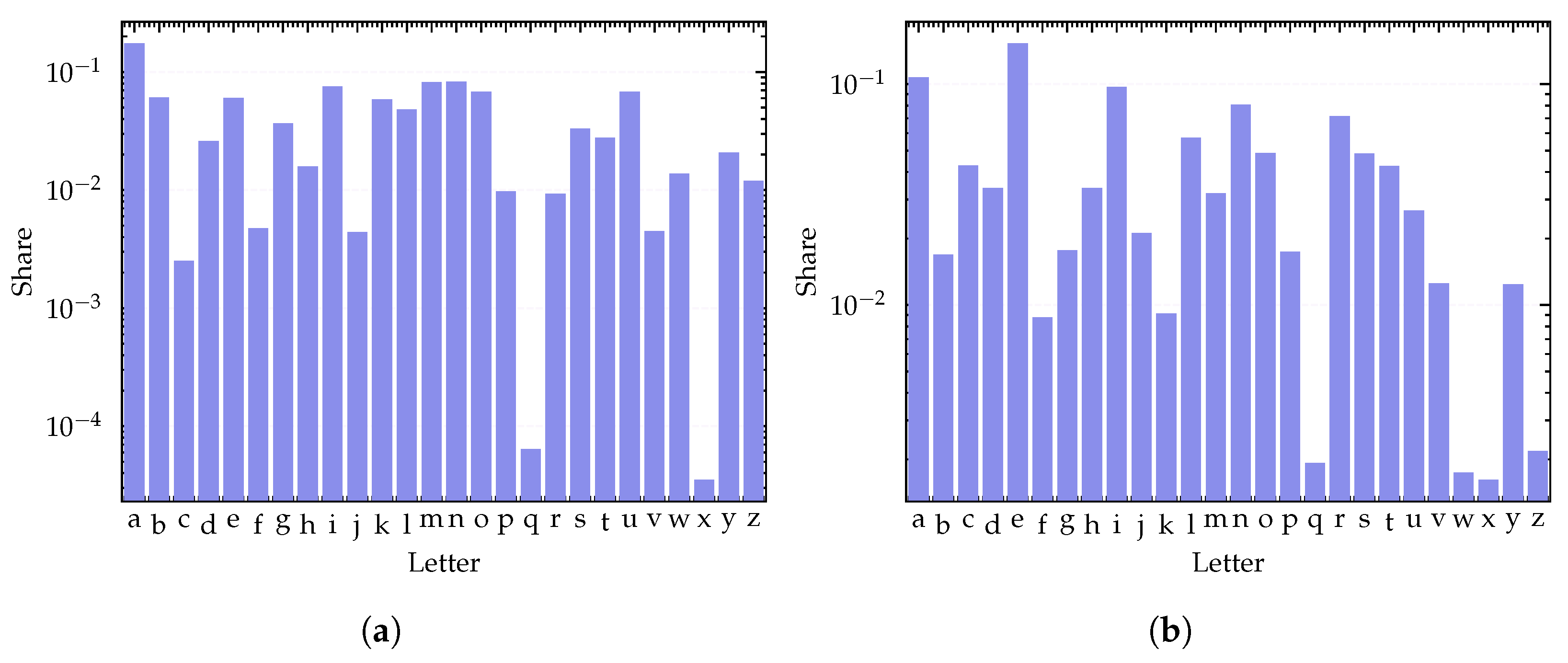
Figure 1 compares letter-frequency profiles computed over (a) the probable native-name component G ( N ) and (b) the probable surname component S ( N ) , restricted to simple names. The two panels reveal strikingly different distributional signatures. In  G ( N ) , frequencies are spread more evenly across the alphabet, with relatively high shares for consonant clusters characteristic of Bantu phonology (k, m, n, b). In  S ( N ) , the distribution is dominated by letters common in French and Latin-origin words (a, e, i, r, n), consistent with frequently occurring Christian names such as Jean, Marie, and Christine.
At a finer granularity, Table 6 and Table 7 report the most frequent character n-grams (bigrams, trigrams, and 4-grams) for G ( N ) and S ( N ) , respectively. For  G ( N ) , the leading bigrams—ng (0.0356), ka (0.0321), and mb (0.0310)—together with trigrams nga, mba, and amb and 4-grams amba, are hallmark sequences of Bantu phonology. For  S ( N ) , the leading n-grams (an, in, el; trigrams ine, ris, ean; 4-grams jean, rist, chri) are characteristic of French and Christian-origin names. The complementarity of these two tables provides quantitative, reproducible evidence for the dual-origin structure of Congolese personal names.

2.6. Name Length and Token Count Distributions

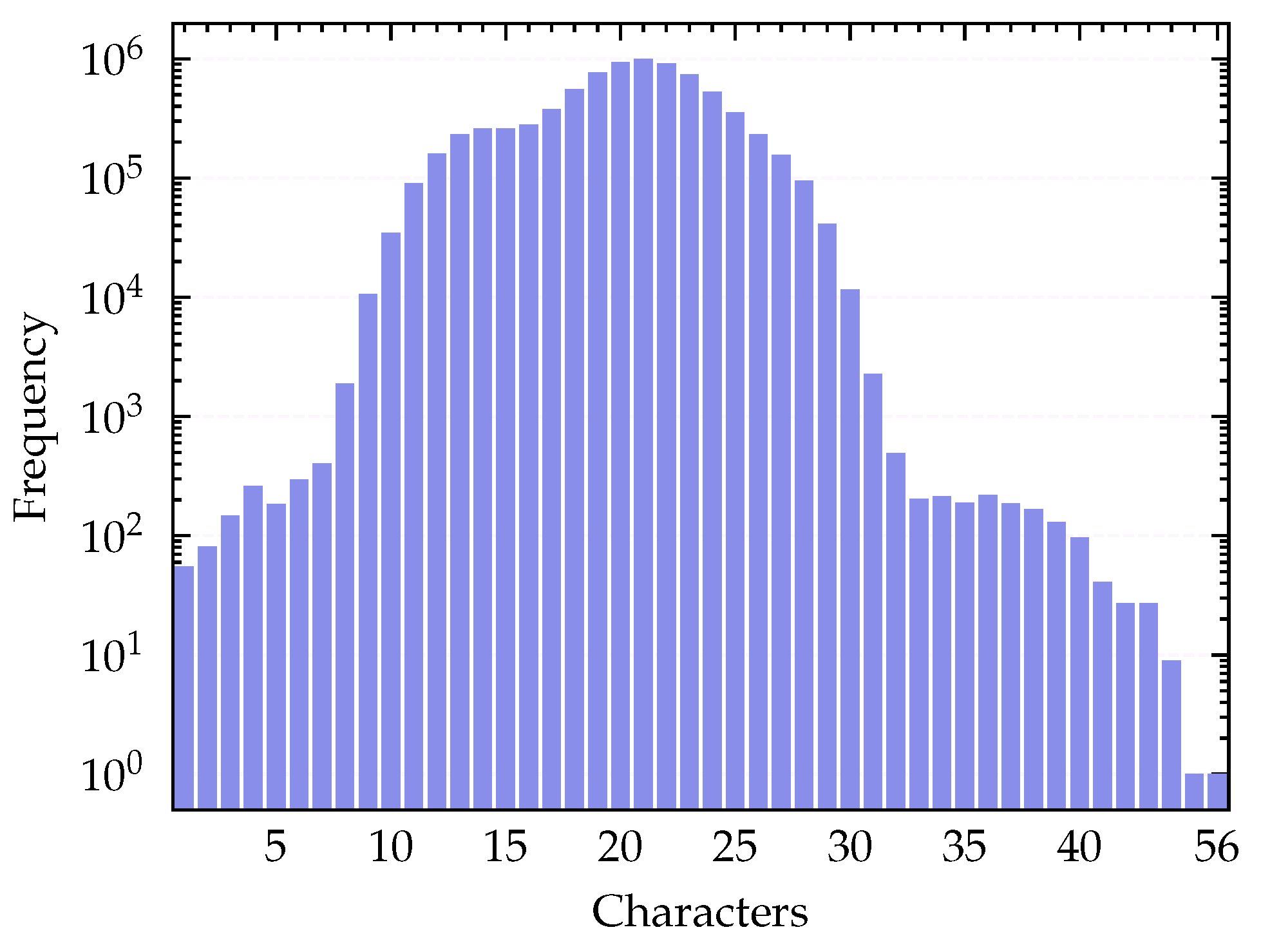
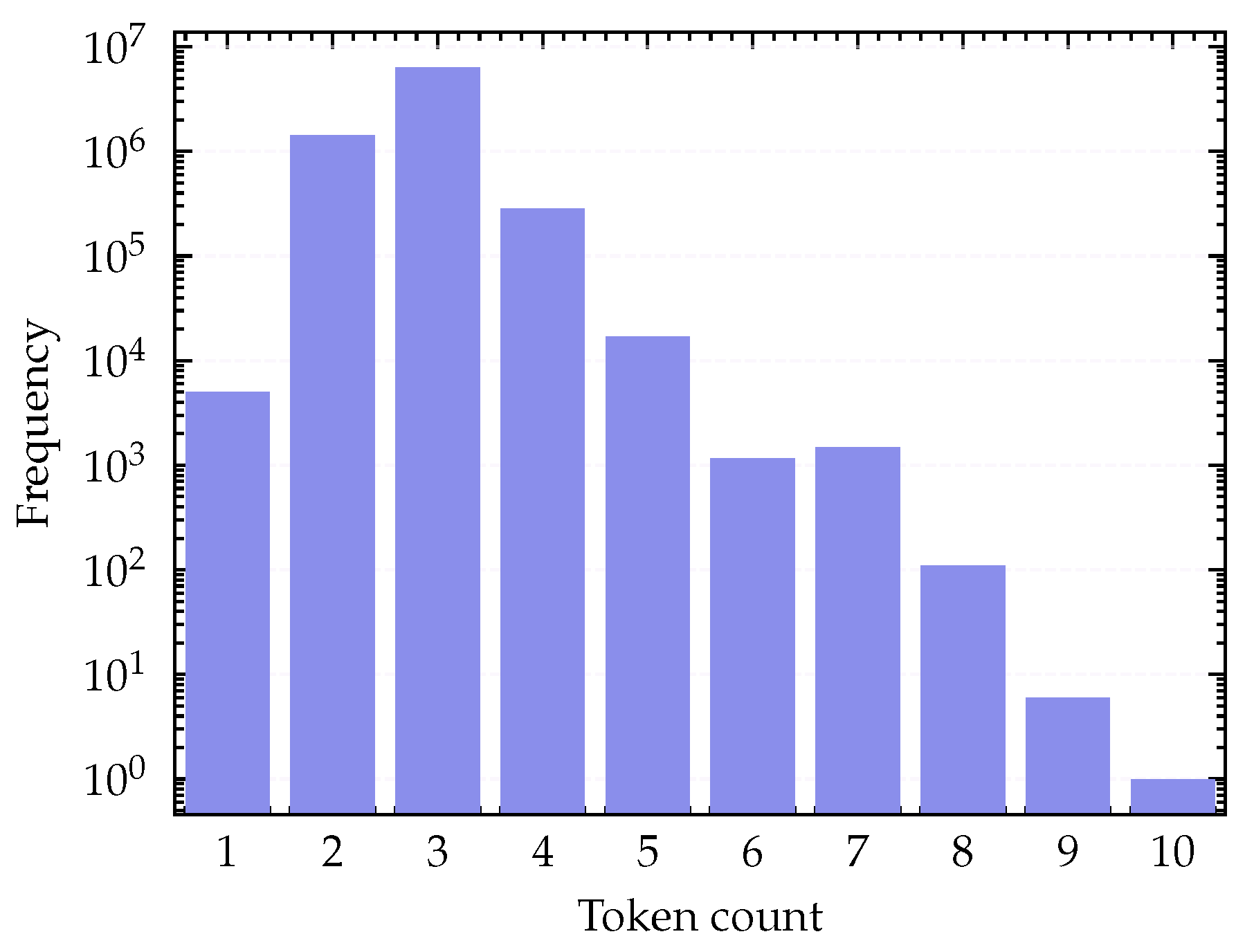
Figure 2 shows the character-length distribution ( N ) across all records on a log-frequency scale. The distribution is approximately unimodal and right-skewed, peaking in the 18–22 character range and tapering sharply below 10 and above 30. Figure 3 depicts the token-count distribution | N | on the same scale. The distribution is highly concentrated at | N | = 3 , with a secondary mode at | N | = 2 and a rapidly declining tail for | N | 4 . Together, these figures establish the expected input characteristics for downstream models processing CongoNames data.

2.7. Reported Sex Marker and Regional Composition

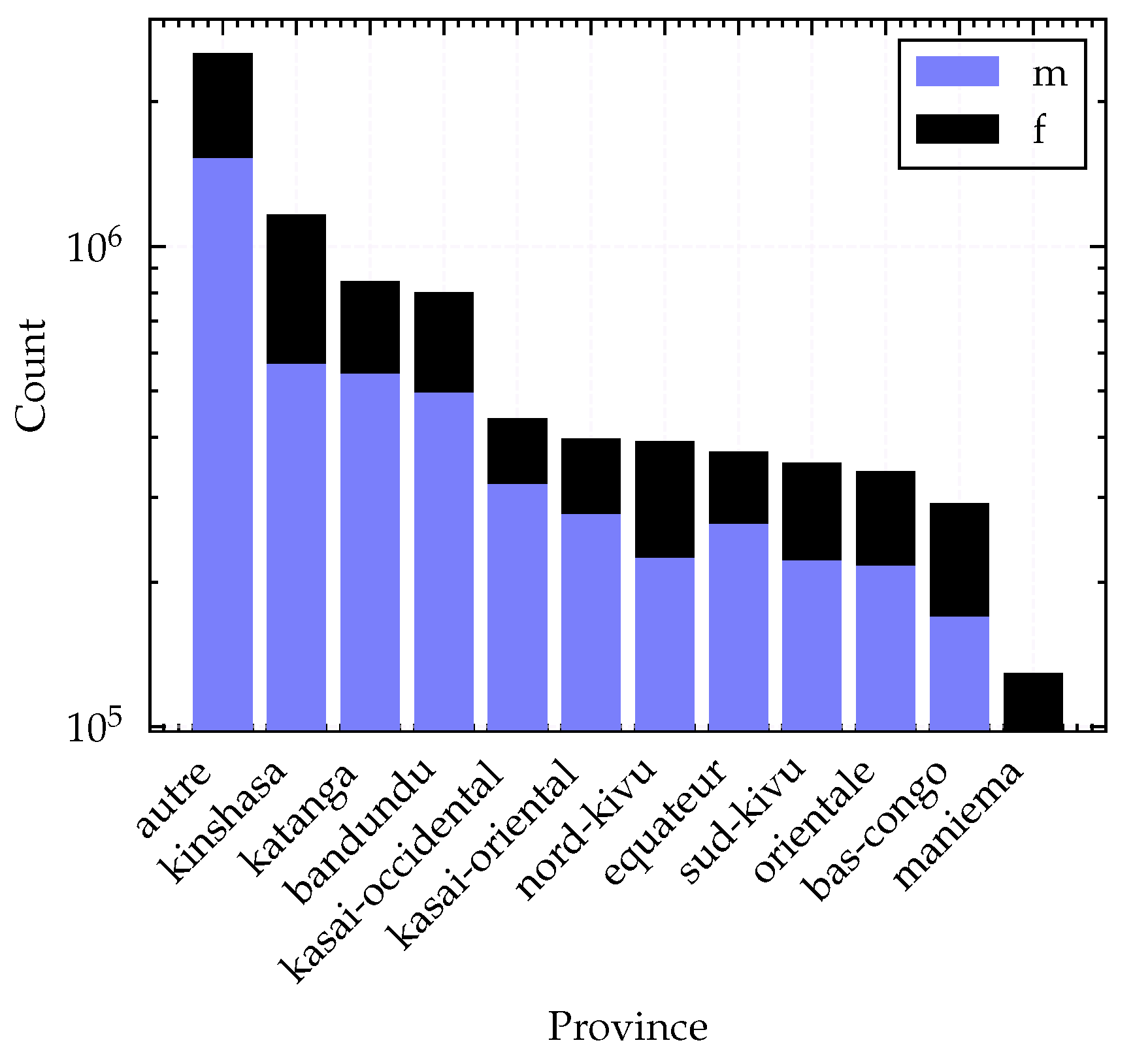
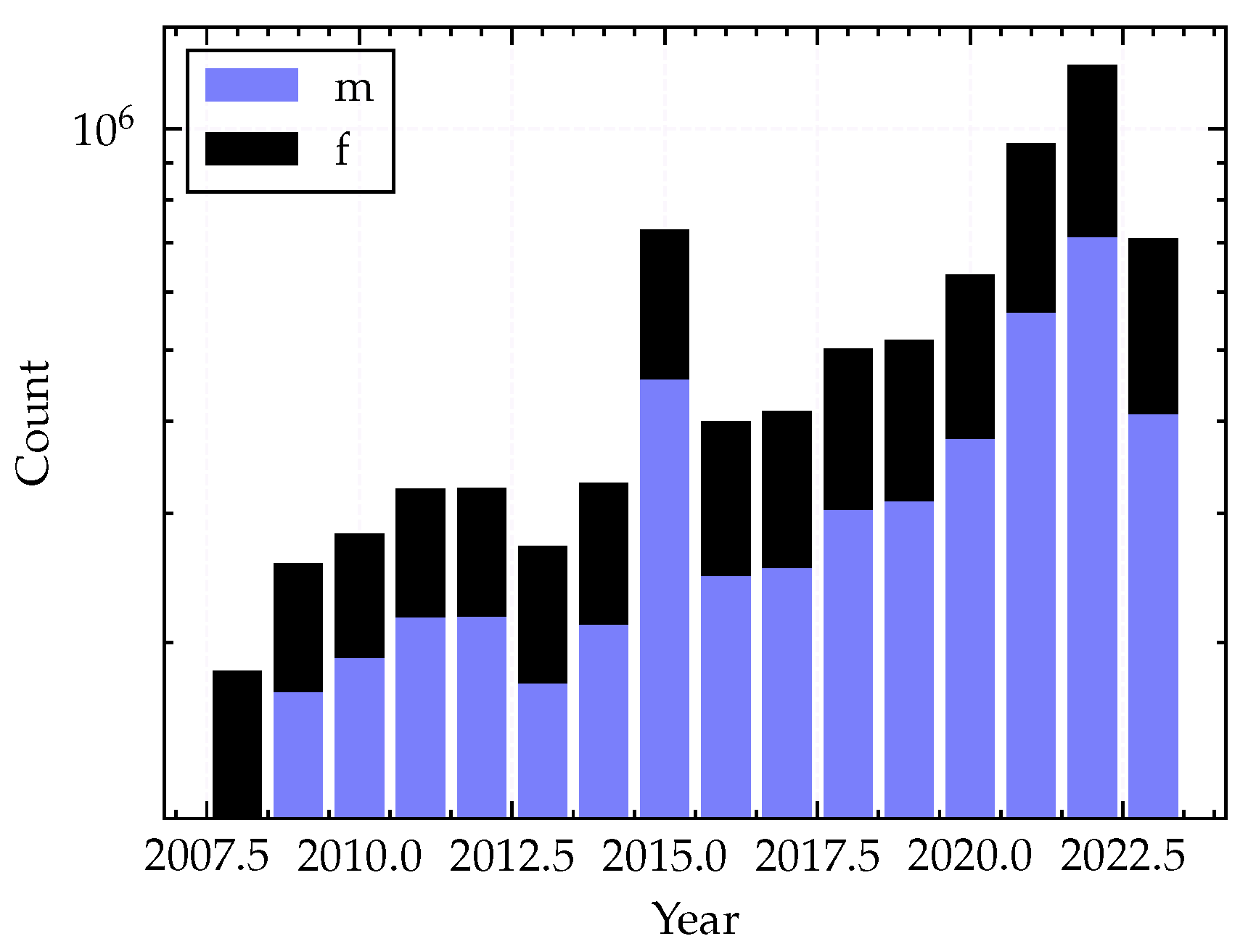
Figure 4 presents the distribution of reported sex markers (M/F) across the 12 provinces on a logarithmic count scale. Male candidates consistently outnumber female candidates in every province except Kinshasa, with the relative gap varying across regions. Figure 5 shows the same breakdown by examination year. Both counts grow substantially over 2008–2023, and the relative M/F gap narrows modestly in recent years, tentatively suggesting incremental progress in gender parity in secondary-school completion, though rigorous causal analysis is beyond the scope of this data descriptor.

2.8. Name Diversity Indices

We quantify name diversity within each group (year or province) using two standard measures. Let V be the set of distinct full names in a group and let p ( v ) denote the empirical frequency of name v V . The Shannon [10] entropy is
H = v V p ( v ) log p ( v ) ,
and the Simpson [11] (Gini–Simpson) diversity index is
D = 1 v V p ( v ) 2 .
We also report the effective number of names (Hill number of order 1 [12]),
N eff = exp ( H ) ,
interpretable as the number of equally frequent names that would yield the same entropy value.
Table 8 and Table 9 report these values by year and by province, respectively. The Simpson index values are uniformly close to 1.0, confirming that no single name dominates any provincial or annual inventory. Across years, both H and N eff increase monotonically (with minor exceptions), reflecting growing corpus coverage and/or increasing naming variation across cohorts. Across provinces, Maniema records the lowest Shannon entropy (11.688) and effective name count (119,087), consistent with its smaller population and more linguistically homogeneous profile, while Kinshasa and the “Autre” category exhibit the highest diversity values ( H = 13.940 and H = 14.705 , respectively), plausibly reflecting cosmopolitan, multi-ethnic compositions.

2.9. Inter-Provincial Name Overlap

To characterize the similarity of provincial name inventories, we compute pairwise Jaccard similarity over sets of unique full names. For provinces a and b with distinct name sets V a and V b , the Jaccard [13] similarity is
J ( a , b ) = | V a V b | | V a V b | .
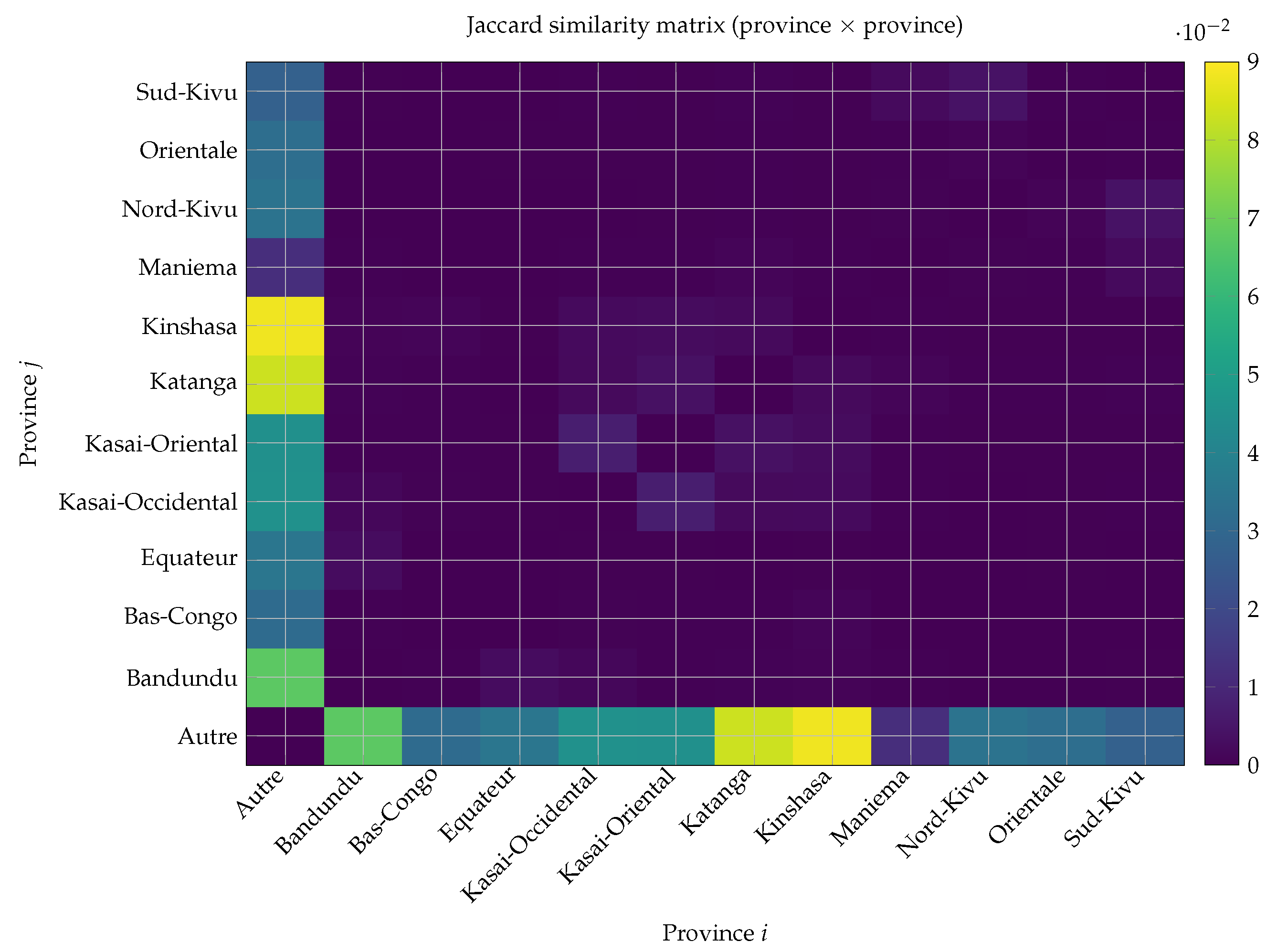
Figure 6 visualizes the resulting similarity matrix. Inter-provincial Jaccard similarities are uniformly low, with most off-diagonal values below 0.05, confirming that provincial name inventories are highly distinctive. The highest pairwise overlaps occur between geographically adjacent or linguistically related provinces (e.g., Kasai-Occidental and Kasai-Oriental; Nord-Kivu and Sud-Kivu), consistent with shared language communities straddling provincial boundaries. Kinshasa shows moderately elevated overlap with several other provinces, plausibly reflecting internal migration from across the country. Maniema consistently records the lowest overlap, in line with its relatively small and linguistically distinct inventory. These patterns accord with the known linguistic geography of the DRC, though caution is warranted given that province is only a coarse proxy for linguistic community.

3. Methods

3.1. Data Source

The CongoNames corpus is derived from the Examen d’État, the national secondary-school graduation examination of the DRC. Each year, the Ministry of Primary, Secondary and Technical Education (MINEPST) publishes the palmarès (result lists) of exam candidates organized by province (historically referred to as education districts), distributed as PDF documents on the official ministry website. Each PDF typically contains candidate names together with school affiliation, reported sex marker, and examination outcome.
Using these publicly available documents as the data source offers three key advantages: (1) they provide an authoritative, high-coverage view of names for each year covered; (2) they include a sex marker (M/F) and a province association, supplying metadata without additional manual annotation and (3) the annual cadence supports temporal analyses across cohorts.
We crawled the ministry’s results portal1 to retrieve all available PDFs. The current release covers 2008–2023 (the most recent year available at the time of extraction, October 2024) and spans multiple provinces. In total, the collection comprises 469 PDFs yielding 8,053,983 individual name entries (Table 1).
All scripts and mapping tables used for downloading, parsing, and normalization are released with the code repository to support end-to-end reproducibility.2

3.2. Pipeline Architecture

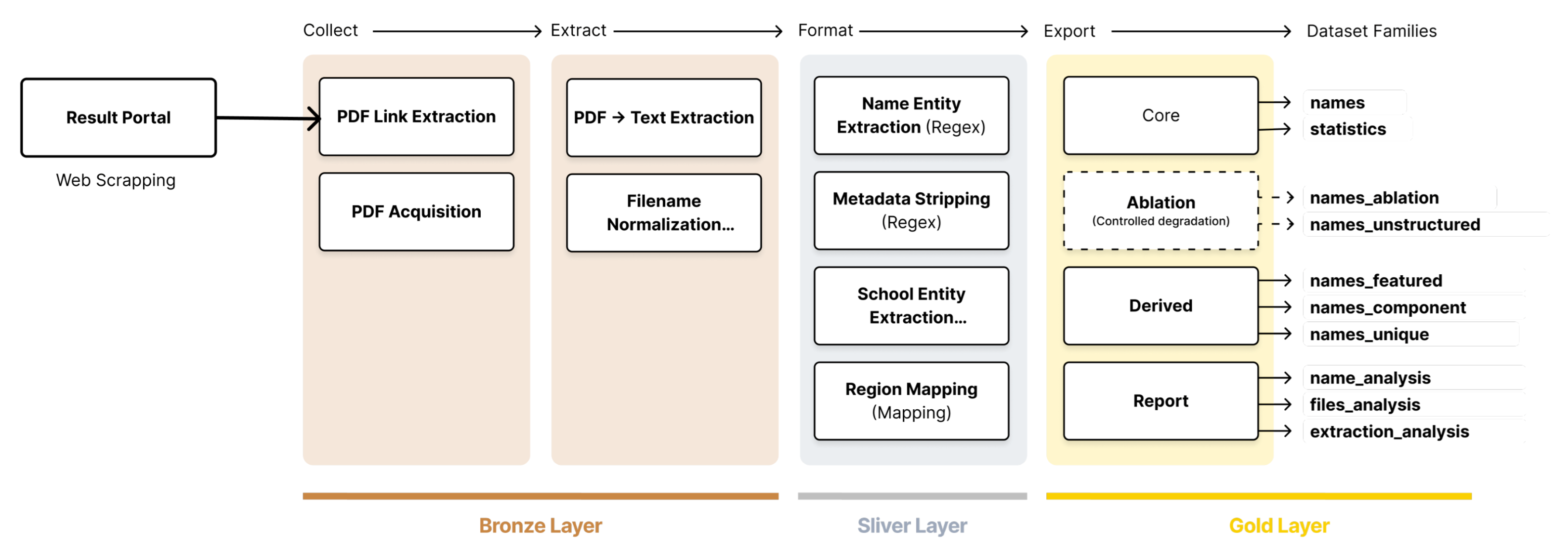
Transforming raw PDF files into a structured corpus required a multi-stage pipeline. We adopted a layered data processing approach inspired by the medallion architecture [14], organizing work into distinct bronze, silver, and gold data layers to ensure traceability and incremental refinement. Figure 7 illustrates the end-to-end workflow.
The principal parsing challenges were practical rather than statistical. The ministry published PDF files contain repeated page headers and footers, wrapped candidate lines, school-summary blocks interleaved with candidate lists, inconsistent separators around sex markers and examination outcomes, historical spelling variants in province and region labels, accent and apostrophe variation in French and local names, and a noticeable layout change in 2023. The pipeline addresses these issues through layer-specific preservation, canonical filename mapping, deterministic regular expressions, line-merging rules, and validation against school-level counts rather than through manual annotation or model-based inference.

3.2.1. Bronze Layer: Source Collection and Text Extraction

PDF result lists are automatically collected from the official ministry portal via a web crawler that enumerates province–year result pages, extracts PDF URLs, and downloads each document with retry logic and checksum verification. The raw PDFs are stored unchanged in dataset/bronze/pdf. Each PDF is then converted to plain text using programmatic PDF parsing (no optical character recognition (OCR)), producing minimally processed UTF-8 text files in dataset/bronze/text. Formatting irregularities are preserved at this stage to avoid premature information loss.

3.2.2. Silver Layer: Filename Normalization and Deterministic Parsing

To impose structural consistency, extracted texts are renamed according to a canonical pattern palmares-[year]-[region].txt using an explicit mapping table that resolves historical spelling variants and administrative changes. Deterministic rule-based parsing components (regular expressions and lookup mappings) then identify candidate entries, school headers, and region metadata while preserving a transparent link to the original bronze artifacts.

3.2.3. Gold Layer: Normalization, Structuring, and Curation

Silver-layer texts are reformatted into a uniform, machine-parseable representation via a custom formatter that standardizes whitespace, merges fragmented lines, and enforces a single-line schema for candidate records. School headers are normalized into canonical blocks, with special-case handling for known year-specific layout deviations (e.g., 2023). From the resulting gold text, we extract two primary structured datasets: individual candidate records (names.csv) and school-level statistics (statistics.csv), each annotated with year, region, filename, and source line number.

3.3. Notation and Feature Augmentation

The corpus-construction procedure is fully deterministic. We operate under the following assumptions: (i) palmarès PDFs are predominantly text-based and can be parsed programmatically without OCR; (ii) each candidate entry carries a reported sex marker (M/F) and a region/province association and (iii) name tokenization is whitespace-based after normalization of spacing.
Let U denote the set of province–year result pages. Crawling U yields a PDF set P . For any p P , let pdf2txt ( p ) denote deterministic PDF-to-text conversion (UTF-8, no OCR). For any extracted full name, the whitespace-tokenized form is
N = ( w 1 , w 2 , , w k ) ,
where k = | N | is the token count. We define the name complexity function as
C ( N ) = simple , if | N | = 3 , complex , otherwise .
This is a pragmatic structural heuristic: three-token names are the most common structure in the source, but this pattern is not universal and should not be interpreted as a linguistic rule. The character length is
( N ) = i = 1 k | w i | + ( k 1 ) ,
where | w i | counts characters in token w i and ( k 1 ) accounts for inter-token spaces.
For simple names ( C ( N ) = simple , i.e.,  N = ( w 1 , w 2 , w 3 ) ), we define a working token-role decomposition for exploratory analysis:
G ( N ) = ( w 1 , w 2 ) and S ( N ) = w 3 ,
treating the first two tokens as a probable native-name component and the final token as a probable surname component. This is a convenience heuristic, not a ground-truth annotation, and will be inaccurate for some individuals (e.g., compound surnames, variable ordering). For complex names, the decomposition is left undefined. Finally, each record receives a normalized province label via a deterministic region-to-province mapping. The enriched table is exported as names_featured.csv.

3.4. Quality Assurance and Validation

3.4.1. Ablation Study for Regex Refinement

To iteratively improve robustness, we applied the deterministic parsing rules to the gold-layer text, removed matched spans, and inspected the residual text for systematic failure modes (e.g., year-specific formatting changes, wrapped lines, irregular separators). We updated the regex rules accordingly, repeating the cycle until the residual text was dominated by non-candidate content (headers, page artifacts, and school blocks).

3.4.2. Aggregate Extraction Error Rate

We provide a quantitative validation signal by comparing extracted record counts against school-level census figures embedded in the same source PDFs. For each year y, let E y denote the expected number of passing candidates (summed from school-statistics tables), and let X y be the extracted passing-candidate row count. The signed extraction error rate is
Err ( y ) = E y X y E y × 100 .
Positive values indicate under-extraction; negative values indicate over-extraction. Table 10 reports E y , X y , and  Err ( y ) for all years. Error rates remain below 2% for all years except 2023 (7.81%), which is flagged as lower-confidence due to layout changes in that year’s PDF format; downstream users may wish to exclude 2023 if strict extraction coverage is required.
This metric does not identify which individual rows are erroneous and may be affected by inconsistencies in the published school-statistics blocks. Nevertheless, it provides a concrete, release-level estimate of extraction coverage that is informative for downstream users.

4. User Notes

4.1. Usage Instructions and Recommended Starting Points

The recommended entry point for most use cases is names_featured.csv, which combines candidate records with computed structural features and province labels. For compact name lexicons suitable for NLP tooling, names_unique.csv provides the deduplicated name list. For component-level analysis (e.g., token frequency distributions), names_components.csv provides one row per name token. The statistics.csv file is recommended for studies linking naming patterns to school-level educational outcomes.
All files are stored under dataset/gold/ in the repository. Name strings are normalized to lowercase; applications requiring proper-case output will need to apply re-capitalization heuristics. Complete field-level schemas are provided in Table A1, Table A2 and Table A3 in the Appendix A.

4.2. Applications and Use Cases

CongoNames supports a broad range of research and applied use cases.
(1)
African NLP and Named Entity Recognition: Large-scale name lexicons derived from this corpus can improve NER systems for French-language and local Congolese language contexts, where coverage of African personal names is typically sparse in standard gazetteers [1]. The corpus can also support spell-checkers, input method editors, and language-model training for Congolese users [15,16].
(2)
Reported Sex Marker Analysis: Because each record carries an administrative sex marker (M/F), the corpus enables analyses of name patterns conditional on that marker. Such studies should frame the sex marker as a proxy derived from administrative records, acknowledging potential inaccuracies. We do not recommend individual-level sex-marker prediction, profiling, or decision-making from names; analyses using this field should be aggregate, hypothesis-driven, and explicit about the distinction between an administrative sex marker and gender identity.
(3)
Regional and Linguistic Variation: Province and year metadata provide an empirical basis for studying regional naming conventions and their correlation with known linguistic geographies, without requiring explicit language-of-origin labels. In future work, we plan to explore adding coarse, explicitly optional “likely language-of-origin” attributions for some name components, via expert-curated lexicons or algorithmic inference.
(4)
Onomastics and Anthropology: The temporal depth (2008–2023) enables diachronic analysis of naming trends, including the effects of the 2015 provincial reorganization on provincial identity and naming practices. The character-level distributions can support generative models (e.g., character-level Markov models or neural language models) for synthetic name generation and NLP stress-testing.
(5)
Data Linkage and Record Matching: The comprehensive Congolese name lexicon can improve the recall of entity-matching algorithms in multilingual database integration scenarios.
(6)
Methodological Transfer: The pipeline methodology is transferable to other countries that publish comparable administrative records. By releasing the processing code openly, we encourage the development of analogous corpora for other underrepresented African nations.

4.3. Limitations

Despite its scale and uniqueness, the corpus is subject to limitations related to population coverage, temporal scope, data quality, normalization choices, and the absence of demographic labels, which should be considered when interpreting the results.
(1)
Coverage Bias: The corpus covers only candidates who reached and sat for the national secondary-school examination in the covered years. This skews toward younger people (late teens) who completed formal secondary education, excluding earlier generations and those outside the formal schooling system. Name distributions may, therefore, differ from the general DRC population.
(2)
Temporal Scope: The current release spans 2008–2023. Earlier decades are not represented, as the ministry did not publish digitized records prior to 2008 and earlier records were paper-based.
(3)
Format Variability: The processing pipeline is tailored to the Examen d’État PDF format. Future changes in ministry layout may require pipeline updates; the 2023 layout change is already flagged as a special case.
(4)
No Ethnicity Labels: Province and year are regional provenance markers, not ethnicity labels. Province is a coarse proxy for geographic origin and is not a reliable indicator of ethnicity, particularly in large, cosmopolitan cities such as Kinshasa.
(5)
Normalization Choices: Lowercasing eliminates capitalization information. Applications requiring properly-cased names must apply re-capitalization heuristics. The heuristic G ( N ) / S ( N ) decomposition is imperfect for individuals with compound surnames, variable ordering, or multi-token family names.
(6)
Residual Extraction Errors: Aggregate error rates are below 2% for most years (Table 10), but residual row-level errors remain possible at the margins. We welcome feedback and will address identified issues in subsequent releases.

4.4. Ethical Considerations and Responsible Use

The source palmarès PDFs are publicly accessible government publications. The released tables contain a limited set of fields—primarily names, a reported sex marker, and year/region provenance—and do not include direct identifiers such as student ID numbers, addresses, phone numbers, or dates of birth. Nevertheless, aggregating names at scale can raise privacy and re-identification risks, particularly because examination candidates are typically minors. We, therefore, release CongoNames for research and educational use only. We encourage aggregate analysis rather than attempts to identify individuals, and we strongly discourage any discriminatory, profiling, or automated decision-making use. Users should comply with applicable laws, institutional review requirements, and data-protection guidelines when combining this resource with other datasets. Public availability of the source examination lists should not be interpreted as removing ethical obligations. The names originate from national exam result publications, include an administrative sex marker, and concern cohorts that largely include underage candidates. Users should avoid reconstructing individual exam histories, linking records to external identity sources, publishing rare-name lookups, or using the corpus for gender inference, surveillance, eligibility screening, or any other individual-level consequential use. When reporting analyses, we recommend aggregation thresholds, suppression of very small cells, and clear statements that the resource is intended for linguistic, NLP, and educational research rather than for identifying or evaluating persons.

Author Contributions

Conceptualization, T.N.B., C.K.A. and M.M.M.; methodology, T.N.B., C.K.A. and M.M.M.; software, T.N.B. and C.K.A.; validation, T.N.B., C.K.A. and M.M.M.; formal analysis, T.N.B., C.K.A. and M.M.M.; investigation, T.N.B., C.K.A. and M.M.M.; resources, T.N.B. and M.M.M.; data curation, T.N.B. and C.K.A.; writing—original draft preparation, T.N.B. and C.K.A.; writing—review and editing, T.N.B., C.K.A. and M.M.M.; visualization, T.N.B. and C.K.A.; supervision, M.M.M.; project administration, M.M.M.; funding acquisition, M.M.M. All authors have read and agreed to the published version of the manuscript.

Funding

This research was partially supported by (1) the Ministry of Science and ICT (MSIT), Republic of Korea, under the National Program for Excellence in AI, supervised by the Institute of Information & Communications Technology Planning & Evaluation (IITP), in 2026 (grant number: 2026-0-00046); (2) Korea University and Computer Science Brain Korea 21 (BK21) FOUR research funding; and (3) Université Nouveaux Horizons (UNH) research funding.

Institutional Review Board Statement

Not applicable.

Informed Consent Statement

Not applicable.

Data Availability Statement

The CongoNames pipeline code is openly available at https://github.com/bernard-ng/drc-names-corpus (accessed on 25 February 2026). The dataset DOI is https://doi.org/10.5281/zenodo.19809985.

Conflicts of Interest

Author M.M. Merlec is affiliated with the Department of Computer Science and Engineering and the BK21 FOUR R&E Center for Computer Science and Engineering at Korea University, Seoul, Republic of Korea. The remaining authors declare no conflicts of interest.

Appendix A

The following tables provide complete schema documentation for all CSV files released as part of the CongoNames corpus. All files are stored under dataset/gold/ and all name strings are normalized to lowercase.
Table A1. Schemas of the core candidate-level datasets released with CongoNames. The names_featured file is the recommended starting point for most analytical use cases. (a) names. (b) names_featured.
(a)
ColumnTypeDescription
idstringCandidate identifier.
namestringFull candidate name (lowercase).
sexstringReported sex marker (m or f).
yearstringExamination year parsed from filename.
regionstringRegion label parsed from filename.
filenamestringSource gold-layer text filename.
lineintegerLine number in gold-layer text file.
(b)
ColumnTypeDescription
idstringCandidate identifier (left-padded).
namestringFull candidate name (lowercase).
sexstringReported sex marker (m or f).
yearstringExamination year parsed from filename.
regionstringRegion label parsed from filename.
filenamestringSource gold-layer text filename.
lineintegerLine number in gold-layer text file.
wordsintegerNumber of whitespace tokens ( | N | ).
lengthintegerCharacter count including spaces ( ( N ) ).
categorystringsimple (3 tokens) or complex.
provincestringProvince inferred from region mapping.
Table A2. Schemas of the school-level statistics and deduplicated name datasets. (astatistics. (b) names_unique.
(a)
ColumnTypeDescription
indexintegerRow index within source file.
namestringSchool name as recorded in source text.
codestringSchool code (normalized numeric format).
entriesintegerTotal candidates listed.
passintegerCandidates who passed.
failintegerCandidates who failed.
entries_fintegerFemale candidates listed.
entries_mintegerMale candidates listed.
pass_fintegerFemale candidates who passed.
pass_mintegerMale candidates who passed.
fail_fintegerFemale candidates who failed.
fail_mintegerMale candidates who failed.
yearstringExamination year parsed from filename.
regionstringRegion label parsed from filename.
filenamestringSource gold-layer text filename.
(b)
ColumnTypeDescription
idstringIdentifier of first occurrence.
namestringUnique full name (deduplicated).
sexstringReported sex marker (m or f).
yearstringExamination year parsed from filename.
regionstringRegion label parsed from filename.
filenamestringSource gold-layer text filename.
lineintegerLine number of first occurrence.
Table A3. Schemas of the derived component-level and unstructured candidate datasets. (anames_components. (b) names_unstructured.
(a)
ColumnTypeDescription
idstringCandidate identifier of original record.
namestringFull name associated with this component.
sexstringReported sex marker (m or f).
yearstringExamination year parsed from filename.
regionstringRegion label parsed from filename.
filenamestringSource gold-layer text filename.
lineintegerLine number in gold-layer text file.
full_namestringOriginal full name string.
componentstringSingle extracted name token.
(b)
ColumnTypeDescription
namestringUnmatched candidate-line fragment.
filenamestringSource ablation text filename.
lineintegerLine number in ablation text file.

Notes

1
2
https://github.com/bernard-ng/drc-names-corpus (accessed on 25 February 2026).

References

  1. Adelani, D.I.; Abbott, J.; Neubig, G.; D’souza, D.; Kreutzer, J.; Lignos, C.; Palen-Michel, C.; Buzaaba, H.; Rijhwani, S.; Ruder, S.; et al. MasakhaNER: Named Entity Recognition for African Languages. Trans. Assoc. Comput. Linguist. 2021, 9, 1116–1131. [Google Scholar] [CrossRef]
  2. Ramscar, M.; Chen, S.; Futrell, R.; Mahowald, K. Cross-cultural structures of personal name systems reflect general communicative principles. Nat. Commun. 2026, 17, 719. [Google Scholar] [CrossRef] [PubMed]
  3. Merlec, M.M.; Maria, K.W.K.; Landry, M.K.M.; In, H.P. GNNRec: A Graph-Based Neural Network Model for Efficient and Robust Product Recommendation. IEEE Access 2026, 14, 8699–8717. [Google Scholar] [CrossRef]
  4. Adelani, D.I.; Neubig, G.; Ruder, S.; Rijhwani, S.; Beukman, M.; Palen-Michel, C.; Lignos, C.; Alabi, J.O.; Muhammad, S.H.; Nabende, P.; et al. MasakhaNER 2.0: Africa-centric Transfer Learning for Named Entity Recognition. In Proceedings of the 2022 Conference on Empirical Methods in Natural Language Processing; Association for Computational Linguistics: Stroudsburg, PA, USA, 2022; pp. 4488–4508. [Google Scholar]
  5. Dossou, B.F.; Tonja, A.L.; Yousuf, O.; Osei, S.; Oppong, A.; Shode, I.; Awoyomi, O.O.; Emezue, C. AfroLM: A self-active learning-based multilingual pretrained language model for 23 African languages. In Proceedings of the Third Workshop on Simple and Efficient Natural Language Processing (SustaiNLP), Abu Dhabi, United Arab Emirates, 7 December 2022; pp. 52–64. [Google Scholar]
  6. Adebara, I.; Elmadany, A.; Abdul-Mageed, M.; Inciarte, A.A. SERENGETI: Massively Multilingual Language Models for Africa. arXiv 2022, arXiv:2212.10785. [Google Scholar] [CrossRef]
  7. Remy, P. Name Dataset. 2021. Available online: https://github.com/philipperemy/name-dataset (accessed on 25 April 2026).
  8. Thiong’o, N. Decolonising the Mind: The Politics of Language in African Literature; Currey, J., Ed.; Studies in African Literature; East African Publishers: Nairobi, Kenya, 1986. [Google Scholar]
  9. Ethnologue. Democratic Republic of the Congo. 2025. Available online: https://www.ethnologue.com/country/CD/ (accessed on 25 April 2026).
  10. Shannon, C.E. A Mathematical Theory of Communication. Bell Syst. Tech. J. 1948, 27, 379–423. [Google Scholar] [CrossRef]
  11. Simpson, E.H. Measurement of Diversity. Nature 1949, 163, 688. [Google Scholar] [CrossRef]
  12. Hill, M.O. Diversity and Evenness: A Unifying Notation and Its Consequences. Ecology 1973, 54, 427–432. [Google Scholar] [CrossRef]
  13. Jaccard, P. Étude comparative de la distribution florale dans une portion des Alpes et des Jura. Bull. Société Vaudoise Sci. Nat. 1901, 37, 547–579. [Google Scholar]
  14. Pasupuleti, S. The Medallion Architecture in Data Engineering: A Layered Approach to Data Quality and Governance. J. Inf. Syst. Eng. Manag. 2025, 10, 131–137. [Google Scholar] [CrossRef]
  15. Okgetheng, B.; Malema, G.; Ahmer, A.; Lenyibi, B.; Ishmael, O. Bantu Spell Checker and Corrector Using Modified Edit Distance Algorithm (MEDA). Data Sci. Mach. Learn. 2022, 12, 303–316. [Google Scholar]
  16. Merlec, M.M.; Sinai, N.K.; In, H.P. A blockchain-based trustworthy and secure review system for decentralized e-portfolio platforms. In Proceedings of the 2023 14th International Conference on Information and Communication Technology Convergence (ICTC); IEEE: Jeju Island, Republic of Korea, 2023; pp. 675–680. [Google Scholar]
Figure 1. Letter-frequency profiles for the native-name component G ( N ) and surname component S ( N ) derived from simple names in CongoNames. The distinct profiles reflect the dual linguistic origin of Congolese personal names. (a) Probable component G ( N ) (native-name segment). (b) Probable component S ( N ) (surname segment).
Data 11 00169 g001
Figure 2. Character-length distribution ( N ) across all records in CongoNames (log frequency scale).
Data 11 00169 g002
Figure 3. Token-count distribution | N | across all records in CongoNames (log frequency scale).
Data 11 00169 g003
Figure 4. Reported sex-marker composition by province (M/F) as provided in the source examination lists.
Data 11 00169 g004
Figure 5. Reported sex-marker composition by year (M/F) as provided in the source examination lists.
Data 11 00169 g005
Figure 6. Province-to-province name overlap measured by Jaccard similarity over sets of unique full names. Values range from 0 (no shared names) to 1 (identical inventories). Most inter-provincial values fall below 0.05.
Data 11 00169 g006
Figure 7. End-to-end data processing pipeline of the CongoNames corpus following a medallion architecture. Each pipeline step persists its outputs in a dedicated data layer to ensure traceability and reproducibility. The Bronze layer stores raw PDFs and extracted text, the Silver layer contains deterministically normalized text and extracted entities, and the Gold layer provides curated datasets, controlled ablation variants, derived representations, and diagnostic analysis reports for research use.
Data 11 00169 g007
Table 1. CongoNames dataset overview.
MetricValue
Total records8,053,983
Unique names (exact)6,371,941
Unique names (normalized)6,370,887
Unique regions304
Unique provinces12
Unique years16
Unique source files469
Simple names6,324,763
Complex names1,729,220
Table 2. Name structure summary.
MetricValue
Total records8,053,983
Mean characters per name20.19
Median characters per name21
90th percentile characters25
95th percentile characters26
Mean tokens per name2.86
Median tokens per name3
90th percentile tokens3
95th percentile tokens3
Table 4. Name distribution by province.
ProvinceTotalUniqueMFSimpleComplex
Autre2,522,5102,465,7651,530,087992,4232,018,242504,268
Bandundu801,752775,347496,382305,370293,673508,079
Bas-Congo292,101288,681169,699122,402269,49422,607
Équateur373,646372,464265,121108,525332,51941,127
Kasai-Occidental437,913411,429320,103117,810322,189115,724
Kasai-Oriental397,775383,110277,774120,001369,50528,270
Katanga846,746818,704543,810302,936698,197148,549
Kinshasa1,165,0381,142,275570,529594,5091,091,33073,708
Maniema129,114123,26097,66931,44570,01859,096
Nord-Kivu392,793386,407224,967167,826351,68641,107
Orientale340,152338,730216,564123,588293,61946,533
Sud-Kivu354,443343,664222,041132,402214,291140,152
Table 5. Name distribution by year.
YearTotalUniqueMFSimpleComplex
2008183,076164,012115,27867,798168,34414,732
2009256,212255,294171,34884,864196,28659,926
2010281,536280,370190,60890,928211,09470,442
2011323,906322,315216,895107,011233,55890,348
2012324,890319,468217,107107,783246,94977,941
2013270,705269,618176,26194,444209,40361,302
2014330,063328,490211,911118,152254,93175,132
2015729,829365,305456,623273,206559,523170,306
2016400,139398,523246,542153,597318,95981,180
2017413,563412,049252,718160,845330,47083,093
2018501,969499,610303,193198,776406,20895,761
2019516,036513,885311,569204,467422,71893,318
2020633,454629,642378,949254,505521,790111,664
2021956,994492,166563,006393,988790,433166,561
20221,222,198602,653713,479508,719982,911239,287
2023709,413691,221409,259300,154471,186238,227
Table 6. Top character n-grams (native segments). (a) Bigrams (top 10). (b) Trigrams (top 10). (c) 4-grams (top 10).
(a)
N-GramCountShare
ng2,690,4390.0356
ka2,422,0680.0321
mb2,344,7810.0310
an2,264,8420.0300
ba1,961,0240.0260
am1,958,6680.0259
ma1,639,7720.0217
nd1,279,9490.0169
mu1,276,8630.0169
al1,263,5420.0167
(b)
N-GramCountShare
nga1,076,9840.0156
mba976,2310.0141
ang785,2780.0113
amb768,4010.0111
ngo723,7300.0105
aka593,8910.0086
ong593,0600.0086
ala483,5410.0070
nda460,6830.0067
mbo433,0590.0063
(c)
N-GramCountShare
amba399,5610.0064
anga379,4540.0060
ongo354,1510.0056
tshi306,3760.0049
umba233,5350.0037
unga192,4240.0031
ombo189,2480.0030
anda168,1170.0027
enga151,1860.0024
ngam149,2370.0024
Table 7. Top character n-grams (surname segments). (a) Bigrams (top 10). (b) Trigrams (top 10). (c) 4-grams (top 10).
(a)
N-GramCountShare
an961,9700.0286
in798,6440.0237
el777,1560.0231
ie754,9620.0224
ne715,3350.0212
er687,1280.0204
ri679,3180.0202
en505,4800.0150
ar502,5200.0149
is495,4710.0147
(b)
N-GramCountShare
ine364,9590.0133
ris190,5420.0070
ean183,1970.0067
jea182,7250.0067
tin181,4960.0066
sti174,4690.0064
ric165,5810.0061
mar163,8440.0060
cha160,0330.0058
anc152,9240.0056
(c)
N-GramCountShare
jean180,5850.0086
rist127,3220.0061
chri123,7460.0059
hris121,4880.0058
stin120,4340.0057
ette102,1920.0049
ranc91,9570.0044
line83,3980.0040
usti82,3960.0039
bert78,3620.0037
Table 8. Name diversity by year.
YearShannonSimpsonEffective Names
200811.9720.9999934158,221
200912.4480.9999961254,823
201012.5420.9999964279,754
201112.6810.9999969321,466
201212.6670.9999968317,185
201312.5020.9999963268,971
201412.6990.9999969327,512
201512.8050.9999972363,981
201612.8940.9999975397,729
201712.9270.9999976411,347
201813.1190.9999980498,471
201913.1480.9999980512,874
202013.3500.9999984627,808
202113.0940.9999979485,789
202213.3020.9999983598,601
202313.4240.9999983675,847
Table 9. Name diversity by province.
ProvinceShannonSimpsonEffective Names
Autre14.7050.99999962,434,210
Bandundu13.5410.9999986760,019
Bas-Congo12.5650.9999964286,366
Équateur12.8260.9999973371,927
Kasai-Occidental12.8680.9999966387,585
Kasai-Oriental12.8310.9999971373,673
Katanga13.5900.9999986798,293
Kinshasa13.9400.99999911,133,022
Maniema11.6880.9999907119,087
Nord-Kivu12.8560.9999973383,186
Orientale12.7310.9999970338,058
Sud-Kivu12.7250.9999968336,043
Table 10. Extraction performance and error rate by year.
YearEntriesPassExtractedError (%)
2008316,849184,887183,0760.98
2009398,896256,795256,2120.23
2010425,350282,693281,5360.41
2011472,097324,245323,9060.10
2012529,949325,288324,8900.12
2013564,970271,092270,7050.14
2014611,657336,206330,0631.83
20151,207,886730,338729,8290.07
2016620,671400,130400,139 0.00
2017627,899412,443413,563 0.27
2018677,820502,045501,9690.02
2019728,688516,240516,0360.04
2020834,606633,516633,4540.01
20211,626,761956,537956,994 0.05
20221,742,7381,201,0511,222,198 1.76
2023987,341769,484709,4137.81
Disclaimer/Publisher’s Note: The statements, opinions and data contained in all publications are solely those of the individual author(s) and contributor(s) and not of MDPI and/or the editor(s). MDPI and/or the editor(s) disclaim responsibility for any injury to people or property resulting from any ideas, methods, instructions or products referred to in the content.