
A Multi-Pressure Keyboard Key Sounds Audio Dataset




Abstract
1. Introduction
- Developing keystroke recognition systems: These datasets can be used to develop keystroke recognition systems that either identify potential attack vectors or serve as the foundation for defensive software. Studies such as [1,2,3] have demonstrated that attackers can use Deep Learning to identify sensitive data, such as passwords, with high accuracy (in particular, authors in [2] report an accuracy over 90%) by simply listening to keystrokes through nearby microphones or even during online video calls. This dataset is a decision-support benchmark, baseline, or seed dataset for exploratory research that enables the study of how these signals are captured and reconstructed [4,5]. Also, it supports the development of countermeasures across various contexts, including mobile banking security [6] and the mitigation of eavesdropping threats in shared workspaces [7]. Our earlier publication [8] used a preliminary version of the current dataset to build a prototype to protect users from acoustic side-channel keyboard attacks. This was accomplished by generating synthetic keystroke sounds to neutralize the acoustic signatures attackers rely on by generating and mixing false, randomized keystroke sounds with real ones to obfuscate keypress identification through sound analysis.
- Detecting Behavioral Biometrics: Since the proposed dataset introduces three distinct levels of keystroke pressure, it would enable a more granular study of users’ behavioral biometrics, detecting their emotional states—such as stress, frustration, or fatigue—based on variations in sound frequency and amplitude. This feature opens new avenues for psychological research related to human–computer interaction and anomaly detection. The work in [9] uses keystroke dynamics to identify or confirm an individual’s identity by analysing habitual rhythm patterns as they type on a keyboard and continuously predicts users’ emotional states during message-writing sessions. The authors in [10] propose a multi-modal behavioral biometrics framework that fuses keystroke and mouse dynamics using temporal alignment and deep learning, achieving up to 99% accuracy in distinguishing benign from adversarial user behavior while preserving nuanced interaction patterns for robust, non-intrusive authentication and anomaly detection.
- Enhancing Accessibility Tools: The proposed dataset can be used to leverage sound-based virtual keyboards with acoustic feedback to enable users with motor impairments to interact with computers or mobile devices without relying on physical keypresses. This approach is particularly valuable for individuals with conditions such as cerebral palsy, spinal cord injuries, or severe arthritis, where traditional typing is challenging or impossible. The work in [11] is an example of the use of acoustic sensors to detect voluntary sounds (even if they are not speech) and convert them into inputs for virtual keyboards. This can be combined with the generation of audible feedback to confirm the input, simulating the sound of keys being pressed.
- Enabling Hardware Diagnostics: The proposed dataset could also aid the development of keystroke recognition systems for hardware monitoring, i.e., acoustic signatures can be used to detect keyboard wear or mechanical failures (e.g., sticky keys) via deviations from the baseline recordings provided. Furthermore, the data can support defensive software that protects users by masking or generating synthetic keystroke sounds to neutralize the acoustic signatures that attackers or diagnostic anomalies rely on [12].
2. Related Work
3. Materials and Methods
- Samsung Galaxy M52 5G;
- –
- Manufacturer: Samsung
- –
- City: Dublin
- –
- Country: Vietnam
- Mi True Wireless Earphones 2 Pro;
- –
- Manufacturer: Tiinlab Corporation (a Mi Ecosystem Company)
- –
- City: Tanglang
- –
- Country: China
- Victus by Gaming Laptop 16-s0006np.
- –
- Manufacturer: HP
- –
- City: Kunshan
- –
- Country: China
- The digital audio signal is analyzed and split into multiple frames. For each frame, the RMS energy value is calculated, which represents the average magnitude of the signal in that fraction of a second, given by the mathematical formula:where “N” is the number of samples in the frame and “x[n]” is the amplitude of the acoustic signal at sample “n”. The result of this step is a vector of RMS values that describes the energy of the keystroke over time.
- To convert this time series into a one-dimensional tabular dataset, the time vector is collapsed into a single scalar value. This is performed by calculating the arithmetic mean of all frames in the recording.
4. Results
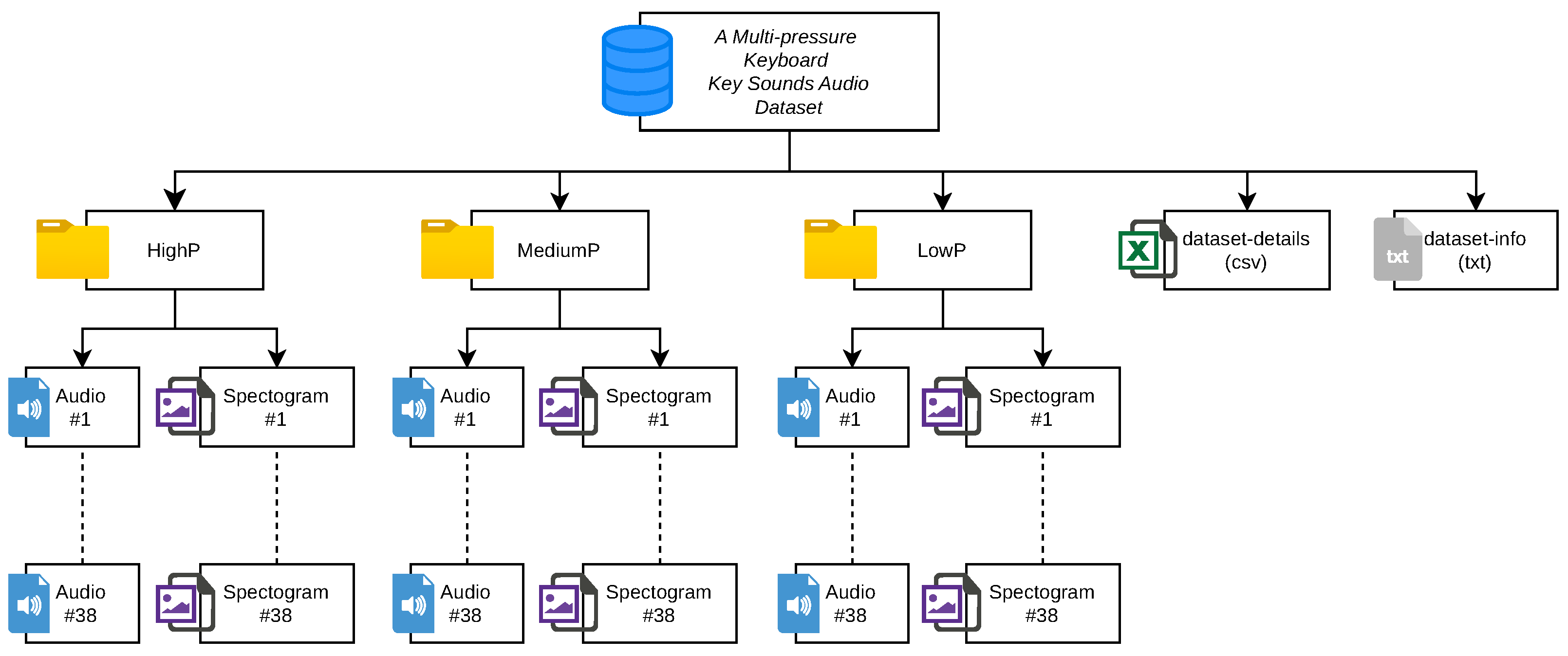
- The subfolders: HighP, MediumP, and LowP, with the audio files and spectrograms for the respective High, Medium, and Low pressures.
- A CSV file with detailed information for each audio file, and a TXT file with a description for each column in the CSV file.
- Subfolder HighP:
- 38 audio files for the High pressure (Format: WAV)
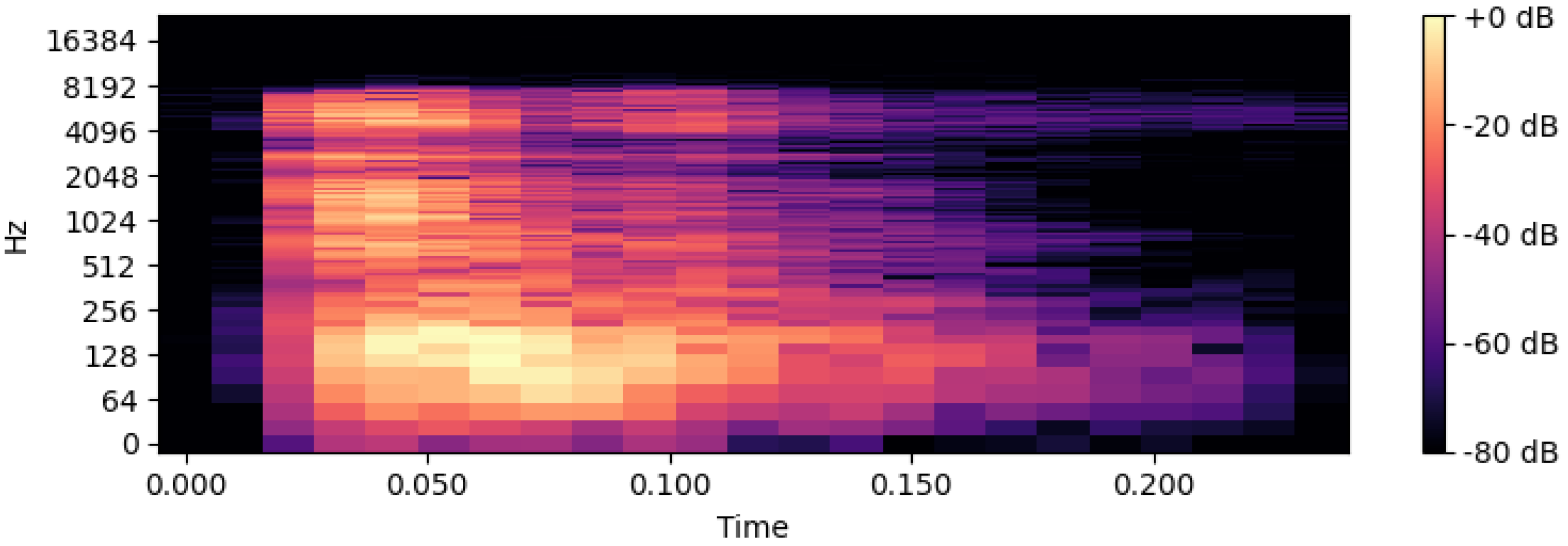
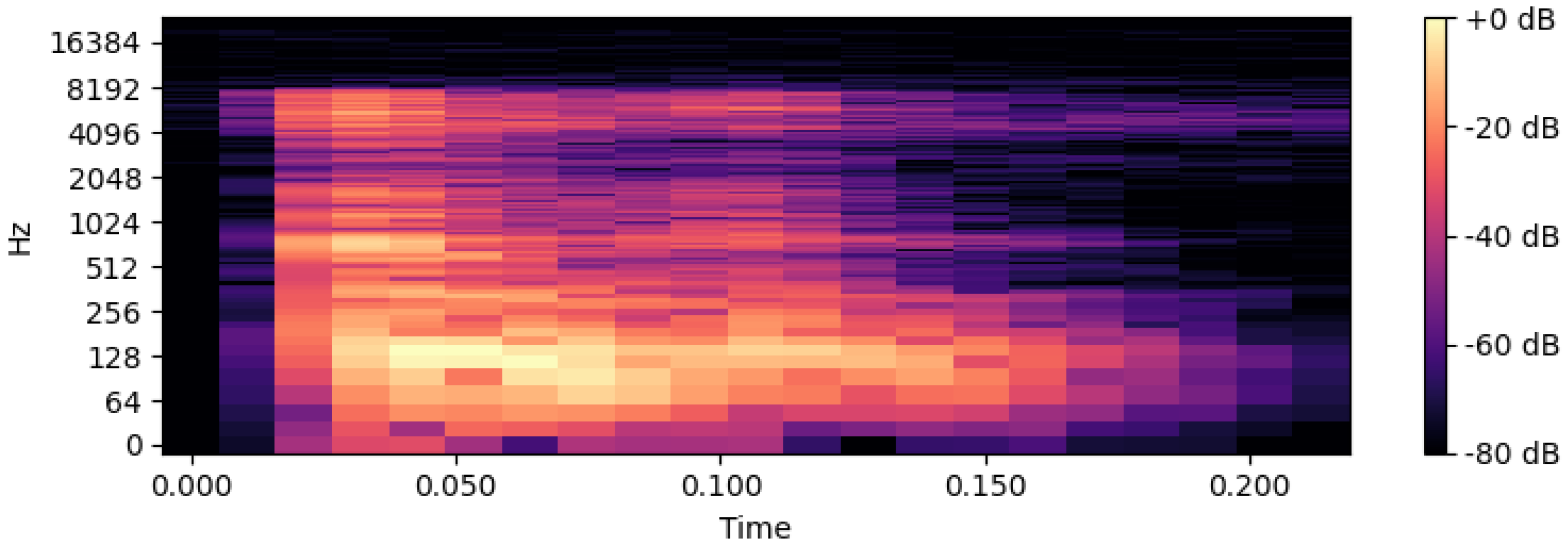
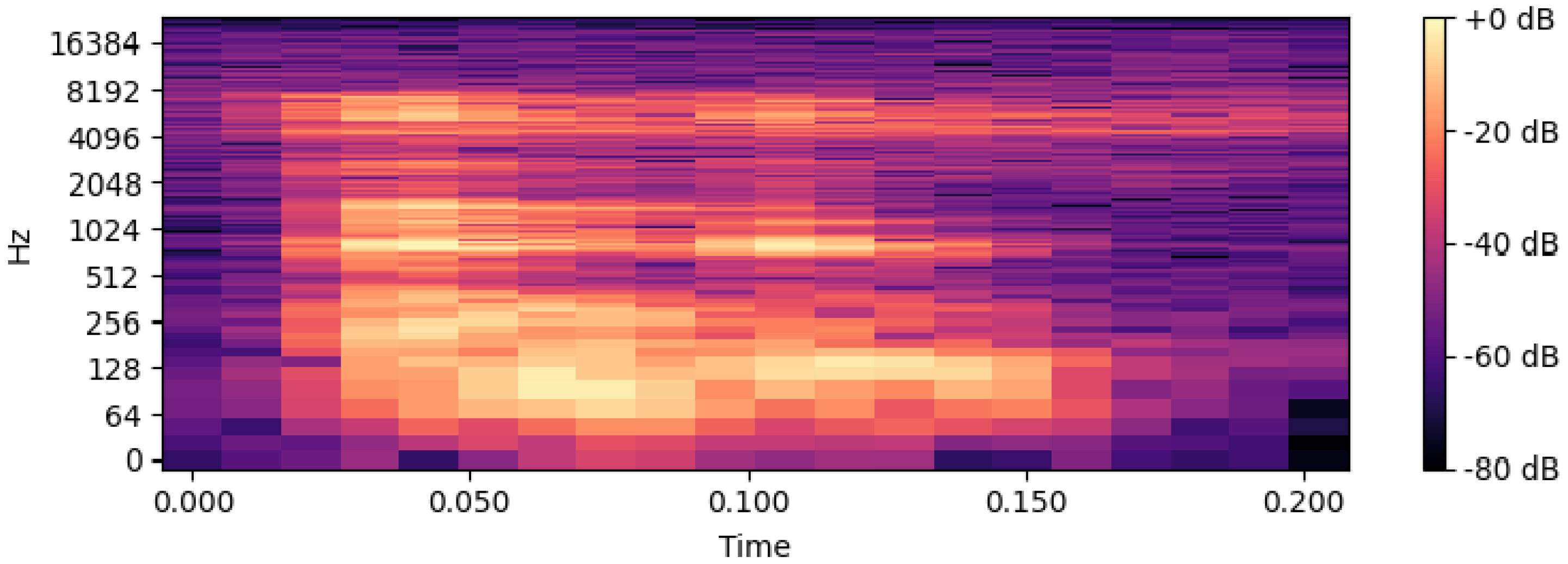
- 38 spectrogram image files of the respective audio files (Format: PNG)
- Subfolder MediumP:
- 38 audio files for the Medium pressure (Format: WAV)
- 38 spectrogram image files of the respective audio files (Format: PNG)
- Subfolder LowP:
- 38 audio files for the Low pressure (Format: WAV)
- 38 spectrogram image files of the respective audio files (Format: PNG)
- File dataset-details (Format: CSV):
- File with detailed information about the audio files in the HighP, MediumP, and LowP subfolders, namely “Key,” “Pressure”, “Folder”, “FileName”, “Spectrum_FileName”, “Duration_s”, “Max_Amplitude”, “Min_Amplitude”, “Max_dB”, “Min_dB”, “RMS_Energy”, and “Mean_ZCR”.
- File dataset-info (Format: TXT):
- File with a description of each column in the dataset-details CSV file.
| Algorithm 1 Script to extract acoustic features and enerate spectrograms |
| Initialize an empty list DatasetRecords |
| Create output directory SpectrogramFolder |
| for EACH folder IN [“HighP”, “LowP”, “MediumP”] do |
| pressure_level ← ExtractPressureLabel(folder) |
| audio_files ← GetWavFiles(folder) |
| for EACH file IN audio_files do |
| audio_signal, sample_rate ← LoadAudio(file) |
| if loading fails then |
| continue |
| end if |
| // 1. Feature Extraction |
| duration ← CalculateDuration(audio_signal, sample_rate) |
| max_amp, min_amp ← FindPeakAmplitudes(audio_signal) |
| max_dB, min_dB ← ConvertAmplitudesToDecibels(max_amp, min_amp) |
| rms_energy ← CalculateMeanRMS(audio_signal) |
| mean_zcr ← CalculateMeanZeroCrossingRate(audio_signal) |
| // 2. Spectrogram Generation |
| stft_matrix ← CalculateSTFT(audio_signal) |
| spectrogram_db ← ConvertToLogScale(stft_matrix) |
| image_filename ← SaveSpectrogramAsPNG(spectrogram_db, SpectrogramFolder) |
| // 3. Data Consolidation |
| key_label ← ParseKeyLabelFromFilename(file) |
| record ← {Key: key_label, Pressure: pressure_level, FileName: file, …} |
| Append record TO DatasetRecords |
| end for |
| end for |
| Save DatasetRecords AS “dataset_keystrokes.csv” |
5. Discussion
- Hardware and Recording Bias
- The dataset may be biased toward specific keyboard models, switch types, or construction materials.
- It uses a single microphone or phone model, which limits generalizability to other recording hardware.
- Microphone placement, angle, and the acoustics of the recording space may introduce consistent patterns not found in typical usage.
- Environmental Conditions
- Recordings were obtained in controlled, low-noise conditions, which differ from real-world environments where background noise, reverberation, or user movement may affect audio.
- The absence of diverse environments (e.g., office, café, classroom, and home) reduces robustness for deployment-focused applications.
- User Variability
- If the dataset includes one or few participants, typing style variability may be limited.
- Differences in press force or key handling between users may not be fully represented.
- Data Coverage
- The dataset focuses on isolated key presses, not continuous typing sequences.
- Only certain key categories may be included (alphabetic, numeric, and space bar), leaving out modifiers, punctuation, or function keys.
- Some applications require more granular distinctions, such as precise press-force levels or additional pressure steps.
- Acoustic Representativeness
- Controlled recording environments may produce sound characteristics that do not reflect everyday usage, where surfaces, table materials, or keyboard orientation affect acoustics.
- The recorded volume and dynamics may not match real user behavior.
- Application-Specific Constraints
- For security and side-channel research, the lack of real-world noise and typing sequences may reduce external validity.
- For machine learning tasks, the dataset may not be large enough to train deep models without augmentation.
- For behavioral biometrics, limited user diversity may constrain generalization.
6. Conclusions
Author Contributions
Funding
Institutional Review Board Statement
Informed Consent Statement
Data Availability Statement
Conflicts of Interest
Abbreviations
| CVS | Comma-Separated Values |
| MKA | Multi-Keyboard Acoustic |
| MFCC | Mel-frequency Cepstral Coefficients |
| PNG | Portable Network Graphics |
| RMS | Root Mean Square |
| TXT | Plain Text File |
| WAV | Waveform Audio File Format |
| STFT | Short-Time Fourier Transform |
| ENC | Environmental Noise Cancellation |
References
- Harrison, J.; Toreini, E.; Mehrnezhad, M. A Practical Deep Learning-Based Acoustic Side Channel Attack on Keyboards. In 2023 IEEE European Symposium on Security and Privacy Workshops (EuroS&PW); Institute of Electrical and Electronics Engineers Inc.: Piscataway, NJ, USA, 2023; pp. 270–280. [Google Scholar] [CrossRef]
- AI Can Identify Passwords by Sound of Keys Being Pressed, Study Suggests. AI (Artificial Intelligence). The Guardian, 2025. Available online: https://www.theguardian.com/technology/2023/aug/08/ai-could-identify-passwords-by-sound-of-keys-being-pressed-study-suggests (accessed on 21 April 2026).
- George, A.; Sagayarajan, S. Acoustic Eavesdropping: How AIs Can Steal Your Secrets by Listening to Your Typing. Partners Univers. Int. Innov. J. 2023, 1, 1–14. [Google Scholar] [CrossRef]
- Venkateswarlu, S. An Overview of Acoustic Side-Channel Attack. 2013. Available online: https://www.academia.edu/91617557/An_Overview_of_Acoustic_Side_Channel_Attack (accessed on 18 April 2026).
- Taheritajar, A.; Harris, Z.M.; Rahaeimehr, R. A Survey on Acoustic Side Channel Attacks on Keyboards. In Information and Communications Security; Katsikas, S., Xenakis, C., Kalloniatis, C., Lambrinoudakis, C., Eds.; Springer: Singapore, 2025; pp. 99–121. [Google Scholar] [CrossRef]
- Savadatti, M.B.; Kulkarni, N.J.; Bansod, G.D.; Sarkar, P.; Kumar, P.; Sargam, K.; Gulati, P.; Bale, A.S. Keyboard Acoustic Side Channel Attacks on Android Phones in the AI Era of Digital Banking: An Elementary Review. Int. J. Intell. Syst. Appl. Eng. 2023, 12, 292–300. [Google Scholar]
- Anand, S.A.; Saxena, N. Keyboard Emanations in Remote Voice Calls: Password Leakage and Noise(less) Masking Defenses. In Proceedings of the Eighth ACM Conference on Data and Application Security and Privacy; CODASPY ’18; Association for Computing Machinery: New York, NY, USA, 2018; pp. 103–110. [Google Scholar] [CrossRef]
- Rodrigues, D.; Macedo, G.; Conti, M.; Pinto, P. A Prototype for Generating Random Key Sounds to Prevent Keyboard Acoustic Side-Channel Attacks. In 2024 IEEE 22nd Mediterranean Electrotechnical Conference (MELECON); IEEE: Piscataway, NJ, USA, 2024; pp. 1287–1292. [Google Scholar] [CrossRef]
- Marrone, S.; Sansone, C. Identifying Users’ Emotional States through Keystroke Dynamics. In Proceedings of the 3rd International Conference on Deep Learning Theory and Applications DeLTA-Volume 1; SciTePress: Setúbal, Portugal, 2022; pp. 207–214. [Google Scholar] [CrossRef]
- Xiong, J.; Belman, A.K. Multi-Modal Adversarial Activity Detection Using Keyboard and Mouse Dynamics. In 2025 IEEE World AI IoT Congress (AIIoT); IEEE: Piscataway, NJ, USA, 2025; pp. 0340–0345. [Google Scholar] [CrossRef]
- Prete, A.L.; Andreini, P.; Bonechi, S.; Bianchini, M. A smart virtual keyboard to improve communication of locked-in patients. Comput. Stand. Interfaces 2025, 93, 103963. [Google Scholar] [CrossRef]
- Lobanova, A.; He, J.; Zhu, N.; Nazir, A.; Ma, X. Machine-learning-based adaptive keyboard sound masking against acoustic channel attacks. In Proceedings of the Fifth International Conference on Computer Communication and Network Security (CCNS 2024), Guangzhou, China, 3–5 May 2024; p. 51. [Google Scholar] [CrossRef]
- Tsalera, E.; Papadakis, A.; Pagiatakis, G.; Samarakou, M. Impact Evaluation of Sound Dataset Augmentation and Synthetic Generation upon Classification Accuracy. J. Sens. Actuator Netw. 2025, 14, 91. [Google Scholar] [CrossRef]
- Rzemieniuk, M.; Niewiarowski, A.; Książek, W. Acoustic Side-Channel Vulnerabilities in Keyboard Input Explored Through Convolutional Neural Network Modeling: A Pilot Study. Appl. Sci. 2026, 16, 563. [Google Scholar] [CrossRef]
- Rawf, K.M.H.; Abdulrahman, A.O.; Kamel, H.O.; Hassan, L.M.; Ali, A.O. Multi-Datasets for Different Keyboard Key Sound Recognition. Data Brief 2024, 19, 110949. Available online: https://pubmed.ncbi.nlm.nih.gov/39391001/ (accessed on 25 June 2026). [CrossRef]
- Dias, T.; Vitorino, J.; Maia, E.; Sousa, O.; Praça, I. KeyRecs: A Keystroke Dynamics and Typing Pattern Recognition Dataset. Data Brief 2023, 50, 109509. [Google Scholar] [CrossRef] [PubMed]
- Quattrone, B.; Badr, Y. SKAID: A Realistic Dataset for Acoustic Side-Channel Attacks with Synchronized Keyboard Audio and Keystroke Logs for AI-based Inference. (V 1.0) [Data Set]. Zenodo. Available online: https://zenodo.org/records/17282184 (accessed on 7 October 2025). [CrossRef]
- Singh, I.; Kaur, G.; Atwal, U.P.S.; Singh, G.; Singh, G.; Singh, M. BEACON: A Multimodal Dataset for Learning Behavioral Fingerprints from Gameplay Data. arXiv 2026, arXiv:2605.10867. [Google Scholar] [CrossRef]
- Spata, M.O.; Maria Russo, V.; Ortis, A.; Battiato, S. A New Pipeline for Snooping Keystroke Based on Deep Learning Algorithm. IEEE Access 2025, 13, 24498–24514. [Google Scholar] [CrossRef]



| Ref. | Authors | Year | Addressed Problems | Materials | Methods | Participants | Keyboard Devices | Recording Environment(s) | Dataset Size |
|---|---|---|---|---|---|---|---|---|---|
| [1] | Harrison et al. | 2023 | Deep learning-based acoustic side-channel attack (ASCA) on keyboards. | Laptop keyboards, smartphone, Zoom recordings. | CoAtNet deep learning model, FFT energy peaks for keystroke isolation. | 1 | 1 | Quiet room/Zoom | 900 keystrokes |
| [2] | The Guardian | 2025 | Password identification feasibility via keystroke sound recording. | - | Journalistic review of AI study findings. | n/a | n/a | n/a | n/a |
| [3] | George & Sagayarajan | 2023 | Acoustic eavesdropping via AI algorithms. | - | Conceptual review. | n/a | n/a | n/a | n/a |
| [4] | Venkateswarlu | 2013 | Fundamental vulnerabilities of keyboard emanations. | - | Broad literature overview of ASCA mechanics. | n/a | n/a | n/a | n/a |
| [5] | Taheritajar et al. | 2025 | State-of-the-art overview of ASCA on keyboards. | Academic literature. | Systematic literature review and survey. | n/a | n/a | n/a | n/a |
| [6] | Savadatti et al. | 2023 | Keystroke ASCA targeting digital banking on Android platforms. | Android mobile devices. | Elementary review of smartphone acoustic vulnerabilities. | n/a | n/a | n/a | n/a |
| [7] | Anand & Saxena | 2018 | Keyboard acoustic leakage during remote voice calls. | Voice call audio streams. | Noise(less) masking defenses and signal obfuscation. | Multiple | Multiple | Remote voice calls | Audio streams |
| [8] | Rodrigues et al. | 2024 | Protection against ASCA via acoustic signature neutralization. | Synthetic keystroke software prototype. | Generation and mixing of false randomized keystrokes. | 1 | 1 | Controlled | Software logs |
| [9] | Marrone & Sansone | 2022 | Identification of users’ emotional states (stress, fatigue). | Keystroke dynamics data. | Behavioral biometric analysis of habitual rhythm patterns. | Multiple | n/a | Uncontrolled | Keystroke dynamics log |
| [10] | Xiong & Belman | 2025 | Distinguishing benign from adversarial user behavior. | Keyboard and mouse dynamics data. | Deep learning framework with temporal alignment fusion. | Multiple | Multiple | Controlled lab | Interaction logs |
| [11] | Prete et al. | 2025 | Accessibility for motor-impaired and locked-in patients. | Acoustic sensors and virtual keyboards. | Voluntary sound detection to trigger keystroke inputs. | Multiple | n/a | Clinical/Home | Sensor data |
| [12] | Lobanova et al. | 2024 | Masking acoustic channels to prevent keystroke inference. | - | Machine-learning-based adaptive sound masking. | n/a | n/a | n/a | n/a |
| [13] | Tsalera et al. | 2025 | Improving training robustness for sound classification tasks. | Environmental sound datasets. | Time shifting, noise insertion, and synthetic generation. | n/a | n/a | Various | Augmented sets |
| [14] | Rzemieniuk et al. | 2026 | Modeling of ASCA vulnerabilities to interpret acoustic data. | Keyboard input samples. | Convolutional Neural Network (CNN) modeling. | 1 | Multiple | Controlled | Input samples |
| [15] | Rawf et al. | 2024 | Creation of benchmark data for ASCA defense research. | MKA Datasets (6 platforms, >70 key classes). | MFCC matrices extraction and raw audio segmentation. | n/a | 6 platforms | Uncontrolled/Various | >70 key classes |
| [16] | Dias et al. | 2023 | Keystroke dynamics for continuous biometric authentication. | KeyRecs dataset (fixed/free text, 99 users). | Inter-key latency and temporal feature extraction. | 99 | 99 (own devices) | Online/Home (uncontrolled) | Fixed and free text |
| [17] | Quattrone & Badr | 2025 | Lack of realistic and synchronized ASCA datasets for AI inference. | SKAID Dataset (Keyboard audio, transcribed text). | Synchronized audio and key event logging in natural conditions. | Multiple | Multiple | Naturalistic | SKAID audio/logs |
| [18] | BEACON Authors | 2026 | Learning behavioral fingerprints under high cognitive load. | Gameplay data (keystrokes and mouse latencies). | Multimodal behavioral biometrics evaluation. | Multiple | Multiple | Gaming environment | Gameplay metrics |
| [19] | Pipeline Authors | 2025 | Extracting and snooping keystrokes from mobile phone recordings. | Physical keyboards, smartphone audio. | Wavelet transforms and Temporal Convolutional Networks (TCN). | n/a | Multiple | Controlled | Recording tracks |
| Pressure Level | Average RMS_Energy for All Keys () |
|---|---|
| Low | 1.332 |
| Medium | 7.975 |
| High | 21.170 |
| Name | Type | Description |
|---|---|---|
| # | Integer (int) | Sequential identification number of the record. |
| Key | String (char) | The key (character) that was pressed (e.g., A, Ç, Z). |
| Pressure | String (char) | Key strike pressure level (High, Medium, Low). |
| Folder | String (char) | The original name of the folder where the audio file is (e.g., HighP, LowP). |
| FileName | String (char) | The full name of the WAV audio file (e.g., Key-A-L.wav). |
| Spectrum_FileName | String (char) | The full name of the PNG image file (e.g., Key-0-H.png). |
| Duration_s | Float | Exact duration of the audio file in seconds. |
| Max_Amplitude | Float | MAXIMUM (positive) peak value of the audio signal waveform (between 0 dB and 1 dB). |
| Min_Amplitude | Float | MINIMUM (negative) peak value of the audio signal waveform (between −1 dB and 0 dB). |
| Max_dB | Float | Maximum volume level in decibels. |
| Min_dB | Float | Minimum volume level in decibels. |
| RMS_Energy | Float | Root Mean Square of the audio signal energy. This corresponds to the average and total volume of sound energy. It is not a statistically normalized value, but the average energy of the acoustic event. |
| Mean_ZCR | Float | Mean Zero Crossing Rate. The average number of times per second that the audio signal crosses the zero axis. |
Disclaimer/Publisher’s Note: The statements, opinions and data contained in all publications are solely those of the individual author(s) and contributor(s) and not of MDPI and/or the editor(s). MDPI and/or the editor(s) disclaim responsibility for any injury to people or property resulting from any ideas, methods, instructions or products referred to in the content. |
© 2026 by the authors. Licensee MDPI, Basel, Switzerland. This article is an open access article distributed under the terms and conditions of the Creative Commons Attribution (CC BY) license.
Share and Cite
Rodrigues, D.; Macedo, G.; Malta, S.; Pinto, P. A Multi-Pressure Keyboard Key Sounds Audio Dataset. Data 2026, 11, 168. https://doi.org/10.3390/data11070168
Rodrigues D, Macedo G, Malta S, Pinto P. A Multi-Pressure Keyboard Key Sounds Audio Dataset. Data. 2026; 11(7):168. https://doi.org/10.3390/data11070168
Chicago/Turabian StyleRodrigues, Diogo, Gonçalo Macedo, Silvestre Malta, and Pedro Pinto. 2026. "A Multi-Pressure Keyboard Key Sounds Audio Dataset" Data 11, no. 7: 168. https://doi.org/10.3390/data11070168
APA StyleRodrigues, D., Macedo, G., Malta, S., & Pinto, P. (2026). A Multi-Pressure Keyboard Key Sounds Audio Dataset. Data, 11(7), 168. https://doi.org/10.3390/data11070168