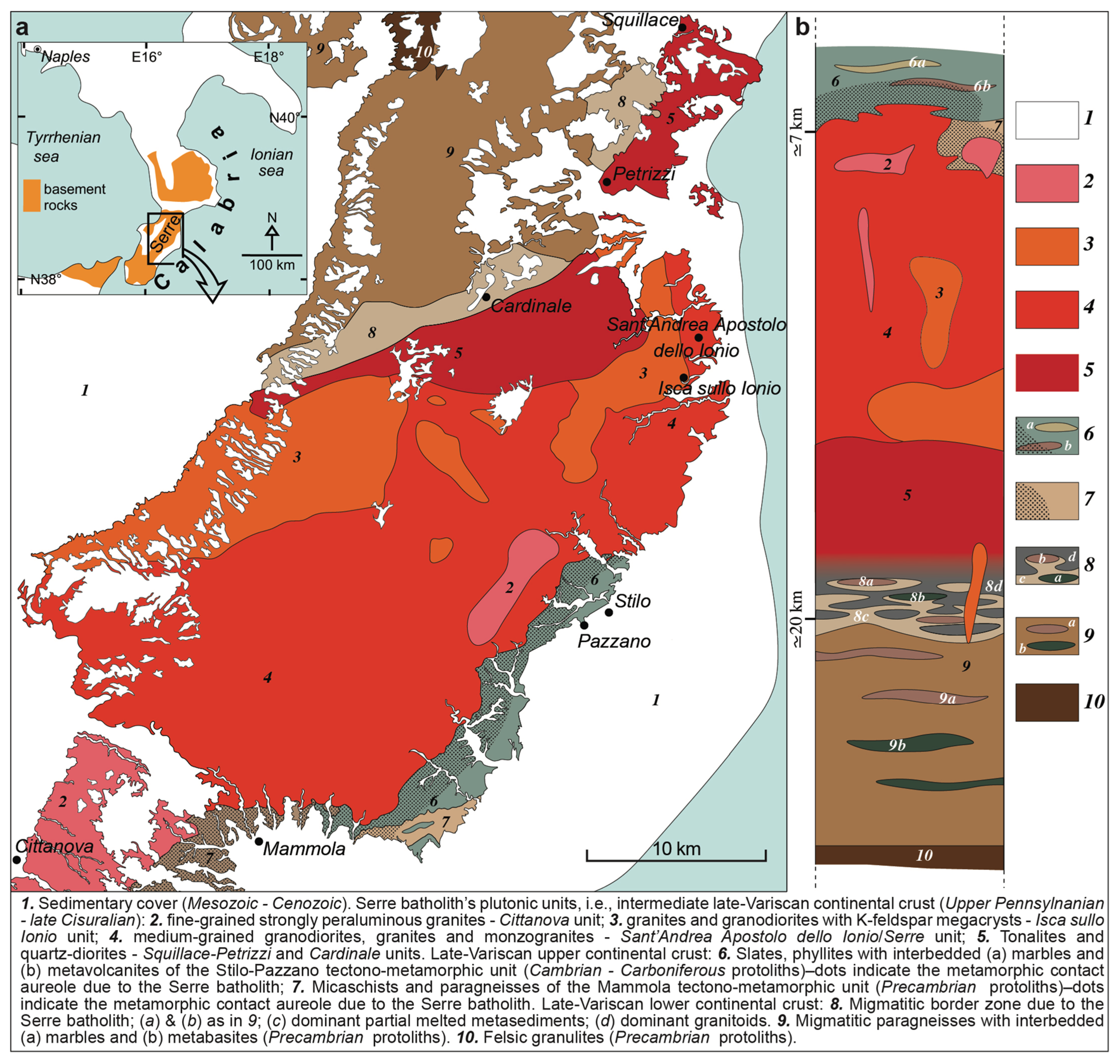

Whole-Rock Geochemical Dataset of Late Variscan Intrusive Rocks from the Serre Batholith (Calabria, Southern Italy)


Abstract
1. Summary

2. Data Description
3. Methods
Supplementary Materials
Author Contributions
Funding
Data Availability Statement
Acknowledgments
Conflicts of Interest
References
- Winter, J.D. Igneous Petrology; Pearson: Upper Saddle River, NJ, USA, 2010. [Google Scholar]
- De Vivo, B.; Ayuso, R.A.; Belkin, H.E.; Lima, A.; Messina, A.; Russo, S.; Viscardi, A. Whole-rock geochemistry and fluid inclusions as exploration tools for mineral deposits assessment in the Serre batholith, Calabria, southern Italy. Eur. J. Mineral. 1992, 4, 1035–1051. [Google Scholar] [CrossRef]
- Moresi, M.; Paglionico, A. Osservazioni geologiche, petrografiche e geochimiche sulle rocce granitoidi delle Serre orientali (Calabria). Boll. Soc. Geol. Ital. 1976, 95, 1855–1882. [Google Scholar]
- Crisci, G.M.; Maccarrone, E.; Rottura, A. Cittanova peraluminous granites (Calabria, Southern Italy). Mineral. Petrogr. Acta 1979, 23, 279–302. [Google Scholar]
- Crisci, G.M.; Paglionico, A.; Rottura, A. Tonalites from the Serre, CalabrianArc, southern Italy. Geological, petrological andgeochemical features. Neues Jahrb. Mineral. Abh. 1985, 153, 59–75. [Google Scholar]
- Del Moro, A.; Paglionico, A.; Piccarreta, G.; Rottura, A. Tectonic structure and evolution of the Serre, Calabrian Arc, southern Italy: Geological, petrological and radiometric evidence. Tectonophysics 1986, 124, 223–238. [Google Scholar] [CrossRef]
- Del Moro, A.; Fornelli, A.; Paglionico, A. K-feldspar megacryst granitic suite in the Serre (Southern Calabria—Italy). Period. Mineral. 1994, 63, 19–33. [Google Scholar]
- Rottura, A.; Bargossi, G.M.; Caironi, V.; Del Moro, A.; Maccarrone, E.; Macera, P.; Paglionico, A.; Petrini, R.; Piccarreta, G. Petrology, geochemistry and Sr, Nd isotopes of contrasting Hercynian granitoids from southern Calabrian Arc (southern Italy). Miner. Petrogr. Acta 1989, 23, 1–36. [Google Scholar]
- Rottura, A.; Bargossi, G.M.; Caironi, V.; Del Moro, A.; Maccarrone, E.; Macera, P.; Paglionico, A.; Petrini, R.; Piccarreta, G.; Poli, G. Petrogenesis of contrasting Hercynian granitoids from the Calabrian Arc, southern Italy. Lithos 1990, 24, 97–119. [Google Scholar] [CrossRef]
- Rottura, A.; Caggianelli, A.; Campana, R.; Del Moro, A. Petrogenesis of Hercynian peraluminous granites from the Calabrian Arc, Italy. Eur. J. Mineral. 1993, 5, 737–754. [Google Scholar] [CrossRef]
- Caggianelli, A.; Del Moro, A.; Paglionico, A.; Piccarreta, G.; Rottura, A. Lower crust granite genesis connected with chemical fractionation in the continental crust of Calabria (Southern Italy). Eur. J. Miner. 1991, 3, 159–180. [Google Scholar] [CrossRef]
- Fornelli, A. Structure and genesis of potassium feldspar megacrysts in the Satriano granitoids, eastern Serre, Calabria. Min. Petrogr. Acta 1991, 34, 95–103. [Google Scholar]
- Fornelli, A. Metamorphic xenoliths and microgranular enclaves in the Serre granodiorites (Southern Calabria-Italy): Their connection with granitoid genesis. Mineral. Petrol. 1994, 51, 49–65. [Google Scholar] [CrossRef]
- Fornelli, A.; Caggianelli, A.; Del Moro, A.; Bargossi, G.M.; Paglionico, A.; Piccarreta, G.; Rottura, A. Petrology and evolution of the central Serre granitoids (Southern Calabria-Italy). Period. Mineral. 1994, 63, 53–70. [Google Scholar]
- Fornelli, A.; Piccarreta, G.; Del Moro, A.; Acquafredda, P. Multi-stage Melting in the Lower Crust of the Serre (Southern Italy). J. Petrol. 2002, 43, 2191–2217. [Google Scholar] [CrossRef]
- Fornelli, A.; Piccarreta, G.; Acquafredda, P.; Micheletti, F.; Paglionico, A. Geochemical fractionation in migmatitic rocks from Serre Granulitic terrane (Calabria, southern Italy). Period. Mineral. 2004, 73, 145–157. [Google Scholar]
- Acquafredda, P.; Fornelli, A.; Micheletti, F.; Piccarreta, G. The abundance of 51 elements and petrovolumetric models of the Calabria crust: Curinga-Stilo area (site 6). In Scritti e Documenti; Accademia Nazionale delle Scienze detta dei XL: Roma, Italy, 2003; pp. 263–288. [Google Scholar]
- Romano, V.; Cirrincione, R.; Fiannacca, P.; Lustrino, M.; Tranchina, A. Late-Hercynian post-collisional dyke magmatism in central Calabria (Serre Massif, southern Italy). Period. Mineral. 2011, 80, 489–515. [Google Scholar]
- Fiannacca, P.; Cirrincione, R.; Bonanno, F.; Carciotto, M.M. Source-inherited compositional diversity in granite batholiths: The geochemical message of Late Paleozoic intrusive magmatism in central Calabria (southern Italy). Lithos 2015, 236–237, 123–140. [Google Scholar] [CrossRef]
- Fiannacca, P.; Lombardo, R.; Militello, G.M.; Cirrincione, R. Plagioclase microstructures and compositions as tracers of mixing processes inweakly to strongly peraluminous granodiorites and granites from the Serre Batholith (southern Italy). Rend. Online Soc. Geol. Ital. 2016, 38, 43–46. [Google Scholar]
- Fiannacca, P.; Williams, I.S.; Cirrincione, R. Timescales and mechanisms of batholith construction: Constraints from zircon oxygen isotopes and geochronology of the late Variscan Serre Batholith (Calabria, southern Italy). Lithos 2017, 277, 302–314. [Google Scholar] [CrossRef]
- Fiannacca, P.; Williams, I.S.; Cirrincione, R.; Pezzino, A. Poly-orogenic melting of metasedimentary crust from a granite geochemistry and inherited zircon perspective (southern Calabria-Peloritani orogen, Italy). Front. Earth Sci. 2019, 7, 119. [Google Scholar] [CrossRef]
- Fiannacca, P.; Basei, M.A.; Cirrincione, R.; Pezzino, A.; Russo, D. Water-assisted production of late-orogenic trondhjemites at magmatic and subsolidus conditions. Geol. Soc. Lond. Spec. Publ. 2020, 491, 147–178. [Google Scholar] [CrossRef]
- Biget, T.; Bruand, E.; Langone, A.; Boyet, M.; Caggianelli, A.; Bonnand, P. Tracing anatexis and bottom-up crustal homogenisation with in situ Sm-Nd isotopes. Geochem. Perspect. Lett. 2026, 38, 46–52. [Google Scholar] [CrossRef]
- Appelo, C.A.J.; Postma, D. Geochemistry, Groundwater and Pollution; Balkema: Rotterdam, The Netherlands, 2005. [Google Scholar]
- Festa, V.; Messina, A.; Paglionico, A.; Piccarreta, G.; Rottura, A. Pre-Triassic history recorded in the Calabria–Peloritani segment of the Alpine chain, southern Italy. An overview. Period. Mineral. 2004, 73, 57–71. [Google Scholar]
- Festa, V.; Di Battista, P.; Caggianelli, A.; Liotta, D. Exhumation and tilting of the late-Hercynian continental crust in the Serre Massif (Southern Calabria, Italy). Boll. Soc. Geol. Ital. 2003, 2, 79–88. [Google Scholar]
- Caggianelli, A.; Prosser, G.; Rottura, A. Thermal history vs. fabric anisotropy in granitoids emplaced at different crustal levels: An example from Calabria, Southern Italy. Terra Nova 2000, 12, 109–116. [Google Scholar] [CrossRef]
- Langone, A.; Caggianelli, A.; Festa, V.; Prosser, G. Time constraints on the building of the Serre Batholith: Consequences for the thermal evolution of the Hercynian continental crust exposed in Calabria (southern Italy). J. Geol. 2014, 122, 183–199. [Google Scholar] [CrossRef]
- Servizio Geologico d’Italia. Carta Geologica d’Italia Alla Scala 1:50.000, F. 580 Soverato; ISPRA: Roma, Italy, 2015. [Google Scholar]
- Servizio Geologico d’Italia. Carta Geologica d’Italia Alla Scala 1:50.000, F. 590 Taurianova; ISPRA: Roma, Italy, 2017. [Google Scholar]
- Del Moro, A.; Fornelli, A.; Piccarreta, G. Disequilibrium melting in granulite facies metasedimentary source of the northern Serre (Calabria–Southern Italy). Mineral. Petrol. 2000, 70, 89–104. [Google Scholar] [CrossRef]
- Festa, V.; Caggianelli, A.; Langone, A.; Prosser, G. Time–space relationships among structural and metamorphic aureoles related to granite emplacement: A case study from the Serre Massif (southern Italy). Geol. Mag. 2013, 150, 441–454. [Google Scholar] [CrossRef]
- Tursi, F.; Spiess, R.; Festa, V.; Fregola, R.A. Hercynian subduction-related processes within the metamorphic continental crust in Calabria (southern Italy). J. Metamorph. Geol. 2020, 38, 771–793. [Google Scholar] [CrossRef]
- Fornelli, A.; Festa, V.; Micheletti, F.; Spiess, R.; Tursi, F. Building an orogen: Review of U-Pb zircon ages from the Calabria–Peloritani terrane to constrain the timing of the southern Variscan belt. Minerals 2020, 10, 944. [Google Scholar] [CrossRef]
- Fregola, R.A.; Ciccolella, A.; Festa, V.; Ruggieri, G.; Schingaro, E.; Tursi, F.; Ventruti, G. Review of Polymetallic Mineralization in the Sila and Serre Massifs (Calabria, Southern Italy). Minerals 2023, 13, 439. [Google Scholar] [CrossRef]
- Leoni, L.; Saitta, M. X-ray fluorescence analysis of 29 trace elements in rock and mineral standards. Rend. Soc. Ital. Di Mineral. Petrol. 1976, 32, 497–510. [Google Scholar]
- Leoni, L.; Saitta, M. Determination of yttrium and niobium on standard silicate rocks by X-ray fluorescence analyses. X-Ray Spectrom. 1976, 5, 29–30. [Google Scholar] [CrossRef]
- Fornelli, A.; Micheletti, F.; Tursi, F.; Festa, V. Whole-Rock Geochemical Dataset of Late Variscan Intrusive Rocks from the Serre Batholith (Calabria, Southern Italy). Preprints 2026, 2026042200. [Google Scholar] [CrossRef]

| Sample | Main Lithological Features | Metamorphic (m.) or Plutonic (p.) Unit | Longitude | Latitude |
|---|---|---|---|---|
| LFC1A | migmatite leucosome concordant with metapelite host | migmatitic paragneisses m. unit | 16°17′56.09″ E | 38°50′43.91″ N |
| LFC5 | migmatite leucosome concordant with metapelite host | migmatitic paragneisses m. unit | 16°18′20.83″ E | 38°48′15.56″ N |
| LFC7 | migmatite leucosome concordant with metapelite host | migmatitic paragneisses m. unit | 16°17′22.13″ E | 38°43′18.11″ N |
| KIS15 | migmatite leucosome concordant with metapelite host | migmatitic paragneisses m. unit | 16° 5′4.91″ E | 38°41′23.13″ N |
| Kis 8a | migmatite leucosome concordant with metapelite host | migmatitic paragneisses m. unit | 16°23′43″ E | 38°46′15″ N |
| Kis 11a | migmatite leucosome concordant with metapelite host | migmatitic paragneisses m. unit | 16°27′35.00″ E | 38°50′31.00″ N |
| Kis16 | migmatite leucosome concordant with metapelite host | migmatitic paragneisses m. unit | 16° 5′21.83″ E | 38°41′29.54″ N |
| LFC8 | migmatite leucosome concordant with metapelite host | migmatitic paragneisses m. unit | 16°27′35.00″ E | 38°50′31.00″ N |
| MFS9 | migmatite leucosome concordant with metapelite host | migmatitic paragneisses m. unit | 16°17′41.58″ E | 38°43′22.87″ N |
| MFS10 | migmatite leucosome concordant with metapelite host | migmatitic paragneisses m. unit | 16°17′30.85″ E | 38°42′53.88″ N |
| MFS11 | migmatite leucosome concordant with metapelite host | migmatitic paragneisses m. unit | 16°17′32.98″ E | 38°41′14.08″ N |
| MFS12 | migmatite leucosome concordant with metapelite host | migmatitic paragneisses m. unit | 16°17′32.98″ E | 38°41′14.08″ N |
| MFS13 | migmatite leucosome concordant with metapelite host | migmatitic paragneisses m. unit | 16°22′49.09″ E | 38°42′52.76″ N |
| LFC13I | migmatite leucosome concordant with metagreywake host | migmatitic paragneisses m. unit | 16°17′45.74″ E | 38°50′41.09″ N |
| LFC12 | migmatite leucosome concordant with metagreywake host | migmatitic paragneisses m. unit | 16°17′45.62″ E | 38°50′42.34″ N |
| KIS18 | migmatite leucosome discordant with metapelite host | migmatitic paragneisses m. unit | 16° 5′52.00″ E | 38°41′25.00″ N |
| Kis17 | migmatite leucosome discordant with metapelite host | migmatitic paragneisses m. unit | 16° 5′21.83″ E | 38°41′29.54″ N |
| LFC4 | migmatite leucosome discordant with metagreywake host | migmatitic paragneisses m. unit | 16°17′56.97″ E | 38°50′53.58″ N |
| LFC11B | migmatite leucosome discordant with metagreywake host | migmatitic paragneisses m. unit | 16°17′56.02″ E | 38°50′42.34″ N |
| LFC6 | migmatite leucosome discordant with metagreywake host | migmatitic paragneisses m. unit | 16°17′19.96″ E | 38°45′29.86″ N |
| LFC1O | migmatite leucosome discordant with metagreywake host | migmatitic paragneisses m. unit | 16°26′2.00″ E | 38°48′33.00″ N |
| SCA1 | biotite-amphibole bearing granitoids | Sant’Andrea Apostolo dello Ionio/Serre p. unit | 16°31′0.09″ E | 38°33′12.38″ N |
| SCA2 | biotite-amphibole bearing granitoids | Sant’Andrea Apostolo dello Ionio/Serre p. unit | 16°31′15.86″ E | 38°33′11.38″ N |
| SCA3 | biotite-amphibole bearing granitoids | Sant’Andrea Apostolo dello Ionio/Serre p. unit | 16°30′49.4″ E | 38°33′19″ N |
| SCA4 | biotite-amphibole bearing granitoids | Sant’Andrea Apostolo dello Ionio/Serre p. unit | 16°32′29.28″ E | 38°34′29.91″ N |
| SCA5 | biotite-amphibole bearing granitoids | Sant’Andrea Apostolo dello Ionio/Serre p. unit | 16°30′45.47″ E | 38°33′14.70″ N |
| SCA6 | biotite-amphibole bearing granitoids | Sant’Andrea Apostolo dello Ionio/Serre p. unit | 16°29′41.19″ E | 38°32′2.52″ N |
| SCA7 | biotite-amphibole bearing granitoids | Sant’Andrea Apostolo dello Ionio/Serre p. unit | 16°30′54.11″ E | 38°32′57.24″ N |
| SCA8 | biotite-amphibole bearing granitoids | Sant’Andrea Apostolo dello Ionio/Serre p. unit | 16°30′53.51″ E | 38°32′6.77″ N |
| SCA9 | biotite-amphibole bearing granitoids | Sant’Andrea Apostolo dello Ionio/Serre p. unit | 16°28′51.80″ E | 38°32′17.86″ N |
| SCA10 | biotite-amphibole bearing granitoids | Sant’Andrea Apostolo dello Ionio/Serre p. unit | 16°30′47.60″ E | 38°32′15.80″ N |
| SCA11 | biotite-amphibole bearing granitoids | Sant’Andrea Apostolo dello Ionio/Serre p. unit | 16°30′22.4″ E | 38°32′36″ N |
| SCA12 | biotite-amphibole bearing granitoids | Sant’Andrea Apostolo dello Ionio/Serre p. unit | 16°30′29.83″ E | 38°32′29.16″ N |
| SCA13 | biotite-amphibole bearing granitoids | Sant’Andrea Apostolo dello Ionio/Serre p. unit | 16°32′15.86″ E | 38°34′15.87″ N |
| SCA14 | biotite-amphibole bearing granitoids | Sant’Andrea Apostolo dello Ionio/Serre p. unit | 16°31′12.27″ E | 38°33′38.24″ N |
| SCA15 | biotite-amphibole bearing granitoids | Sant’Andrea Apostolo dello Ionio/Serre p. unit | 16°30′38.85″ E | 38°32′36.72″ N |
| SCA9 | biotite-muscovite bearing granitoids | Sant’Andrea Apostolo dello Ionio/Serre p. unit | 16°31′34.4″ E | 38°34′32″ N |
| SCA9a | biotite-muscovite bearing granitoids | Sant’Andrea Apostolo dello Ionio/Serre p. unit | 16°31′34.4″ E | 38°34′32″ N |
| SCA15 | biotite-muscovite bearing granitoids | Sant’Andrea Apostolo dello Ionio/Serre p. unit | 16°32′34.13″ E | 38°37′6.55″ N |
| SCA24 | biotite-muscovite bearing granitoids | Sant’Andrea Apostolo dello Ionio/Serre p. unit | 16°32′34.11″ E | 38°36′20.64″ N |
| SCA46 | biotite-muscovite bearing granitoids | Sant’Andrea Apostolo dello Ionio/Serre p. unit | 16°30′44.10″ E | 38°33′14.98″ N |
| SCA47 | biotite-muscovite bearing granitoids | Sant’Andrea Apostolo dello Ionio/Serre p. unit | 16°30′13.57″ E | 38°33′9.19″ N |
| SCA49 | biotite-muscovite bearing granitoids | Sant’Andrea Apostolo dello Ionio/Serre p. unit | 16°30′3.89″ E | 38°32′55.70″ N |
| SCA51 | biotite-muscovite bearing granitoids | Sant’Andrea Apostolo dello Ionio/Serre p. unit | 16°30′5.73″ E | 38°33′1.49″ N |
| SCA56 | biotite-muscovite bearing granitoids | Sant’Andrea Apostolo dello Ionio/Serre p. unit | 16°31′0.54″ E | 38°34′02″ N |
| ccar67 | biotite-muscovite bearing granitoids | Sant’Andrea Apostolo dello Ionio/Serre p. unit | 16°32′19.39″ E | 38°37′20.10″ N |
| SCA27 | K-feldspar megacrysts granitoids | Isca sullo Ionio p. unit | 16°29′25.74″ E | 38°40′24.11″ N |
| SCA28 | K-feldspar megacrysts granitoids | Isca sullo Ionio p. unit | 16°29′25.74″ E | 38°40′24.11″ N |
| SCA30 | K-feldspar megacrysts granitoids | Isca sullo Ionio p. unit | 16°29′25.74″ E | 38°40′24.11″ N |
| SCA31 | K-feldspar megacrysts granitoids | Isca sullo Ionio p. unit | 16°29′25.74″ E | 38°40′24.11″ N |
| SCA94 | K-feldspar megacrysts granitoids | Sant’Andrea Apostolo dello Ionio/Serre p. unit | 16°32′51.89″ E | 38°35′28.72″ N |
| SCA95 | K-feldspar megacrysts granitoids | Sant’Andrea Apostolo dello Ionio/Serre p. unit | 16°32′41.4″ E | 38°35′21″ N |
| SCA96 | K-feldspar megacrysts granitoids | Sant’Andrea Apostolo dello Ionio/Serre p. unit | 16°32′51.89″ E | 38°35′28.72″ N |
| SCA97 | K-feldspar megacrysts granitoids | Sant’Andrea Apostolo dello Ionio/Serre p. unit | 16°32′44.4″ E | 38°35′22″ N |
| SCA98 | K-feldspar megacrysts granitoids | Sant’Andrea Apostolo dello Ionio/Serre p. unit | 16°32′49.4″ E | 38°35′23″ N |
| SCA99 | K-feldspar megacrysts granitoids | Sant’Andrea Apostolo dello Ionio/Serre p. unit | 16°32′51.89″ E | 38°35′28.72″ N |
| SCA100 | K-feldspar megacrysts granitoids | Sant’Andrea Apostolo dello Ionio/Serre p. unit | 16°32′51.89″ E | 38°35′28.72″ N |
| SCA101 | K-feldspar megacrysts granitoids | Sant’Andrea Apostolo dello Ionio/Serre p. unit | 16°32′51.89″ E | 38°35′28.72″ N |
| SCA102 | K-feldspar megacrysts granitoids | Sant’Andrea Apostolo dello Ionio/Serre p. unit | 16°32′51.89″ E | 38°35′28.72″ N |
| SCA104 | K-feldspar megacrysts granitoids | Isca sullo Ionio p. unit | 16°29′28.4″ E | 38°40′24″ N |
| SCA105 | K-feldspar megacrysts granitoids | Isca sullo Ionio p. unit | 16°29′28.4″ E | 38°40′24″ N |
| GO66 | peraluminous microgranites | Cittanova p. unit | 16° 7′11.60″ E | 38°20′19.79″ N |
| GO67 | peraluminous microgranites | Cittanova p. unit | 16° 7′18.47″ E | 38°20′27.23″ N |
| GO68 | peraluminous microgranites | Cittanova p. unit | 16° 5′21.03″ E | 38°20′46.61″ N |
| GO69 | peraluminous microgranites | Cittanova p. unit | 16° 5′28.94″ E | 38°20′43.56″ N |
| GO70 | peraluminous microgranites | Cittanova p. unit | 16° 5′28.94″ E | 38°20′43.56″ N |
| SCA50 | peraluminous microgranites | Sant’Andrea Apostolo dello Ionio/Serre p. unit | 16°30′4.61″ E | 38°32′58.77″ N |
| SCA71 | peraluminous microgranites | Sant’Andrea Apostolo dello Ionio/Serre p. unit | 16°28′53.64″ E | 38°32′15.77″ N |
| SCA73 | peraluminous microgranites | Sant’Andrea Apostolo dello Ionio/Serre p. unit | 16°28′52.98″ E | 38°32′20.76″ N |
| SCA62 | peraluminous microgranites | Sant’Andrea Apostolo dello Ionio/Serre p. unit | 16°30′56.93″ E | 38°32′4.70″ N |
| SCA5a | hypabyssal rocks | Sant’Andrea Apostolo dello Ionio/Serre p. unit | 16°30′37.76″ E | 38°32′35.52″ N |
| SCA6 | hypabyssal rocks | Sant’Andrea Apostolo dello Ionio/Serre p. unit | 16°30′40.43″ E | 38°32′35.81″ N |
| SCA60 | hypabyssal rocks | Sant’Andrea Apostolo dello Ionio/Serre p. unit | 16°30′30.45″ E | 38°32′30.72″ N |
| SCA63 | hypabyssal rocks | Sant’Andrea Apostolo dello Ionio/Serre p. unit | 16°29′48.21″ E | 38°32′6.25″ N |
Disclaimer/Publisher’s Note: The statements, opinions and data contained in all publications are solely those of the individual author(s) and contributor(s) and not of MDPI and/or the editor(s). MDPI and/or the editor(s) disclaim responsibility for any injury to people or property resulting from any ideas, methods, instructions or products referred to in the content. |
© 2026 by the authors. Licensee MDPI, Basel, Switzerland. This article is an open access article distributed under the terms and conditions of the Creative Commons Attribution (CC BY) license.
Share and Cite
Fornelli, A.; Micheletti, F.; Tursi, F.; Festa, V. Whole-Rock Geochemical Dataset of Late Variscan Intrusive Rocks from the Serre Batholith (Calabria, Southern Italy). Data 2026, 11, 130. https://doi.org/10.3390/data11060130
Fornelli A, Micheletti F, Tursi F, Festa V. Whole-Rock Geochemical Dataset of Late Variscan Intrusive Rocks from the Serre Batholith (Calabria, Southern Italy). Data. 2026; 11(6):130. https://doi.org/10.3390/data11060130
Chicago/Turabian StyleFornelli, Annamaria, Francesca Micheletti, Fabrizio Tursi, and Vincenzo Festa. 2026. "Whole-Rock Geochemical Dataset of Late Variscan Intrusive Rocks from the Serre Batholith (Calabria, Southern Italy)" Data 11, no. 6: 130. https://doi.org/10.3390/data11060130
APA StyleFornelli, A., Micheletti, F., Tursi, F., & Festa, V. (2026). Whole-Rock Geochemical Dataset of Late Variscan Intrusive Rocks from the Serre Batholith (Calabria, Southern Italy). Data, 11(6), 130. https://doi.org/10.3390/data11060130