
OntoNanoMat: A Semantic Dataset and Ontology for Green-Synthesized Nanomaterials in Environmental Remediation

 , and
, and
Abstract
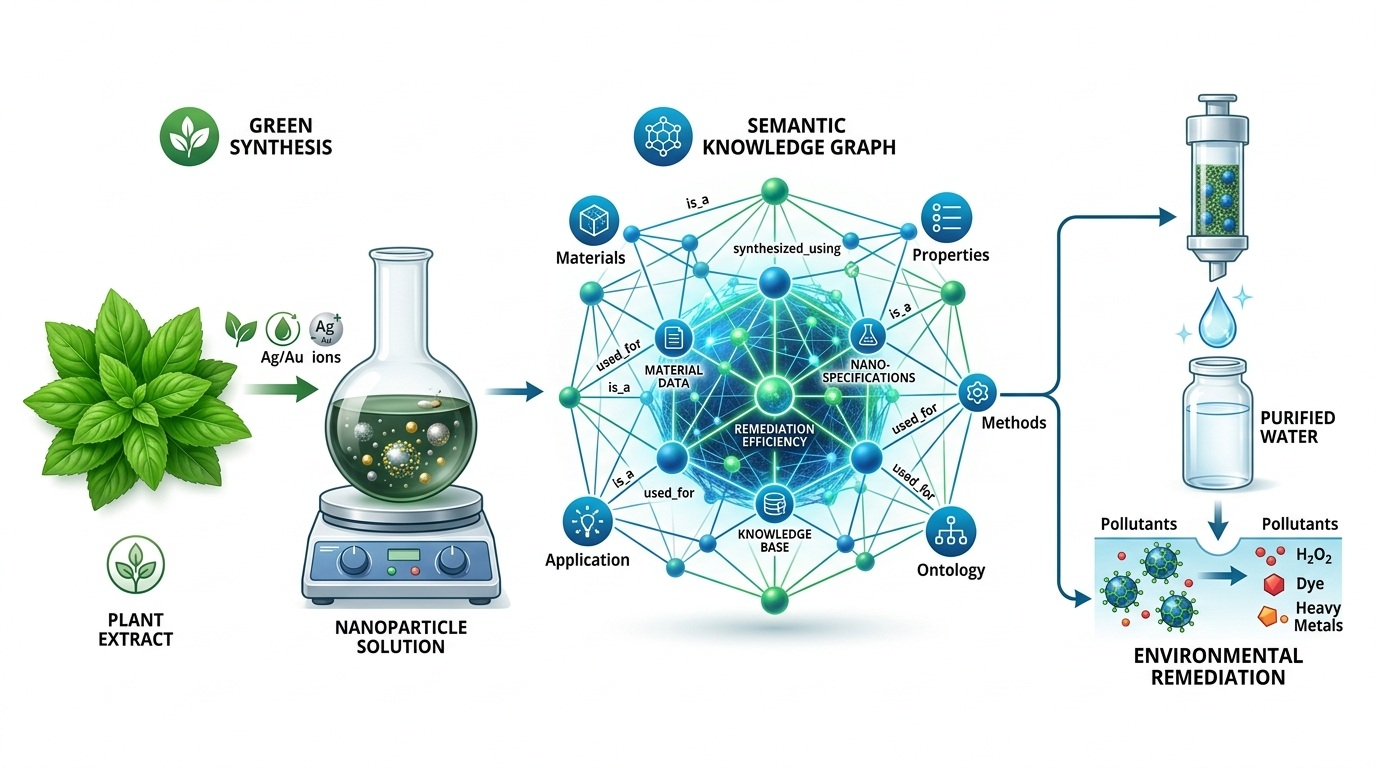
1. Summary
2. Data Description
2.1. Dataset Files and Formats
- dataset_case_studies.csv: A UTF-8 encoded tabular file containing the primary data for statistical analysis.
- dataset_case_studies.json: A machine-readable JSON array, ideal for integration into web platforms or NoSQL databases.
- dataset_case_studies.ttl: An RDF serialization in Turtle format. This file links the data instances to the classes and properties defined in the green_nanomaterials_ontology.ttl file.
2.2. Tabular Data Structure
2.3. Semantic Mapping and Interpretation
- Logic Links: The synthesis descriptors are mapped to the gsn:SustainabilityProfile class, while performance metrics are linked to gsn:PerformanceIndicator.
- Units: All numerical values follow standard units: Temperature in Kelvin (K), concentration in g/L, and adsorption capacity in mg/g, as defined by the ontology’s datatype properties.
2.4. Ontology Metrics and Complexity
2.5. Validation Resource
3. Methods
3.1. Literature Search Strategy and Data Acquisition
3.2. Inclusion and Exclusion Criteria
- Inclusion: (1) Peer-reviewed articles; (2) Full reporting of synthesis precursors and conditions; (3) Quantitative performance data (removal efficiency or $q_{max}$); (4) Characterization data (size, surface area, or zeta potential).
- Exclusion: (1) Review papers or conference abstracts; (2) Studies lacking precise chemical dosage or pH values; (3) Proprietary materials with non-disclosed synthesis routes.
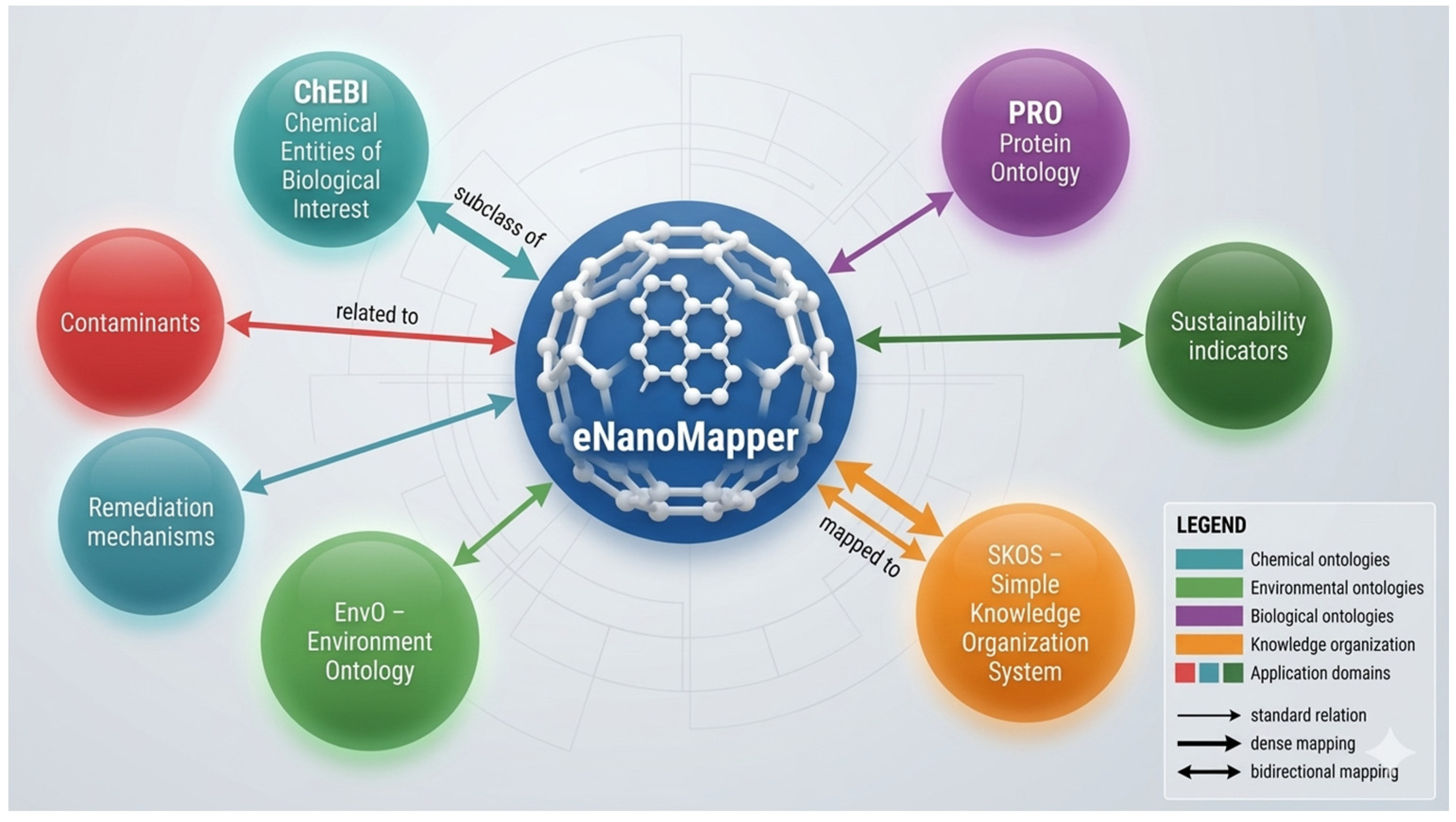
3.3. Ontology Alignment
3.4. Data Acquisition and Curation
- Synthesis parameters: Solvent type, precursors, and energy indicators.
- Experimental conditions: pH, temperature, and dosage.
- Performance metrics: Removal efficiency and adsorption capacity (qmax).
3.5. Ontology Development
- Modularity: The ontology was organized into five core modules (Material, Synthesis, Process, Performance, and Provenance) to allow for independent updates.
- Reusability: Where possible, classes and properties were aligned with existing vocabularies such as PROV-O for provenance and CHEO or ENM for chemical entities.
- Axiomatization: Logical restrictions (SubClassOf and EquivalentTo) were implemented to enable automatic classification of “green-synthesized” materials based on their sustainability profiles.
3.6. Data Transformation and RDFization
- Tabular Structuring: The curated data was first organized into a master CSV file.
- Semantic Mapping: Using a custom Python-based (v. 3.9.12) mapping script, each CSV row was transformed into an RDF individual (instance).
- Serialization: The data was exported into JSON for web accessibility and Turtle (.ttl) for semantic reasoning. The Turtle version explicitly uses the gsn: namespace defined in the ontology to ensure that the instances are logically bound to their semantic definitions.
3.7. Technical Validation Setup
4. Technical Validation
4.1. Structural Integrity and SHACL Validation
4.2. Logical Consistency and Reasoning
4.3. High-Fidelity Data Validation (Y-Scrambling)
4.4. Semantic Validation (SHACL)
- Each Nanomaterial entry is linked to at least one RemediationMechanism.
- Quantitative indicators (like removal_efficiency_percent) are restricted to numerical ranges (0–100).
- Mandatory provenance metadata (DOI and year) is present for every record.
4.5. Competency Question Testing
5. Usage Notes (Or User Notes)
5.1. Software Environment
5.2. Data Access Example
|
5.3. Accessing and Exploring the Data
- For Nanotechnologists: The dataset_case_studies.csv file can be opened in any spreadsheet software (Excel, Google Sheets) or R/Python environments for quick benchmarking.
- For Knowledge Engineers: The .ttl file should be loaded into Protégé or a triplestore like Apache Jena Fuseki or GraphDB. Users can then execute the provided SPARQL queries to filter materials by specific green chemistry or performance criteria.
5.4. Integration and Extensibility
5.5. Software Requirements
- Protégé (v5.5 or higher) is recommended for ontology visualization.
- Python (rdflib library) is suggested for those wishing to programmatically integrate this dataset into machine learning pipelines or larger Knowledge Graphs.
6. Conclusions and Future Work
Future Work Will Focus on Three Key Strategic Areas
- Scaling and Community Curation: We aim to expand the dataset from the current illustrative cases to a large-scale curated repository by implementing a community-driven ingestion pipeline, allowing researchers to submit biogenic synthesis data directly into the OntoNanoMat schema.
- Ontological Benchmarking: As suggested during the peer-review process, future iterations will include a formal comparative analysis and benchmarking against other emerging nanomaterial ontologies. This will further refine the mapping with eNanoMapper and NanoCommons, ensuring deeper cross-domain harmony.
- Machine Learning Integration: Leveraging the high-fidelity nature of the semantically annotated data, we plan to develop hybrid models that combine semantic reasoning with deep learning to predict the remediation efficiency of new green-synthesis routes, accelerating the discovery of sustainable environmental technologies.
Supplementary Materials
Author Contributions
Funding
Institutional Review Board Statement
Informed Consent Statement
Data Availability Statement
Acknowledgments
Conflicts of Interest
Abbreviations
| CSV | Comma-Separated Values |
| DL | Description Logic |
| DOI | Digital Object Identifier |
| FAIR | Findable, Accessible, Interoperable, and Reusable |
| GSN | Green-Synthesized Nanomaterial |
| IRI | Internationalized Resource Identifier |
| JSON | JavaScript Object Notation |
| OWL | Web Ontology Language |
| RDF | Resource Description Framework |
| SHACL | Shapes Constraint Language |
| SPARQL | SPARQL Protocol and RDF Query Language |
| TTL | Terse RDF Triple Language (Turtle) |
| W3C | World Wide Web Consortium |
References
- Recio-Colmenares, C.L.; Recio-Colmenares, R.B.; Castillo-Barrera, F.E.; Garcia-Garcia, C.A. An Ontology-Based Framework for Semantic Integration and Interoperable Assessment of Green-Synthesized Nanomaterials for Environmental Remediation. Appl. Sci. 2026, 16, 1539. [Google Scholar] [CrossRef]
- Arshadi, M.; Mehravar, M.; Amiri, M.J.; Faraji, A.R. Synthesis and adsorption characteristics of an heterogenized manganese nanoadsorbent towards methyl orange. J. Colloid Interface Sci. 2015, 440, 189–197. [Google Scholar] [CrossRef] [PubMed]
- Schweizer, C.; Thomas, A.; Janka-Ramm, M. Digitalizing Material Knowledge: A Practical Framework for Ontology-Driven Knowledge Graphs in Process Chains. Appl. Sci. 2024, 14, 11683. [Google Scholar] [CrossRef]
- Labra-Gayo, J.E.; Iglesias-Préstamo, Á.; Martín-Fernández, D.; Arnaud, M.A. rudof: A Rust Library for handling RDF data models and Shapes. CEUR Workshop Proc. 2024, 3828, 32. [Google Scholar]
- Wilkinson, M.D.; Dumontier, M.; Aalbersberg, I.J.; Appleton, G.; Axton, M.; Baak, A.; Blomberg, N.; Boiten, J.W.; da Silva Santos, L.B.; Bourne, P.E.; et al. The FAIR Guiding Principles for scientific data management and stewardship. Sci. Data 2016, 3, 160018. [Google Scholar] [CrossRef] [PubMed]
- Recio-Colmenares, C.L.; Recio-Colmenares, R.B.; Castillo-Barrera, F.E.; Garcia-Garcia, C.A. OntoNanoMat: A Semantic Dataset and Ontology for Green-Synthesized Nanomaterials (Version 1.1). Zenodo 2025. [Dataset]. Available online: https://zenodo.org/records/18201276 (accessed on 26 January 2026).


| Module | Attribute Group | Parameter Name (CSV Header) | Data Type | Example/Unit |
|---|---|---|---|---|
| I. Identification | Identity | case_id, nanomaterial_id, nanomaterial_name | String | CS1, MB_Adsorbent |
| Taxonomy | nanomaterial_type, dataset_identifier | Categorical | Magnetic nanocomposite | |
| II. Synthesis | Biogenic Process | green_synthesized, synthesis_route, precursor_type | Boolean/Str | True, Plant extract |
| Sustainability | solvent_type, solvent_greenness, renewable_precursor | String/Bool | Aqueous, Low-toxicity | |
| III. Mechanism | Physical Properties | surface_area_m2_per_g, zeta_potential_mV, band_gap_eV | Float | m2/g, mV, eV |
| Conditions | pH, temperature_K, contact_time_min | Float | 7.0, 298.0, 120.0 | |
| Photochemistry | irradiance_W_per_m2, wavelength_nm | Float | W/m2, nm | |
| IV. Performance | Efficiency | removal_efficiency_percent, qmax_mg_per_g, rate_constant | Float | %, mg/g, min−1 |
| Stability | cycles, recyclability_comment, energy_demand_index | Int/String | 5, Material reused | |
| V. Provenance | Citation | provenance_publication_title, provenance_publication_doi | String | DOI URL |
| Metadata | provenance_publication_year, notes | Integer/Str | 2020, Illustrative case |
| Metric Type | Ontology Element | Count |
|---|---|---|
| Axioms | Total number of axioms | 462 |
| Logical axiom count | 288 | |
| Declaration axioms | 165 | |
| Entities | Class count | 86 |
| Object property count | 41 | |
| Data property count | 38 | |
| Individual count (Proof-of-concept) | 2 | |
| Reasoning | Description Logic (DL) Expressivity | ALCRIF(D) |
| Database | Full Search String | Results (Records Retrieved) |
|---|---|---|
| Scopus/Web of Science | (“green synthesis” OR “biogenic synthesis”) AND (“nanomaterials” OR “nanoparticles”) AND (“environmental remediation” OR “dye removal” OR “heavy metal removal”) | 1842 |
| Google Scholar | allintitle: “green synthesis” nanomaterials remediation | 320 |
| Total Identified | 2162 | |
Disclaimer/Publisher’s Note: The statements, opinions and data contained in all publications are solely those of the individual author(s) and contributor(s) and not of MDPI and/or the editor(s). MDPI and/or the editor(s) disclaim responsibility for any injury to people or property resulting from any ideas, methods, instructions or products referred to in the content. |
© 2026 by the authors. Licensee MDPI, Basel, Switzerland. This article is an open access article distributed under the terms and conditions of the Creative Commons Attribution (CC BY) license.
Share and Cite
Recio-Colmenares, C.L.; Recio-Colmenares, R.B.; Castillo-Barrera, F.E.; Garcia-Garcia, C.A. OntoNanoMat: A Semantic Dataset and Ontology for Green-Synthesized Nanomaterials in Environmental Remediation. Data 2026, 11, 71. https://doi.org/10.3390/data11040071
Recio-Colmenares CL, Recio-Colmenares RB, Castillo-Barrera FE, Garcia-Garcia CA. OntoNanoMat: A Semantic Dataset and Ontology for Green-Synthesized Nanomaterials in Environmental Remediation. Data. 2026; 11(4):71. https://doi.org/10.3390/data11040071
Chicago/Turabian StyleRecio-Colmenares, Carolina L., Roxana B. Recio-Colmenares, F. E. Castillo-Barrera, and Cesar A. Garcia-Garcia. 2026. "OntoNanoMat: A Semantic Dataset and Ontology for Green-Synthesized Nanomaterials in Environmental Remediation" Data 11, no. 4: 71. https://doi.org/10.3390/data11040071
APA StyleRecio-Colmenares, C. L., Recio-Colmenares, R. B., Castillo-Barrera, F. E., & Garcia-Garcia, C. A. (2026). OntoNanoMat: A Semantic Dataset and Ontology for Green-Synthesized Nanomaterials in Environmental Remediation. Data, 11(4), 71. https://doi.org/10.3390/data11040071